Thomas Lanyon – Pewterer of Bristol

Researching a family often necessitates many hours trawling through online resources for any mention of the family surname. A trawl through the Somerset Heritage Centre online index produced the deeds for a farm and lands at St Decumans and the name Thomas Lanyon.

The record starts on 13 Aug 1601. ‘Thomas Fulford of Fulford, Devon, Esq. enfeoffed to John Hooper of Ould Cleve, yeoman, a messuage known as Hooper’s Tenement and ten acres of land, part of the manor of Williton Fulford’ The deeds show the various tenants over the years. In 1715/6 John Leach of Bristol, ‘powterer’ and Sarah his wife (daughter and heir of Robert Mawdsley of Bristol, mariner and brother of Richard Mawdsley of Williton mortgaged the property to Arthur Thomas of Bristol, ‘powterer’. On 1 Jul 1718 John Leach mortgaged the property , by lease and release, to Abraham Lloyd, merchant, John Andrews, merchant, Richard Stafford, merchant and Samuel Cox, soapboiler, all of Bristol.

On 13 Mar 1718/19 John Rowe Esq and Martin Innys and Milborn Taylor, gents, all of Bristol , assigned the property to Daniel Woolmer, haberdasher, Thomas Lanyon, pewterer and George Bridges the younger, distiller, all of Bristol and John Roberts of Bedminster, cotton weaver (all creditors of John Leach, who was now bankrupt.)

So who was Thomas Lanyon and where does he fit on the tree?

Thomas was working as a pewterer (a tinsmith) from around 1715 and is last mentioned in 1755.
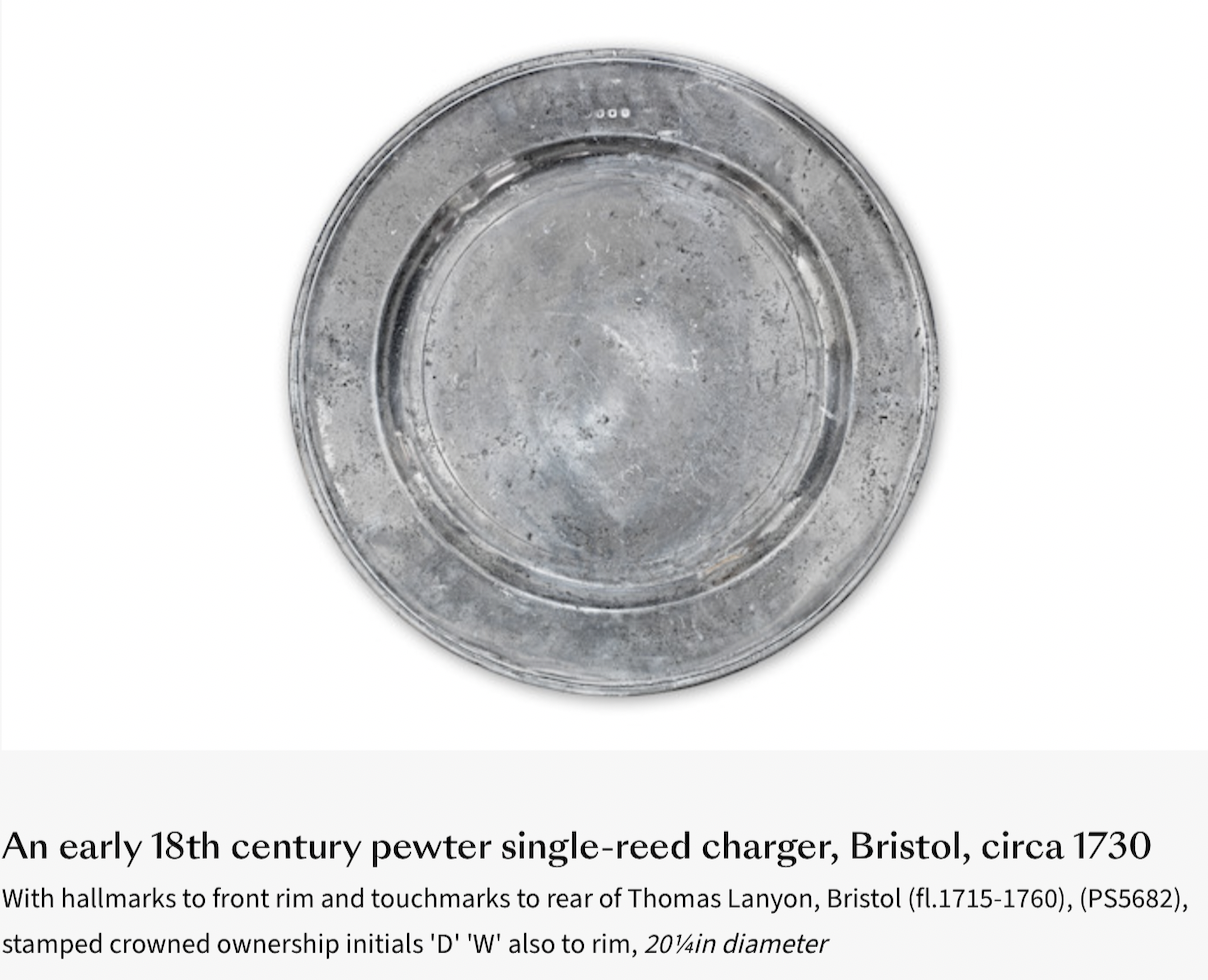
In 2021 this charger made by Thomas sold for £318.

Thomas was apprenticed to John Batcheler of Bristol on 2 Feb 1707 and is free by 9 Apr 1715. He’s mentioned in the Poll Books of 1721 and 1739 as of St Nicholas Bristol, the last mention of him in is 1755.
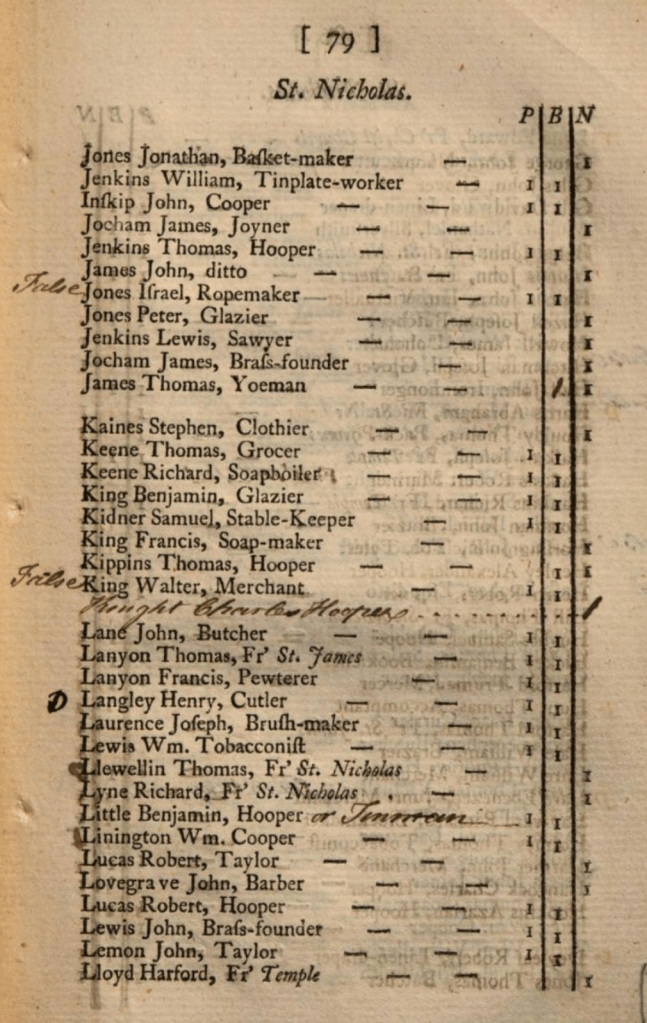
Poll Book 1754 mentions father and son.

We know Thomas Lanyon married someone called Anne before 1725 but I can’t find a record of the marriage anywhere in England. Her name is mentioned alongside Thomas’ apprentices.

They had at least one son, Francis Lanyon, who was baptised on 29 Aug 1725 at St Nicholas, Bristol. He was also working as a pewterer on 26 Jun 1747. In the 1754 Poll Book he is listed as of St Nicholas in Bristol.
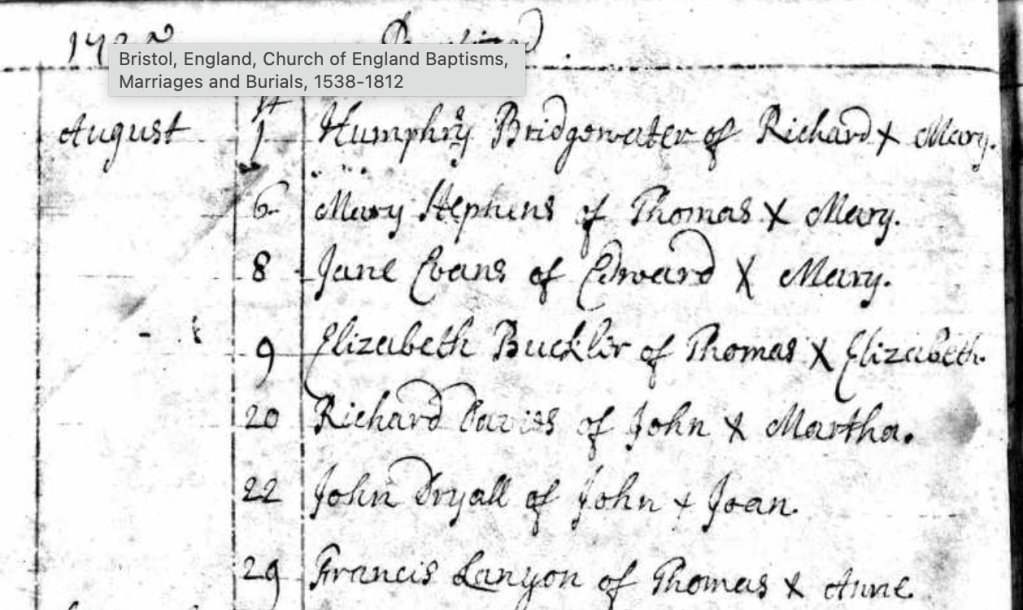
Baptism of Francis Lanyon – St Nicholas Bristol

Thomas had at least two apprentices; Thomas Page who was indentured to Lanyon between 1729 and 1737 and Robert Bush who was indentured at a cost of £50 between the years 1748 and 1755. In 1765 he was based in the High Street in Bristol.

To give you an idea of the size of Lanyon’s business, in the 1740s he exported 1148lbs of pewter in one year. The book ‘Old Pewter, its Makers and Marks’ described Thomas Lanyon as being from Bristol and Coventry but I can’t find any records placing him in Coventry.
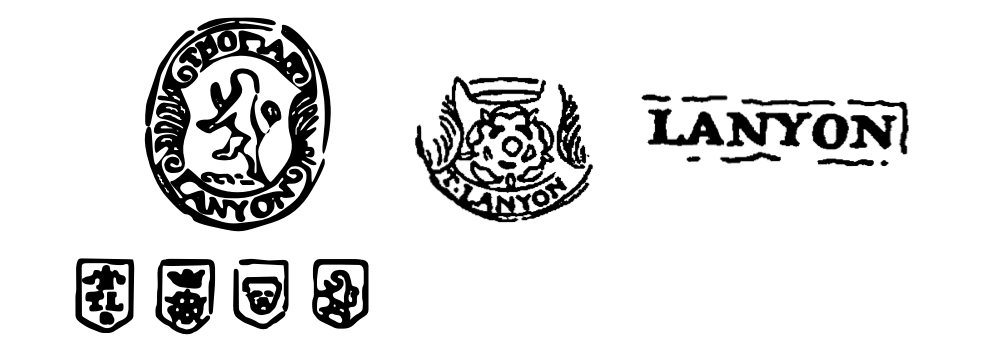
Lanyon’s Pewter Marks

The same book mentions a Thomas Lanyon of Coventry in 1774. This could be a son or even a grandson but I can find no trace of a baptism, marriage or burial.

A trawl through St Nicholas, Bristol’s parish registers reveals two baptisms which may be relevant: William & Anne Lanyen, twin children of Eli and Anne Lanyen, baptised on 3 Dec 1723 and three days later, William Lanyen and Anne Lanyen both buried 6 Dec 1723. Who was Eli Lanyen and was he any relation to Thomas Lanyon?

Sadly the records do not give us any answers. We don’t know if Eli was related to him or if it was just a coincidence that two men called Lanyon/Lanyen had wives both called Anne and were baptising children at the same time in the same area.

To complicate things even further there is a marriage of an Ann Lanyon/Lanion to a William Wayne/Wain at St Nicholas Bristol on 10 Sep 1758. They had a daughter Anna Maria Wayne. William Wayne was a metallurgist who went to Cornwall with his daughter, presumably after his wife died, to teach the Cornish metallurgy (Jane Veale Mitchell research). Both William and Anna feature in several Lanyon wills and are left very large bequests. They are related to Tobias and Mary Lanyon (the children of Francis Lanyon and Phillipp Nicholls of Sancreed).

Tobias’ Will, proved 1779, mentions ‘…my nephew William Wayne gentleman late of the City of Bristol, now residing with me (at Penzance) and my niece Anna Maria Wayne his daughter….’ Tobias bequeathes them £5000!

Tobias’ Will – PROB 11/1050/103

Tobias’ sister, Mary, also had her will proved in 1779. She bequeathes her nephew William Wayne £1000 and her niece, his daughter, £2000.
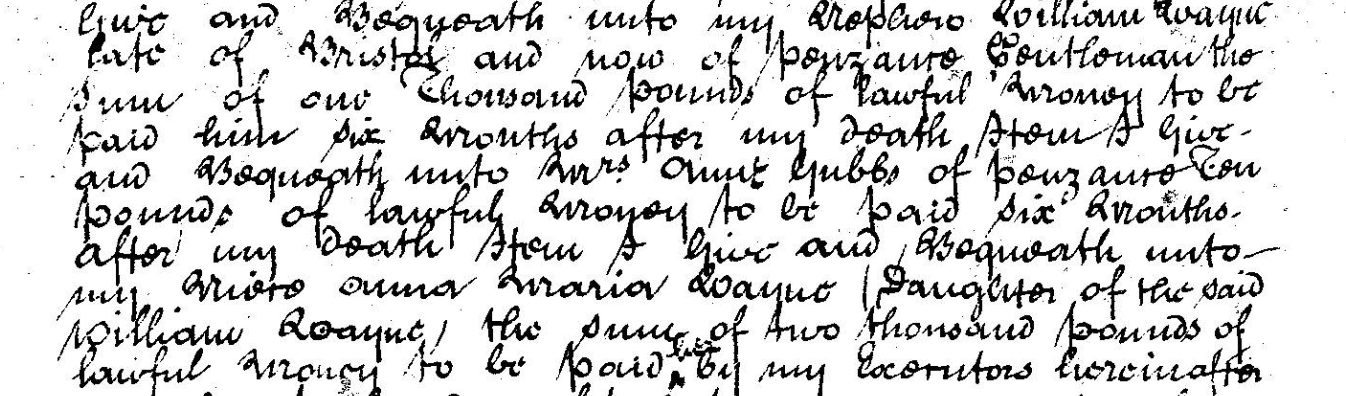
Mary’s Will – PROB/11/1051/117

Tobias and Mary clearly regard William Wayne as their nephew which implies that his wife, Ann Lanyon, was their niece.

It was time to look at Tobias & Mary’s branch of the tree and see what information I could find.
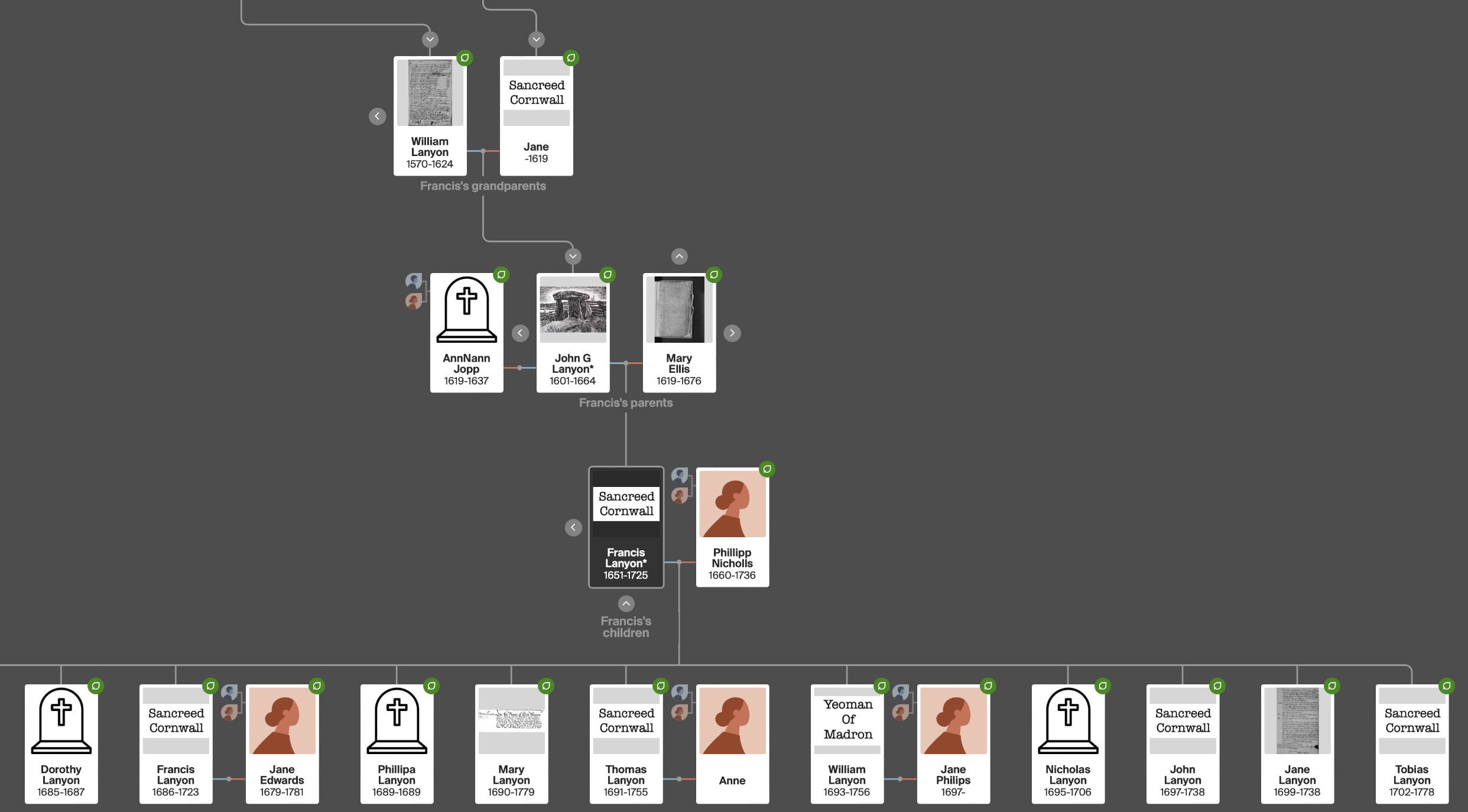
The Sancreed branch of the Lanyon family tree.

Tobias and Mary were the children of Francis Lanyon and Phillipp Nicholls of Sancreed. Francis was the son of John Lanyon, called ‘The Golden Lanyon’ as he made so much money from tin. John was a grandson of John Lanyon Esq and Phelype Milliton.

Tobias and Mary had a brother called Thomas and whilst I cannot prove that he was the Thomas who was a successful pewterer in Bristol, it does seem likely.

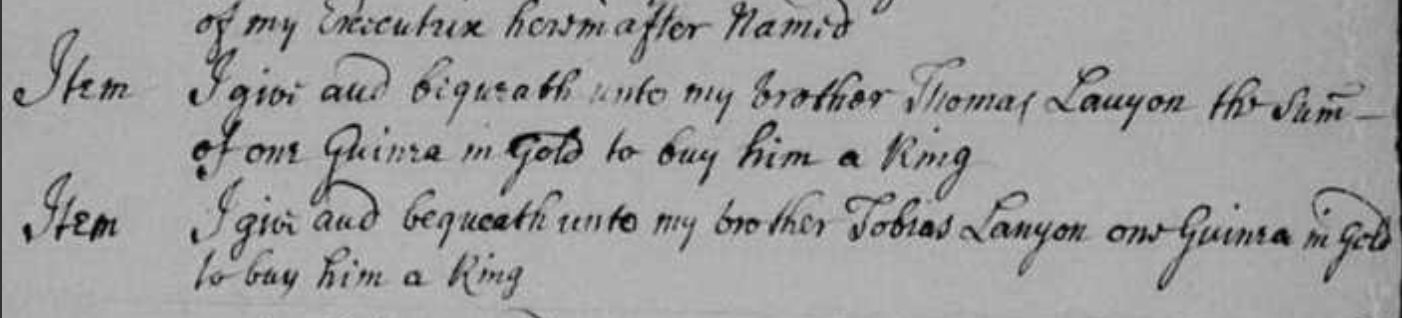
Tobias and Mary’s sister Jane died in 1738 and she leaves her brother Thomas the sum of one guinea in gold to buy him a ring.
Thomas had a son called Francis Lanyon, perhaps he was named after his father, who died in 1725, or his elder brother Francis, who died in 1723.

This branch of the tree now looks like this –
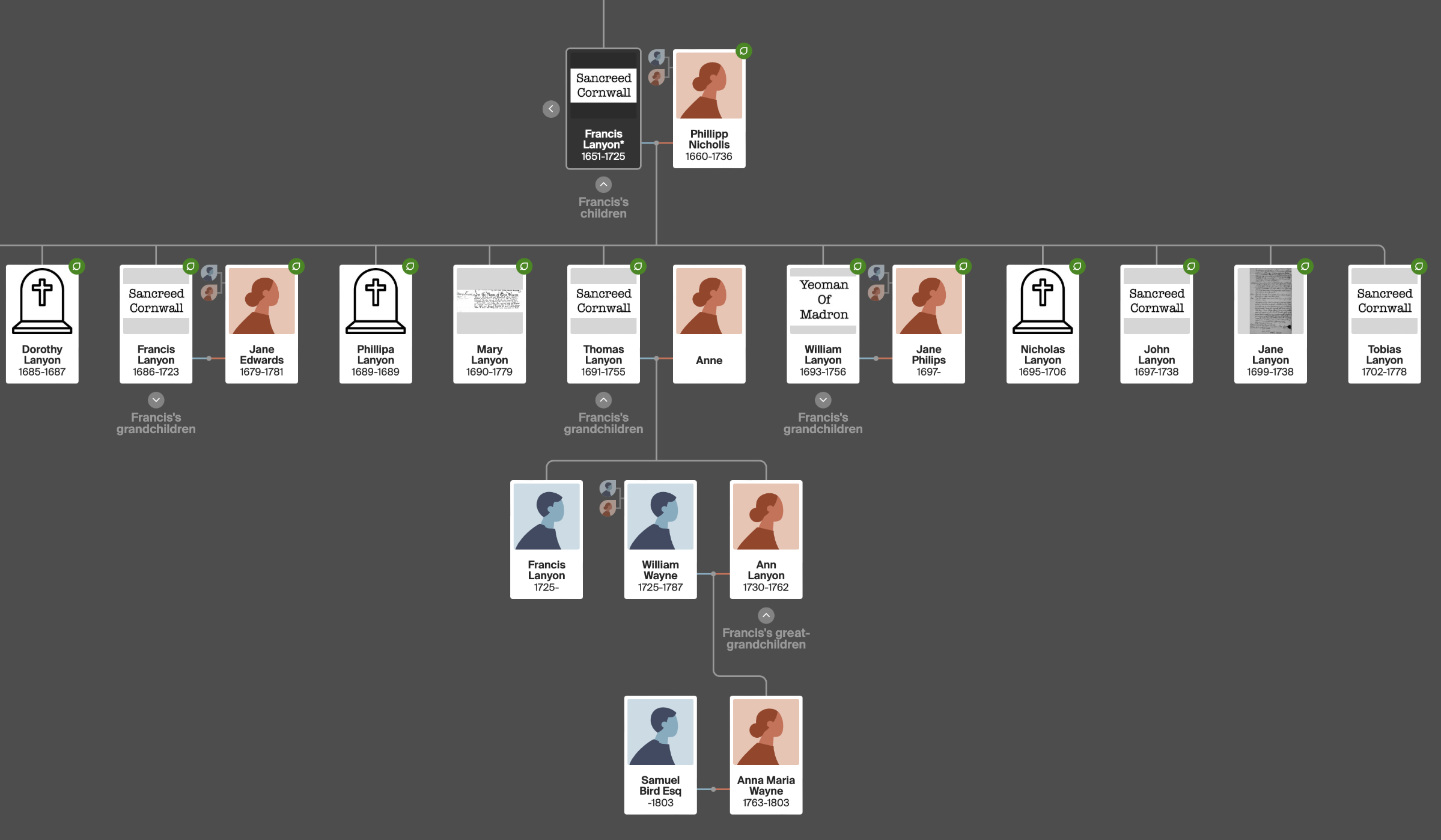
So Thomas Lanyon of Bristol was born in Sancreed, Cornwall in 1691 and died sometime after 1755. We don’t know what happened to his wife, Anne. We know that his son Francis became a pewterer but we don’t know if he married or had any children (the Thomas Lanyon working as a pewterer in Coventry in 1774 may be his son). There is no record of a birth of a daughter Ann Lanyon but we do have a record of her marriage to William Wayne.
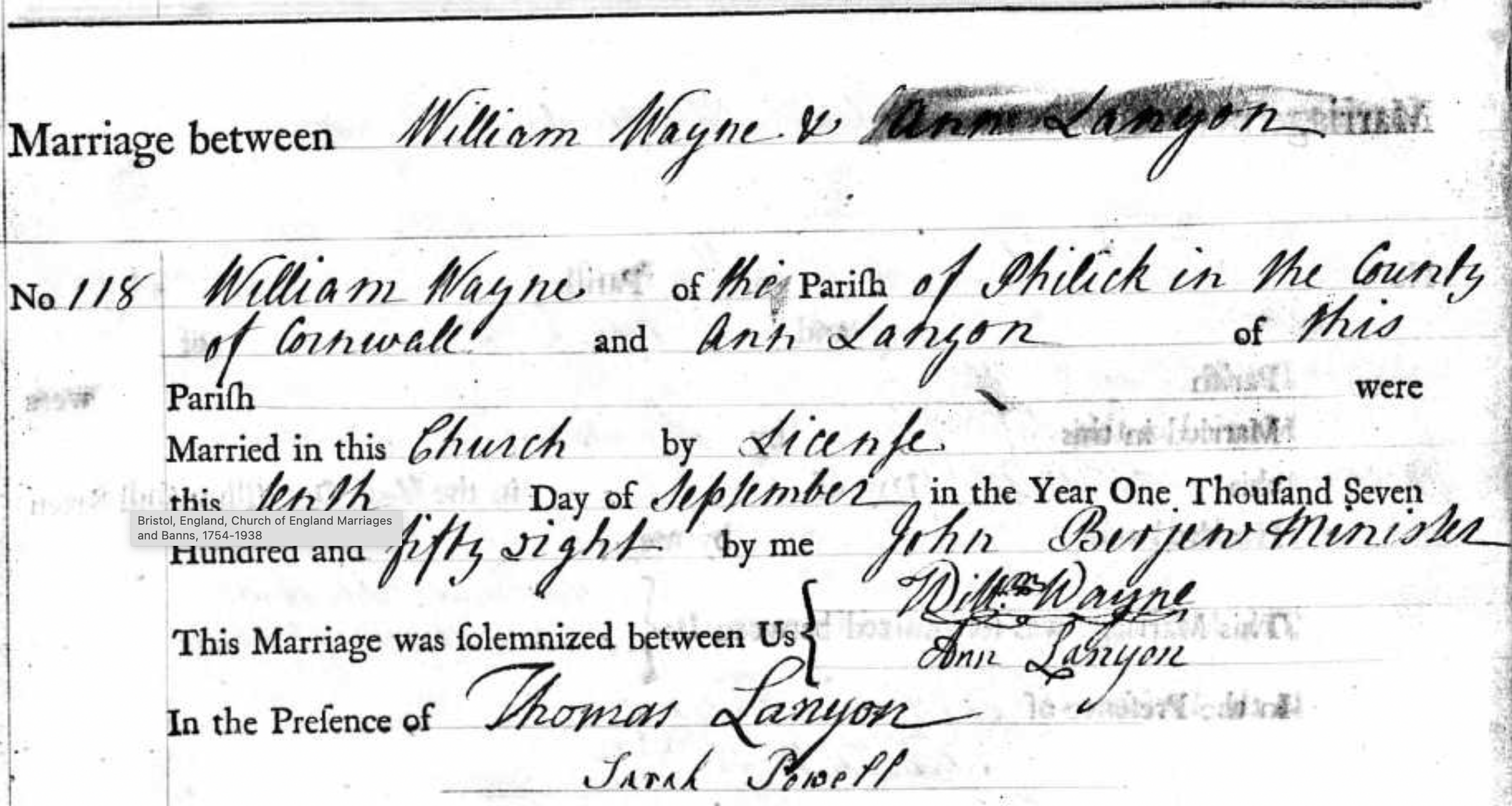
Bristol, England, Church of England Marriages and Banns, 1754-1938

Their marriage was solemnised in the presence of one Thomas Lanyon!

Anna Maria Wayne married Samuel Bird Esq. in London in 1784.
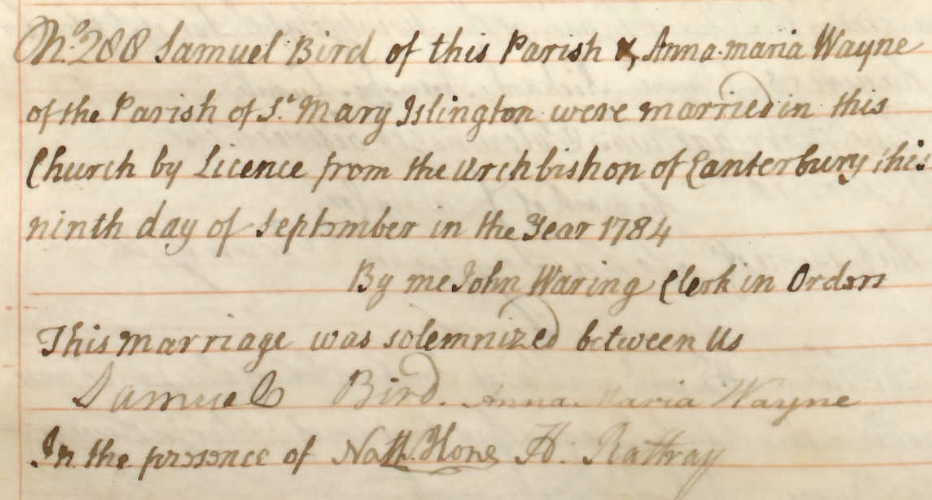
Marriage Register – St James Piccadilly, Westminster

By 1790 William Wayne was dead and administration of Tobias’ will passed to Anna Maria Bird the residuary legatee.

I found one possible burial entry for William at St Philip and St Jacob in Bristol on 19 Feb 1787. If it is ‘our’ William Wayne, he died of asthma.
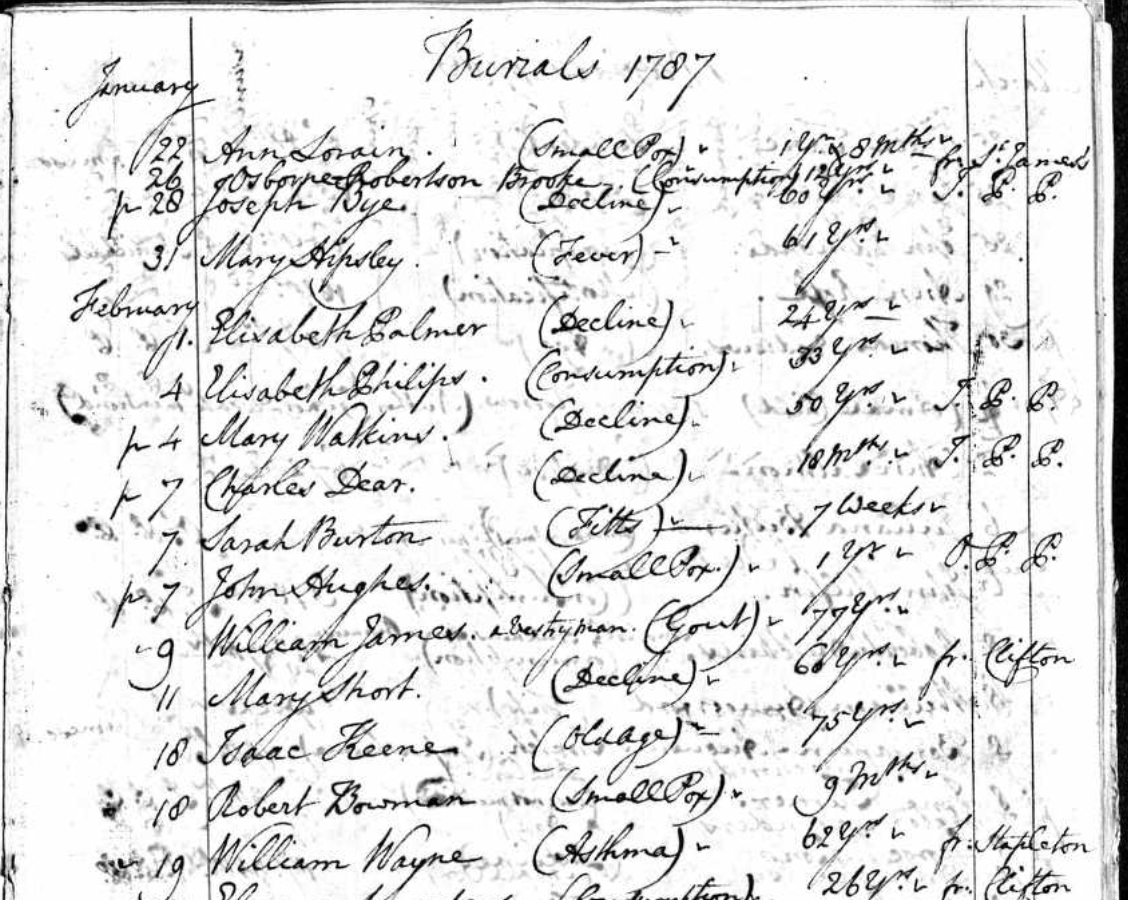
Bristol Archives; Bristol, England; Bristol Church of England Parish Registers; Reference: P/St P&J/R/1/5

Anna was left a very wealthy young woman with bequests of several thousand pounds, a huge sum at that time.

Sadly she died on 8 Apr 1803, at East Stonehouse in Devon, but her will requests that she be interred at Sancreed in Cornwall. She was just 40, widowed, and suffering from Consumption (TB). She and Samuel were childless so her fortune was left to various cousins. There is a plaque in Sancreed church which reads:-

‘Sacred to the memory of Anna Maria Bird, widow of Samuel Bird, of Ridgeway in the county of Devon, Esqr. She died the 8th day of April, 1803; aged 40 years. Her body is deposited in a vault with the remains of her relatives, Josiah Lanyon, Esqr, and Jane his sister.’ (https://sancreedopccornwall.tripod.com/id1.html)

Josiah Lanyon? I think that should read Tobias!
Sarah’s Pew Seat

Sarah was baptised at Sancreed, Cornwall in 1690. She was the second daughter of Charles Lanyon and Sarah Tresilian and her grandfather was called ‘The Golden Lanyon’ due to his great wealth.

Sarah was the second of three daughters and they also had a younger brother Abraham. We know very little about Sarah; she witnessed the will of Anne Basset of Manwinnion, Illogan in 1713 and was mentioned in the 1778 will of Mary Lanyon and left the considerable sum of £100.

Sarah never married and appears to have lived in Penzance for most of her life.

We do know that at the age of 95 Sarah sold her reserved pew seat at St Mary’s Church Penzance. It was the 5th seat from the stairs in the north gallery of the chapel and it was sold for 7 Guineas. (Source – CRO P179/2/4/8)

St Mary’s Church, Penzance by David Dixon, CC BY-SA 2.0 https://creativecommons.org/licenses/by-sa/2.0, via Wikimedia Commons

Perhaps she didn’t think that she would require the seat for much longer. In the event she lived to the grand old age of 102 and was buried on the 10 January 1793!

Henrietta’s Lectern

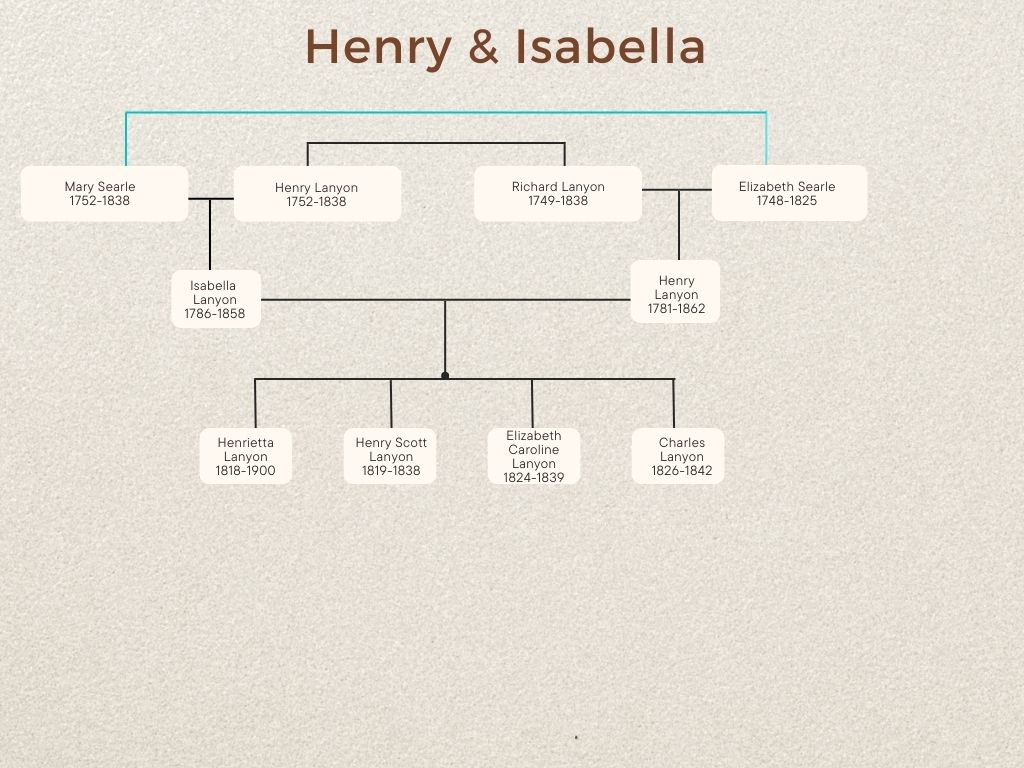
Henrietta was the eldest daughter of Henry and Isabella Lanyon (see the post Captain Cork!)

Henrietta was born in 1818, her brother Henry Scott a year later. He died aged 19 of a fever. Elizabeth Caroline was born in 1824 and died aged 14 of water on the brain. Charles was born in 1826 and died aged 16 of TB.

Henrietta, as the sole surviving child, set out to commemorate her parents by installing a beautiful stained glass window at St Allen church in their memory.

She also made a number of donations to Truro cathedral, including her father’s jewelled sword and gold snuff box. These items are now lost.

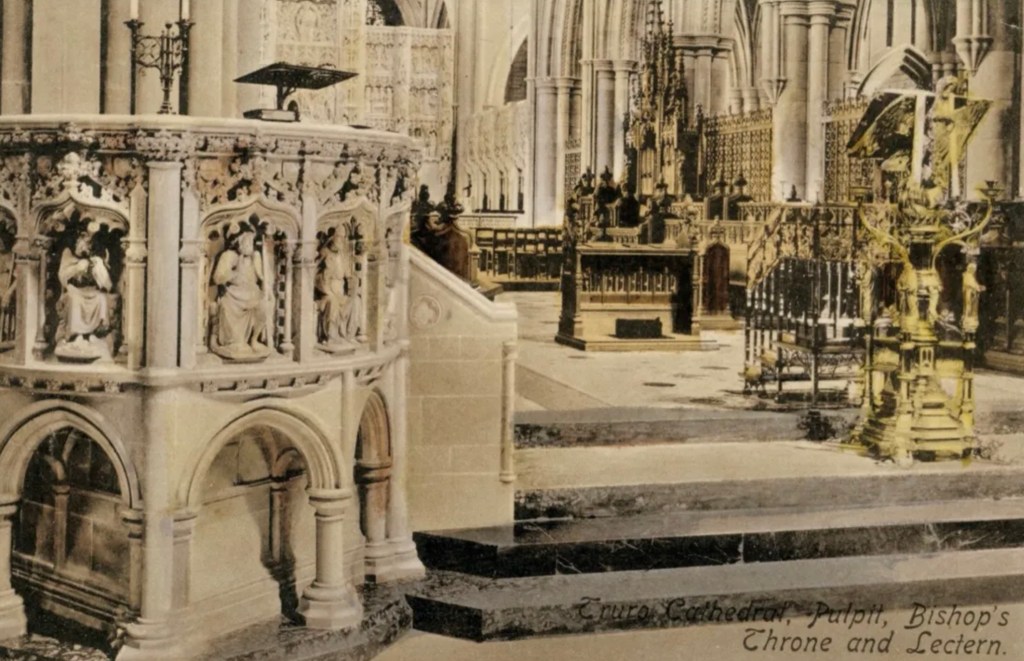
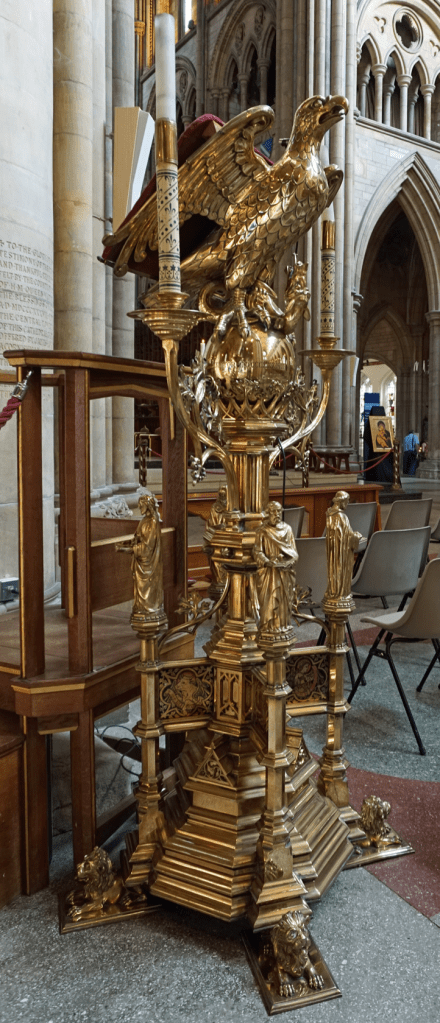
But her pièce de résistance was the lectern at Truro cathedral!

Postcard of Truro Cathedral showing the pulpit, Bishop’s throne and lectern.

The eagle was chosen to represent St John the Evangelist. Henrietta paid £550 for the lectern, a huge sum in those days and despite that they spelt her name incorrectly on the commemorative plaque! Harriett rather than Henrietta!

Horse Stealing

James Lanyon was arrested for stealing a horse rug on 11 May 1873 and stealing a horse (presumably to go with the rug!) on 26 May 1873. The horse belonged to William Uren of the Devon and Cornwall Artillery Militia. James appeared at the midsummer assizes at Bodmin and was tried by Sir Charles Brune Graves Sawle.

James appears to have been caught ‘red handed’ as he plead guilty and was sentenced to six months hard labour at the house of correction at Bodmin. That meant the dreaded treadmill.

Bodmin Jail was pretty grim! Robert Linsdell from St. Andrews, Canada, CC BY 2.0 https://creativecommons.org/licenses/by/2.0, via Wikimedia Commons
Bodmin Jail Inmates

I found a second conviction for James in 1873. he was found guilty of stealing Fras. Osborne’s trousers at Camborne. He was described as crippled in his right hand and having an ‘enlargement in right breast’. Again he was sentenced to the treadmill.

In 1874 he was convicted of trespassing on the land of Gustavus Lambart Basset esq, in Illogan, in search of game. His description is as follows: Roman nose, eyes rather small, right forefinger small and useless. Again he was sentenced to the treadmill.

British Library, Public domain, via Wikimedia Commons

James Lanyon was aged just 19 at his conviction in 1873 (born in 1854) and a labourer. James is quite a common name in the Lanyon family but it didn’t take long to find him on the tree.

James was the son of William Lanyon and Mary Maddern.

James’ grandfather, William Lanyon 1767-1836, was transported to Australia!

James’ parents married in 1841 at St Buryan and by 1861 they were living in Lelant. By 1871 James was no longer living at home but I can’t find him on the census. He may have been avoiding the authorities!
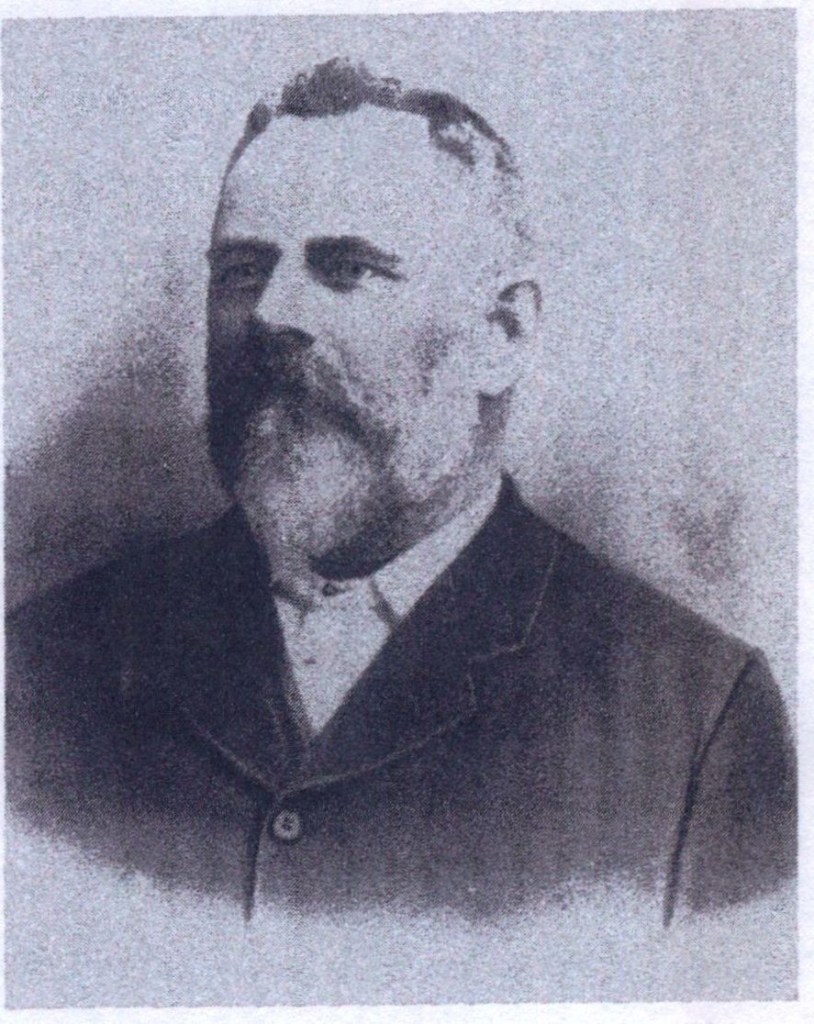
After jail we lose track of James but he may be the James Lanyon aged 21 who sailed to Australia in 1875 and was described as a copper miner. He may have died, prison wasn’t conducive to good health and a long life.

Abel Angove

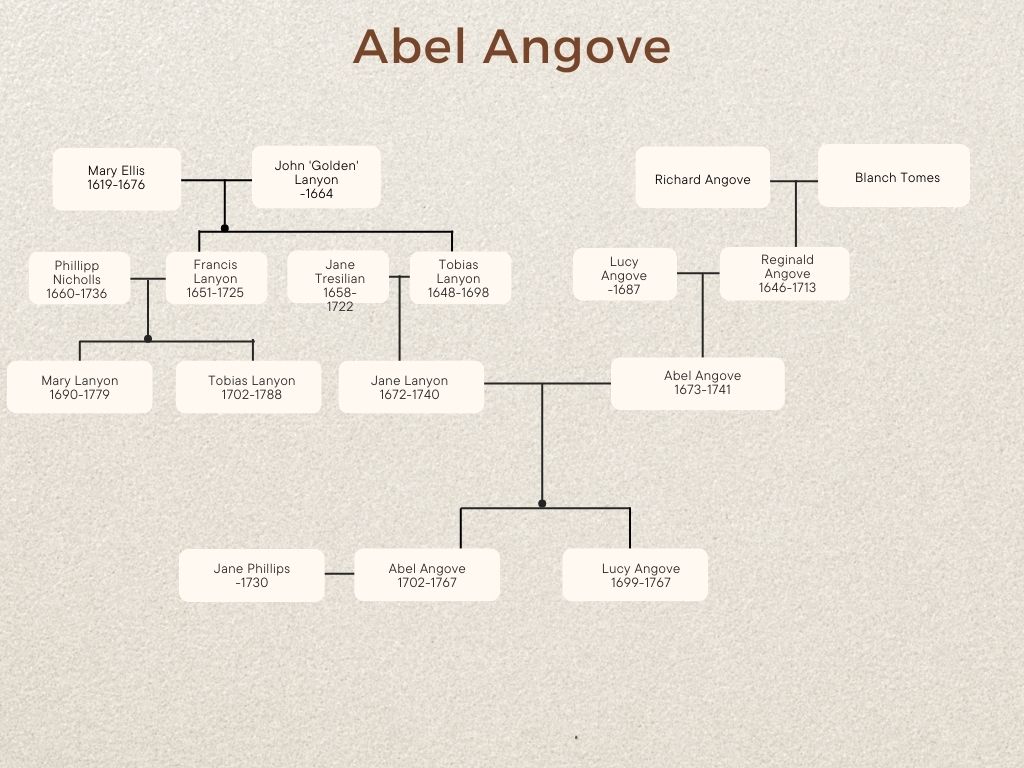
Tobias and Mary Lanyon were ‘cousins german’ or first cousins, next of kin and co-administrators of Abel Angove of Trevenson, Illogan. The only problem was which Tobias and Mary Lanyon and how were they connected to Abel Angove?

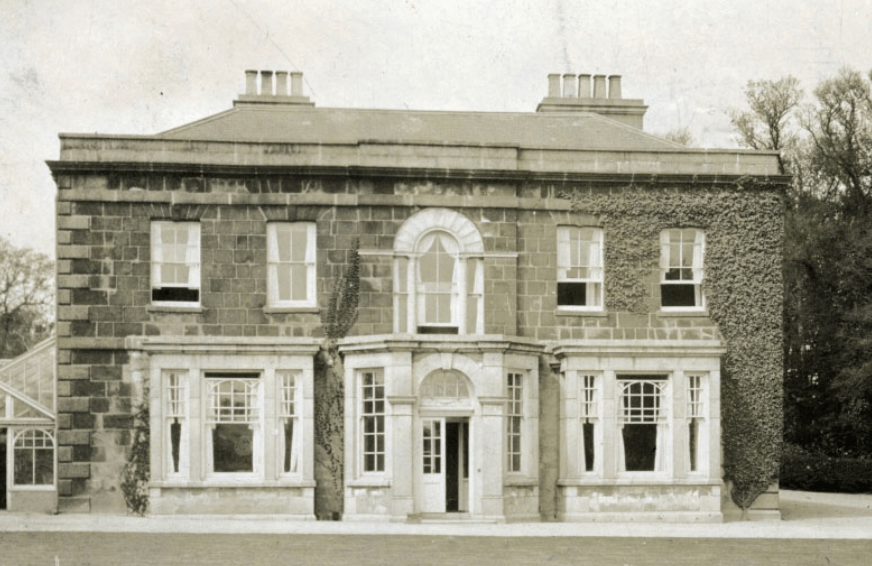
Trevenson House Pool, Illogan

Abel Angove died following a fall from his horse, he was buried on 5 Aug 1767. There is a letter at Kresen Kernow from Francis Basset claiming the horse (the cause of death) by ‘deodhand’ as Lord of the Manor of Tehidy. (Source – TEM/1/10 dated 4 Aug 1767- Francis didn’t hang around, the letter was written before Abel was interred!!)

Abel was an attorney and a widower, he had married Jane Phillips the daughter of Mr. Henry Phillips in 1729 at Phillack. Jane  died 13 Aug 1730 and Abel never remarried or had children.

Why were Lanyons his next of kin? I started digging!

Abel was the son of Abel Angove gent. He was born in 1673 the son of Reginald/Reynald Angove.

The Parochial History of Cornwall founded on the manuscript histories of Mr Hals and Mr Tonkin by Davies Gilbert (Vol II p.234, 1838) gives the following information about Reginald Angove.

“In this parish, at….,liveth Reginald An-Gove, gent. i.e. Reginald the smith, a sirname (sic) assumed in memory of his first ancestor, who was by trade and occupation a smith.

And of this sort of sirname in England, thus speaks Verstegan. 

‘From whence came smith, all be it knight or ‘squire? But from the smith that forgeth in the fire.’

This Reginald Angove is that crafty tinner, whom common fame reports to have gotten a considerable estate by labouring, adventuring, and dealing in tin, both in the mines below and blowing houses above ground, by indirect arts and practices; for which, about the 8th of William and Mary (1697) he was indicted before the jury of tinners (whereof the writer of these lines was summoned for one) amongst other things, for putting hard heads of false metal and lead in the midst of slabs of tin, melted and cast in his blowing house, in testimony whereof some pieces or slabs thereof was cut in pieces, and the fallacy detected; whereupon the Grand Jury returned the bill of indictment, indorsed (sic), Billa Vera. But on his trial there was given a verdict of acquittal.

Trying to work out which Tobias and Mary Lanyon were ‘next of kin’ was a challenge. There are several Tobias Lanyons and lots of Mary Lanyons. I was able to eliminate any that died before 1767 when Abel died, any that were dead before 1779 when a lease was assigned which named them both as co-administrators. (Source – CRO X473/94). Tobias Lanyon gent of Penzance was mentioned in a mortgage assignment (Source-CRO X446/5) which seemed to preclude the Gwinear Tobias Lanyons.

There was a suitable candidate: Tobias Lanyon the son of Francis Lanyon and Phillipp Nicholls (Botrea branch) and he had a spinster sister called Mary Lanyon. 

Tobias was baptised in Sancreed in 1702 and in 1717 ‘Tobias son of Francis Lanyon, gent, was apprenticed to John Tonkin of Penzance, tobacconist.’ Tobias never married and died in 1778.

His sister Mary was baptised at Sancreed in 1690, she too never married and died in 1779. 

But that still didn’t explain how they were related to Abel Angove. 

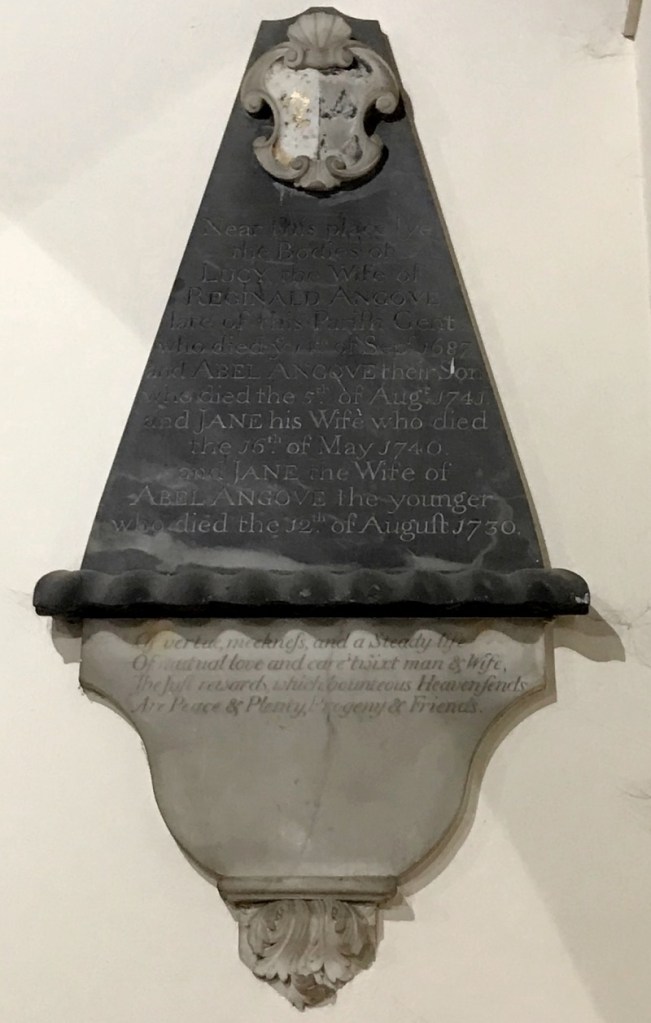
A plaque in Illogan church lists both Abel Angoves and names both wives as Jane. 

Memorial Plaque Illogan Church

Jane Phillips was the wife of Abel Angove the younger but who was Abel’s mother?

There is no record of a marriage for Abel Angove senior. His wife was called Jane and that’s as much as we know for certain. It does however seem likely that she was a Lanyon.

I found Abel’s will:

The Will of Abel Angove of Illogan 1740

I Abel Angove of Trevonson in the Parish of Illugan and County of Cornwall Gent resigning my Soul to Almighty God my Creator in hopes of his mercy and forgiveness through the alone Merrits and Intercession of my most Blessed Saviour and Redeemer Jesus Christ doe by this my last Will and Testament dispose of my Real and Personal Estate as followeth I give unto my most dutifull Daughter Lucy Angove the Sum of One Thousand Pounds in lieu and Bar of a Instrument in Writing Tripartite dated Eleaventh day of June One Thousand Seaven Hundred and Thirty the one half to be paid her within Six Months after my decease and the other half to be paid her within Nine Months after the Six Months before mentioned and the farther Sum of Five Hundred Pounds to be paid her within two Years after my decease and alsoe Ten Pounds to buy her Mourning the which Ten Pounds I doe order my Executor hereafter named to pay at my decease I Give unto the Poor of this Parish the Sum of five Pounds I mean those that receive no Pay from the said Parish to be distributed by my Executor within one Month after my decease I give unto my most dutiful Son Abel Angove all my Lands Goods and Chattles that I dye posses’d of in paying my Debts and Legacy’s And I do hereby make and constitute my said Son Abel Angove Executor of this my last Will and Testament hereby revoking all other Wills at any time heretofore made by me declaring this to be my last Will In Witness whereof I have to this my Will (the whole Written with my own hand) Sett my hand and Seale this first day of August 1740 Abel Angove

(Attestation Clause)

Mary Lanyon _ Edward Angove Junr._ Richard Gribbell Proved at London 15 September 1741

Source: National Archives ref: PROB 11/711/373

Transcribed by Ros Dunning and reproduced with permission of Cornwall OPC.

Sadly it doesn’t mention his wife or her family. Jane died in 1740 a year before he did.

It didn’t take long to find a suitable candidate: Jane Lanyon the daughter of Tobias Lanyon and Jane Tresilian of Sancreed. Tobias was the brother of Francis Lanyon and uncle to Tobias and Mary the co-administrators of Abel’s estate.

Whilst I have no proof that Jane Lanyon was Abel Angove’s wife it does seem likely.

Excommunicated!

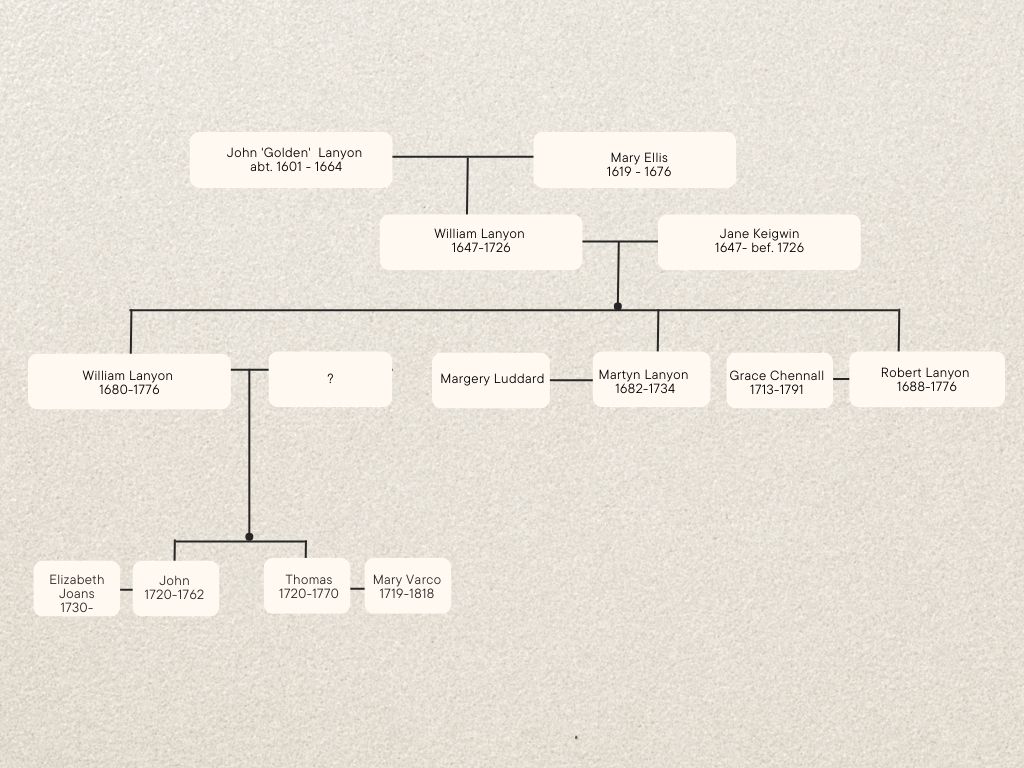
William Lanyon 1680-bef. 1776

William was baptised at Sancreed in 1680, the son of William Lanyon and Jane Keigwin. We don’t know the name of his wife but his sons John & Thomas lived at Fowey (see the post ‘Fowey Boys’).

A William Lanyon of Sancreed was excommunicated on 16th Jan 1722 for contumacy (stubborn refusal to obey or comply with authority, especially disobedience to a court order or summons). Source NA ARD/160/24 – National Archives Archdeanery of Cornwall.

William was excommunicated by Lancelot Blackburne, the Bishop of Exeter.

Lancelot Blackburne – Attributed to Joseph Highmore, Public domain, via Wikimedia Commons

We don’t know what he did but it must have been bad enough for the Bishop of Exeter to get involved and for William to move to Fowey and raise his children away from Sancreed.

Stained Glass Windows

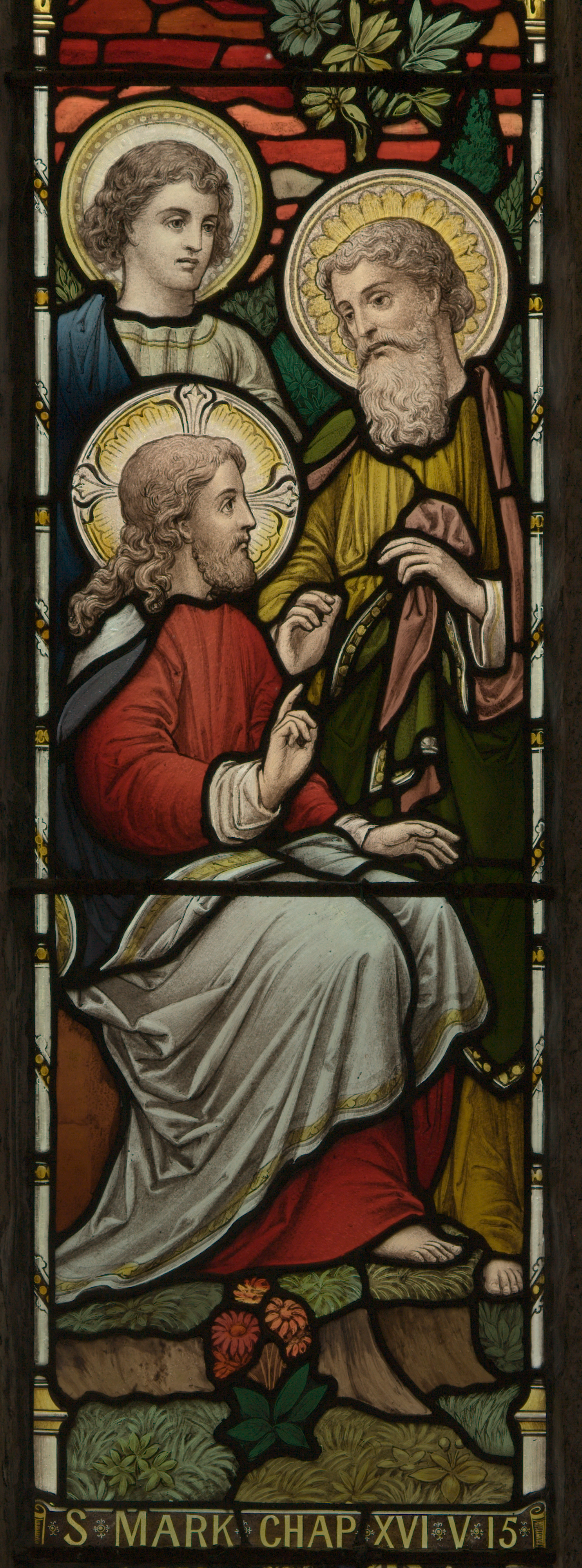
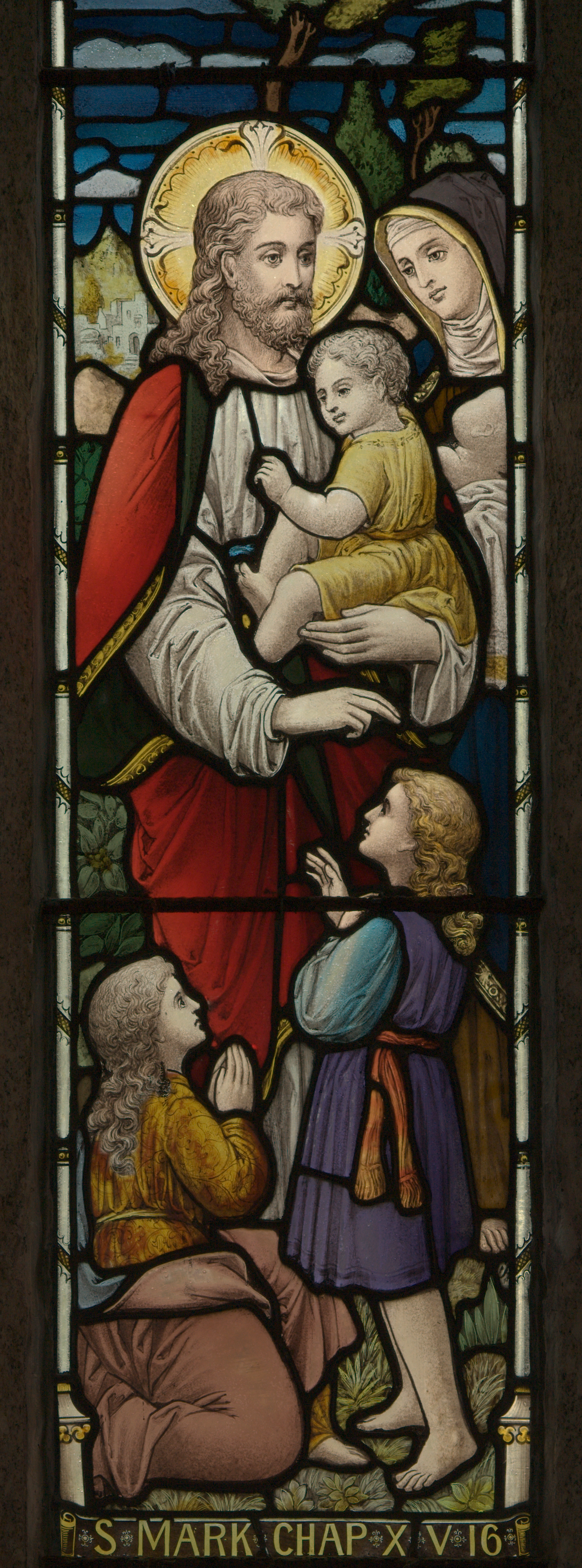
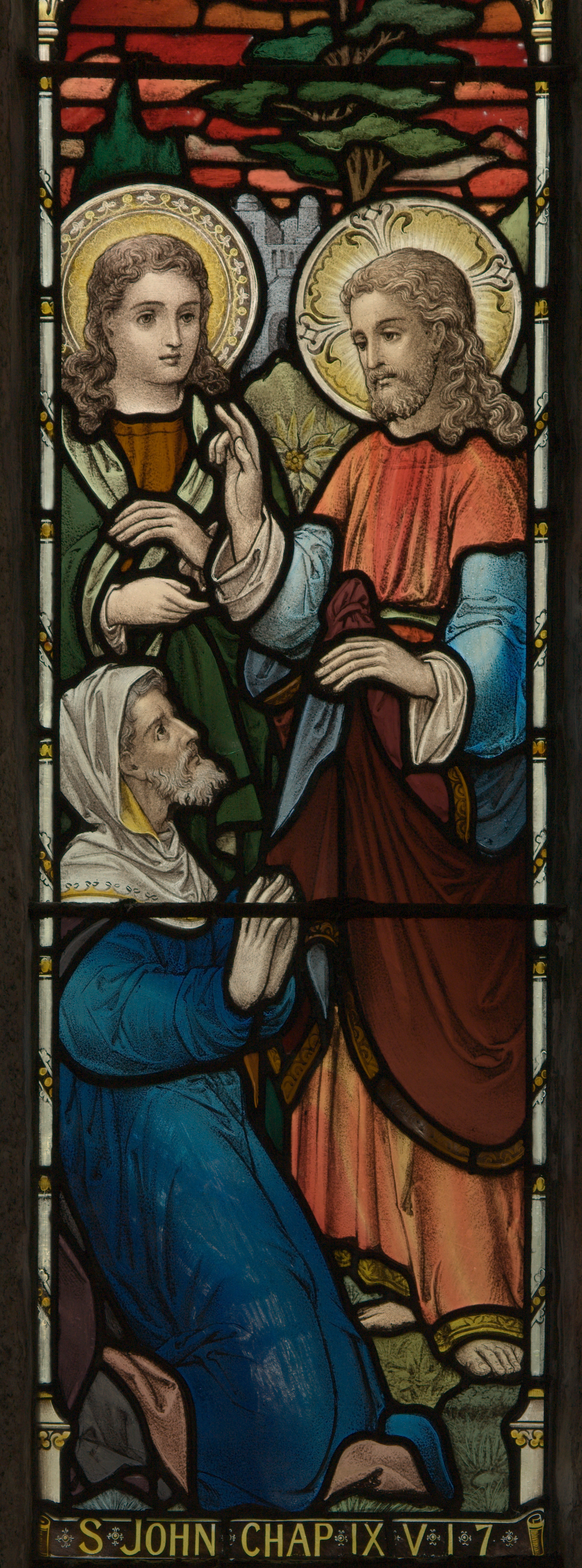
Whilst researching the family tree I discovered that there were several beautiful windows erected in memory of various Lanyons. Whilst the photos are included on the site along with the individuals concerned I thought it worth creating a page with all the windows together.

I’d like to thank Dr Mark Charter the webmaster of Cornish Stained Glass Windows https://www.cornishstainedglass.org.uk for permission to use the photos.

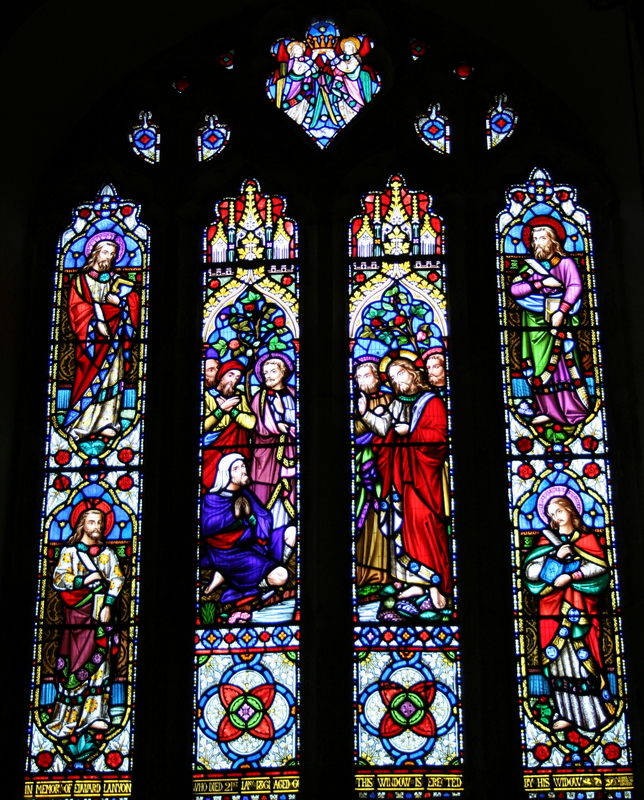
Camborne Church

Christ healing the impotent man at the pool of Bethesda.

Made by Alexander Gibbs 1864. Erected by Charlotte Lanyon (Reynolds) in memory of her husband Edward who died in 1861. (Post about Edward in Gwinear Branch – Christ and the Impotent Man!).

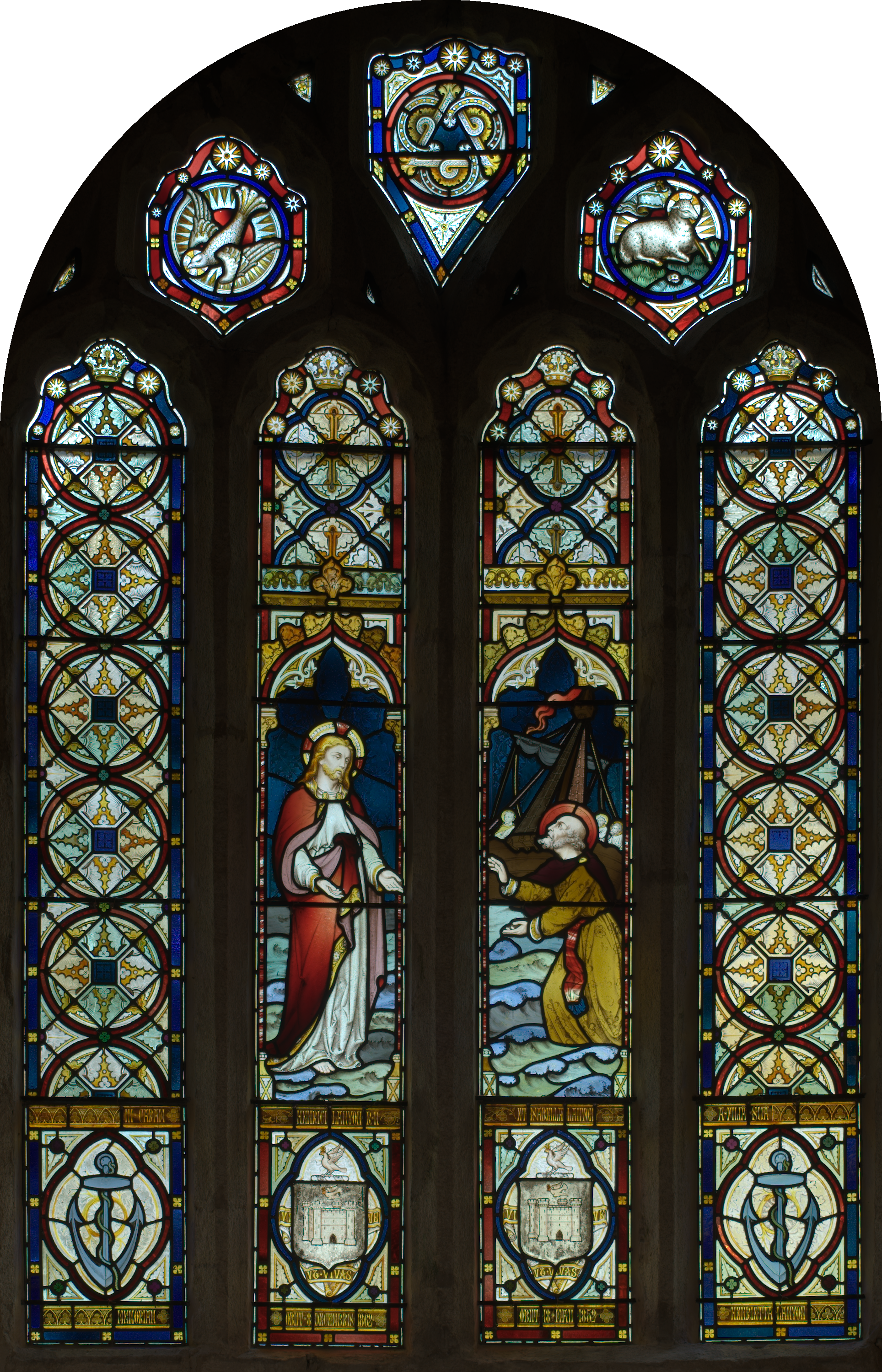
St Allen Church

Chancel East

Christ saves Peter from drowning.

Made in 1874 possibly by Lavers and Barreau. Erected by Henrietta Lanyon in memory of her parents Henry Lanyon and Isabella Lanyon. (Post about Henry & Isabella in St Allen branch – ‘Captain Cork!’)

Detail of Christ saving Peter

Lanyon Arms and family motto ‘Vive ut Vivas’.

Nave North 3

Made in 1889 by Arthur Louis Moore

  1. Christ’s commission to Peter: “Feed my sheep” – Panel 1 in memory of John and Peggy Lanyon of Henver. (Post about John and Peggy in St Allen branch – ‘Henry and Mary Lanyon’s Sons’.)
  2. Suffer little children – Panel 2 in memory of Simon Lanyon John and Peggy’s fourth son who died at Mineral Point, Wisconsin. (Post about Simon Lanyon in St Allen branch – Henry Lanyon and Mary Searle’s Grandsons part. 1.)
  3. Healing of a man born blind – erected by Simon Henry Lanyon son of Simon Lanyon on his visit to England in 1889. (Post about Simon Lanyon in St Allen branch – Henry Lanyon and Mary Searle’s Grandsons part. 1.)
Detail Panel 1

Detail Panel 2

Detail Panel 3

Nave North 4

Made in 1910, maker unknown.

In memory of Eliel Lanyon of Henver, son of John and Peggy Lanyon of Trevalsa, St Allen, died 10th October 1909 aged 86.

Detail Panel 1

Detail Panel 2

Detail Panel 3

St Stithians

North Aisle East

Window erected in memory of Richard Lanyon of Kennal Vale and of Acton Castle, died 8th December 1863 aged 66.

Made in 1864, maker not known.

Decorative panels with diagonal memorial inscription in centre light. Lanyon arms (Polsue).

No image available.

Henry Lanyon & Mary Seale’s Grandsons part. 2

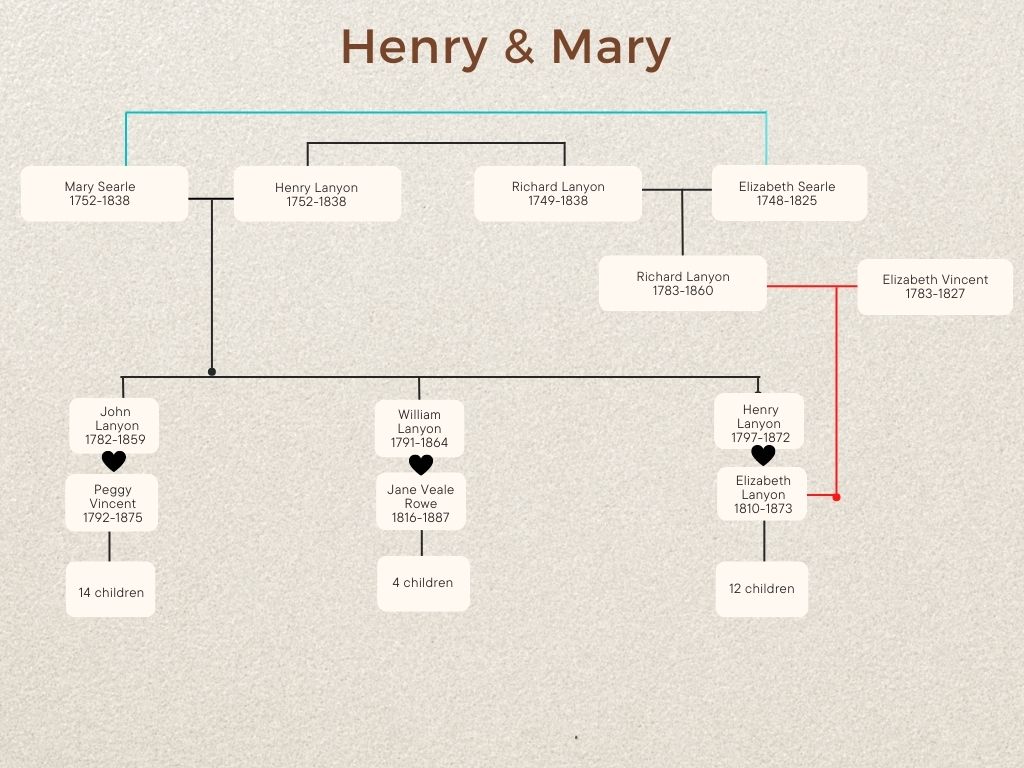
We’ve followed John & Peggy’s large family in part 1 of this post now we’ll follow William & Henry.

William & Jane’s Son

William Lanyon and Jane Veale Rowe had just one son Charles Scott.

Charles Scott Lanyon 1844-1890

Charles was born at Newlyn East in 1844, he was a farmer at Higher Treluddra and married Elizabeth Jane Rowe in 1872. Charles was accidentally killed in 1890 by being thrown from his horse at Shepherd’s Gate, Newlyn East. (Source – Royal Cornwall Gazette).

They had four children:

  • William 1874-1956 he was a farmer who married Amy Elizabeth Bice at Colan, Cornwall in 1899 – no children
  • Frances 1875-1875 died in infancy
  • Jane Rowe 1877-1953 married Francis Rowe, a farmer in 1899 and her name became Jane Rowe Rowe! No children
  • Thomas Rowe 1879-1958 he was a farmer too, he emigrated to Canada. Then he returned home in 1914 and fought in the first World War, he was a sergeant in the Royal Army Medical Corp. After the war he returned to Canada. He never married.

This little branch of the tree has died out.

Internet Archive Book Images, No restrictions, via Wikimedia Commons

Henry & Elizabeth’s Sons (and daughter!)

Henry and Elizabeth were first cousins once removed. They had twelve children and of them, three sons to carry on the Lanyon name.

Albert Cornelius 1834-1887

Albert was born at St Allen in 1834 and was a farmer at Trevalsa. He married Mary Ellen Varcoe in 1883 at St Erme, he died in 1887. Albert and Mary had three sons:

  • Albert Cornelius 1884-1960 he was a farmer at St Allen. In 1914 he married Margaret Louise May – two children
  • John Henry 1886-1963 he too was a farmer at Trevalsa, in 1933 he married Charlotte Adeline Carveth – no children
  • Obed Howard 1887-1970 also a farmer at Trevalsa, bachelor, no children

Emily Lanyon 1838-1888

Emily was Albert Cornelius’ younger sister. She and her brother Simon Searle Lanyon emigrated to Australia in 1857. She went to help her aunt Bella Lanyon and Uncle Thomas Johns with their children and working in their shop on Eureka Street, Ballarat. Her brother Simon set up a mining business with Thomas William Bull. Simon was killed in an accident at their Ophir mine in 1859. Thomas went to break the news to his sister Emily and months later they were married. They had eleven children:

Emily & Thomas
  • Sarah Ann Bull 1860-1889 Sarah developed appendicitis and died at Whitton railway station whilst waiting for a train to take her to hospital.
Sarah Ann Bull
  • Eliza Jane Bull 1862-1882 died age 20, spinster
Eliza Jane Bull
  • Elizabeth Emily Bull 1863-1934 married William Davies
  • Henry James Bull 1865-1947 married Charlotte Tresilian
  • William Thomas Bull 1866-1956 married Agnes Kock
William Thomas Bull
  • Albert Edwin Bull 1869-1952 married Lucy Taylor Johnstone
Albert Edwin Bull
  • Mary Ellen Bull 1871-1954 married Alfred George driver
Mary Ellen, Adelaide Sibella and Caroline Louisa Bull
  • John Louis (Jack) Bull 1873-1951 married Matilda May Kock
  • Adelaide Sibella Bull 1875-1969 married George Cormack
  • Charles Wager Lanyon Bull 1877-1954 married Hanna Pearce
  • Caroline Louisa Bull 1879-1957 married Archibald Gates

Henry Scott Lanyon 1839-1903

Henry was born at St Allen and emigrated to Ballarat in Australia in the 1860s. He was a shepherd and leased a paddock so he could run his own sheep. He married Maria Wescott in 1874. They met when Henry went to visit his cousin Richard Lanyon who was working for Isaac Westcott, Maria’s father. Henry died in 1903 after suffering with cancer for 18 months.

Henry Scott Lanyon & Maria Westcott

They had six children:

  • Henry Maynard 1876-1967 he was a teacher, he married Mabel Wilkinson in 1903 – six children. Henry was quite delicate and instead of farm work he became a teacher.
  • Albert Vincent 1878-1953 he married Emily Margaret McRorie in 1905 – five children
Albert and Emily
  • Elizabeth Jane 1881-1933 spinster
Elizabeth Jane
  • Annie Violet 1882-1973 married Percy Garnet Weaver in 1908 – five children
Annie Violet & percy
  • Thomas Wescott 1885-1965 married Margaret Ethel Smith in 1909 – three children
Thomas Westcott and Margaret Ethel
  • Lewis Isaac 1887-1925 married Elsie Elizabeth Lewis in 1913 at Victoria. One son. He returned to Cornwall in 1925 and made lots of notes about Lanyon family history. He died of Cholera after drinking contaminated water in Cornwall and was buried at St Allen Church
Lewis and Elsie

Lewis Edwin Lanyon 1841-1886

He was born at St Allen in 1841 and worked as a farmer and engineer. In 1877 he married Sarah Osman – six children:

  • Elizabeth Maud 1977-1934 she married John Henry Trenerry and they had one son, they emigrated to Omaha Nebraska.
  • Eliza Helen 1880-1956 she married William Thomas Argall Searle, a farmer, seven children
  • Isabella 1881-1944 married Samuel Arthur Chenoweth in 1903 – four children
  • Louisa 1882-1958 married Henry Woolcock in 1904. Two sons
  • Mabel 1885-1968 married Thomas Roberts in 1910, one son
  • Louis Edwin 1886-1955 he was a bookkeeper who emigrated to Omaha Nebraska, married Lillian Mae Ashley – two daughters

Here we must leave Henry & Mary’s branch of the family.

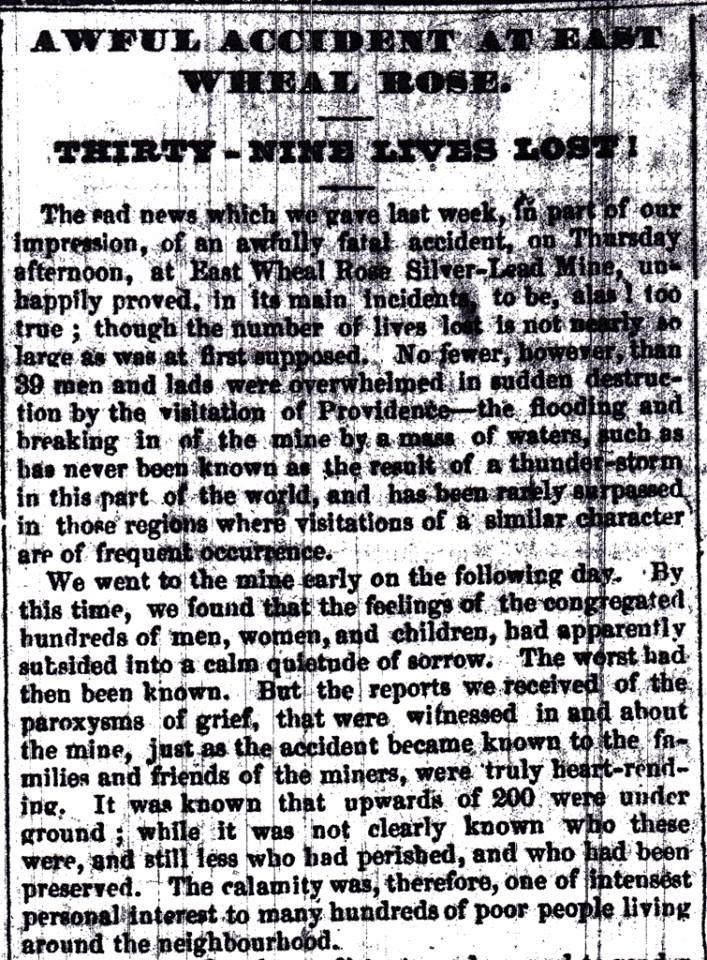
The East Wheal Rose Mining Disaster

The East Wheal Rose mining disaster of 1846 was the worst mining disaster in Cornish history.

Malcolm Kewn / East Wheal Rose Mine

On 9 July 1846 a thunderstorm caused a flash flood. The mine was in a natural bowl, and the flood waters had nowhere to go, except into the mine. Captain Middleton, the manager of the mine, organised 300 men to pile up earth around the collars of the shafts but the volume of water pouring down was so great that soon torrents of water poured down the shafts. This caused a wind to blow that extinguished the candles that the miners used underground. So when the water hit them, they were in utter darkness.

Captain Champion somehow managed to climb the slippery ladders against the tremendous weight of down-rushing water. A timber-man, Samuel Bastion, went down into the mine to lie across a manhole, diverting the flow of water and saving eighteen lives.

The beam engines were put to work in raising men to the surface, clinging to the kibbles and chains ‘like strings of onions’. Forty-three men and boys were missing but four of them were brought up alive next morning. The lower levels of the mine were completely flooded. But, by November 1846 all the debris and water had been cleared and the mine was in full production again.

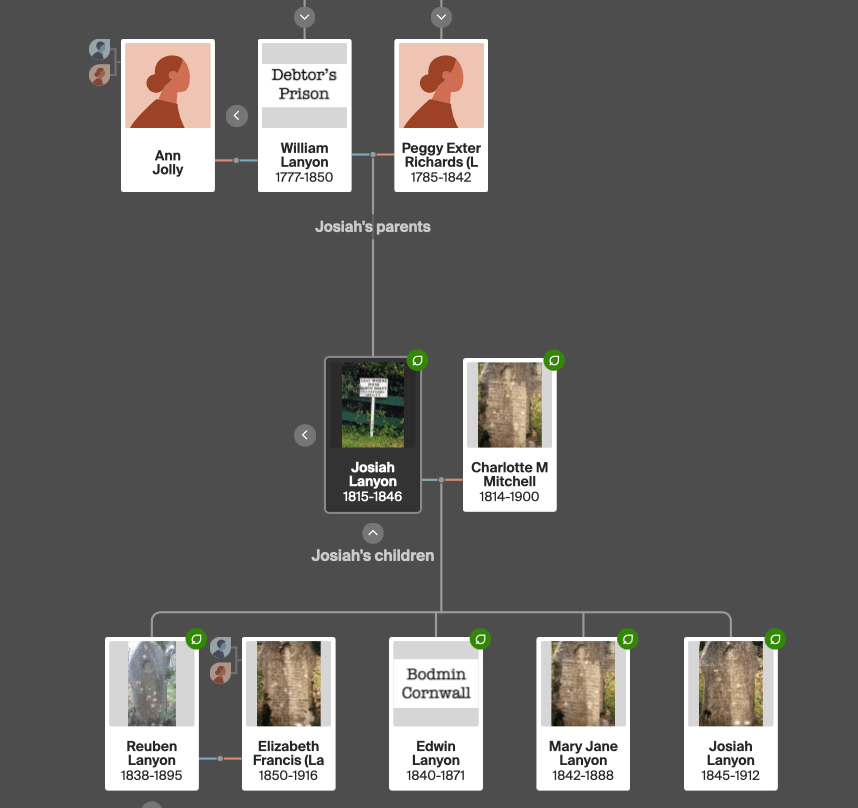
William Lanyon and Peggy Exter Richard’s sons, Josiah and Reuben were among the thirty nine miners drowned.

The Royal Cornwall Gazette Jul 1846

Josiah Lanyon 1815-1846

Josiah married Charlotte Mae Mitchell at St Allen in 1837. They had four children:

  • Reuben 1838-1895 married Elizabeth Francis – six children: two died in infancy, Reuben, a school teacher died unmarried, aged 28, Mary Ellen married her cousin also called Reuben Lanyon (the son of John Lanyon and Johanna Roberts) but they had no children. Two sons Francis and Edwin had children.
  • Edwin 1840-1871 he was a miner and emigrated to California where he died, he was unmarried
  • Mary Jane 1842-1888 was a milliner and a spinster
  • Josiah 1845-1912 was a grocer and a bachelor

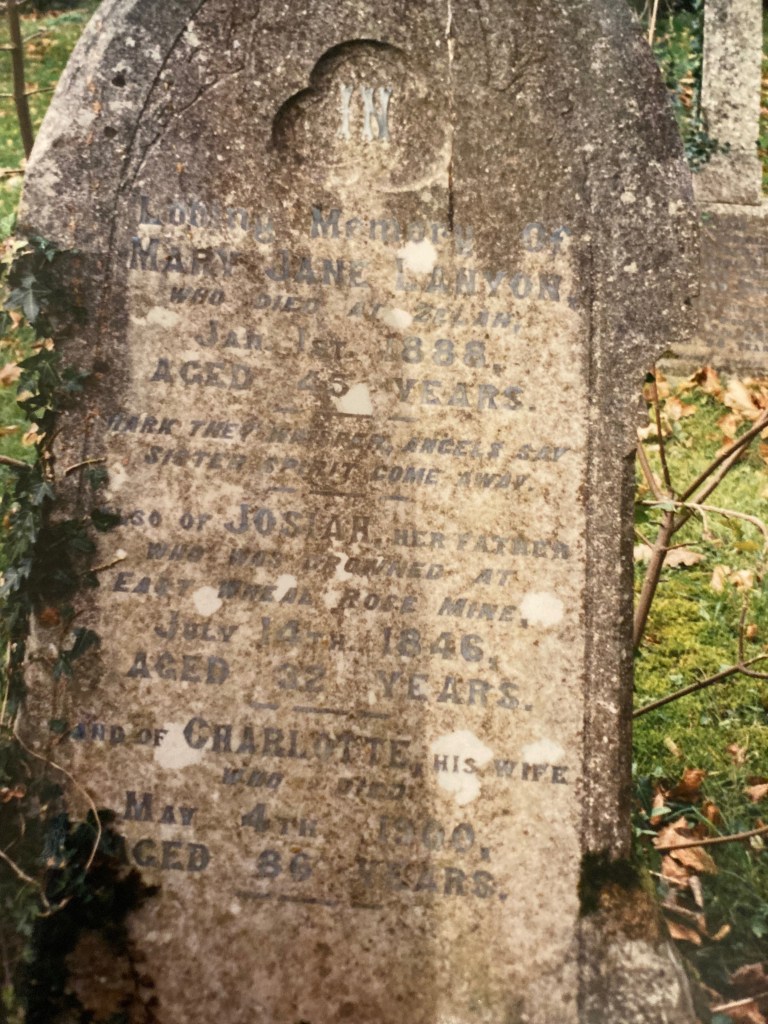
Josiah’s widow Charlotte died in 1900 at the age of 86.

Josiah & Charlotte Lanyon’s headstone

Reuben Lanyon 1824-1846

Reuben was Josiah’s younger brother and drowned alongside him in the mine disaster aged just 22.

Josiah and Reuben’s family tree

Six Lanyon boys were subsequently named after him.

Richard & Elizabeth Lanyon’s Sons

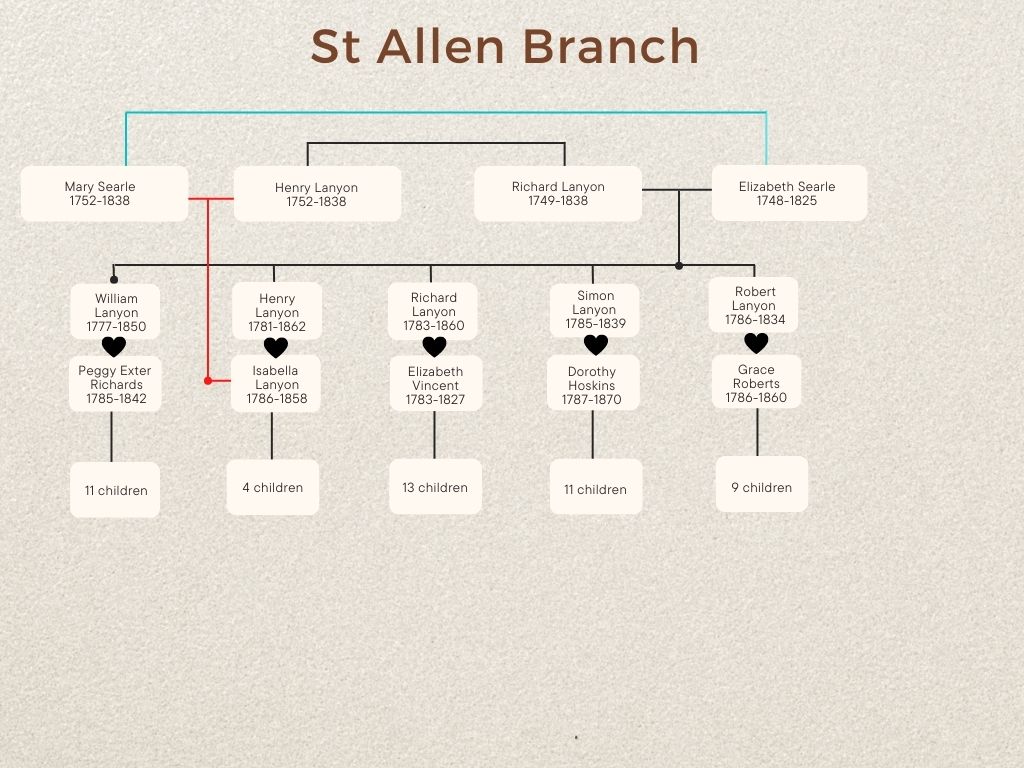
Two Lanyon brothers (Richard & Henry) married two Searle sisters (Elizabeth & Mary) and each couple had ten children. This post is about Richard and Elizabeth’s sons who had children.

Five of Richard’s and Elizabeth’s sons had children to carry on the Lanyon name.

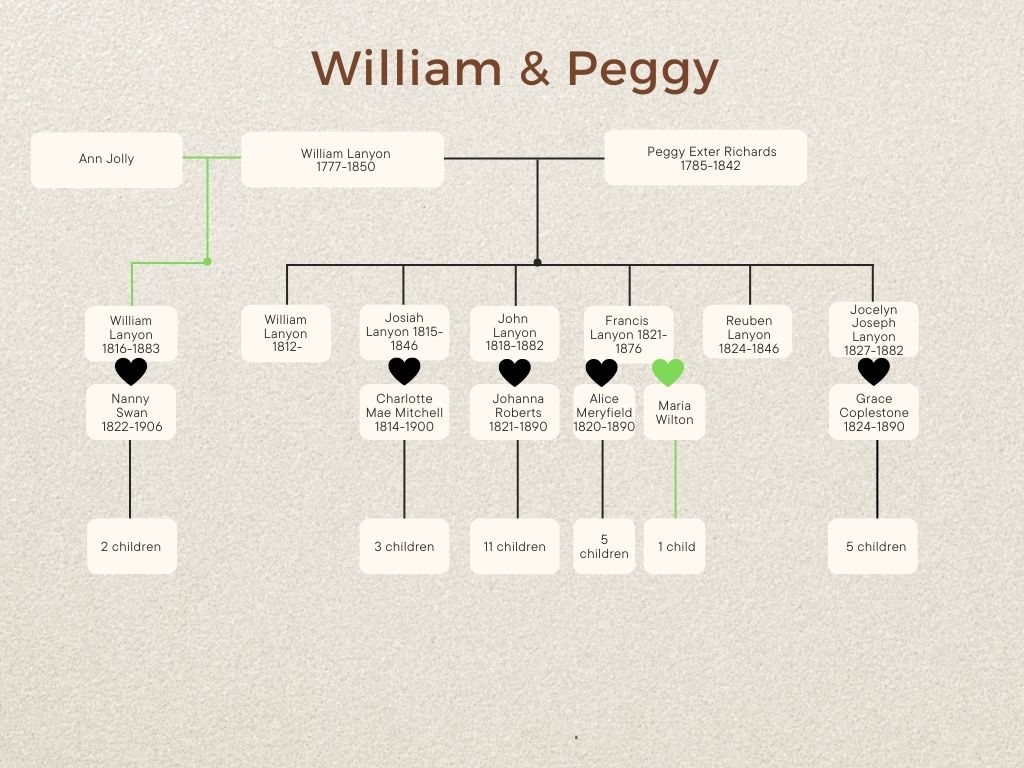
William Lanyon 1777-1850

William was the eldest son and in 1803 he married Peggy Exter Richards at St Allen. They had eleven children:

  • Isabella 1806-1874 married Andrew Batten, a farm labourer at St Allen in 1809 – eight children (Isabella and Sarah may have been twins as they were both baptised on the same day in 1806)
  • Sarah 1806-1876 married Richard Benny, a farm labourer, at St Allen in 1835 – three children
  • Elizabeth -1809 died young
  • Elizabeth 1811-1873 no trace of a marriage and date of death is possibly not correct
  • William 1812- aft. 1846 married Elizabeth Gill Bishop at St Allen in 1835 – five children but can’t trace any of them after 1846, perhaps they emigrated?
  • Josiah 1815-1846 married Charlotte Mae Mitchell
  • John 1818-1882 married Johanna Roberts
  • Francis 1821-1876 married Alice Meryfield
  • Reuben 1824-1846
  • Jocelyn Joseph 1827-1882 married Grace Coplestone
  • Hubert 1829-1848 died young

William also had an illegitimate child with Ann Jolly a farm servant:

  • William 1816-1883 married Nanny Swan

Two sons called William just adds to the confusion!

His father Richard died in February 1838 and he had changed his will and left his estate to his son Richard and a codicil removed an annuity of £7 for William. In Mar 1838 he was sent to Bodmin Debtor’s Prison as he had a debt of £93. 3/-1d owed to Thomas Nicholas.

Perhaps the will was changed to protect the estate from legal action from Thomas Nicholas to recover his debt?

He was released from jail in Oct 1847 almost ten years later! He was permitted to remain at the jail for one extra night as neither his family nor his friends had come to pick him up and he was too weak to proceed alone. His wife Peggy had died in 1842.

He died at Little Trevalsa, St Allen in 1850 aged 72.

Richard Lanyon 1783-1860

Richard was the fourth son of Richard and Elizabeth (second son John was a bachelor). He was a farmer and inherited his father’s estate, Polstain. He married Elizabeth Vincent at St Allen in 1803, so father and son were both Richard Lanyons married to women called Elizabeth! He and Elizabeth had thirteen children:

  • Paul Vincent 1804-1882 was a farmer and agricultural labourer at Lanner Mill. He married Jane Truran at St Allen in 1854 at the age of 50. There were no children.
  • Elizabeth 1805-1807 died in infancy
  • Mary 1807-1866 married Paul Clark a farmer and a widower in 1838, they had one daughter, Elizabeth Jane Vincent Lanyon Clark.
  • Richard 1809-1878 married Catherine Lanyon
  • Elizabeth 1810-1873 married Henry Lanyon
  • Catherine 1812-1895 spinster
  • Robert Vincent 1814-1894 married Elisabeth Bowden
  • Bella 1816-1894 married Thomas Johns – emigrated to Ballarat, Australia – seven children
  • Oliver Vincent 1818-1821 died in infancy
  • Samuel 1821-1875 farmer at Lanner, married Elizabeth Hosking Gill at Perranzabuloe in 1860 – no children
  • John 1824-1846 died young (Asthenic Fever – fatigue and lethargy, could be from TB) may be the twin of Eliza as they were baptised together
  • Eliza 1824-1897 married Thomas Northcott, a farmer of 50 acres – ten children
  • Louisa 1826-1911 married her widowed brother-in-law Paul Clark in 1872 at St Mary’s Wesleyan Chapel – no children

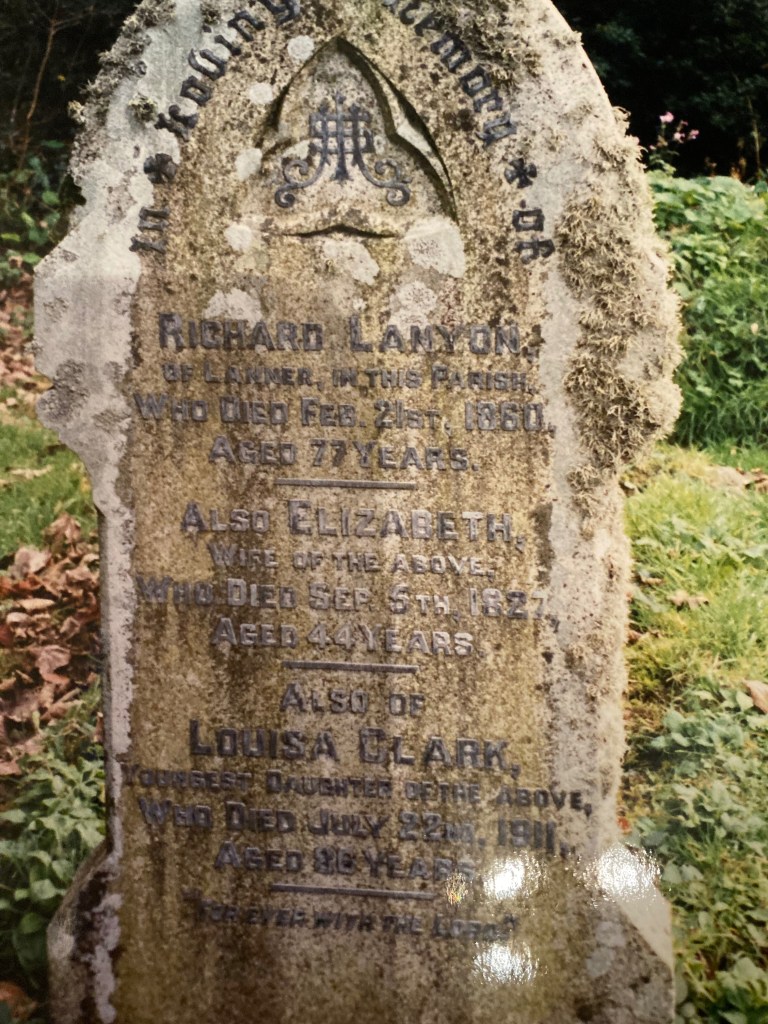
Grave of Richard, Elizabeth and younger sister Louisa Clark.

Simon Lanyon 1785-1839

Simon was baptised at St Allen in 1785 and married Dorothy Hoskins there in 1810. He died at St Neot, Cornwall on 26th Dec 1839 aged 52. His will described him as a yeoman of St Neot. They had eleven children:

  • Ann Buckland 1810-1896 married John Skewes – six children
  • Dorothy Hoskins 1813-1883 married John Clyma at St Neot in 1834 – seven children
  • Simon 1814-1837 died age 22, killed by a kick from a horse, no children
  • Josephus 1816-1817 (twin) died in infancy
  • Josiah 1816-1839 (twin) died age 22 of a seizure, no children
  • Josephus 1819-1844 died at Bodmin Asylum age 26 of a brain fever, no children
  • Elizabeth 1825-1883 spinster, lived with brother John and his family
  • Mary Ellen 1825-1898 married George Clyma – four children
  • Catherine 1825-1894 (3 sisters baptised on the same day so may be older than born in 1825) married Richard Lanyon (son of Richard Lanyon, her uncle) confused yet?
  • John 1826-1908 he was a saddler he married Louisa Smith Upward in Dorset in 1873 – no children
  • Charlotte 1827-1843 died age 16 of spasms. The death was mistakenly recorded as Caroline Lanyon by the undertaker. The entry was corrected in the parish register by G. Morris, Vicar in the presence of Dorothy Lanyon, her mother and Mary Pellow who were present at her burial. (Recorded as Caroline at GRO.)

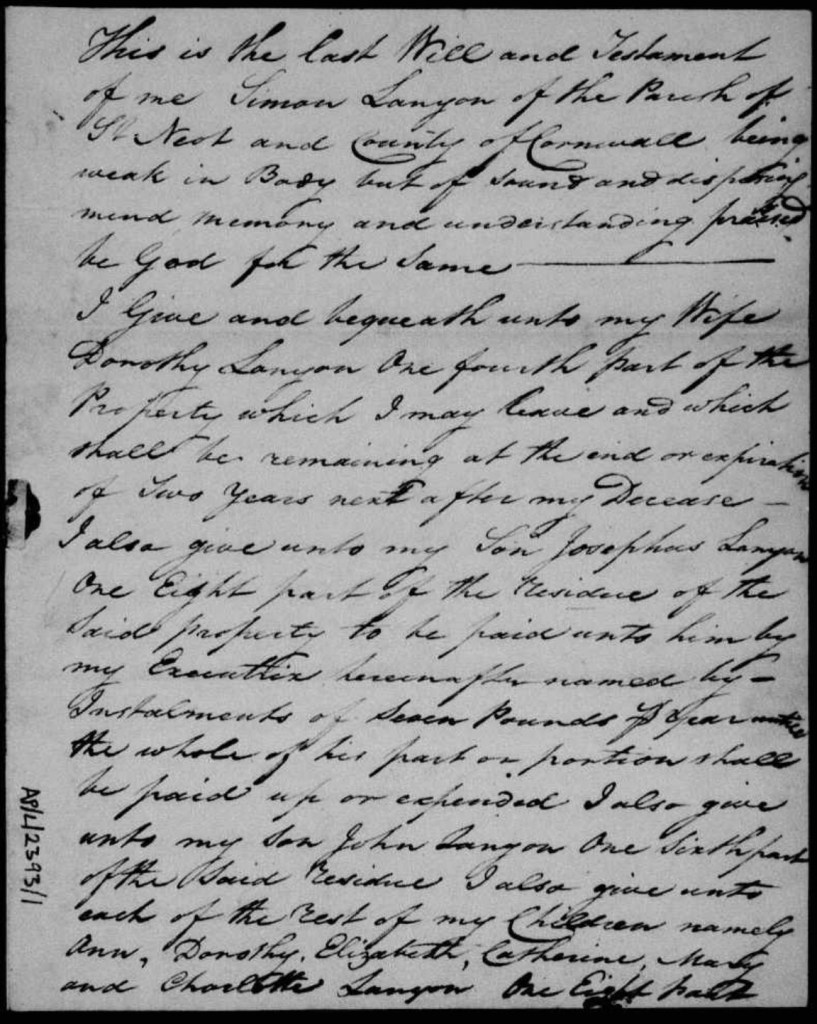
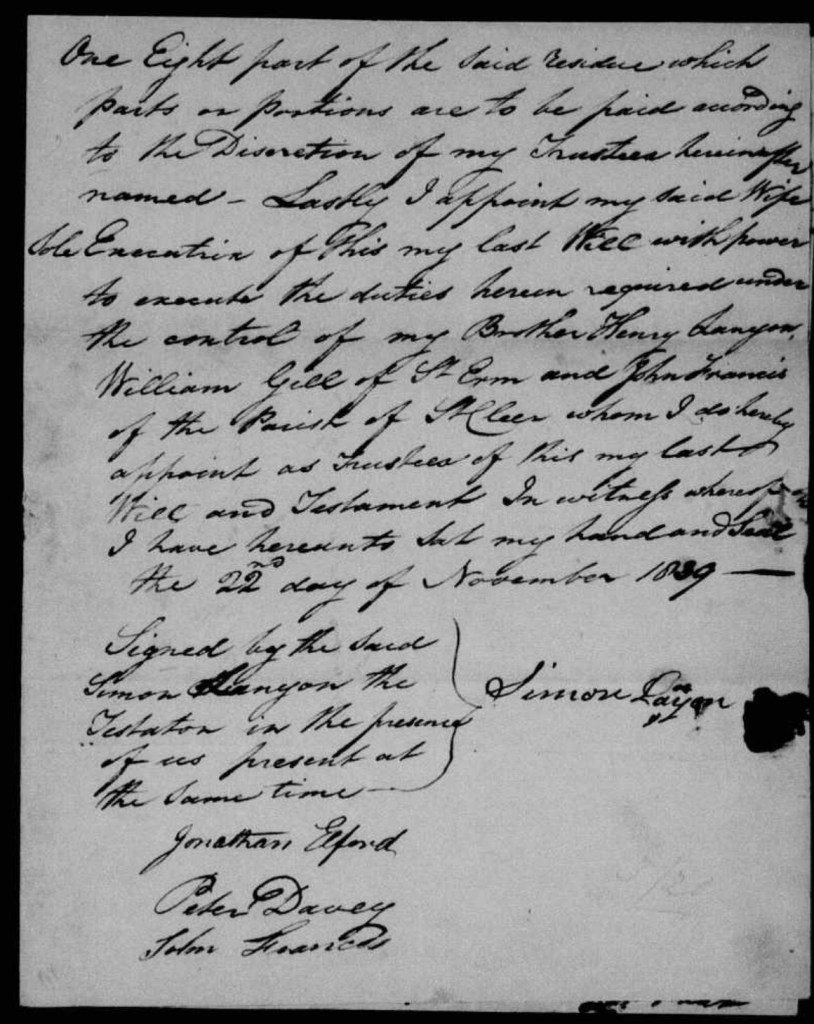
Simon left a will. Source – CRO/AP/L/2393

Partial transcript:

  • To my wife Dorothy one fourth part of residue of said property
  • To son Josephus one eighth part of residue of said property
  • To son John one sixth part of said residue
  • To each of the rest of my children namely: Ann, Dorothy, Elizabeth, Catherine, Mary and Charlotte one eighth residue
  • My wife sole executrix with power to execute the sureties herein required under the control of my brother Henry Lanyon, William Gill of Erme and John Francis of Par, St Cleer whom I appoint as trustees

Robert Lanyon 1786-1834

Robert was the youngest son of Richard and Elizabeth and a farmer at Trevascus in Gorran, he married Grace Roberts at Probus in 1817.

They had nine children:

  • Grace 1818-1893 married age 53 Walter Langford Williams a widower – no children
  • Robert 1819-1920 married twice
  • John Robert 1821- not on 1841 census and no trace
  • Edwin 1822-1870 married Ellen Brewer
  • Julia Roberts 1823-1852 married John Wills – three children, she died of ‘decline’ which could be TB
  • Amy 1825- not on 1841 census and no trace
  • Emma 1826-1889 married Nicholas Westcott at Probus in 1858 – four children
  • Caleb 1828-1856 died young no children, he died of Phthisis (TB)
  • Frederick 1829-1851 died young no children, he died of Consumption (TB)

Henry Lanyon’s story is told in a separate post ‘Captain Cork!

We’ll see what happens to the grandsons of Richard and Elizabeth in another post.