In the 17th century if a house caught fire it could have devastating consequences for the whole town. Wooden buildings burned easily and without a fire brigade to fight the fire the flames could consume huge areas.
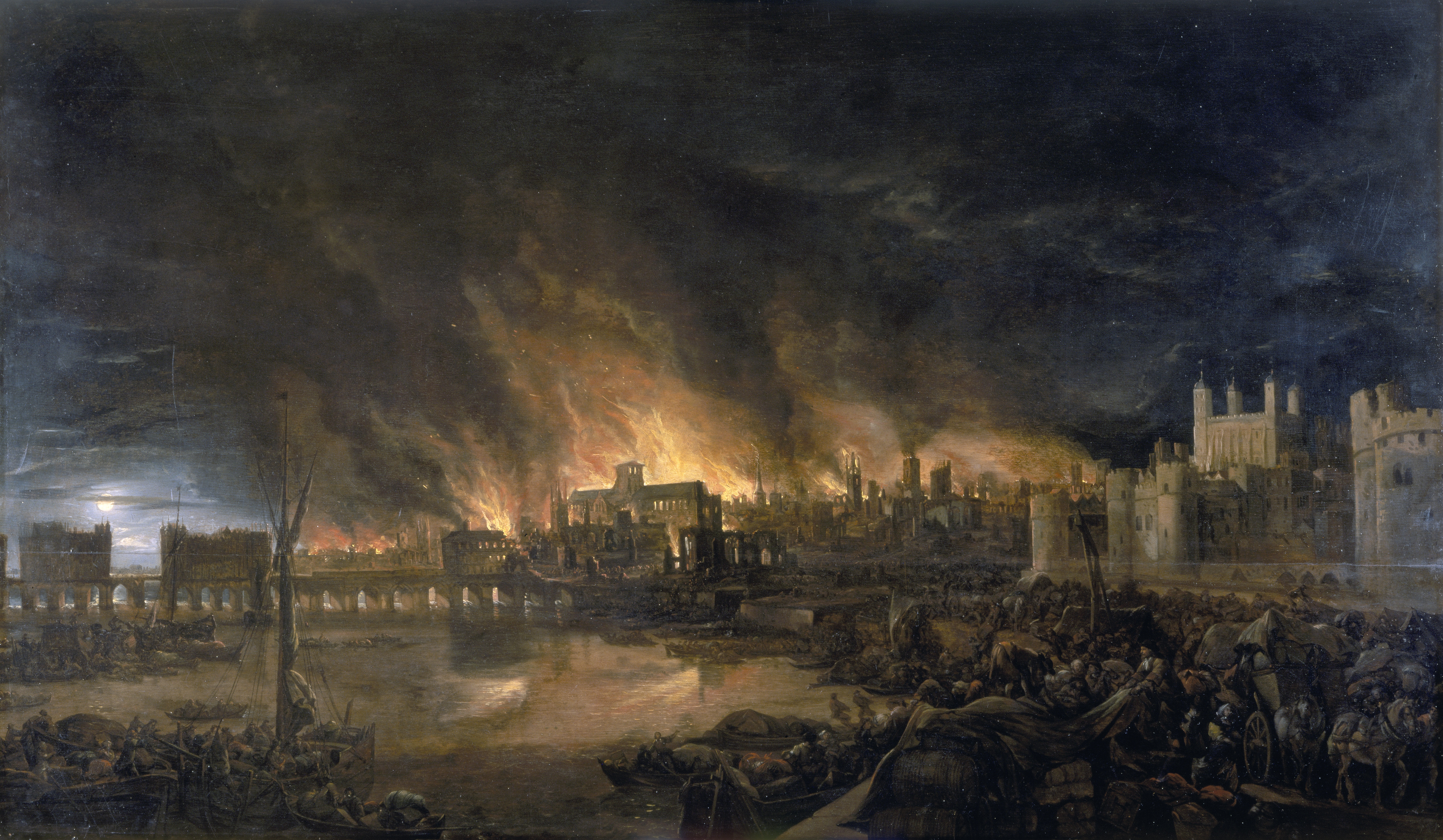
The Great Fire of London in 1666 is probably the most famous fire. It started in Pudding Lane and spread rapidly and destroyed over 13,000 homes, 87 churches and St Paul’s Cathedral in the medieval city. Miraculously the death toll was relatively small.
1666 Great Fire of London – Museum of London, Public domain, via Wikimedia Commons
In 1659 the town of Southwold in Suffolk suffered a devastating fire. Over 450 buildings were lost and many families faced poverty and ruin. In the space of four hours the town was changed forever.
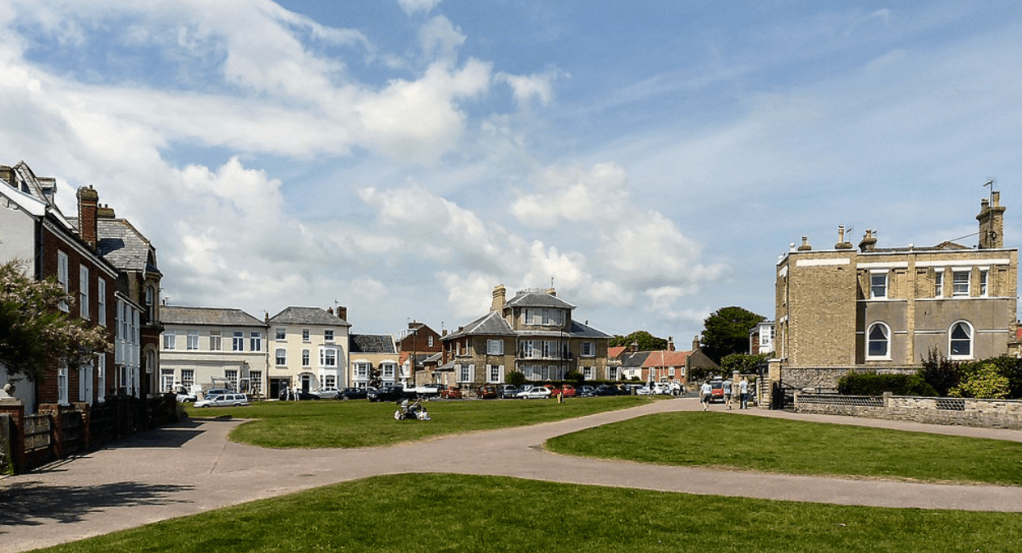
The fire left many open spaces and the town didn’t rebuild on them. This created natural fire breaks and has resulted in the town having lots of green spaces today.
The green spaces in Southwold today.
So why am I mentioning this on a Lanyon website? On the 2 October 1659 the church warden at St Michael Penkevil Church in Cornwall held a collection for the inhabitants of Southwold in Suffolk who had ‘suffered fire’. He collected £2. 8/- 1d.
The church warden was John Lanine, he was described in the Parochial History of Cornwall by Davies Gilbert as ‘a sea sand barge daily labourer’. He was the father of John Lanyon who is the subject of the post ‘Poisoned’.
The stone that commemorates the 300th anniversary of the fire.
Occasionally you come across a document which really helps to paint an accurate picture of a person.
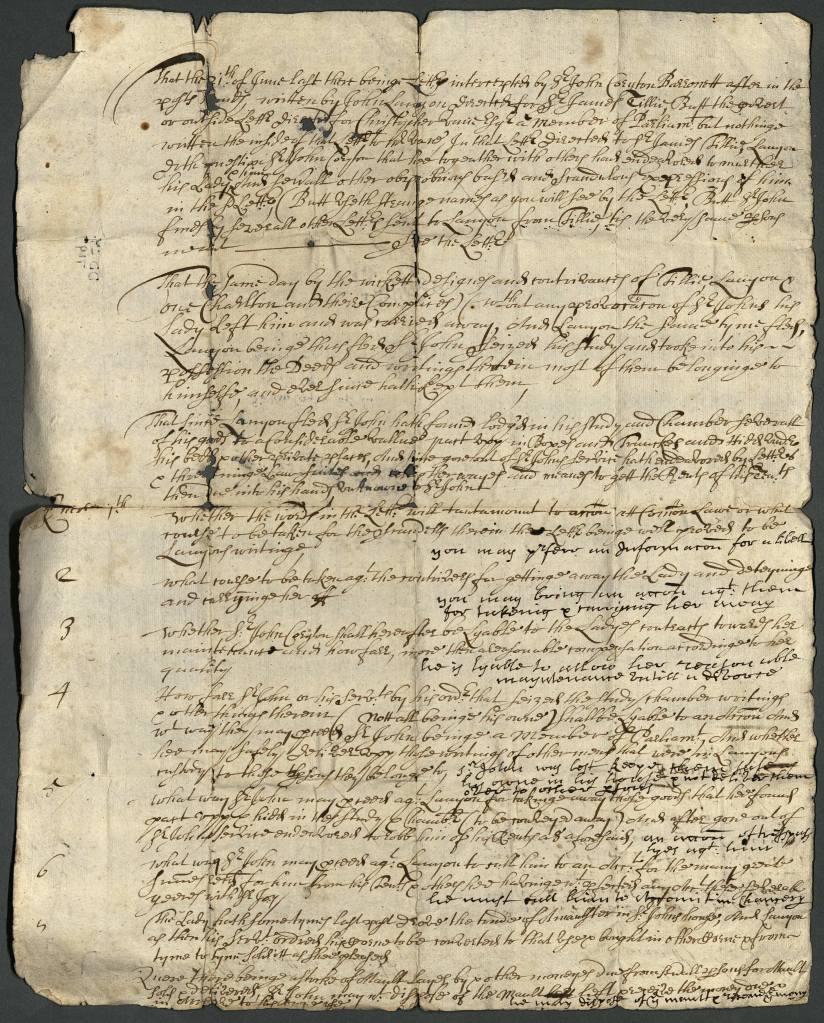
Whilst searching through the online archives at Kresen Kernow (Cornish Record Office) I found a legal opinion dated 1689 for Sir John Coryton against Sir James Tillie. This is of interest to us as Sir John’s servant was called John Lanyon.
From the documents held at Kresen Kernow John Lanyon was witnessing Sir John Coryton’s documents from 1674 onwards so by 1689 he must have been a trusted member of staff.
Sir John Coryton was the 2nd baronet of Newton Ferrers. He was married to Lady Elizabeth.
Sir James Tillie was Sir John Coryton’s land agent. He wanted to be married to Lady Elizabeth!
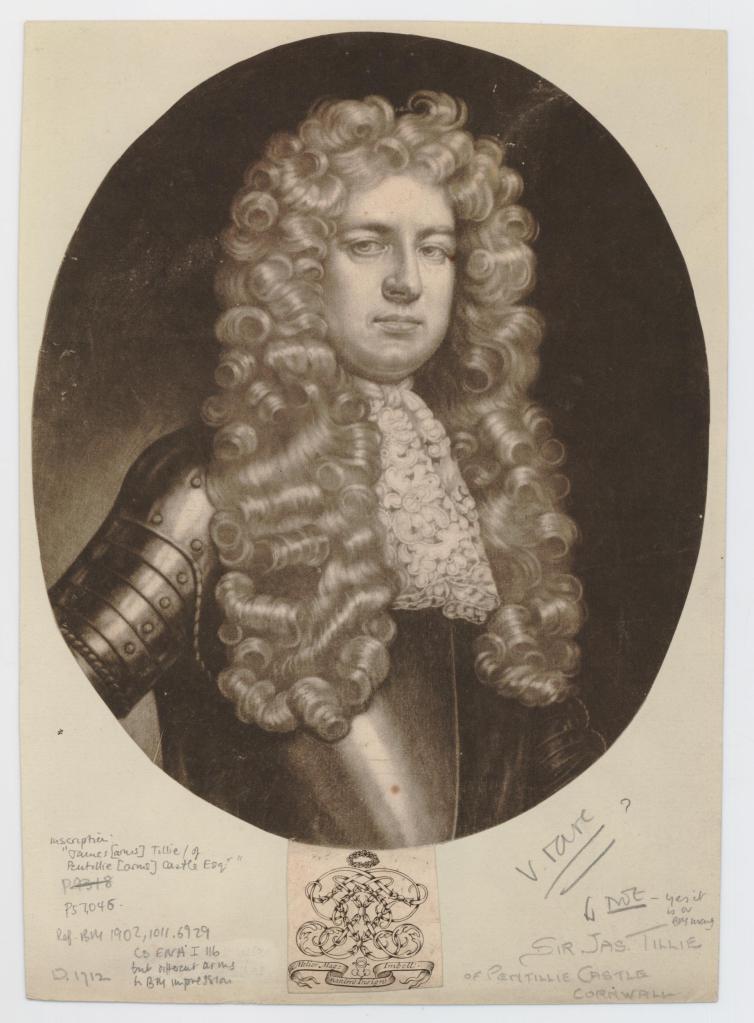
Sir James Tillie – Creative Commons Licence
The counsel’s opinion for Sir John Coryton against Sir James Tillie details how Sir John’s wife Elizabeth had been ‘carried off’ by Sir James Tillie. Sir John was advised that he could take action against the man/men who carried off his wife but he was liable to give her reasonable maintenance until a divorce.
The document also explains that Lady Coryton had been a ‘maltster’ (a brewer) in Sir John’s house and he was advised that he could sell the stock and receive the proceeds. The legal opinion goes on to explain that if Lady Coryton was with child which Sir John did not want to inherit then he must sue for divorce but must have full proof of adultery.
Elizabeth was the daughter of Sir Richard Chiverton who had been Lord Mayor of London from 1657-1658.
Whilst all this was going on John Lanyon had been busy defrauding Sir John. He wrote secret letters to James Tillie threatening to murder John Coryton and his wife. When Lady Elizabeth left her husband and was ‘carried away’, John Lanyon, realising the game was up, fled.
After he’d gone papers and goods belonging to Sir John were found in Lanyon’s study. These showed that he had been threatening Sir John’s tenants and trying to obtain rents and properties.
Legal Opinion 1689 – Source CY/7197
Conveniently Sir John died mysteriously at the age of only 42. There is speculation that he was poisoned. Lady Elizabeth married Sir James Tillie who divided the Newton Ferrers estate and built ‘Pentillie’. John Lanyon escaped prosecution.
Rod Allday / Pentillie Castle
James Tillie died in 1713 and his will left instructions that he was not to be buried but placed in a vault sitting in a sturdy chair in his finest clothes with his pipe so he could await resurrection! His instructions were carried out but his body was later moved and then lost. 300 years later it was found!
So what happened to John Lanyon and where does he fit on the tree?
Clearly John Lanyon was an educated man. If he was working for Sir John from 1674 onwards then he was probably born early 1650s.
There are currently 315 John Lanyons on the family tree but there is only one candidate that really stands out and that is John Lanyon 1652-1720. (See post ‘William ‘Generosi’ Lanyon of Breage.)
John was the eldest son and heir of John Lanyon a ‘sea and sand barge daily labourer’.
The Parochial History of Cornwall stated that John Lanyon senior:
‘…had a son named John Lanyon who having had his education under Hugh Boscawen, gent, Master of Arts, who kept a school at St Michael Penkevill Church, became afterwards a steward to Trefusis, St Aubyn, Coryton and lastly came into the service of Brook Lord Chandos, and having by these services accumulated considerable riches he gave lands and built and endowed an almshouse for the poor people.’
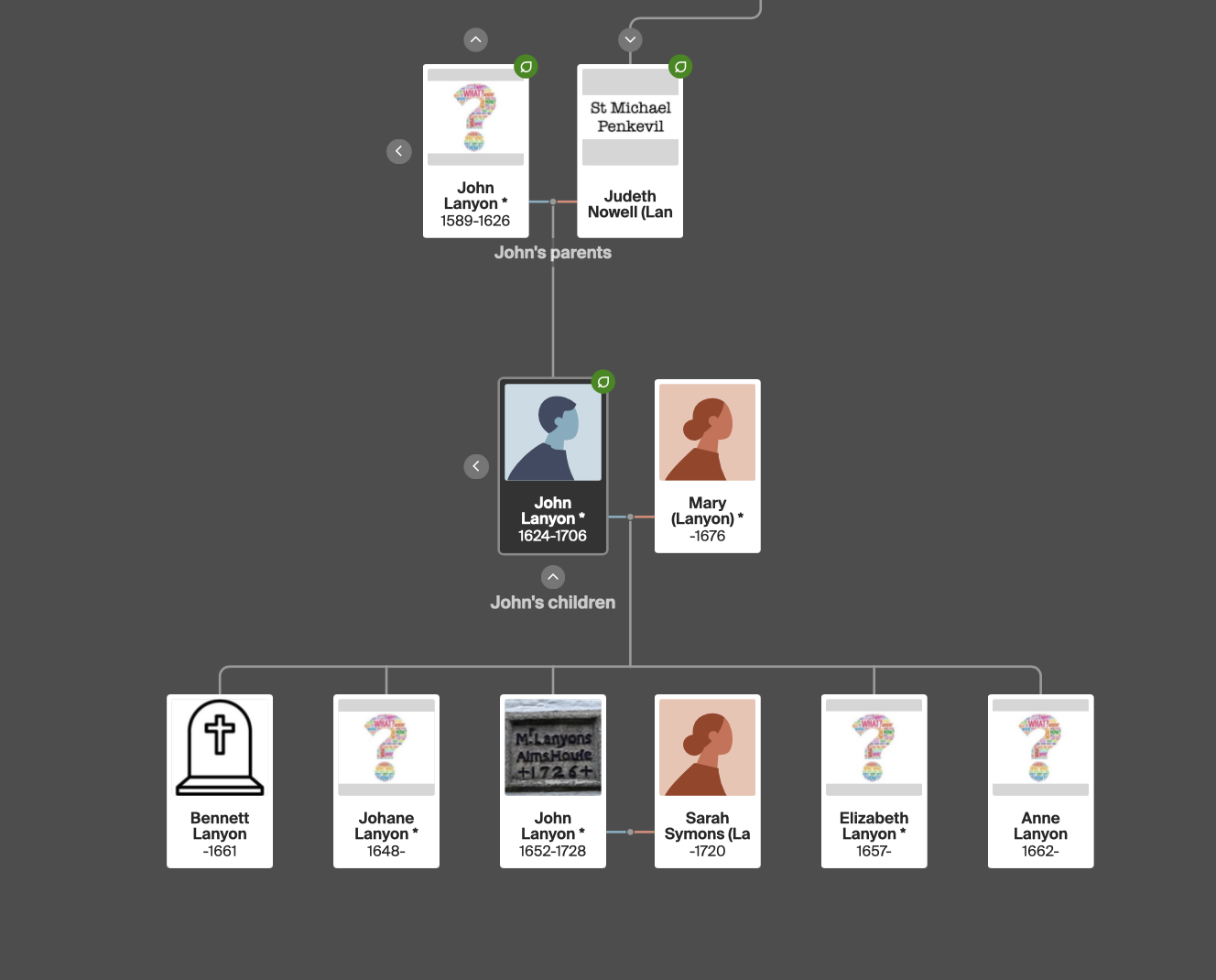
John Lanyon’s branch of the tree.
After he fled he must have headed to London and persuaded Lord Chandos to hire him. He later married Sarah Symons. We now have a pretty good idea how he acquired ‘considerable riches’! Perhaps the alms houses were a way to atone for past sins!
For more information see Nigel Baker’s article on John Lanyon:
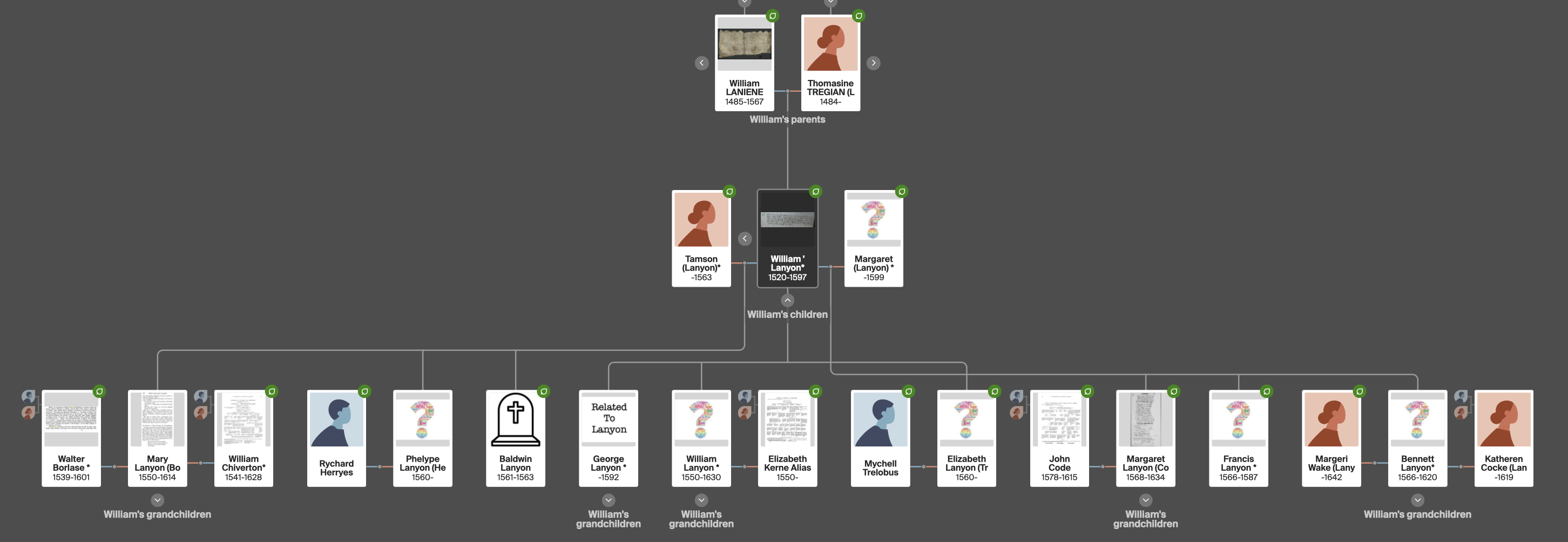
William Laniene and Thomasine Tregian had four sons: Richard, William & Walter and a previously undocumented son – Edward.
Richard was the son and heir, Walter lived at Madron, we lose track of Edward after 1586 and William founded the Breage branch of the Lanyon tree.
William ‘Generosi’ Lanyon had 8 children and with the exception of Baldwin it’s not clear who gave birth to each child. I’ve noted the dates of marriage as we don’t have dates of baptism for any of them except Baldwin.
William was probably born about 1520 in Gwinear. There is no mention of any Lanyon on the Breage Subsidy Roll of 1543 so his move to that area happened after that date, possibly 1569.
William’s first wife was Tamson, we don’t know the date of marriage nor how many children they had. William and Tamson had a son Baldwin who was buried on 24 Jun 1563 at Gwinear aged 2 and Tamson was buried two days later.
Sometime after 1563 William married Margaret. Variously I’ve seen her named as Margaret Tresilian or Margaret Kekewich but can’t find any proof for either.
There are a further seven children but it is not clear if they are from the first or second marriage.
William abt. 1550-1630
Phelype abt. 1558-
Mary -1614
Elizabeth abt. 1560-
Margaret abt. 1560-1634
Bennett abt. 1566-
Francis abt. 1566-
In 1553 William is mentioned in a pre-marital settlement on Benedict Penrose and Jone Lanyon, his sister. William is a trustee and is called ‘junior’ as his father William Laniene is still alive.
William is listed on the 1569 Muster Roll for Breage, Cornwall. “Furnished long bow sheaf arrows steel cap and black bill. Willm Lanyne”
In 1581 William Lanyon of Tregonen in Breage, gent, and William Lanyen (sic) junior his son and heir to William Painter of Trelysick heir in St Erth ‘Trelysick Walbert in Erghe’. (Source – Royal Institution of Cornwall.) This is the only mention of their home ‘Tregonen’ that I’ve come across. Tregonen may be Tregonning today.
In 1582 William was appointed overseer by John Rashleigh of Fowey (his brother-in-law).
William appears in the records again in 1595 at Helston, William Lanion (sic) gent of Breage, 4 pieces of tin of 1726lbs for coining.
He was buried on 7 Aug 1597 at Breage and left a will which is now sadly lost. In the Breage parish records he is described as ‘generosi’ due to his generosity.
Jane Veale Mitchell suggests that George Lanyon, gent, of Sancreed is the son of this William. I have found no documentary evidence but she did have access to wills which are now destroyed.
William Lanyon’s Children
William Lanyon abt.1550-1630
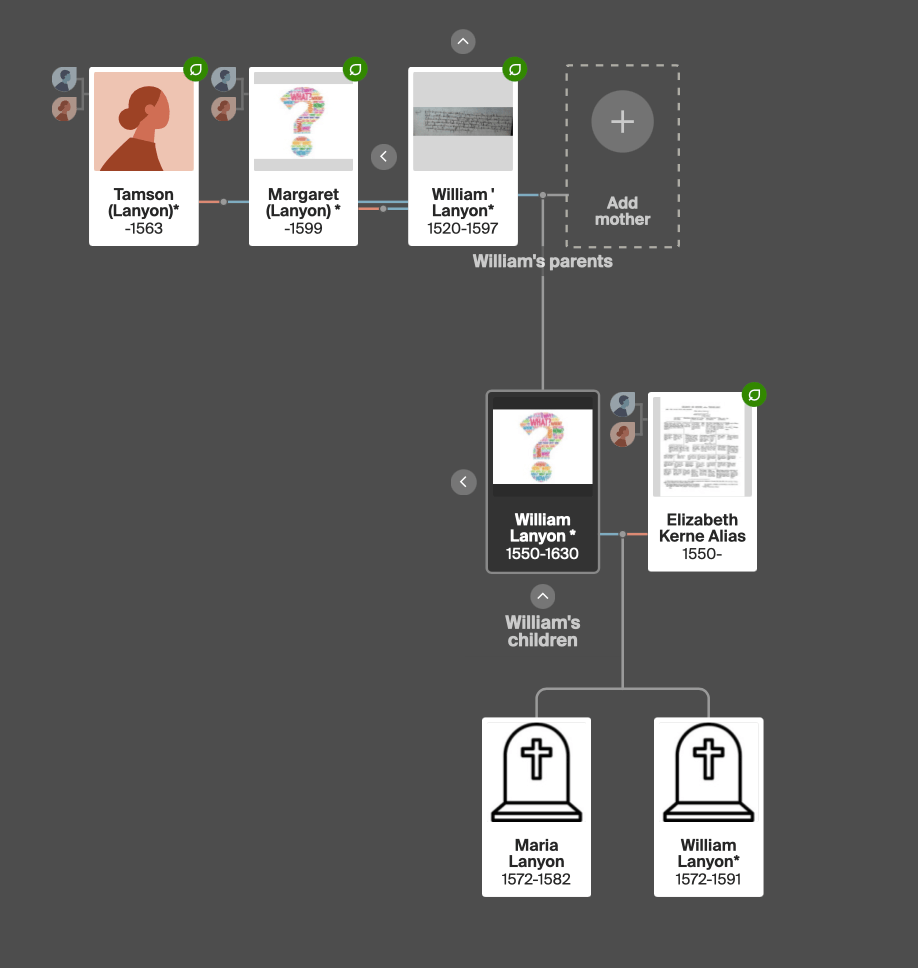
William Junior (eldest son and heir) married Elizabeth Kerne alias Tresilian the daughter of Paskowe Kerne alias Tresilian and Margaret Vivyan. They married at Breage in 1572 which makes it likely that he was born in the 1550s. They had two children:
William -1591 died in infancy
Maria -1592 died in infancy
William died at Breage in 1630 with no other heirs.
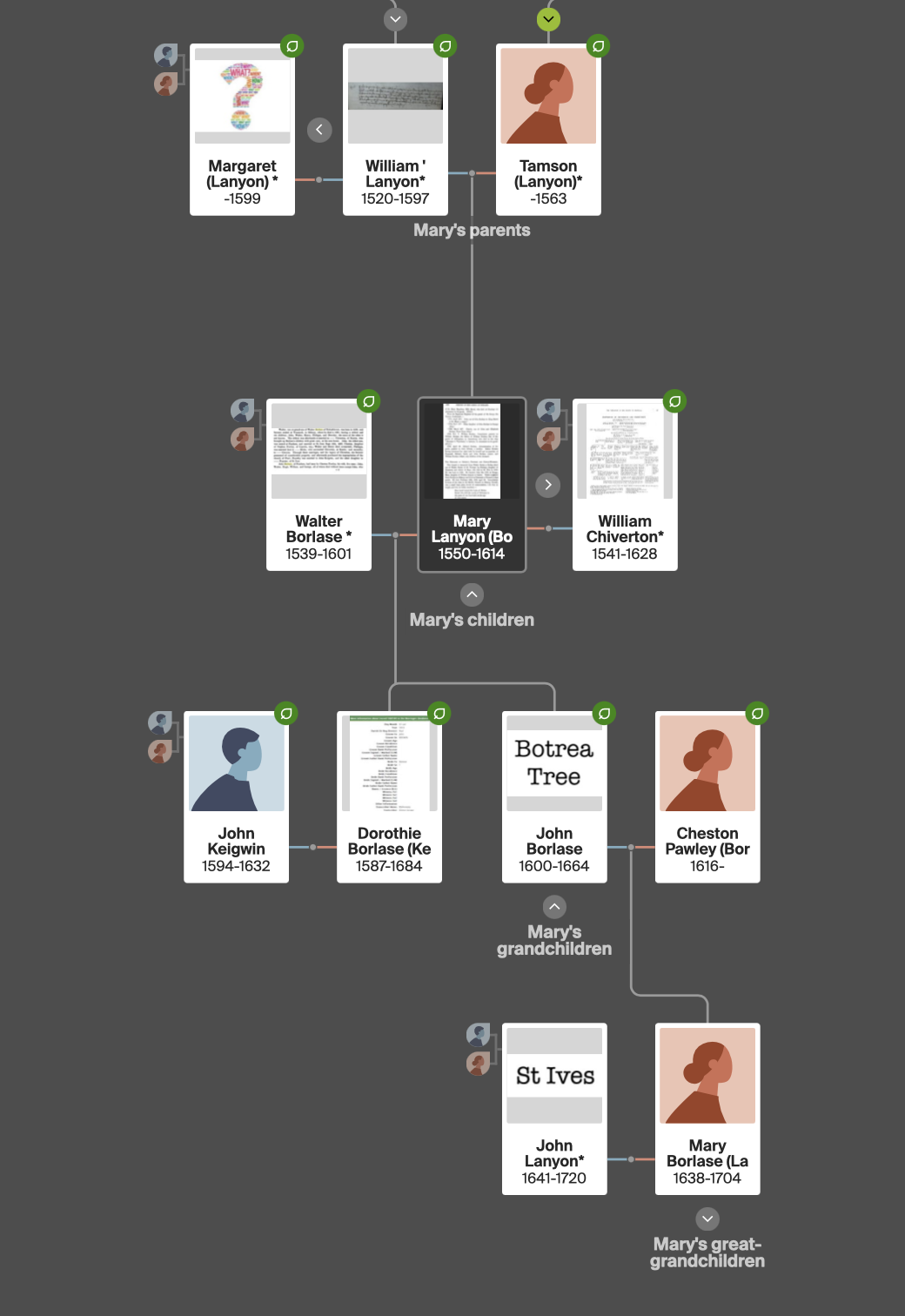
Mary Lanyon -1614
Mary married Walter Borlase at Breage in 1576 so was probably born in the 1550s. They had nine children:
William 1577-1653
Philippa 1579-1682 married Nicholas Hicks
Thomas 1583-
Walter 1584-1679
Harry 1585-1653
Mary 1586-1681
Dorothie 1587-1684 married John Keigwin
John 1600-1664 married Cheston Pawley, their daughter Mary Borlase married John Lanyon of St Ives (Botrea branch of the tree.)
Ann
Walter Borlase died in 1601 and Mary married William Chiverton.
Elizabeth Lanyon abt. 1560–
Elizabeth married Mychell Trelobus at Breage in 1581. No further information about them.
Phelype Lanyon abt. 1558-
Phelype Lanyon married Rychard Herryes at Breage in 1583. No further information about them.
Margaret Lanyon abt. 1550-1634
Margaret married John Code at Breage in 1584. They had five children: John, Blancia, Loveday, Thomasin and Elizabeth. John’s grand daughter Patience married Ralph Lanyon (the son of Thomas Lanyon and Mary Levelis of Madron.)
Francis Lanyon bef. 1566-aft. 1587
Francis is mentioned in a legal document of 1587 which shows he is at least 21 and therefore born 1566 or earlier. There is no further trace of him.
“ME Edgcumbe family of Cotehele, Calstock and Mount Edgcumbe, Maker.
Ref No ME/501Title: Quitclaim, land in Menyghye Veor, Wendron
Date 1 May 1587
Description
Parties: 1) Bennett Lanyen and Francis Lanyen, gentlemen of Breage
2) William Lanyen of Breage, gentleman, father of party 1.
Property: Land held of demise of Edward Sparnan, gentleman, deceased, in Menyghye Veor in Wendron.”
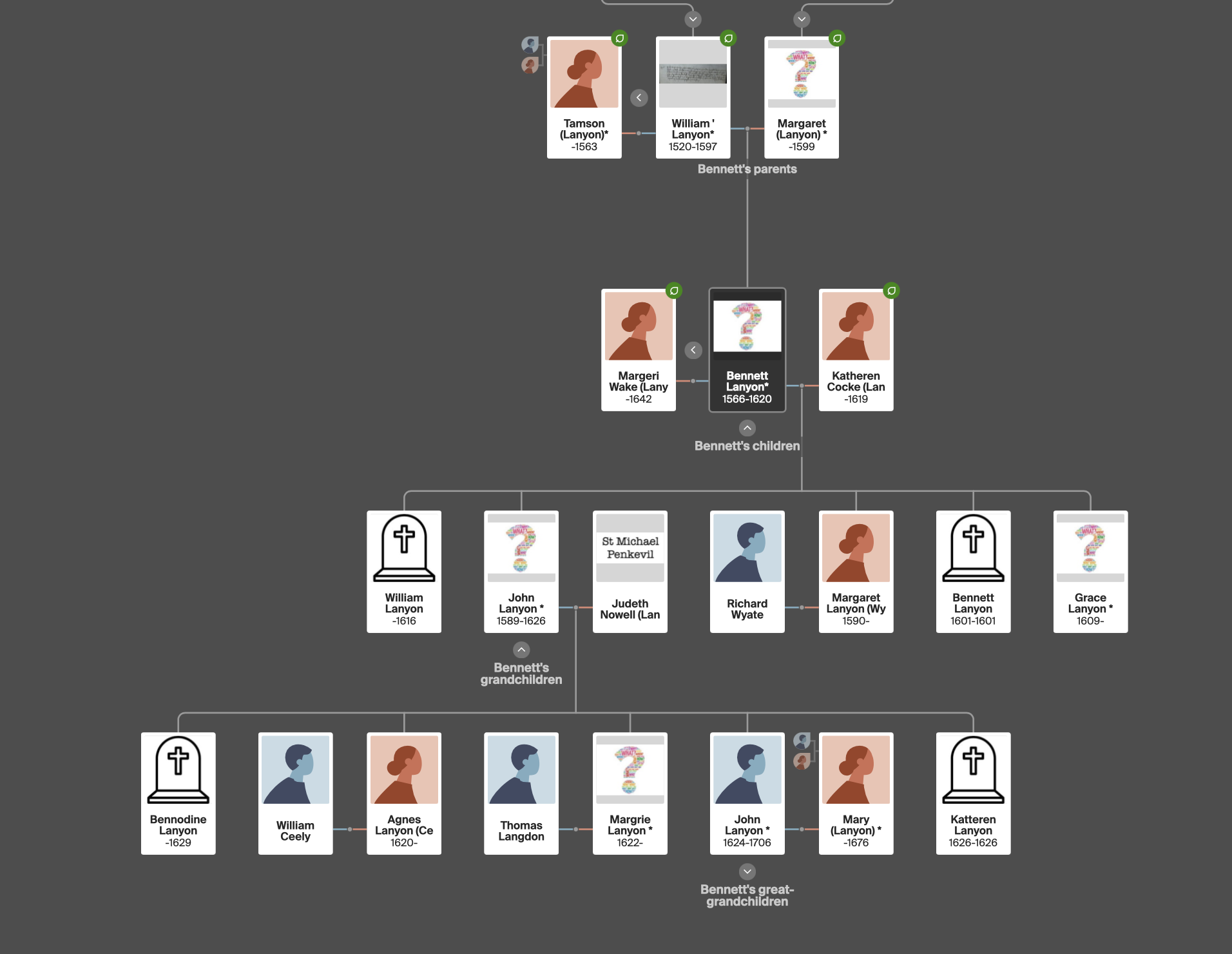
Bennett Lanyon bef. 1566
Bennett married in 1589 to Katheren Cocke and they had four children:
John aft. 1589-aft. 1626
Bennet 1601-1601 died in infancy
Grace 1609- no further trace
William – 1616 died young
His second marriage was to Margeri Wake in 1620 at St Michael Penkevil. No children traced from this marriage.
Bennett’s descendants
John Lanyon aft. 1589-aft. 1626
John, the son of Bennett, married Judith Nowell at St Michael Penkevil on 26 Apr 1618. They had four children:
In 1641/2 he or his son John, signed the Protestation Return for St Michael Penkevil – name spelt John Lanine. If he signed the protestation return he must have been alive in 1641/2. There is only one Lanyon that signed the Protestation Return so it seems likely that it was signed by his son and he was dead by this date.
Margrie 1622- a Margery Lanyne married Thomas Langdon at Truro St Mary in 1654, it’s possible that it is this Margery
Agnes born abt 1620. there is no evidence that Agnes was John & Judith’s daughter but she married William Ceely at St Michael Penkevil 22 Jun 1646 and there is no other Lanyon family in the town at that time.
John 1624- aft. 1664 married with five children
Kateren 1626-1626 died in infancy
Bennodine -1629 died in infancy
St Michael Penkevil Church is close to Lamorran on the map.
John was the son of John & Judith. He is probably the person who signed the 1641/2 Protestation Return. In 1664 he paid Hearth Tax in St Michael Penkevil.
The Parochial History of Cornwall by Davies Gilbert. 1838 described him thus:
“Mr. John Lanyon of this parish, a sea sand barge daily labourer.”
John married Mary, we don’t know the surname of John’s wife as his marriage wasn’t recorded but they had five children:
Johane 1648- no further trace
John 1652-1726
Elizabeth 1657- no further trace
Anne 1662- no further trace
Bennett – 1661 died young
We don’t have any record of what happened to his daughters, but we do know what happened to his son John.
John Lanyon 1652-1726
John was the eldest son and heir of John Lanyon, a ‘sea sand barge daily labourer’ and his wife Mary.
The Parochial History of Cornwall stated that John senior:
“had a son named John Lanyon who having had his education under Hugh Boscawen, gent, Master of arts, who kept a school at St Michael Penkevill Church, became afterwards a steward to Trefusis, St Aubyn, Coryton and lastly came into the service of Brook Lord Chandos, and having by these services accumulated considerable riches he gave lands and built and endowed an almshouse for poor people.”
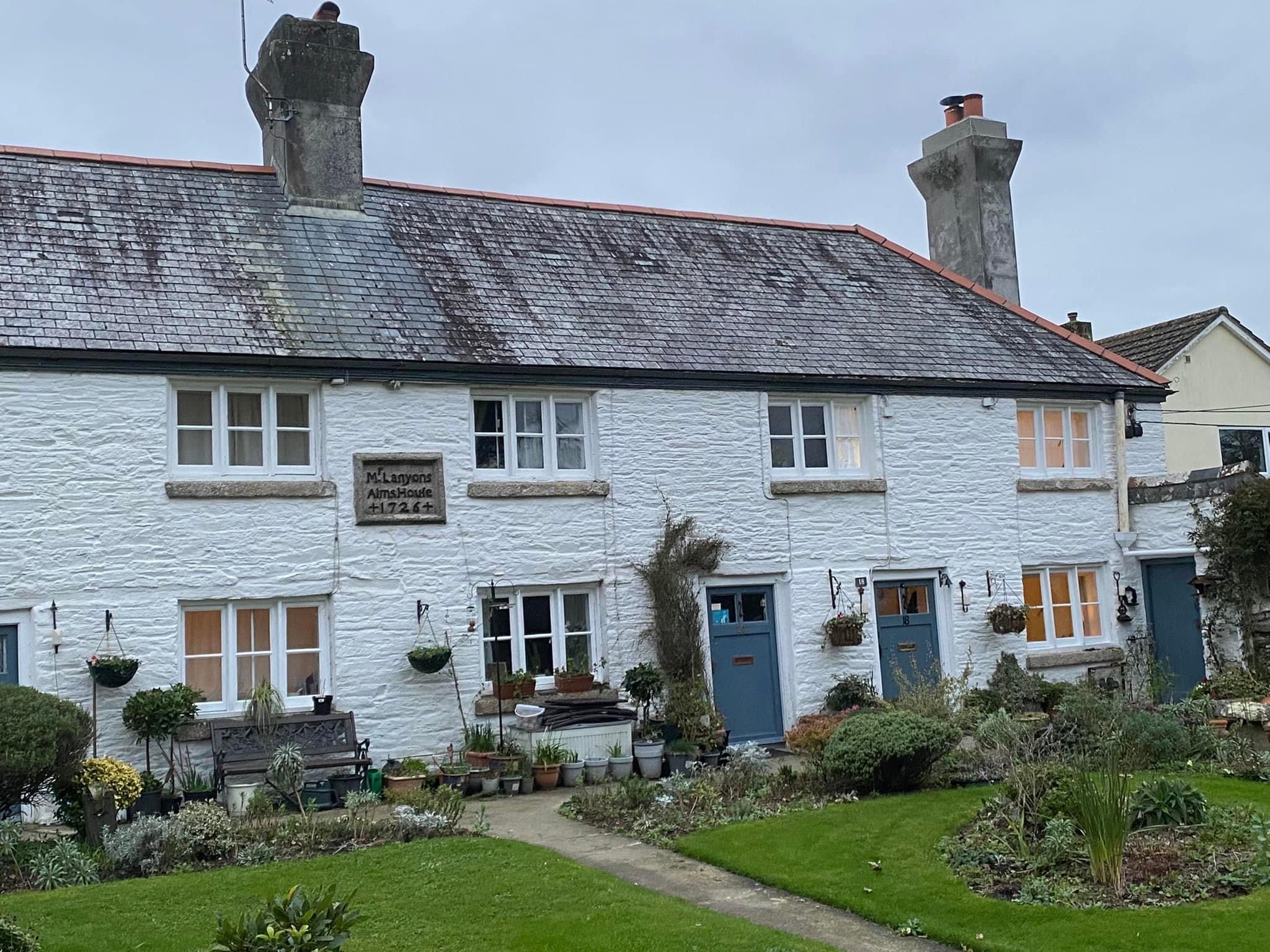
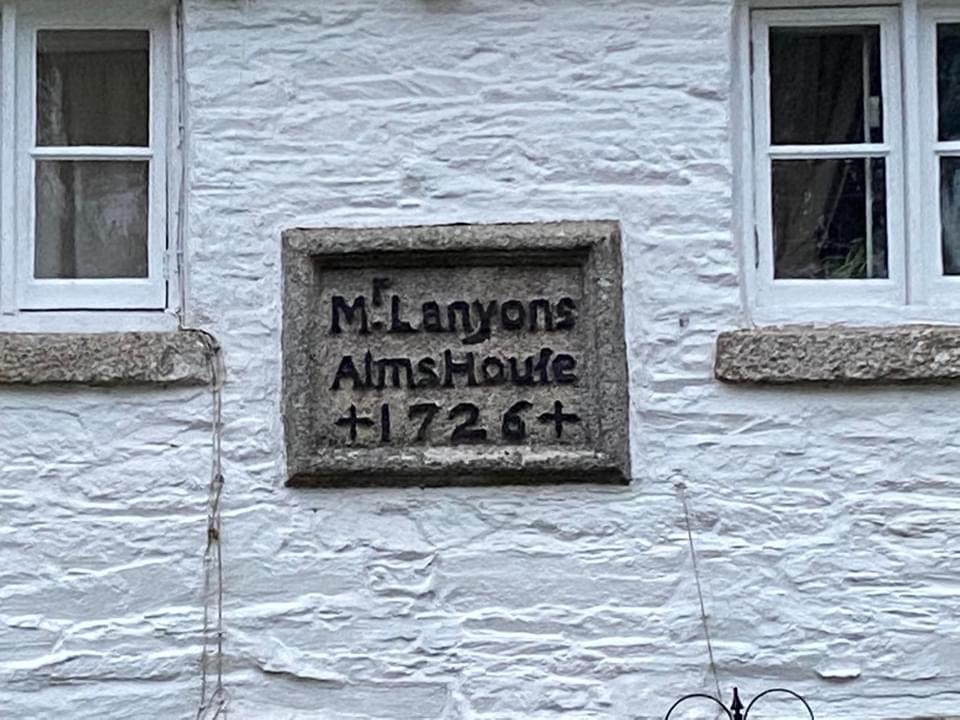
The almshouses built in 1726 are still there today.
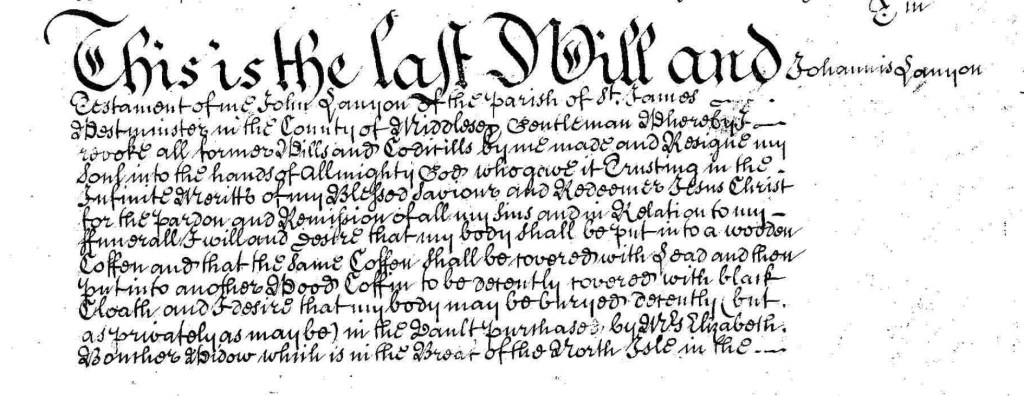
John may have married Sarah Symons although I cannot find a record for this. He didn’t have any children and died in 1726 at St James in London but left a very interesting will naming lots of Cornish people.
The Will of John Lanyon of St James Westminster – Source NA/PROB 11/620/334
In his will he asks to be buried ‘as near as may be to my wife Sarah.
Mentions brother -in-law Jonah Symons of Mylor (he was a clothier).
Niece Anne Tresidder, wife of Nicholas Tresidder of Budock.
Brother-in-law Richard Oliver, Wymouth, wool stapler.
Codicil dated 1726 mentions sister-in-law Mesdames Francis and Jobson.
Benjamin Brown, son of late brother-in-law Benjamin Brown.
My kinswoman Mrs Lanyon, widow of Thomas Lanyon and daughter. We don’t know which Thomas Lanyon he is referring to.
There is also a property transaction dated 29 Sep 1683 (Source – CRO CY/378) which links John to the Symons family.
James Tillie – Middle Temple Esq
Richard Symons of Kea, yeoman and John Lanyon of Kea, yeoman. Bargain and sale Lanner Wood and Lambe Wood in Kea, part of Manor of Landegay. To have two years ‘for the rynding, felling, cutting down, coaling, working upp and faggotting’ these coppice woods.
This was witnessed by a John Lanyon as well.
(See the post ‘Poisoned?’ in The Black Sheep category, for more information about John.)
And here ends the Breage branch of the tree.
In many parishes, during the Civil War and Interegnum, records were poorly kept or omitted altogether. The government appointed lay people to take on this task rather than priests and as there was a charge for registering births – 4d (and it was births, not baptisms at this time), marriages 1/- and burials 4d many people did not record their family’s life events. The Breage branch may end here but there were probably descendants of this branch that we just cannot trace.




 The Lanyons