The Huguenot Branch

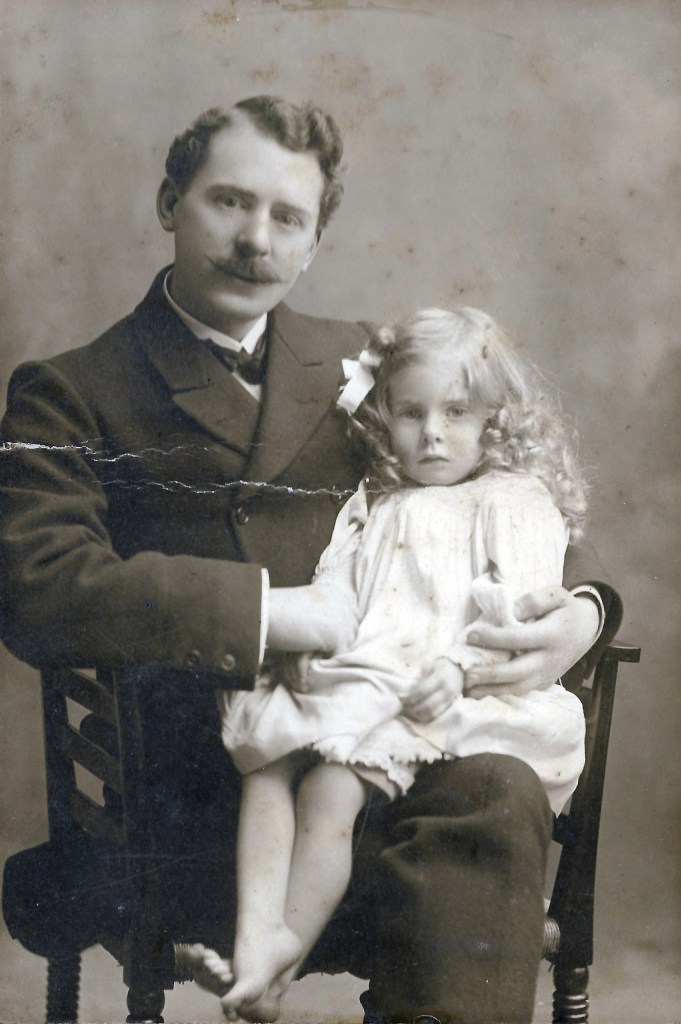
Catherine Septima Lamotte 1874-1958 married Arthur Herbert Lanyon, this is her family’s story.

The Lamotte family were Huguenots.

In 1642, in Switzerland, Claude LaMotte and Jeanne LeClair had a son Claude Lagier LaMotte. (Some researchers name Antoine Lagier as the father but the only record I have found names father and son as Claude.)

Claude married Marie Caillat on 16 May 1684 • Vierzon, France. (Marie’s father is also named Claude on the marriage record!) Perhaps it was a second marriage for Claude LaMotte, who was 42 at the time of his marriage. I have only traced two sons, Daniel born in 1698 and John (Jean) born in 1708 when his father was 66 years of age.

The family appears to have moved between France and Switzerland. John was born in France but Claude died in Geneva, Switzerland on 05 Mar 1712.

We next see Jean in George II’s State papers when a bill in the House of Lords was passed to naturalise Jean Lagier Lamotte. His brother Daniel became a British citizen in 1742.

On 06 Feb 1734  at  St Martin Orgars French Huguenot Church, St Martin’s Lane, London Jean married Louise D’Albiac, the daughter of Capt. James D’Albiac and Louise De La Porte.

James Dalbiac

James D’Albiac was born 28 Nov 1681 • Nîmes, Gard, Languedoc-Roussillon, France, the son of Scipion D’Albiac and Marie Durand. Scipion was born 18 Jan 1650 at Nîmes.

They anglicised their name to Dalbiac. The Dalbiacs lived at 20 Spital Square, Spitalfields London.
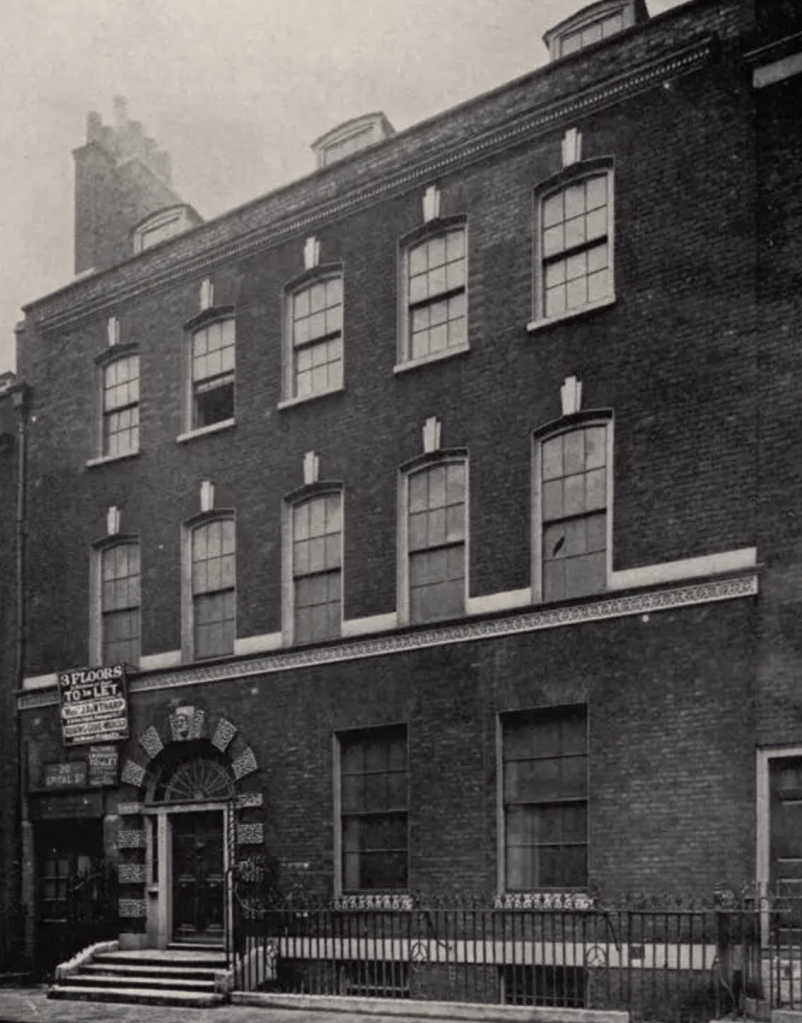
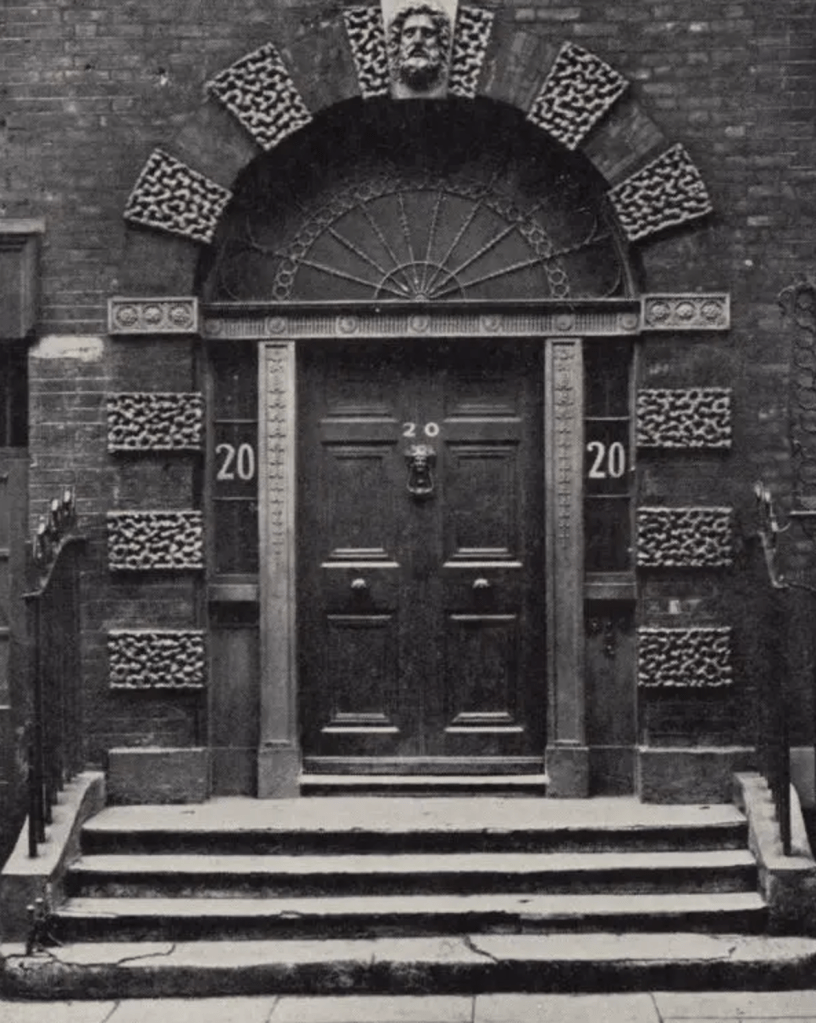
20 Spital Square – https://spitalfieldslife.com/2017/07/29/lost-spitalfields-2/

The doorway of 20 Spital Square – https://spitalfieldslife.com/2017/07/29/lost-spitalfields-2/

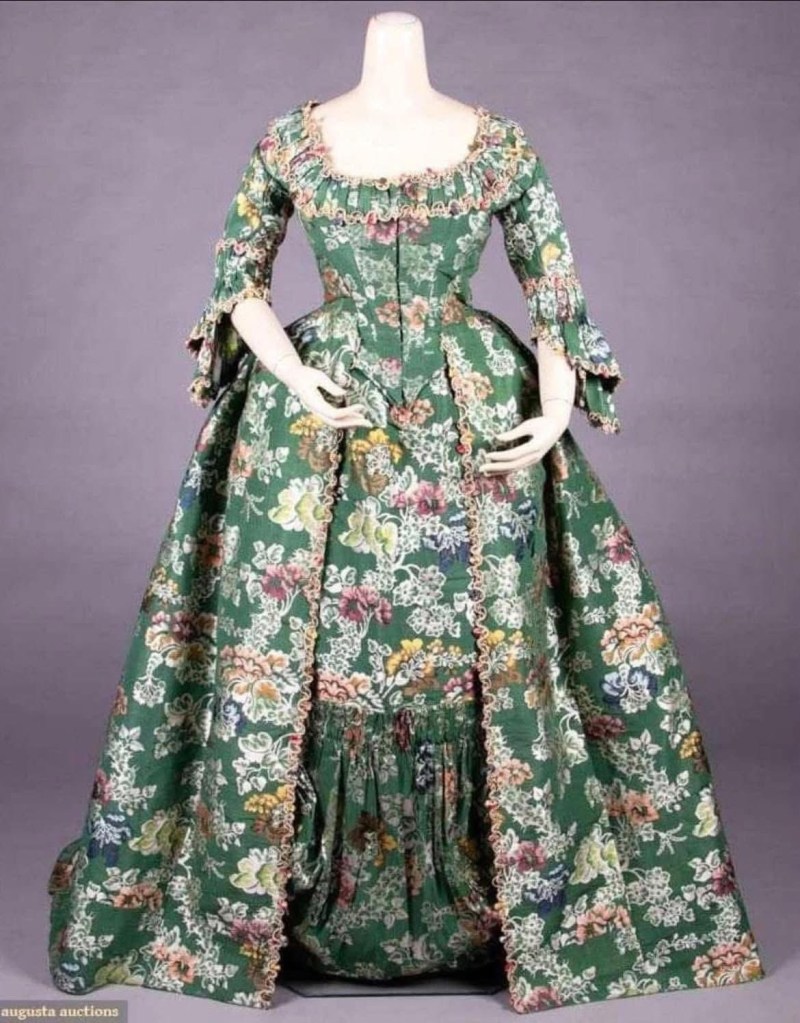
James Dalbiac was a silk weaver and was admitted to the Weaver’s Company in 1711 as a foreign master. The Huguenot silk weavers were not popular and between 1719-1721 the anti-calico campaign led to riots. Many Huguenot silk weavers lived in Spitalfields. Windows were smashed and business disrupted. This didn’t stop James and the other silk weavers from becoming hugely successful. At his death in 1749 he was described as “an eminent black silk weaver reputed to have died very rich”.
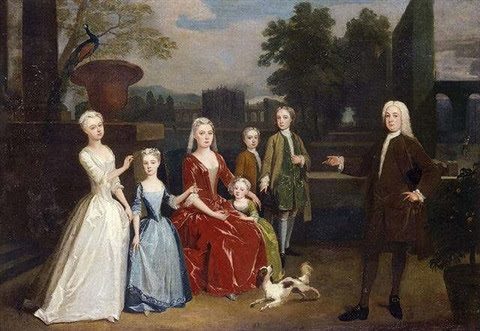
James Dalbiac (standing) and his family.
An example of the beautiful Spitalfields woven silk c 1736

James’ daughter, Louise Dalbiac, was born in 1712 and she married John Lagier Lamotte.

John Lagier Lamotte senior

The year before his marriage there was an act to naturalise Jean Lagier LaMotte whose name was anglicised to John Lamotte.

John Lagier Lamotte’s tree

John and Louise had five children:

  • Louise Lagier 1736-1825 she married Benjamin Dubouley who was the pastor at the French church in Threadneedle Street
  • Marie Lagier 1737-
  • John Lagier Lamotte 1740-1812
  • Catherine Lagier 1743-1797
  • Henri Lagier 1746-

In 1743 John Lagier Lamotte, merchant, leased for 7 years vaults for storing beer in the new church Brick Lane. Source – Spitalfields great Synagogue deeds & agreements.

In 1744 he was listed as one of the merchants protesting against papists.

John Lamotte senior was a merchant. He was given the freedom of the City of London in 1767 in the Company of Wheelwrights.
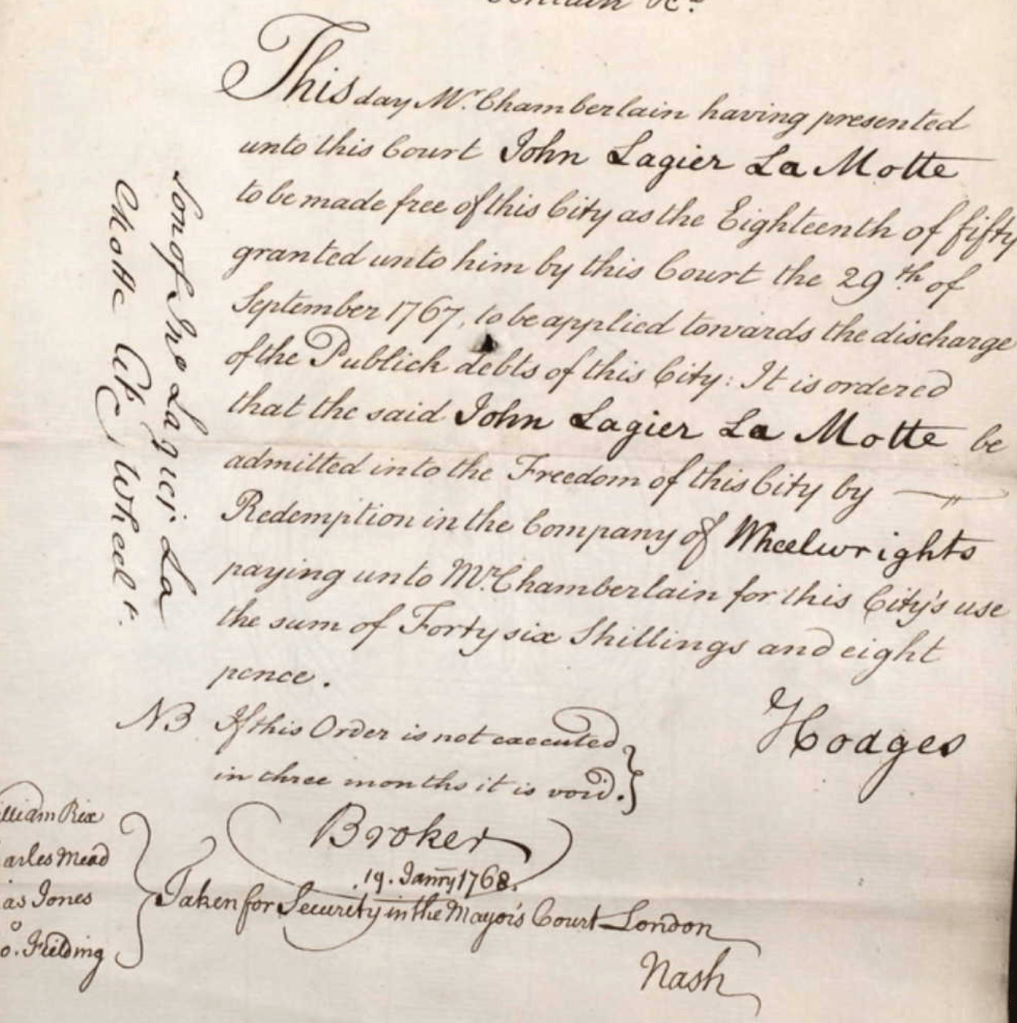
Freedom of the City of London

Like his father in law he was a successful businessman and died a rich man. He was buried in 1792 at Wanstead in Essex. Fortunately for us, he left a will which mentions his wife and son, John.
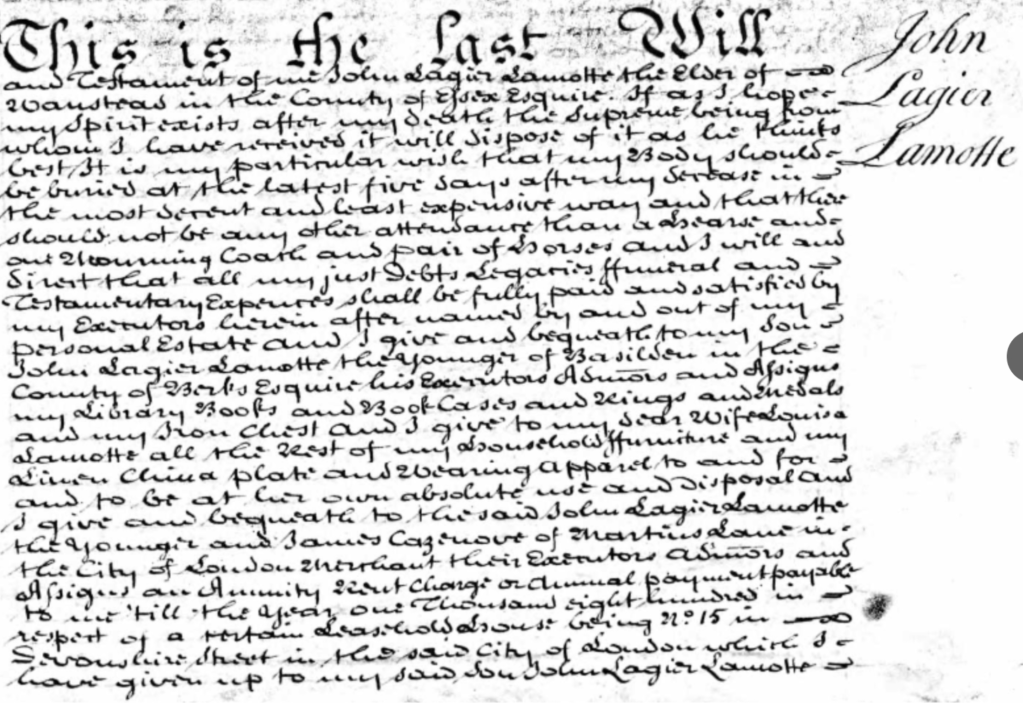
John Lagier Lamotte Junior

John was baptised on 5 Sep 1740 in London. He was 41 before he married Mary Davies in 1781.
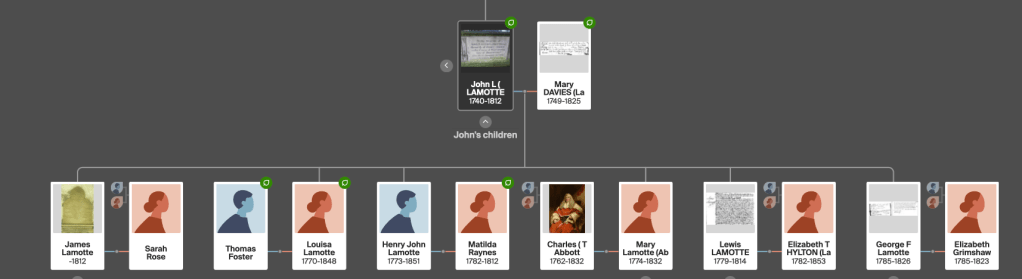
I found six children, however only one was born after their date of marriage so it appears as though John Lamotte had another wife who died after 1779 and before 1781:

  • Louisa 1770-1848 married Thomas Foster
  • Henry John 1773-1851 married Matilda Raynes
  • Mary 1774-1832 married Charles Abbott, Lord Tenterden
  • Lewis 1779-1814 married Elizabeth Hylton
  • George 1785-1826 married Elizabeth Grimshaw
  • James -1812 married Sarah Rose (I was unable to find a date of birth or baptism for James)
Owen, William; Charles Abbott (1762-1832), Baron Tenterden, Lord Chief Justice; Corpus Christi College, University of Oxford; http://www.artuk.org/artworks/charles-abbott-17621832-baron-tenterden-lord-chief-justice-221895

John was a broker of financial services and a successful and wealthy businessman. he died 26 January 1812 at Brighton.

John’s grave at Brighton

Lewis Lamotte

Lewis was born in 1779. In 1796 he obtained his degree from Oxford University and became a lawyer. In 1805 he was a member of the Middle Temple of the Jamaican Bar. Before 1809 he married Elizabeth Tomlinson Hylton in Jamaica. (We’ll follow her family in a separate post.)
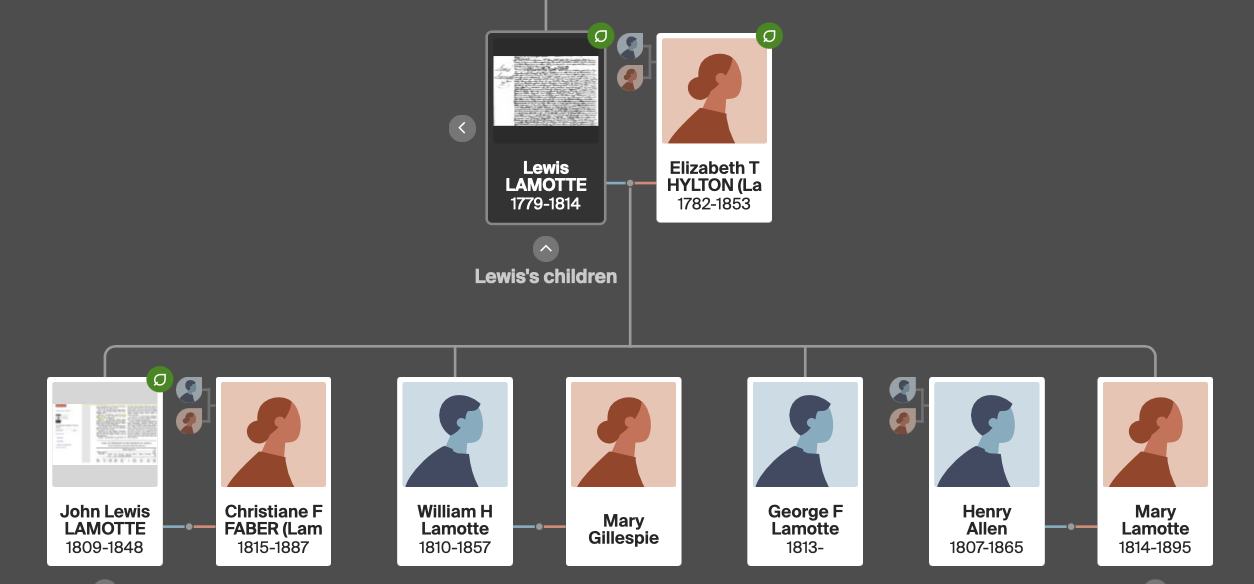
Lewis Lamotte’s tree

Lewis and Elizabeth had four children:

  • John Lewis 1809-1848
  • William Hylton 1810-1857 married Mary Gillespie
  • George Francis 1813-
  • Mary 1814-1895 married Henry Allen
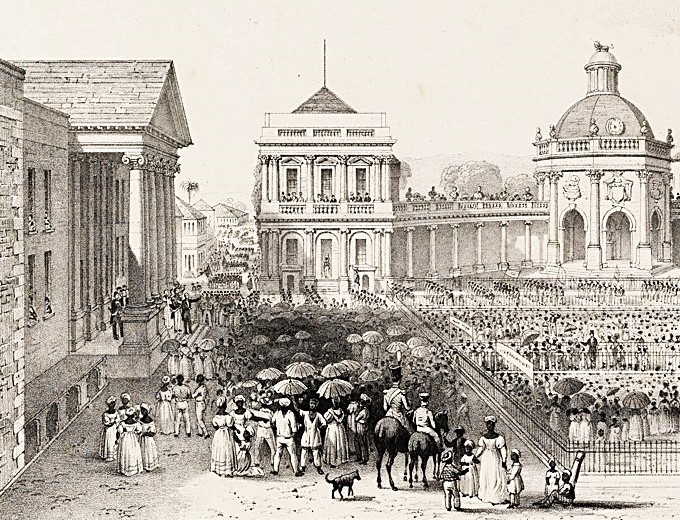
Spanish Town – Thomas Ashburton Picken, Public domain, via Wikimedia Commons

The West Indies was a place to make money but it carried enormous risks and Lewis died in 1814 at Spanish Town, Jamaica. He was 35. He left a long and detailed will.
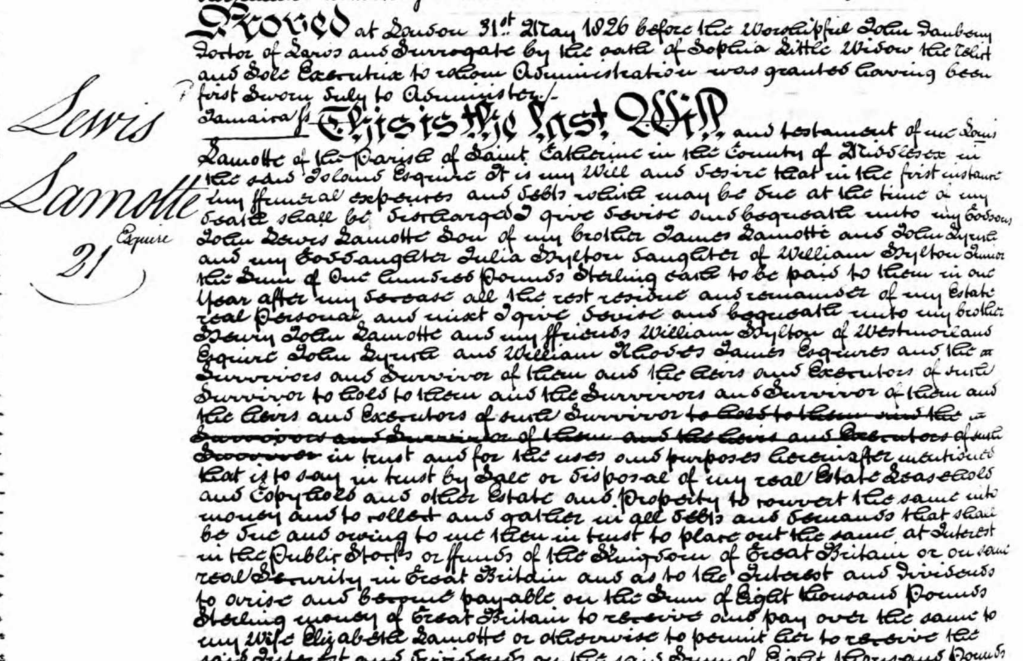
Lewis Lamotte will – Source NA PROB 11; Piece: 1712

John Lewis Lamotte

John Lewis Lamotte was just 5 when his father died in Jamaica. He was a tobacco broker and it was this that brought him to Bremen in Germany where he married Christiane Friederike Margarethe Faber sometime before 1836 when their first child was born.
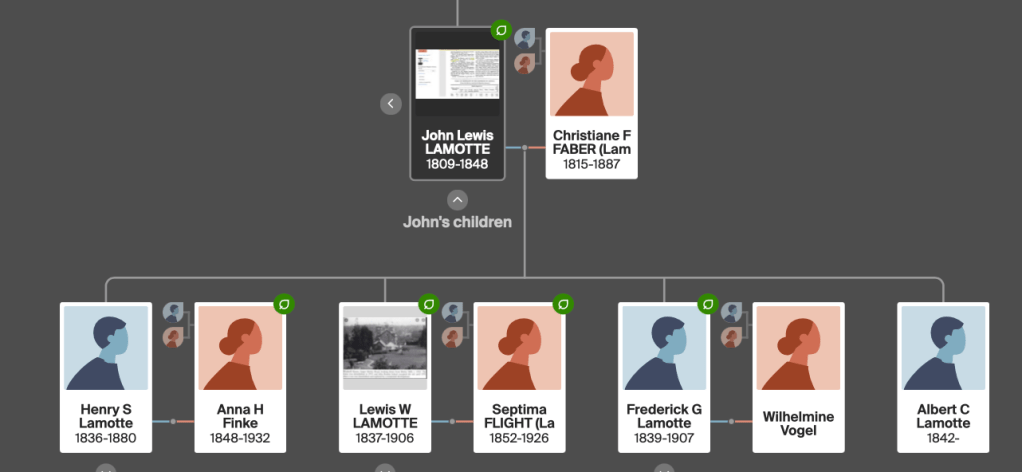
John Lewis Lamotte’s tree

He and Christiane had four children:

  • Henry Sidney 1836-1880 married Anna Finke
  • Lewis William 1837-1906
  • Frederick George 1839-1907 married Wilhelmine Vogel
  • Albert Charles 1842

German records have proved to be quite impenetrable, especially as I don’t speak German!
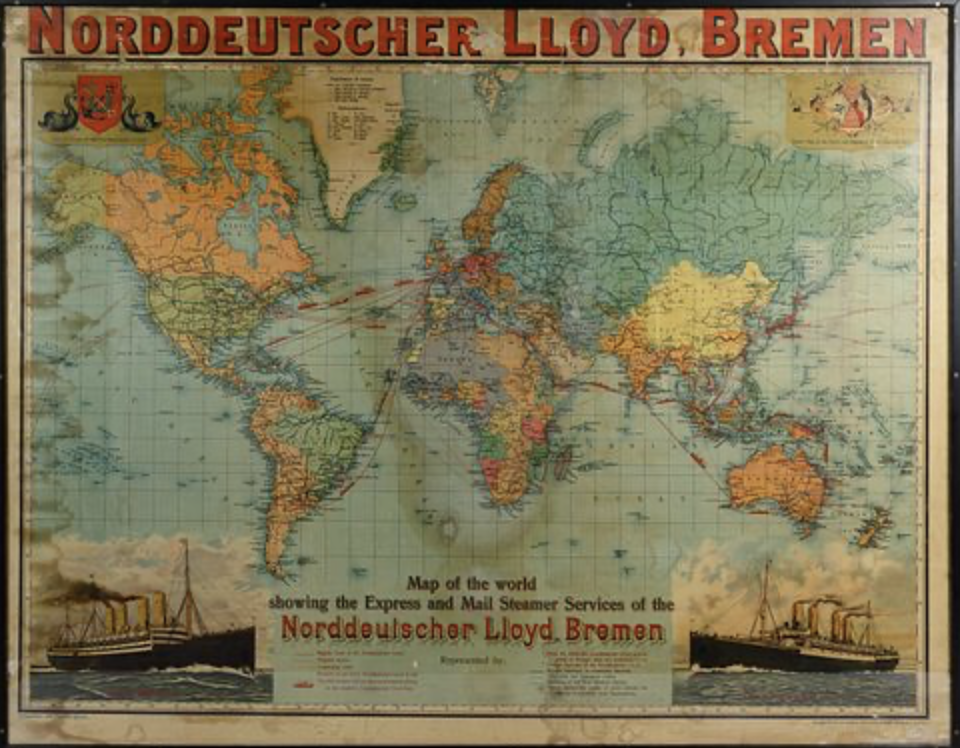
Bremen was a huge port, perfect for a tobacco broker.

John Lewis died in Germany in 1848. He was just 38. His death was listed in The Gentleman’s Magazine Volume 184-5

Lewis William Lamotte

Lewis was born in Bremen but by 1871 he was living in England. He appears on the 1871 census and is described as a tobacco broker. The same year he married Septima Flight at All Saints with St Margaret at Upper Norwood in Surrey.
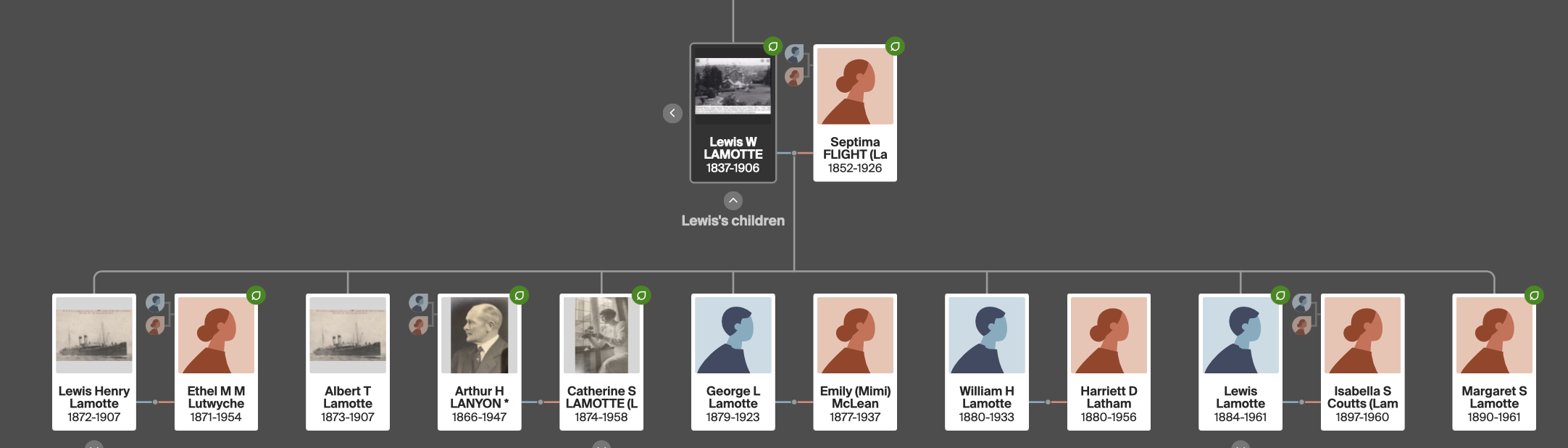
Lewis Lamotte’s tree

Lewis and Septima had seven children:

  • Lewis Henry 1872-1907 married Ethel Lutwyche
  • Albert Thomas 1873-1907
  • Catherine Septima 1874-1956 married Arthur Herbert Lanyon
  • George Lagier 1879-1923 married Emily McLean
  • William Hylton 1880-1933 married Harriett Latham
  • Lewis 1884-1961 married Isabella Coutts
  • Margaret Septima 1890-1961

To keep things interesting they named two sons Lewis!

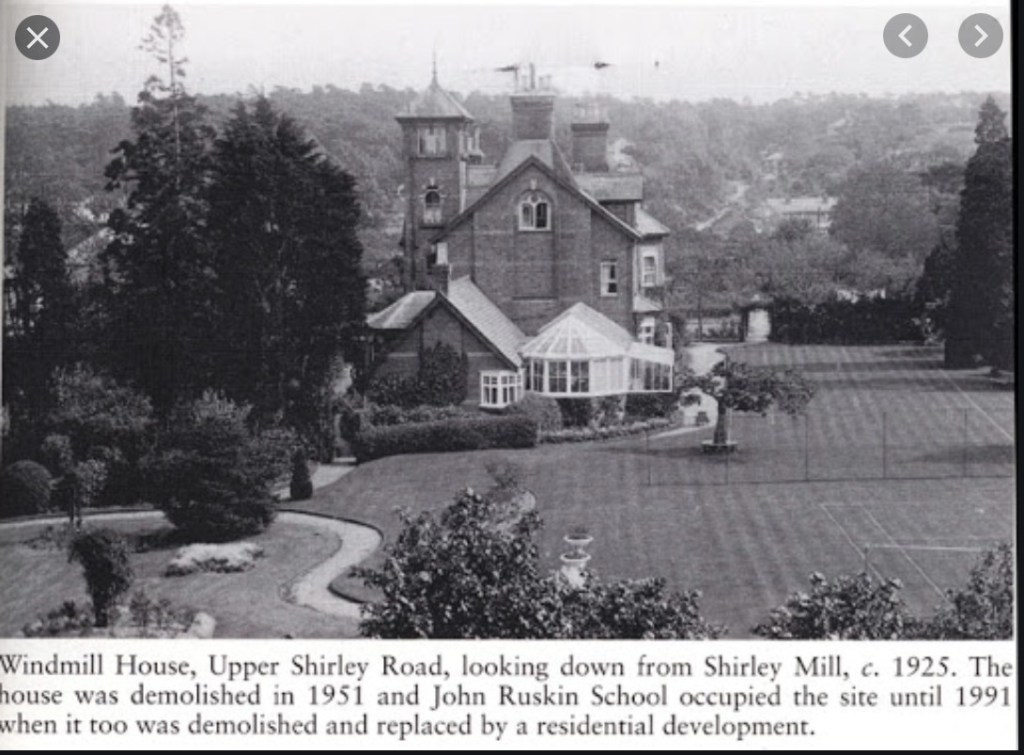
They lived at Windmill House and clearly were wealthy as the 1891 census lists them as having the following servants: cook, house nurse, parlour maid, house maid, under nurse and a kitchen maid.
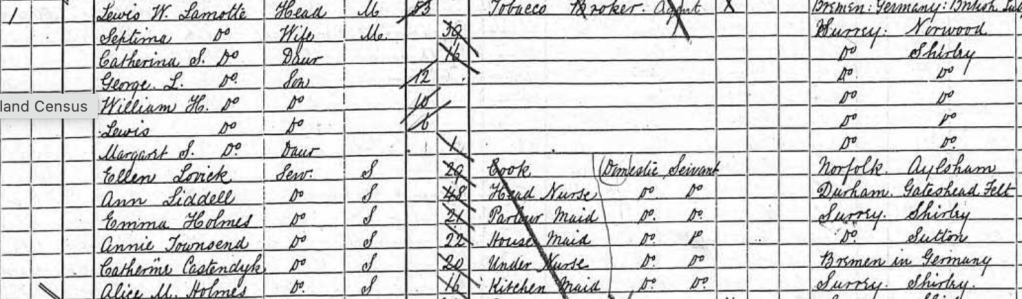
1891 census

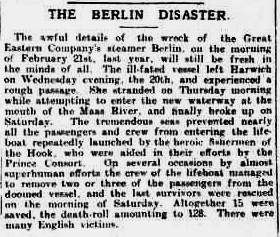
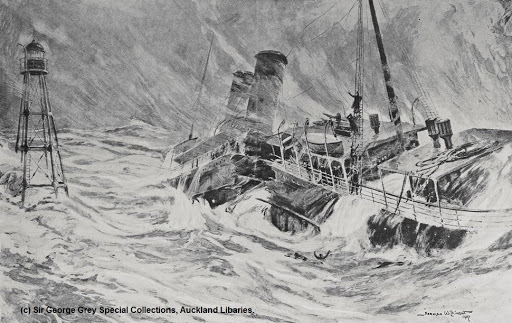
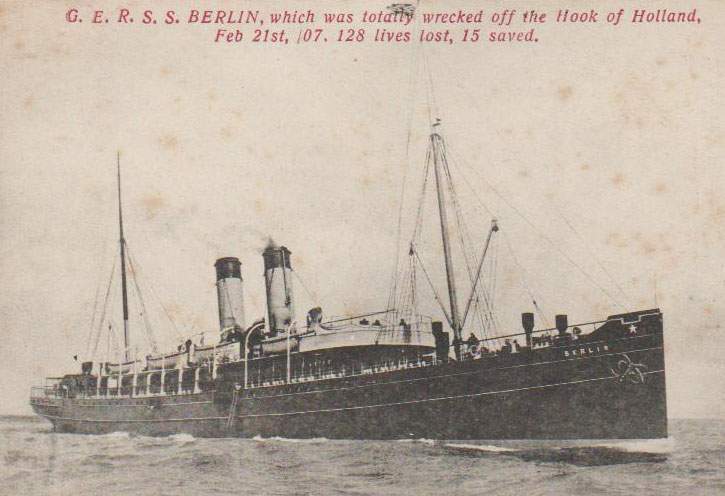
Their eldest sons Lewis and Albert were both killed on 21 Feb 1907 in a shipping disaster at the Hook of Holland. The SS Berlin sank with the loss of 140 lives. They were on their way to visit their dying uncle in Germany.
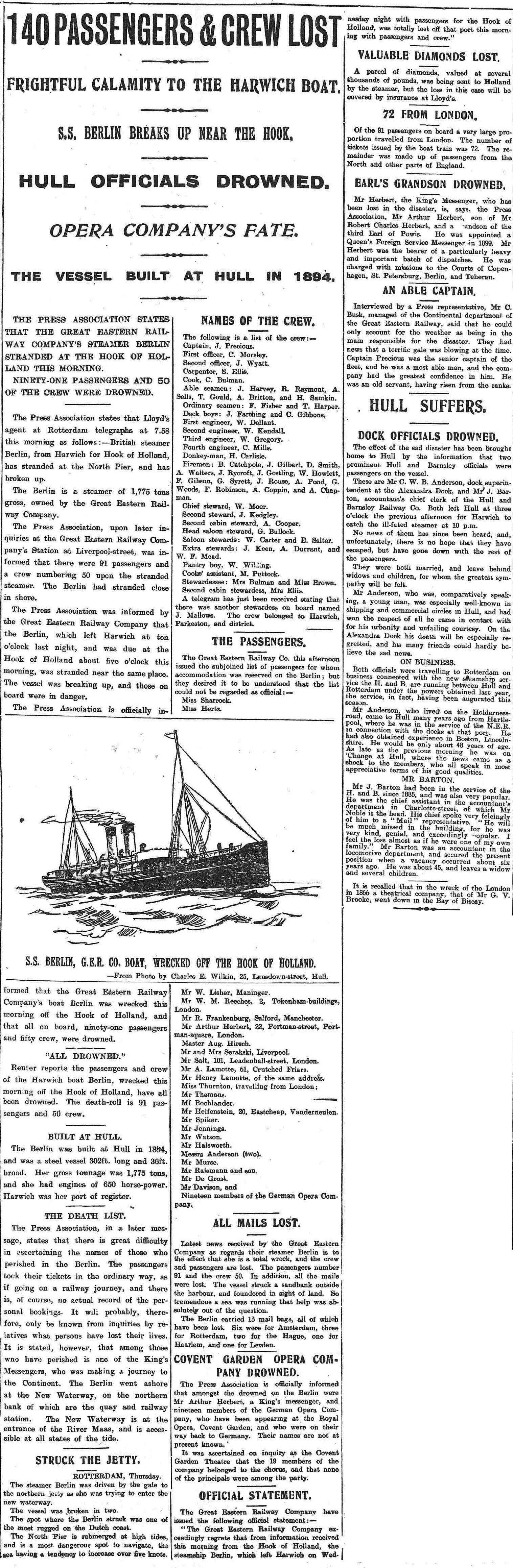
List of deceased passengers showing the Lamotte brothers

Catherine Septima Lamotte

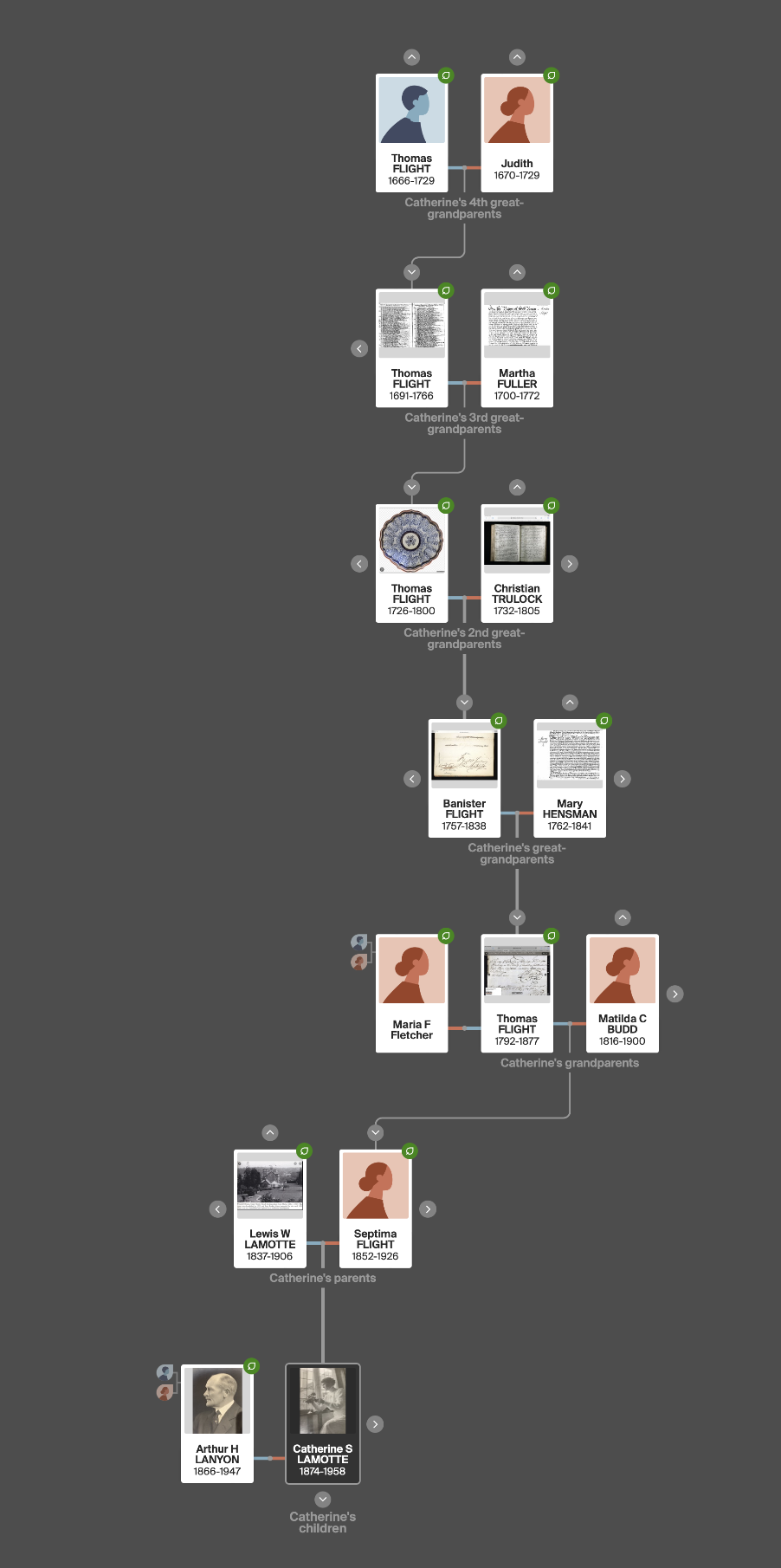
Catherine was born in Surrey in 1874 and in 1899 she married Arthur Herbert Lanyon. You can find out more about them in the post ‘Arthur Herbert Lanyon’ in the Redruth & Croydon section. You can find out more about Catherine’s Flight ancestors on the website.
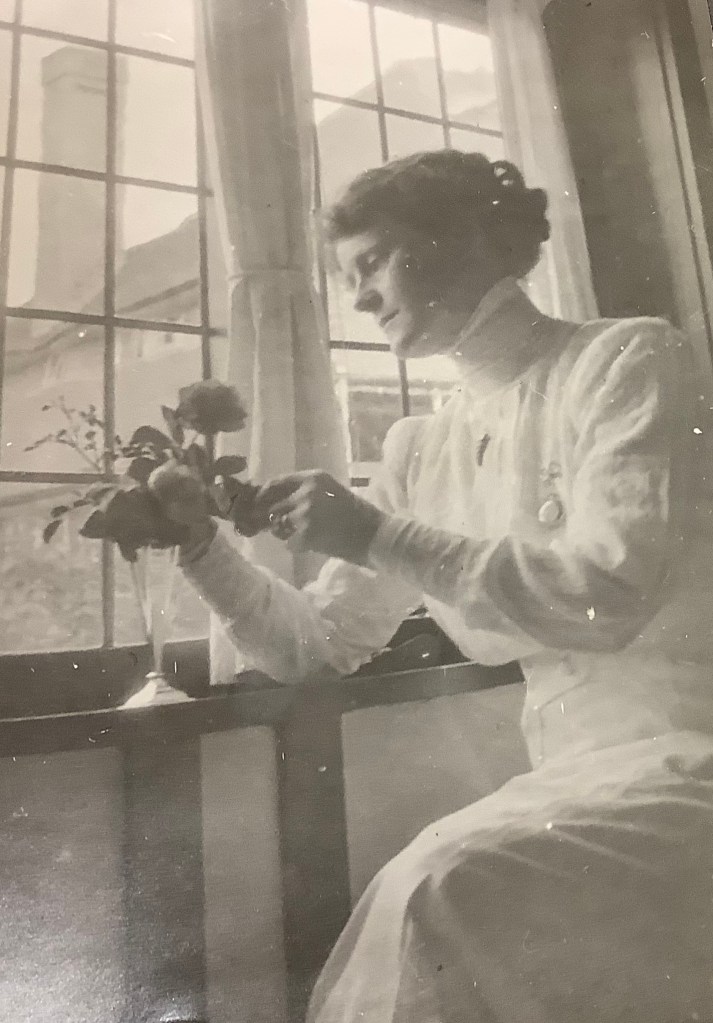
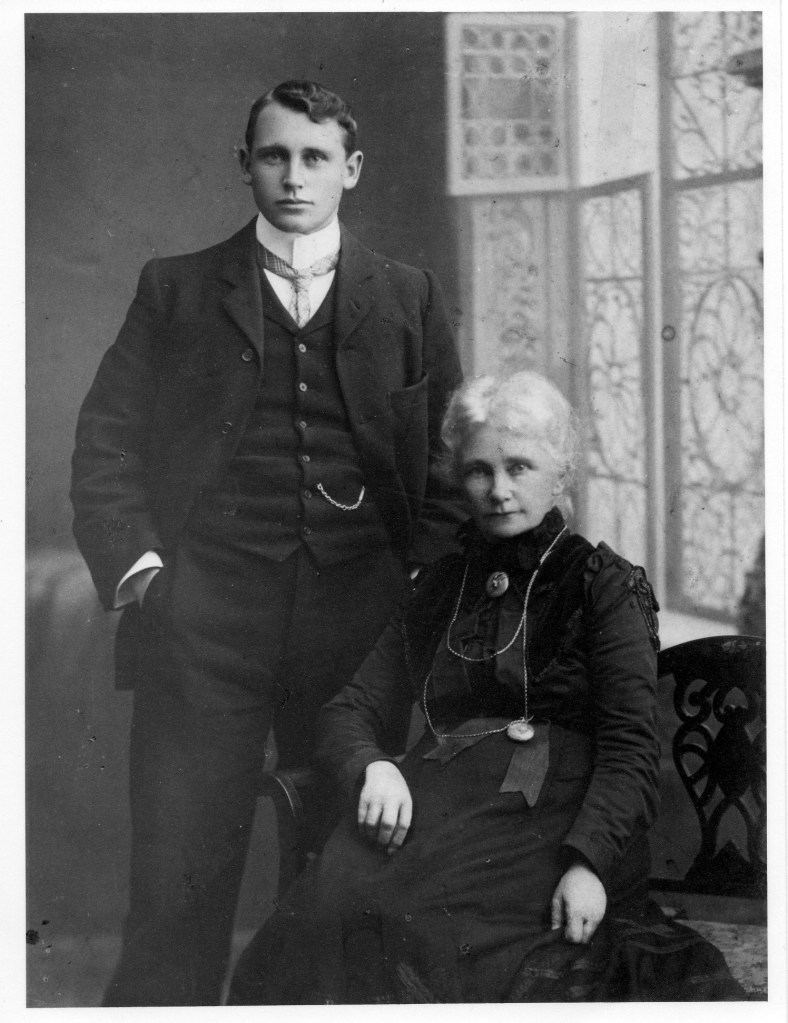
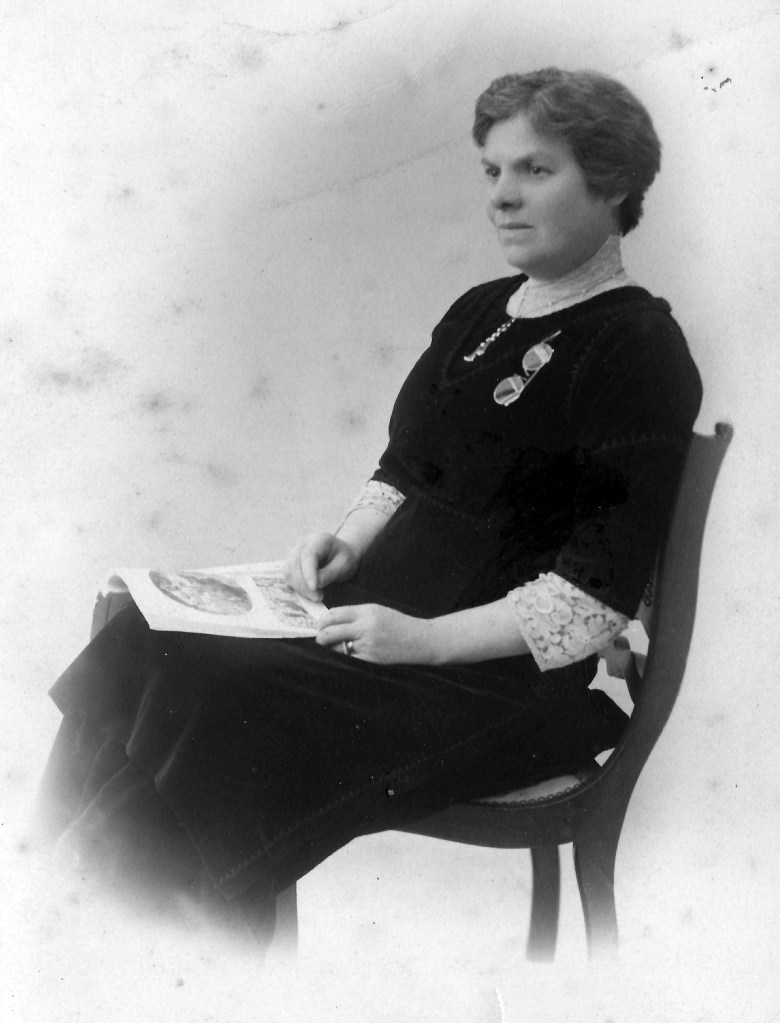
Catherine as a young woman

There is still a branch of the Lamotte family in Germany today.

You can find out more about the Dalbiac family on the really interesting website https://huguenotgirl.com
The Plot to Assassinate the King!

Every family has a ‘fruitcake’, this post is about ours!

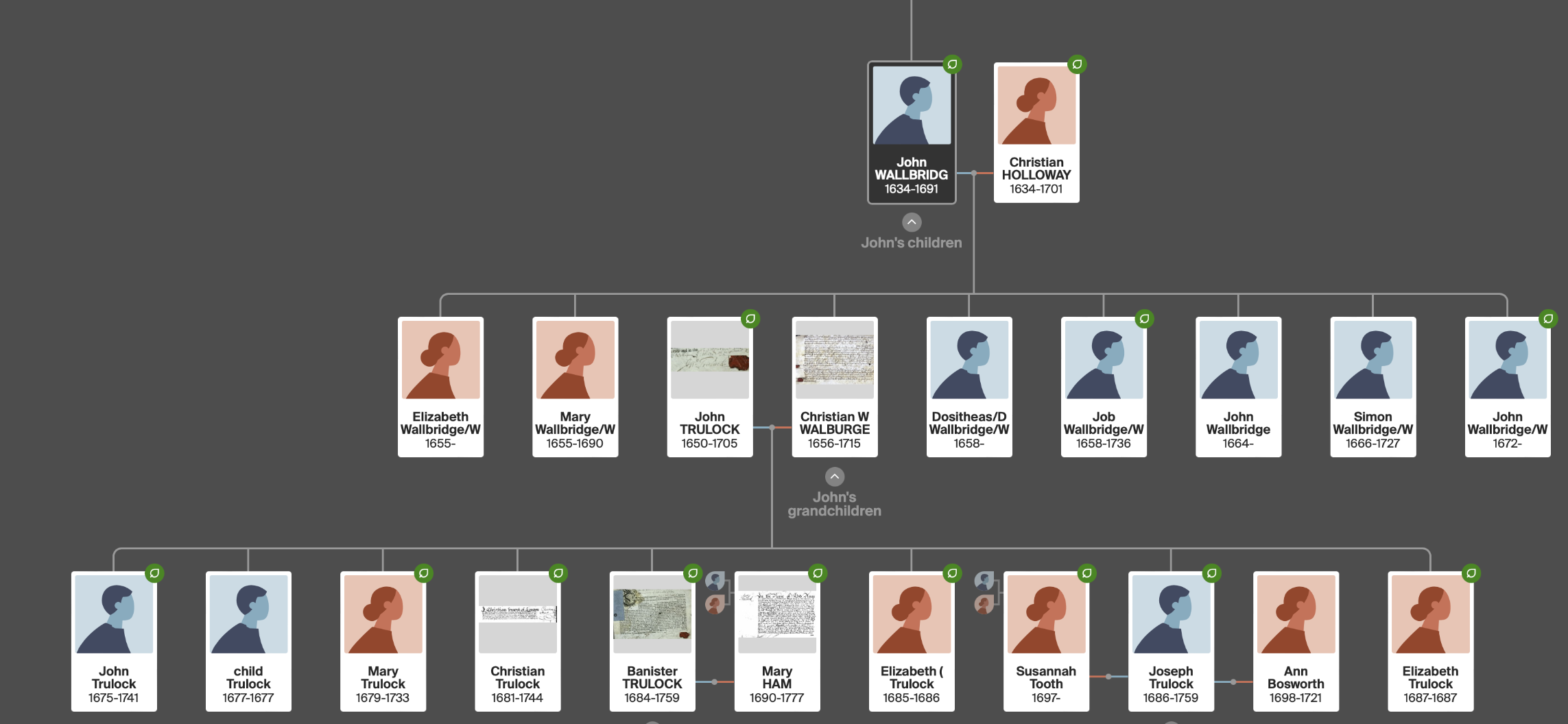
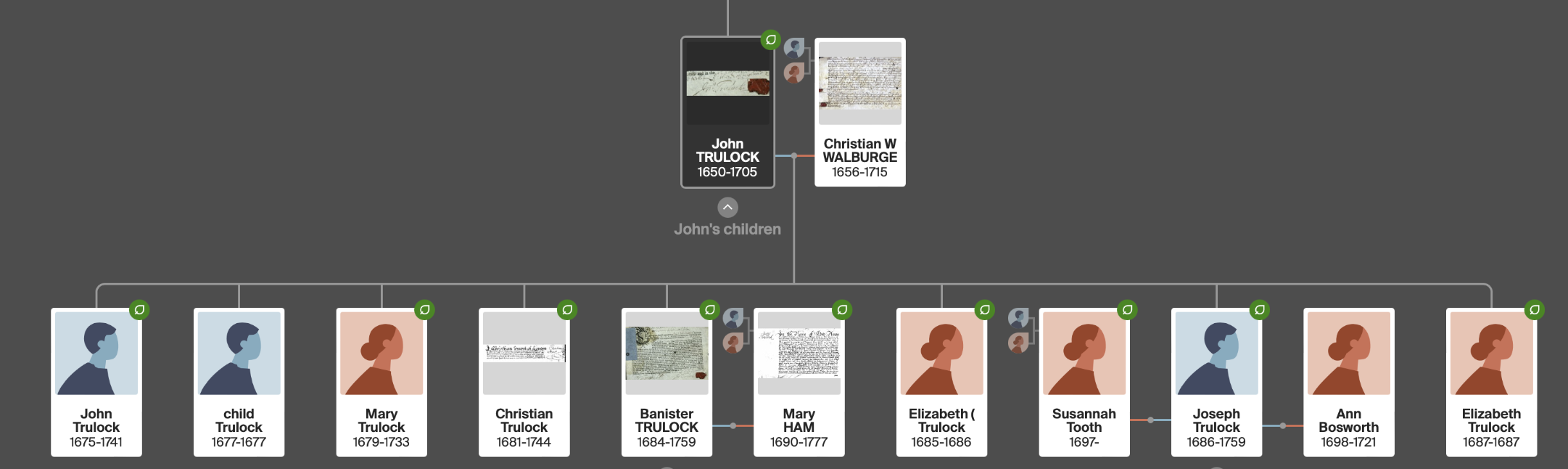
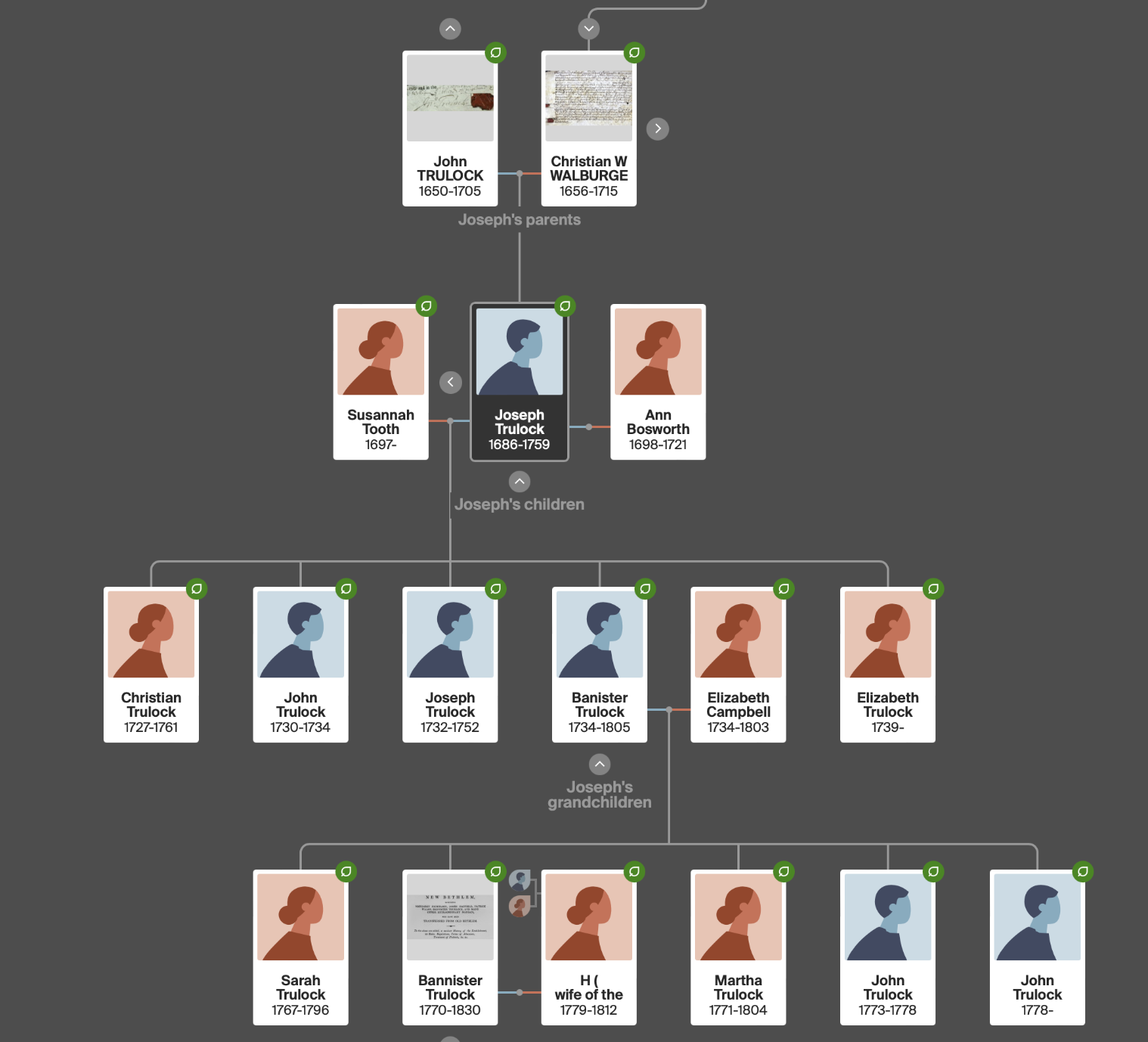
John Trulock and Christian Wallburge were the great grandparents of Banister Trulock born in 1770.

Their son Joseph Trulock married Ann Bosworth on 25 Feb 1719 at St Benet Paul’s Wharf, London. Ann sadly died in Sep 1721 and Joseph remarried on 07 Jun 1722 • St. Anne’s Church, Lewes, Sussex to Susannah Tooth.

Their first two sons John and Joseph died young and that left their third son, Banister as the eldest son and heir.

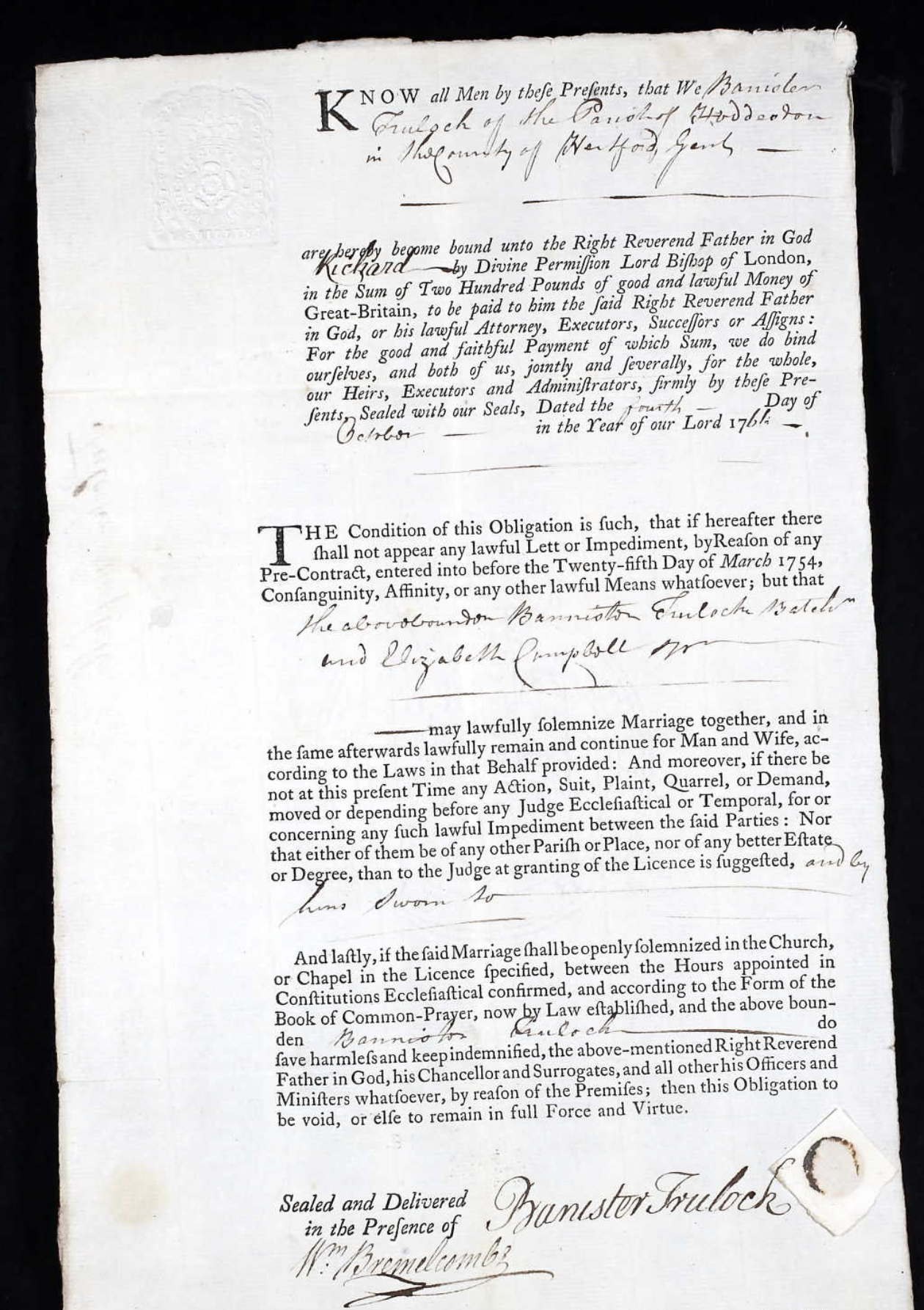
Banister was born about 1734 in East Grinstead. He married Elizabeth Campbell 05 Oct 1766 at Broxbourne, Hertfordshire. He signed a marriage bond.

London and Surrey Marriage Bonds DL/A/D/24/MS10091E/79

Their son also called Banister was born about 1770 at Hertfordshire. In 1783 Banister was apprenticed to John Payne a cordwainer in East Grinstead, Sussex. His father is described as a husbandman.

(The name Banister and Trulock are variously recorded as Bannister, Banester and Truelock.)

Before 1799 he married Ann/Hannah and they had two sons: Banester who died age 4 and William Henry who was baptised in 1812.

Banister was a religious fanatic who prophesied the second coming of the messiah. He also insisted in the belief that the Messiah would be born from his mouth!

“He met Hadfield by accident in White-Conduit Fields, and talked the unfortunate fellow into a persuasion, that the first step to the commencement of his doctrines, and to its fulfilment in a happy change of things throughout the world, would be the death of the Sovereign ; with this view, Hadfield set out as the supposed chosen instrument for the accomplishment of the great design. Hadfield, in his examination, mentioned this man’s name ; he was accordingly apprehended the next day, underwent several examinations, and was committed to prison ; but from his incoherent manner, his answers, and the evidence of his mother, he was found to be deranged, and was sent ultimately to Old Bethlem.By May 1800 he was working as a shoemaker and living in the White Lion, Islington, London. Whilst there he was visited by James Hadfield, whom Trulock encouraged to try to assassinate King George III. ”

Source – https://www.gethistory.co.uk/reference/sources/modern/georgian/sketches-in-bedlam-males

He was lodging with Sarah Lock until Dec 1799, she evicted him after he told her on Christmas Eve that there was a plot to assassinate the king. (Source: Hampshire Chronicle, 2 Jun 1800)

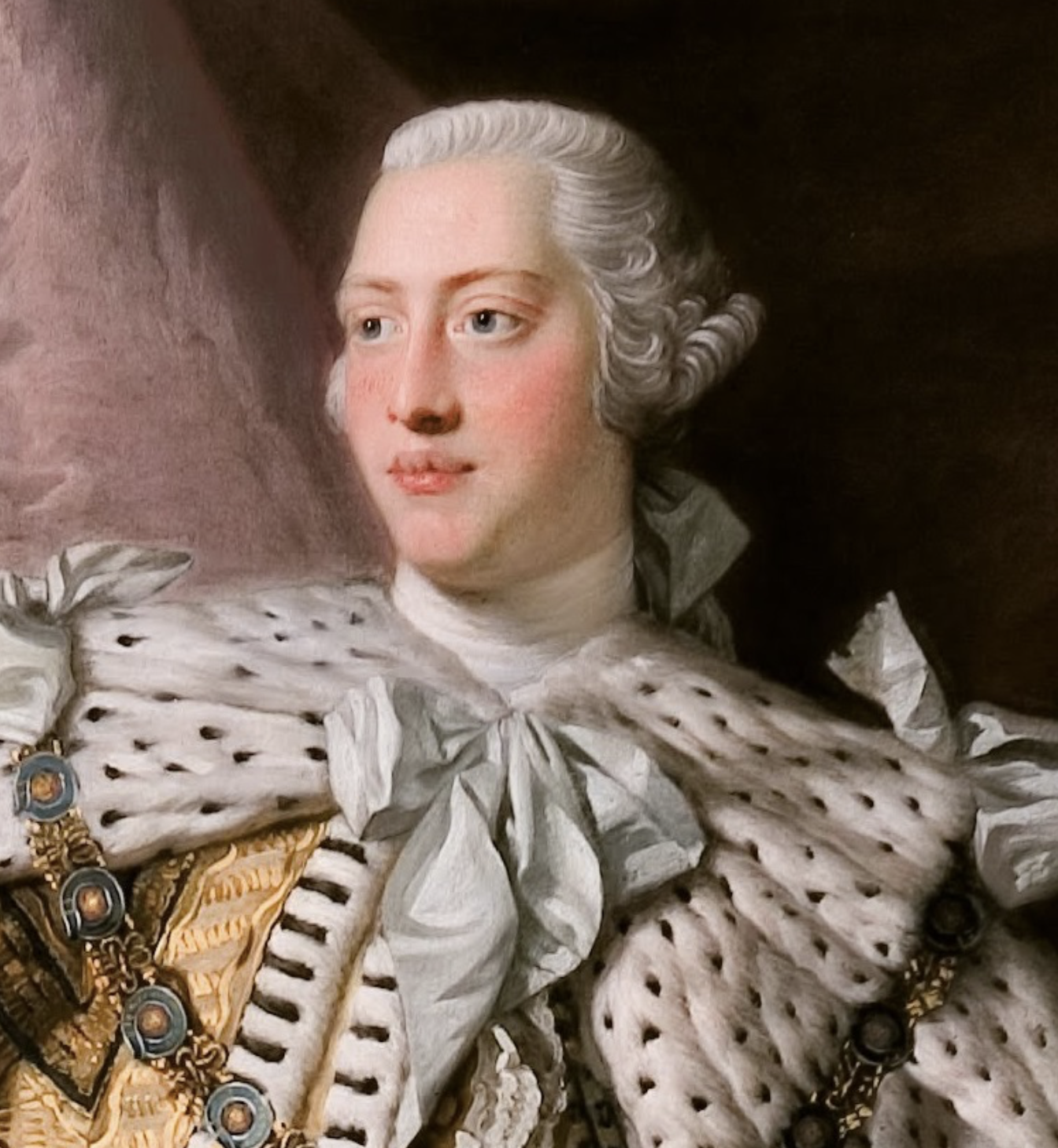
George III – Studio of Allan Ramsay, Public domain, via Wikimedia Commons

The Assassination Attempt

At the Theatre Royal, Drury Lane, on 15 May 1800, James Hadfield tried to shoot King George III while the national anthem was being played, and the king was standing to attention in the royal box.

It’s reported that after missing his target, Hadfield then said to the king:

‘God bless your royal highness; I like you very well; you are a good fellow.’

Hmm, we’re thinking that his words might be a very good examples of quick thinking…

Hadfield went on trial for high treason but, after listening to evidence from three doctors as to Hadfield’s state of mind, the judge decided on an acquittal, with the proviso that Hadfield would be detained indefinitely at his majesty’s pleasure.

Hadfield died from tuberculosis in Bethlehem Hospital (i.e. ‘Bedlam’) in 1841.

Chester Chronicle – Friday 27 June 1800

Banister Trulock was apprehended the next day and was committed to prison ; but from his manner, his answers, and the evidence of his mother, he was found to be deranged, and was sent to Old Bethlem.

Bethlem Hospital at Moorfields London – John Maurer, CC BY 4.0 https://creativecommons.org/licenses/by/4.0, via Wikimedia Commons

Visitors reported that he sounded sane until he started to discuss religion. He was kept in some comfort and had an apartment at the top of the hospital which had a view of the Surrey hills. He had ‘coal, candle and every convenience for his use; his provisions are regularly brought to him and in the fine weather he is permitted to walk in the garden.’

He was later moved to New Bethlem hospital.

Visitors to Bethlem could pay to ‘view’ the patients and Banister Trulock was one of the celebrated patients.

Visitors to Bethlem – British Museum, Public domain, via Wikimedia Commons

Banister died on 02 Nov 1830 at Bethlehem Hospital, St Saviour Southwark, London

Citizens of London – The Walburge and Trulock Families

John Walburge

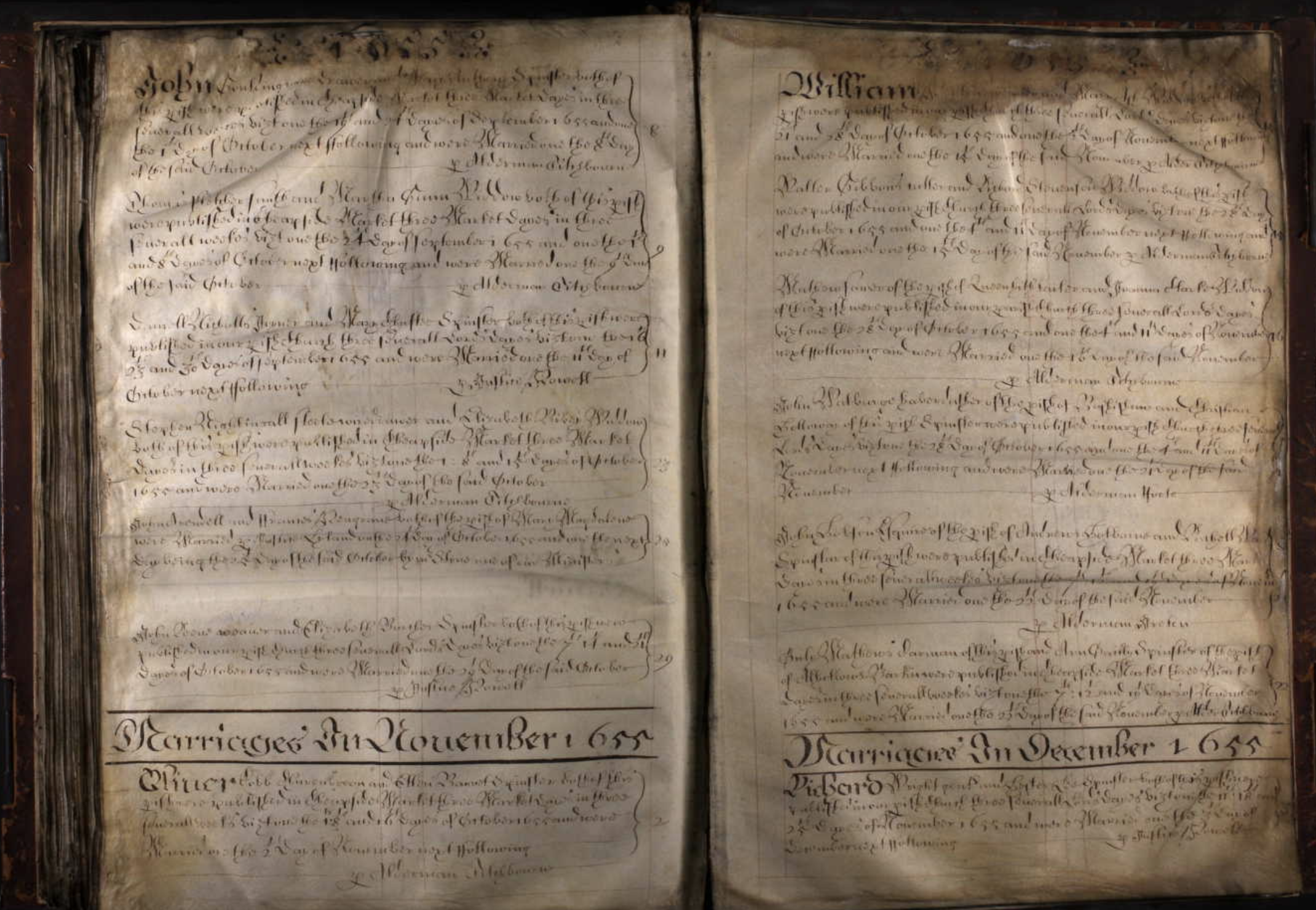
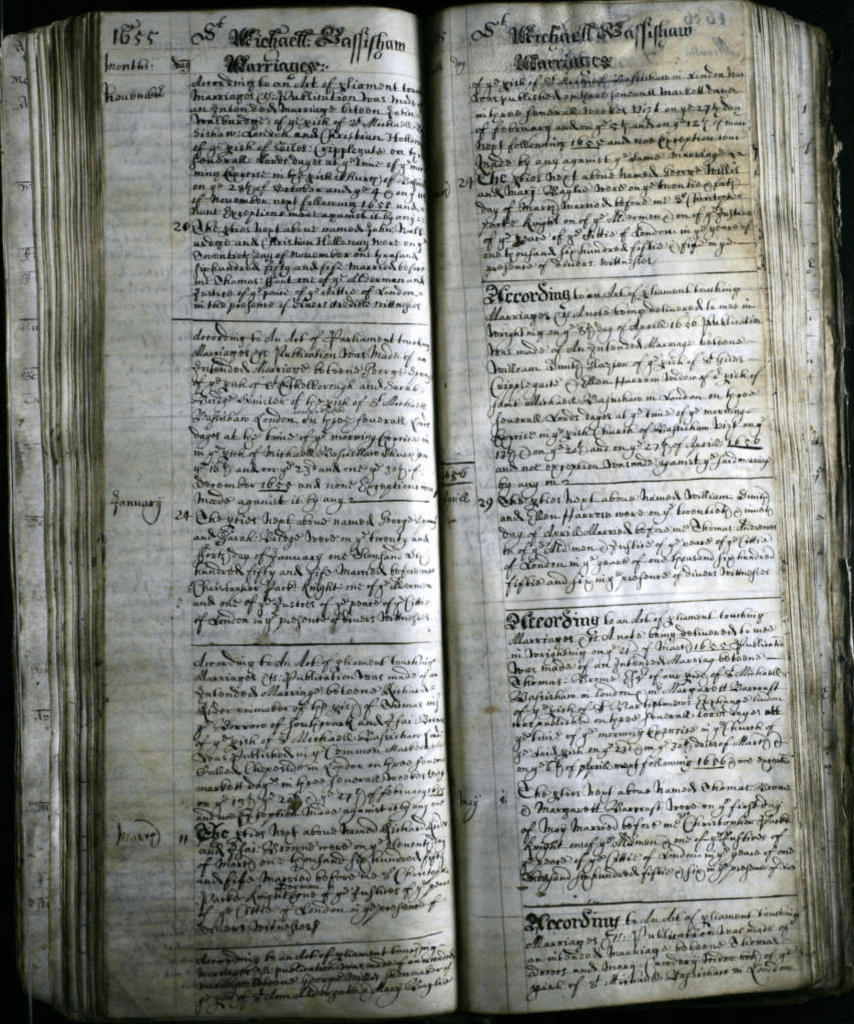
John Walburge was born about 1634. We don’t know where he was from. He was a haberdasher who married Christian Holloway on 20 Nov 1655  at St Michael Bassishaw, City of London and again on 21 Nov 1655 at St Giles Cripplegate, City of London! Perhaps the marriage was recorded in both home parishes?

(The name Walburge is variously spelt: Walburge, Walburghe, Walbarge, Wallbridge.)


St Giles Cripplegate Parish Register
St Michael Bassishaw Parish Register

John and Christian had several children. Our ancestor is Christian Walburge, she married John Trulock.

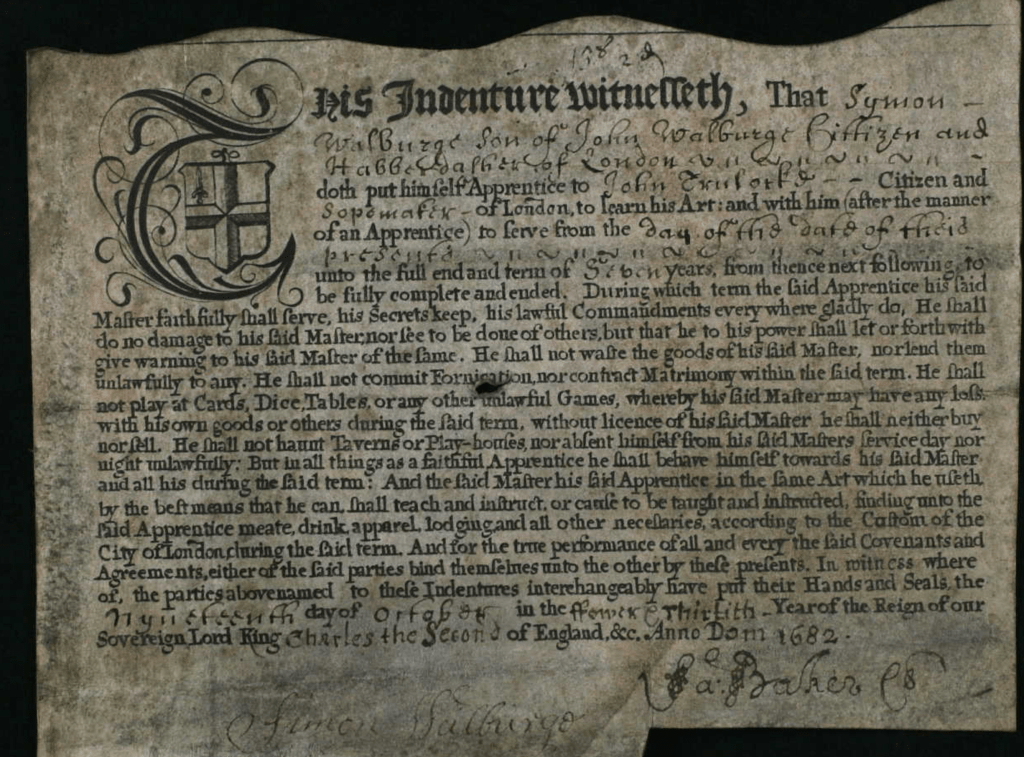
Both John Walburge and his son in law John Trulock were citizens of and had the freedom of the City of London. John Walburge apprenticed his son Simon to John Trulock, soapmaker in 1682

London, England, Freedom of the City Admission Papers, 1681-1930, London Metropolitan Archives

John Walburge died in 1690 and was buried at Bishopsgate, Middlesex. He left a will proved 29 Jan 1690. His will mentions his dear and loving wife Christian, his daughter Christian ‘now wife of John Trulock’, his house at Tottenham which has a garden and orchard. He bequeaths various tenements and messuages to his children and grandchildren. Clearly he is a wealthy man. His wife Christian (Holloway) was buried in 1701.

John Trulock

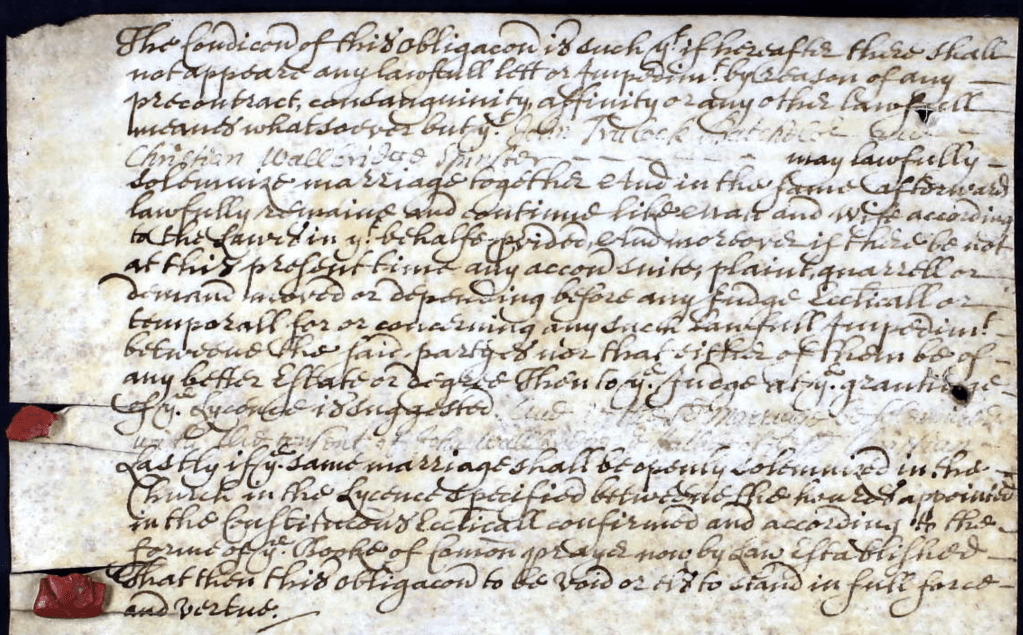
John Trulock was born about 1650 and Christian Walburge was baptised 03 Oct 1656 • St Michael Bassishaw, London. They married at St Helens, Bishopsgate, London on 27 Nov 1674.

London & Surrey Marriage Bonds & Allegations 1674

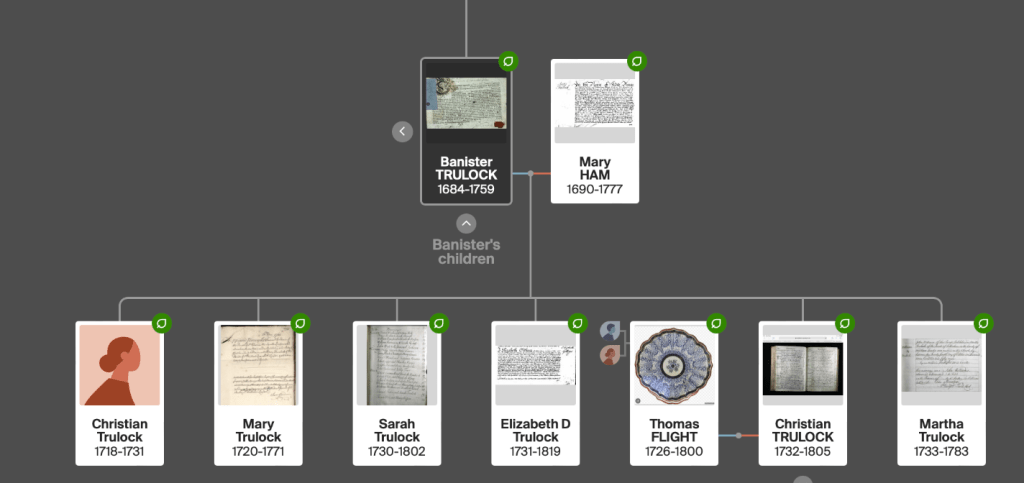
John and Christian had several children all born towards the end of the 17th century. Their son Banister Trulock was born in 1684. He married Mary Ham at St Paul’s Cathedral, London, on 23 Nov 1714.

John was buried in 1705 and Christian his wife was buried in 1715. She is recorded as being a widow who died of convulsions. Buried Tindals Ground/Bunhill Fields, London.

Banister Trulock

Thank goodness John and Christian chose such an interesting name for their son as it made research a lot easier! Banister was born in 1684 and was a successful soapmaker like his father. His name means: English (of Norman origin): from Old French banaste, banastre ‘covering for a cart or wagon; basket’, i.e. a large wicker container. Perhaps this had been a family surname in the past.

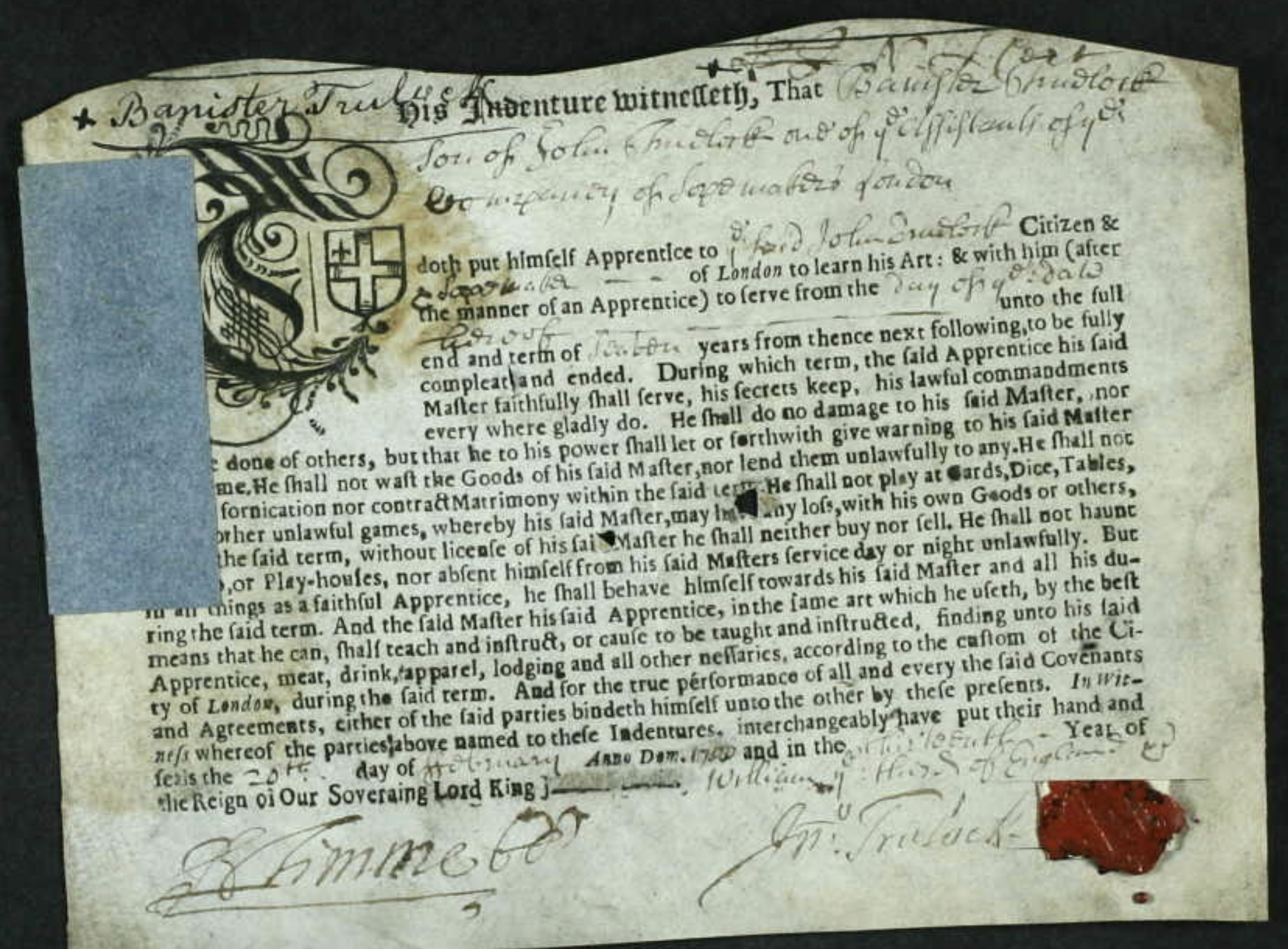
Banister Trulock Apprentice Indenture

In Oct 1711 Banister Trulock was the victim of a crime.

Whereas at the Sessions of the Peace
holden for ye County of Midx in Febry last
an Indictmt. was preferrd agt Thos Hatton
of ye Pish of Tottenham High Cross in ye Sd County
Yeoman & other for an Assault & Battery upon
Banister Trulock These are to Authorize
and require you that you enter or Cause to
be entred a less at processd on the sd Indictmt.
& stay all proceedings thereon agt. the sd.
Thomas Hatton onely And for so doing
this Shall be of Warrant Dated the 27th
day of Novr. 1711

Middlesex Sessions : Sessions Papers – Justices’ Working Documents  SM | PS, 10th October 1711

He married Mary Ham (possibly Horn) at St Paul’s Cathedral, London, on 23 Nov 1714.

Their first child was born in 1718 and the second in 1720 then there is a gap of 10 years before their third child was born. Perhaps there were more children which died in infancy.

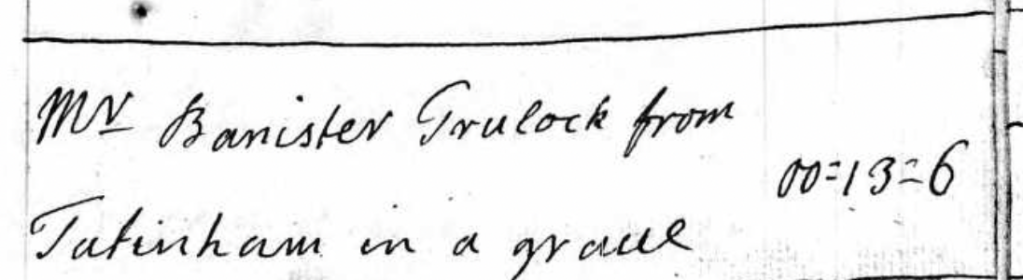
Banister was a non-conformist and lived at Tottenham, we know he was buried at Bunhill Fields as the burial was recorded. His wife was buried there in Sep 1777.

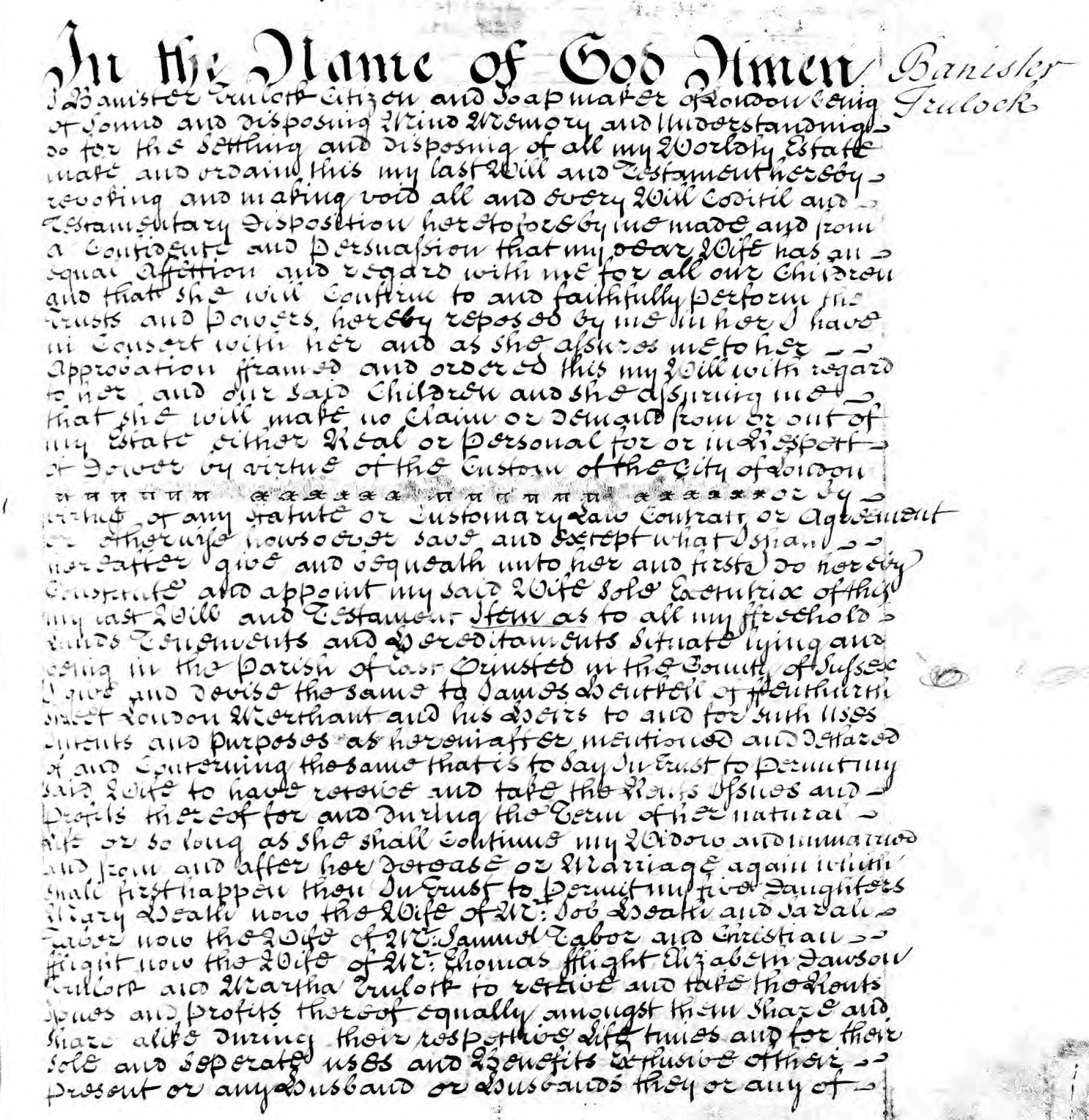
Banister’s will was proved on 23 Apr 1759 and he left his various property at Tottenham and East Grinstead to his wife and daughters. The will is several pages long and shows that this was a wealthy family.

National Archives PROB 11; Piece: 846

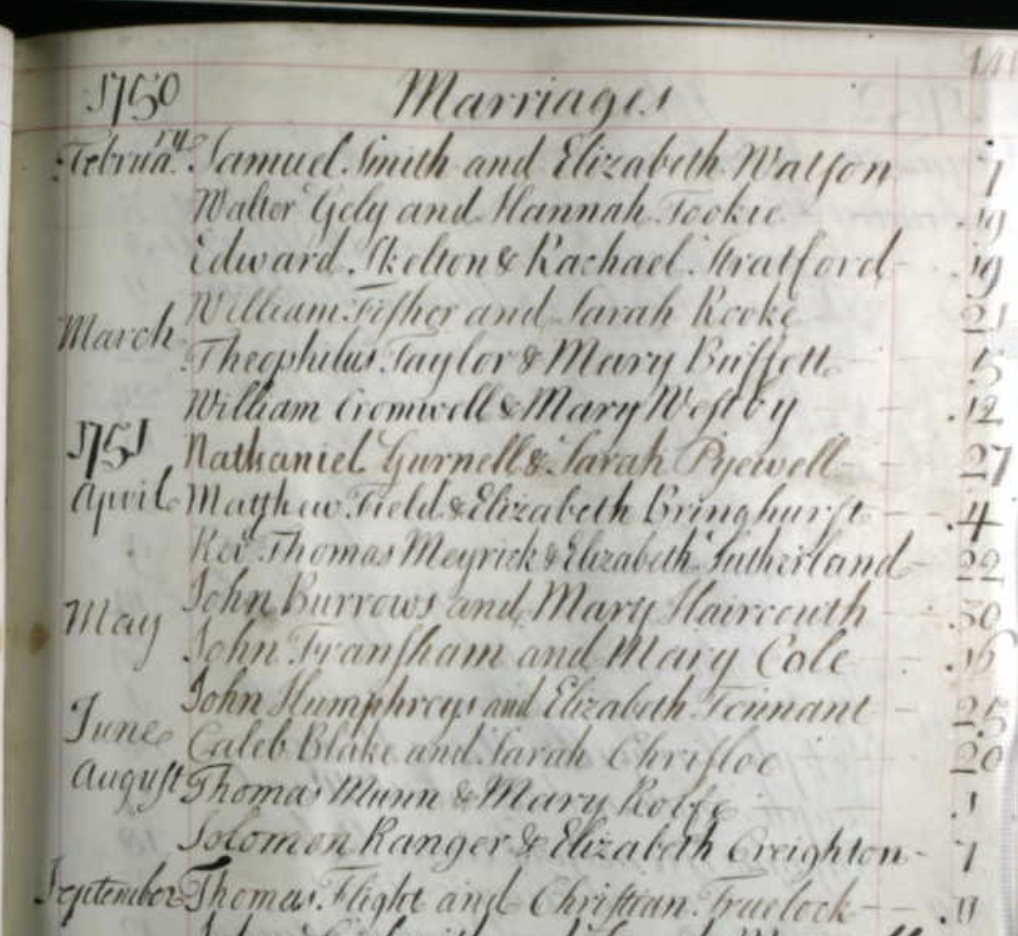
Their fifth daughter, Christian married Thomas Flight who was a porcelain manufacturer on 11 Sep 1751 at Allhallows London Wall,London.

London Metropolitan Archives; London, England; Reference Number: P69/ALH5/A/005/MS05088

You can find out all about the Flight family from the posts: The Flight Family, Thomas Flight and the Royal Worcester China Factory and Banister Flight and his Descendants.

Banister Flight and his Descendants

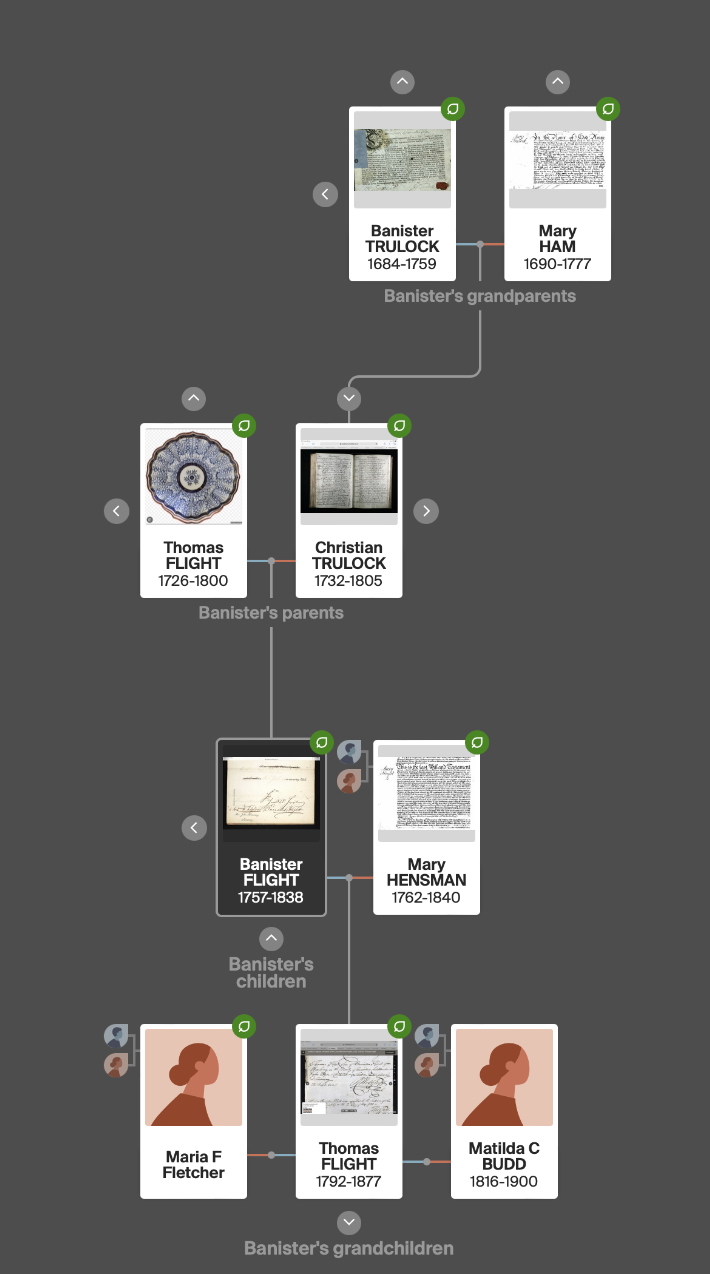
Banister Flight was born about 1757, the son of Thomas Flight and Christian Trulock. He was named after his maternal grandfather Banister Trulock and it seems the perfect name for a carpenter!

In 1783 Banister married Mary Hensman at Kimbolton, Huntingdon. They had one child, Thomas born in 1792.

From London electoral registers we can see that Banister and his son owned property at 44, 45 and 46 Gray’s Inn Lane.

Gray’s Inn Lane, (now Gray’s Inn Road) described in 1878 by Thornbury in Old and New London as a narrow, dingy thoroughfare, had several literary associations, it was the road by which Fielding’s Tom Jones entered London, James Shirley (1596-1666), the dramatist resided here and it was the favourite haunt of the poet John Langhorne (1735-1779). Public domain.

Banister may have owned property in Gray’s inn Lane but he resided at Stone-bridge, Tottenham. He also lived at Lewes in Sussex.

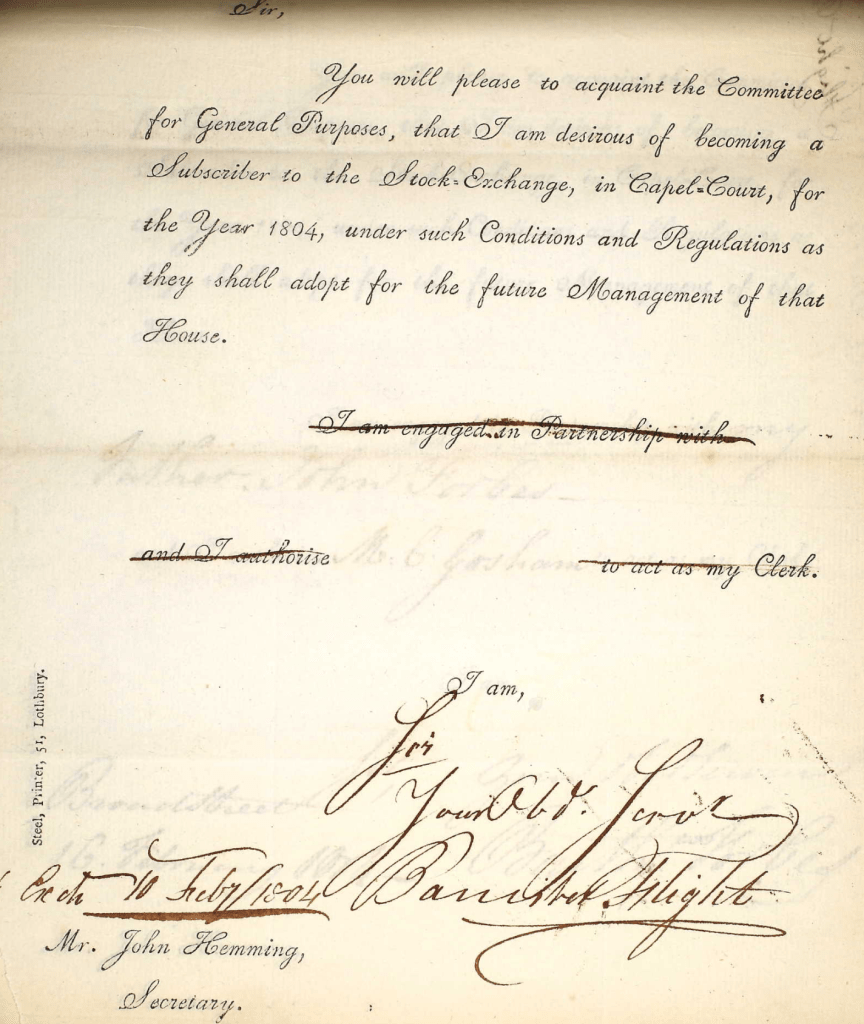
In 1804 Banister Flight applied to join the London Stock Exchange.

He was also a director of the London Annuity Society for the Benefit of Widows.

When he died in 1838 (of paralysis) he left his estate to his wife Mary and son Thomas. Mary died just two years later in 1840.

Thomas Flight

In 1812 Thomas, like his father, was given Freedom of the City of London as part of the Carpenter’s Company. His occupation was banking and moneylending and it made him very wealthy.

He lived partly in Brighton and was an early commuter to London.

Thomas married at Eton in Buckinghamshire in 1840 at the age of 48, his wife Matilda Catherine Budd was just 23! They went on to have eight children. It may have been Thomas’ first marriage but they weren’t his first children.

Previously Thomas lived with Maria Frances Fletcher, a widow and they had five children together.

  • Maria Flight Fletcher b 1829
  • Mary Flight Fletcher b 1830
  • Thomas Flight Fletcher b 1832
  • Banister Flight Fletcher b 1833 – 1899
  • Emily Flight Fletcher b 1837

The children were all sent away to school at a young age and the 1841 census shows the four eldest children at school on the Isle of Thanet. Emily age 4 was living with a nurse Eliza Rickards at Seymour Place, St Pancras.

It’s not clear what happened to Maria Frances Fletcher, she may have married Thomas Prier. Of the children I have only traced Banister Flight Fletcher, more of him later.

Once married Thomas wasted no time in starting a second family with Matilda. They produced eight daughters!

  • Christiana 1841-1931
  • Matilda 1842
  • Mary 1843-1920 (two daughters called Mary is helpful when researching a family tree!!)
  • Sophia 1846-1944
  • Frances 1847-1933
  • Annie 1848-1941
  • Septima 1852-1926 (by now he seems to have run out of female family names to use!)
  • Octavia 1853-1926

In 1843 Thomas was a beneficiary of his aunt Christian Flight’s will. She bequeathed him £3000.

By 1871 they were living at Grecian Villa, Beulah Hill, Norwood in Surrey. He died on 15th Feb 1877 at Brighton aged 85. Cause of death was old age and exhaustion.

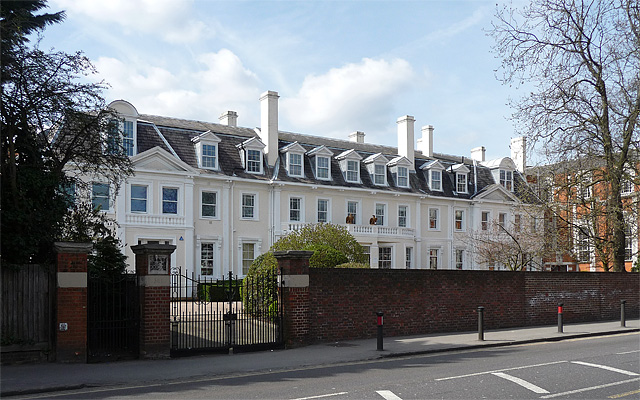
Grecian Villa Beulah Hill

Today Grecian Villa is St Joseph’s College

St Joseph’s College, Beulah Hill
cc-by-sa/2.0 – © Stephen Richards – geograph.org.uk/p/2218283

Banister Flight Fletcher

Banister was born on 11th Aug 1833 and baptised on 29th Jun 1836 at St Mary Paddington along with his siblings. In 1864 he married Eliza Jane Phillips.

He was an architect and surveyor for the board of trade. He was also the Liberal MP for North West Wiltshire. He went on to become the professor of architecture and building construction at King’s College in 1890.

Banister Flight Fletcher – Public domain via Wikimedia Commons

He had 12 children, his eldest son also called Banister Flight Fletcher was knighted. His youngest son was memorably named Ernest Tertius Decimus Fletcher – obviously chosen to help future family historians!

Sir Banister Flight Fletcher by Glyn Warren Philpot RA (5 October 1884 – 16 December 1937), Public domain, via Wikimedia Commons

Thomas Flight’s Daughters

Thomas had eight daughters from his marriage to Matilda Budd.

Christiana 1841-1931

She may have been named after her great aunt Christian Flight. When Christian died in 1843 she left Christiana £100. Christiana was presented to Queen Victoria.

Christiana Flight presented to Queen Victoria

In 1863 she married William James Nevill and they had 11 children. She emigrated to New Zealand and died there in 1931.

Christiana and her son Geoffrey

Matilda 1842-

Matilda was born in 1842 in Highbury. In 1867 she married William Henry Smith. They emigrated to Australia and had five children. There are so many Matilda Smiths that it isn’t possible to determine when she died.

Mary 1843-1920

Thomas had two daughters called Mary and one called Maria which complicated the search for information! Mary was born in 1843 and married Thomas Howse the younger, a merchant, in 1865. They had four children. Mary died in 1920 in Kent.

Sophia 1846-1944

Sophia was born in 1846 in Upper Brook St, London. In 1868 she married Edwin Francis Hickman and they had five children. Sophia died in 1944 in her 99th year.

Frances 1847-1933

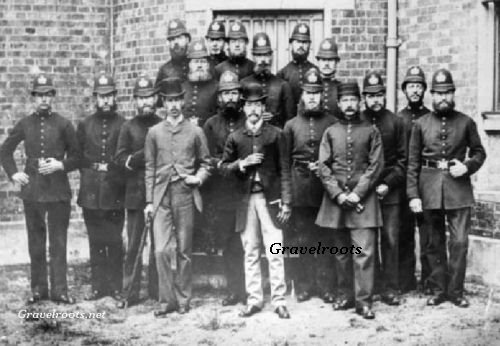
Frances was born in 1847. In 1874 she married George Robinson Bridge Drummond. At the time of their marriage he was a Captain in the Bombay Army and he went on to become the Chief Constable of Sussex. He was knighted in 1904. They had four daughters.

Chief Constable of Sussex, centre.

Annie 1848-1941

Annie was born in 1848 and never married. She never worked and was described on the census as having independent means. She died in 1941.

Septima 1852-1926

Septima was born in 1852 in Norwood, Surrey. In 1871 she married Lewis William Lamotte a tobacco broker. They had seven children. Their eldest daughter married Arthur Herbert Lanyon. Septima died in 1926.

Octavia 1853-1926

Octavia, the eighth daughter was born in 1853. She married Bonham Carter Evelegh, a journalist and author, in 1882. They had five children. Their son George was held prisoner by the Japanese during the 2nd World War. Both George and his brother Aldridge, were given freedom of the city of London and admitted to the Company of Carpenters like their ancestors.

Thomas Flight and the Royal Worcester China Factory

Thomas Flight was Thomas and Martha’s second and arguably the most successful son. He was born at Abingdon in Berkshire in 1726 and in 1751 he married Christian Trulock/Truelock. They had six children in all but this post is about his third and fourth sons, Joseph and John Flight.

Marriages 1750 at All Hallows London Wall

Thomas was a carpenter by trade and a very successful business man. In 1768 his place of abode was Monument Yard.

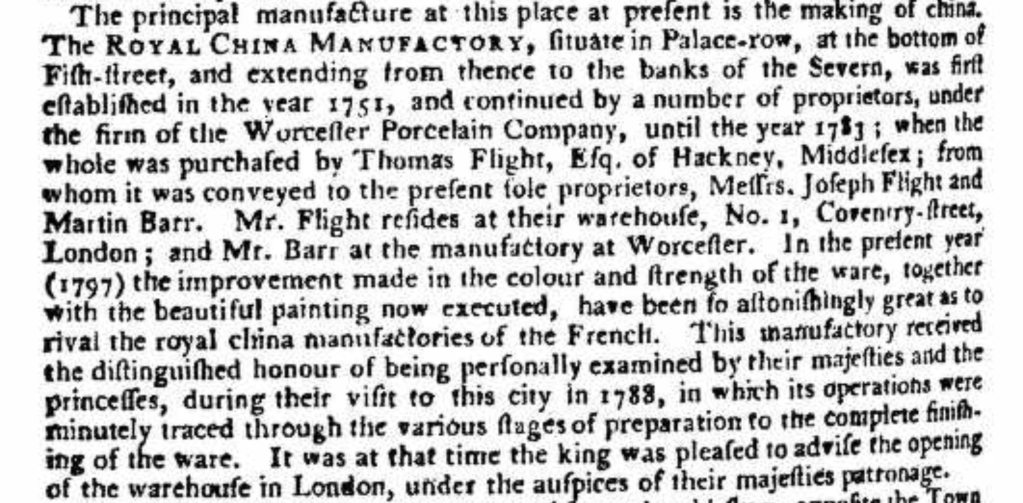
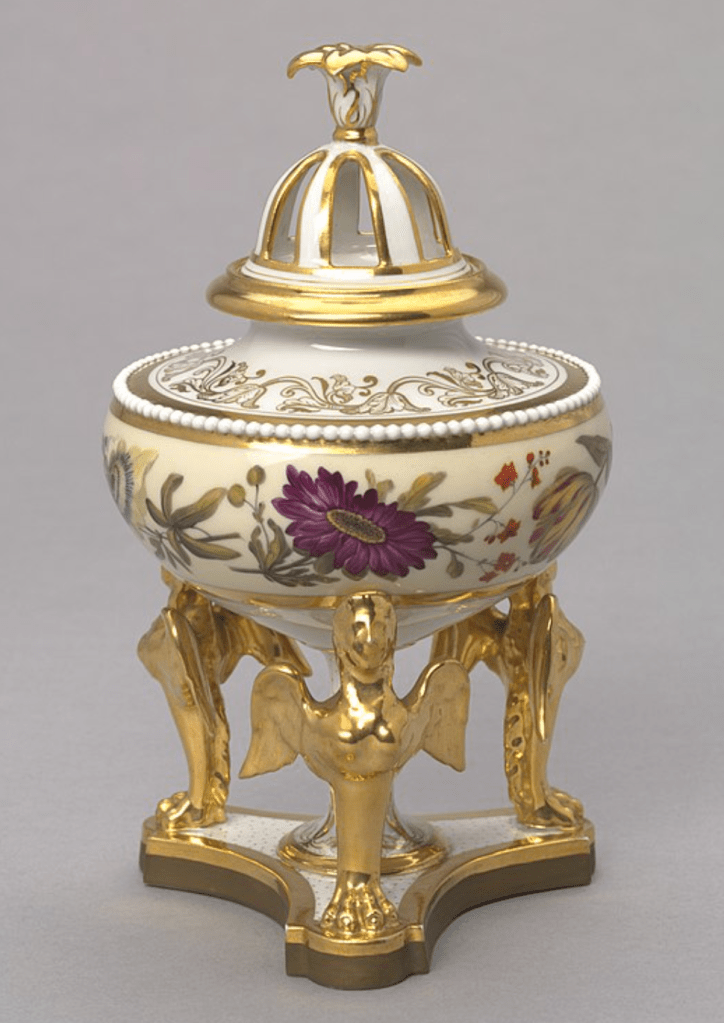
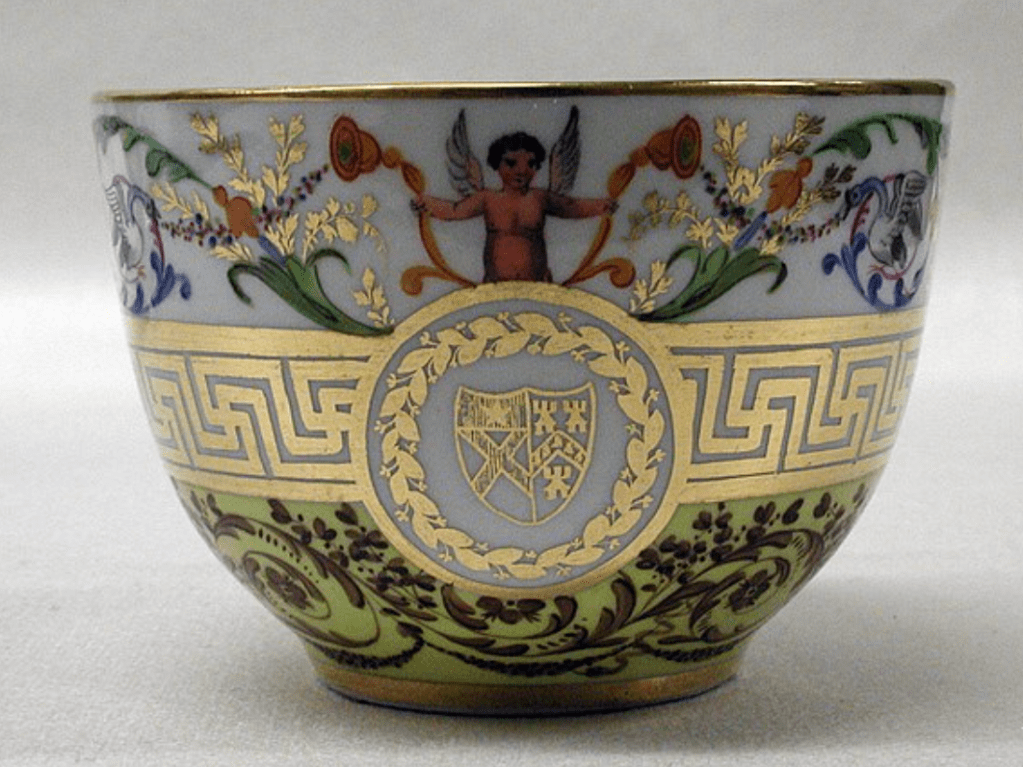
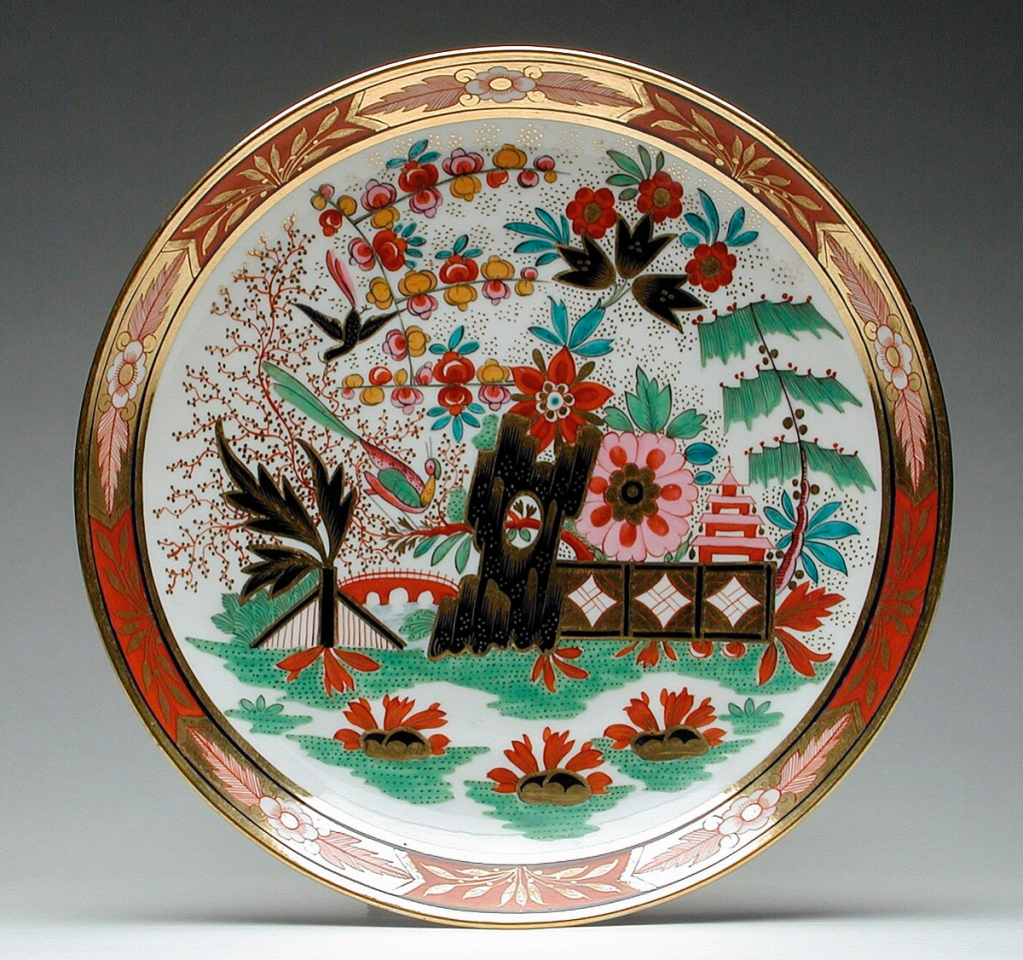
He was also the London agent for Worcester china. In 1783 he purchased the factory for £3000 and intended that his sons John and Joseph would run it. (In the same year Chamberlain opened a rival china factory in Worcester.)

The Universal British Directory 1791

In 1788, on the advice of George III, they opened a shop at 1 Coventry Street off Piccadilly Circus which was run by Joseph Flight. In 1789 the King awarded them their first Royal Warrant.

In 1789 Thomas was listed in Kent’s directory as a Worcester china man living at 22 Bread St, London.

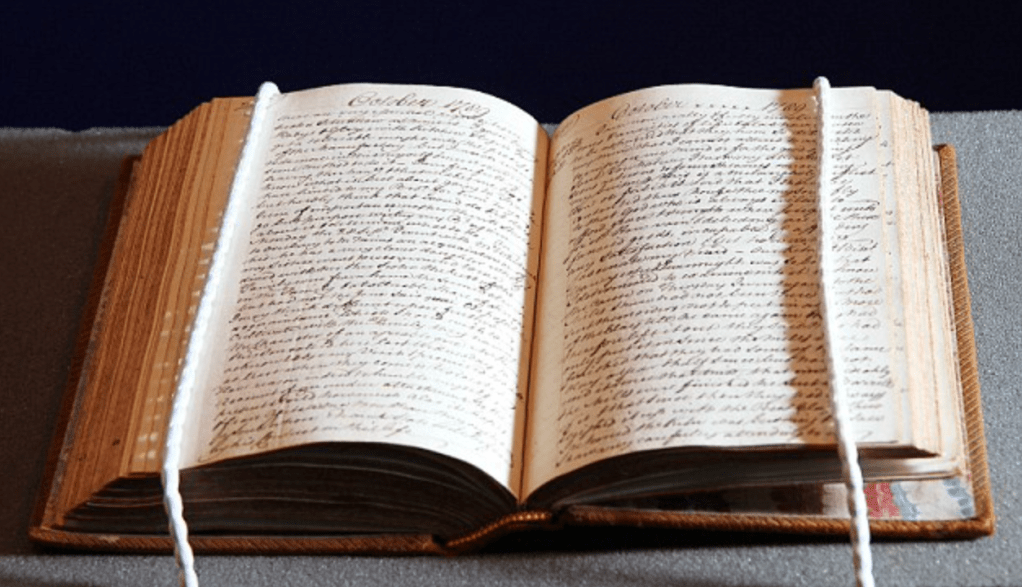
John Flight kept a detailed diary about his time at the factory. It reveals how they got new ideas for their wares and resolved some of the problems they encountered; they spied on French potters! It was a dangerous time to be travelling to France which was in the midst of a bloody revolution.

The diary is in the Royal Worcester Porcelain Museum.

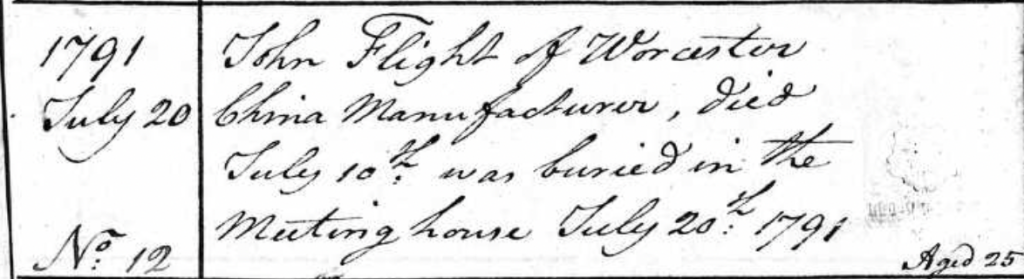
John kept the journal from 1785 until his death in 1791 aged just 25.

Worcester, Angel Street (Independent), Burial

John left a wife, Ann Gillam and a son also called John who was born after his death and died aged 1 year.

It now fell to his brother Joseph to run the factory with Martin Barr and later Martin’s son.

British Museum, Public domain, via Wikimedia Commons

During this time the factory produced many fine pieces. In 1830 they made the Coronation dinner service for King William IV.

Joseph married Hephzibah Gill in 1790 and they had at least four sons, John, Josiah, Edward and Conrad.

In 1840 Chamberlain, Flight and Barr merged into one company and by 1862 it was called Royal Worcester.

The Flight Family

Septima Flight married Lewis Lamotte and their daughter Catherine Septima Lamotte married Arthur Herbert Lanyon in 1899. The Flights are an interesting family and probably deserve their very own website.

Thomas Flight and Judith

Thomas Flight lived in Henley in Berkshire and the little we know about him comes from his wife’s will. We don’t know when he was born or when he married but presumably it was before 1691 when his eldest son Thomas was born. When Judith died in 1729 she was a widow and her will described Thomas as a baker. They had 5 daughters and 4 sons all named in Judith’s will.

Thomas Flight and Martha Fuller

Thomas and Judith’s eldest son Thomas Flight married Martha Fuller 1st Aug 1720 at St. Leonards, Wallingford, Berkshire. Thomas was buried on 8th Aug 1767 at Bunhill Fields in London. His burial record records that he was a dissenter. His will names his children: Joseph, Thomas, John, Ann, Mary, Elizabeth and Hanson, son in law Joseph Pattison and grandson Joseph Pattison. He left the sum of £1600 to his wife to be shared amongst his children. His eldest son Joseph inherited his lands in Farringdon and his youngest son, Hanson, inherited his lands at Abingdon. His sons Thomas and Joseph are his executors.

His daughter Martha Pattison died in 1766

His son Joseph was a turpentine merchant and wheelwright. He died in 1788.

His son John was a maltster and draper. He died in 1769.

His youngest son was Hanson.

Hanson Flight and Martha Underhill

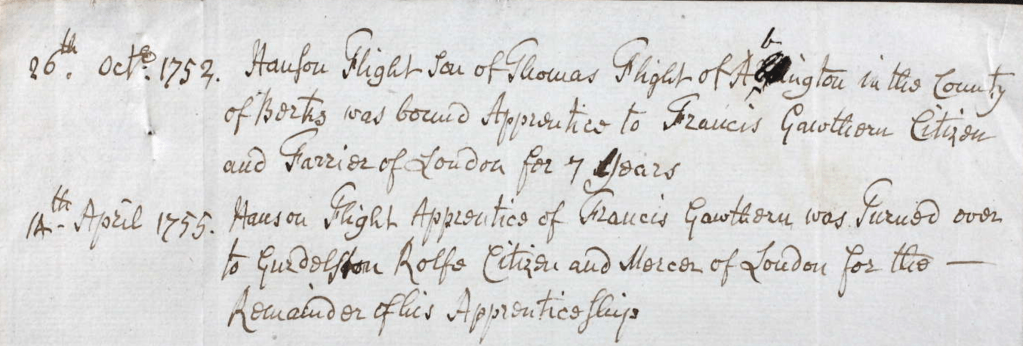
In 1752 aged 15 Hanson was apprenticed to Francis Gawthern a citizen and farrier of London for seven years however three years later his apprenticeship was passed to Gurdolfston Rolfe a citizen and mercer of London.

Freedom of the City Admission Papers

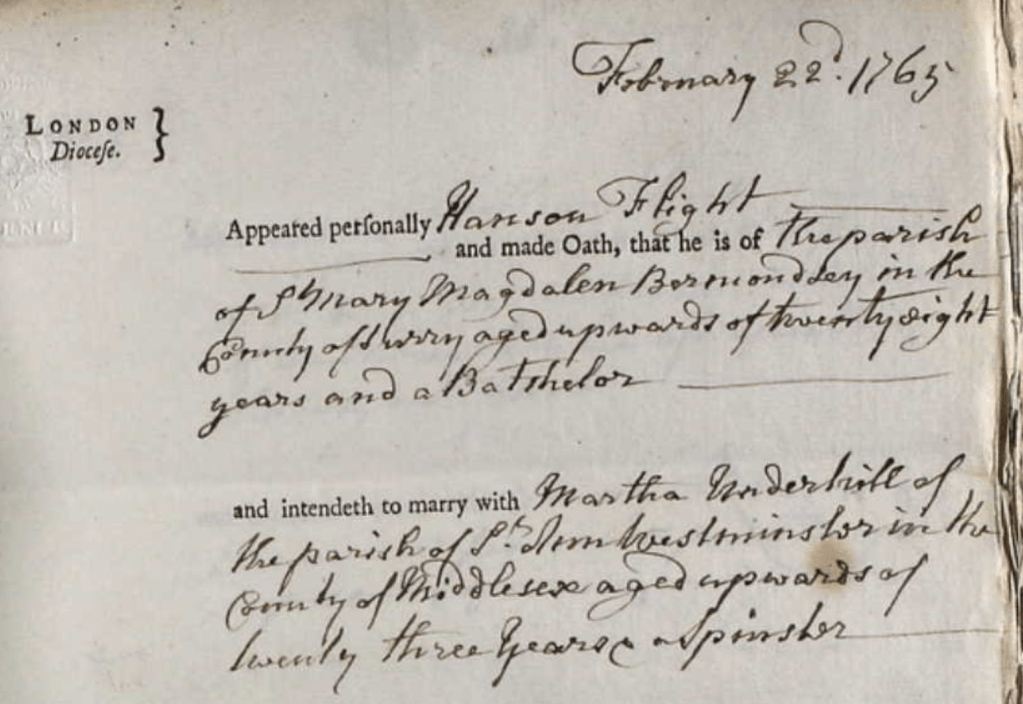
Hanson Flight and Martha Underhill pledged to marry at Bermondsey, Surrey in Feb 1765 and married at St Anne, Soho two days later on the 24th.

London and Surrey, England, Marriage Bonds and Allegations

Hanson and Martha had at least two sons:

  • Joseph 1773 – 1811 married Jane Greenwood in 1801
  • Hanson 1776

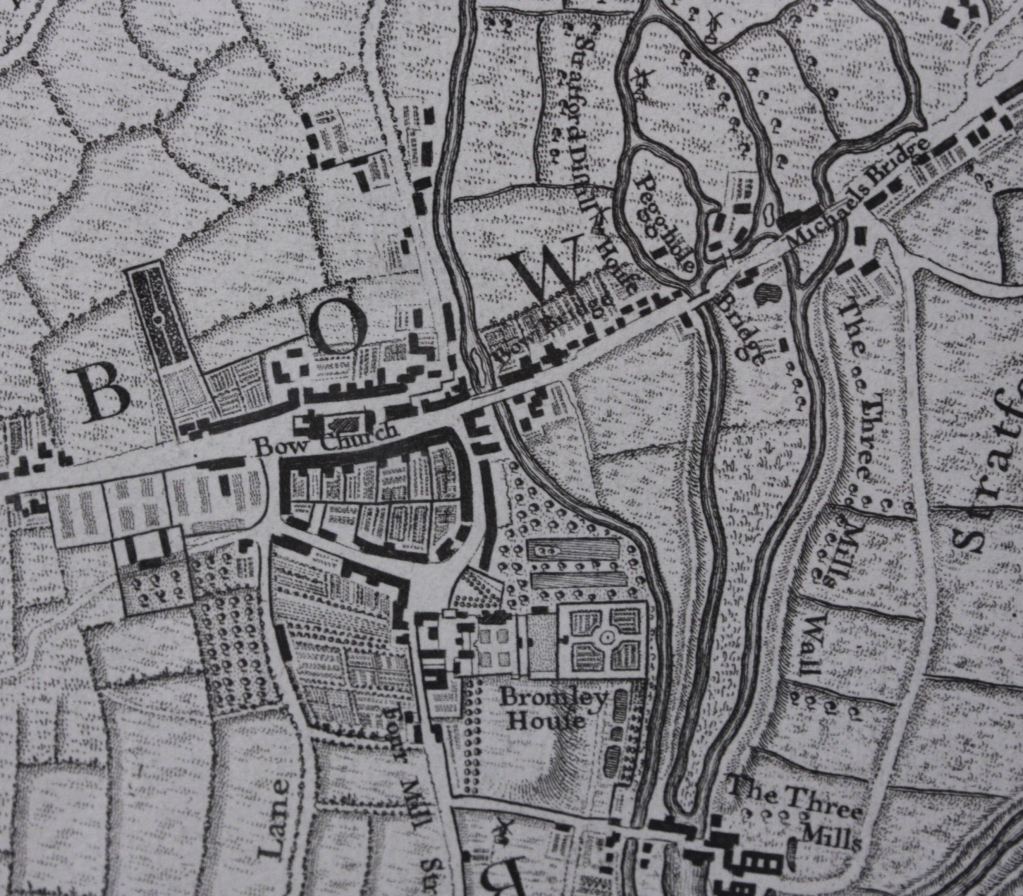
Joseph was a miller and lived at the Abbey Mills at Barking. Joseph was attacked and murdered by footpads at Bow Bridge, River Lea at Stratford on 2nd Feb 1811. He left a wife and six children under the age of 10.

Bow Bridge at Stratford

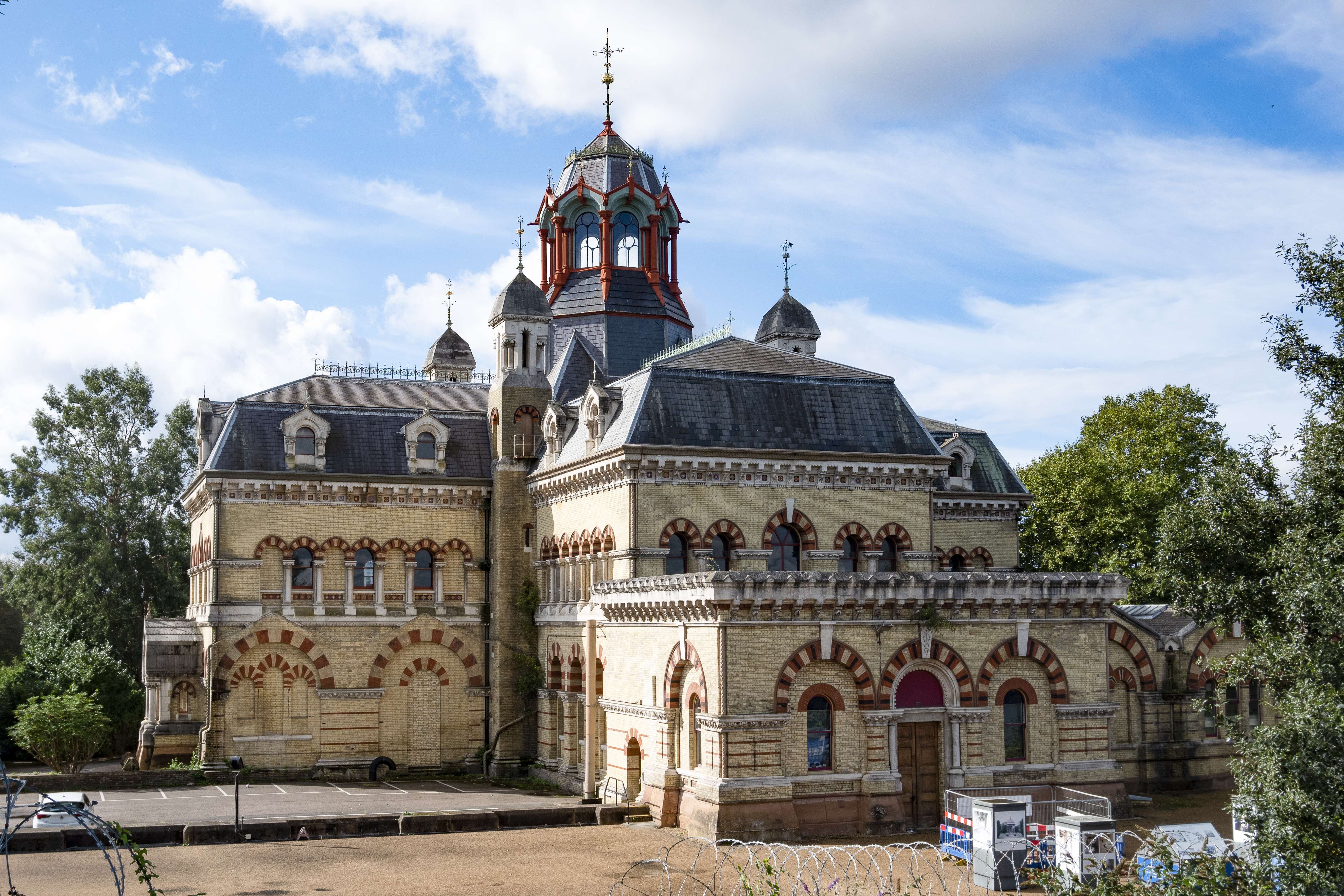
The Abbey Mills no longer exist but on the site today is the Abbey Mills pumping station.

Joseph Flight’s son was also called Hanson and worked as a collector to a draper.

Joseph’s great great great great granddaughter also married a Lanyon!

Descended from the Yetholm Gypsies

Nancy Eleanor Mitchell (1901-74) married John Arthur Lanyon. Nancy was the only daughter of Isaac Haig Mitchell and Margaret Hunter. Margaret’s story is told in the post ‘DNA Detective’, this is the story of Isaac’s family.

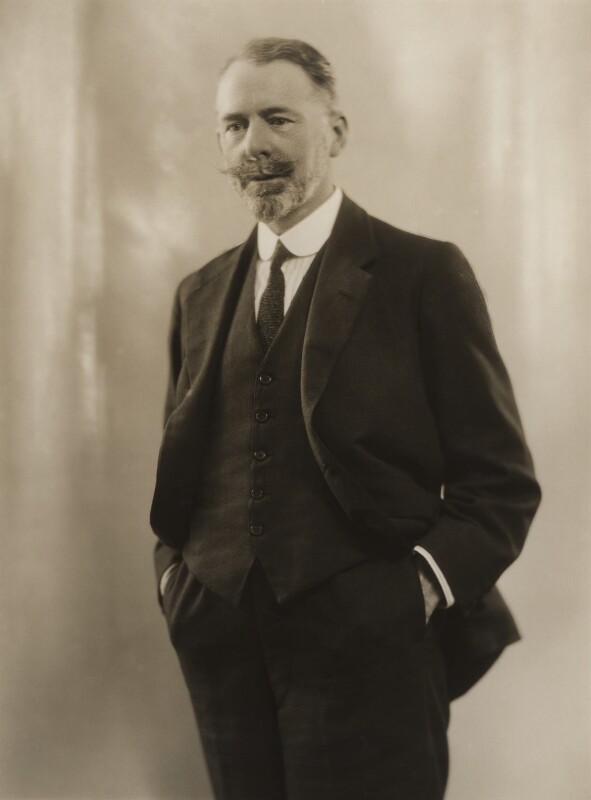
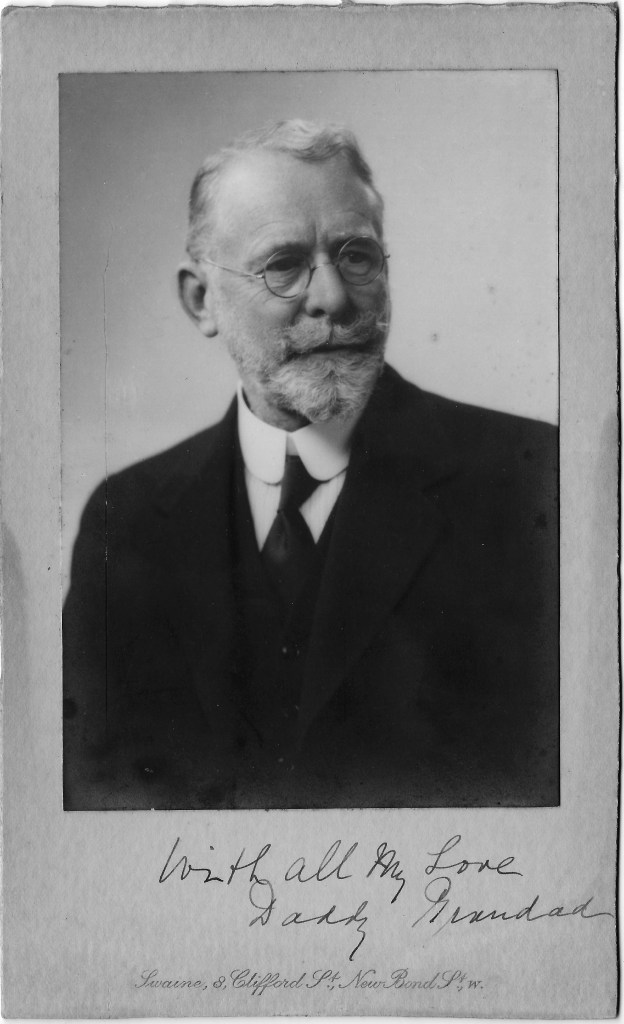
Isaac Haig Mitchell was a mechanical engineer who became a trade unionist. You can read about him on Wikipedia and see his portrait at the National Portrait Gallery in London.

Isaac was named after an uncle also called Isaac Haig Mitchell who was born in 1831. I eventually tracked him down to New York, America where he was working as a clerk and married to Sarah. He died of arthritis chronic inflammation of the joints aged just 36 in 1868, just a year after his nephew Isaac was born.

Isaac Haig Mitchell by Bassano NPG x83999
© National Portrait Gallery, London

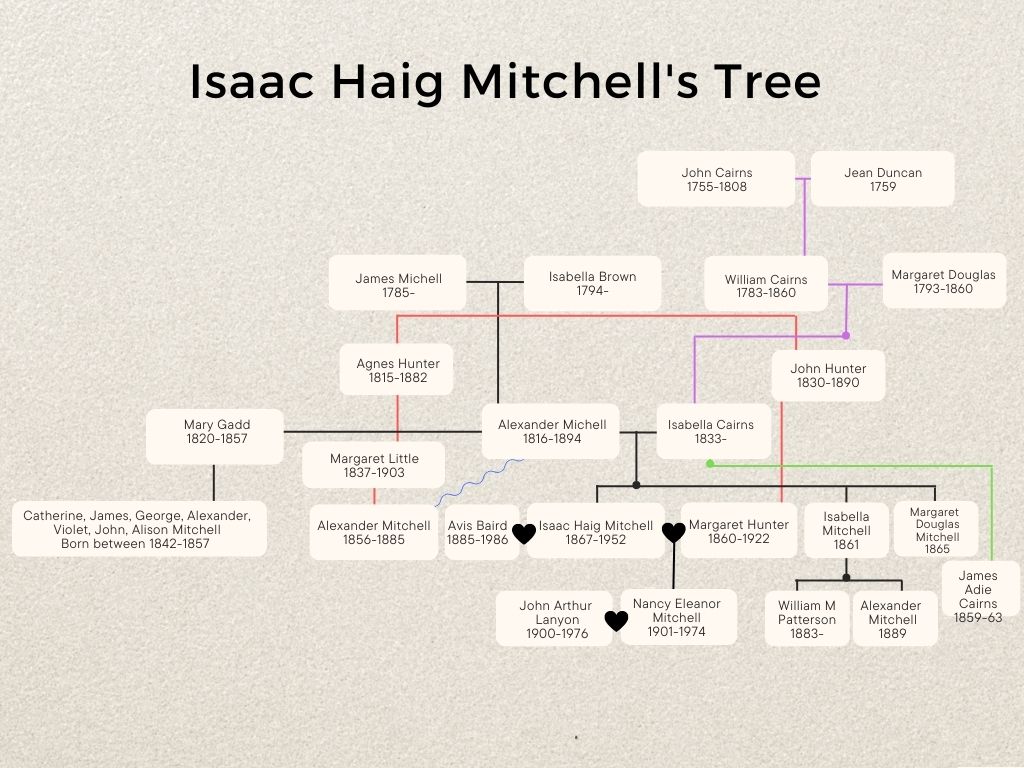
Isaac’s complicated family tree!

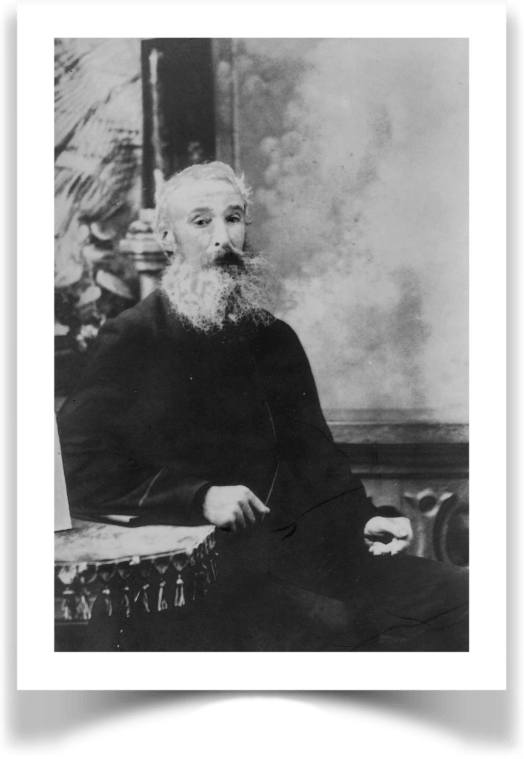
Isaac’s father was Alexander Mitchell 1816-1894 he was born in Eccles and lived all his life in the borders area, dying in Hawick in 1894.

Alexander Mitchell 1816-1894

He was a wool dyer and scourer (scouring is washing the wool to remove all the dirt and grease). Wool was a big industry in this area and many people worked from home, spinning and weaving. Hawick was known for its tweed and cashmere industries.

Alexander’s first wife was Mary Gadd from Leicestershire. They had 7 children together but sadly Mary died of puerperal fever aged 37, five days after giving birth to her seventh child. Baby Alison also died. Alexander was now a widower with six young children to care for.

Alexander may also be the father of Mary Little’s illegitimate son Alexander Mitchell who was born in 1856 and grew up to be a dyer and scourer. (Mary Little was the niece of John Hunter who was the father of Margaret Hunter who married Isaac Haig Mitchell and this may be how the two families knew each other.)

In 1860 Alexander married Isabella Cairns age 27 and the mother of an illegitimate son born in 1859, James Adie Cairns. They were both living at the same address when they married so perhaps Alexander was the father of her child although he had another son named James from his first marriage who was still alive in 1861 so it seems unlikely.

Isabella & Alexander had three children: Isabella, Margaret Douglas & Isaac Haig. Alexander is described as  the step father of James Adie Cairns who sadly died age 4 of Phthisis Abdominalis (abdominal tuberculosis). Sometime before 1881 they adopted a child, John Murray born 1871, the son of Elizabeth Murray. Elizabeth may be a relative or a friend. In 1871, aged 23 she was admitted to Roxburgh Poorhouse as she was a pauper, pregnant and unmarried. Ending up in the poorhouse usually meant the woman’s family has disowned her and thrown her out. 

By 1891 John Murray was no longer with the family, I couldn’t find a record of his death but did locate a record that showed a John Murray joining the Kings Own Scottish Borderers Militia in 1890. After that there are too many John Murrays to identify what happened to him.

The 1891 census shows that Alexander and Isabella had two grandsons living with them: William Paterson and Alexander Brown Mitchell. These are both the illegitimate sons of Isaac’s older sister Isabella. Isabella was a power loom weaver and as she was able to support herself financially and had support from her family she didn’t end up in the poorhouse.

William’s father is named as William Paterson a solicitor’s clerk. William (junior) changed his name to Mitchell from Paterson. This William Mitchell was staying with Isaac in London in 1901 when Nancy Eleanor was born.

Isabella Cairns is descended from the Cairns family in Yetholm Roxburgh. Yetholm is the gypsy capital of Scotland and most of the families in this small village were descended from or intermarried with the gypsy community.

Isabella’s mother was Margaret Douglas and the Douglas family were a well known gypsy family.

Walter Baxter / Kirk Yetholm Gypsy stone inscription

Map of the Borders Area of Scotland.

Unlike his peers Isaac stayed on at school and did an engineering apprenticeship. On the 1891 census he was boarding at Newcastle Upon Tyne where he joined the Amalgamated Society of Engineers. In 1892 he moved to New York and found work as a millwright and joined the Socialist Labour Party of America. In 1894 he moved back to Galashiels in Scotland and founded a branch of the Independent Labour Party. He moved to Glasgow where he was the ASE’s delegate on the TUC. In 1899 he became the first general secretary of the General Federation of Trade Unions.

In 1899 he also married Margaret Hunter and in 1901 their daughter Nancy Eleanor was born.

Isaac & Nancy

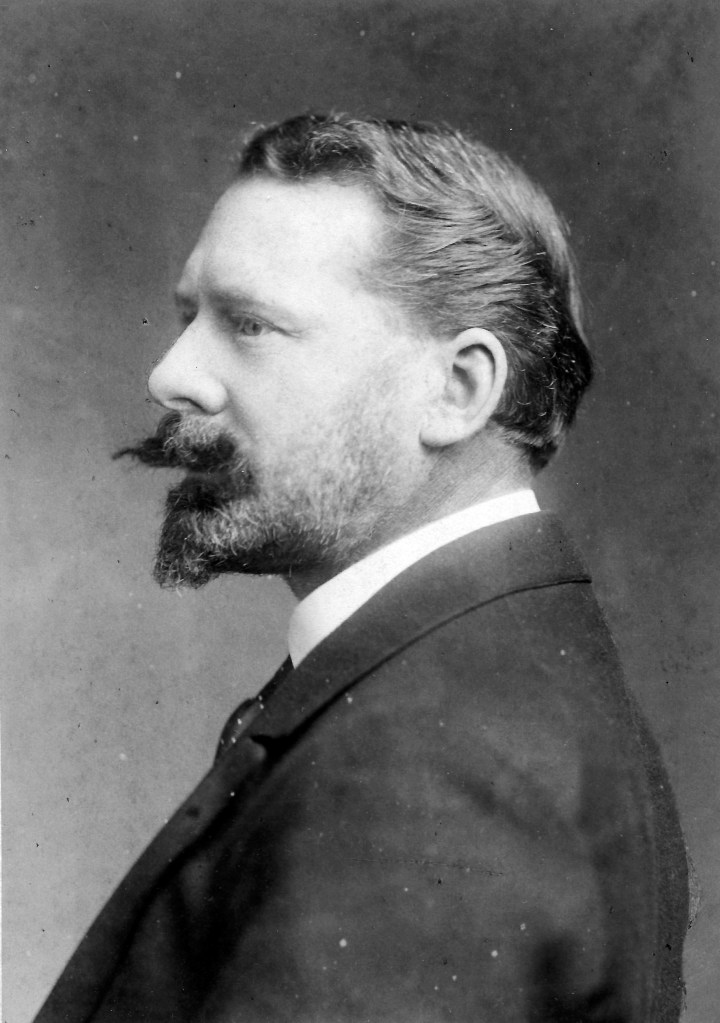
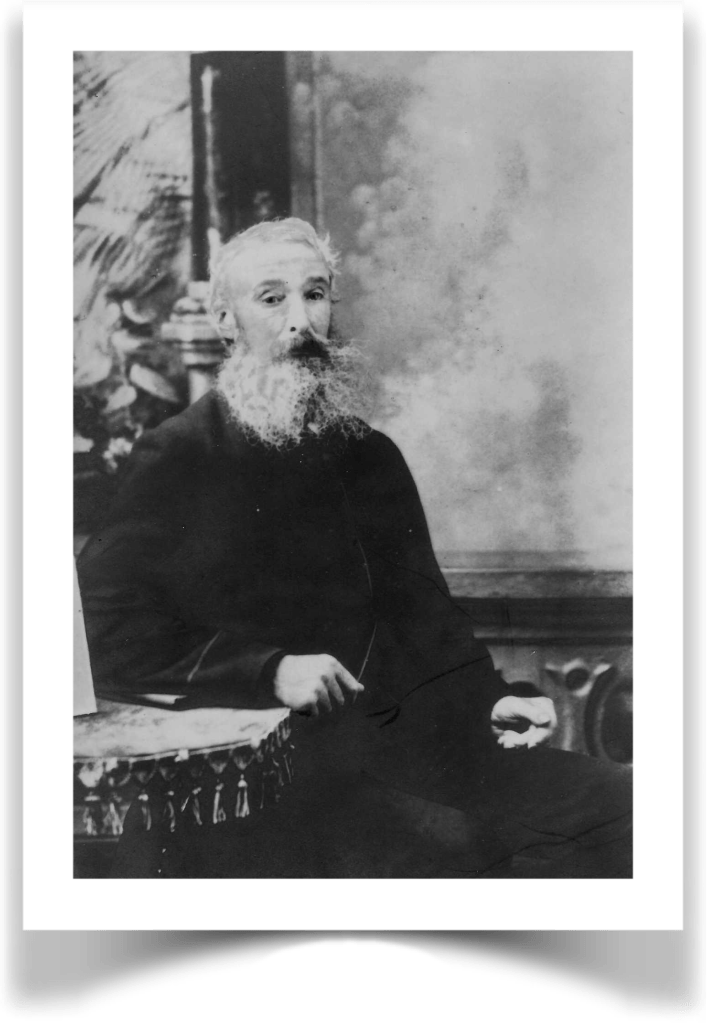
They moved to London and he was elected as a Progressive Party alderman on London City Council. In 1907 he accepted an offer to work for the Board of Trade. He became known as ‘Haig Mitchell’ and grew a distinctive beard.

Isaac after 1907

His first wife Margaret died in 1922. On 29 Jul 1927 he married a widowed neighbour Avis Chatterley Baird. Avis died in 1986 aged 100!

Isaac

In 1941 Isaac wrote an article “The Road to Peace”

Isaac died on 15 Mar 1952 at Wandsworth, London. After his death Avis wrote to his daughter Nancy and the letter gives us an insight to his traits as he aged.

DNA Detective – The Search for Margaret Hunter

When I started working on the family tree I very quickly progressed on all branches apart from Margaret Hunter’s family. I was completely stumped.

Margaret Hunter

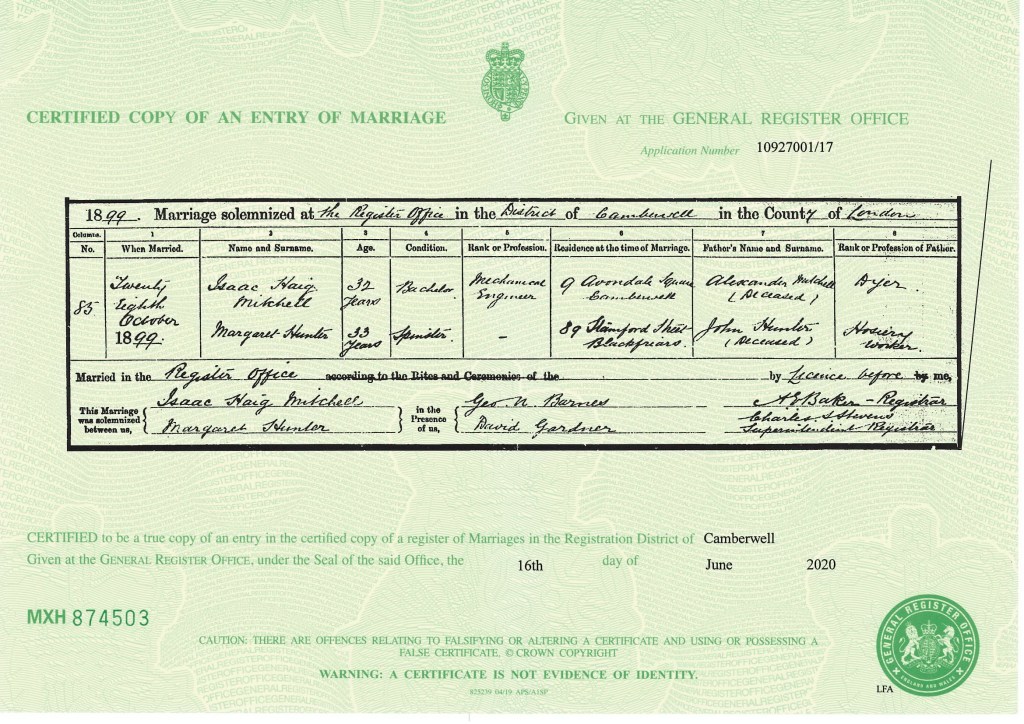
Margaret was the mother of Nancy Eleanor Mitchell and Nancy’s birth certificate gave me her maiden name of Hunter. I found Margaret’s marriage to Isaac Haig Mitchell on 29 Oct 1899 and the marriage certificate stated that her age was 33 and that her father was called John Hunter, a deceased hosiery worker.

Margaret’s marriage certificate

I easily found Isaac and Margaret on the 1901 and 1911 census. In 1901 Margaret is listed as age 34, born in Scotland and on the 1911 census she is described as age 44, born in Hawick and living in Sutton, Surrey. (I haven’t yet managed to find them on the 1921 census.)

1911 Census return

I then started a search for a Margaret Hunter born about 1866/67 in Hawick the daughter of John Hunter a hosiery worker. There weren’t any candidates so I expanded the search to the whole of Roxburgh and, as Margaret Hunter is a fairly common name, I found lots. I found a few with father’s called John but none of them was a hosiery worker or similar and whilst people did change their occupations I thought it unlikely that a man would, in middle age, change from mining or agriculture to become a hosiery worker.

I decided to search in the 1871 census for a 4/5 year old Margaret Hunter in Hawick and then the whole of Roxburgh and again had no real luck. I then searched the 1881 census (the Mormon Church has transcribed this whole census and it is easy and free to search) for the whole of the UK and found a Margaret Hunter born in 1865 in Scotland with a father called John Hunter who was a weaver now living in Cumberland. After months of searching I thought I had at last found ‘our’ Margaret. At age 16 this Margaret had an illegitimate child who was raised by his grandparents. Her father John Hunter was a blind weaver born in Scotland but as there are thousands of John Hunters born in Scotland I thought I couldn’t go any further and I left the story there and moved onto another branch of the tree.

Months later I returned to this branch of the tree and decided to look for John Hunter’s death certificate. He was recorded as deceased on Margaret’s marriage certificate so his death must have occurred sometime after the 1881 census and before October 1899. I eventually found his death on 10th Feb 1887 in Carlisle. He was 68, a woolen weaver and his daughter Margaret registered the death. The only problem was she was called Margaret Martin now. It was fairly easy to find her marriage and then to find her on the 1901 census with Mr Martin so she couldn’t possibly be ‘our’ Margaret.

I started again from a slightly different angle. I had found a record for a burial of a Margaret Mitchell in Banstead Surrey on 15 Nov 1921. Margaret was recorded as being 53 years old giving an approximate date of birth as 1868. I had assumed this was ‘our’ Margaret as there was only one death of a Margaret Mitchell in this area. I decided to obtain the death certificate just to confirm the information. When the certificate arrived many weeks later it stated that she was the wife of George Mitchell a ‘carman’ so she wasn’t ‘our’ Margaret. 

The wrong burial!


I spent several days searching for her death. Her death wasn’t registered near her residence in Surrey so I had no idea where to look. Eventually I found her death registered in Lambeth/Brixton on 5 Aug 1922 where she is recorded as being age 55 giving an approximate date of birth as 1867. (She died of stomach cancer and pneumonia.)

Death certificate


I now searched in Scotland for every Margaret Hunter born between 1864-1870, there are lots! I then checked the census and married up every one of them with a family. Some had fathers called John Hunter. I was able to eliminate any John who was still alive after 1899. I was able to eliminate any Margaret who was still a spinster after 1899. I was able to eliminate any Margaret who married someone other than Issac Haig Mitchell and was still married in 1901. I then eliminated any John Hunter who’s occupation didn’t fit with the description ‘hosiery worker’, so all the miners, heavy labourers, farmers etc. Slowly but surely I whittled the list down and still could not find ‘our’ Margaret.

I then took a different approach. I decided to look for all John Hunters in Hawick who were working in any capacity in the wool/cloth industry. Hawick and the surrounding towns in Roxburgh  are famous for their wool industries so there were quite a few candidates but one stood out.

1871 census for 50 Loan Street, Hawick. John Hunter age 40, wool frame work knitter but the only problem was he was unmarried. He did however have a daughter called Margaret Hunter. Unfortunately she was aged 11 and therefore born 1860 which is several years before ‘our’ Margaret was supposedly born.

I searched for a birth of Margaret Hunter in 1859/60/61 in Hawick. Again without success.

I then concentrated on John Hunter and slowly but surely worked out the story.

In 1851 John Hunter was recorded on the Hawick census as age 19, a woollen frame work knitter and living as a lodger with the Thomson family. His place of birth is listed as Langholm Dumfries.

I found him again in 1861 lodging with Margaret Graham and her mother Margaret Notman at Myreslaw Green in Hawick. He was age 27, a power stocking frame tender, unmarried. 

Margaret Graham is listed as a married seamstress. The following children are also listed at the same property: Elizabeth Graham age 12, Joan Graham age 9, John Hunter age 6, William Hunter age 3 and Margaret Hunter age 1, all born in Hawick. The relationships are listed against the head of the house Margaret Notman so it’s not always clear if they are actually related to the lodger John Hunter.

1861 Census Hawick

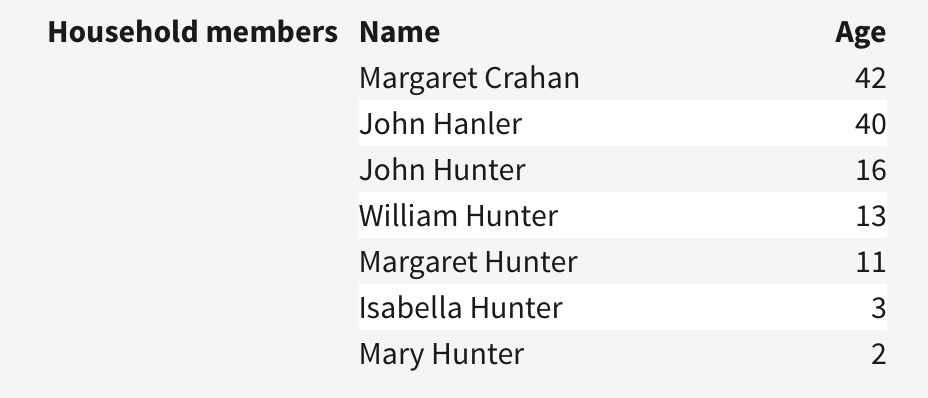
By 1871 John Hunter was listed as the head of the household and the children were listed as his sons and daughters. Margaret Graham is listed as his married housekeeper and there were two more children: Isabella age 7 and Mary age 2. Unfortunately his surname was transcribed as Hanler and hers as Crahan which made the search a little more tricky!

1871 Census Hawick incorrectly transcribed.

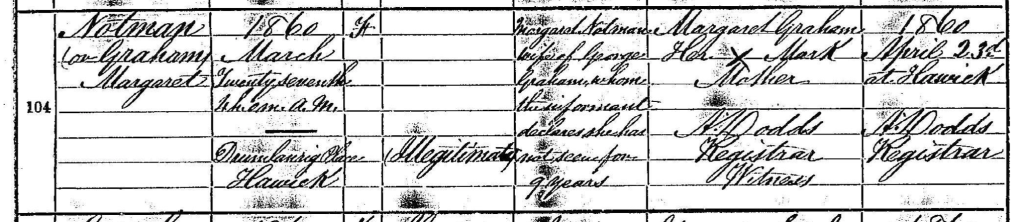
It appears as though John Hunter was co-habiting with Margaret Graham. I decided to search for a birth for a Margaret Graham born 1859/60/61 in Hawick, without success. I then tried using the surname Notman and hit the jackpot!

Margaret’s birth record

Margaret Notman (or Graham) 27 Mar 1860 in Hawick. Margaret is listed as illegitimate but there is a note “Margaret Notman wife of George Graham who the informant declares she has not seen for 9 years”. So having been abandoned by her husband George Graham (a mason’s journeyman) in 1851 she went back to her parents and later met John Hunter, who she lived with until her death in 1877 age 47. 

After her death John Hunter continued to live in Hawick with his daughter Isabella and appears on the 1881 census still working as a wool frame work knitter. He died on 4 Nov 1890 at the Melrose District Asylum age 62. Cause of death was paralysis of the insane four years (late stage Syphilis). The death was registered by Andrew Butler, Isabella’s husband.

John Hunter’s death record

By 1881 Margaret Notman/Hunter had left home and I spent quite a long time looking for her on the census. The most credible entries I found were: 

  1. Margaret L Hunter age 21, birth year 1860 Hawick, Roxburgh. Working as a tablemaid at The Scores, St Andrews, Fife. (I couldn’t find a Margaret L Hunter born in 1860 in Roxburgh).
  2. B) Margaret Hunter age 18, birth year 1863 Roxburgh. Working as a domestic servant and described as a visitor staying with Robert & Helen Gilholm at their home in Ancrum Roxburgh. I did find a Margaret Stodda Hunter born in Roxburgh 1863 but it wasn’t ‘our’ Margaret.

By 1891 there was no obvious candidate for her in the UK census. I decided to look at both Margaret Notman/Graham’s family and John Hunter’s family to see if Margaret had gone to live with any of them. 

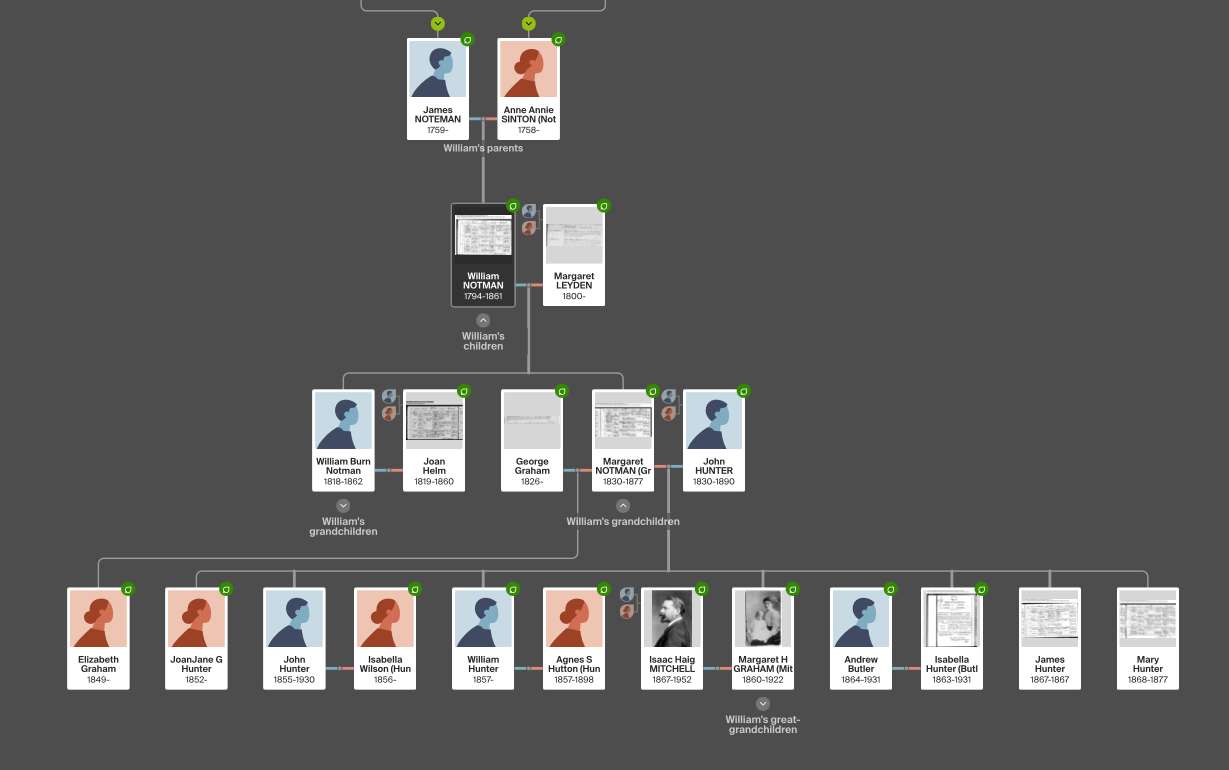
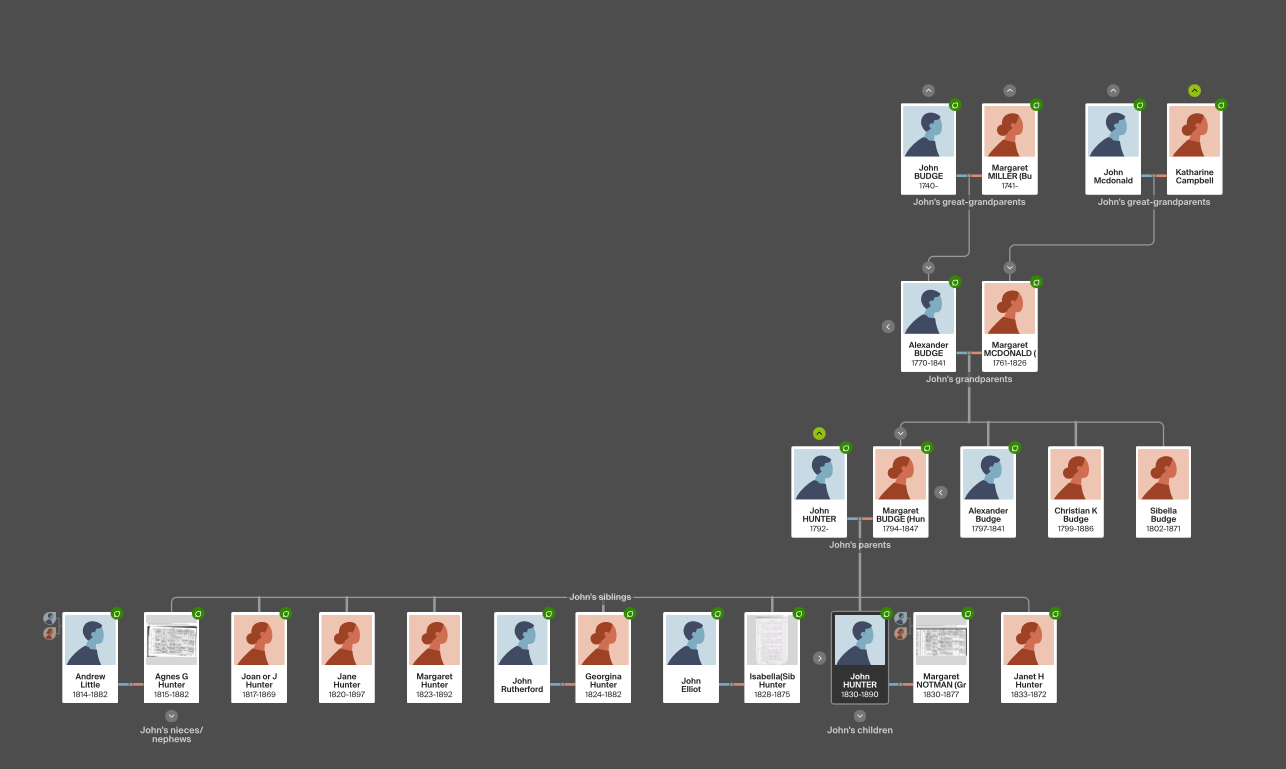
Margaret’s Tree

John Hunter (born 20 Nov 1830) was the son of John Hunter born about 1792 and Margaret Budge baptised 7 Aug 1794 Langholm. He had several brothers and sisters. His elder sister Agnes Gaskill Hunter was born in 1815, she married Andrew Little and their first child was born in 1833. They had several children and their daughter Margaret Little was born in 1837. In 1856 Margaret Little gave birth to an illegitimate child called Alexander Mitchell in Hawick. He grew up to be a wool scourer and dyer. It’s pure speculation but I wondered if he could be the illegitimate son of Isaac Haig Mitchell’s father who was also called Alexander Mitchell who was also a wool scourer and dyer. It would perhaps explain how ‘our’ Margaret knew Isaac Haig Mitchell.

John Hunter’s Tree
Alexander Mitchell, father of Isaac Haig Mitchell and possible father of Alexander Mitchell born 1856.

Alexander Mitchell/Little died age 28 of pulmonary consumption. In 1879 he was involved in a Sheriff Court paternity case with Sarah McWatters over the paternity of her daughter Ellen L Stainton McWatters. He went on to marry Betsy Young the year before he died.

I still don’t know where ‘our’ Margaret was in 1891. But it appears that at age 39 she married 32 year old Isaac Haig Mitchell. In 1901 age 41 she gave birth to Nancy Eleanor Mitchell, her only child. She maintained the lie about her age for the rest of her life.

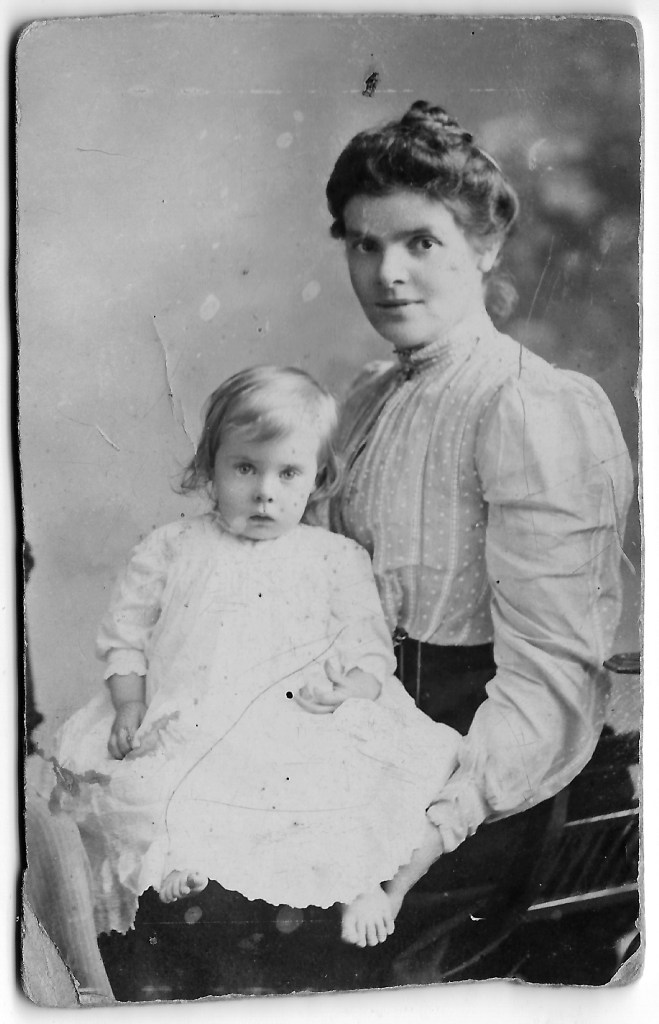
Margaret with her daughter Nancy Eleanor Mitchell

Of course this was all speculation until my husband submitted a DNA test to ancestry.com and we discovered several distant cousins all descended from John Hunter and Margaret Notman/Graham which confirmed at long last that I had indeed found ‘our’ Margaret Hunter.
What happened to Margaret’s brothers and sisters?

Elizabeth Graham her half sister was born about 1849. There are a couple of possible marriages but I could not find anything to prove which was correct.

Joan/Jane Graham/Hunter born 1852 may or may not be George Graham’s daughter. By 1871 she is no longer with the family, she may have died or moved away. No further trace of her.

John Hunter born 1855 and died 3 May 1930 Kilmarnock. He married Isabella Wilson and they had 7 children. Their youngest, born in 1898, was called Maggie Notman Hunter.

William Hunter born 1857 married Agnes Sanderson Hutton and moved to Peebles. They had 4 children, the youngest was born in 1886 and was called Margaret Notman Hunter.

Isabella Hunter born 1863 died 5 Feb 1931 Paisley. She was run over by a lorry and killed, there is a procurator fiscal’s report attached to her death certificate. She married Andrew Butler and had 6 children, the eldest was born in 1885 called Margaret Notman Butler.

James Hunter born 7 Mar 1867 and died 6 Sep 1867 of whooping cough.

Mary Hunter born 17 Aug 1868 and died 19 Mar 1877 of tubercular meningitis.

Without DNA I would never have ben able to confirm that this was indeed ‘our’ Margaret Hunter.