The Lanyons have travelled all over the world and there are branches of the family on most continents. A Lanyon is even listed as a ruler of the Northern State of Gonja in Ghana!
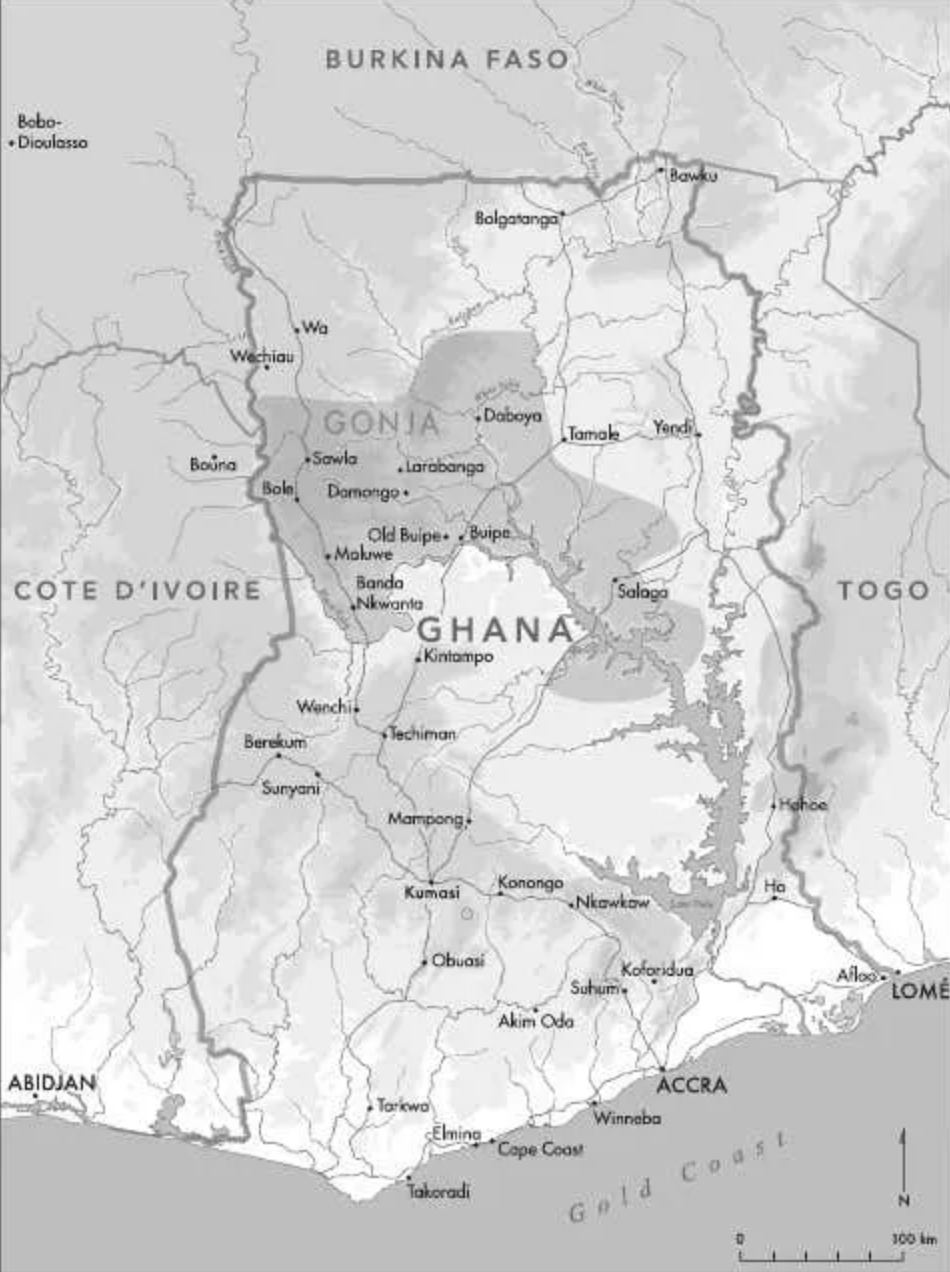
Gonja was created by Mande Conquerors around the beginning of the 17th century. According to Wikipedia the capital is Yagbum.
Map of Ghana showing Gonja region.
The first ruler of Gonja was Sumalia Ndewura Jakpa, a slave trader.
Precolonial Gonja society was stratified into castes, with a ruling class, a Muslim trader class, an animist commoner class, and a slave class. Its economy depended largely on trade in slaves from Central Africa and kola nuts, particularly through the market town of Salaga, sometimes called the “Timbuktu of the South.”
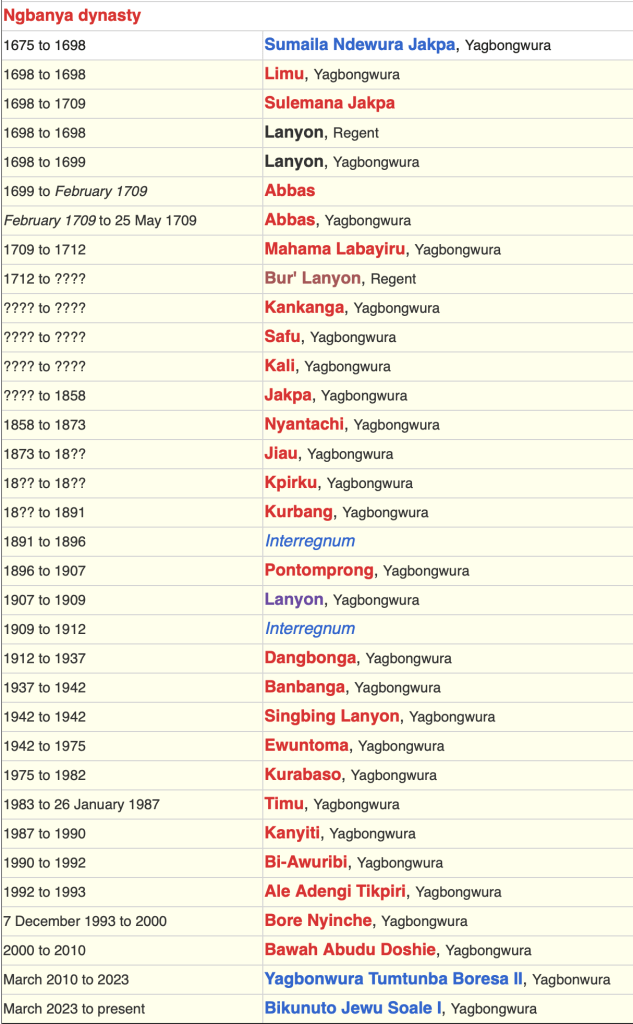
Wikipedia gives a list of rulers of Gonja.
Apparently between 1698 and 1699 Lanyon was regent and Yagbongwura (paramount ruler). I suspect the name Lanyon may have been used to fill a gap in the list!
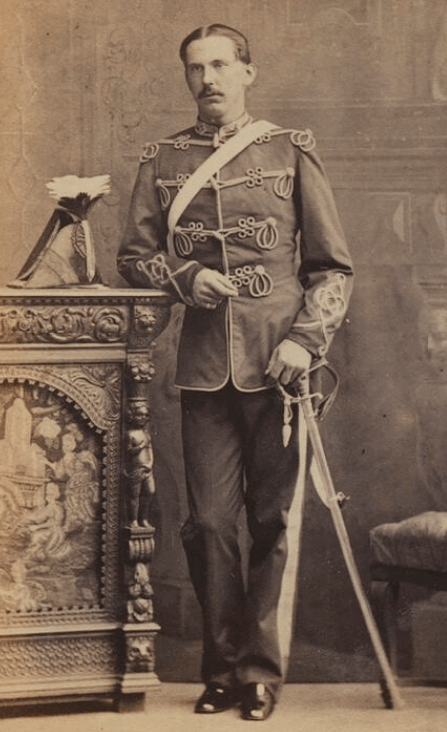
1907 – 1909 Lanyon was again listed as Yagbongwura. Curiously Wikipedia identifies this Lanyon as Colonel SirWilliam Owen Lanyon, who died of cancer in New York in 1887.
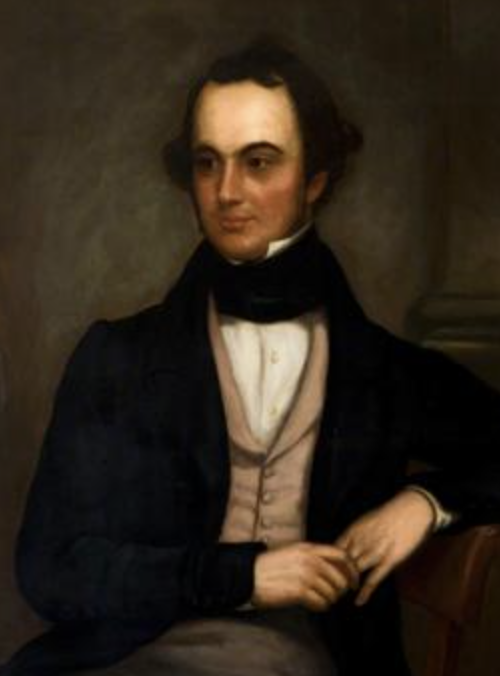
William was born in Ireland in 1842 the son of Sir Charles Lanyon and his wife Elizabeth Owen. He was a British colonial administrator and army officer.
William Owen Lanyon – Wikimedia Commons
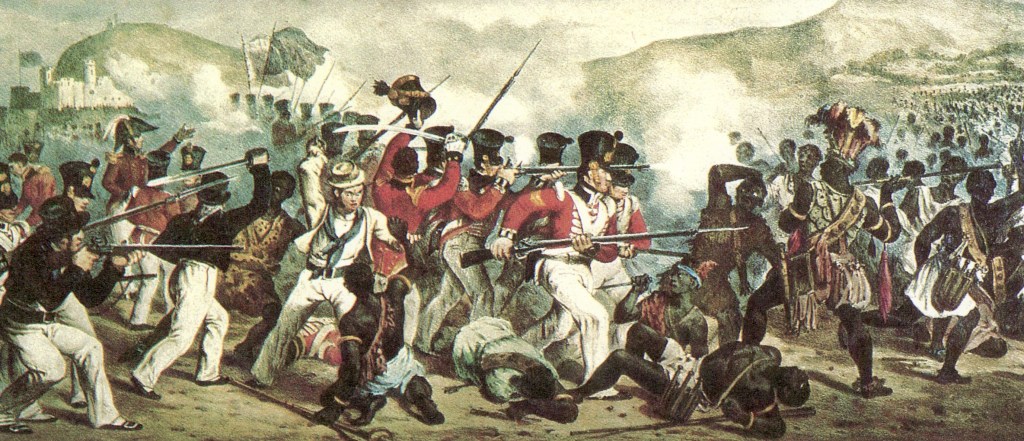
He was invalided in the Ashanti campaign which may be his connection to Gonja.
The Anglo-Ashanti wars lasted 70 years finally ending in 1900. The wars established the British Gold Coast and the country became a British protectorate.
“Defeat of the Ashantees, by the British forces under the command of Coll. Sutherland, July 11th 1824.” Wikimedia Commons
It’s not clear how William Owen Lanyon went from fighting in the Ashanti wars to being listed as a ruler of Gonja twenty years after his death but it makes life interesting for family historians!
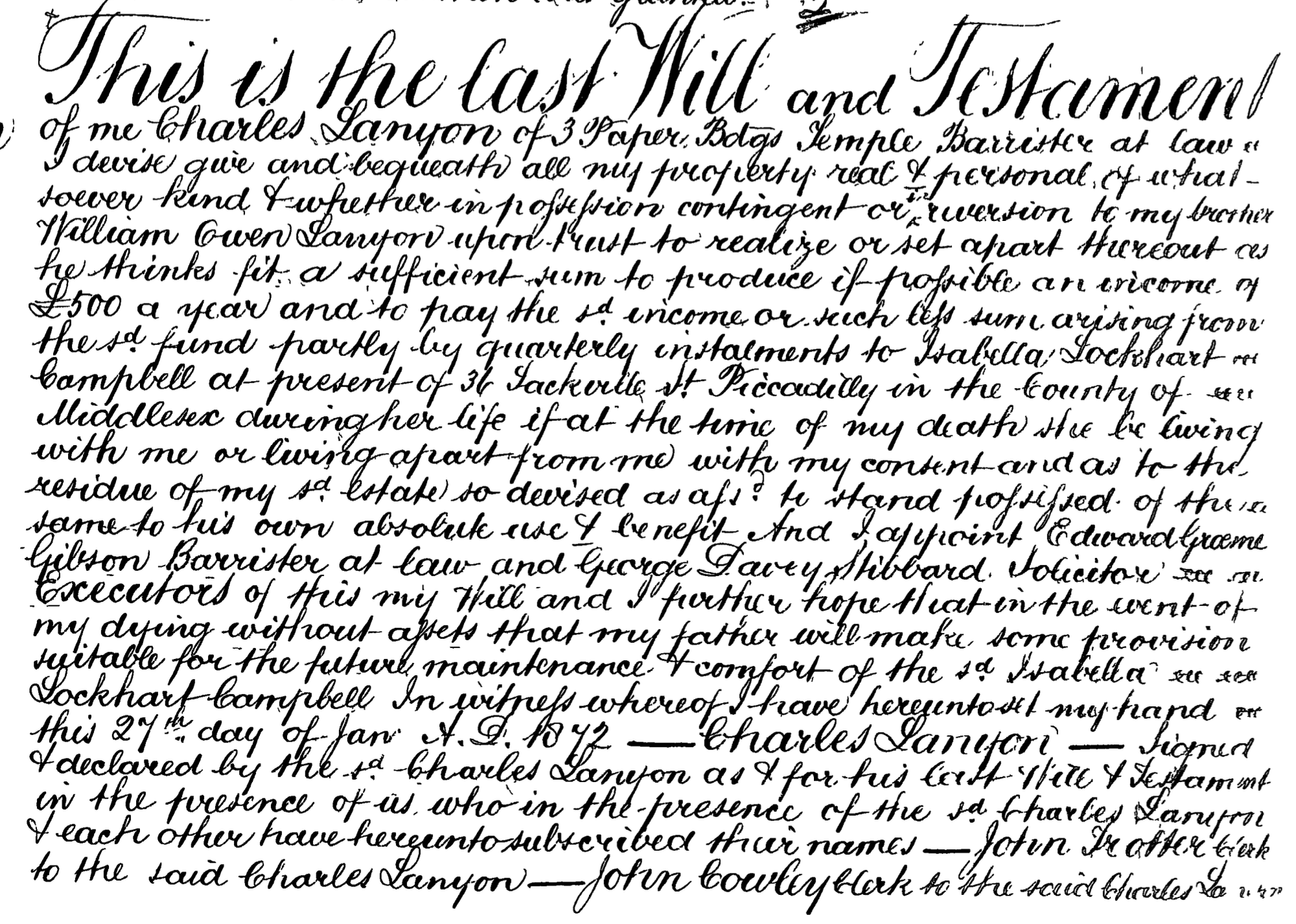
During the winter of 2024 I decided to transcribe all the old Lanyon wills I could find. Most were fairly straightforward but one did catch my attention, the will of Charles Mortimer Lanyon who died in 1877. He left a sizeable bequest to Isabella Lockhart Campbell “if at the time of my death she be living with me or living apart from me with my consent…”
Curiosity piqued I started digging to find out more!
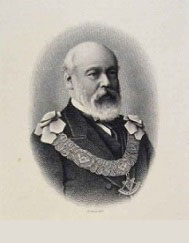
Charles Mortimer Lanyon was born in Belfast on 23 Aug 1840 the son of Charles Mortimer Lanyon and Elizabeth Helen Owen. His father was the famous Irish architect who built a number of well known buildings. He was later knighted and became Mayor of Belfast.
Sir Charles Mortimer Lanyon – Architect
Charles was the third child of Charles and Elizabeth. He trained to be a barrister. He never married and died on 27 Feb 1877 at the age of 37. He was just a name on the Lanyon tree until I read his will and set out to find out more about Isabella.
The name Isabella Campbell is very common, especially in Scotland, and the search for information was long and at times frustrating and whilst searching often involves working backwards I will retell the story chronologically.
Isabella Campbell was born Isabella Jones (an even more common name!) on 9 Dec 1847 in the village of Pontesford in Shropshire. Being so close to the Welsh border they weren’t the only Jones family in the area.
Her father was Richard Jones, a lawyer, and her mother was Jane Lockhart Mills. Isabella was the second of seven children born to the couple. I found them on the 1851 census for Pontesbury, Isabella was aged 4. By the 1861 census Isabella was missing. At the age of 14 she could have been staying with relatives on census night, away at school or possibly even working, although that seemed unlikely as her father was a lawyer and probably financially secure.
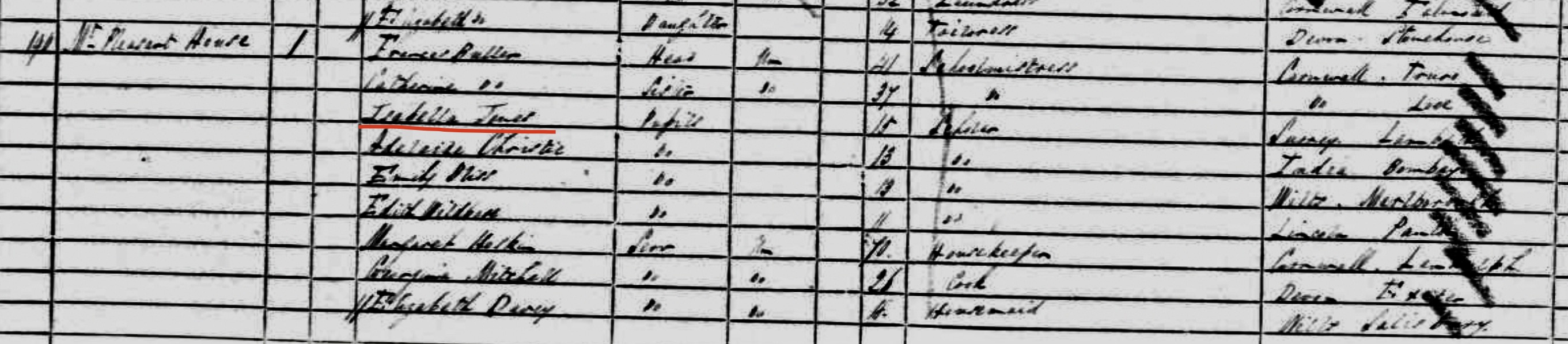
I couldn’t find a single Isabella Jones born in 1847 in Pontesbury on the 1861 census. The most likely candidate I found was an Isabella Jones, born abt. 1846 in Lambeth, Surrey and at school in Plymouth, Devon.
Screenshot
Plymouth seemed the most likely place in view of what happened next. On 15 Feb 1865 Isabella gave birth to a daughter, Florence Lockhart Campbell, at 4 Buckland Street, Plymouth. Isabella was just 18 years of age.
Florence’s birth record names her mother as Isabella Campbell formerly Lockhart (no mention of the name Jones) and names the father – Edward Campbell, a surgeon. I did search before 1865 for a marriage, without success.
I searched for Isabella on the 1871 census. I found her and Florence living with two servants, a mother and daughter, both called Sarah Cowley. Isabella’s occupation is listed as ‘chambers’. Is this a reference to Charles Lanyon who is a barrister?
Screenshot
Isabella is described as a ‘wife’ but I could find no trace of a marriage before 1871.
On 27 Jan 1872 Charles Mortimer Lanyon made his will and named Isabella so they must have been in a relationship before that date.
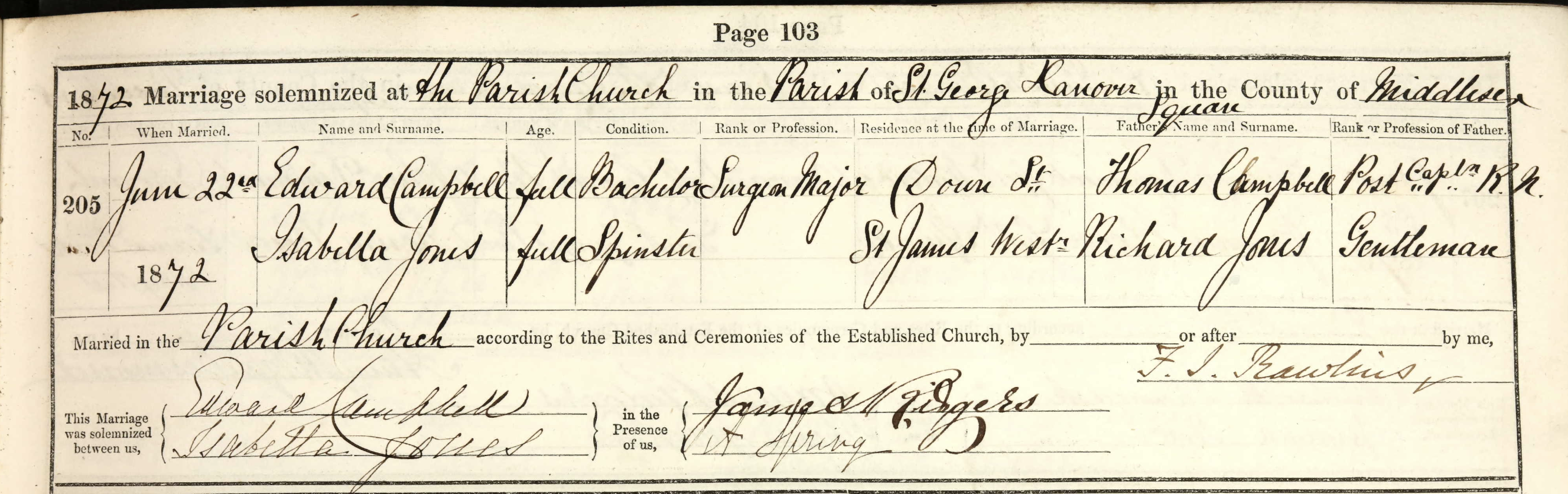
Then on 22 June 1872 Isabella finally got married. Not to bachelor Charles Lanyon but to Edward Campbell!
Edward Campbell was a surgeon major and a little research quickly established that he had served in the Bengal Army and was born in 1815, making him 32 years older than Isabella!
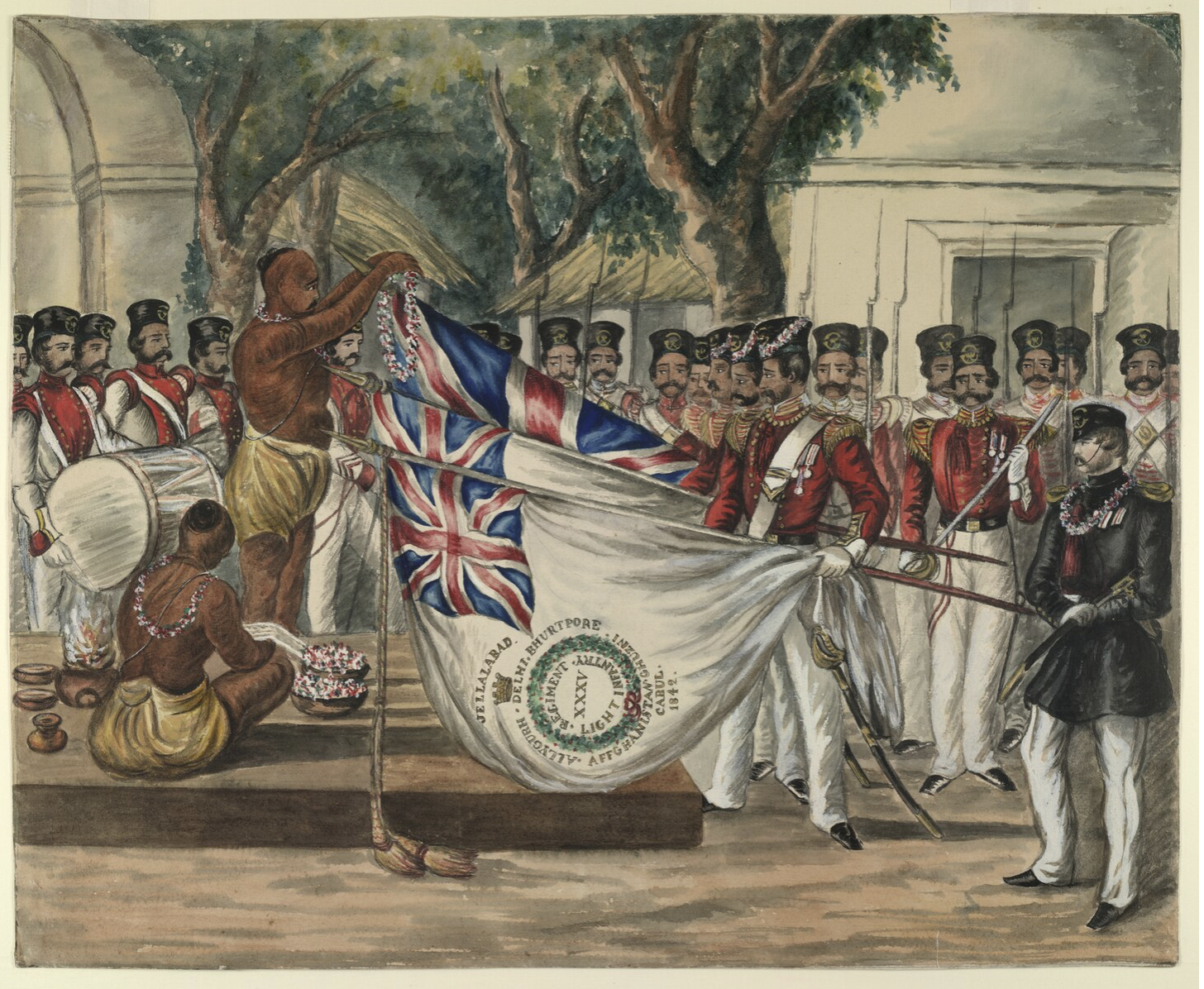
Edward was the son of Thomas Campbell a Captain in the Royal Navy and his wife Phoebe. Edward was baptised at St Martin by Looe in Cornwall on 8 Apr 1815. He was an MRCS (member of the Royal College of Surgeons) by 1837 and served in the following wars:-
Afghanistan 1840-42 – Storming of Istalif
Attended the wounded during the retreat from Kabul
Gwalior War 1843-44
First Sikh War 1845-46
Crimean War 1855
Santhal Rebellion 1855
Hindu priest garlanding the flags of the 35th Bengal Light Infantry (c.1847) – British Museum – Wikimedia Commons
By 1864 Edward had retired from the army and returned to England where he met Isabella.
On 4 Jan 1876 Charles Lanyon wrote a codicil to his will. He reduced the bequest to Isabella from £500 to £300 a year as he had settled some money on her whilst he was still alive and he appointed his brother William Owen Lanyon his sole executor.
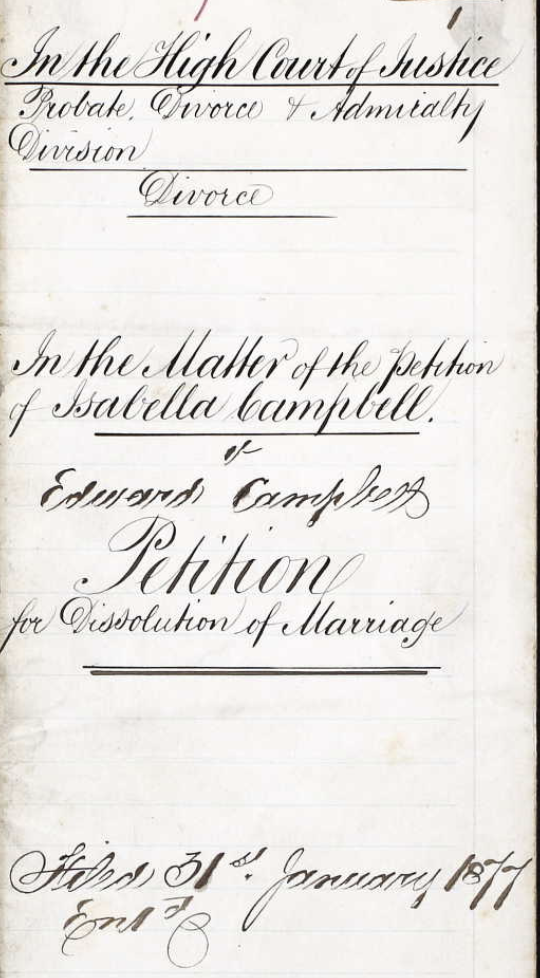
The next time they appear in the records is on 31 Jan 1877 when Isabella filed for divorce from Edward.
Isabella’s petition alleged that in September 1874 Edward had deserted her and since December 1873 he had committed adultery numerous times with various unnamed women in both London and Plymouth. And that on the 25th and 26th of January 1877 he had committed adultery with an unnamed woman at the Norfolk Square Hotel in Paddington. Isabella also alleged that there were no children from this marriage!
Was she divorcing Edward so she could marry Charles? If so she was too late.
Less than one month later Charles was dead.
He suffered from a weak dilated heart and had developed painful inflammation of his collar bone, he was just 37 years old.
Charles’ will was proved on 26 May 1877 and probate was granted to William Owen Lanyon’s attorneys as he was in South Africa. Then nothing happened. The grant of probate ceased and expired.
We next find Isabella and Florence on the 1881 census. Florence was living with her ‘father’ Edward Campbell in Devon (helpfully her name was transcribed as Kormcoh Campbell! Nothing is ever simple in genealogy) and Isabella was a visitor at Clifton in Bristol. She is described as ‘wife of Dr Campbell’.
Screenshot
On 5 Aug 1887 probate of William’s will was finally granted to Sir William Owen Lanyon. We don’t know if William ever paid out the bequest to Isabella.
Isabella died on 3 Dec 1888 at 74 Bishop’s Road, Paddington in London. Her ‘husband’ Edward was present. She too was suffering from heart problems and collapsed. She was just 41.
Edward may have been 32 years older than Isabella but he outlived her and died on 16 Jan 1890.
We could of course leave the story there but I wanted to know what happened to Florence and consequently found myself disappearing down a genealogical rabbit hole!
Florence’s Story
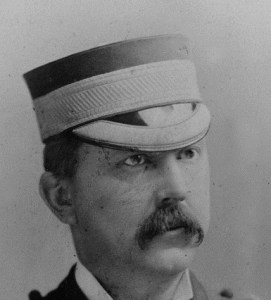
On 8 Aug 1889 Florence married Willington Augustus David Shelton (now that’s the sort of name genealogists love!) Willington was of Irish heritage and I quickly found an obituary for him in the Limerick Archives. They also had a photo of him.
He had a distinguished military career and became a Lieutenant Colonel. He served in India, Ireland and South Africa during the Boer war and was at the siege of Ladysmith in 1900. He was mentioned in dispatches and awarded the DSO.
Perhaps of more interest to family historians was the mention of three wives! His first marriage was to Mary Bridget Goodlake on 17 Jan 1877. He filed for divorce on 25th May 1878 on the grounds of her adultery with Hermon Samler. On 4 Oct 1879 Mary married John Hermon Samler.
Just a year later, on 28 Oct 1880 Mary filed for divorce on the grounds of John’s cruelty (she alleged he was intoxicated and would pinch and kick her) and he counter sued on the grounds of her adultery! The divorce petition is some 64 pages long and they weren’t granted a decree absolute until 1886 and during that time she gave birth to two daughters who were both given the surname Samler!
On 6 Jan 1887 Mary married for a third time to William Middleton Power. She lived to the grand old age of 93!
Willington’s second marriage was to Victoria Chancellor in 1886. Victoria was ten years older than Willington and had been married twice before. Her first marriage was to John Atcheler who was 47 years older than her! Victoria’s father was a coach maker and John Atcheler was a horse dealer. John died in 1867 at the age of 75 and the same year she married for a second time to George Bury a GP who was 30 years older than her! George died in 1886 and that same year she married Willington.
Victoria died on 1 Jan 1889.
Victoria Chancellor
Willington waited eight months and then married Florence on 8 Aug 1889. They had two children but Florence died of scarlet fever at the London Fever hospital on 18 Jun 1905 aged just 40.
Whilst this starts off as a post about Charles Lanyon it develops into a post about marriage, adultery and divorce in the Victorian era.
William was the son of Sir Charles Lanyon and Elizabeth Helen Owen. He was born in Belfast in 1842 and was a famous British colonial administrator. He served in the West India Regiment and was secretary to the Governor of Jamaica. He was administrator of the southern African territories in the 1870s. His autocratic outlook and low opinion of the local peoples made him immensely unpopular during his terms of office. He was governor of Griqualand West and described it as the most “hideous and disgusting” place he had ever seen.
William Owen Lanyon ‘The Major’
Sir William Owen Lanyon – AnonymousUnknown author, Public domain, via Wikimedia Commons
He became a Companion of the Order of the Bath and a Knight Commander of the Order of St Michael and St George. He married Florence Levy but she died in childbirth and the child was stillborn. He died of cancer of the jaw in New York.
Major William Owen Lanyon, the British Imperial Administrator of Griqualand West, is shown being devoured by the Cape Colony monster.
Caricature showing the bearded Sidney Godolphin Alexander Shippard (right) and R.W. Murray “Limner” (left) tripping up the Lieutenant Governor of Griqualand West, Major William Owen Lanyon. Image relates to the unsuccessful attempt by Major Lanyon to sue the newspaper editor Murray for libel, and Shippard’s support for the newspaper.
Charles was the son of John Jenkinson Lanyon and Catherine Anne Mortimer and was baptised at Eastbourne in 1813. He was articled to Jacob Owen of the Irish Board of Works in Dublin to learn engineering. He secretly married his daughter Elizabeth Helen Owen. He was appointed county surveyor for Kildare and then asked for a transfer to Antrim. He was responsible for many of the important buildings and infrastructure in Northern Ireland. He was elected Mayor of Belfast and Conservative MP for the city.
Every Lanyon researcher who has found John Jenkinson Lanyon has been left scratching their heads and wondering where he fits into the Lanyon tree.
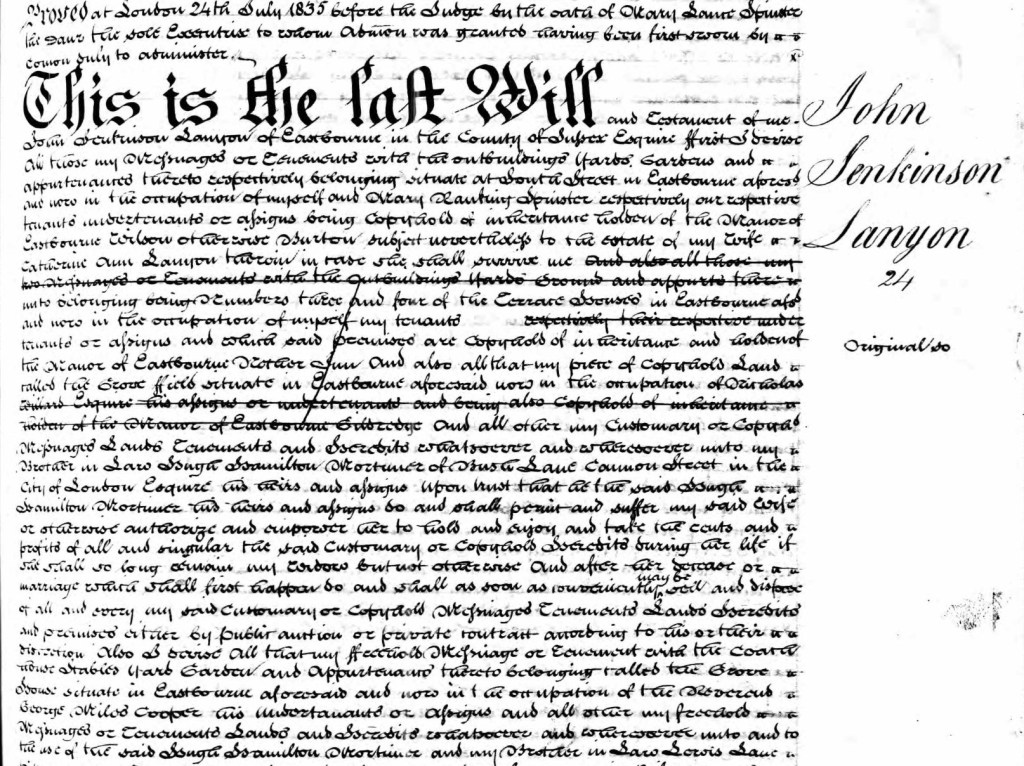
We know he was born abt. 1770 but there is no record of his baptism and no record of his parents’ names. Jane Veale Mitchell notes that he was raised by the Bulteel family of Devon but gives no more detail. He died in 1835 and left a will but no clue as to his family roots.
He did use a gold fob seal with the Madron arms which suggests that he is descended from that branch of the tree. Jane Veale Mitchell speculated that he was the son of Robert Lanyon and Martha Dyer; Robert was baptised in 1735 at Madron and married Martha Dyer at Plymouth, St Andrew in 1759. They had two documented daughters: Sarah and Mary Jensen. Could this be where John Jenkinson fits on the tree?
There is also a Hugh Lanyon who married Sarah Row at Plymouth, Charles the Martyr in 1747 and had children at Plymouth Dock. He’s mentioned in his father’s will (Francis Lanyon 1680-1757) could Hugh be a father or grandfather of John Jenkinson?
It’s possible that he was illegitimate, his mother packed off to Devon to give birth in secret. If so the stain of illegitimacy didn’t prevent him making a good marriage.
We may never know for sure who his father was but it seems certain that he was connected to the Madron branch of the family somehow.
He married Catherine Anne Mortimer (1773-1840) at St Clement Danes, London on 22nd May 1806. He was a purser in the Royal Navy. They had three sons:
John Hamilton Mortimer 1807-1841 he went to Australia and founded Lanyon Homestead near Canberra.
William 1810-1831 died Guangzhou, China, drowned alongside eight others when their boat sank – bachelor. His memorial reads: Sacred to the memory of William Lanyon second son of John Jenkinson and Catherine Ann Lanyon of this parish. 4th Officer of the Honble. Co. Ship Hythe, who was drowned with Eight of the Crew of the said ship by the upsetting of her boat in the river of Canton in China on the 18th day of November 1831 in the 21st year of his age. An affectionate and dutiful son and beloved and respected by all who knew him.
Charles Mortimer 1813-1889
Will of John Jenkinson Lanyon – Source NA PROB 11; Piece: 1849









 The Lanyons