William John Glanville Lanyon

William John Glanville Lanyon was born on 31 May 1881 in Saltash Cornwall, the illegitimate son of Mary Ann Lanyon. He was known as John Lanyon. His family also knew him as Barney.

I’ve pieced the following story together from the records available.

According to the 1861 census Mary Ann Lanyon was born in 1858 in Hayle, Cornwall the daughter of John Lanyon & Emma Jane. John was a boiler maker steam engineer and died at the tragically young age of just 24. John was from Marazion and I can trace his family tree back to Barnard Lanyon 1638-1714.

I found a marriage of a John Langon & Emma Elmes in 1857 St Germans and a birth registration for Mary Ann in Penzance in 1857 with a mother’s maiden name of Elums. Various censuses have her born C1857/8 in either Hayle or Saltash.

In 1864 Emma Jane  (26) married William Barrett, a fisherman, age 20. She is listed as a widow on the marriage certificate.

In 1873 at the age of 15 Mary had her first illegitimate child: Kate Lanyon, followed three years later by Edith Annie and then Alfred & Francis Lanyon, twins (they were actually triplets, but the third child was stillborn). Finally in 1881 she gave birth to William John Glanville Lanyon. According to the 1881 census she was an inmate at St Germans  Union, Torpoint (the workhouse) with 2 year old twins Frank & Alfred Lanyon. She’s listed as a fisher saleswoman and pauper. Presumably she had been admitted to the workhouse due to the imminent arrival of another child and extreme poverty. What a desperately hard life it must have been.
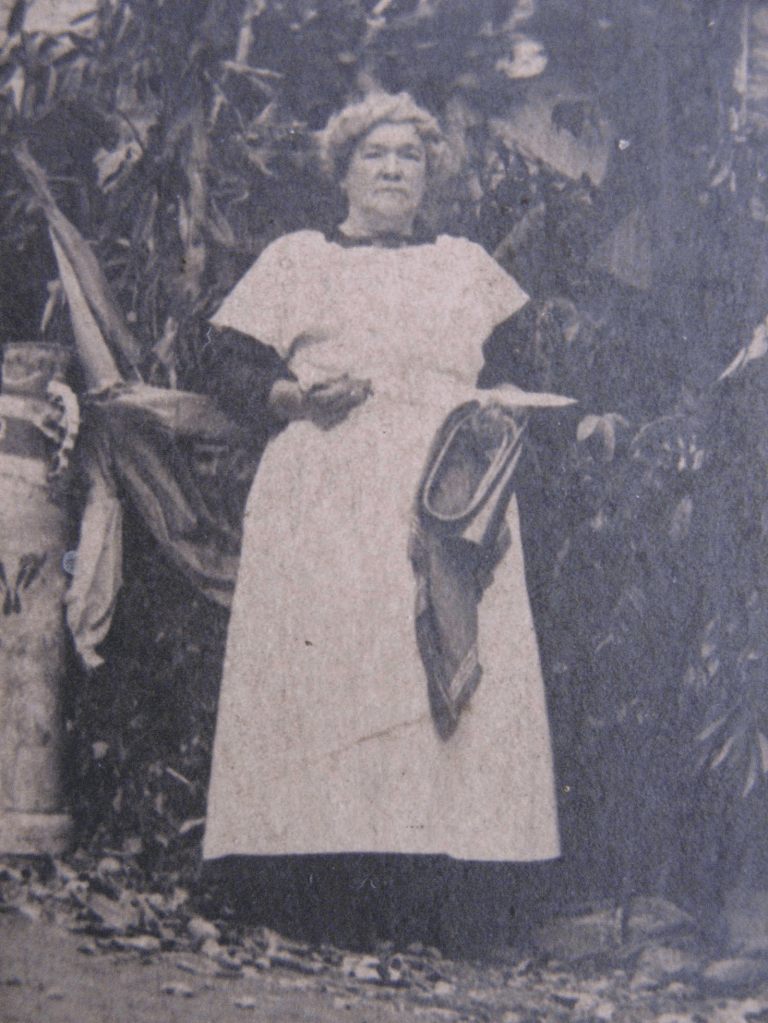
Mary Ann Lanyon

In 1884 she gave birth to another illegitimate child, Hetty Roseanna Beer and the following year she married William Henry Beer in Saltash. William was a tailor journeyman.

In 1886 Mary gave birth to William George Henry Beer (her second child called William). This is presumably why William John Glanville Lanyon used the name John rather than William.

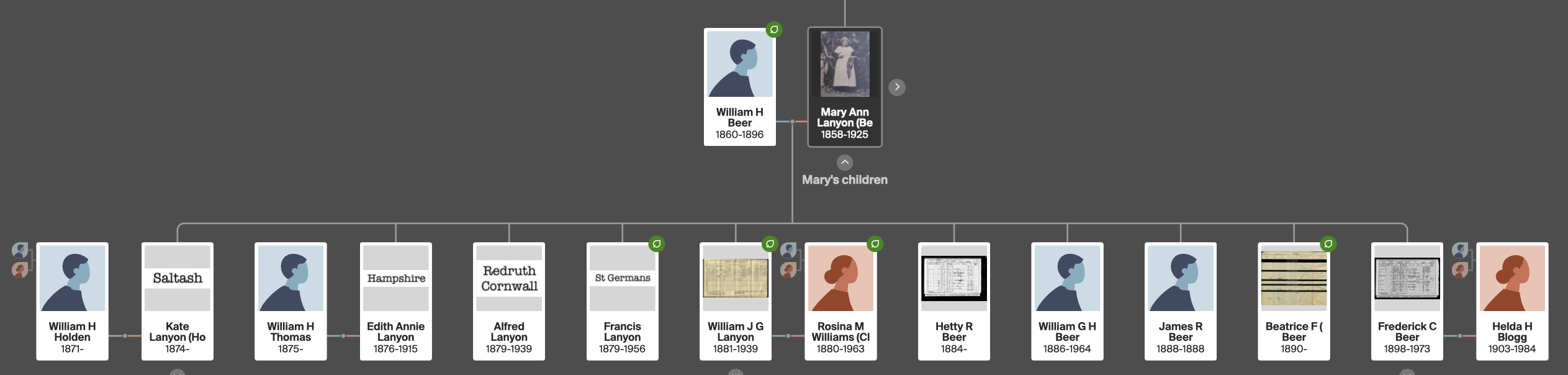
Mary Ann had two more children: James & Beatrice Beer. Then William Beer her husband died aged just 36. Two years later she had another illegitimate child, Frederick Charles Beer.

Mary Ann died 17 Mar 1925 in Saltash.

On the 1911 census William John Glanville Lanyon aka John Lanyon is described as a fisherman and is still living at home with his mother and three of his brothers.

Military records show that he was a private in the army, the Duke of Cornwall’s light infantry, during the first world war and that he was discharged on 14 April 1917 as he had a gun shot wound to his arm which was amputated. Despite this disability he was still able to row a boat with one arm!

The 1921 census shows him still living at home with two of his brothers, working as a fisherman and is still listed as single.

1921 Census

In 1923 his army pension records showed him moving from Saltash to 141 Hertford Road Enfield.  The electoral register for Enfield in 1924 showed him living at 141 Hertford Road with Rosina ‘Lanyon’. I was unable to trace a death or burial for Rosina’s first husband Alfred William Clarke.

On 29 May 1939 John Lanyon married Rosina Maud Clarke (nee Williams) she was known as Maud. John was almost 60! Rosina was the ‘widow’ of Alfred William Clarke. There were two children of this first marriage.

  • Alfred Felix 1900-
  • Rosalind Jannette 1900-2006

The 1939 register described John Lanyon as incapacitated. The couple were living on a houseboat called ‘Beatrice’ in Saltash.

So far so good…..but this is where it gets complicated and it’s fair to say it took me many months to untangle this little branch of the family.

In 1921 Rosalind Jannette Clarke was working as a shorthand typist and living in Devonport with her parents, Alfred and Rosina. Alfred was a boatman for the RN coastguard service and they lived at Fawley coastguard station. Perhaps Alfred knew a one armed fisherman called John Lanyon!

By Aug 1922 Rosalind had given birth to her first child. She wasn’t married but the father of the child was Sidney Alfred Thomas.

Sidney Alfred Thomas

Sidney was born in Sheerness Kent on 15 Mar 1889, the son of John Battersby Thomas and Mary Louisa Hurrell. On the 1901 census he is listed as attending the Royal Hospital School at Greenwich. In 1904 he joined the navy (service no: 347079). In 1911 he joined the freemasons, Hong Kong United Service lodge of HMS Robin. HMS Robin was a river gunboat in Canton, China.

In January 1915 Sidney married Ida May Boulton at Devonport.

On 8 Jul 1919 Sidney left the Royal Navy and by 1921 he and Ida were no longer living together. He was working as a dairyman and pork butcher. There were no children from this marriage.

1921 census for Plymouth

By Aug 1922 he was the father of Rosalind’s first son. He had also changed his name to John Lanyon! I assume he chose this name as he knew William John Glanville Lanyon.

By 1928 he, Rosalind and their son were living in Surrey. I found them on the electoral register in Esher, working at the Claremont Restaurant and living with a William Lanyon. Presumably William John Glanville Lanyon.
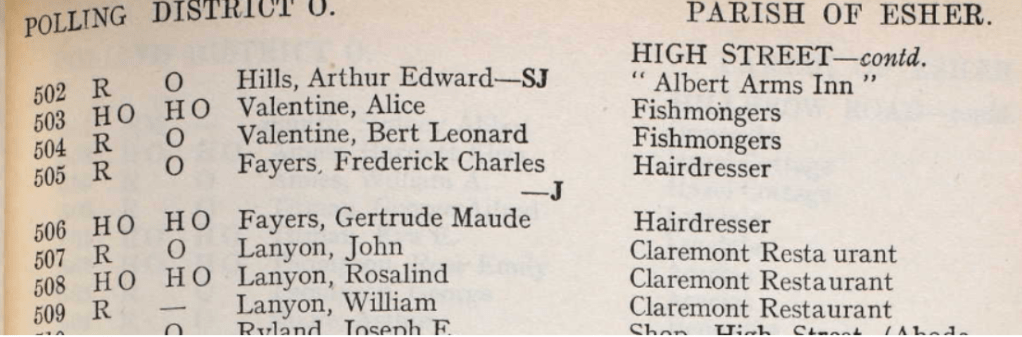
Electoral Register for Esher

By 1943 they had two more children and Rosalind was using the surname Lanyon and also using the first name Rosalina. To confuse matters even more by this time her mother Rosina had married William John Lanyon so mother and daughter, Rosalind/Rosalina and Rosina, were both using the surname Lanyon and living with men known as John Lanyon!

Rosina’s wedding certificate was signed by Rosalind J Thomas and Sidney A Thomas even though he had been using the name John Lanyon since 1922.

Marriage certificate of William and Rosina

Sidney/John and Rosalind must have separated sometime after 1943 when their third child was born. Then on 25 Sep 1950 Sidney Alfred Thomas aka John Lanyon married Agnes Taylor at Finsbury London. John described himself as a widower. John had never been married to Rosalind but his first wife Ida was still very much alive and they weren’t divorced!

To complicate things even further Agnes Taylor’s first husband was called Sydney Alfred Hurry. It seems incredible that Agnes married two men both called Sidney Alfred! They had married on 25 Sep 1926. The 1939 register records that she was divorced.
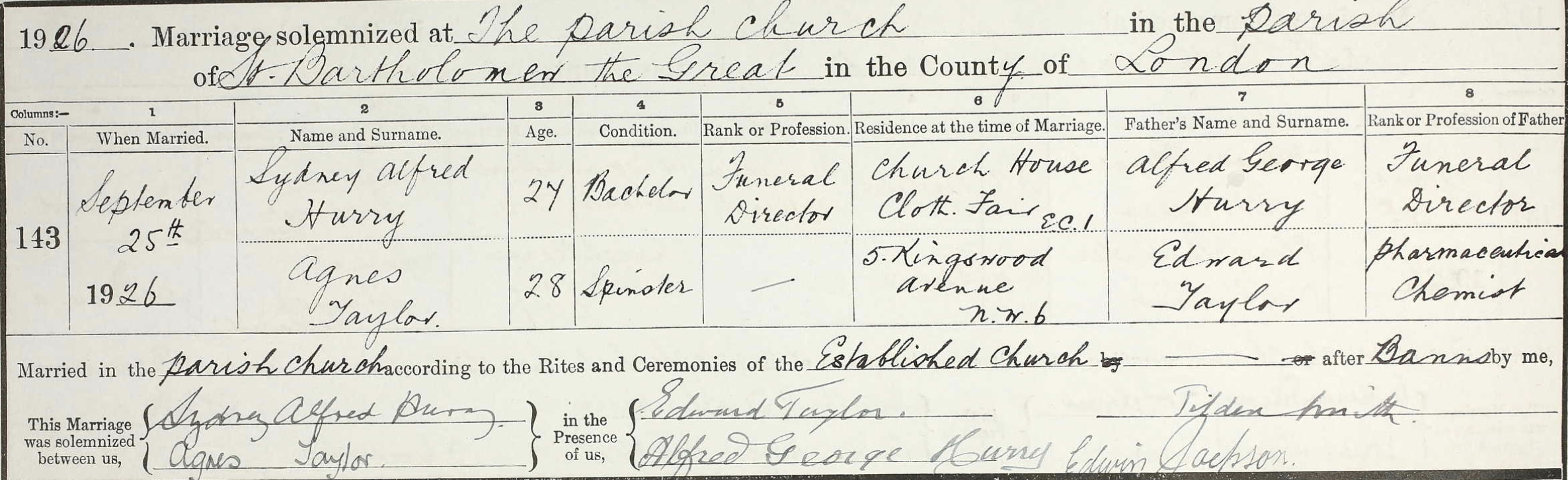
Marriage of Agnes Taylor to Sydney Alfred Hurry

Poor Ida Lanyon had been abandoned and had gone back to live with her mother and sisters. She worked as a school teacher. She died on 14 Sep 1961 at Plymouth and her probate described her as ‘wife of Sidney Alfred Thomas’.
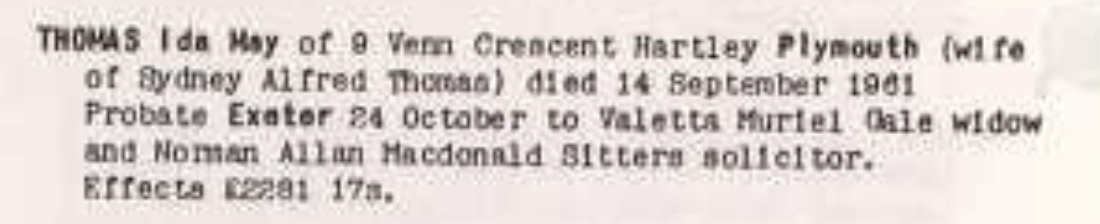
Ida Thomas’ probate

I was unable to trace a death for William John Glanville Lanyon/John Lanyon. He was alive in 1939 and that’s as far as I was able to follow him until a family member got in touch and recalled how he was still alive in 1952.

Rosina Maud Lanyon died Q2 1963 at Portsmouth.

Sidney Alfred Thomas/John Lanyon died 13 June 1964 in Chelmsford.

Rosalind Jannette Clarke aka Lanyon died in 2006 at the age of 106!
Press Gang

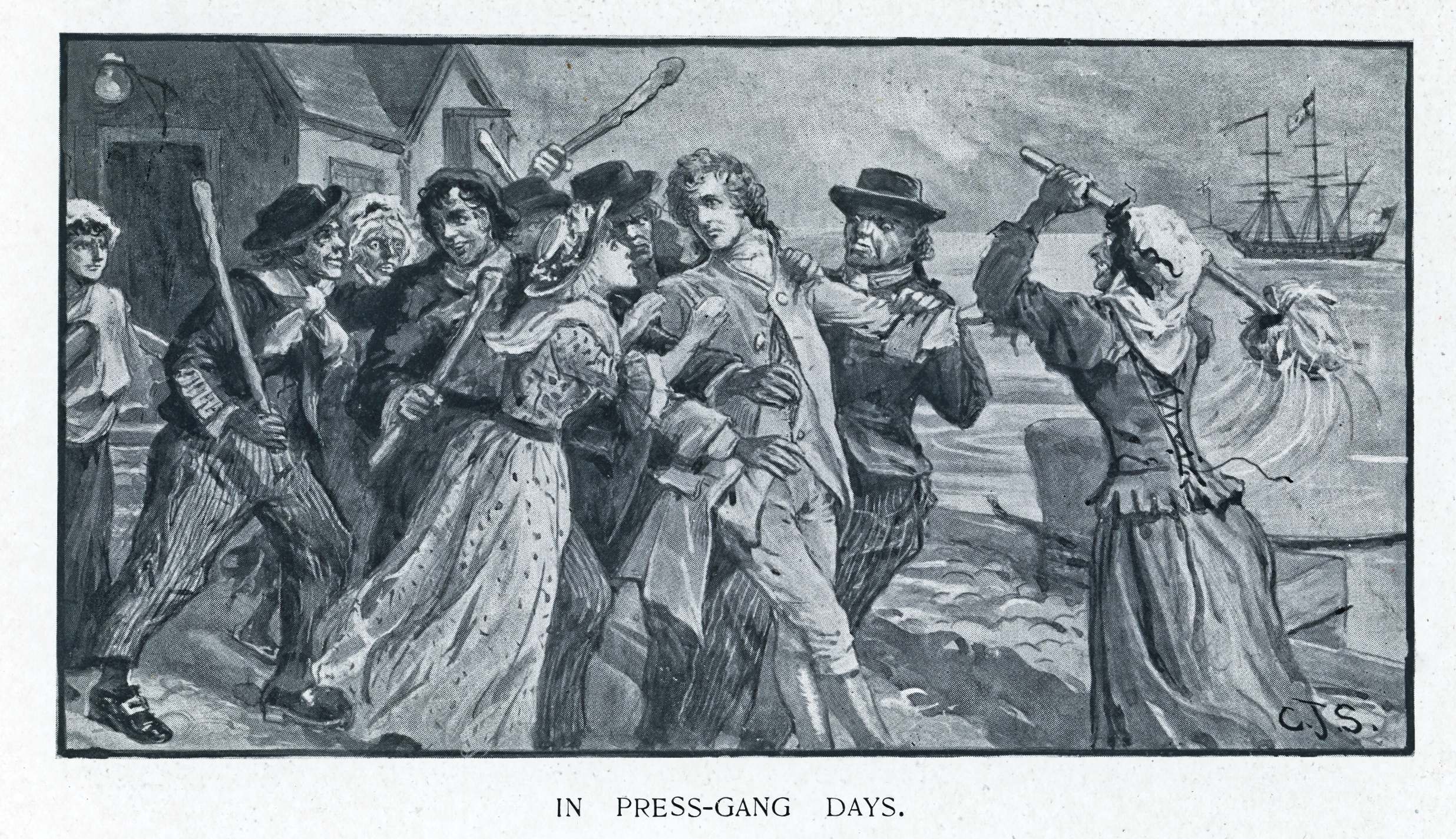
Britain may have ruled the waves with its huge navy of sailing ships but the only way it could man all those ships was by impressment or the ‘press gang’. From the late 17th century until the early 19th century men between the ages of 18-55 could be forced to serve in the navy. Today we’d probably call it kidnapping!

Charles Joseph Staniland, Public domain, via Wikimedia Commons

The navy preferred sea faring men so merchant seaman and fishermen were liable to be ‘pressed’ and this made coastal communities particularly vulnerable. Merchant seamen ashore (easily identifiable by their uniforms) would be asked to volunteer to join the navy, if they refused they could be seized or plied with drink and taken. Many seamen were ‘pressed’ whilst at sea. Their ships, usually homeward bound, would be stopped and the merchant seamen seized and placed on the navy ships.

Understandably the press gangs were very unpopular and fights often broke out when men were seized from their communities. Wives and children suffered from poverty and hardship when their husbands and fathers were seized. Having been seized it was difficult to return and deserters could face the death penalty.

The Neglected Tar – Unknown author, Public domain, via Wikimedia Commons

At Trafalgar half of the navy’s 120,000 men were pressed into service.

Richard Lanyon of Marazion

This post is about Richard Lanyon of Marazion and what happened when the Press Gang arrived in town.

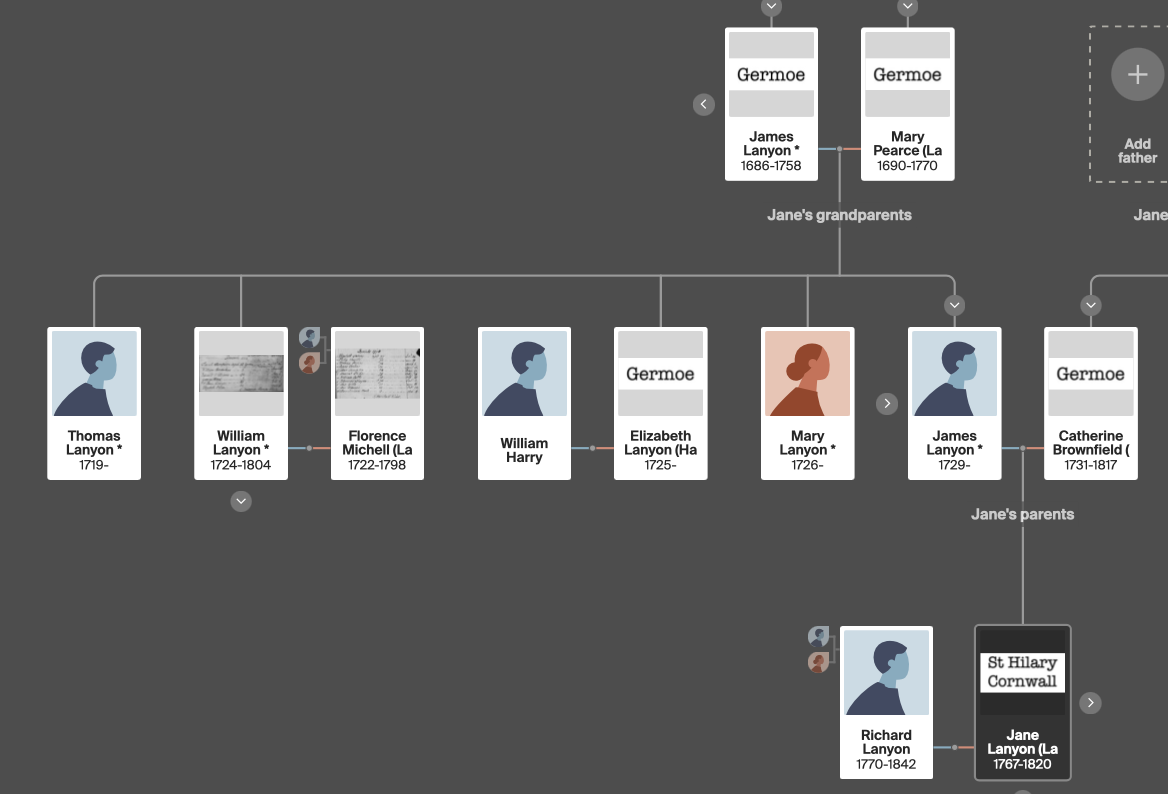
Richard was born in 1770 the youngest son of William Lanyon and Florence Michell. In 1794 he married his cousin Jane Lanyon (the daughter of James Lanyon and Catherine Brownfield) at St Hilary in Cornwall. (See St Hilary branch of the Lanyon tree.)

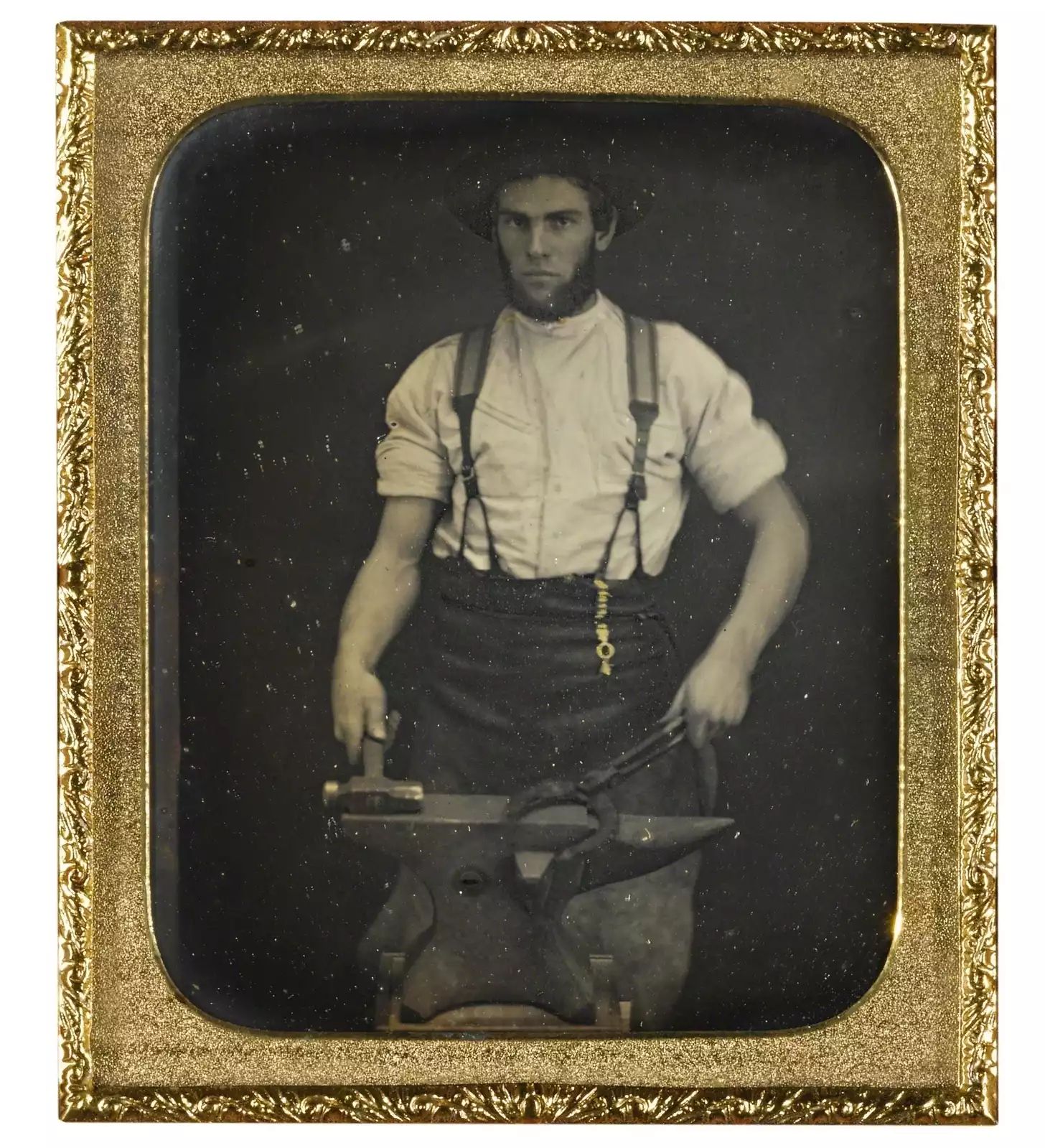
Richard was the blacksmith at Marazion. The town opposite St Michael’s Mount.

Richard also served as a sergeant in the 2nd Regiment of Mount’s Bay Volunteers. Britain was at war with France and all over the country there were volunteer regiments prepared to defend the country in the event of an invasion.

Marazion : St Michael’s Mount Wall Painting by Lewis Clarke, CC BY-SA 2.0 https://creativecommons.org/licenses/by-sa/2.0, via Wikimedia Commons

On the 9 October 1804 the volunteers had been at a field day practising their fighting skills. The day went well and the officers bought the men a ‘few’ drinks to celebrate. That evening the press gang, led by Lieutenant Andrew Wills arrived in town in search of seamen who had deserted. Accompanied by the constable they went to a home expecting to find one of the deserters, instead they found Richard Lanyon with several others.

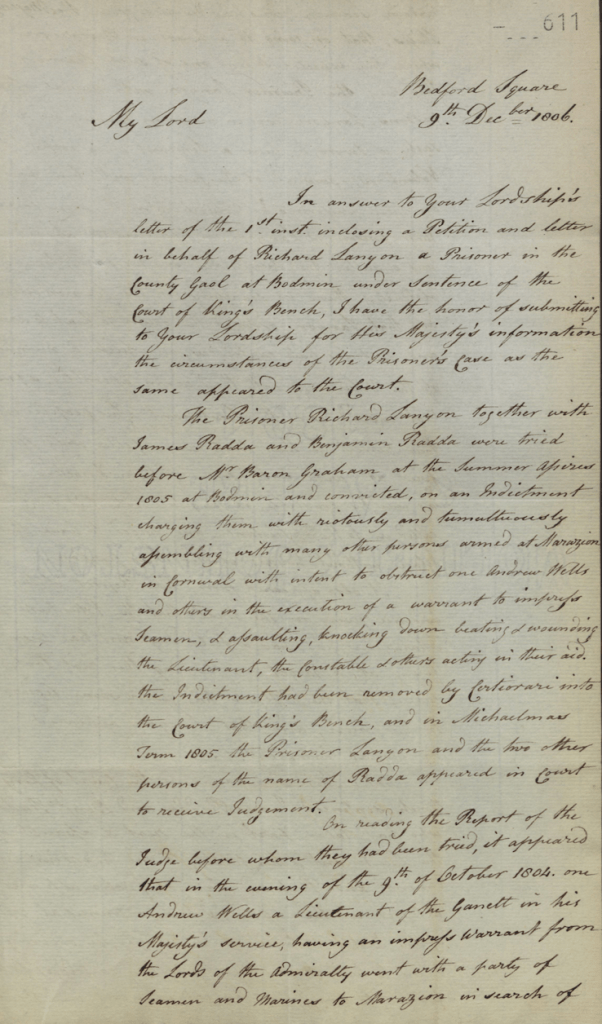
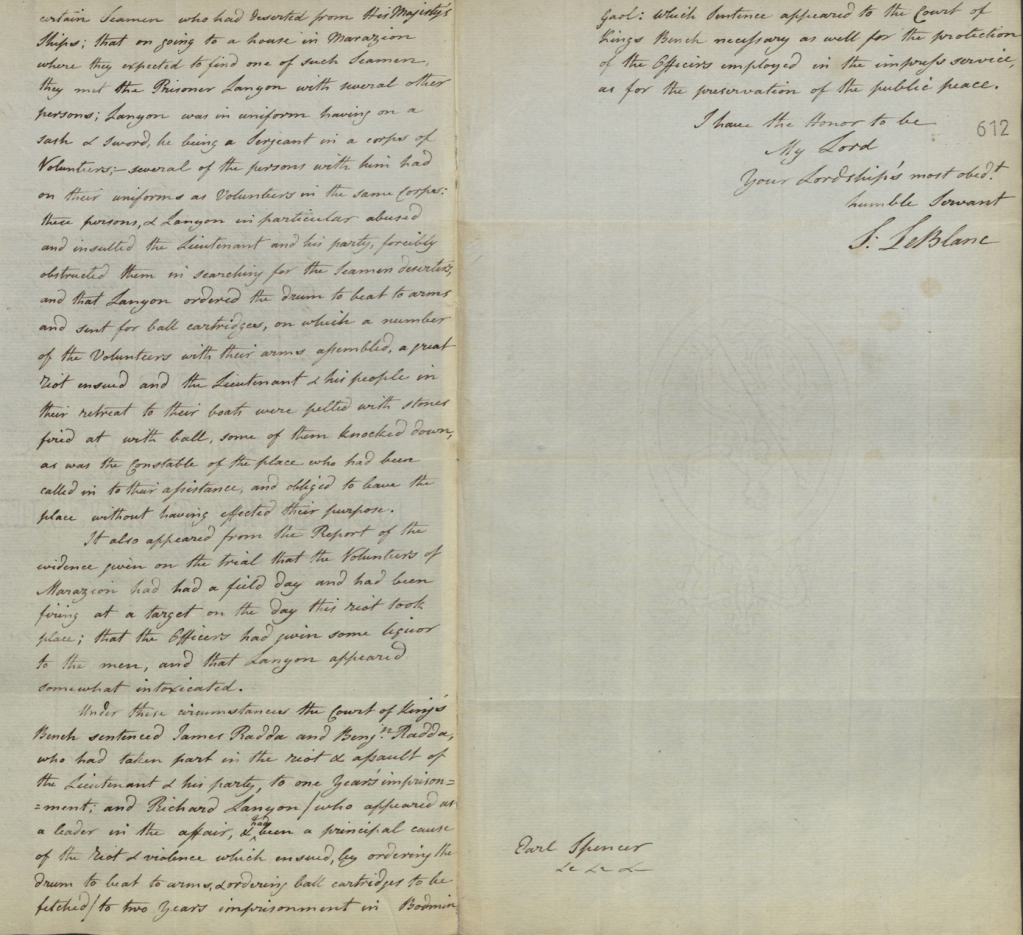
Richard was still wearing his uniform, sash and sword and several of the men with him still had on their volunteer uniforms. Lanyon in particular abused and insulted the lieutenant and his party and obstructed them in searching for the deserters. “Lanyon then ordered the drum to beat to arms and sent for ball cartridges.” A great riot ensued and the lieutenant and his people in their retreat to their boat were pelted with stones, fired at with ‘balls’ and some of them were assaulted.

A letter to Earl Spencer from J. Le Blanc explaining what had happened stated “Lanyon was somewhat intoxicated“!

Richard and his nephews James and Benjamin Rodda were arrested and tried before Mr Baron Graham at the summer assizes at Bodmin in 1805. They were convicted on an indictment charging them with “riotously and tumultuously assembling with many other persons armed at Marazion in Cornwall with intent to obstruct one Andrew Wills and others in the execution of a warrant to impress seamen…

The trial was the transferred to the Court of the King’s Bench in Westminster, London.

The Roddas were sentenced to one year in prison and Lanyon was sentenced to two years. After a year he appealed for an early release. Mr Gryles, a gentleman of considerable property in Marazion, gave a reference and stated that Lanyon was of previous good character and always a ‘man of fair and upright character’, he also had a wife and several children who had suffered ‘the severest deprivations by means of the long confinement’ but the appeal fell on deaf ears and Richard served two years.

Richard eventually returned home and was still living in Marazion in 1841. He’s listed on the census living with his youngest daughter Julia. His wife Jane had died in 1820. Richard died shortly after the 1841 census.

Press gangs finally came to an end with the fall of Napoleon in 1815.

The Woman in the White Apron

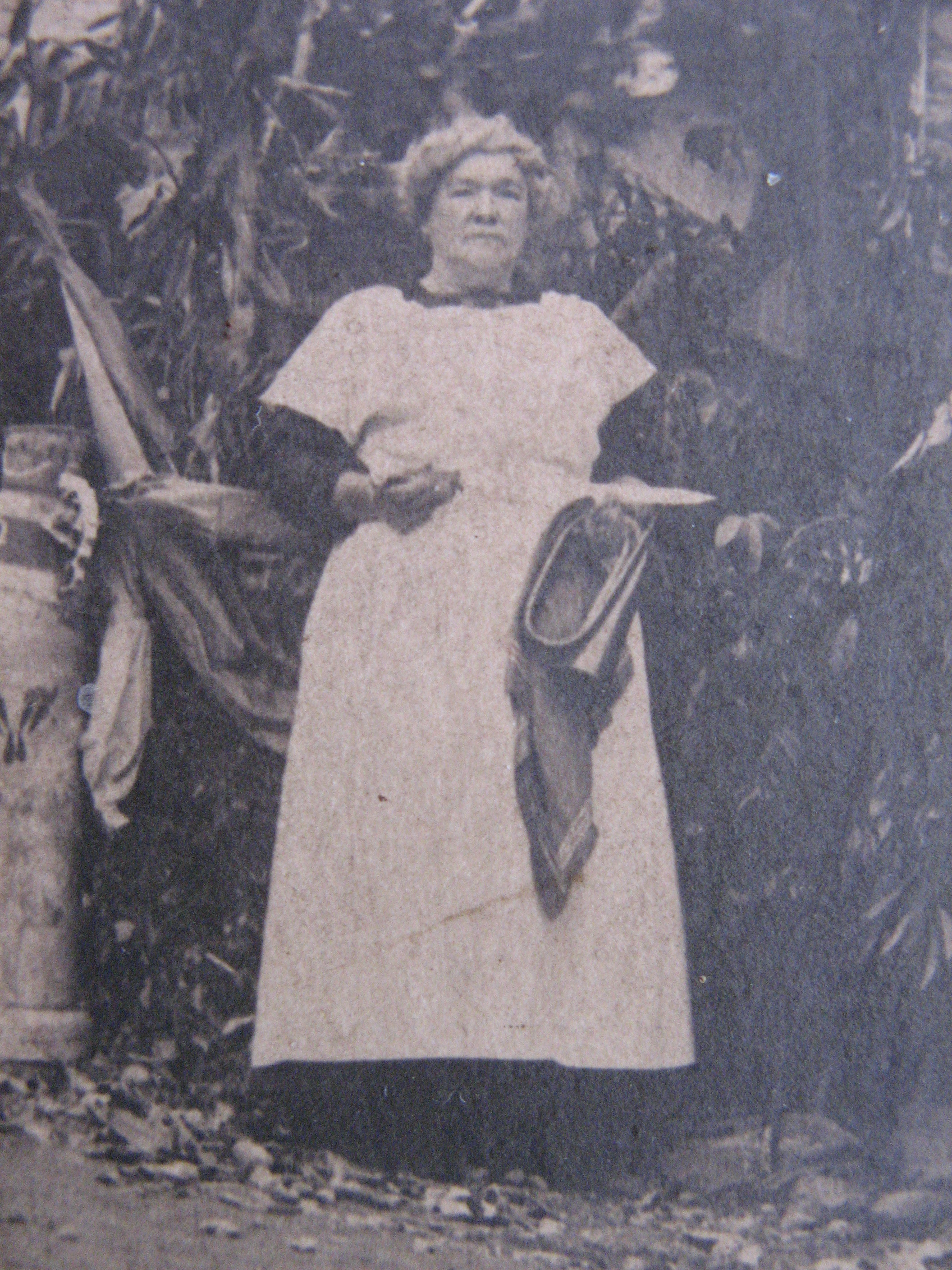
Mary Ann Lanyon 1897

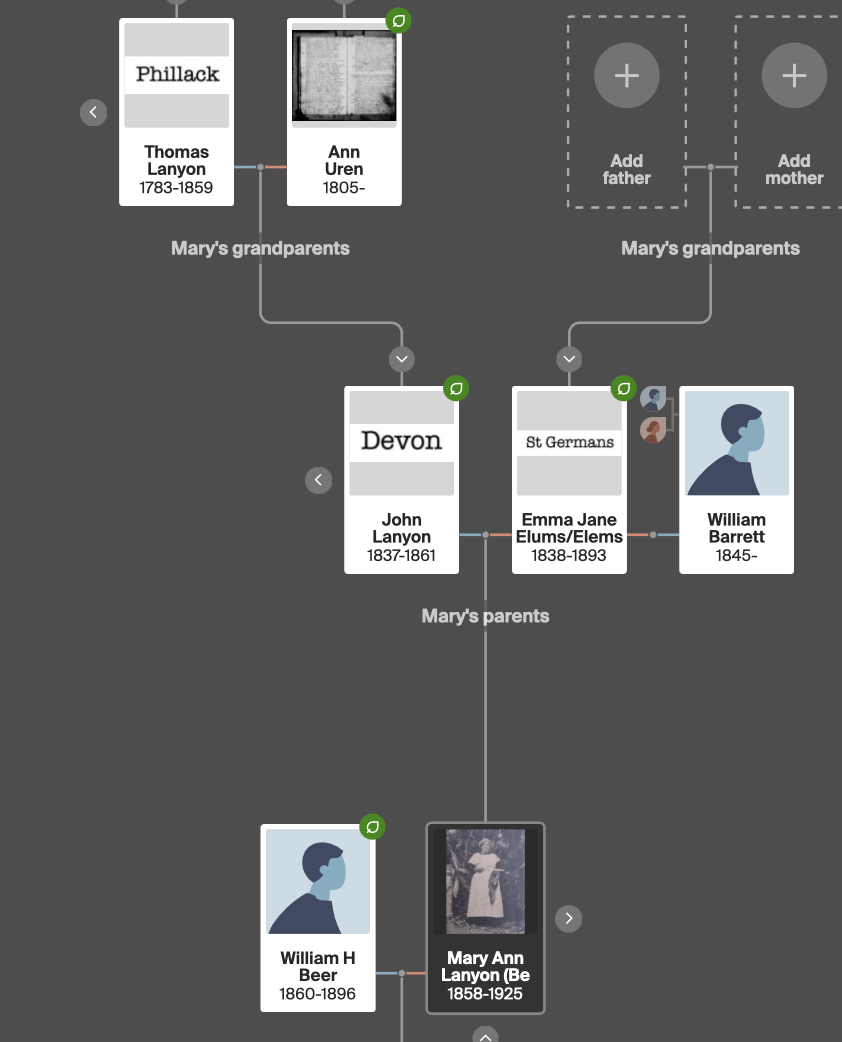
Mary Ann Lanyon was born abt. 1858 at Hayle in Cornwall but I can’t find a record of her birth or her parents’ marriage. Her father was John Lanyon the son of Thomas Lanyon and Ann Uren and her mother was Emma Jane and perhaps her surname was Elems, Elums or Bassett!

John was a boilermaker, steam engineer and in 1861 the family were living in Tavistock, Devon. It’s not clear if John died or just abandoned his family but by 1864 his ‘wife’ had remarried to William Barrett, a fisherman, almost ten years younger than she was.

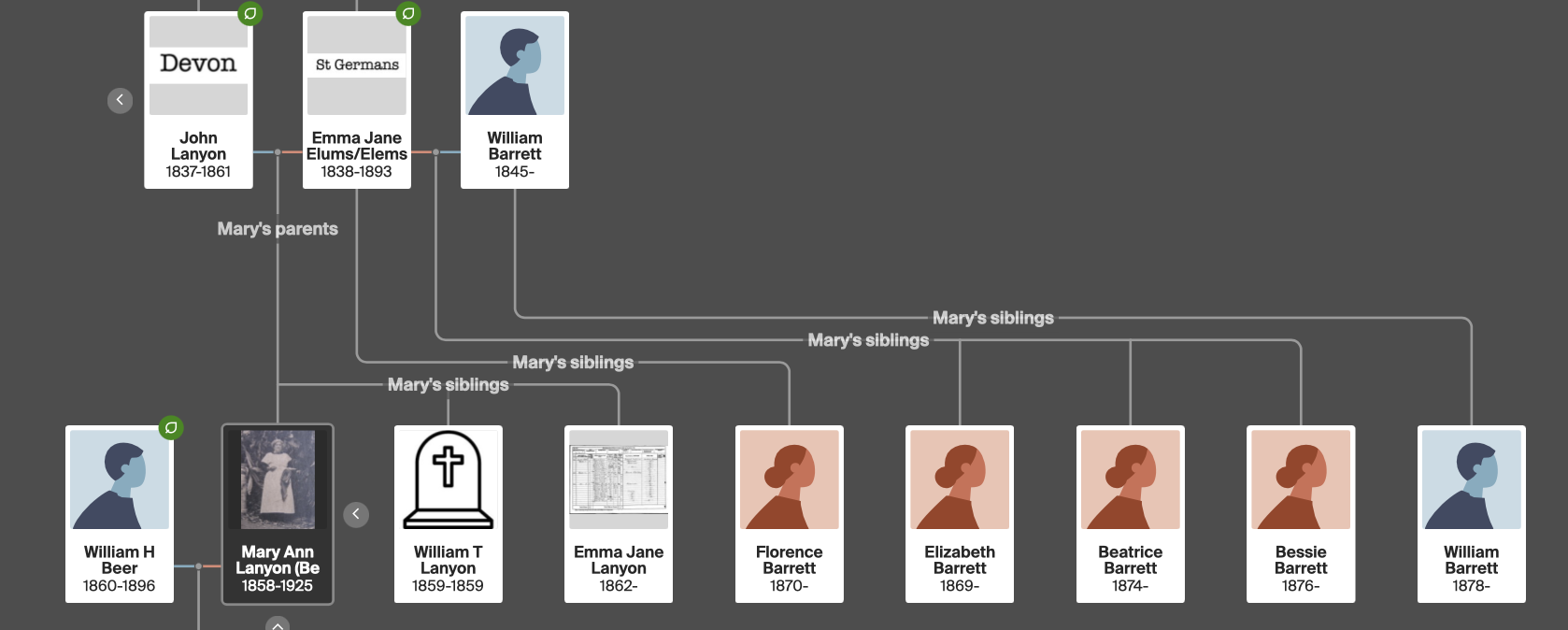
Children from her ‘marriage’ to John Lanyon:

  • Mary Ann Lanyon 1858-1925
  • William Thomas Lanyon 1859-1859
  • Emma Jane Lanyon 1862-

Children from her marriage to William Barrett:

  • Elizabeth Barrett 1869-
  • Beatrice Barrett 1874-
  • Bessie Barrett 1876-
  • Florence barrett 1870-
  • William Barrett 1878-

At the age of sixteen Mary Ann had her first illegitimate child, Kate and two years later she had Edith Annie. In 1879 she had twin boys, Francis and Alfred. By 1881 she was in the St Germans Union workhouse with her twins and expecting her fifth illegitimate child. She was just 24 years old. The census described her as a fish saleswoman and a pauper. Whilst she was in the workhouse her daughters Kate and Edith were living with her mother.

Her fifth child was William John Glanville Lanyon. Her sixth child was Hetty Roseanna Beer born in 1884. Mary Ann married Hetty’s father, William Henry Beer in 1885. William was a journeyman tailor born in Saltash in 1860. They had three more children before William died in 1896: William George Henry 1886 (her second son called William, the first was known as John), James Robert Beer 1888, Beatrice Florence (Betty) Beer 1890.

Two years after her husband’s death Frederick Charles Beer was born in 1898. According to the 1911 census she had twelve children altogether and three died. There are two still to trace.

In 1901 she was working as a charwoman and in 1911 she was living with her four single sons: Alfred (an invalid), Francis, John and George.

She died in Saltash in 1925 aged just 68.

We’ll follow her son William John Glanville in another post.

Pauper’s Passport

Settlement Certificates or Paupers Passports were documents that in effect permitted poor people to travel between parishes usually to look for work.

Under the old Poor Law everyone was deemed to have a home parish or place of settlement. The Act for the Better Relief of the Poor of 1662 (Act of Settlement) was an attempt to provide for the poorest, to prevent migration and to restrict the arrival of vagrants who may become an expense for the parish.

In effect it tied labourers to a particular parish and enabled employers to exploit them and pay poor wages as they could not leave to search for work elsewhere.

Eventually Settlement Certificates were issued. These documents proved an individual’s parish of settlement, enabling him or her to move to other parishes, perhaps to find work. Without one, a migrant was liable to be sent back to his or her parish of settlement. Settlement certificates could be issued for individuals or whole families. They guaranteed that their home parish would pay for their ‘removal’ costs (from the host parish) back to their home if they needed poor relief.

If a removal order was issued the Settlement Certificate would be pinned to the pauper and they would be returned to their home parish.

In 1834 the New Poor Law was brought in and ensured that paupers were clothed, housed and fed but many still encountered terrible problems when they fell on hard times.

Poor Law of 1834 in Britain – Public Domain

This post is about Louisa Lanyon and the order to remove her and her child from St Allen to Mawgan in Meneage in 1856.

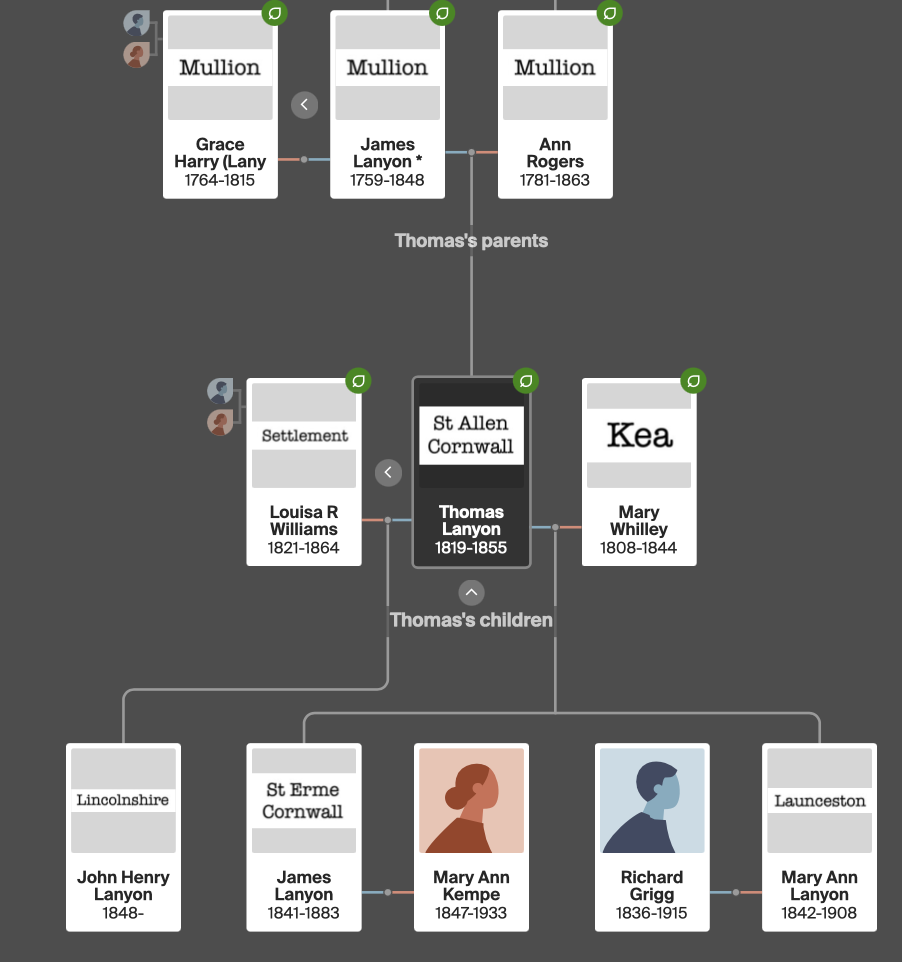
Louisa was the wife of Thomas Lanyon. She was baptised on 22 Apr 1821 at Kenwyn in Cornwall, the daughter of Soloman and Ann Williams. Thomas was the son of James Lanyon and Ann Rogers and was baptised in 1819 in Mawgan in Meneage. James, a widower, got Ann Rogers pregnant and had to marry her. He became a father again at the age of 60!

Thomas married his first wife Mary Whilley abt. 1840 and they had two children, James and Mary Ann. Mary died in 1844 and Thomas married for a second time in 1845 to Louisa Rawling Williams at St Allen.

Thomas was a labourer/husbandman and he died of kidney disease on 4 Nov 1855 at St Allen aged just 36. Louisa was left a widow with a young son, John Henry Lanyon and James and Mary Ann were left orphans.

The Parish of St Allen, full of compassion for the young widow and her son, promptly ordered her removal back to Mawgan in Meneage, her husband’s home parish (wives automatically assumed the home parish of their husband on marriage) even though Louisa had never lived there or knew anyone there.

Louisa appealed:

Removal Order Appeal – 9 April* 1856 – Louisa Lanyon, widow, and son St. Allen to Mawgan in Meneage

MAWGAN IN MENEAGE, appellant; Mr. Shilson and Mr. F.V. Hill. ST. ALLEN, respondent; Mr. Childs and Mr. Chilcott.—An appeal against an order by H.P. Andrew, Esq., and W.P. Kempe, Esq., for removal of Louisa Lanyon, widow, and John Henry, her son, aged 7 years, from the parish of St. Allen, to Mawgan in Meneage.

Settlement in respondent parish being admitted, the appellant set up a settlement of pauper’s deceased husband in the parish of Cury, by hiring and service with Mr. James Randle, farmer, of Colvenor in that parish.

Mr. CHILDS took a preliminary objection to the ground of appeal in which it was alleged that, ‘in or about the year 1831,’ the pauper’s husband, Thomas Lanyon, hired himself to James Randle of Cury,—the objection being that the words ‘in or about the year 1831’ were not sufficiently definite to establish a complete year’s service prior to the year 1834—the date of the Poor Law Act, which abolished settlement by hiring and service. In support of the objection Mr. Childs cited the cases of St. Ann’s Westminster, and St. Paul’s Covent Garden.

The Court overruled the objection, and held that the grounds of appeal would enable the appellant to go on.

Mr. SHILSON then stated the nature of the appellant’s case—for establishing a settlement of the pauper’s deceased husband in Cury. The deceased being born in 1819 was in or about 1831 hired, by agreement made in his behalf by his mother, to Mr. James Randle of Colvenor, as a yearly servant; and in two subsequent years, he served in a similar way, by fresh agreements made in his behalf by his mother.

In support of this case, Mr. SHILSON examined Ann Lanyon, aged 75 years, mother of the deceased Thomas Lanyon; and Samuel Hendy, aged 40, who at the time of Thomas Lanyon’s service with James Randle, was living with his father at Sawanna, within one field of Colvenor, and was in the habit of seeing Thomas Lanyon at labour on the farm; and the COURT, on the evidence adduced, held that the settlement in Cury had been made out.

Mr. CHILDS proposed to rebut the evidence of dates by counter evidence. He would show that at the time Lanyon went into the service of Randle, he was of the age of 14 years, and consequently, on the evidence of his birth in 1819, the time of his entering that service was in September 1833, and the conclusion of the year’s service would not have been until after the passing of the Poor Law Act, in August 1834. This evidence of the period of service would be corroborated by an account book, belonging to Mr. James Randle of Colvenor, who would also prove that Lanyon was not in his service more that twelve months. If these facts were substantiated, then the respondent’s case was fully made out; while the appellants could not maintain their case, unless they showed, without doubt, that the alleged settlement in Cury was clearly prior to the passing of the Poor Law Act.

The witnesses called and examined for the respondent, were Mr. James Randle of Colvenor; his servant Martha Rogers; and his son Samuel Randle, now living at Stithians.

The Court held that the settlement in Cury was gained previous to the statute of August 1834. Order quashed, £5 costs.

Source: Royal Cornwall Gazette 11 April 1856 (Cornwall Easter Sessions)

Transcribed by Karen Duvall – Reproduced with the permission of Cornwall OPC https://www.opc-cornwall.org/index.php

It’s quite a distance to remove someone from their family and friends.

By 1861 (source – the census) Louisa Lanyon (a charwoman) was living in St Allen with her mother Ann Williams (a charwoman) and her son John Henry who was 13 and working as an agricultural labourer.

By 1864 at the age of 43 she was dead. In 1868 Ann Williams was dead. We don’t know what happened to John Henry Lanyon, did he die, did he emigrate, did he use a different name? There is a John Henry Lanyon who died in Lincolnshire in 1935 is it the same person?

What happened to his half brother and sister?

James Lanyon 1841-1883 married Mary Ann Kempe. He worked as an agricultural labourer and they never had any children.

Mary Ann Lanyon 1842-1908 married Richard Grigg, a carrier, in 1883 at Penzance and they never had any children.

Perhaps becoming orphans put them off ever having children of their own.

Thomas, William and John Lanyon x 2!

James Lanyon and Mary Pearce had six great grandsons to carry on the family name: two called Thomas, two called William and two called John!

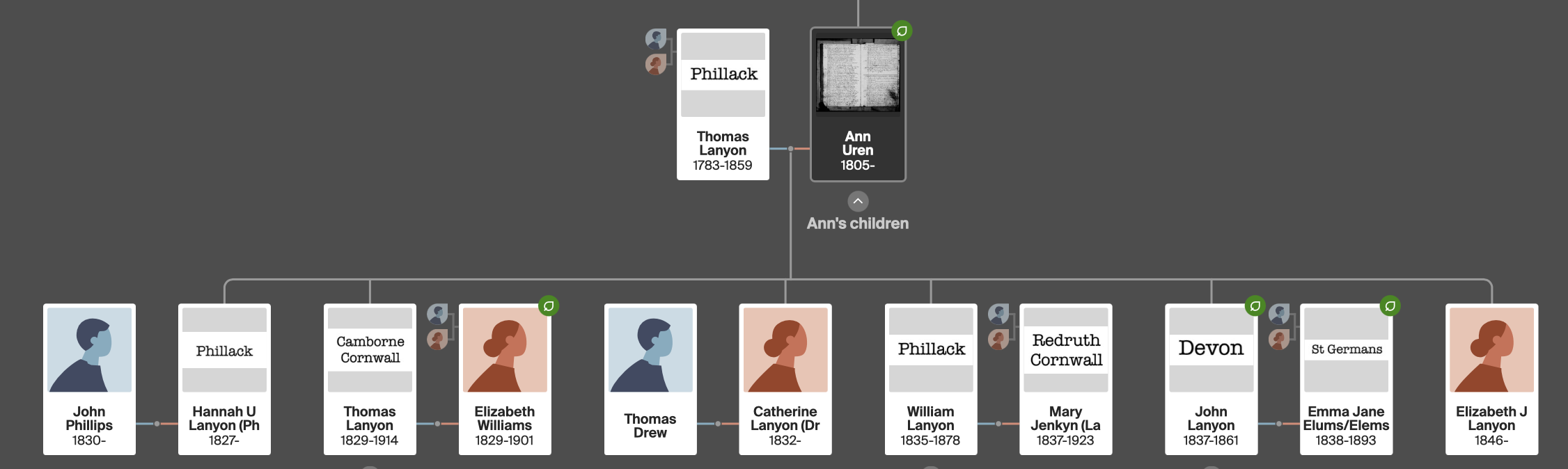
Thomas Lanyon 1783-1859

Thomas was baptised in Marazion in 1783 and married Ann Uren at Gwinear in 1826. Thomas was a shoemaker. He and Ann had six children:

  • Hannah Uren 1827- married John Philips at Phillack in 1850 one daughter traced
  • Thomas 1829-1914 was a blacksmith and he married Elizabeth Williams in 1854. Four children.
  • Catherine 1832- she was a labourer and may be the Catherine Lanyon who married Thomas Drew in 1852, no further trace.
  • William 1835-1878 he was an engine driver and married Mary Jenkyn at Phillack in 1859, six children of which only two daughters survived to adulthood.
  • John 1837-1861 was a boilermaker and steam engineer, he married Emma Jane and had three children, we’ll follow his daughter Mary Ann Lanyon in a separate post ‘The Woman in the White Apron’.
  • Elizabeth J 1846- she’s on the 1851 census and then no further trace

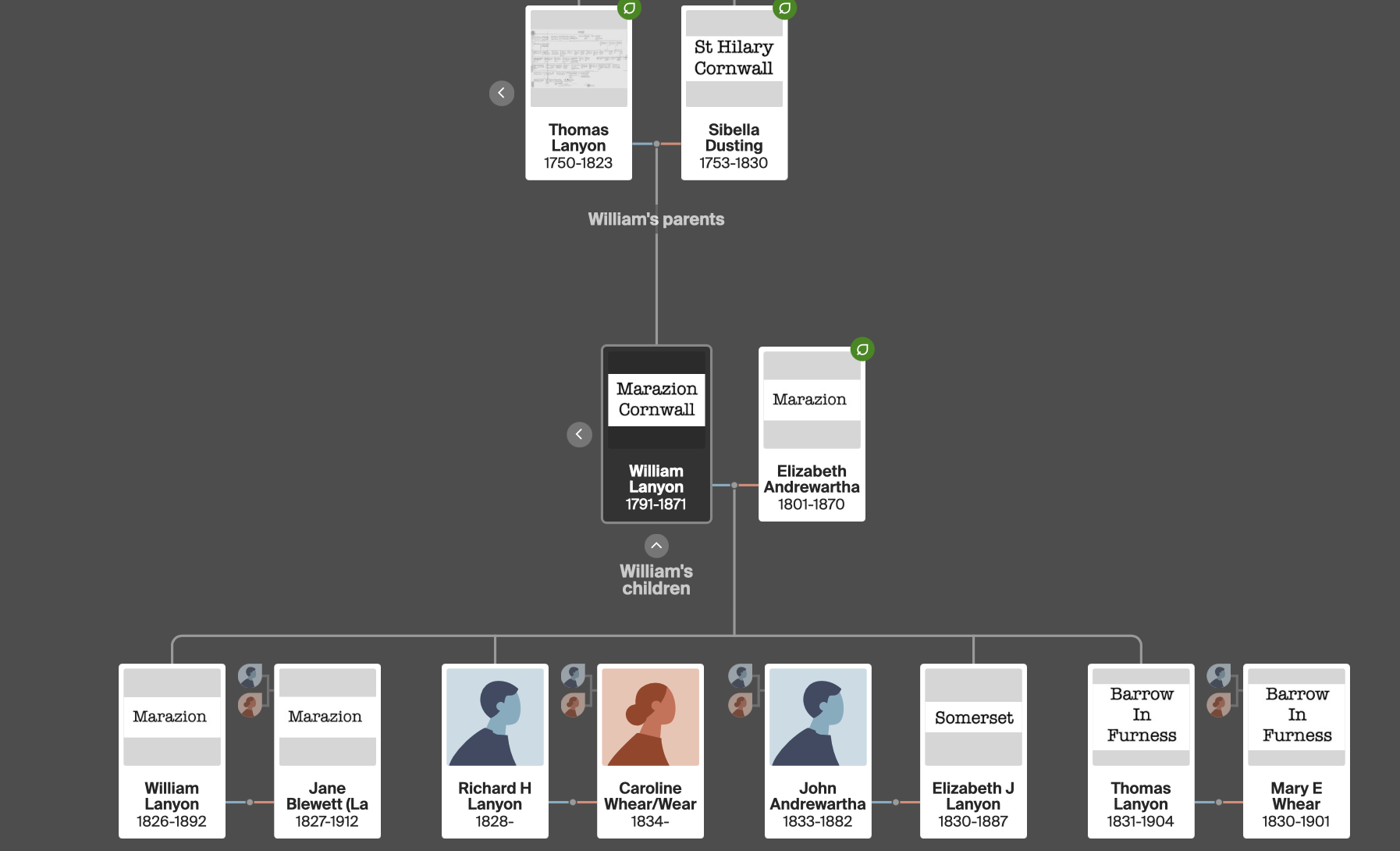
William Lanyon 1791-1871

William was a cordwainer/shoemaker like his brother Thomas. He married Elizabeth Andrewartha at St Hilary in 1825. They had four children:

  • William 1826-1892 he was a miner and married Jane Bleweth at St Hilary in 1850 – eight children
  • Richard Henry 1828- 1871 he was a cordwainer, no trace of a marriage or children
  • Elizabeth Jane 1830-1887 married John Andrewartha at Penzance in 1855 – six daughters
  • Thomas 1831-1904 he married Mary Whear in 1851. He was a miner and by 1881 he had moved his family to Barrow in Furness, twelve children
Apprentice domestic shoemaker in the 19th century. Image taken from The Band of Hope Review November 1861. Public domain, via Wikimedia Commons

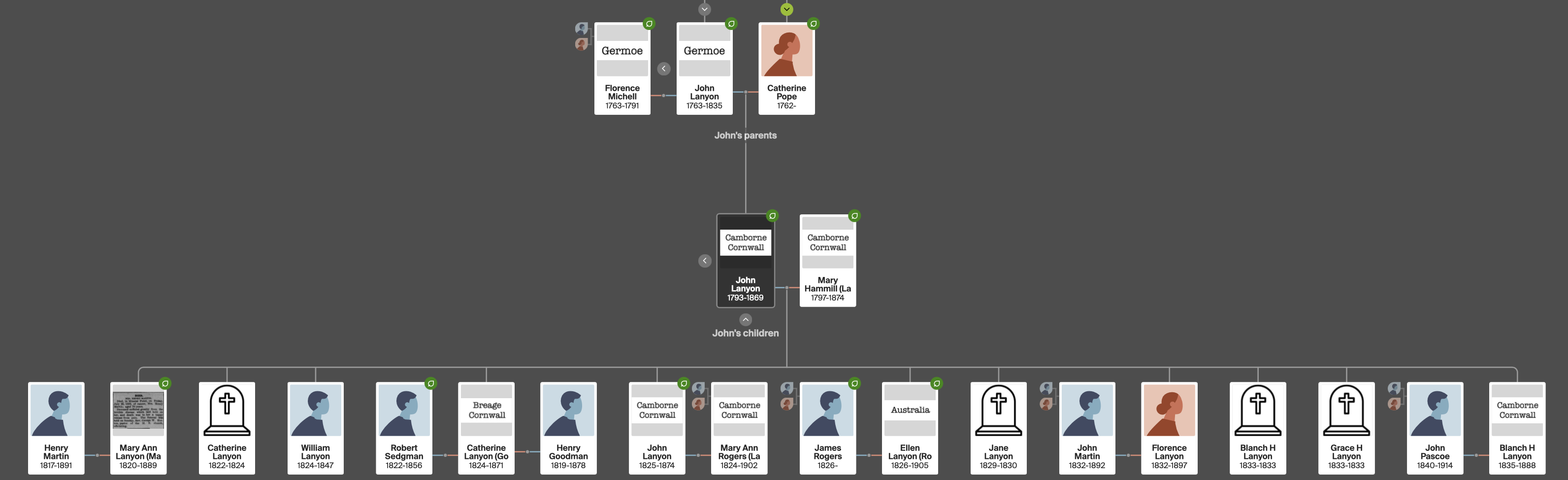
John Lanyon 1793-1869

John was baptised at Breage in 1793 and married Mary Hammill at Sithney in 1817. He was a tin miner. They had eleven children:

John & Mary’s tree
  • Mary Ann 1820-1889 married Henry Martin and four children, emigrated to Mineral Point Wisconsin
  • Catherine 1822-1824 died in infancy
  • Catherine 1824-1871 born in the Scilly Isles, married Robert Sedgman a mariner, at Porthleven in 1851, he died in 1856 and in 1858 she married Henry Goodman, a miner, and they had three daughters.
  • William 1824-1847 born at St Mary’s in the Scilly Isles and died at Bodmin Asylum age 22, he was suffering from TB and epilepsy
  • John 1825-1874 born at St Mary’s in the Scilly Isles he was a tin miner, he married Mary Rogers at Sithney in 1848. They had nine children
  • Ellen 1826-1905 baptised at Sithney and married James Rogers there in 1847, three children
  • Jane 1829-1830 died in infancy
  • Florence 1832-1897 married John Martin in 1850, four children and emigrated to Mineral Point Wisconsin
  • Blanch Hammill 1833-1833 died in infancy
  • Grace Hammill 1833-1833 died in infancy (it’s not clear if they are twins)
  • Blanch Hammill 1835-1888 married John Pascoe a miner at Camborne in 1861, five children

Scilly Isles and Sithney, Cornwall

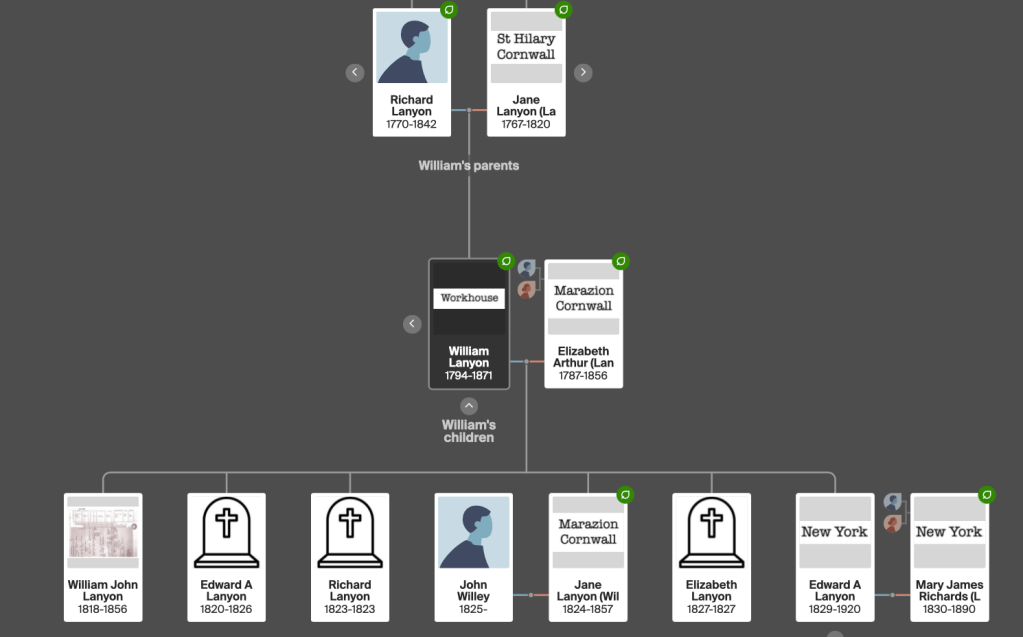
William Lanyon 1794-1871

William was baptised at St Hilary in 1794. He was a blacksmith and married Elizabeth Arthur at St Hilary in 1818. They had six children:

  • William John 1818-1856 he was a journeyman carpenter, he died age 38 of Phthisis Pulmonalis (TB) he was a bachelor
  • Edward Arthur 1820-1826 died young
  • Richard 1823-1823 died in infancy
  • Jane 1824-1857 she was a dressmaker, she married John Wiley and had a daughter Bessie Jane in 1855. Jane senior died in 1857
  • Elizabeth 1827-1827 died in infancy
  • Edward Arthur 1829-1920

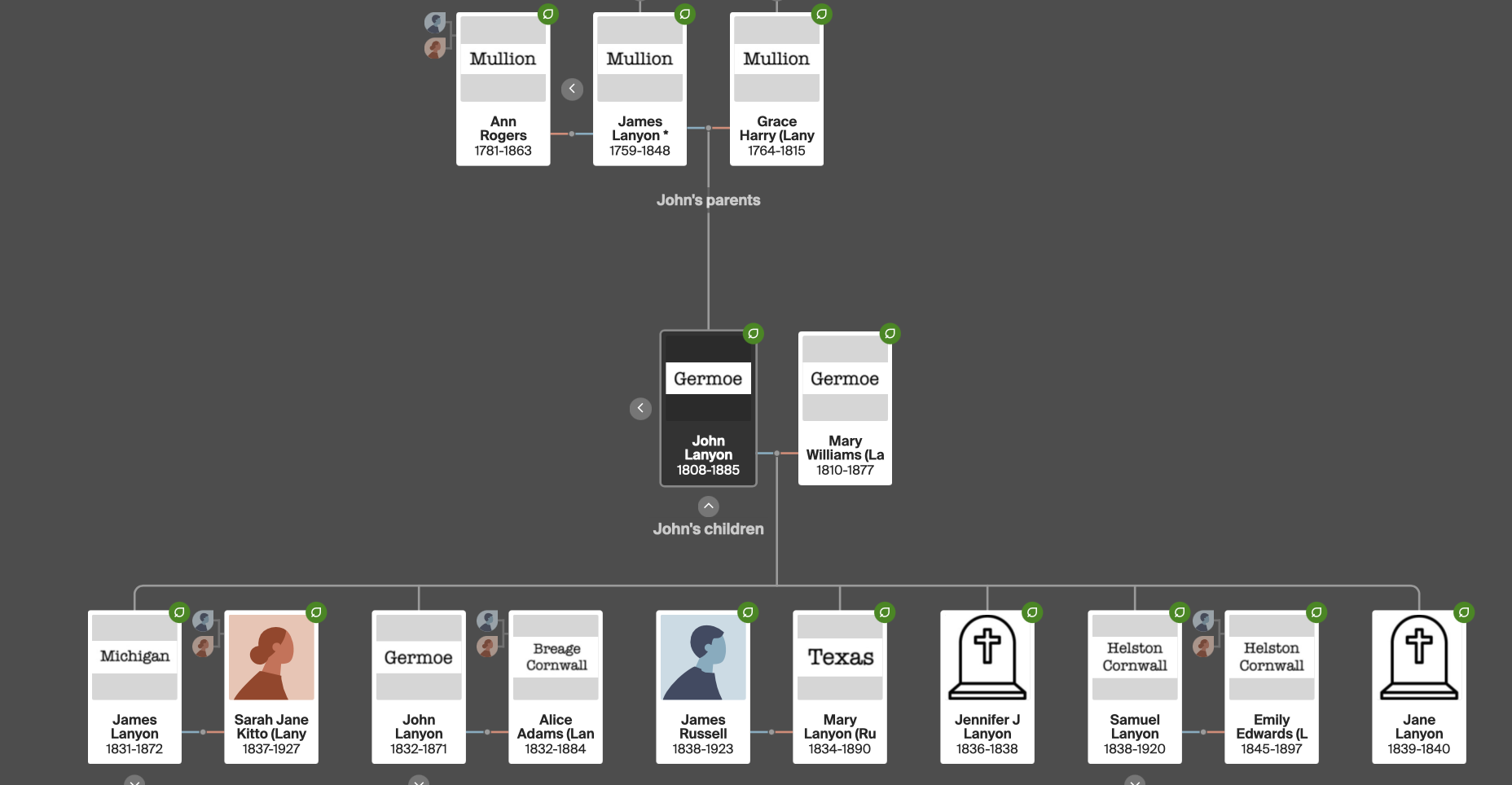
John Lanyon 1808-1885

John was born at Germoe abt. 1808, he was a tin miner and married Mary Williams at Germoe in 1830. Their children:

  • James 1831-1871 he was a tin miner, married Sarah Jane Kitto at Breage in 1856 – five children. He died at Detroit Michigan 1871
  • John 1832-1871 he was a tin dresser, married Alice Adams at Crowan in 1860 – four children – he drowned at Sarawak in Malaysia in 1871
  • Mary 1834-1890 married James Russell at Helston in 1861 – eight children, emigrated to Texas
  • Jennifer Jennings 1836-1838 died in infancy
  • Samuel 1838-1920 he was also a tin dresser, married Emily Edwards at Helston in 1866 – two children, his son John Edwards emigrated to South Africa
  • Jane 1839-1840 died in infancy

Thomas Lanyon 1819-1855

Thomas was baptised at Mawgan in Meneage in 1819. He was a farm labourer. His first marriage was to Mary Whilley and there were two children:

  • James 1841-1883
  • Mary Ann 1842-1908

Mary Whilley died in 1844 and was buried at Kea. He them married for a second time to Louisa Rawling Williams at St Allen in 1845. There was one child from this marriage:

  • John Henry 1849-1935

Thomas died of kidney disease in 1855 aged just 36. We’ll find out what happened to his widow and children in the post ‘Pauper’s Passport’.

Charles Lanyon of Falmouth

Charles Lanyon died at Falmouth in 1748 and is probably the Charles Lanyon baptised at St Hilary in 1687. His first marriage to Grace Berteau produced one son, Charles. This post is about him and his descendants.

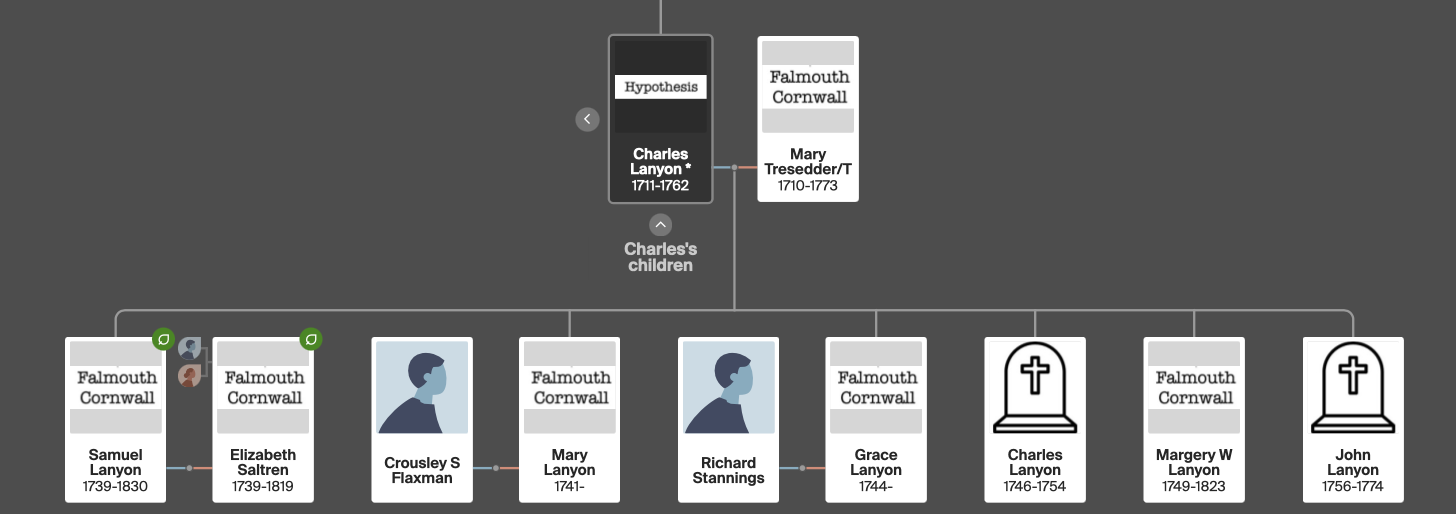
Charles was baptised at Falmouth in 1711 (Source – FHL Film 267525) and married Mary Tresedder at Mawnan in 1739. They had six children:

Charles & Mary’s tree
  • Samuel 1739-1830
  • Mary 1741- married Crousley Shovel Flaxman (what a great name!), a mariner, at Falmouth in 1761
  • Grace 1744- married Richard Stannings, a mariner, at Falmouth in 1773
  • Charles 1746-1754 died young
  • Margery Wills 1749-1823 spinster
  • John 1756-1774 drowned at Falmouth, age 18

Charles died at Falmouth in 1762 and his wife Mary Tresedder died in 1773.

Samuel Lanyon 1739-1830

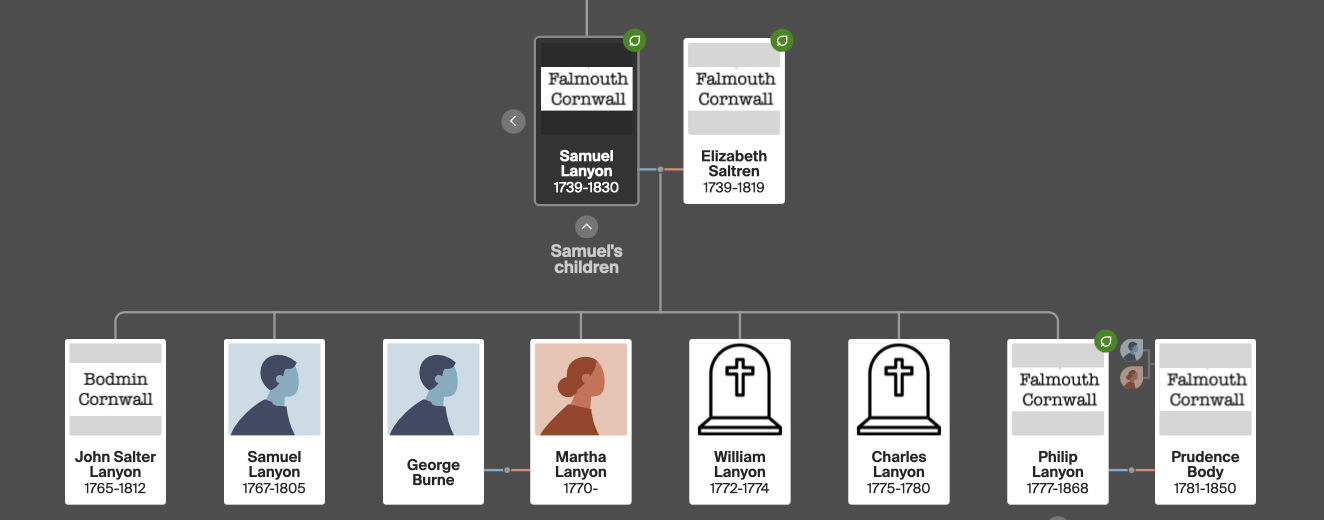
In 1755 Samuel was apprenticed to Richard Hosken of Falmouth, a carpenter, cost £13 10/- (Source – Register of Duties Paid for Apprentices Indentures). In 1764 he married Elizabeth Saltren (Sic) and they had six children:

Charles & Elizabeth’s tree
  • John Salter 1765-1812 he was a merchant and a bachelor. He died at Bodmin in 1812 and his father Samuel administered his estate.
  • Samuel 1767-1805 he worked for the East India Company as a seaman on the packet ‘Swallow’. He died in 1805 and administration of his estate was granted to his father Samuel. Samuel Junior was a bachelor.
East India Company Ships – Thomas Whitcombe, Public domain, via Wikimedia Commons
  • Martha 1770- married George Burne at Falmouth in 1806
  • William 1772-1774 died in infancy
  • Charles 1775-1780 died young
  • Philip 1777-1868

Samuel died in 1830 at the age of 90.

Philip Lanyon 1777-1868

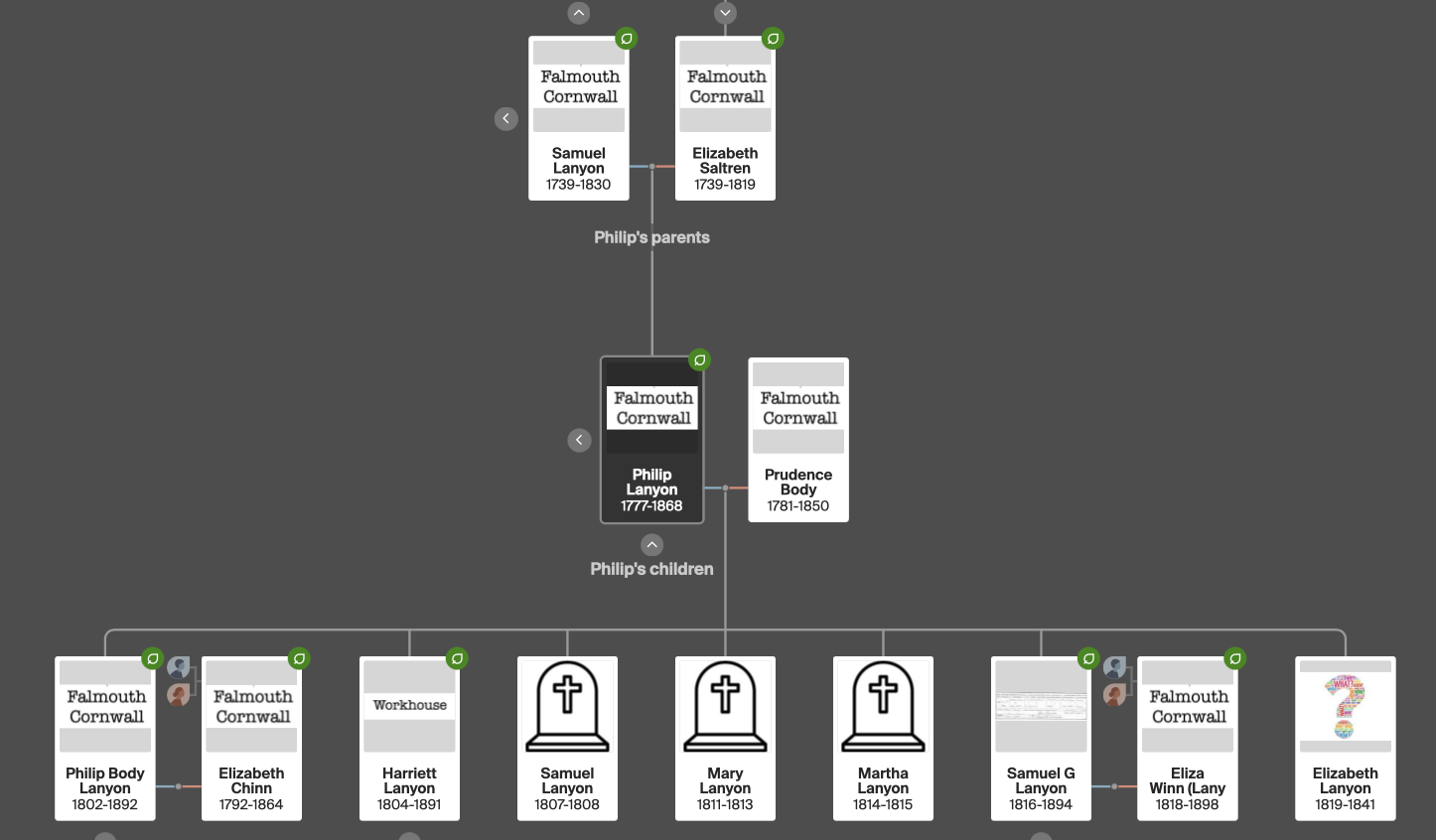
Philip was the only one of Samuel’s sons to have children. He was baptised at Falmouth in 1777 and became a carpenter like his father and in later life a farmer. In 1802 he married Prudence Body at Falmouth and they had seven children:

Philip & Prudence’s tree
  • Philip Body 1802-1892
  • Harriett 1804-1891 In 1826 Harriett had an illegitimate daughter, Eliza. Harriett never married and lived with her father until his death and then with her niece Eliza. She then worked as a farm labourer in her 70s! By 1891 she was in the workhouse and listed as a pauper. She died there in Nov 1891. Her daughter Eliza married Joseph Lawrence and they had six children
  • Samuel 1807-1808 died in infancy
  • Mary 1811-1813 died in infancy
  • Martha 1814-1815 died in infancy
  • Samuel George 1816-1894
  • Elizabeth 1819-aft.1841 she’s on the 1841 census as a dressmaker and no trace after that

Like his father Philip lived to the age of 90 and died in Falmouth in 1868. Philip left two sons who both had sons of their own to carry on the family name, Philip and Samuel.

Philip Body Lanyon 1802-1892

Philip was born at Germoe and baptised at Breage in 1802 he married Elizabeth Chinn (ten years his senior) at Falmouth in 1827 (his father was a witness). The census lists him variously as a farmer and carpenter. By 1871 the census notes that he is blind. They had two sons:

  • William Henry 1828-1871 he was a carpenter he died age 41, unmarried.

FALMOUTH.

INTERMENT OF A FORESTER.—On Sunday afternoon, the remains of the late Mr. W. H. Lanyon were interred in Falmouth cemetery. Deceased being a forester, about 150 members of that order formed in procession at their lodge-room, whence they repaired to the residence of the deceased to pay their last tribute of respect. About half-past three the funeral procession proceeded to the cemetery, the coffin being borne to the grave on the shoulders of the members. The burial service was impressively read by the Rev. J. Baly, rector, and that appointed by the Order by Mr. E. Gregg, Chief Ranger. A large concourse of spectators witnessed the proceedings.

William Henry LANYON of Swanpool Street, Parish of Falmouth, a carpenter aged 42, was buried at Falmouth Cemetery on 2 April 1871

Royal Cornwall Gazette 8 April 1871 Funeral of Mr. W.H. Lanyon

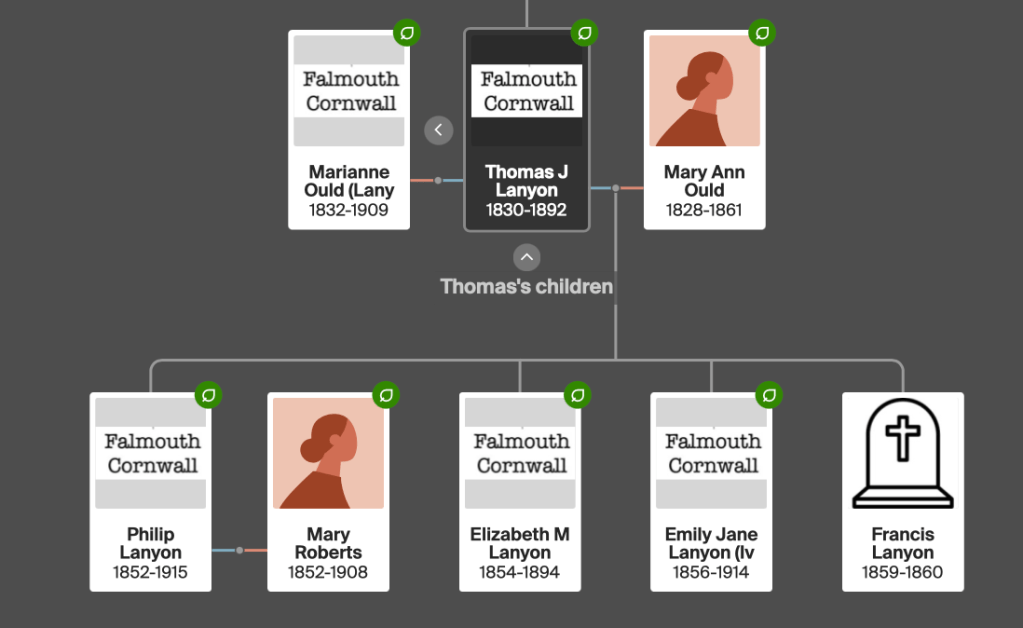
  • Thomas James 1830-1892 worked as an agricultural labourer he married Mary Ann Ould at Constantine in 1866, he’s listed as a widower but I can’t find an earlier marriage for him. On the 1851 census he is ‘unmarried’. On the 1861 census he is listed as married to Mary A from Mawnan who was born abt. 1827 and they have three children. On the 1871 census he’s married Mary A from Constantine who was born abt. 1831. Are they the same person and the dates of birth have been entered incorrectly?

A bit of research and head scratching revealed that Thomas had two wives both called Mary Ann Ould! What are the chances of that?

  • Wife number 1 married Thomas Q4 1851 at Falmouth. She was baptised at Mawnan in 1828 and called Marianne Ould, the daughter of Francis and Mary. She died at Mawnan 5 Jul 1861 aged just 33.
  • Wife number 2 married Thomas at Constantine in 1866. She was baptised at Constantine in 1832, the daughter of Emanuel and Jane. She died at Falmouth in 1909.

Presumably both women were cousins but I can’t find the connection.

There were four children of the first marriage:

  • Philip 1852-1915 he was a mariner in the Royal Navy, he married Mary Roberts but there were no children
  • Elizabeth Mary 1854-1894 a spinster
  • Emily Jane 1856-1914 she married Thomas Ivey in 1896 at Plymouth no children traced
  • Francis 1859-1860 died in infancy

Thomas James Lanyon died in 1892, his father Philip Body Lanyon outlived him. As Philip had no male great grandchildren this little branch of the tree died out.

Samuel George Lanyon 1816-1894

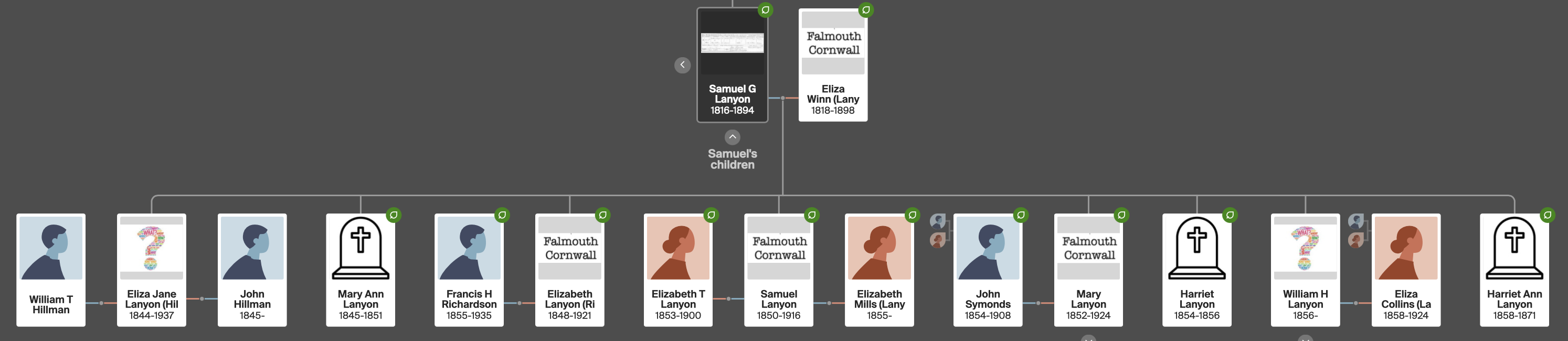
Samuel was the youngest son of Philip Lanyon and Prudence Body. He was baptised at Falmouth and married Eliza Winn at Mawnan in 1843. Samuel was a mason. He and Eliza had eight children:

  • Eliza Jane 1844- married William Thomas Hillman in 1864 however the census records him as being called John Hillman, a mason, several children
  • Mary Ann 1845-1851 died young
  • Elizabeth 1848-1921 married Francis Henry Richardson in 1876 – nine children
  • Samuel 1850-1916 he was a shepherd. He married Elizabeth Mills in Q3 1900 but appears to have been married to another Elizabeth (Toy) before that. She’s listed on the census but I can’t trace a marriage. No children of either marriage.
  • Mary 1852-1924 married John Symons – several children
  • Harriet 1854-1856 died in infancy
  • William H 1856- he was a farmer at Lower Cardew farm near Redruth. He married Eliza Collins at Stithians in 1875. They had fourteen children! In 1916 they were in Canada and many of the children lived in the United States.
  • Harriet Ann 1858-1871 died young

Here we must leave this branch of the tree.

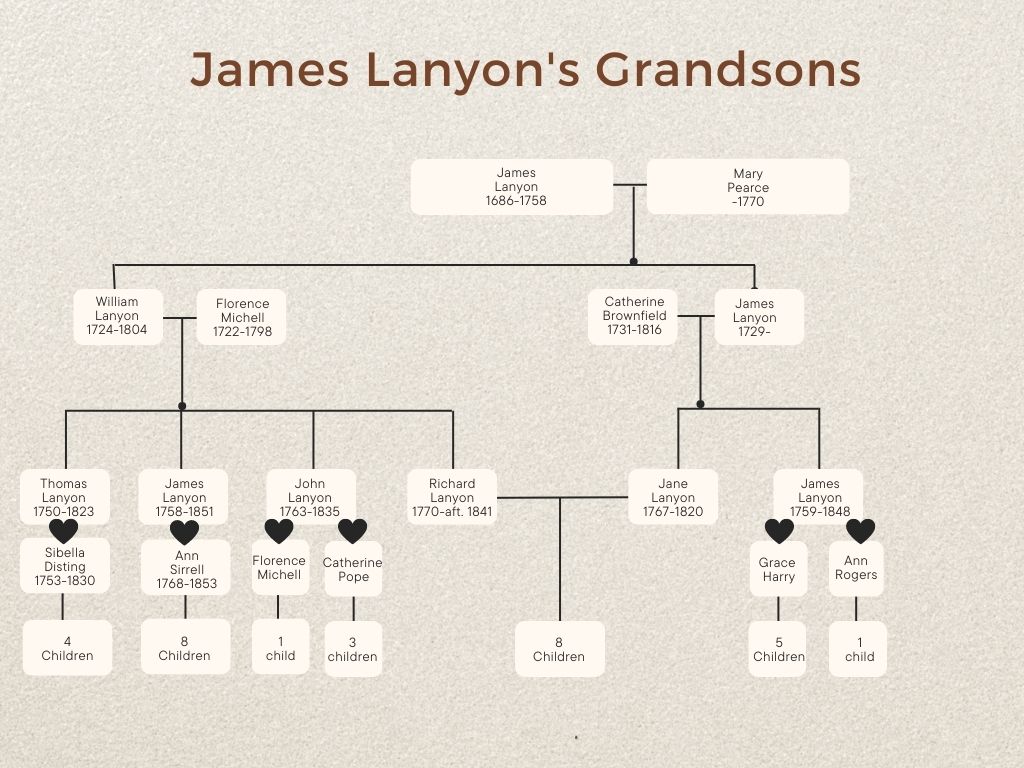
James Lanyon’s Grandsons

James and Mary had two sons and five grandsons to carry on the family name.

Thomas Lanyon 1750-1823

Thomas was baptised at Breage in 1750, he was a tinner at St Michael’s Mount and married Sibella Dusting/Disting at St Hilary in 1778. They had four children:

  • Catharine 1778-1779 died in infancy
  • Catharine 1781- in 1822 a Catherine Lanyon married Richard James at Breage could be this Catharine?
  • Thomas 1783-1859
  • William 1791-1871

Thomas senior was buried at St Hilary in 1823. Sibella was buried there in 1830.

Cornish Tin Mne – Internet Archive Book Images, No restrictions, via Wikimedia Commons

James Lanyon 1758-bef. 1851

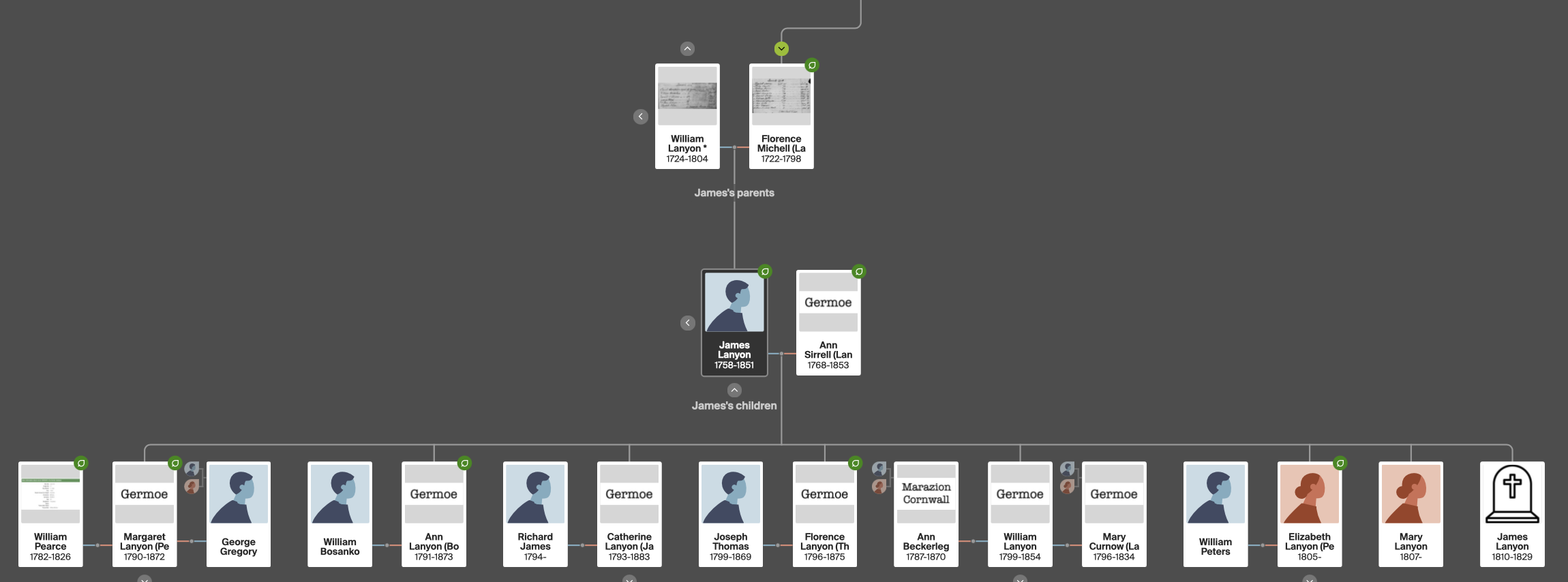
James was baptised at Breage in 1758, he too was a tinner and he married Ann Sirrell at Breage in 1789 (William Lenine was a witness). They had eight children:

  • Margaret 1790-1872 baptised at Germoe in 1790 and two possible marriages may be hers – William Pearce 1809 at Germoe and George Gregory 1838 at Uny Lelant – two children from the marriage to George
  • Ann 1791-1873 she married William Bosanko at Germoe in 1834 no children
  • Catherine 1793-1883 in 1818 she gave birth to an illegitimate daughter at Sithney (Catherine Lanyon of Rosladen, Breage). In 1822 she married Richard James a miner at Breage – three daughters. Catherine died at Germoe aged 90.
  • Florence 1796-1875 she married Joseph Thomas at Germoe in 1821 – six children
  • William 1799-1854 was a tin miner, he married Mary Curnow at Germoe in 1822 and they had four children: William 1824 no further trace, Maria 1827-aft. 1901 married John Thomas – six children and two daughters who died in infancy. He then married Ann Beckerleg in 1834 and they had one daughter.
  • Elizabeth 1805- had an illegitimate son William baptised at Germoe in 1826 no further trace of him. Elizabeth then married William Peters at Germoe in 1829
  • Mary 1807- no further trace
  • James 1810-1829 he died age 19 at Germoe

There is no one traceable to continue James’ line. He died before 1851, his widow is listed on the 1851 census as living with her widowed daughter Ann Bosanko and is described as a pauper aged 83.

1851 Census for Germoe

John Lanyon 1763-1835

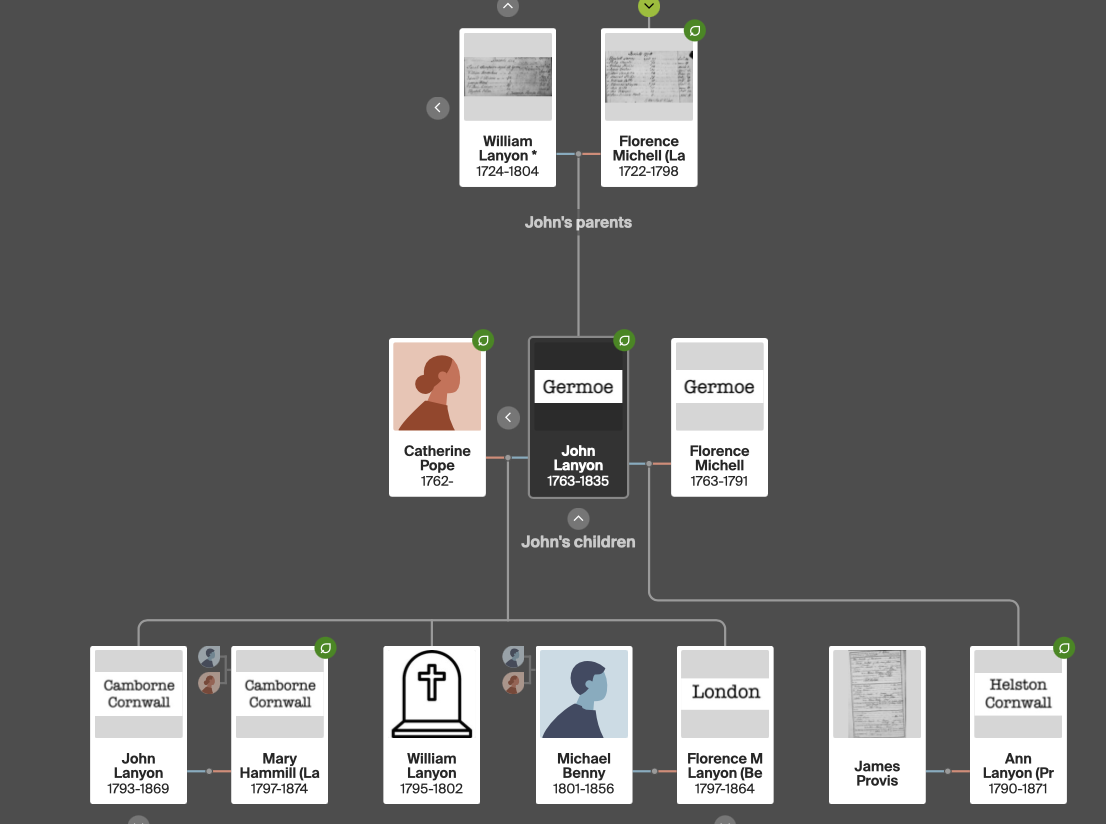
John was baptised at Breage in 1763 and like his brothers he was a tinner. He married Florence Michell (a relative of his mother) in 1789 at Breage. Their only daughter Ann was baptised at Germoe in Sep 1790, her mother Florence was buried in Jan 1791 aged just 28. Ann married James Provis at St Hilary in 1815.

John married for a second time in Aug 1792 at Breage to Catherine Pope (Witnesses Richard Michell and Thomas Kitto). They had three children:

  • John 1793-1869
  • William 1795-1802 died young
  • Florence Michell 1797-1864 she married Michael Benny at Helston in 1818, they had six children and she died in London in 1864

John senior died at Germoe in 1835 age 77 which gives him a date of birth of 1758, he could have been baptised when he was age 5 or his family may have miscalculated his age when he died.

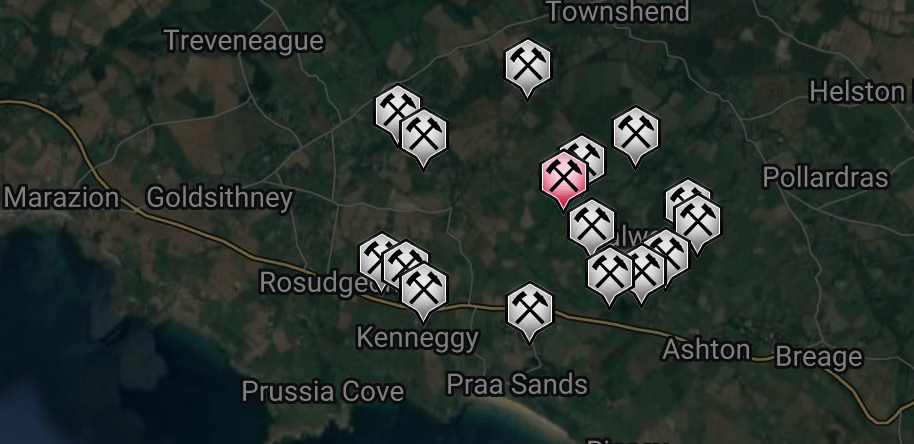
There were lots of mines in the Germoe/Breage/St Hilary area.

Mines

We don’t know which mines they worked in but this film will give you an idea of what it was like.

Richard Lanyon 1770-aft. 1841

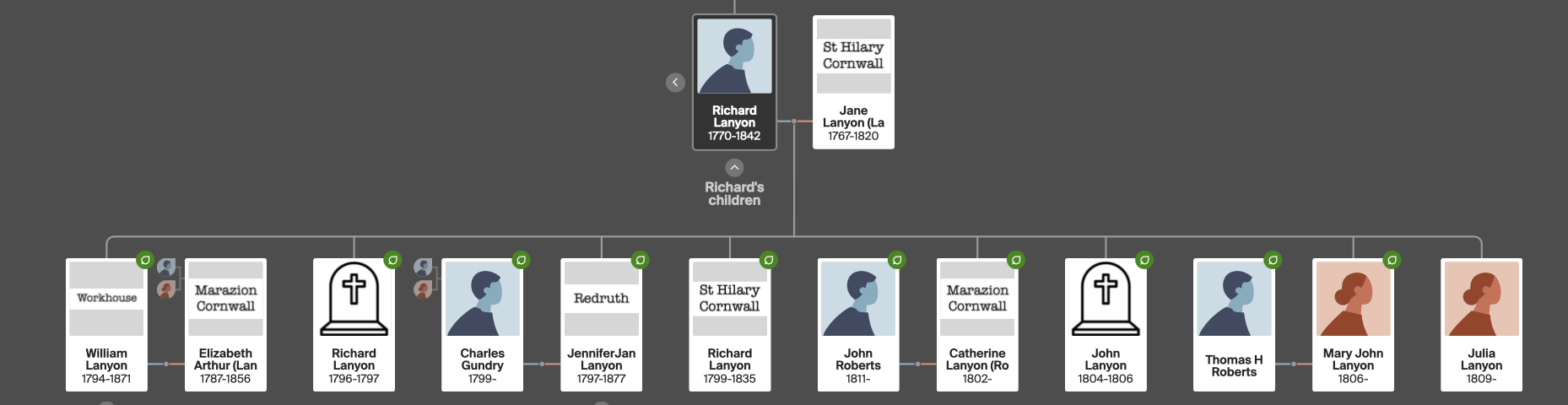
Richard was baptised at Germoe in 1770, he was a blacksmith at Marazion. He married his cousin Jane Lanyon at St Hilary in 1794. They had eight children:

  • William 1794-1871
  • Richard 1796-1797 died in infancy
  • Jennifer Jane 1797-1877 married Charles Gundry, a farmer, three children
  • Richard 1799-1835 died age 35 at Marazion, unmarried
  • Catherine 1802- aft. 1881 married John Roberts, a miner, she was still alive in 1881 and according to the census her two daughters Eliza (tailoress) and Jane (dressmaker) were living with her and her grandson William, illegitimate son of one of the daughters.
  • John 1804-1806 died in infancy
  • Mary John 1806-she married Thomas Harris Roberts at St Hilary in 1841 no further trace
  • Julia 1809-1843 living with her father on the 1841 census and dead by 1843

Richard senior was still alive in 1841 and living with youngest daughter Julia but after that no trace of his death. He’s often confused with the Richard Lanyon who died at Lostwithiel in 1848.

Victorian Blacksmith – Summer A. Smith, Public domain, via Wikimedia Commons

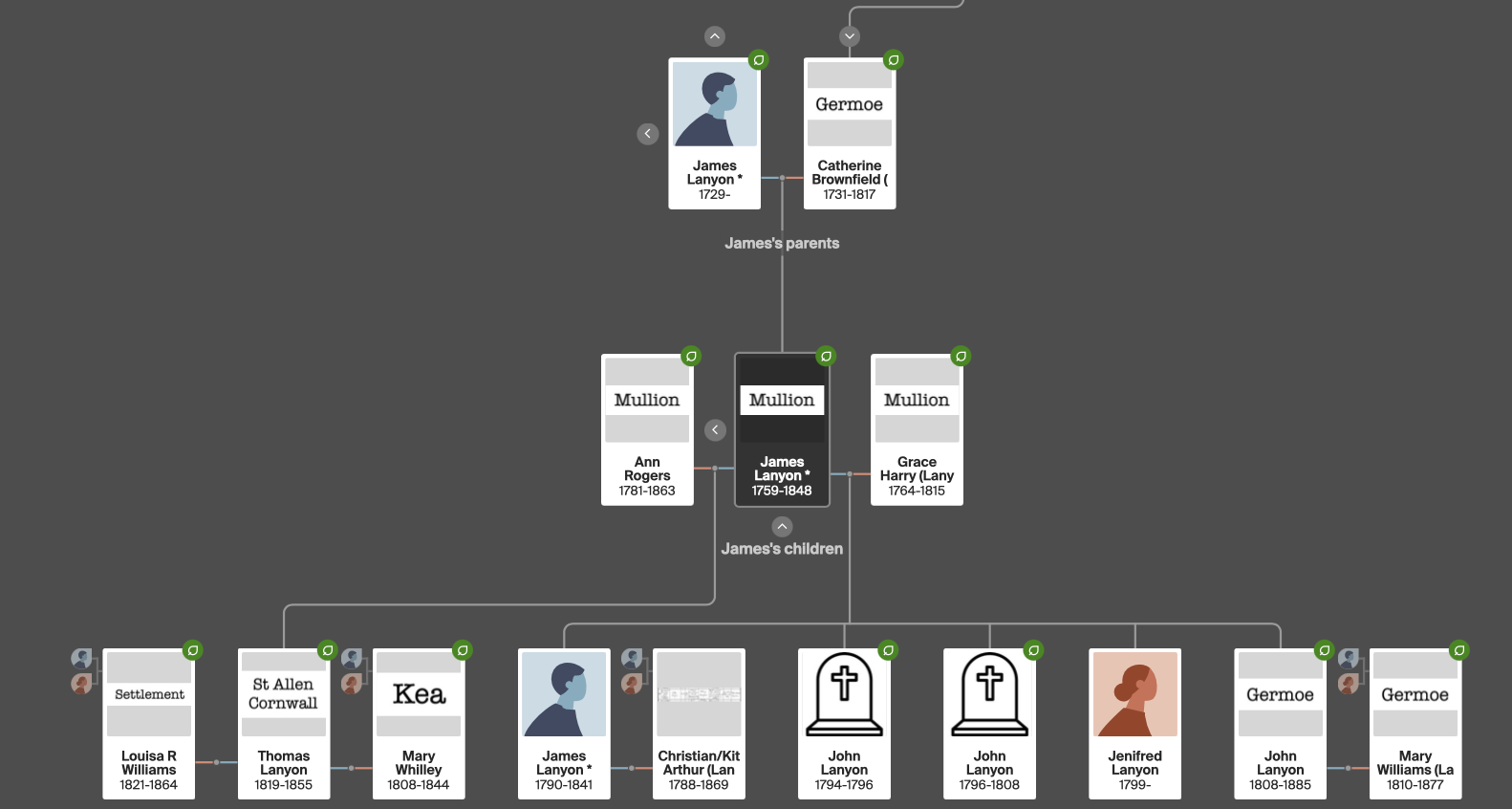
James Lanyon 1759-1848

James was the son of James and Catherine Brownfield. He was baptised at Breage in 1759 and married Grace Harry at Germoe in 1790. They had five children:

  • James 1790- he was a labourer and married Christian Arthur at Breage in 1812, one daughter Mary Anne baptised at Camborne in 1812. There is a Christian Lanyone on the 1841 census living at Helston but no sign of her husband. No further trace.
  • John 1794-bef. 1796 died in infancy
  • John 1796-bef. 1808 died in infancy
  • Jennifred 1799- no further trace
  • John 1808-1855

James’ wife Grace Harry died in 1815. In 1819 he married again in Mawgan in Meneage to Ann Rogers. They had one son:

  • Thomas 1819-1855

James died at Mullion in 1848 and Ann Rogers died in 1863 at Mullion.

Out of the five grandsons of James Lanyon and Mary Pearce there were only five great grandsons with children to follow.

William & James of Germoe

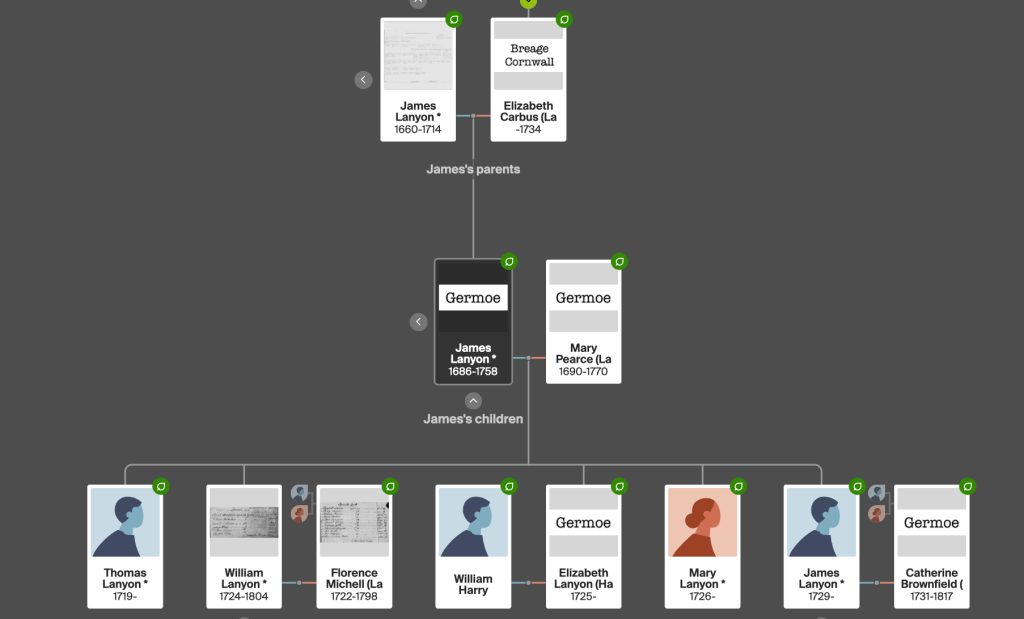
William and James were the sons of James Lanyon and Mary Pearce. James was baptised at Breage in 1686 and married Mary Pearce at Breage in 1712. They had two sons and two daughters, this post is about their sons.

William Lanyon 1724-1804

William was baptised some twelve years after his parents’ marriage, presumably there were other children who died in infancy or stillbirths and miscarriages to account for the large gap. He married Florence Michell at Germoe in 1749. They had eleven children:

William & Florence’s tree
  • Thomas 1750-1823
  • Florence 1752-1791
  • William 1753-1831 William’s first marriage was to Mary Gibbons at St Hilary in 1781 and they had a child, Mary baptised in 1803. She married James Pearce in 1823 and they had nine children. Mary was baptised in Feb 1803 and her father remarried in Jul 1803 so presumably her mother Mary Gibbons died in childbirth. William’s second wife was Honour King and they married at St Hilary (witnesses to the marriage Thomas Lanyon and Benjamin Rodda). Honour Lanyon died on 8 Mar 1807 at St Hilary age 44. On 11 Jul 1807 (he didn’t hang around!) William (widower) married Honour Edwards at Breage (Witnesses: Benjamin Rodda and William Edwards.) They had a daughter called Mary Anne baptised in 1809 and buried at St Hilary in 1813 age 4. So William had three wives, two called Honour and two daughters both called Mary! William was buried at St Hilary in 1831 and without any male heirs his line died out.
  • Mary 1755- she married James Rodda a widower at St Hilary in 1781. They had seven children including Benjamin who was a witness at his uncle William’s weddings.
  • James 1757-1758 died in infancy
  • James 1758-1851
  • Elizabeth 1760-1809 no trace of a marriage
  • Catherine 1762- she was baptised at Breage and married Richard Ellis, a carpenter at St Hilary in 1781 – five children
  • John 1763-1835
  • Margaret 1765-1855 she was baptised at Germoe in 1765. At Sithney in 1792 a Margaret Lanyon baptised an illegitimate child also called Margaret (not sure if it is this Margaret or not) in 1796 she married Nicholas Edwards, a tinner, at Breage – five children. Nicholas died in 1814 and in 1827 Margaret married John Symons, a widower, at Breage. She died at Godolphin Cross in 1855 aged 89, she was living with her son Nicholas.
  • Richard 1770-1848 married Jane Lanyon his cousin

With four sons having children of their own this branch of the family is thriving.

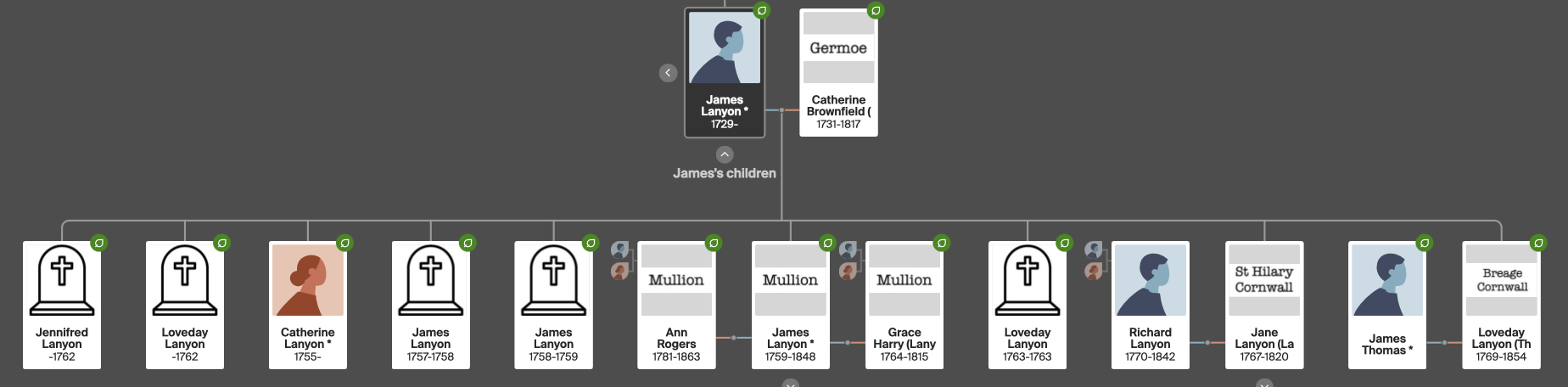
James Lanyon 1729-

James was William’s younger brother. He was baptised at Germoe in 1729 and married Catherine Brownfield there in 1755. They had nine children:

James & Catherine’s tree
  • Catherine 1755- no further trace
  • James 1757-bef.Aug 1758 died in infancy
  • James Aug 1758-bef. Dec 1759 died in infancy
  • James 1759-1848
  • Loveday – Apr. 1762 died in infancy
  • Jennifred – May. 1762 died in infancy
  • Loveday 1763-1763 died in infancy
  • Jane 1767-1820 married Richard Lanyon her cousin, the son of William Lanyon and Florence Michell
  • Loveday 1769-1854 married James Thomas at Germoe in 1801 – six children

Out of nine children only three survived to adulthood.

James senior died after 1769 (when his last child was born) but there is no trace of his burial, Catherine his wife was buried at Germoe in 1816/7 aged 88.

Saint Germochus or Germoe was an early 6th century saint active in Cornwall and Brittany. he was the patron saint of Germoe, he is said to have been a king and friend of St Breage. In the churchyard there is St Germoe’s chair. I wonder how many Lanyons sat in it?

St Germoe’s Chair also know as the Throne by Raymond Cubberley, CC BY-SA 2.0 https://creativecommons.org/licenses/by-sa/2.0, via Wikimedia Commons

Barnard’s Grandsons

Barnard had two sons (we think!) Charles and James. There were no baptisms recorded for either and Barnard didn’t leave a traceable will which may have confirmed his children’s names. However there was only one Lanyon family at St Hilary at that time so it is likely that Charles and James were his sons.

Charles’ Sons

We don’t know when Charles was born, died or when he married. The baptism register of St Hilary states that his wife was called Margaret. We don’t even have conclusive proof that he was Barnard’s son but he did name his sons David, Francis and Thomas. David after Barnard’s father and Francis and Thomas after Barnard’s older brothers.

Charles Lanyon’s tree

St Hilary parish register records that Charles Lanyon son of Charles was buried in 1683 and that probably places Charles’ birth in the 1660s. In 1687 there is a Charles Lalion baptised at St Hilary, father’s name not mentioned so he may be Charles’ son or James’ son or not a Lanyon at all.

Charles Lanyon 1687-

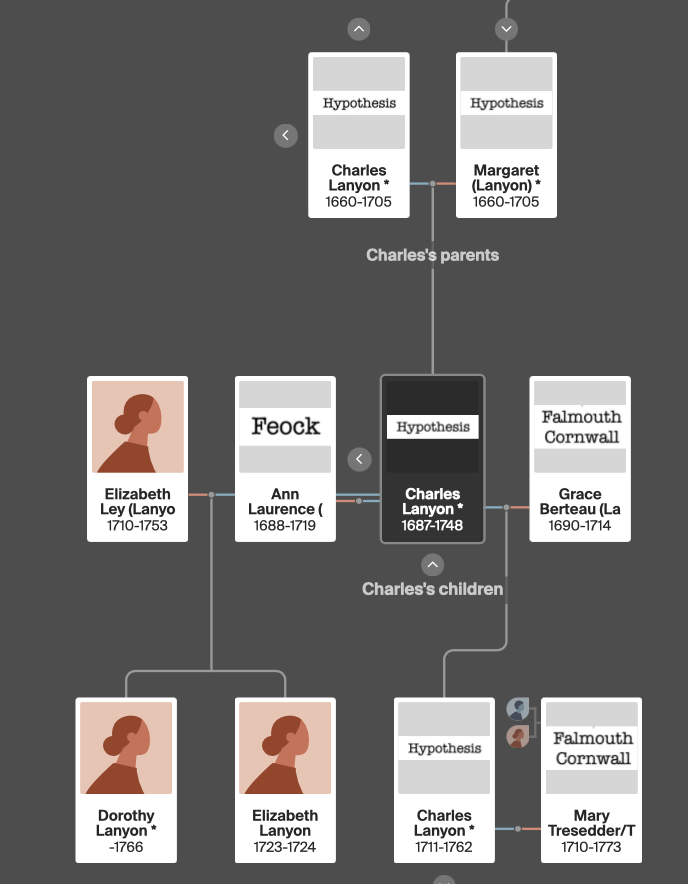
Initially I thought this Charles might have married Eleanor Nines at Perranuthoe in 1715 and couldn’t trace any children. Then I had a breakthrough. This Charles is likely the Charles Lanyon who married Grace Berteau at Falmouth in 1709. They had one son:

  • Charles 1711-1762

Grace was buried in 1714. It’s possible that Charles married Eleanor Nines in 1715 and that the Eleanor Lanyon buried at Mylor in 1733 is his wife however I have a more likely candidate for his second wife – Ann Laurence. Charles Lanyon of Falmouth married Ann Laurence at Philleigh in 1718. Ann died a year later at Feock.

It appears that Charles married for a third time and whilst there is no trace of this marriage when Charles died intestate the administration papers mention his widow and relict Elizabeth. There are baptisms and burials listed in Falmouth for two daughters:

  • Elizabeth -1723
  • Elizabeth 1723-1724

There is a possible third daughter, Dorothy. In 1766 there was a Mrs Dorothy Lanyon (Mrs does not necessarily denote a woman is married, it is used to denote a gentlewoman) buried at Constantine. Could this be an unrecorded daughter of Charles?

It’s a bit confusing we have four wives and only one Charles Lanyon to go round!

David Lanyon 1693-1773

David & Elizabeth’s tree

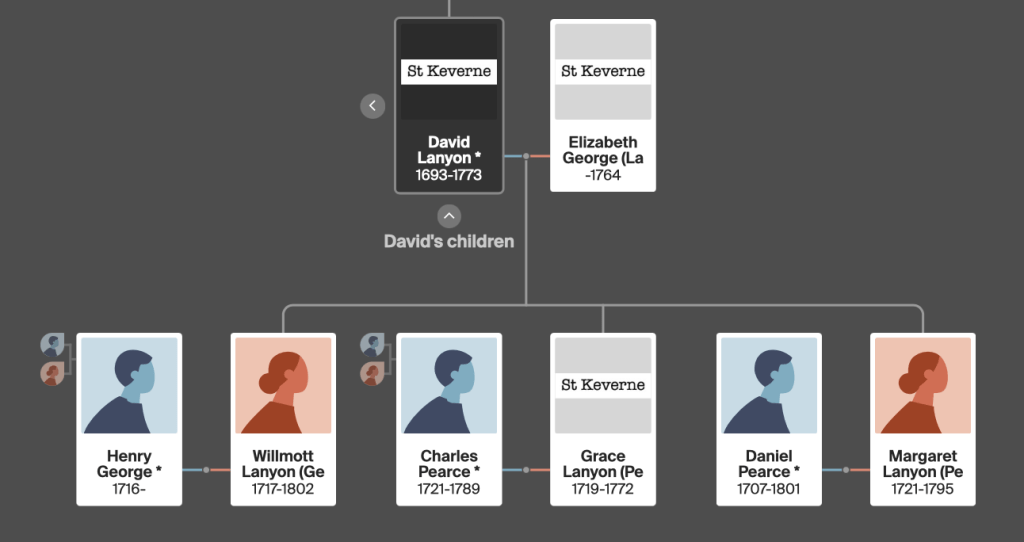
David was Charles’ younger brother, he was baptised at St Hilary in 1693 and he may be the David Lenine who married Elizabeth George at St Anthony in Meneage in 1716. The register describes them both as ‘of St Keverne’.

From this marriage there were three children traced:

  • Willmott 1717 married Henry George at St Keverne in 1738
  • Grace 1719 married Charles Pearce at St Keverne in 1745 – four children
  • Margaret 1721 married Daniel Pearce

David was buried at St Keverne in 1773.

Francis Lanyon 1695-1770

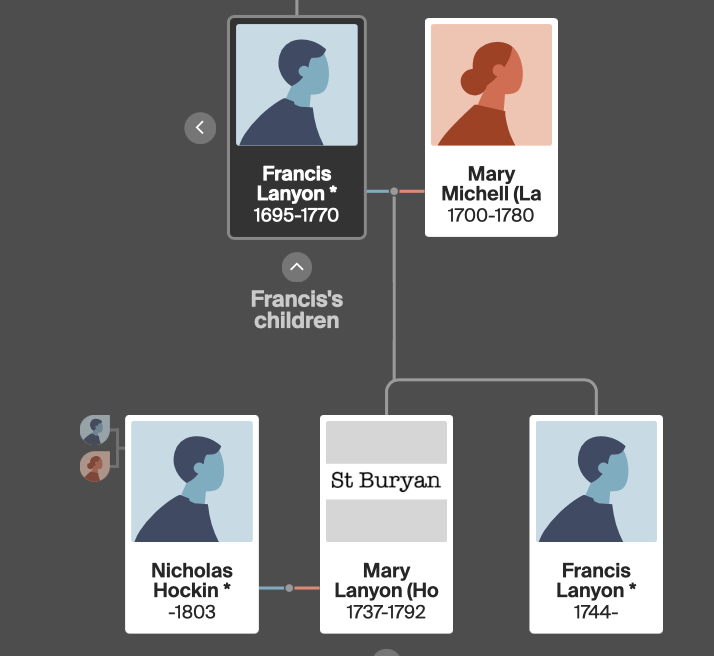
Francis was baptised at St Hilary in 1695 and married Mary Michell there in 1735. Two children traced:

  • Mary 1737- baptised at St Just in Penwith in 1737 married Nicholas Hockin in 1765
  • Francis 1744- baptised at St Just in Penwith in 1744 and no further trace

Francis senior was buried at St Just in 1770 and Mary his wife in 1780

Thomas Lanyon 1697-1737

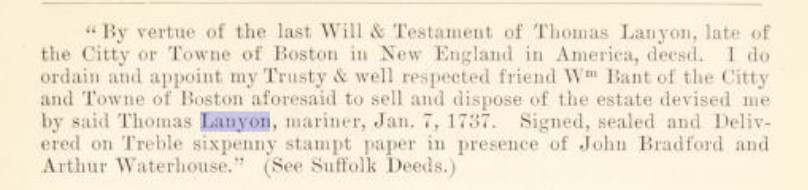
Thomas was baptised at St Hilary in 1697 and may be the Thomas Lanyon, mariner, of Boston, America who died on 7 Jan 1737. (Source ‘Brondson & Box Families Part 1’ by Lucius B Marsh.) Charles Lanyon merchant of Penzance was given power of attorney to sell his estate.

James’ Son

James & Elizabeth’s tree

We know very little about James, we don’t know when he was born or died, we can’t even be sure he was Barnard Lanyon’s son. We do however know that he married Elizabeth Carbus at St Hilary in 1685. There were only two children traced so perhaps James died young. I think Elizabeth was buried at Breage in 1734 but that is just guess work.

  • James 1686-1758
  • Margaret 1690-1693 (name is spelt Lannion in the register of baptisms at Germoe) died in infancy.

Others have Elizabeth Carbus being buried in 1689 at Liskeard but that wouldn’t be possible with her daughter being born in 1690.

Germoe is near Praa Sands.

There is a James Lanyon buried at Germoe in 1727 and this may be Elizabeth Carbus’ husband.

The St Hilary branch of the family now rests with James Lanyon 1686-1758 and Mary Pearce, can his sons William and James keep the tree going?

Barnard Lanyon

The St Hilary branch of the family tree started with Barnard Lanyon.

Barnard was the youngest son of David (Davy) and Joan, he was baptised on 10 Jun 1638 at Madron and was just three years old when his father died in 1641. When his mother died in 1655 she left him ‘a brass pann conteyning 7 or 8 galls and 1 heifer to be kept by Thomas till she becomes a cow’.

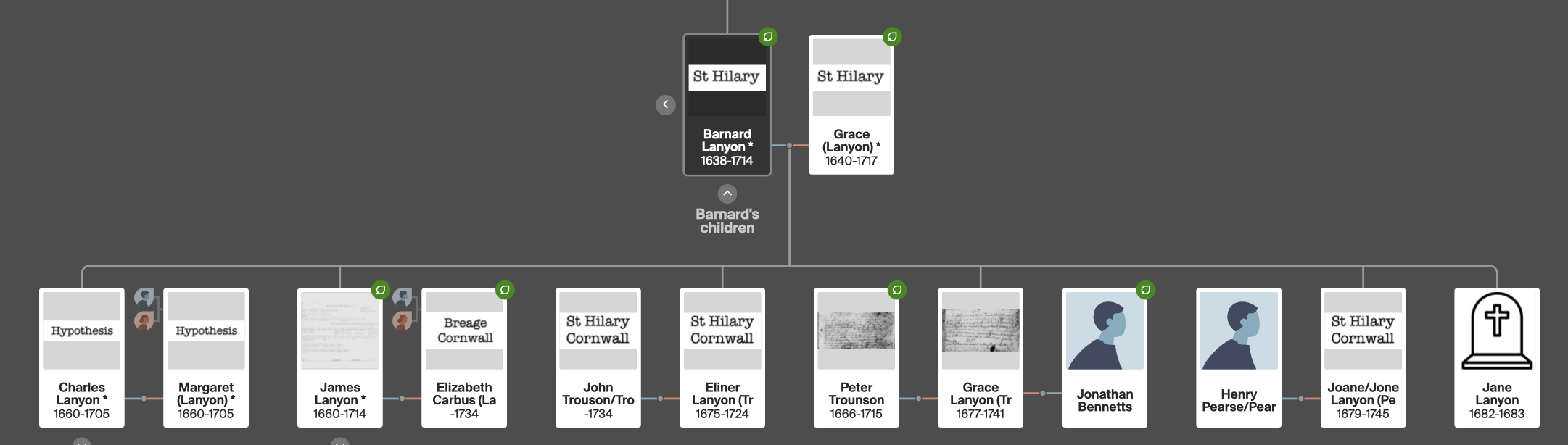
He married Grace, sadly we don’t know her surname or the date of marriage but in the 1660s and 1670s they were having children. The baptisms of some of the children are not recorded so there is a bit of guess work involved.

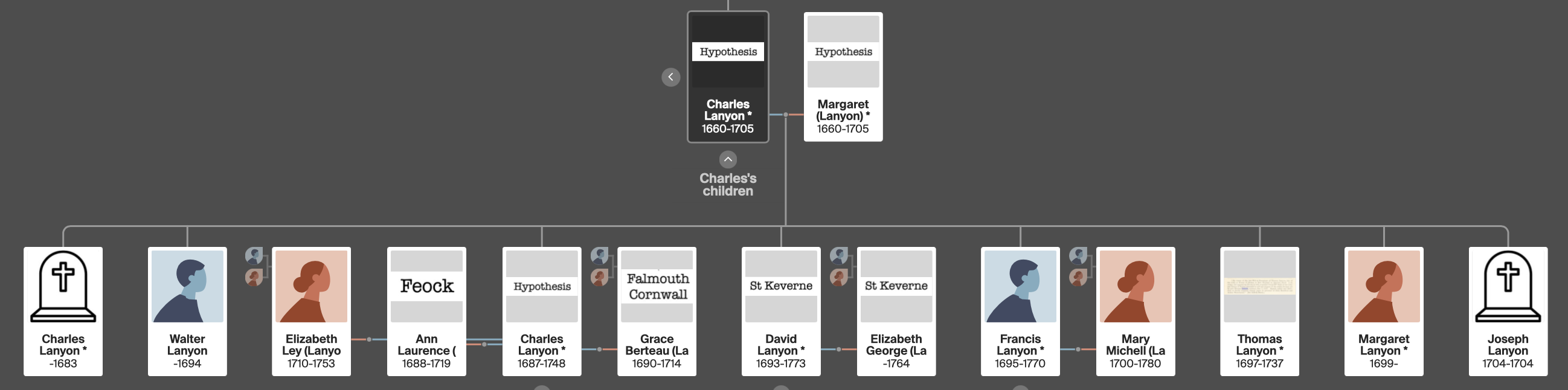
  • Charles abt. 1660-1705 married Margaret
  • James abt. 1660-1714 married Elizabeth Carbus
  • Eliner 1675-1724 married John Trouson
  • Grace 1677-1741 married Peter Trouson & Jonathan Bennetts
  • Joane 1679-1745 married Henry Pearce
  • Jane 1682-1683 died infancy

Charles Lanyon 1660s

We don’t know when Charles was born or died or even when he married but from the records of the baptisms of some of his children his wife is named as Margaret. Their children:

  • Charles -1683 there is a burial of a Charles Lanyon son of Charles (from the date of the burial of this child it looks as if Charles the father was born early 1660s)
  • Charles 1687- There is a Charlis Lalion baptised on 2nd Feb 1687 at St Hilary no father is named, could this be a son of Charles or even a son of Barnard? Or a separate family altogether? (There is a Charles Lanyon who married Eleanor Nines at Perranuthoe in 1715 could that be this Charles as that marriage doesn’t appear to fit anywhere else?)
  • Walter -1694 died in infancy
  • David 1693-1773
  • Francis 1695-1770
  • Thomas 1697-1737
  • Margaret 1699- there is a Margaret Lenine who married a William John (Bond) at Ludgvan on 5 Jun 1725 who may be this Margaret
  • Joseph 1704-1704 died in infancy

James Lanyon 1660s

There is no record of James’ baptism or his burial but we do know he married Elizabeth Carbus at St Hilary on 20 Apr 1685. Two children traced:

  • James 1686-1758
  • Margaret 1690-1693 died in infancy

Eliner Lanyon 1675-aft. 1724

Eliner was baptised at St Buryan in 1675. She married John Trouson/Trownson at St Hilary in 1724. No children of this marriage. John was buried in 1734 but no trace of a burial for Eliner/Eleanor.

Grace Lanyon 1677-1741

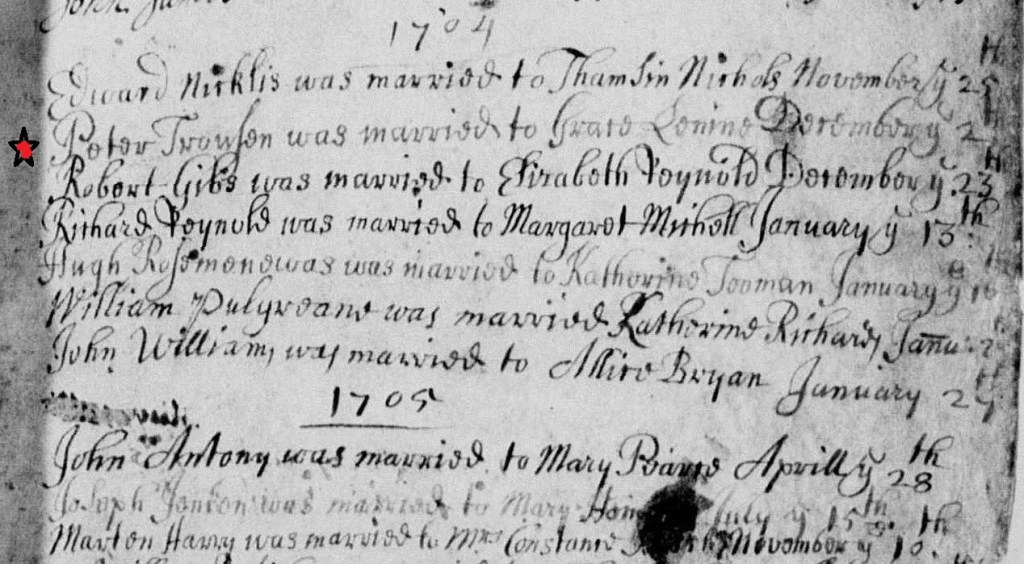
Grace was baptised at St Buryan in 1677. She married Peter Trouson at Ludgvan in 1704. They had four children, at least three died as a children. Peter died in 1715 and Grace married Jonathan Bennetts at Madron in 1732. She was buried at Madron in 1741.

Marriage of Peter & Grace Ludgvan Parish Register.

Joane Lanyon 1679-1745

Joane was baptised at St Buryan in 1679 and named after her grandmother, Barnard’s mother. She married Henry Pearse at St Hilary in 1709 and had three children: John, Jane and Francis. Joane was buried at St Hilary in 1745.

Barnard was buried at Marazion in 1714 and Grace his wife, was buried at St Hilary in 1717. They didn’t leave a will which might have helped confirm their children’s names.