Phillimores Marriage Records show that on 3 May 1615 Elizabeth Lanyne married Oliver Neilder at Menheniot in Cornwall. Despite several attempts I couldn’t initially place Elizabeth on the Lanyon tree, who was she?
Early marriage records rarely mention the parent’s names and Elizabeth is one of the most common names in the Lanyon family so I decided to look at Oliver Neilder in more depth to see if I could discover anything useful.
Oliver Neilder baptised at least four children at Menheniot in the early 17th century: Marye 1619, Jane 1621, John 1624 and Elizabeth 1627. The Menheniot parish register also lists the following burials: Elizabeth Neilder was buried on 15 Jan 1659 (she was noted as being ‘old’) and Oliver Neilder was buried the following year on 26 Sep 1660 (he’s noted as ‘old senr’.)
Neither Oliver nor Elizabeth left a will so that avenue for research was closed. I did find Oliver Nealder (sic) listed on the 1641/2 Protestation Return for Menheniot but that was it. I then turned to Kresen Kernow (The Cornish Record Office) and the National Archives to see if there was anything useful there.
I found just one relevant record at Kresen Kernow. Assignment of land at Trenant, the parties were Oliver Nealder, yeoman of Menheniot and Peter Carveth also a yeoman of Menheniot (BRA991/120).
The National Archives were more forthcoming. I found records of litigation between the Neilder family and the Kekewich family. I’ve come across the Kekewich family before whilst researching the Lanyons so I was curious to find out more.
The Kekewich’s were one of the most powerful families in Cornwall in the late 16th and early 17th centuries. The family resided at Catchfrench near Saltash and Trehawke near Menheniot. So Oliver and Elizabeth Neilder were neighbours of the Kekewich family.
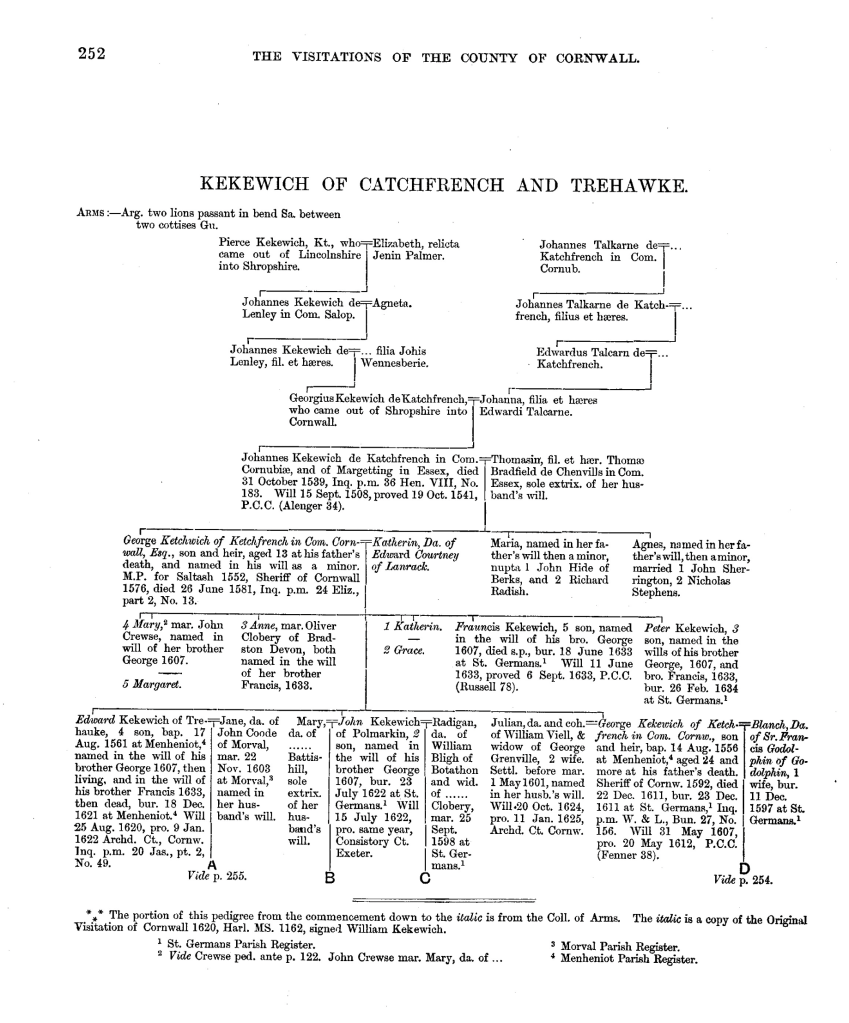
The Herald’s Visitation of Cornwall gives us the Kekewich family tree for that period.
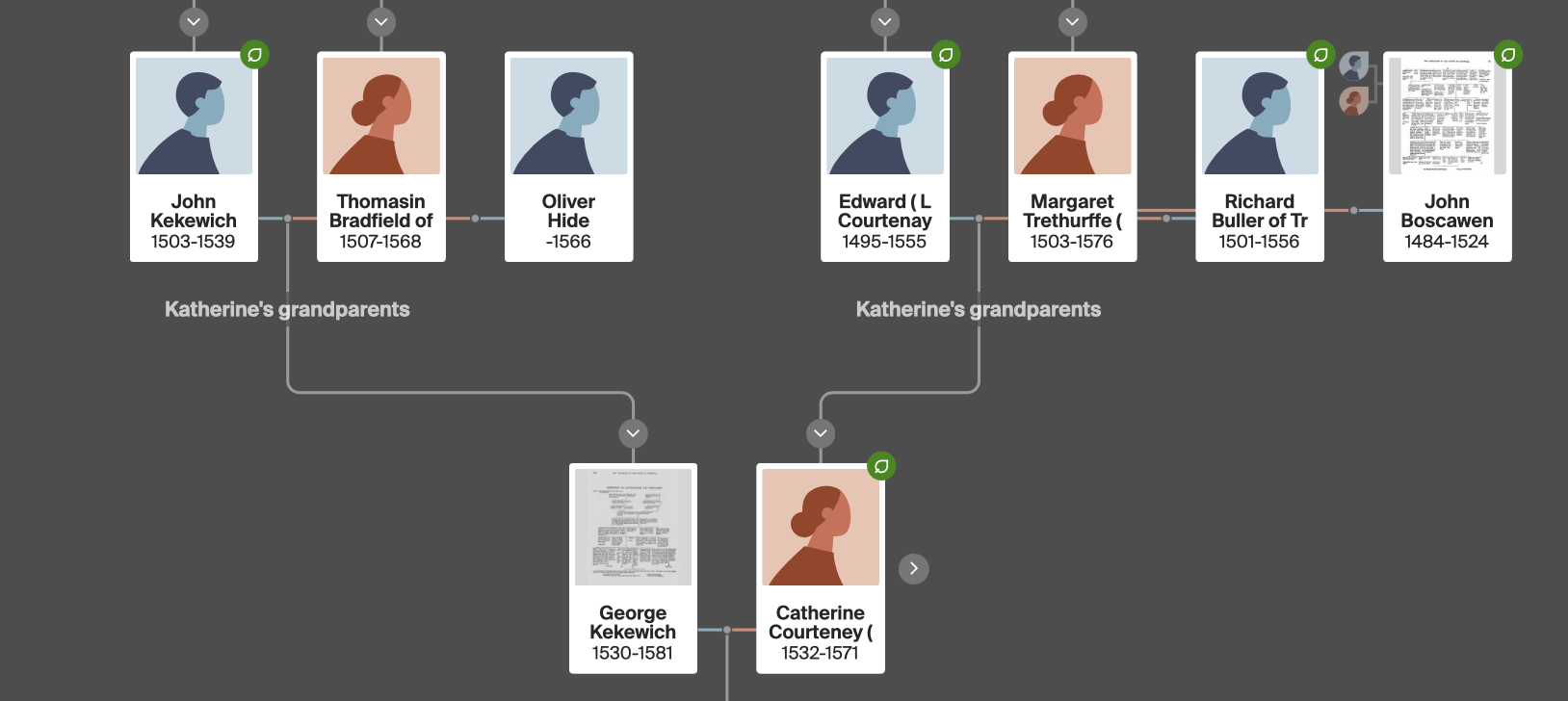
George Kekewich married Katherine/Catherine Courtney, descended from an aristocratic family. Her mother Margaret, daughter of Thomas Trethurfe, was one of the co-heirs of Edward Courtenay, Earl of Devon. Margaret married three times; first to John Boscowen, second to Edward Courtenay of Landrake and third to Richard Buller of Tregarrick.
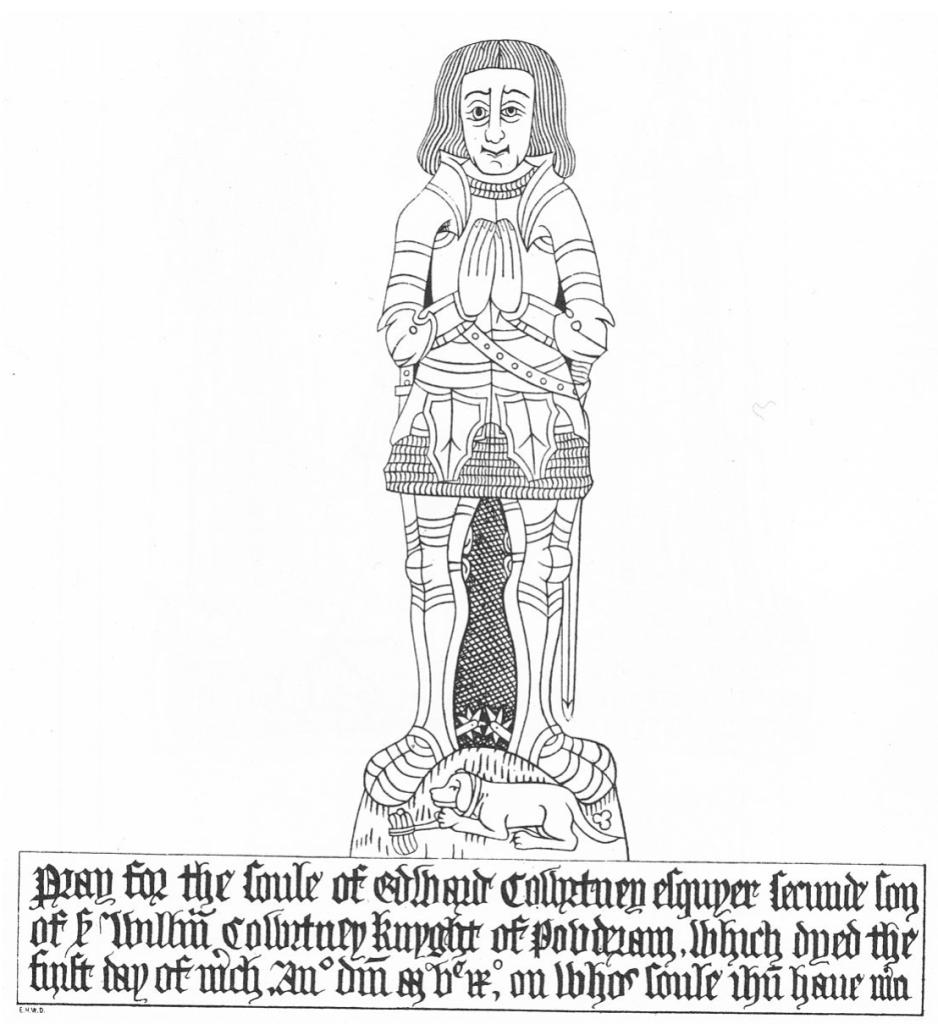
Edward Courtenay 1509 brass – Dunkin, E.H.W. The Monumental Brasses of Cornwall, 1882, Plate XXIKekewich – Courtenay family tree
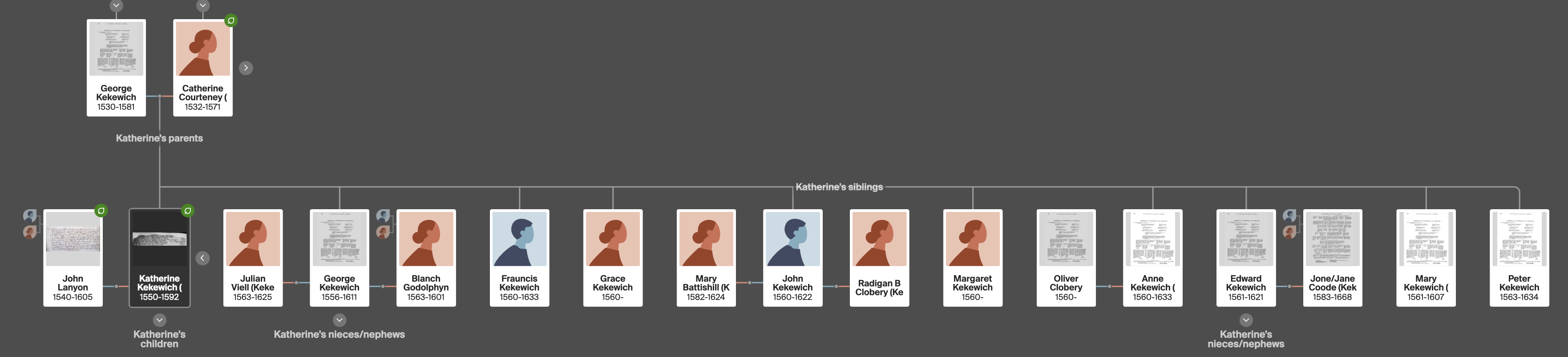
George and Katherine Kekewich had several children but we’re interested in their first born daughter Katherine and their fourth son Edward. Edward Kekewich of Trehawke was baptised on the 17 Aug 1561 at Menheniot, he married Jane, the daughter of John Coode of Morval on 22 Nov 1603 at Morval. Edward was buried at Menheniot on 18 Dec 1621. Edward and Jane’s second son, Peter Kekewich, was born in 1605 and he was the man involved in litigation with the Neilder family.
The children of George & Catherine Kekewich
National Archives document C9/47/58 Neilder v. Kekewich 1668 states that Nicholas Honey on behalf of his stepchildren, Oliver and Elizabeth Neilder, who were under 18 started the litigation. Honey stated that in 1657 Oliver Neilder was 83 years old (giving him a birthdate about 1574) and he was blind and decayed in memory. Honey alleged that Peter Kekewich and his brother-in-law Roger Porter were not related to Oliver Neilder and had conned the elderly man.
Peter Kekewich and Roger Porter (the husband of Peter’s sister, Elizabeth) responded that Oliver wasn’t quite so blind or so poor in memory, despite his age. They also pointed out that Oliver Neilder’s wife Elizabeth (Lanyne) was cousin germane to Peter Kekewich and Roger’s wife. (National Archives C10/178/69 & C8/352/249)
A cousin germane is a first cousin so Elizabeth Neilder (Lanyne) must have been the daughter of one of Edward Kekewich’s sisters. Edward had five sisters: Katherine, Grace, Anne, Mary and Margaret. We know that Anne married Oliver Clobery of Bradston, Devon and Mary married John Crewse so we can discount them.
That leaves Katherine, Grace and Margaret as possible mothers. George Kekewich’s will of 1581 is in the National Archives (PROB 11/64/488) and it shows that his eldest daughter Katherine/Catherine had married a Lanyon.
His will states that his daughter “Cate Lanyan have the sixe pounds thirtene shillings Fower pence given her by her grandmother Buller and three poundes sixe shillings eighte pence for to make the whole somme Tenne poundes.”
PROB 11/64/488
So ‘Cate’ had married a Lanyon, but which one?
Richard Carew’s ‘Survey of Cornwall’ states:
“Diverse other Gentlemen there dwell in this Hundred: as Lanyne the husband of Kekewich his father married Militon and beneath s. a castle a. standing in waves b. over the same a falcon hovering with bells o.”
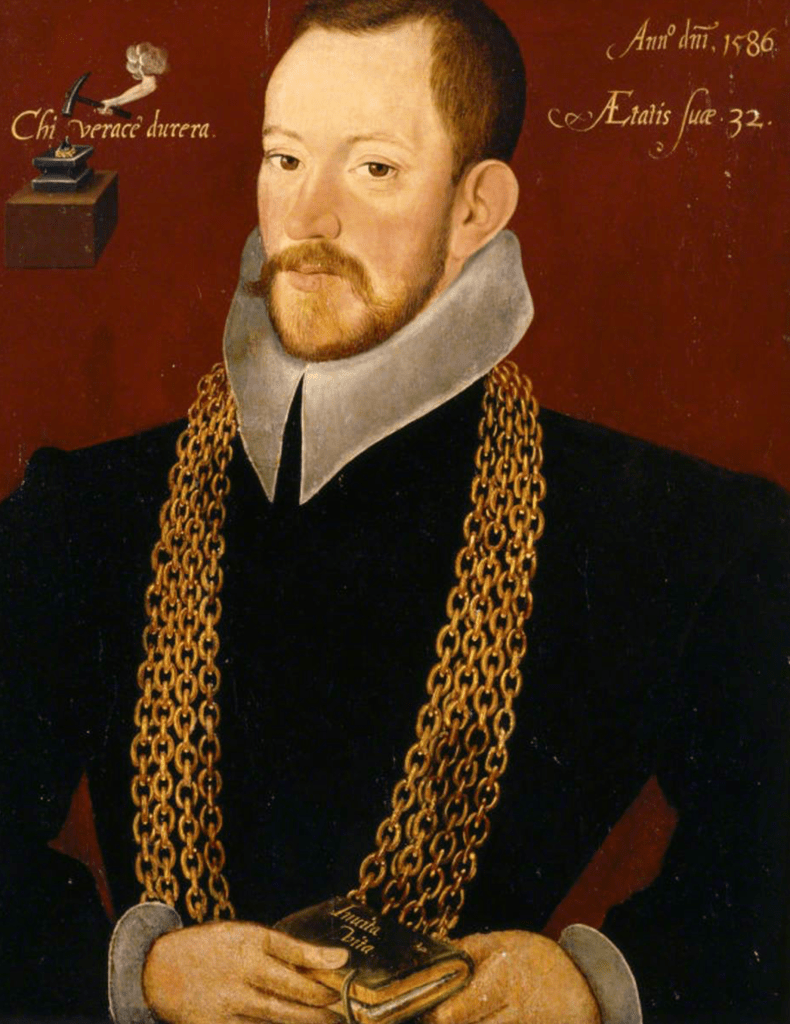
Richard Carew National Trust, Public domain, via Wikimedia Commons
We know that John Lanyon (the son of Richard Lanyon Esq) married Phelype Militon on 18 Jan 1562 at Breage. Their eldest son Francis married Alice Trewren in 1584. John & Phelype’s second son William married Jane at Sancreed in 1592. There is one other son, John who is described as the son of John Lanyon esq. and he was buried at Madron in 1587, he appears to be a child but his age isn’t given. Phelype Militon was buried 29 Dec 1578 at Breage.
So which ‘son’ of John Lanyon married Cate Kekewich?
John and Phelype’s son Francis was born at the earliest in 1563 and he married Alice Trewren in 1584. He was still married to her at the time of his death in about 1593. Cate Lanyon was named in her father’s will which was dated 1581 so whilst it was just about possible for Francis to have married her when he was aged 17 or 18 years old she would have to have died before 1584, when he married Alice. There is no evidence that Cate Lanyon was buried at this time. Francis did have an illegitimate daughter called Elizabeth who was baptised in 1587 however I think it highly unlikely that Cate Kekewich would have had an illegitimate daughter who was later described as a cousin germane by her nephews. I think we can safely disregard Francis as a possible husband to Cate and father to Elizabeth Neilder.
That leaves his second son William Lanyon as a possible candidate. We don’t know when William was born but it must have been 1564 at the earliest and it could have been a few years later. The oldest he could have been was just 17 and that’s if Cate married the same year as the will was written. If she was married a year or two before that William would have been only 15 or 16. We don’t know when Cate was born but she was the eldest daughter of George Kekewich and Katherine Courtenay. Their date of marriage is suggested as 1555 at Landrake, in Cornwall. We know that their eldest son and heir was baptised on 14 Aug 1556, it seems likely that Cate was born soon after. Her mother Katherine Courtenay died in 1571 so all nine children must have been born before that date. This makes Cate several years older than William Lanyon.
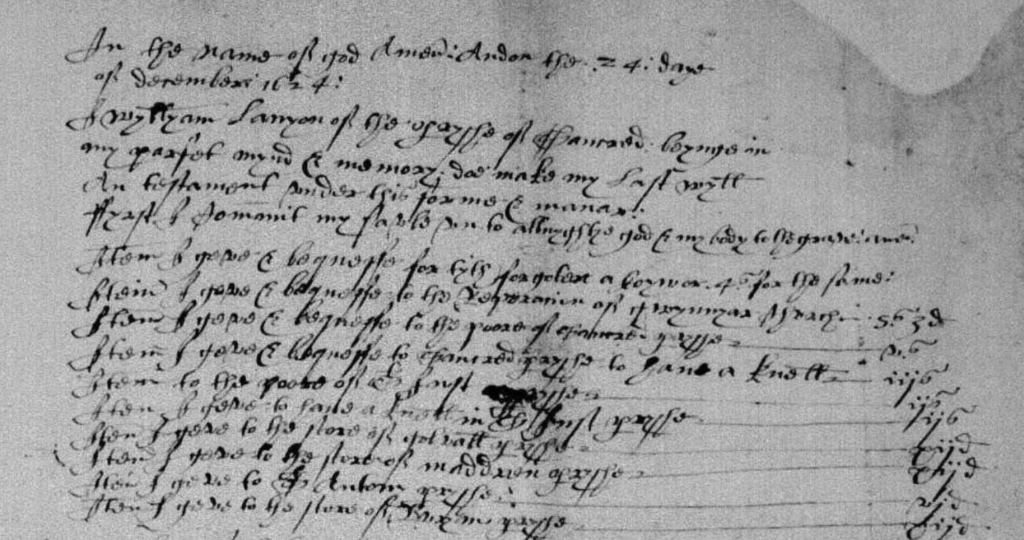
William Lanyon did marry a woman called Jane at Sancreed in 1592 and they had six children. He died in 1624 and his will survives and names his children. He had two daughters, both called Elizabeth! The eldest was born in 1593 after his marriage to Jane so Cate couldn’t be her mother. The youngest was born in 1607 and would be too young to marry Oliver Neilder in 1615.
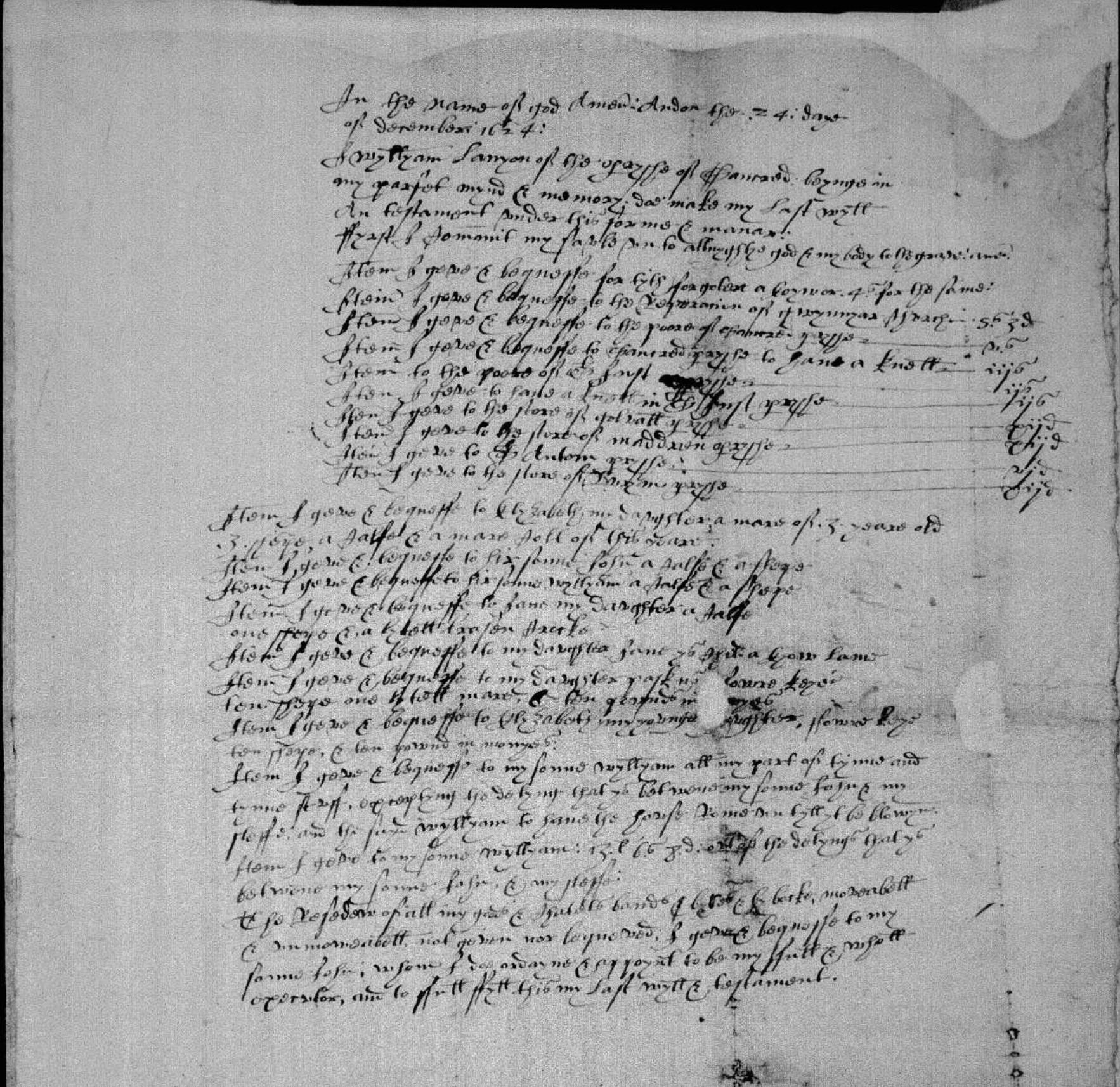
William Lanyon’s 1624 will naming his children
George Kekewich was an MP for Saltash and Sheriff of Cornwall, Katherine Courtenay was descended from an aristocratic family, would they have married their eldest daughter to a teenage second son?
It seems much more likely that Cate Kekewich married the recently widowed John Lanyon, the eldest son and heir to Richard Lanyon Esq and the head of the Lanyon family.
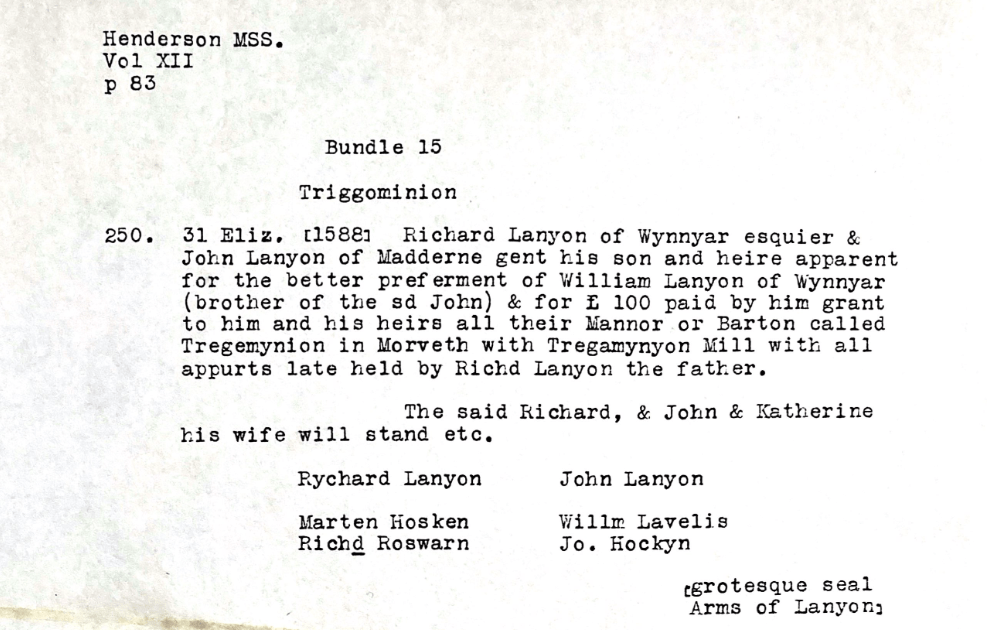
Whilst there is no record of a marriage for John Lanyon and Cate Kekewich there is a record which may help prove the relationship. In 1589 Richard Lanyon Esq and his eldest son John sold Tregemynion in Morvah to Richard’s fourth son William. The agreement is signed by Richard, John and Katherine his wife. (Hendersons MSS Vol XII p.83)
Abstract from Hendersons MSS
So it appears as though sometime after 29 Dec 1578, when Phelype Militon died, and before 1581 when George Kekewich’s will was written, that John Lanyon married for a second time to a woman named Katherine.
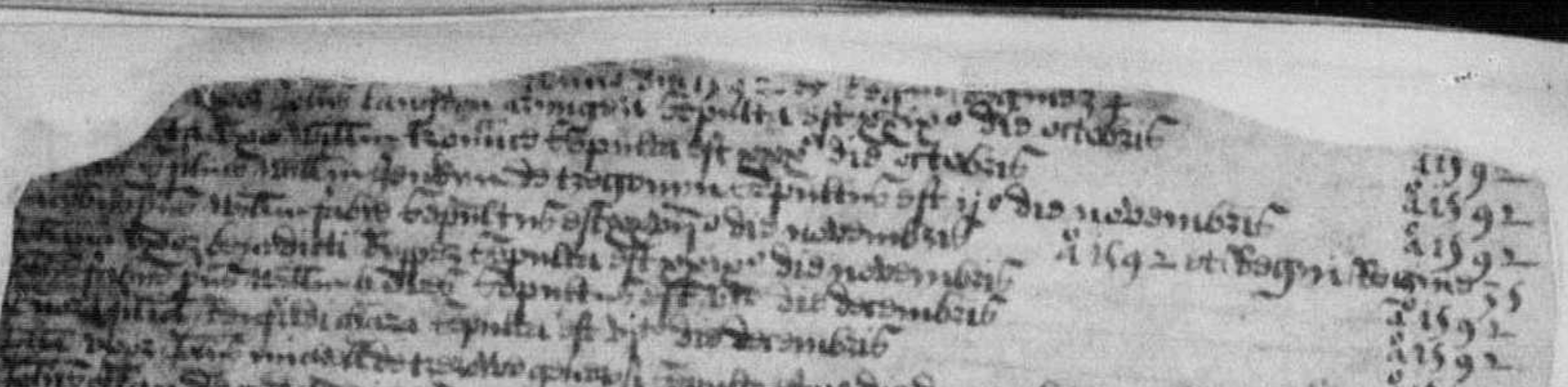
Breage parish register also has an interesting entry for a burial. On 29 Oct 1592 there is the following entry ‘uxor Johis Lanyon armiger’. Sadly the page is damaged so the wife’s name is not legible but John Lanyon, who has the right to bear arms, buried his wife. There is only one John Lanyon who has the right to bear arms at this time.
Breage Parish Register Burials
There are no records of any children of this marriage being baptised or buried. However looking at the wills of Cate’s brothers gives us some more clues. George Kekewich the younger’s will was written 22 Jun 1607 and proved 20 May 1612. It states:
“I give the blynde Lanian, my kinsman xx s a year towards his mayntenance untill my heire accomplish the age of xxj years.”
National Archives PROB 11/119/518
So Cate’s brother had a ‘kinsman’ called Lanian who was blind.
Cate’s brother Francis also left a will which was written 20 May 1633 which states:
“I give George Lanion twenty shillings a year during my lease of Manoby with the proviso that he wander not the country as a beggar contrary to God’s and Man’s laws. Hoping the rest of his friends will make up the rest that must be paid for his board.” (National Archives PROB 11/164/299)
So it appears as though Cate Lanyon had a son called George who was blind. He’s not mentioned in any Lanyon wills however most of the 16th century Cornish wills were destroyed during World War II bombing.
There is no record of a baptism, marriage or death of George Lanyon and we wouldn’t know anything about him but for these wills. None of the wills mentions Elizabeth Lanyne or Oliver Neilder.
Whilst none of this is actual proof that Elizabeth Neilder was the daughter of Katherine Kekewich and John Lanyon Esq it’s probably as close as we’ll come.
We know what happened to Elizabeth, she died an old woman in Menheniot. Perhaps ‘Blynde George’ lived out his life with her?
Wills are a great way to build a tree especially when there are gaps in the baptism, marriage and burial records.
Margaret Richard’s will (which I came across by accident whilst looking for another document) helped with the early Breage Lanyons.
Margaret was baptised on the 27 Oct 1622 at Breage, the daughter of William Lanyon and Susannah Burdon. William must have been a farmer as his will inventory values his corn and the corn in the ground.
Margaret married John Richards but we don’t have a date of marriage. When her older brother William died unmarried in 1661 he left his estate to her.
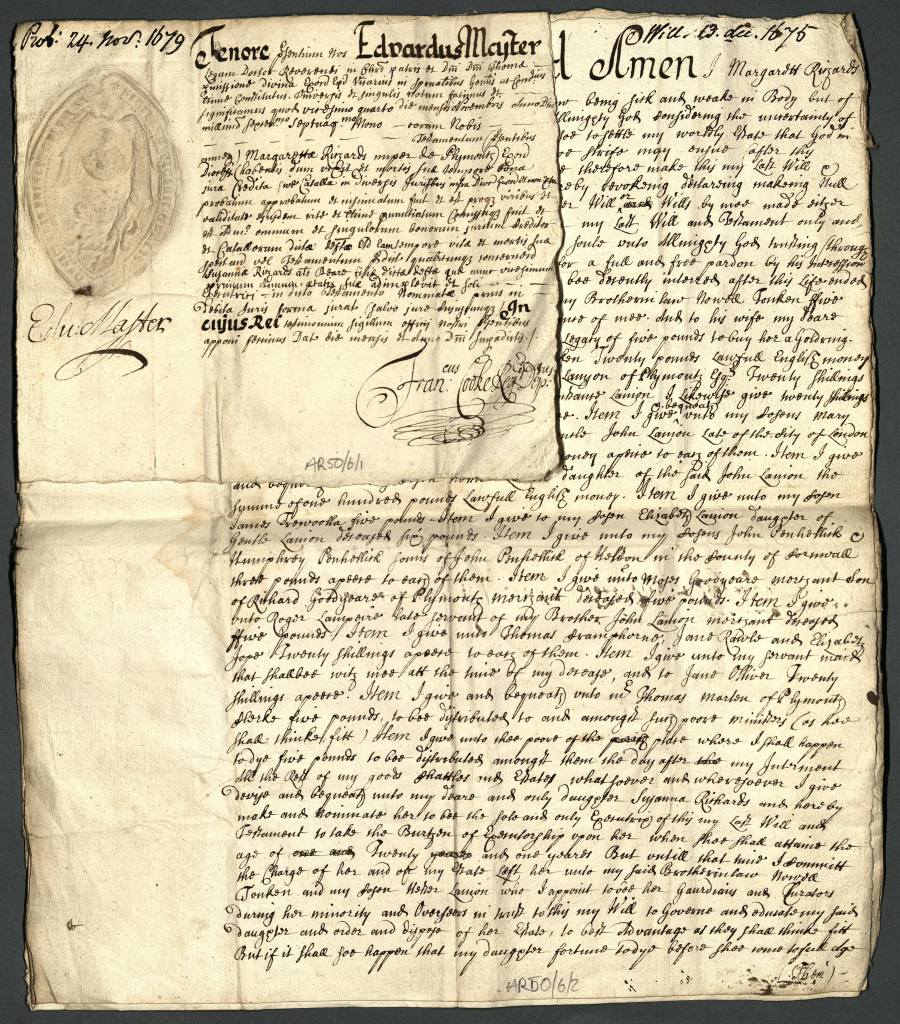
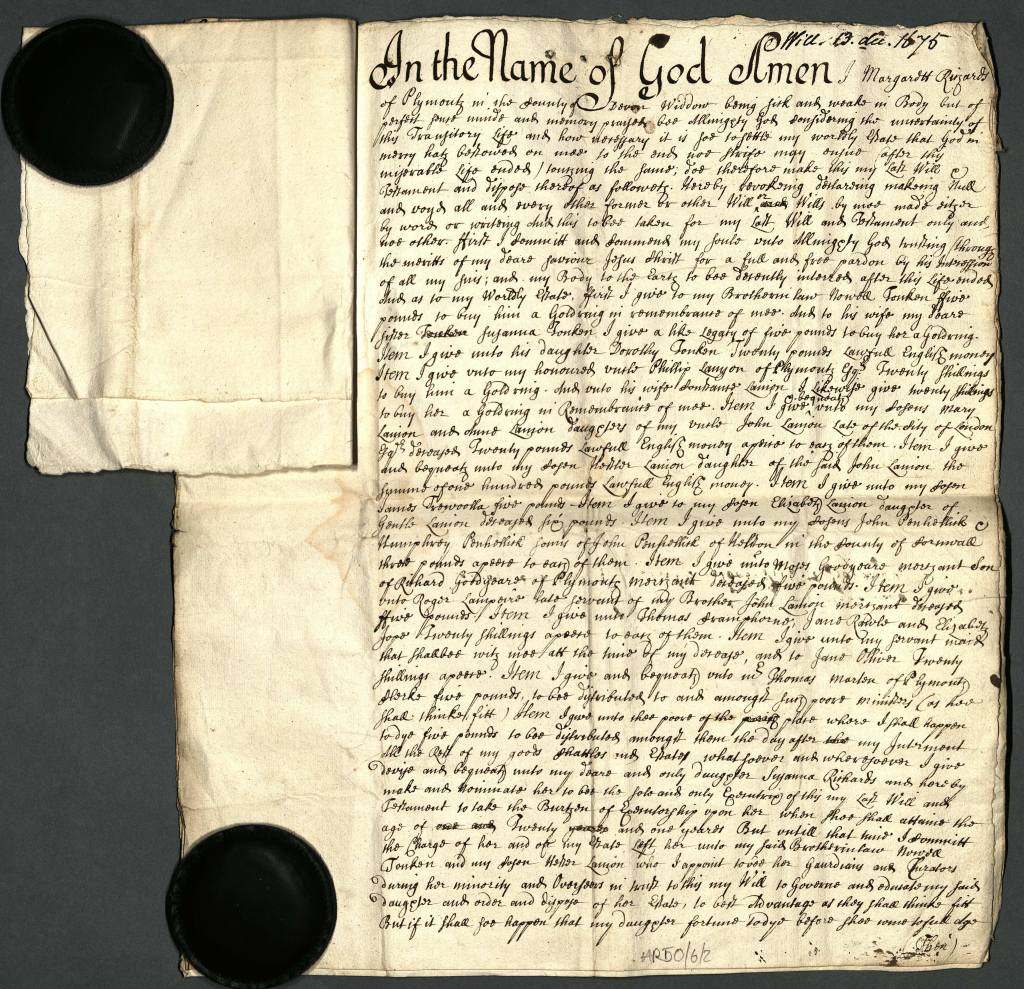
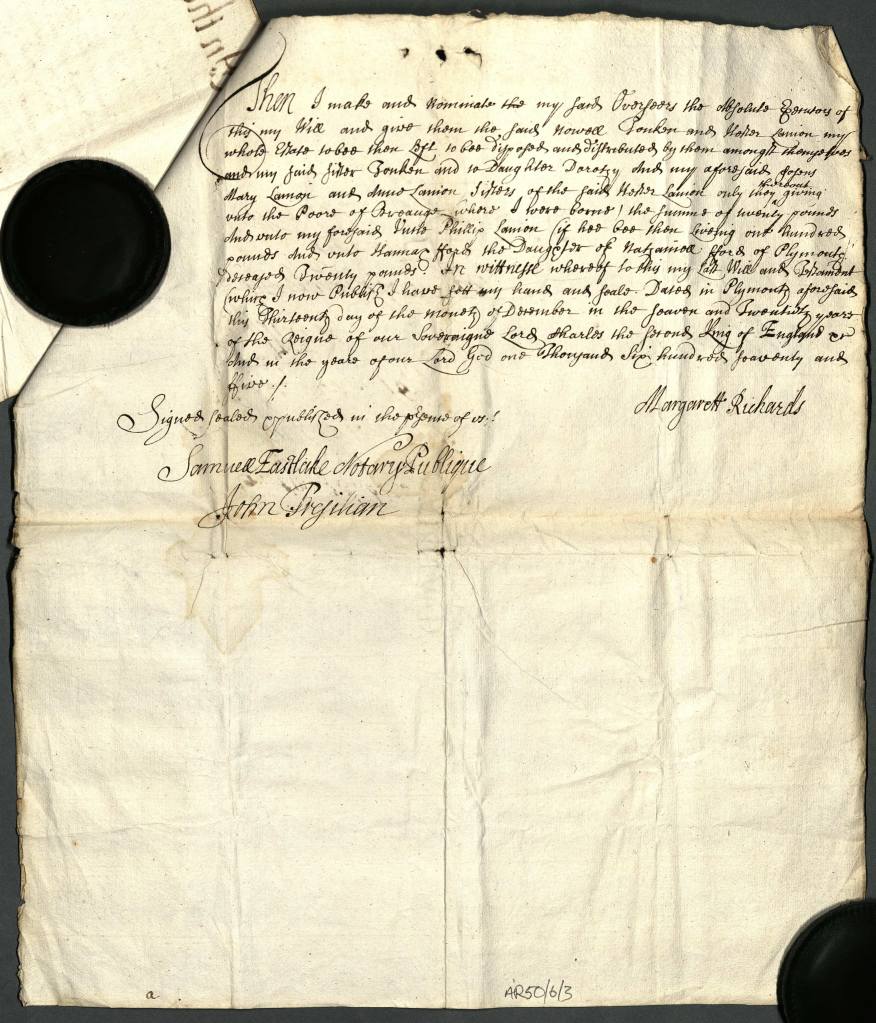
Margaret made a will in 1675 (it was proved in 1679) and her will helps confirm relationships on this very early branch of the tree.
Margaret’s will CRO AR/50/6
She is described as Margaret Richards of Plymouth, ‘widdow, being sick and weake in body but of perfect minde and memory’ and she mentions the following relatives:
My brother-in-law Nowell Tonkin £5 for a mourning ring
My sister Susannah Tonkin £5 for a ring
Their daughter Dorothy Tonkin £20
Uncle Philip Lanyon of Plymouth Esq 20 shillings for a ring
His wife Constance Lanyon 20 shillings for a ring
Mary and Anne Lanyon daughters of my Uncle John late of the City of London £20 (John was Chief Engineer to Charles I) £20 each
Hester Lanyon daughter of Uncle John £100 (again Hester is described as a cousin and not the wife of her brother John Lanyon)
Cousin James Trewollah £5
Cousin Elizabeth Lanyon daughter of George Lanyon £5
Cousin John Penhellick and Humphrey Penhellick sons of John Penhellick of Helston £3 each (not sure where they fit on the tree)
Roger Lampoire? servant of my brother John Lanyon £5
All the rest to my dear and only daughter Susannah Richards.
Nowell Tonkin and Hester Lanyon to be her guardians
Interestingly the name Lanyon is spelt two ways in this will; Lanyon and Lanion.
Until this document we had no idea that George had a daughter. Now we know he had a daughter but we’ve no idea what happened to her! So the search continues!
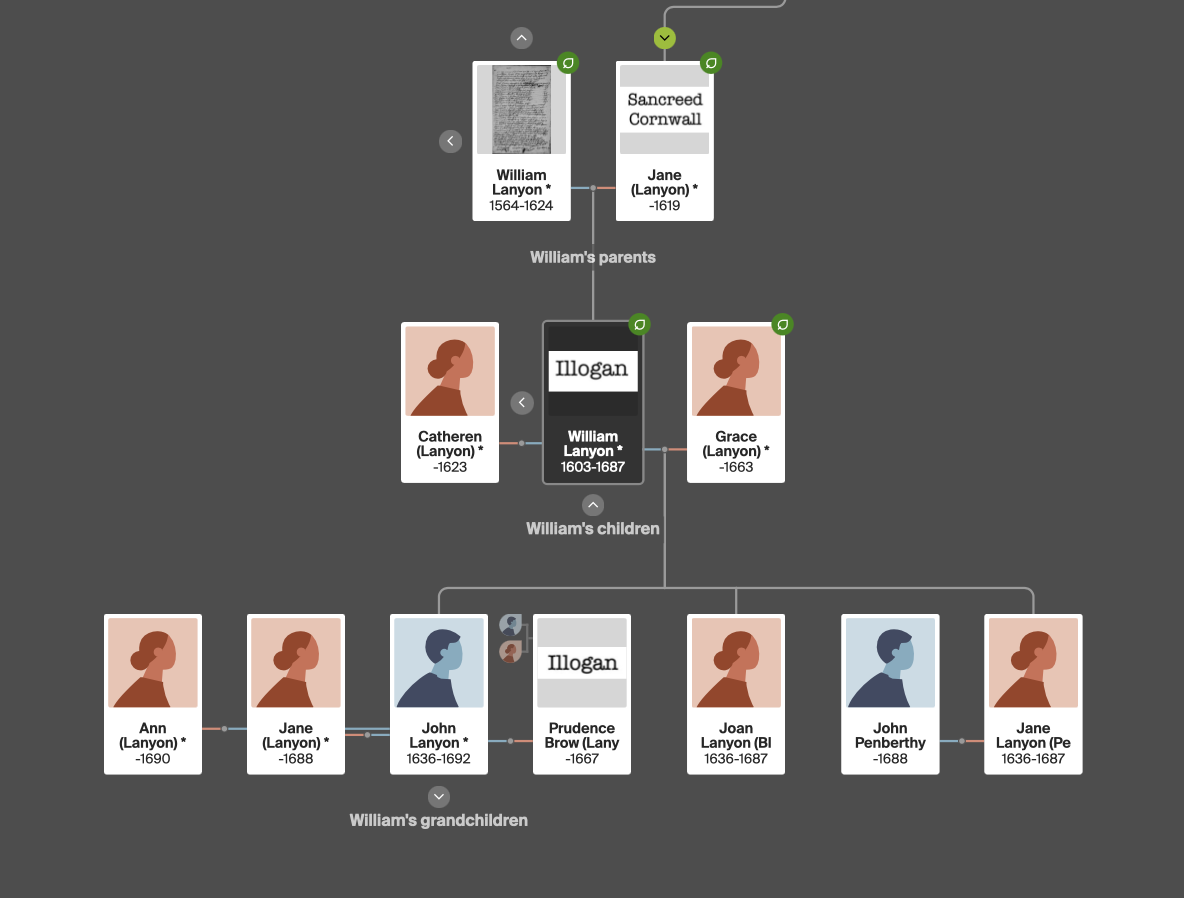
William was the son of William Lanyon and the grandson of John Lanyon Esq.
William was baptised at Sancreed in 1603. He may have had a first wife called Catheren as there was a Catheren Lanyne buried at Illogan in 1623. He married Grace (surname not recorded) at Illogan in 1636. He signed the Protestation Return on 1641/2 as William Lanyne Illogan.
William had three children who’s baptisms and burials have not been traced. Assumption is that they were all born after their parent’s marriage in 1636 and were still alive when their father’s will was proved in 1687.
John aft.1636-aft.1687 married Jane
Jane aft.1636-aft.1687 married John Penberthy – children
Joan aft.1636-aft.1687 married Bloyes, no children at the time of the will.
William’s son John Lanyon was married at least twice. His first wife was Prudence Brow and they married at Illogan in 1663. They had a daughter Grace baptised in 1665 and Prudence died in 1667. John married again to Jane, surname unknown. John had three more children but it isn’t clear if the mother was Jane or Prudence as we don’t know the dates of baptism just the dates of their burials:
William – 9 Jul 1669
Elizabeth – 27 Jun 1669
Thomas – 13 Jul 1669
It appears as though William, Elizabeth and Thomas died in an epidemic – they were buried within three weeks of one another.
There is a John Lanyon who married Ann at Illogan in 1690. Perhaps Jane died after the will and John remarried. No record of any children.
Grace baptised in 1665 married Stephen Cock at Illogan in 1683 and is mentioned in her grandfather’s will. It sounds as though she has had a child and perhaps lost it. ‘If my granddaur Grace Cock have another child in my lifetime £100 to same at 21.’
The John Lanyon of St Ives ‘my kinsman’ mentioned in William’s will is his nephew, the son of John Lanyon and Mary Ellis. William is also mentioned in Mary (Ellis) Lanyon’s will of 1676.
We don’t know much about William of Illogan but we do know he was summoned to appear at the Consistery Court of the 29 April 1663. We don’t know what the summons was for but on the 16 May he “makes humble acknowledgement of his sorrow for not appearing.” Source – letter from HL Douch, curator Royal Institution of Cornwall to WSL Lamparter. 1 Nov 1962.
With no surviving grandchildren called Lanyon this little branch of the family died out.
Paskis Lanion married Thomas Shetford at St Just in Penwith in 1625. Who was Paskis Lanion? If only the answer was straight forward!
A quick trawl through the Cornwall Online Parish Clerks database revealed no baptisms for a Paskis/Paksis/Pascha/Pasca/Paska/Paskes/Paskas Lanion/Lanyon.
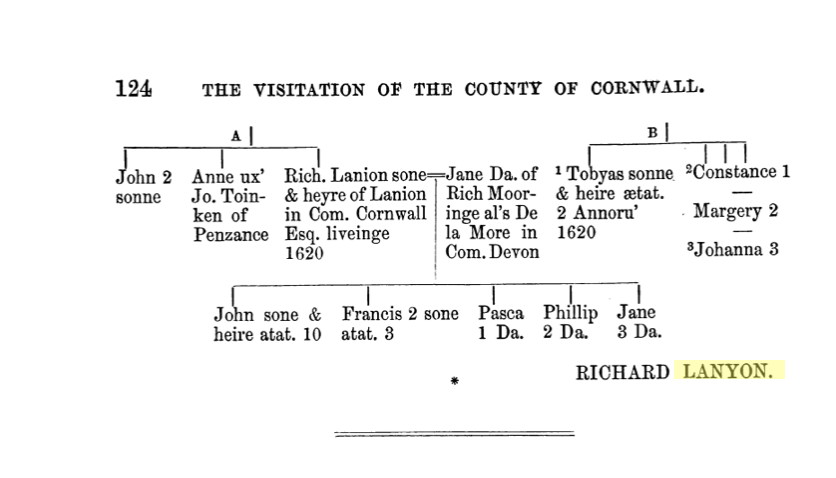
However the Heralds Visitation for Cornwall 1620 does have a suitable candidate:
Vivian’s Herald’s Visitation of Cornwall 1620
Richard Lanyon Esq submitted his tree showing that his wife was Jane Mooring alias De La More from Devon and their eldest daughter was called Pasca but was she old enough to get married in 1625?
Their eldest son was John aged 10 in 1620 so therefore born in 1610. Could Pasca be older than John? When did Richard marry Jane? The Royal Institution of Cornwall has a marriage settlement between Richard Lanyon and Jane his wife dated 1608 so presumably they married about 1608. The letter from Mrs Rose Tolman confirms that Jane’s mother was called Pascha Risdon so eldest daughter was named after her grandmother.
Francis 2nd son – deposition taken 1635 when he is aged 16 so born in about 1619
Elizabeth baptised 17 Nov 1622 St Merryn
The children with no baptisms recorded are:
Pasca eldest daughter born before 1613 when Philippa is baptised
Jane 3rd daughter born after 1613 and before 1622
Richard not listed on Herald’s Visitation so presumably born after 1620
Thomas not listed on Herald’s Visitation so presumably born after 1620
Margerie – from Richard Lanyon Esq’s will it is implied that Elizabeth and Margerie are the youngest daughters
The latest Pasca could have been born was 1613 and with John born in 1610 and two unbaptised babies born in 1611 and 1612 it looks likely that Pasca was probably born about 1608/9 which would make her about 16 years of age at the time that the marriage to Thomas Shetford took place. So she is a possible candidate.
Richard Lanyon Esq’s will of 1636 left all his daughters £30 or £40 apart from Pasca who received 5 shillings which implies that in 1636 she was already married and had received her ‘portion’. Sadly the will does not mention her married name.
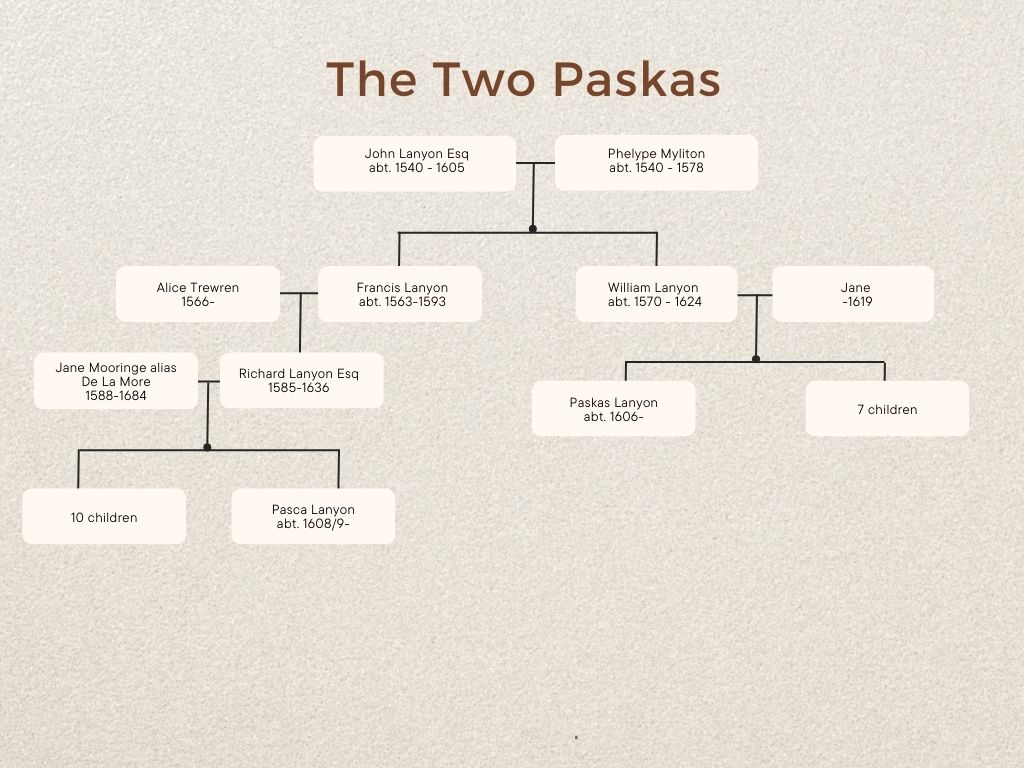
The only problem is that there is a second Paskas who is also a candidate.
Richard Lanyon Esq’s uncle William has a daughter also called Paskas.
William’s daughter’s baptism isn’t recorded but we know she existed from his will. Again we’ll have to list his other children and see where she could fit in:
Elizabeth baptised 31 Oct 1593 Sancreed
John baptised 8 Jun 1596 and buried 15 Sep 1601 at Sancreed
John born after Sep 1601
Jane baptised 24 Oct 1602 Sancreed
William baptised Dec 1603 Sancreed
Elyzabethe baptised 17 Jul 1607 Sancreed
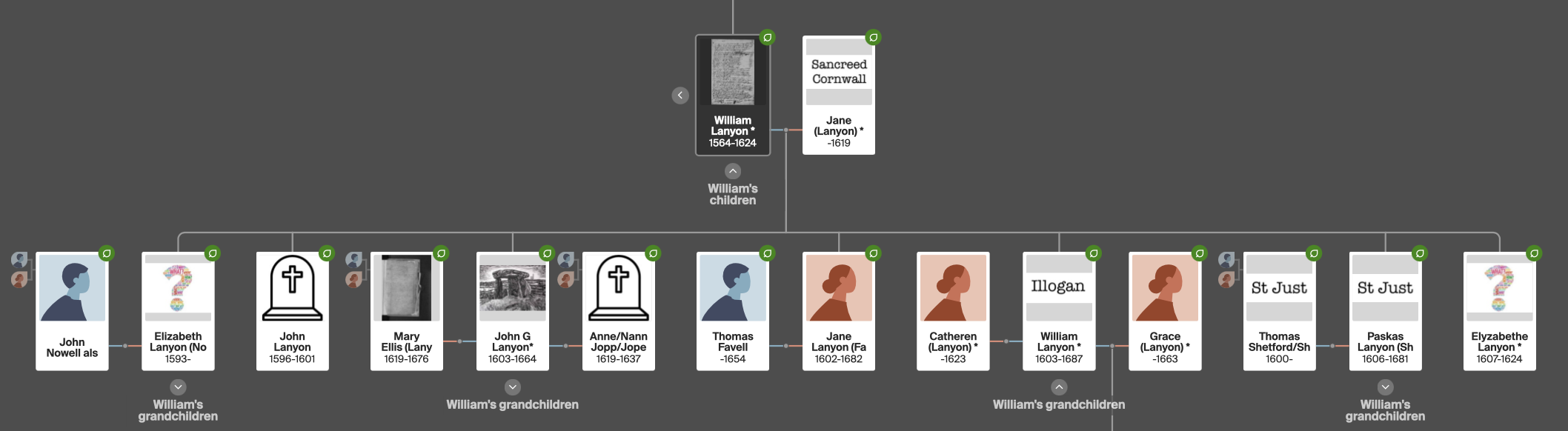
Both daughters called Elizabeth survived and are mentioned in William’s will of 1624!
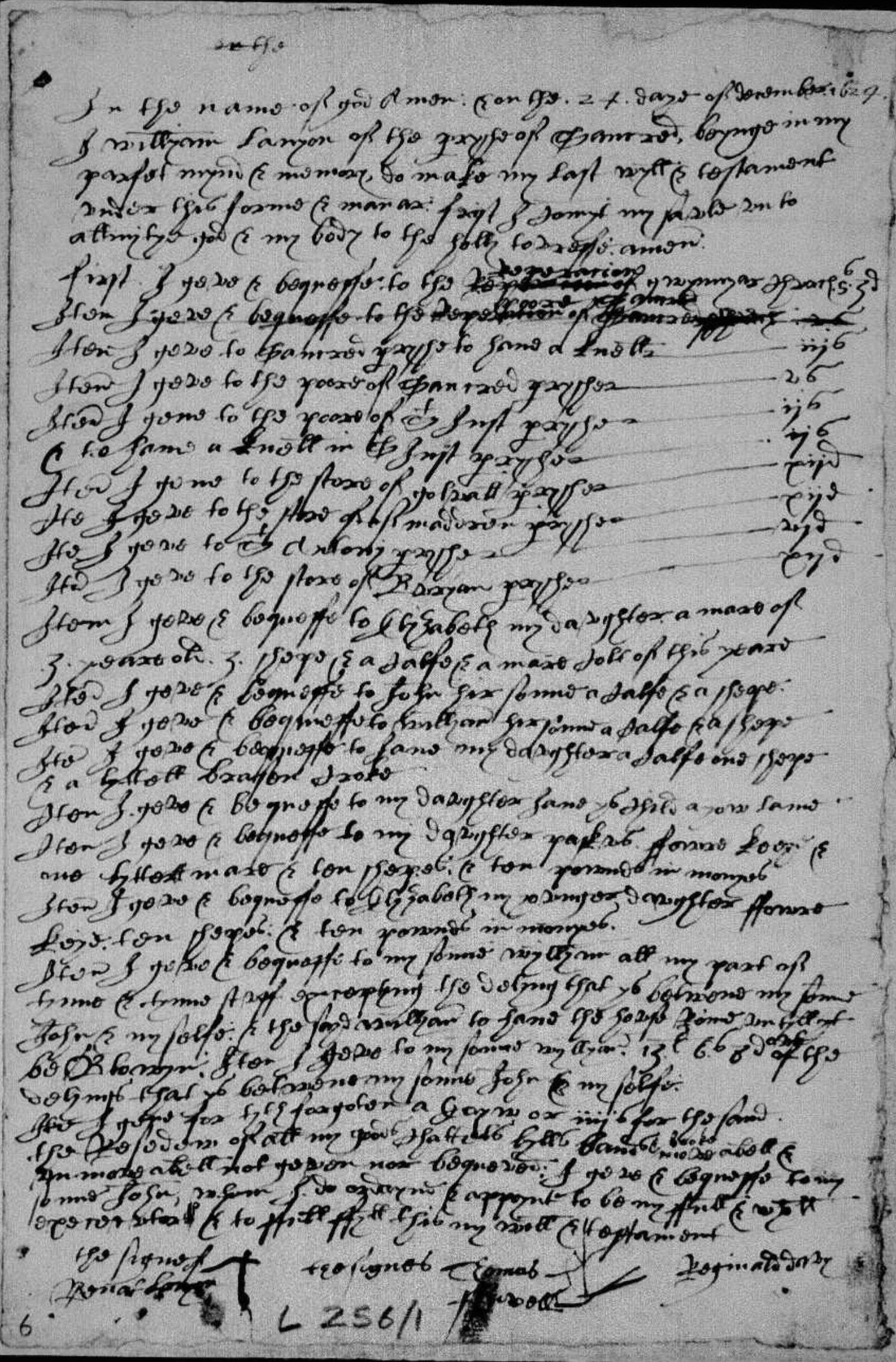
William’s Will of 1624 – Source CRO AP/L/256
Abstract:-
WILLIAM LANYON of Sancreed written: 24 Dec 1624 proved: 8 Feb 1624/5
poor of Sancreed – 3 sh. poor of St. Just – 5 sh. poor of Gulval – 12 d. poor of Maddern – 12 d. poor of Antony – 12 d. poor of Buryan – 12 d. daughter: ELIZABETH – mare, 3 sheep, calf, mare colt JOHN her son – calf & a sheep WILLIAM her son – calf & a sheep daughter: JANE – calf, 1 sheep, brazen crock daughter JANE’s child – a ewe lamb daughter: PASKAS – 4 kyne, mare, 10 sheep, 10 pounds youngest daughter: ELIZABETH – 4 kyne, 10 sheep, 10 pounds son: WILLIAM – all my part of tin and tin stuff, 13 pounds, 6 sh., 3 d. son: JOHN – all the rest & executor
The will implies that Paskas is younger than Jane and older than Elizabeth his youngest daughter which suggests that she was born between 1602 and 1607. So aged about 18-23 in 1625 when the marriage to Thomas Shetford took place.
It’s interesting that William leaves 5 shillings to the poor of St Just as that’s the town that Thomas Shetford comes from.
Who was Thomas Shetford?
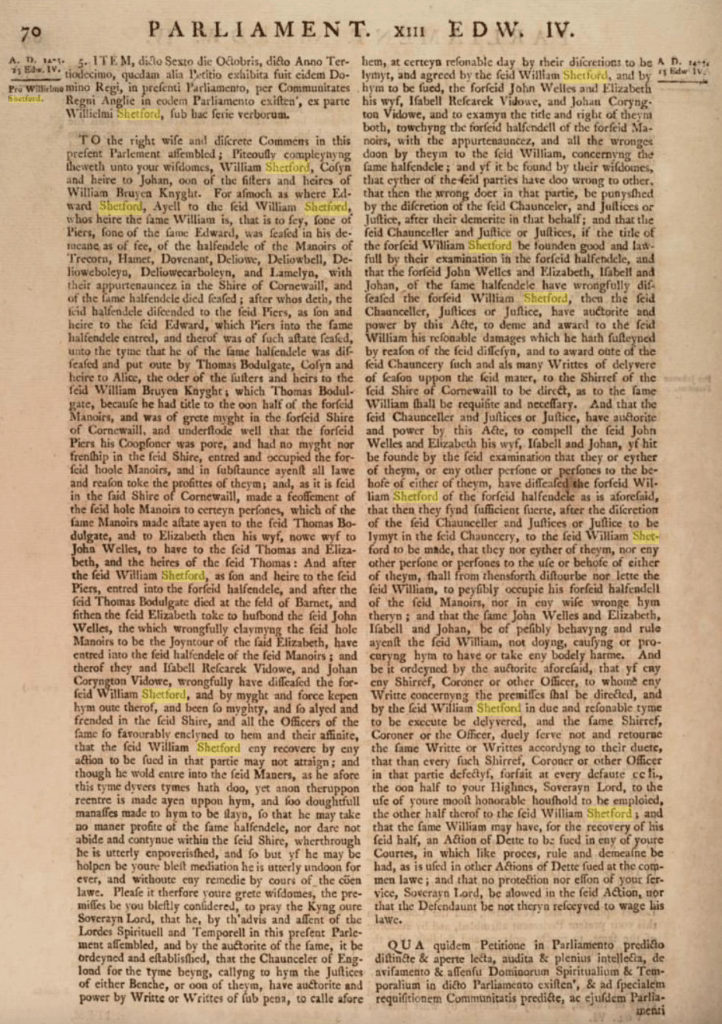
The Shetford/Shutford (and occasionally Shitford!) family originally came from Somerset. They were cheated out of a half share in six manors in Cornwall by Sir Thomas Bodulgate during the Wars of the Roses.
Source – History of Parliament Edward IV
We know very little about Thomas, the parish registers for St Just in Penwith start quite late but with the little we know we can create a tree that might be correct.
We know that Paskis Lanion married Thomas Shetford at St Just in Penwith in 1625 so he was probably born about 1600
There is a baptism for a Margarett Shetfod (Sic) daughter of Thomas on 14 Nov 1630 at St Just listed in the Exeter Bishop’s Transcripts
16 Oct 1647 marriage at St Just between Elizabeth Shetford (daughter of Thomas) and John Rawlyn (Source – OPC)
Baptism of Alse Shutford, daughter of Thomas 20 Dec 1633 St Just (Source- FHL film number 0226217, 0226218, 962681)
Burial of Paskes Shetford, widow 19 Dec 1681/2 St Just in Penwith (Source – OPC)
The will of Joan Lanyon (Shutford) 1655 (Source – NA PROB 11/257/72) Joan was the wife of David Lanyon of Madron and her will mentions her Shutford relatives
There is also a record at Kresen Kernow (The Cornish Record Office) which mentions Thomas and William Shilford.
Lease, tenement, Treloweth Wartha, Illogan
Parties:
1) Right Honourable John Lord Robartes, Baron of Truro.
Term: 99 years, or the natural lives of [?] Lanyon, John Lanyon his brother and William Shilford, son of Thomas Shilford.
Annual rent: 46 shillings 8 pence, one capon or 12 pence, a harvest day or 6 pence.
Heriot: Best beast or £3.
Reference number
CL/1/124
Date
3 Oct 1635
I think it should be William and Thomas Shitford/Shetford rather than Shilford. Could Thomas have a son called William and could these Lanyons be Paskas’ brothers?
The Paskas born in Sancreed had brothers called John and William. ‘William Lanyon Yeoman of St Just’ listed in the lease is definitely not the St Merryn family of Lanyons.
There is a marriage of a William Shetford and Mary Edward at St Just on 26 Nov 1653, they had two daughters: Rebecea (sic) bapt. 1655 and Ellizabeth (sic) bapt. 1657.
There is a legal dispute between John Lanyon and William Shutford in 1659, the year Thomas Shutford died. Source – NA C 10/48/84
Lanyon v Shutford.
Plaintiffs: John Lanyon. Defendants: William Shutford, James Pratt and Robert Baynard. Subject: property in Sancreed, Cornwall.
This is the hypothetical tree I’ve created from all those snippets of information.
We still haven’t conclusively answered the question which Paskis Lanion married Thomas Shutford in 1625 but I think the Paskas born to William Lanyon of Sancreed is the more likely candidate.
William Lanyon died in 1624 (his wife had died in 1619) and left Paskas £10 and some cattle. The following year she married Thomas from the neighbouring parish of St Just in Penwith.
Ultimately geography may be the best clue, the distance between St Just and Sancreed (near Penzance) is a lot smaller than the distance between St Just and St Merryn (near Padstow).
With thanks to Louise Quigley who first posed this question in 2014 and the Penwith Genealogy Group who produced some great answers and evidence.
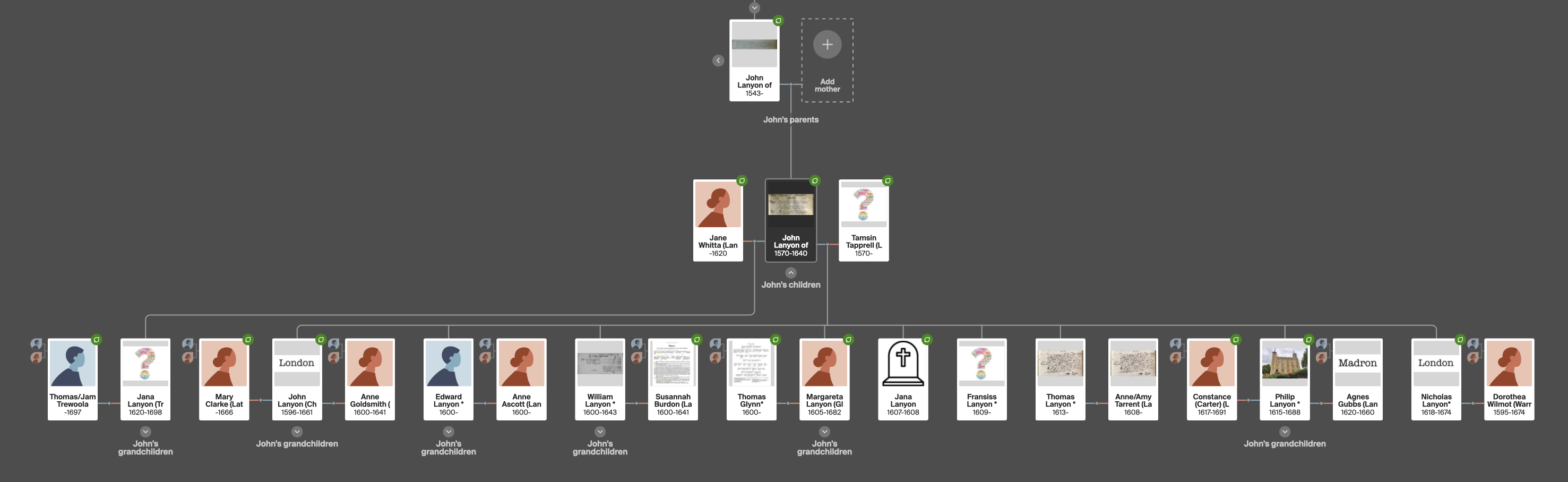
Philip Lanyon was the fifth son of John Lanyon and Tamsin Tapprell of Breage.
Philip was baptised at Breage in 1615.
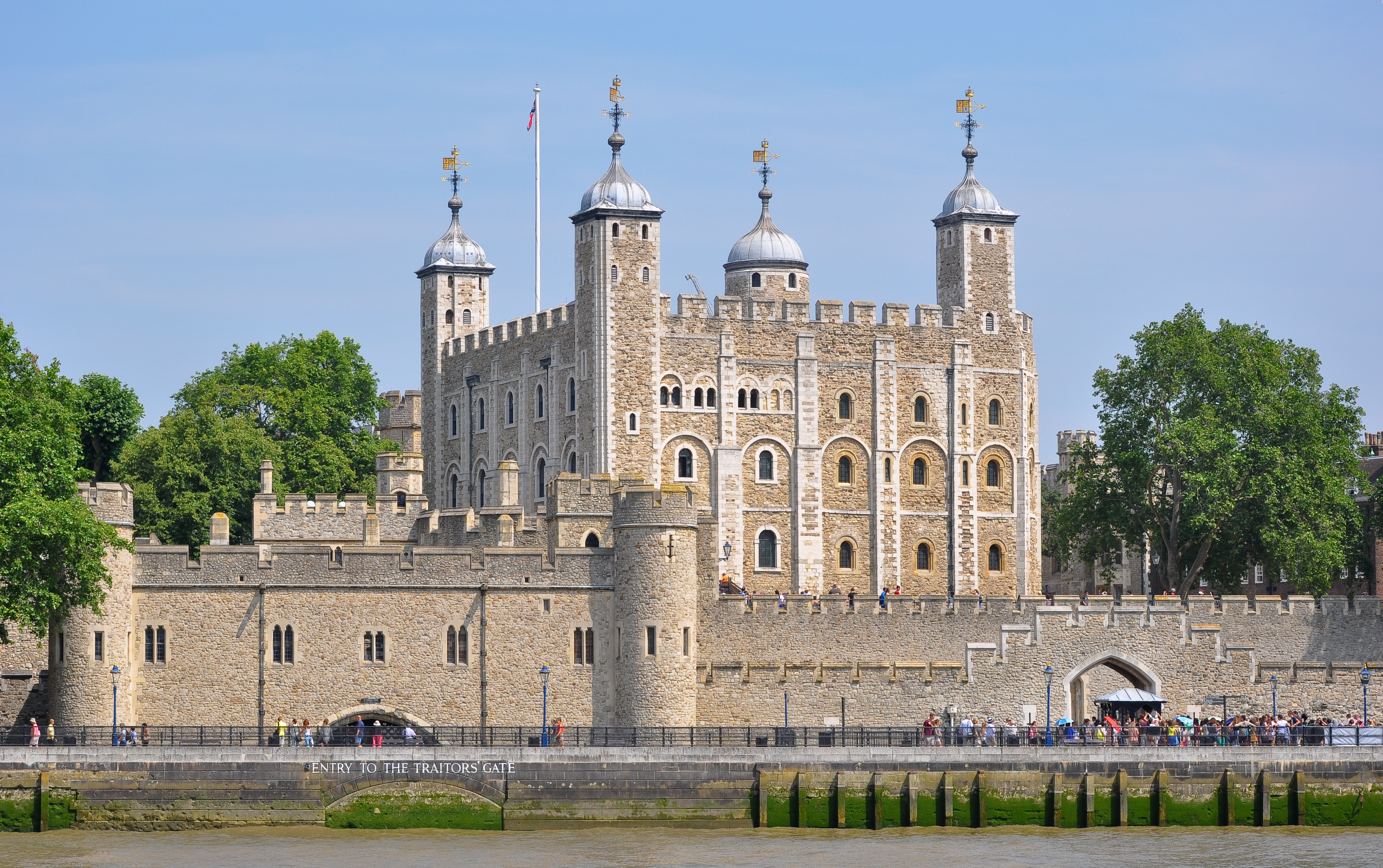
On 29 Feb 1640 he was given a grant of a gunners room in the Tower of London. Fee 6d per diem during pleasure to commence from the death of Nicholas Congon.
Philip signed the Protestation Return of 1641/2 at Penzance and between 1641-1660 he was in partnership with Anthony Gubbs a wholesale merchant in wood and iron. Anthony Gubbs was elected alderman and Mayor of Penzance.
In 1641 (the transcription says 1644 but that is after the baptism of the first child) Philip married Agnes Gubbs, Anthony’s daughter at Madron/Penzance. They had three sons:
Anthony 1641-1649 died young
Philip -1648 died young
Anthony aft. 1649-1680 he was a soldier and died at Tangier in North Africa. Administration of his estate was granted to his father “All to Philip Lanyon, father”.
Tangier 1680 – Hendrick Danckerts, Public domain, via Wikimedia Commons
In 1647 Philip Lanion was an alderman of Penzance.
During the Civil War he was adjutant and captain of the King’s Forces in Cornwall. The land from Lizard Town to St Michael’s Mount held for King Charles I. Lords Goring and Hopton’s horse troops (supporters of the Crown) were driven to Penzance by Parliamentary forces and were welcomed by the town. In revenge two days later Sir Thomas Fairfax’s Parliamentary forces sacked the town in 1648. Philip was plundered of £1000 his estate sequestered and he was imprisoned.
In an appendix to Mary Coate’s ‘Cornwall in the Great Civil War and Interregnum, 1642-1660’ she gives a list of Royalist Commanders in the County of Cornwall in Jan 1646/7 and among the list is Philip Lanyon of Penzance, gent. Fined £10. 16/- 8d. (This was one of the lightest fines which ranged from £10,000 to £3. 6/- 8d. So apparently Philip Lanyon was not the most ardent of Royalists!)
At the Restoration, he petitioned Charles II for what seems to have been the office of supervisor of workmen at all castles and forts throughout the kingdom, but it does not appear that he was successful.
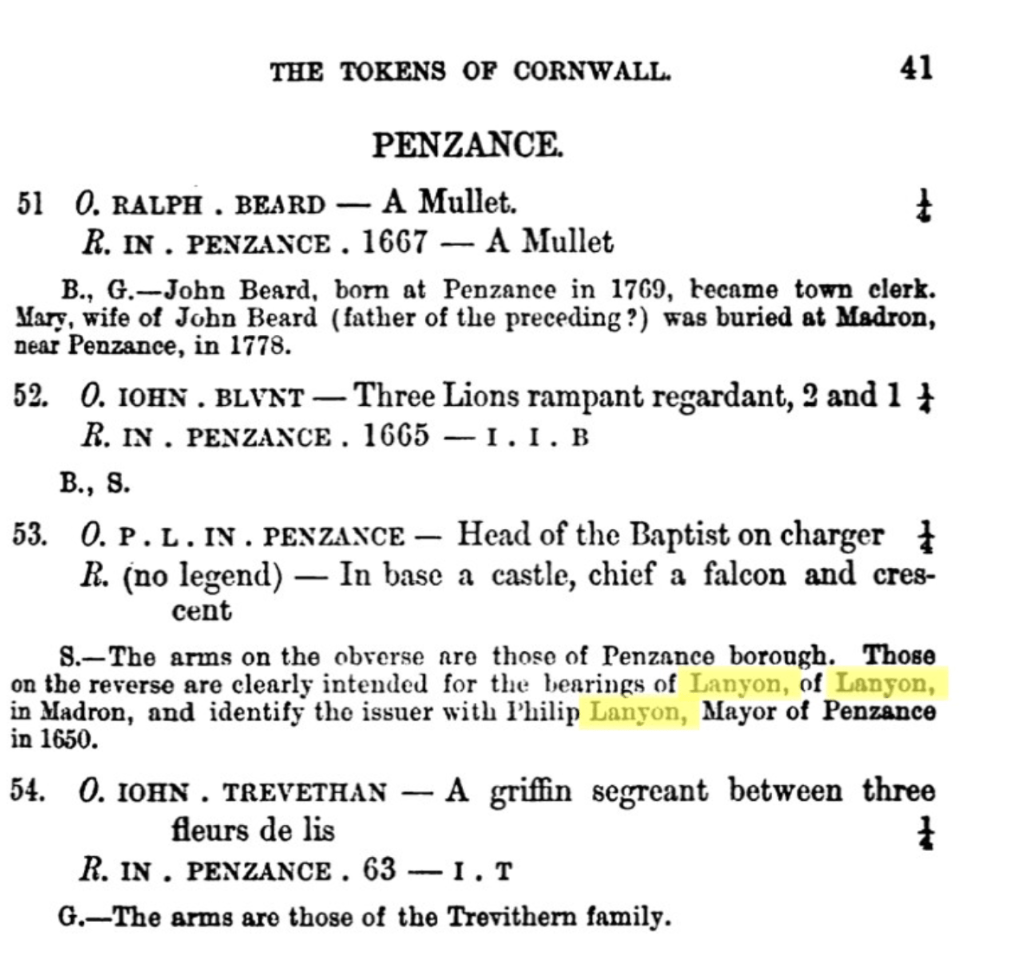
He was Mayor of Penzance in 1650 and he issued a token in Penzance with the arms of the borough on one side and those of Lanyon on the other. There are five known tokens issued by the town between 1663-7. The names of the other merchants whose names appear on these little coins are:- John Trevethan, Anthony Gubbs, John Blunt and Ralph Beard. (Source- ‘Penzance Past and Present’ – West Penwith Resources.)
In 1659 Philip Lanyon was the guardian of a child and administered the estate of William Tonkin of Penzance. In 1689 a legal case Lanyon V. Tonkyn at Plymouth, Devon. A dispute about an inheritance! (Source- NA C8/518/21)
In 1662 Philip married to Constance Carter a widow. No children of this marriage.
In 1667 there was a warrant from the Commissioner of Prizes to Lord Ashley to pay £200 to Philip Lanyon Deputy Treasurer and Commissioner of Prizes at Plymouth. (Source – British Museum Addt MSS, 5752, fol, 164.)
In the 1670s there are many letters listed in Charles II State Papers from Capt. Philip Lanion regarding ships coming and going from Plymouth letters sealed with the Madron arms in black wax.
Charles II – Dulwich Picture Gallery, Public domain, via Wikimedia Commons
In Jul 1671 The King visited Plymouth. The Governor of Plymouth, the Earl of Bath, asked Capt. Philip Lanion if he would allow the Earl to keep a table in the hall of his house and entertain daily for him, the Duke of York, the Duke of Monmouth, the Marquess of Blanquefort and many other nobles.
In his later years Philip was involved in numerous legal disputes.
1657 Court of Chancery – Six Clerks Office NA C/10/55/110 Lanyon v Lanyon. Plaintiffs: Richard Lanyon. Defendants: Elizabeth Lanyon and Philip Lanyon. Subject: property in St Merryn, Cornwall. Document type: bill and two answers.
1661 Court of Chancery – Six Clerks Office NA C7/456/8 Lanyon v Lobb. Plaintiffs: Richard Lanyon. Defendants: Philip Lanyon, [unknown] Lobb and others. Place or subject: money, Cornwall.
1662 Court of Chancery – Six Clerks Office NA C/6/77/96 Lanyon v Hall. Plaintiffs: Philip Lanyon and Constance Lanyon his wife. Defendants: John Hall. Subject: money matters, Devon.
1666 Court of Chancery – Six Clerks Office NA C5/513/100 Lanyon v Eastwicke. Plaintiffs: Philip Lanyon and another. Defendants: Adrian Eastwicke and another. Subject: money matters, Devon.
1666 Court of Chancery – Six Clerks Office NA C/10/82/71 Lanyon v Spernon. Plaintiffs: Philip Lanyon. Defendants: William Spernon. Subject: money matters, Devon.
1667 Court of Chancery – Six Clerks Office NA C7/474/74 Lanyon v Goodall. Plaintiffs: Philip Lanyon. Defendants: John Goodall. Place or subject: money, Devon.
1671 Court of Chancery – Six Clerks Office NA C/5/459/100 Cary v Lanyon. Plaintiffs: Robert Cary. Defendants: Philip Lanyon and Constance Lanyon his wife. Subject: property in Plymouth, Devon.
1674 Chancery: Master Brougham’s Exhibits NA C111/221 PEIRSON v SAWLE: Agreement with bond between Philip Lanyon, Margaret Richards and Hester Lanyon, all of Plymouth, Devon, concerning the estate of John Lanyon of Plymouth, deceased.
1674 Court of Chancery – Six Clerks Office NA C8/188/43 Lanyon v Amy. Plaintiffs: Philip Lanyon. Defendants: William Amy and Thomas Wills. Subject: property in Tintagel, Cornwall.
1675 Court of Chancery – Six Clerks Office NA C6/217/2 Barton v Lanyon. Plaintiffs: Isaac Barton. Defendants: Philip Lanyon. Subject: money matters.
1675 Court of Chancery – Six Clerks Office NA C5/513/101 Lanyon v Barton. Plaintiffs: Philip Lanyon and others. Defendants: Isaac Barton. Subject: money matters.
1676 Court of Chancery – Six Clerks Office NA C8/329/126 Lanyon v Buckham. Plaintiffs: Philip Lanyon and Hester Lanyon. Defendants: John Buckham. Subject: property in Plymouth, Devon.
1678 Court of Chancery – Six Clerks Office NA C/8/297/157 Yeabsly v Lanyon. Plaintiffs: Thomas Yeabsly. Defendants: Philip Lanyon, Thomas Young, Hester Young his wife, William Addis and Thomasine Yeabsly, widow. Subject: money, Devon.
1678 Court of Chancery – Six Clerks Office NA C7/558/33 Lanyon v Young. Plaintiffs: Philip Lanyon. Defendants: Thomas Young, [unknown] Beere and others. Place or subject: money, Devon.
1679 Court of Chancery – Six Clerks Office NA C10/204/98 Trewolla v Lanyon. Plaintiffs: Mary Trewolla. Defendants: Philip Lanyon, Thomas Younge, Hester Younge his wife, George Bere, Susannah Bere his wife and Nowell Tonken. Subject: personal estate of John Lanyon, Plymouth, Devon.
1679 Court of Chancery – Six Clerks Office NA C8/297/99 Mayor of Totnes v Lanyon. Plaintiffs: Mayor etc of Totnes. Defendants: Philip Lanyon, Thomas Younge, Hester Younge his wife and Margaret Richards. Subject: charitable bequest under will of John Lanyon, Totnes, Devon.
1679 Court of Chancery – Six Clerks Office NA C7/574/111 Younge v Lanyon. Plaintiffs: Thomas Younge. Defendants: Philip Lanyon and another. Place or subject: property in Breage, Saltash, Cornwall etc.
1680 Court of Chancery – Six Clerks Office NA C7/576/6 Ford v Lanyon. Plaintiffs: Philip Ford and others. Defendants: Philip Lanyon, [unknown] Addis and others. Place or subject: money, Devon.
1682 Court of Chancery – Six Clerks Office NA C7/589/29 Lanyon v Rashleigh. Plaintiffs: Philip Lanyon and others. Defendants: Jonathan Rashleigh and others. Place or subject: property in Calstock, Cornwall.
1683 Court of Chancery – Six Clerks Office NA C7/575/54 Lanyon v Carkett. Plaintiffs: Philip Lanyon. Defendants: Thomas Young, [unknown] Carkett and others. Place or subject: money, Devon.
1685 Court of Chancery – Six Clerks Office NA C7/117/48 Ford v Lanyon. Plaintiffs: Philip Ford and Philip Ford. Defendants: Philip Lanyon and others. Place or subject: property in Plymouth, Devon.
1686 Court of Chancery – Six Clerks Office NA C5/171/22 Lanyon v Johnson. Plaintiffs: Philip Lanyon. Defendants: Elizabeth Johnson and others. Subject: property in Plymouth, Devon.
1686 Court of Chancery – Six Clerks Office NA C7/573/92 Lanyon v Eastlake. Plaintiffs: Philip Lanyon. Defendants: John Johnson, [unknown] Eastlake and others. Place or subject: estate of Tobias Wiseman, Plymouth, Devon.
1686 Court of Chancery – Six Clerks Office NA C7/573/67 Ford v Young. Plaintiffs: Philip Ford. Defendants: Philip Lanyon, [unknown] Young and others. Place or subject: money, Devon.
1688 Court of Chancery – Six Clerks Office NA C/7/594/71 Lanyon v Eastlake. Plaintiffs: Constance Lanyon, widow and executrix of Philip Lanyon late of Plymouth Devon, esq deceased. Defendants: John Johnson and Elizabeth Johnson his wife, Samuel Eastlake and Rebecca Wiseman. Place or subject: money, Devon.
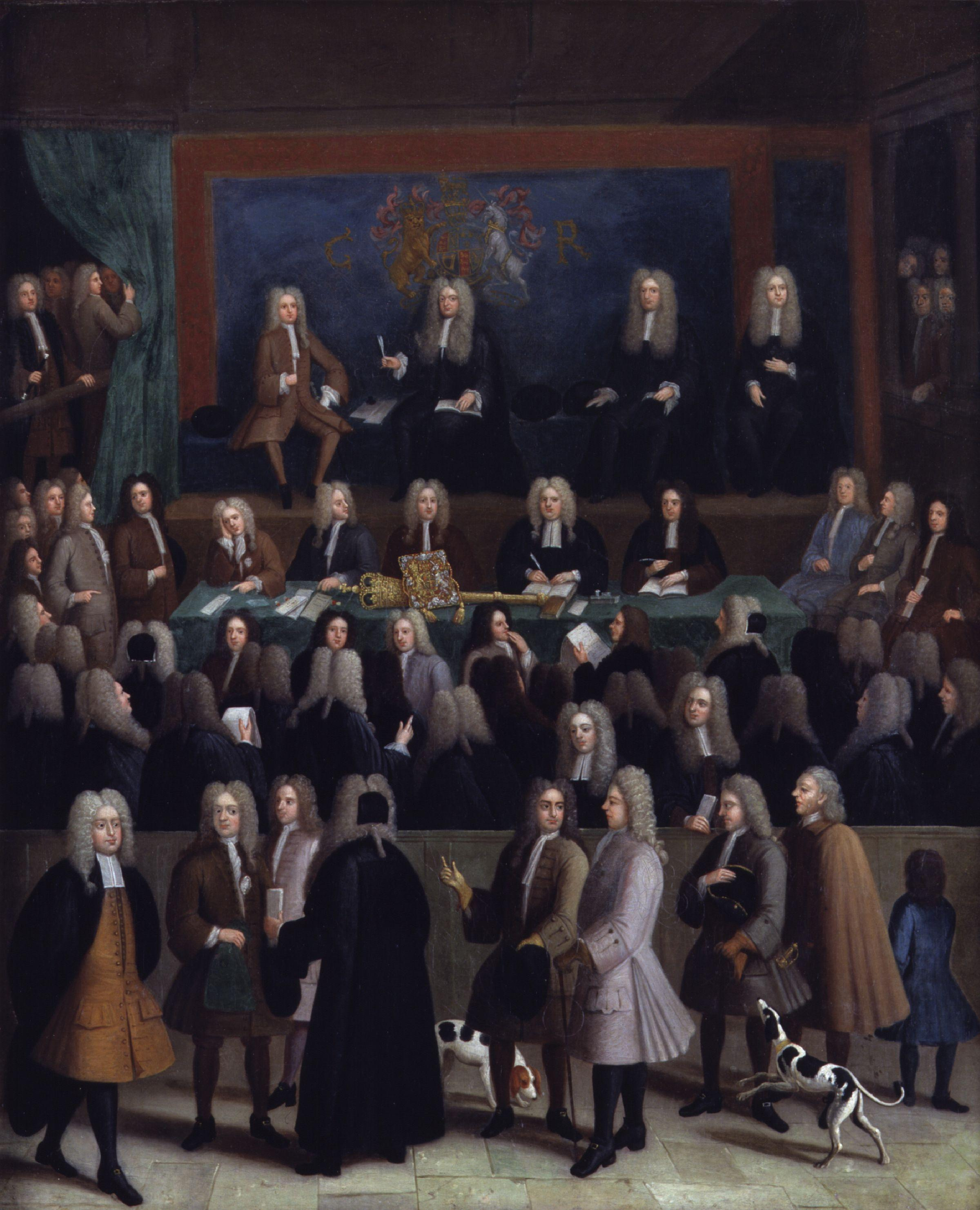
Wow! Wonder what they thought in Court of Chancery – Six Clerks Office every time they saw Philip Lanyon’s name?
Court of Chancery – National Portrait Gallery, Public domain, via Wikimedia Commons
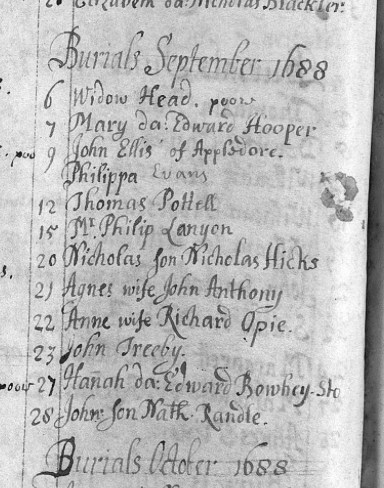
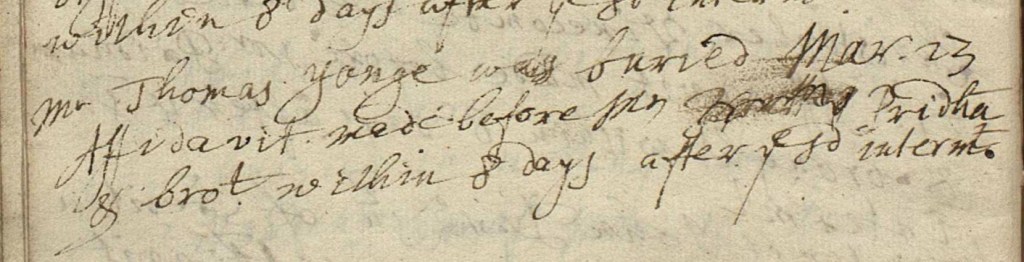
Philip died in Plymouth in 1688 and his widow Constance continued the litigation!
Plymouth St Andrew Parish Register
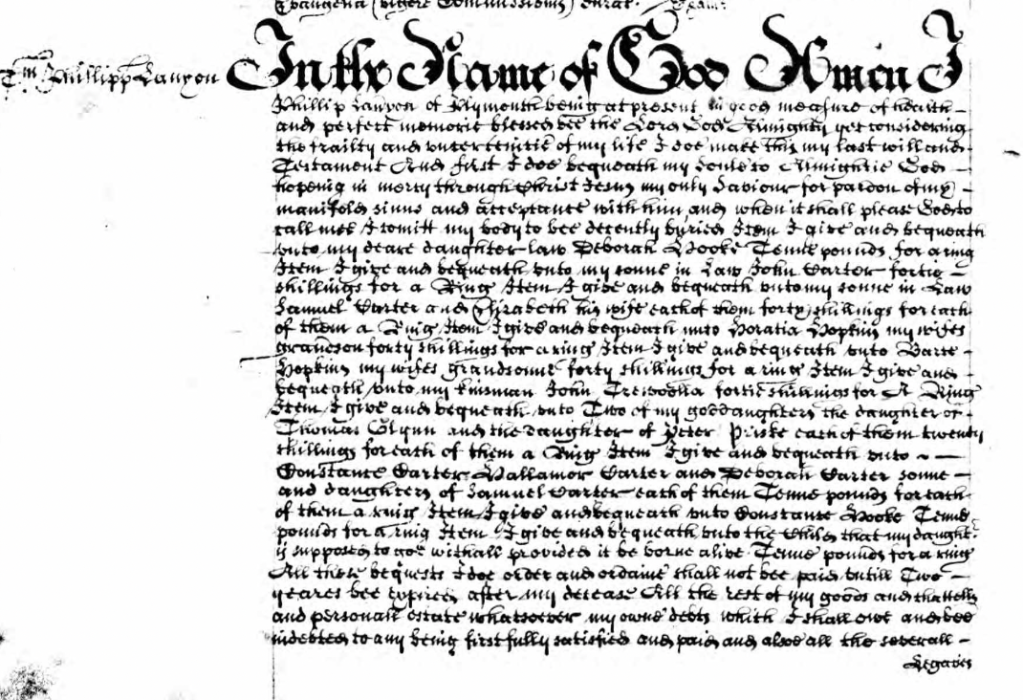
Philip left a will which named his kinsman John Trewolla, his two god daughters, daughters of Thomas Glynn and his wife Constance. He also mentions Constance’s children Samuel, John, Deborah (Hook) and Ann (Hopkins).
Will of Philip Lanyon 1688 – NA PROB 11-393-119
Without any surviving heirs this little branch of the family died out.
William was the second documented son of John Lanyon of Breage and Tamsin Tapprell.
William was baptised at Breage in Aug 1600. In Oct 1618 he married Susannah Burdon at Breage. We know very little about William; he signed the Protestation Return of 1641/2 for Breage and apart from baptising his children the only other record we have of him is his will of 1643. He must have been a farmer as his will values the corn and the corn in the ground.
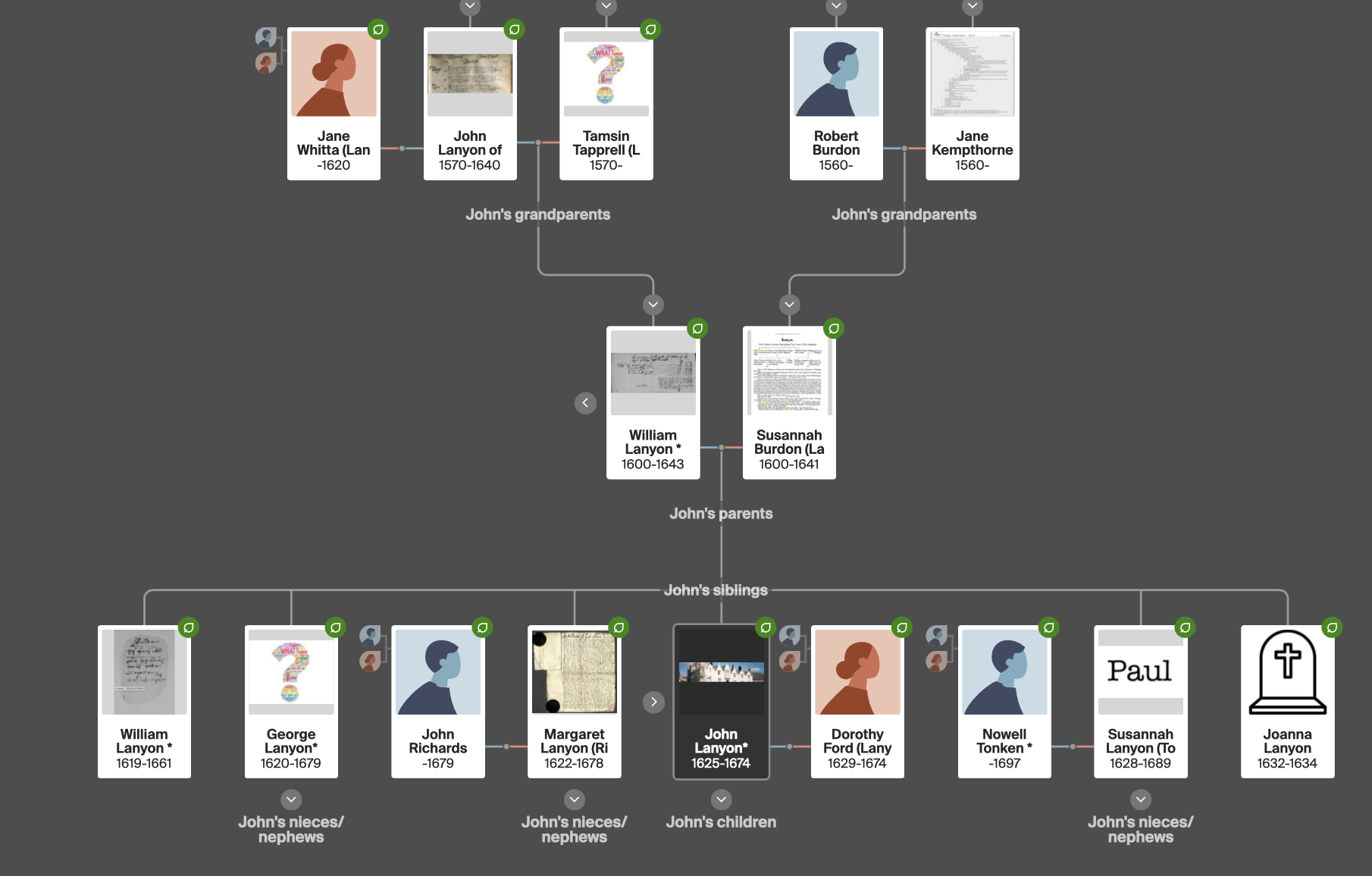
William & Susannah’s tree
His children:
William 1619-1661 William was the eldest son and heir, he never married and when he died he left everything to his sister Margaret Richards
Will of William Lanyon 1661 Source – CRO/AP/L/546
George 1620-aft.1643 He is mentioned in his father’s will of 1643 so must have been alive then but no trace of him after that. No mention of him in his brothers’ wills of 1661 and 1674. His sister Margaret’s will mentions his daughter Elizabeth.
Margaret 1622-1679 she married John Richards and had at least one child Susannah Richards who was baptised in 1655. Her brother William left all his estate to her and brother John left her the huge sum of £1000 in his will, she was buried at St Columb Minor on 20 Jan 1686. Susannah Richards married George Beare, gent of St Ervan in 1676. In 1680 there is a Bill of Complaint between George Beare the younger, Susannah his wife defendants complaint of Philip Lanion Esq, Thomas Yonge gent and Hester his wife. (Source- CRO AR/17/127)
John 1625-1674
Susannah 1628-1689 she married Nowell Tonken, a merchant of Newlyn, in Nov 1664 at Paul, Cornwall. They had two children: Dorothy and Susannah.
Joanna 1632-1634 died in infancy
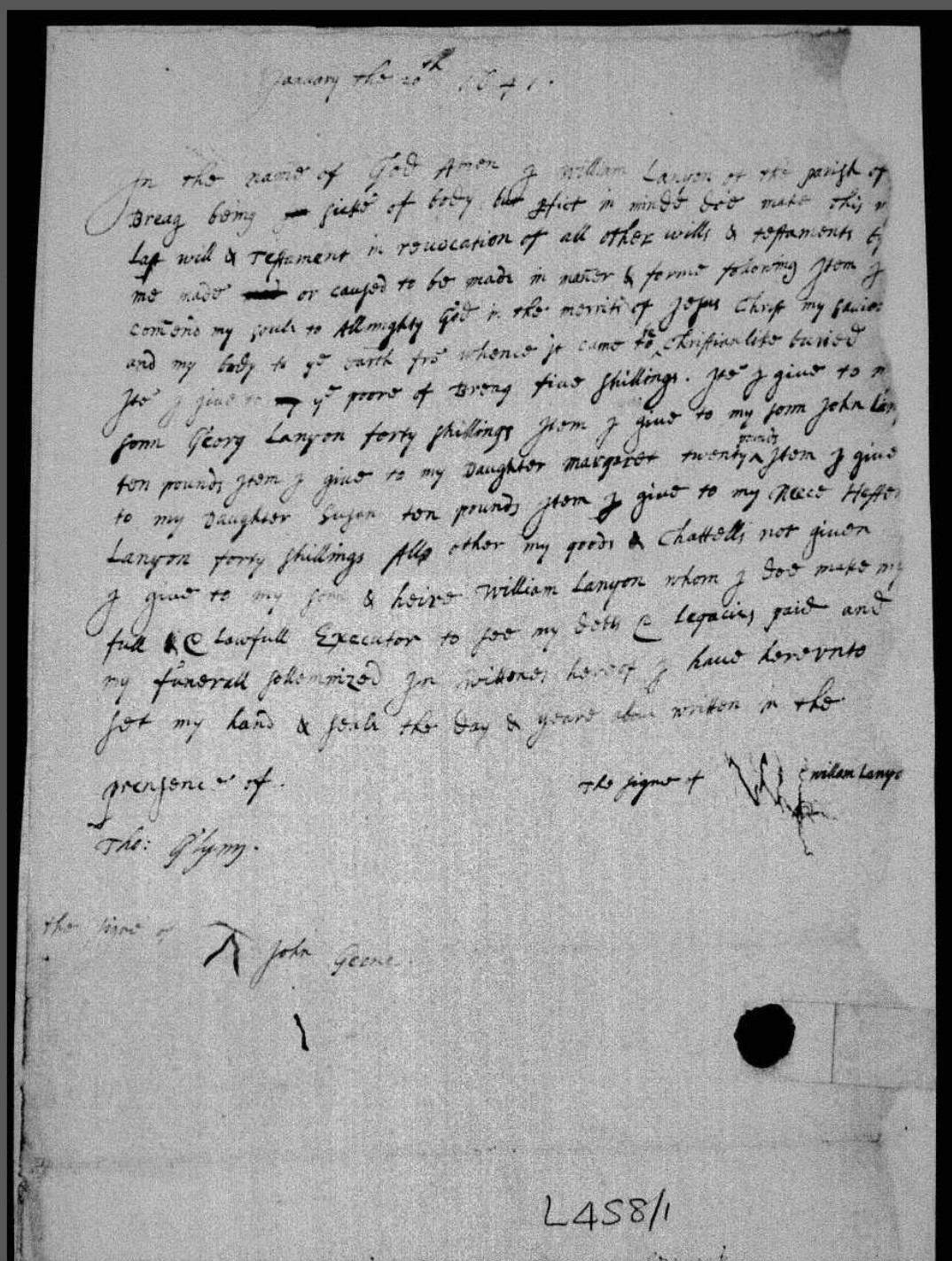
William senior died in 1643.
William Lanyon’s will of 1643 – Source CRO AP/L/458
There is no mention of his wife Susannah so presumably she predeceased him. He leaves:
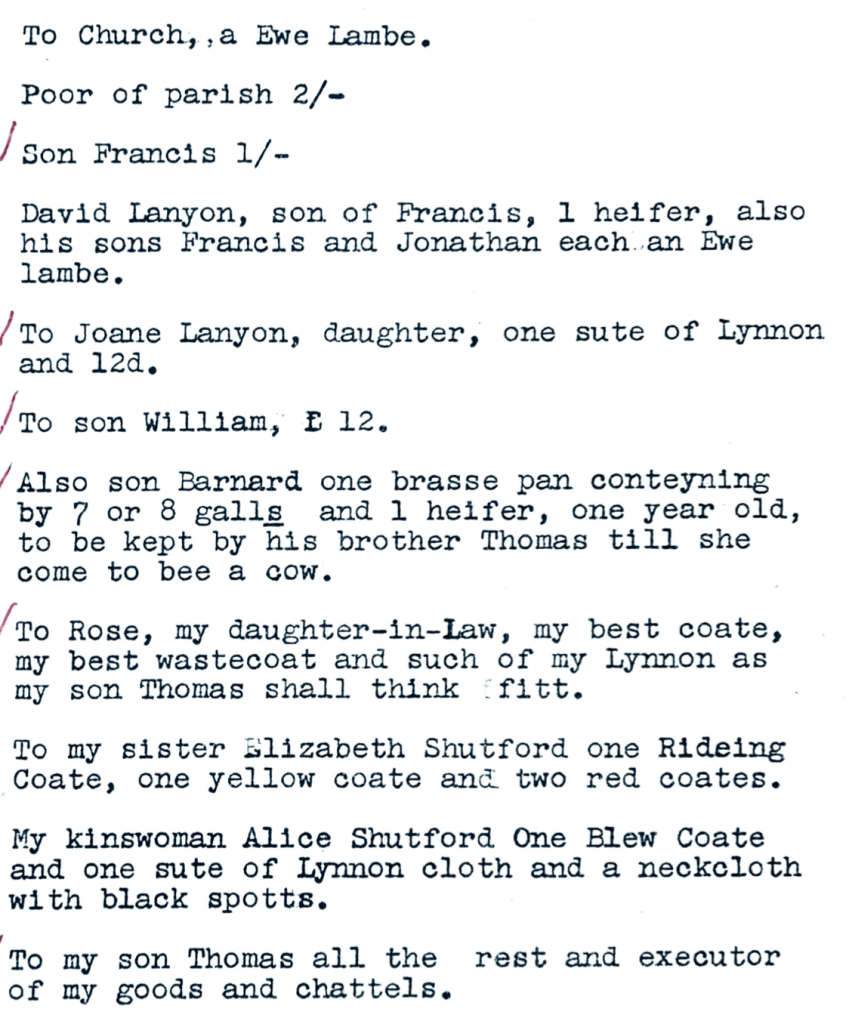
To my son George 40 shillings
To my son John £10
To my daughter Margaret £20
To my daughter Susan £10
To my niece Hester Lanyon 40 shillings
All the rest to my son William
Hester seems to feature in many of the wills!
John Lanyon 1625-1674
John was the third son of William Lanyon and Susannah Burdon. He married Dorothy Ford at St Andrews Church in Plymouth on 14 May 1656. They had two children:
William -1665 died in infancy
Margaret 1668-1671 died in infancy
There was an inscription in St Andrews Church in Plymouth (gradually worn away and in time will disappear altogether) Wife & Children of John Lanyon-
Under this stone a root with blameless green
To sense, but not to faith do lie unseen
Excepting when the righteous rising sun
Shall quicken them by Resurrection
Into that glorious state ordained of God
Of those who live their mercies and their rod
Ecclesiastical History of Plymouth – J Brooking, Devon 1873
The church was bombed during the Blitz in 1941 so presumably this inscription has been lost.
We don’t know when Dorothy died but at some stage before 1674 he appears to have married his cousin Hester Lanyon (the daughter of John Lanyon and Anne Goldsmith). There were no children of this marriage. Hester is described as his relict in a legal document. We don’t know if this marriage took place or if a mistake was made in the legal document.
John was a merchant in Plymouth and in 1672 he was Mayor of Plymouth. He was also the navy agent there.
He was friends with Samuel Pepys who mentions him in his diary:
30th. Up betimes, and with W. Hewer, who is my guard, to White Hall, to a Committee of Tangier, where the business of Mr. Lanyon [John Lanyon, agent of the Navy Commissioners at Plymouth. The cause of complaint appears to have been connected with his contract for Tangier. In 1668 a charge was made against Lanyon and Thomas Yeabsley that they had defrauded the king in the freighting of the ship ‘Tiger’ (‘Calendar of State Papers,’ 1668-69, p. 138).] took up all the morning; and where, poor man! he did manage his business with so much folly, and ill fortune to boot, that the Board, before his coming in, inclining, of their own accord, to lay his cause aside, and leave it to the law, but he pressed that we would hear it, and it ended to the making him appear a very knave, as well as it did to me a fool also, which I was sorry for. Thence by water, Mr. Povy, Creed, and I, to Arundell House, and there I did see them choosing their Council, it being St. Andrew’s-day; and I had his Cross [The cross of St. Andrew, like that of St. Patrick, is a saltire. The two, combined with the red cross of St. George, form the Union flag.] set on my hat, as the rest had, and cost me 2s., and so leaving them I away by coach home to dinner, and my wife, after dinner, went the first time abroad to take the maidenhead of her coach, calling on Roger Pepys, and visiting Mrs. Creed, and my cozen Turner, while I at home all the afternoon and evening, very busy and doing much work, to my great content. Home at night, and there comes Mrs. Turner and Betty to see us, and supped with us, and I shewed them a cold civility for fear of troubling my wife, and after supper, they being gone, we to bed. Thus ended this month, with very good content, that hath been the most sad to my heart and the most expenseful to my purse on things of pleasure, having furnished my wife’s closet and the best chamber, and a coach and horses, that ever I yet knew in the world: and do put me into the greatest condition of outward state that ever I was in, or hoped ever to be, or desired: and this at a time when we do daily expect great changes in this Office: and by all reports we must, all of us, turn out. But my eyes are come to that condition that I am not able to work: and therefore that, and my wife’s desire, make me have no manner of trouble in my thoughts about it. So God do his will in it!
Samuel Pepys – Godfrey Kneller, Public domain, via Wikimedia Commons
Pepys Diary – Alfred Garth Jones, FAL, via Wikimedia Commons
John Lanyon to the Navy Commissioners. Finds the Milford may be supplied with a mainmast here. Wishes the old debts might be discharged; cannot persuade the carpenters without ready money to make the mast, as since the peace, they have been employed on merchant ships at 2s. 6d. per day. [Ibid. No. 166.]
John Lanyon to the Navy Commissioners. In expectation of satisfaction for his disbursements, will get ready a mast for the Milford frigate, which shall be despatched in a few days. [Ibid. No. 36.] Source – State Papers
John died in Paris in 1674 and was buried at the Shalanton Protestant Church. He left a detailed will mentioning many family members.
John’s will – Source – NA PROB/11/344
It’s a lengthy will that is impressive with the size and breadth of his bequests to the poor people of various towns and parishes, but it also gives us the information to deduce John was the son of William Lanyon and Susanna Burdon of Breage, baptised in 1625.
John left £50 to the parish of Breage in Cornwall, and also 40 shillings yearly forever, to be paid from “my interest in three prize tin bounds in or near the said parish”.
John’s will mentions his uncle Mr Philip Lanyon. This confirms that John’s father William had a brother called Philip, and they are more than likely both the sons of John Lanyon that was baptising children in Breage at the start of the 1600s.
The will also mentions John Lanyon of Plymouth’s sister, Margaret Richards and Margaret’s daughter Susanna, and another sister Susanna Tonkin, wife of Nowell Tonkin, and their daughter Dorothy Tonkin.
There is no mention of brothers William and George in his will written 15 Sept 1674 in Paris. William died in 1661 and presumably George had also died.
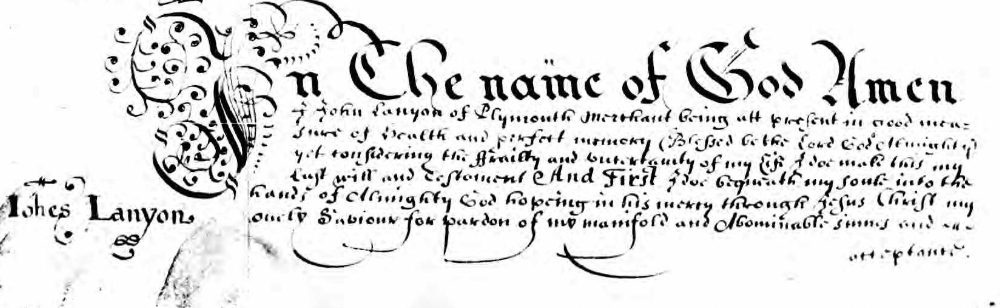
John mentions various ‘cousens’, among them are Hester Lanyon whom he bequests £700 “in case she should survive me and acquit my executors of my obligation for £30 per annum payable to her by me during her natural life.” This suggests there is a pre-existing arrangement possibly arranged and set down in the will of either his brother William or George. The will continues “out of this £700, my cousen Hester do pay or make good unto her sisters, my cousens, Mary and Ann £10 to each during their natural lives.” (John does not call Hester his wife.)
Other cousins/kinsmen mentoned are:
James Trewolla, my kinsman, John Trewolla his brother, Mary Trewolla his sister and Jane Trewolla his sister. John then gives an extra bequest to Jane Trewolla, calling her his cousin, and stating that she recieves “£50 pounds more in consideration of £5 which I received off my uncle Glynn to improve for her advantage.”
John Lanyon also gives to the grandchildren (un-named) of his aunt Glynn and to his cousin Thomas Glynn and his wife.
He was a great benefactor and left money to several parishes and money for almshouses in Plymouth (built 1679) and money for the Educational Foundation of John Lanion. There is an inscription in the boardroom of the Borough Workhouse in Plymouth:-
“to the memorie of a great benefactor to the poore of this town”
He also left £50 to Totnes in Devon and legal proceedings over this legacy give us more information about the family.
Chancery proceedings ante 1714 – Writ 297/99 Year 1679
John Lanyon merchant late of Plymouth personal estate valued at £20,000 did by his last will and testament dated 15 Sep 1674 bequeath a legacy of £50 to Totnes in Devon, which sum the Mayor and Burgesses were claiming of the Executors Captain Philip Lanyon, his sister Margaret Richards and niece Hester Lanyon.
In this chancery lawsuit the Totnes claimants speak of Hester Lanyon as John’s relict “who has since married Thomas Yonge”.
John Lanyon’s ‘personal estate’ consisted of ready money, rings, plate, jewels, bonds, judgments and the claimants accused the executors Philip Lanyon, Margaret Richards and Hester Lanyon of trying to defeat John Lanyon’s wish by pretending that the testator’s estate was not of the value it seemed to be.
Answer to Totnes: To this accusation Captain Philip Lanyon replied that after paying all legacies mentioned in John Lanyon’s will of 1674 there might be a small surplus left, but that he does not believe the testator’s estate to be of the value of £20,000 in fact, the said John Lanyon owed him over £600 on his house.
Note: In John Lanyon’s will he states the opposite, that his Uncle Philip owed him that amount on the house the said Captain lived in.
With no children to follow him this little branch of the tree now comes to an end.
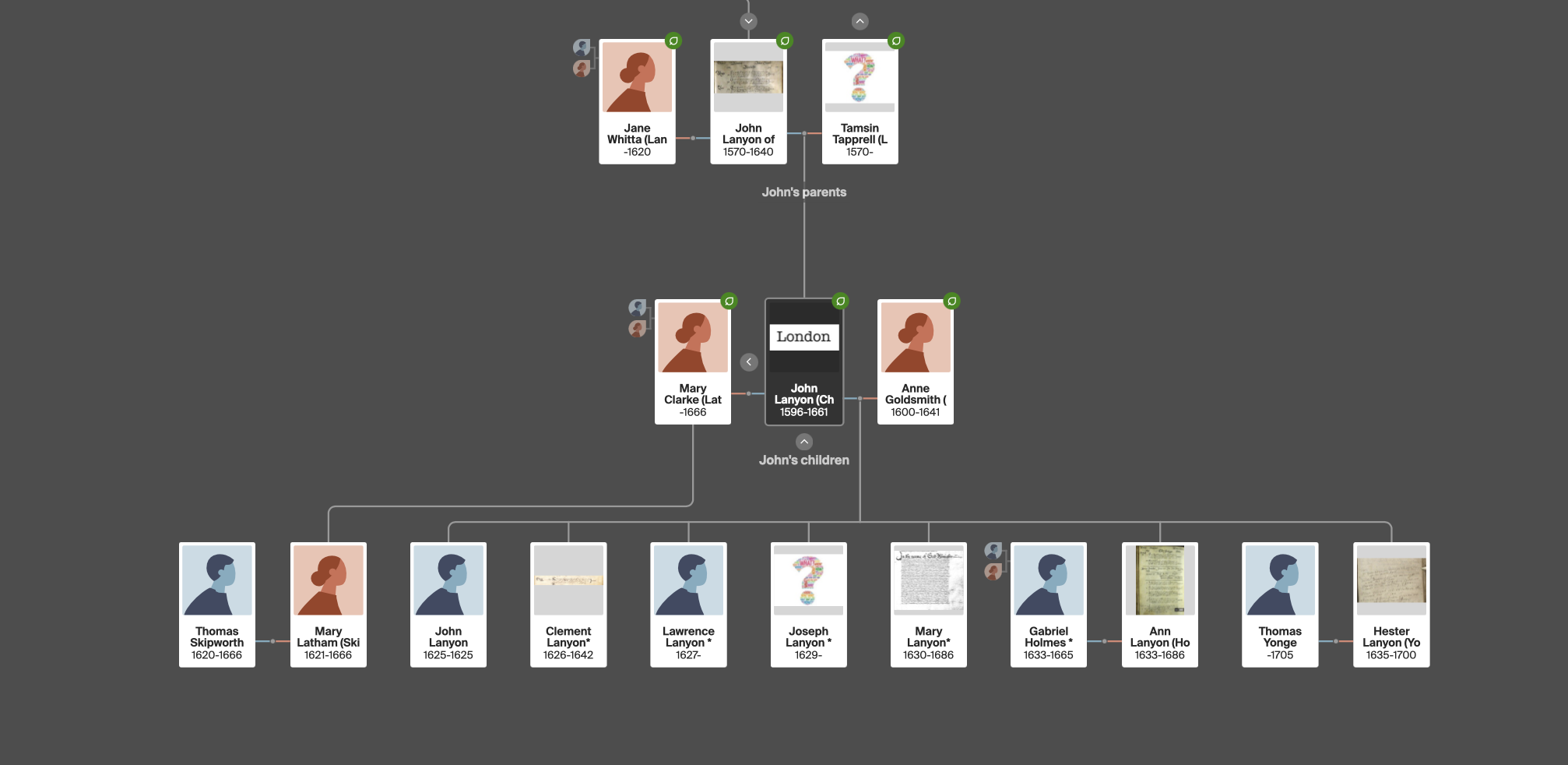
John Lanyon was born after 1596 and before 1600 at either St Agnes or Breage, there is no baptism recorded for him. His parents John & Tamsin were married at St Agnes in 1596 and his younger brother William was baptised at Breage in 1600.
By 1618 John is in London. He was listed on an indenture dated 19 Oct 1618-
John Lanion gent of New Place Essex in chancery indenture re- properties in Breage.
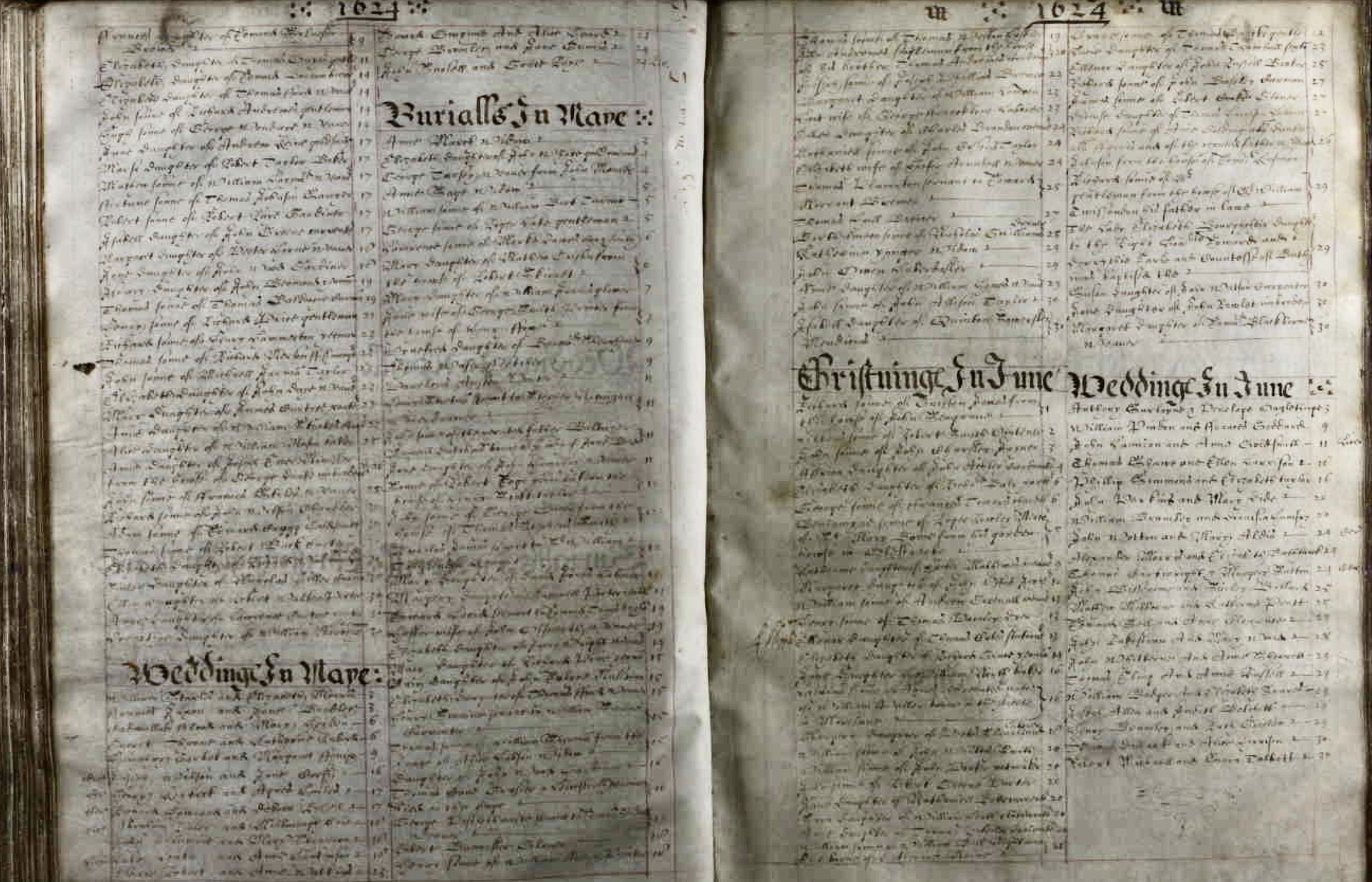
On 11 Jun 1624 John married Anne Goldsmith at Saint Giles Cripplegate, London.
St Giles Cripplegate Parish Register – Source London Metropolitan Archives
It appears as though they returned to Breage as some of their children were baptised there.
John – 1625 a John, son of John Lanyon, was buried at Breage in Jun 1625
Clemens 1626- baptised at Breage 11 Jun 1626 no further trace
Lawrence 1627- baptised at Holborn in London no further trace
Joseph 1629- baptised at Holborn in London no further trace
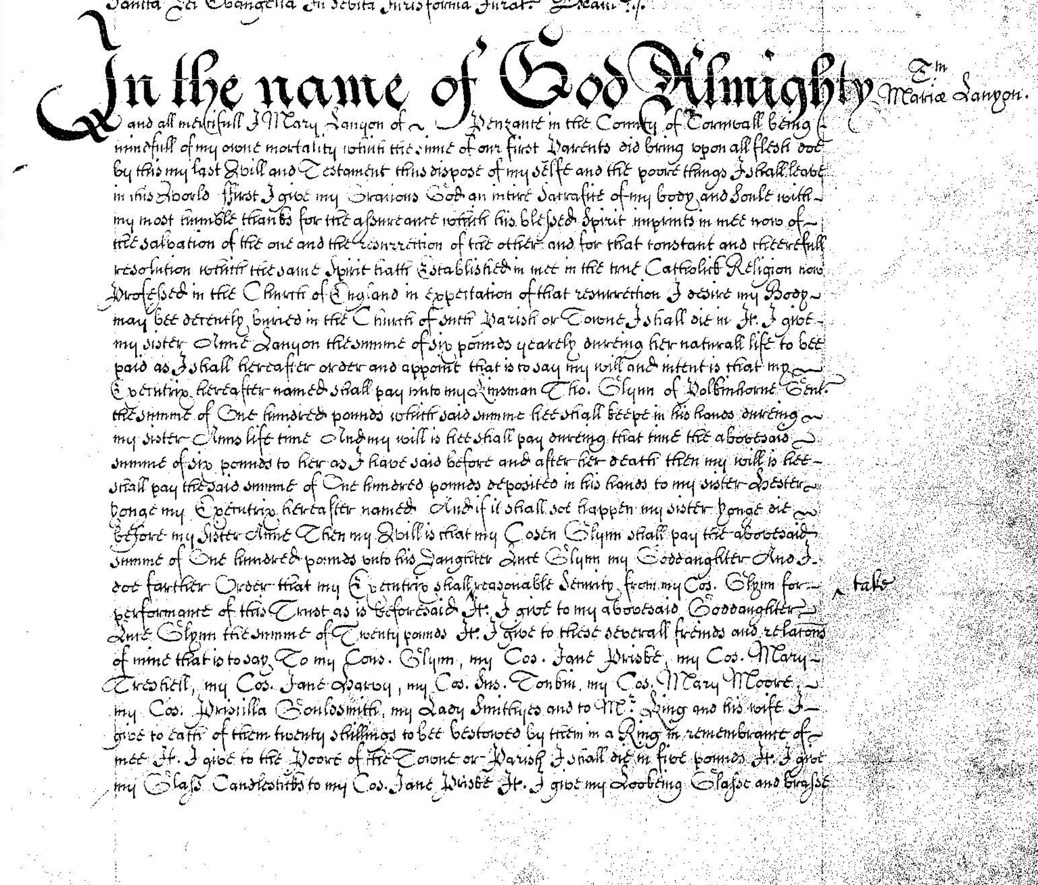
Mary 1630-1686 she was a spinster and was buried in Penzance in 1686, she left a great will which mentions lots of relatives
Source – NA/PROB/11/386
Partial transcript:
To my sister Anne Lanyon the sum of £6 yearly for her natural life
To my kinsman Thomas Glynn of Polkinghorne gent the sum of £100 which he shall keep in his house during my sister Anne’s lifetime to pay her £6 yearly and then to my sister Hester
Thomas Glynn’s daughter my goddaughter Jane Glynn the sum of £20
Cousins Glynn, cousin Jane Prisbe?, Mary Treshell?, cousin Jane Darby, cousin ? Tonkin, cousin Mary Moore, cousin Priscilla Goldsmith, Mr. King and his wife – 20 shillings each for a ring in remembrance of me
Poor of the town or parish £5
Glass candlesticks to Jane Prisbe?
Looking glass and brass candlesticks to Susanna Glynn
Sister’s picture and great cabinet to brother Yonge
Watch to cousin Thomas Glynn the younger
Chamber furniture to Hester Yonge
My china and earthenware as my sister will part with to cousin Jane Darby
My cousins Grace and Jane Daniell
My sister Yonge
We can place some of these cousins on the tree.
John and Anne’s other children were:
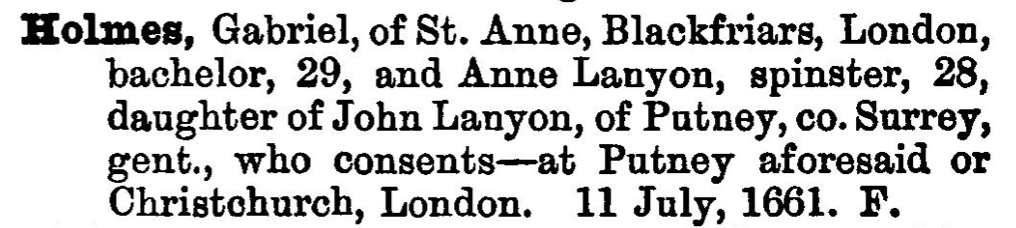
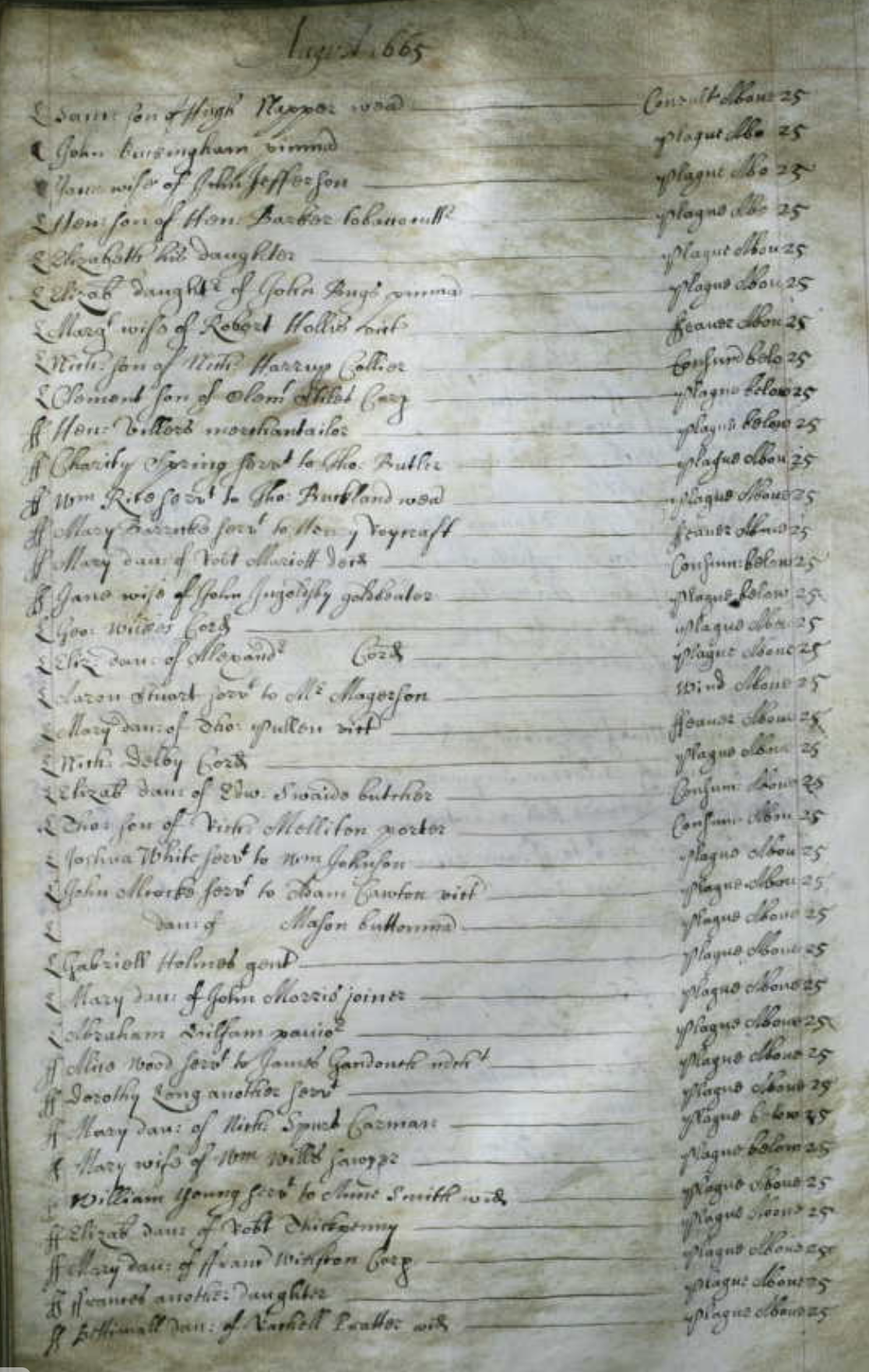
Ann 1633-aft. 1686 Ann was baptised at Holborn in London in 1633 she is mentioned in her sister’s will so presumably is still alive in 1686. She is called Ann Lanyon in the will however there is a marriage of an Ann Lanyon daughter of John Lanyon who married Gabriel Holmes in 1661. A Gabriel Holmes gent, died of plague and was buried at St Giles Cripplegate in 1665. (There is an Ann Lanyon buried at St Clement Danes on 19 Aug 1691- could it be this Ann? Why would she be called Lanyon and not Holmes?)
Hester 1635-1700 she was baptised in Holborn London, she married Thomas Yonge and she may have been married to her cousin John Lanyon.
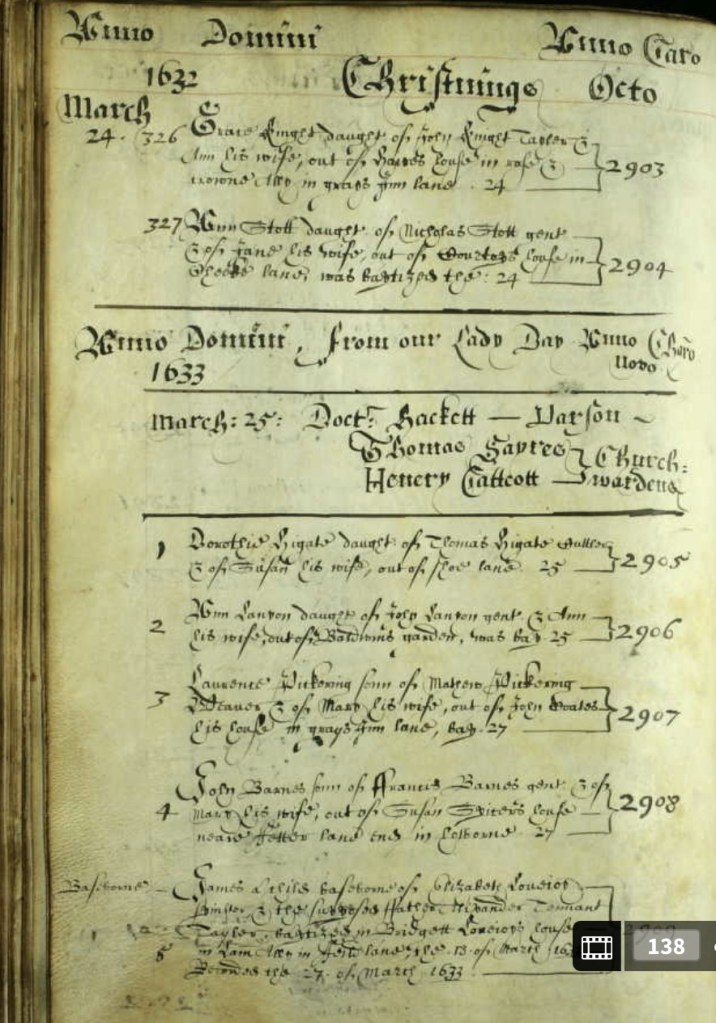
Ann’s baptism (2906) Parish Register St Andrew HolbornLondon Marriage Licences 1521-1869 Gabriel Holmes, gent, died of Plague and buried 25 August 1665 -St Giles Cripplegate register – source London Metropolitan Archives
Hester’s sister Mary left a will (dated 1686) that refers to her as Hester Yonge and sister Yonge, Mary also has a clause giving her sister’s picture and great cabinet to brother Yonge.
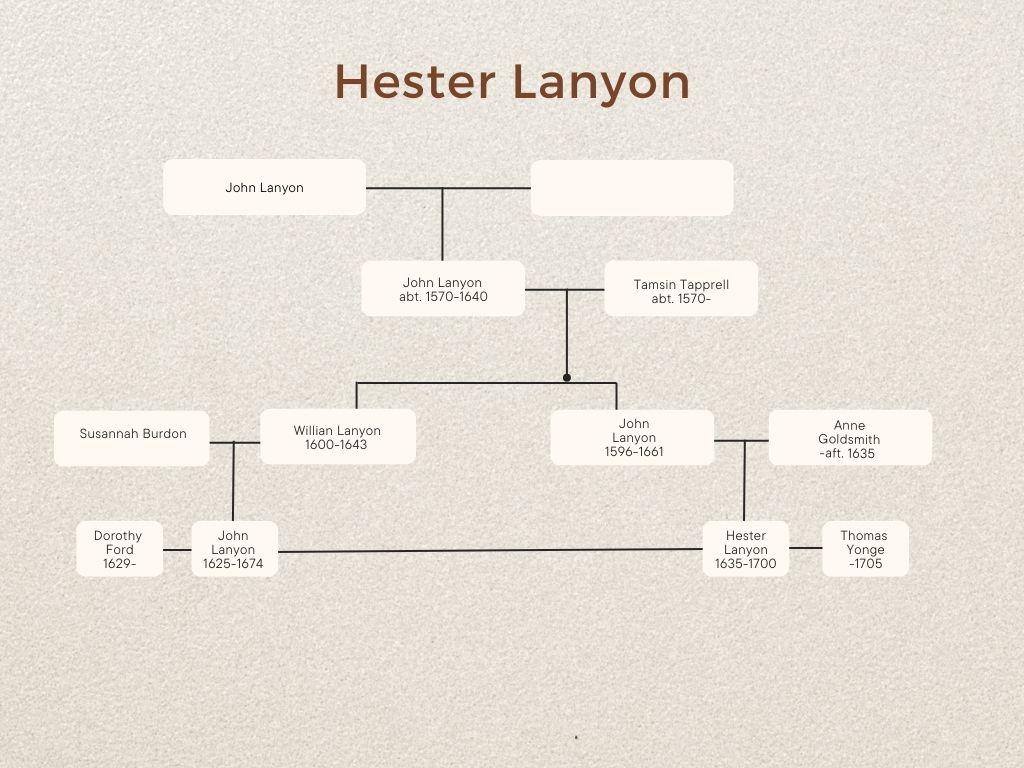
Hester’s tree
Her possible first husband John Lanyon of Plymouth died in 1674 in Paris, he left a detailed will which helps us fit him into the tree. He mentions his uncle Mr Philip Lanyon, this confirms that John’s father William had a brother called Philip. He leaves a generous bequest to the town of Breage. John mentions various cousins among them are Hester Lanyon who he bequeathes £700 “in case she should survive me and acquit my executors of my obligation for £30 payable to her by me during her natural life”. The will continues “…out of this £700 my cousin Hester do pay or make good unto her sisters, my cousins, Mary and Ann £10 each during their natural lives.” (Source- NA/PROB/11/344/542)
After his death there are legal proceedings over his estate.
Chancery Proceedings Ante 1714 – Writ 297/99 Year 1679
John Lanyon merchant late of Plymouth personal estate valued at £20,000 did by his last will and testament dated 15 Sep 1674 bequeath a legacy of £50 to Totnes in Devon, which sum the Mayor and Burgesses were claiming of the Executors Captain Philip Lanyon, his sister Margaret Richards and niece Hester Lanyon.
In this chancery lawsuit the Totnes claimants speak of Hester Lanyon as John’s relict “who has since married Thomas Yonge”.
There is no trace of a marriage between Hester and either John Lanyon or Thomas Yonge but they are referred to in the Chancery proceedings. Although John Lanyon’s will describes her as his cousin rather than his wife. Was Hester Lanyon John’s second wife? Until we can find other documentary evidence we can’t be sure.
Hester Yonge was buried on 6 Apr 1700 at Colebrooke, Devon.
Colebrooke Devon Parish Register
Hester’s husband Thomas Yonge died in 1705 at Colebrooke.
We’ll look at Hester’s husband John Lanyon of Plymouth in more detail in another post.
What of Hester’s father John?
John Lanyon was Proof Master and Chief Engineer to Charles I from 1630-39. In 1640 John went to Flanders and wrote to Whitehall from Brussels sealing the letter with the Lanyon (Madron) arms. As the principal engineer he was responsible for forts and castles. It was his misfortune to land such an illustrious post just as the monarchy was about to be swept aside in the Civil War.
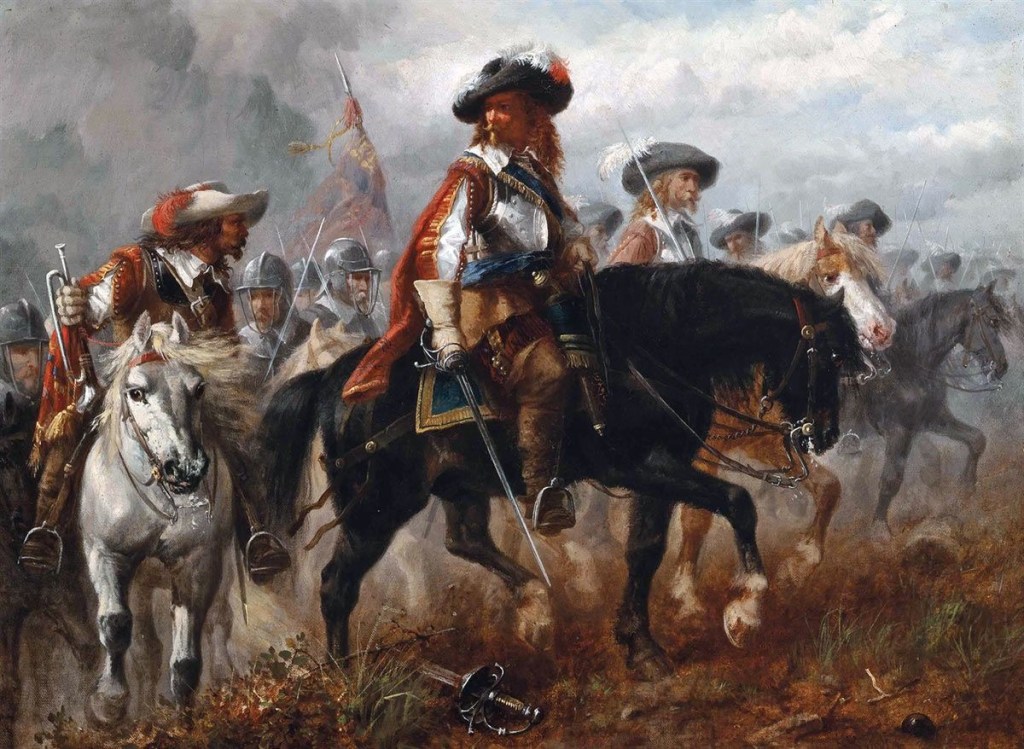
King Charles I and Prince Rupert before the Battle of Naseby 14 June 1645 during the English Civil War – Wikimedia Commons
During the Civil War John Lanyon had a tough time; he was plundered, sequestered and imprisoned. In 1661 he petitioned the Lord Treasurer to pay his fee due at Midsummer last. He had been promised £240 a year as chief engineer. Sir William Compton certified that John Lanyon had £240 a year granted him by the late King as chief engineer and that “he is well skilled in his art and deserving of the said salary.” (Source- Charles II State Papers Vol 36 – 1661).
His wife, Anne Goldsmith, must have died because John remarried Mary Latham (née Clarke) the widow of Ralph Latham Esq of Upminster, Essex, late barrister Middle Temple, London. Ralph died in 1642 so sometime after that date the marriage took place. There were no children of this marriage.
John died in Sep 1661 and was buried at Surrey. His widow Mary died in 1666 and her will mentions her children from her first marriage and step daughters Mary, Anne and Hester Lanyon.
Will of Mary Lanyon 1666 – Source NA PROB/11/320
As far as we can ascertain none of John’s sons survived and none of his daughters had children of their own so this little branch of the tree died out.
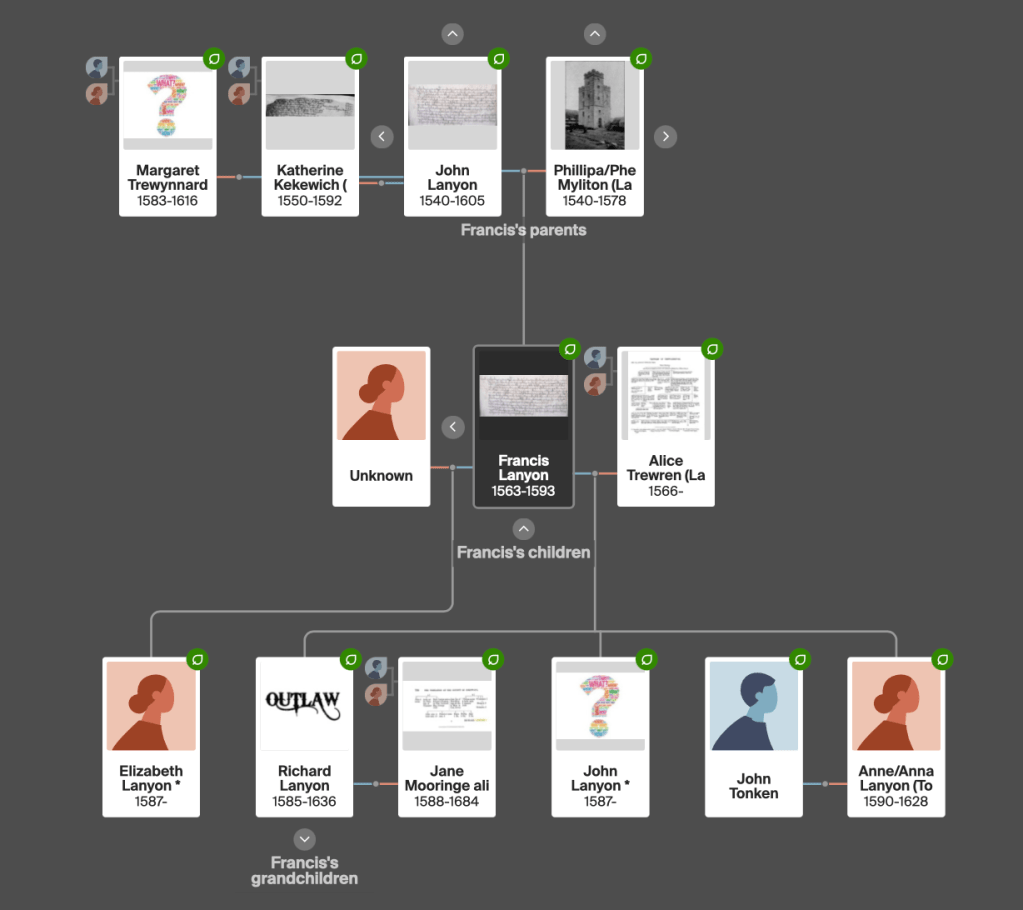
John Lanyon Esq had at least three wives (see the post ‘The Two Johns’) but surprisingly few documented children. His first marriage to Phelype Myliton produced two sons: Francis and William.
John Lanyon’s tree
Francis Lanyonabt. 1563-1593
Francis Lanyon was born about 1563; in 1584 he married Alice (Ales) Trewren, the daughter of John Trewren and Elizabeth Chiverton. There were three documented children of this marriage: Richard baptised 8 Sep 1585 at Sancreed, (see the post ‘Richard Lanyon Esq ‘Outlaw’ ‘), John baptised 10 Dec 1587 and Anne born about 1590. Francis also had an illegitimate daughter who was baptised 11 Nov 1587 at Sancreed, a month before his son John was baptised. We don’t know what happened to Elizabeth or what his wife Alice thought!
Less than six years later Francis was dead, he was aged about 30. Administration of his estate was granted to his widow on 17 Oct 1593 (will lost). Eight year old Richard Lanyon becomes the heir to John Lanyon Esq. Alice appears to have raised her family at Sancreed, staying close to her own family.
Their daughter Anne Lanyon married John Tonken on 8 Nov 1612 at Madron. No further trace of their son John.
Francis Lanyon’s tree
William Lanyonabt. 1570-1624
William was the second son, we don’t know when he was born, perhaps the early 1570s. On 19 Nov 1592 he married Jane at Sancreed. Their children were: Elizabeth, John, John, Jane, William, Paskas and Elizabettie. (Two daughters both called Elizabeth and both survived!)
William Lanyon’s tree
See the Post about Paskis Lanion for more information.
William was buried on 17 Jan 1624 at Sancreed, fortunately he left a detailed will which helpfully names his children. He also leaves a great inventory of goods and chattels worth £170, a considerable sum at that time.
John Lanyon’s esquire’s second wife was Katherine Kekewich and they had at least one son called George who was blind. George was born about 1586 and was still alive in 1633 (see post “The Two Johns”).
We don’t know what happened to George, there is no record of his burial, no will and he’s not mentioned in any Lanyon wills.
Elizabeth Lanyne -1659
See post ‘The Neilder Connection’
Elizabeth lived at Menheniot in Cornwall. There is one other Lanyne living there at the same time, a woman called Grace Lanyne who married James Short in 1620. She may be a sister to Elizabeth as she doesn’t fit anywhere else on the tree!
John Lanyon – 1587
The Madron parish register records the burial of John Lanyon the son of John Lanyon Esq on 2 Jul 1587. This must be the burial of a child but there is no record of a baptism so we have no idea if he was baptised before or after Phelype’s death or whether his mother was Phelype or Katherine, he may even have been an illegitimate child.
Four, possibly five, children seems a small number of children for the time, perhaps John Lanyon Esq had others who weren’t recorded.
See also the post ‘John Lanyon of Penwinnick Estate’ under the Breage branch.
Richard Lanyon married Margaret Treskillard and they had at least twelve children, including two sons both called John!
His children were: John, John, Richard, William, Raphe, Edward, Clement, Syman, Thomasine, Maude, Joane and Jane.
To find out more about his sons see separate posts “The Two Johns’, ‘John the Younger’ and ‘Richard, Edward and Raphe Lanyon’. This post is about his daughters.
Thomasine Lanyon
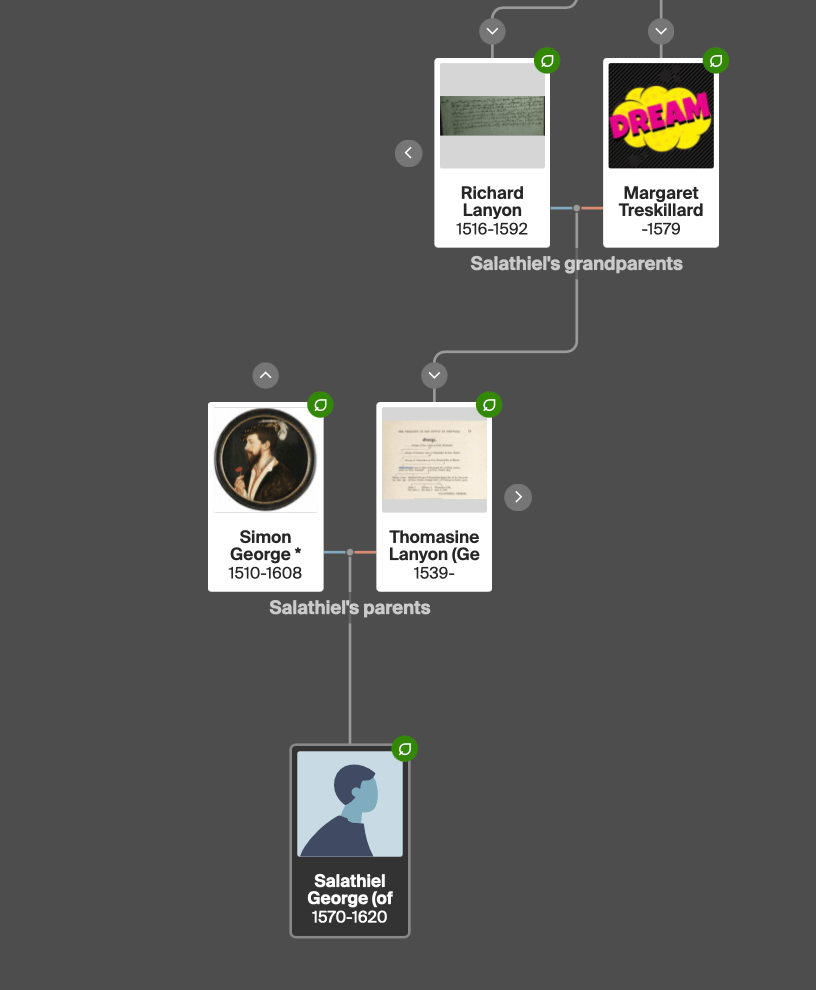
Richard’s eldest daughter was Thomasine, named after her grandmother Thomasine Tregian. Thomasine married Simon George and they had at least two children: Simon and Salathiell George of Trenouth who was still alive in 1620.
Simon George by Hans Holbein the Younger, Public domain, via Wikimedia Commons
From the Bartolozzi book;
“Simon George, of Quocoute, in the country of Cornwall, was the son of a private gentleman of his names, who acquired property at that place, and lived there, and whose father came from Gloucestershire into Dorsetshire, and settled at Osmondton, in the latter country; his mother was descended from a good family of the name Hussey. He married Thomasine, daughter of Richard Lanyon, a gentleman of an ancient Cornish house, and had by her two sons, Simon, who died without issue; and Salathiel, who settled at Trenouth, and was living there in 1620, having at that time three daughters, Anne, Elizabeth, and Thomasine.”
Maude Lanyon
Maude was the second daughter and born about 1539. She married Henry Rosewarne from Camborne, Cornwall. Their daughter Elizabeth was baptised 9 Feb 1558 at Camborne. There may be other children but I haven’t traced them. Henry died in 1570 and Maude was buried 24 Feb 1619 at Camborne.
Joane Lanyon
Joane was baptised 24 Jun 1548 at Gwinear. On 15 Feb 1567 she married Otes Merefeild (sic), gent of St Columb and St Ives and the son of Walter Merefild (sic) and Jane Beare, at St Columb Major/Gwinear. They had at least four daughters: Marye, Johan, Johane, Alse. No further trace of their daughters. Otes was still alive in 1605 as he ‘prayed’ over the will of his brother in law, John Lanyon Esq. Joane was still alive after 1630 as her brother Edward’s will mentions a legacy ‘to my sister Jane Merefield’. She would have been 82 at the time of his death.
Jane Lanyon
Jane married Richard Crane on 5 Oct 1561 at Camborne. The register records the name as Lawyne. She had three sons: Richard, and twins John and Richard. The twins were buried a day after they were baptised on 10 Sep 1578. Her first son also called Richard was baptised and the Herald’s Visitation shows him as the father of 5 children. Richard senior died in 1606 but there is no record of Jane’s burial.
Syman was the seventh son and Clement was the eighth. They were recorded on the Herald’s visitation so presumably they were still alive at that time however there is no trace of either man in any other records. Like many younger sons they may have been sent out of Cornwall or even overseas to find their fortune.
The Lanyons, Trewrens and Noy (Noye) families intermarried over several generations.
Lanyon & Trewren families in Tudor times
The Trewren family lived in Sancreed Cornwall. Driff or Drift was the ancient seat of the family—“Dryffe“ wrote Norden in 1584, “The howse of Thomas Tre-wryn.” This family was settled here as early as 1340; they moved from this place to Trewardreva, Constantine.
Map of Sancreed Cornwall – The Lanyon family had homes at Madron, Bosullow, Sancreed, Paul and Morvah in the 15th, 16th & 17th century.
Jane Trewren married Sampson Noy on 22 Jul 1587 at Madron, Jane died giving birth to her seventh child Chesten on 6 Feb 1600. Two years later Sampson married his friend, John Lanyon’s daughter, Ane Lanyon and he had a further ten children!
Lanyon & Noy family
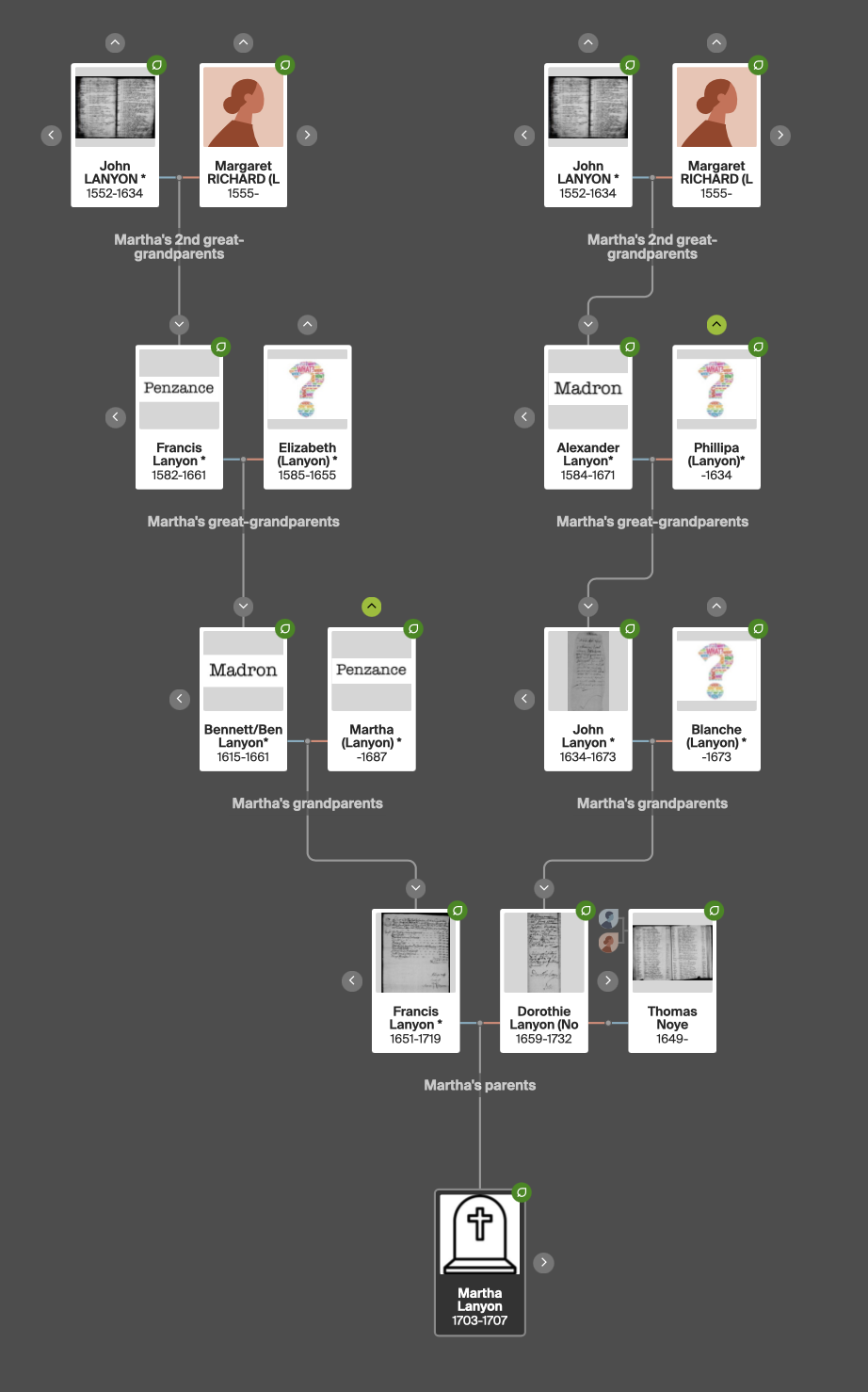
John Lanyon had a son called Alexander who married Philippa, he mentions them in his will of 1634. Their son John was also mentioned in the will but we don’t know when he was born. John junior married Blanche possibly in 1648 because their first child Margaret was born in 1649. Their fourth child Dorothie was born in 1659 and in 1678 she married Thomas Noy. Thomas died in 1699 and Dorothie then married her cousin Francis Lanyon at Morvah in 1701. Francis was fifty when he married for the first time and Dorothie was forty two. Their only child Martha died aged four.
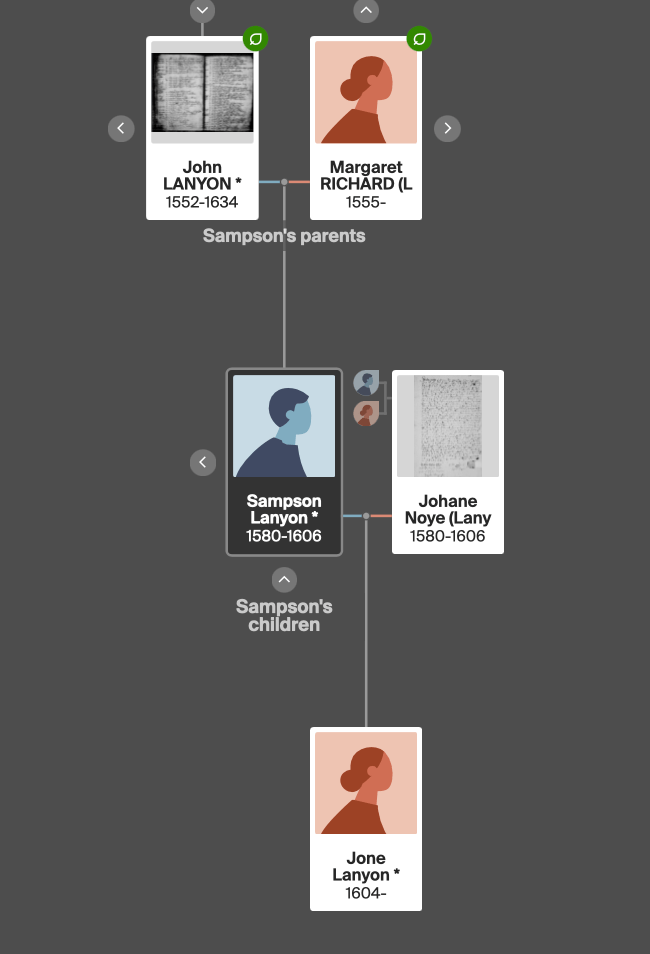
Sampson Lanyon married Johane Noy at Madron in 1602. There is no record of his birth but it is possible that he was an unrecorded son of John Lanyon and Margaret Richard and was named after his grandfather Samspon John Richard. Johane Noy was a daughter of Johane Noy widow of Sancreed who died in 1606. I can’t trace a marriage for Johane who died in 1606 but it seems likely that she was connected to Samspon Noy as he took the inventory of her goods for her will in 1606 along with John Lanyon (gent).
The Noys also married into the Gwinear Lanyon branch of the family.
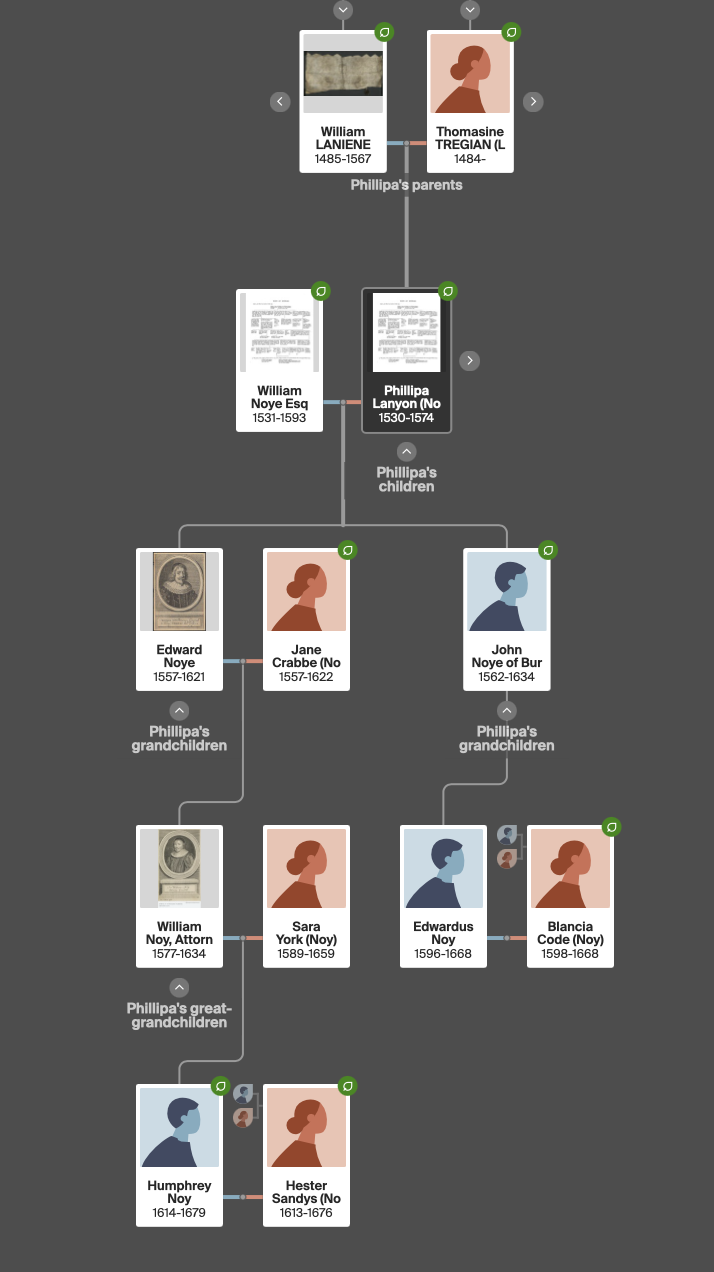
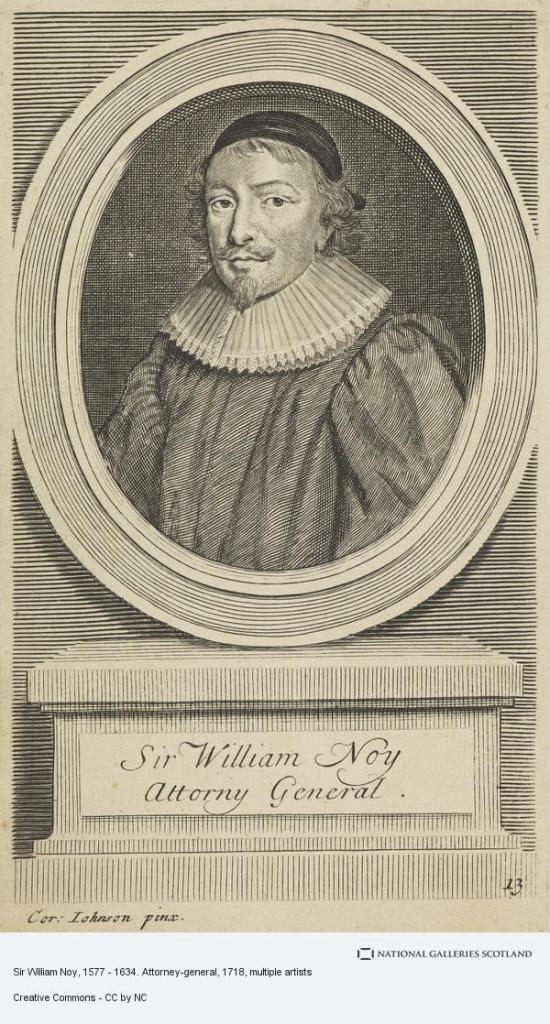
William Noy of Buryan married Phillipa Lenyne about 1556 at Gwinear. The Herald’s Visitation shows Philippa as the daughter of Edward Lenyne but Edward didn’t have any daughters. It seems more likely that Philippa was the daughter of William Laniene Esq and Thomasine Tregian. William and Philippa had at least three sons: William, John and Edward. Edward married Jane Crabb and their son William Noy of Carnanton and of Lincoln’s Inn became Attorney General to Charles I.
Sir William Noy – Attorney General
William Noy’s son was Humphrey Noy of Carnanton. He was born 1614. He married Hester Sandys, the daughter of Henry Lord Sandys. Humphrey served as a colonel in Charles I’s army. His estates were sequestered by Parliament and he was fined a tenth under the Articles of Truro. He lived for many years on the charity of his friends. He died at Mawgan in Pydar and was buried there on 12 Dec 1679. Hester was buried at St Buryan in Cornwall on 5 May 1676.
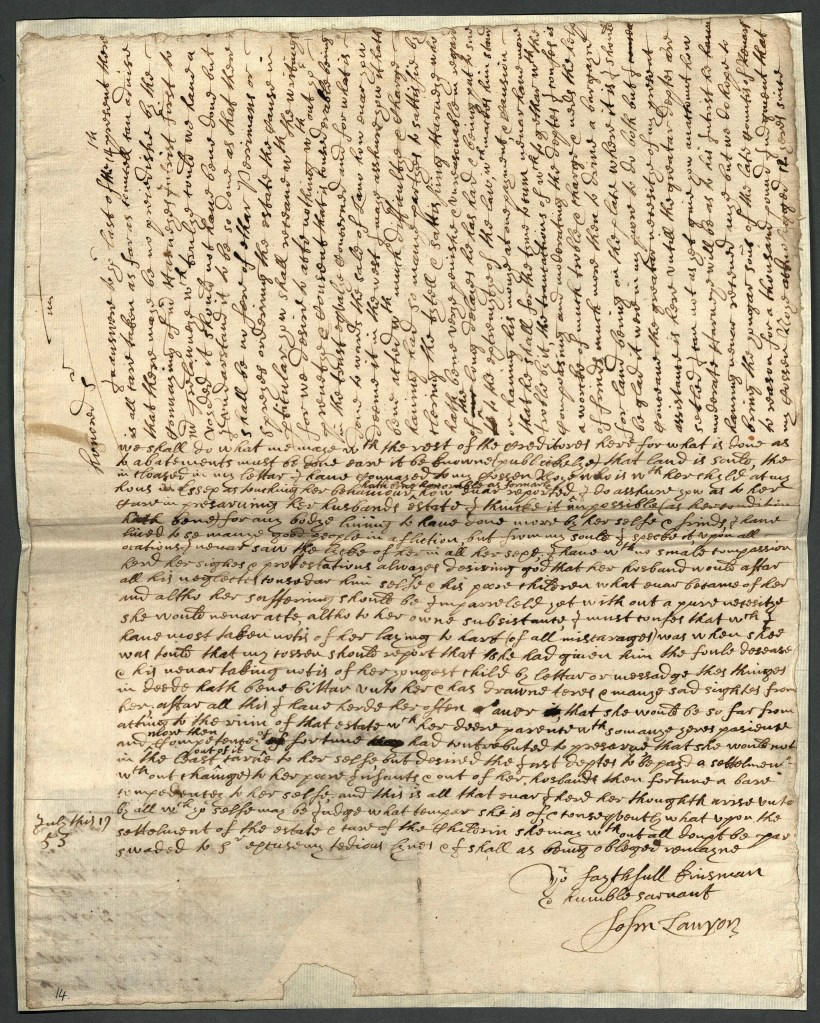
For a time Hester Noy lived at the home of John Lanyon in Essex. John Lanyon wrote to his cousin Rashleigh about Hester and the letter still survives.
Honored Sir, In answer to your last of the 14th present there is all care taken as far as counsel can advise that there may be no prejedishe [prejudice?] by the conveying of Mr Harveys intrist [interest] first to Mr Trelawney which truly could we have avoided it should not have been done but I understand it will be so done as that there shall be [in or no] […?…] of either Perrimans or Spreyes ordering the estate the cause in particular you shall receive with the writings for we desire to act nothing without your [pre…?…] consent that is considerable being in the trust equally concerned and for what is done towards the sale of [land?] however you deem it in the west I may assure you it hath been acted with much difficulty and charge having had so many parties to satisfy closing the [tytell? title?] and satisfying Harveye who hath been very peevish and unreasonable in regard of the long delays he has had and being put to [sue?] ? to the extremety of the law, which [makes?] him stand on having his money at one payment, and caution that he shall for the time [to come?] never have more trouble by it, the transactions of which together with the [composing?] and moderating the deptes [debts?] I confess is a work of much trouble and charge and needs the help of friends much more then to drive a bargain for land being on the place where it is I should be glad it were in my [p..?..] to do both but I [c..?..] the greater necessity of my present assistance is here until the greater depts [debts?] are settledI can not as yet give you an account how moderate Harveye will be as to his intrist [interest?] he having never received any but we do hope to bring the younger sons of the late Countis [Countess?] of […?…] to reason for a thousand pound judgement that my cousin Noye [a…?…] 12 years since, we shall do what we may with the rest of the creditors here for what is done as to abatements must be done [save?] it be known (publicly) that land is sold, the in cloased [enclosed] in my letter I have conveyed to my cossen Noye who is with her child at my house in Essex as touching her behaviour how ever reported [following inserted] hath been honorable as formally, I do assure you as to her care in preserving her husbands estate I think it impossible (as her condition has been) for any body living to have done more by herself and friends, I have lived to see many good people in affliction, but from my soul I speak it, upon all occasions never saw the like of her in all herself. I have with no small compassion heard her sighs and protestations always desiring god that her husband would after all his neglects consider himself and his poor children what ever became of her and also her suffering should be [impass..?.. impossible?] yet without a [purse?] necessity she would never ask, although to her own subsistance, I must confess that which I have most taken notice of her laying to heart (of all miscarriages) was when she was told that my cossen should report that she had given him the foul disease and his never taking notice of her youngest child by letter or message these things indeed hath been bitter unto her and has drawn tears and many sad sighs from her. After all this I have heard her often aver that she would be so far from acting to the ruin of that estate which her dear [parent?] with so many years [patience?] and more then [than?] competencey of fortune had contributed to [preserve?] that she would not in the least out of it carve to her self, but desired the just debts to be paid a settlement without [charge?] to her poor infants and out of her husbands then fortune a base competency to her self, and this is all that ever I heard her thought arise unto by all which your self may be judge what temper she is of, and consequently what upon the settlement of the estate and care of the children she may without all doubt be persuaded to. Sir excuse my tedious lines and I shall as being obliged remain your faithful kinsman
and humble servant
John Lanyon
Source – Cornish Record Office RS/1/62 dated 19 Jul 1653 transcribed by Louise Quigley
John Lanyon’s daughter Hester (1635-1700) may have been named after Hester Noy.
















 The Lanyons