Wishing all my subscribers and visitors a very happy new year!
2025 in numbers:-
The website had 7,500 views and 2,200 visitors.
The top three countries for visitors were United Kingdom, USA and Australia but we also had visitors from as far away as Ghana, New Caledonia, Kiribati, Pakistan and Ethiopia! Just amazing!
The most popular post in the last year was ‘The Fiji Lanyons’.
The busiest day for visitors was 11th March 2025.
I only produced four new posts in 2025 as it was a busy year for me. Hopefully in 2026 I’ll have some interesting new posts.
I’m always delighted to read your comments and happy to help, if I can, with family history queries.
If you have a Lanyon family story you’d like to share please get in touch.
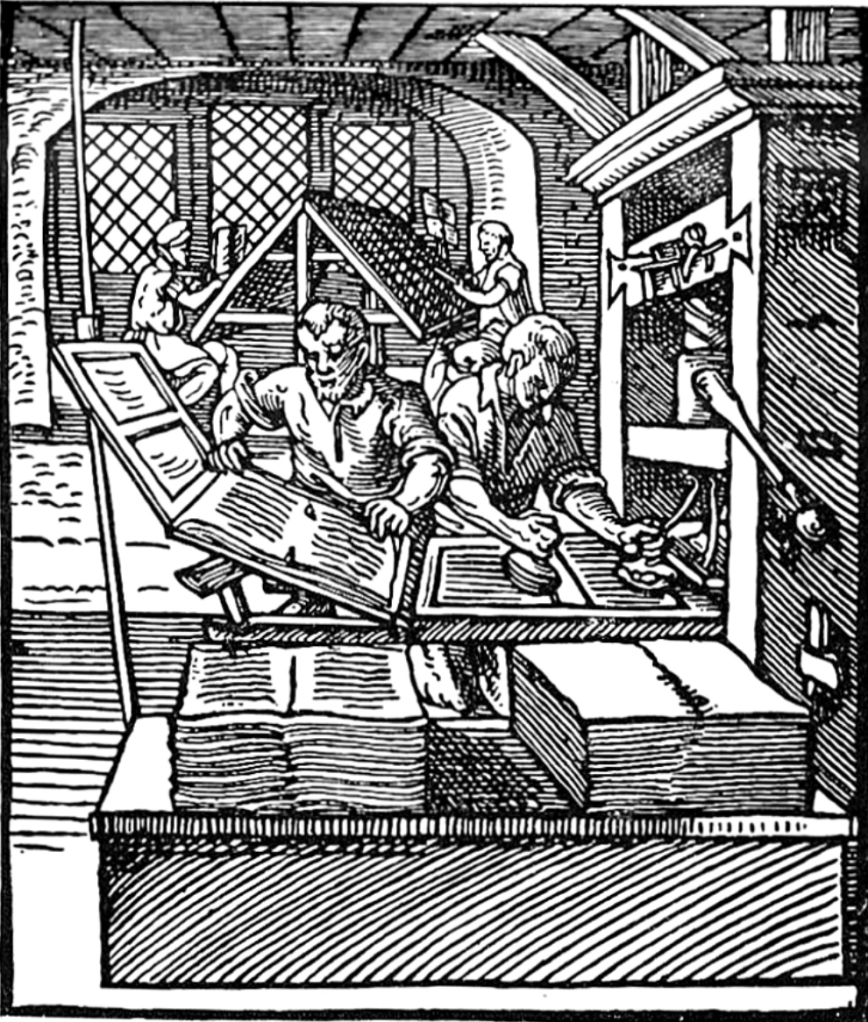
With the introduction of printing in 1476 there were attempts to standardise spelling in Britain but it wasn’t until the first dictionaries began to appear in the mid 17th century that spelling settled down. Often words were spelt the way people pronounced them. In Tudor Cornwall the name Lanyon was pronounced La-nine hence the spelling Lanine, Lanyne, Lenine. Add to that the difficulty in reading old documents and it’s easy for an ‘n’ to become an ‘m’, so other varients like Lamyne and Lamin appeared. Slight changes in pronunciation resulted in Lanion (LanIon) and Lanyon (LanYon). By the 18th century the accepted spelling became Lanyon. To further complicate things there are families called Lamin, Lemin and Lemon who are quite separate from the Lanyons.
It can be really difficult to know if a variant of the name is actually the same family or another family altogether.
When I found the record of a marriage between John Lamelyn and Johan Tregian it was difficult to know if he belonged on the Lanyon tree or not.
Henderson’s MSS gives details of this marriage in 1524.
“Thomas Lamelyn to John his son and heir in marriage with Johan daughter of Thomas Tregian for their lives Lamelyn als Gunvenowe Hole Juxte Tregony Nethercombe 16 Henry VIII”
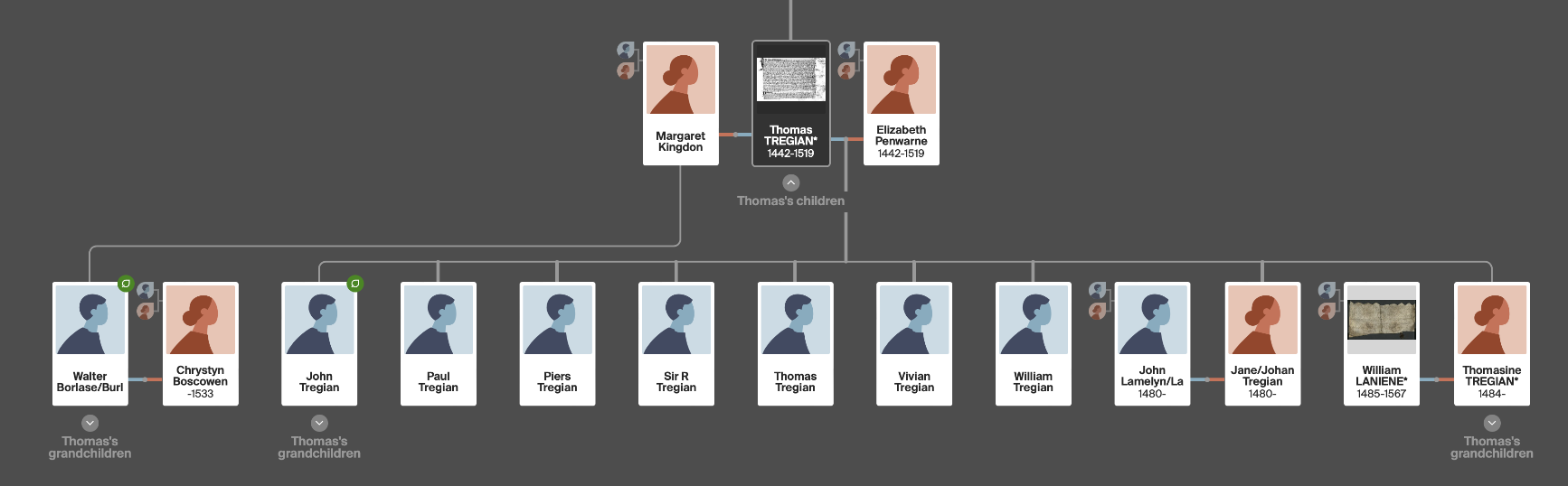
So in 1524 a John Lamelyn married Johan the daughter of Thomas Tregian. Thomas Tregian already features on the Lanyon family tree. His daughter, Thomasine, married William Laniene Esq around the beginning of the 16th century. Almost all the Lanyons I’ve found can trace their ancestry back to William and Thomasine.
William & Thomasine’s children and their spouses
We know so much about William as he was the head of the family when the first Herald’s Visitation took place in Cornwall and he submitted his tree in 1531, his eldest son Richard, did so again at the second visitation in 1573 and Richard’s grandson submitted more information in 1620 when the third and final visitation took place.
The purpose of the Herald’s Visitations was to register and regulate the coats of arms of nobility, gentry and boroughs and to record pedigrees. They are a great resource for family historians but the information they hold is not complete or always accurate. Many families concentrated on recording the details of their eldest son and heir as he would be the person who would have the right to bear arms. Some families embellished their pedigrees especially if they were new to wealth and titles.
The Visitation shows William Laniene Esq with a sister Isabel who married Thomas Trewren but William and Isabel may have had other siblings and cousins which aren’t recorded. So it is possible that Thomas Lamelyn and his son John are related.
Thomas Tregian was born about 1440 at Truro in Cornwall. He was a prosperous tin merchant and shipper and in 1512 he is recorded as owning the ship “Jesus” of Truro. He invested his profits in land and owned several manors in Cornwall. He married Elizabeth Penwarne about 1467. His second marriage was to Margaret (née Kyngdom) the widow of the historian John Borlase of Pendeen. His children were from his first marriage.
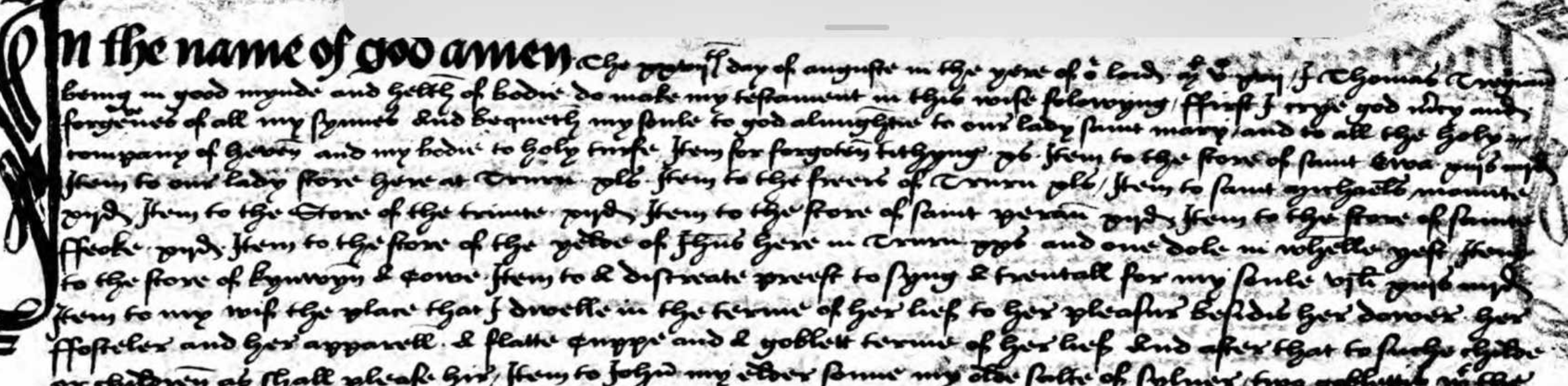
Thomas Tregian’s will exists and helps us build his tree.
PROB 11/19/375
Transcript:-
“In the name of God amen. The 27th day of Auguste in the yere of or lord 1517. I Thomas Tregian being in good mynde and helth of. bodie do make my testament in this wise folowyng. First I crye God m’cy and forgivenes of all my synnes and bequeth my soule to God Almightie to our Lady saint Mary and to all the holy company of hcven and my bodie to holy turfe. Item for forgotcn tithyng 10s. Item to the store of saint Ewa 18s. 4d. Item to our Lady store here at Truru 40s. Item to the freres of Truru 40s. Item to saint Michaels Mounte 12d. Item to the store of the Tiinite 12d. Item to the store of saint Peran 12d. Item to the store of sainte Peoke 12(3. Item to the store of the gelde of .Thus here in Truru 20s. and one dole in whelle Yest. Item to the store of Kynwyn a cowe. Item to a discreate preest to syng a trentall for my soule £6 13s 4d. Item to my wif the place that I dwelle in the terrne of her lief to her plcasur besides her dower her Hosteler [fosterlean] and her apparell a flatte cuppe and a goblett tonne of her liof and after that to sucho childe or children as shall please hir. Item to John my elder sonne my olde salte of sylver, 2 gohlettis with the cover of sylver and gilto, the best bedde the Tubull in the halle, all coi)tenors and hanging clothes bothe in the hallo and in the plor [parlour]. Item to Peers my sonne 12 qter pooos of Tynnn waying by the Kyngis beame three thousand pounde, one qter of the shyppe called the Jhus, the place that William ffornaby dwellith in Chidawe, half of my blowying house, the place that Pascowe fflotcher dwellith in, all my right in Poldisse worke and in Whelle Yeste in Kyllcvrethe downe, my best two saltes of sylver and gilte, oon dosen of spones of sylver and my best standing cuppe of sylver after his moder’s decesse 2 flatte cuppes of aylver. Item to Jane my doughtor £40 to her mariage. Item to Thomysen my doughter a m. [thousand] of tynne wayed by the Kyngis beame. Item to Sir Raynolde my sonne 40s in money and he to synge 30 masses for my soule also more a gowne of blacke furred w’ lambe and a flatte olde cuppe of sylver. Item to Benet Tregian I forgive all that he owith me before this dayo. Item to Peers Treworva a furred gowne w”‘ blake. Item to John Edwarde a coote or a gowne and all that he owith me p’donat. And if it fortune that eny of my children dye without issue that then the same parte to be divided amongeste the other that lyveth equally. And I ordeigne my wif my sonne John and my sonne Peers myn executours, they to fulfill my said wille. In witnes whereof the said Thomas wrote his testament in man’ and forme as ys above rehearsed with his owne hande.”
His will mentions his sons John, Peers and Sir Raynolde (a priest) and daughters Thomasine and Jane.
He bequeathes Thomasine “…a m. (thousand) of tynne wayed by the Kyngis beame.”
He bequeathes Jane “…my doughter £40 to her mariage.” This tells us she isn’t yet married.
The will also tells us by omission that by 1517, when it was written, that Thomas Tregian’s sons Paul, Vivian, Thomas and William must have died.
So could Thomas’ daughter Jane be the Johan that married John Lamelyn? It’s possible. The names Johan, Joan and Jane are often interchangeable at this time and sometimes it’s hard to tell if a letter is an ‘a’ or an ‘o’, although in this case the ‘a’ in Jane is quite clear when compared to the ‘o’ in Doughter.
So what other evidence is there?
Charles Henderson’s record states that John is the son and heir of Thomas Lamelyn. Is there any evidence for a family called Lamelyn at this time?
The National Archives and Kresen Kernow have the following records relating to the name ‘Lamelyn’:-
WM/217 – A Jn Lamelyn is listed as a witness at Polruan in 1399. Kresen Kernow
C/241/249/22 – A John Lamelyn is listed as a constable in 1465. NA
ART/3/12 – A Thomas Lamelyn was listed as a witness at Tywardreth. KK
C/131/102/7 – A Thomas Lamelyn gent of Lamelyan, Cornwall is listed as a debtor. NA
ME/628 – A Thomas Lamelyn Esq is listed as a witness in 1519. KK
C1/1519/74 – Motion v. Lamelyn. Rent due from the parsonage of Lanteglos which was leased to Lamelyn by prior of St John’s Bridgwater, Cornwall. NA
C1/363/39 – Spenser v. Lamelyn. 1504-1515. NA
R/1626 – Property grant to Jn Lamelyn 1508. KK
E/150/177/10 & C/142/58/13 – Inquisition Post Mortem of Thomas Lamelyn 1536-37. NA
Spenser v. Lamelyn is the most interesting. Thomas Spenser, the vicar of Lanteglos, and Thomas Lamelyn, a parishioner of Lanteglos. Spenswer complains that Lamelyn interrupted the sacrament at easter last ‘with his knyff drawen’ and seizure of oblations and tithes at Lanteglos.
So there was definitely a family calling themselves Lamelyn in Cornwall in the 15th-16th century. The Cornwall OPC database has just a handful of entries for the names Lamelyn, Lamellen, Lamellin and Lamelling.
Having started, thinking I had found another variation of the name Lanyon, I now accept that Thomas Lamelyn was from a different family. Sometimes family history leads you down all sorts of pathways and sadly sometimes they are dead ends
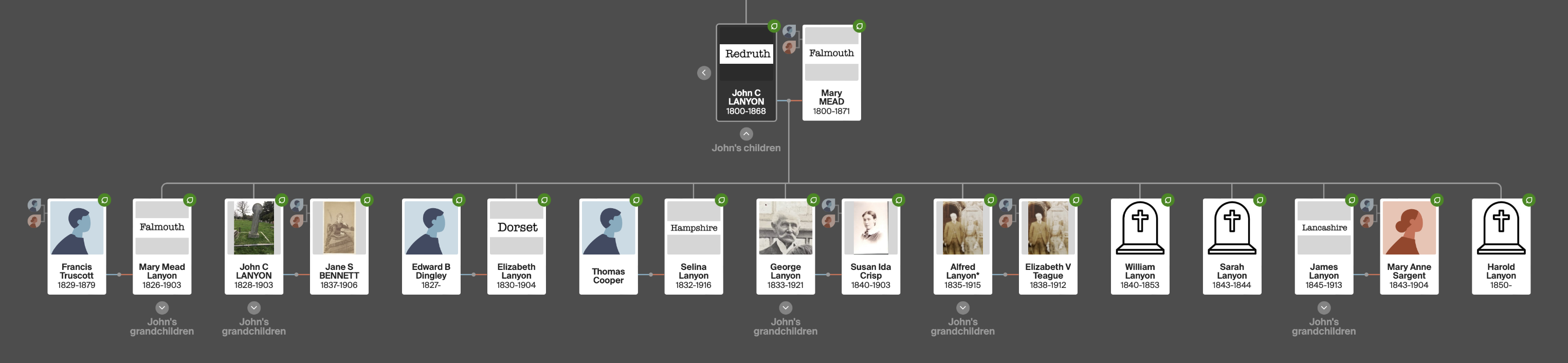
George Lanyon, the second son of John Charles Lanyon and Mary Mead, was nicknamed “The Shepherd”. This post is my attempt to find out why.
George was born 3 Oct 1833 at Redruth in Cornwall. His father owned an ironmongers on Fore Street and in his later years was a successful merchant tanner and ironmonger.
John Charles Lanyon died in 1868 and left a detailed will, there was no mention of his second son George and that was the first indication that all was not well.
JC Lanyon’s eldest son, also called John Charles, his third son Alfred and fourth surviving son Thomas all receive generous bequests and businesses. (The estate was valued at £35,000 in 1868.) But there was nothing for George, why?
George Lanyon appeared on the 1851 census as a seventeen year old ‘assistant’, presumably to his father. Sometime after 1851 and before 1861 he emigrated to Tasmania. His elder brother was already trading in Adelaide in Australia (he was a partner in Adelaide’s department store ‘Harris Scarfe’) perhaps George set out to emulate him?
Initially I thought George may have acquired his nickname ‘The Shepherd’ through a business interest in sheep farming in Tasmania however the story is a little more interesting than that!
On 3 July 1861 George married Susan Ida Crisp at Hobart in Tasmania.
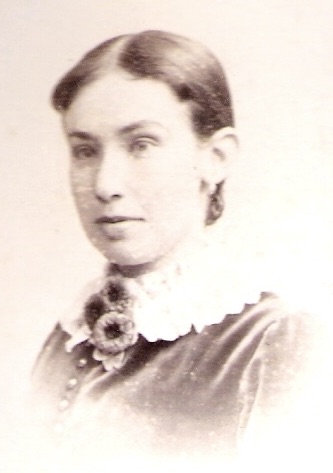
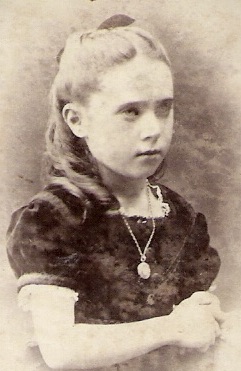
Susan Ida Crisp
By 1862 they had returned to Cornwall and their first child Catherine Rosina Lanyon was born at Falmouth.
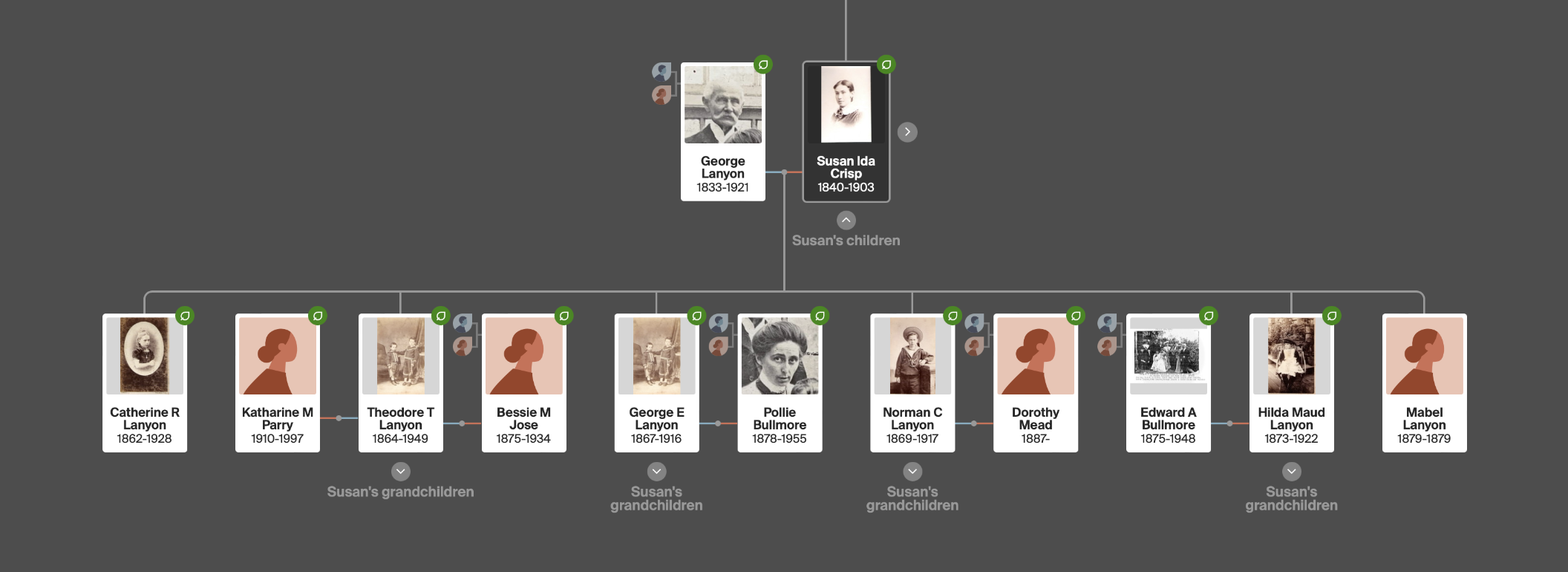
Their children:
Catherine Rosina 1862
Theodore Tasman 1864
George Edward 1867
Norman Crisp 1869
Hilda Maud 1873
Mabel 1879 who died in infancy
In 1871 the census describes George as a tanner employing 10 men, by all appearances a successful businessman like his brothers.
A closer look at Susan Ida Crisp revealed why he may have been given his nickname and also why he was left nothing in his father’s will.
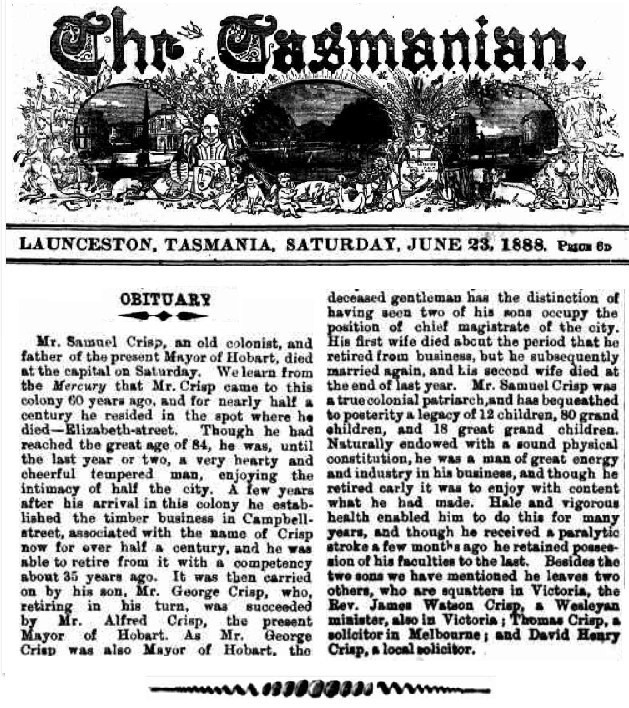
Susan was the daughter of Samuel Crisp and Elizabeth Sams. She was born in Hobart in 1840. Samuel’s obituary describes him as one of the original colonists.
What they failed to mention is how he arrived in Tasmania….transported for life for sheep stealing!
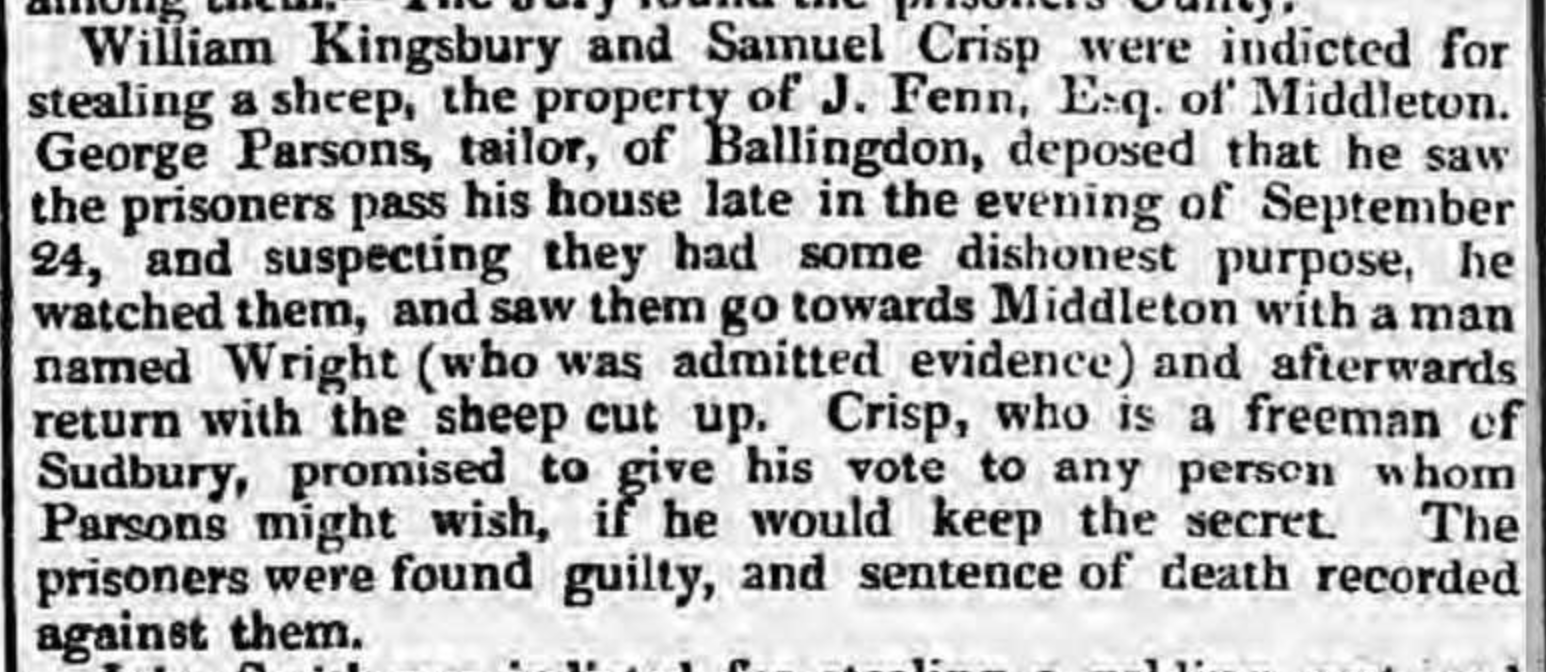
Samuel Crisp was born in Sudbury in Suffolk in 1805. In 1820 he was sentenced to a month in prison for larceny, stealing 18 yards of ribbon from the shop of John Holman. Shortly after this he married Elizabeth Sams and they had two young sons, Samuel born 1823 and George born 1824. In September 1825 Samuel was caught sheep stealing. The Bury and Norwich Post for December 1825 has this report:
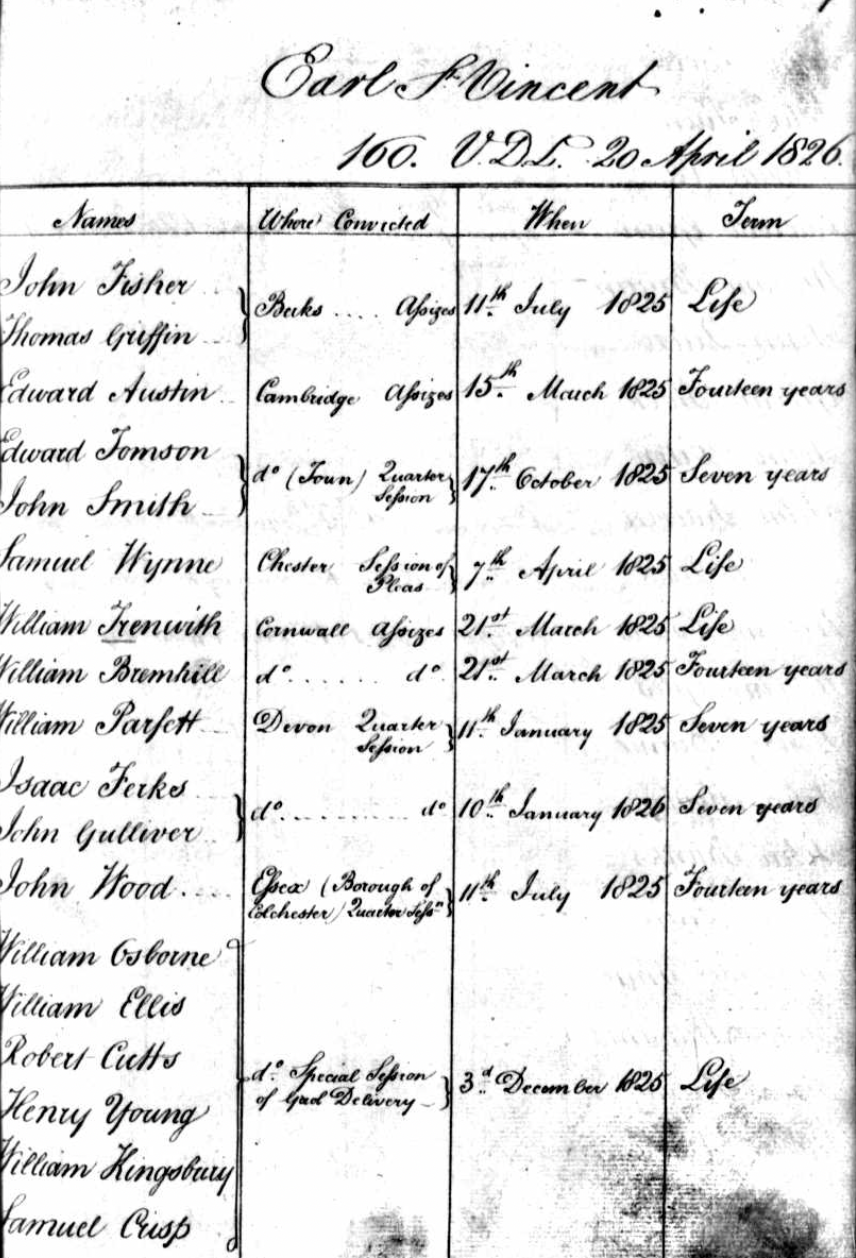
He was found guilty. The sentence of death was commuted to transportation for life and Samuel aged just 20 was transported to Tasmania on the ship “Earl St Vincent” which set sail on 20 Apr 1826.
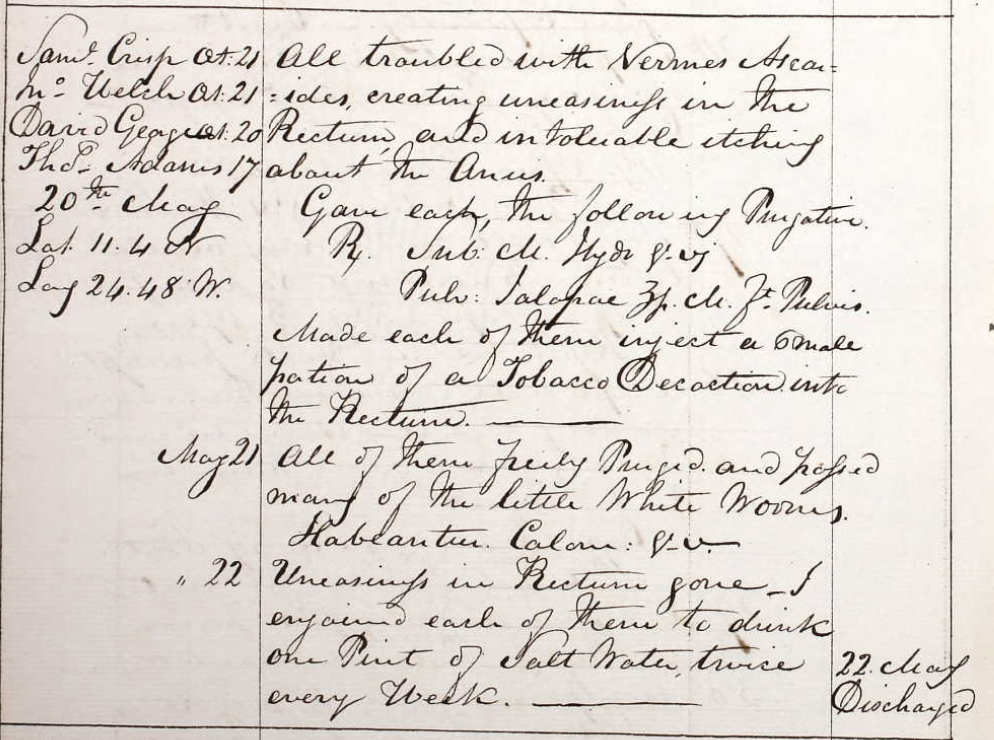
The Royal Navy kept detailed records and the ship’s surgeon records the following:-
So 200 years later we know Samuel and three others were suffering with worms which caused intolerable itching! The treatment sounds even worse; they were given a purgative and then had to inject a decoction of tobacco into their rectums! To prevent the worms returning they were told to drink a pint of salt water twice every week.
The journey to Tasmania took 110 days and the ship contained 180 prisoners.
Two years later Samuel’s wife and sons followed him to Tasmania and they produced another 5 children whilst he was still a prisoner.
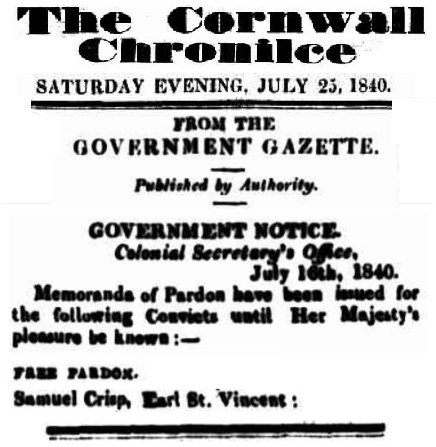
By 1840 “The Hobart Town Courier and Van Diemen’s Land Gazette” reported that he had been given a free pardon.
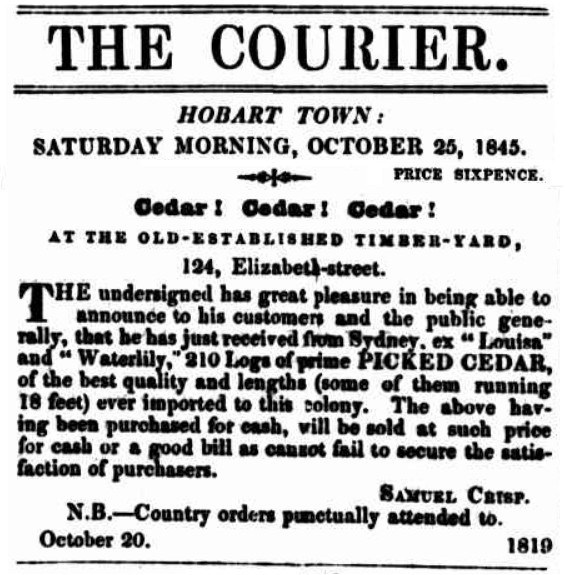
Now a free man Samuel set about creating a successful timber business, Crisp & Gunn.
Samuel and Elizabeth had twelve children. In 1853 Elizabeth died and Samuel remarried to an Elizabeth Farquarson. By the time of his death, aged 84, he had 80 grand children and 18 great grand children. He had become a respectable member of Hobart society. His children became solicitors and his son James was a Wesleyan minister. His grandsons served as Mayor of Hobart.
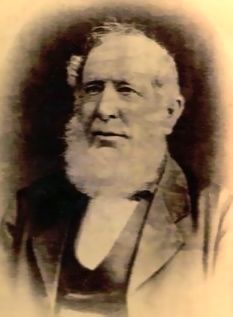
Samuel Crisp
So what became of his grandchildren in Cornwall?
Catherine Rosina never married. She lived with her father in Falmouth and died there in 1928.
Catherine Rosina Lanyon
Theodore Tasman 1867-1949. Theodore was a paymaster Admiral in the Royal Navy. There were four children from his first marriage.
George Edward 1869-1916. George was a doctor. There were six children from his marriage to Pollie Bullmore.
Theodore & George Lanyon
Norman Crisp 1869-1917. Norman married his cousin Dorothy Mead and they had three sons. He was shipwrecked in the English channel by a torpedo and drowned.
Norman Crisp Lanyon
Hilda Maud 1873-1922. Hilda married Edward Augustus Bullmore (Pollie Bullmore’s brother). He too was a doctor. They had two sons.
Hilda Maud Lanyon
George Lanyon and his family lived at Tasman Villa in Falmouth (circled) just behind what is now the Greenbank Hotel.
Susan Ida died in 1903 and George in 1921, at the grand old age of 88. He outlived all his siblings and three of his six children.
George is on the back row (left) standing behind his daughter in law Pollie.
Edward Augustus Bullmore, who was married to Hilda, collaborated with Jane Veale Mitchell to research the Lanyon family tree. He left his papers to William Smith Lamparter so that he could continue the research. In turn those papers made their way to me and ultimately led to the creation of this website.
So now we know why George Lanyon was nicknamed “The Shepherd”. If you have a better theory please get in touch!
Cecil was born 07 Aug 1894 • Brooklyn, New York, USA. He was the son of Ernest James Lanyon (originally from Guernsey) and Helen Sullivan. He was the eldest of three children. He was a private, service number: 2444596 in the 305th Infantry, 77th Division. He was killed in action on 31 Aug 1918 and was buried at Oise-Aisne American Cemetery, France.
Charles Edward Lanyon 1882-1918
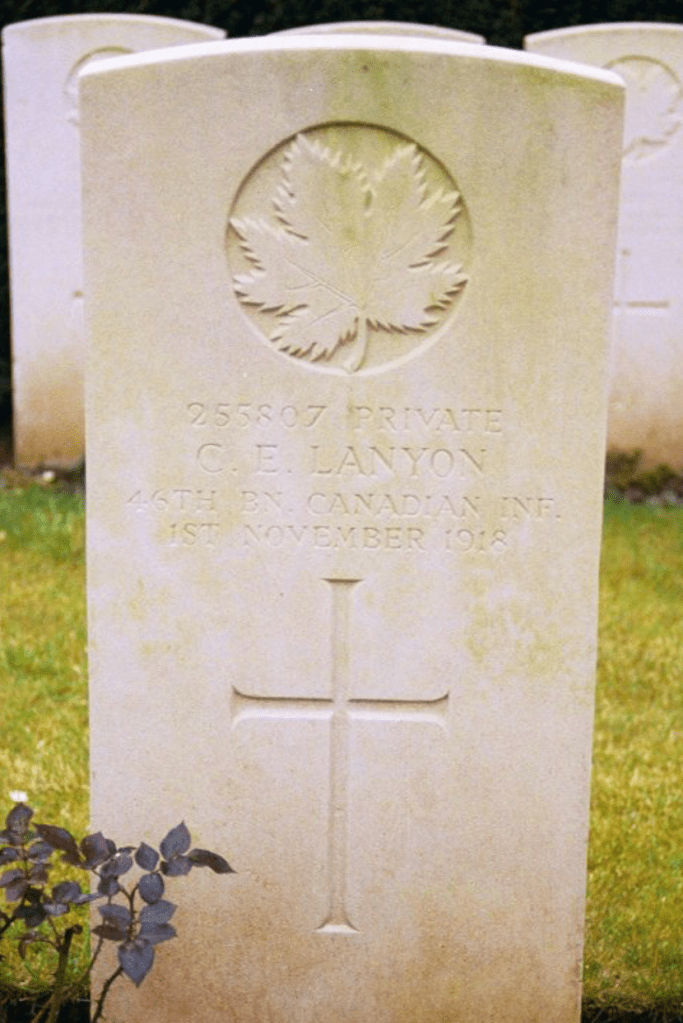
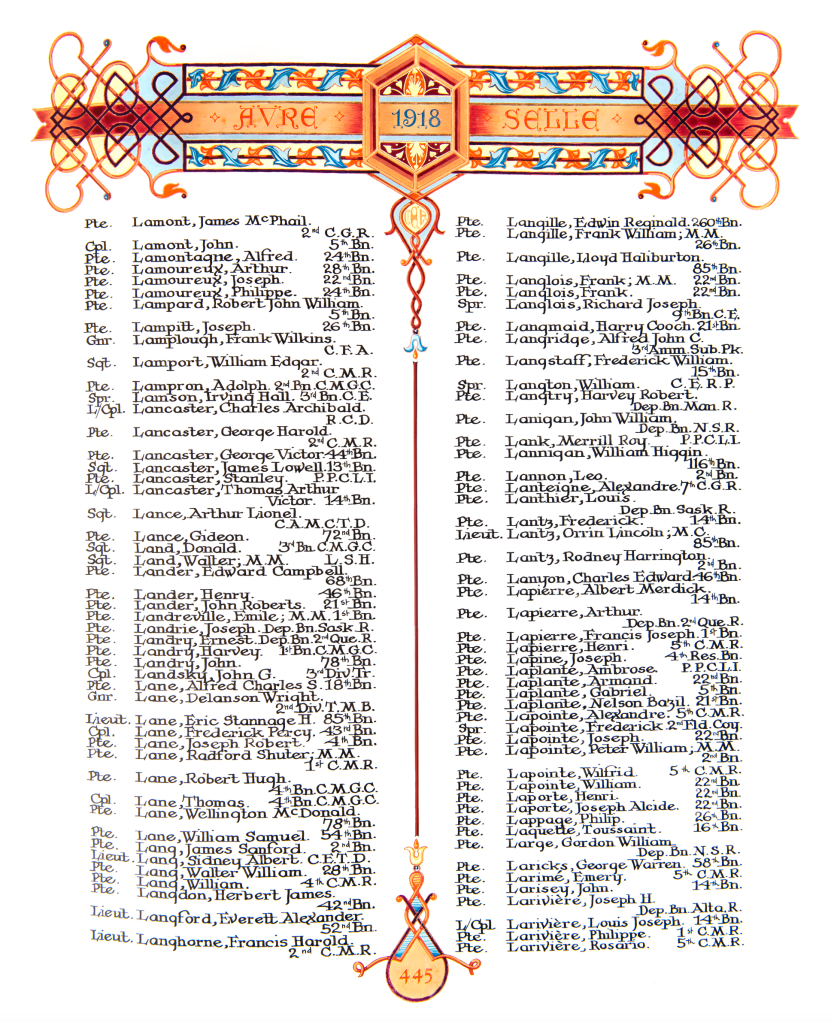
Charles was born 05 Mar 1882 • Penzance, Cornwall, England the son of John Rodolphus Lanyon and Emily Anne Hearle. He was the fifth of six children born to the couple. He was a farmer who emigrated to Manitoba, Canada in 1909. He was a private in the 46th battalion of the Canadian Infantry (Saskatchewan Regiment), service number: 255807. He was killed in action (shot by a sniper) on the 1 Nov 1918, just days from the armistice on 11 Nov. He was buried at Aulnoy Communal Cemetery, Nord, France.
Charles Edward Lanyon’s graveFirst World War Book of Remembrance (Canada)
Frederick Lanyon 1895-1916
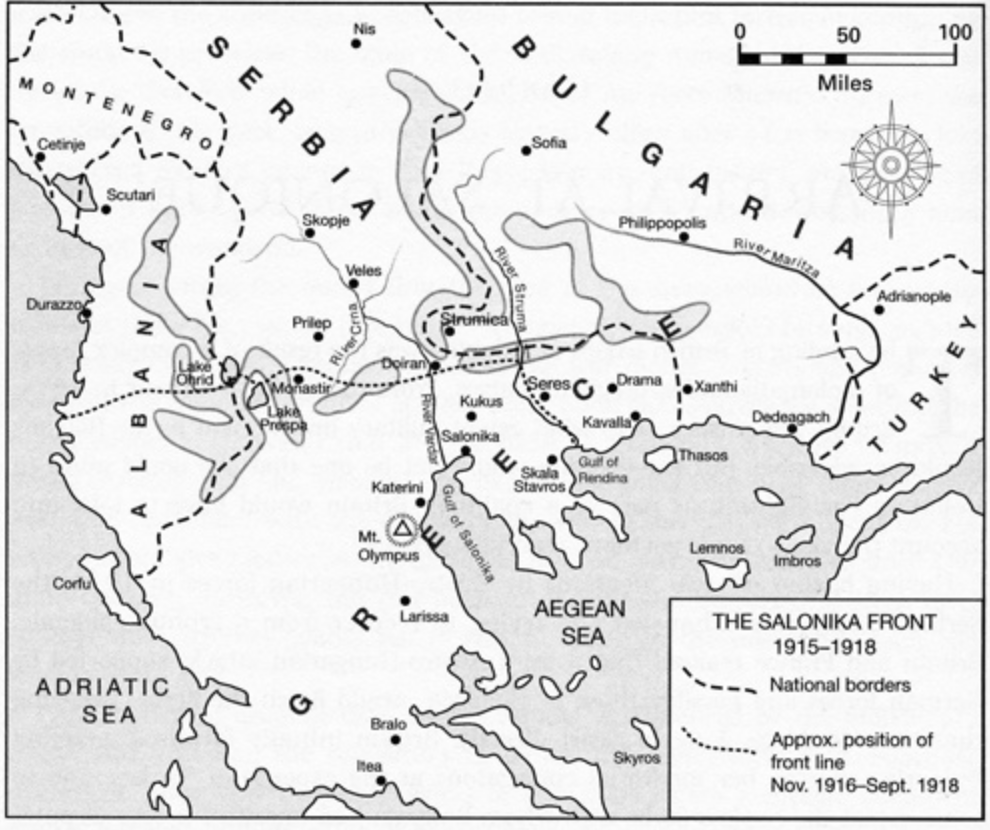
Frederick was born 16 Apr 1895 • Chacewater, Cornwall, England, the son of Frederick Lanyon and Susanna Tregoning. Frederick was a private (service number SE/20297) in the Army Veterinary Corp. He died on 30 Nov 1916 at Salonika, Greece.
George James Lanyon 1909-1942
George was born 8 Nov 1909 • Harlton, Kent, England, the son of George Henry Lanyon and Daisy Harriet Warren. He was the second of five children born to the couple. The 1939 Register shows he was a munitions worker. He served in Fighter Command as an Air Craftsman First Class, service number 1031229. He was killed, aged 32, in an accident at the military base at Llanbedr, Merioneth on 9 Sep 1942 when he was struck while on drogue collection duty by a Spitfire which was taking off.
Harold Merrill Lanyon 1920-1942
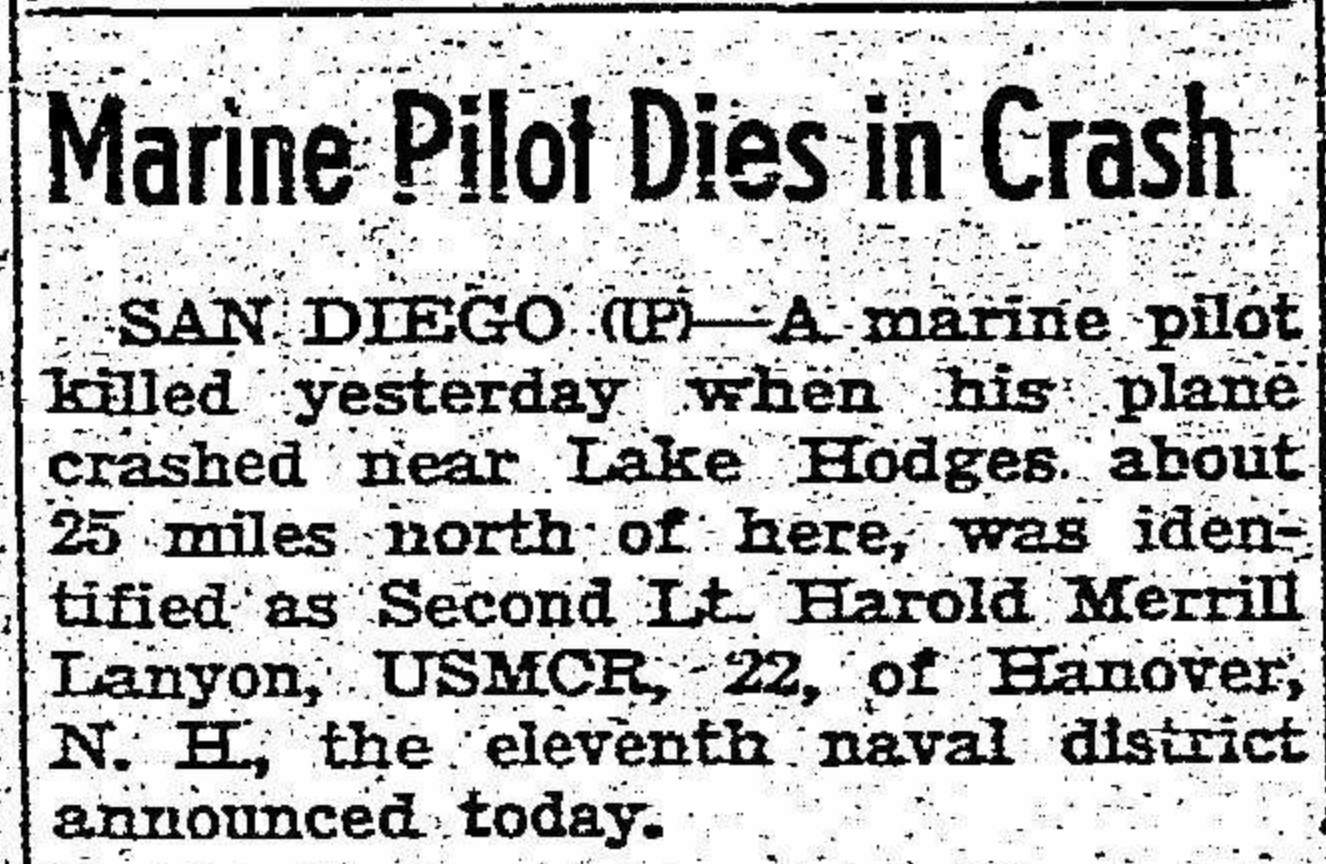
Harold was born 01 Jun 1920 • Hanover, New London, Connecticut, USA. He was the son of William Jacob Lanyon and Frances Merrill and the eldest of four children. He joined the Marine Corps and was a marine pilot. He was accidentally killed when his plane crashed on 24 Nov 1942 in California, USA.
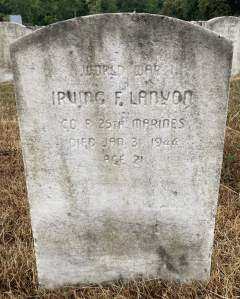
Irving Frances Lanyon 1922-1944
Irving was born 11 Jul 1922 • Stamford, Connecticut, USA, the only son of Irving Lanyon and Leona Madelon Farrell. He was a Private First Class (service number: 439683) in the 2nd Btn, 25th Marines. He was killed in action in the Marshall Islands on 31 Jan 1944 age just 21.
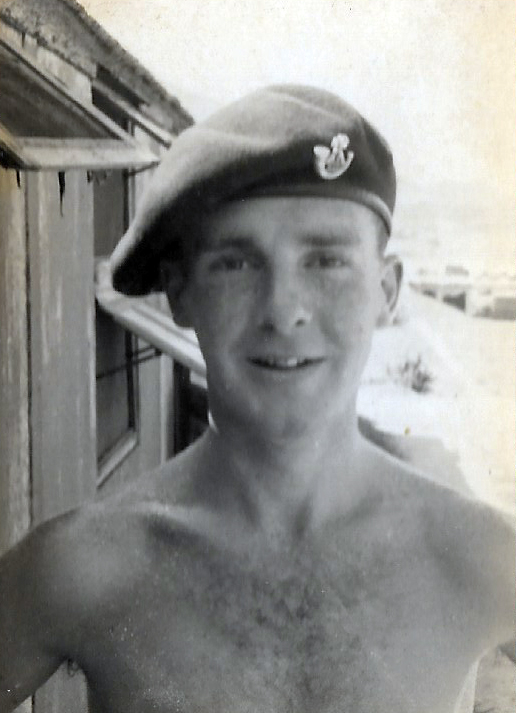
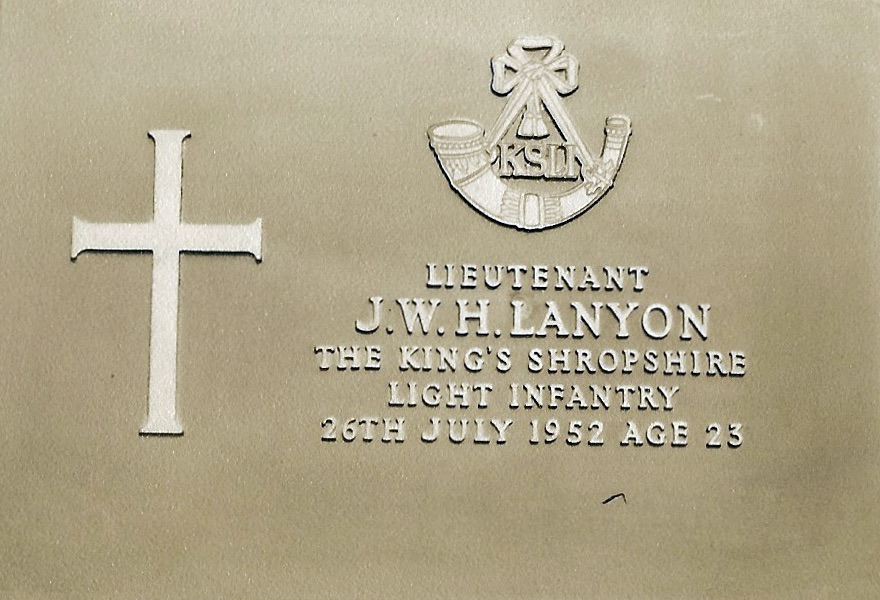
John William Haig Lanyon 1929-1952
John, known to his family as ‘Bill’, was born in 1929 in Nantwich, Cheshire, England, the eldest son of John Arthur Lanyon and Nancy Eleanor Mitchell. He was a Lieutenant (service number: P/407938) in the 1st Battalion King’s Shropshire Light Infantry. He was killed on 26 Jul 1952 in Korea and buried at the United Nations Memorial Cemetery Tanggok, Busan, South Korea. He is commemorated on the Kelsall War Memorial in Cheshire.
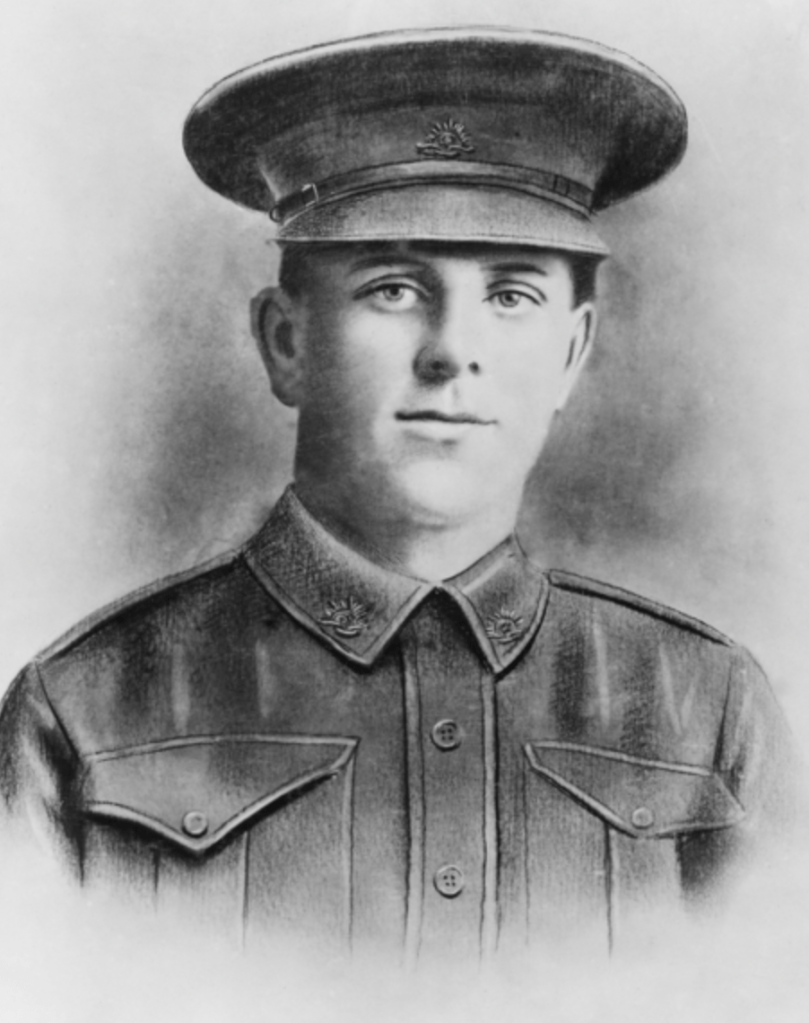
Joseph James Lanyon 1894-1916
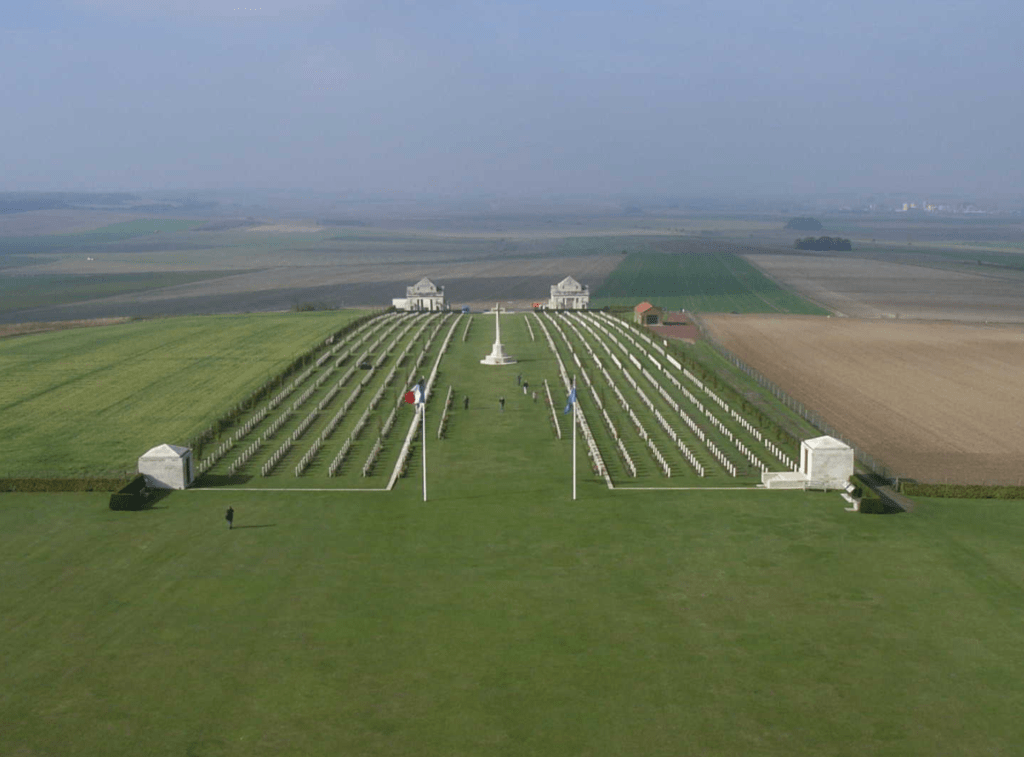
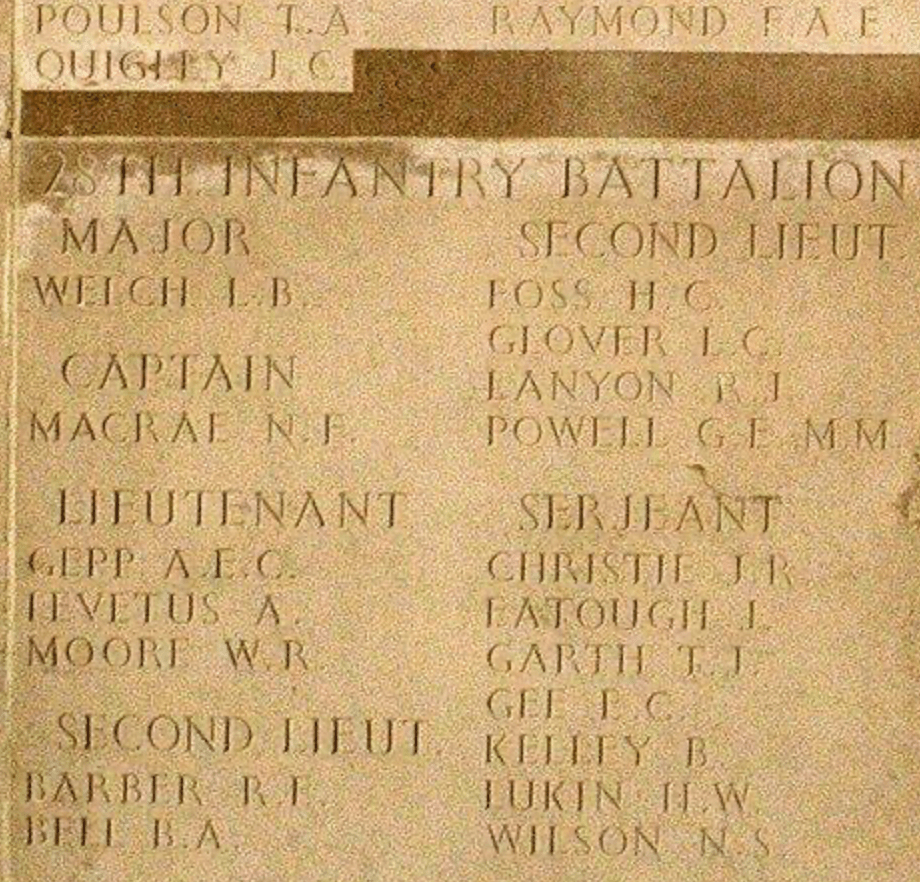
Joseph was born at Broken Hill, New South Wales, Australia in 1894, the son of John James Lanyon and Eliza Jane Sampson. He was the fourth of seven children. Private Joseph James Lanyon, 1st Battalion from Broken Hill, NSW. A 21 year old labourer with previous service in the 20th Militia prior to enlisting on 13 Apr 1916, he embarked for overseas with the 3rd Divisional Cyclist Company from Sydney on 18 May 1916 aboard HMAT Demosthenes (A64). On arrival in France, he transferred to the 1st Battalion on 29 Oct 1916 and was killed in action near Gueudecourt, France on 5 Nov 1916. Pte Lanyon is commemorated on the Australian National Memorial at Villers-Bretonneux, France with others who have no known grave.
Joseph James Lanyon (public domain photo)Australian National Memorial at Villers-Bretonneux
Kenneth Maurice Munro Lanyon 1913-1940
Kenneth was born in Portsmouth, Hampshire, England in 1913. He was the only son Harold John Lanyon and Ada Maud Munro. In 1939 he married Pattie Vinson Hewitt. He was a gunner in the Royal Artillery, 4th Battalion City of London Regiment. Service number: 1432428. He died in hospital on 30 Dec 1940, he was suffering from inflammation of the kidneys and heart weakness aged 27. He was buried at Rakowicki Cemetery, Małopolskie, Poland.
Robert Jordan Lanyon 1891-1917
Robert was born 16 May 1891 • Cometville, Queensland, Australia, the son of Richard Lanyon and Kate Jordan. He was one of 15 children born to the couple, 9 of which died in infancy. Robert was a bank clerk who volunteered for the Australian Infantry. He was a 2nd Lieutenant. He was killed on 3 May 1917 at the Battle of Bullecourt and was buried at Villers-Bretonneux, Departement de la Somme, Picardie, France.
Angus Herbert William Kennedy 1906-1941
Angus was born 13 Mar 1906 • Bendigo, Victoria, Australia, the only son of Donald Dan Kennedy and Elizabeth Anne Lanyon. He was a gunner in the Second Australian Imperial Force (service number: Vx1088). He was killed at the Battle for Crete on 24 May 1941 and buried at Athens, Greece.
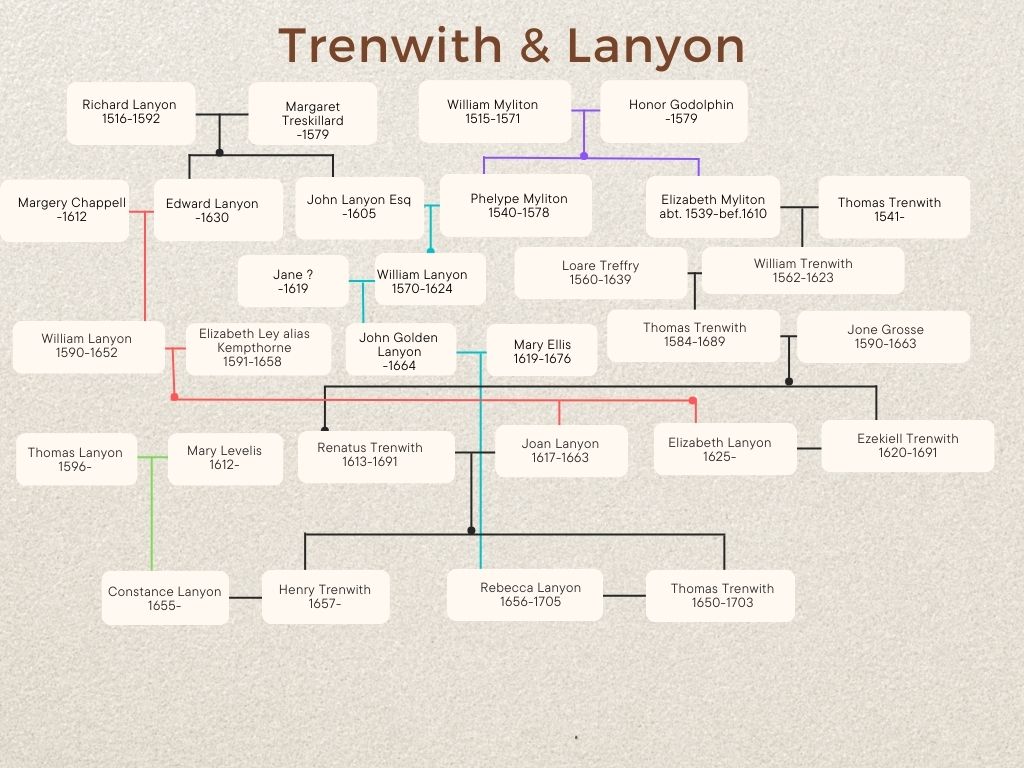
The Trenwith family has connections with the Lanyon family going back to Tudor times. Thomas Trenwith married Elizabeth Myliton, the daughter of William Myliton and Honor Godolphin of Pengersick Castle, Breage. Elizabeth’s sister was Phelype Myliton who married John Lanyon Esq.
It’s a confusing tree and I hope I’ve finally got it right!
The great grandsons of Elizabeth and Thomas; Renatus Trenwith and Ezekiell Trenwith married two sisters. Joan and Elizabeth Lanyon the daughters of William Lanyon and Elizabeth Ley alias Kempthorne. William was the son of Edward Lanyon and Margery Chappell and the nephew of Phelype Myliton and John Lanyon.
Renatus and Joan had a son called Thomas Trenwith and he married Rebecca Lanyon who was the great grand daughter of Phelype Myliton and John Lanyon.
Renatus and Joan had another son called Henry Trenwith and he married Constance (her surname is not mentioned in the Madron parish register) but she could be the daughter of Thomas Lanyon and Mary Levelis.
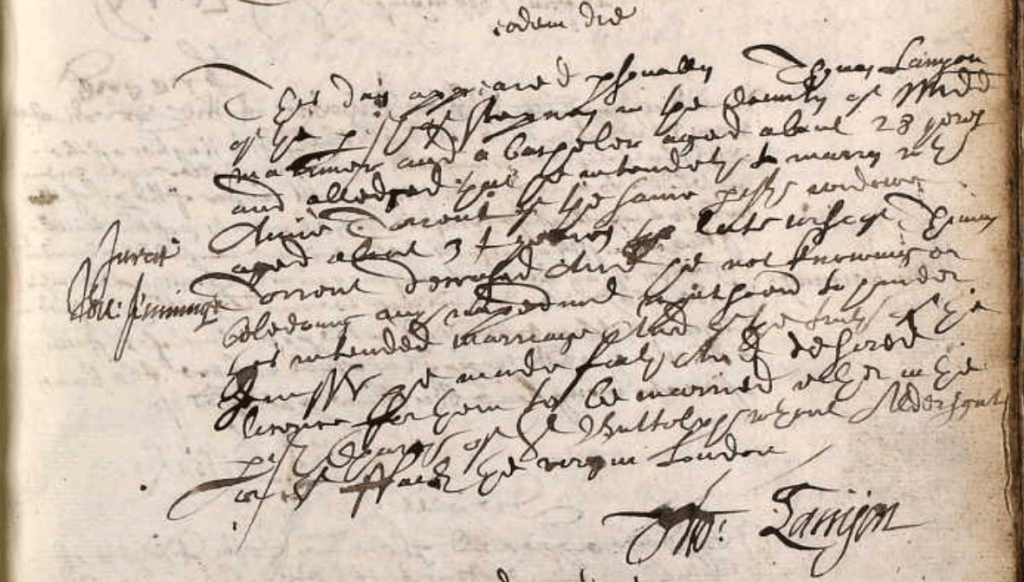
Paskis Lanion married Thomas Shetford at St Just in Penwith in 1625. Who was Paskis Lanion? If only the answer was straight forward!
A quick trawl through the Cornwall Online Parish Clerks database revealed no baptisms for a Paskis/Paksis/Pascha/Pasca/Paska/Paskes/Paskas Lanion/Lanyon.
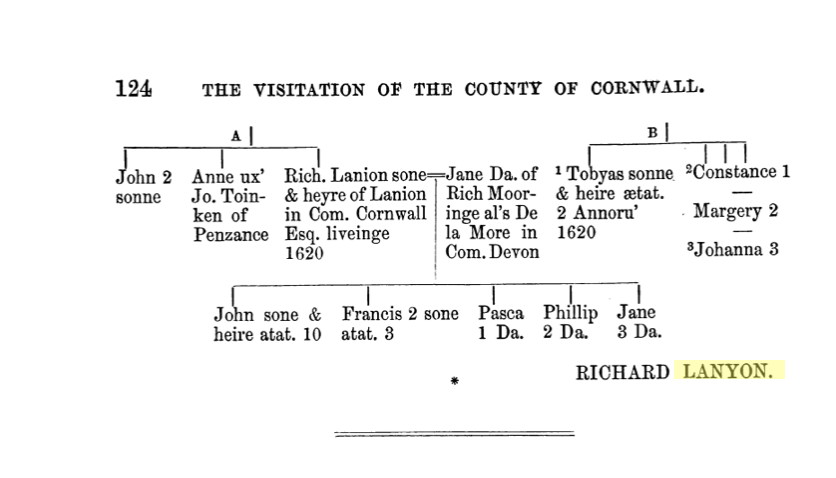
However the Heralds Visitation for Cornwall 1620 does have a suitable candidate:
Vivian’s Herald’s Visitation of Cornwall 1620
Richard Lanyon Esq submitted his tree showing that his wife was Jane Mooring alias De La More from Devon and their eldest daughter was called Pasca but was she old enough to get married in 1625?
Their eldest son was John aged 10 in 1620 so therefore born in 1610. Could Pasca be older than John? When did Richard marry Jane? The Royal Institution of Cornwall has a marriage settlement between Richard Lanyon and Jane his wife dated 1608 so presumably they married about 1608. The letter from Mrs Rose Tolman confirms that Jane’s mother was called Pascha Risdon so eldest daughter was named after her grandmother.
Francis 2nd son – deposition taken 1635 when he is aged 16 so born in about 1619
Elizabeth baptised 17 Nov 1622 St Merryn
The children with no baptisms recorded are:
Pasca eldest daughter born before 1613 when Philippa is baptised
Jane 3rd daughter born after 1613 and before 1622
Richard not listed on Herald’s Visitation so presumably born after 1620
Thomas not listed on Herald’s Visitation so presumably born after 1620
Margerie – from Richard Lanyon Esq’s will it is implied that Elizabeth and Margerie are the youngest daughters
The latest Pasca could have been born was 1613 and with John born in 1610 and two unbaptised babies born in 1611 and 1612 it looks likely that Pasca was probably born about 1608/9 which would make her about 16 years of age at the time that the marriage to Thomas Shetford took place. So she is a possible candidate.
Richard Lanyon Esq’s will of 1636 left all his daughters £30 or £40 apart from Pasca who received 5 shillings which implies that in 1636 she was already married and had received her ‘portion’. Sadly the will does not mention her married name.
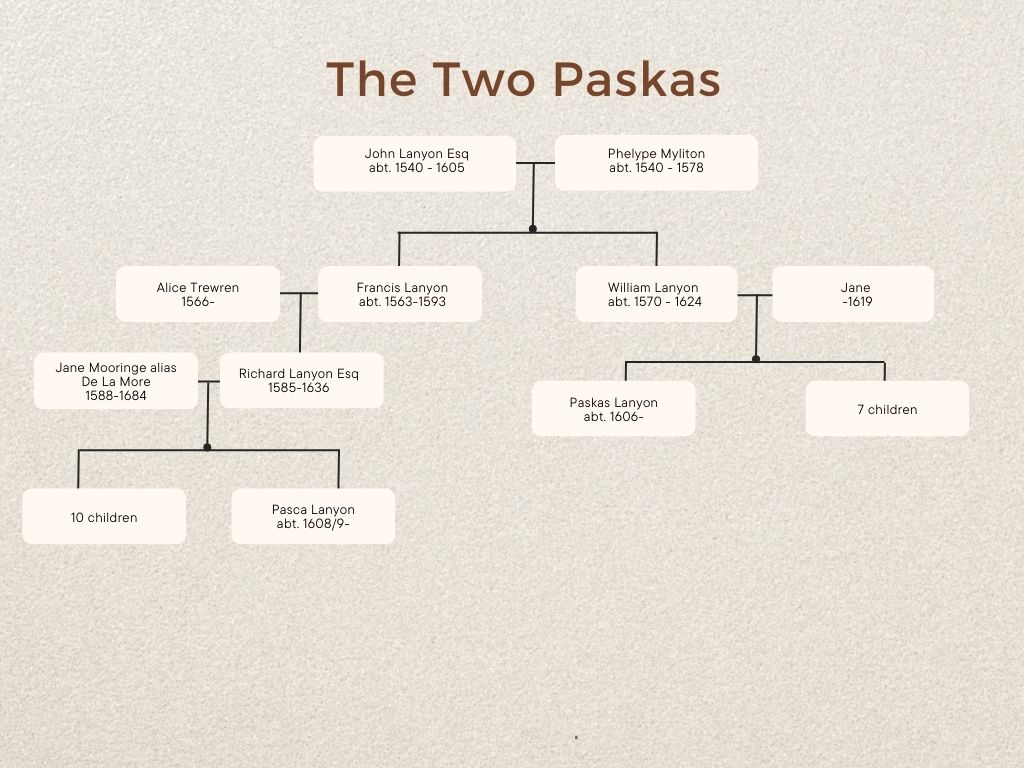
The only problem is that there is a second Paskas who is also a candidate.
Richard Lanyon Esq’s uncle William has a daughter also called Paskas.
William’s daughter’s baptism isn’t recorded but we know she existed from his will. Again we’ll have to list his other children and see where she could fit in:
Elizabeth baptised 31 Oct 1593 Sancreed
John baptised 8 Jun 1596 and buried 15 Sep 1601 at Sancreed
John born after Sep 1601
Jane baptised 24 Oct 1602 Sancreed
William baptised Dec 1603 Sancreed
Elyzabethe baptised 17 Jul 1607 Sancreed
Both daughters called Elizabeth survived and are mentioned in William’s will of 1624!
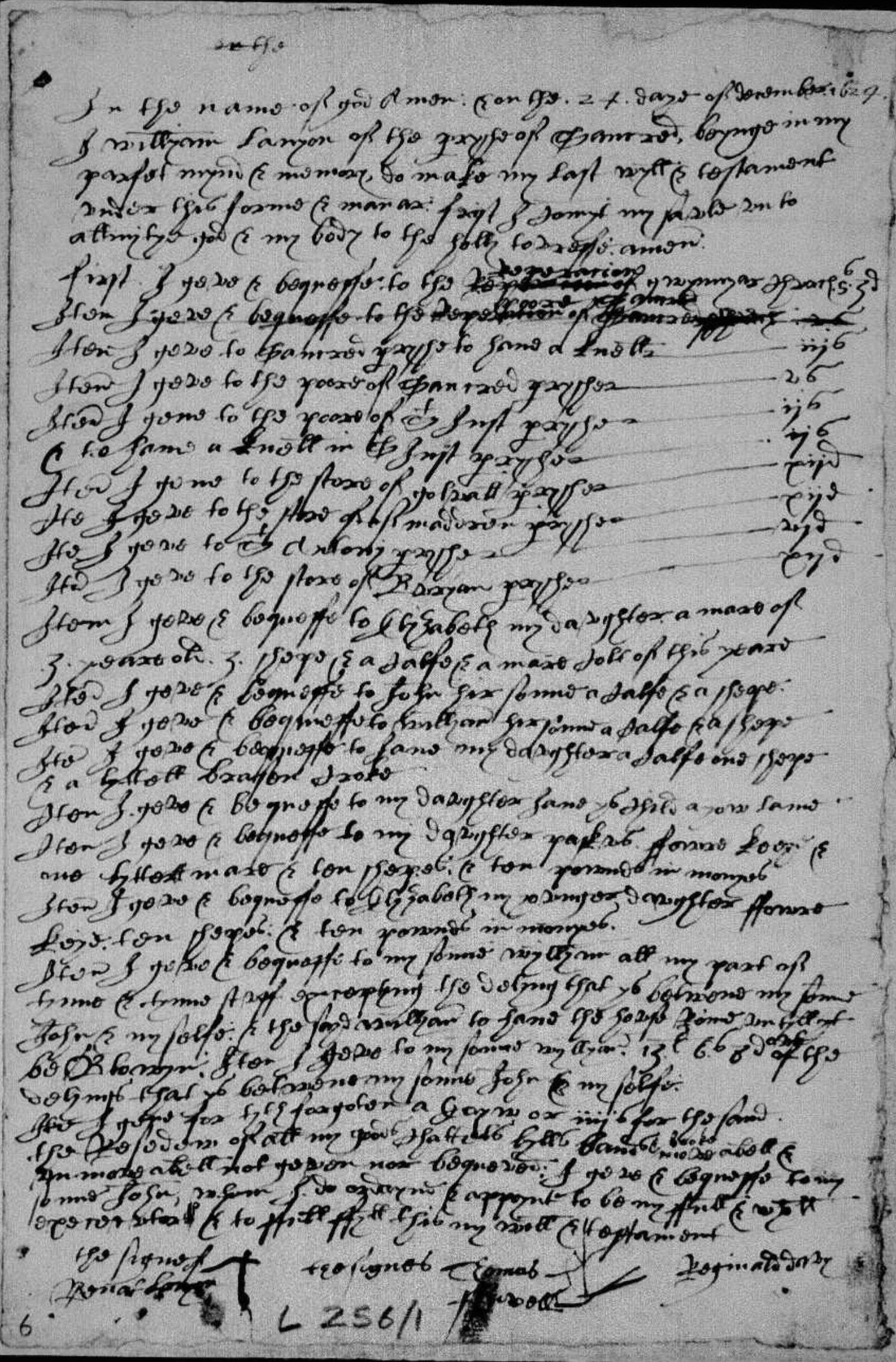
William’s Will of 1624 – Source CRO AP/L/256
Abstract:-
WILLIAM LANYON of Sancreed written: 24 Dec 1624 proved: 8 Feb 1624/5
poor of Sancreed – 3 sh. poor of St. Just – 5 sh. poor of Gulval – 12 d. poor of Maddern – 12 d. poor of Antony – 12 d. poor of Buryan – 12 d. daughter: ELIZABETH – mare, 3 sheep, calf, mare colt JOHN her son – calf & a sheep WILLIAM her son – calf & a sheep daughter: JANE – calf, 1 sheep, brazen crock daughter JANE’s child – a ewe lamb daughter: PASKAS – 4 kyne, mare, 10 sheep, 10 pounds youngest daughter: ELIZABETH – 4 kyne, 10 sheep, 10 pounds son: WILLIAM – all my part of tin and tin stuff, 13 pounds, 6 sh., 3 d. son: JOHN – all the rest & executor
The will implies that Paskas is younger than Jane and older than Elizabeth his youngest daughter which suggests that she was born between 1602 and 1607. So aged about 18-23 in 1625 when the marriage to Thomas Shetford took place.
It’s interesting that William leaves 5 shillings to the poor of St Just as that’s the town that Thomas Shetford comes from.
Who was Thomas Shetford?
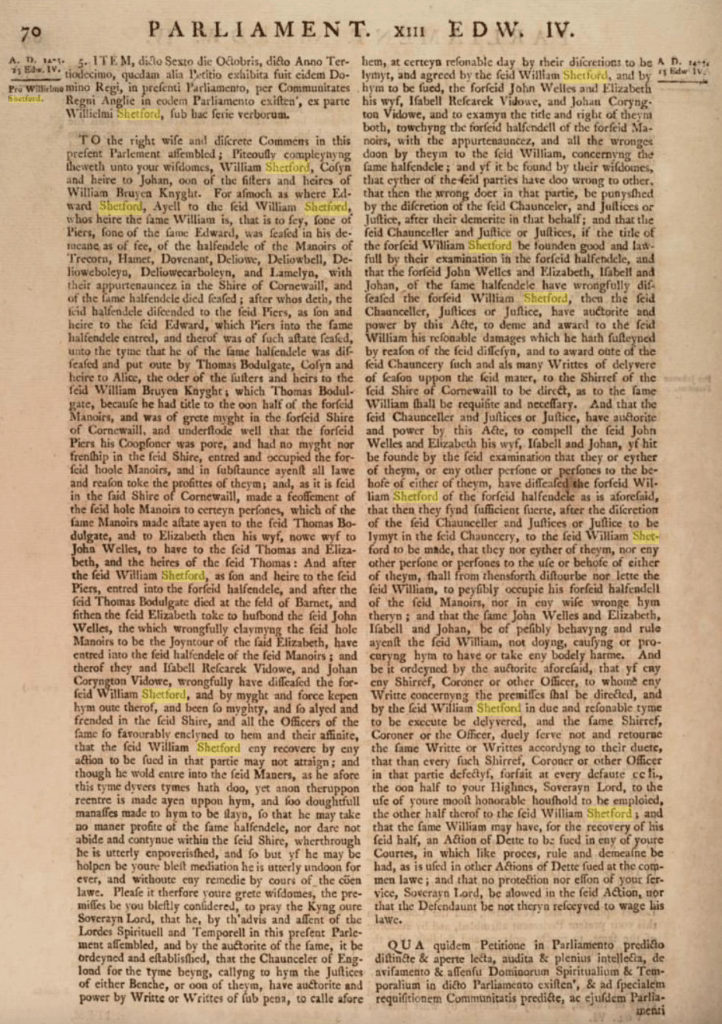
The Shetford/Shutford (and occasionally Shitford!) family originally came from Somerset. They were cheated out of a half share in six manors in Cornwall by Sir Thomas Bodulgate during the Wars of the Roses.
Source – History of Parliament Edward IV
We know very little about Thomas, the parish registers for St Just in Penwith start quite late but with the little we know we can create a tree that might be correct.
We know that Paskis Lanion married Thomas Shetford at St Just in Penwith in 1625 so he was probably born about 1600
There is a baptism for a Margarett Shetfod (Sic) daughter of Thomas on 14 Nov 1630 at St Just listed in the Exeter Bishop’s Transcripts
16 Oct 1647 marriage at St Just between Elizabeth Shetford (daughter of Thomas) and John Rawlyn (Source – OPC)
Baptism of Alse Shutford, daughter of Thomas 20 Dec 1633 St Just (Source- FHL film number 0226217, 0226218, 962681)
Burial of Paskes Shetford, widow 19 Dec 1681/2 St Just in Penwith (Source – OPC)
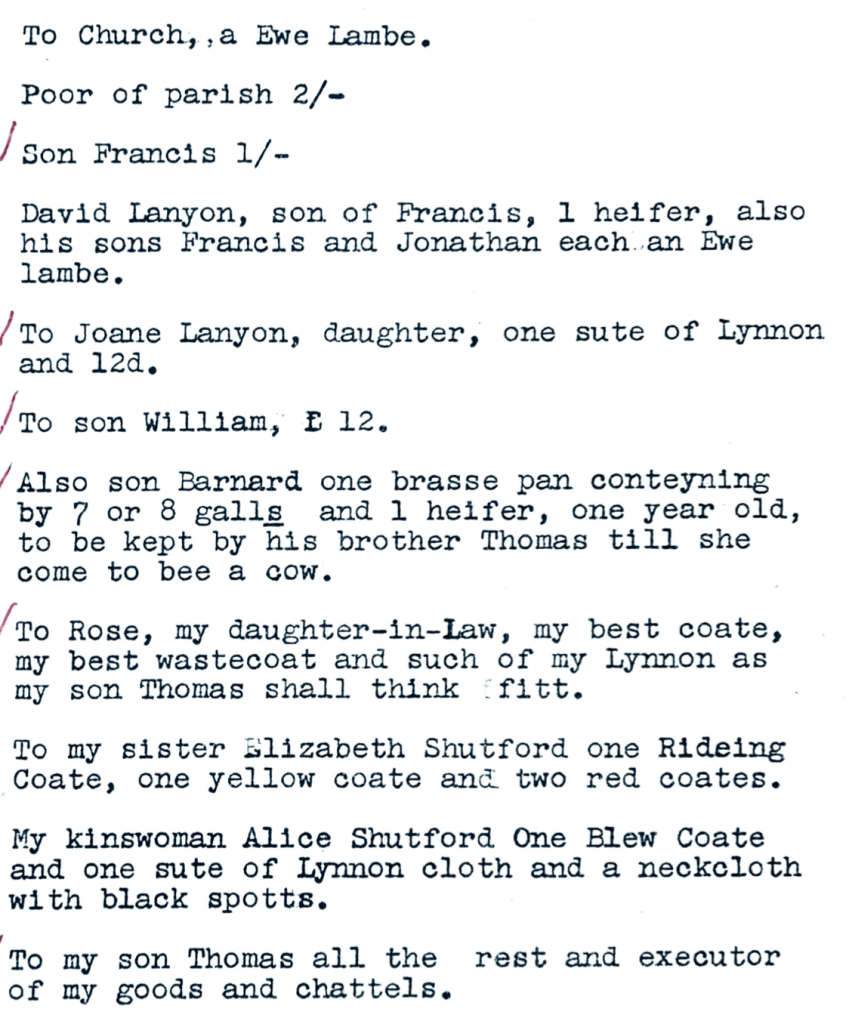
The will of Joan Lanyon (Shutford) 1655 (Source – NA PROB 11/257/72) Joan was the wife of David Lanyon of Madron and her will mentions her Shutford relatives
There is also a record at Kresen Kernow (The Cornish Record Office) which mentions Thomas and William Shilford.
Lease, tenement, Treloweth Wartha, Illogan
Parties:
1) Right Honourable John Lord Robartes, Baron of Truro.
Term: 99 years, or the natural lives of [?] Lanyon, John Lanyon his brother and William Shilford, son of Thomas Shilford.
Annual rent: 46 shillings 8 pence, one capon or 12 pence, a harvest day or 6 pence.
Heriot: Best beast or £3.
Reference number
CL/1/124
Date
3 Oct 1635
I think it should be William and Thomas Shitford/Shetford rather than Shilford. Could Thomas have a son called William and could these Lanyons be Paskas’ brothers?
The Paskas born in Sancreed had brothers called John and William. ‘William Lanyon Yeoman of St Just’ listed in the lease is definitely not the St Merryn family of Lanyons.
There is a marriage of a William Shetford and Mary Edward at St Just on 26 Nov 1653, they had two daughters: Rebecea (sic) bapt. 1655 and Ellizabeth (sic) bapt. 1657.
There is a legal dispute between John Lanyon and William Shutford in 1659, the year Thomas Shutford died. Source – NA C 10/48/84
Lanyon v Shutford.
Plaintiffs: John Lanyon. Defendants: William Shutford, James Pratt and Robert Baynard. Subject: property in Sancreed, Cornwall.
This is the hypothetical tree I’ve created from all those snippets of information.
We still haven’t conclusively answered the question which Paskis Lanion married Thomas Shutford in 1625 but I think the Paskas born to William Lanyon of Sancreed is the more likely candidate.
William Lanyon died in 1624 (his wife had died in 1619) and left Paskas £10 and some cattle. The following year she married Thomas from the neighbouring parish of St Just in Penwith.
Ultimately geography may be the best clue, the distance between St Just and Sancreed (near Penzance) is a lot smaller than the distance between St Just and St Merryn (near Padstow).
With thanks to Louise Quigley who first posed this question in 2014 and the Penwith Genealogy Group who produced some great answers and evidence.
John Lanyon was born after 1596 and before 1600 at either St Agnes or Breage, there is no baptism recorded for him. His parents John & Tamsin were married at St Agnes in 1596 and his younger brother William was baptised at Breage in 1600.
By 1618 John is in London. He was listed on an indenture dated 19 Oct 1618-
John Lanion gent of New Place Essex in chancery indenture re- properties in Breage.
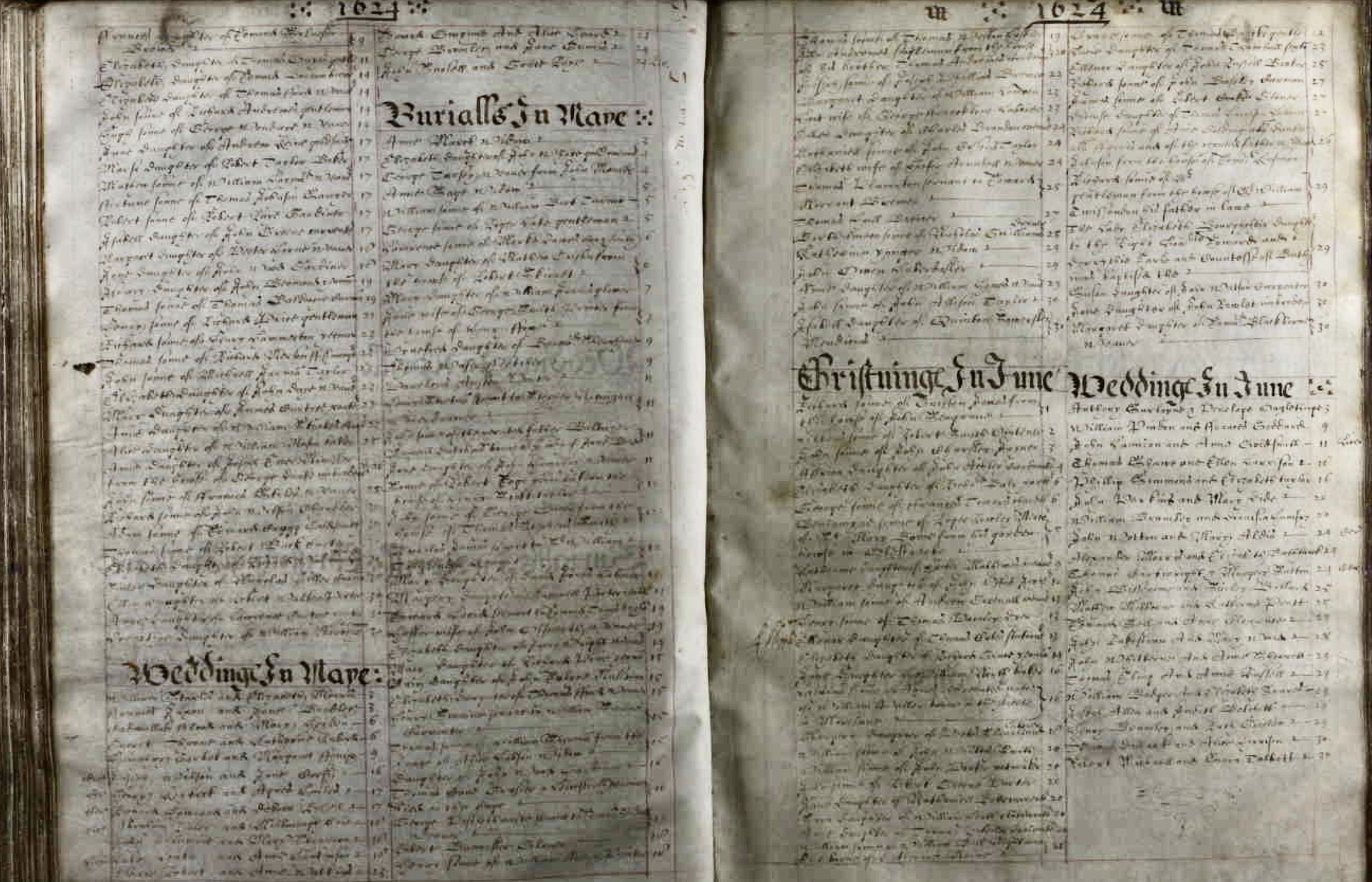
On 11 Jun 1624 John married Anne Goldsmith at Saint Giles Cripplegate, London.
St Giles Cripplegate Parish Register – Source London Metropolitan Archives
It appears as though they returned to Breage as some of their children were baptised there.
John – 1625 a John, son of John Lanyon, was buried at Breage in Jun 1625
Clemens 1626- baptised at Breage 11 Jun 1626 no further trace
Lawrence 1627- baptised at Holborn in London no further trace
Joseph 1629- baptised at Holborn in London no further trace
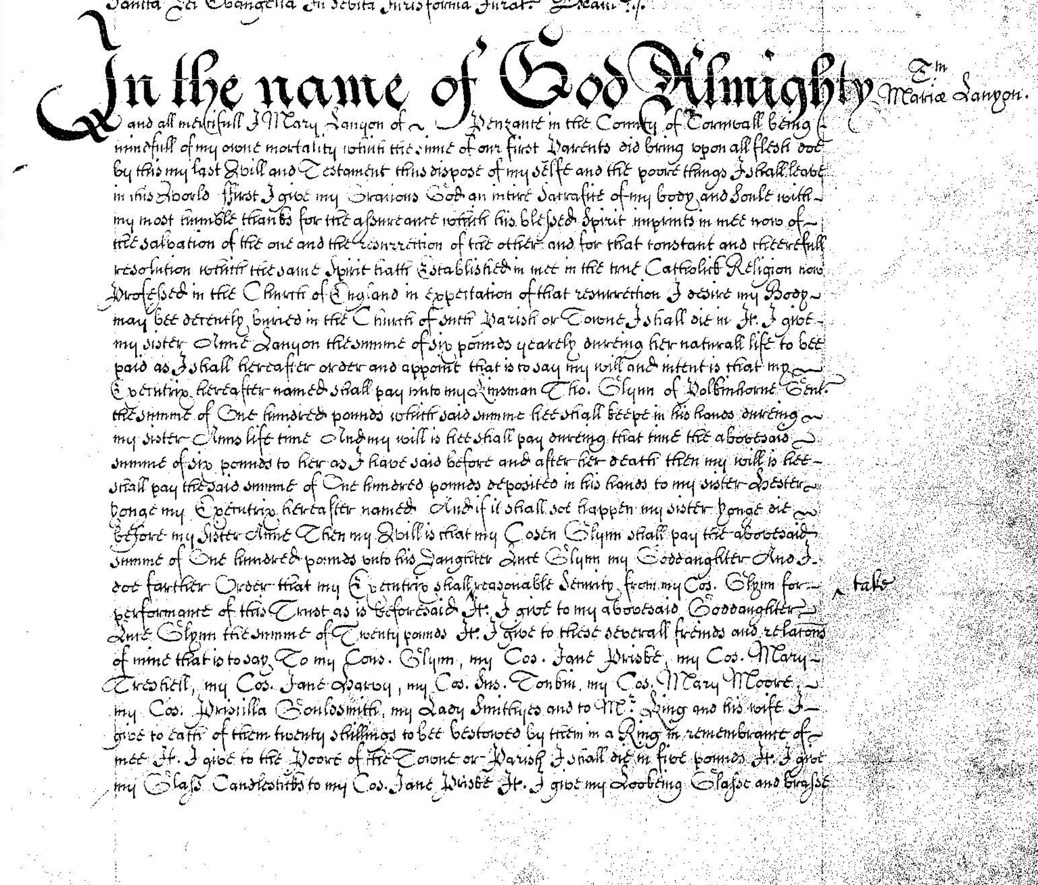
Mary 1630-1686 she was a spinster and was buried in Penzance in 1686, she left a great will which mentions lots of relatives
Source – NA/PROB/11/386
Partial transcript:
To my sister Anne Lanyon the sum of £6 yearly for her natural life
To my kinsman Thomas Glynn of Polkinghorne gent the sum of £100 which he shall keep in his house during my sister Anne’s lifetime to pay her £6 yearly and then to my sister Hester
Thomas Glynn’s daughter my goddaughter Jane Glynn the sum of £20
Cousins Glynn, cousin Jane Prisbe?, Mary Treshell?, cousin Jane Darby, cousin ? Tonkin, cousin Mary Moore, cousin Priscilla Goldsmith, Mr. King and his wife – 20 shillings each for a ring in remembrance of me
Poor of the town or parish £5
Glass candlesticks to Jane Prisbe?
Looking glass and brass candlesticks to Susanna Glynn
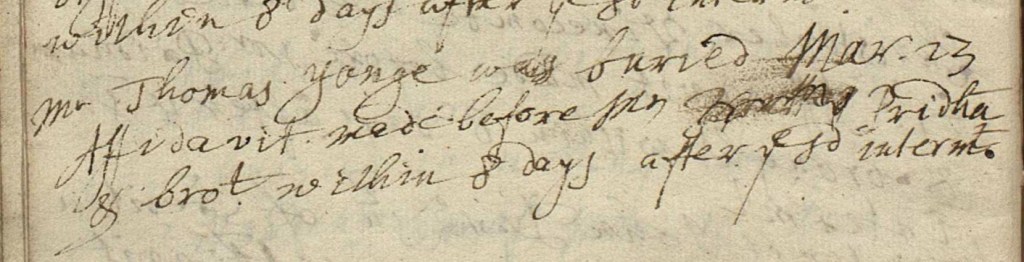
Sister’s picture and great cabinet to brother Yonge
Watch to cousin Thomas Glynn the younger
Chamber furniture to Hester Yonge
My china and earthenware as my sister will part with to cousin Jane Darby
My cousins Grace and Jane Daniell
My sister Yonge
We can place some of these cousins on the tree.
John and Anne’s other children were:
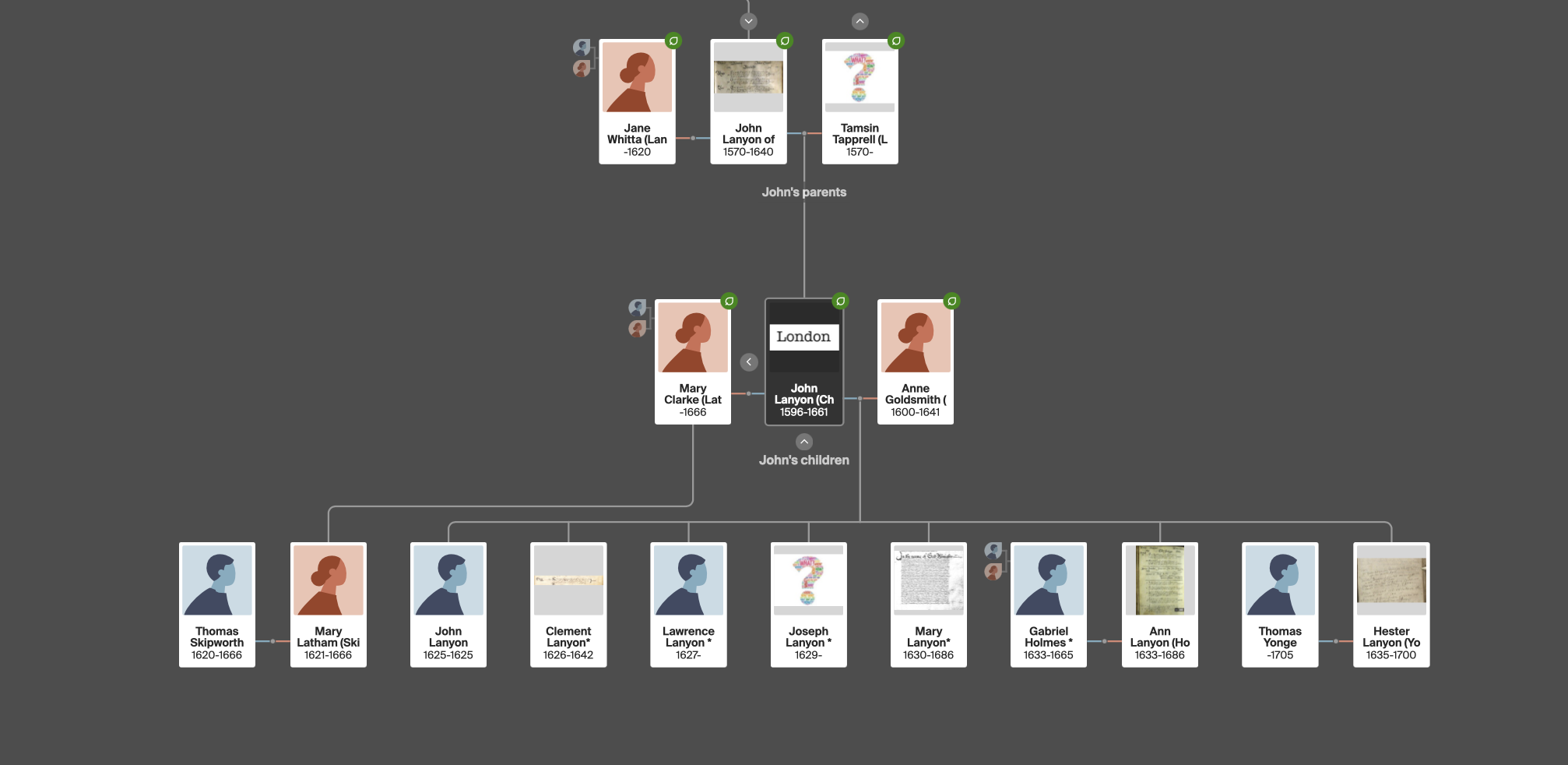
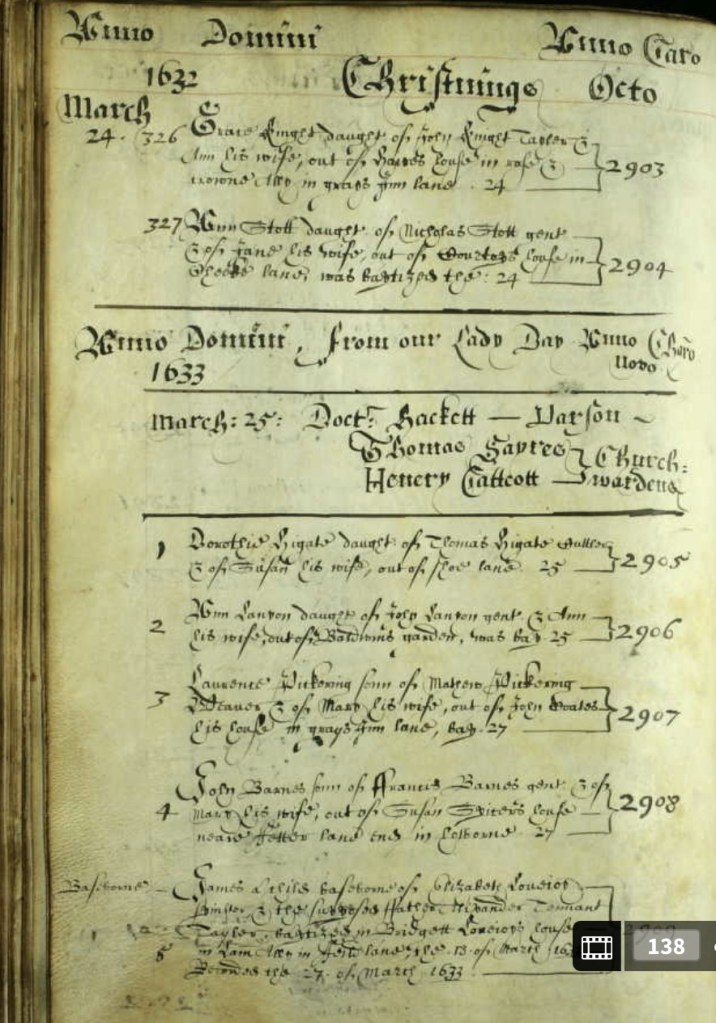
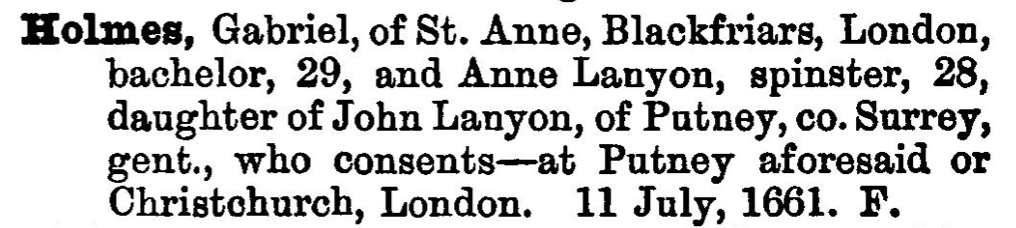
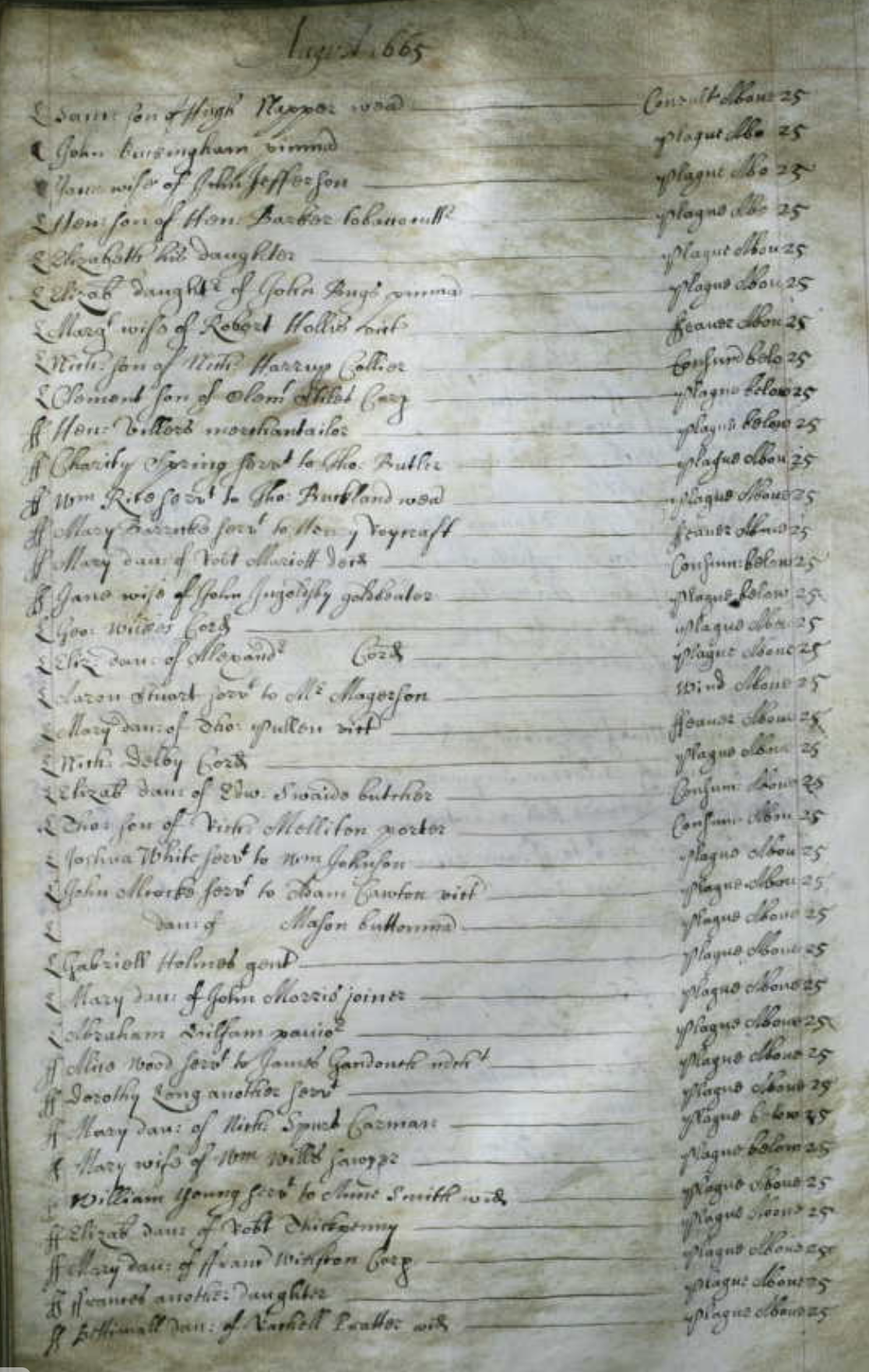
Ann 1633-aft. 1686 Ann was baptised at Holborn in London in 1633 she is mentioned in her sister’s will so presumably is still alive in 1686. She is called Ann Lanyon in the will however there is a marriage of an Ann Lanyon daughter of John Lanyon who married Gabriel Holmes in 1661. A Gabriel Holmes gent, died of plague and was buried at St Giles Cripplegate in 1665. (There is an Ann Lanyon buried at St Clement Danes on 19 Aug 1691- could it be this Ann? Why would she be called Lanyon and not Holmes?)
Hester 1635-1700 she was baptised in Holborn London, she married Thomas Yonge and she may have been married to her cousin John Lanyon.
Ann’s baptism (2906) Parish Register St Andrew HolbornLondon Marriage Licences 1521-1869 Gabriel Holmes, gent, died of Plague and buried 25 August 1665 -St Giles Cripplegate register – source London Metropolitan Archives
Hester’s sister Mary left a will (dated 1686) that refers to her as Hester Yonge and sister Yonge, Mary also has a clause giving her sister’s picture and great cabinet to brother Yonge.
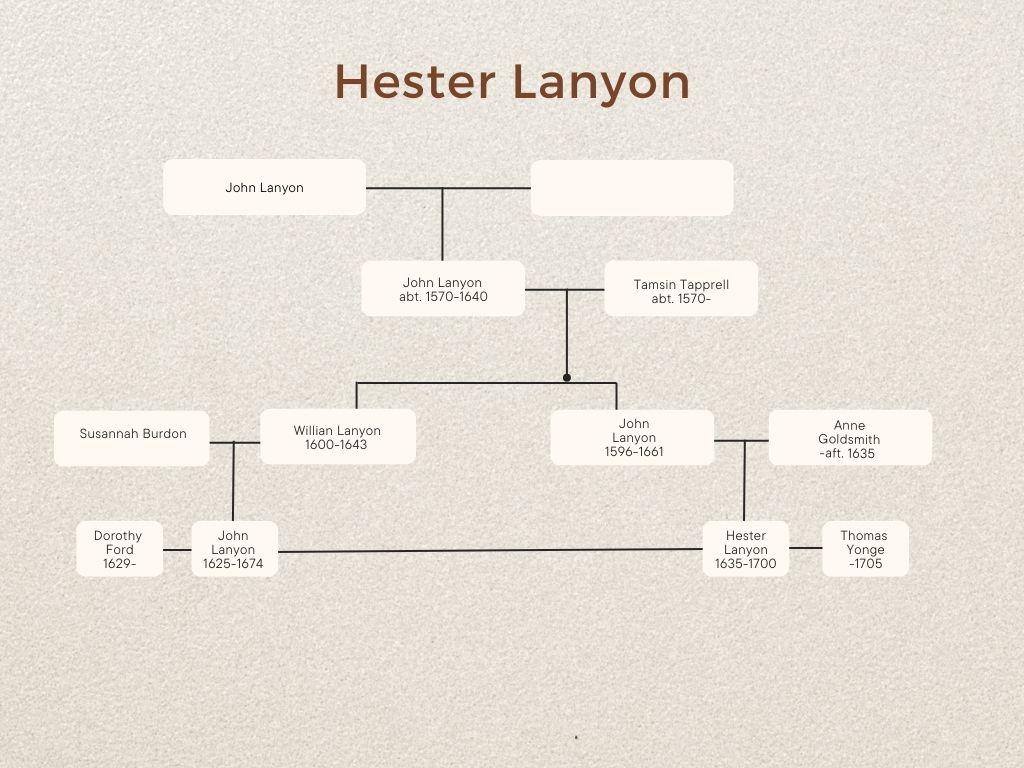
Hester’s tree
Her possible first husband John Lanyon of Plymouth died in 1674 in Paris, he left a detailed will which helps us fit him into the tree. He mentions his uncle Mr Philip Lanyon, this confirms that John’s father William had a brother called Philip. He leaves a generous bequest to the town of Breage. John mentions various cousins among them are Hester Lanyon who he bequeathes £700 “in case she should survive me and acquit my executors of my obligation for £30 payable to her by me during her natural life”. The will continues “…out of this £700 my cousin Hester do pay or make good unto her sisters, my cousins, Mary and Ann £10 each during their natural lives.” (Source- NA/PROB/11/344/542)
After his death there are legal proceedings over his estate.
Chancery Proceedings Ante 1714 – Writ 297/99 Year 1679
John Lanyon merchant late of Plymouth personal estate valued at £20,000 did by his last will and testament dated 15 Sep 1674 bequeath a legacy of £50 to Totnes in Devon, which sum the Mayor and Burgesses were claiming of the Executors Captain Philip Lanyon, his sister Margaret Richards and niece Hester Lanyon.
In this chancery lawsuit the Totnes claimants speak of Hester Lanyon as John’s relict “who has since married Thomas Yonge”.
There is no trace of a marriage between Hester and either John Lanyon or Thomas Yonge but they are referred to in the Chancery proceedings. Although John Lanyon’s will describes her as his cousin rather than his wife. Was Hester Lanyon John’s second wife? Until we can find other documentary evidence we can’t be sure.
Hester Yonge was buried on 6 Apr 1700 at Colebrooke, Devon.
Colebrooke Devon Parish Register
Hester’s husband Thomas Yonge died in 1705 at Colebrooke.
We’ll look at Hester’s husband John Lanyon of Plymouth in more detail in another post.
What of Hester’s father John?
John Lanyon was Proof Master and Chief Engineer to Charles I from 1630-39. In 1640 John went to Flanders and wrote to Whitehall from Brussels sealing the letter with the Lanyon (Madron) arms. As the principal engineer he was responsible for forts and castles. It was his misfortune to land such an illustrious post just as the monarchy was about to be swept aside in the Civil War.
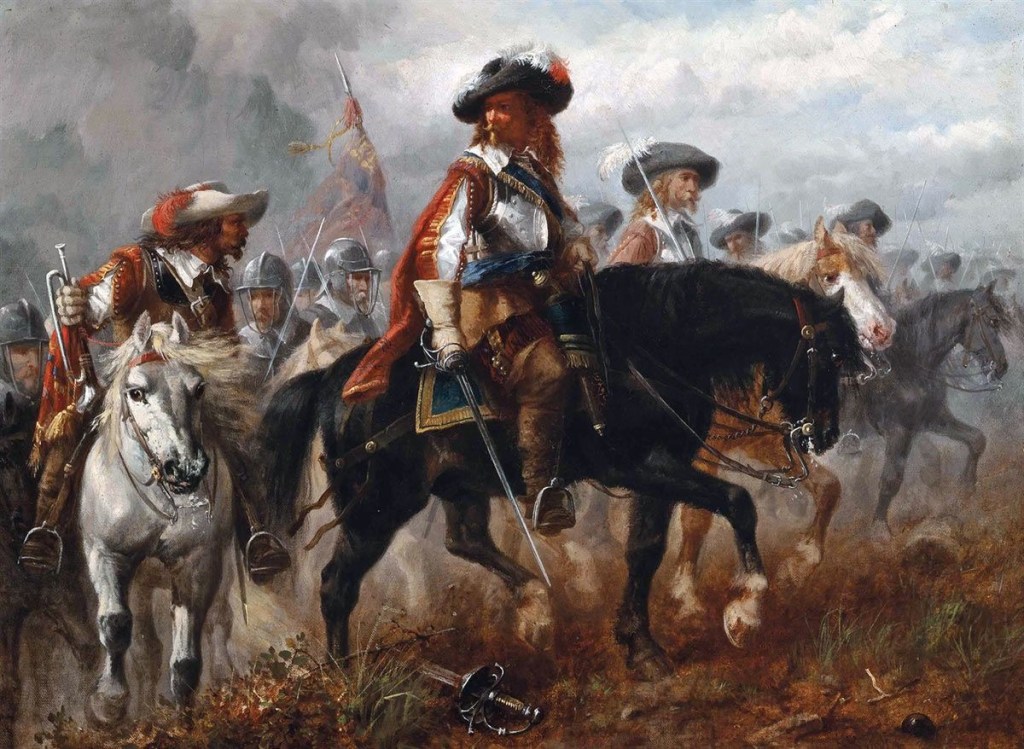
King Charles I and Prince Rupert before the Battle of Naseby 14 June 1645 during the English Civil War – Wikimedia Commons
During the Civil War John Lanyon had a tough time; he was plundered, sequestered and imprisoned. In 1661 he petitioned the Lord Treasurer to pay his fee due at Midsummer last. He had been promised £240 a year as chief engineer. Sir William Compton certified that John Lanyon had £240 a year granted him by the late King as chief engineer and that “he is well skilled in his art and deserving of the said salary.” (Source- Charles II State Papers Vol 36 – 1661).
His wife, Anne Goldsmith, must have died because John remarried Mary Latham (née Clarke) the widow of Ralph Latham Esq of Upminster, Essex, late barrister Middle Temple, London. Ralph died in 1642 so sometime after that date the marriage took place. There were no children of this marriage.
John died in Sep 1661 and was buried at Surrey. His widow Mary died in 1666 and her will mentions her children from her first marriage and step daughters Mary, Anne and Hester Lanyon.
Will of Mary Lanyon 1666 – Source NA PROB/11/320
As far as we can ascertain none of John’s sons survived and none of his daughters had children of their own so this little branch of the tree died out.
In 1573 John Lanion was elected Warden of St Ives. (Source – A History of the Parishes of St Ives, Lelant, Towednack and Zennor by John Hobson Matthews P 146 and P 147). He was also listed in 1575 “Payd to Mr Laynyane for iiij trees”.
Around 1596 John Lanion gent bought the Penwinnick Estate in St Agnes (later sold to Edward Noy, cousin, in 1622). So who is this John Lanion?
On the 1569 Muster Roll for St Agnes there is a John Lanyne listed. He is the only John Lanyon (all name variants checked) listed on any muster roll at this time. Which begs the question ‘where is John Lanyon (esq) listed?’ Both Johns are probably of a similar age so why is only one listed on the muster roll? Could the John Lanion gent who was elected Warden of St Ives and the John Lanion gent who bought the Penwinnick Estate actually be John Lanyon Esq or his younger brother who was also called John?
I think it more likely that the John Lanyon of Penwinnick Estate was the second son of Richard Lanyon esq and the younger brother of John Lanyon esq.
There are few surviving records from this time. One of the earliest entries at St Agnes is the marriage of John, son of John Lanyon gent who married Tamsin Tapprell on 22nd Jun 1596.
John Lanyon & Tamsin Tapprell
John and Tamsin married at St Agnes but soon went to Breage where most of their children were born.
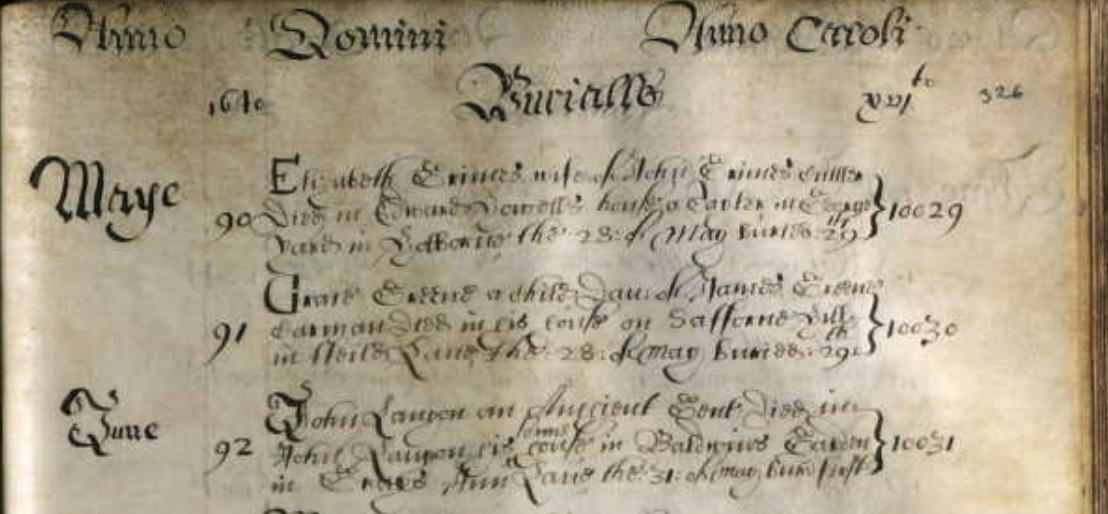
We know very little about John and Tamsin. John’s last child was baptised in 1620 but it’s not clear if Tamsin was the mother to all of them. John was buried in London at St Andrew, Holborn on 1st Jun 1640. He’s listed in the burial register as ‘an ancient gent’. He was living at Grey’s Inn Lane with his eldest son.
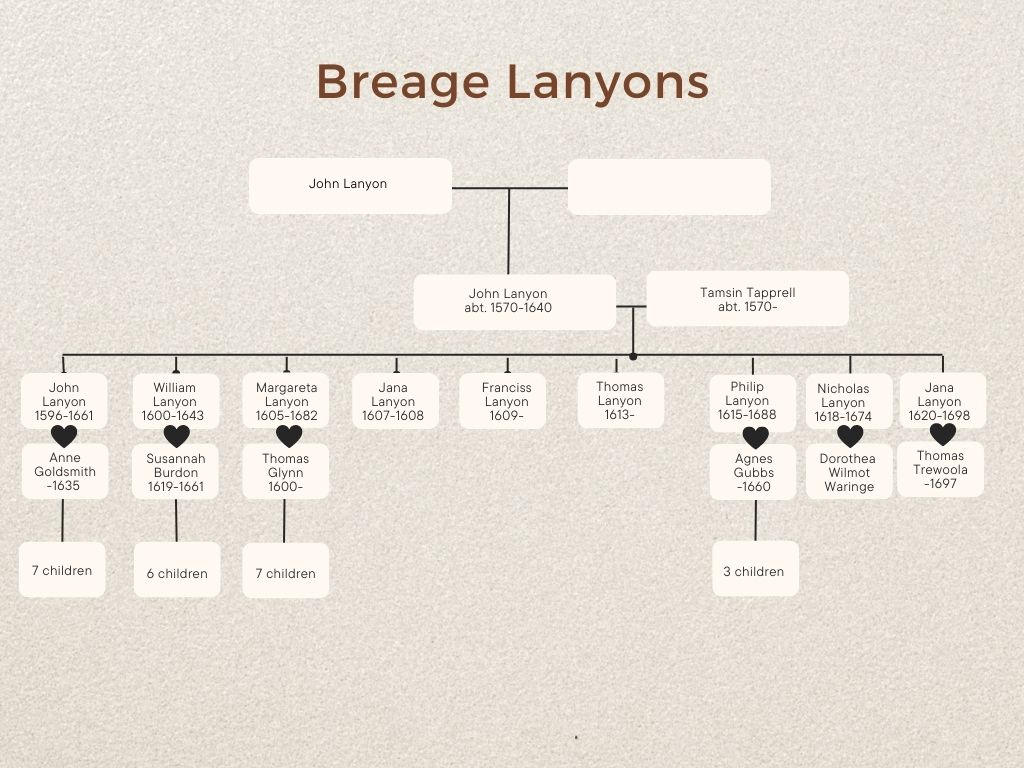
John had nine children, we don’t know if Tamsin was mother to all of them:
John aft. 1596-1661 married Anne Goldsmith
William 1600-1643 married Susannah Burdon
Margareta 1605-1682 married Thomas Glynn, gent and Mayor of Helston, Oct 1635. Seven children. John Lanyon of Plymouth’s will of 1674 states ‘…to every grandchild of Aunt Glynn and my cousin Thomas Glynn and his wife £10 for a ring…’ Margareta was buried at Gwinear on 9th Dec 1682 ‘wife of Thomas, gent’.
Jana 1607-1608 died in infancy
Franciss 1609- no further trace
Thomas 1613- married Anne/Amy Tarrant 1639 London. Thomas is aged 28 therefore born about 1611.
London and Surrey marriage licences – Thomas Lanyon & Anne Tarrant 1639
Philip 1615-1688 married Agnes Gubbs
Nicholas 1618-1674 married Dorothea Wilmot Waringe, the illegitimate child of Lord Charles, Viscount Wilmot in 1647 at Saint Bartholomew The Less in London. He had properties in Essex and Nottinghamshire. They had no children although she had four children from her first marriage to a man called Waringe/Warren. In his will of 1674 he left ‘all to wife Dorothea Warren’
Jana 1620-1698 she is described in the parish register as daughter of Johis and Janae, could her father have had a second wife after Tamsin? She married Thomas Trewoola, gent of Towednack in 1647 at Helston. No children traced. Her cousin John Lanyon of Plymouth mentions her in his will of 1674 ‘…to cousin Jane Trewollah £50 more in consideration and satisfaction of the £5 I received from Uncle Glynn to improve her advantage.’ There is a burial of a Joan Trewhela widow at Towednack in 1698, possibly her.
Did John of Penwinnick remarry?
There is a document at Kresen Kernow dated 16th May 1623 – St Agnes – Penwennick – John Lanyon the elder gentleman and wife Jane and their sons John and Edward assign lease to Edward Noye. (Source GP/17). There is another document dated 30th Dec 1608 – St Agnes. John Lanyon of St Agnes, gent and Edward Lanyon (John Lanyon’s second son) 1 quarter of Penwennacke. The first document seems to confirm that John of Penwinnick did indeed have a wife named Jane and he also had a second son called Edward who was not found in the baptism register but must have been born before William who was baptised in Aug 1600. There is no record of Tamsin Tapprell being buried or of a marriage to Jane. Thomas Tonkin suggests that she is Jane the daughter of William Whitta, the previous owner of Penwennick Castle.
We’ll follow John, William and Philip Lanyon’s interesting lives in the post ‘Chief Engineer to Charles I’.
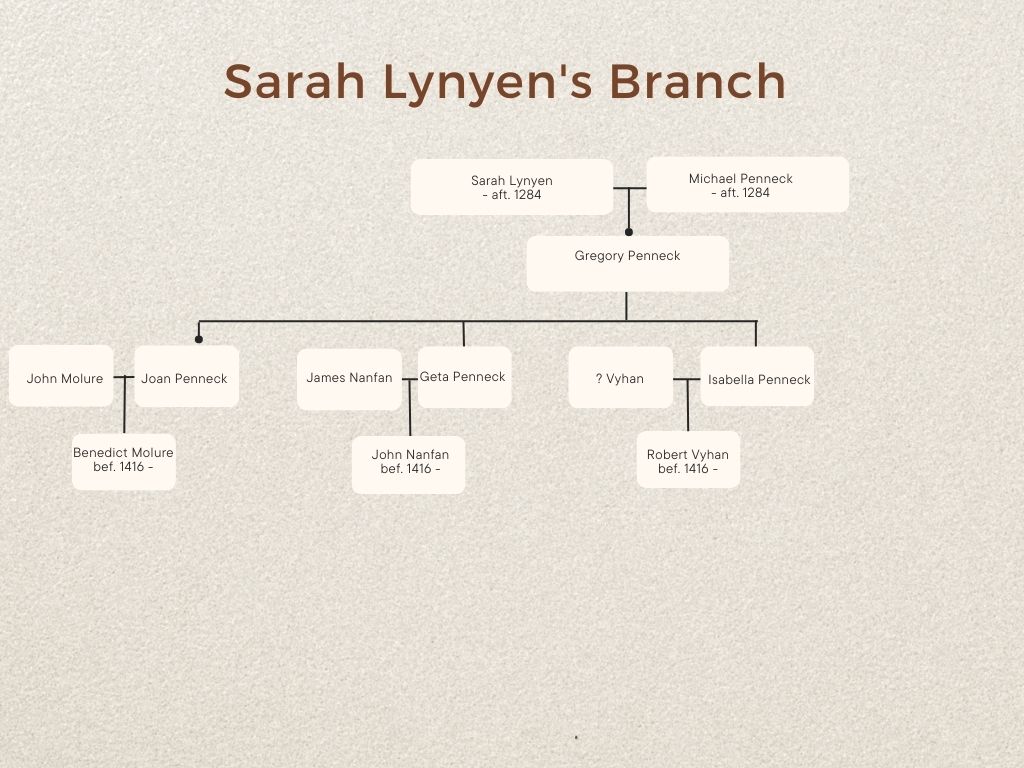
It’s difficult to know where to place Sarah on the Lanyon tree. We have very little information about her. This is my attempt to fit her in.
The De Banco Roll – Trinity 4 Henry V (1416)
Tredyn Lands – The plaintiffs – John Nanfan and Robert Vyhan sued their cousin Benedict Molure all three being sons and heirs of Geta, Isabella and Joan Penneck, granddaughters of David Lanyein.
So from this document we know that Geta, Isabella and Joan Penneck were graddaughters of Sarah Lynyen and great grand daughters to her father David.
Charter of 1284
“John de Leynen to David his son and William de Trenyer chaplain and to the heirs of the body of the said David by Marina his wife. Charter with warranty of all his lands and messuages in the towns of Lennyen, Resik, Bossewolonwyan, Polgon, Hendrenythyn, Boswolnel and Trengwenton, with two mills corn and fulling in Lenyen, and the rent, service and homage of Ralph de Pendyn and his heirs for land there, and of Michael Penneck, Sarah his wife and their heirs for land in Trethyn by Treudreuen.”
Dated Lanyen Friday before St Peter’s Chains 12 Edward I
From this document we know that Michael Penneck was the husband of Sarah and held lands at Trethyn. David was the son of John de Leynen and was married to Marina and held lands at Lanyon and Rissick that were still held in the 17th century. From the De Banco Roll we know that David had a son-in-law called Penneck so it seems logical to place Sarah as his daughter.
There is also a David De Linien who was a witness to a Charter of Glasney College dated 10th October 1267. Advowson of St Sithney Church by Roger de Skyburriow.
But there is also a mention of a David de Lynyen on the Lay Subsidy Roll of Madron 1 Edward III (1327) he was assessed at 4 shillings? Is he David de Lennyen or his son David de Kylminawis or another David altogether?
Therein lies the problem with researching families at this time you don’t know for sure who the documents refer to.












 The Lanyons