Philip Rashleigh settled in Fowey, in the 16th century, as a trader. His son’s marriage to Alice Lanyon resulted in the acquisition of Cornish properties and soon they became prolific merchants and ship owners.
In time they would own property at nearby Menabilly as well as a new townhouse in Fowey (now the Ship Inn.)
According to research they benefited from the dissolution of the monasteries by scrupulously buying land and re-selling at a profit. By marrying into wealthy Cornish families the Rashleighs became huge landowners with significant influence across the county. Many became MPs and it was Menabilly, on the Gribben Peninsula, that provided the family home.
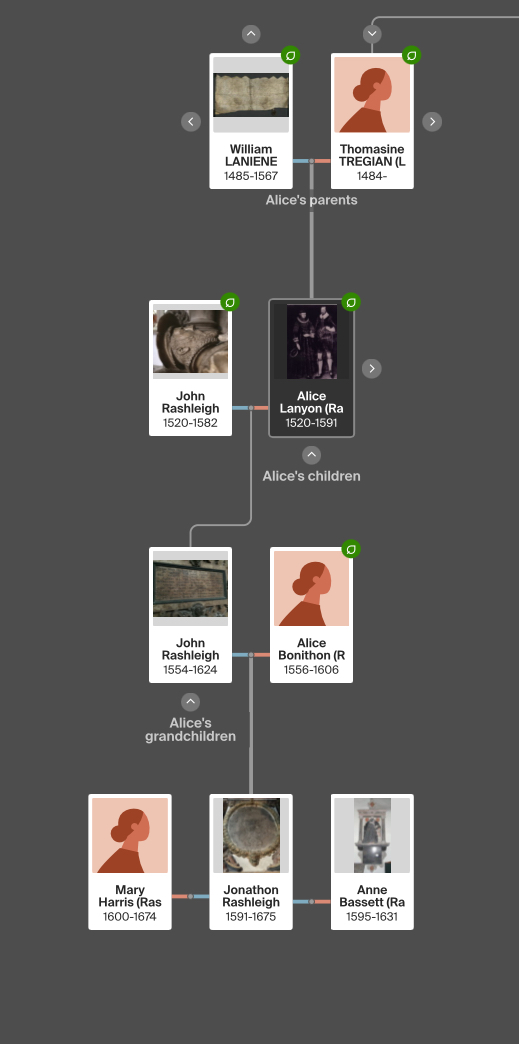
Alice Lanyon’s family tree
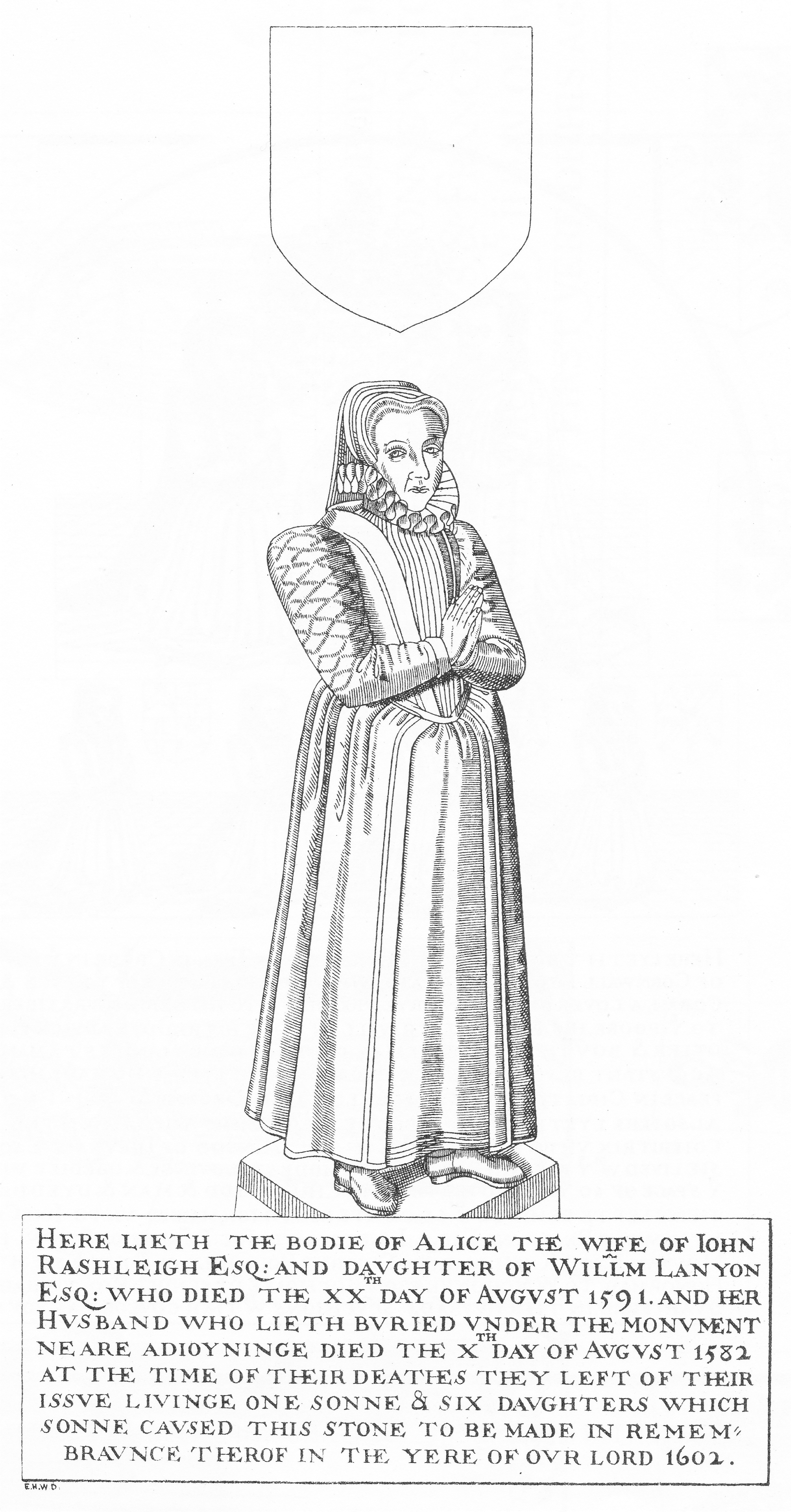
Alice was born abt. 1520 and died 20th Aug 1591 at Fowey, Cornwall. She married John Rashleigh abt. 1540. They had twelve children, eleven girls and one boy. Only six of their daughters survived. Her son John, placed a brass commemoration plaque in Fowey church and it’s still there over 400 years later!
Alice Lanyon brass plaque in Fowey Church Drawn by Dunkin, Edwin Hadlow Wise
The brass plaque is not the only portrait of Alice.
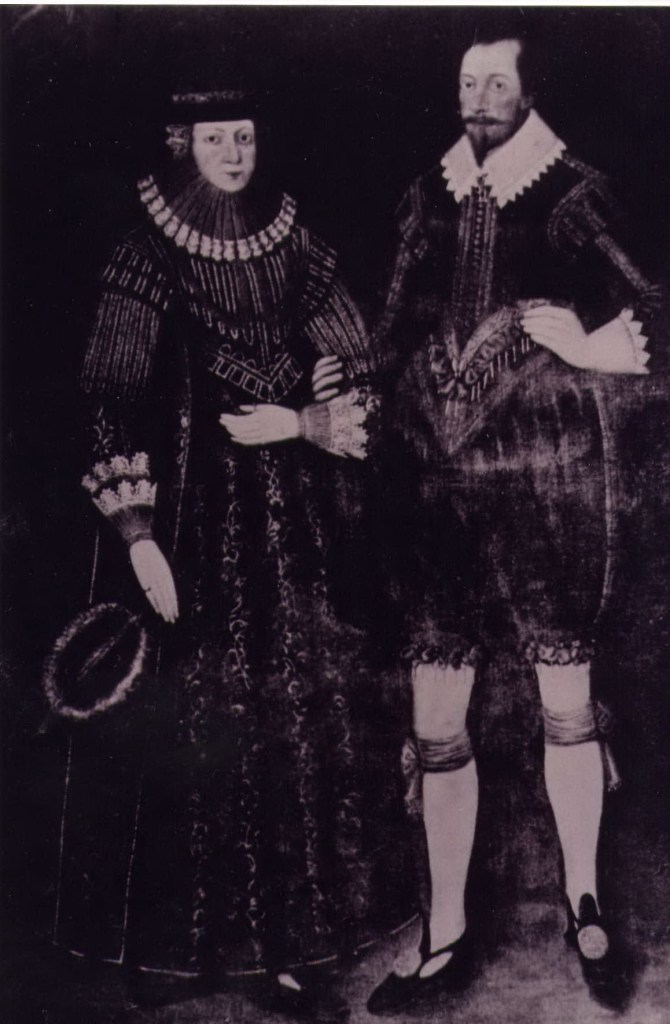
Nicholas Hilliard also painted their portrait.
Alice and John Rashleigh by Hilliard painted 1581
This portrait is the first Lanyon portrait!
Alice and John’s descendants lived at Menabilly, Fowey. The house was later leased to Daphne Du Maurier and became the inspiration for Manderley in the book ‘Rebecca’.
Menabilly
Alice and John’s town house in Fowey is still there today, it’s now called The Ship Inn.
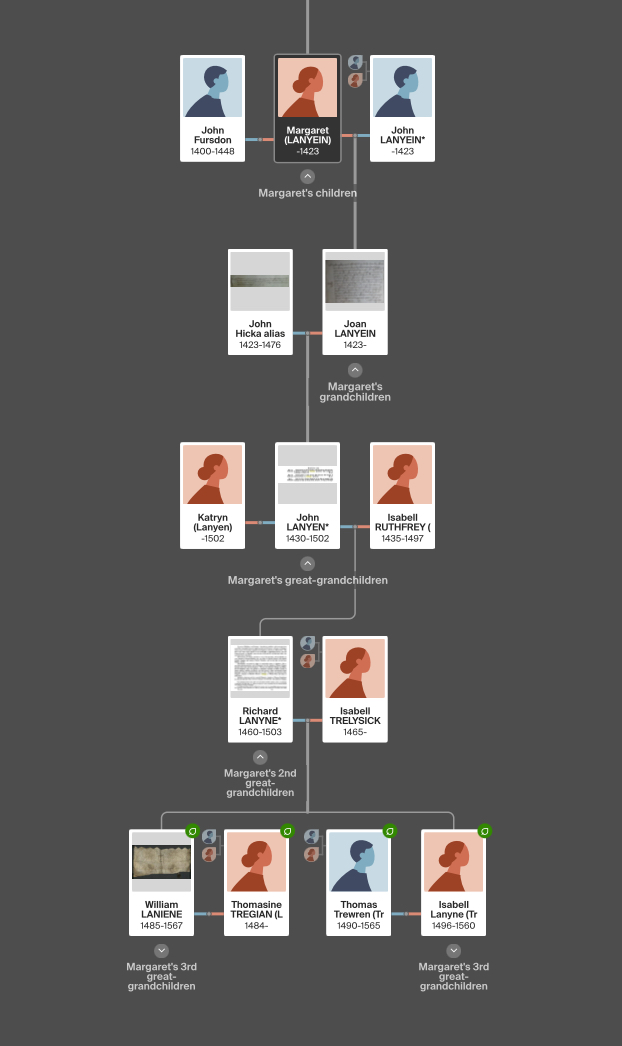
Richard Lanyne (the son of John Lanyen and Isabell Ruthfrey) married Isabel Trelissick. Richard’s son and heir was William Laniene born abt. 1480 but it’s not clear if Isabel Trelissick was his mother or if she was Richard’s second wife. William’s sister, Isabel was born in 1496. There is no trace of any other siblings but Benoit’s 1531 MSS states that Thomas Treuran married Isabell the 1st daughter of Richard Lanyne of Trylyswyke so that implies there must have been at least one other daughter.
William Laniene’s ancestors
William was the first recorded esquire
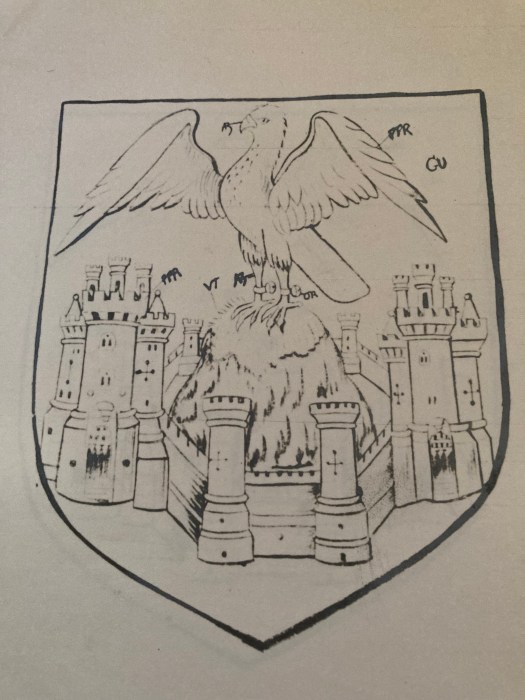
Lanyon Coat of Arms
Heraldic visitations were tours of inspection undertaken by Kings of Arms. Their purpose was to register and regulate the coats of arms of nobility, gentry and boroughs and to record pedigrees. They took place from 1530 to 1688, and their records provide important source material for historians and genealogists. Much of the Lanyon family information from the 16th & 17th century comes from these visitations. They visited Cornwall in 1531, 1573 and 1620. Families submitted trees to establish their right to bear arms. (The trees weren’t always correct!)
The definition of an Esquire is “the eldest son of a knight and their eldest sons in perpetuity”. Second sons were styled “Gentlemen” and the sons of gentlemen were given the title Mr. (daughters were addressed as Mrs. even when single). A Yeoman was a landowner but not considered genteel enough to be styled Mr or gentleman.
Below yeoman was a husbandman and below that serf/villein/cottar, then came domestic servant and finally in the pecking order vagabond and slave.
Whilst these terms started to fall out of use by the late 17th and 18th centuries in the 16th and early 17th centuries they were still generally adhered to and that’s a huge help to genealogists.
In 1531 William Laniene gave his family tree to the heralds and his right to ‘bear arms’ was documented. The first Lanyon to bear arms may have been born much earlier than William but this is the first documented esquire.
Grant of Arms to Bacon family – British Library, CC0, via Wikimedia Commons
William lived at Gwinear. Perhaps a medieval long house was not sufficiently grand, perhaps it just wasn’t big enough for his large family or perhaps it’s just a bit too cold and windy in West Penwith compared to Gwinear!
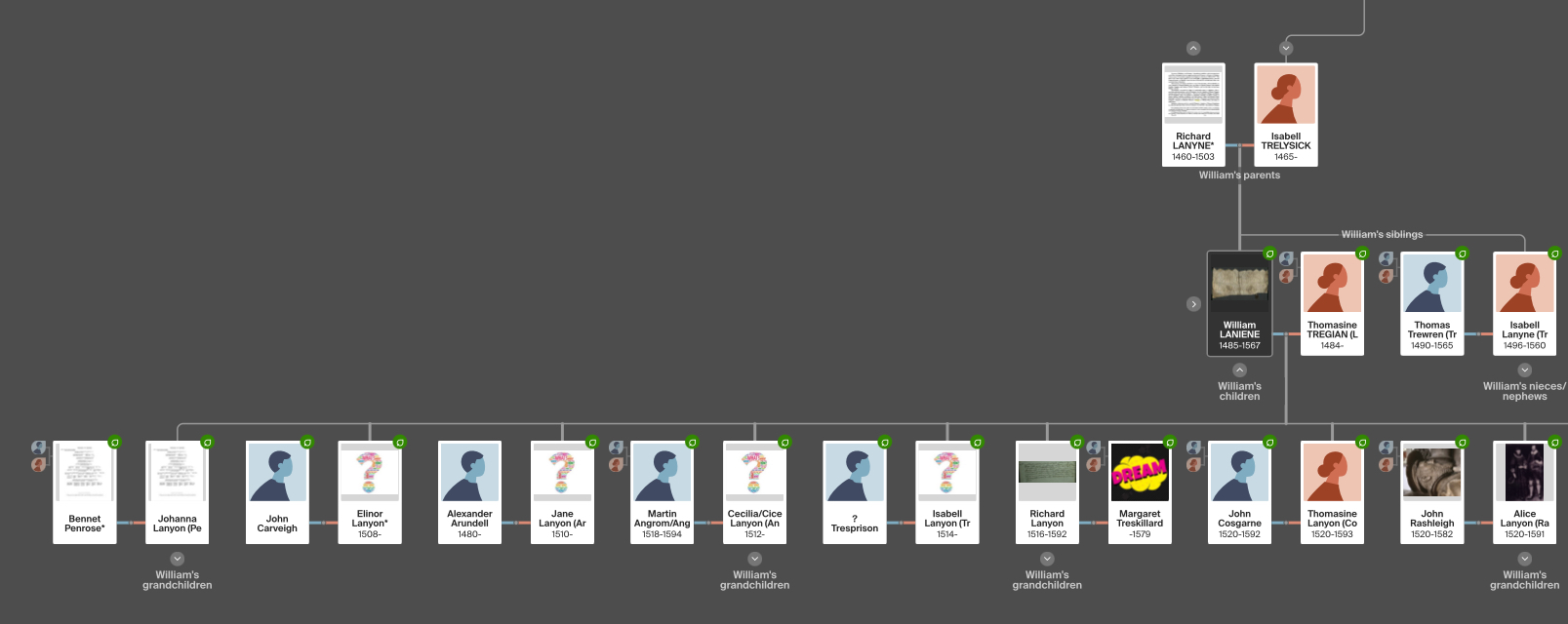
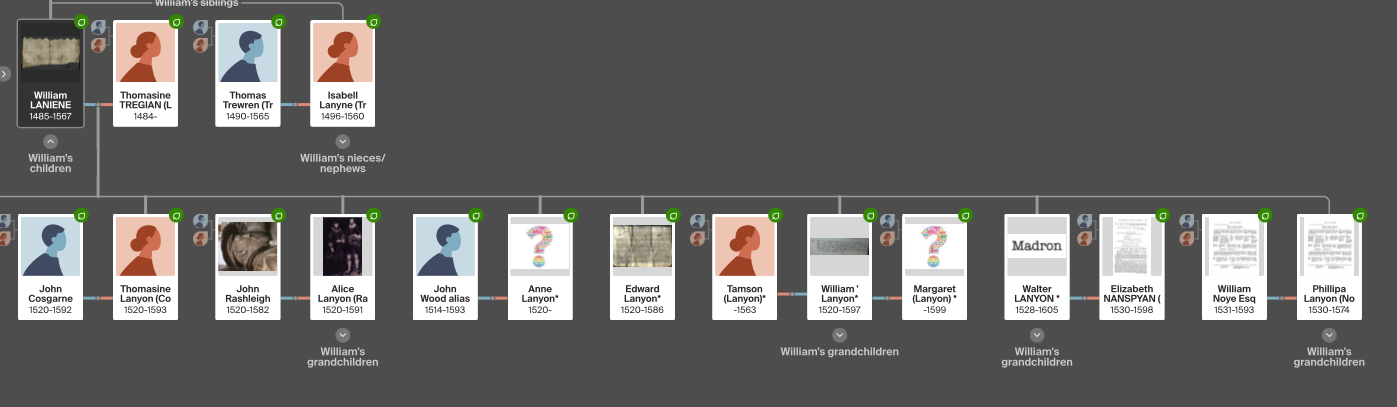
William married Thomasine Tregian the daughter of Thomas Tregian of Tregian and Truro and Margaret (daughter of William Kingdon and widow of John Borlase) abt. 1505. William’s large family (at least nine daughters and four sons) married into the important families in the county.
William large family requires two images!
We don’t know the dates of birth for all his children or the order they were born in-
Alice born abt. 1520 died 20th Aug 1591 married John Rashleigh abt. 1540.
Elinor married John Carveigh.
Cecilia/Cicely born abt. 1520 married Martin Angwyn abt. 1540.
Isabell married ? Tresprison.
Anne married John Wood alias Atwood.
Thomasine died 12th April 1593 married John Cosgarne.
Jane married Alexander Arundel. Their descendants were the Arundel’s of Leigh.
Philippa married Edward Noy Esq abt. 1556
Johanna/Joan married Bennet Penrose 1553 (she was the first of his 3 wives so presumably died young.)
Richard, his eldest son and heir born abt. 1516 and died 18th Dec 1592 married Margaret Treskillard.
Edward died aft. 1586.
William ‘Generosi’ died 7th Aug 1597. Married Tamsin and Margaret.
Walter died 12th May 1605 married Elizabeth Nanspyan.
William Laniene died 20th Mar 1567. (Source- Inquisition Post Mortem 1586 of William Lanyon Coswinwollard, Gwinear. Source CRO/R/1168)
William owned substantial lands. Gilbert says “this William succeeded his father in considerable estates in Maddern, Morva and other adjoining parishes….”. The Penwith Subsidy Roll of 1509-1523 lists the following: value of land by the year – Willm Lanyine Gwinear 41s, St Erth 41s, Gulval 11s 8d, Madron 111s 8d.
In common with much of the landed gentry in Cornwall at that time William was frequently manipulating and speculating in land often with his relatives.
In a legal dispute from 1504-1515 William Laniene claims a right to part of the estate of the late Michael Ruthfos. Michael left his large estate to a Thomas Ruthfos and his heirs, with remainder to a John Ruthfos and his heirs, and a further remainder to a Richard Ruthfos and his heirs. William Lanyon appears to claim that as Thomas and John Ruthfos died without heirs he, as a son of Richard Lanyon, has a right to the property. If Richard ‘s mother Isabel Ruthfrey was the daughter or heiress of Richard Ruthfos this could explain how he got the name Richard. Variations of the name Ruthfos appear so Ruthfrey is possible.
Legal dispute -Source : Anglo American legal Tradition – aalt.law.uh.edu/AALT7/ChP/C1no341/IMG_0085.htm
Court of Star Chamber 1509-1547
PLAINTIFF: Alan Powe DEFENDANT: William Lanyen, Tamysen (Thomasine) his wife and Thomas Trewren. Messuage and land in Cosswyn Wulward.
PLAINTIFF: William Lanyon DEFENDANT: Thomas William, Jenett his wife, and John and Robert their sons. Source: National Archives STAC 2/30/48
PLAINTIFF: Thomas William DEFENDANT: William Lanyeyn and Thomasyn his wife, Richard Lanyeyn, William Lanyeyn, junior, John Breton, and John Trespryson. Source: National Archives STAC 2/30/48
PLACE OR SUBJECT: Forcible entries in Gwinear COUNTY: Cornwall, William Lanyeyn and Thomas William. Source: National Archives STAC 2/30/48
Court of Chancery: Six Clerks Office:
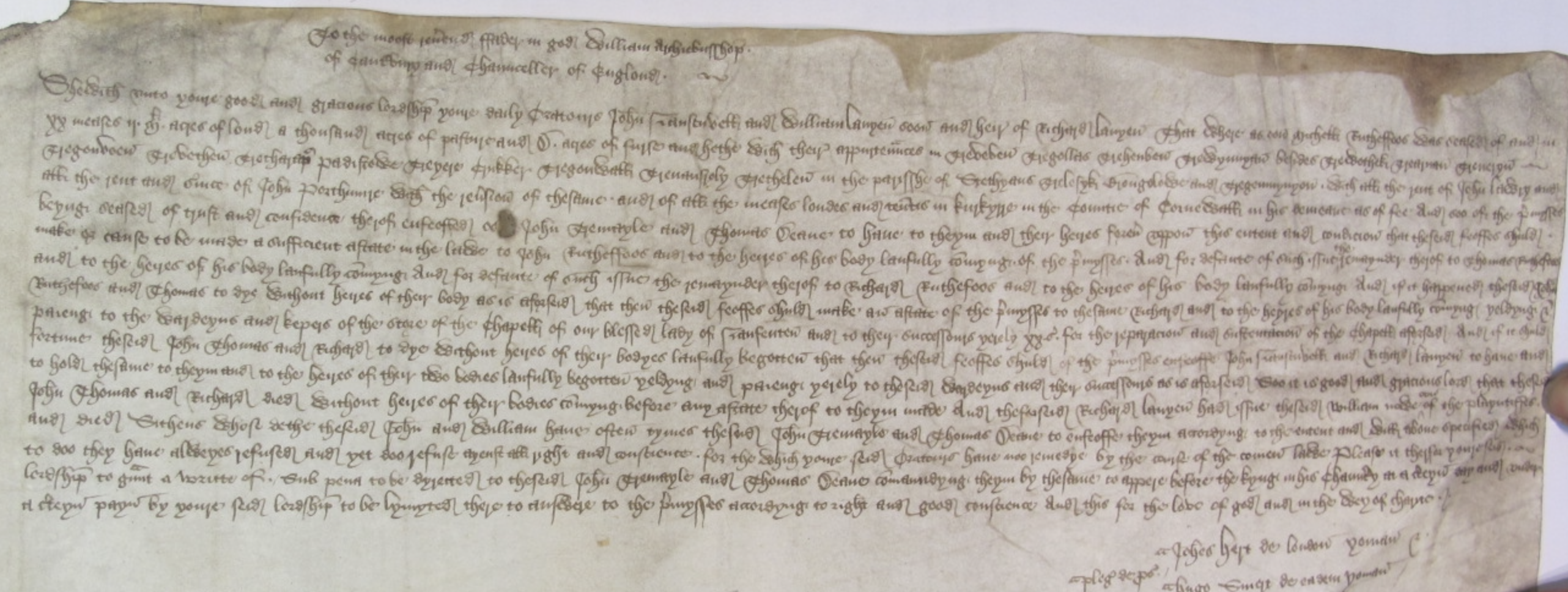
John Nanscuvell and William, son and heir of Richard Lanyen. v. John Tremayle and Thomas Deane, feoffees to uses. Messuages, land, rents, and services in Treveben, Tregollas, Trehenben, Trewynnyan by Trewothek, Trearnan, Treneryn, Tregonvoen, Trevethen, Date: 1504 – 1515 Source: A C1/341/56
In 1533-38 Thomas Tresculard’s widow Isabel took action against William Lanneyen and others over the detention of deeds relating to messuages and lands in Tresculard and elsewhere. Source: C1/911
The History of the Family Borlase cites a legal dispute over woods at Bridockke involving Thomasina’s nieces where evidence was given that Thomasina’s brother John referred to William Lanyne as his brother in law. Source: The Genealogist Magazine Vol III 1886.
Mentioned in a deed, 1 Mar 1554, Cornwall, England. Grant of land, Penrose, Sennen and land in Sancreed. Parties: 1) Joyce Penrose of Penrose, gentleman, to 2) Radulph Penrose, John Treuryn and William Lanyon. Penrose [Sennen], Respletha, etc, and Brane, Bosence and Zelena in Sancreed.
William was also a ‘tinner’. In Oct 1556, Cornwall, England, William and his partner David Angove were given a licence, for two years, to search and dig for tin anywhere on the lands of the Earl of Oxford throughout Cornwall. Source: CRO AR/1/852
William is also listed on the ‘Tinner’s Muster Roll’ of 1539 for St Clement, Cornwall. Stannary of Tywarnhaile, Moreske Manor. Whole Harness (the harness and trappings for a horse which might include armour).
In 1539 William could have been almost 60 years of age (Henry VIII would have been 48) and there were threats from Scotland, the low countries, France and Spain so it was possible that he may have had to fight.
Thank goodness the Lanyons were so litigious as it has left us with a paper trail to follow.
Later Medieval Lanyons
John Lanyeyne (the son of John Hicka alias Lanyein) died in 1476 and his heir was also called John Lanyen. The Account Roll of Connerton for 1476/77 records the death of John Lanyeyne who held 2 acres Cornish at Coswynwulward.
Source: (CRO AR/2/195)
“Goswyn Lanyon, formerly “Coswynwolward”, in Gwinear: John Lanyeyn, the heir of John Hicka, in Goswyn, 2 acres Cornish, in socage; yearly rent, with common suit of court, 6s. at the 3 dates stated, and 20d. at Michaelmas = 7s. also for offering and aid at Michaelmas, 3d.”
Source: Devon and Cornwall Record Society, Vol 41, 1955, p45.
John Lanyen married Isabell Ruthfrey, daughter of Thomas. The name is variously spelt Ruthfrey, Rathrey and Ruthvey. Their son and heir Richard Lanyne was born abt. 1460.
In 1488, John Lanyen is listed among the free tenants who paid a fine for release of suit of court at Connerton, Gwithian. (CRO AR/2/92.)
There is no record of Isabell’s death but John remarried and his second wife Katryn was in dispute with her step son Richard, in 1502, following John’s death.
Lanyen v Lanyen.
Plaintiffs: Richard, son and heir of John Lanyen.
Defendants: Katherine Lanyen, his stepmother, executrix of John Lanyen.
Subject: Detention of deeds relating to messuages and land in Coyswyn, Wolward, Lanyen, Tregamenyon, Rysyk, Bossowolowe, and elsewhere. Cornwall
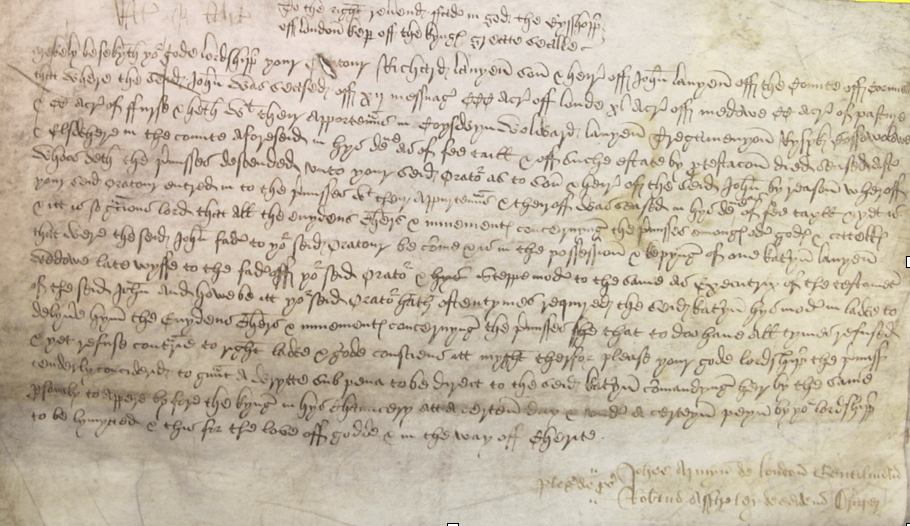
The dispute shows that John Lanyeyn was in possession of 12 messuages (a dwelling house with outbuildings and land assigned to its use) 300 acres of land, 40 acres of meadow, 200 acres of pasture and 200 acres of furze and heath. The land was situated in Coswyn Wolward, Lanyen, Tregamynyan, Rysyk, Bossowolowe and elsewhere is Cornwall.
Source: Early Chancery Proceedings C1 Bundle 266/4
Court of Chancery C 1460 – Public domain, via Wikimedia Commons
“Mekely besechyth your gode Lordshipp your oratour Richard Lanyen son and heir of John Lanyen of the Counte of Cornwall that where the seid John was seased of XII messuag CCC acre of londs XL acre of medowe CC acre of pasture CC acre of furze and heth with their appurtenances in Coswyn Wolward Lanyen Tregamenyan Rysyk Bossowolowe and elsewhere in the counte aforeseid in hys demesne as of fee tail and of such estate by ptestacon (protestation) died seased after whose deth the premisses descended unto your seid oratour as to son and heir of the seid John by reason whereof your seid oratour entred in to the premisses and their apputenances and thereof was seased in hys demesne as of fee tail and yet is and it is so gracious lord that all the evydens charters and munements concernyng the premisses that were the seid John fader to your seid oratour be come and in the possession and kepyng of one Katryn Lanyen Wedowe late wife to the fader of your seid oratour and steppe moder to the same and executryx of the testament of the seid John and howe be it yourseid oratour hath oftentymes required the seid Katryn hys moder in lawe to delyver hym the evydens charters and munements concernyng the premisses and that to do has at all tymes refused and yet refuse contrarie to right lawe and gode constiens (conscience) as might thereof please your gode lordshipp the premiss tenderly considered to grant a derycte sub poena to be direct to the seid Katryn commandyng her by the same personalyto appear by fore the Kyng in hys chauncery at a certen day and under a certeyn payn by your lordshipp to be lymytted and this for the love of godde and in the way of charitie.”
Legal dispute – Court of Chancery Six Clerks Office C1/266/4
David Thomas V Thomas Tregian 1504-1515
From all the properties listed in Lanyen v Lanyen we can see that they were a wealthy family however before his death John Lanyen was in ”great necessities and need” and borrowed £260 from David Thomas.
Source: National Archives C 1/367/7
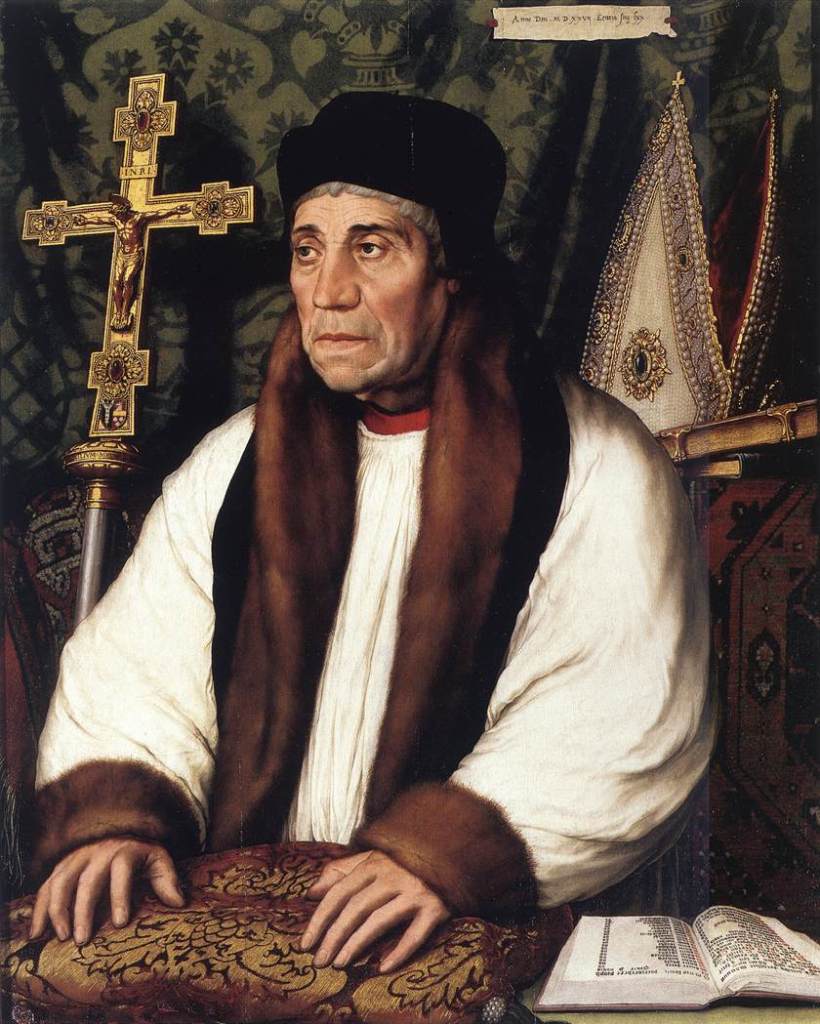
William Wareham Archbishop of Canterbury – Hans Holbein the Younger, Public domain, via Wikimedia Commons
To William Archbishop of Canterbury and Chancellor of England.
‘John Lannyen being in “great necessitie and nede” borrowed £260 from David Thomas, and for guarantee of repayment “made estate” to D. Thomas of his messuages lands and tents in Lannyen, Resyk, Chy[woo]n and Trenyventon. The conditions of the loan were that D. Thomas should have possession and all the issues and profits of these properties until the loan was repaid. The terms for repayment were that there should be 6 payments of £20, followed by a payment of £40 and a final payment of £100. J. Lannyen guaranteed that his heirs or assignees would honour this agreement. At the time of J. Lannyen’s death only the six £20 payments had been made. Richard Lannyen, son and heir of J. Lannyen then disposessed D. Thomas and installed Thomas Tregian in the said properties. T. Tregian promised D. Thomas that if he was given all the deeds to the said properties and documents relating to the loan that he would take over the loan, of which £140 was still outstanding. D. Thomas handed over all such documentation but T. Tregian has subsequently ignored all requests to repay the outstanding debt.‘
So begins a period in the family’s history where they spent a great deal of time on litigation which is great for family historians!
This story appeared in the Online History of Parliament.
Plaintiff: John Fursdon.
Defendants: Richard Trevaignon, of Carhayes, gent., John Trevaignon, of Trevaignon, gent., Thomas Trevaignon, of Tregony, bastard, and many others, nine of whom, mostly husbandmen, are named in the bill of complaint.
Complaint: They smashed the doors and windows at Fursdon and, as well as taking money, property and documents and causing his wife Margaret to have a miscarriage, they abducted Joan his step-daughter who was the daughter and heir of John Lanyein, Margaret’s first husband.
Date: 1423
John Fursdon of Fursdon in Liskeard.
Son of James Fursdon of Fursdon by his wife Margaret. Married (1) Joan, before 1400; (2) before 1423, Margaret (widow of John Lanyein).
Source: The notice of Oyer and Terminer appeared in the Patent Rolls on 16th June 1424. It covered the complaint but failed to mention the abduction of Joan, daughter and heir of John Lanyein.
CPR H6 Vol 1, p229
The article on the History of Parliament casts doubts about the honesty of Fursdon.
‘abducted his stepdaughter, Joan heiress, he claimed, to lands worth 100 marks a year‘
Published in The History of Parliament: the House of Commons 1386-1421, ed. J.S. Roskell, L. Clark, C. Rawcliffe., 1993
In the course of his life, if he himself is to be believed, Fursdon suffered several assaults on his person and depredations of his property. On more than one occasion he brought suits in the King’s bench claiming that bands of armed men had forcibly evicted him from his land, and in the Parliament of 1423-4 he ‘suyst une bille’ against Richard Trevanion of Carhayes and his kinsmen who, he alleged, on 29 June 1423 had come to his house at Fursdon with 121 malefactors, broken down fences, gates, doors and windows, stolen goods worth £40, along with muniments and £9 in cash, assaulted him and his wife (nearly killing the latter and causing her to suffer a miscarriage), and abducted his stepdaughter, Joan (heiress, he claimed, to lands worth 100 marks a year). At other times, so Fursdon said, the Trevanions had lain in wait for him and had so threatened his life that he dared not go about his business except with a great ‘posse’, whereby he suffered much trouble and expense. This bill awaited the attention of the King’s Council with other ‘billes de Riottis’ for several months, and it was only after Fursdon appealed to the chancellor that in June 1424 a commission of oyer and terminer was set up to investigate the affair.
This story leaves us with a problem, where do John, Margaret and Joan Lanyein fit in the family tree?
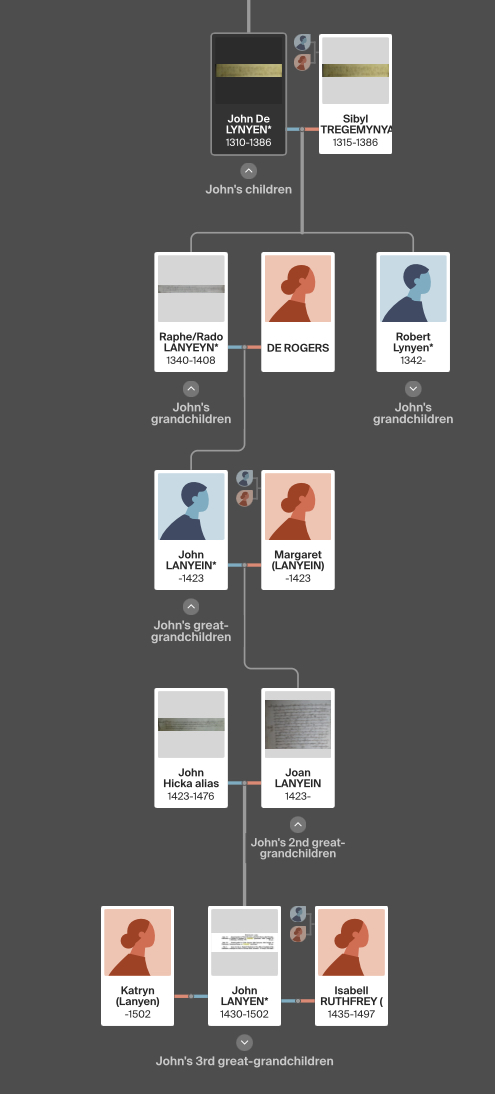
Lanyon family Tree 14th & 15th Century
We know about Raphe (Radolphus) Lanyeyn involved in the dispute over Tregamynyan in 1388 after Princess Joan’s death. A John Lanyeyn received deeds in October 1446 probably after his father’s death. This John could be the John who died abt. 1476 and is mentioned in the Account Roll of Connerton and would have been the father of the John who married Isabel Ruthfrey. According to Fursdon’s account there must have been a John Lanyein who died before 1423 and left a widow and daughter, Margaret & Joan.
There is a record from Connerton Manor Gwithian Cornwall dated 14 July 1463.
“John Lanyeyn, namely John Hicka, 2 Cornish acres in Coswyn”.
It appears as though there was a break in the male line, Joan Lanyein was the heir and married John Hicka who took the Lanyeyn name and became John Hicka alias Lanyeyn.
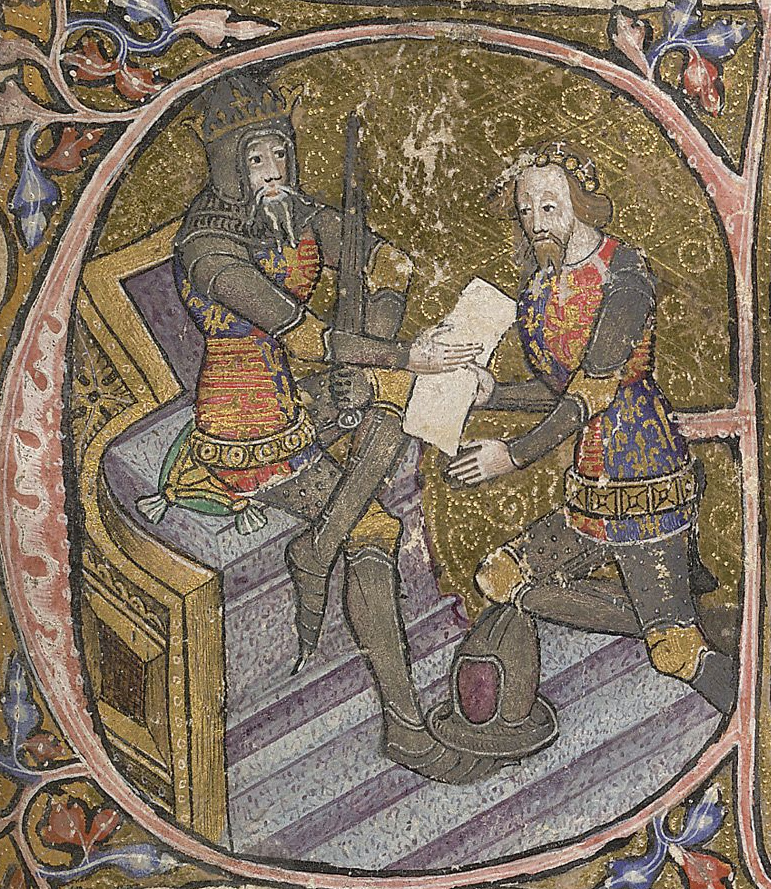
We learn about the next generation of the Lanyon family from a legal dispute of 1386 with Princess Joan of Kent, the widow of Edward the Black Prince, who fought at Crecy. She would have been queen but her husband died before his father, Edward III, and the throne passed to her son, Richard II.
Edward III and the Black Prince
The legal dispute between Princess Joan and the Tregamynyans and Lanyons had rumbled on for many years and was only settled after Joan’s death in 1385.
Joan of Kent from illustrated manuscript, Cotton MS Nero D VII, folio 7v, aka: The Benefactors’ Book of St Albans Abbey (‘the Golden Book of St Albans’)
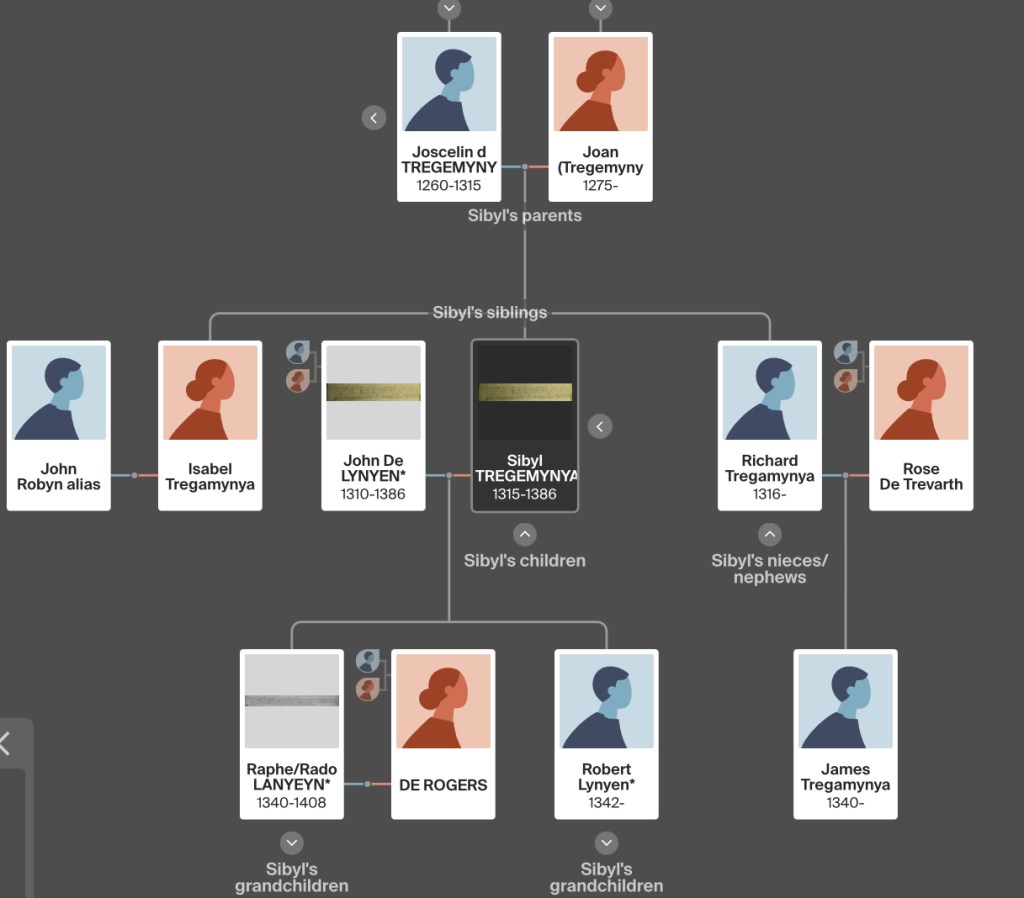
When James Tregamynyan died without heirs the estate passed to his aunt Sibyl Lanyeyn and her sister Isabel. Isabel was married to John Robyn. Sibyl, Isabel and John Robyn granted the lands to John Lanyeyn but he was ousted by James Park (Keeper of the Fees for Princess Joan of Kent) who claimed that Robyn was a villein of the princess. Consequently when the pincess died the land passed to the king who granted it to a man named Langueth. Raphe Lanyeyn, John and Sibyl’s son, requested that this should be repealed.
The judgement favoured Raphe Lanyeyn but Alexander Langueth was later allowed a rent free life interest in Isabel & John Robyn’s portion.
Richard II – Westminster Abbey, Public domain, via Wikimedia Commons
“To John Aston Escheator in Cornwall. Order to remove the King’s hand and meddle no further with a moiety of the lands of Joceus de Tregemyngnoun, delivering to Ralph son of John Lanyeyn any issues thereof taken; as the king. Has learned by inquisition, taken by the Escheator that the said Joceus was seized of 12 messuages, 3 carucates of land and 20s of rent in Tregemynyan, Trenwen, Croghton, Tregessyelle, Keguyn and Bossnyoun, that he had a son named Richard and two daughters Sibyl & Isabel and died, that Richard his son & heir had a son named James. And died, that the said James died without issue, that Sibyl the said first daughter married John Lanyeyn, that they had a son named Ralph and the said John died, that Isabel his second daughter married John Robyn, a villein of the princess as of her dower in Cornwall, that the said Sibyl and John Robyn with Isabel his wife were seized of all the premises and granted the same to the said Ralph and the heirs of his body, that he was seized thereof by virtue of that grant, taking all the profits, until be reason of John Robyn’s neifty (servitude, bondage, or villeinage) James Park, Keeper of the fees of the Princess of Cornwall seized all the premises, thrusting out the said Ralph and that for that cause the same are in the king’s hand by the death of the princess; and now at suit of the said Ralph, after deliberation in chancery with the justices, the king reckons the seizure insufficient in regard to one moiety of the premises being aware that his other’s feodary seized that moiety without process of law.”
Source: Calendar Curia Rolls 9 Richard II Vol 3 (1386)
Calendar of Close Rolls, Ric II, vol. III, 1385-1389, (Public Record Office, 1921), p.71 (1386 order to remove King’s hand from moiety of lands of Joyce de Tregemyngnoun, delivering petitioner any issues taken thereof)
Calendar of Patent Rolls, Ric II, vol. III, 1385-1389, (Public Record Office, 1900), p.304 (1387 grant for life to petitioner of all lands and tenements late of James Tregamynyon).
Legal Dispute with Princess Joan – SC 8/305/15206 National Archives
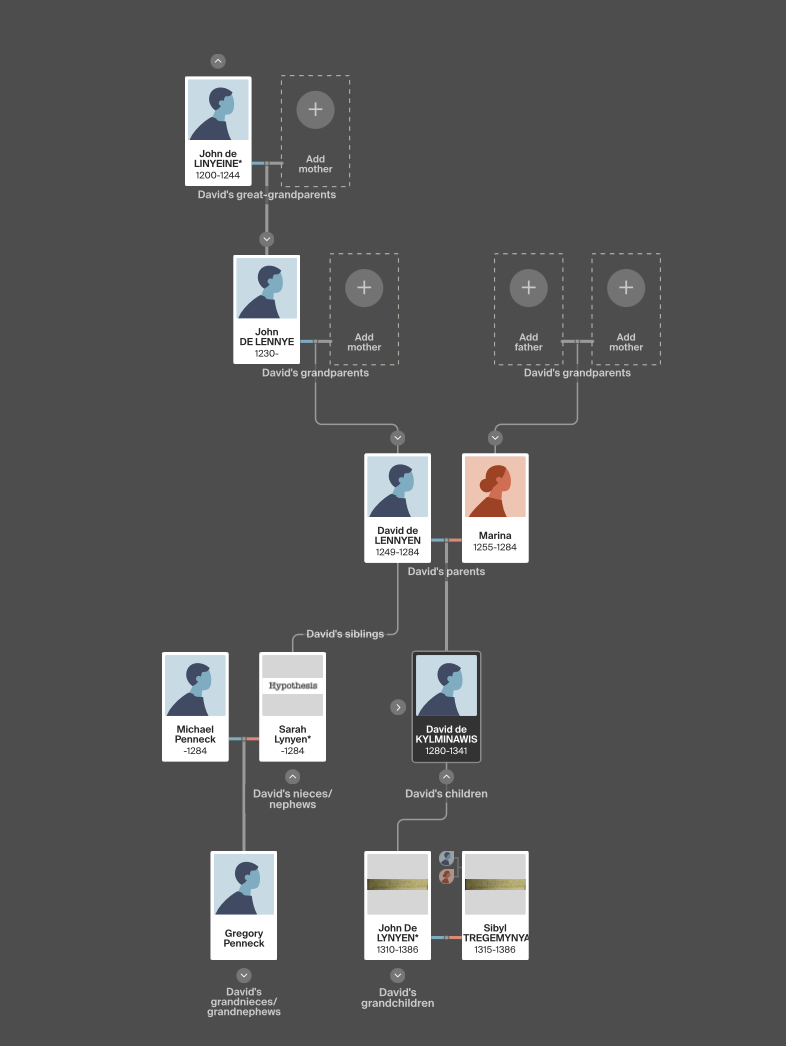
David was born about 1280 and died after 1341. David may have been the brother of Sarah Lynyen. It’s not possible to say with any certainty but they were both living at the same time. The tree below shows the possible relationship.
Kylminawis – Kyl may be the equivalent to the Scottish Kil meaning church so Kylminawis possibly refers to St Minver in North East Cornwall.
A Cornish language expert has also suggested that the name Kylminawis is near identical to the earliest recorded spellings of Kilminorth, Talland on Cornwall’s southeast coast. Those spellings are ‘Kilminawyd’ and ‘Kylmynawyd’ 1284, It’s thought to contain the words ‘kyl’ meaning ‘nook, back, ridge’ and ‘menowes’ meaning ‘awl, or a hill, stone or piece of land shaped like an awl.’ I haven’t been able to find any connection to this area and the 1341 charter mentions David’s bake house in Portzwyhan which is now Port Quin which is on the north coast near St Minver. There are also family connections to St Ervan, St Merryn, Padstow and Harlyn.
In 1341 there is a charter which mentions David de Kylminawis and his son John who married Sibyl de Tregamynyan.
St Enodoc’s Church at St Minver by Peter Skynner,
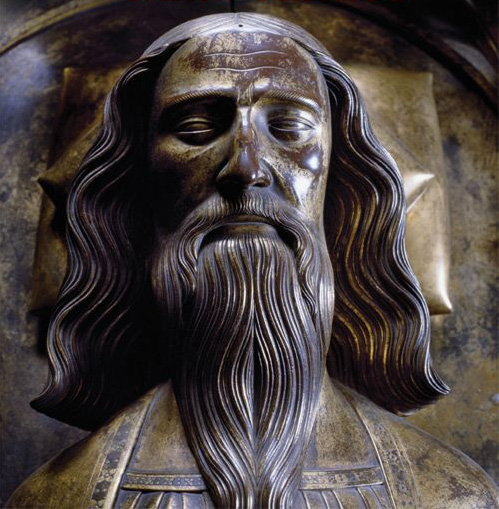
Edward III – Unknown author, Public domain, via Wikimedia Commons
“David De Kylmynawis to John his firstborn son & heir, and to the heirs of his body by Sibyl daughter of Joceli de Tregaminion his wife, with remainder to the grantor and his heirs. Charter with warranty of all his messuages, lands etc. In Kylmynawis, namely yards, gardens, woods, meadows, moors, turbaries, launds an pastures, and his corn mill there with multiple, waters and watercourses or beads, his bake house with garden in the town of Portzwyhan, the rent and service of John de Landewarnek and his heirs for lands held of the grantor in Kylcoys, of Simon de Kylcoys there, of Paternus and Robert brothers of the grantor for lands of him held for their lives in Kylcoys, of Margery his sister likewise in Araweyte, and the reversion of all lands of the said John, Simon, Paternus, Robert and Margery which they claim to hold for life of the grantor and his heirs when it shall fall in.”
Dated Kylminawis, Friday before St Barnabas 15 Edward III
Source: CCR Calendar Curia Rolls, Henry IV, Vol.4, 1441-47, (Public Records Office, London, 1937), 452/3.
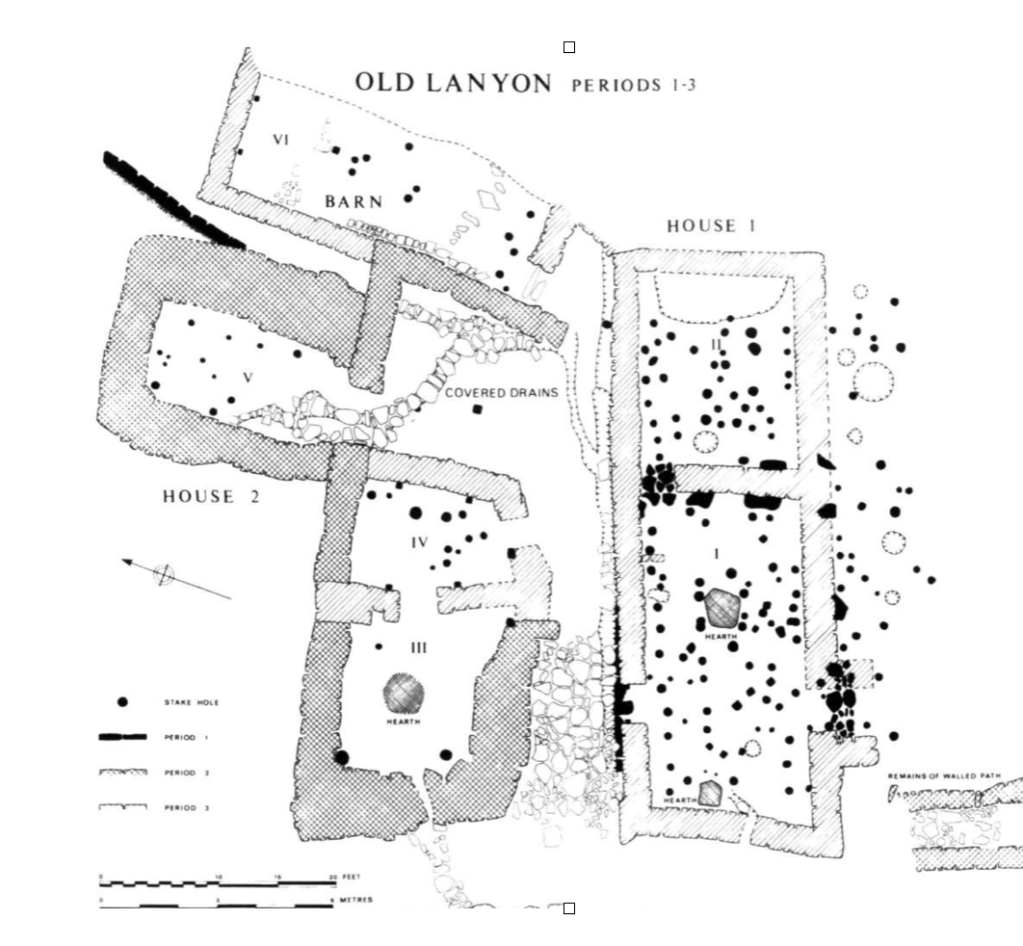
The Manor House at Lanyon was just west of Penzance at Madron. Originally these were turf houses which were extensively rebuilt each generation. In the mid 13th century they were replaced by a long house with thick granite walls, a turf roof and a central hearth. The hall would have been very smoky and smelly from animals in the barn and house.
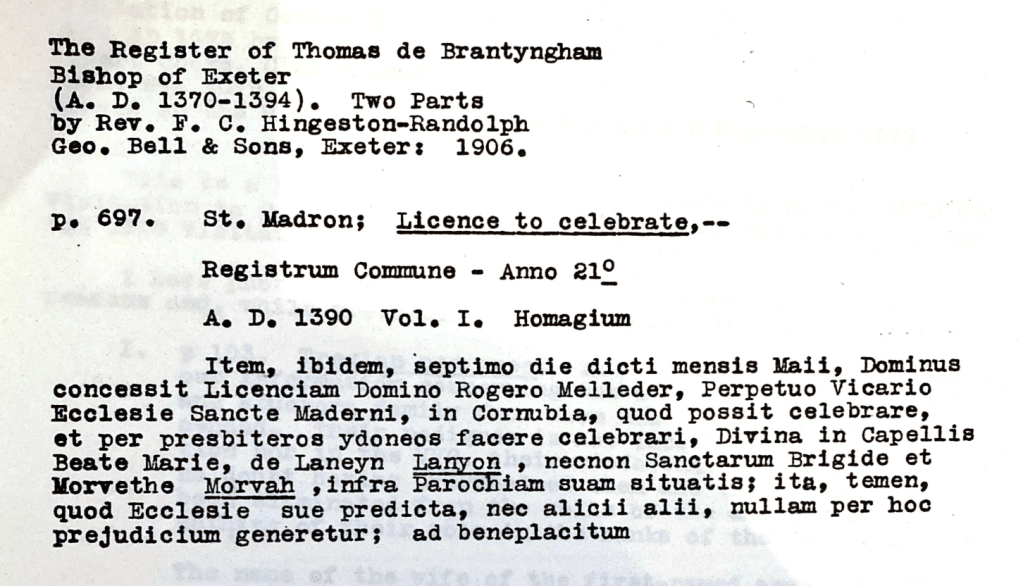
In 1390 the Bishop of Exeter licensed the Vicar of Madron to hold services in the Chapel of the Blessed Mary of Lanyen which is next to the present farm and suggests that the main house was at this location in 1390.
The site of Old Lanyon was scheduled under the Monuments Act of 1957 and in 1964 an archeological excavation of the mediaeval settlement took place. It found that Old Lanyon was a series of superimposed buildings dating from c1050 to the 16th century.
Source: 1. Beresford G 1994 – Old Lanyon Madron – A Deserted Medieval Settlement.
Source: 2. Minter EM 1965 – Lanyon in Madron – Interim Report on the Society’s 1964 Excavation.
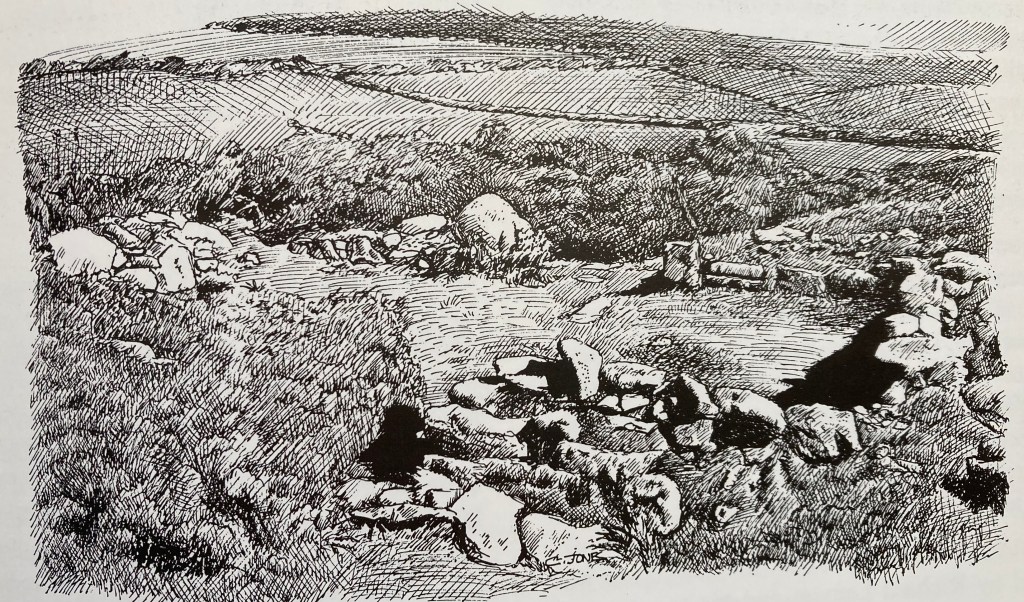
The last Lanyon to live at the old manor house was John Lanyon, who died in 1784 aged 92, after that the old house was taken down and the current farm house was built. It’s still possible to see some parts of the old manor.
Bob Jones / Mounting steps at Lanyon FarmThe remains of the old manor house at Madron – from ‘These Were Our People’ by Ruth Lanyon
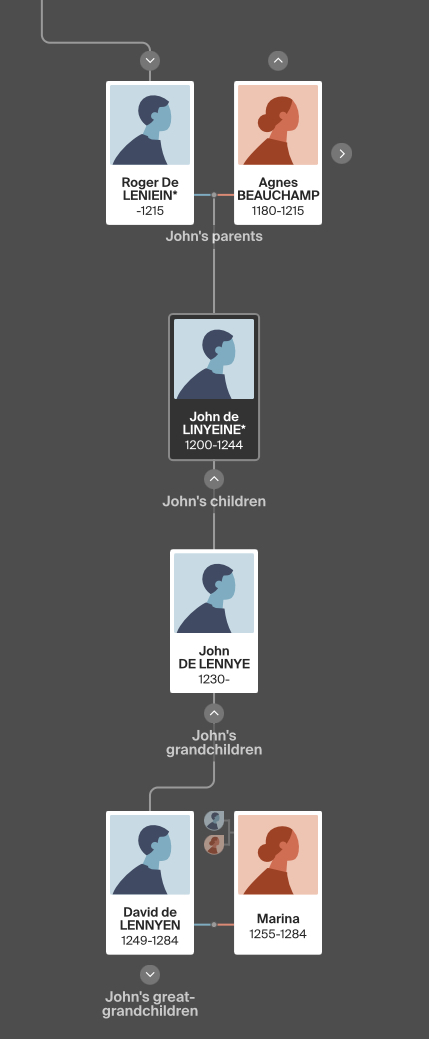
The earliest Lanyon is Roger De Linyeine/Leniein who died before 1215. He was married to Agnes Beauchamp (Bello Campo) and after his death she pleaded for a third part of two acres which she claimed as her dowry on Hugh de Bello Campo. She was successful and passed her land to her son/stepson John de Linyeine. (A Cornish Acre is apparently approx 300 acres but the size varied over time.)
Lanyon was subject to the Domesday Manor of Binnerton held by Hugh de Bello Campo. Agnes may have been the daughter of Stephen de Beauchamp and Stephen was the son of Hugh.
“Cornub Agnes que fuit uxor Rogeri de Leniein optulit se quarto die versus Hugonem de Bello Campo de placito tercie partis duarum acrarum terre cum pertinentiis in Leniein, quam ipsa clamat in dotem versus eum: et Hugo non venit etc. Et summonito etc. Judicum. Tercia pars capitur in manum…”
CRR Curia Regis Rolls, John 15-16, C.T.Fowler (Ed.), (Public Records Office, 1971),p.193.
King John signs Magna Carta 1215
The next time we see the name Lanyon is in 1244 in the Cornwall Feet of Fines. Roger’s son John receives two small parcels of land from Stephen de Bello Campo, one at Little Bosullow and one in Lower Drift in Sancreed. John guarantees no interference to the water supply to the mill.
Henry I – Matthew Paris (Historia Anglorum), Public domain, via Wikimedia Commons
One of the few ways to find families at this time is through property transactions and legal disputes. A charter of 1284 gives us the name of John de Leynen’s son, David and his wife Marina.
Edward I
“At Lanzaveton (Launceston) 1 month from Easter day, in the 28th year of King Henry (1 May 1244). Before Henry de Tracy, Gilbert de Preston and Robert de Haya, justices itinerant, and other liegemen of our lord the King then there present. Between John de Linyeine (Lanyon in Madron), plaintiff, and Hugh de Bello Campo (Beauchamp) [tenant] whom Stephen de Bello Campo vouched to warranty, & who warranted to him 3 ferlings of land in Botuolo bichan (Little Bosullow in Madron) & 1 ferling of land in Drek bichan. John acknowledged the whole of the said land to be the right of Hugh. For this Hugh granted to John the 3 Ferlings in Botuolo bichan, to have and to hold to John and his heirs of Stephen and his heirs for ever, rendering therefor 40 1/2 (?) at the four terms of St Andrew (30 Nov.), Mid Lent, the Nativity of St John the Baptist (24 June), & St Michael (29 Sept.) for all services & demand. Moreover John granted for himself & his heirs that the water which runs from Retsic (Rissick) to Netcurran shall be a free stream by the land of the said John in Retsic as far as the mill of the said Stephen at Netcuran, as in contained in a charter made between Roger father of the said John and Hugh de Bello Campo, without hindrance from John or his heirs for ever.”
Cornwall Feet of Fines, Volume 1, Joseph Hambley Rowe (Ed), (Devon & Cornwall Record Society, Exeter, 1914), pp.39/40.
Charter of 1284 confirms that David, husband of Marina was the son of John de Leynen. The charter also mentions the properties obtained by John de Leynen in 1244.
“John de Leynen to David his son and William de Trenyer chaplain and to the heirs of the body of the said David by Marina his wife. Charter with warranty of all his lands and messuages in the towns of Lennyen, Resik, Bossewolonwyan, Polgon, Hendrenythyn, Boswolnel and Trengwenton, with two mills corn and fulling in Lenyen, and the rent, service and homage of Ralph de Pendyn and his heirs for land there, and of Michael Pennek, Sara his wife and their heirs for land in Trethyn by Treudreuen.”
Dated Lanyen Friday before St Peter’s Chains 12 Edward I
English Groat – Edward I – PHGCOM, Public domain, via Wikimedia Commons
John de Lynyen was born about 1310 in Cornwall the son of David de Kylminawis. John died before 1386. He lived at Bosollow, Madron near Penzance. John married a neighbour Sibyl de Tregamynyan the daughter of Joscelin de Tregamynyan and his wife Joan of Tregamynyan Manor in Morvah.
Joan died in 1344 and Sibyl returned to Tregamynyan. When she went back to her home at Madron she brought her mother’s (possibly step-mother’s) jewels and other goods with her. Perhaps she felt they were rightly hers. Evidently her family thought otherwise and this led to her being charged with the theft. Her husband John was charged as an accessory to a felony as he permitted her to come home with the goods. If found guilty he would have faced being outlawed and his lands forfeit.
Having been charged, John appealed to a higher court and then left home to join the Earl of Derby’s army who were going to France.
French army besieging the citadel of Auberoche, catapaulting an English messenger over the walls- Jean de Wavrin, Public domain, via Wikimedia Commons
The 100 Years’ War started in 1337 and continued until 1453. In 1345 Edward III decided to send an army to France lead by Henry, Earl of Derby, his cousin.
A patent Roll of 24 Edward III (24th year of Edward III’s reign) explicitly states that John was charged before the Earl’s expedition of 1345. The Patent Roll does not disclose what John de Lynyen did in France but on their return The Earl of Derby (now also the Earl of Lancaster) gave personal testimony at Westminster on 3 June 1350 to John’s ‘good service in Gascony’ which obtained a royal pardon for him. John was able to return to Cornwall a free man.
Whilst we don’t know what John did in Gascony it seems possible that he fought at the Battle of Auberoche.
The Earl of Derby gave personal testimony at Westminster on 3 June 1350 to John’s ‘good service in Gascony’ which obtained a royal pardon for him.
The National Archives at Kew Ref: SC 8/254/12666 & 12667 Old Cornwall Journal “The Lanions of Lanion, Madron, Cornwall: An Incident in the Family History” 1964
Edward III-AnonymousUnknown author, Public domain, via Wikimedia Commons
Another tradition, repeated by Bottrell, of Bosawa in St Buryan, (a house owned by the Lanyons), says ‘In the hall of this house there hung suspended on the wall a coat of mail, a buff jacket and a huge pair of jackboots of Cordovan leather, the monster spurs still buckled on them which once belonged to some renowned Lanyon: over the stone cut Lanyon arms an old rusty sword.‘
Could these boots have been John de Lynyens?
“Traditions and Hearthside Stories of West Cornwall” by William Bottrell.














 The Lanyons