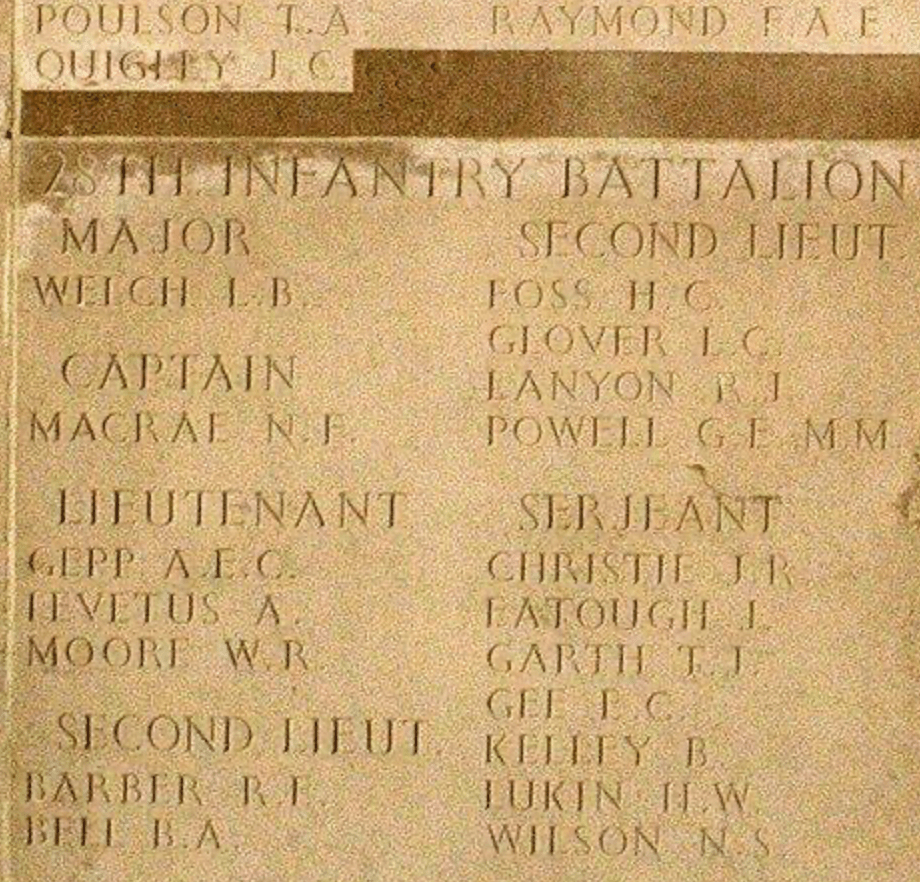
Cecil was born 07 Aug 1894 • Brooklyn, New York, USA. He was the son of Ernest James Lanyon (originally from Guernsey) and Helen Sullivan. He was the eldest of three children. He was a private, service number: 2444596 in the 305th Infantry, 77th Division. He was killed in action on 31 Aug 1918 and was buried at Oise-Aisne American Cemetery, France.
Charles Edward Lanyon 1882-1918
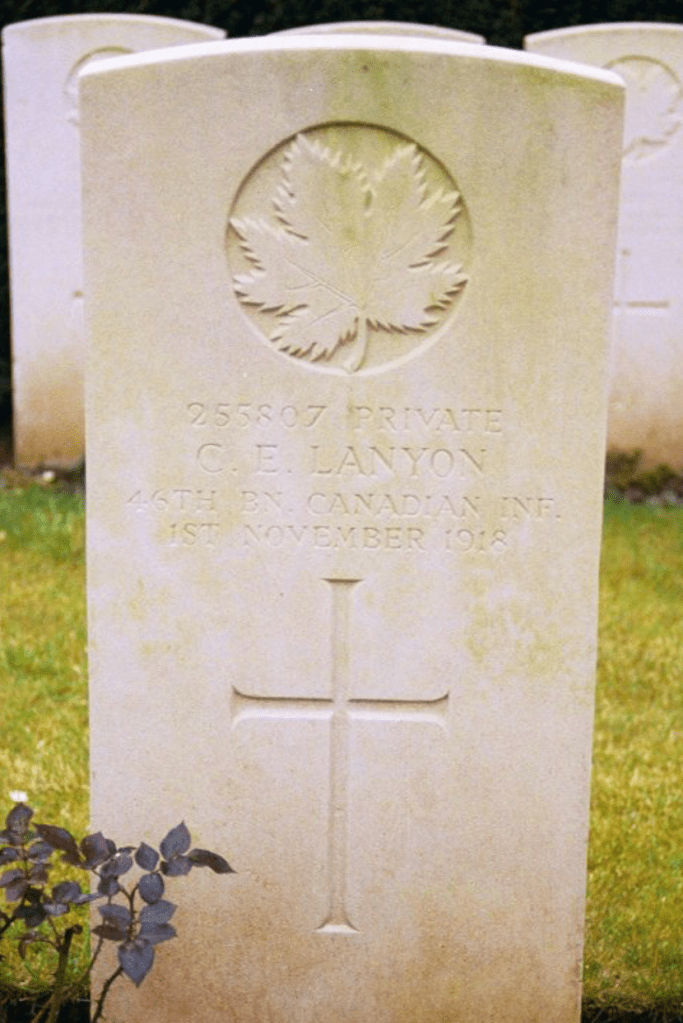
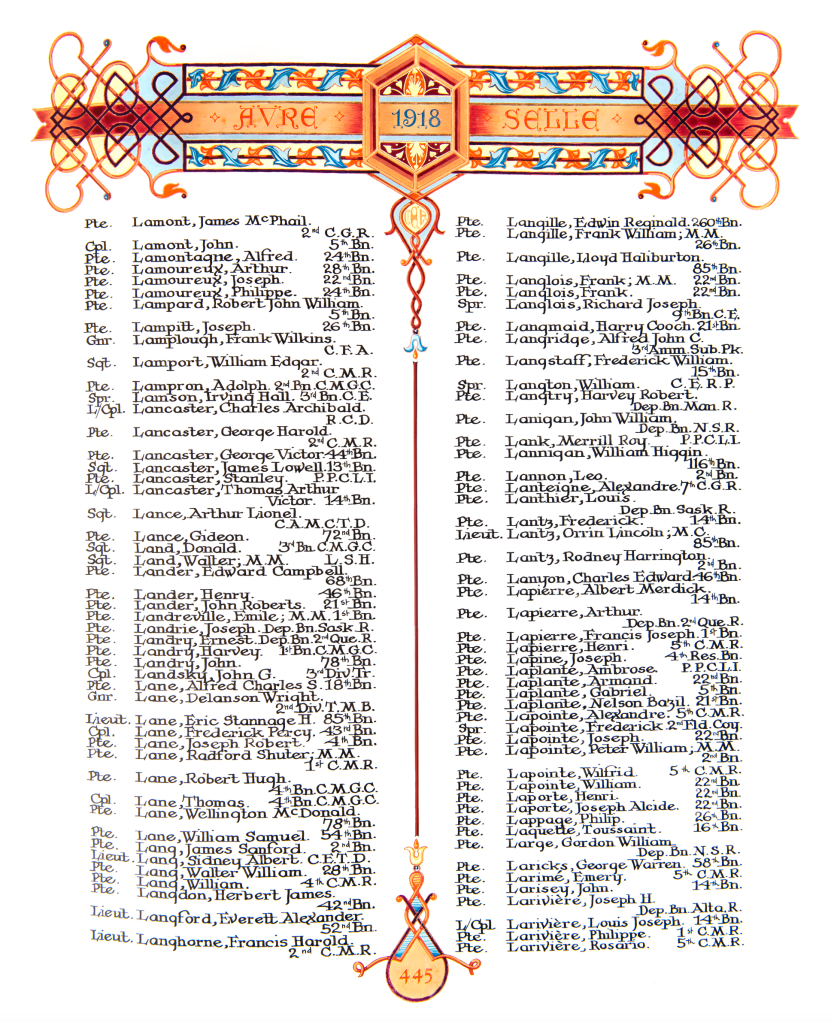
Charles was born 05 Mar 1882 • Penzance, Cornwall, England the son of John Rodolphus Lanyon and Emily Anne Hearle. He was the fifth of six children born to the couple. He was a farmer who emigrated to Manitoba, Canada in 1909. He was a private in the 46th battalion of the Canadian Infantry (Saskatchewan Regiment), service number: 255807. He was killed in action (shot by a sniper) on the 1 Nov 1918, just days from the armistice on 11 Nov. He was buried at Aulnoy Communal Cemetery, Nord, France.
Charles Edward Lanyon’s graveFirst World War Book of Remembrance (Canada)
Frederick Lanyon 1895-1916
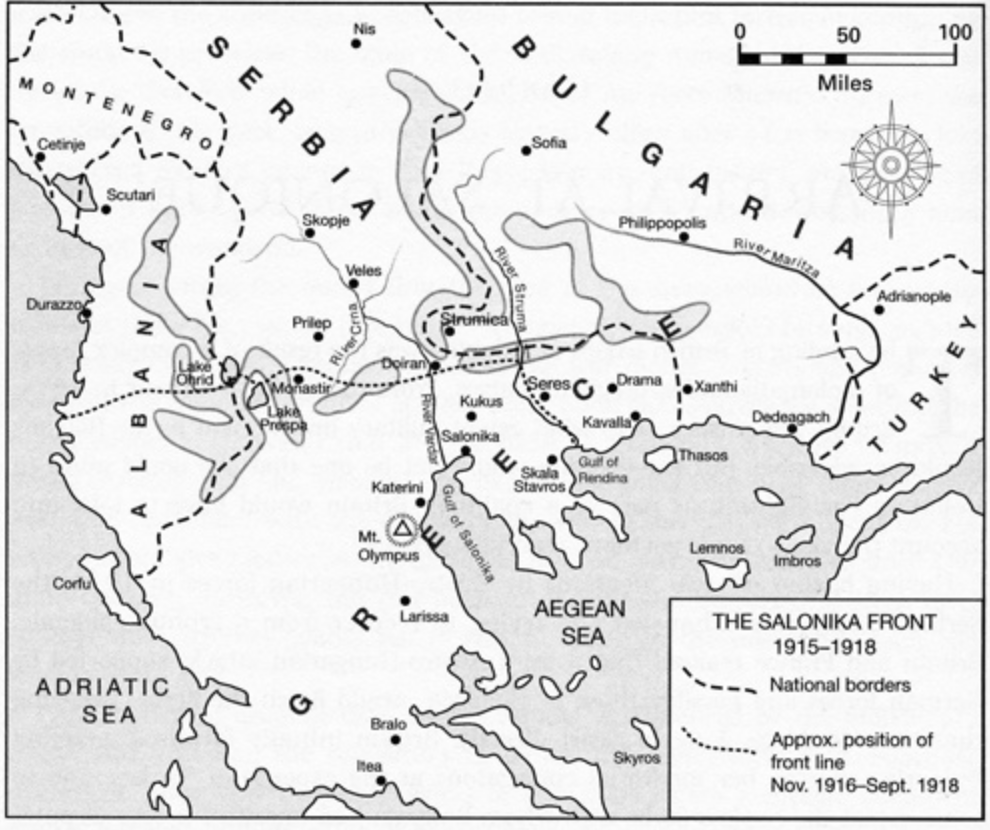
Frederick was born 16 Apr 1895 • Chacewater, Cornwall, England, the son of Frederick Lanyon and Susanna Tregoning. Frederick was a private (service number SE/20297) in the Army Veterinary Corp. He died on 30 Nov 1916 at Salonika, Greece.
George James Lanyon 1909-1942
George was born 8 Nov 1909 • Harlton, Kent, England, the son of George Henry Lanyon and Daisy Harriet Warren. He was the second of five children born to the couple. The 1939 Register shows he was a munitions worker. He served in Fighter Command as an Air Craftsman First Class, service number 1031229. He was killed, aged 32, in an accident at the military base at Llanbedr, Merioneth on 9 Sep 1942 when he was struck while on drogue collection duty by a Spitfire which was taking off.
Harold Merrill Lanyon 1920-1942
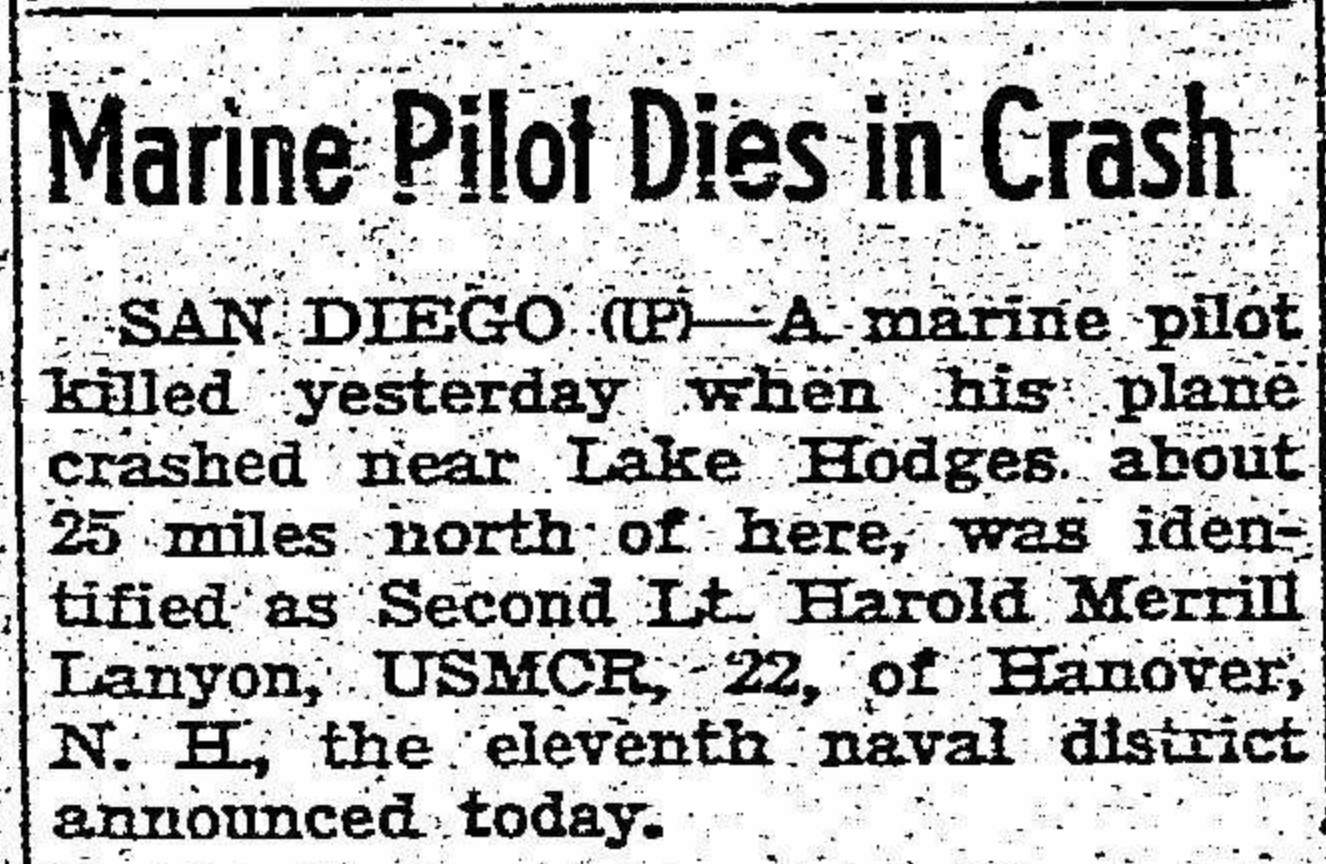
Harold was born 01 Jun 1920 • Hanover, New London, Connecticut, USA. He was the son of William Jacob Lanyon and Frances Merrill and the eldest of four children. He joined the Marine Corps and was a marine pilot. He was accidentally killed when his plane crashed on 24 Nov 1942 in California, USA.
Irving Frances Lanyon 1922-1944
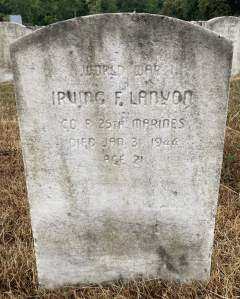
Irving was born 11 Jul 1922 • Stamford, Connecticut, USA, the only son of Irving Lanyon and Leona Madelon Farrell. He was a Private First Class (service number: 439683) in the 2nd Btn, 25th Marines. He was killed in action in the Marshall Islands on 31 Jan 1944 age just 21.
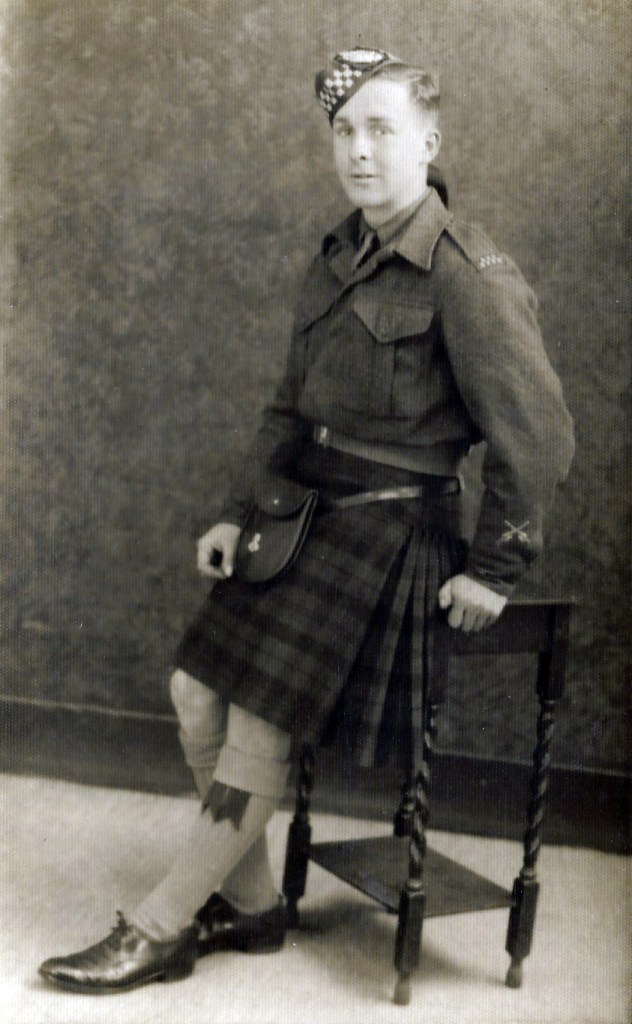
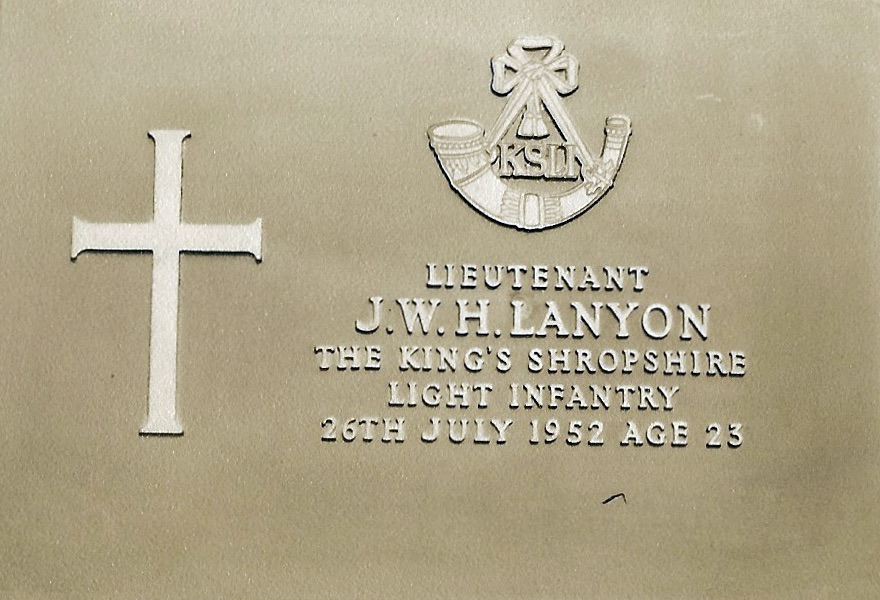
John William Haig Lanyon 1929-1952
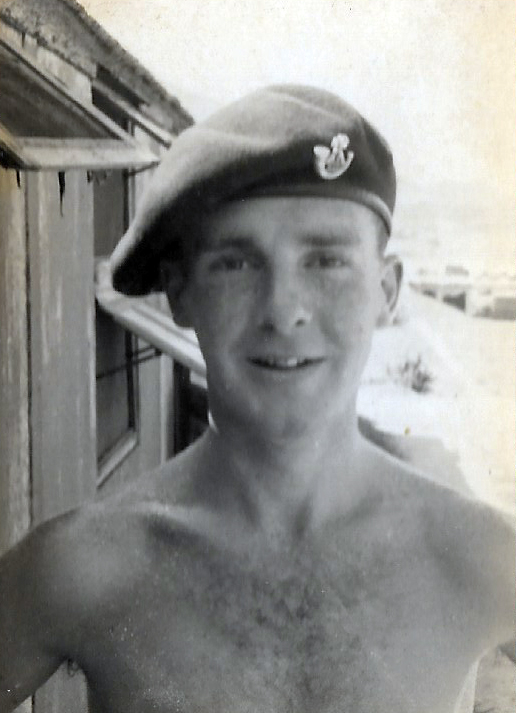
John, known to his family as ‘Bill’, was born in 1929 in Nantwich, Cheshire, England, the eldest son of John Arthur Lanyon and Nancy Eleanor Mitchell. He was a Lieutenant (service number: P/407938) in the 1st Battalion King’s Shropshire Light Infantry. He was killed on 26 Jul 1952 in Korea and buried at the United Nations Memorial Cemetery Tanggok, Busan, South Korea. He is commemorated on the Kelsall War Memorial in Cheshire.
Joseph James Lanyon 1894-1916
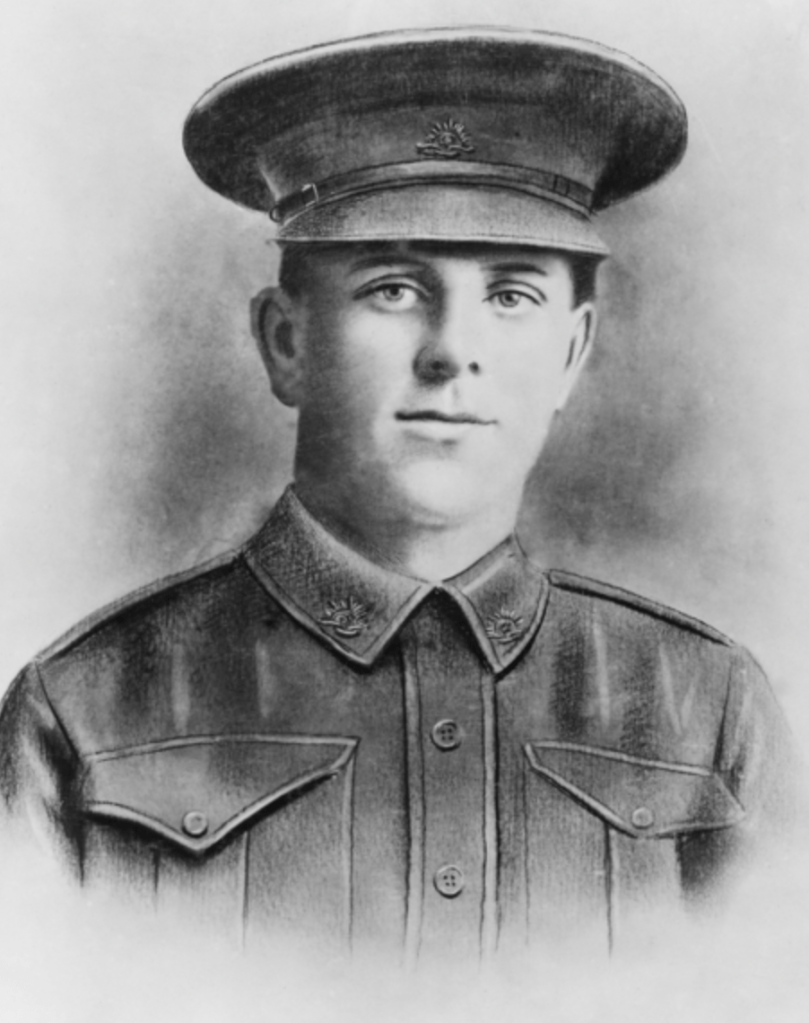
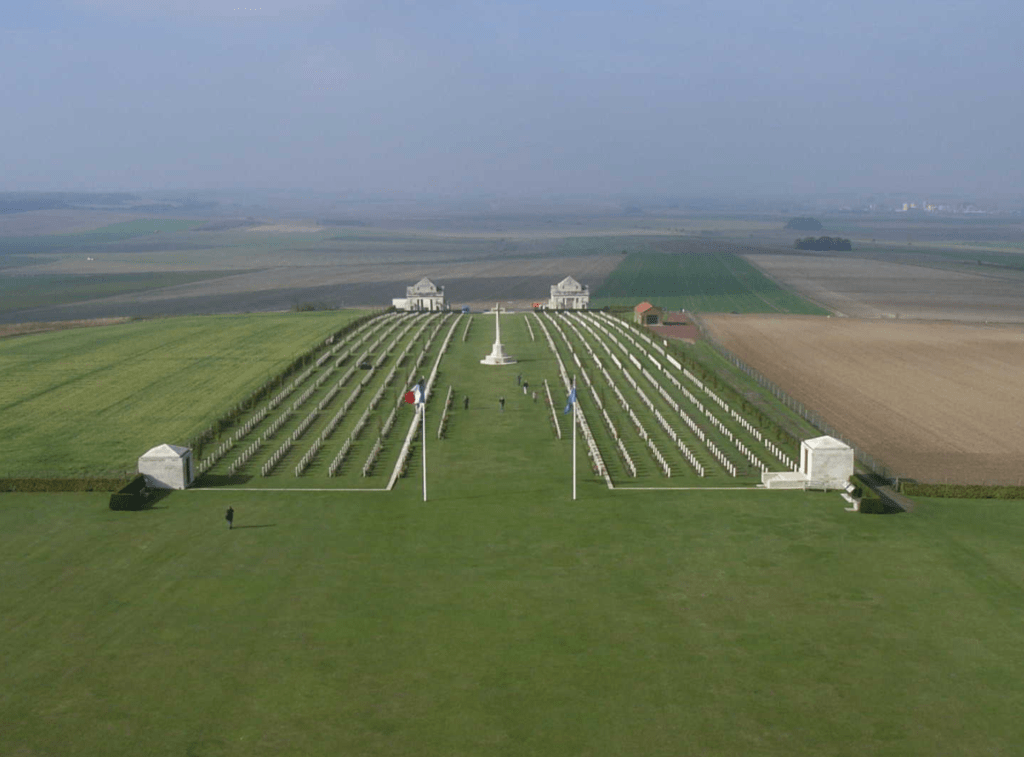
Joseph was born at Broken Hill, New South Wales, Australia in 1894, the son of John James Lanyon and Eliza Jane Sampson. He was the fourth of seven children. Private Joseph James Lanyon, 1st Battalion from Broken Hill, NSW. A 21 year old labourer with previous service in the 20th Militia prior to enlisting on 13 Apr 1916, he embarked for overseas with the 3rd Divisional Cyclist Company from Sydney on 18 May 1916 aboard HMAT Demosthenes (A64). On arrival in France, he transferred to the 1st Battalion on 29 Oct 1916 and was killed in action near Gueudecourt, France on 5 Nov 1916. Pte Lanyon is commemorated on the Australian National Memorial at Villers-Bretonneux, France with others who have no known grave.
Joseph James Lanyon (public domain photo)Australian National Memorial at Villers-Bretonneux
Kenneth Maurice Munro Lanyon 1913-1940
Kenneth was born in Portsmouth, Hampshire, England in 1913. He was the only son Harold John Lanyon and Ada Maud Munro. In 1939 he married Pattie Vinson Hewitt. He was a gunner in the Royal Artillery, 4th Battalion City of London Regiment. Service number: 1432428. He died in hospital on 30 Dec 1940, he was suffering from inflammation of the kidneys and heart weakness aged 27. He was buried at Rakowicki Cemetery, Małopolskie, Poland.
Robert Jordan Lanyon 1891-1917
Robert was born 16 May 1891 • Cometville, Queensland, Australia, the son of Richard Lanyon and Kate Jordan. He was one of 15 children born to the couple, 9 of which died in infancy. Robert was a bank clerk who volunteered for the Australian Infantry. He was a 2nd Lieutenant. He was killed on 3 May 1917 at the Battle of Bullecourt and was buried at Villers-Bretonneux, Departement de la Somme, Picardie, France.
Angus Herbert William Kennedy 1906-1941
Angus was born 13 Mar 1906 • Bendigo, Victoria, Australia, the only son of Donald Dan Kennedy and Elizabeth Anne Lanyon. He was a gunner in the Second Australian Imperial Force (service number: Vx1088). He was killed at the Battle for Crete on 24 May 1941 and buried at Athens, Greece.
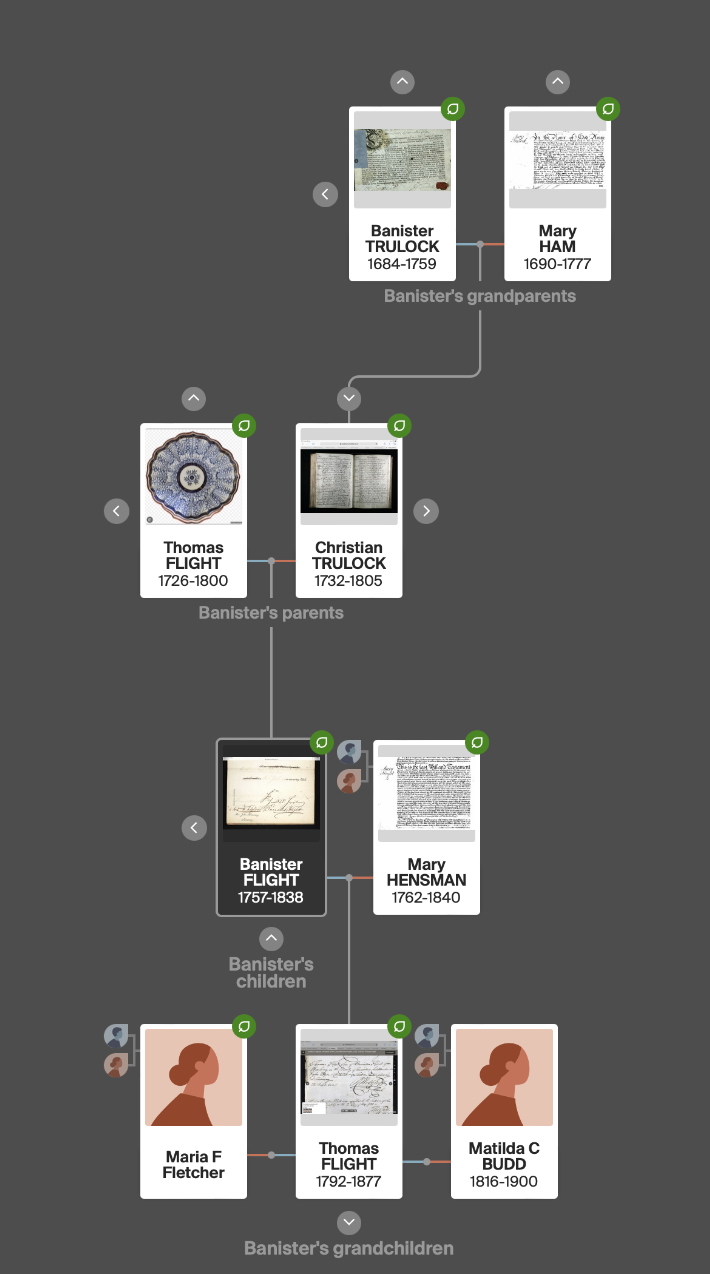
Banister Flight was born about 1757, the son of Thomas Flight and Christian Trulock. He was named after his maternal grandfather Banister Trulock and it seems the perfect name for a carpenter!
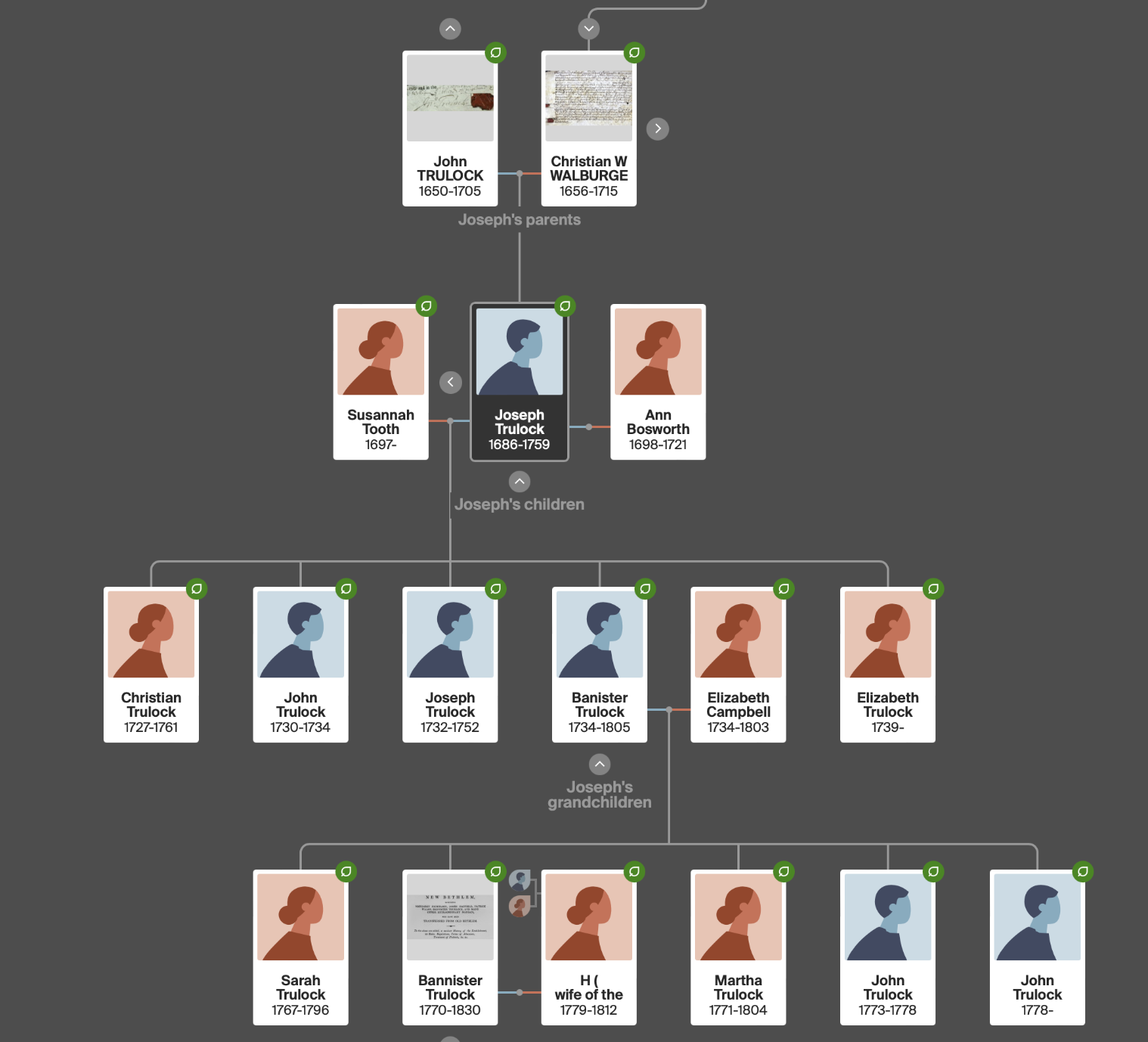
In 1783 Banister married Mary Hensman at Kimbolton, Huntingdon. They had one child, Thomas born in 1792.
From London electoral registers we can see that Banister and his son owned property at 44, 45 and 46 Gray’s Inn Lane.
Gray’s Inn Lane, (now Gray’s Inn Road) described in 1878 by Thornbury in Old and New London as a narrow, dingy thoroughfare, had several literary associations, it was the road by which Fielding’s Tom Jones entered London, James Shirley (1596-1666), the dramatist resided here and it was the favourite haunt of the poet John Langhorne (1735-1779). Public domain.
Banister may have owned property in Gray’s inn Lane but he resided at Stone-bridge, Tottenham. He also lived at Lewes in Sussex.
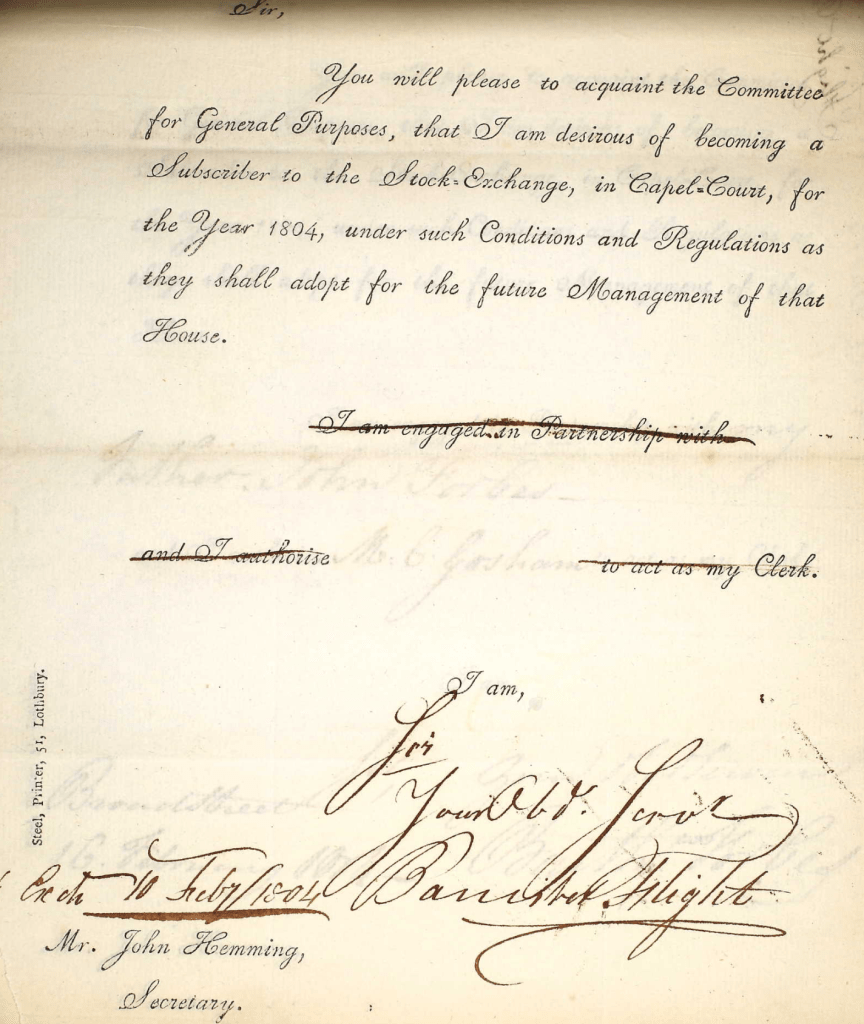
In 1804 Banister Flight applied to join the London Stock Exchange.
He was also a director of the London Annuity Society for the Benefit of Widows.
When he died in 1838 (of paralysis) he left his estate to his wife Mary and son Thomas. Mary died just two years later in 1840.
Thomas Flight
In 1812 Thomas, like his father, was given Freedom of the City of London as part of the Carpenter’s Company. His occupation was banking and moneylending and it made him very wealthy.
He lived partly in Brighton and was an early commuter to London.
Thomas married at Eton in Buckinghamshire in 1840 at the age of 48, his wife Matilda Catherine Budd was just 23! They went on to have eight children. It may have been Thomas’ first marriage but they weren’t his first children.
Previously Thomas lived with Maria Frances Fletcher, a widow and they had five children together.
Maria Flight Fletcher b 1829
Mary Flight Fletcher b 1830
Thomas Flight Fletcher b 1832
Banister Flight Fletcher b 1833 – 1899
Emily Flight Fletcher b 1837
The children were all sent away to school at a young age and the 1841 census shows the four eldest children at school on the Isle of Thanet. Emily age 4 was living with a nurse Eliza Rickards at Seymour Place, St Pancras.
It’s not clear what happened to Maria Frances Fletcher, she may have married Thomas Prier. Of the children I have only traced Banister Flight Fletcher, more of him later.
Once married Thomas wasted no time in starting a second family with Matilda. They produced eight daughters!
Christiana 1841-1931
Matilda 1842
Mary 1843-1920 (two daughters called Mary is helpful when researching a family tree!!)
Sophia 1846-1944
Frances 1847-1933
Annie 1848-1941
Septima 1852-1926 (by now he seems to have run out of female family names to use!)
Octavia 1853-1926
In 1843 Thomas was a beneficiary of his aunt Christian Flight’s will. She bequeathed him £3000.
By 1871 they were living at Grecian Villa, Beulah Hill, Norwood in Surrey. He died on 15th Feb 1877 at Brighton aged 85. Cause of death was old age and exhaustion.
Banister was born on 11th Aug 1833 and baptised on 29th Jun 1836 at St Mary Paddington along with his siblings. In 1864 he married Eliza Jane Phillips.
He was an architect and surveyor for the board of trade. He was also the Liberal MP for North West Wiltshire. He went on to become the professor of architecture and building construction at King’s College in 1890.
Banister Flight Fletcher – Public domain via Wikimedia Commons
He had 12 children, his eldest son also called Banister Flight Fletcher was knighted. His youngest son was memorably named Ernest Tertius Decimus Fletcher – obviously chosen to help future family historians!
Sir Banister Flight Fletcher by Glyn Warren Philpot RA (5 October 1884 – 16 December 1937), Public domain, via Wikimedia Commons
Thomas Flight’s Daughters
Thomas had eight daughters from his marriage to Matilda Budd.
Christiana 1841-1931
She may have been named after her great aunt Christian Flight. When Christian died in 1843 she left Christiana £100. Christiana was presented to Queen Victoria.
Christiana Flight presented to Queen Victoria
In 1863 she married William James Nevill and they had 11 children. She emigrated to New Zealand and died there in 1931.
Christiana and her son Geoffrey
Matilda 1842-
Matilda was born in 1842 in Highbury. In 1867 she married William Henry Smith. They emigrated to Australia and had five children. There are so many Matilda Smiths that it isn’t possible to determine when she died.
Mary 1843-1920
Thomas had two daughters called Mary and one called Maria which complicated the search for information! Mary was born in 1843 and married Thomas Howse the younger, a merchant, in 1865. They had four children. Mary died in 1920 in Kent.
Sophia 1846-1944
Sophia was born in 1846 in Upper Brook St, London. In 1868 she married Edwin Francis Hickman and they had five children. Sophia died in 1944 in her 99th year.
Frances 1847-1933
Frances was born in 1847. In 1874 she married George Robinson Bridge Drummond. At the time of their marriage he was a Captain in the Bombay Army and he went on to become the Chief Constable of Sussex. He was knighted in 1904. They had four daughters.
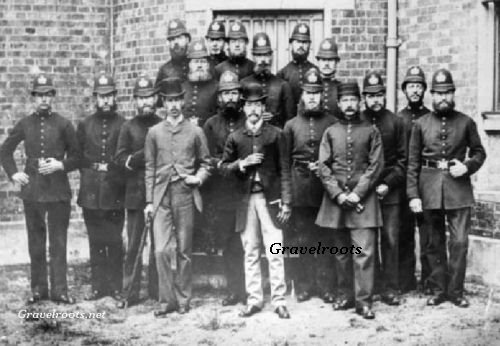
Chief Constable of Sussex, centre.
Annie 1848-1941
Annie was born in 1848 and never married. She never worked and was described on the census as having independent means. She died in 1941.
Septima 1852-1926
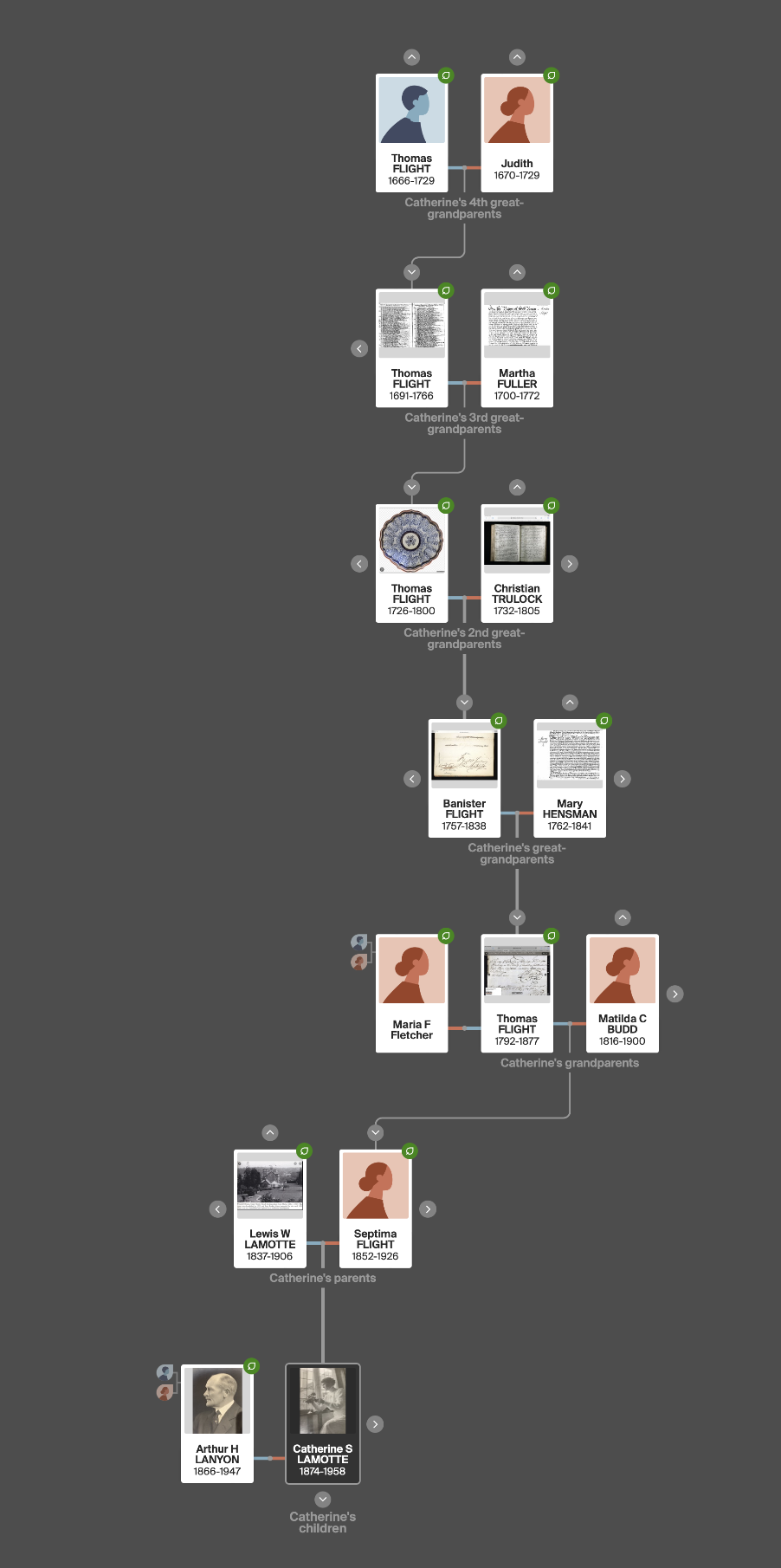
Septima was born in 1852 in Norwood, Surrey. In 1871 she married Lewis William Lamotte a tobacco broker. They had seven children. Their eldest daughter married Arthur Herbert Lanyon. Septima died in 1926.
Octavia 1853-1926
Octavia, the eighth daughter was born in 1853. She married Bonham Carter Evelegh, a journalist and author, in 1882. They had five children. Their son George was held prisoner by the Japanese during the 2nd World War. Both George and his brother Aldridge, were given freedom of the city of London and admitted to the Company of Carpenters like their ancestors.
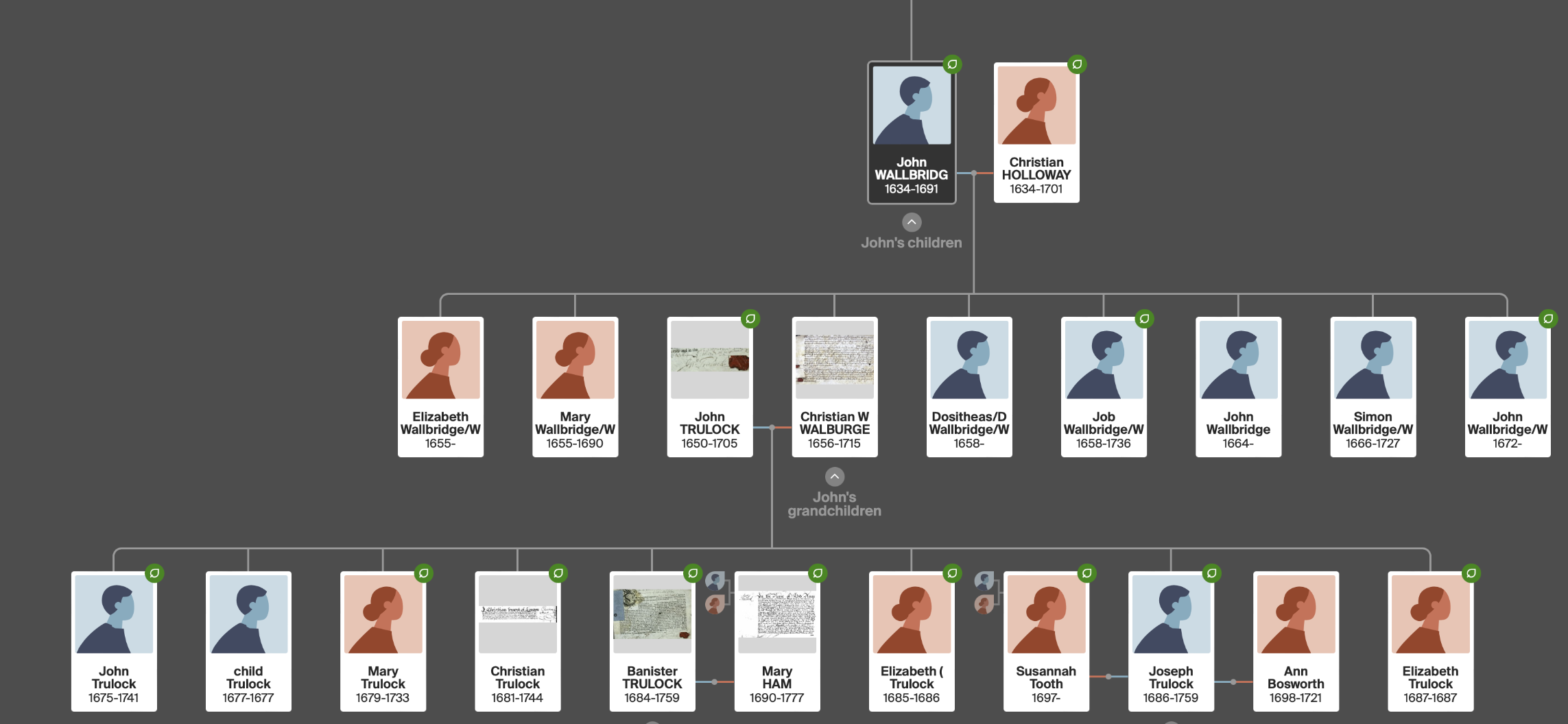
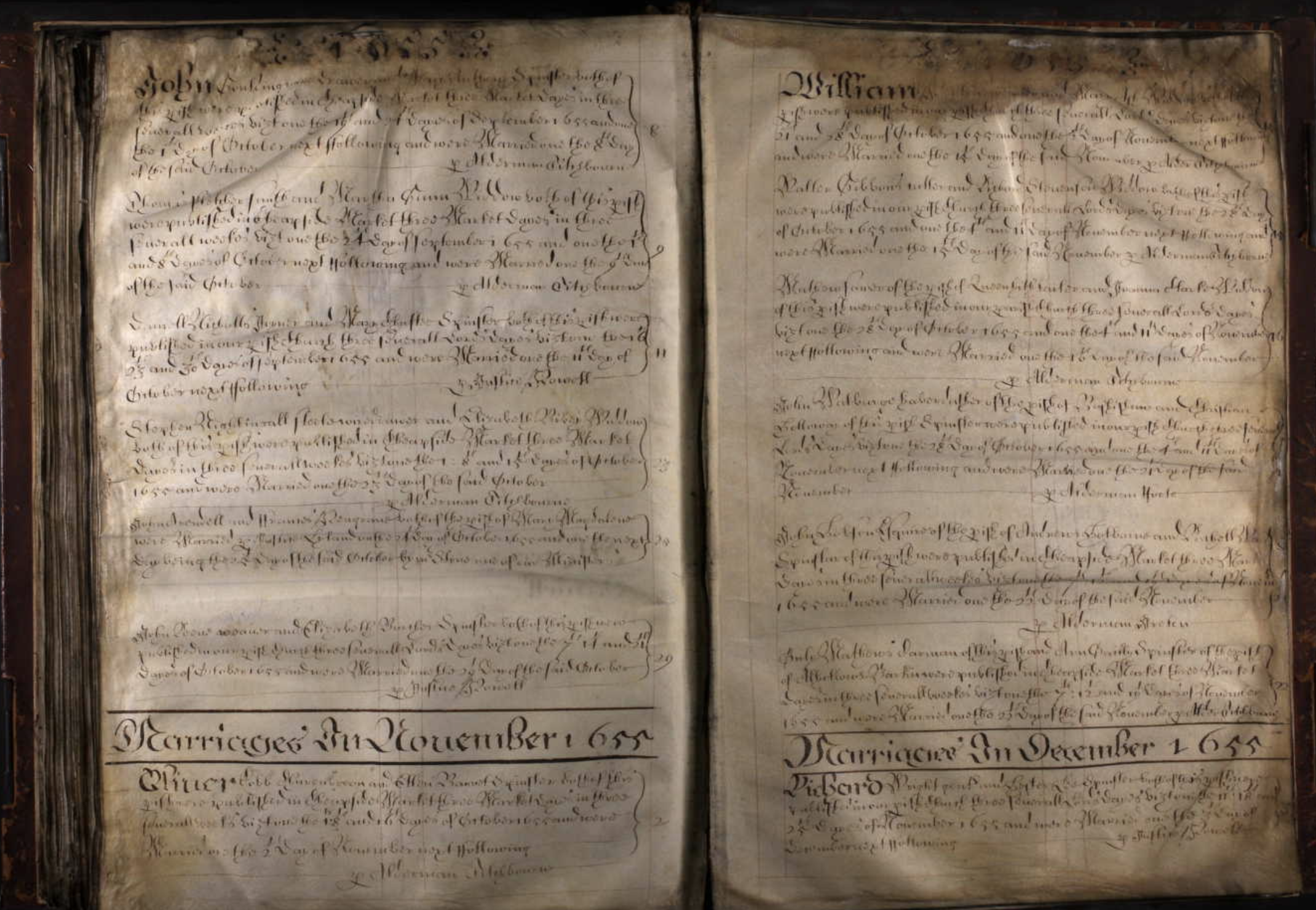
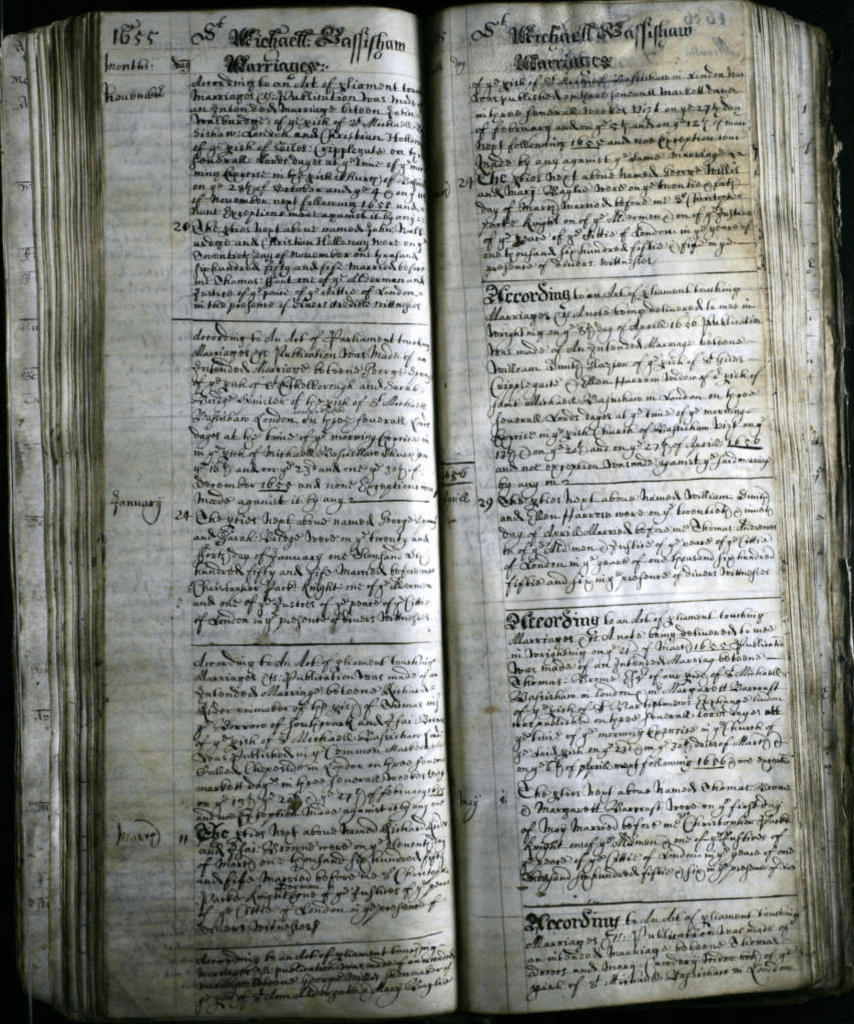
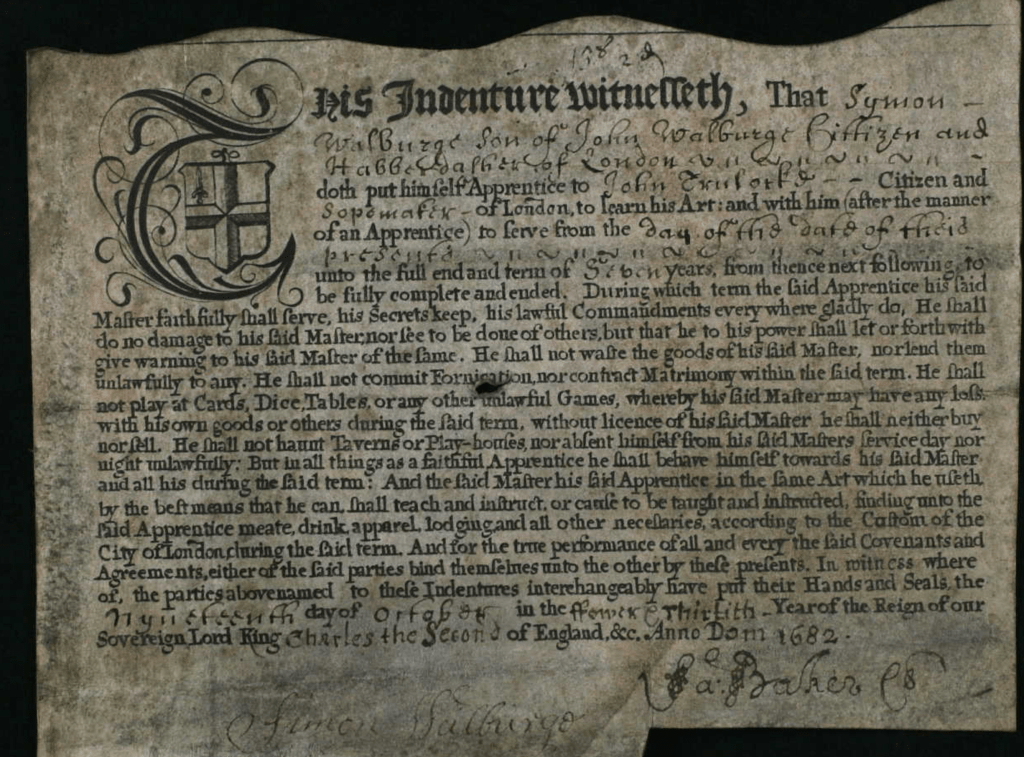
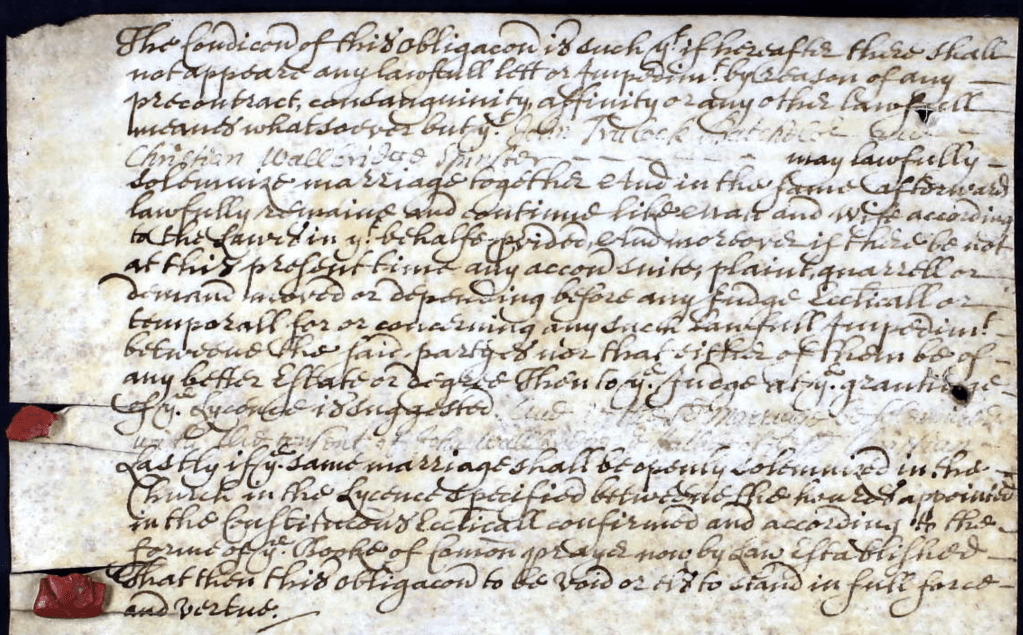
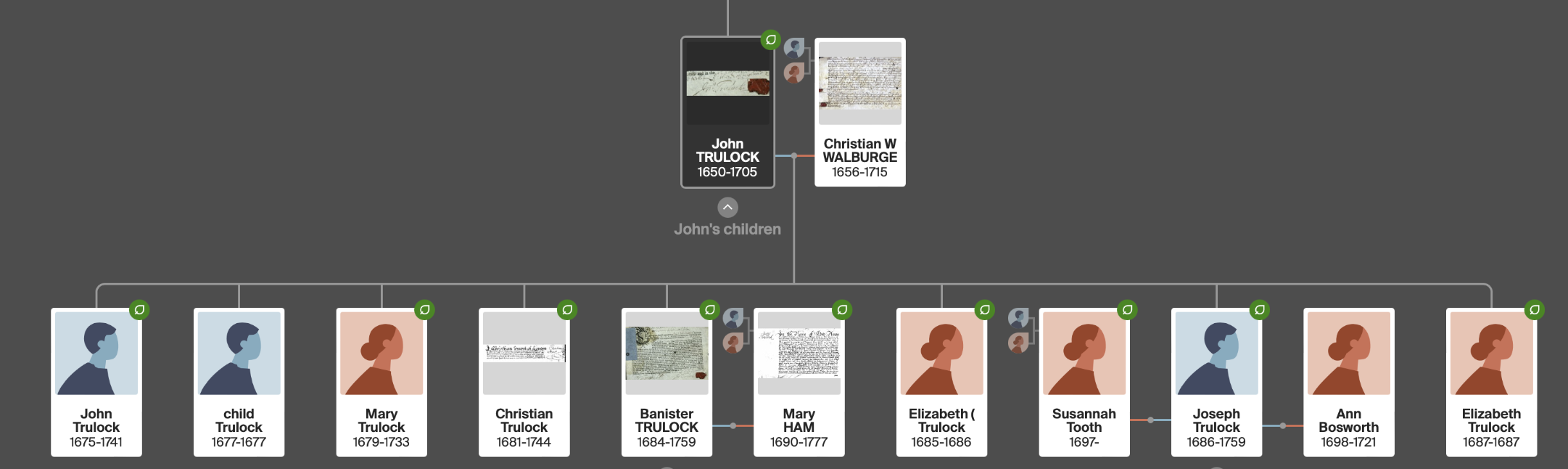
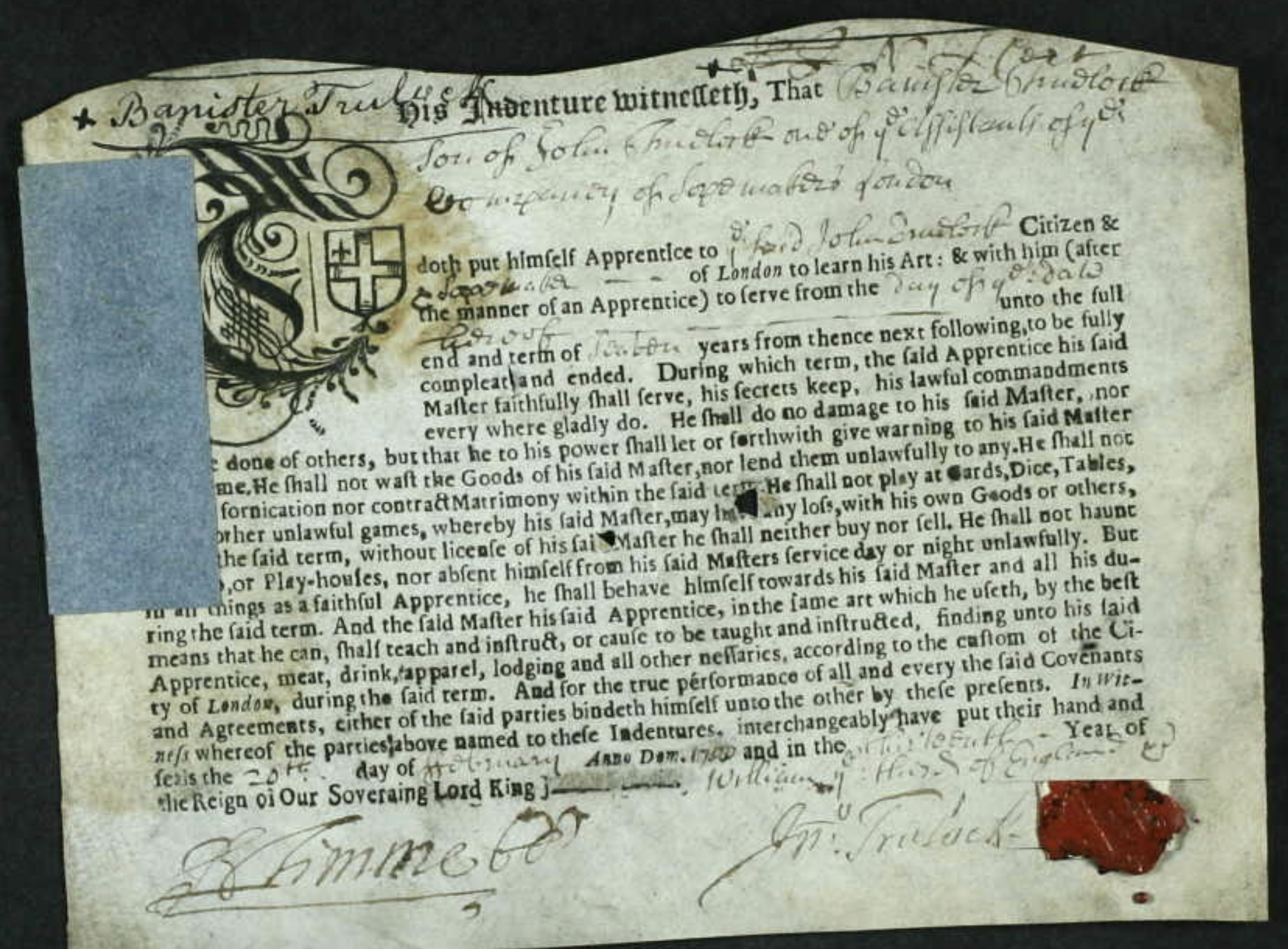
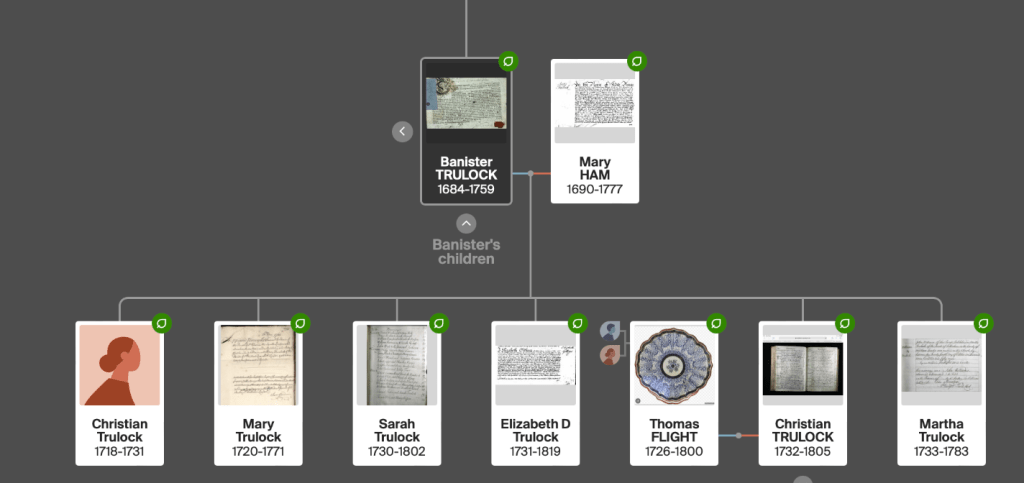
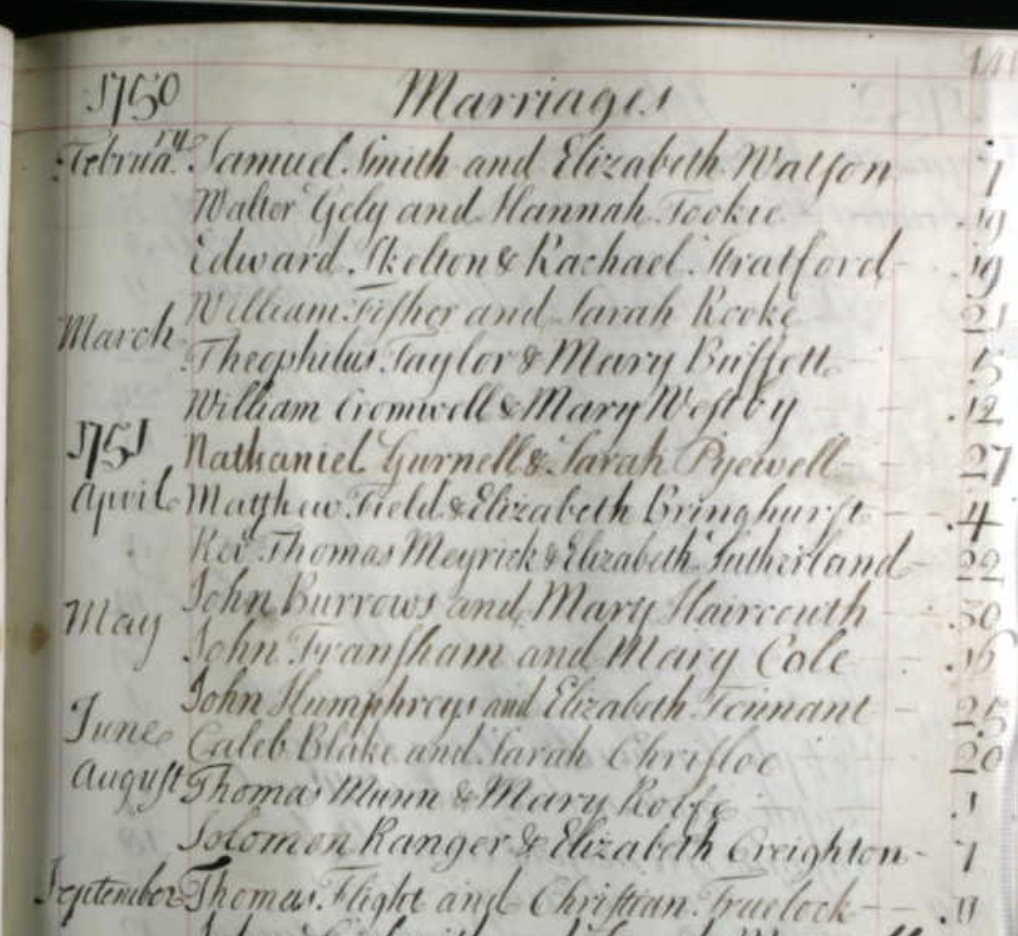
Thomas Flight was Thomas and Martha’s second and arguably the most successful son. He was born at Abingdon in Berkshire in 1726 and in 1751 he married Christian Trulock/Truelock. They had six children in all but this post is about his third and fourth sons, Joseph and John Flight.
Marriages 1750 at All Hallows London Wall
Thomas was a carpenter by trade and a very successful business man. In 1768 his place of abode was Monument Yard.
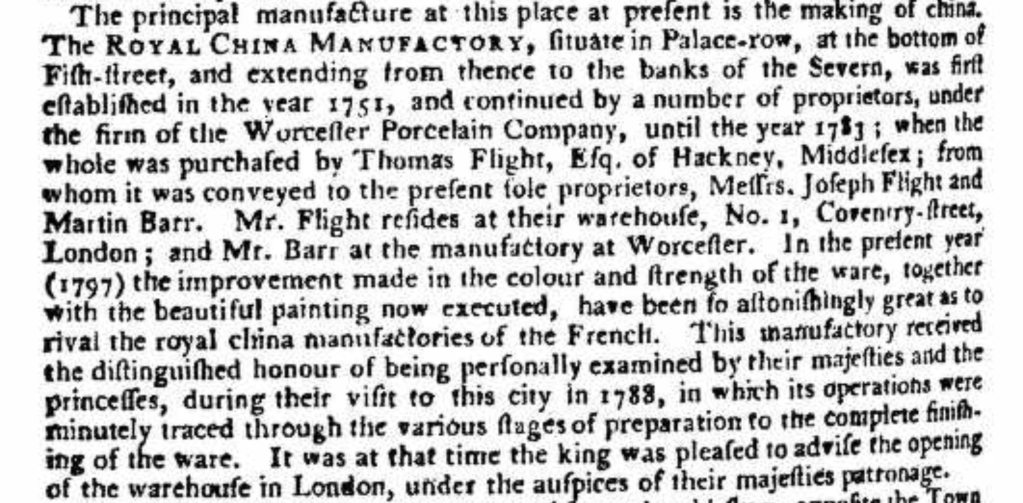
He was also the London agent for Worcester china. In 1783 he purchased the factory for £3000 and intended that his sons John and Joseph would run it. (In the same year Chamberlain opened a rival china factory in Worcester.)
The Universal British Directory 1791
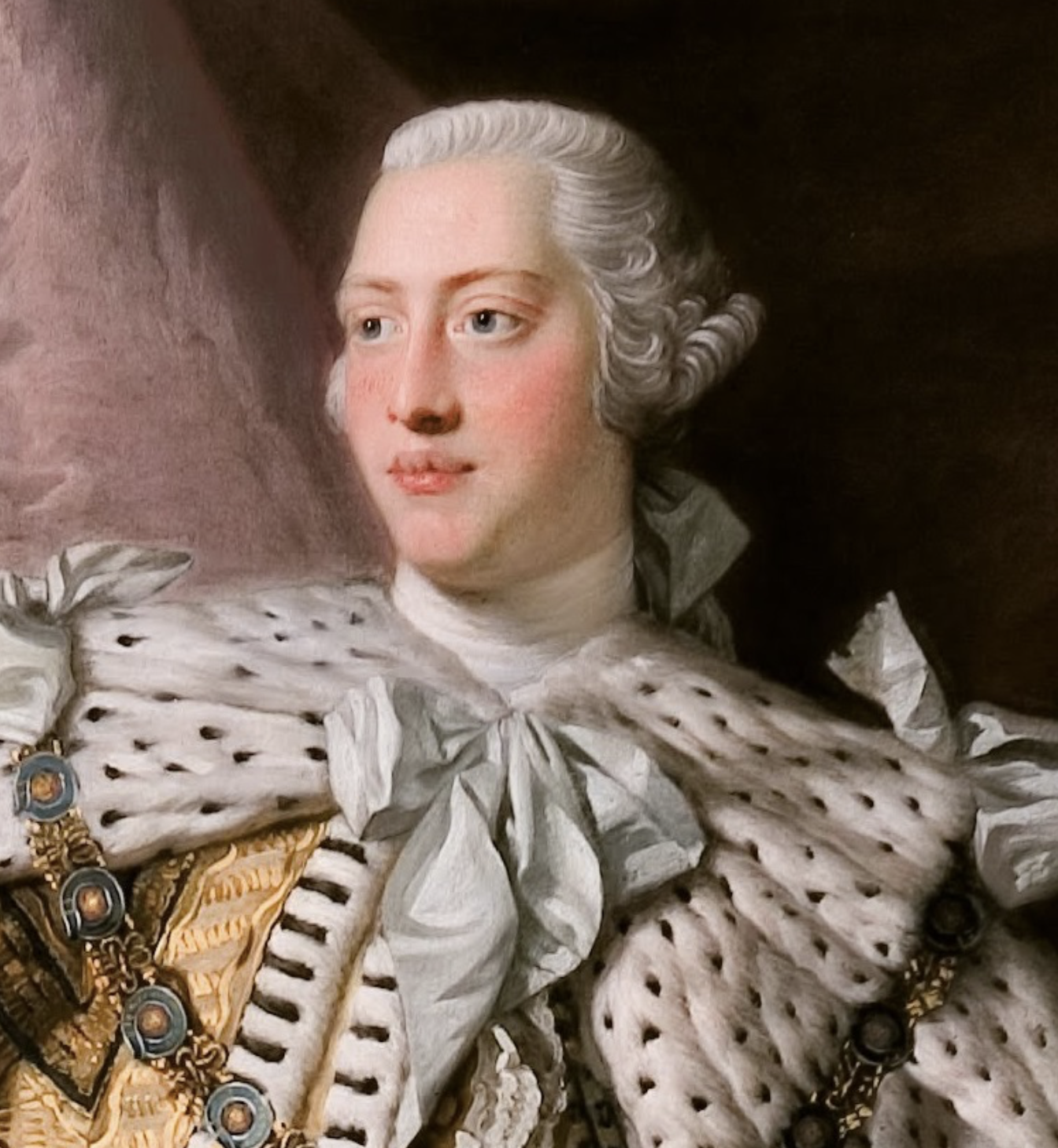
In 1788, on the advice of George III, they opened a shop at 1 Coventry Street off Piccadilly Circus which was run by Joseph Flight. In 1789 the King awarded them their first Royal Warrant.
In 1789 Thomas was listed in Kent’s directory as a Worcester china man living at 22 Bread St, London.
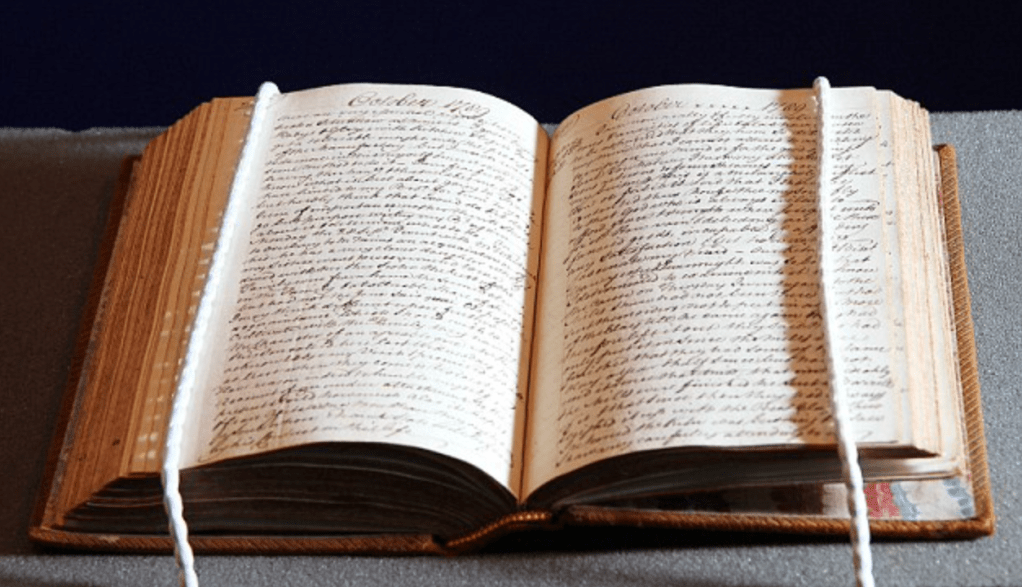
John Flight kept a detailed diary about his time at the factory. It reveals how they got new ideas for their wares and resolved some of the problems they encountered; they spied on French potters! It was a dangerous time to be travelling to France which was in the midst of a bloody revolution.
The diary is in the Royal Worcester Porcelain Museum.
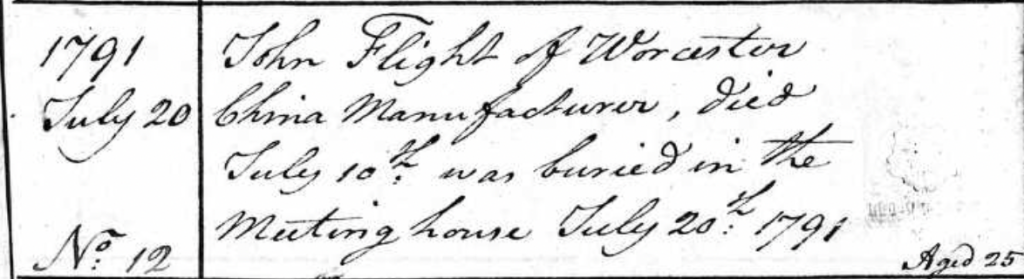
John kept the journal from 1785 until his death in 1791 aged just 25.
Worcester, Angel Street (Independent), Burial
John left a wife, Ann Gillam and a son also called John who was born after his death and died aged 1 year.
It now fell to his brother Joseph to run the factory with Martin Barr and later Martin’s son.
British Museum, Public domain, via Wikimedia Commons
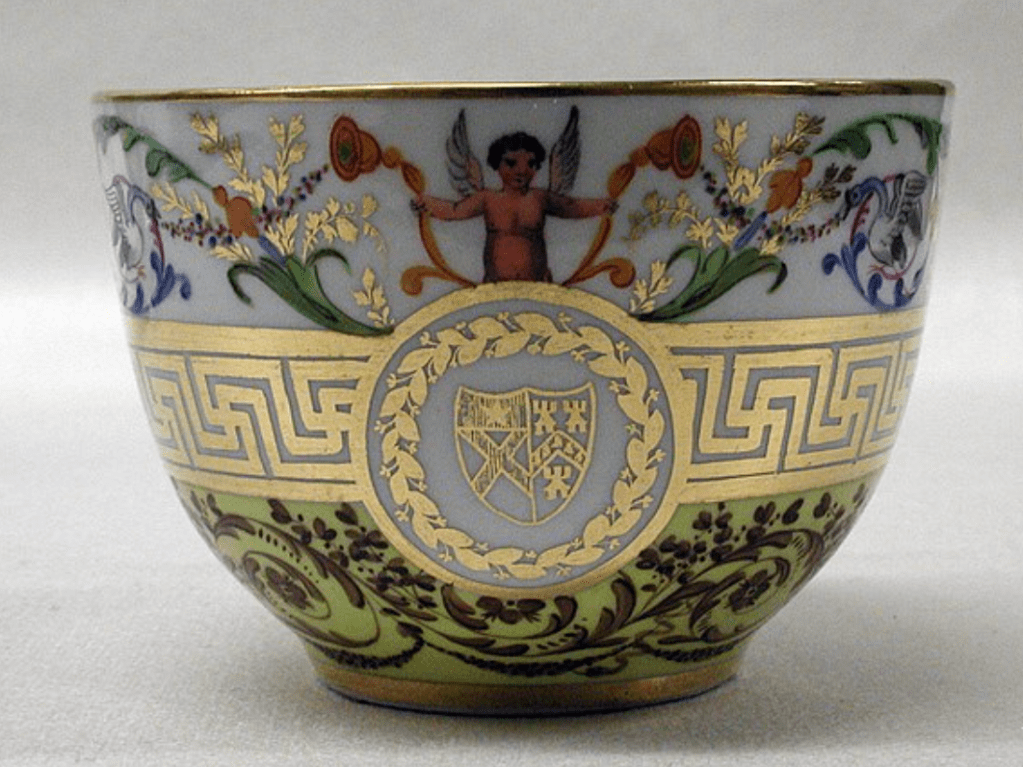
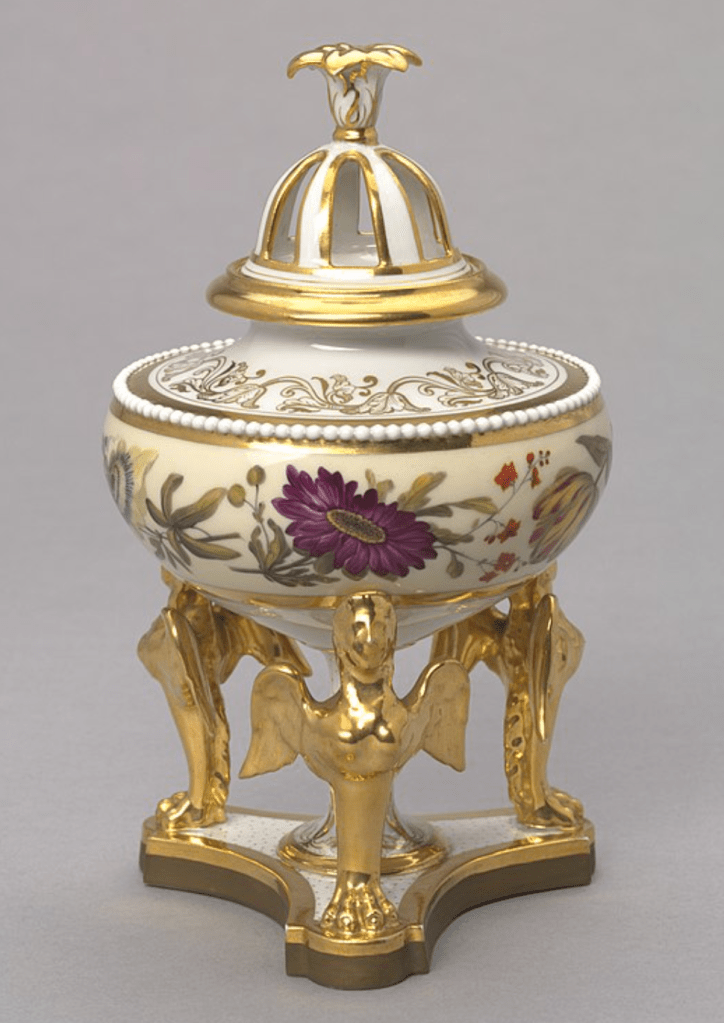
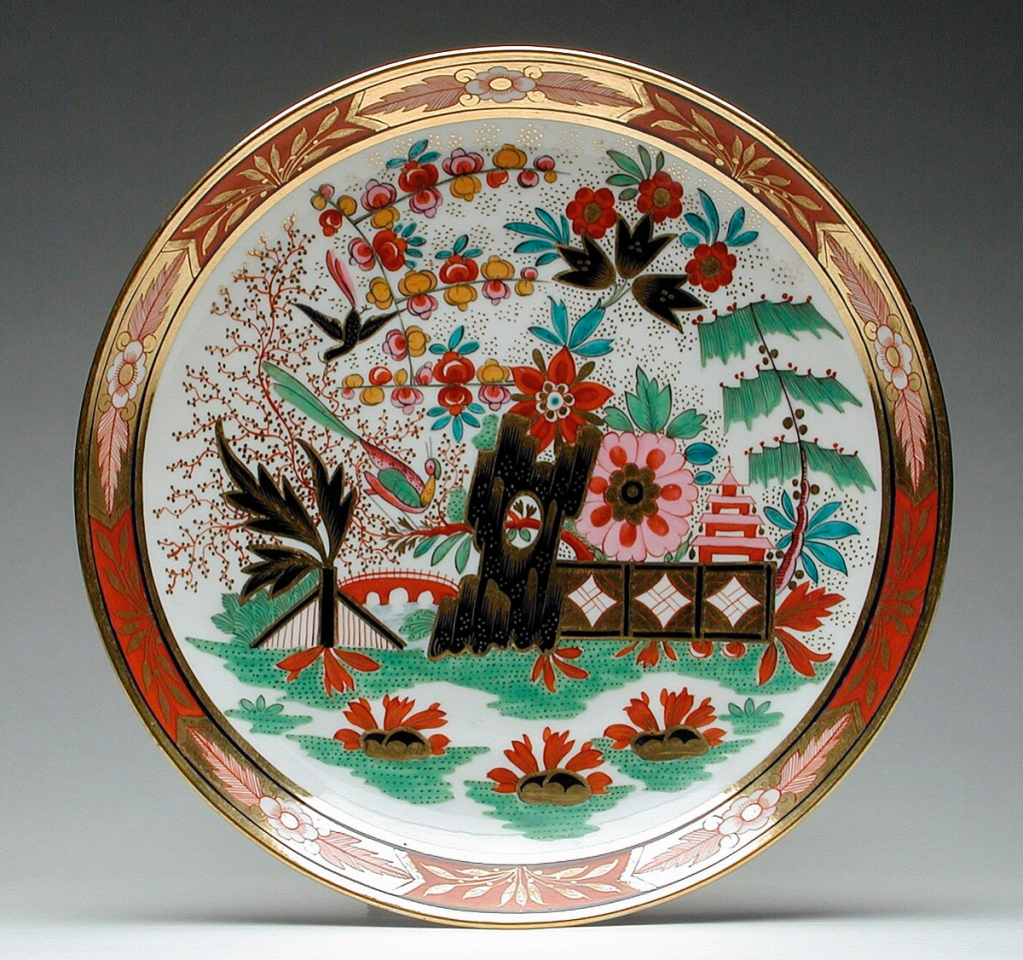
During this time the factory produced many fine pieces. In 1830 they made the Coronation dinner service for King William IV.
Wikimedia Commons
Joseph married Hephzibah Gill in 1790 and they had at least four sons, John, Josiah, Edward and Conrad.
In 1840 Chamberlain, Flight and Barr merged into one company and by 1862 it was called Royal Worcester.
Septima Flight married Lewis Lamotte and their daughter Catherine Septima Lamotte married Arthur Herbert Lanyon in 1899. The Flights are an interesting family and probably deserve their very own website.
Thomas Flight and Judith
Thomas Flight lived in Henley in Berkshire and the little we know about him comes from his wife’s will. We don’t know when he was born or when he married but presumably it was before 1691 when his eldest son Thomas was born. When Judith died in 1729 she was a widow and her will described Thomas as a baker. They had 5 daughters and 4 sons all named in Judith’s will.
Thomas Flight and Martha Fuller
Thomas and Judith’s eldest son Thomas Flight married Martha Fuller 1st Aug 1720 at St. Leonards, Wallingford, Berkshire. Thomas was buried on 8th Aug 1767 at Bunhill Fields in London. His burial record records that he was a dissenter. His will names his children: Joseph, Thomas, John, Ann, Mary, Elizabeth and Hanson, son in law Joseph Pattison and grandson Joseph Pattison. He left the sum of £1600 to his wife to be shared amongst his children. His eldest son Joseph inherited his lands in Farringdon and his youngest son, Hanson, inherited his lands at Abingdon. His sons Thomas and Joseph are his executors.
His daughter Martha Pattison died in 1766
His son Joseph was a turpentine merchant and wheelwright. He died in 1788.
His son John was a maltster and draper. He died in 1769.
His youngest son was Hanson.
Hanson Flight and Martha Underhill
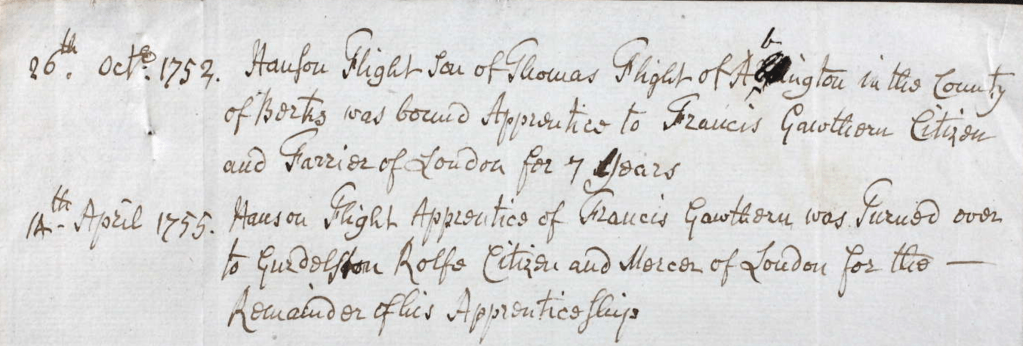
In 1752 aged 15 Hanson was apprenticed to Francis Gawthern a citizen and farrier of London for seven years however three years later his apprenticeship was passed to Gurdolfston Rolfe a citizen and mercer of London.
Freedom of the City Admission Papers
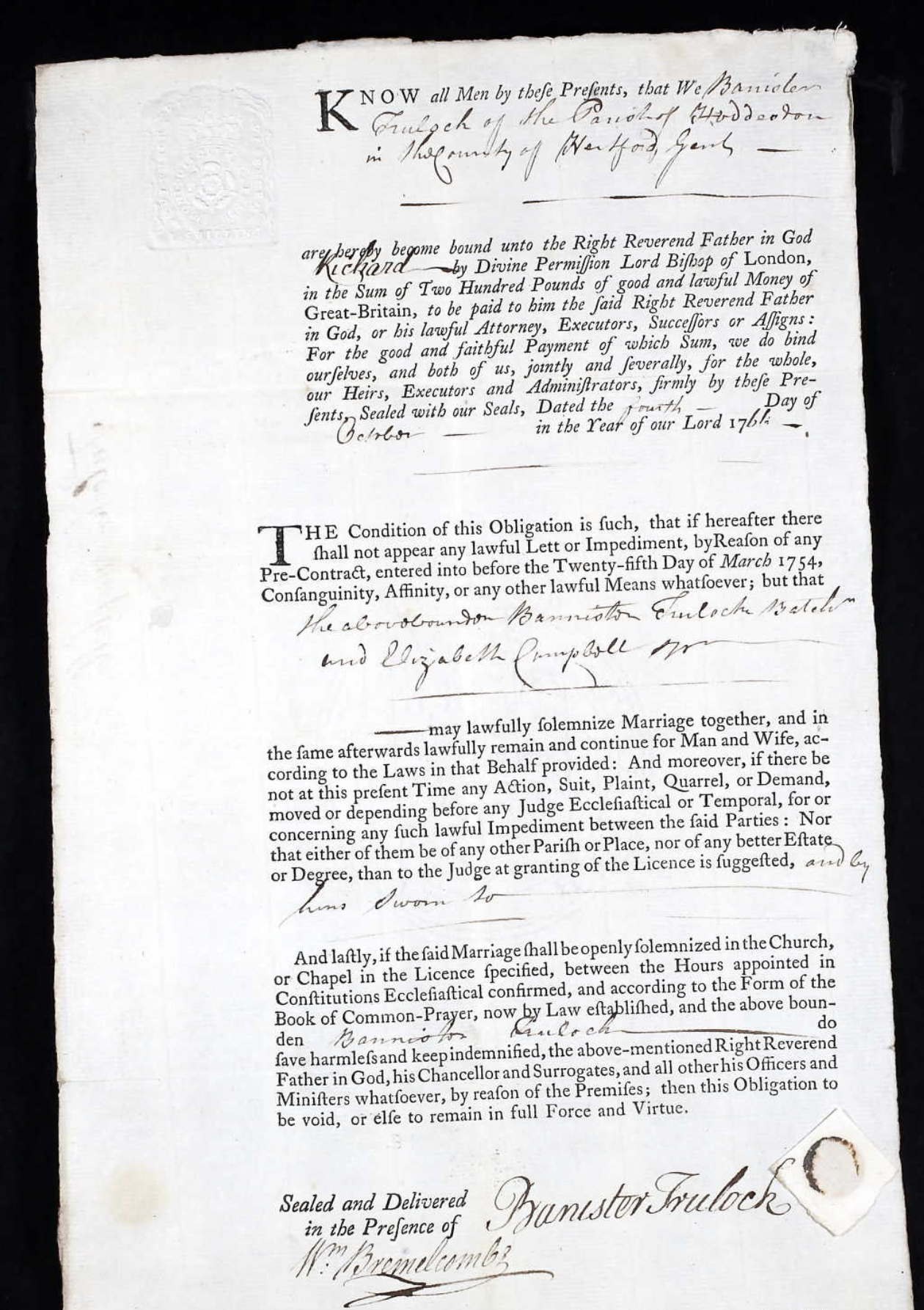
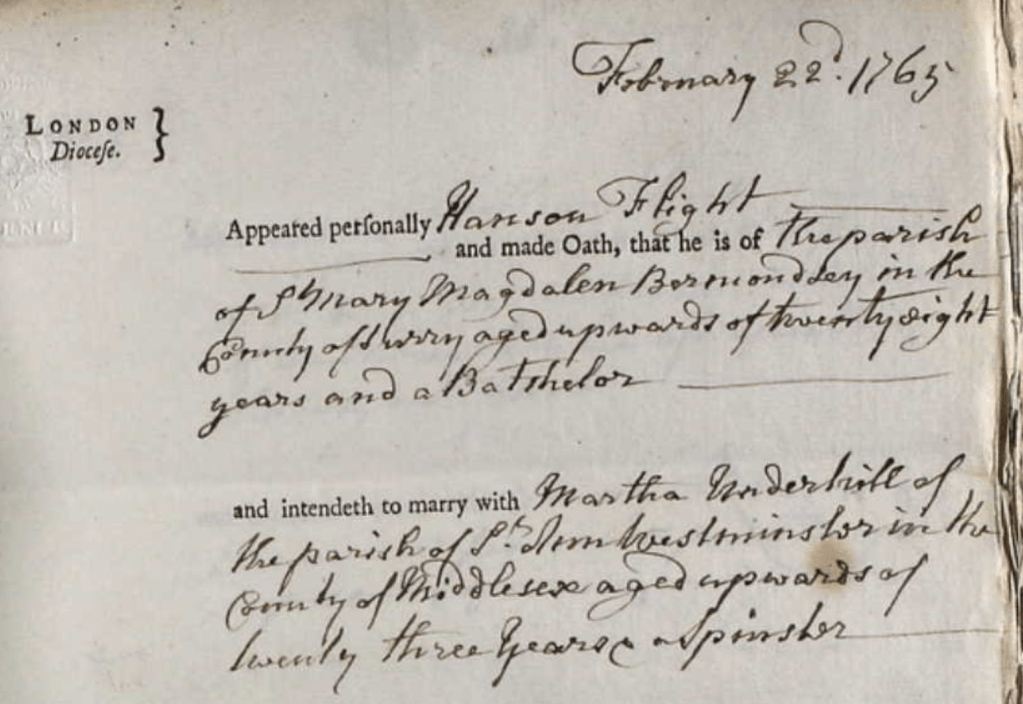
Hanson Flight and Martha Underhill pledged to marry at Bermondsey, Surrey in Feb 1765 and married at St Anne, Soho two days later on the 24th.
London and Surrey, England, Marriage Bonds and Allegations
Hanson and Martha had at least two sons:
Joseph 1773 – 1811 married Jane Greenwood in 1801
Hanson 1776
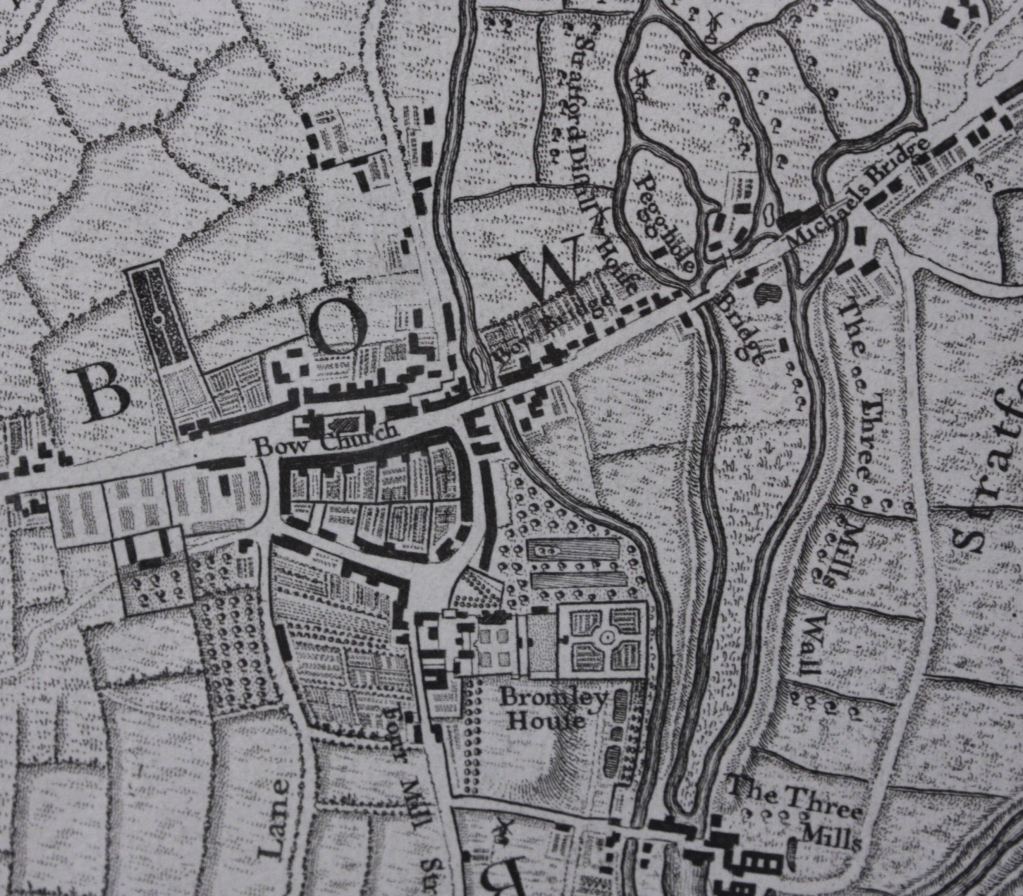
Joseph was a miller and lived at the Abbey Mills at Barking. Joseph was attacked and murdered by footpads at Bow Bridge, River Lea at Stratford on 2nd Feb 1811. He left a wife and six children under the age of 10.
Bow Bridge at Stratford
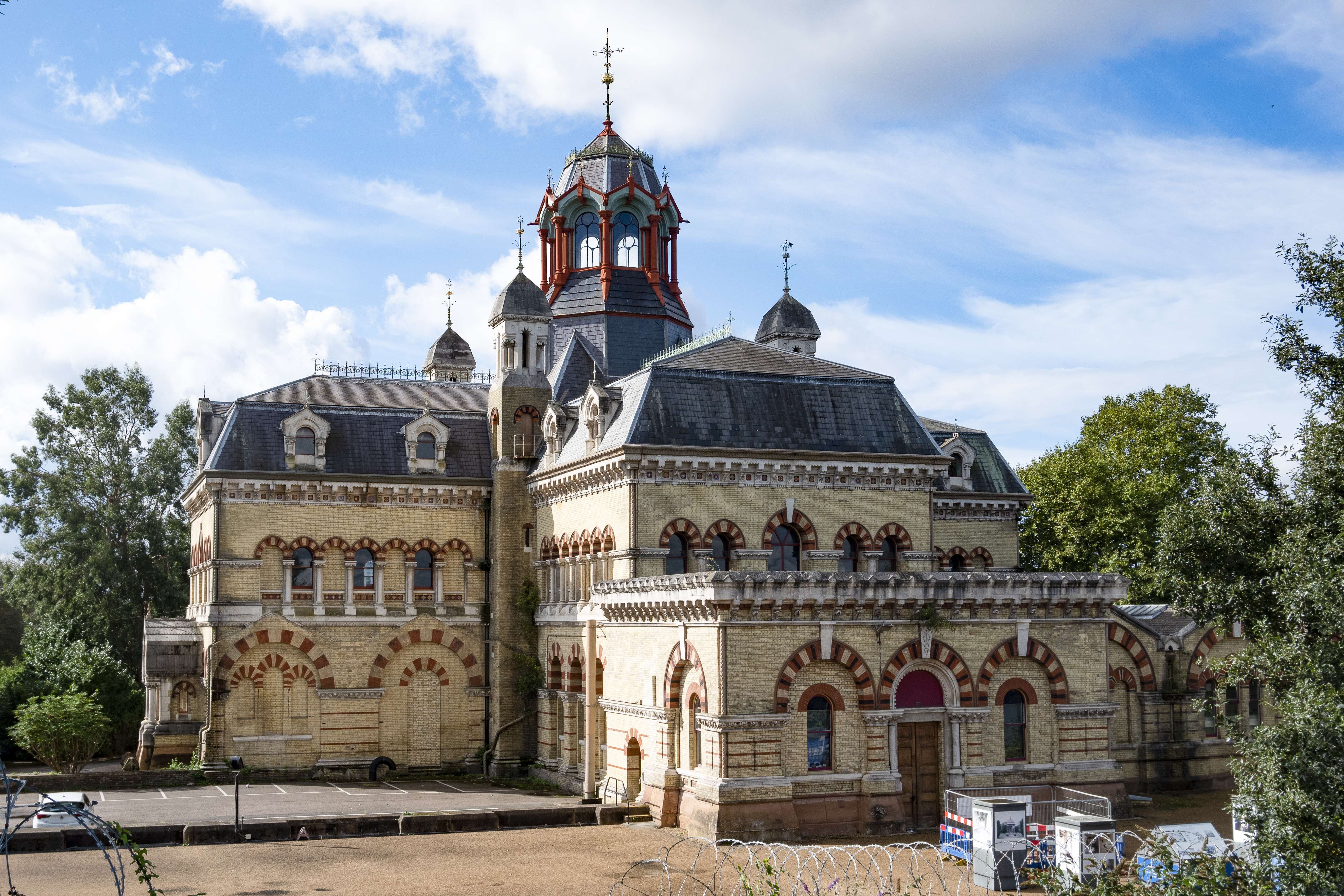
The Abbey Mills no longer exist but on the site today is the Abbey Mills pumping station.
Joseph Flight’s son was also called Hanson and worked as a collector to a draper.
Joseph’s great great great great granddaughter also married a Lanyon!
I was surprised to discover that there is a flourishing branch of the Lanyon family tree in Fiji!
After a little research I discovered this branch is descended from the Gwinear branch of the tree.
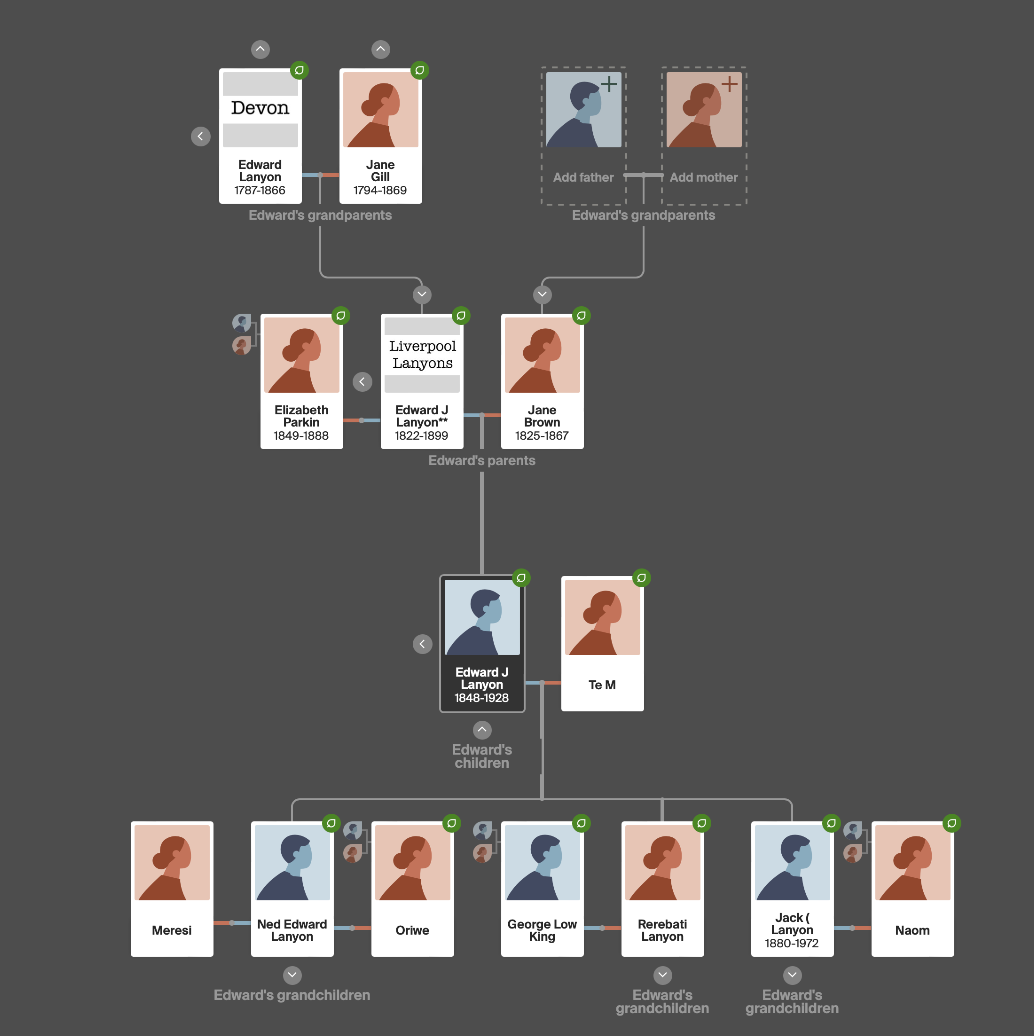
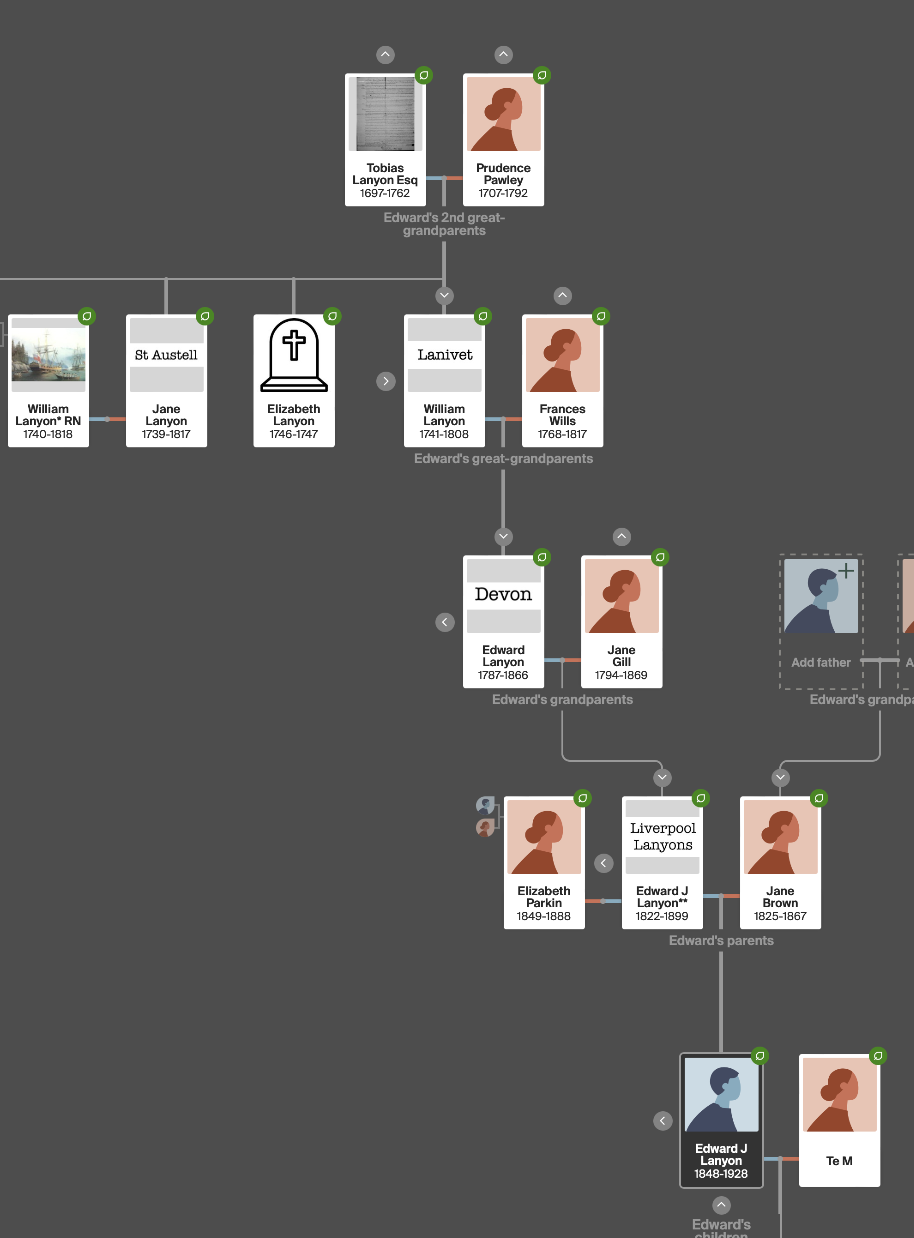
Edward James Lanyon 1848-1928 was the son of Edward James Lanyon and Jane Brown. He was born in Aylesbury, Buckinghamshire and for a long time there was no further trace of him. Then I came across the Fiji Lanyons on a Facebook post and a whole new avenue opened up!
Edward James Lanyon travelled out to the other side of the word to become a plantation owner. He was very successful, he married Te Maotarawa in Fiji and they had three children:-
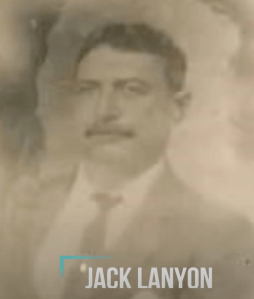
Jack (John) Lanyon abt 1880-1972
Rerebati Lanyon
Ned (Edward) Lanyon
Jack married Naom and they had five children:-
Rerepati Elizabeth Lanyon 1910-
Wilson Lanyon 1910-1999
George Lanyon
Tapanou Lanyon
Mary Lanyon
Rerebati married George Low King and they had two daughters Mereka and Beri
Ned married Oriwe and they had five sons and his second wife was Meresi:-
Jack Lanyon 1940-1980
Edward Koaia Lanyon
David Lanyon
Frank Lanyon
John Lanyon
Curiously Edward James Lanyon was a great great nephew of William Lanyon RN who sailed with Captain Cook. Perhaps the desire to sail to the other side of the world is in the genes!
The Milliner – Richard Edward Miller, Public domain, via Wikimedia Commons
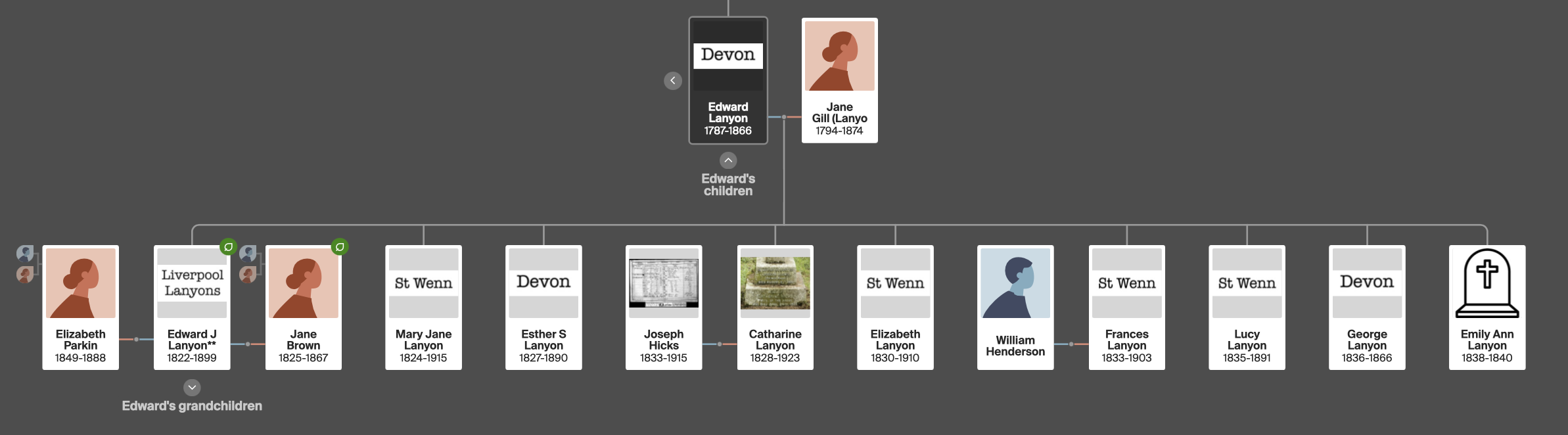
Edward Lanyon was the son of William Lanyon and Frances Wills. He was baptised on 20 Jul 1787 at St Ewe in Cornwall. He married Jane Gill in 1821 at High Bickington, Devon. They had nine children:-
Map of St Ewe near Mevagissey, High Bickington near Barnstaple and Ilfracombe.
Edward was an excise man. In 1851 the family were living at Ilfracombe and Edward was still working at the age of 63.
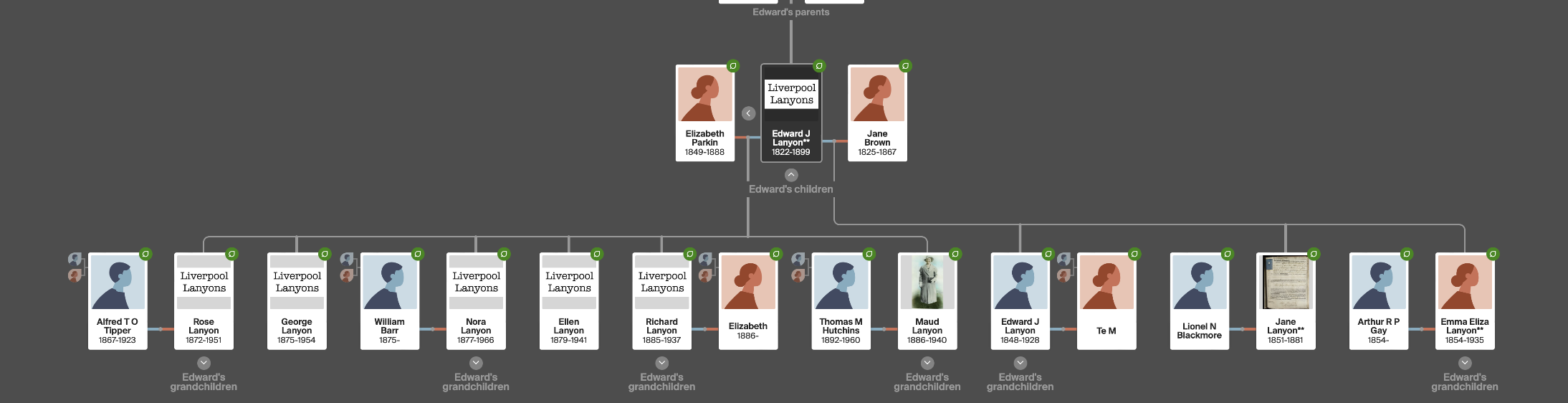
Edward’s eldest son Edward James Lanyon was an inland revenue officer, he married twice, first to Jane Brown who died before 1867 and second to Elizabeth Parkin. There were three children from the first marriage:-
Edward James Lanyon 1848-1928 he founded the Fiji branch of the Lanyon family
Jane Lanyon 1851-1881
Emma Eliza Lanyon 1854-1935
In 1867 Edward married Elizabeth Parkin in Barnstaple, Devon. They moved to Liverpool and they had six children:-
Rose Lanyon 1872-1951
George Lanyon 1875-1954
Nora Lanyon 1877-1966
Ellen Lanyon 1879-1941
Richard Lanyon 1885-1937
Maud Lanyon 1886-1940
Of Edward senior’s daughters only two married and they had no children. Catherine married Joseph Hicks and Frances Lanyon married William Henderson. All the daughters were at one time working as milliners or hat makers.
Over the decades the census shows them living together with Joseph and Catherine Hicks in London and Cornwall. Joseph was a warehouseman, a manufacturer of women’s clothing and a milliner. They must have been fairly successful as they were all able to live ‘on their own means’.
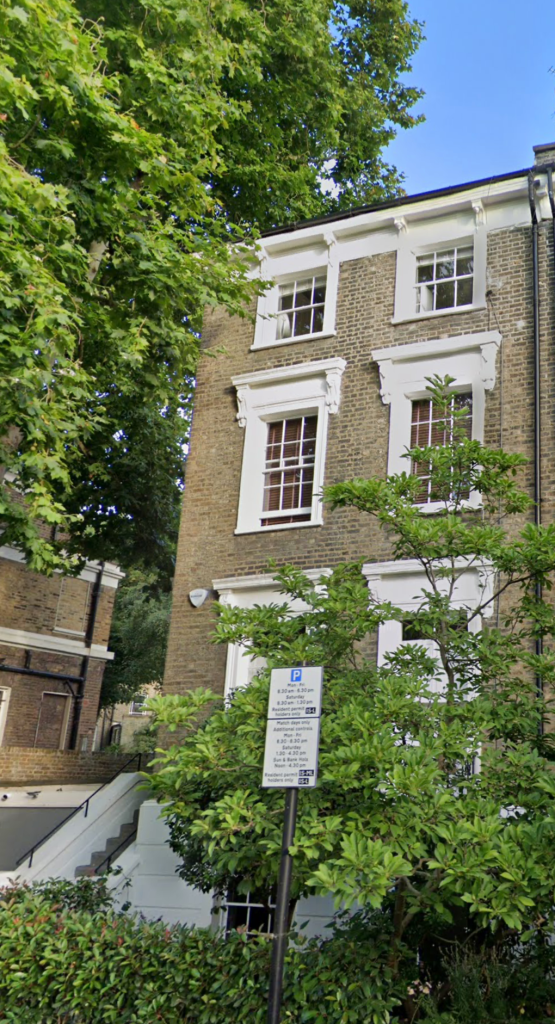
In 1881 they were living at 13 Alwyne Road, Islington, London and employed three servants.
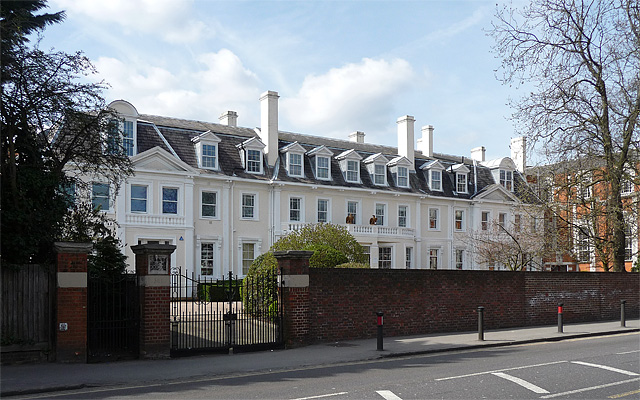
13 Alwyne Road today.
Their younger brother George worked as a draper and a grocer, he died aged just 30 from TB.
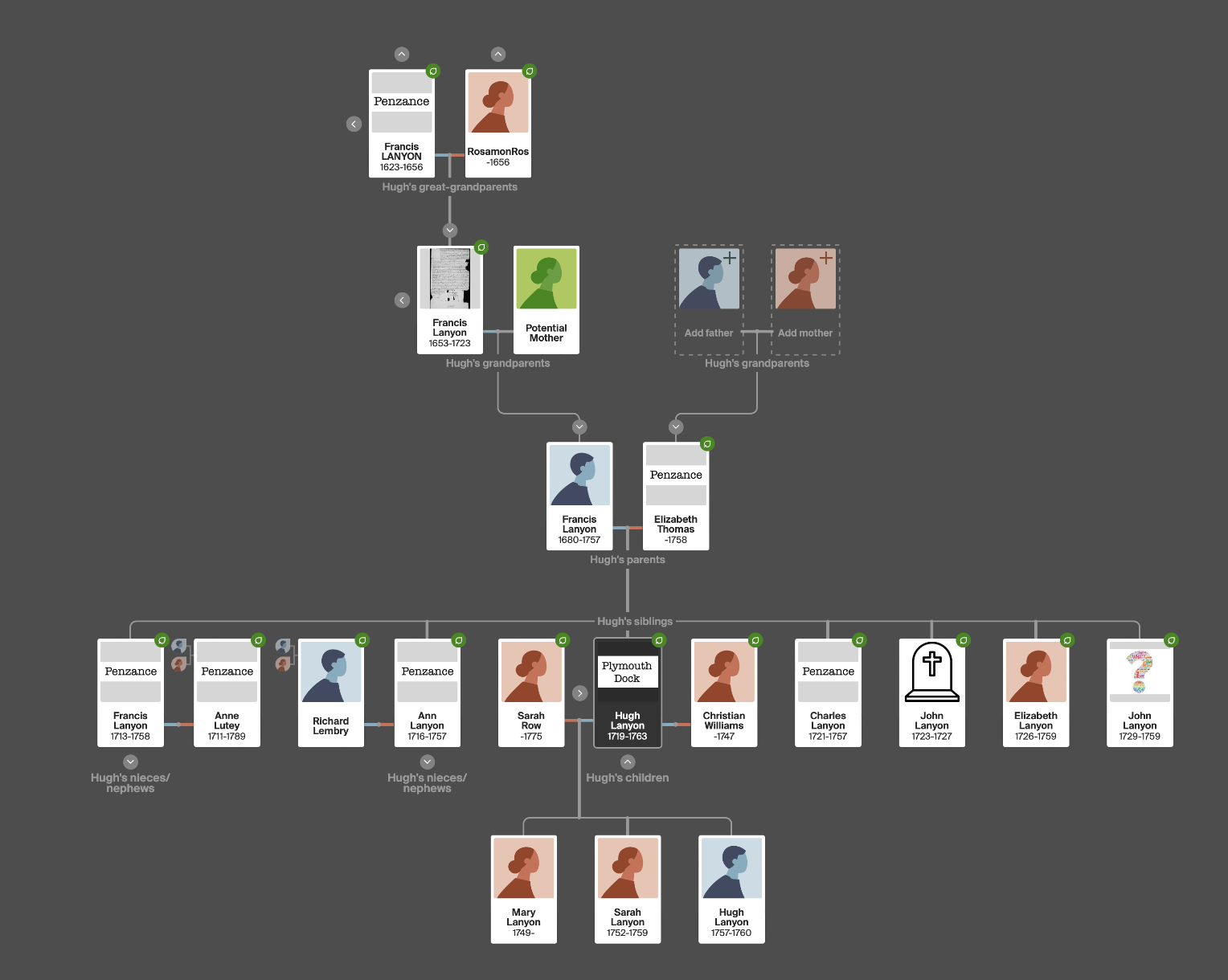
Hugh Lanyon was baptised on 22 May 1719 at Madron, Cornwall, the son of Francis Lanyon and Elizabeth Thomas. Francis died in 1757 and his 1759 will mentions that son Hugh was now living at Plymouth Dock.
PLAN of the LINES round PLYMOUTH DOCK, 1756.jpg- British Library, No restrictions, via Wikimedia Commons
Hugh married Christian Williams at Madron on 6 Feb 1740. There were no children recorded from this marriage but Christian must have died as Hugh married for a second time on 19 Jan 1747 at Charles the Martyr, Plymouth, Devon to Sarah Row.
They had three children:-
Mary 1749-
Sarah 1752-1759
Hugh 1757-1760
Sometime between 1749 and 1752 they moved from Plymouth to Stoke Damerel, Devon. Hugh worked as a labourer.
We know very little about them but Sarah appears in the Devon Quarter Session records and through that we get a tiny glimpse of their life.
‘Sarah Lanyon wife of Hugh of Stoke Damerel, labourer – bound to appear next session accused of assaulting and beating William Dobey of Plymouth, salesman,’ (24/11/1757)
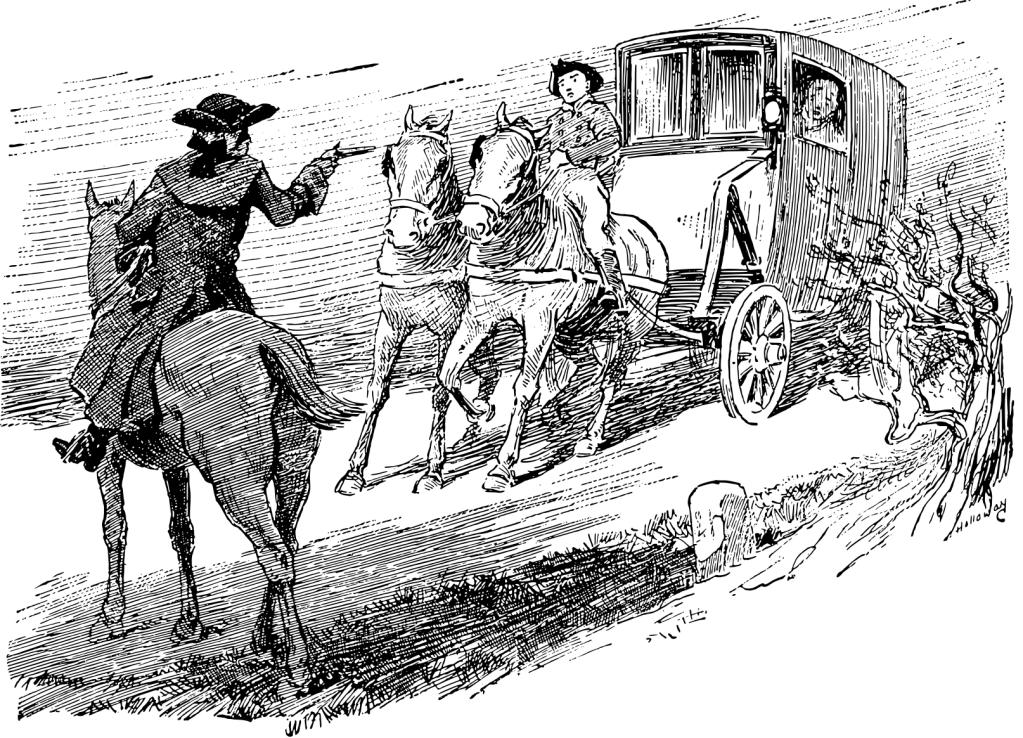
My husband recalled being told tales of a highwayman in the family when he was a little boy but just assumed it was a made up bed time story. A little research however reveals that it was probably true!
Highwayman holds up a coach, by illustrator E. A. Holloway – Wikimedia Commons
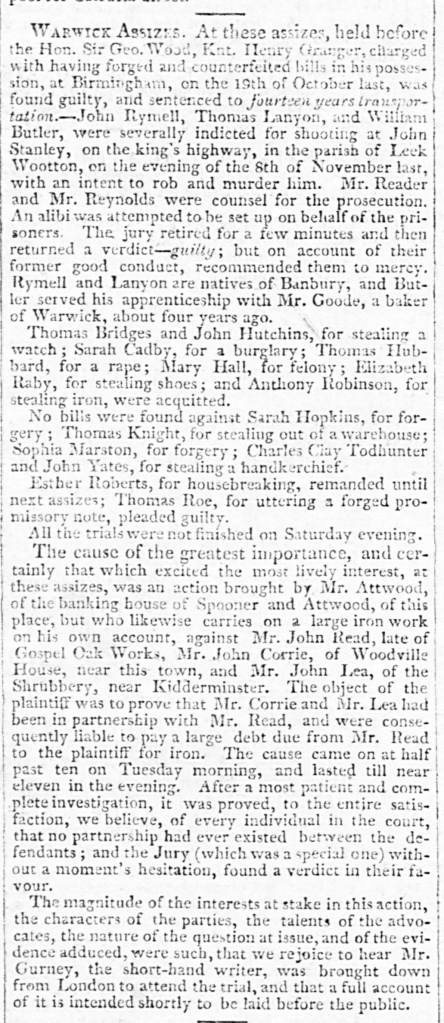
In 1814 Thomas Lanyon, William Butler and John Rymell were convicted at Warwick Assizes of shooting at Mr J Stanley with intent to kill on the highway at Leek Wootton, just outside Warwick.
There is a short newspaper account in Aris’s Birmingham Gazette dated 25 April 1814.
The jury retired for a few minutes to consider their verdict, they found them guilty and asked for mercy but Lanyon and Rymell were hanged at Warwick for their crime.
Thomas Lanyon was buried on the 1st May at Banbury in Oxfordshire. He was just 27.
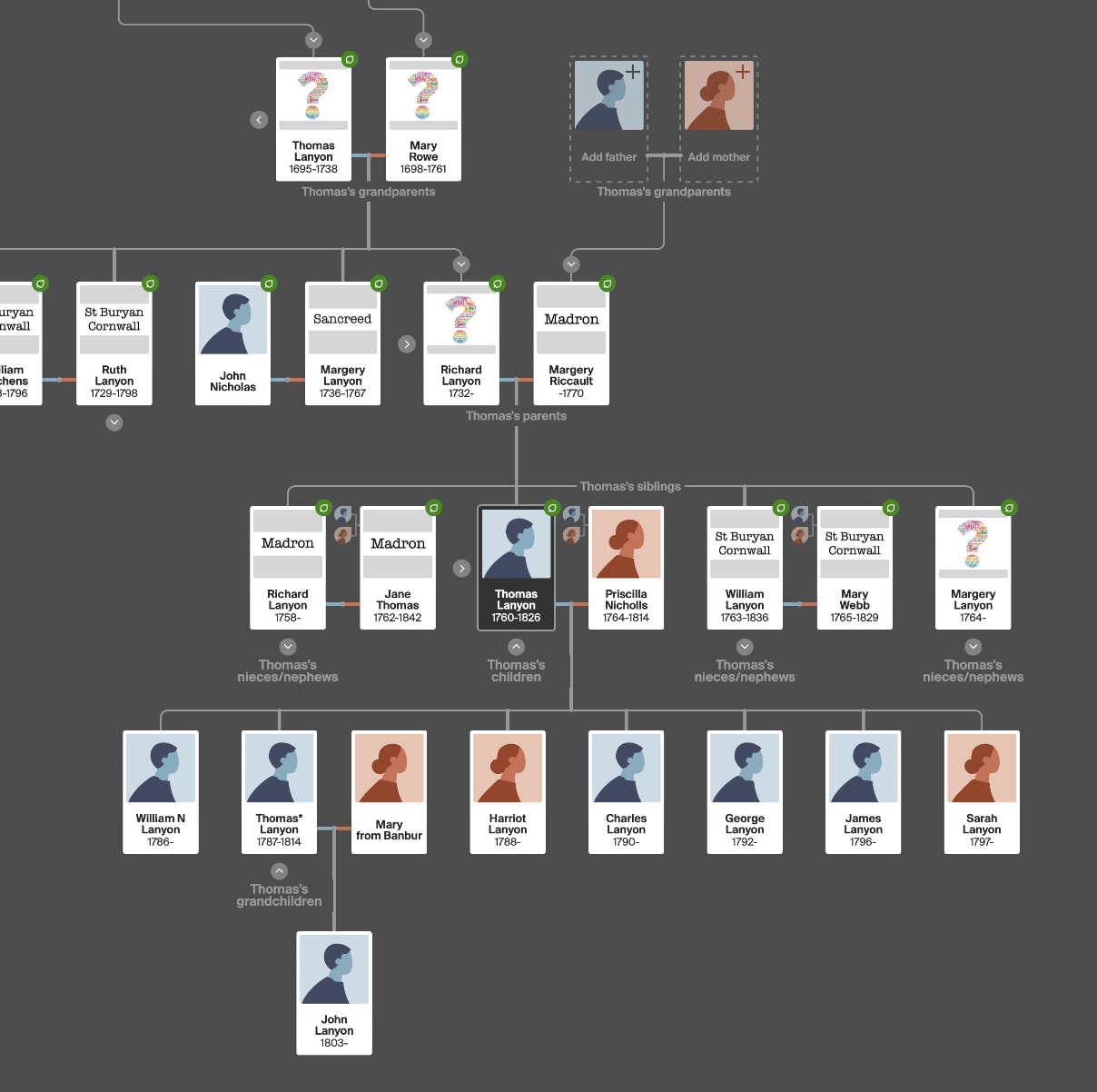
Having discovered Thomas I needed to work out where he fitted on the Lanyon tree. It didn’t take long to find his parents and siblings. He was the son of Thomas Lanyon and Priscilla Nicholls who were married at Banbury on 12 July 1785.
Their children were born shortly after:-
William Nicholls Lanyon 1786-
Thomas 1787-1814
Harriot 1788-
Charles 1790-
George 1792-
James 1796-
Sarah 1797
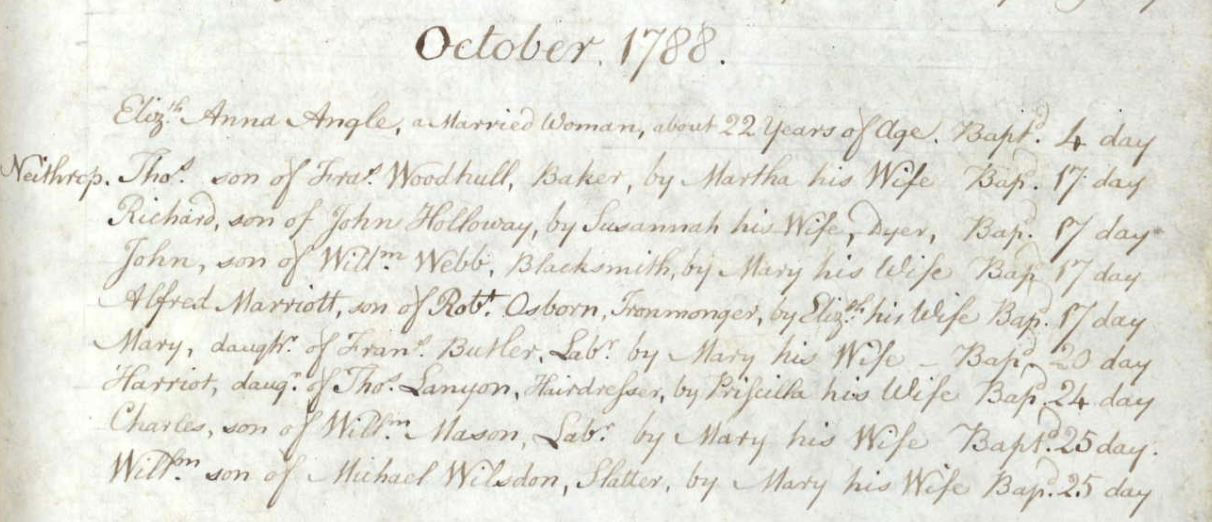
The parish record keeper has helpfully recorded the occupations of the men presenting their children for baptism so we know that Thomas was a hairdresser.
Banbury Parish Register – baptism of Harriot Lanyon
We don’t know if Thomas was a barber or a wigmaker, perhaps he was both.
In a crowded salon, a wigmaker fits wigs according to occupation; Coloured etching by J.E. Marcus after J. Smies, c. 1810.
Priscilla Lanyon was buried in February 1814 and her husband Thomas was buried on 11 Dec 1826 at Banbury.
There is a record of a Thomas and Mary Lanyon presenting a son John for baptism in 1803. This Thomas is also noted as being a hairdresser. It seems likely that this is the son Thomas who was executed, although he would be barely 16 years old.
Where did Thomas Lanyon senior come from? After quite a search there was just one Thomas who seemed to fit the bill. Thomas baptised 13 July 1760 at Madron, the son of Richard Lanyon and Margery Riccault.
Having worked out where they came from the family disappears and I cannot find where they went. Perhaps the stigma of an executed brother was too much for them to remain in Banbury? Perhaps they changed their names? Perhaps they emigrated?
Sarah was baptised at Sancreed, Cornwall in 1690. She was the second daughter of Charles Lanyon and Sarah Tresilian and her grandfather was called ‘The Golden Lanyon’ due to his great wealth.
Sarah was the second of three daughters and they also had a younger brother Abraham. We know very little about Sarah; she witnessed the will of Anne Basset of Manwinnion, Illogan in 1713 and was mentioned in the 1778 will of Mary Lanyon and left the considerable sum of £100.
Sarah never married and appears to have lived in Penzance for most of her life.
We do know that at the age of 95 Sarah sold her reserved pew seat at St Mary’s Church Penzance. It was the 5th seat from the stairs in the north gallery of the chapel and it was sold for 7 Guineas. (Source – CRO P179/2/4/8)
Perhaps she didn’t think that she would require the seat for much longer. In the event she lived to the grand old age of 102 and was buried on the 10 January 1793!
When researching a family tree it can be hard to see beyond the name and dates associated with each individual and come up with information that brings a person to life. We might be lucky enough to find their occupation, if they had a criminal conviction and their religion. Occasionally we’re lucky enough to find a physical description or even a photograph. However, one thing that is particularly hard to discover is whether or not they were disabled.
When searching through old records it can be challenging to see the words used to describe disability. Many of the terms used are considered offensive today but I have chosen to use the words in the original documents as that is part of the history of this subject.
I discovered ‘blynde Lanian’ when I was sent a copy of his uncle’s will written in 1607.
“I give the blynde Lanian, my kinsman xxs a year towards his mayntenance untill my heire accomplish the age of xxi years.”
The will of George Kekewich was written 22 June 1607 and proved 20 May 1612. The National Archives Ref. PROB 11/119/518
‘Blynde Lanian’
‘Blynde Lanian’ was George Lanyon the son of John Lanyon Esq and Katherine Kekewich. (See the post in Tudor & Stuart Lanyons about John Lanyon Esq’s children.) George must have been born about 1586 and died after 1633. There is no record of his baptism or burial and no record of a marriage or children. We only know he existed from two Kekewich wills. His uncle George’s will of 1607 and his cousin Francis Kekewich also mentions him in his will of 1633.
“Item I give George Lanion Twentie shillings a yeare during my lease of Manely with this premise that he wander not the Country as a beggar, contrary to God and Mans lawe hopeing the rest of his friends will make up the rest that maie paie for his board.”
The will of Francis Kekewich was written 11 July 1633 and proved 6 Sep 1633. The National Archives Ref. PROB 11/164/299. Transcribed by Angela Wood and Richard Samways. With permission of Cornwall Online Parish Clerks
George’s mother Katherine died in 1592 and her brother and nephew have made provision for him so that he does not wander the country as a beggar which is probably what happened to other disabled people who did not have the means to support themselves or families to take care of them.
I could not find mention of George in any Lanyon wills of the period. Perhaps he was raised by his mother’s family in St Germans, Cornwall?
We know very little about George but it did make me wonder what life was like for disabled people in the past and whether there were any more ancestors with disabilities. There must have been others but would I be able to find them in the records?
Historic England provided some interesting information about the history of disability. In medieval times it was thought that those who were charitable to the sick and disabled could speed their journey to heaven after their death. That led the wealthy to endow hospitals and leper houses and to care for the poor and disabled. A statute of 1388 talks of the ‘deserving poor’ and ‘undeserving poor’, the deserving poor were those born with disabilities and they were deserving of alms and support.
At the start of the Tudor period in 1485 disabled people were cared for in ‘spyttals’ or hospitals and almshouses run by monks and nuns. This worked fairly well until the dissolution of the monasteries in Henry VIII’s reign. With nowhere to go and no one to care for them the sick and disabled were often to be found dying on the streets. Many of the disabled were wounded seamen and soldiers and senior officers, horrified at the way they were treated, he argued for hospitals and pensions for the men. In 1590 the Chatham Chest was created to pay pensions to disabled seamen. The world’s first occupational pension!
In practice most disabled people stayed with their families and played a part in their local community. Families tended to work together and any disabled family members would work alongside their parents and siblings carrying out tasks they were able to perform. Those with learning disabilities were thought of as ‘natural fools’ or ‘innocents’ and were not excluded from village life.
In 1570 the city of Norwich carried out a census of the poor. Fourteen hundred of the poorest people were questioned. Of them 63 were disabled men and women who suffered from ‘lameness’ or ‘crookedness’, had missing limbs or were blind or deaf. Interestingly almost all the disabled people were married to non-disabled people and many had children. They had jobs and were part of their community in every sense.
By the 18th century hospitals such as Bedlam had been built and were home to many people with learning and physical disabilities. There was no real treatment offered and the afflicted were seen as a source of entertainment for visitors to the hospital.
Scene in Bedlam from Rake’s Progress – National Library of Medicine, No restrictions, via Wikimedia Commons
By the 19th century the Victorians had built huge asylums and the ‘mentally afflicted’ were moved away from their communities to be cared for in institutions. At the same time the first schools for deaf and blind people were opened. In the 20th century, especially after the first World War, the concept of rehabilitation took hold and with the arrival of modern medicine our whole understanding of disability changed. From the 1930s onwards charities and organisations were formed to fight for disability rights and today many countries have laws enshrining equal rights for disabled people.
Discovering our Disabled Ancestors in the Census
One of the easiest ways of discovering our disabled ancestors is to use the census. From 1841 onwards a census was held in Britain every ten years. The householder completing the form was asked to note if a person was: blind, deaf, ‘dumb’, ‘imbecile’, ‘idiot’ or ‘lunatic.’ One narrow column to represent a lifetime of disability.
The words ‘dumb’, ‘imbecile’, ‘idiot’ and ‘lunatic’ are today considered offensive and unacceptable but in the 19th century they were proper medical terminology and had different definitions:
‘Idiot’ – someone with a congenital mental impairment, an IQ under 25
‘Imbecile’ – someone who had lost their mental faculties e.g. dementia or had an IQ between 25 and 50
‘Lunatic’ – someone of average intelligence suffering from mental illness
Of course the people completing the census forms were not doctors and did not always use the correct terms. There was also a stigma attached to mental illness and disability in Victorian times so some people were reluctant to mention family members who were affected.
The census returns were used to produce all sorts of statistics and formulate government policy.
The 1851 census revealed some interesting statistics relating to blindness. It was much more common in rural areas than industrial areas. This was probably because younger and healthier people migrated to the cities and left older and more infirm members of the family behind. Also those who were blind were less suited to work in factories and perhaps less likely to leave the security of their village.
Blindness also affected the south more than the north. In Cornwall in 1851 one in 793 persons was blind whereas in York it was one in 1296 people. Were the Cornish more likely to suffer accidents that caused blindness? Were they more likely to have children with congenital blindness? There doesn’t seem to be an answer to that.
More men than women were blind, 105 males and 88 females per 100,000 people. This was probably due to male occupations being more hazardous.
One of the major causes of blindness was Smallpox. In Ireland the potato famine caused an epidemic of Opthalmia which led to much higher levels of blindness in that population.
The south west also had the highest proportion of ‘deaf and dumb’ people, the north the least. One in 1390 in the south and one in 1995 in the north.
Muteness was often attributed to the mother suffering a fright in the final stages of her confinement! In reality an inability to speak was associated with congenital deafness. Those who were born deaf were less likely to be able to speak. It was thought that congenital deafness could be caused by cousins marrying which was more likely in small remote communities. Disease was a major cause of deafness; Scarlatina, Smallpox, Typhus and Measles could all cause fevers and deafness.
Searching the Census Returns
I started searching the census for any Lanyons with disabilities. Having all the census returns online makes this a relatively easy task. I have selected just a few of the people I found for this post.
Philip Body Lanyon 1802-1892 was blind. He was working as a farmer; we don’t know if he was born blind or became blind following an accident or disease. (Some census enumerators have noted whether a person was disabled ‘from birth’ on the form.)
In 1851 Philip was working as a farmer of 13 acres and was blind
In 1881 Philip was working as a carpenter!
Philip shows us that despite a disability he was able to work, marry, raise a family and live to the ripe old age of 90! However I can’t be the only person slightly concerned about the health and safety of a blind man working as a carpenter!
Dorothy Lanyon born in 1806 was deaf and working as a power loom cotton weaver in Blackburn 1861. The census tells us she was a widow and the daughter (possibly daughter in law) of William and Ann Lanyon. Again we don’t know if she was born deaf, or became deaf as a result of disease, accident or industrial accident.
Mary Addison Lanyon, born in 1812, was deaf. In 1851 she was living with her mother and unmarried sisters in Penzance. Mary was married to John Mathews Lanyon, a confectioner. They married on 19 Apr 1836 and in 1838 their only daughter Rebecca Addison Lanyon was born. Shortly afterwards John disappeared from the local records and it appears that he abandoned his family. Did he abandon her after she became deaf or was she born deaf? Mary worked as a stay maker mistress (a corset maker). By 1871 she was described on the census as a confectioner’s widow but there is no trace of John’s death. Rebecca married James Eva and they had at least nine children and lived in Penzance until after 1881. Mary lived with her daughter and her family until her death in 1877 . The family later emigrated to the United States and Rebecca died in Minnesota in 1898.
Henry Lanyon 1842-1856. Henry was the son of James and Elizabeth Lanyon, who were cousins.
The 1851 census described Henry as ‘dumb’. It’s not clear if this was to describe his inability to talk or a learning disability. Henry sadly died in 1856 the same year as his mother. His death certificate describes his cause of death as ‘idiocy from birth and Scrofula’ (Scrofula was Tuberculosis of the throat.) Her death was described as following ‘a lingering illness’ which often meant Tuberculosis. Henry’s two sisters both called Mary Anne died aged one in 1841 and 1843. Perhaps they all suffered from autosomal recessive genetic disorders caused by close relatives marrying?
Richard Lanyon 1844-1919 was born into a St Just family that suffered more than their fair share of tragedy. He was the son of John Lanyon and Elizabeth Bowden.
The Royal Cornwall Gazette, 16 November 1855
Coroner’s Inquest John Lanyon
(The following inquests have been held by W. Hichens, Esq., county coroner:—) —On the following day (the 10th inst.) in the parish of St. Just in Penwith, on the body of John Lanyon, aged 47 years. –The deceased was a miner, and worked at Park Noweth Mine, in that parish, and was at the 80 fathom level, assisting in changing the boxes of the lift, when the engine being working, the rod came down, and the navel-pin thereof struck him on the head and caused such injury thereto that he died on the following day. It appeared to be the usual practice to change the boxes whilst the engine is at work, and that the same may be done without fear of accident where the party doing it is ordinarily careful. – Verdict “accidental death.” –The deceased was very much respected. He leaves a widow and five children to deplore their loss. The poor woman has been very unfortunate, having had her first husband drowned, her father killed, her son killed, and now her second husband also killed, and not long since a grand child was drowned in a well.
Reproduced by kind permission of Cornwall OPC – Transcribed by Karen Duvall
Richard was Elizabeth’s last child. He was disabled and is variously described as an ‘imbecile’ or a ‘dumb imbecile’. We don’t know the cause or severity of his disability but he lived at home with his mother until her death in 1878 and then lived with his older sister Cordelia until 1884 when she finally married at the age of 47. (Cordelia worked as a tin dresser – someone who broke up the lumps of rock when they were brought to the surface.)
1871 census St Just
1881 census St Just
1891 census Madron Penzance
From 1884 until 1919 Richard was an inmate of the Penzance Union Workhouse at Madron. The 1891 census described him as a mine labourer so even though he was disabled he had been employed.
It’s heartbreaking to think he spent the last 35 years of his life in such a bleak place.
Mary Mead 1800-1871 was married to John Charles Lanyon (senior). On the 1871 census she is listed as an ‘imbecile’ but in this case the word is used to show that she was suffering from dementia. Mary lived with her daughter and son-in-law until her death.
1871 census Falmouth
William Henry Lanyon 1825-1895 was a wealthy gunpowder manufacturer and merchant who lived at Tullimaar House with his large family. He was a successful but unusual man and he suffered a rather dramatic mental breakdown in 1871.
In the 1891 census William is described as an ‘imbecile’ but it is hard to know if he is still suffering from his mental breakdown or has developed dementia.
One word in one small column and yet so many different meanings.
1891 census Falmouth
It’s curious that the census asks about so few disabilities. Where are all the people suffering from paralysis or with missing limbs? Why is the government just interested in the numbers of deaf, ‘dumb’, blind and mentally impaired people? Surely a column that listed those unable to work due to ill health or disability would have been more useful? Or perhaps a column listing all those with Tuberculosis (a disease responsible for protracted illness and so many deaths).
The 2021 census asks a number of questions about health.
They also ask if a person is caring for someone What will our descendants make of our answers in 100 years time?
Discovering our Disabled Ancestors in other Family History Resources
If we want to discover our disabled ancestors before 1841 (when the census began) we need to use other resources like wills, diaries, letters and obituaries.
Wills
Nathaniel Lanyon abt. 1685-1741 of Kenwyn in Cornwall left a detailed will which hints that his son, also called Nathaniel, may have a disability of some kind.
Nathaniel the younger was born in 1720, the fourth of twelve children. Nathaniel senior bequeathes his children various amounts of money:
My son William £20
Daughter Constance, wife of John Harvey half a crown (as a married daughter she has already received her ‘portion’)
Daughter Catherine £5 when she is 21
Daughter Mary £5 when she is 21
Son Henry £5 when he is 21
As for my sons Nathaniel (the second name is erased, perhaps the child died before his father) – I do hereby oblige my executor to take care of him and to give him handsome maintenance during his life.
The will doesn’t state that Nathaniel is disabled but why is he treated differently? Is it because he can’t take care of himself? We don’t know when Nathaniel junior died but he’s not mentioned in his mother’s will.
Nathaniel’s Will – AP/L/1482
The situation is much clearer when it comes to Sarah Lanyon 1750-1802. Sarah was the daughter of John Lanyon and Rebecca Treloar of Helston, Cornwall. John was a cordwainer (shoemaker) and died at the age of 34 just a year after Sarah was born. Rebecca was just 29 when she became a widow and she never remarried. She spent her life raising her son and looking after her daughter.
In her will she spells out that ‘Sarah Lanyon is now of insane mind’ and makes provision for her future.
In the event Sarah predeceased her mother and was buried on 15 Feb 1802 and her mother died just a few days later and was buried on the 24th Feb.
Letters
In Jane Veale Mitchell’s letters from the 1920s she makes numerous mentions of her delicate health:
“I am so sorry that I cannot earn a little in some light employment….but this is not easy to do in Cornwall and I am not strong.”
“I went to London ….but as it was Easter and I was not so strong as I could have wished for….”
“I have not been at all well lately, under the doctor pro tem, so that must account for my silence.”
Jane was a descendant of the St Allen branch of the Lanyon family and a family history researcher. Perhaps if she had been more robust she would never have started her research into the family tree. She was killed in an accident at Perranzabuloe train station in 1929 when she was sucked off the platform by a passing train, she was 62.
Obituaries
Obituaries often give clues as to the cause of death, long illnesses and disabilities. I found one amazing obituary for Charles Bennett born abt. 1740-1804, who was the great grandfather of Jane Stacey Bennett who married John Charles Lanyon (junior).
Charles was the organist at Truro Church for forty years and he was blind but we only know this fact from the obituary. It details how he lost his sight in a childhood accident when a wooden gun exploded. His parents then sent him to be taught music by the celebrated organist John Stanley, who was also blind.
John Stanley, a blind musician. Line engraving, 1784 – Wellcome Images
Charles didn’t allow his disability to prevent him living a full and interesting life. He married Anne Vivian and they had several children. He is described thus ‘his wit and convivial temper made him a welcome visitor wherever he went, and often has he “felt the table in a roar.”
He was ‘partial to horticulture and so exquisite was his touch that he could distinguish and describe all his flowers and even the different weeds.’
Charles also ‘enjoyed a game of whist and played with skill and perfection having previously marked his cards with a needle that the punctures were imperceptible to his adversaries.’
He was an author of musical compositions and had a memory for voices and events. In short he coped with his disability so well that the writer of the obituary commented that ‘although blind he delighted in amusements which would appear to give pleasure chiefly to the sighted.’
Charles died in 1804 of cancer of the throat. How tragic that a man deprived of his sight was in the end deprived of his voice as well.
Clearly there must have been many more people in the family who had disabilities but without records we’ll never be able to identify them. Perhaps the records don’t exist as disabled people weren’t considered ‘disabled’, or perhaps there was no need to note they were blind or deaf as everyone in a small community would already know this. Perhaps disability was just part of life in a society that was used to disease, infant mortality and untimely death on a scale we now find hard to comprehend.
Friends by the Ears – British Museum, Public domain, via Wikimedia Commons