Family historians are lucky to find a documented legal dispute from the 14th century to help build their family tree. Ralph’s dispute with Princess Joan of Kent gives us valuable information which confirms names and relationships but it’s not the only record available about Ralph.
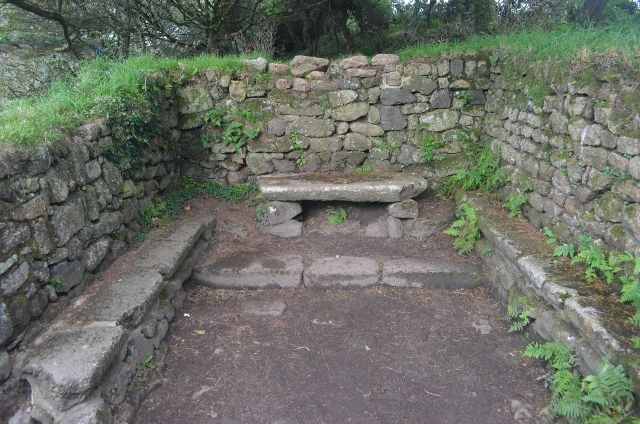
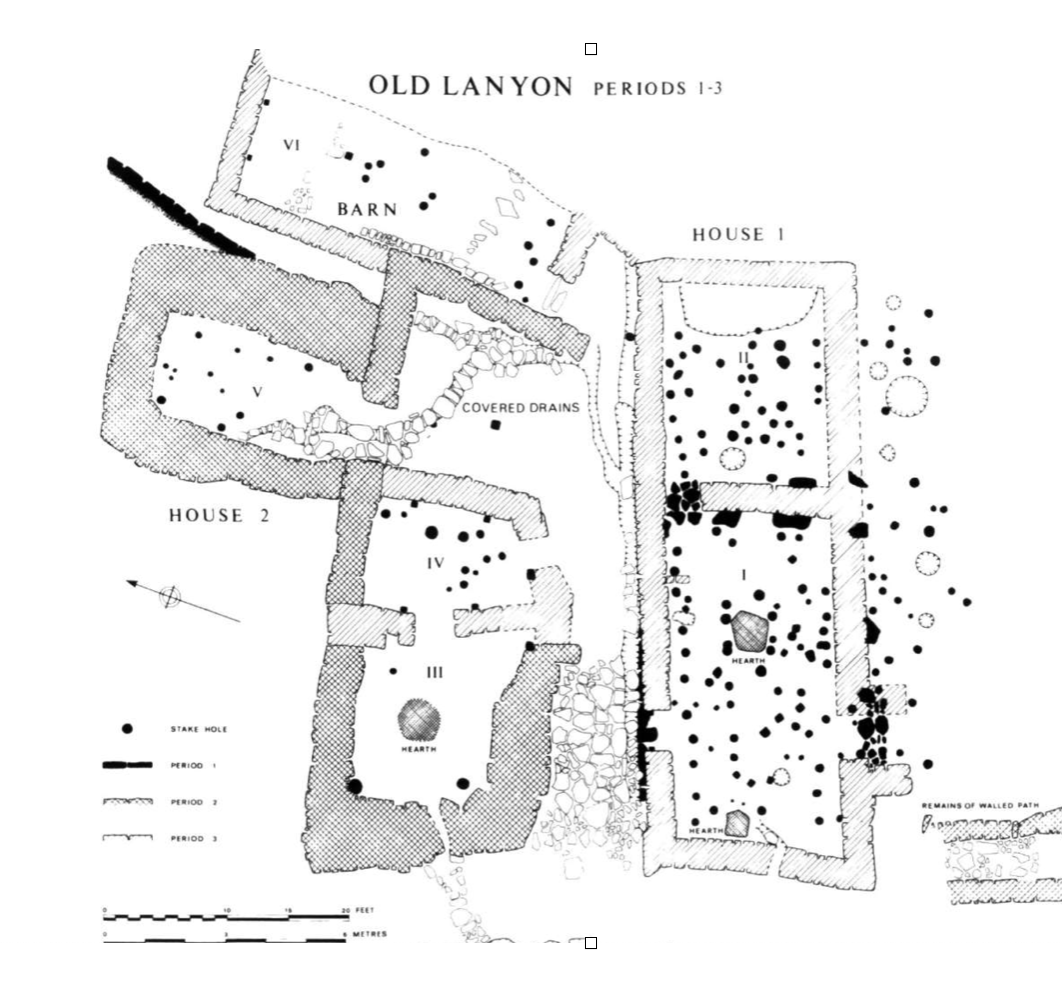
In 1390 the Bishop of Exeter granted a licence to celebrate divine service in the chapel of St Mary at Lanyen in Madron (Lysons 1817). Today the chapel is a ruin but it gives an idea of the size of Ralph’s home, the barton of Lanyon in the late 14th century.
There are also three records in the Court of Common Pleas which relate to Ralph.
CP40/561 Easter 1401. Roger Boswarneth sues Ralph Lanyeyn for a debt.
CP40/589 1408 Ralph Lanyeyn sues Luke de Pensans for detinue (the crime of wrongful detention of goods or personal possessions) for a chest of charters.
CP40/589 1408 Alice Reda sues Ralph Lanyeyn, John Cornyssh, Robert Pensans, Richard Joce (tailor), Ralph Joce, Richard Dere & David Shade for trespass.
At a time when there are no records of baptisms, marriages or burials these records prove that Ralph was still alive in 1408.
I also have a letter from Jane Veale Mitchell to Edward Augustus Bullmore dated 23 Jan 1926 which states:
‘In Rolls Office, Chancery Lane, a Radolphus Lanyon asks that Tregamynyan, then in possession of his brother-in-law de Rogers, might come to him and his descendants, because they had no children. Written in old French, date 1327.’
This throws up a query, is the date 1327 correct? Is it the same Ralph Lanyeyn? The original letter has been transcribed, could the transcriber have got it wrong? It’s possible.
We don’t know when Ralph was born but 1327 seems far too early. If Ralph is married with descendants in 1327 then he is a very great age in 1408!
We know that Ralph’s parents were John de Lynyen and Sibyl de Tregamynion. This is confirmed by the record in Calendar Close Rolls CCR Ric II Vol 30 p.71.
We know that John de Lynyen’s father was David de Kylminawis as CCR Hen IV Vol 4 states that ‘David de Kylmynawis to John his firstborn son and heir, and to the heirs of his body by Sibyl daughter of Jocelin de Tregamynion…’
So where does the Radolphus Lanyon mentioned in Jane’s letter fit in? I haven’t found the original record she mentions but I think the date 1327 must be wrong and that the Radolphus Lanyon she mentions is Ralph Lanyeyn, the son of John & Sibyl. This then gives us the name of his brother-in-law, de Rogers, and leaves us wondering why the property Tregamynion at Morvah should be in his possession?
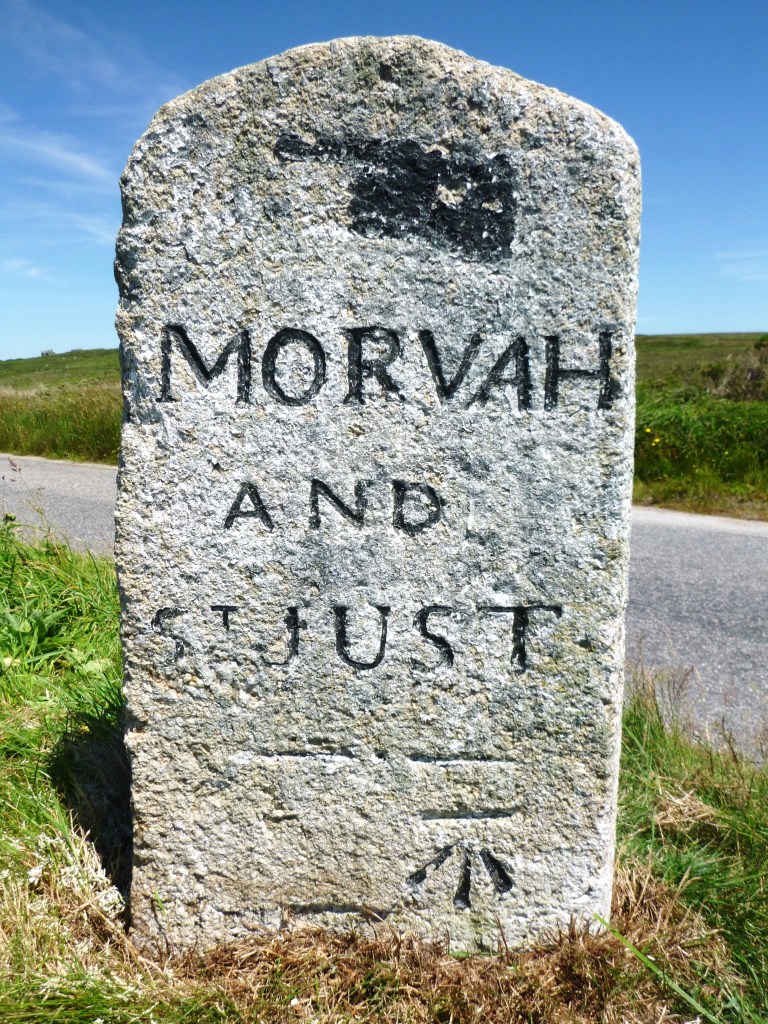
Rosy Hanns / Old Guide Stone on Bosullow Common, south east of Morvah
And that’s the fun of researching your family history, a few records discovered and a whole load of new queries to puzzle over!
Sometimes when researching family history you find a tiny story which really has to be retold.
This is the story of William Henry Lanyon’s ‘Difficult Journey.’
William Henry was the son of Richard Lanyon and Susan Tucker of Acton Castle. He was the eldest son born in 1825 and appears to have been quite an unusual man. Although he was married and had a large family he chose to live apart from them.
He was a gunpowder manufacturer and merchant and evidently needed to travel to London on business.
The Royal Cornwall Gazette reports that on 24 June 1869 William contacted Mrs Dobb from the Royal Hotel and ordered a bus to call at his residence at Strangways Terrace in Truro to take him to the train station. Unfortunately his booking was forgotten, the omnibus didn’t call and he missed his train.
William then did something that many modern rail travellers wish they could do….he ordered a special train to be got ready which took him to Bristol to catch the train up to London! The Victorian equivalent of an Uber!
The cost of this special run was £68 and William planned to claim that from the landlady of the Royal Hotel, Mrs Dobb, who had taken the original booking.
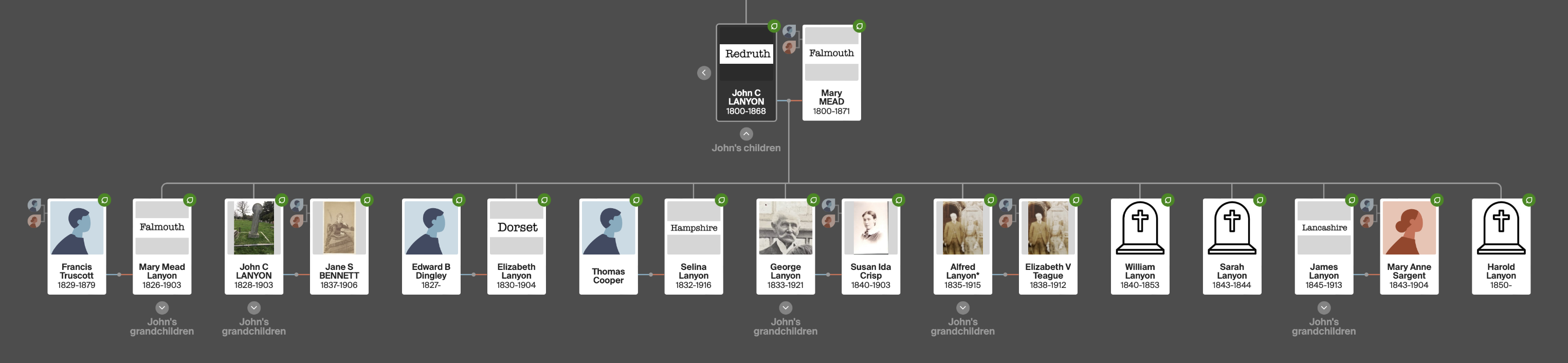
George Lanyon, the second son of John Charles Lanyon and Mary Mead, was nicknamed “The Shepherd”. This post is my attempt to find out why.
George was born 3 Oct 1833 at Redruth in Cornwall. His father owned an ironmongers on Fore Street and in his later years was a successful merchant tanner and ironmonger.
John Charles Lanyon died in 1868 and left a detailed will, there was no mention of his second son George and that was the first indication that all was not well.
JC Lanyon’s eldest son, also called John Charles, his third son Alfred and fourth surviving son Thomas all receive generous bequests and businesses. (The estate was valued at £35,000 in 1868.) But there was nothing for George, why?
George Lanyon appeared on the 1851 census as a seventeen year old ‘assistant’, presumably to his father. Sometime after 1851 and before 1861 he emigrated to Tasmania. His elder brother was already trading in Adelaide in Australia (he was a partner in Adelaide’s department store ‘Harris Scarfe’) perhaps George set out to emulate him?
Initially I thought George may have acquired his nickname ‘The Shepherd’ through a business interest in sheep farming in Tasmania however the story is a little more interesting than that!
On 3 July 1861 George married Susan Ida Crisp at Hobart in Tasmania.
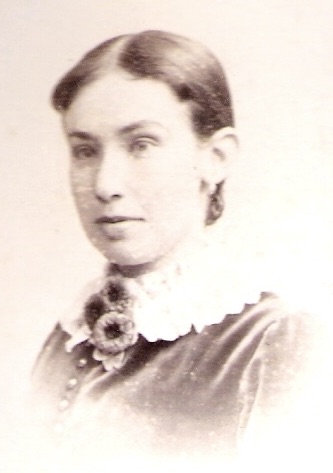
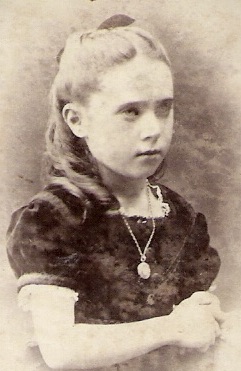
Susan Ida Crisp
By 1862 they had returned to Cornwall and their first child Catherine Rosina Lanyon was born at Falmouth.
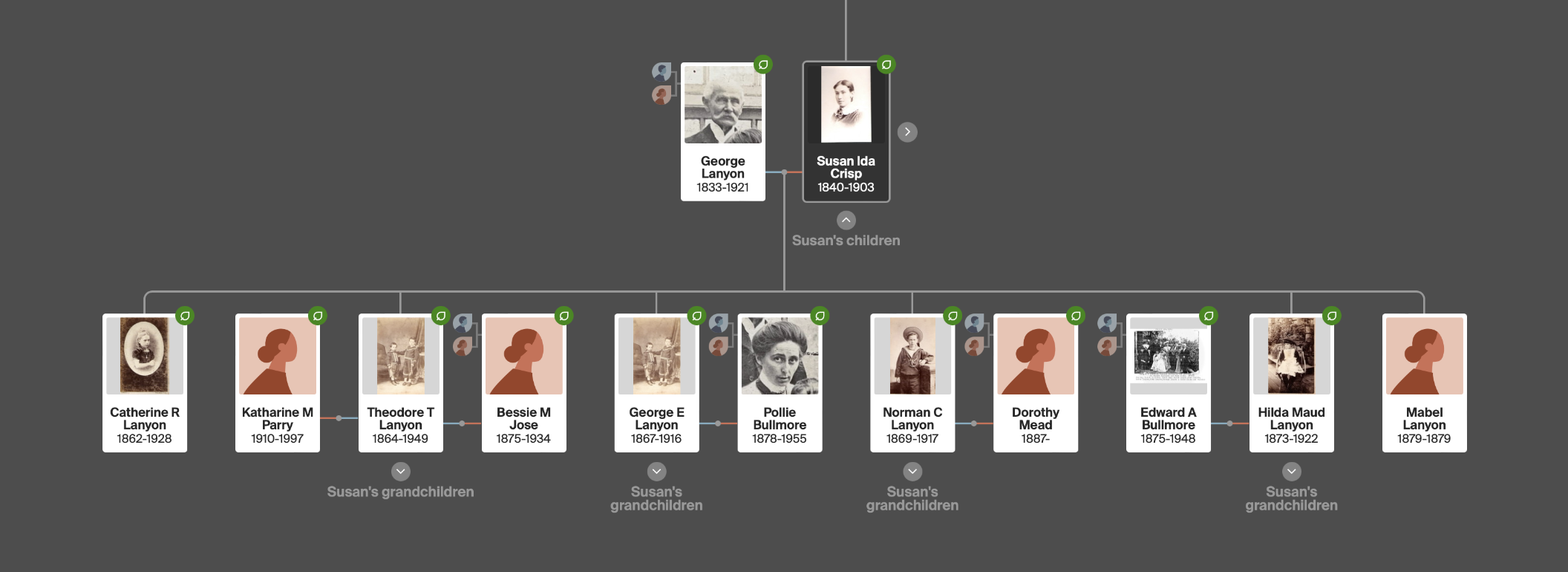
Their children:
Catherine Rosina 1862
Theodore Tasman 1864
George Edward 1867
Norman Crisp 1869
Hilda Maud 1873
Mabel 1879 who died in infancy
In 1871 the census describes George as a tanner employing 10 men, by all appearances a successful businessman like his brothers.
A closer look at Susan Ida Crisp revealed why he may have been given his nickname and also why he was left nothing in his father’s will.
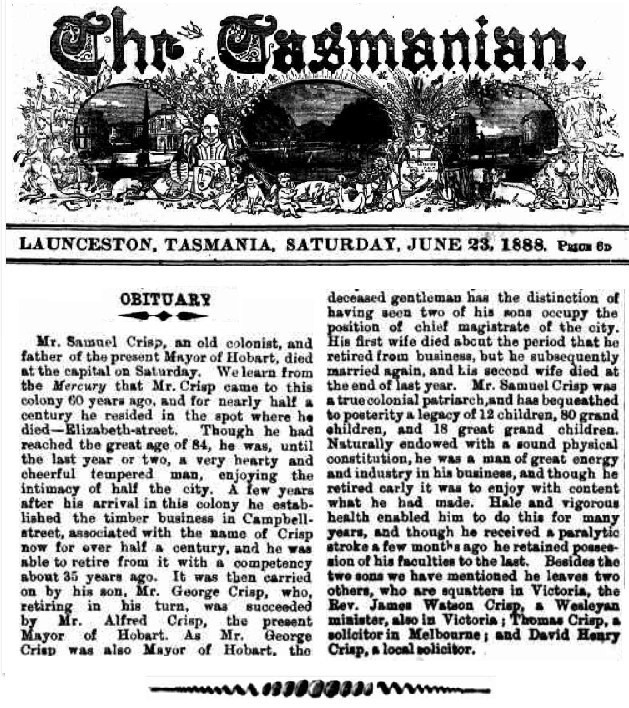
Susan was the daughter of Samuel Crisp and Elizabeth Sams. She was born in Hobart in 1840. Samuel’s obituary describes him as one of the original colonists.
What they failed to mention is how he arrived in Tasmania….transported for life for sheep stealing!
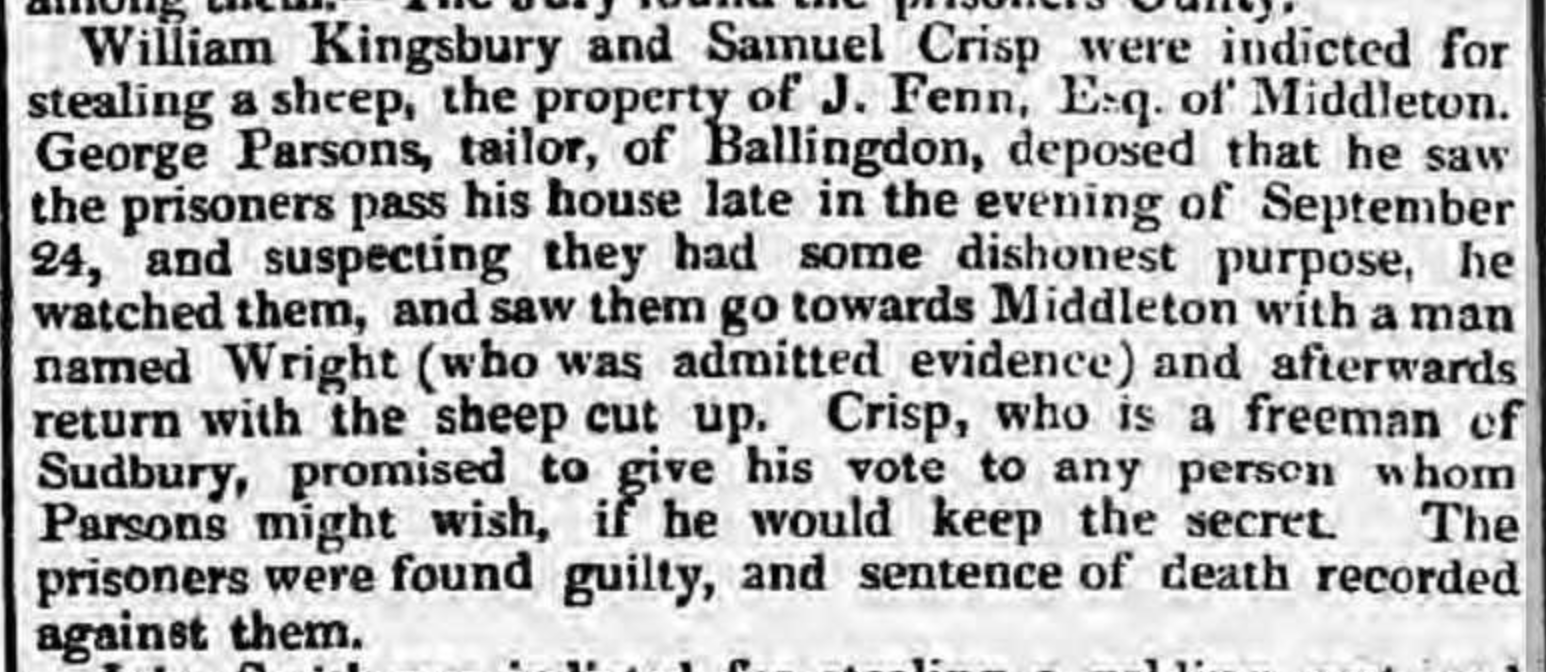
Samuel Crisp was born in Sudbury in Suffolk in 1805. In 1820 he was sentenced to a month in prison for larceny, stealing 18 yards of ribbon from the shop of John Holman. Shortly after this he married Elizabeth Sams and they had two young sons, Samuel born 1823 and George born 1824. In September 1825 Samuel was caught sheep stealing. The Bury and Norwich Post for December 1825 has this report:
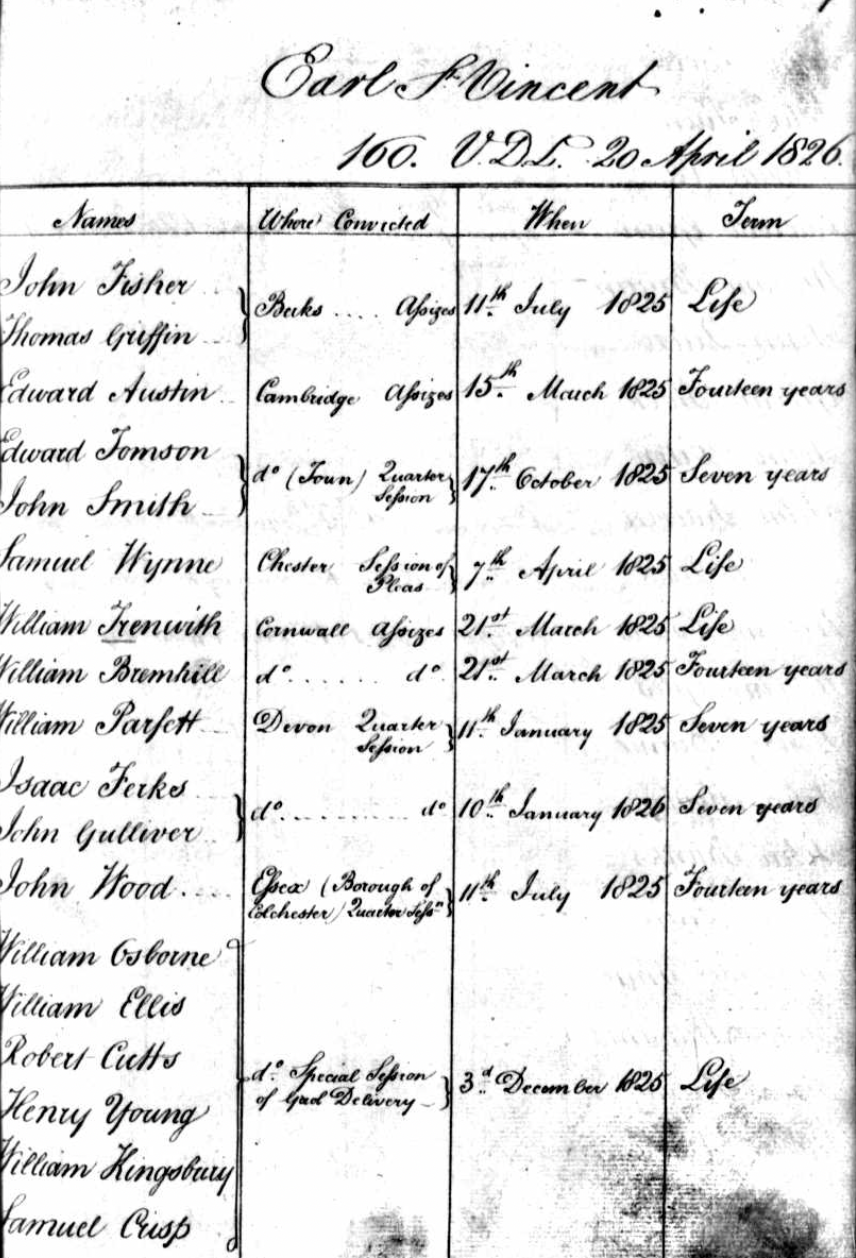
He was found guilty. The sentence of death was commuted to transportation for life and Samuel aged just 20 was transported to Tasmania on the ship “Earl St Vincent” which set sail on 20 Apr 1826.
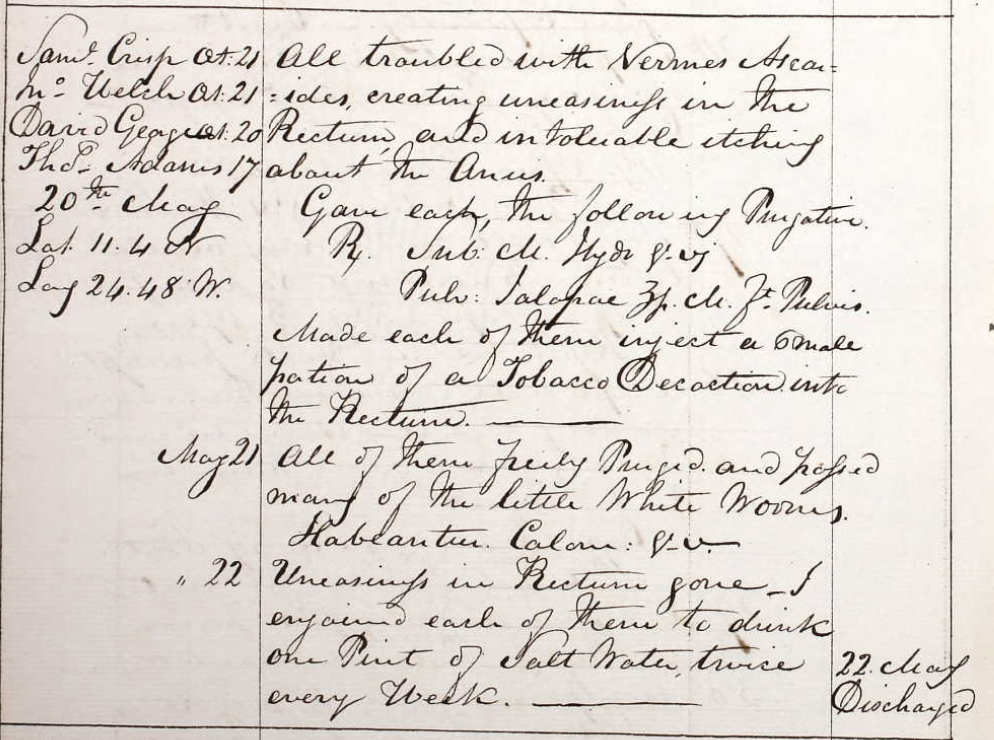
The Royal Navy kept detailed records and the ship’s surgeon records the following:-
So 200 years later we know Samuel and three others were suffering with worms which caused intolerable itching! The treatment sounds even worse; they were given a purgative and then had to inject a decoction of tobacco into their rectums! To prevent the worms returning they were told to drink a pint of salt water twice every week.
The journey to Tasmania took 110 days and the ship contained 180 prisoners.
Two years later Samuel’s wife and sons followed him to Tasmania and they produced another 5 children whilst he was still a prisoner.
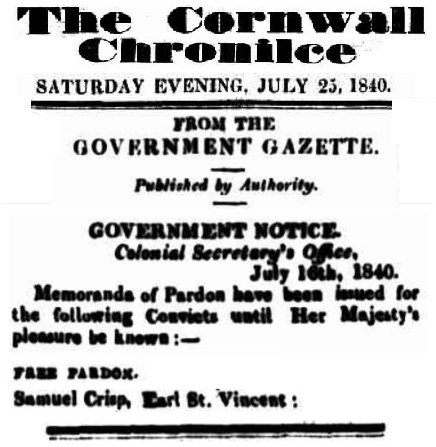
By 1840 “The Hobart Town Courier and Van Diemen’s Land Gazette” reported that he had been given a free pardon.
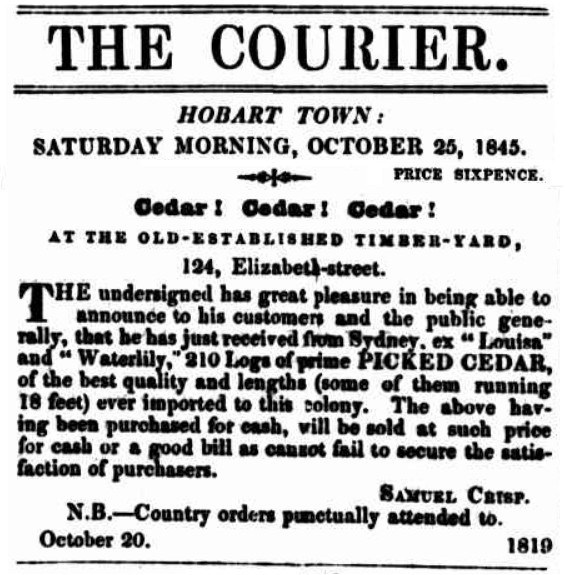
Now a free man Samuel set about creating a successful timber business, Crisp & Gunn.
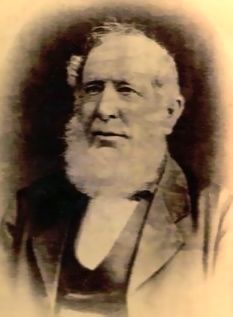
Samuel and Elizabeth had twelve children. In 1853 Elizabeth died and Samuel remarried to an Elizabeth Farquarson. By the time of his death, aged 84, he had 80 grand children and 18 great grand children. He had become a respectable member of Hobart society. His children became solicitors and his son James was a Wesleyan minister. His grandsons served as Mayor of Hobart.
Samuel Crisp
So what became of his grandchildren in Cornwall?
Catherine Rosina never married. She lived with her father in Falmouth and died there in 1928.
Catherine Rosina Lanyon
Theodore Tasman 1867-1949. Theodore was a paymaster Admiral in the Royal Navy. There were four children from his first marriage.
George Edward 1869-1916. George was a doctor. There were six children from his marriage to Pollie Bullmore.
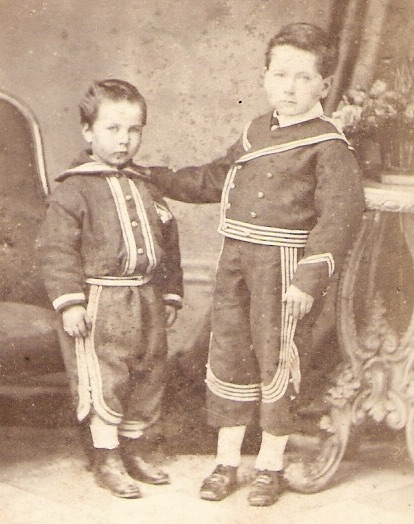
Theodore & George Lanyon
Norman Crisp 1869-1917. Norman married his cousin Dorothy Mead and they had three sons. He was shipwrecked in the English channel by a torpedo and drowned.
Norman Crisp Lanyon
Hilda Maud 1873-1922. Hilda married Edward Augustus Bullmore (Pollie Bullmore’s brother). He too was a doctor. They had two sons.
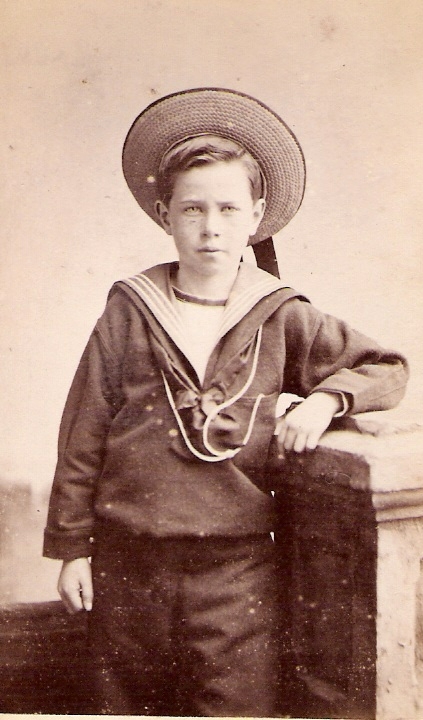
Hilda Maud Lanyon
George Lanyon and his family lived at Tasman Villa in Falmouth (circled) just behind what is now the Greenbank Hotel.
Susan Ida died in 1903 and George in 1921, at the grand old age of 88. He outlived all his siblings and three of his six children.
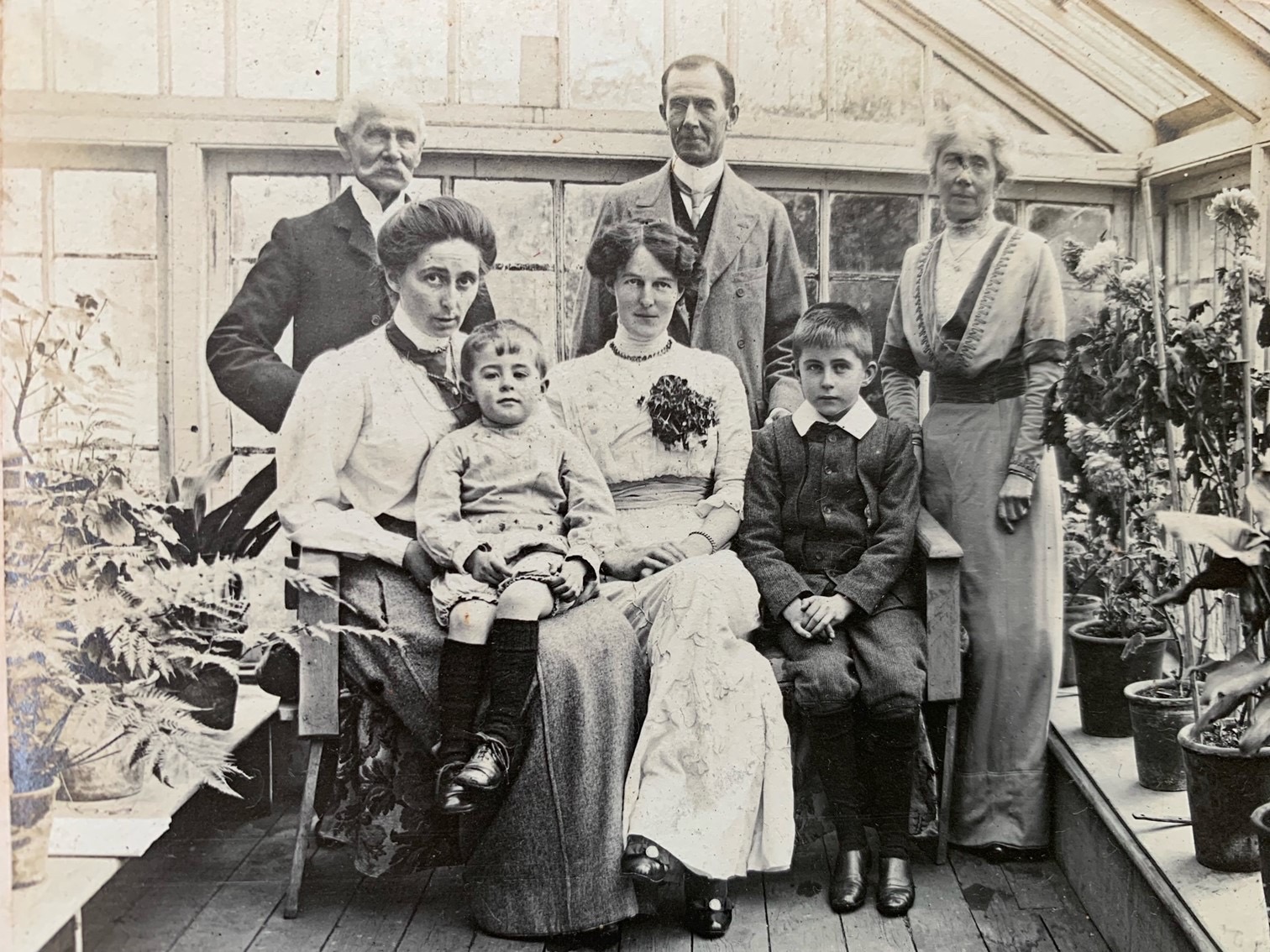
George is on the back row (left) standing behind his daughter in law Pollie.
Edward Augustus Bullmore, who was married to Hilda, collaborated with Jane Veale Mitchell to research the Lanyon family tree. He left his papers to William Smith Lamparter so that he could continue the research. In turn those papers made their way to me and ultimately led to the creation of this website.
So now we know why George Lanyon was nicknamed “The Shepherd”. If you have a better theory please get in touch!
Researching a family often necessitates many hours trawling through online resources for any mention of the family surname. A trawl through the Somerset Heritage Centre online index produced the deeds for a farm and lands at St Decumans and the name Thomas Lanyon.
The record starts on 13 Aug 1601. ‘Thomas Fulford of Fulford, Devon, Esq. enfeoffed to John Hooper of Ould Cleve, yeoman, a messuage known as Hooper’s Tenement and ten acres of land, part of the manor of Williton Fulford’ The deeds show the various tenants over the years. In 1715/6 John Leach of Bristol, ‘powterer’ and Sarah his wife (daughter and heir of Robert Mawdsley of Bristol, mariner and brother of Richard Mawdsley of Williton mortgaged the property to Arthur Thomas of Bristol, ‘powterer’. On 1 Jul 1718 John Leach mortgaged the property , by lease and release, to Abraham Lloyd, merchant, John Andrews, merchant, Richard Stafford, merchant and Samuel Cox, soapboiler, all of Bristol.
On 13 Mar 1718/19 John Rowe Esq and Martin Innys and Milborn Taylor, gents, all of Bristol , assigned the property to Daniel Woolmer, haberdasher, Thomas Lanyon, pewterer and George Bridges the younger, distiller, all of Bristol and John Roberts of Bedminster, cotton weaver (all creditors of John Leach, who was now bankrupt.)
So who was Thomas Lanyon and where does he fit on the tree?
Thomas was working as a pewterer (a tinsmith) from around 1715 and is last mentioned in 1755.
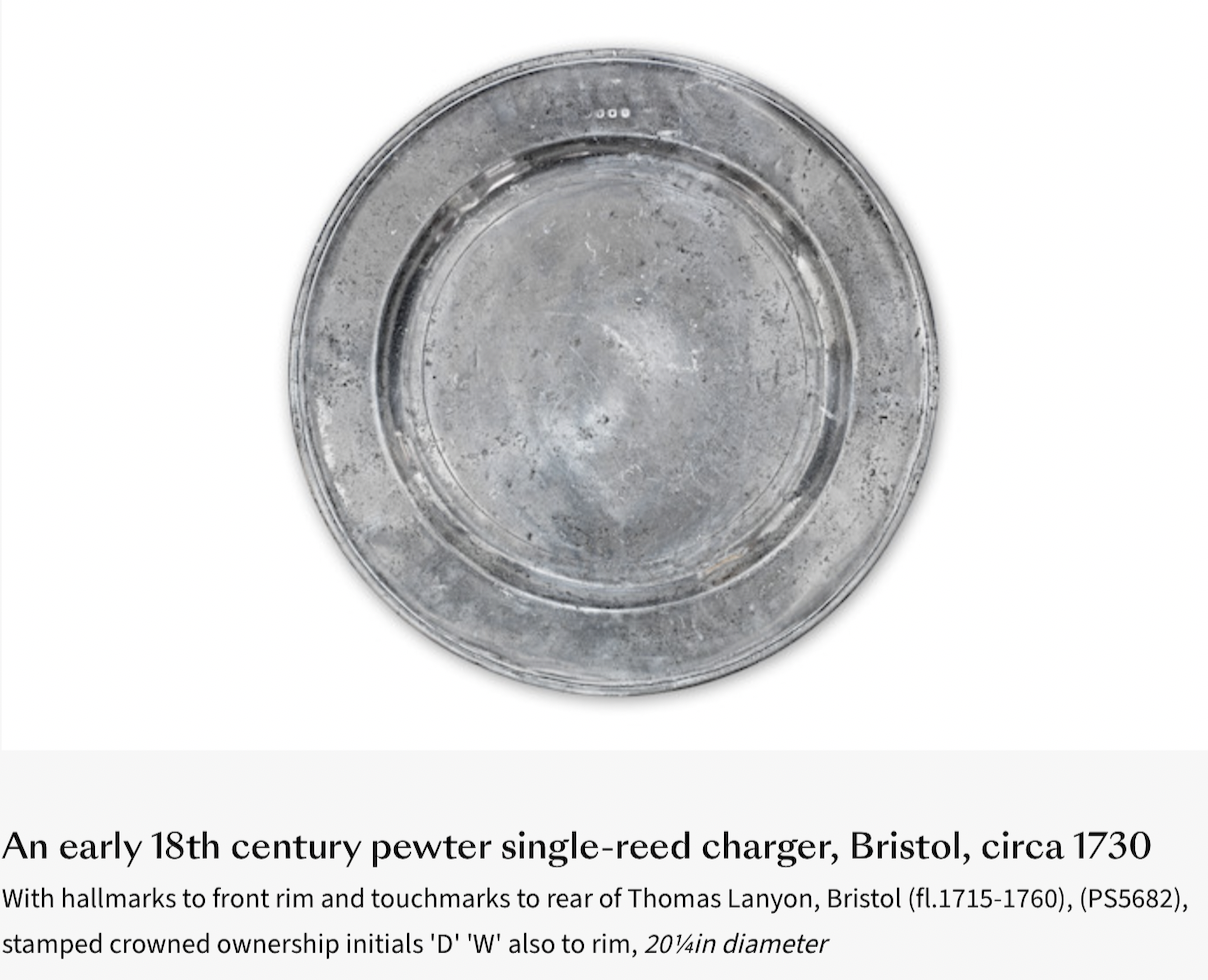
In 2021 this charger made by Thomas sold for £318.
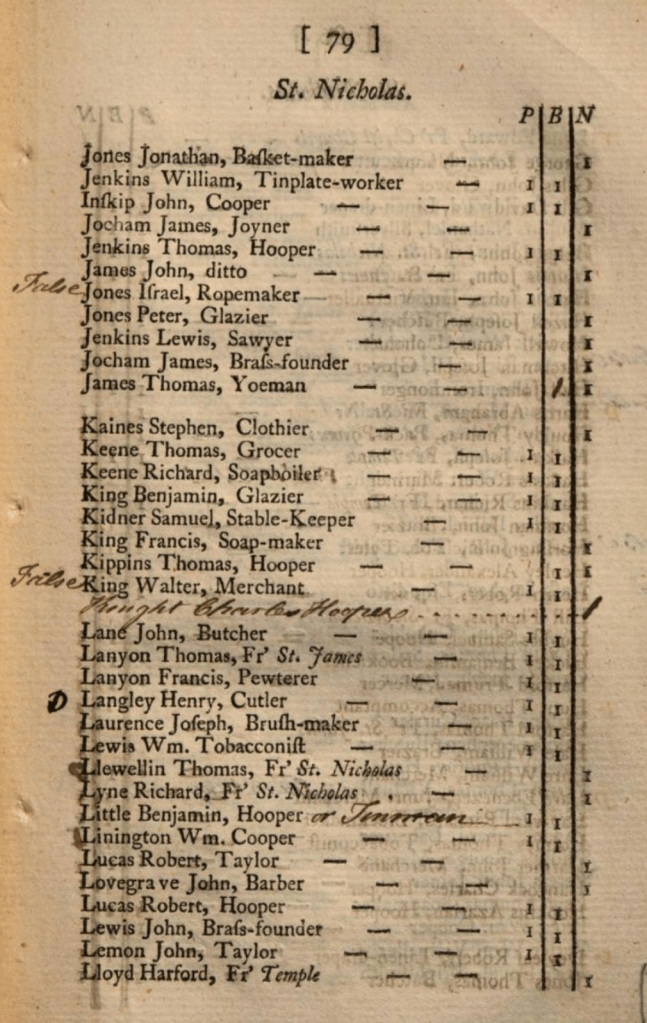
Thomas was apprenticed to John Batcheler of Bristol on 2 Feb 1707 and is free by 9 Apr 1715. He’s mentioned in the Poll Books of 1721 and 1739 as of St Nicholas Bristol, the last mention of him in is 1755.
Poll Book 1754 mentions father and son.
We know Thomas Lanyon married someone called Anne before 1725 but I can’t find a record of the marriage anywhere in England. Her name is mentioned alongside Thomas’ apprentices.
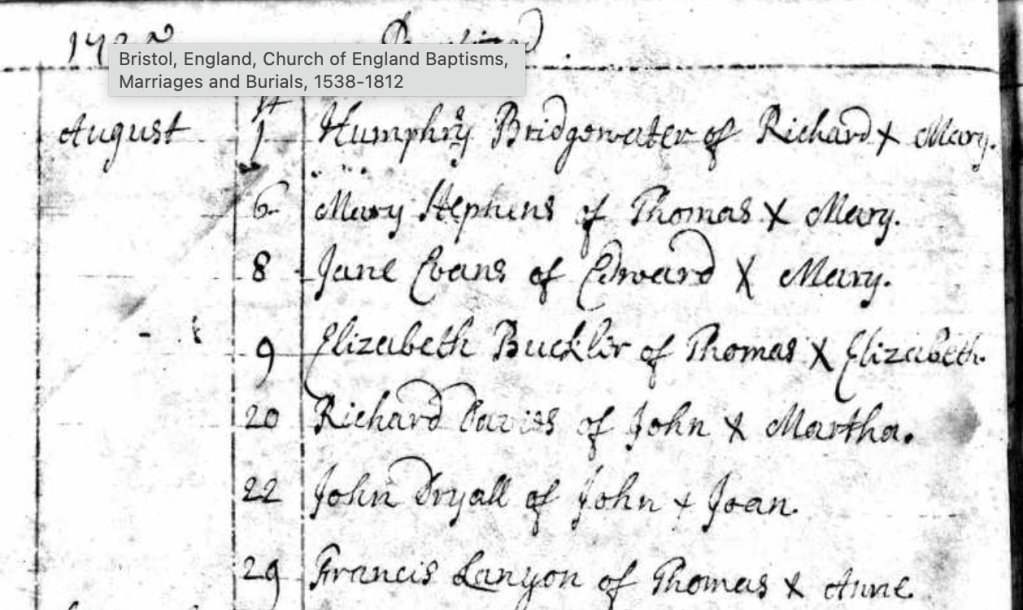
They had at least one son, Francis Lanyon, who was baptised on 29 Aug 1725 at St Nicholas, Bristol. He was also working as a pewterer on 26 Jun 1747. In the 1754 Poll Book he is listed as of St Nicholas in Bristol.
Baptism of Francis Lanyon – St Nicholas Bristol
Thomas had at least two apprentices; Thomas Page who was indentured to Lanyon between 1729 and 1737 and Robert Bush who was indentured at a cost of £50 between the years 1748 and 1755. In 1765 he was based in the High Street in Bristol.
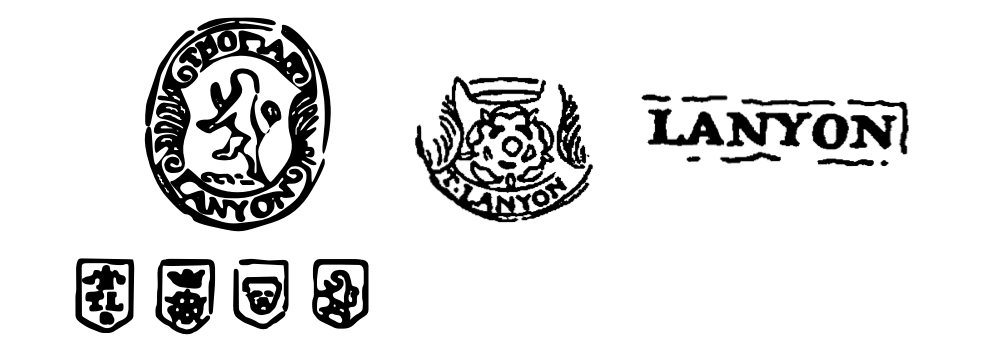
To give you an idea of the size of Lanyon’s business, in the 1740s he exported 1148lbs of pewter in one year. The book ‘Old Pewter, its Makers and Marks’ described Thomas Lanyon as being from Bristol and Coventry but I can’t find any records placing him in Coventry.
Lanyon’s Pewter Marks
The same book mentions a Thomas Lanyon of Coventry in 1774. This could be a son or even a grandson but I can find no trace of a baptism, marriage or burial.
A trawl through St Nicholas, Bristol’s parish registers reveals two baptisms which may be relevant: William & Anne Lanyen, twin children of Eli and Anne Lanyen, baptised on 3 Dec 1723 and three days later, William Lanyen and Anne Lanyen both buried 6 Dec 1723. Who was Eli Lanyen and was he any relation to Thomas Lanyon?
Sadly the records do not give us any answers. We don’t know if Eli was related to him or if it was just a coincidence that two men called Lanyon/Lanyen had wives both called Anne and were baptising children at the same time in the same area.
To complicate things even further there is a marriage of an Ann Lanyon/Lanion to a William Wayne/Wain at St Nicholas Bristol on 10 Sep 1758. They had a daughter Anna Maria Wayne. William Wayne was a metallurgist who went to Cornwall with his daughter, presumably after his wife died, to teach the Cornish metallurgy (Jane Veale Mitchell research). Both William and Anna feature in several Lanyon wills and are left very large bequests. They are related to Tobias and Mary Lanyon (the children of Francis Lanyon and Phillipp Nicholls of Sancreed).
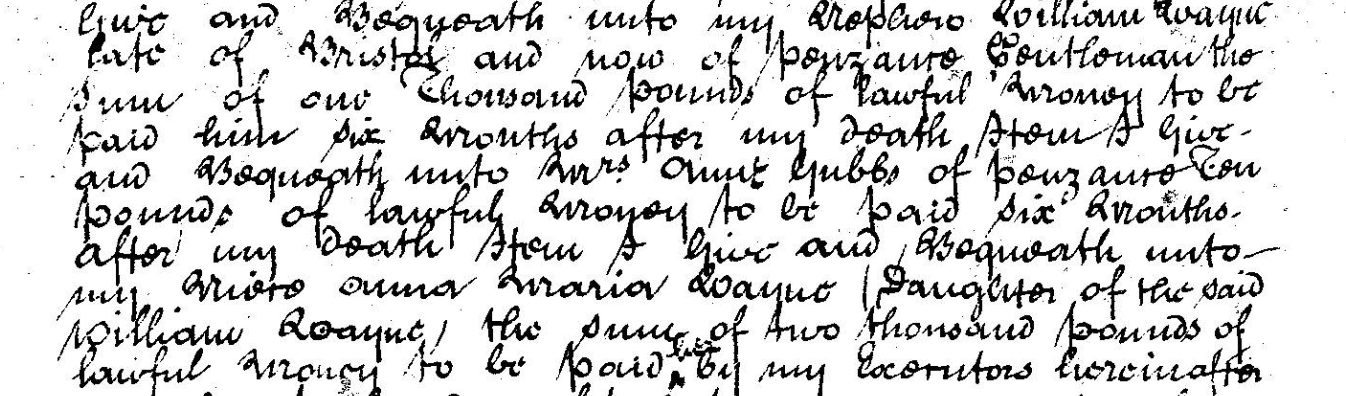
Tobias’ Will, proved 1779, mentions ‘…my nephew William Wayne gentleman late of the City of Bristol, now residing with me (at Penzance) and my niece Anna Maria Wayne his daughter….’ Tobias bequeathes them £5000!
Tobias’ Will – PROB 11/1050/103
Tobias’ sister, Mary, also had her will proved in 1779. She bequeathes her nephew William Wayne £1000 and her niece, his daughter, £2000.
Mary’s Will – PROB/11/1051/117
Tobias and Mary clearly regard William Wayne as their nephew which implies that his wife, Ann Lanyon, was their niece.
It was time to look at Tobias & Mary’s branch of the tree and see what information I could find.
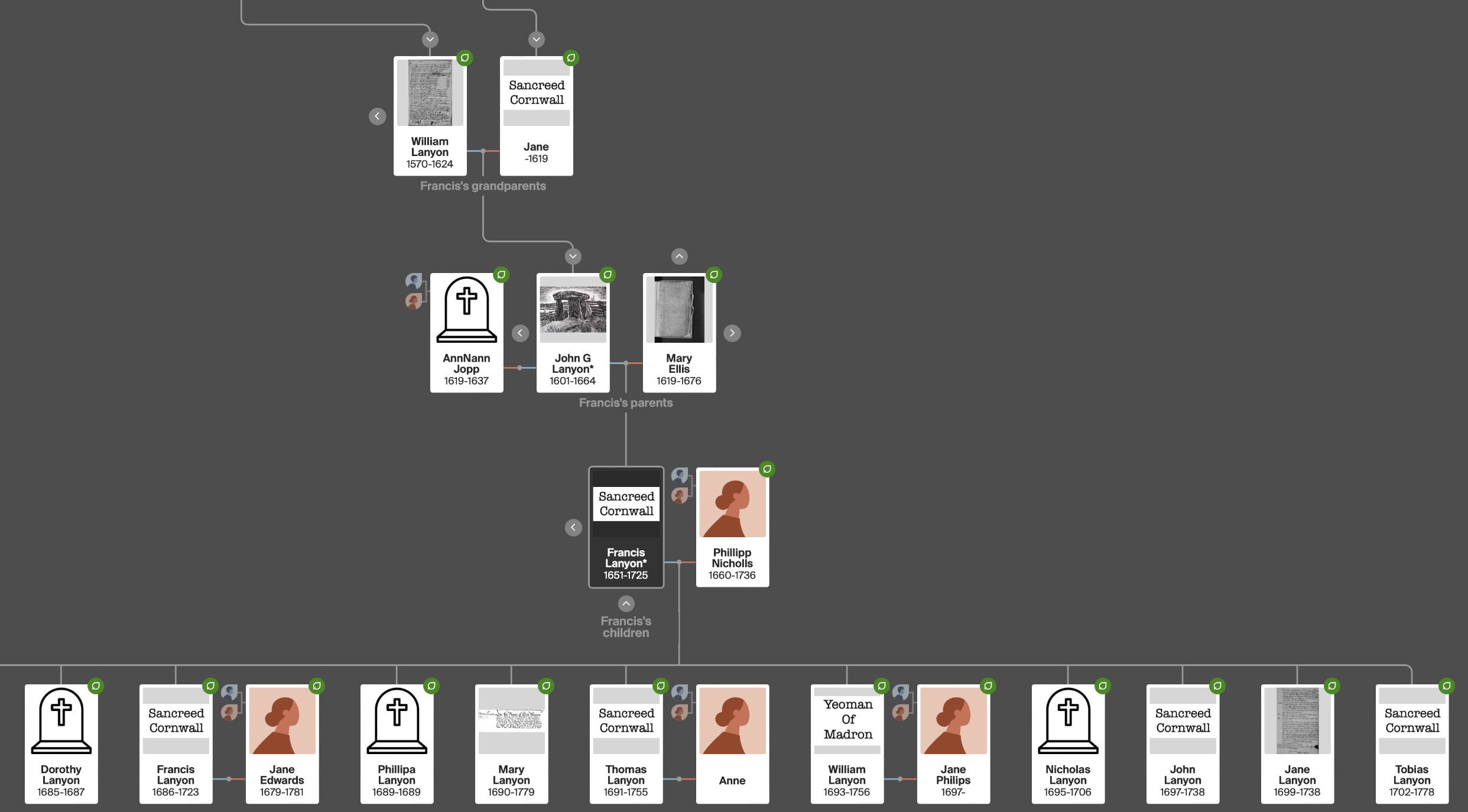
The Sancreed branch of the Lanyon family tree.
Tobias and Mary were the children of Francis Lanyon and Phillipp Nicholls of Sancreed. Francis was the son of John Lanyon, called ‘The Golden Lanyon’ as he made so much money from tin. John was a grandson of John Lanyon Esq and Phelype Milliton.
Tobias and Mary had a brother called Thomas and whilst I cannot prove that he was the Thomas who was a successful pewterer in Bristol, it does seem likely.
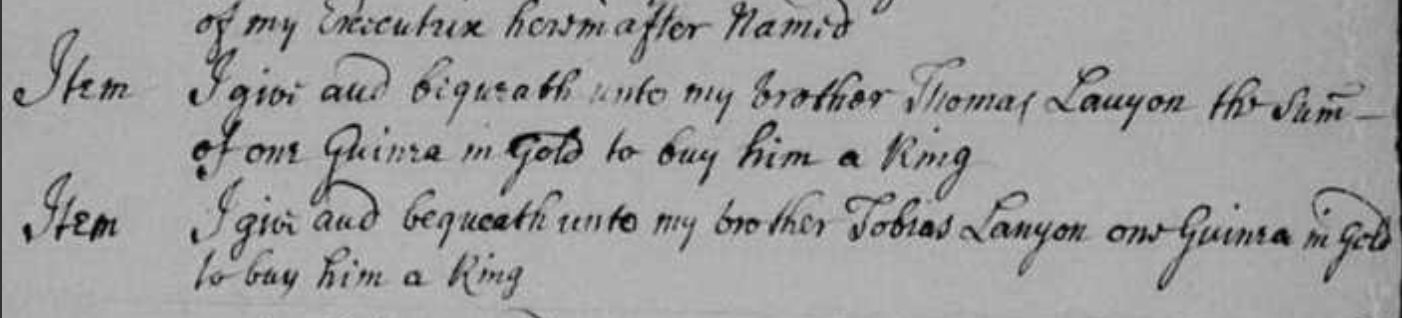
Tobias and Mary’s sister Jane died in 1738 and she leaves her brother Thomas the sum of one guinea in gold to buy him a ring.
Thomas had a son called Francis Lanyon, perhaps he was named after his father, who died in 1725, or his elder brother Francis, who died in 1723.
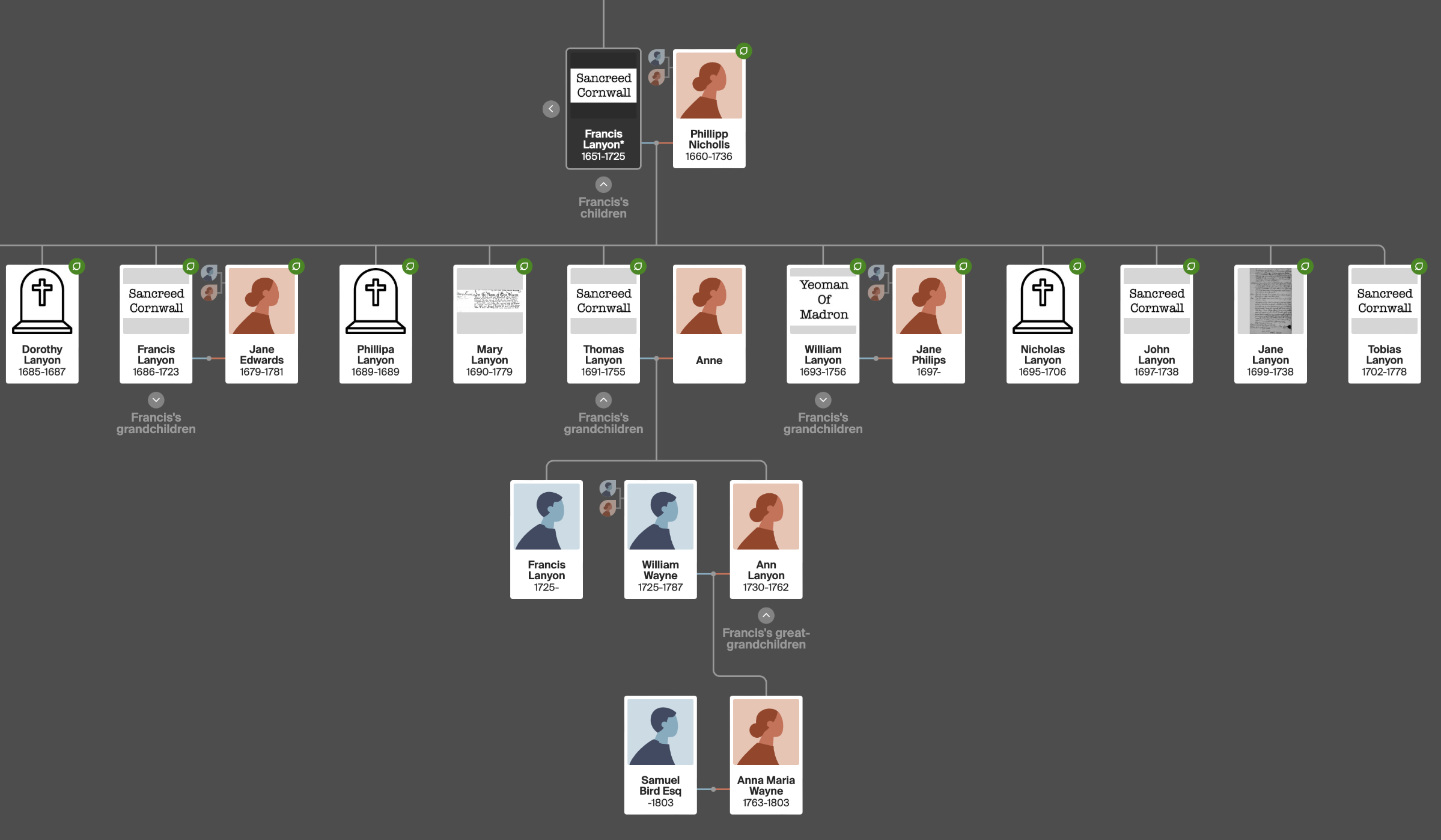
This branch of the tree now looks like this –
So Thomas Lanyon of Bristol was born in Sancreed, Cornwall in 1691 and died sometime after 1755. We don’t know what happened to his wife, Anne. We know that his son Francis became a pewterer but we don’t know if he married or had any children (the Thomas Lanyon working as a pewterer in Coventry in 1774 may be his son). There is no record of a birth of a daughter Ann Lanyon but we do have a record of her marriage to William Wayne.
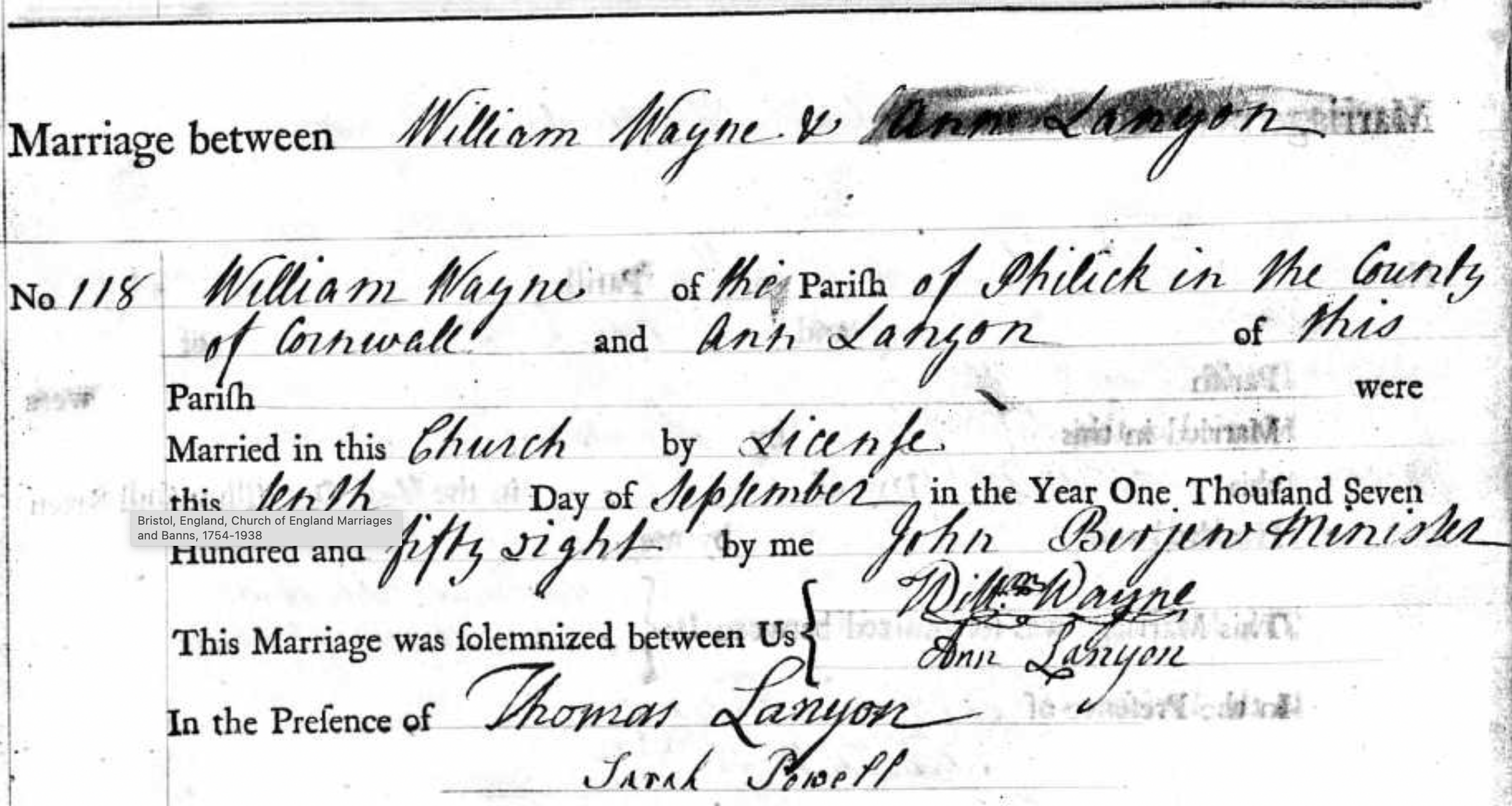
Bristol, England, Church of England Marriages and Banns, 1754-1938
Their marriage was solemnised in the presence of one Thomas Lanyon!
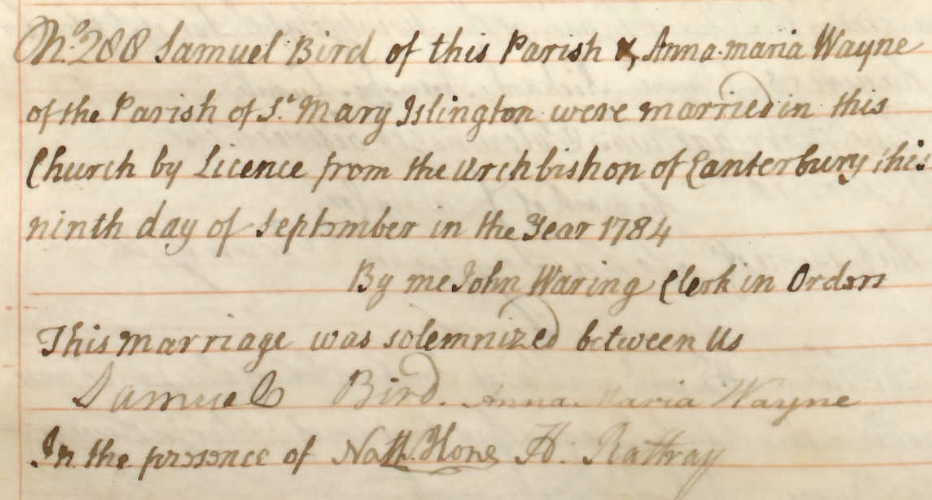
Anna Maria Wayne married Samuel Bird Esq. in London in 1784.
Marriage Register – St James Piccadilly, Westminster
By 1790 William Wayne was dead and administration of Tobias’ will passed to Anna Maria Bird the residuary legatee.
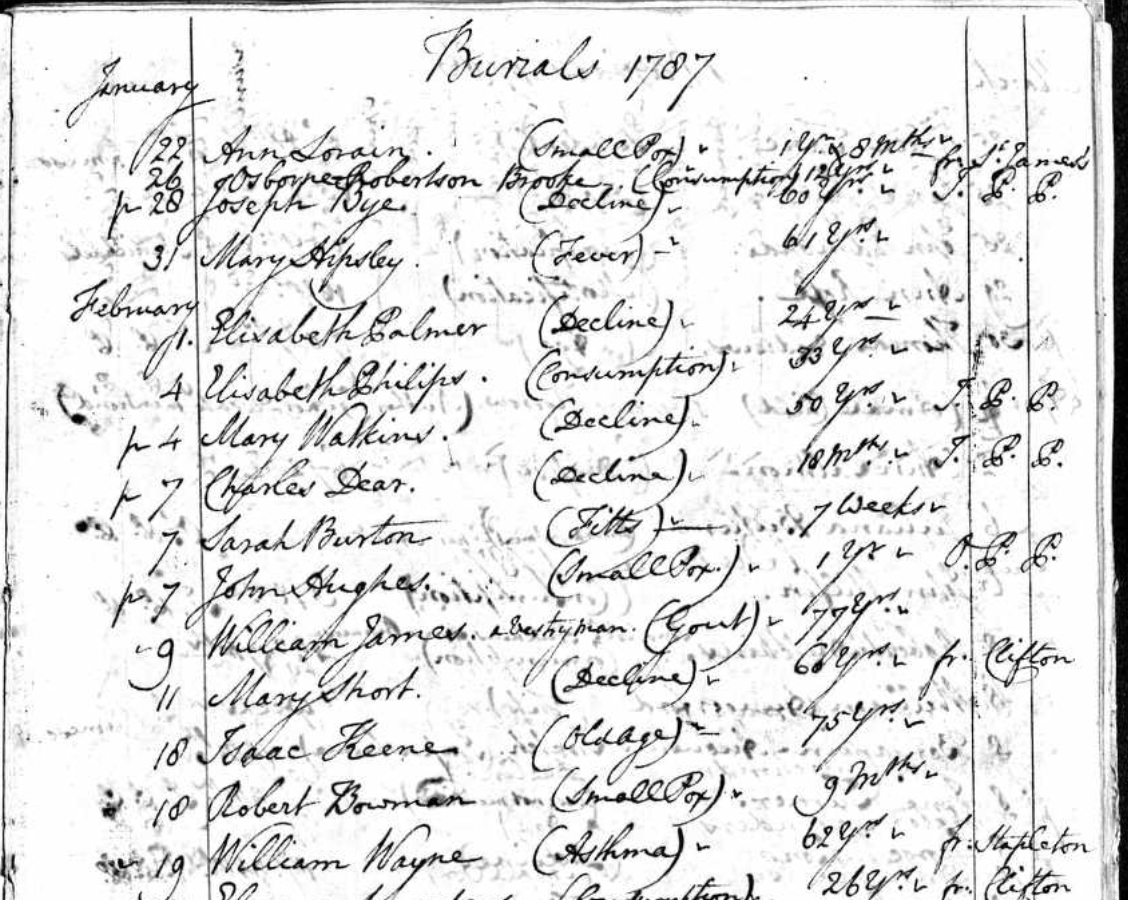
I found one possible burial entry for William at St Philip and St Jacob in Bristol on 19 Feb 1787. If it is ‘our’ William Wayne, he died of asthma.
Bristol Archives; Bristol, England; Bristol Church of England Parish Registers; Reference: P/St P&J/R/1/5
Anna was left a very wealthy young woman with bequests of several thousand pounds, a huge sum at that time.
Sadly she died on 8 Apr 1803, at East Stonehouse in Devon, but her will requests that she be interred at Sancreed in Cornwall. She was just 40, widowed, and suffering from Consumption (TB). She and Samuel were childless so her fortune was left to various cousins. There is a plaque in Sancreed church which reads:-
‘Sacred to the memory of Anna Maria Bird, widow of Samuel Bird, of Ridgeway in the county of Devon, Esqr. She died the 8th day of April, 1803; aged 40 years. Her body is deposited in a vault with the remains of her relatives, Josiah Lanyon, Esqr, and Jane his sister.’ (https://sancreedopccornwall.tripod.com/id1.html)
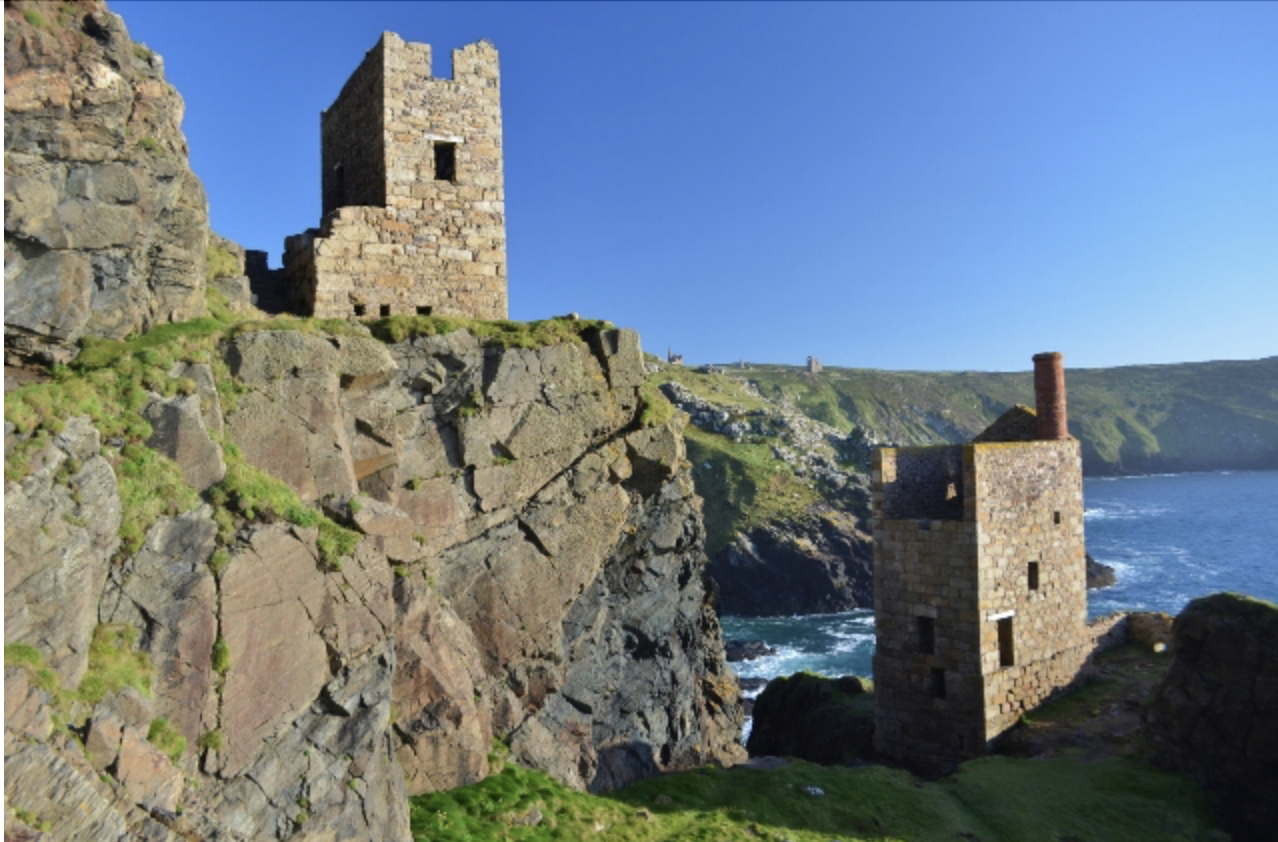
The Lanyons had connections to mining in Cornwall going back to the mid sixteenth century and possibly earlier. In 1556 John de Veer, Earl of Oxford, Viscount Bulbek and Chamberlain of England gave William Laniene and David Angove a licence to dig and search “…for the loode and veyne of tynne…” within de Veer’s manors and lordships in Cornwall for two years. (Source – CRO AP/1/852) We don’t know where they found tin but the original document has later been endorsed in pencil with the word ‘Gwinear’.
William Laniene’s son, Richard, married Margaret Treskillard in 1531. She is mentioned in Carew’s ‘The Survey of Cornwall’ as having a dream which told her where to find tin.
“Some have found Tynne-workes of great vallew, through meanes no lesse
strange, then extraordinarie, to wit, by dreames. As in Edward the
sixts time, a Gentlewoman, heire to one Tresculierd, and wife to
Lanine, dreamed, that a man of seemely personage told her, how in such
a Tenement of her Land, shee should find so great store of Tynne, as
would serve to inrich both her selfe and her posteritie. This shee
revealed to her husband: and hee, putting the same in triall, found a
worke, which in foure yeeres, was worth him welneere so many thousand
pounds.”
Richard Carew – Survey of Cornwall (1602)
John Lanyon of Sancreed, who died in 1664, was known as the Golden Lanyon as he made so much money from tin.
A document in the National Archives dating from 1605 is the first documented ‘incident’ with mining. Challynor v Buvargus concerns: assault; destruction of property and unlawful assembly.
Plaintiffs: John Challynor esq of Fulham.
Defendants: William Buvargus (Busvargus) of Buryan, Maderne Pendeene of Madron, Sandry Maderne, and others, tinners.
Subject: Assault on Ralph Lanyn, agent of plaintiff John Challynor, and seizure of tin belonging to four ‘doles’ of a tinwork called Wheal (Bennett) at St Tust (reetius St Just). Cornwall.
We don’t know where this Ralph fits on the tree but I think he is the same person who was buried at Sancreed on 29 Apr 1614.
Hugh Lanyon ‘tynner’
The first confirmed ‘tynner’ in the family is Hugh Lanyon 1648-1709. Hugh was born in Madron, the son of William Lanyon and Jane. He married Mary Tonkin and is described as a ‘merchant of Paul.’ His will survives and it is that document which describes him as a ‘tynner’.
Hugh Lanyon’s will. CRO AP/L/1104
Doubtless there were plenty of other Lanyons involved with mining in some way or another but with so few early records available it isn’t possible to identify them.
In the 19th century Coroner’s Inquests, newspaper reports and death certificates make the search much easier.
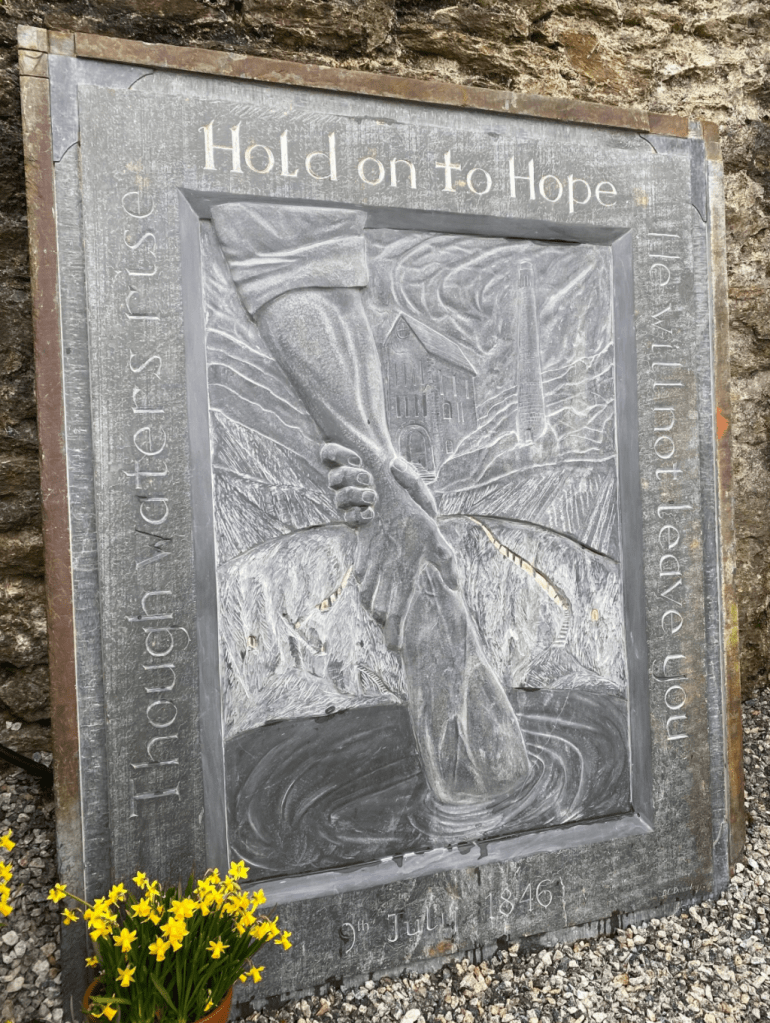
East Wheal Rose Mining Disaster
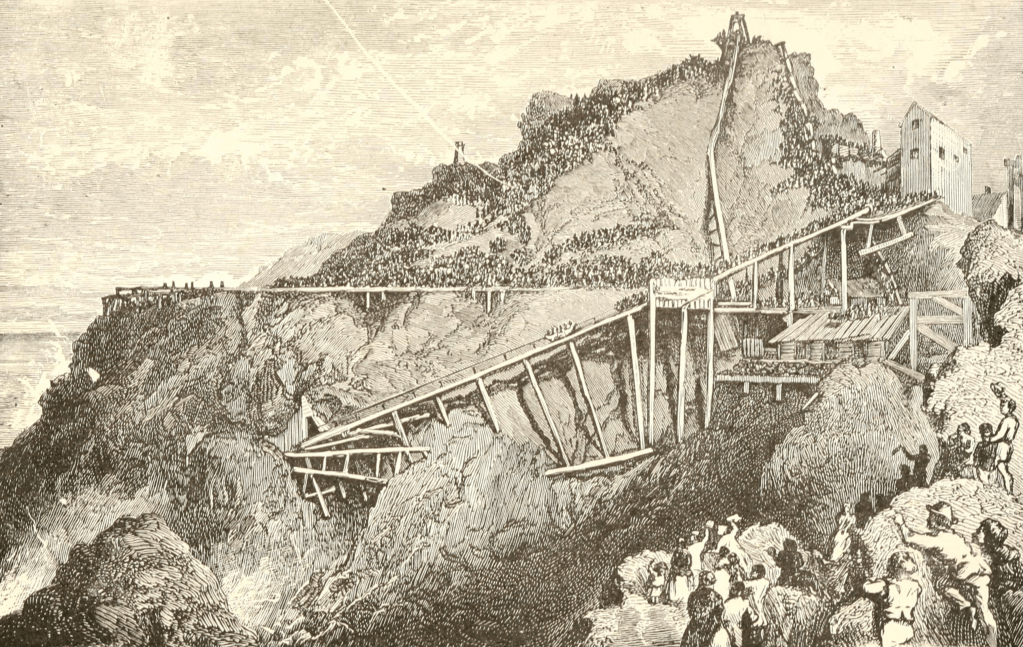
The biggest disaster to affect the family was the East Wheal Rose disaster of 1846. At that time the mine employed over 1000 men, women and children. A terrible thunderstorm sent torrential rain pouring into the valley, where the mine was situated, and into the mine itself. The men at the surface struggled to divert the water away from the mine entrance but the shafts quickly began to fill with water. There were great acts of heroism; a timber-man, Samuel Bastion, went down into the mine to lie across a manhole, diverting the flow of water and saving eighteen lives. Men went down to search for sons, only to lose their lives.
In all 39 men died in the mine including Josiah and Reuben Lanyon, brothers from St Allen.
Malcolm Kewn / East Wheal Rose / CC BY-SA 2.0East Wheal Rose Commemorative Sculpture
Most mine accidents aren’t as big as the East Wheal Rose disaster. We only find out about them from Coroner’s inquests or newspaper reports.
10 Nov 1843 – Ralph Lanyon junior from St Just in Penwith aged 14 was working in the Wheal Bosean mine and accidentally fell into one of the shafts, a distance of approx. 10 fathoms and was instantly killed. The verdict was recorded in the Royal Cornwall Gazette “Accidental death.”
Deep Down A Tale of the Cornish Mine – Internet Archive Book Images, No restrictions, via Wikimedia Commons
9 Oct 1838 – John Lanyon who was born in Gwennap, died in the Ellen Beryle Mine and was buried at St Day in Cornwall.
24 Mar 1865 – Simon Lanyon was born in St Allen and was killed at the Cargoll Mine, he was just 19 years old. “On Tuesday, an inquest was held at Zelah, before E. T. Carlyon, Esq., deputy coroner, on the body of Simon Lanyon, of the above place, who was accidentally crushed to death under the bob of the engine at Cargoll mine. A verdict of “Accidental death” was returned.” Royal Cornwall Gazette.
10 Nov 1855 – John Lanyon of St Just in Penwith was killed at Park Noweth Mine. “…in the parish of St. Just in Penwith, on the body of John Lanyon, aged 47 years. The deceased was a miner, and worked at Park Noweth Mine, in that parish, and was at the 80 fathom level, assisting in changing the boxes of the lift, when the engine being working, the rod came down, and the navel-pin thereof struck him on the head and caused such injury thereto that he died on the following day. It appeared to be the usual practice to change the boxes whilst the engine is at work, and that the same may be done without fear of accident where the party doing it is ordinarily careful. – Verdict “accidental death.” –The deceased was very much respected. He leaves a widow and five children to deplore their loss. The poor woman has been very unfortunate, having had her first husband drowned, her father killed, her son killed, and now her second husband also killed, and not long since a grand child was drowned in a well.” Royal Cornwall Gazette
Dolcoath Mine – John Charles Burrow (1852—1918), Public domain, via Wikimedia Commons
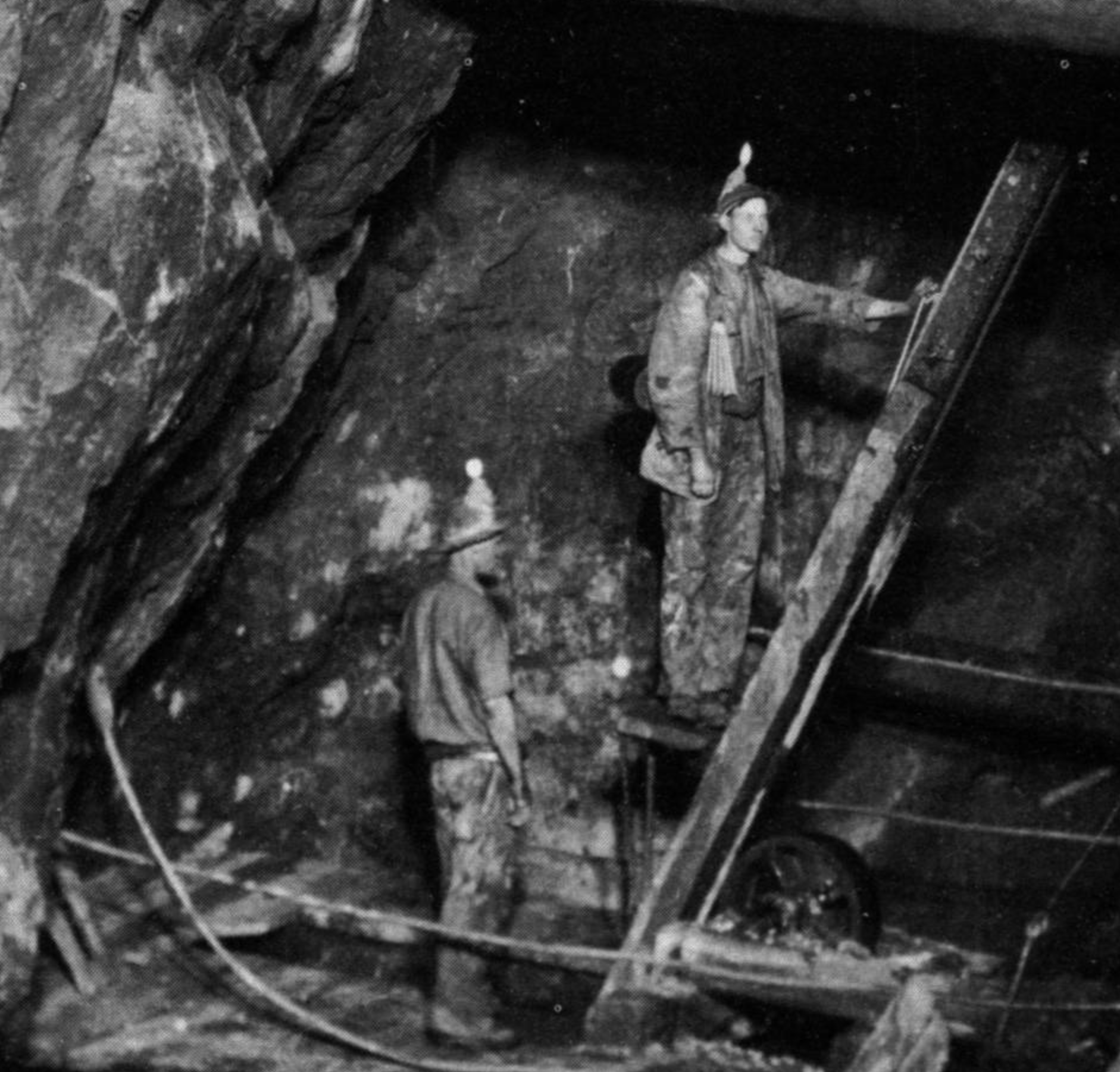
5 Jul 1912 – James Lanyon was a timber man at Wheal Carne mine in Pendeen, he was the grandson of John Lanyon (above). “He and another were “spilling” along an old adit level were they were working the sides were of decomposed granite and were weak. The level supports consisted of stull pieces hitched in the hanging and foot walls, and over these supports the piles were driven. The last stull piece, which was about 2 feet from the dirt, had been set with rather less pitch than usual and the bottom ledge of the hitch in the hanging wall was only half an inch deep. At the time of the accident, Lanyon was cutting a hitch in the hanging wall, for another stull piece when a big fall of ground about 4 feet above him fell from the wall knocked out the last stull piece and pinned him under it. The loose stone had been noticed at the commencement of the shift but it was thought that it would not fall. If legs had been set under the stull pieces the accident would probably not have happened.” Source – UK, Coal Mining Accidents and Deaths Index, 1878-1935 on Ancestry.com
When the mining industry in Cornwall started to collapse in the mid 19th century many Cornish miners took their skills to new mines overseas.
Brothers John and James Lanyon of Breage both died in Sarawak on the island of Borneo. John was a tin dresser and he died 30 Dec 1871 and James was a miner and died on 14 Jun 1872.
Simon Searle Lanyon of St Allen emigrated to Australia in 1857. He headed to the gold mines of Ballarat, like so many others, to make his fortune. His sister Emily followed soon after. Simon set up a mining company at Ballarat, Ophir Mine, with Thomas William Bull and a man called Rablin. In 1859 Simon and Rablin were killed by a fall of earth. “The timbers slipped and earth came down in that one section only, covering Rablin and Lanyon so that it was eleven hours before their bodies were recovered.” Source – “These Were Our People” by Ruth Lanyon.
Thomas William Bull broke the terrible news to Emily and in time they became friends. He went on to marry Emily Lanyon in Oct 1859.
Thomas & Emily
This post is a work in progress and will be added to as new information is found.
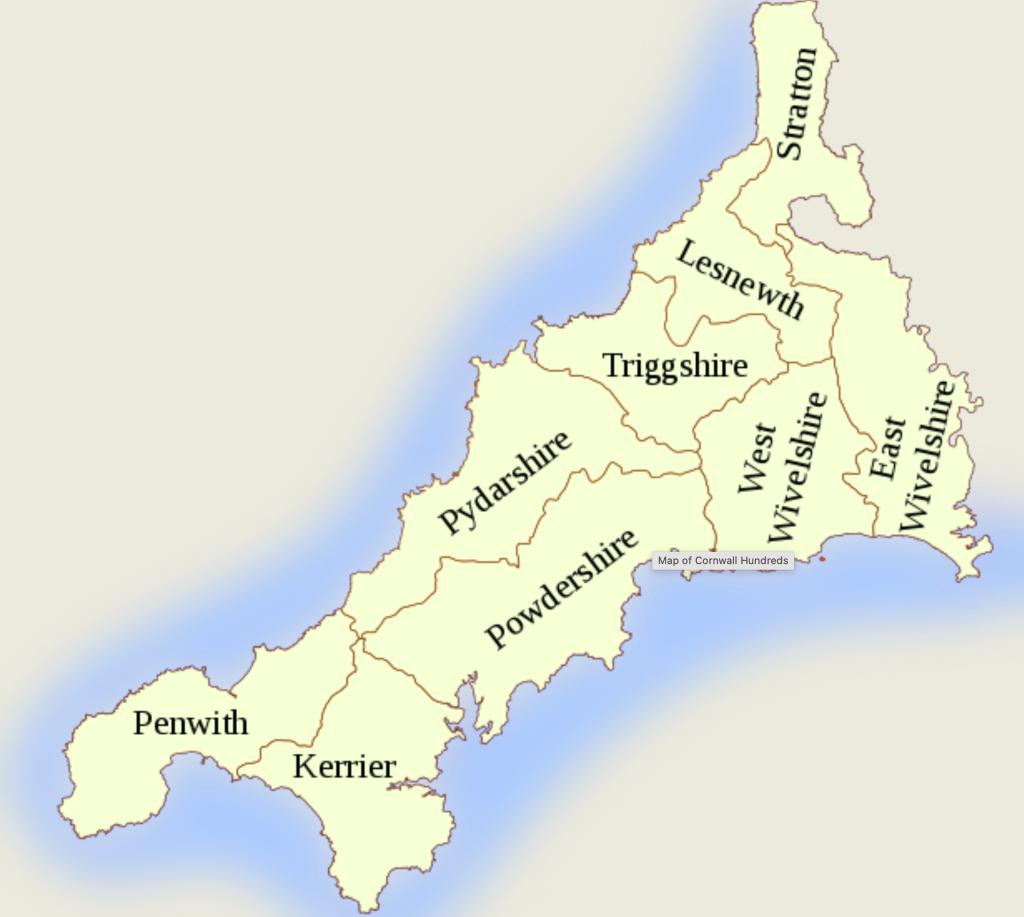
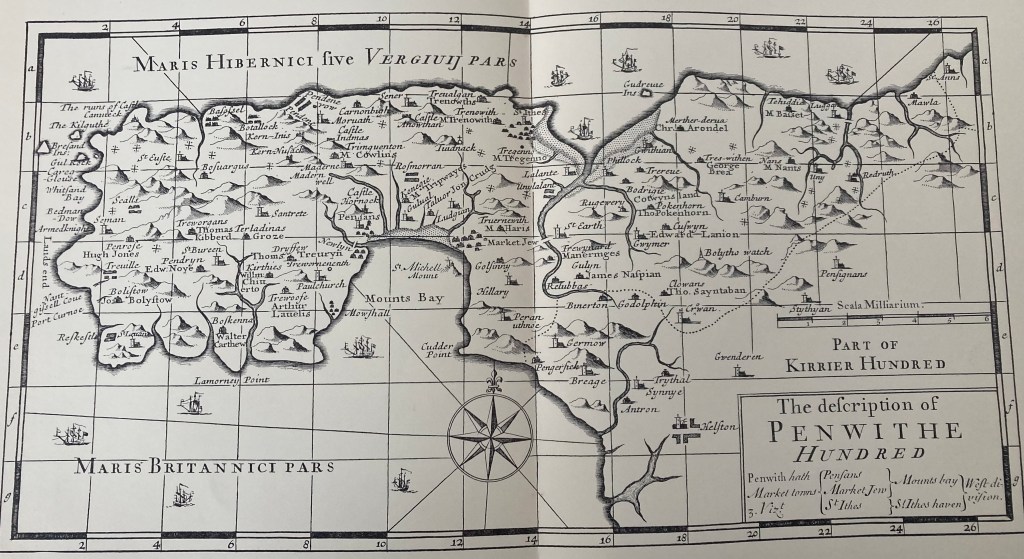
Property and land transactions are a great way to build your family history. The Lanyons owned and leased numerous properties and areas of land in Cornwall and following some of these has helped me to build their story. They owned land and property in four main areas of Cornwall: Penwith, Kerrier, Pydar and Trigg.
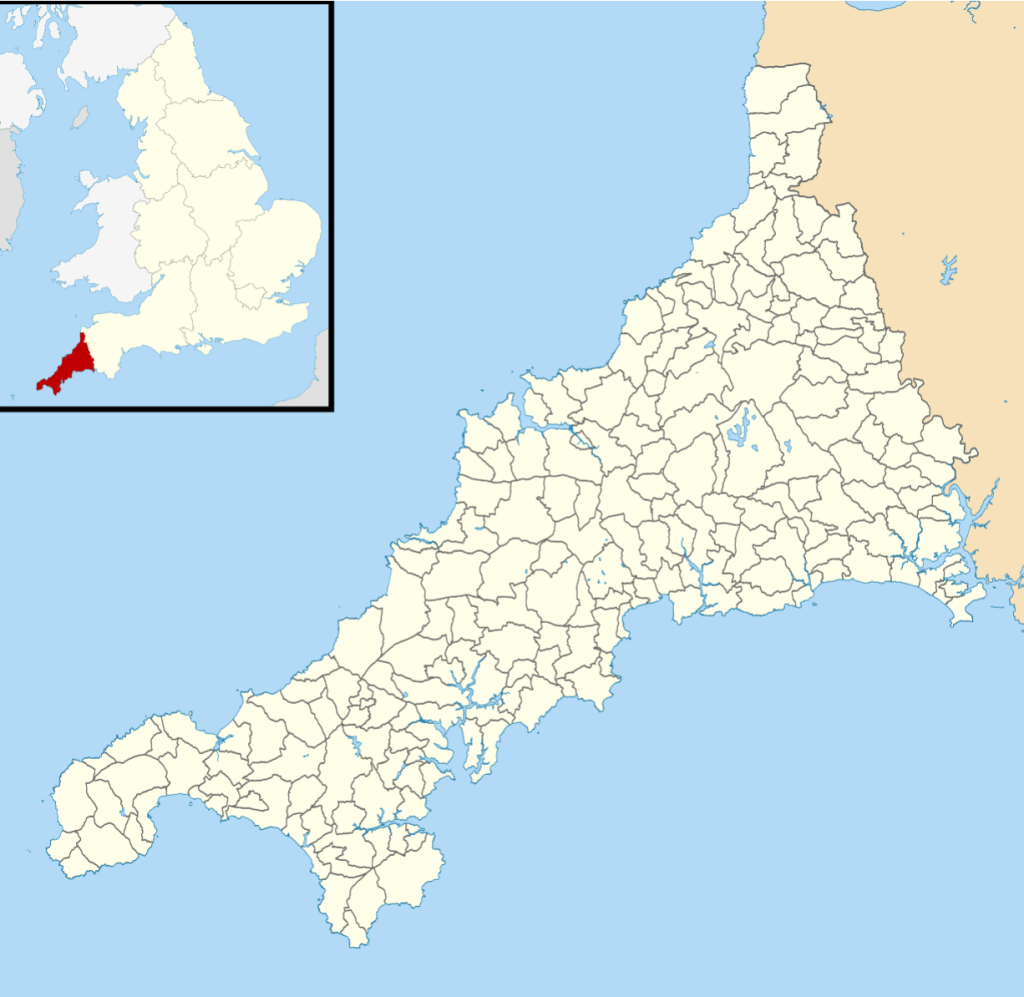
Wikimedia Commons map of Cornwall showing parish boundariesMap of the Historical Cornwall Hundreds
Penwith
The oldest property and land records I’ve found relate to Penwith.
Madron & PenzanceParish
Bosullow
The earliest property record I have found was 1244 Feet of Fines (Cornwall Feet of Fines, Volume 1, Joseph Hambley Rowe (Ed), (Devon & Cornwall Record Society, Exeter, 1914), pp.39/40) which mentions that Stephen de Bello Campo (Beauchamp) gave to John de Linyeine 3 ferlings of land at Botuolo bichan (Little Bosollow) and 1 ferling of land at Drek bichan (Drift in Sancreed). The rent at Little Bosollow was 40s 2d per year in 1244.
Little and Great Bosullow still exist today but over the centuries the name has been variously spelt:-
Botilwoelou – 1238
Botuolo – 1244
Bossywoelou – 1296
Botuelou – 1297
Boschiwolou – 1301
Bosuoylagh – 1313
Botywoelou – 1319
Bossuolou – 1334
Bosywolou – 1336
Bussolowe – 1561
(One of the biggest problems is finding the modern location of properties from the old names listed in charters and wills. )
The two houses are called Bosullow Veor (great) and Bosullow Vean or Vyan (small).
We know from Raphe Lanyon’s will of 1604, that in 1580 Walter Lanyon, who lived at the Barton of Lanyon agreed that Raphe Lanyon, his nephew, would live at Bosollow. Following Raphe’s death in 1604 his son William lived there. William died in 1627 and his widow Mary Lavelis continued to live there, her father’s will confirms this. Some time after that Walter’s grandson David Lanyon lived at Little Bosollow with his family. Following David’s death in 1641 the house appears to have been occupied by William Lanyon, yeoman, the grandson of Raphe.
Barton of Lanyon
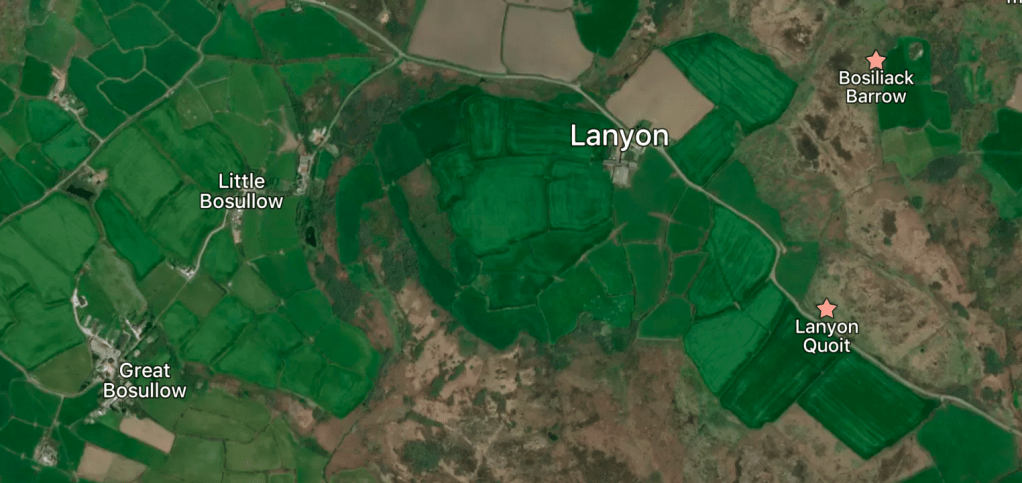
Probably the oldest property was the Barton of Lanyon near Madron. An archaeological dig in 1964 revealed that the manor house was a series of superimposed buildings dating back to at least the 11th century. Originally it would have been a turf house but by the 13th century that had been replaced by granite walls and in 1390 the Bishop of Exeter licensed the chapel at Lanyon to hold services. In 1784 the old house was taken down and a new farm built. Today the ancient site is a ‘national monument’ but little of the original house remains.
Rev. T Taylor prepared a second volume of the Victoria County History of Cornwall. The unpublished work is at the Royal Institution of Cornwall. He states:-
“Lanyon (Lanyon, Lynyen, Lanine), the ancient seat of the family of that name and styled a manor in the 17th century, is situated in an exposed position on the outskirts of the moors which form the northern extremity of the parish. In 1390 Roger Melledor, vicar of Madron, had the bishop’s licence to celebrate divine service in the chapel of Blessed Mary of Lanyon. The family of Lanyon is first found in connection with Tregaminion. In the reign of Henry VIII William Lanyon who was assessed at the large sum of 111s 8d for lands in Madron, to the first subsidy in that reign, acquired lands in Gwinear parish and his grandson Edward Lanyon settled there and became the ancestor of the Lanyons of Lanyon in Gwinear. Less is known of the parent stock. In 1627 Richard Lanyon, who as head of the family signed the Visitation Pedigree in 1620, and Jane his wife conveyed the manor of Lanyon in Madron to James Jenkyn (Feet of Fines Trinity 3 Charles I). The family of Lanyon lived at Tregaminion in good condition until the reign of Queen Anne when they sold the estate.”
Taylor hadn’t discovered that the Lanyon’s had a much longer association with Gwinear and Madron and that the manor in Madron was sold to Johnathan Rashleigh in 1634.
In 1569 Richard Lanyon Esq leased the house to his younger brother Walter and his descendants lived here until 1784.
Lanyon Quoit is so named as it is close to the old manor house.
Nancealverne
Nancealverne is on the outskirts on Penzance, parts of the house date from Elizabethan times but it was extensively rebuilt in 1700. It was home to Richard (son of Richard Lanyon Esq) and Margery Lanyon who married at Madron on 6 Jan 1587.
Richard also owned the property Rosecadghill at Penzance which is very close to Nancealverne.
Tregaminian came into the family in the 14th century when Sybil Tregemynyan married John de Lynyen. Richard Lanyon Esq and his son John sold it to Richard’s fourth son William in 1589. William’s son John sold it to his cousin John Lanyon of Botrea and it was sold to John Borlase of Pendeen during the reign of Queen Anne.
Charles Henderson wrote of Tregaminion in Morvah c. 1925
“Close to the church is the farm of Tregaminion where are the remains of an ancient manor house. A blocked up pointed granite doorway in the wall of a cart shed is apparently 14th century, the remaining portions being 15th century or later.
On this estate were to be seen an ancient chapel and holy well. They stood in a marshy field about 30 yards from the cliff and due north of the church. The well still remains and can be found by following a grassy lane from the church to the sea.”
Sancreed Parish
Drift
The 1244 Feet of Fines also mentions Drek Bichan or Drift at Sancreed as another Lanyon property. Drift was the ancient seat of the Trewren family who intermarried with the Lanyons.
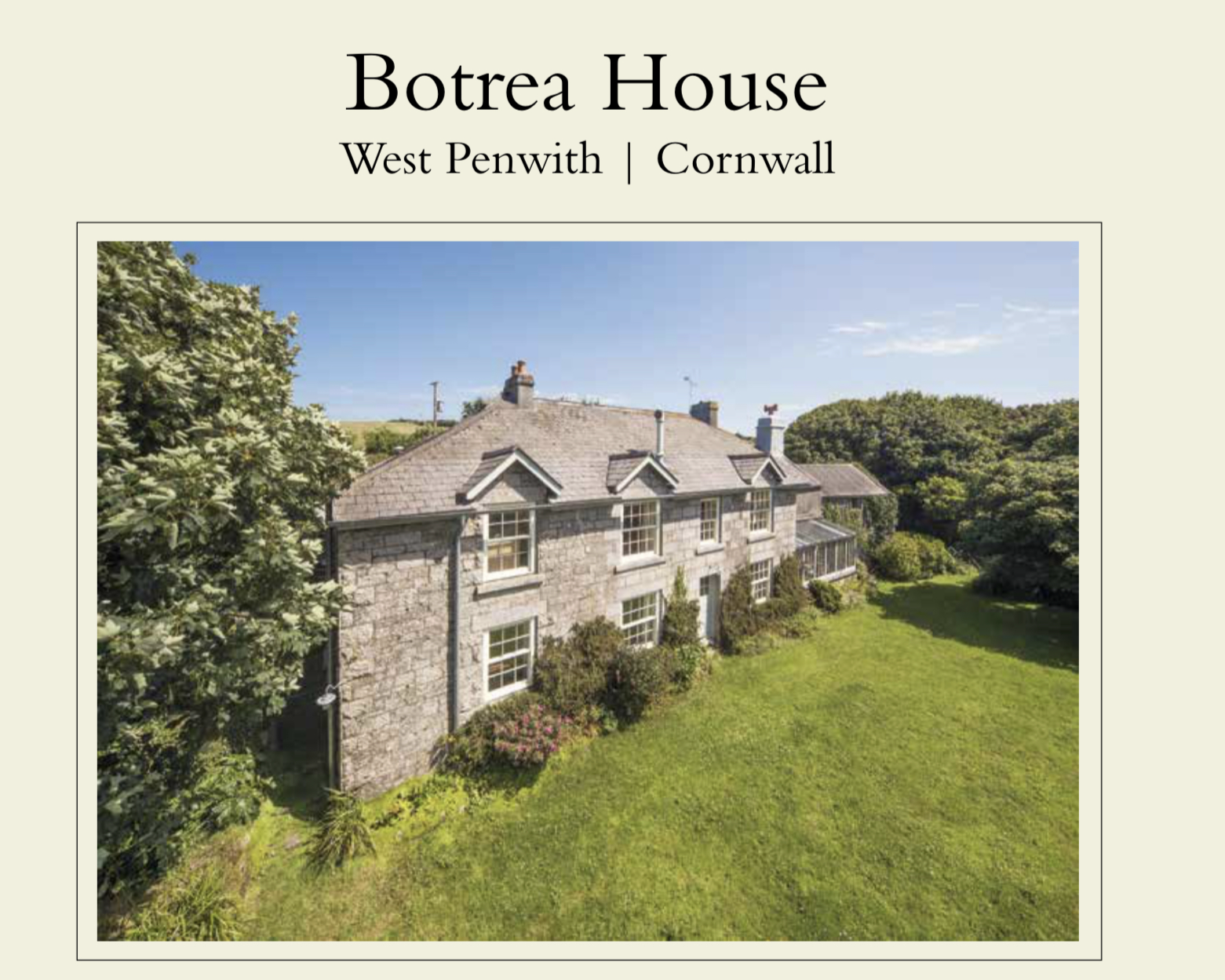
Botrea in Sancreed is another property that can be traced back to at least 1624. William Lanyon (the second son of John Lanyon Esq and Phelype Milliton) lived here and the property is mentioned in the inventory of his possessions after his death. It passed from him to his son John.
Botrea House today
John Lanyon, often called the Golden Lanyon as he made so much money from tin and money lending, mentions a number of properties in his will of 1664:- Tregonebris, Bossence, Treronacke and Treronacke Mill, Deanerall Chegwine, Tredgion, Brane, Bowante, Boddeneak, Laven Treaven, Nanceathon, Terdeny & Bownance.
The Lanyons owned several farms in this area: Treviddron, Bolankan, Treave, Cardinney and Kerrow. Some are still farms today but some have become holiday cottages and camping parks.
Gwinear became the home for the senior branch of the family. Their seat was known as Coswyn or Coswynwullard and later was renamed Lanyon Manor.
The rental or survey of Connerton Manor in Gwithian dated 14 July 1463 and states:-
“John Lanyeyn namely John Hicka, 2 Cornish acres in Coswyn.” (Cornish acres are much larger). John Hicka married the heiress Joan Lanyeyn and became John Hicka Alias Lanyeyn.
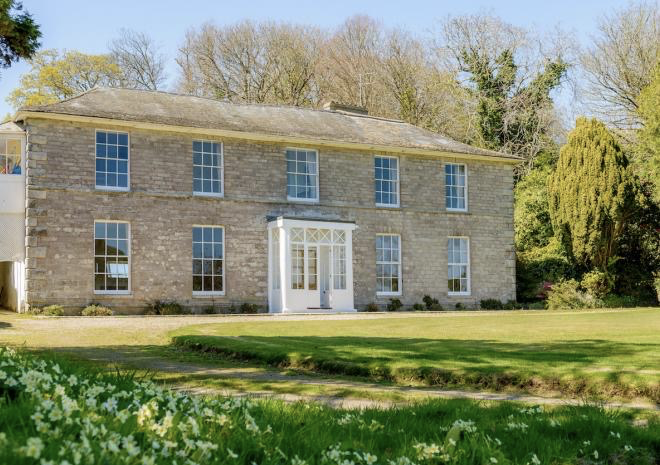
In the late 16th century Coswyn was renamed Lanyon and in 1688 Tobias Lanyon rebuilt the house in the French style. Oriel chamber over the porch. The family custom was to bring their dead and light a fire and keep it burning constantly until they were buried. This ancient custom was observed for Mrs Ann Lanion who died 21 Oct 1829, the last of the family to die at Lanyon in Gwinear.
Rev. T Taylor prepared a second volume of the Victoria County History of Cornwall. The unpublished work is at the Royal Institution of Cornwall. He states:-
“Lanyon in this parish must be distinguished from the place of the same name in Madron, both of which were seats of the Lanyon family. In the latter half of the 16th century Edward Lanyon, a younger brother of John Lanyon of Madron, is found living at Coswin in Gwinear (Feet of Fines Michaelmas 41 Elizabeth). The position which Coswin occupies on Norden’s map, and the fact that in deeds of conveyance (Visitation of Cornwall 1620. Harl MS 1162) made in 1786 the estate is described as “Coswyn Woolva otherwise Coswyn Wellard otherwise Lanyon” renders it probable that when the mansion was built (Feet of Fines Trinity 44 Eliz) at Coswin in 1668 the name was changed to Lanyon. (The Rent Roll of Connerton given in Bowles’ History of Penwith (the date of which may be as early as 1637 and cannot be later than 1673) states that Tobias Lanyon, the builder of Lanyon, was living at Coswin Wolver, and paid yearly 7s 11d to the manor of Connerton. No high rent is now paid for Lanyon.”
Charles Henderson wrote the following about Gwinear c.1925
“Between the churchtown and the railway station – picturesquely embowered amongst trees – stands the old manor house of Lanyon. The family who lived here was a younger branch of the family of Lanyon in Madron. Edward Lanyon – the youngest son of Richard Lanyon of Madron was the first to settle in Gwinear circa 1600 and gave his name to the barton.
The House continued in the family until 1785 when it was sold. The Lanyon family are said to have originated from Lannion in Brittany and there are still descendants of them bearing the same name.
The first house built circa 1600 formed three sides of a square surrounding a courtyard and faced north. In 1668 it was – like so many in the district – reconstructed, the mullions being ejected and square stones substituted. The charming old porch was allowed to remain and the eastern wing pulled down. At present – the back of the house has been enlarged and only a few years since – the eastern wing was partially destroyed and turned into a stable. The porch id the only original portion of the building and very charming it is. The granite dorrway has a drip stone and moulded jambs. Above it is a shield bearing the family arms and the date 1688. The former are :- sable a castle with four towers argent, a falcon hovering with bells, proper. Below is the motto – “Vive et Vivas.” Above this is a mullioned window and the gable of the roof is picturesquely finished off with a granite border. Inside the house there are two good ceilings on the ground floor but nothing else remarkable. The western wing of the being turned into a stable it was found that rats from it infested the house and so a small portion of it was pulled down and the rest disconnected from the main portion of the house. Unfortunately this alteration necessitated the destruction of a stone spiral staircase.
A large number of mullions and cut stones are to be seen lying about the farmyard or built into walls. two portions of a fine granite fireplace can be seen in the former. The ‘lintel’ now serves the purpose of a lintel above a door in one of the cow houses and one of the jambs is built upside down into the wall of the yard and a small iron pump has been inserted through it. The inner angle has a hollow moulding and at the base is an ornamentation representing a dice box and a ball. Both fragments show the work to be remarkably good and it is a thousand pities that they were ever ejected. Acting as the arch of the loft doorway in the same stable is a very fine Tudor doorway. In the spandrils are balls similar to those on the fireplace.
Just above it is a small stone head built into the wall. It has eyes, nose and a curious moustache and seems to be a crude imitation of a lion’s head. It may have formed at one time part of a garden ornament.
The old walled garden is at the back of the house and is shut in by huge high stone walls, one of which has been pulled down.
Lanyon is approached by a fine avenue of ash and oak but the oldest tree is near the house and is said to be 150 years old.”
Whilst some of the history is incorrect, Charles’ descriptions of the house are very useful.
Norden’s 1584 map of Penwith which shows Edward Lanion’s home at Gwinear called Coswyn
These aren’t the only properties in Penwith but they give an idea of the extent of the family’s property in this area.
Kerrier
Breage Parish
William ‘Generosi’ Lanyon moved to Tregonen in Breage in 1569. I think Tregonen is now called Tregonning.
In 1341 a charter names David de Kylmynawis as the father of John de Lynyen. Where is Kylminawis?
Kylminawis appears to be St Minver. The charter also mentions Portzwyhan which today is better known as Port Quin.
“David De Kylmynawis to John his firstborn son & heir, and to the heirs of his body by Sibyl daughter of Joceli de Tregaminion his wife, with remainder to the grantor and his heirs. Charter with warranty of all his messuages, lands etc. In Kylmynawis, namely yards, gardens, woods, meadows, moors, turbaries, launds an pastures, and his corn mill there with multiple, waters and watercourses or beads, his bake house with garden in the town of Portzwyhan, the rent and service of John de Landewarnek and his heirs for lands held of the grantor in Kylcoys, of Simon de Kylcoys there, of Paternus and Robert brothers of the grantor for lands of him held for their lives in Kylcoys, of Margery his sister likewise in Araweyte, and the reversion of all lands of the said John, Simon, Paternus, Robert and Margery which they claim to hold for life of the grantor and his heirs when it shall fall in.”
John Lanyon, probably the second son of Richard Lanyon Esq, lived at St Agnes, he appears on the 1569 Muster Roll for St Agnes. William Whitta owned the Penwennick Estate. Around 1569 it appears that John Lanyon married William Whitta’s daughter Jane. In 1596 when John & Jane’s son also called John married Tamsin Tapprell at St Agnes John Lanyon gent purchased the Penwennick Estate. By 1623 John, his wife Jane and their sons John and Edward sold the estate to Edward Noy.
We don’t know the name of any property owned in St Erth but William Laniene paid 41 shillings for property in the parish according to the Penwith Subsidy Roll of 1509-1523. His Gwinear estate also cost 41 shillings so the St Erth property was of a similar size.
St Erth was also the home to Elizabeth Nanspian, the wife of William Laniene’s son Walter. The Nanspyan’s lived at the Manors of Godrevy, Tregender and Gurlyn in St Erth.
St Allen Parish
John Lanyon descended from the Sancreed branch of the Lanyons. He married Sarah Straight and they moved to St Allen parish. They lived at Henver Wartha and the family purchased more farms at Polstain, Trevalsa and Lanner.
In the late 16th century John Lanyon Esq married for a third time to Margaret Trewinnard and moved to St Merryn near Padstow. They lived at the Treveglos.
His grandson Richard Lanyon Esq lived at Treginegar at St Ervan. This was absorbed into the Royal Naval Air Station at St Merryn and became the officers wardroom.
In 1586 Edward Lanyon was involved in a legal dispute over the property at Cruckmorreck, it’s not clear where this is today but it could be Crugmeer near St Merryn.
John Lanyon Esq’s marriage settlement of 1561 lists the various properties he was to receive on his marriage. They were in Gwinear, Madron, Morvah, Buryan, Sennen, St Levan, Kenwyn, St Just, Paul, St Merryn, St Ervan, St Issey and Padstow.
Just sixty years later John’s grandson, Richard Lanyon Esq, lost many of the properties when he fell into debt and sold much of the estate to his cousin Jonathan Rashleigh for £500. Rashleigh leased some of the properties back to the family.
1569 was the year the first lottery was held in England, the prize was £5000. It was also the year Mary Queen of Scots was first imprisoned and of the Northern Rebellion against Elizabeth I.
Mary Queen of Scots François Clouet, Public domain, via Wikimedia Commons
It was also an important year for the Lanyon family.
In 1567 William Laniene esq died. We don’t know his date of birth but his eldest son was born about 1516 and he had older sisters so it is estimated that William was born in the 1480s. There is an Inquisition Post Mortem of William Laniene of Coswynwollard, Gwinnear from 1586 which gives the date 20 Mar 1567 as the date of his death. This Inquisition gives his son Richard’s age as 70 (in 1586), so he was already 51 when he inherited his father’s estate in 1567.
In 1562 at the time of his son John’s marriage to Phelype Myliton, Richard was living at Tregaminian in Morvah. In 1567 he moved to Coswynwollard in Gwinear (now called Lanyon.)
Map of the Lanyon Estate at Gwinear
We don’t know which lands, if any, William Laniene senior intended for his sons as there is no will. In 1569 Richard granted estates to his brothers.
William ‘Generosi’ Lanyon
Richard’s brother William had been living at the family estate in Gwinear. His first wife Tamson was buried there on 26 Jun 1563. His son Baldwin was baptised at Gwinear on 1 Apr 1561 and buried 24 Jun 1563 just two days before his mother.
William was given the estate Tregonen at Breage. He appears on the Breage Muster Roll of 1569 ‘Furnished long bow sheaf arrows steel cap and black bill’ and he lived there until his death in 1597. His burial is listed in the Breage parish register where he is described as ‘generosi’.
Tregonning Hill near Breage which may be the location of Tregonen
Walter Lanyon
Walter married Elizabeth Nanspyan of St Erth. He is listed on the 1569 Muster Roll for St Erth ‘Bow shaft arrows, ability B’. His father owned land at St Erth as it is listed on the 1523 Penwith Subsidy Roll as having a value of 41 shillings (the same as the Gwinear estate.)
In 1569 he was given the tenancy of the Barton of Lanyon (the ancestral family home) at Madron by his brother Richard. Hendersons MSS 30534 pt 7 gives details of the lease and confirms the names of Walter’s son (John) and three grandsons (Francis, Alexander and David) also their ages.
The ancestral home at Lanyon near Madron. Bosullow was also part of the estate.
Edward Lanyon
The only record we have of William Lanyon having a son called Edward is a record from Kresen Kernow (Cornwall Record Office) AR/3/39 dated 11 Feb 1586. It’s a lawsuit over Crugmoreck in St Merryn.
“…..that Richard Lanyen esquire, on 20 September 1569 (11 Elizabeth), had granted to party (1-Edward Lanyen) 30 acres of land, being one close called Crukemorecke (parish of Seynt Meryn), for (1) to hold for term of 6 years from St Bartholomew last past [24 Aug 1569]; on the following 26 Sep [1569], (2-George Arundell)-(3-John Michall) forcibly entered the tenement and ejected him from it…”
The case goes on to mention that the sheriff of Cornwall Peter Edgecombe esq was a kinsman of Edward. Peter was the son of Joan Tregian the daughter of Thomas Tregian and that Edward was the son of Thomasine Tregian the daughter of Thomas Tregian.
We don’t know what happened to Edward after 1586. We don’t know if he had any children. All we know is that Richard Lanyon esq granted him the lease of the estate in Crugmoreck in 1569. There is an Edward Leyne on the Padstow muster roll of 1569 ‘bow 6 arr, ability a-ar’. Could this be the same person?
We don’t know where Crugmoreck lies today but the Lanyons owned lands at Harlyn, St Ervan, St Merryn and Padstow. Perhaps Crugmeer is the location?
Paskis Lanion married Thomas Shetford at St Just in Penwith in 1625. Who was Paskis Lanion? If only the answer was straight forward!
A quick trawl through the Cornwall Online Parish Clerks database revealed no baptisms for a Paskis/Paksis/Pascha/Pasca/Paska/Paskes/Paskas Lanion/Lanyon.
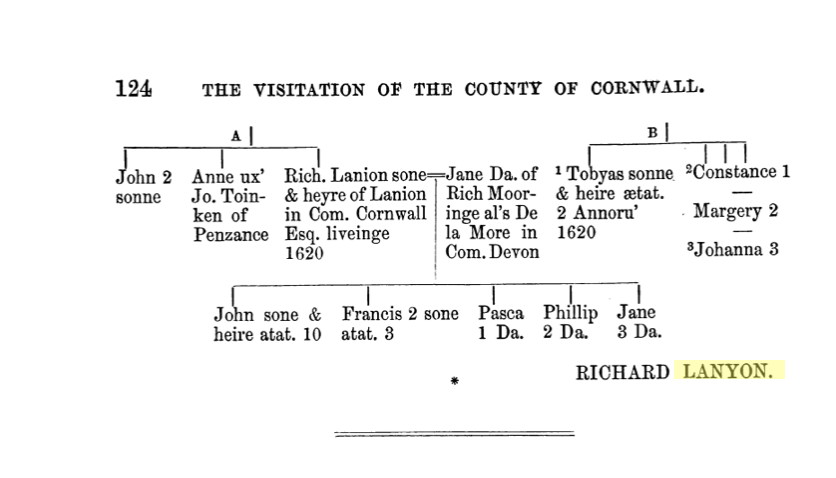
However the Heralds Visitation for Cornwall 1620 does have a suitable candidate:
Vivian’s Herald’s Visitation of Cornwall 1620
Richard Lanyon Esq submitted his tree showing that his wife was Jane Mooring alias De La More from Devon and their eldest daughter was called Pasca but was she old enough to get married in 1625?
Their eldest son was John aged 10 in 1620 so therefore born in 1610. Could Pasca be older than John? When did Richard marry Jane? The Royal Institution of Cornwall has a marriage settlement between Richard Lanyon and Jane his wife dated 1608 so presumably they married about 1608. The letter from Mrs Rose Tolman confirms that Jane’s mother was called Pascha Risdon so eldest daughter was named after her grandmother.
Francis 2nd son – deposition taken 1635 when he is aged 16 so born in about 1619
Elizabeth baptised 17 Nov 1622 St Merryn
The children with no baptisms recorded are:
Pasca eldest daughter born before 1613 when Philippa is baptised
Jane 3rd daughter born after 1613 and before 1622
Richard not listed on Herald’s Visitation so presumably born after 1620
Thomas not listed on Herald’s Visitation so presumably born after 1620
Margerie – from Richard Lanyon Esq’s will it is implied that Elizabeth and Margerie are the youngest daughters
The latest Pasca could have been born was 1613 and with John born in 1610 and two unbaptised babies born in 1611 and 1612 it looks likely that Pasca was probably born about 1608/9 which would make her about 16 years of age at the time that the marriage to Thomas Shetford took place. So she is a possible candidate.
Richard Lanyon Esq’s will of 1636 left all his daughters £30 or £40 apart from Pasca who received 5 shillings which implies that in 1636 she was already married and had received her ‘portion’. Sadly the will does not mention her married name.
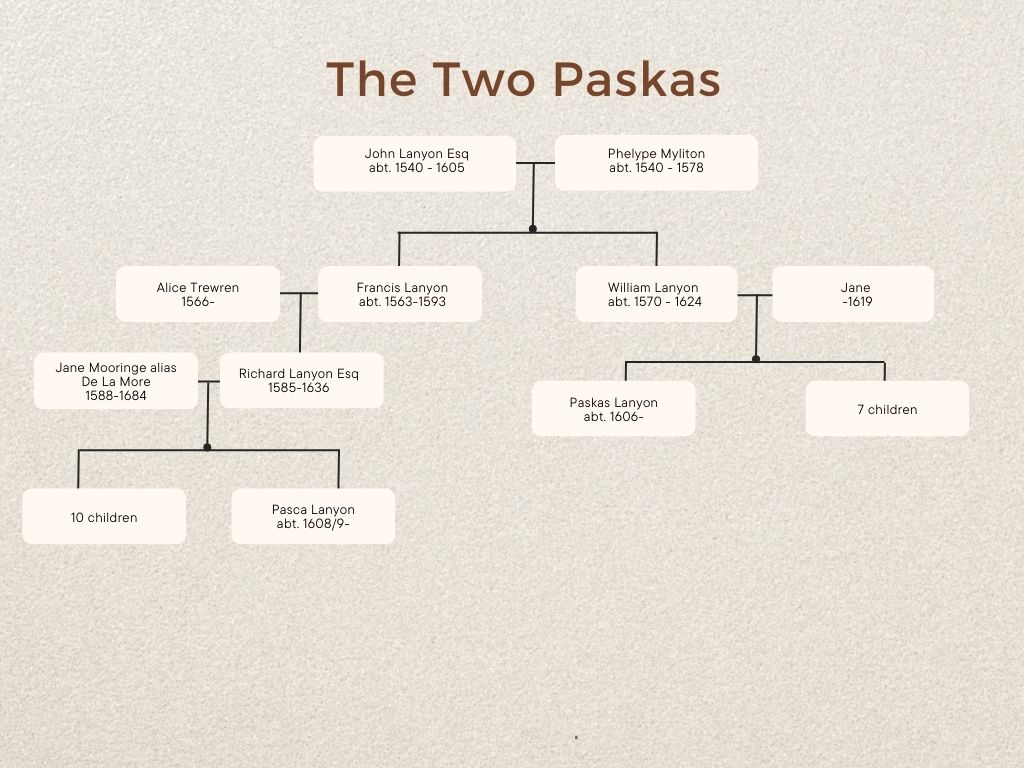
The only problem is that there is a second Paskas who is also a candidate.
Richard Lanyon Esq’s uncle William has a daughter also called Paskas.
William’s daughter’s baptism isn’t recorded but we know she existed from his will. Again we’ll have to list his other children and see where she could fit in:
Elizabeth baptised 31 Oct 1593 Sancreed
John baptised 8 Jun 1596 and buried 15 Sep 1601 at Sancreed
John born after Sep 1601
Jane baptised 24 Oct 1602 Sancreed
William baptised Dec 1603 Sancreed
Elyzabethe baptised 17 Jul 1607 Sancreed
Both daughters called Elizabeth survived and are mentioned in William’s will of 1624!
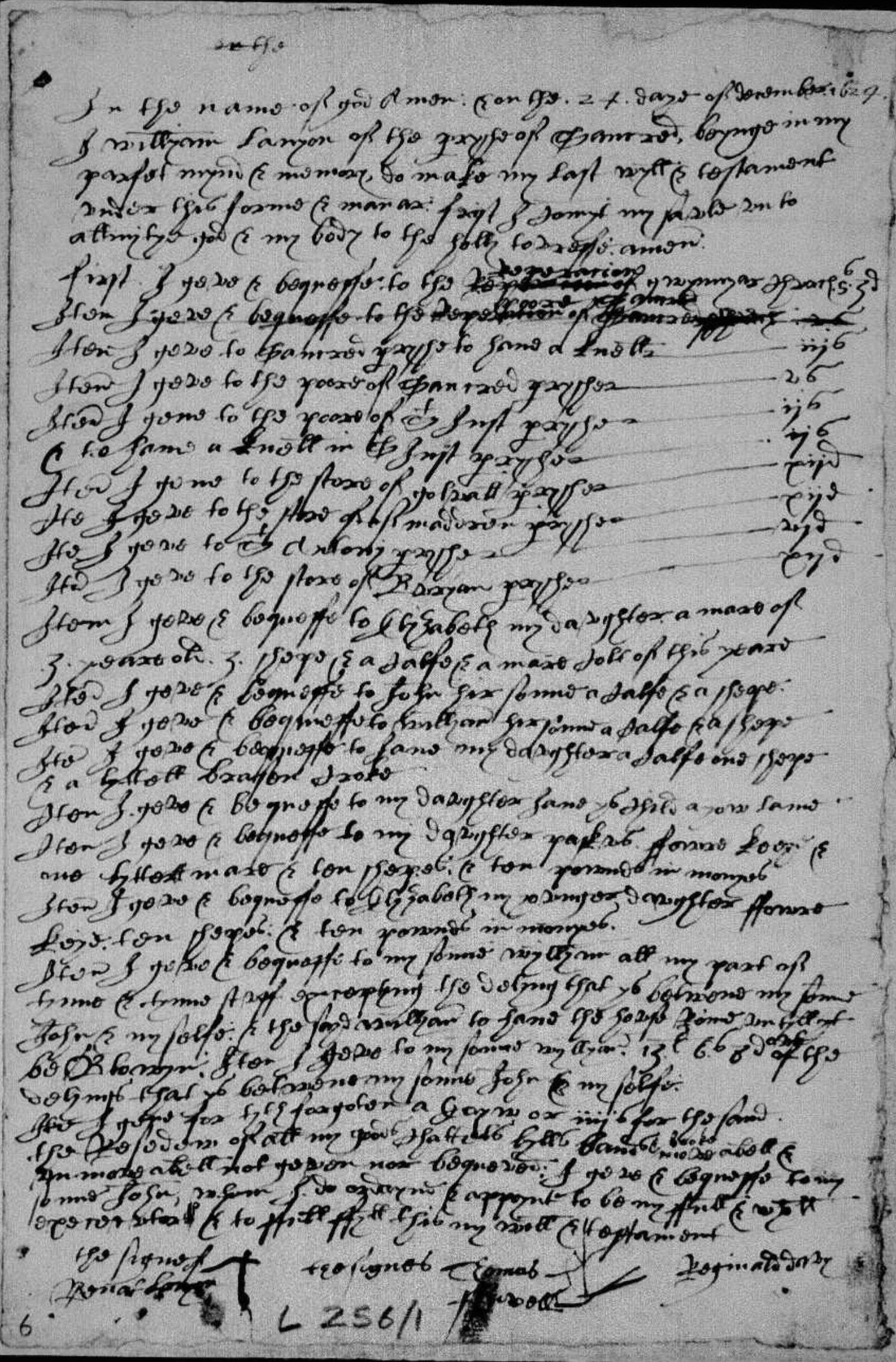
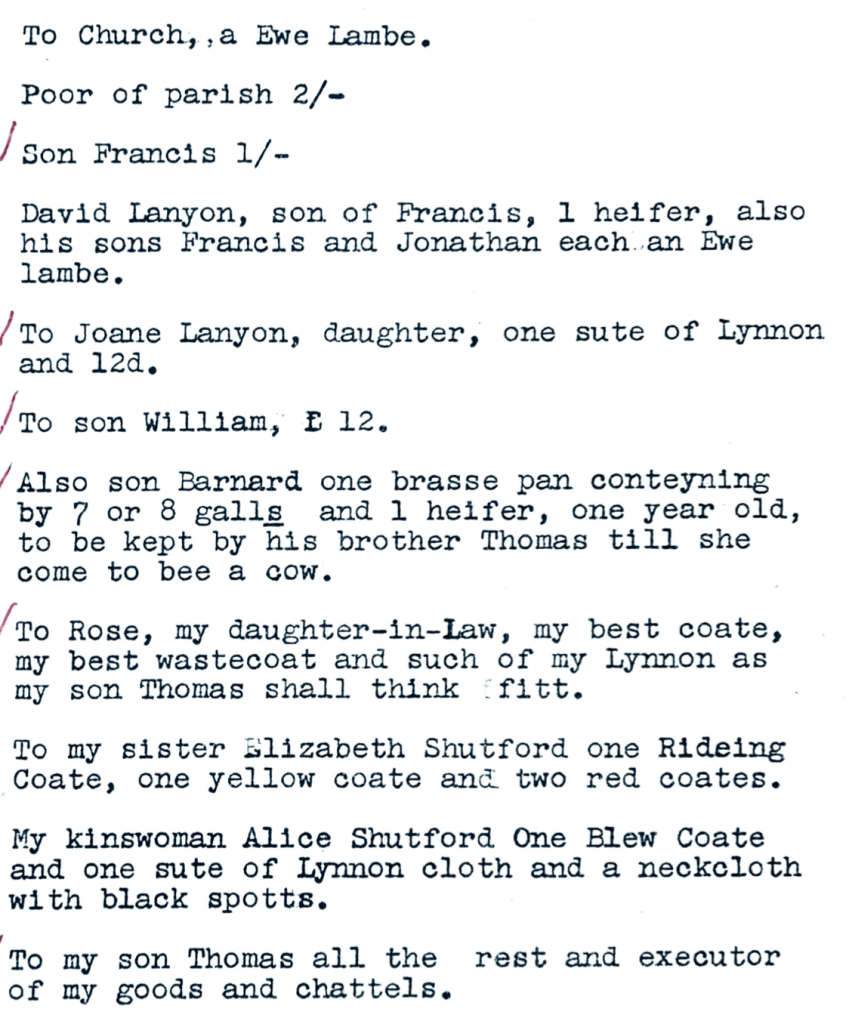
William’s Will of 1624 – Source CRO AP/L/256
Abstract:-
WILLIAM LANYON of Sancreed written: 24 Dec 1624 proved: 8 Feb 1624/5
poor of Sancreed – 3 sh. poor of St. Just – 5 sh. poor of Gulval – 12 d. poor of Maddern – 12 d. poor of Antony – 12 d. poor of Buryan – 12 d. daughter: ELIZABETH – mare, 3 sheep, calf, mare colt JOHN her son – calf & a sheep WILLIAM her son – calf & a sheep daughter: JANE – calf, 1 sheep, brazen crock daughter JANE’s child – a ewe lamb daughter: PASKAS – 4 kyne, mare, 10 sheep, 10 pounds youngest daughter: ELIZABETH – 4 kyne, 10 sheep, 10 pounds son: WILLIAM – all my part of tin and tin stuff, 13 pounds, 6 sh., 3 d. son: JOHN – all the rest & executor
The will implies that Paskas is younger than Jane and older than Elizabeth his youngest daughter which suggests that she was born between 1602 and 1607. So aged about 18-23 in 1625 when the marriage to Thomas Shetford took place.
It’s interesting that William leaves 5 shillings to the poor of St Just as that’s the town that Thomas Shetford comes from.
Who was Thomas Shetford?
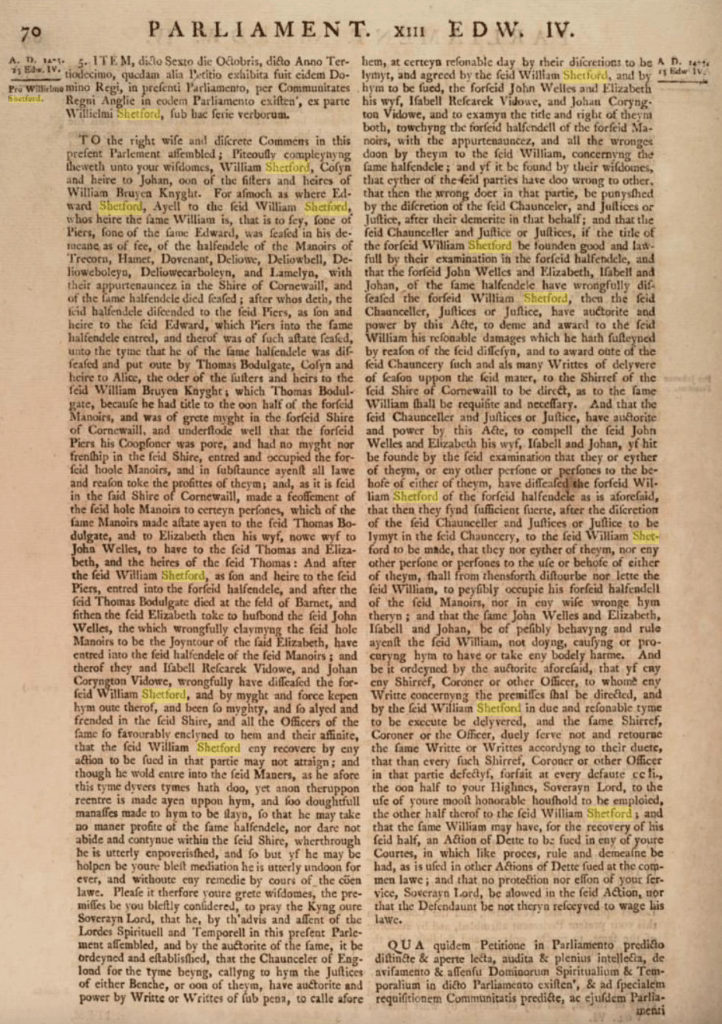
The Shetford/Shutford (and occasionally Shitford!) family originally came from Somerset. They were cheated out of a half share in six manors in Cornwall by Sir Thomas Bodulgate during the Wars of the Roses.
Source – History of Parliament Edward IV
We know very little about Thomas, the parish registers for St Just in Penwith start quite late but with the little we know we can create a tree that might be correct.
We know that Paskis Lanion married Thomas Shetford at St Just in Penwith in 1625 so he was probably born about 1600
There is a baptism for a Margarett Shetfod (Sic) daughter of Thomas on 14 Nov 1630 at St Just listed in the Exeter Bishop’s Transcripts
16 Oct 1647 marriage at St Just between Elizabeth Shetford (daughter of Thomas) and John Rawlyn (Source – OPC)
Baptism of Alse Shutford, daughter of Thomas 20 Dec 1633 St Just (Source- FHL film number 0226217, 0226218, 962681)
Burial of Paskes Shetford, widow 19 Dec 1681/2 St Just in Penwith (Source – OPC)
The will of Joan Lanyon (Shutford) 1655 (Source – NA PROB 11/257/72) Joan was the wife of David Lanyon of Madron and her will mentions her Shutford relatives
There is also a record at Kresen Kernow (The Cornish Record Office) which mentions Thomas and William Shilford.
Lease, tenement, Treloweth Wartha, Illogan
Parties:
1) Right Honourable John Lord Robartes, Baron of Truro.
Term: 99 years, or the natural lives of [?] Lanyon, John Lanyon his brother and William Shilford, son of Thomas Shilford.
Annual rent: 46 shillings 8 pence, one capon or 12 pence, a harvest day or 6 pence.
Heriot: Best beast or £3.
Reference number
CL/1/124
Date
3 Oct 1635
I think it should be William and Thomas Shitford/Shetford rather than Shilford. Could Thomas have a son called William and could these Lanyons be Paskas’ brothers?
The Paskas born in Sancreed had brothers called John and William. ‘William Lanyon Yeoman of St Just’ listed in the lease is definitely not the St Merryn family of Lanyons.
There is a marriage of a William Shetford and Mary Edward at St Just on 26 Nov 1653, they had two daughters: Rebecea (sic) bapt. 1655 and Ellizabeth (sic) bapt. 1657.
There is a legal dispute between John Lanyon and William Shutford in 1659, the year Thomas Shutford died. Source – NA C 10/48/84
Lanyon v Shutford.
Plaintiffs: John Lanyon. Defendants: William Shutford, James Pratt and Robert Baynard. Subject: property in Sancreed, Cornwall.
This is the hypothetical tree I’ve created from all those snippets of information.
We still haven’t conclusively answered the question which Paskis Lanion married Thomas Shutford in 1625 but I think the Paskas born to William Lanyon of Sancreed is the more likely candidate.
William Lanyon died in 1624 (his wife had died in 1619) and left Paskas £10 and some cattle. The following year she married Thomas from the neighbouring parish of St Just in Penwith.
Ultimately geography may be the best clue, the distance between St Just and Sancreed (near Penzance) is a lot smaller than the distance between St Just and St Merryn (near Padstow).
With thanks to Louise Quigley who first posed this question in 2014 and the Penwith Genealogy Group who produced some great answers and evidence.

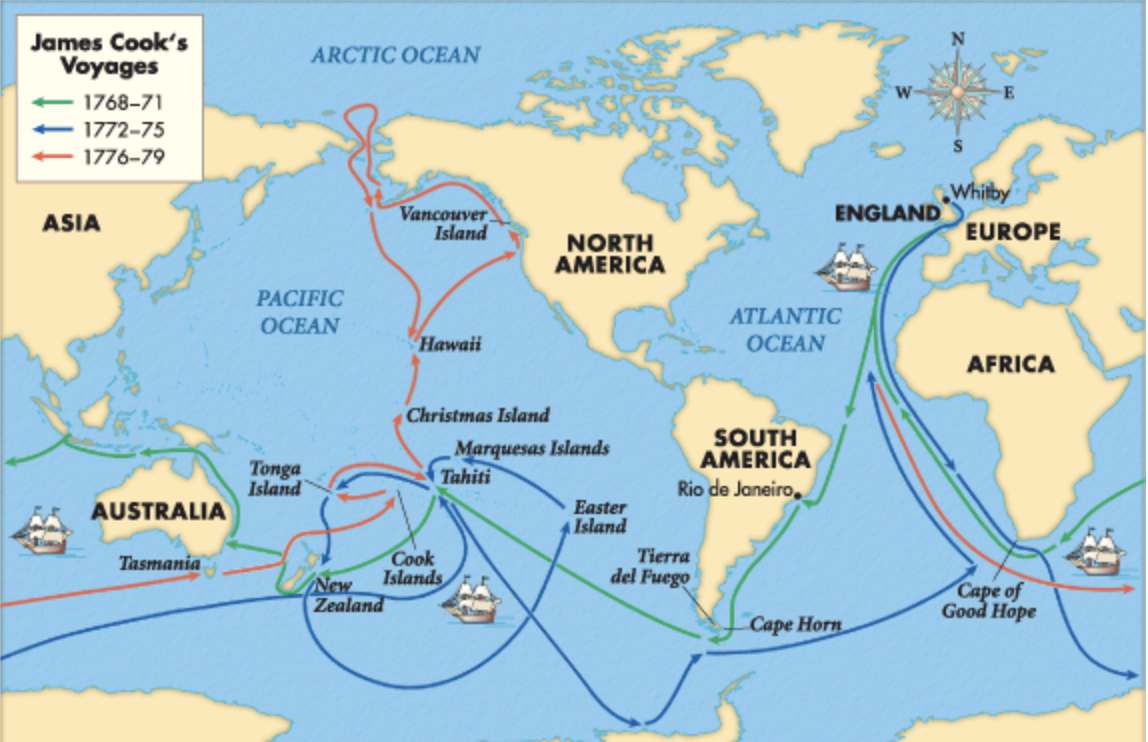
William Lanyon was a lieutenant in the Royal Navy and twice sailed with Captain James Cook.
Captain James Cook – Nathaniel Dance-Holland, Public domain, via Wikimedia Commons
William Lanyon joined the navy when he was about 15 years old. His first recorded service was as an Able Seaman on the Orford and then the Mars. He then served on HMS Jason as a midshipman. He moved onto HMS Terrible. In 1772 he joined HMS Adventure one of the companion ships on Cook’s second voyage. In 1773 he was promoted to Master’s Mate.
He was promoted to Lieutenant in 1774 but when he was taken on for Cook’s third voyage he was a Master’s Mate again on HMS Resolution. He was eventually promoted to Second Lieutenant on HMS Discovery in 1779.
John Cleveley the younger (1747-1786) (style of) – HMS ‘Resolution’ and ‘Discovery’ in Tahiti – BHC1939 – Royal Museums Greenwich.jpg
He supposedly collected vocabularies of the South Pacific languages which were published in 1979 by Peter Lanyon-Orgill but there is some doubt as to their authenticity.
Cook’s three voyages
Between 1790 and 1796 he was in command of the Spider a cutter based at Plymouth. In 1799 he commanded the Kent. In November of that year he captured a French privateer the Four Brothers out of Calais. His last recorded command was of HMS Genereux a prison ship at Plymouth.
By 1814 he was retired and living at St Austell. He was buried there on 26 Mar 1818, the register states he was ‘paralytic’. His wife Jane had been buried at St Austell almost exactly a year earlier on 27 Mar 1817. They had no children.
So where does William fit on the tree?
‘A Genealogical & Heraldic History of the Commoners of Great Britain & Ireland enjoying Territorial Possessions…..’ Vol IV by Burke. has the following entry in the index.
Lanyon, John, 36.
‘Jane b. in November 1765 m. to John Lanyon of Lanyon in Gwinear, grandfather of lieutenant William Lanyon R.N., well known for his various acts of heroism and benevolence in his profession, the last survivor of those gallant officers who accompanied Captain Cook in his voyages. Twice he circumnavigated the globe with that distinguished commander and was with him at the period of his melancholy end.’
The Jane referred to is Jane Willyams and Burke has transposed her date of birth from 1675 to 1765! Vivian’s ‘The Visitations of Cornwall: Comprising the Heralds’ Visitations of 1530, 1573 & 1620‘ prints the family tree of the Willyams family and shows the correct date.
Visitations of Cornwall -Willyams Family
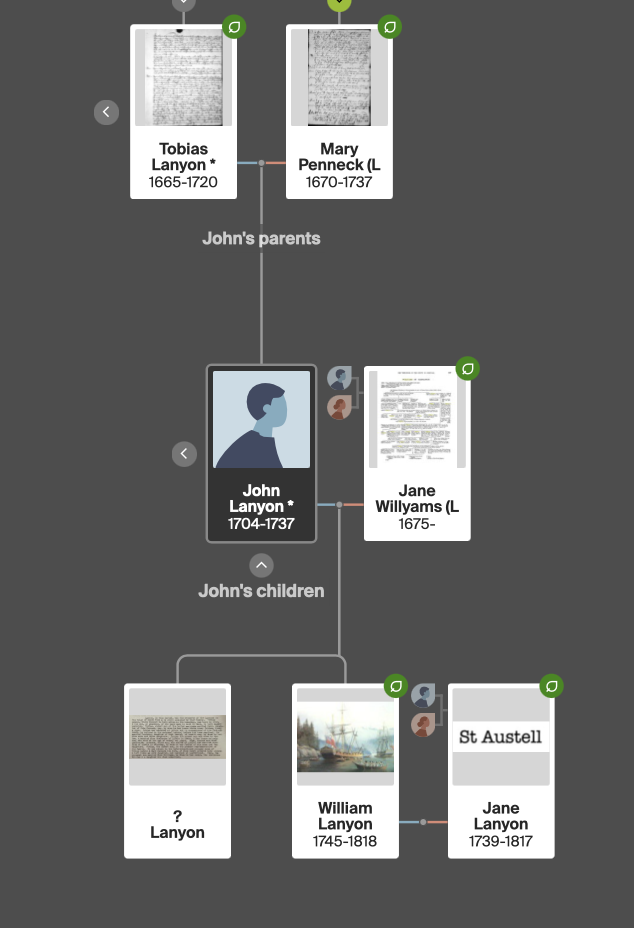
Jane is shown as the daughter of Humphry Willyams of Roseworthy and Dorothy Addington of Devon. Jane was baptised 11 Nov 1675 at Gwinear and married John Lanyon of Lanyon Gwinear.
So who is John Lanyon of Lanyon Gwinear?
Assuming John was a similar age to Jane we are looking for a John born in the 1670s who lived at Lanyon Manor in Gwinear. This would probably be a child of Tobias Lanyon and Susannah Reynolds but they don’t have a child called John and don’t mention a son of that name in their wills. Tobias and Susannah’s son Tobias does have a son called John however he must have been born after 1703 and would be at least twenty-eight years younger than Jane Willyams!
We need to go back and look at the information we have for William Lanyon. There is a note on his Lieutenant’s certificate dated 29 July 1774 which says ‘we have examined Mr. William Lanyon who by certificate appears to be more than 28 years of age and find he has gone to sea more than six years….’ (Captain John Campbell and Captain Abraham North). This implies that William must have been born before 1746.
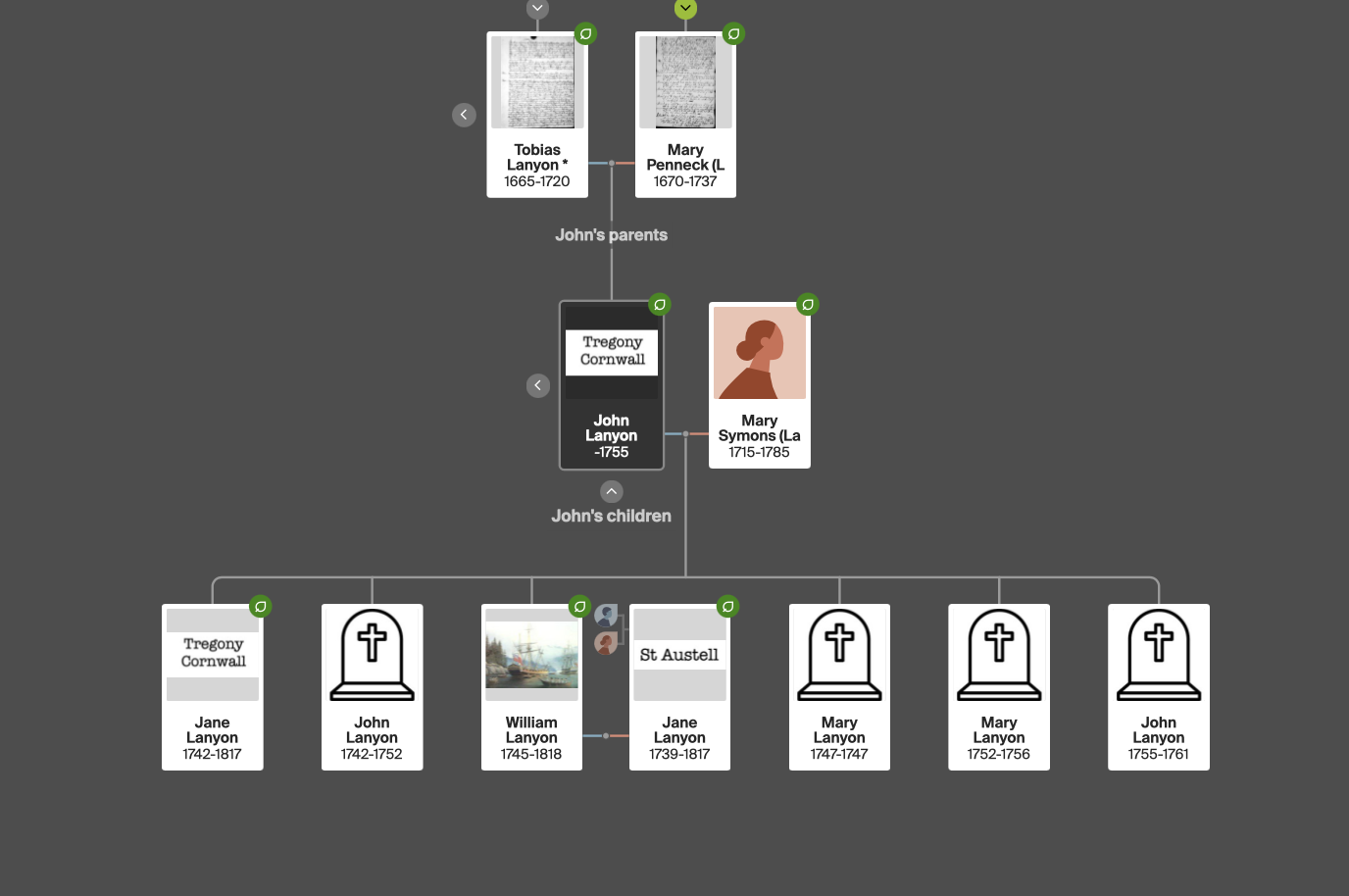
There is a baptism of William Lanyon son of Mr. John Lanyon and Mary on 2 Apr 1745 at Cuby with Tregony. They have three other children baptised there: Mary 1747, Mary 1752 and John 1755. Of their children, only William survived to adulthood.
There is a marriage between a Mr. John Lanyon and Mrs. Mary Symons at Creed in Cornwall (not far from Cuby with Tregony) on 3 Jan 1742. There is a Mary Symons baptised at Creed in 1715, the daughter of William Symons. We can’t prove it is the same person.
There is a John Lanyon son of Tobias Lanyon, deceased who is apprenticed to Philip Webber of Falmouth, Attorney at Law on 25 Sep 1722 for £52. 10/-
Proposed tree for William Lanyon
Possible tree but Jane would be far too old to give birth to William in 1745. Perhaps John & Jane had a son called John Lanyon who married Mary Symons?
The Jane Lanyon that William married appears to be the daughter of Tobias and Prudence Pawley.
John Lanyon left a will which might have helped clarify this part of the tree but it has been lost!
The Admiralty Record Office wrote to Captian Wingfield D.S.O., R.N., D.G.W. on 17 Feb 1959 and confirmed that:
William was born in 1745
Enlisted Sep 1760
Appointed lieutenant Aug 1779
Retired on half pay plus pension from Greenwich Hospital
Superannuated Commander 1814
Served on Spider 1790-1795, Kent 1795-1799, Matilda 1800-1804 and Genereux 1805-1806
Served on HMS Nelson & Resistance under Captain Cook on the voyages of discovery
The Will of William Lanyon proven on 15 May 1818 (PROB 11/1604). This is the last Will and Testament of me William Lanyon of the Parish of Saint Austell in the County of Cornwall, Esquire, Commander in the Royal Navy.
I give, devise and bequeath all that my Leasehold Dwelling House situate in the said Parish of Saint Austell in which I now reside with the Garden Courtlage and Appurtenances thereunto belonging unto Tobias Lanyon of Camborne in the said County, Surgeon, his Exors, Admors, and Assigns, for and during all the Estate and Interest which I shall have therein at the time of my decease, to and for his and their own absolute use and benefit, subject to the rent and other reservations payable by or under the Indenture of Lease by virtue of which I am intitled to hold the same.
I give and bequeath unto my Niece, Frances the Wife of Thomas Penna, all and singular my Household Furniture, Plate, Linen and China whatsoever which I may be possessed of at the time of my decease (except the Bed and Bedding hereinafter bequeathed to my Servant Mary Eplett) and I do will and direct that my Executors hereinafter named do and shall release and discharge the said Thomas Penna of and from all sum and sums of money which he may be indebted to me at the time of my decease, and particularly of and from the Sum of Two Hundred Pounds which I advanced him on a note of hand bearing date the 16th day of May last, which Note of Hand I hereby direct shall be given up to the said Thomas Penna.
I give and bequeath to my Servant Mary Eplett, if she shall be living with me at the time of my decease, over and above what may be due to her for wages, the sum of twenty pounds to be paid to her within six Months after my decease. Also I give to the said Mary Eplett the Bed and Bedding in the Garret on which she usually sleeps.
And as for and concerning all and singular other the property, Stocks, Funds, Money and Effects which I shall be possessed of or intitled to, or over which I shall have a disposing power at the time of my decease, of what nature or kind soever the same may be, I give, devise and bequeath the same and every of them unto the said Tobias Lanyon and John Carne of the said Parish of Saint Austell, Gentlemen, their Heirs, Exors & Admors upon the Trusts and to and for the several ends, intents and purposes hereinafter declared of or concerning the same, that is to say, upon Trust in the first place that they, my said Trustees, do and shall thereout with all convenient speed after my decease pay, discharge and satisfy all my just Debts and my Funeral and Testamentary Expences and the aforesaid Legacy of twenty pounds, and do and shall in the next place lay out and invest such of my Monies as shall not be already invested in the Stocks in the purchase of Parliamentary Stocks or Funds of Great Britain in the names of them my said Trustees, or the Survivor of them, his Exors or Admors and do and shall stand and be possessed of all such Stocks, Funds and Securities In Trust that they my said Trustees or the survivor of them, his Exors, or Admors do and shall pay the following Legacies (that is to say):
unto my Nephew Edward Lanyon (Son of the late William Lanyon of Surry) the sum of Eighty Pounds of lawful Money of Great Britain and my watch, unto my Nephew William Lanyon (Son of the said William Lanyon of Surry) the Sum of One hundred pounds of like lawful Money and my Sleeve buttons, unto my Niece Jane Lanyon, (Daughter of the said Willian Lanyon of Surry) the Sum of One hundred pounds of like lawful Money, unto my Nephew Richard Lanyon (Son of the said William Lanyon of Surry) the Sum of One hundred pounds of like lawful Money, unto my Nephew Henry Lanyon (Son of the said William Lanyon of Surry) the Sum of Fifty pounds of like lawful Money unto my Nephew James Lanyon (Son of the said William Lanyon of Surry) the Sum of Fifty pounds of like lawful Money, unto my Niece Elizabeth Lanyon (Daughter of the said William Lanyon of Surry) the Sum of Eighty Pounds of like lawful money, and unto my Nephew Joseph Lanyon (Son of the said Willaim Lanyon of Surry) the Sum of Fifty pounds of like lawful Money,
such several Legacies to be paid to such of my said Nephews and Nieces respectively as shall have attained the age of twenty one years immediately after my decease, and to such of my said Nephews and Nieces as shall be under that age, as and when they shall severally attain the age of twenty one years,
and my mind and will is and I hereby direct that it shall and may be Lawful to and for my said Trustees to receive the Dividends and Proceeds of such of the said Legacies as shall not be payable at the time of my decease by reason of the Legatees being under the age of twenty one years and do and shall lay out and invest the same in the purchase of the like Stock there to accumulate to and for the use and benefit of such last mentioned Legatees which accumulations shall be paid to them with their original Legacies as and when they shall severally attain the age of twenty one years, Provided always that it shall be lawful to and for my said Trustees to apply so much of the Dividends arising from any such Legacy as they shall think proper in and towards the education of the Person intitled thereto, and I direct that the Residue of my Property after payment of the before mentioned Legacies and the expences incident thereto shall be divided equally between and among my said last named eight Nephews and Nieces, to be paid to them at the time the youngest of them shall attain the age of Twenty one years, provided always that if any of my said Nephews or Nieces shall happen to die under the age of Twenty one years then it is my will and meaning and I do hereby direct that the Legacy and accumulation or Legacies and accumulations of him, her or them so dying shall go and accrue to the Survivors or such nephews and Nieces or Nephew and Niece as shall not have attained the age of twenty one years at the time of the death of such Nephew and Niece so happening to die, to be equally divided between them and to be vested, paid and payable to them at such age and in such manner as their original legacies are hereinbefore directed to be paid, Provided also and I do hereby further declare and direct that it shall be lawful for my said Trustees at any time and from time to time when and as often as they shall think fit or adviseable to sell, transfer and dispose of or vary all or any of the Funds or Stock wherein the said Trust monies shall at any time be invested and to lay out and invest the money to arise by any such sale, transfer or disposition in the purchase of other or the same or like Stocks or Funds in the joint names of them my said Trustees, and all such new or other Stocks and Funds shall stand and be in the names of such Trustees and the Dividends and annual produce thereof and of every part thereof respectively shall be applicable and applied upon and for such and the same Trusts, end, intents and purposes as the original Stocks and Funds and the Dividends thereof were subject and applicable to at the time of such Sale, Transfer, Disposition or variance thereof.
And lastly I nominate, constitute and appoint the said Tobias Lanyon and John Carne Execuitors of this my Will hereby revoking all former Wills by me made. In Witness whereof I have hereunto set my hand and Seal this eighth day of July in the year of our Lord One thousand Eight hundred and Seventeen – Wm Lanyon.Signed and sealed by the said Testator William Lanyon and by him publiched and declared as and for his last Will and Testament in the presence of us who in his presence at his request and in the presence of each other have hereunto subscribed our Names as Witnesses John Cary Maria Cary.
Proved at London 15 May 1818 before the Judge by the Oaths of Tobias Lanyon and John Carne the Executors to whom Admon. was granted being first sworn by Comm. Duly to Adminr.
Source NA/PROB/11/1604/220
(William Lanyon of Surrey is Tobias and Prudence’s son William born in 1741.)
We can’t prove that William Lanyon RN is the son of John and Mary Lanyon but it seems the most likely explanation.
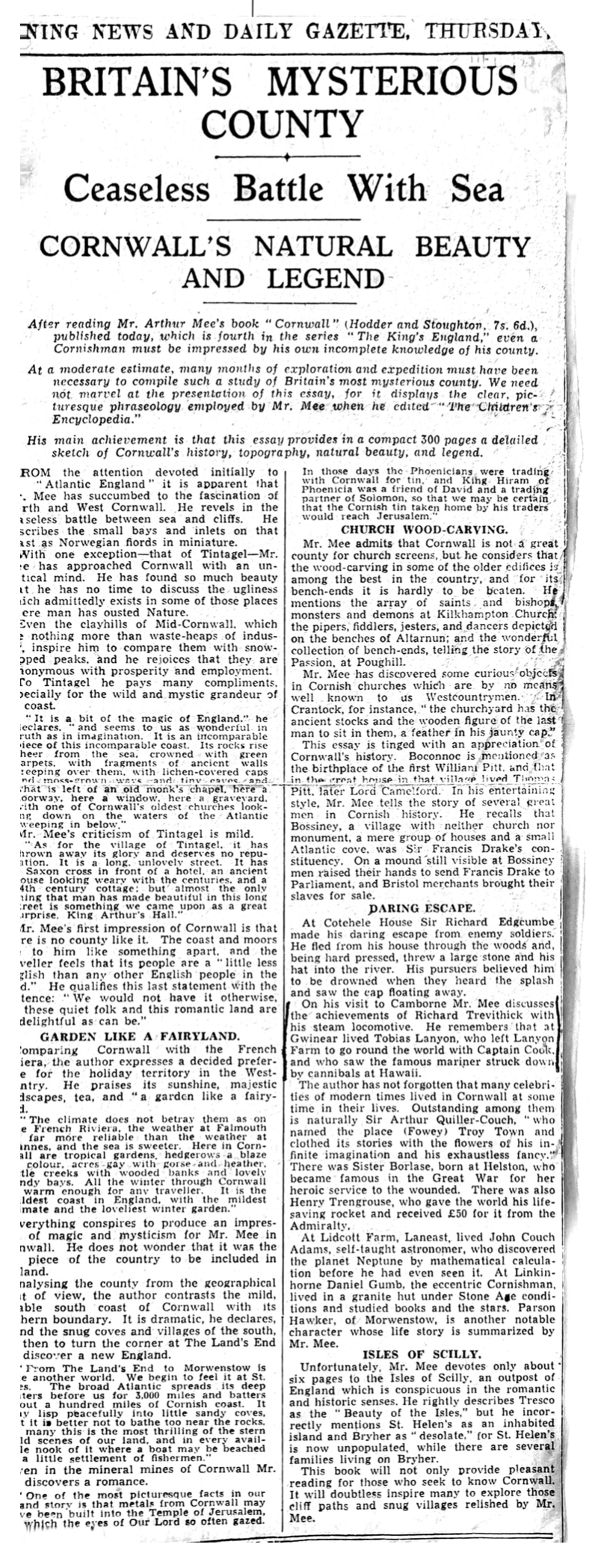
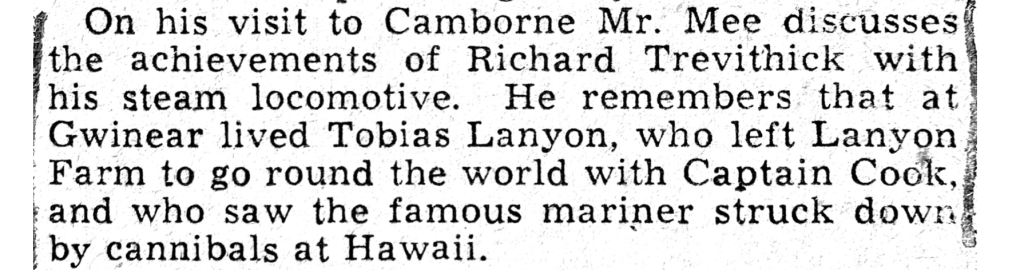
To add to the confusion there is a newspaper cutting that further muddies the water by naming Tobias as the person who sailed with Cook!
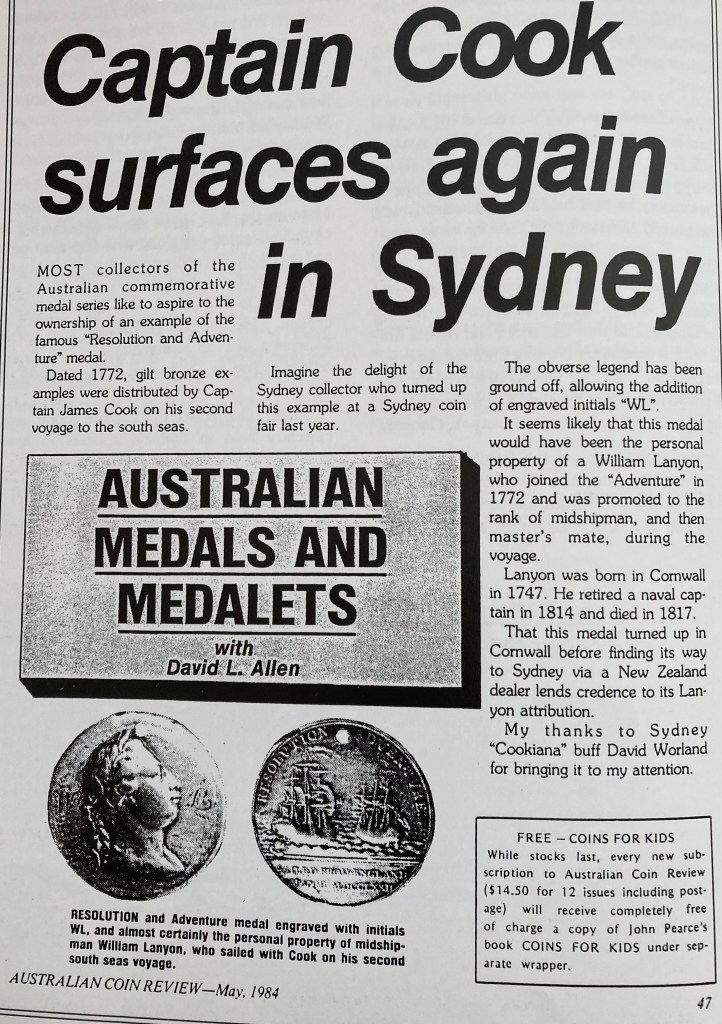
It’s a valuable lesson on the accuracy of documents!
And finally another article where the dates aren’t quite right, is it any wonder that genealogists make mistakes?
Francis was the son of Francis and Rosamon Lanyon of Penzance, he was born about 1653. When his grandmother died in 1655 she left him a ewe in her will.
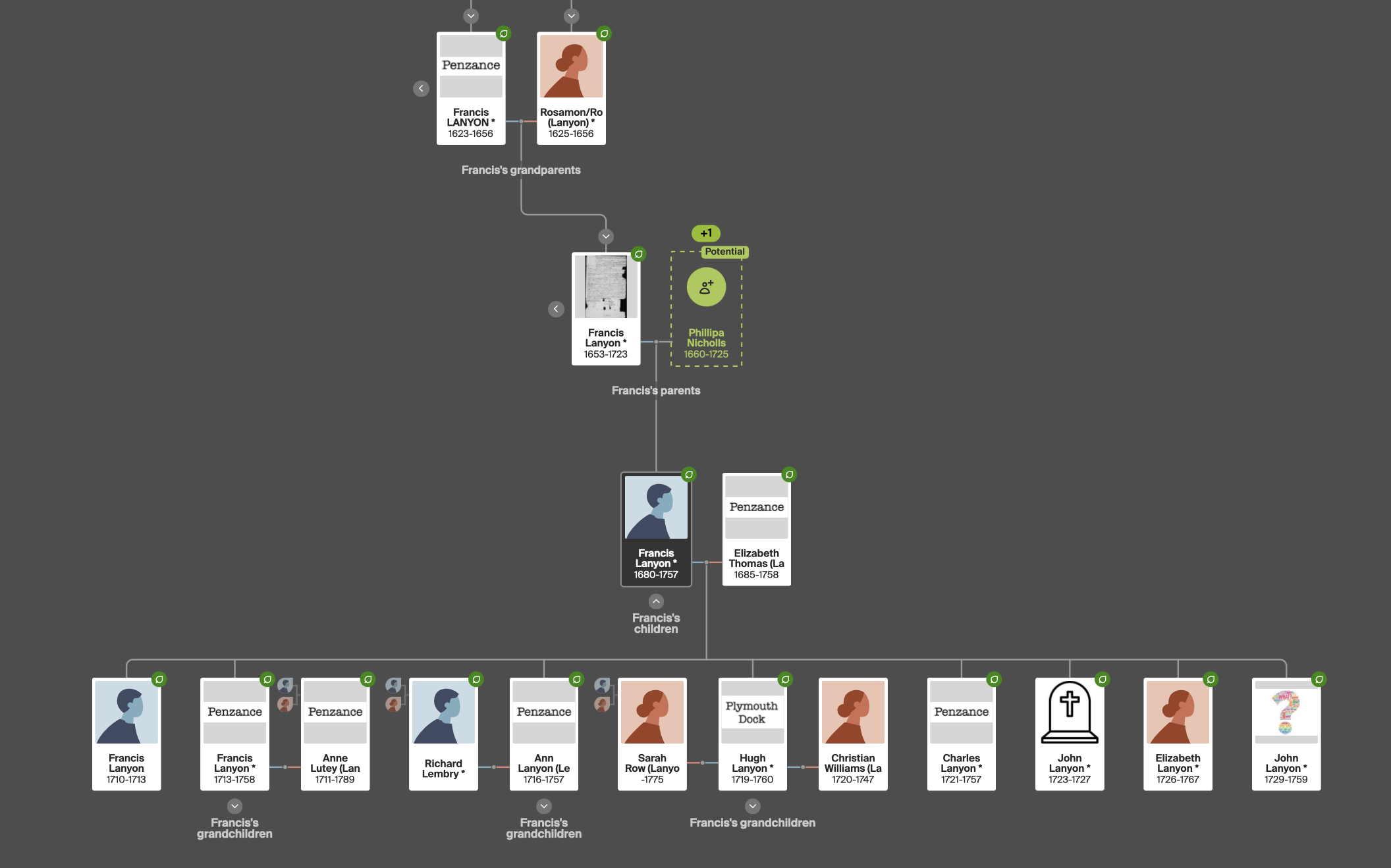
Francis’ branch of the tree
We don’t know the name of Francis’ wife, their marriage wasn’t recorded but he did have a son also called Francis in 1680.
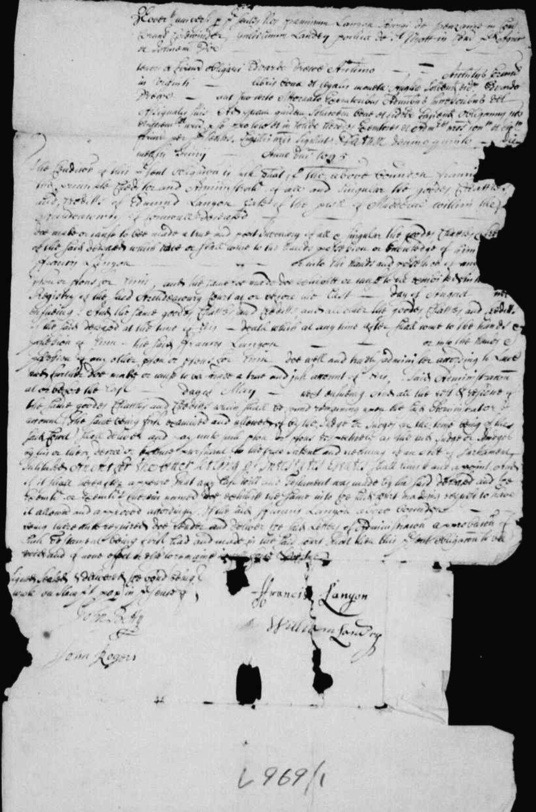
Like his father, Francis was a cordwainer in Penzance. In 1695 he is mentioned as the principal creditor of Edmund Lanyon who died whilst aboard HMS Weymouth.
Edmund Lanyon’s administration AP/L/969 signed by Francis and William Landry
We don’t know where Edmund fits on the Lanyon tree as there are many gaps in the records.
Francis Lanyon abt. 1680-1757
Francis was the only son of Francis Lanyon. His baptism was not recorded but he was probably born about 1680. He married Elizabeth Thomas at Madron in 1708. They had seven children:
Francis 1713-1758 married Anne Lutey
Ann 1716-1757 married Richard Lembry – one daughter
Hugh 1719- aft.1759
Charles 1721-1757 bachelor, no children
John 1723-1727 died in infancy
Elizabeth 1726-aft. 1759 no further trace
John 1729-aft. 1759 living abroad- no further trace
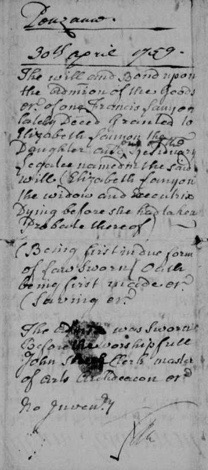
So many in this family died in such a short time period that there was probably some sort of epidemic in Penzance. Francis senior died in April 1757, in November Ann & Charles both died. Jan 1758 Elizabeth senior died and in June 1758 Francis junior died. In 1757 there was a smallpox outbreak which may have reached Cornwall and also epidemics of measles and scarlatina and in 1758 an influenza epidemic. Perhaps one or a combination of illnesses affected this family. Daughter Elizabeth had to administer her father’s estate as the widow and heir had both died.
Source AP/L/1652
In 1754 Vesuvius erupted and that caused poor weather and sickness in subsequent years. The 1750s seems to have been a time of natural disasters and disease. Gangrenous sore throat and Angina Maligna (an obsolete term for: Acute necrotising ulcerative gingivitis; Diphtheria; Pseudomembranous pharyngitis) are described as being ‘very fatal’.
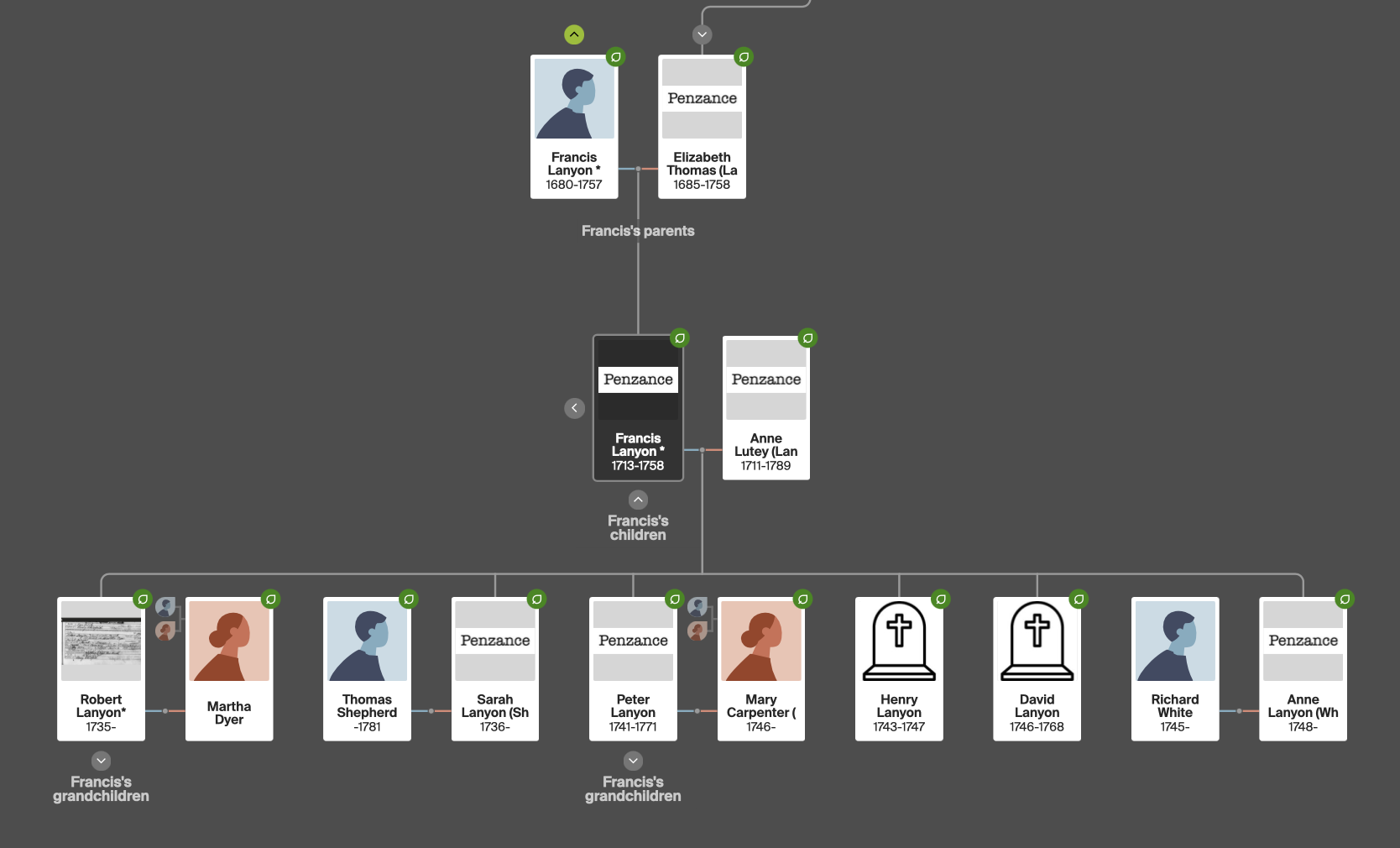
Francis married Anne Lutey in 1734 at Madron. They had six children.
Francis & Anne’s tree
Robert 1735-
Sarah 1736- in 1767 she married Thomas Shepherd, a hatter, they had three children.
Peter 1741-1771
Henry 1743-1747 died in infancy
David 1746-1768 unmarried
Anne 1748- married Richard White no children traced
Hugh Lanyon 1719- aft.1759
Hugh was baptised at Madron in 1719 and he married Christian Williams at Madron in 1740. There are no children from this marriage and she must have died before 1747 as Hugh married for a second time to Sarah Row at Charles the Martyr, Plymouth, Devon.
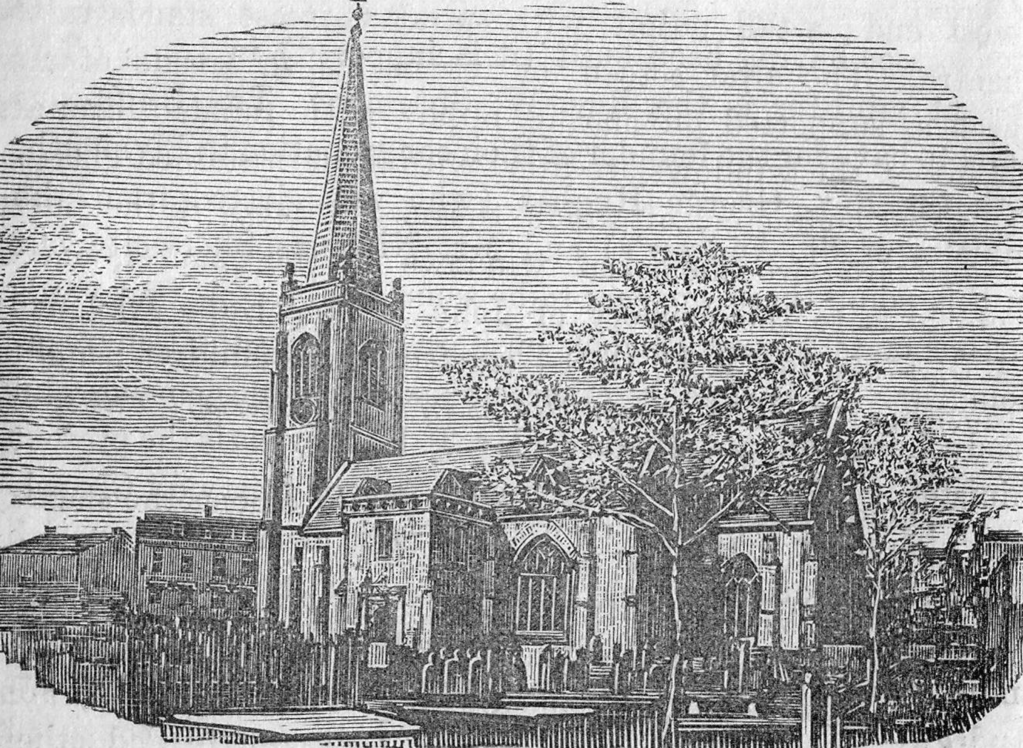
Plymouth – Charles the Martyr – bombed during the blitz
From Francis’ will of 1759 he mentions son Hugh and children now living at Plymouth Dock. There are three children traced.
Mary 1749-
Sarah 1752-59
Hugh 1757-1760
There are later marriages and burials of Lanyons at Plymouth but we can’t say if they are related to Hugh & Sarah.
Marriage register Plymouth Charles the Martyr 1747
Hugh was buried at Stoke Damerel on 17 Dec 1760.
Robert Lanyon 1735-
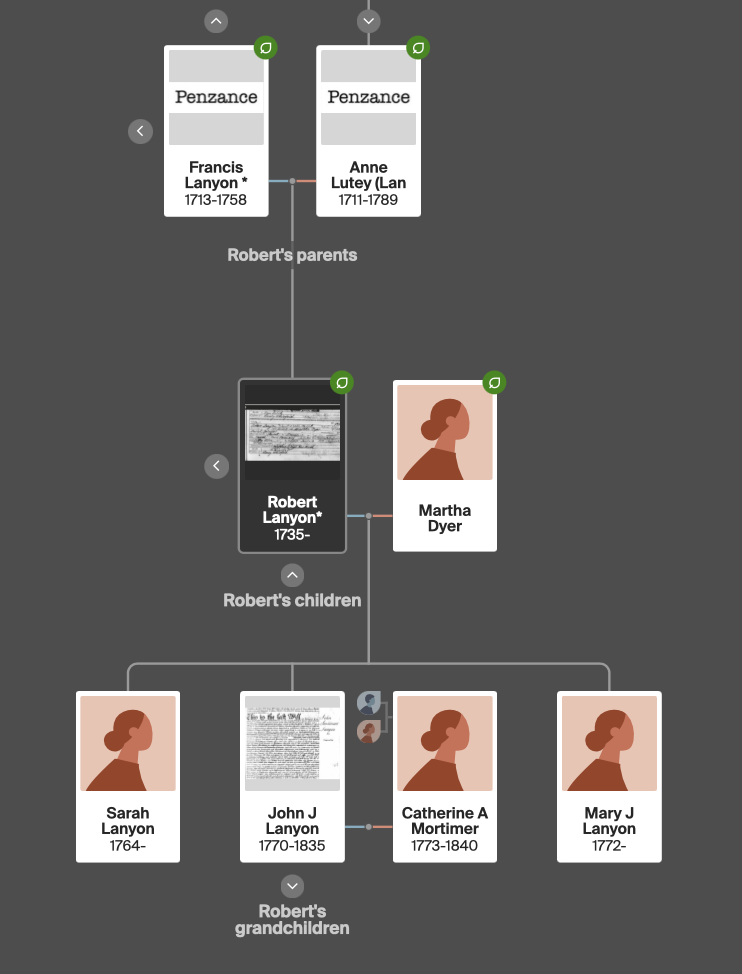
Francis and Anne Lutey’s son Robert was baptised at Madron in 1735 and in 1759 he married Martha Dyer at Plymouth St Andrew. Perhaps after his father’s death he went to join Uncle Hugh in Plymouth?
Robert & Martha’s tree
They had two documented children:
Sarah 1764- who married William Gains at Plymouth in 1784.
Mary Jensen 1772- no further trace
Possibly John Jenkinson Lanyon 1770-1835
Baptism register Plymouth St Andrew 1772
The researcher Jane Veale Mitchell believed that John Jenkinson Lanyon (see Irish branch) was the unrecorded son of Robert and Martha. The names Jensen and Jenkinson are both unusual and don’t appear anywhere else in the tree. John Jenkinson Lanyon used a ring with the Madron coat of arms to seal his letters so he must have had a connection to this branch of the tree somehow.
Peter Lanyon 1741-1771
In 1767 Robert’s brother Peter married Mary Carpenter at Madron. Peter was a cordwainer at Madron. They had three children
Peter & Mary’s tree
Peter 1768-1768 died in infancy
Elizabeth 1768- no further trace
Peter abt. 1769-1827
Peter senior died aged 30 and left Mary to raise the children.
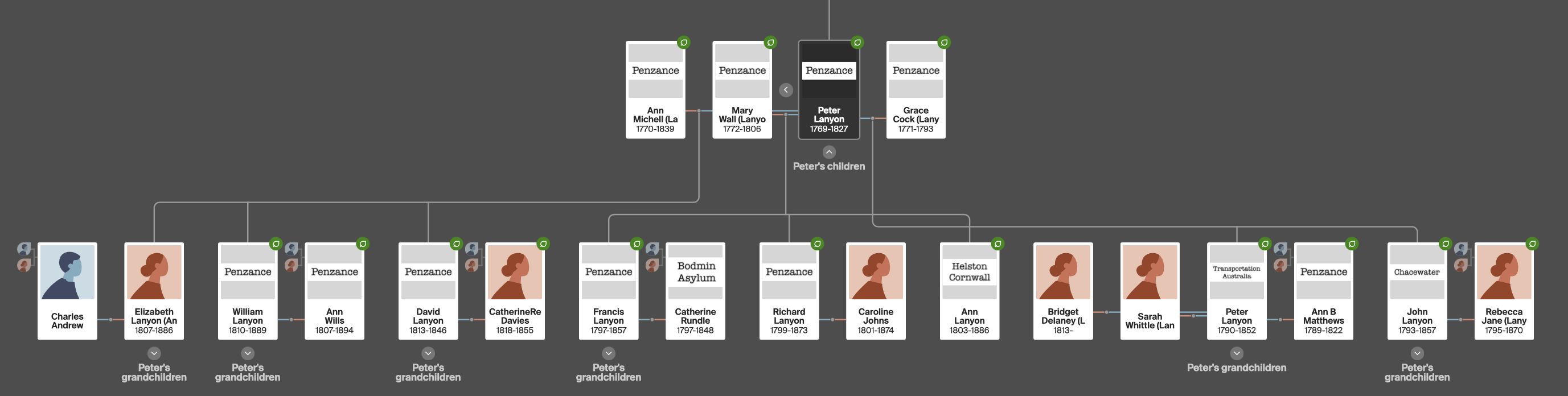
Peter Lanyon abt. 1769-1827
Peter’s tree
Peter, son of Peter and Mary Carpenter had three wives. He married for the first time at Madron in 1789 to Grace Cock (1771-1793). There were two children from this marriage.
Peter 1790-1852
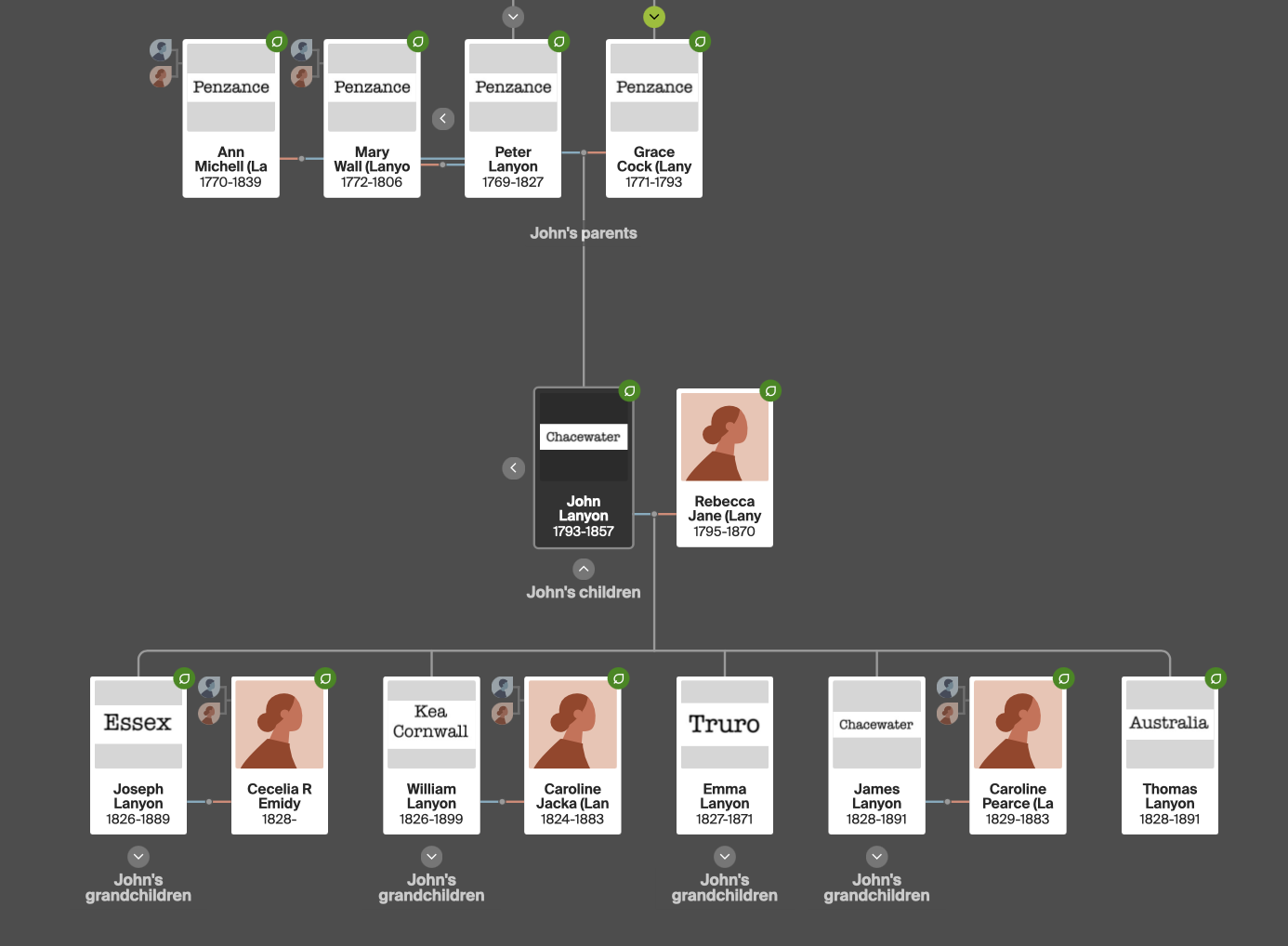
John 1793-1857
Grace may have died, possibly in childbirth, in 1793 as Peter remarried in 1795. His second marriage was to Mary Wall (1772-1806). This marriage produced three children.
Francis 1797-1857
Richard 1799-1973 was a grocer, he married Caroline Johns at Helston in 1822, no children
Ann 1803-1886 spinster died age 82
Mary died in 1806 and Peter married for a third time in 1807 to Ann Michell (1770-1839). They had three children.
Elizabeth 1807-1886 she married Charles Andrew at Madron in 1827 – six children
William 1810-1889
David 1813-1846 was a mason, he married Catherine Rebecca Davies in 1838 – one daughter died in infancy.
Peter was aged 58 when he was buried at Penzance in 1827. He had eight children and 26 grandchildren!
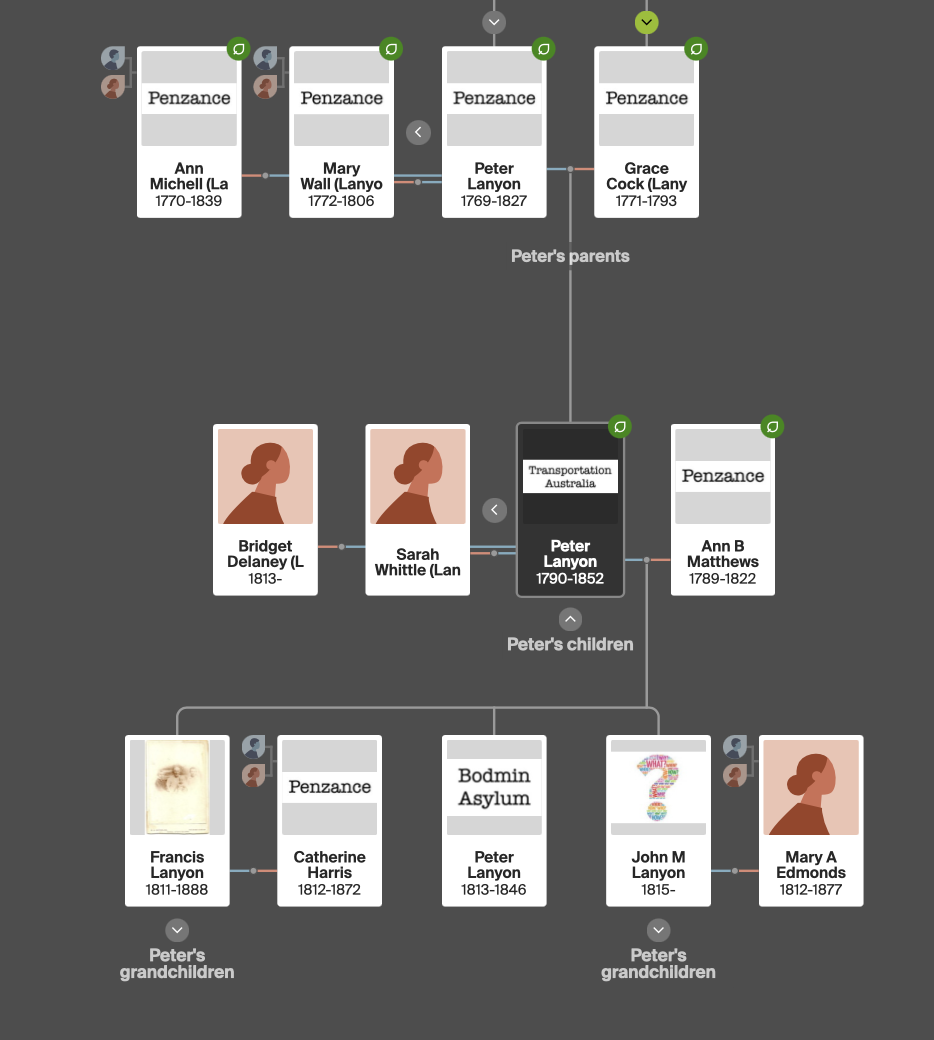
Peter Lanyon 1790-1852
Peter’s tree
Peter’s eldest son was also called Peter and like his father he too had three wives! In 1810 at the age of 20 he married Ann Barnicoat Matthews (1789-1822)
Francis 1811-1888
Peter 1813-1846 he was a mason who died in Bodmin Asylum a pauper with a ‘disease of the brain’
John Matthews 1815- John married Mary Addison Edmonds at Madron in 1836, they had one daughter Rebecca Addison 1838-1898 who married James Eva in 1855
A ‘disease of the brain’ could be anything from a disease to a head injury. Clearly it was serious as he died aged just 33.
UK Lunacy Patients Admission Registers 1846-1912
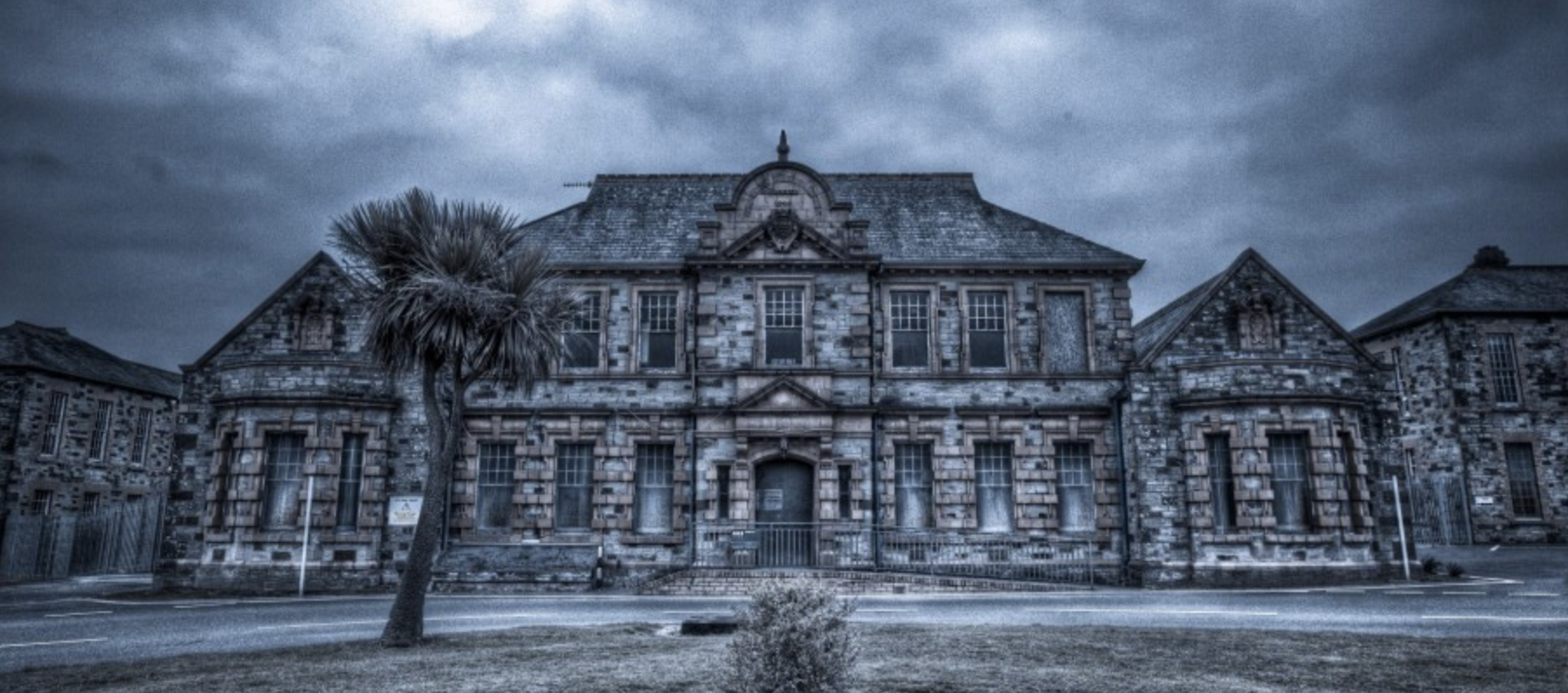
Bodmin Asylum is still a forbidding place today.
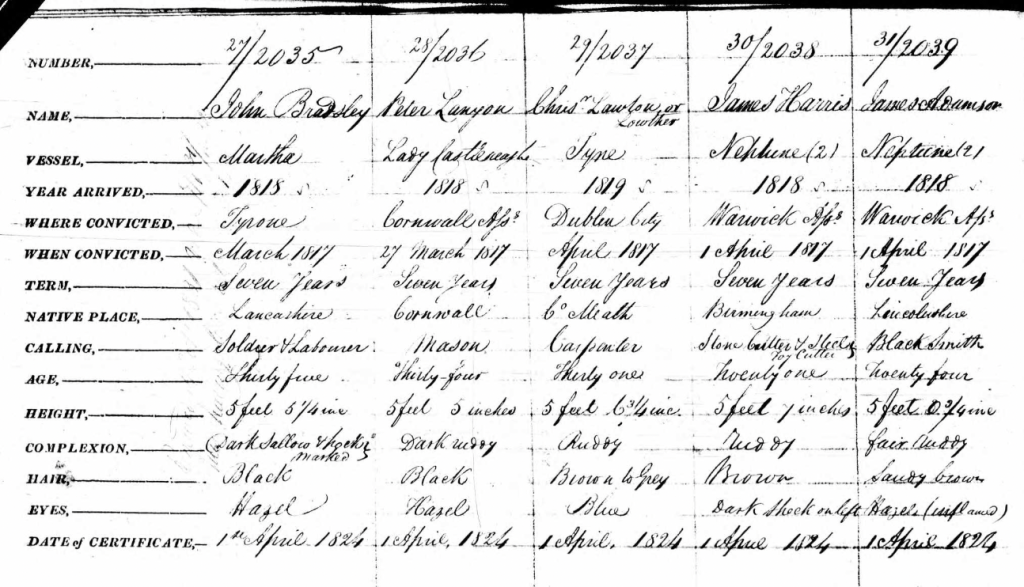
In 1817 Peter senior was convicted of larceny and sentenced to be transported for seven years. His wife and three young sons were left to fend for themselves. Peter arrived at Sydney, Australia on the ship Lady Castlereagh on 1 May 1818. He was described as 5’5″, dark complexion, dark hair and hazel eyes. He was a mason.
In 1824 he married Sarah Whittle at Parramatta NSW, Sarah must have died because in 1836 he requested and was granted permission to marry Bridget Delaney.
NSW Register of Convicts’ Applications to Marry 1826-51
Peter died in Australia in 1852, he never saw Cornwall or his Cornish children again.
John Lanyon 1793-1857
Peter’s brother John was a miner and in 1823 he married Rebecca Jane (1795-1870) at Kea in Cornwall. They had five children.
John & Rebecca’s tree
Joseph 1826-1889 he was a tin miner, he married Cecilia Rose Emidy in 1848. Cecilia had an illegitimate daughter Julia. Joseph had no children.
William 1826-1899
Emma abt. 1827-aft. 1871 was a tailoress who had two illegitimate children
James 1828-1891
Thomas 1828-1891 was a tin miner, he emigrated to Australia, no trace of any children
John died in 1857 at Chacewater. Chacewater was the centre of the mining world and there are a number of mines in the area. In the 1860s metal prices started falling and mining declined.
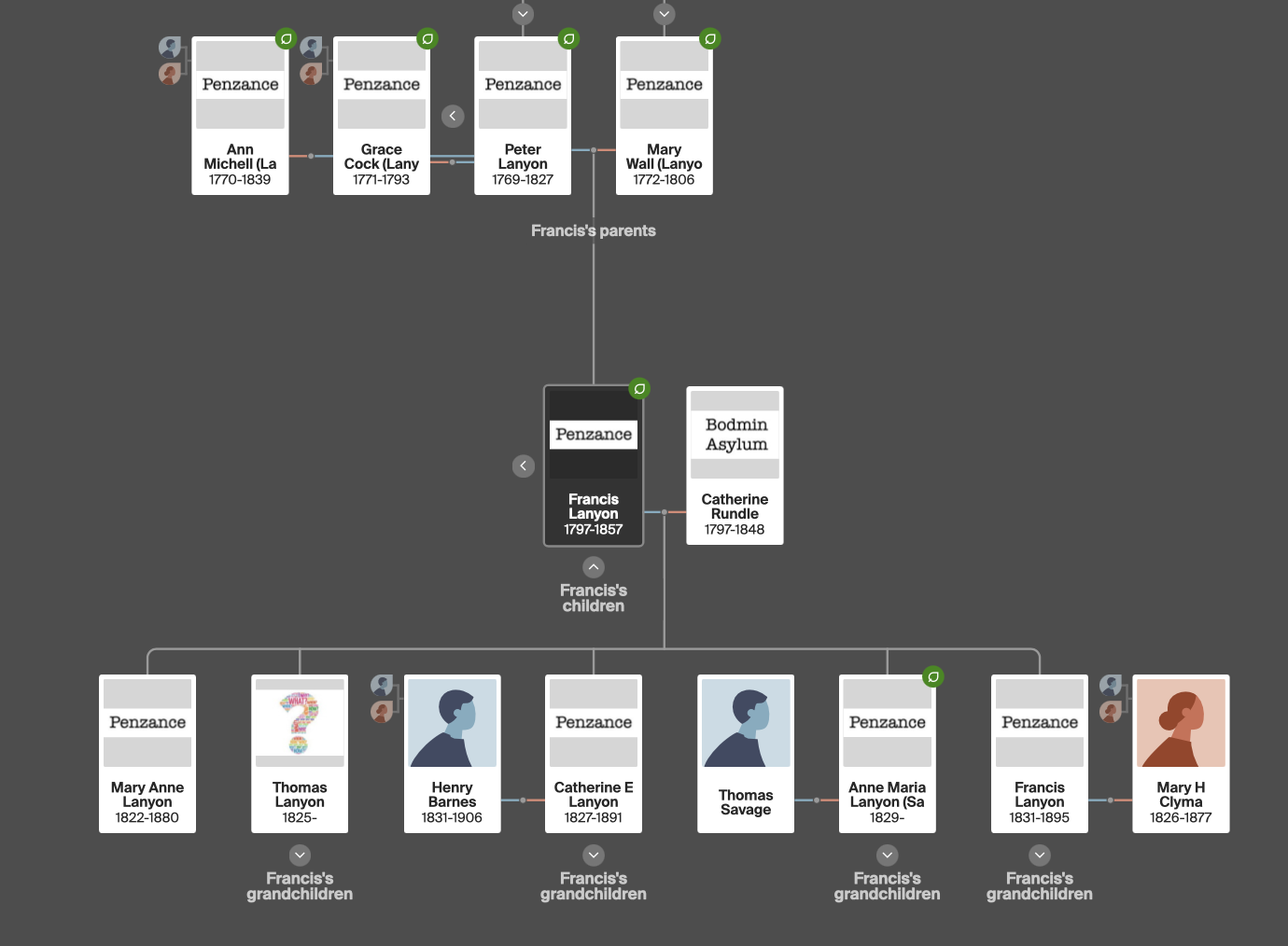
Peter and John’s half brother Francis was a cordwainer like his father. He married Catherine Rundle at Paul in 1822. They had five children.
Francis & Caroline’s tree
Mary Anne 1822-1880 – There is a Mary Anne Lanyon convicted of larceny which may be her
Thomas 1825- possibly married Mary Whear. Father of Milly 1860-1941 who married Edward Ladner in 1885. No further trace of Thomas.
Catherine Elizabeth 1827-1891 married Henry Barnes at Penzance in 1855 – five children
Anne Maria 1829- In 1858 she had an illegitimate son, Edwin who died in infancy. In 1859 she married Thomas Savage and they had one daughter, Mary Ann.
Francis 1831-1895
Shoemaker – Paul Renouard, Public domain, via Wikimedia Commons
William Lanyon 1810-1889
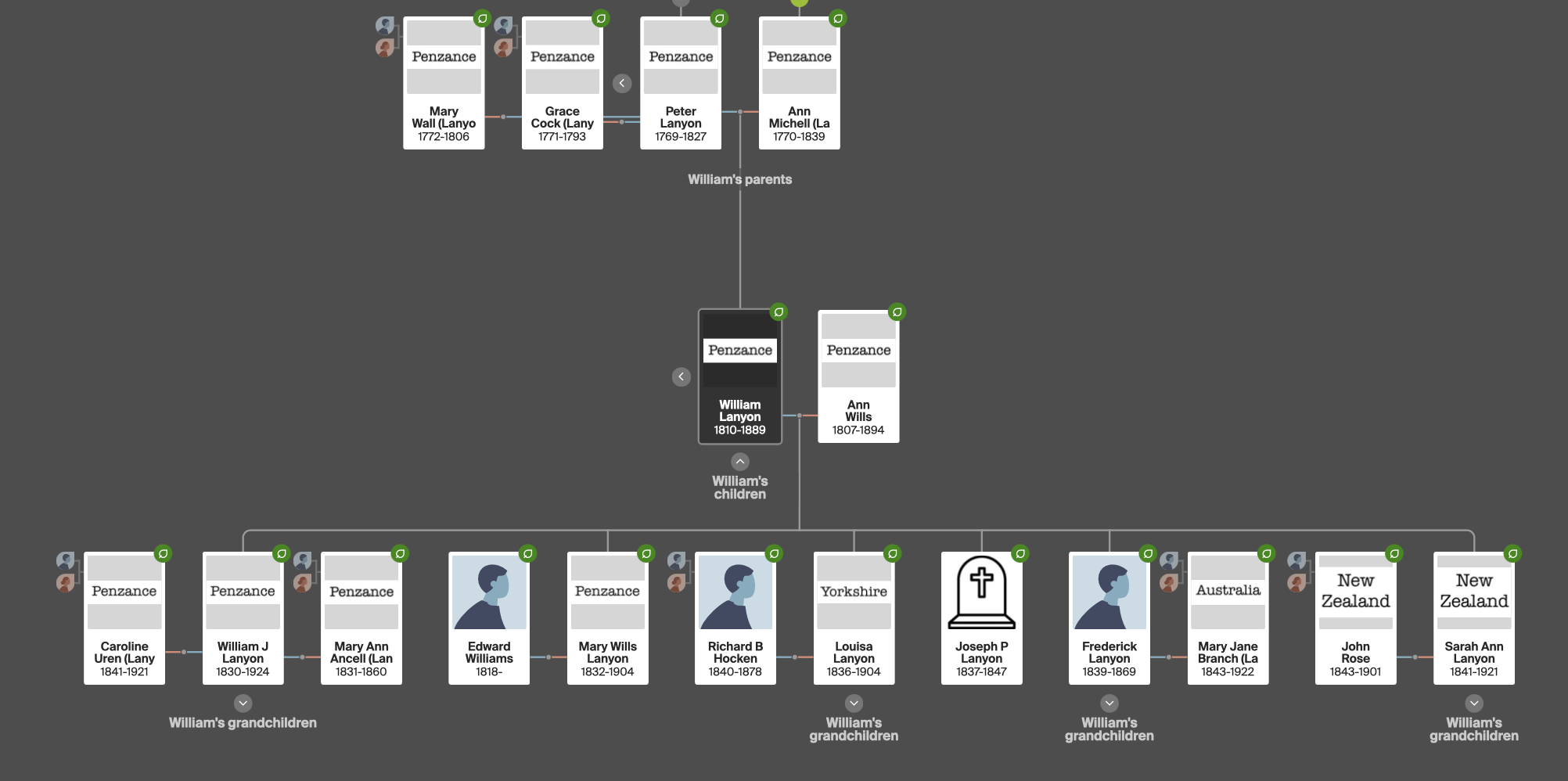
Peter, John, and Francis’ half brother William was born in 1810. He was described as a ‘poor shoemaker’ on admission to the dispensary in 1829. In 1830 he married Ann Wills at Madron. They had six children.
William & Ann’s tree
William James 1830-1924
Mary Wills 1832-1904 married Edward Williams – no children
Louisa 1836-1904 married Richard Baxter Hocken – five children and she died in Yorkshire.
Joseph Phillips 1837-1847 died young
Frederick 1839-1869
Sarah Ann 1841-1921 married John Rose – two daughters, emigrated to New Zealand
We’ll find out what happened to Peter’s grandsons in the post ‘Peter Lanyons Grandchildren and the Great Migration’.







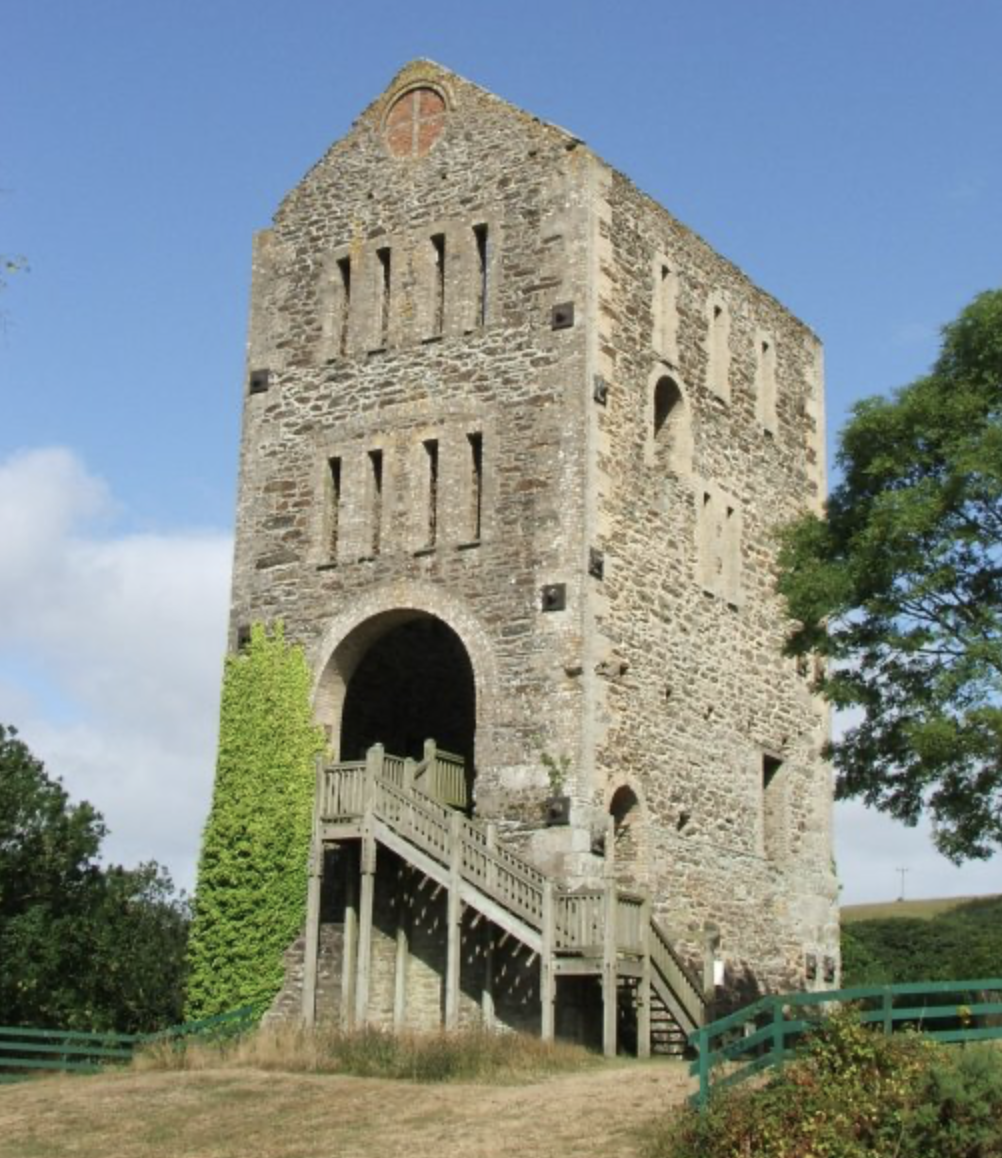
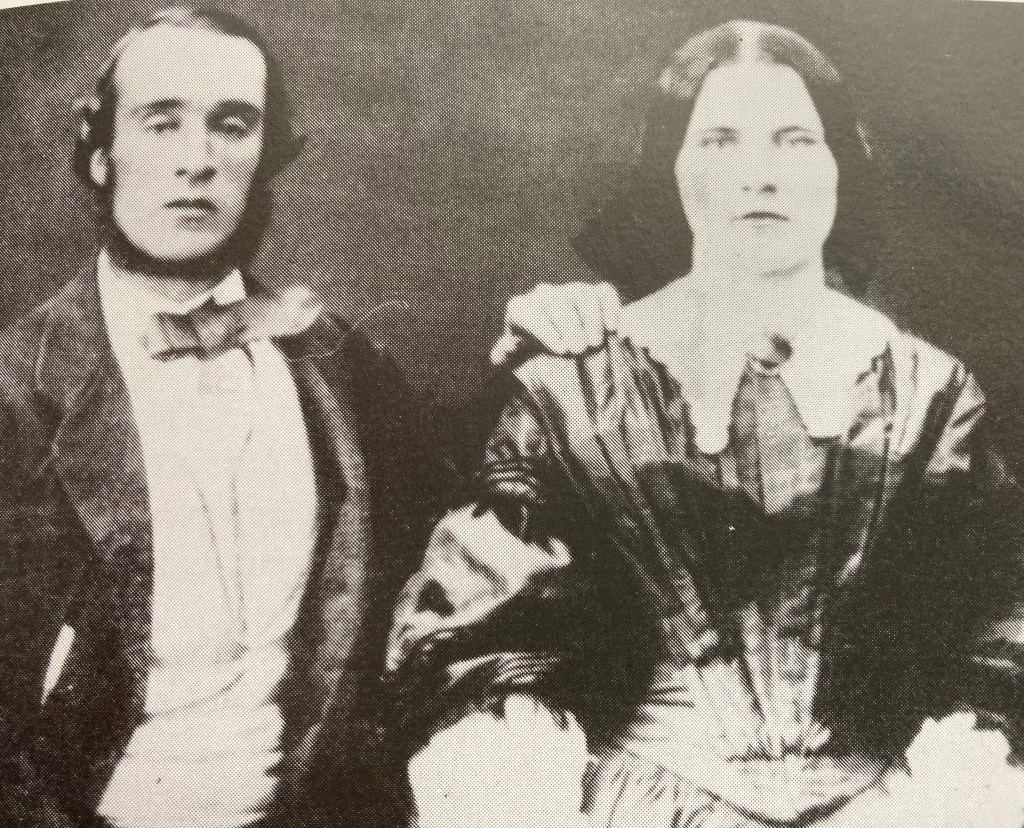














 The Lanyons