Alexander Lanyon’s Descendants

Alexander Lanyon married Philippa at Madron in 1614.
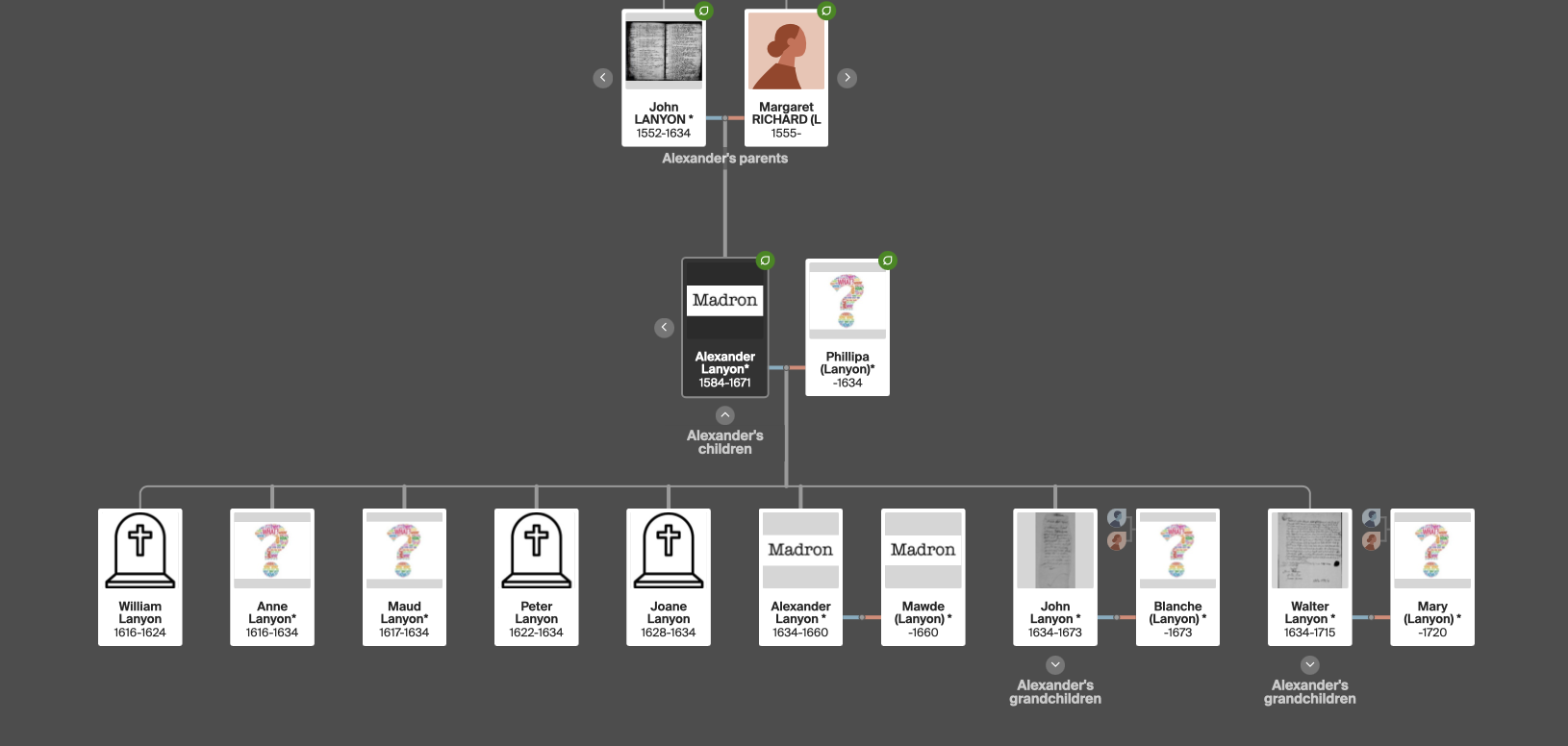
Alexander Lanyon’s tree

The parish registers have lots of gaps at this time so wills can be an additional source of information. John Lanyon’s 1634 will mentions numerous grandchildren and from that we can start to build a tree.

Anne and Maud were still alive in 1634 but there is no further trace of them. They may have married and their marriages have not been recorded or they may have died.

  • Alexander aft. 1616-1624
  • Anne 1616-aft. 1634
  • Maud 1617-aft. 1634
  • Peter 1622-bef. 1634
  • Joane 1628-bef.1634
  • Walter bef.1634-1715
  • John bef.1634-1673
  • Alexander aft. 1634-1660
  • William -1624

The only children who have recorded marriages are Walter, John and Alexander.

Alexander Lanyon aft. 1634-1660

Alexander wasn’t mentioned in his grandfather’s will so must have been born after 1634. He and his wife died within nine months of one another in 1660. We don’t know what caused their deaths but given that they were both only in their twenties perhaps they both died of TB which killed so many young people. They had no children so this line died out.

Walter Lanyon bef. 1634-1715

Walter Lanyon’s tree

Walter was the heir and he lived at the barton of Lanyon after his father. He married Mary and they had two sons:

  • John 1665-1733 married Margery Ustick – one son John
  • Thomas 1670-1723 married Alice Baynard – no children

Walter died 8 Sep 1715 at Madron and left a will.
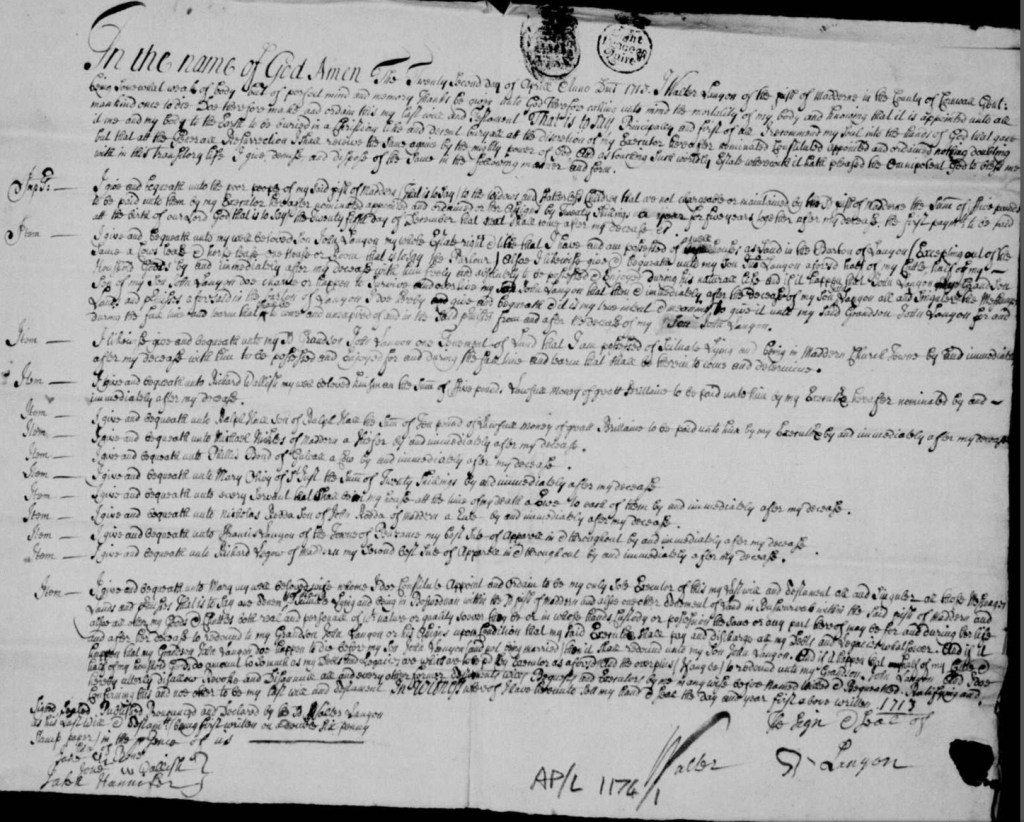
Walter’s will 1715 – Source CRO/AP/L/1174

The will gives his son John the barton of Lanyon, son Thomas half his goods and cattle and his wife Mary land in Boswednan, Madron and Boswarva and these lands to go to his grandson John after her death.

He also leaves his suit of ‘best apparel’ to Francis Lanyon of Penzance and £3 to his beloved henchman Richard Wallish.

Walter’s son John married Margery Ustick in 1691 and their only child John was born the following year. John died in 1733 and the estate passed to his son, Walter’s grandson.

John junior married Elizabeth Huthnance the daughter of Henry Huthnance, the vicar of Breage. They had a daughter, also called Elizabeth, born in 1718. John’s wife died but there is no record of her burial. John remarried in 1725 to a Lanyon cousin, Jane Andrew. (She was the daughter of Isabel Lanyon and Matthias Andrew of Sancreed.) They didn’t have any children.

In 1954 William Lamparter corresponded with Miss Dorothy E B Hichens, the niece of John Hichens, who was then aged 90 and the great grandson of Richard Hichens who held the lease at ‘Lanyon’. She stated “The only thing I can tell you about Elizabeth Lanyon is a story handed down the family and told to me by my grandmother – that Elizabeth’s mother having died, the child was neglected by her father and her mother’s family paid a gypsy to steal her. They brought her up after which she presumably returned and married my ?? grandfather.”

His only daughter Elizabeth married Richard Hutchens (Hichens), they had four children: Richard, Jane, Elizabeth and Thomas.

John Lanyon was without a male heir and when he died in 1784 aged 92 he left the barton of Lanyon to his favourite granddaughter, Jane Hutchens. John was the last Lanyon to live at the old ancestral home.

John Lanyon’s will 1784 – Source CRO/AP/L/1878

Jane Hutchens renounced the bequest and from 1784 Mr John Hosking of Landithy, Madron took a 99 years lease of Lanyon for his two sons John and Thomas who failed to make a success of the farm and Mrs Elizabeth Hutchens’ grand sons, Richard and Thomas took the remainder of the lease and much improved the Lanyon estate. The old manor house was pulled down and a new house built. Thomas’ son, Richard Hutchens, died at Lanyon in 1889.

Jane Hutchens renounces the bequest from her grandfather. Source – CRO/AP/L/1878

This is the end of Walter’s line.

On 29 March 1927 Jane Veale Mitchell wrote the following:-

“Last Tuesday the weather improved and I went off to keep an appointment at Carne, in Morva with Mr John Hichens (St Ives family) whose great-grandfather Richard held Lanyon in Madron and Rissick in Madron, under 99 years lease or remainder. (For several weeks I have missed him when he came into Penzance; then we met and I went out). How glad I was, you can imagine when he brought in a great armful of oldish deed for me to see. Between us (and you too) we are sworn to secrecy in regard to these deeds, as the man would be pestered for them; as it is, he gave me the one I longed for and which explicitly explained what my instinct told me must be a fact i.e. that a Lanyon, as his fathers before him, lived and died at Lanyon in Madron in the year 1784, the very last one in the old Manor House, before Mr Hosking (who renewed the lease from Philip Rashleigh’s assigns) tore it down and built the present farmhouse.”

John Lanyon – bef. 1634-1673

John was the second surviving son of Alexander and Philippa. John Lanyon married Blanche about 1648, the marriage was not recorded but their first child was born about 1650.
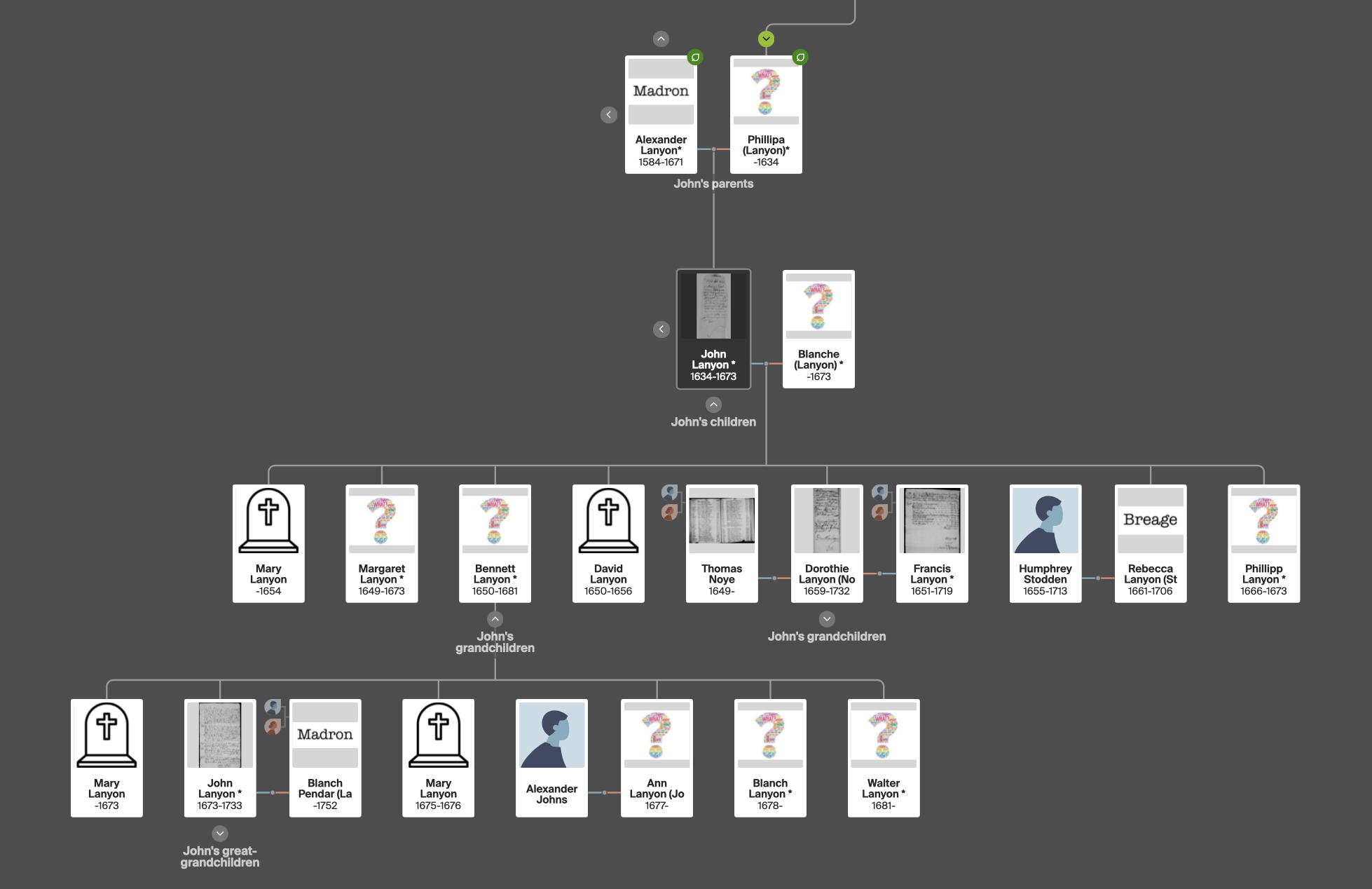
John & Bennett Lanyon’s tree

They had seven children:

  • Mary – 1654 died in infancy
  • Margaret 1649-aft. 1673 no further trace
  • Bennett abt. 1650-aft. 1673
  • David 1650-1656 died in infancy
  • Dorothie 1659-1732 she married Thomas Noye in 1678 – six children. Then in 1701 she married her cousin Francis Lanyon – they had one daughter Martha who died age 4.
  • Rebecca 1661-1706 she married Humphrey Stodden – three children
  • Philippa 1666-aft. 1673 no further trace
  • Mary – 1654 died in infancy

We’re covered Dorothie in the post ‘Lanyons, Trewrens and Noys’.

Bennett Lanyon abt. 1650-aft. 1673

Bennett was born about 1650. He was the executor of his father’s will. We know he married but we don’t know his wife’s name. He had six children:

  • Mary 1673-1673 died in infancy
  • John 1673-1733 married Blanche Pendar
  • Mary 1675-1676 died in infancy
  • Ann 1677- married Alexander Johns in 1706 no further trace
  • Blanch 1678- no trace
  • Walter 1681- no trace

John Lanyon 1673-1733

John and Blanche married in 1723 when John was aged 50. His son John may have been from an earlier unrecorded marriage.

John died in 1733 and his will begins “being penitent and very sorry for my sins”. One wonders what he had done!
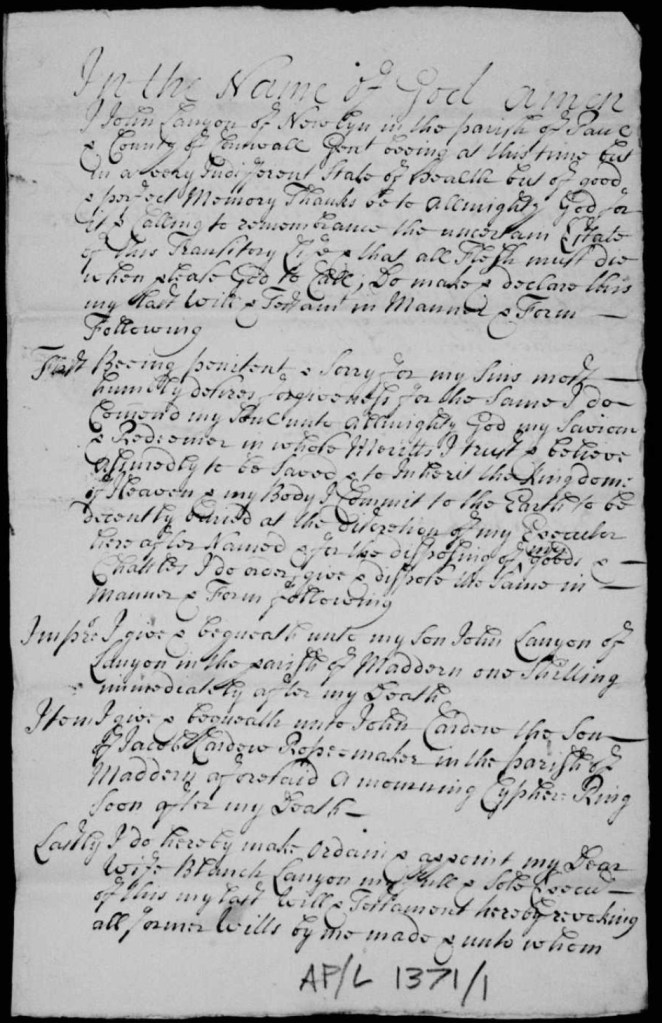
John Lanyon’s will 1733 source: CRO/AP/L/1371

There is no record of John and Blanche’s son being baptised, married or buried. His father left him 1/- in his will which suggests he had already inherited. In 1752 he had the role of Accessionable Manor’s Commissioner and we know nothing else about him.

And this is where we must leave Alexander’s line, there are no more traceable Lanyon descendants.

Interestingly on 5 Mar 1781 an Alexander Lanyon died in Penzance aged 100. There is no record of any Alexander Lanyon being baptised about 100 years earlier. Could he be a descendant of this line?
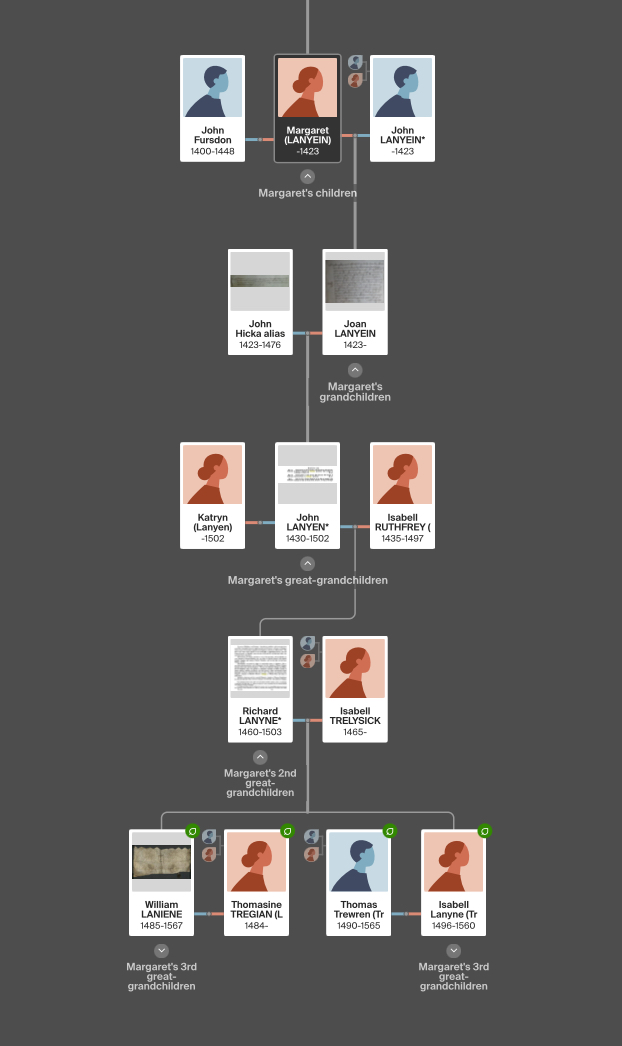
The First Esquire – William Laniene

Richard Lanyne (the son of John Lanyen and Isabell Ruthfrey) married Isabel Trelissick. Richard’s son and heir was William Laniene born abt. 1480 but it’s not clear if Isabel Trelissick was his mother or if she was Richard’s second wife. William’s sister, Isabel was born in 1496. There is no trace of any other siblings but Benoit’s 1531 MSS states that Thomas Treuran married Isabell the 1st daughter of Richard Lanyne of Trylyswyke so that implies there must have been at least one other daughter.

William Laniene’s ancestors

William was the first recorded esquire

Lanyon Coat of Arms

Heraldic visitations were tours of inspection undertaken by Kings of Arms. Their purpose was to register and regulate the coats of arms of nobility, gentry and boroughs and to record pedigrees. They took place from 1530 to 1688, and their records provide important source material for historians and genealogists. Much of the Lanyon family information from the 16th & 17th century comes from these visitations. They visited Cornwall in 1531, 1573 and 1620. Families submitted trees to establish their right to bear arms. (The trees weren’t always correct!)

The definition of an Esquire is “the eldest son of a knight and their eldest sons in perpetuity”. Second sons were styled “Gentlemen” and the sons of gentlemen were given the title Mr. (daughters were addressed as Mrs. even when single). A Yeoman was a landowner but not considered genteel enough to be styled Mr or gentleman.

Below yeoman was a husbandman and below that serf/villein/cottar, then came domestic servant and finally in the pecking order vagabond and slave.

Whilst these terms started to fall out of use by the late 17th and 18th centuries in the 16th and early 17th centuries they were still generally adhered to and that’s a huge help to genealogists.

In 1531 William Laniene gave his family tree to the heralds and his right to ‘bear arms’ was documented. The first Lanyon to bear arms may have been born much earlier than William but this is the first documented esquire.

Grant of Arms to Bacon family – British Library, CC0, via Wikimedia Commons

William lived at Gwinear. Perhaps a medieval long house was not sufficiently grand, perhaps it just wasn’t big enough for his large family or perhaps it’s just a bit too cold and windy in West Penwith compared to Gwinear!

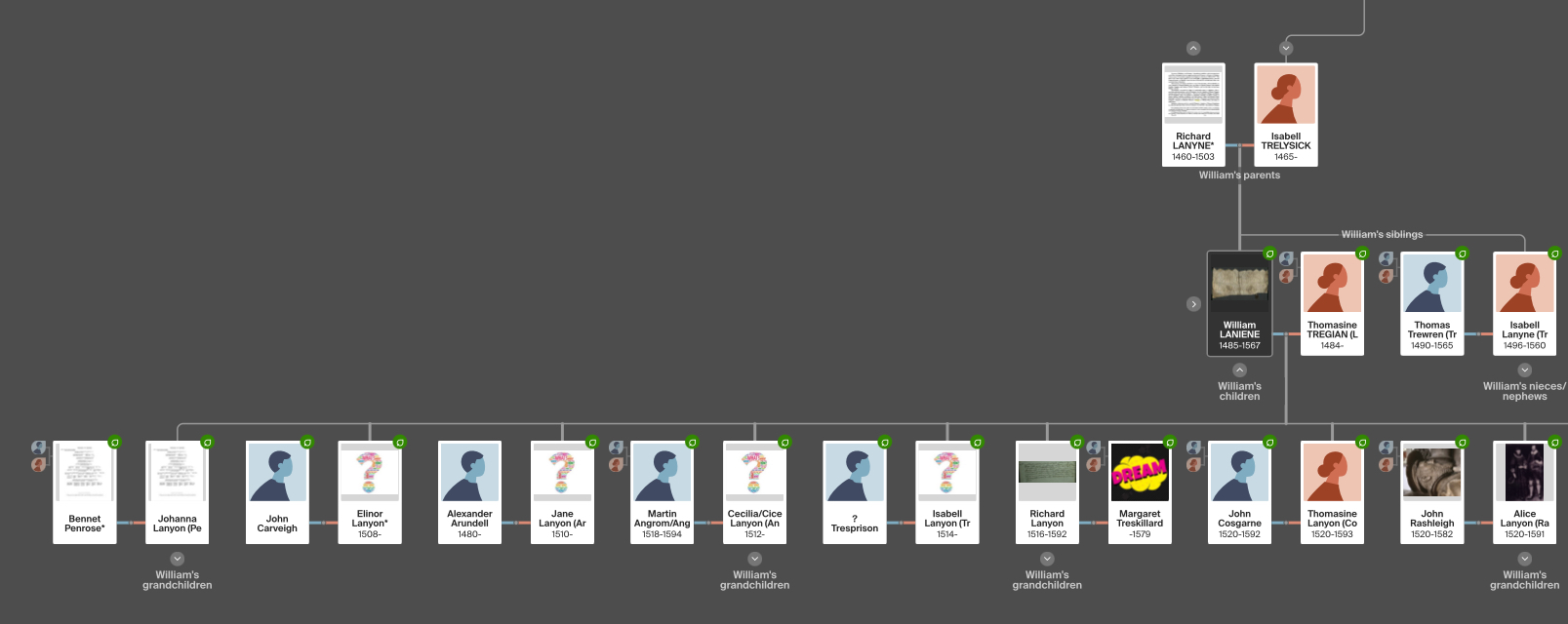
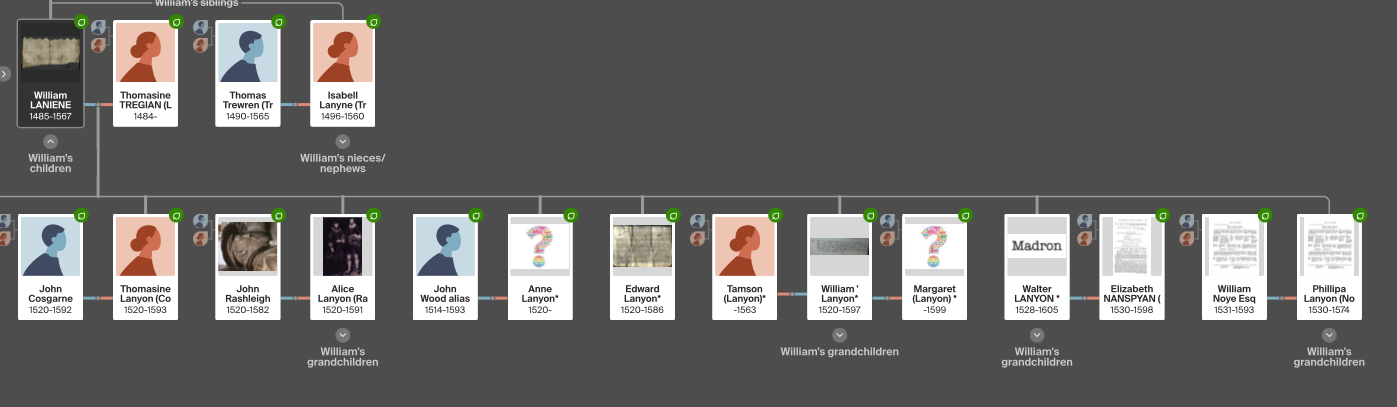
William married Thomasine Tregian the daughter of Thomas Tregian of Tregian and Truro and Margaret (daughter of William Kingdon and widow of John Borlase) abt. 1505. William’s large family (at least nine daughters and four sons) married into the important families in the county.

William large family requires two images!

We don’t know the dates of birth for all his children or the order they were born in-

  • Alice born abt. 1520 died 20th Aug 1591 married John Rashleigh abt. 1540.
  • Elinor married John Carveigh.
  • Cecilia/Cicely born abt. 1520 married Martin Angwyn abt. 1540.
  • Isabell married ? Tresprison.
  • Anne married John Wood alias Atwood.
  • Thomasine died 12th April 1593 married John Cosgarne.
  • Jane married Alexander Arundel. Their descendants were the Arundel’s of Leigh.
  • Philippa married Edward Noy Esq abt. 1556
  • Johanna/Joan married Bennet Penrose 1553 (she was the first of his 3 wives so presumably died young.)
  • Richard, his eldest son and heir born abt. 1516 and died 18th Dec 1592 married Margaret Treskillard.
  • Edward died aft. 1586.
  • William ‘Generosi’ died 7th Aug 1597. Married Tamsin and Margaret.
  • Walter died 12th May 1605 married Elizabeth Nanspyan.

William Laniene died 20th Mar 1567. (Source- Inquisition Post Mortem 1586 of William Lanyon Coswinwollard, Gwinear. Source CRO/R/1168)

William owned substantial lands. Gilbert says “this William succeeded his father in considerable estates in Maddern, Morva and other adjoining parishes….”. The Penwith Subsidy Roll of 1509-1523 lists the following: value of land by the year – Willm Lanyine Gwinear 41s, St Erth 41s, Gulval 11s 8d, Madron 111s 8d.

In common with much of the landed gentry in Cornwall at that time William was frequently manipulating and speculating in land often with his relatives.

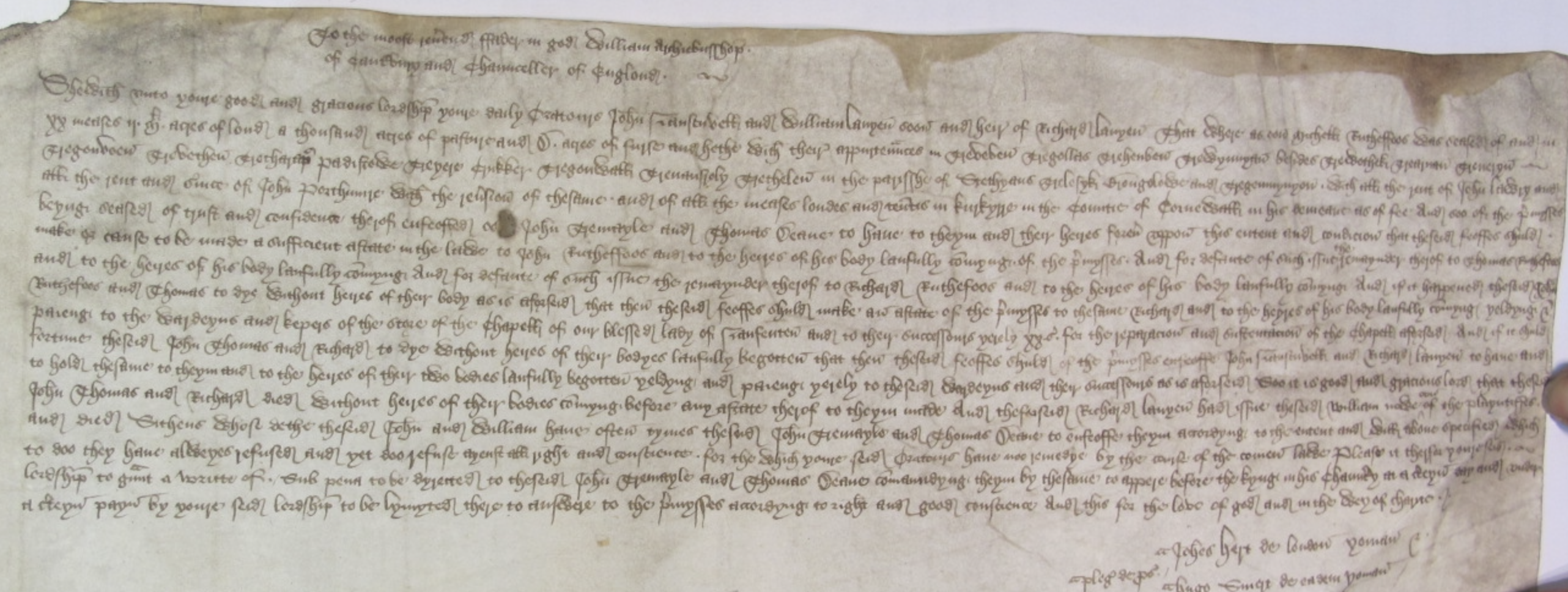
In a legal dispute from 1504-1515 William Laniene claims a right to part of the estate of the late Michael Ruthfos. Michael left his large estate to a Thomas Ruthfos and his heirs, with remainder to a John Ruthfos and his heirs, and a further remainder to a Richard Ruthfos and his heirs. William Lanyon appears to claim that as Thomas and John Ruthfos died without heirs he, as a son of Richard Lanyon, has a right to the property. If Richard ‘s mother Isabel Ruthfrey was the daughter or heiress of Richard Ruthfos this could explain how he got the name Richard. Variations of the name Ruthfos appear so Ruthfrey is possible.

Legal dispute -Source : Anglo American legal Tradition – aalt.law.uh.edu/AALT7/ChP/C1no341/IMG_0085.htm

Court of Star Chamber 1509-1547

PLAINTIFF: Alan Powe DEFENDANT: William Lanyen, Tamysen (Thomasine) his wife and Thomas Trewren. Messuage and land in Cosswyn Wulward.

PLAINTIFF: William Lanyon DEFENDANT: Thomas William, Jenett his wife, and John and Robert their sons. Source: National Archives STAC 2/30/48

PLAINTIFF: Thomas William DEFENDANT: William Lanyeyn and Thomasyn his wife, Richard Lanyeyn, William Lanyeyn, junior, John Breton, and John Trespryson. Source: National Archives STAC 2/30/48

PLACE OR SUBJECT: Forcible entries in Gwinear COUNTY: Cornwall, William Lanyeyn and Thomas William. Source: National Archives STAC 2/30/48

 Court of Chancery: Six Clerks Office:

John Nanscuvell and William, son and heir of Richard Lanyen. v. John Tremayle and Thomas Deane, feoffees to uses. Messuages, land, rents, and services in Treveben, Tregollas, Trehenben, Trewynnyan by Trewothek, Trearnan, Treneryn, Tregonvoen, Trevethen, Date: 1504 – 1515 Source: A C1/341/56

In 1533-38 Thomas Tresculard’s widow Isabel took action against William Lanneyen and others over the detention of deeds relating to messuages and lands in Tresculard and elsewhere.  Source: C1/911

The History of the Family Borlase cites a legal dispute over woods at Bridockke involving Thomasina’s nieces where evidence was given that Thomasina’s brother John referred to William Lanyne as his brother in law. Source: The Genealogist Magazine Vol III 1886.

Mentioned in a deed, 1 Mar 1554, Cornwall, England. Grant of land, Penrose, Sennen and land in Sancreed. Parties: 1) Joyce Penrose of Penrose, gentleman, to 2) Radulph Penrose, John Treuryn and William Lanyon. Penrose [Sennen], Respletha, etc, and Brane, Bosence and Zelena in Sancreed.

William was also a ‘tinner’. In Oct 1556, Cornwall, England, William and his partner David Angove were given a licence, for two years, to search and dig for tin anywhere on the lands of the Earl of Oxford throughout Cornwall. Source: CRO AR/1/852

William is also listed on the ‘Tinner’s Muster Roll’ of 1539 for St Clement, Cornwall. Stannary of Tywarnhaile, Moreske Manor. Whole Harness (the harness and trappings for a horse which might include armour).

In 1539 William could have been almost 60 years of age (Henry VIII would have been 48) and there were threats from Scotland, the low countries, France and Spain so it was possible that he may have had to fight.

David de Kylminawis

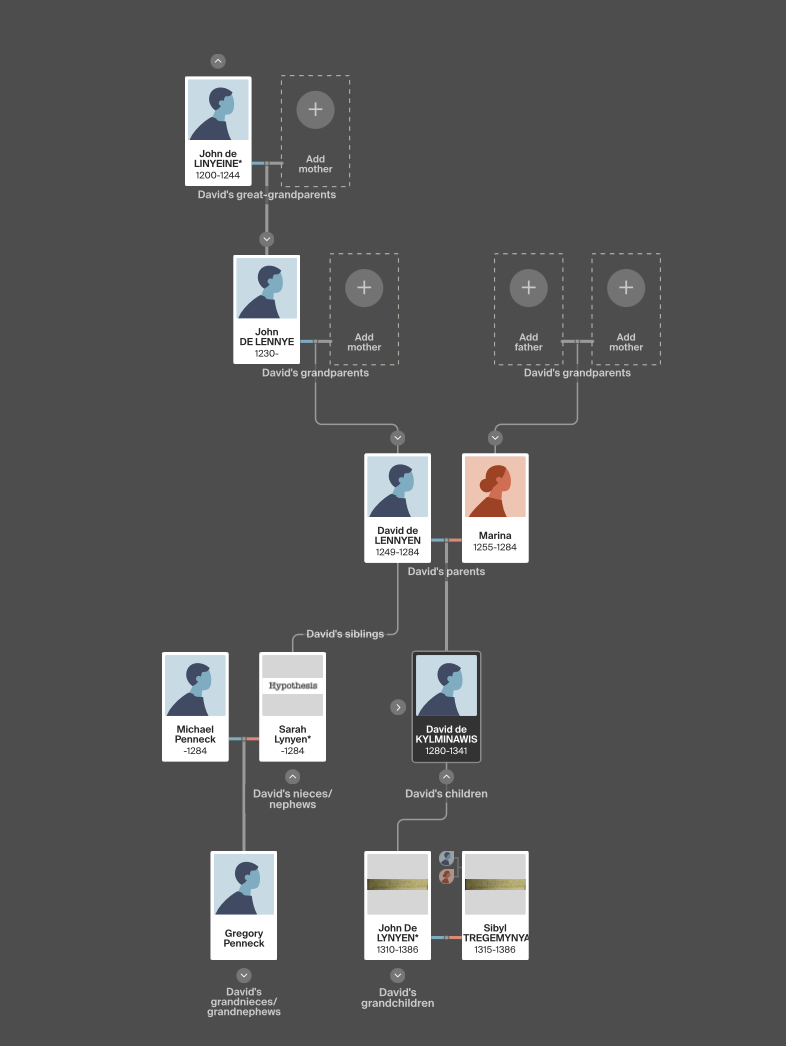
David was born about 1280 and died after 1341. David may have been the brother of Sarah Lynyen. It’s not possible to say with any certainty but they were both living at the same time. The tree below shows the possible relationship.

Kylminawis – Kyl may be the equivalent to the Scottish Kil meaning church so Kylminawis possibly refers to St Minver in North East Cornwall.

A Cornish language expert has also suggested that the name Kylminawis is near identical to the earliest recorded spellings of Kilminorth, Talland on Cornwall’s southeast coast. Those spellings are ‘Kilminawyd’ and ‘Kylmynawyd’ 1284, It’s thought to contain the words ‘kyl’ meaning ‘nook, back, ridge’ and ‘menowes’ meaning ‘awl, or a hill, stone or piece of land shaped like an awl.’ I haven’t been able to find any connection to this area and the 1341 charter mentions David’s bake house in Portzwyhan which is now Port Quin which is on the north coast near St Minver. There are also family connections to St Ervan, St Merryn, Padstow and Harlyn.

In 1341 there is a charter which mentions David de Kylminawis and his son John who married Sibyl de Tregamynyan.

St Enodoc’s Church at St Minver by Peter Skynner,


Edward III – Unknown author, Public domain, via Wikimedia Commons

“David De Kylmynawis to John his firstborn son & heir, and to the heirs of his body by Sibyl daughter of Joceli de Tregaminion his wife, with remainder to the grantor and his heirs. Charter with warranty of all his messuages, lands etc. In Kylmynawis, namely yards, gardens, woods, meadows, moors, turbaries, launds an pastures, and his corn mill there with multiple, waters and watercourses or beads, his bake house with garden in the town of Portzwyhan, the rent and service of John de Landewarnek and his heirs for lands held of the grantor in Kylcoys, of Simon de Kylcoys there, of Paternus and Robert brothers of the grantor for lands of him held for their lives in Kylcoys, of Margery his sister likewise in Araweyte, and the reversion of all lands of the said John, Simon, Paternus, Robert and Margery which they claim to hold for life of the grantor and his heirs when it shall fall in.”

Dated Kylminawis, Friday before St Barnabas 15 Edward III

Source: CCR Calendar Curia Rolls, Henry IV, Vol.4, 1441-47, (Public Records Office, London, 1937), 452/3.

Portzwyhan is Port Quin today.

Port Quin and St Minver in North Cornwall.