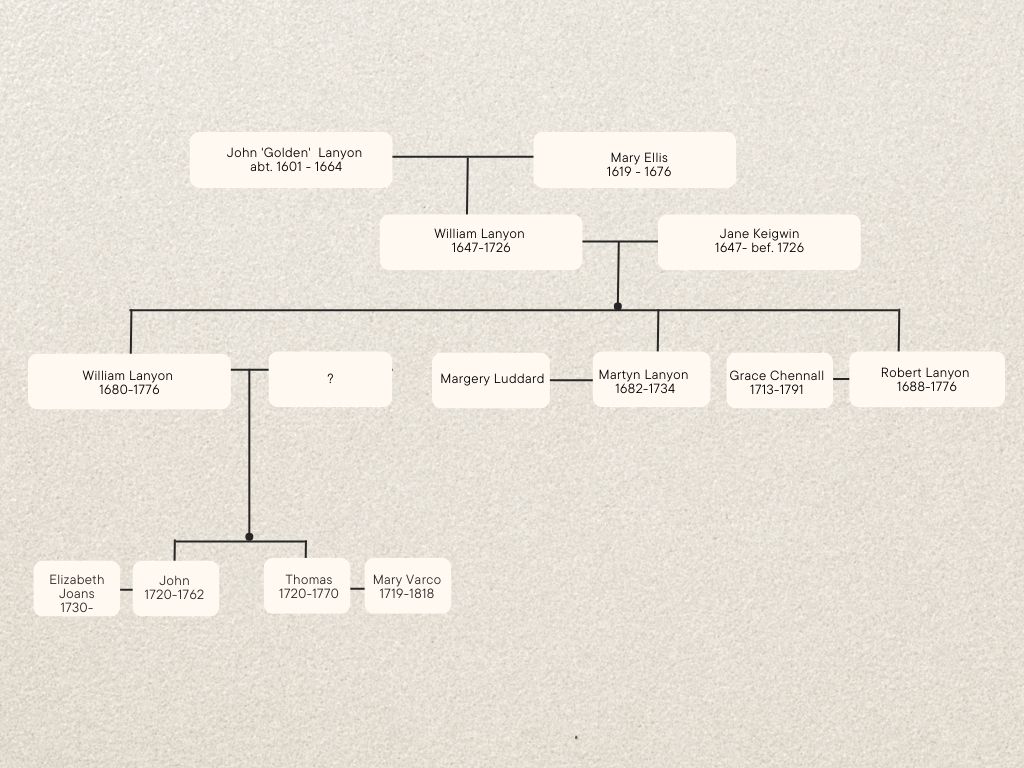
William was baptised at Sancreed in 1680, the son of William Lanyon and Jane Keigwin. We don’t know the name of his wife but his sons John & Thomas lived at Fowey (see the post ‘Fowey Boys’).
A William Lanyon of Sancreed was excommunicated on 16th Jan 1722 for contumacy (stubborn refusal to obey or comply with authority, especially disobedience to a court order or summons). Source NA ARD/160/24 – National Archives Archdeanery of Cornwall.
William was excommunicated by Lancelot Blackburne, the Bishop of Exeter.
Lancelot Blackburne – Attributed to Joseph Highmore, Public domain, via Wikimedia Commons
We don’t know what he did but it must have been bad enough for the Bishop of Exeter to get involved and for William to move to Fowey and raise his children away from Sancreed.
Despite having fourteen children the Golden Lanyon had only twelve great great great grandsons to carry on the family name on the Botrea branch of the Lanyon family. There may be unrecorded children, and children who have moved away from Cornwall and not been traced, but it is a diminishing tree.
Diminishing Botrea Branch
The Fowey Boys
John and Thomas (the sons of William Lanyon 1680-bef. 1776) both lived in Fowey, initially I couldn’t find their parents or where they fitted on the tree. It was the wills of William’s brother Robert and his wife Grace Chennall which helped me resolve the problem.
We don’t know the name of William’s wife but as both his eldest grand daughters are called Mary we may surmise that is her name or perhaps they were named after their great grandmother, Mary Ellis.
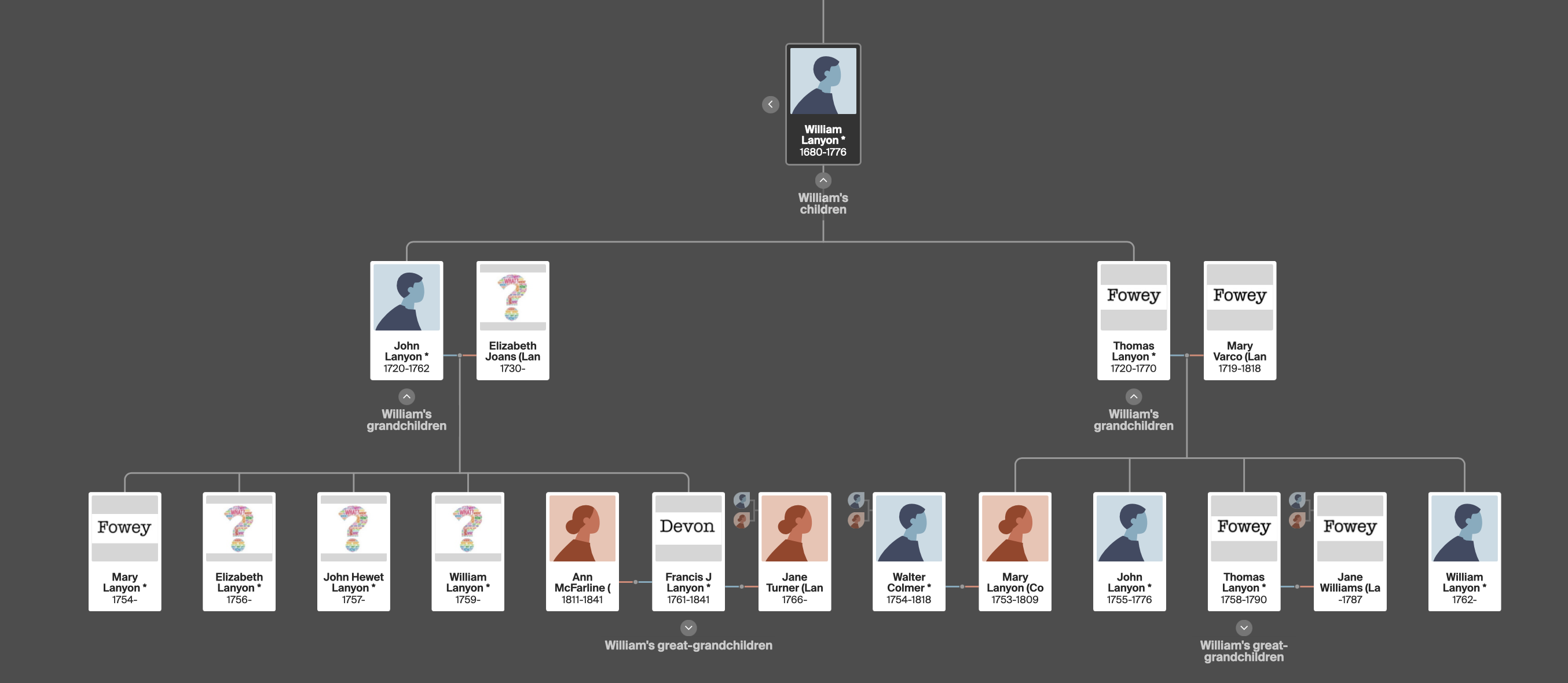
William’s tree
John Lanyon abt. 1720-1762
John was born about 1720 but there is no trace of a baptism, he married Elizabeth Joans from Fowey, at Lostwithiel, on 26 Jul 1753. John was the Officer of Excise in Fowey.
They had five children:
Mary 1754-1809
Elizabeth 1756- no further trace
John Hewet 1757- no further trace
William 1759- no further trace
Francis Joans (Jones) 1761-1841
It is possible that only Francis and Mary survived to adulthood and he is the only ‘nephew’ mentioned by Grace Lanyon (Chennall) in her will.
Smugglers – John Atkinson
Francis Joans Lanyon 1761-1841
Francis Joans Lanyon was a shipwright and married Jane Turner in 1786 at Charles the Martyr, Plymouth, Devon. Their children:
Francis Joans Lanyon’s tree
John 1788-1791 died in infancy
John Francis 1792-1863 married Jane Hicks at Plymouth in 1815, they had no children but lived with her widowed mother Betsy and nieces. From the 1859 census we can see that John was a bread baker. He died in 1863 and left an estate valued at under £200.
Jane 1795-1872 was baptised at Devonport and married Edward Wills. They had four sons two of which were called Napoleon and Horatio! Perhaps Edward fought at Trafalgar? Edward died before 1826 as Jane remarried William Honey and had another five children including William Lanyon Honey and John Francis Lanyon Honey.
Eliza 1798-1799 died in infancy
Elizabeth 1805- no further trace
Francis -1791 died in infancy
Then in 1831 Francis Joans Lanyon married Ann McFarline at East Stonehouse, Devon. They are shown on the 1841 census he is aged 80 and she is aged 30! The 1841 census doesn’t show their relationship.
1841 census East Stonehouse, Devon
Thomas Lanyonabt. 1720-1770
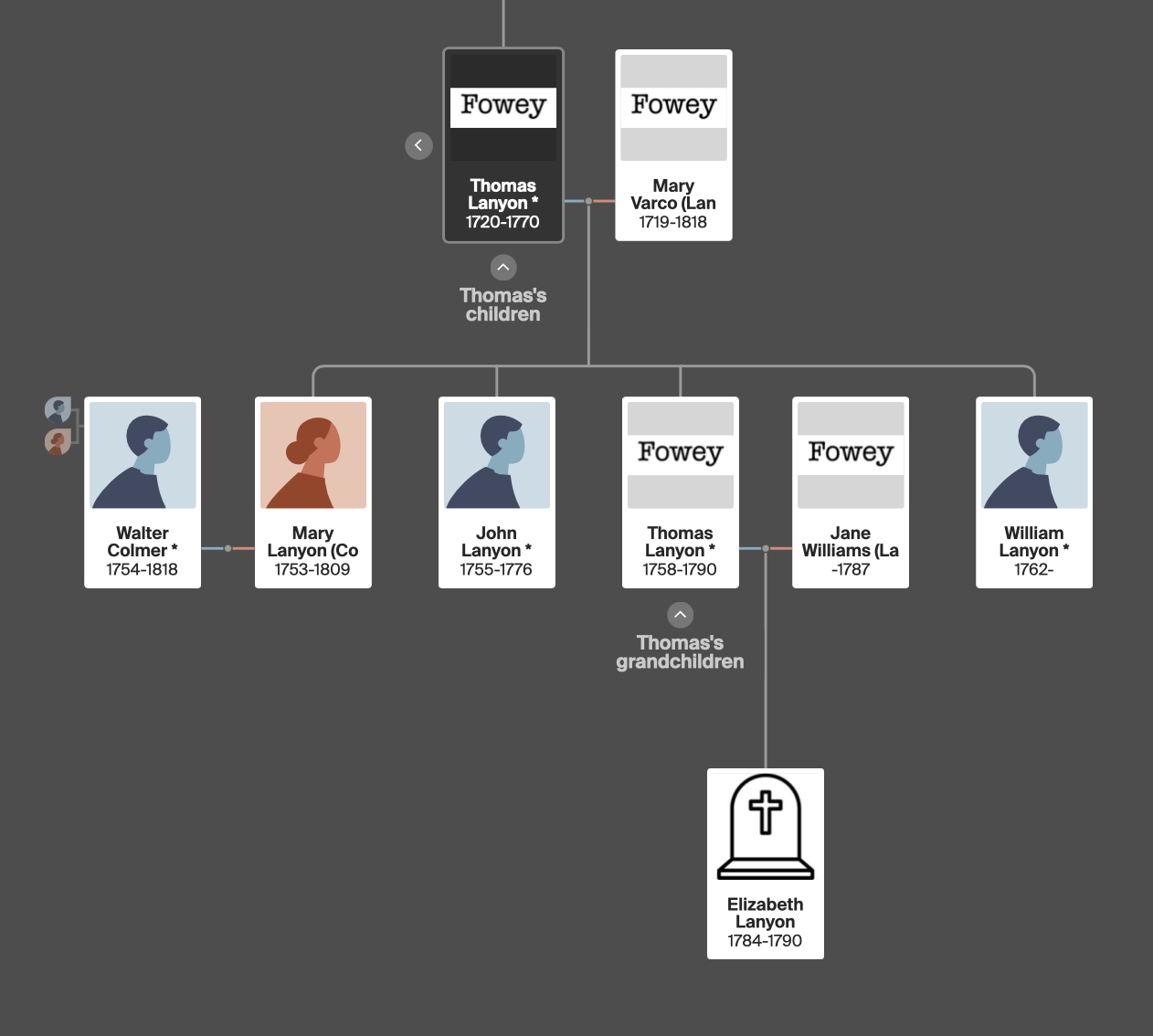
William’s second son was Thomas born about 1720, he was a victualler and maltster in Fowey. Thomas married Mary Varco at Fowey in 1752. Their children:
Thomas & Mary’s tree
Mary 1753- was born at Fowey and she married Walter Colmer at Fowey in 1774 and had 9 children, the eldest was called John Lanyon Colmer.
John 1755- no further trace
Thomas 1758-1790 he married Jane Williams by licence at Fowey in 1784. He was a ‘salt officer’. He and Jane had a daughter Elizabeth. Jane died Nov 1787, Thomas died Sep 1790 and Elizabeth died Oct 1790 aged just 6.
William 1762- no further trace
Thomas Lanyon and his wife Mary Varco ran the Dolphin Inn at Fowey, the Dolphin’s biggest competitor was the Ship Inn (John Rashleigh and Alice Lanyon’s first town home.)
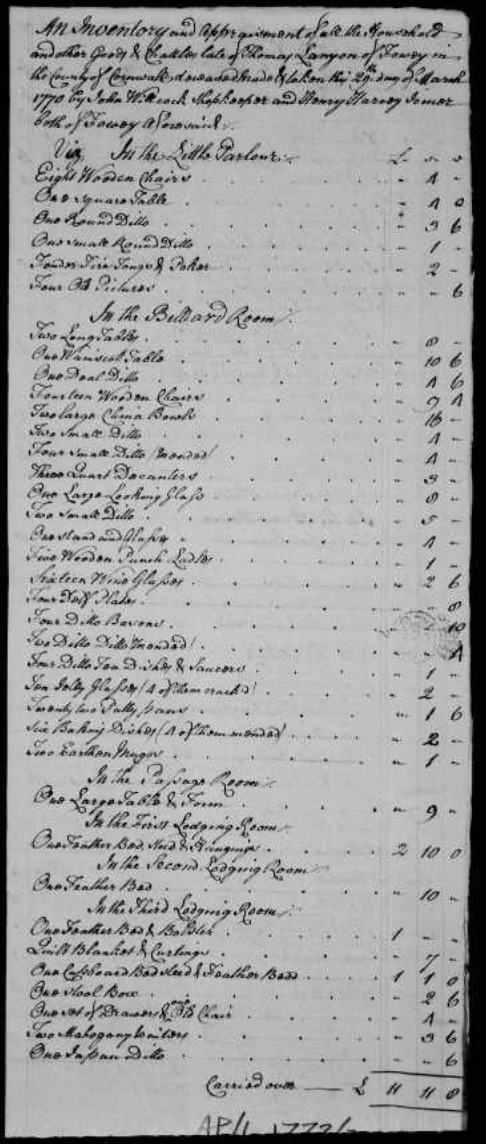
Thomas died in 1770 and left a wonderfully detailed inventory of goods which gives a real glimpse into their lives. The will describes the furnishings in each room.
Part of the inventory of Thomas’ administration- Source: CRO AP/L/1772
Following Thomas’ death Mary continued to run the inn and in 1771 Philip Rashleigh’s expenses listed ” the widow Lanyon’s bill for the entertainment on election day £2 4/-“. Source – Old Cornish Inns by H.L Douch. 1966.
The Dolphin was taken over by her son in law Walter Colmer and daughter Mary but by 1817 it was defunct.
Mary was buried on 12 Aug 1818 at Fowey aged 99! (Royal Cornwall Gazette.)
Philip Rashleigh settled in Fowey, in the 16th century, as a trader. His son’s marriage to Alice Lanyon resulted in the acquisition of Cornish properties and soon they became prolific merchants and ship owners.
In time they would own property at nearby Menabilly as well as a new townhouse in Fowey (now the Ship Inn.)
According to research they benefited from the dissolution of the monasteries by scrupulously buying land and re-selling at a profit. By marrying into wealthy Cornish families the Rashleighs became huge landowners with significant influence across the county. Many became MPs and it was Menabilly, on the Gribben Peninsula, that provided the family home.
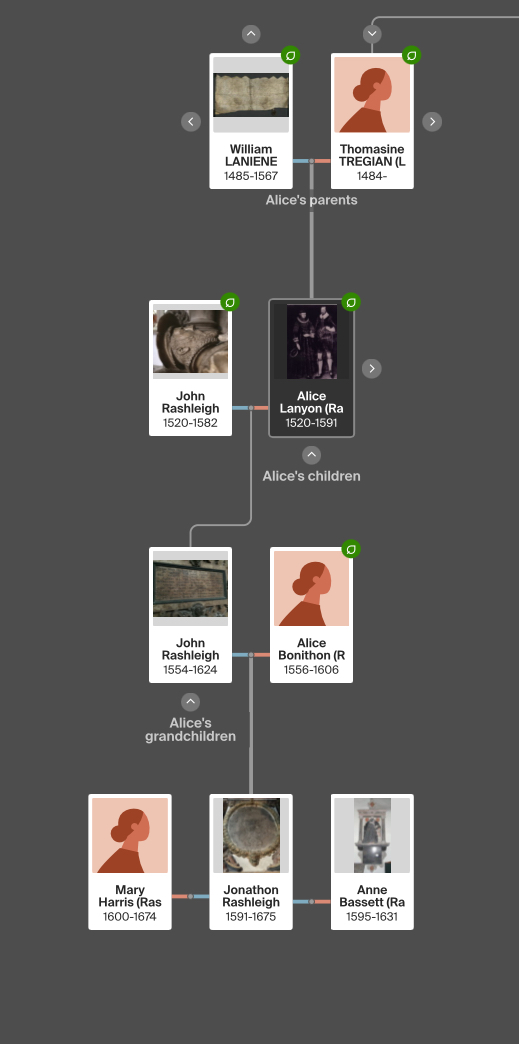
Alice Lanyon’s family tree
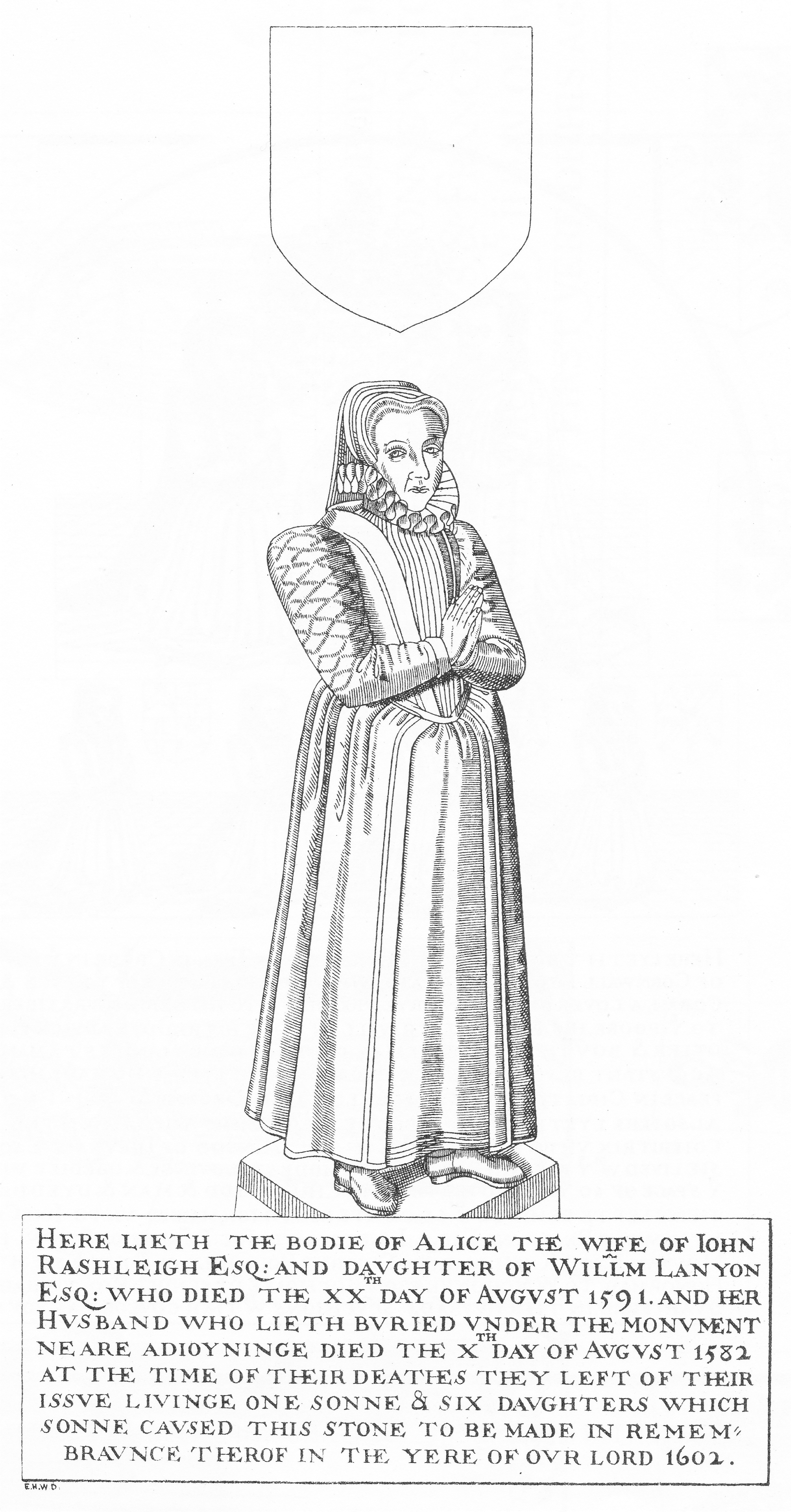
Alice was born abt. 1520 and died 20th Aug 1591 at Fowey, Cornwall. She married John Rashleigh abt. 1540. They had twelve children, eleven girls and one boy. Only six of their daughters survived. Her son John, placed a brass commemoration plaque in Fowey church and it’s still there over 400 years later!
Alice Lanyon brass plaque in Fowey Church Drawn by Dunkin, Edwin Hadlow Wise
The brass plaque is not the only portrait of Alice.
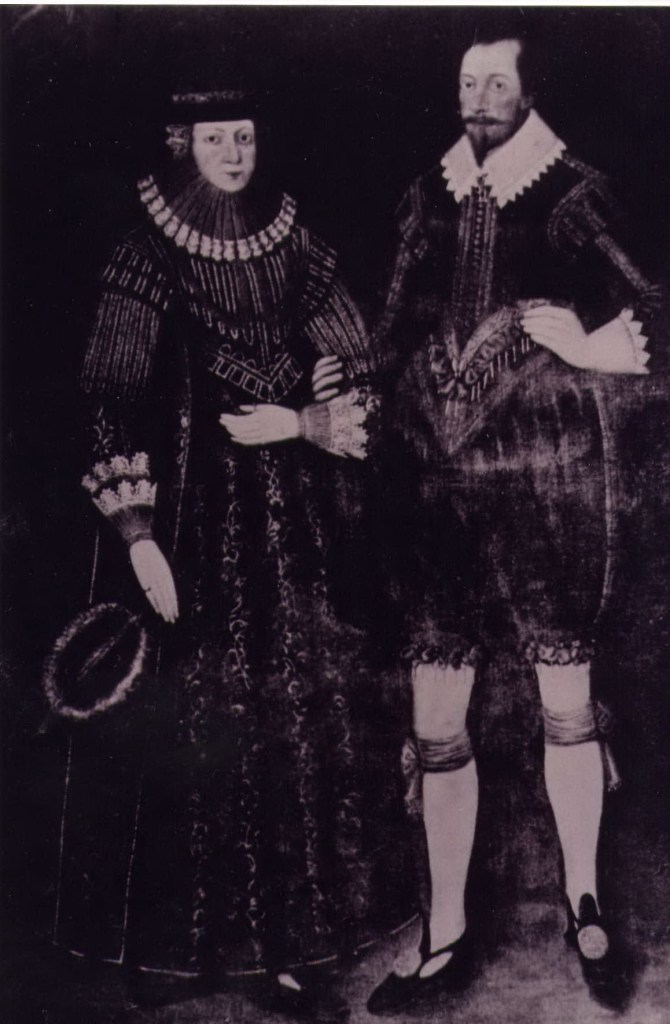
Nicholas Hilliard also painted their portrait.
Alice and John Rashleigh by Hilliard painted 1581
This portrait is the first Lanyon portrait!
Alice and John’s descendants lived at Menabilly, Fowey. The house was later leased to Daphne Du Maurier and became the inspiration for Manderley in the book ‘Rebecca’.
Menabilly
Alice and John’s town house in Fowey is still there today, it’s now called The Ship Inn.







 The Lanyons