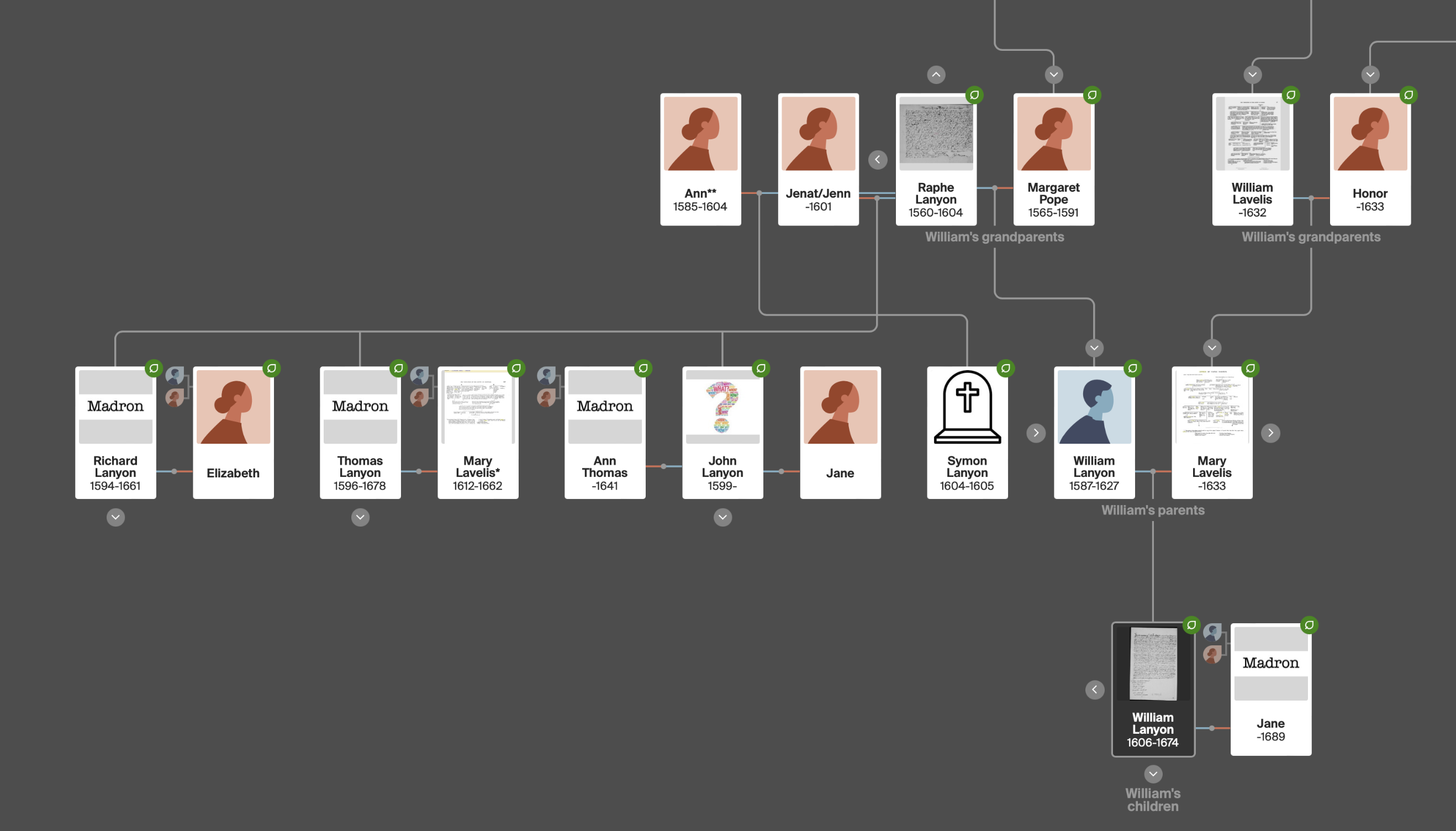
William Lanyon, yeoman of Bussalowe Veor, died in 1674 and left a will but it wasn’t until I read Raphe Lanyon’s will of 1604 and William Lavelis’s will of 1633 that I worked out where William should be placed on the tree.
William Lanyon’s tree
Raphe’s will mentions his five sons: William, Richard, Thomas, John and Symon. His will mentions that he bequeathes Bussalowe to his son William. William married Mary Lavelis after his father’s death in 1605. William died in 1627. His father-in-law William Lavelis died in 1632 and his will mentions his daughter Mary Lanyon and his Lanyon grand children at Bussalowe.
There is no record of the baptism of William and Mary’s eldest son but as he inherited Bussalowe Veor he must have been the eldest and born after 1605.
We know very little about him but his will fills in some of the gaps.
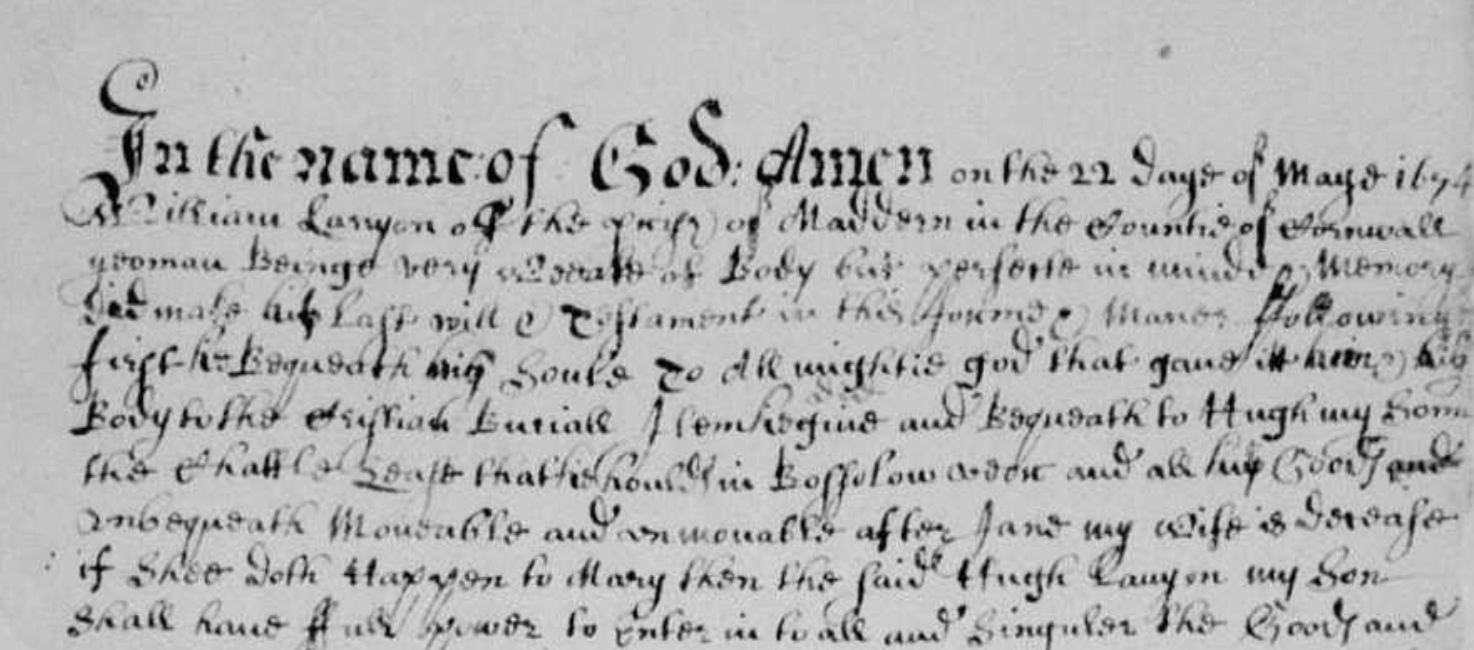
Will of William Lanyon written 1674
“In the name of God Amen On the 22 Daye of May 1674 William Lanyon of the parish of Maddern in the Countie of Cornwall yeoman Beinge very weake of Body but perfect in minde & memory Did make his Last will & Testament in this forme & maner following First he Bequeath his Soule To Allmightie God that gave it him & his Body to the Christian Buriall Item doe give and Bequeath to Hugh my Sonne the Chattle Lease that is house in Bossolow Veor and all his Goods un bequeath Moveable and unmoveable after Jane my wife is decease if shee doth happen to mary then the said Hugh Lanyon my Son shall have Full power to enter in to all and Singular the Goods and Chattles and to Turne her Away without Nothinge Item I give and bequeath to Thomas my Second Son one little Chattelle that I have in ?.. in Reversion of one life in possession and out of the Said Chattle the Said Thomas my Son is to paye Fortie Shillings and five pounds more I Doe give and Bequeath to William my Third Son to be paid at the End of Six Mounthes after my wife Jane is decease Item I give and Bequeath to Jane my Daughter Ten pounds to be paid att the end of nine mounthes after my wife is decease Item I give and Bequeath to Mary the Daughter of Elcana Lanyon one ewe Item I give and Bequeath to Thomas Lanyon my Son one ewe and the two Sonnes of Thomas Tonkinge Each of them one ewe Item I give and Bequeath to Margarett the wife of Thomas Tonkinge one ewe Item I give and Bequeath to Mary the wife of Edward Plomrose 12s and the residue of my Goods Moveable and unmoveable I give & Bequeath to Jane my wife during her life Time provided that shee doe not Marry whome I doe appoint Ordaine and make my Full & whole Executor, to Fullfill this my Last will and Testament”
His wife is Jane but her maiden name is not recorded. In common with most men at that time William leaves his property to his eldest son Hugh Lanyon and gives his wife lifetime enjoyment so long as she doesn’t remarry. William’s will however seems particularly harsh:
“if shee doth happen to mary (marry) then the said Hugh Lanyon my Son shall have Full power to enter in to all and Singular the Goods and Chattles and to Turne her Away without Nothinge”
William Lanyon will dated 22 May 1674
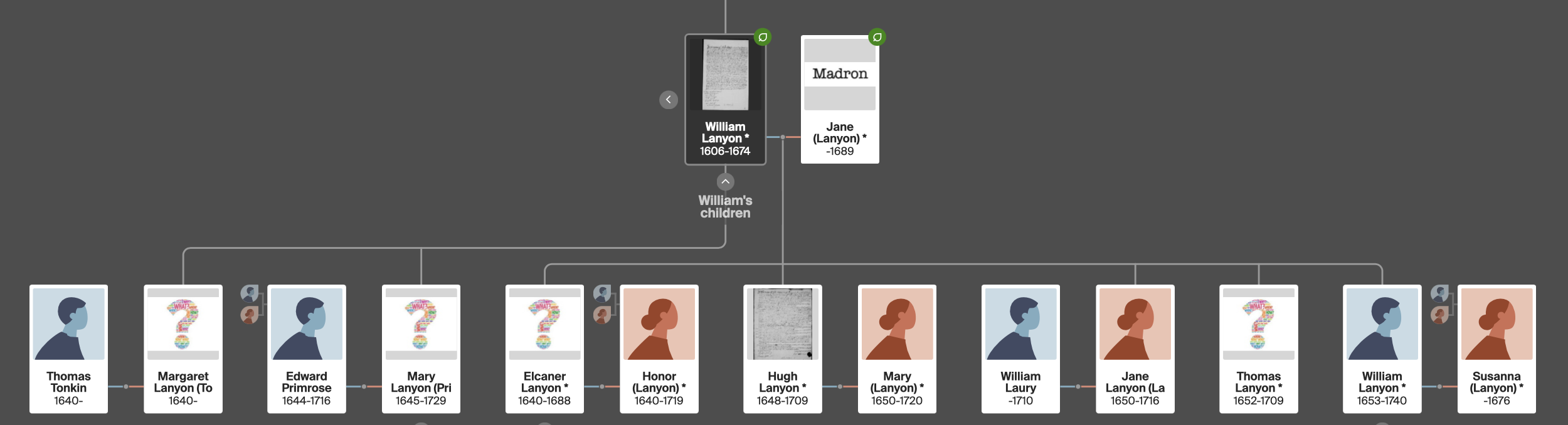
The will names his children:-
Hugh 1648-1709
Thomas 1652- aft. 1709
William 1653 – aft. 1709
Jane – aft. 1709
He also mentions Mary the daughter of Elcana Lanyon, Margarett the wife of Thomas Tonkinge and Mary the wife of Edward Plomrose.
It’s not clear what the relationship is between William and Elcana, Margarett and Mary but clearly they are related somehow as he remembers them in his will. There is no trace of William’s marriage to Jane but his ‘eldest’ son Hugh is born in 1648 when he was aged about 40. Could Elcana, Margaret and Mary be the children of an earlier unrecorded marriage?
William’s tree showing Elcana, Margaret & Mary. This may not be correct!
See the post ‘Elcana Lanyon’ under ‘Loose Lanyons’ for more on this branch of the family.
Phillimores Marriage Records show that on 3 May 1615 Elizabeth Lanyne married Oliver Neilder at Menheniot in Cornwall. Despite several attempts I couldn’t initially place Elizabeth on the Lanyon tree, who was she?
Early marriage records rarely mention the parent’s names and Elizabeth is one of the most common names in the Lanyon family so I decided to look at Oliver Neilder in more depth to see if I could discover anything useful.
Oliver Neilder baptised at least four children at Menheniot in the early 17th century: Marye 1619, Jane 1621, John 1624 and Elizabeth 1627. The Menheniot parish register also lists the following burials: Elizabeth Neilder was buried on 15 Jan 1659 (she was noted as being ‘old’) and Oliver Neilder was buried the following year on 26 Sep 1660 (he’s noted as ‘old senr’.)
Neither Oliver nor Elizabeth left a will so that avenue for research was closed. I did find Oliver Nealder (sic) listed on the 1641/2 Protestation Return for Menheniot but that was it. I then turned to Kresen Kernow (The Cornish Record Office) and the National Archives to see if there was anything useful there.
I found just one relevant record at Kresen Kernow. Assignment of land at Trenant, the parties were Oliver Nealder, yeoman of Menheniot and Peter Carveth also a yeoman of Menheniot (BRA991/120).
The National Archives were more forthcoming. I found records of litigation between the Neilder family and the Kekewich family. I’ve come across the Kekewich family before whilst researching the Lanyons so I was curious to find out more.
The Kekewich’s were one of the most powerful families in Cornwall in the late 16th and early 17th centuries. The family resided at Catchfrench near Saltash and Trehawke near Menheniot. So Oliver and Elizabeth Neilder were neighbours of the Kekewich family.
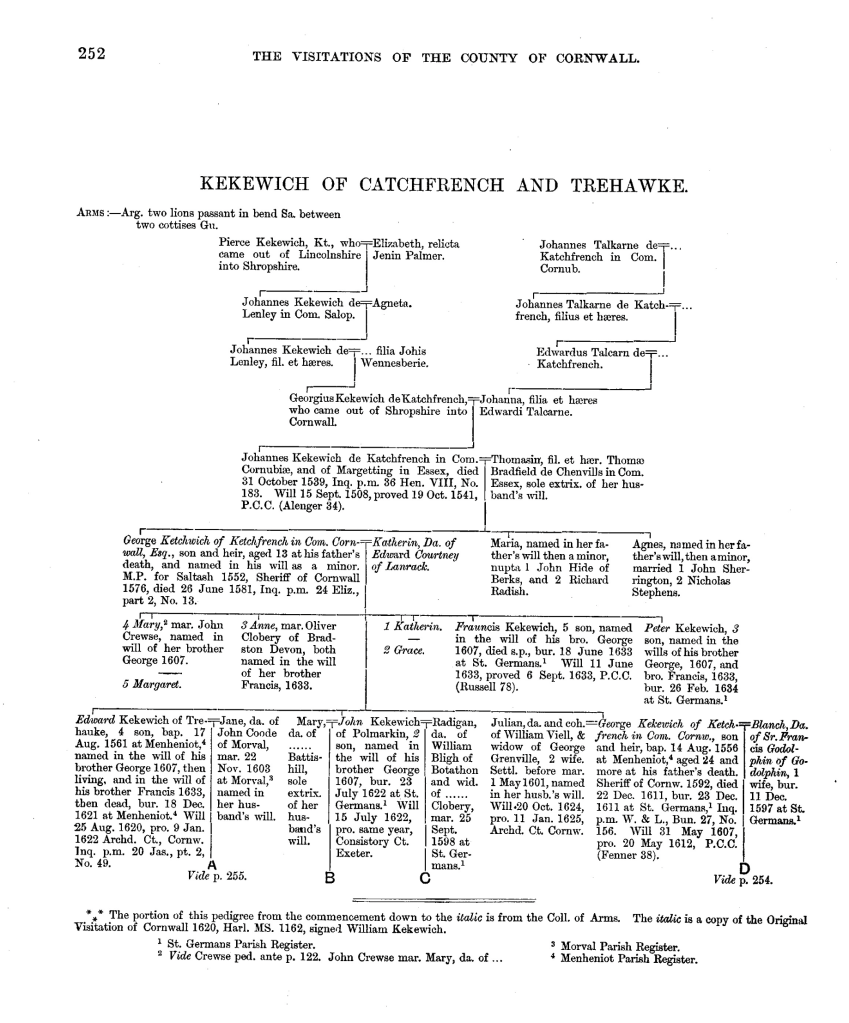
The Herald’s Visitation of Cornwall gives us the Kekewich family tree for that period.
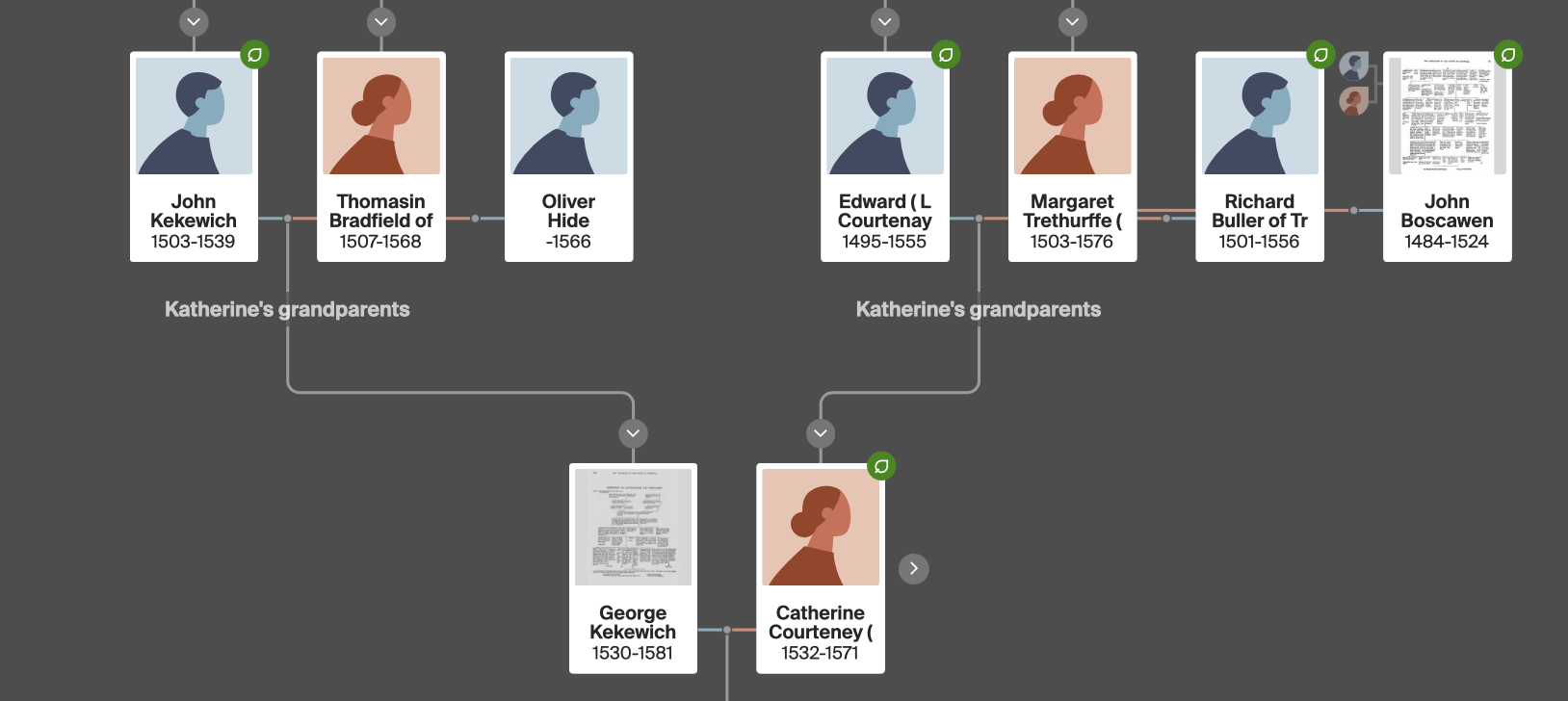
George Kekewich married Katherine/Catherine Courtney, descended from an aristocratic family. Her mother Margaret, daughter of Thomas Trethurfe, was one of the co-heirs of Edward Courtenay, Earl of Devon. Margaret married three times; first to John Boscowen, second to Edward Courtenay of Landrake and third to Richard Buller of Tregarrick.
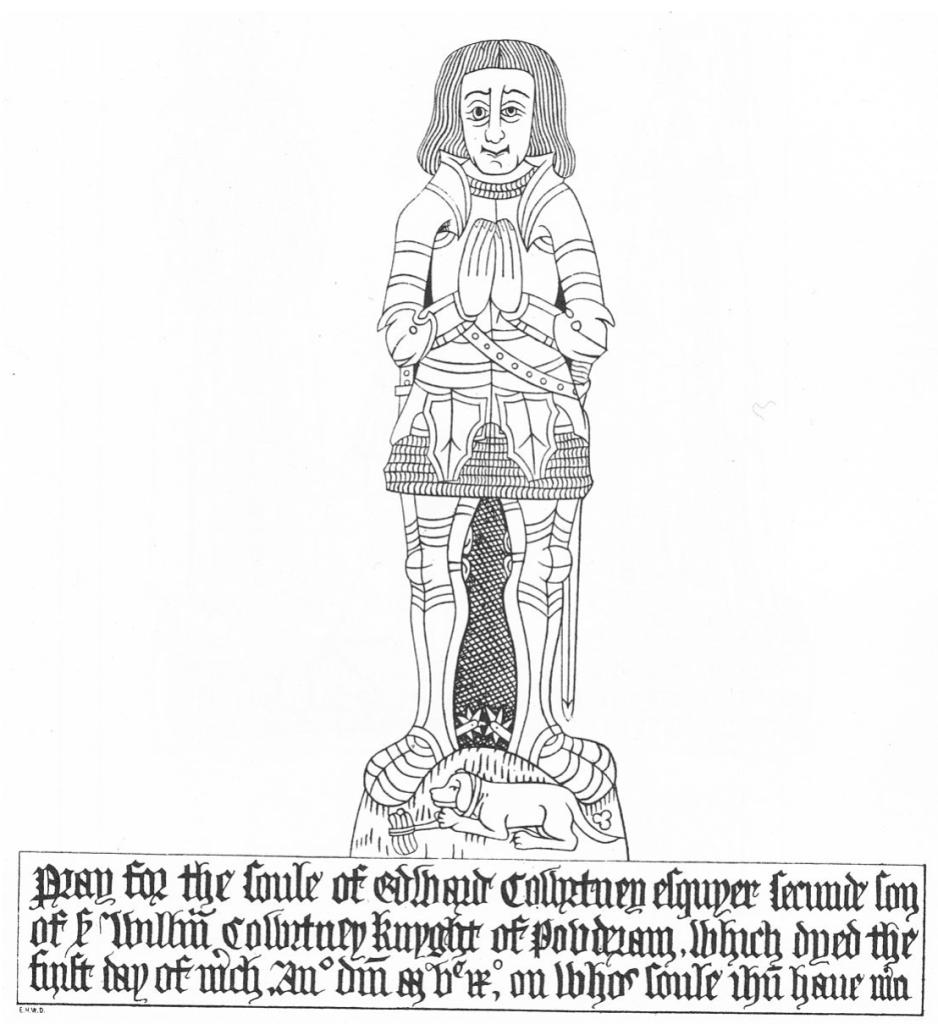
Edward Courtenay 1509 brass – Dunkin, E.H.W. The Monumental Brasses of Cornwall, 1882, Plate XXIKekewich – Courtenay family tree
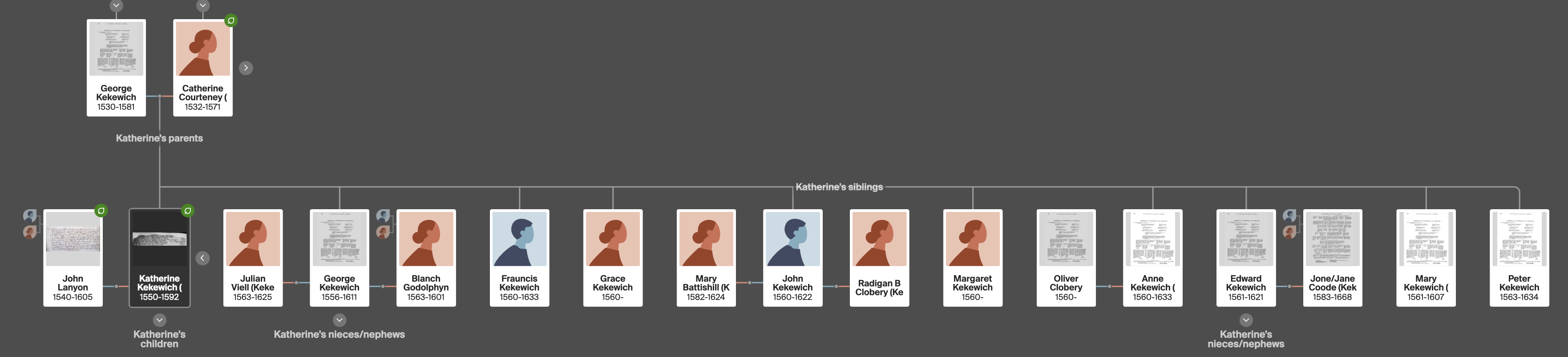
George and Katherine Kekewich had several children but we’re interested in their first born daughter Katherine and their fourth son Edward. Edward Kekewich of Trehawke was baptised on the 17 Aug 1561 at Menheniot, he married Jane, the daughter of John Coode of Morval on 22 Nov 1603 at Morval. Edward was buried at Menheniot on 18 Dec 1621. Edward and Jane’s second son, Peter Kekewich, was born in 1605 and he was the man involved in litigation with the Neilder family.
The children of George & Catherine Kekewich
National Archives document C9/47/58 Neilder v. Kekewich 1668 states that Nicholas Honey on behalf of his stepchildren, Oliver and Elizabeth Neilder, who were under 18 started the litigation. Honey stated that in 1657 Oliver Neilder was 83 years old (giving him a birthdate about 1574) and he was blind and decayed in memory. Honey alleged that Peter Kekewich and his brother-in-law Roger Porter were not related to Oliver Neilder and had conned the elderly man.
Peter Kekewich and Roger Porter (the husband of Peter’s sister, Elizabeth) responded that Oliver wasn’t quite so blind or so poor in memory, despite his age. They also pointed out that Oliver Neilder’s wife Elizabeth (Lanyne) was cousin germane to Peter Kekewich and Roger’s wife. (National Archives C10/178/69 & C8/352/249)
A cousin germane is a first cousin so Elizabeth Neilder (Lanyne) must have been the daughter of one of Edward Kekewich’s sisters. Edward had five sisters: Katherine, Grace, Anne, Mary and Margaret. We know that Anne married Oliver Clobery of Bradston, Devon and Mary married John Crewse so we can discount them.
That leaves Katherine, Grace and Margaret as possible mothers. George Kekewich’s will of 1581 is in the National Archives (PROB 11/64/488) and it shows that his eldest daughter Katherine/Catherine had married a Lanyon.
His will states that his daughter “Cate Lanyan have the sixe pounds thirtene shillings Fower pence given her by her grandmother Buller and three poundes sixe shillings eighte pence for to make the whole somme Tenne poundes.”
PROB 11/64/488
So ‘Cate’ had married a Lanyon, but which one?
Richard Carew’s ‘Survey of Cornwall’ states:
“Diverse other Gentlemen there dwell in this Hundred: as Lanyne the husband of Kekewich his father married Militon and beneath s. a castle a. standing in waves b. over the same a falcon hovering with bells o.”
Richard Carew National Trust, Public domain, via Wikimedia Commons
We know that John Lanyon (the son of Richard Lanyon Esq) married Phelype Militon on 18 Jan 1562 at Breage. Their eldest son Francis married Alice Trewren in 1584. John & Phelype’s second son William married Jane at Sancreed in 1592. There is one other son, John who is described as the son of John Lanyon esq. and he was buried at Madron in 1587, he appears to be a child but his age isn’t given. Phelype Militon was buried 29 Dec 1578 at Breage.
So which ‘son’ of John Lanyon married Cate Kekewich?
John and Phelype’s son Francis was born at the earliest in 1563 and he married Alice Trewren in 1584. He was still married to her at the time of his death in about 1593. Cate Lanyon was named in her father’s will which was dated 1581 so whilst it was just about possible for Francis to have married her when he was aged 17 or 18 years old she would have to have died before 1584, when he married Alice. There is no evidence that Cate Lanyon was buried at this time. Francis did have an illegitimate daughter called Elizabeth who was baptised in 1587 however I think it highly unlikely that Cate Kekewich would have had an illegitimate daughter who was later described as a cousin germane by her nephews. I think we can safely disregard Francis as a possible husband to Cate and father to Elizabeth Neilder.
That leaves his second son William Lanyon as a possible candidate. We don’t know when William was born but it must have been 1564 at the earliest and it could have been a few years later. The oldest he could have been was just 17 and that’s if Cate married the same year as the will was written. If she was married a year or two before that William would have been only 15 or 16. We don’t know when Cate was born but she was the eldest daughter of George Kekewich and Katherine Courtenay. Their date of marriage is suggested as 1555 at Landrake, in Cornwall. We know that their eldest son and heir was baptised on 14 Aug 1556, it seems likely that Cate was born soon after. Her mother Katherine Courtenay died in 1571 so all nine children must have been born before that date. This makes Cate several years older than William Lanyon.
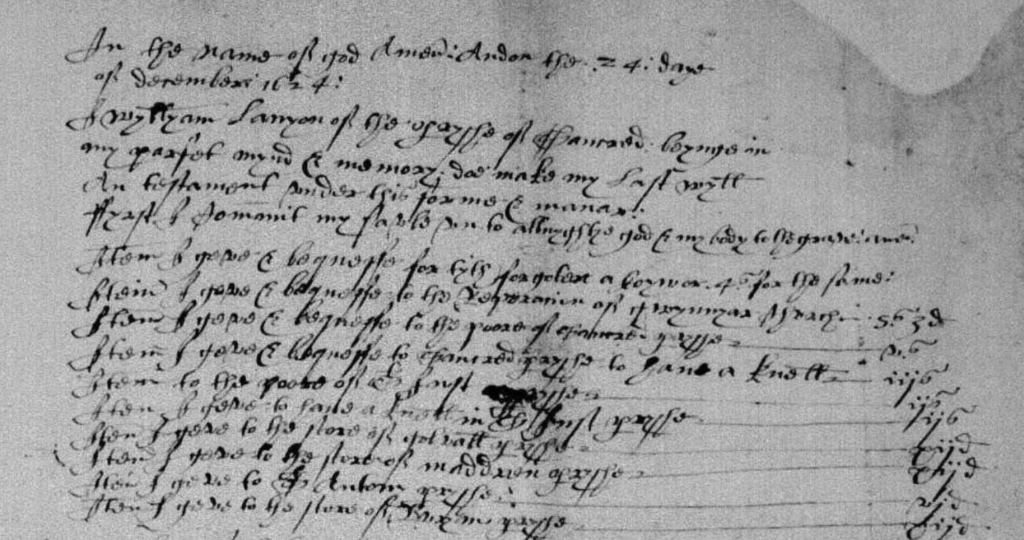
William Lanyon did marry a woman called Jane at Sancreed in 1592 and they had six children. He died in 1624 and his will survives and names his children. He had two daughters, both called Elizabeth! The eldest was born in 1593 after his marriage to Jane so Cate couldn’t be her mother. The youngest was born in 1607 and would be too young to marry Oliver Neilder in 1615.
William Lanyon’s 1624 will naming his children
George Kekewich was an MP for Saltash and Sheriff of Cornwall, Katherine Courtenay was descended from an aristocratic family, would they have married their eldest daughter to a teenage second son?
It seems much more likely that Cate Kekewich married the recently widowed John Lanyon, the eldest son and heir to Richard Lanyon Esq and the head of the Lanyon family.
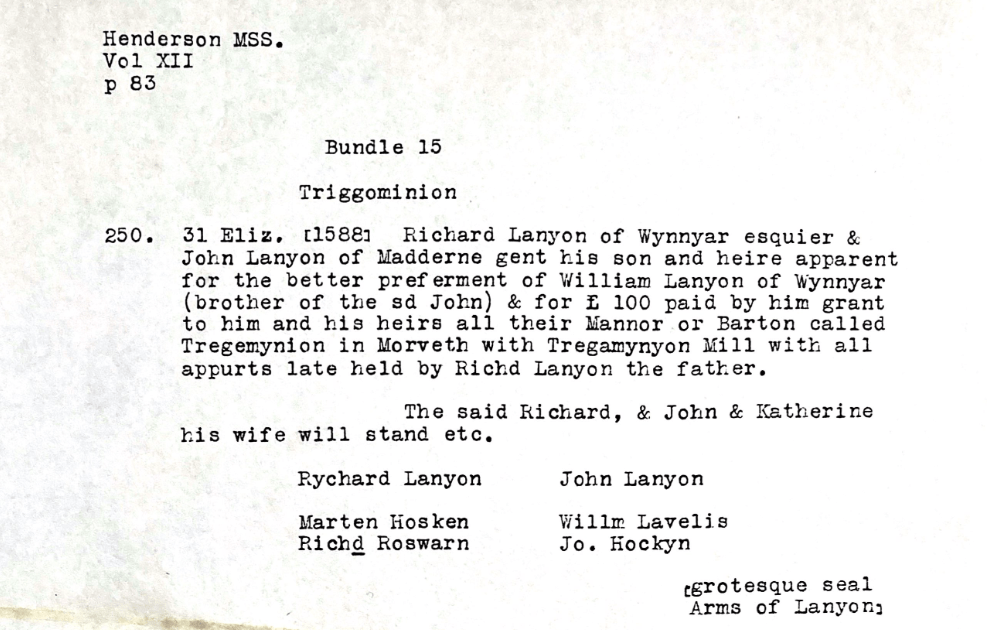
Whilst there is no record of a marriage for John Lanyon and Cate Kekewich there is a record which may help prove the relationship. In 1589 Richard Lanyon Esq and his eldest son John sold Tregemynion in Morvah to Richard’s fourth son William. The agreement is signed by Richard, John and Katherine his wife. (Hendersons MSS Vol XII p.83)
Abstract from Hendersons MSS
So it appears as though sometime after 29 Dec 1578, when Phelype Militon died, and before 1581 when George Kekewich’s will was written, that John Lanyon married for a second time to a woman named Katherine.
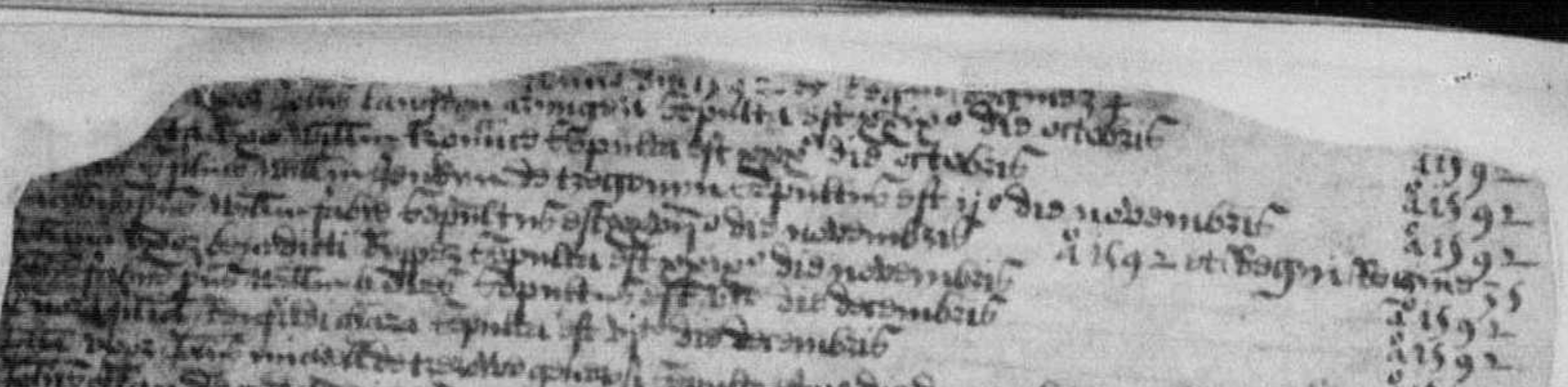
Breage parish register also has an interesting entry for a burial. On 29 Oct 1592 there is the following entry ‘uxor Johis Lanyon armiger’. Sadly the page is damaged so the wife’s name is not legible but John Lanyon, who has the right to bear arms, buried his wife. There is only one John Lanyon who has the right to bear arms at this time.
Breage Parish Register Burials
There are no records of any children of this marriage being baptised or buried. However looking at the wills of Cate’s brothers gives us some more clues. George Kekewich the younger’s will was written 22 Jun 1607 and proved 20 May 1612. It states:
“I give the blynde Lanian, my kinsman xx s a year towards his mayntenance untill my heire accomplish the age of xxj years.”
National Archives PROB 11/119/518
So Cate’s brother had a ‘kinsman’ called Lanian who was blind.
Cate’s brother Francis also left a will which was written 20 May 1633 which states:
“I give George Lanion twenty shillings a year during my lease of Manoby with the proviso that he wander not the country as a beggar contrary to God’s and Man’s laws. Hoping the rest of his friends will make up the rest that must be paid for his board.” (National Archives PROB 11/164/299)
So it appears as though Cate Lanyon had a son called George who was blind. He’s not mentioned in any Lanyon wills however most of the 16th century Cornish wills were destroyed during World War II bombing.
There is no record of a baptism, marriage or death of George Lanyon and we wouldn’t know anything about him but for these wills. None of the wills mentions Elizabeth Lanyne or Oliver Neilder.
Whilst none of this is actual proof that Elizabeth Neilder was the daughter of Katherine Kekewich and John Lanyon Esq it’s probably as close as we’ll come.
We know what happened to Elizabeth, she died an old woman in Menheniot. Perhaps ‘Blynde George’ lived out his life with her?
The opera singer Cecile Lanyon performed in England and Australia in the 1940s and 50s but who was she?
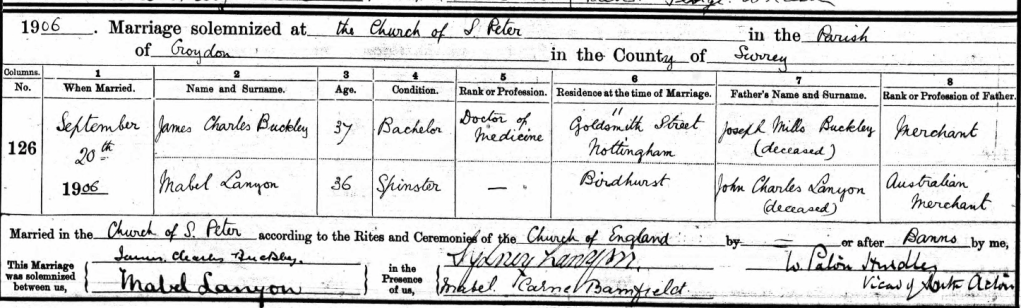
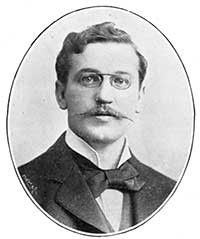
Cecile was the daughter of Mabel Lanyon and Dr. James Charles Buckley. They married at Croydon on the 20 Sep 1906 (the groom’s brother Rev W.F Buckley married them).
Marriage certificate of Mabel and James
James Charles Buckley
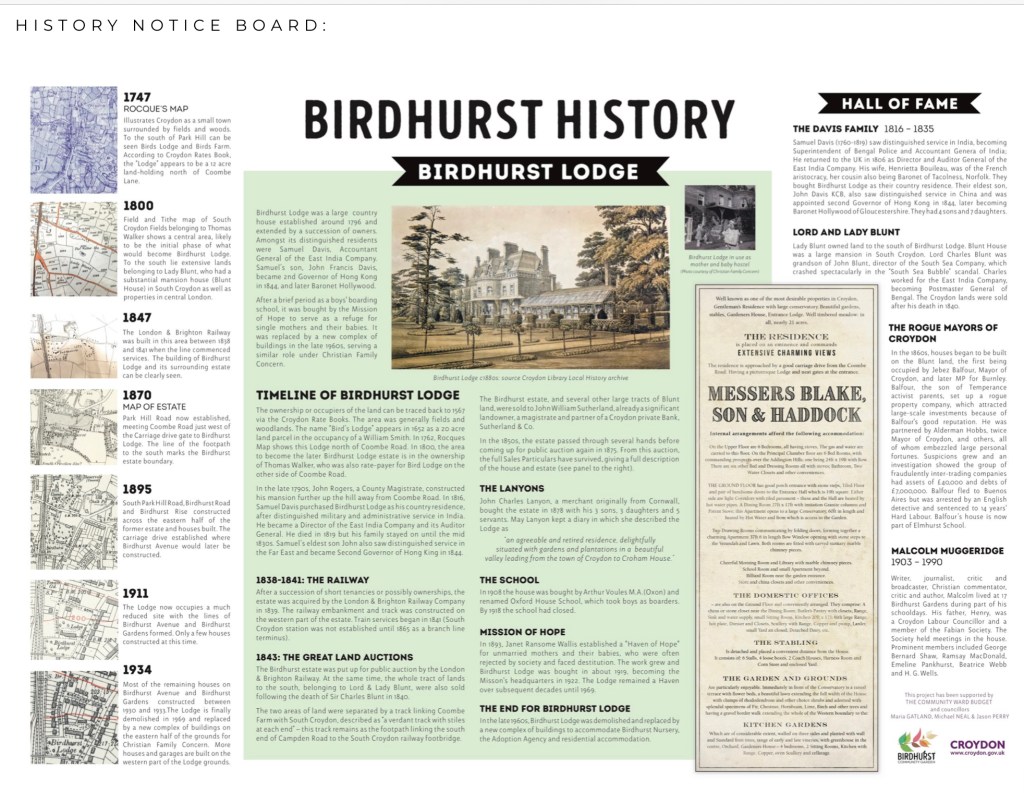
Mabel was the younger daughter of John Charles Lanyon of Birdhurst, Croydon.
Birdhurst
Mabel’s first child, John Charles was born in Jun 1907 and a daughter Joyce Catherine Stacey Buckley arrived in 1911.
Joyce’s baptismal name
Stacey was a family surname and perhaps the name Catherine came from Mabel’s sister-in-law Catherine Septima Lanyon.
Joyce was born and raised in Nottingham where her father worked as a Doctor and venereologist. We don’t know much about Joyce’s early life but the 1939 register lists her as a musician’s singer.
In 1940 she appeared at the Gaiety Theatre in The Magic Flute as The Queen of the Night and her name is listed as Cecile Lanyon.
She chose her mother’s maiden name ‘Lanyon’ as her stage name and adopted the name Cecile.
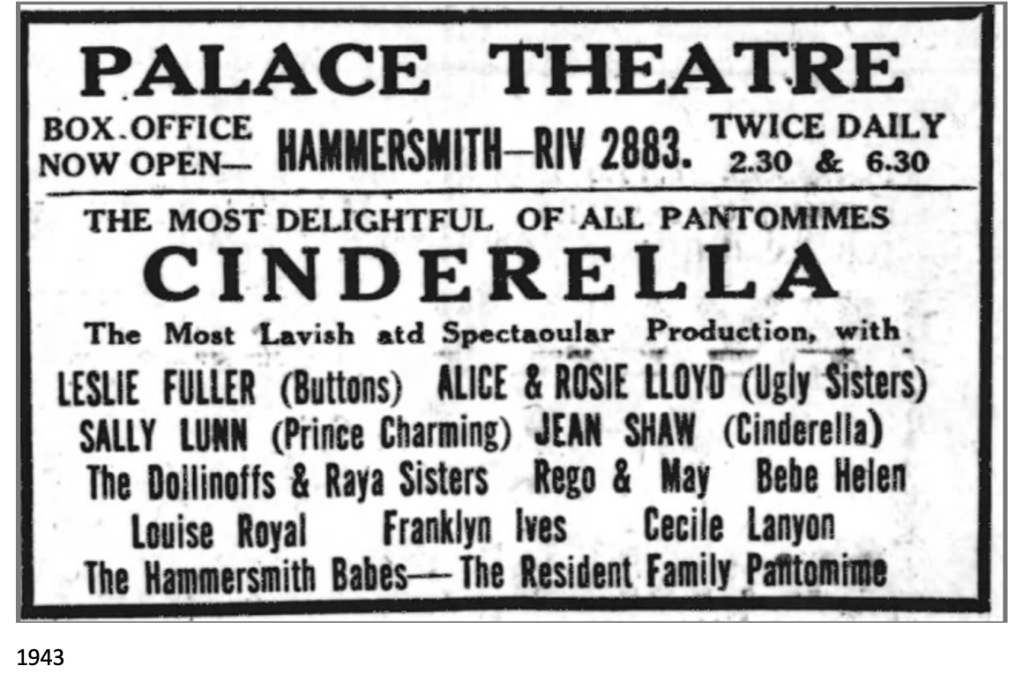
In 1943 she was in Cinderella at the Palace Theatre, Hammersmith.
Her mother Mabel died in 1944 and her father the following year. We don’t know when or where she met William Montgomery but by 1948 she had decided to marry him.
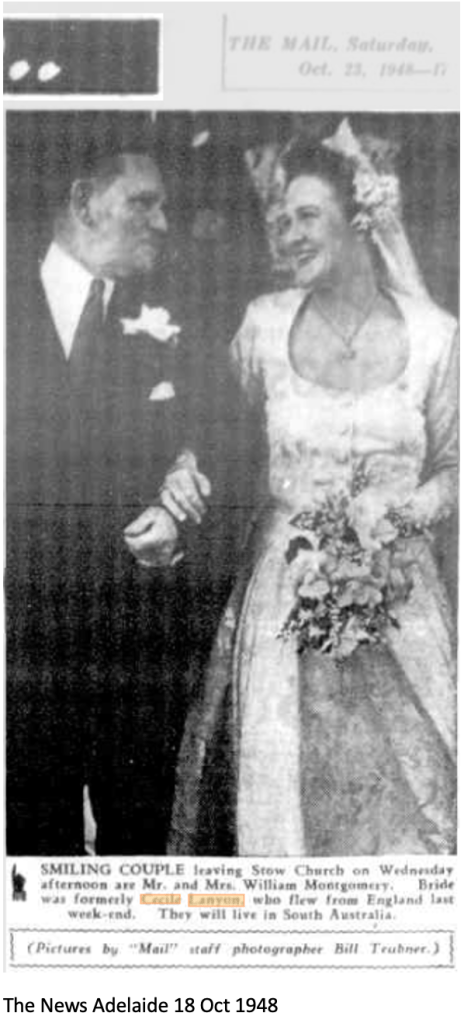
In 1948 Cecile married William Conway Montgomery. She had emigrated to Australia the previous weekend! Their photo appeared in the News Adelaide on 18 Oct 1948.
William Conway Montgomery was born in Ceylon on 17 Sep 1895.
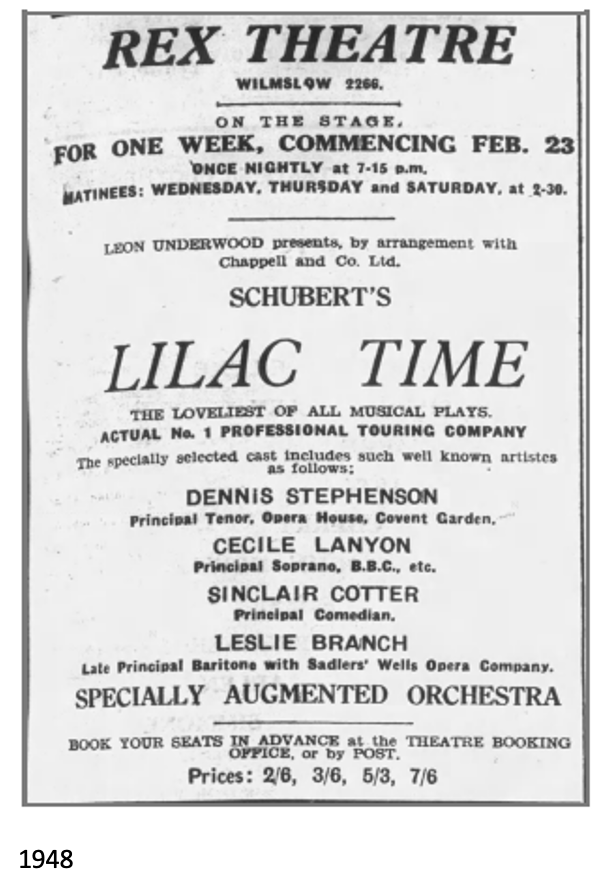
In 1948 she was described as ‘principal soprano’ for a performance of Schubert’s ‘Lilac Time’. The credits also mention BBC so perhaps she had also performed for them.
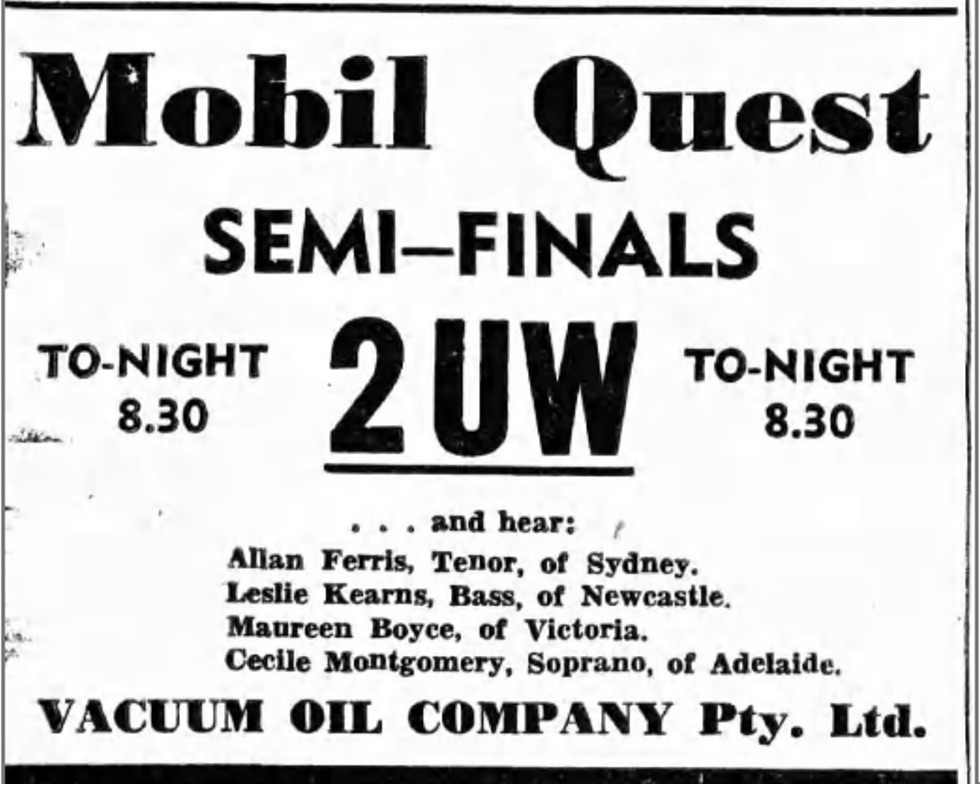
By 1949 she had changed her stage name to Cecile Montgomery.
1949
William died in Colombo, Ceylon in 1958. For the rest of her life Cecile lived with a friend and bred dogs.
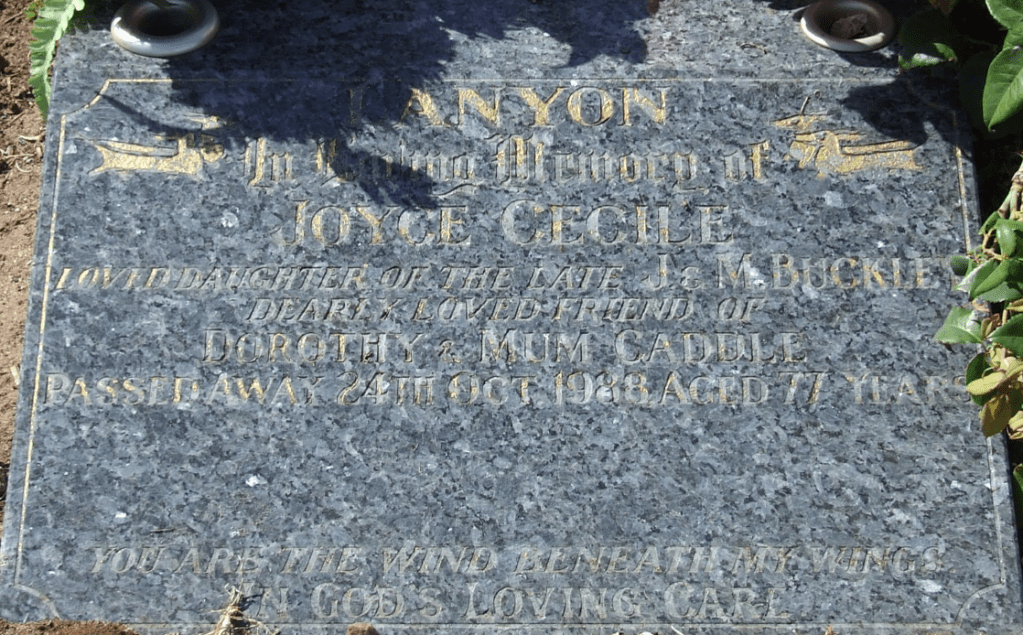
She died in at Burnside City Australia on 24 Oct 1988 aged 77 years.
On her headstone she is named as Joyce Cecile Lanyon, loved daughter of the late J&M Buckley.
With thanks to Peter Duke of the Nottingham Family History Society who gave me the story.
1569 was the year the first lottery was held in England, the prize was £5000. It was also the year Mary Queen of Scots was first imprisoned and of the Northern Rebellion against Elizabeth I.
Mary Queen of Scots François Clouet, Public domain, via Wikimedia Commons
It was also an important year for the Lanyon family.
In 1567 William Laniene esq died. We don’t know his date of birth but his eldest son was born about 1516 and he had older sisters so it is estimated that William was born in the 1480s. There is an Inquisition Post Mortem of William Laniene of Coswynwollard, Gwinnear from 1586 which gives the date 20 Mar 1567 as the date of his death. This Inquisition gives his son Richard’s age as 70 (in 1586), so he was already 51 when he inherited his father’s estate in 1567.
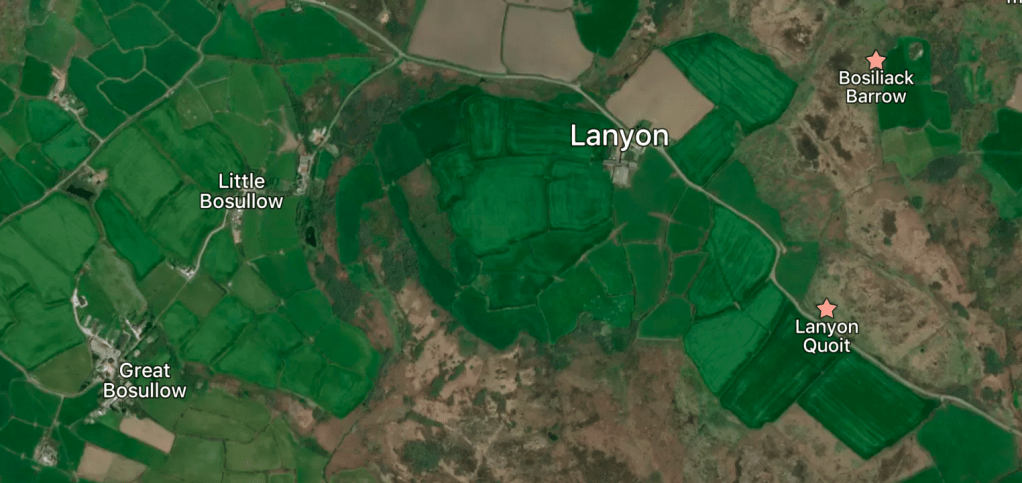
In 1562 at the time of his son John’s marriage to Phelype Myliton, Richard was living at Tregaminian in Morvah. In 1567 he moved to Coswynwollard in Gwinear (now called Lanyon.)
Map of the Lanyon Estate at Gwinear
We don’t know which lands, if any, William Laniene senior intended for his sons as there is no will. In 1569 Richard granted estates to his brothers.
William ‘Generosi’ Lanyon
Richard’s brother William had been living at the family estate in Gwinear. His first wife Tamson was buried there on 26 Jun 1563. His son Baldwin was baptised at Gwinear on 1 Apr 1561 and buried 24 Jun 1563 just two days before his mother.
William was given the estate Tregonen at Breage. He appears on the Breage Muster Roll of 1569 ‘Furnished long bow sheaf arrows steel cap and black bill’ and he lived there until his death in 1597. His burial is listed in the Breage parish register where he is described as ‘generosi’.
Tregonning Hill near Breage which may be the location of Tregonen
Walter Lanyon
Walter married Elizabeth Nanspyan of St Erth. He is listed on the 1569 Muster Roll for St Erth ‘Bow shaft arrows, ability B’. His father owned land at St Erth as it is listed on the 1523 Penwith Subsidy Roll as having a value of 41 shillings (the same as the Gwinear estate.)
In 1569 he was given the tenancy of the Barton of Lanyon (the ancestral family home) at Madron by his brother Richard. Hendersons MSS 30534 pt 7 gives details of the lease and confirms the names of Walter’s son (John) and three grandsons (Francis, Alexander and David) also their ages.
The ancestral home at Lanyon near Madron. Bosullow was also part of the estate.
Edward Lanyon
The only record we have of William Lanyon having a son called Edward is a record from Kresen Kernow (Cornwall Record Office) AR/3/39 dated 11 Feb 1586. It’s a lawsuit over Crugmoreck in St Merryn.
“…..that Richard Lanyen esquire, on 20 September 1569 (11 Elizabeth), had granted to party (1-Edward Lanyen) 30 acres of land, being one close called Crukemorecke (parish of Seynt Meryn), for (1) to hold for term of 6 years from St Bartholomew last past [24 Aug 1569]; on the following 26 Sep [1569], (2-George Arundell)-(3-John Michall) forcibly entered the tenement and ejected him from it…”
The case goes on to mention that the sheriff of Cornwall Peter Edgecombe esq was a kinsman of Edward. Peter was the son of Joan Tregian the daughter of Thomas Tregian and that Edward was the son of Thomasine Tregian the daughter of Thomas Tregian.
We don’t know what happened to Edward after 1586. We don’t know if he had any children. All we know is that Richard Lanyon esq granted him the lease of the estate in Crugmoreck in 1569. There is an Edward Leyne on the Padstow muster roll of 1569 ‘bow 6 arr, ability a-ar’. Could this be the same person?
We don’t know where Crugmoreck lies today but the Lanyons owned lands at Harlyn, St Ervan, St Merryn and Padstow. Perhaps Crugmeer is the location?
Every family has a ‘fruitcake’, this post is about ours!
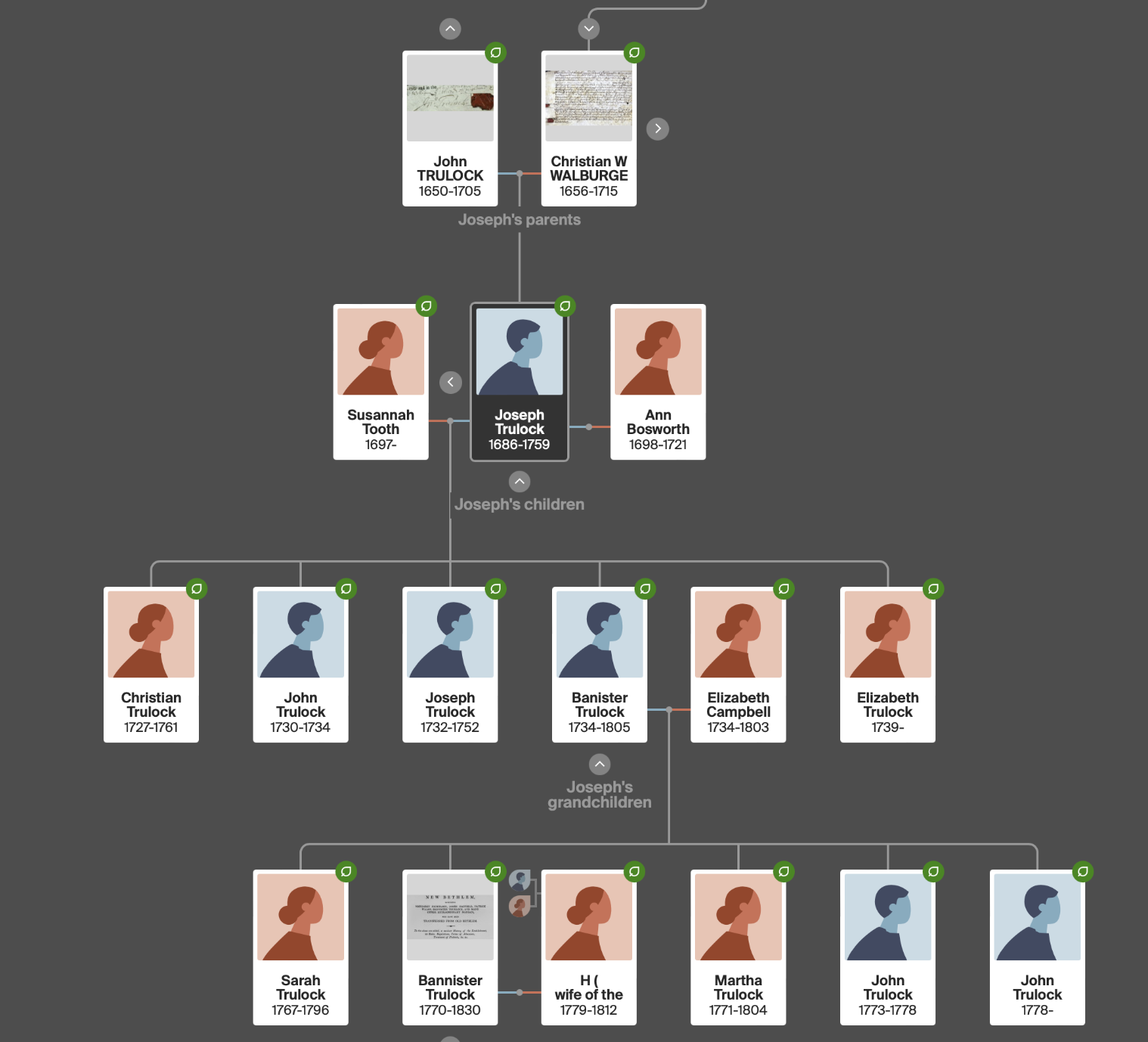
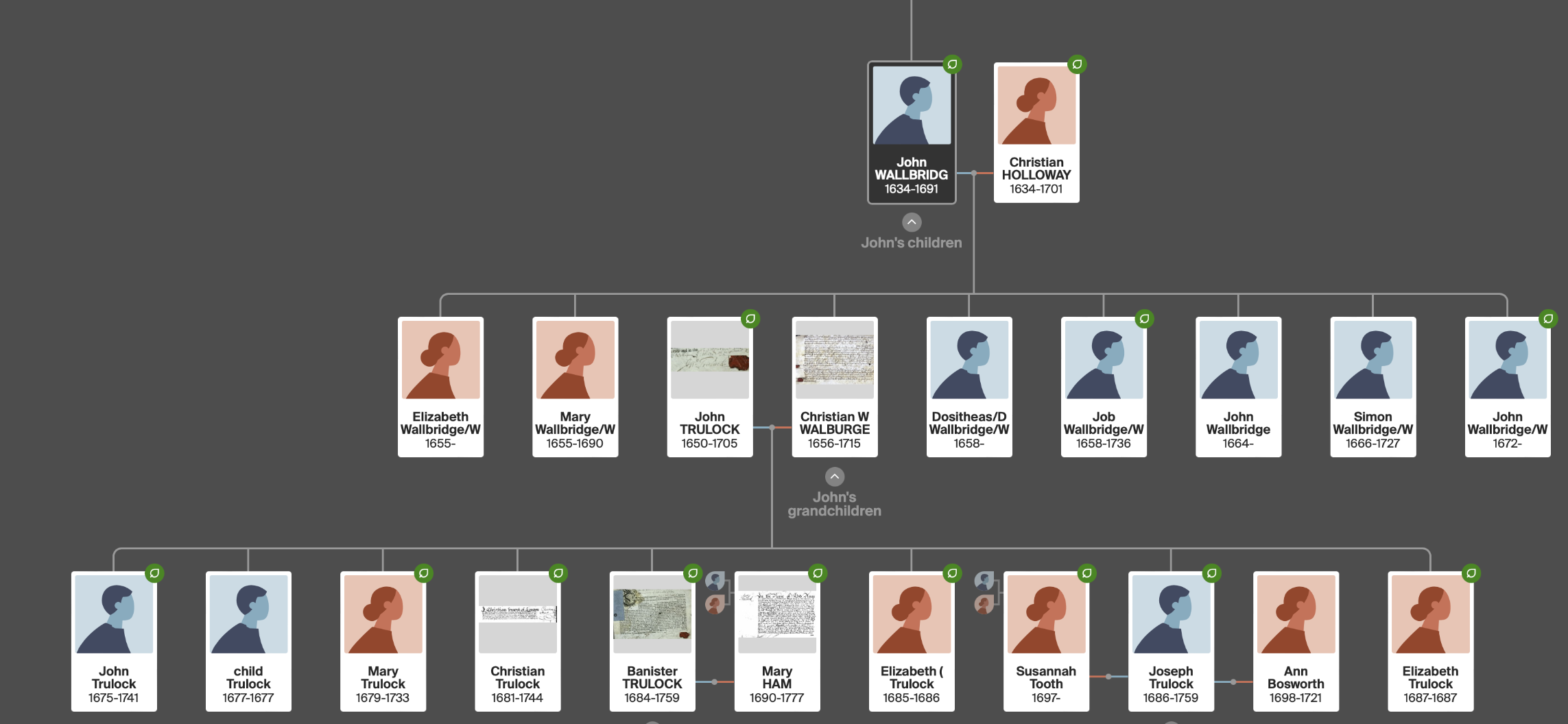
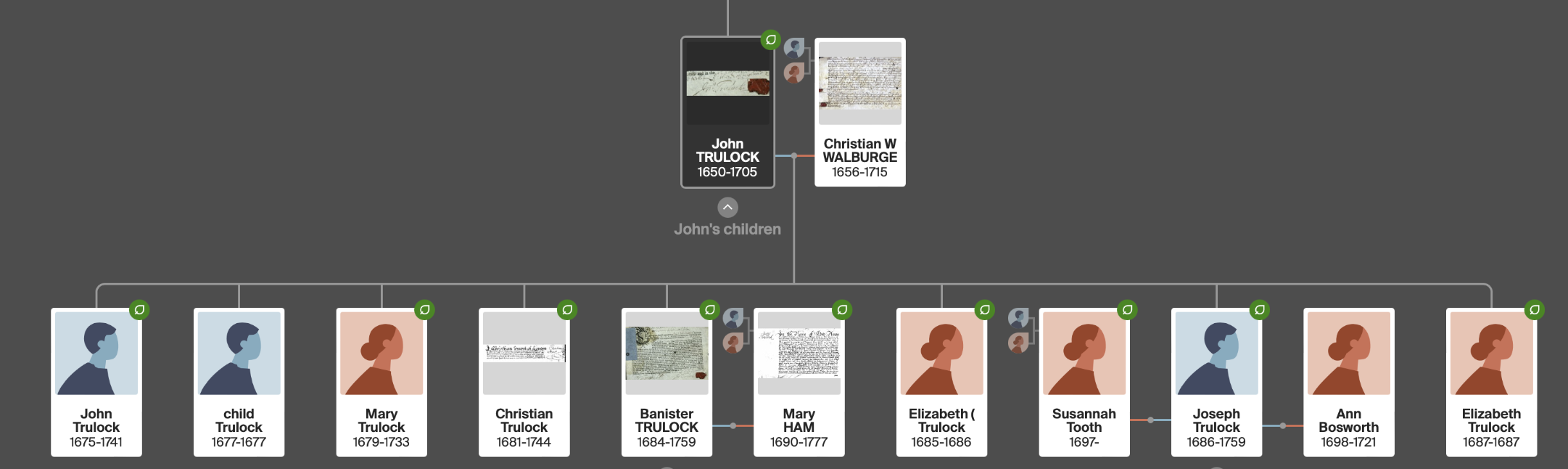
John Trulock and Christian Wallburge were the great grandparents of Banister Trulock born in 1770.
Their son Joseph Trulock married Ann Bosworth on 25 Feb 1719 at St Benet Paul’s Wharf, London. Ann sadly died in Sep 1721 and Joseph remarried on 07 Jun 1722 • St. Anne’s Church, Lewes, Sussex to Susannah Tooth.
Their first two sons John and Joseph died young and that left their third son, Banister as the eldest son and heir.
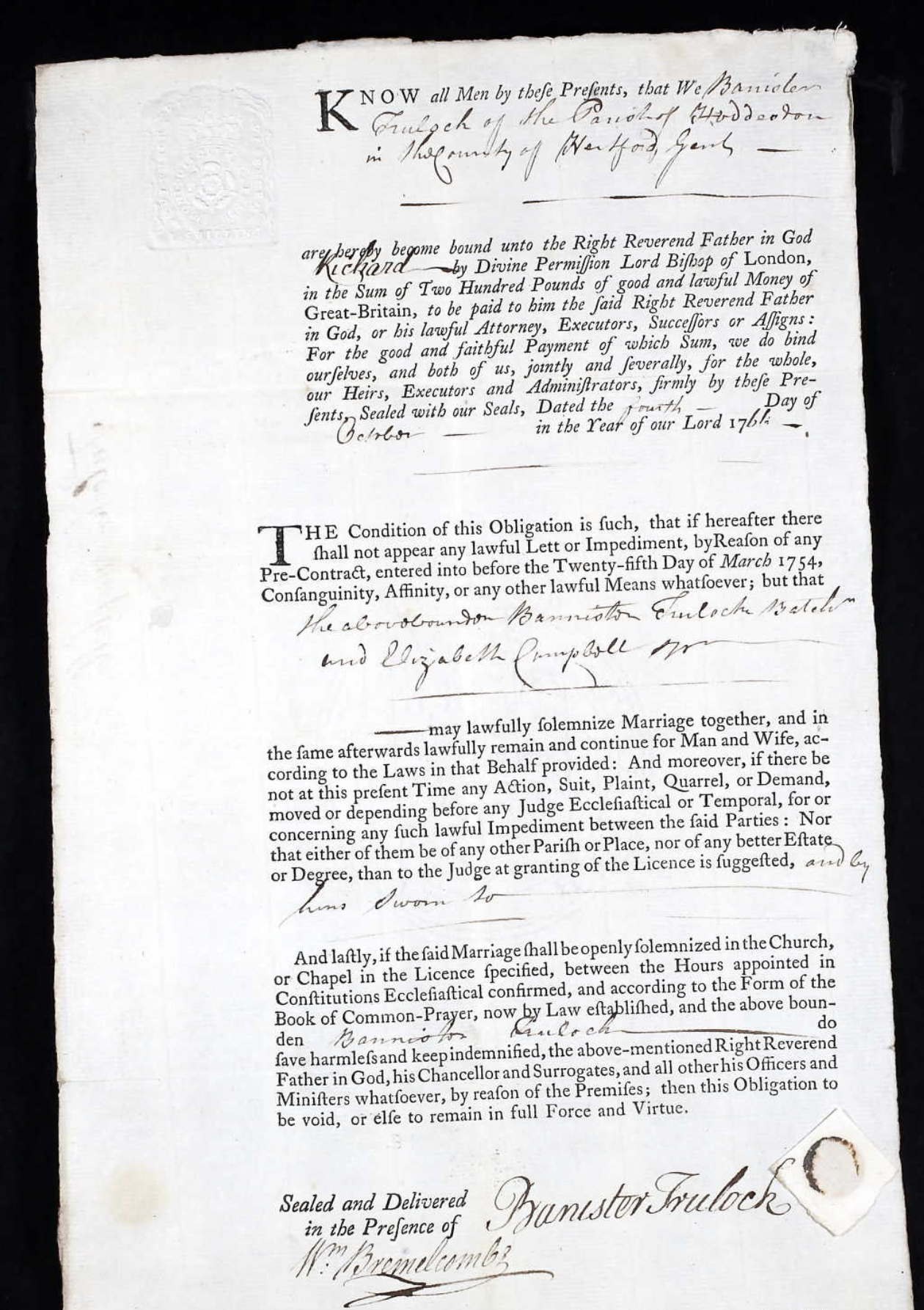
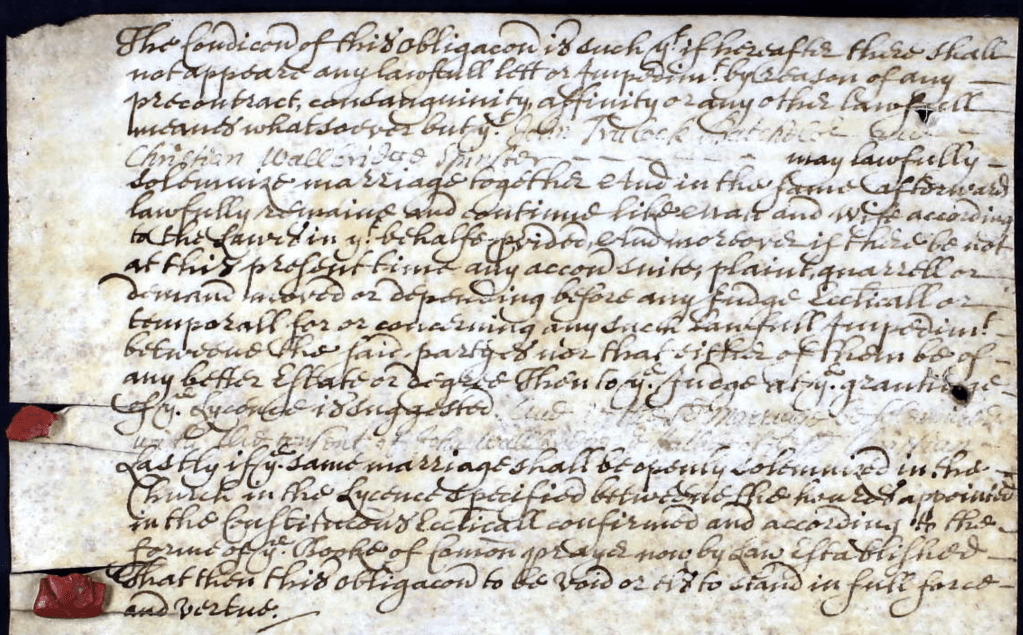
Banister was born about 1734 in East Grinstead. He married Elizabeth Campbell 05 Oct 1766 at Broxbourne, Hertfordshire. He signed a marriage bond.
London and Surrey Marriage Bonds DL/A/D/24/MS10091E/79
Their son also called Banister was born about 1770 at Hertfordshire. In 1783 Banister was apprenticed to John Payne a cordwainer in East Grinstead, Sussex. His father is described as a husbandman.
(The name Banister and Trulock are variously recorded as Bannister, Banester and Truelock.)
Before 1799 he married Ann/Hannah and they had two sons: Banester who died age 4 and William Henry who was baptised in 1812.
Banister was a religious fanatic who prophesied the second coming of the messiah. He also insisted in the belief that the Messiah would be born from his mouth!
“He met Hadfield by accident in White-Conduit Fields, and talked the unfortunate fellow into a persuasion, that the first step to the commencement of his doctrines, and to its fulfilment in a happy change of things throughout the world, would be the death of the Sovereign ; with this view, Hadfield set out as the supposed chosen instrument for the accomplishment of the great design. Hadfield, in his examination, mentioned this man’s name ; he was accordingly apprehended the next day, underwent several examinations, and was committed to prison ; but from his incoherent manner, his answers, and the evidence of his mother, he was found to be deranged, and was sent ultimately to Old Bethlem.By May 1800 he was working as a shoemaker and living in the White Lion, Islington, London. Whilst there he was visited by James Hadfield, whom Trulock encouraged to try to assassinate King George III. ”
He was lodging with Sarah Lock until Dec 1799, she evicted him after he told her on Christmas Eve that there was a plot to assassinate the king. (Source: Hampshire Chronicle, 2 Jun 1800)
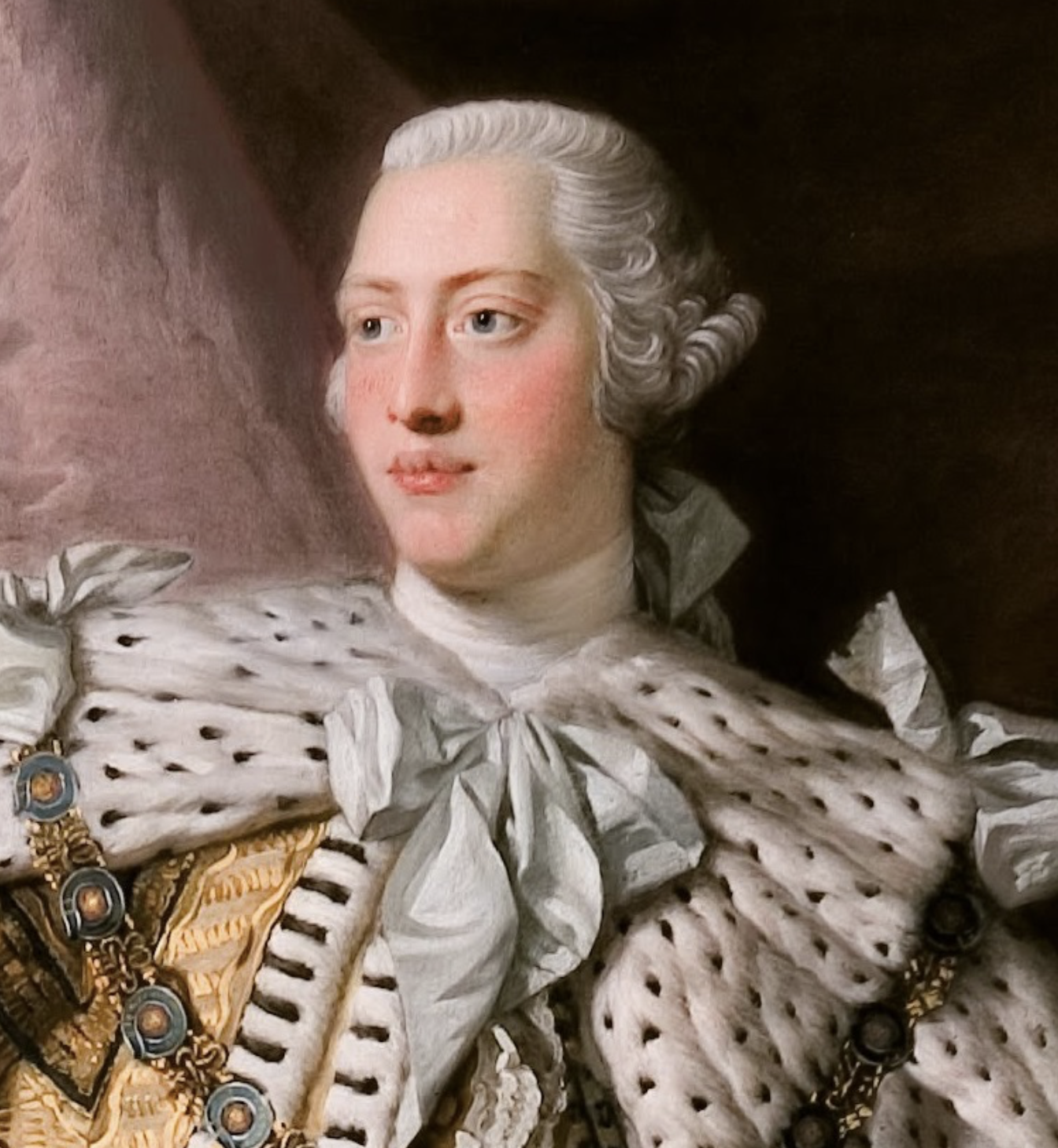
George III – Studio of Allan Ramsay, Public domain, via Wikimedia Commons
The Assassination Attempt
At the Theatre Royal, Drury Lane, on 15 May 1800, James Hadfield tried to shoot King George III while the national anthem was being played, and the king was standing to attention in the royal box.
It’s reported that after missing his target, Hadfield then said to the king:
‘God bless your royal highness; I like you very well; you are a good fellow.’
Hmm, we’re thinking that his words might be a very good examples of quick thinking…
Hadfield went on trial for high treason but, after listening to evidence from three doctors as to Hadfield’s state of mind, the judge decided on an acquittal, with the proviso that Hadfield would be detained indefinitely at his majesty’s pleasure.
Hadfield died from tuberculosis in Bethlehem Hospital (i.e. ‘Bedlam’) in 1841.
Chester Chronicle – Friday 27 June 1800
Banister Trulock was apprehended the next day and was committed to prison ; but from his manner, his answers, and the evidence of his mother, he was found to be deranged, and was sent to Old Bethlem.
Visitors reported that he sounded sane until he started to discuss religion. He was kept in some comfort and had an apartment at the top of the hospital which had a view of the Surrey hills. He had ‘coal, candle and every convenience for his use; his provisions are regularly brought to him and in the fine weather he is permitted to walk in the garden.’
He was later moved to New Bethlem hospital.
Visitors to Bethlem could pay to ‘view’ the patients and Banister Trulock was one of the celebrated patients.
Visitors to Bethlem – British Museum, Public domain, via Wikimedia Commons
Banister died on 02 Nov 1830 at Bethlehem Hospital, St Saviour Southwark, London
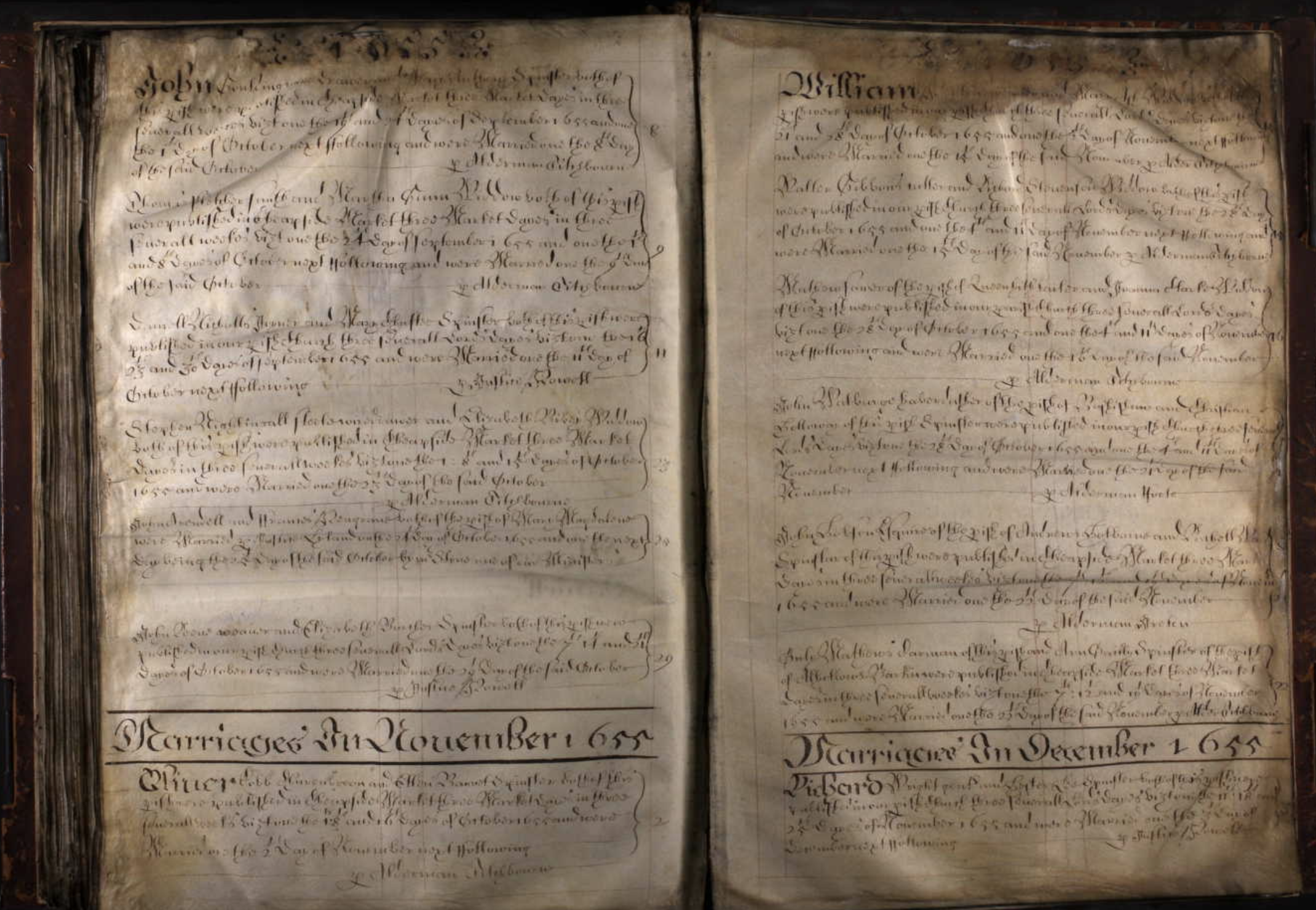
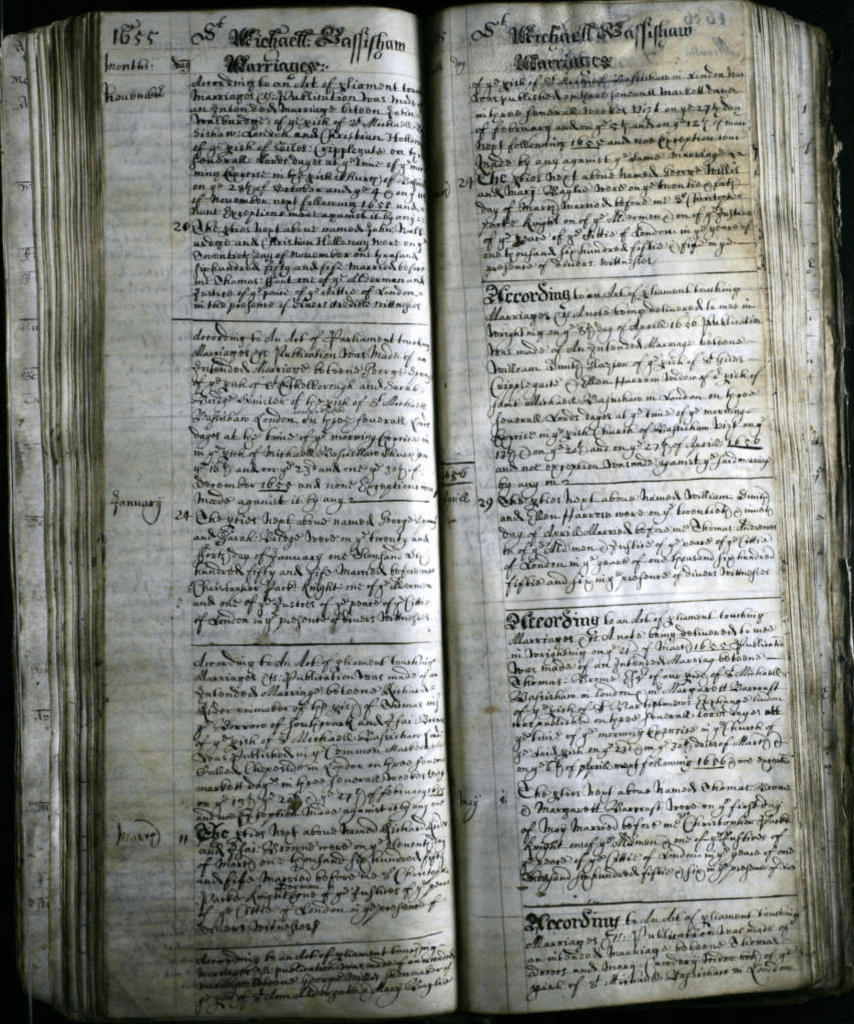
John Walburge was born about 1634. We don’t know where he was from. He was a haberdasher who married Christian Holloway on 20 Nov 1655 at St Michael Bassishaw, City of London and again on 21 Nov 1655 at St Giles Cripplegate, City of London! Perhaps the marriage was recorded in both home parishes?
(The name Walburge is variously spelt: Walburge, Walburghe, Walbarge, Wallbridge.)
St Giles Cripplegate Parish RegisterSt Michael Bassishaw Parish Register
John and Christian had several children. Our ancestor is Christian Walburge, she married John Trulock.
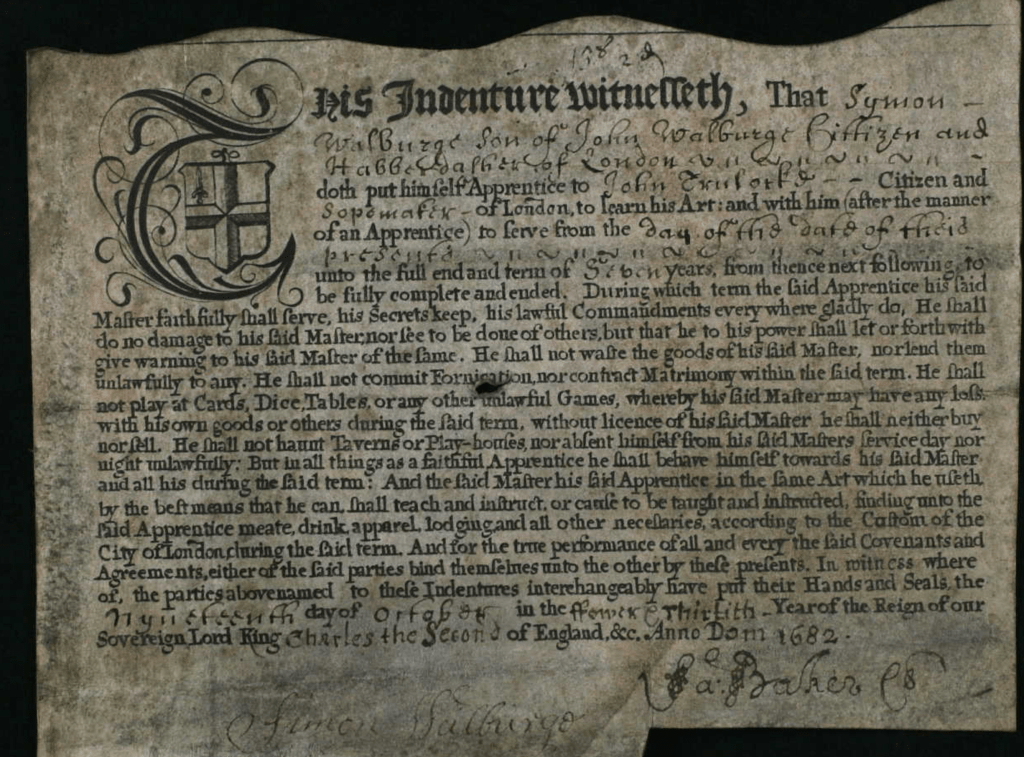
Both John Walburge and his son in law John Trulock were citizens of and had the freedom of the City of London. John Walburge apprenticed his son Simon to John Trulock, soapmaker in 1682
London, England, Freedom of the City Admission Papers, 1681-1930, London Metropolitan Archives
John Walburge died in 1690 and was buried at Bishopsgate, Middlesex. He left a will proved 29 Jan 1690. His will mentions his dear and loving wife Christian, his daughter Christian ‘now wife of John Trulock’, his house at Tottenham which has a garden and orchard. He bequeaths various tenements and messuages to his children and grandchildren. Clearly he is a wealthy man. His wife Christian (Holloway) was buried in 1701.
John Trulock
John Trulock was born about 1650 and Christian Walburge was baptised 03 Oct 1656 • St Michael Bassishaw, London. They married at St Helens, Bishopsgate, London on 27 Nov 1674.
London & Surrey Marriage Bonds & Allegations 1674
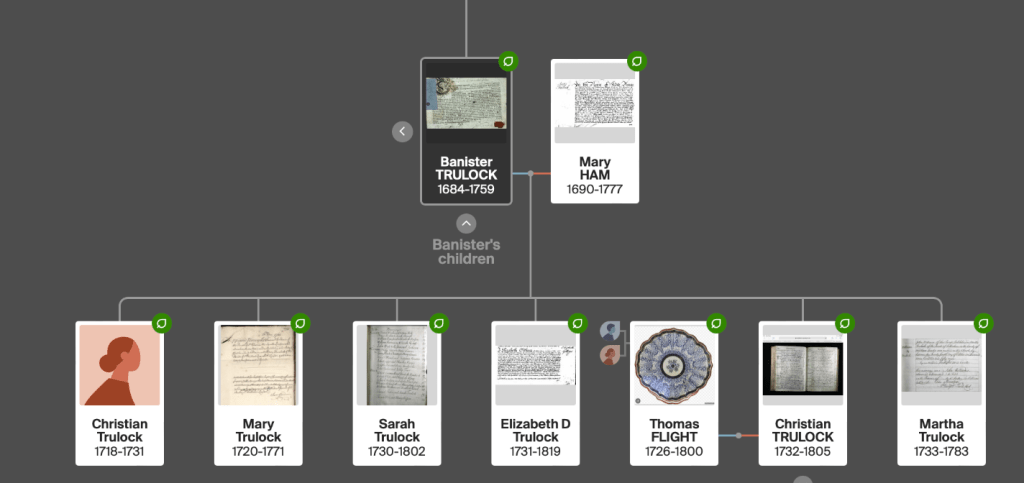
John and Christian had several children all born towards the end of the 17th century. Their son Banister Trulock was born in 1684. He married Mary Ham at St Paul’s Cathedral, London, on 23 Nov 1714.
John was buried in 1705 and Christian his wife was buried in 1715. She is recorded as being a widow who died of convulsions. Buried Tindals Ground/Bunhill Fields, London.
Banister Trulock
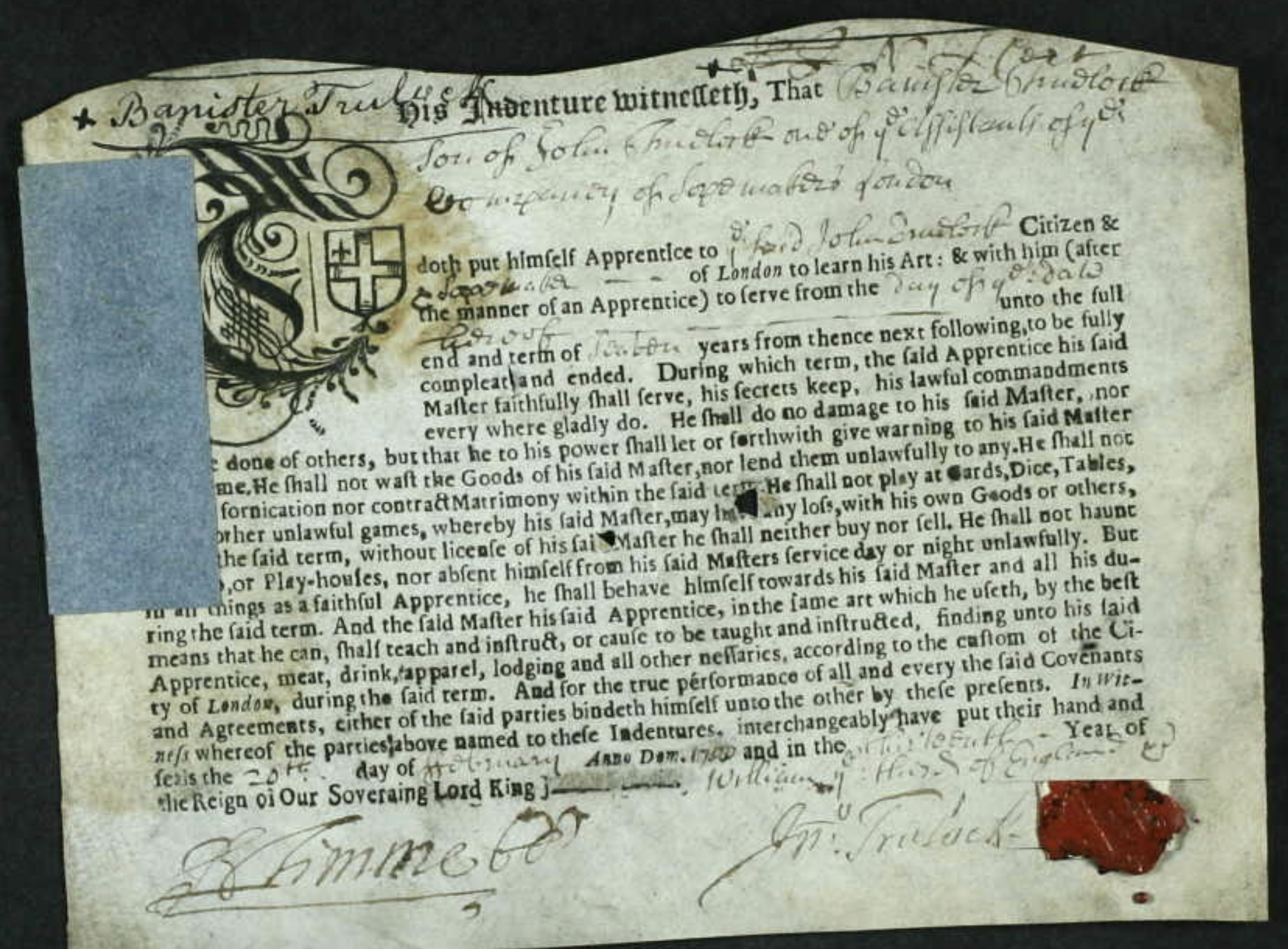
Thank goodness John and Christian chose such an interesting name for their son as it made research a lot easier! Banister was born in 1684 and was a successful soapmaker like his father. His name means: English (of Norman origin): from Old French banaste, banastre ‘covering for a cart or wagon; basket’, i.e. a large wicker container. Perhaps this had been a family surname in the past.
Banister Trulock Apprentice Indenture
In Oct 1711 Banister Trulock was the victim of a crime.
Whereas at the Sessions of the Peace holden for ye County of Midx in Febry last an Indictmt. was preferrd agt Thos Hatton of ye Pish of Tottenham High Cross in ye Sd County Yeoman & other for an Assault & Battery upon Banister Trulock These are to Authorize and require you that you enter or Cause to be entred a less at processd on the sd Indictmt. & stay all proceedings thereon agt. the sd. Thomas Hatton onely And for so doing this Shall be of Warrant Dated the 27th day of Novr. 1711
He married Mary Ham (possibly Horn) at St Paul’s Cathedral, London, on 23 Nov 1714.
Their first child was born in 1718 and the second in 1720 then there is a gap of 10 years before their third child was born. Perhaps there were more children which died in infancy.
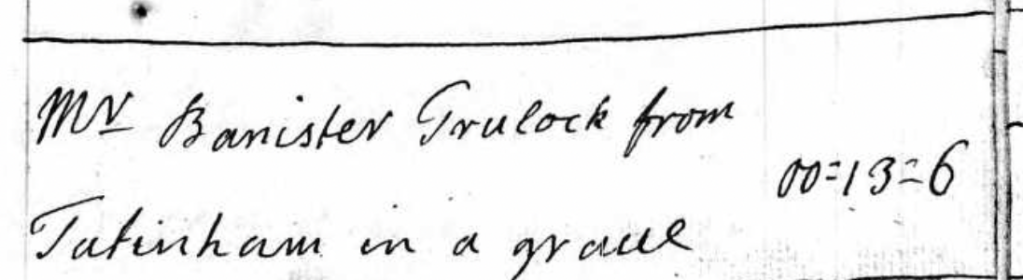
Banister was a non-conformist and lived at Tottenham, we know he was buried at Bunhill Fields as the burial was recorded. His wife was buried there in Sep 1777.
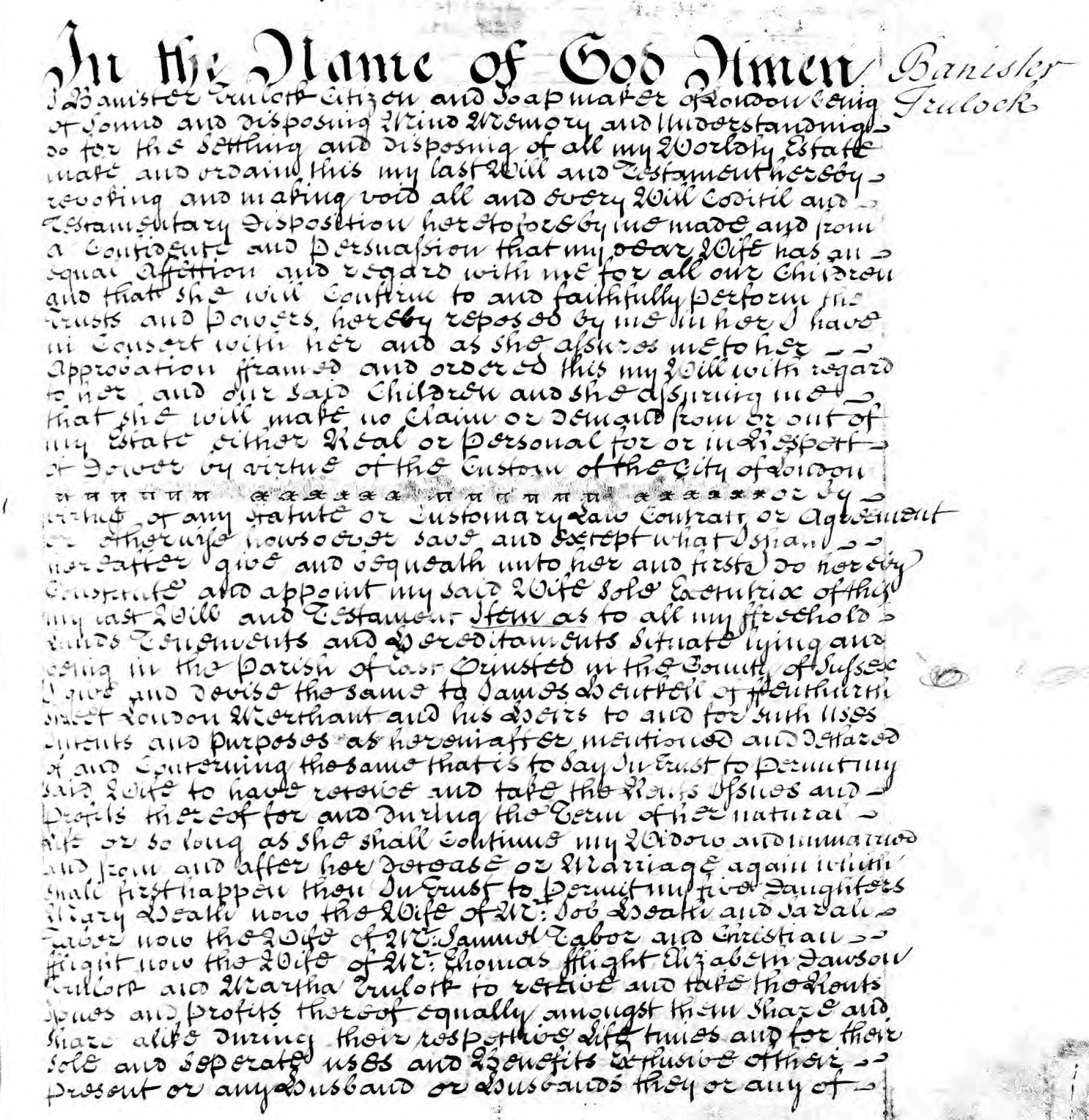
Banister’s will was proved on 23 Apr 1759 and he left his various property at Tottenham and East Grinstead to his wife and daughters. The will is several pages long and shows that this was a wealthy family.
National Archives PROB 11; Piece: 846
Their fifth daughter, Christian married Thomas Flight who was a porcelain manufacturer on 11 Sep 1751 at Allhallows London Wall,London.
London Metropolitan Archives; London, England; Reference Number: P69/ALH5/A/005/MS05088
You can find out all about the Flight family from the posts: The Flight Family, Thomas Flight and the Royal Worcester China Factory and Banister Flight and his Descendants.

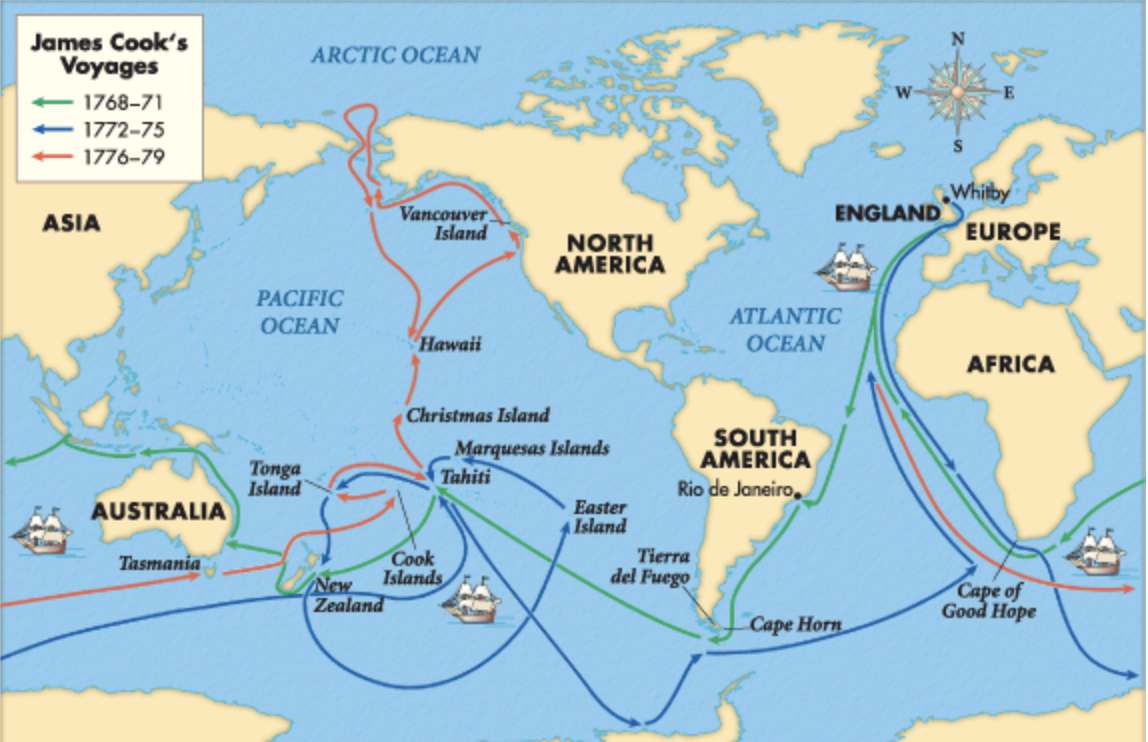
William Lanyon was a lieutenant in the Royal Navy and twice sailed with Captain James Cook.
Captain James Cook – Nathaniel Dance-Holland, Public domain, via Wikimedia Commons
William Lanyon joined the navy when he was about 15 years old. His first recorded service was as an Able Seaman on the Orford and then the Mars. He then served on HMS Jason as a midshipman. He moved onto HMS Terrible. In 1772 he joined HMS Adventure one of the companion ships on Cook’s second voyage. In 1773 he was promoted to Master’s Mate.
He was promoted to Lieutenant in 1774 but when he was taken on for Cook’s third voyage he was a Master’s Mate again on HMS Resolution. He was eventually promoted to Second Lieutenant on HMS Discovery in 1779.
John Cleveley the younger (1747-1786) (style of) – HMS ‘Resolution’ and ‘Discovery’ in Tahiti – BHC1939 – Royal Museums Greenwich.jpg
He supposedly collected vocabularies of the South Pacific languages which were published in 1979 by Peter Lanyon-Orgill but there is some doubt as to their authenticity.
Cook’s three voyages
Between 1790 and 1796 he was in command of the Spider a cutter based at Plymouth. In 1799 he commanded the Kent. In November of that year he captured a French privateer the Four Brothers out of Calais. His last recorded command was of HMS Genereux a prison ship at Plymouth.
By 1814 he was retired and living at St Austell. He was buried there on 26 Mar 1818, the register states he was ‘paralytic’. His wife Jane had been buried at St Austell almost exactly a year earlier on 27 Mar 1817. They had no children.
So where does William fit on the tree?
‘A Genealogical & Heraldic History of the Commoners of Great Britain & Ireland enjoying Territorial Possessions…..’ Vol IV by Burke. has the following entry in the index.
Lanyon, John, 36.
‘Jane b. in November 1765 m. to John Lanyon of Lanyon in Gwinear, grandfather of lieutenant William Lanyon R.N., well known for his various acts of heroism and benevolence in his profession, the last survivor of those gallant officers who accompanied Captain Cook in his voyages. Twice he circumnavigated the globe with that distinguished commander and was with him at the period of his melancholy end.’
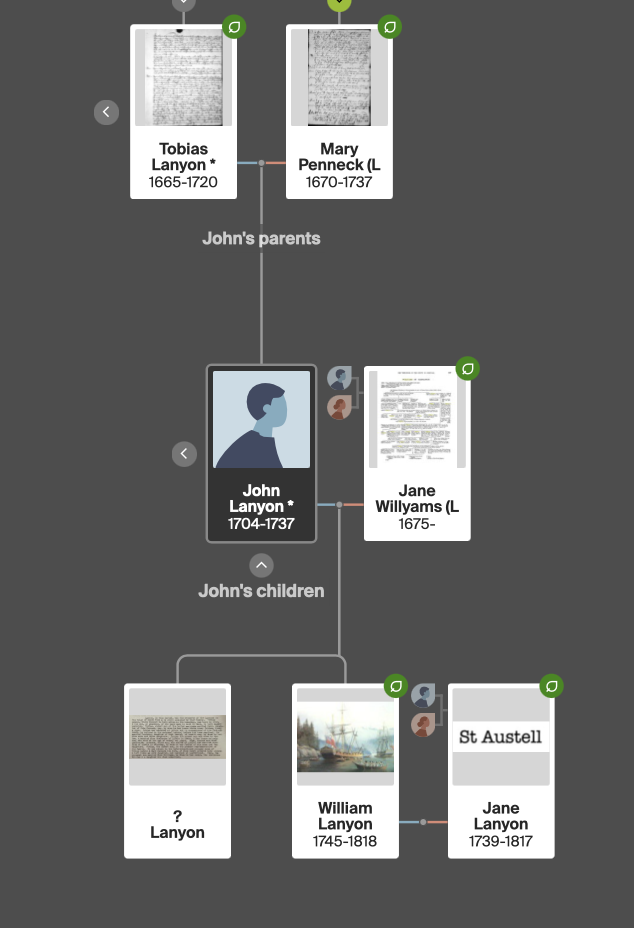
The Jane referred to is Jane Willyams and Burke has transposed her date of birth from 1675 to 1765! Vivian’s ‘The Visitations of Cornwall: Comprising the Heralds’ Visitations of 1530, 1573 & 1620‘ prints the family tree of the Willyams family and shows the correct date.
Visitations of Cornwall -Willyams Family
Jane is shown as the daughter of Humphry Willyams of Roseworthy and Dorothy Addington of Devon. Jane was baptised 11 Nov 1675 at Gwinear and married John Lanyon of Lanyon Gwinear.
So who is John Lanyon of Lanyon Gwinear?
Assuming John was a similar age to Jane we are looking for a John born in the 1670s who lived at Lanyon Manor in Gwinear. This would probably be a child of Tobias Lanyon and Susannah Reynolds but they don’t have a child called John and don’t mention a son of that name in their wills. Tobias and Susannah’s son Tobias does have a son called John however he must have been born after 1703 and would be at least twenty-eight years younger than Jane Willyams!
We need to go back and look at the information we have for William Lanyon. There is a note on his Lieutenant’s certificate dated 29 July 1774 which says ‘we have examined Mr. William Lanyon who by certificate appears to be more than 28 years of age and find he has gone to sea more than six years….’ (Captain John Campbell and Captain Abraham North). This implies that William must have been born before 1746.
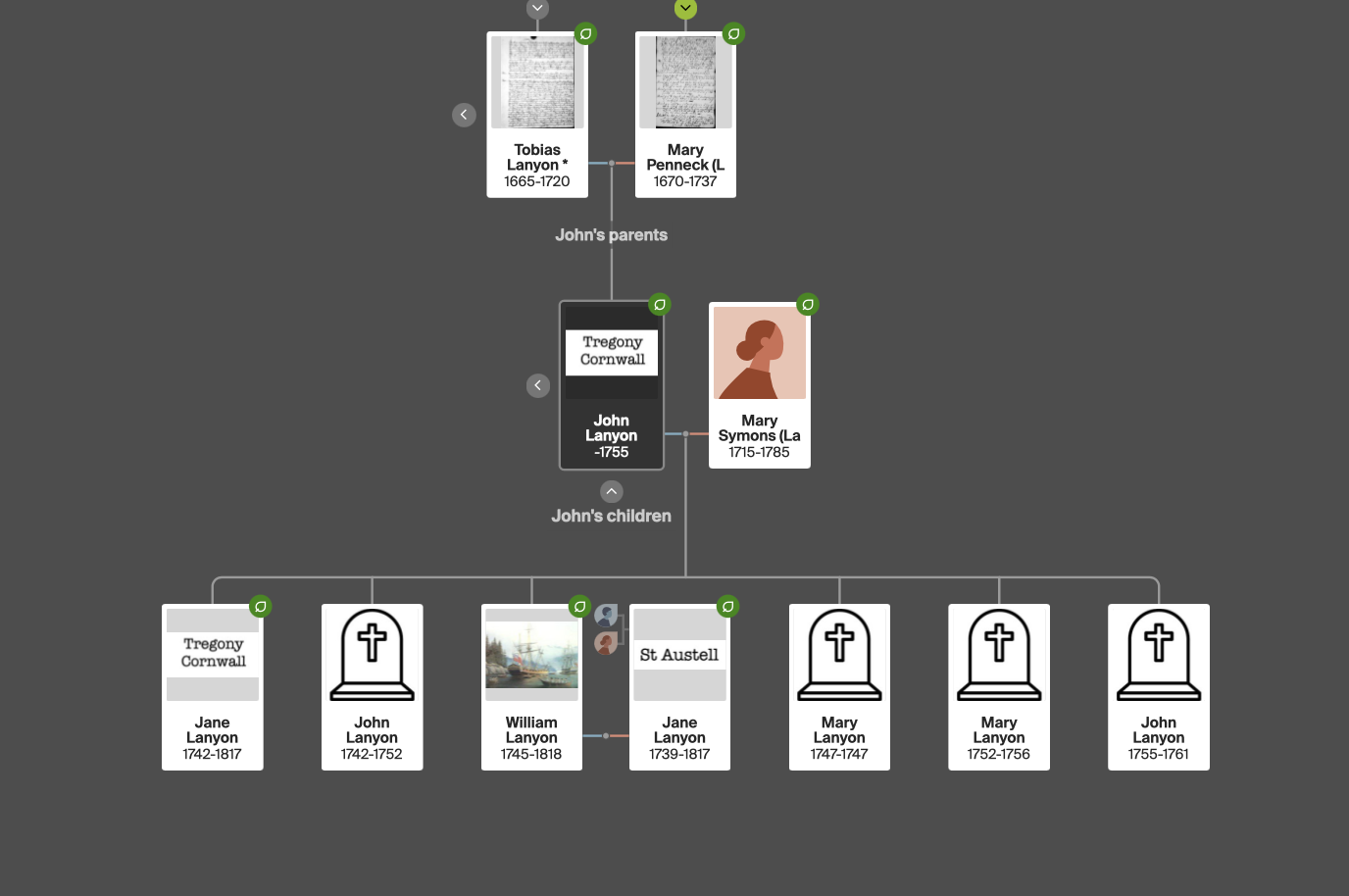
There is a baptism of William Lanyon son of Mr. John Lanyon and Mary on 2 Apr 1745 at Cuby with Tregony. They have three other children baptised there: Mary 1747, Mary 1752 and John 1755. Of their children, only William survived to adulthood.
There is a marriage between a Mr. John Lanyon and Mrs. Mary Symons at Creed in Cornwall (not far from Cuby with Tregony) on 3 Jan 1742. There is a Mary Symons baptised at Creed in 1715, the daughter of William Symons. We can’t prove it is the same person.
There is a John Lanyon son of Tobias Lanyon, deceased who is apprenticed to Philip Webber of Falmouth, Attorney at Law on 25 Sep 1722 for £52. 10/-
Proposed tree for William Lanyon
Possible tree but Jane would be far too old to give birth to William in 1745. Perhaps John & Jane had a son called John Lanyon who married Mary Symons?
The Jane Lanyon that William married appears to be the daughter of Tobias and Prudence Pawley.
John Lanyon left a will which might have helped clarify this part of the tree but it has been lost!
The Admiralty Record Office wrote to Captian Wingfield D.S.O., R.N., D.G.W. on 17 Feb 1959 and confirmed that:
William was born in 1745
Enlisted Sep 1760
Appointed lieutenant Aug 1779
Retired on half pay plus pension from Greenwich Hospital
Superannuated Commander 1814
Served on Spider 1790-1795, Kent 1795-1799, Matilda 1800-1804 and Genereux 1805-1806
Served on HMS Nelson & Resistance under Captain Cook on the voyages of discovery
The Will of William Lanyon proven on 15 May 1818 (PROB 11/1604). This is the last Will and Testament of me William Lanyon of the Parish of Saint Austell in the County of Cornwall, Esquire, Commander in the Royal Navy.
I give, devise and bequeath all that my Leasehold Dwelling House situate in the said Parish of Saint Austell in which I now reside with the Garden Courtlage and Appurtenances thereunto belonging unto Tobias Lanyon of Camborne in the said County, Surgeon, his Exors, Admors, and Assigns, for and during all the Estate and Interest which I shall have therein at the time of my decease, to and for his and their own absolute use and benefit, subject to the rent and other reservations payable by or under the Indenture of Lease by virtue of which I am intitled to hold the same.
I give and bequeath unto my Niece, Frances the Wife of Thomas Penna, all and singular my Household Furniture, Plate, Linen and China whatsoever which I may be possessed of at the time of my decease (except the Bed and Bedding hereinafter bequeathed to my Servant Mary Eplett) and I do will and direct that my Executors hereinafter named do and shall release and discharge the said Thomas Penna of and from all sum and sums of money which he may be indebted to me at the time of my decease, and particularly of and from the Sum of Two Hundred Pounds which I advanced him on a note of hand bearing date the 16th day of May last, which Note of Hand I hereby direct shall be given up to the said Thomas Penna.
I give and bequeath to my Servant Mary Eplett, if she shall be living with me at the time of my decease, over and above what may be due to her for wages, the sum of twenty pounds to be paid to her within six Months after my decease. Also I give to the said Mary Eplett the Bed and Bedding in the Garret on which she usually sleeps.
And as for and concerning all and singular other the property, Stocks, Funds, Money and Effects which I shall be possessed of or intitled to, or over which I shall have a disposing power at the time of my decease, of what nature or kind soever the same may be, I give, devise and bequeath the same and every of them unto the said Tobias Lanyon and John Carne of the said Parish of Saint Austell, Gentlemen, their Heirs, Exors & Admors upon the Trusts and to and for the several ends, intents and purposes hereinafter declared of or concerning the same, that is to say, upon Trust in the first place that they, my said Trustees, do and shall thereout with all convenient speed after my decease pay, discharge and satisfy all my just Debts and my Funeral and Testamentary Expences and the aforesaid Legacy of twenty pounds, and do and shall in the next place lay out and invest such of my Monies as shall not be already invested in the Stocks in the purchase of Parliamentary Stocks or Funds of Great Britain in the names of them my said Trustees, or the Survivor of them, his Exors or Admors and do and shall stand and be possessed of all such Stocks, Funds and Securities In Trust that they my said Trustees or the survivor of them, his Exors, or Admors do and shall pay the following Legacies (that is to say):
unto my Nephew Edward Lanyon (Son of the late William Lanyon of Surry) the sum of Eighty Pounds of lawful Money of Great Britain and my watch, unto my Nephew William Lanyon (Son of the said William Lanyon of Surry) the Sum of One hundred pounds of like lawful Money and my Sleeve buttons, unto my Niece Jane Lanyon, (Daughter of the said Willian Lanyon of Surry) the Sum of One hundred pounds of like lawful Money, unto my Nephew Richard Lanyon (Son of the said William Lanyon of Surry) the Sum of One hundred pounds of like lawful Money, unto my Nephew Henry Lanyon (Son of the said William Lanyon of Surry) the Sum of Fifty pounds of like lawful Money unto my Nephew James Lanyon (Son of the said William Lanyon of Surry) the Sum of Fifty pounds of like lawful Money, unto my Niece Elizabeth Lanyon (Daughter of the said William Lanyon of Surry) the Sum of Eighty Pounds of like lawful money, and unto my Nephew Joseph Lanyon (Son of the said Willaim Lanyon of Surry) the Sum of Fifty pounds of like lawful Money,
such several Legacies to be paid to such of my said Nephews and Nieces respectively as shall have attained the age of twenty one years immediately after my decease, and to such of my said Nephews and Nieces as shall be under that age, as and when they shall severally attain the age of twenty one years,
and my mind and will is and I hereby direct that it shall and may be Lawful to and for my said Trustees to receive the Dividends and Proceeds of such of the said Legacies as shall not be payable at the time of my decease by reason of the Legatees being under the age of twenty one years and do and shall lay out and invest the same in the purchase of the like Stock there to accumulate to and for the use and benefit of such last mentioned Legatees which accumulations shall be paid to them with their original Legacies as and when they shall severally attain the age of twenty one years, Provided always that it shall be lawful to and for my said Trustees to apply so much of the Dividends arising from any such Legacy as they shall think proper in and towards the education of the Person intitled thereto, and I direct that the Residue of my Property after payment of the before mentioned Legacies and the expences incident thereto shall be divided equally between and among my said last named eight Nephews and Nieces, to be paid to them at the time the youngest of them shall attain the age of Twenty one years, provided always that if any of my said Nephews or Nieces shall happen to die under the age of Twenty one years then it is my will and meaning and I do hereby direct that the Legacy and accumulation or Legacies and accumulations of him, her or them so dying shall go and accrue to the Survivors or such nephews and Nieces or Nephew and Niece as shall not have attained the age of twenty one years at the time of the death of such Nephew and Niece so happening to die, to be equally divided between them and to be vested, paid and payable to them at such age and in such manner as their original legacies are hereinbefore directed to be paid, Provided also and I do hereby further declare and direct that it shall be lawful for my said Trustees at any time and from time to time when and as often as they shall think fit or adviseable to sell, transfer and dispose of or vary all or any of the Funds or Stock wherein the said Trust monies shall at any time be invested and to lay out and invest the money to arise by any such sale, transfer or disposition in the purchase of other or the same or like Stocks or Funds in the joint names of them my said Trustees, and all such new or other Stocks and Funds shall stand and be in the names of such Trustees and the Dividends and annual produce thereof and of every part thereof respectively shall be applicable and applied upon and for such and the same Trusts, end, intents and purposes as the original Stocks and Funds and the Dividends thereof were subject and applicable to at the time of such Sale, Transfer, Disposition or variance thereof.
And lastly I nominate, constitute and appoint the said Tobias Lanyon and John Carne Execuitors of this my Will hereby revoking all former Wills by me made. In Witness whereof I have hereunto set my hand and Seal this eighth day of July in the year of our Lord One thousand Eight hundred and Seventeen – Wm Lanyon.Signed and sealed by the said Testator William Lanyon and by him publiched and declared as and for his last Will and Testament in the presence of us who in his presence at his request and in the presence of each other have hereunto subscribed our Names as Witnesses John Cary Maria Cary.
Proved at London 15 May 1818 before the Judge by the Oaths of Tobias Lanyon and John Carne the Executors to whom Admon. was granted being first sworn by Comm. Duly to Adminr.
Source NA/PROB/11/1604/220
(William Lanyon of Surrey is Tobias and Prudence’s son William born in 1741.)
We can’t prove that William Lanyon RN is the son of John and Mary Lanyon but it seems the most likely explanation.
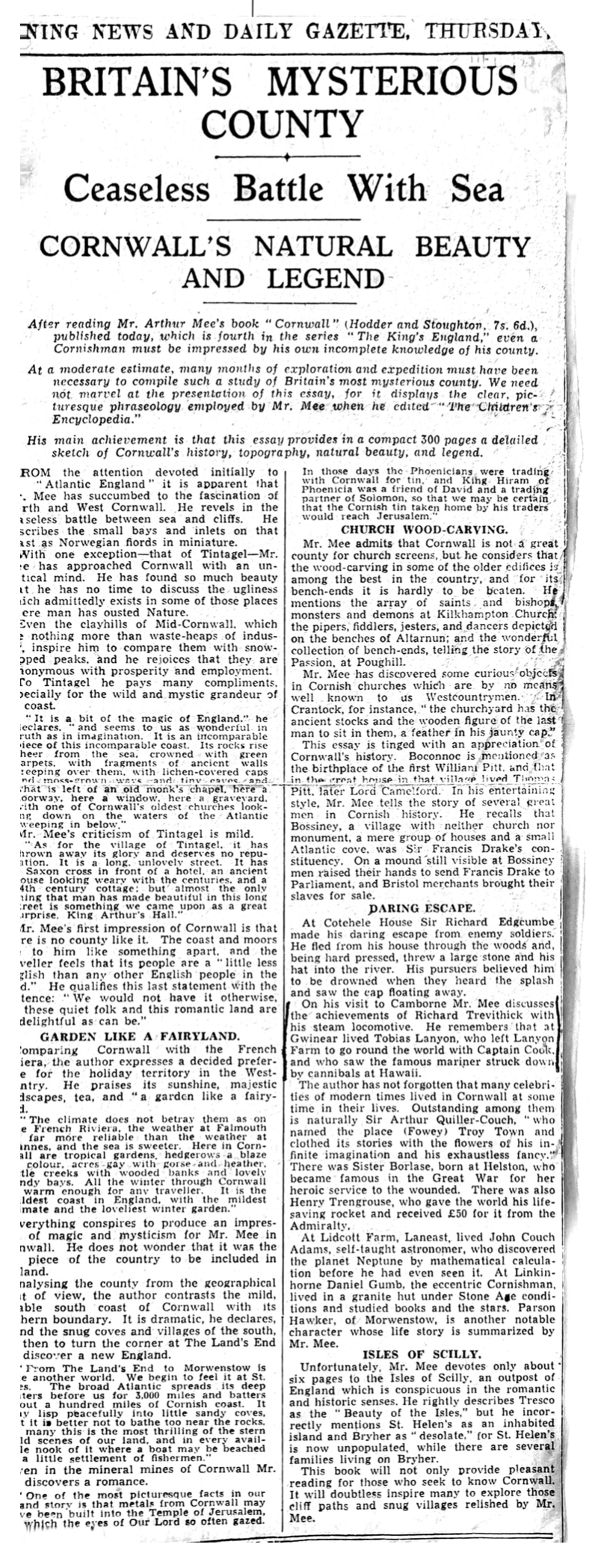
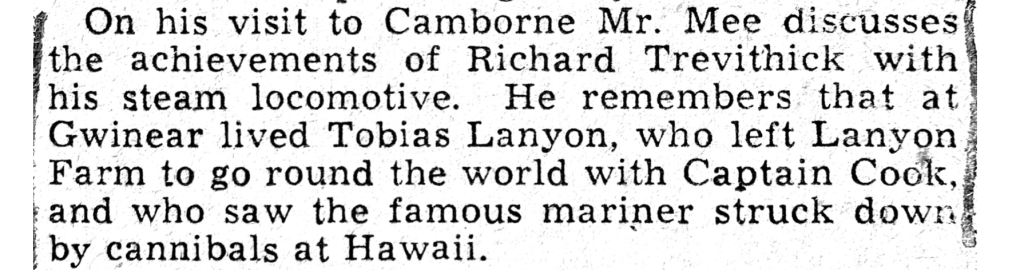
To add to the confusion there is a newspaper cutting that further muddies the water by naming Tobias as the person who sailed with Cook!
It’s a valuable lesson on the accuracy of documents!
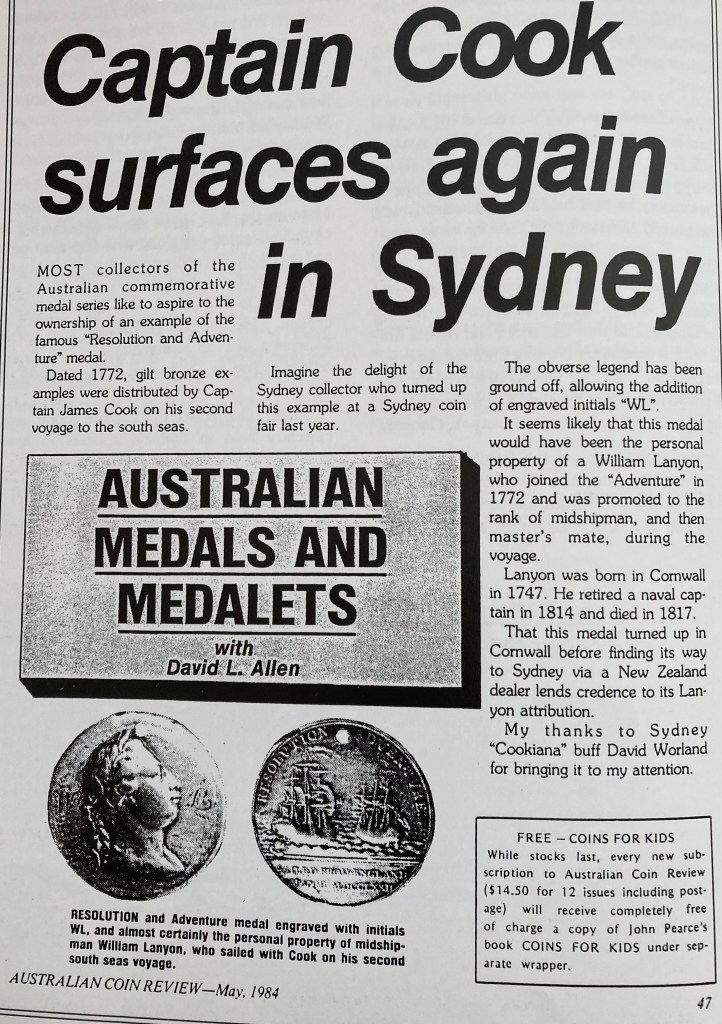
And finally another article where the dates aren’t quite right, is it any wonder that genealogists make mistakes?
Francis was the son of Francis and Rosamon Lanyon of Penzance, he was born about 1653. When his grandmother died in 1655 she left him a ewe in her will.
Francis’ branch of the tree
We don’t know the name of Francis’ wife, their marriage wasn’t recorded but he did have a son also called Francis in 1680.
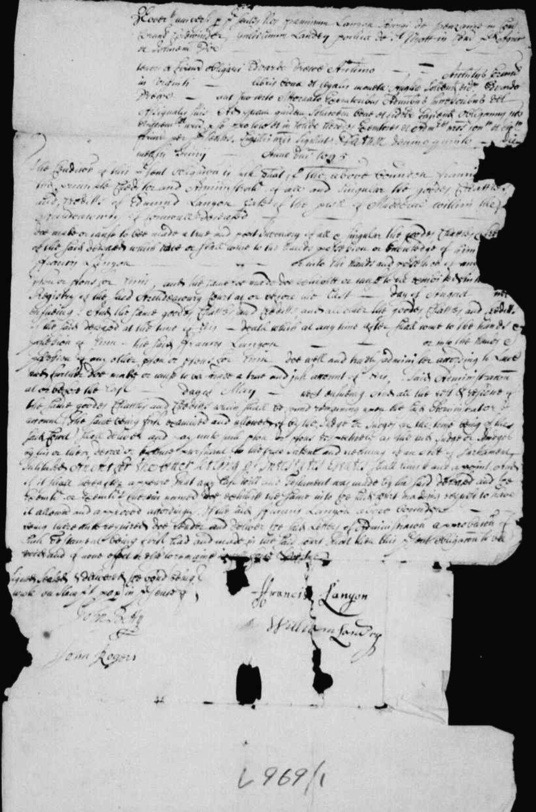
Like his father, Francis was a cordwainer in Penzance. In 1695 he is mentioned as the principal creditor of Edmund Lanyon who died whilst aboard HMS Weymouth.
Edmund Lanyon’s administration AP/L/969 signed by Francis and William Landry
We don’t know where Edmund fits on the Lanyon tree as there are many gaps in the records.
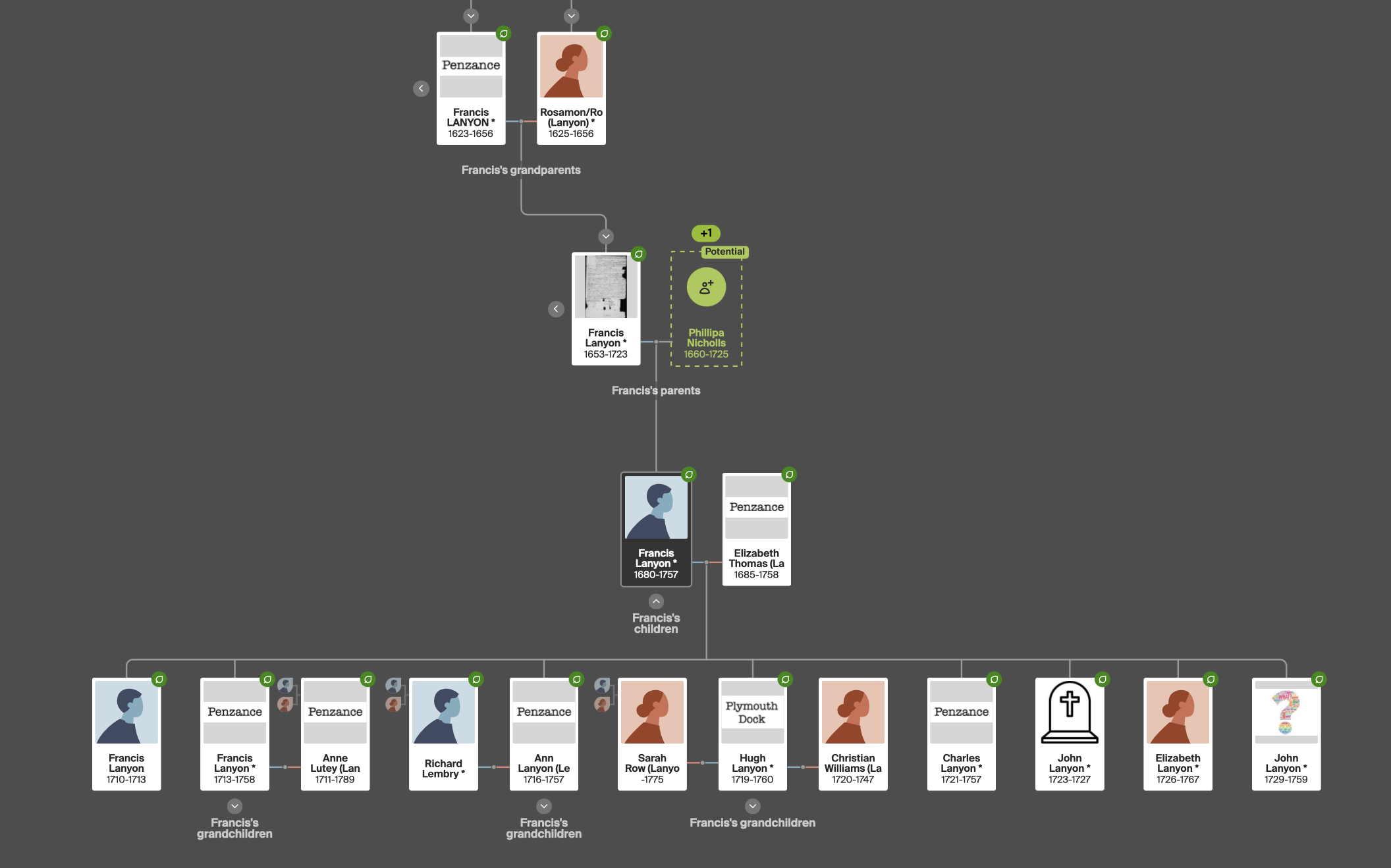
Francis Lanyon abt. 1680-1757
Francis was the only son of Francis Lanyon. His baptism was not recorded but he was probably born about 1680. He married Elizabeth Thomas at Madron in 1708. They had seven children:
Francis 1713-1758 married Anne Lutey
Ann 1716-1757 married Richard Lembry – one daughter
Hugh 1719- aft.1759
Charles 1721-1757 bachelor, no children
John 1723-1727 died in infancy
Elizabeth 1726-aft. 1759 no further trace
John 1729-aft. 1759 living abroad- no further trace
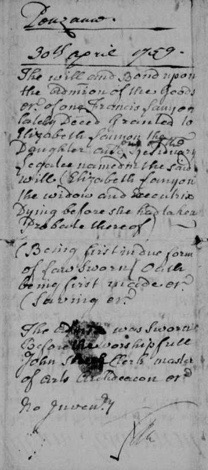
So many in this family died in such a short time period that there was probably some sort of epidemic in Penzance. Francis senior died in April 1757, in November Ann & Charles both died. Jan 1758 Elizabeth senior died and in June 1758 Francis junior died. In 1757 there was a smallpox outbreak which may have reached Cornwall and also epidemics of measles and scarlatina and in 1758 an influenza epidemic. Perhaps one or a combination of illnesses affected this family. Daughter Elizabeth had to administer her father’s estate as the widow and heir had both died.
Source AP/L/1652
In 1754 Vesuvius erupted and that caused poor weather and sickness in subsequent years. The 1750s seems to have been a time of natural disasters and disease. Gangrenous sore throat and Angina Maligna (an obsolete term for: Acute necrotising ulcerative gingivitis; Diphtheria; Pseudomembranous pharyngitis) are described as being ‘very fatal’.
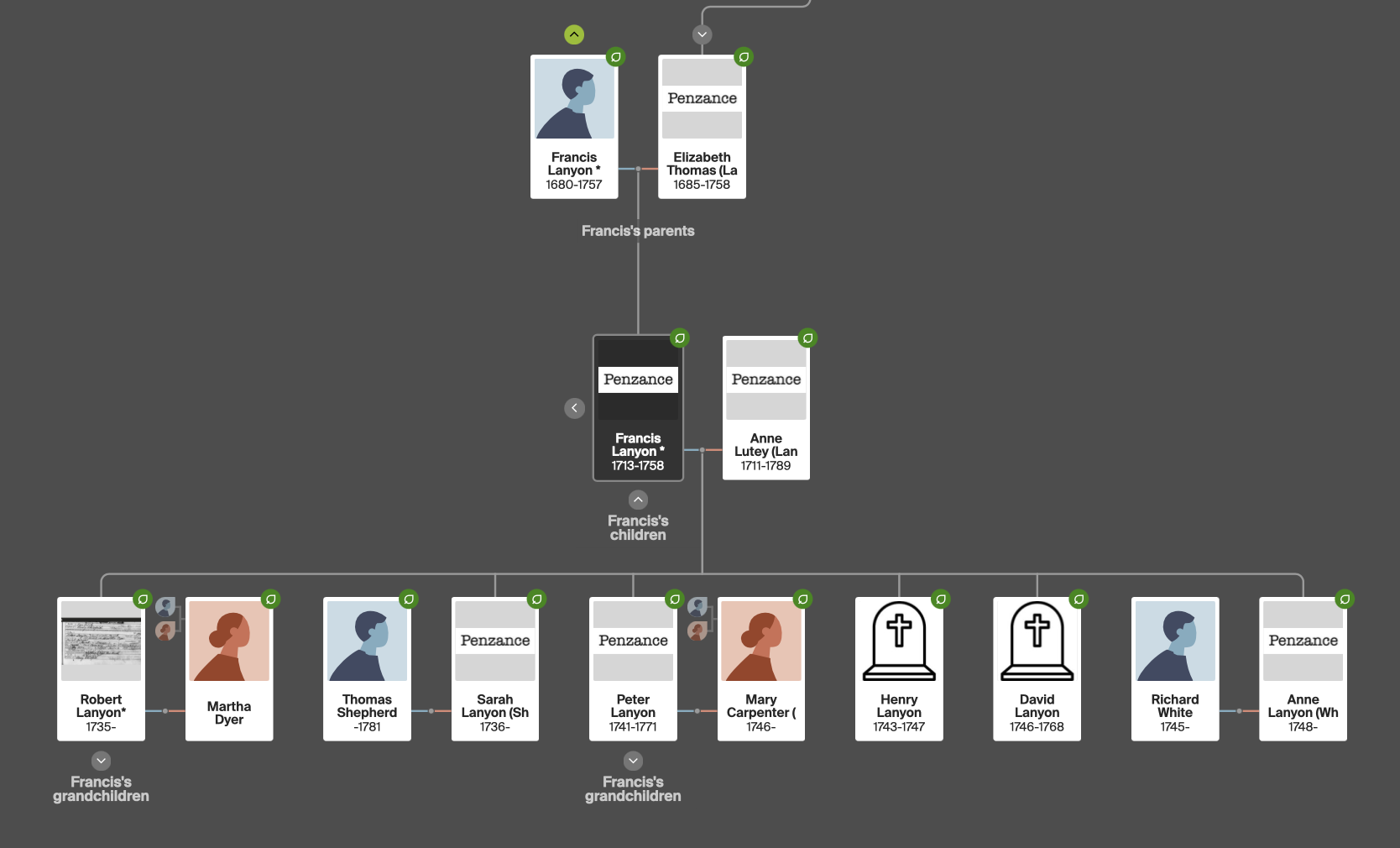
Francis married Anne Lutey in 1734 at Madron. They had six children.
Francis & Anne’s tree
Robert 1735-
Sarah 1736- in 1767 she married Thomas Shepherd, a hatter, they had three children.
Peter 1741-1771
Henry 1743-1747 died in infancy
David 1746-1768 unmarried
Anne 1748- married Richard White no children traced
Hugh Lanyon 1719- aft.1759
Hugh was baptised at Madron in 1719 and he married Christian Williams at Madron in 1740. There are no children from this marriage and she must have died before 1747 as Hugh married for a second time to Sarah Row at Charles the Martyr, Plymouth, Devon.
Plymouth – Charles the Martyr – bombed during the blitz
From Francis’ will of 1759 he mentions son Hugh and children now living at Plymouth Dock. There are three children traced.
Mary 1749-
Sarah 1752-59
Hugh 1757-1760
There are later marriages and burials of Lanyons at Plymouth but we can’t say if they are related to Hugh & Sarah.
Marriage register Plymouth Charles the Martyr 1747
Hugh was buried at Stoke Damerel on 17 Dec 1760.
Robert Lanyon 1735-
Francis and Anne Lutey’s son Robert was baptised at Madron in 1735 and in 1759 he married Martha Dyer at Plymouth St Andrew. Perhaps after his father’s death he went to join Uncle Hugh in Plymouth?
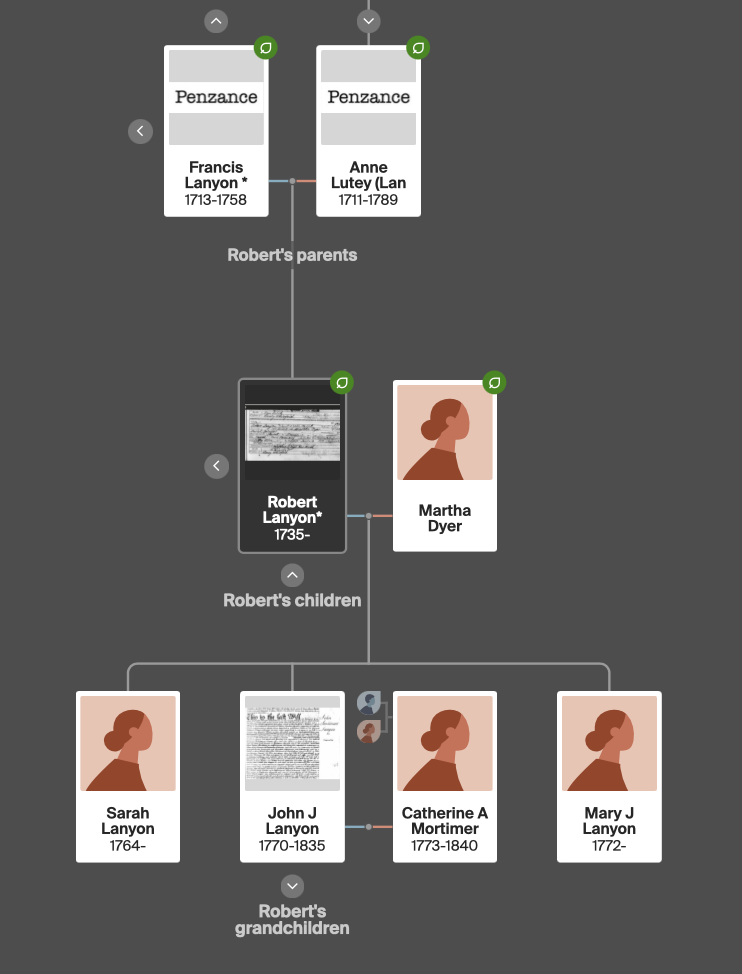
Robert & Martha’s tree
They had two documented children:
Sarah 1764- who married William Gains at Plymouth in 1784.
Mary Jensen 1772- no further trace
Possibly John Jenkinson Lanyon 1770-1835
Baptism register Plymouth St Andrew 1772
The researcher Jane Veale Mitchell believed that John Jenkinson Lanyon (see Irish branch) was the unrecorded son of Robert and Martha. The names Jensen and Jenkinson are both unusual and don’t appear anywhere else in the tree. John Jenkinson Lanyon used a ring with the Madron coat of arms to seal his letters so he must have had a connection to this branch of the tree somehow.
Peter Lanyon 1741-1771
In 1767 Robert’s brother Peter married Mary Carpenter at Madron. Peter was a cordwainer at Madron. They had three children
Peter & Mary’s tree
Peter 1768-1768 died in infancy
Elizabeth 1768- no further trace
Peter abt. 1769-1827
Peter senior died aged 30 and left Mary to raise the children.
Peter Lanyon abt. 1769-1827
Peter’s tree
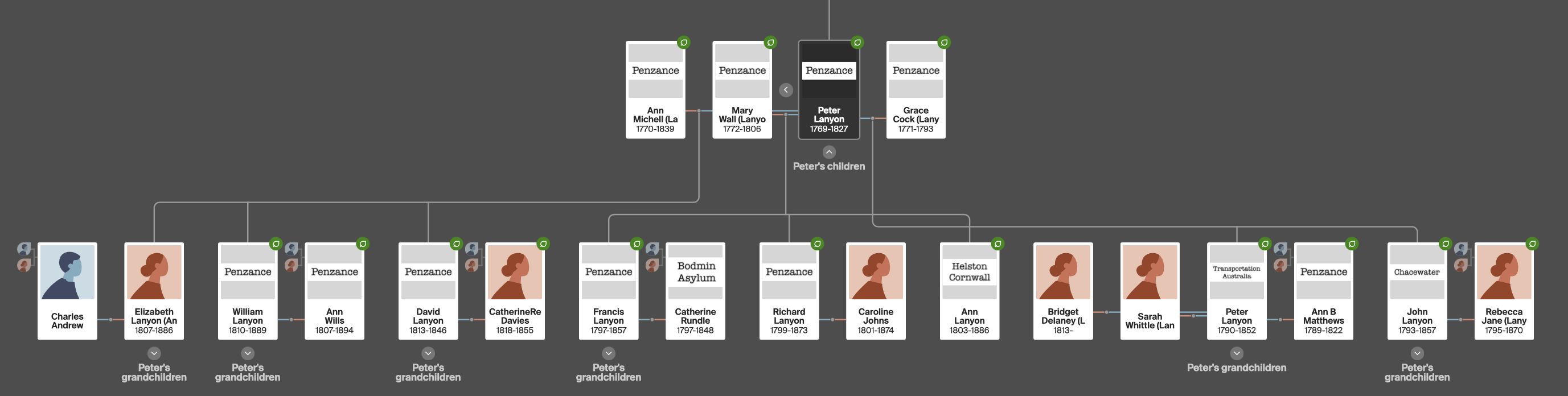
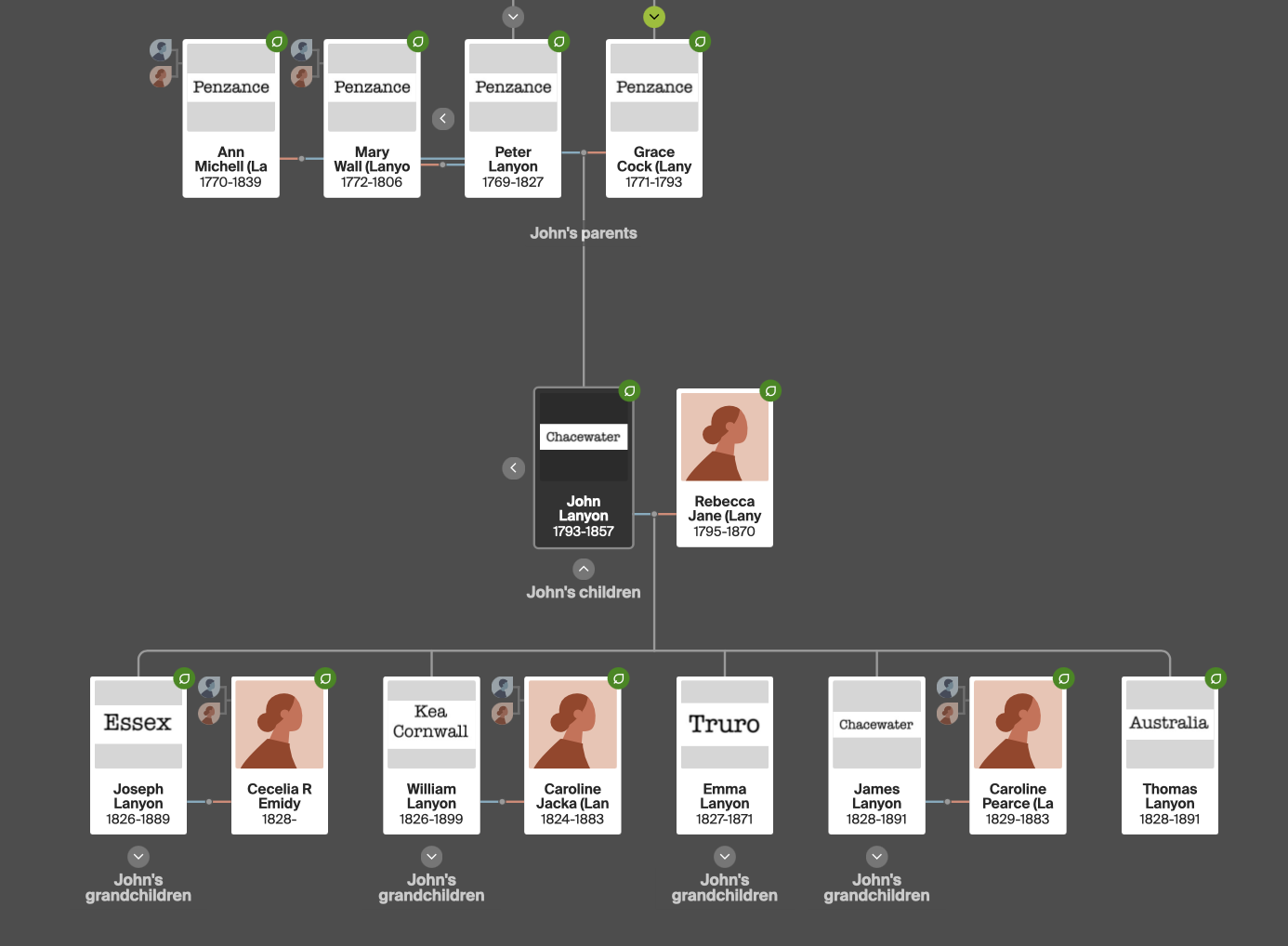
Peter, son of Peter and Mary Carpenter had three wives. He married for the first time at Madron in 1789 to Grace Cock (1771-1793). There were two children from this marriage.
Peter 1790-1852
John 1793-1857
Grace may have died, possibly in childbirth, in 1793 as Peter remarried in 1795. His second marriage was to Mary Wall (1772-1806). This marriage produced three children.
Francis 1797-1857
Richard 1799-1973 was a grocer, he married Caroline Johns at Helston in 1822, no children
Ann 1803-1886 spinster died age 82
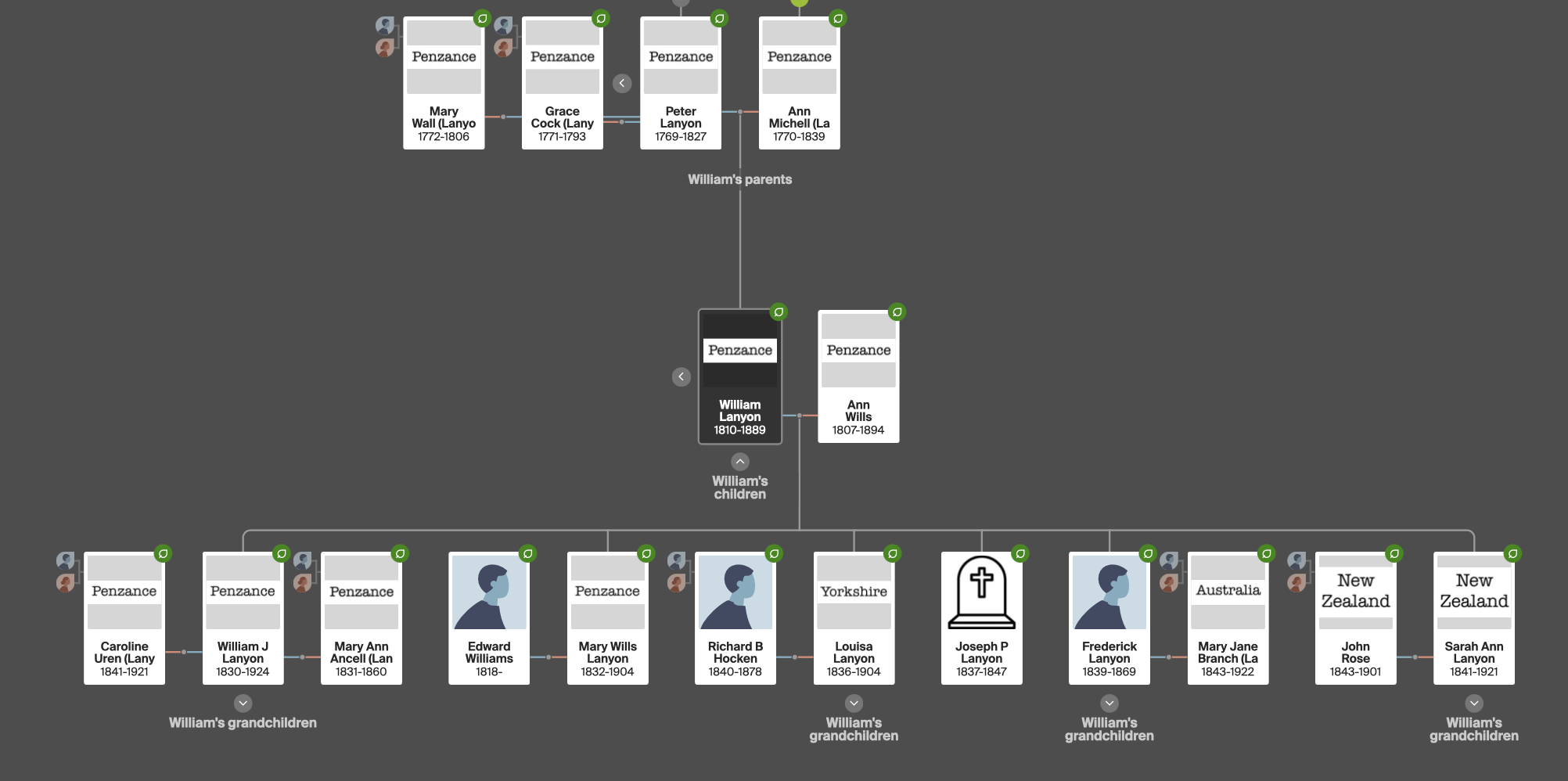
Mary died in 1806 and Peter married for a third time in 1807 to Ann Michell (1770-1839). They had three children.
Elizabeth 1807-1886 she married Charles Andrew at Madron in 1827 – six children
William 1810-1889
David 1813-1846 was a mason, he married Catherine Rebecca Davies in 1838 – one daughter died in infancy.
Peter was aged 58 when he was buried at Penzance in 1827. He had eight children and 26 grandchildren!
Peter Lanyon 1790-1852
Peter’s tree
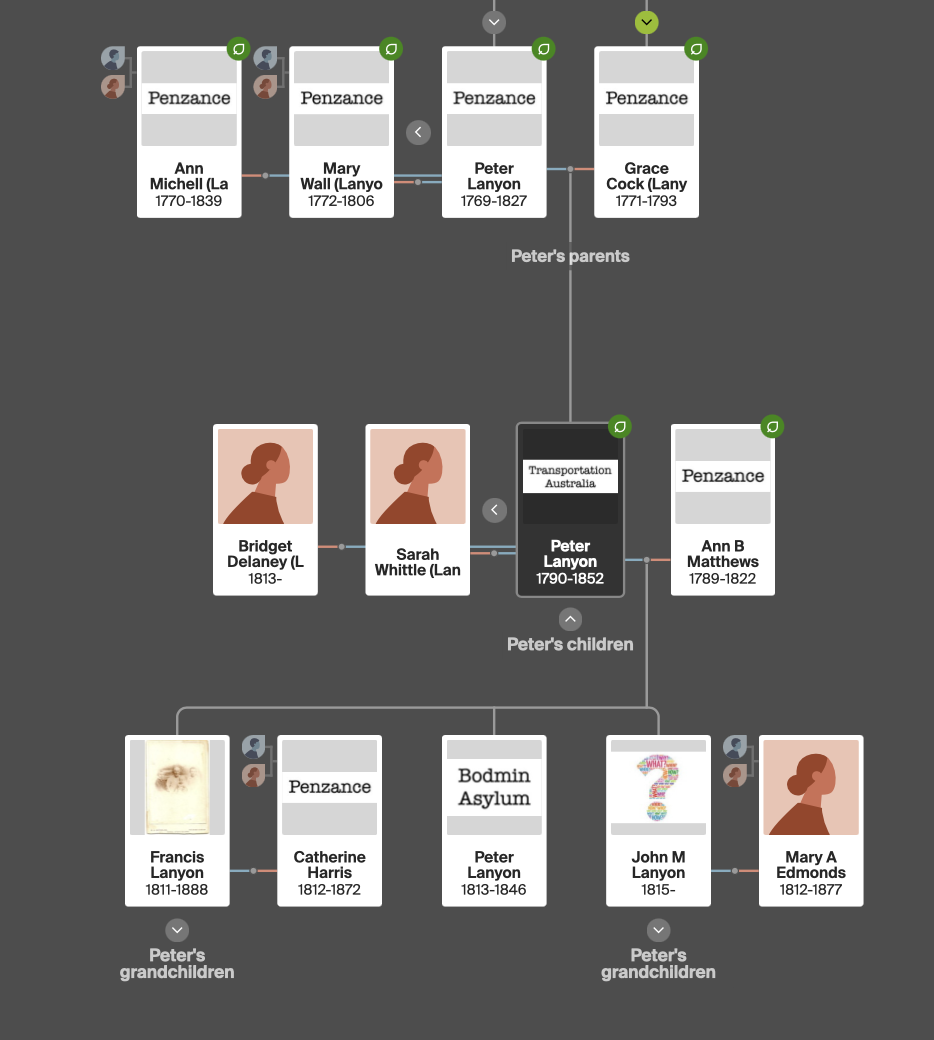
Peter’s eldest son was also called Peter and like his father he too had three wives! In 1810 at the age of 20 he married Ann Barnicoat Matthews (1789-1822)
Francis 1811-1888
Peter 1813-1846 he was a mason who died in Bodmin Asylum a pauper with a ‘disease of the brain’
John Matthews 1815- John married Mary Addison Edmonds at Madron in 1836, they had one daughter Rebecca Addison 1838-1898 who married James Eva in 1855
A ‘disease of the brain’ could be anything from a disease to a head injury. Clearly it was serious as he died aged just 33.
UK Lunacy Patients Admission Registers 1846-1912
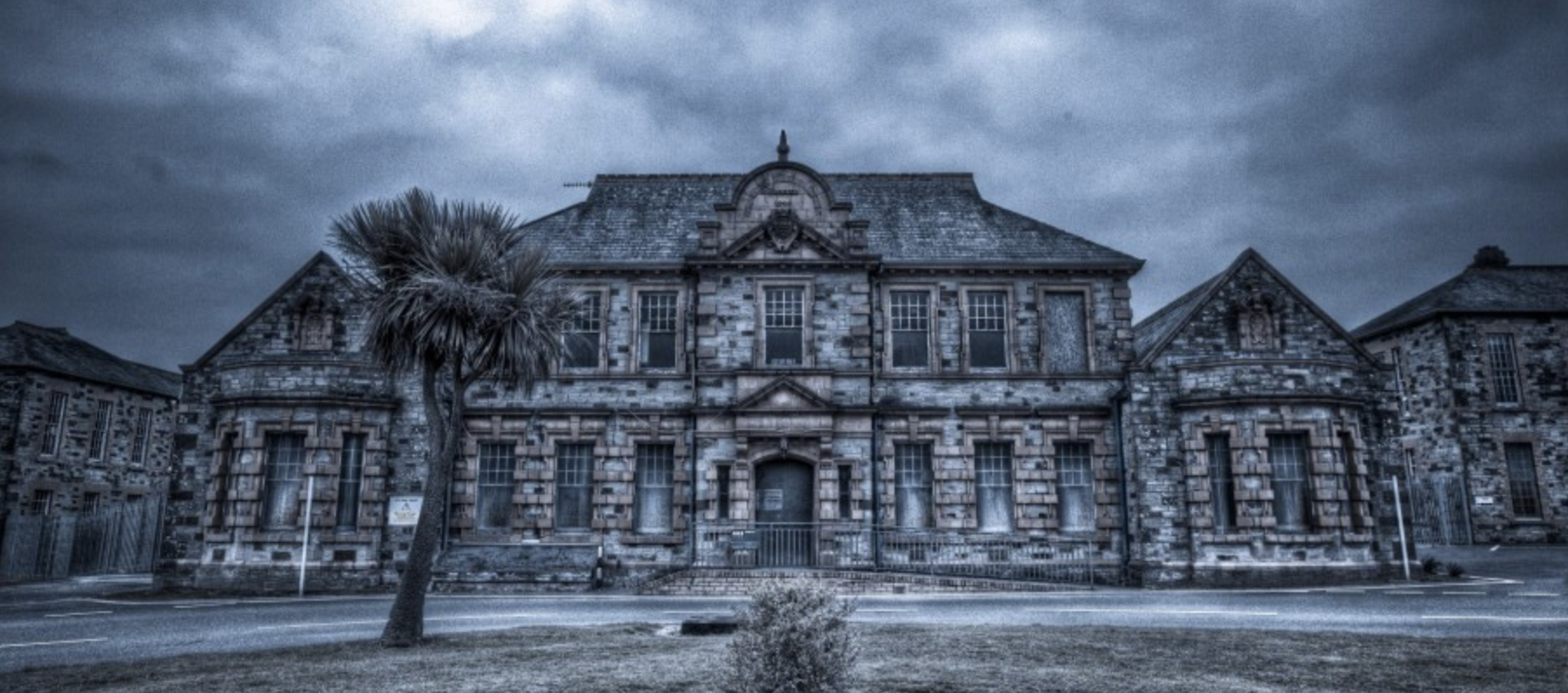
Bodmin Asylum is still a forbidding place today.
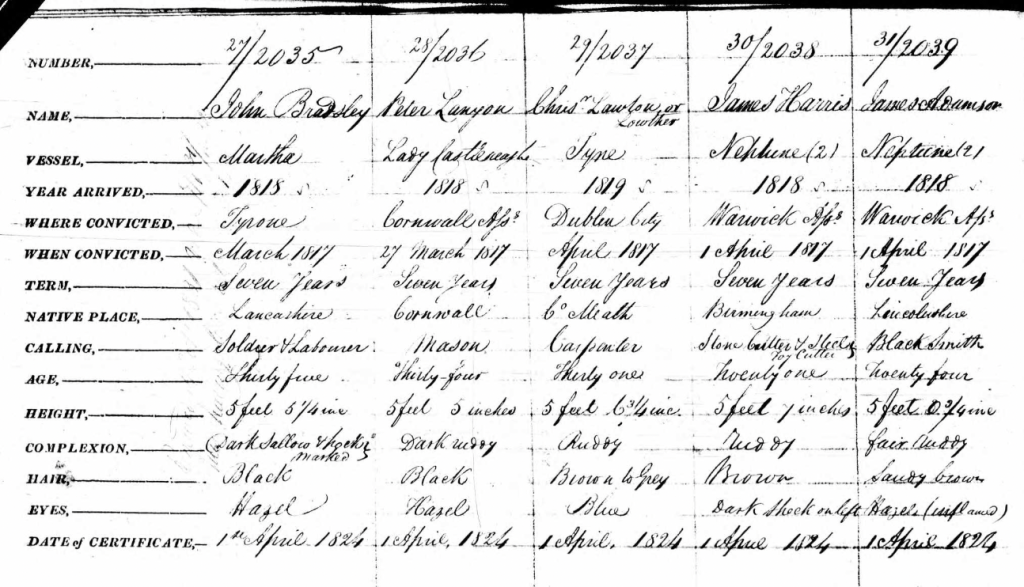
In 1817 Peter senior was convicted of larceny and sentenced to be transported for seven years. His wife and three young sons were left to fend for themselves. Peter arrived at Sydney, Australia on the ship Lady Castlereagh on 1 May 1818. He was described as 5’5″, dark complexion, dark hair and hazel eyes. He was a mason.
In 1824 he married Sarah Whittle at Parramatta NSW, Sarah must have died because in 1836 he requested and was granted permission to marry Bridget Delaney.
NSW Register of Convicts’ Applications to Marry 1826-51
Peter died in Australia in 1852, he never saw Cornwall or his Cornish children again.
John Lanyon 1793-1857
Peter’s brother John was a miner and in 1823 he married Rebecca Jane (1795-1870) at Kea in Cornwall. They had five children.
John & Rebecca’s tree
Joseph 1826-1889 he was a tin miner, he married Cecilia Rose Emidy in 1848. Cecilia had an illegitimate daughter Julia. Joseph had no children.
William 1826-1899
Emma abt. 1827-aft. 1871 was a tailoress who had two illegitimate children
James 1828-1891
Thomas 1828-1891 was a tin miner, he emigrated to Australia, no trace of any children
John died in 1857 at Chacewater. Chacewater was the centre of the mining world and there are a number of mines in the area. In the 1860s metal prices started falling and mining declined.
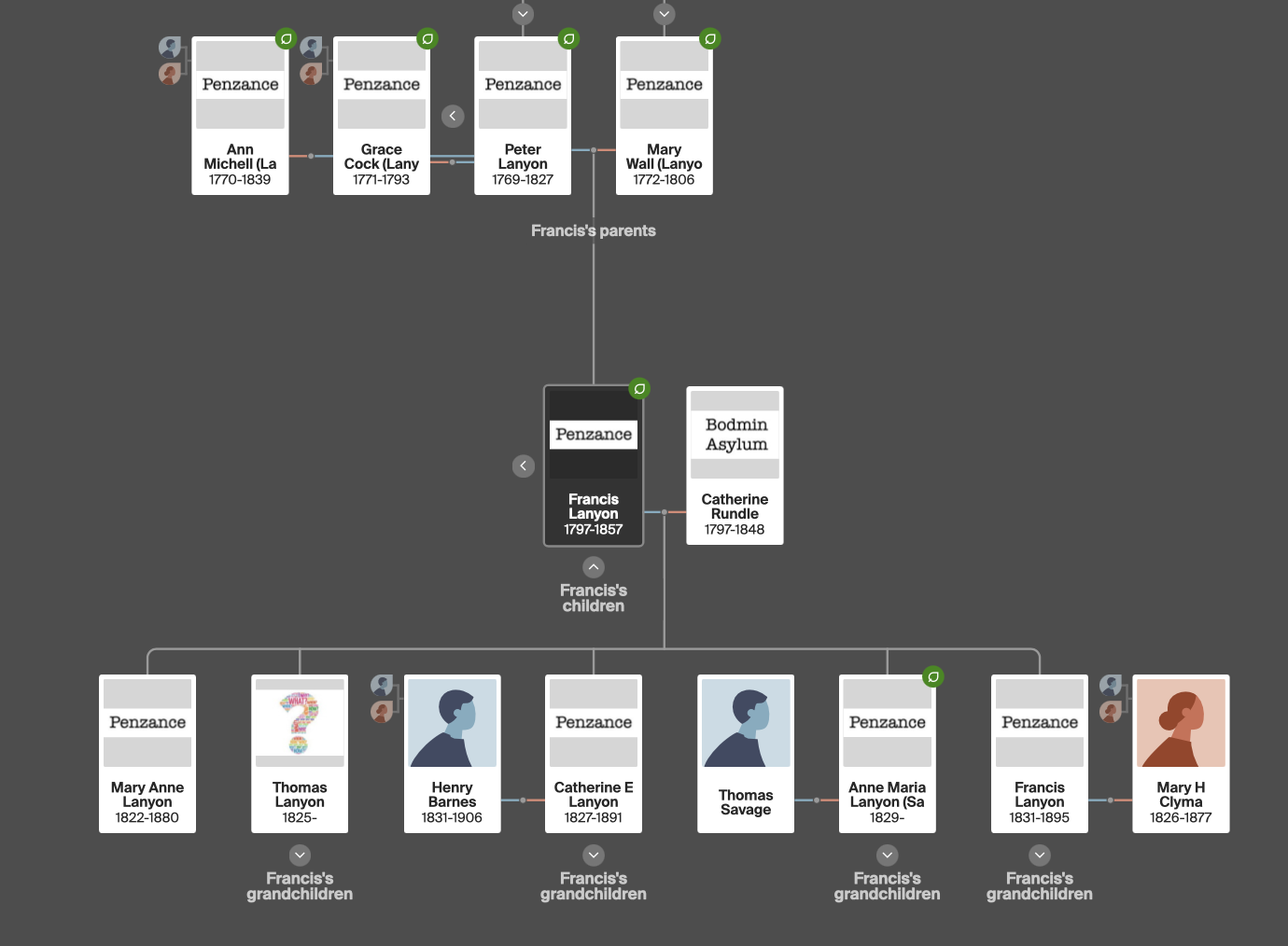
Peter and John’s half brother Francis was a cordwainer like his father. He married Catherine Rundle at Paul in 1822. They had five children.
Francis & Caroline’s tree
Mary Anne 1822-1880 – There is a Mary Anne Lanyon convicted of larceny which may be her
Thomas 1825- possibly married Mary Whear. Father of Milly 1860-1941 who married Edward Ladner in 1885. No further trace of Thomas.
Catherine Elizabeth 1827-1891 married Henry Barnes at Penzance in 1855 – five children
Anne Maria 1829- In 1858 she had an illegitimate son, Edwin who died in infancy. In 1859 she married Thomas Savage and they had one daughter, Mary Ann.
Francis 1831-1895
Shoemaker – Paul Renouard, Public domain, via Wikimedia Commons
William Lanyon 1810-1889
Peter, John, and Francis’ half brother William was born in 1810. He was described as a ‘poor shoemaker’ on admission to the dispensary in 1829. In 1830 he married Ann Wills at Madron. They had six children.
William & Ann’s tree
William James 1830-1924
Mary Wills 1832-1904 married Edward Williams – no children
Louisa 1836-1904 married Richard Baxter Hocken – five children and she died in Yorkshire.
Joseph Phillips 1837-1847 died young
Frederick 1839-1869
Sarah Ann 1841-1921 married John Rose – two daughters, emigrated to New Zealand
We’ll find out what happened to Peter’s grandsons in the post ‘Peter Lanyons Grandchildren and the Great Migration’.
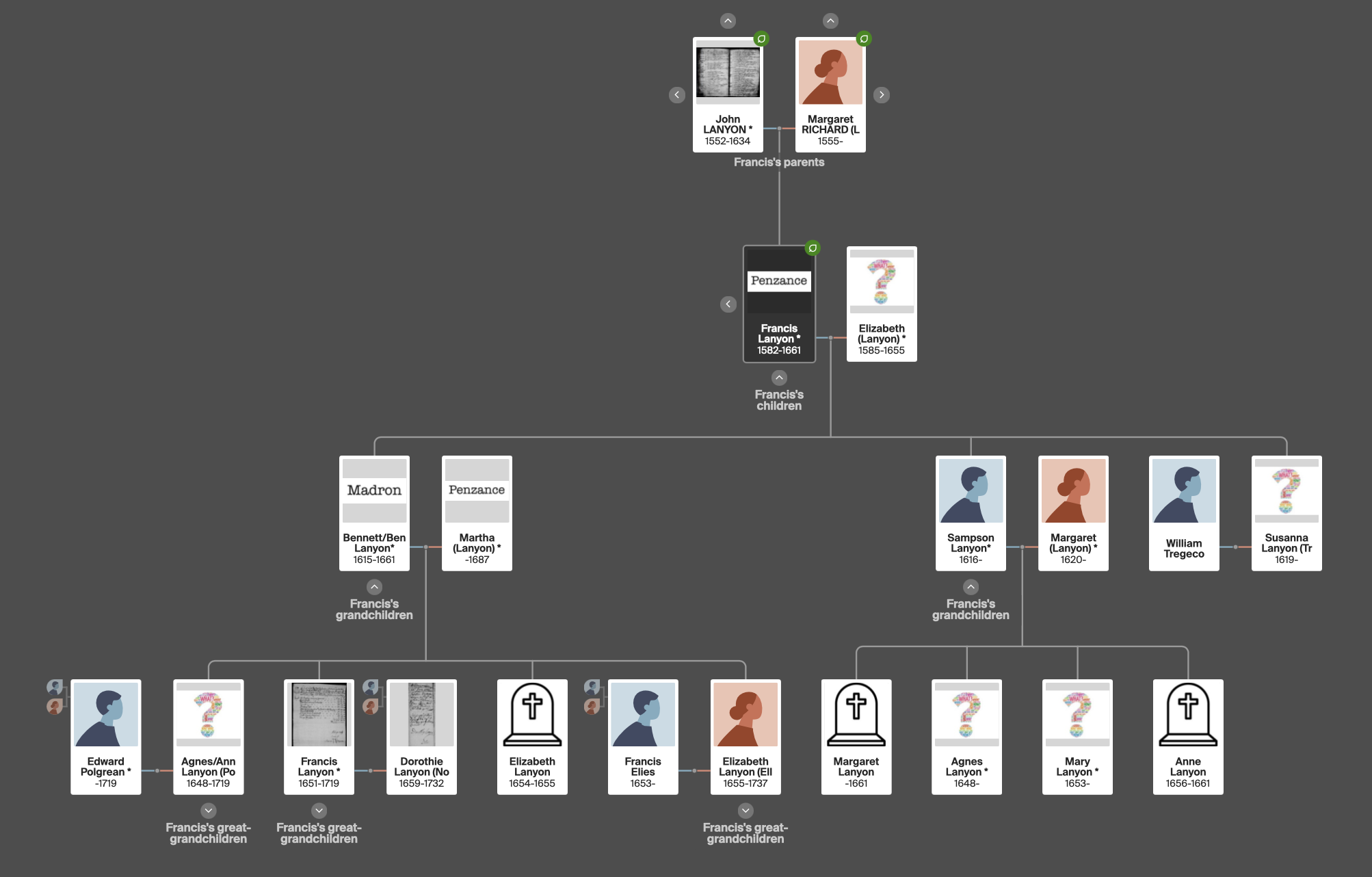
Francis Lanyon was the eldest son and heir of John & possibly Margaret Richard and he is described as a ‘gentleman’. He married Elizabeth on 19 Jun 1607 at Madron (sadly most women did not have their surnames recorded in the Madron register so we don’t know which family Elizabeth was from.) He was a Penzance merchant.
Francis signed the Protestation return of 1641/2. He appears on the Subsidy Roll for Charles I in Oct 1641 and paid £3 on goods.
I Oct 1655 the mayor of Penzance granted him the profits of ‘key and pier’ (quay) for one year for £25.
In Oct 1656 the ship Dunkerke landed at Mousehole and Francis was paid 12/-
The Penzance mayoral records also show that Francis and Thomas Jenkin were paid 12d for repairing the quay’s mansards.
Francis and Elizabeth had three surviving children: Bennett, Sampson and Susanna.
Bennett Lanyon 1615-1661
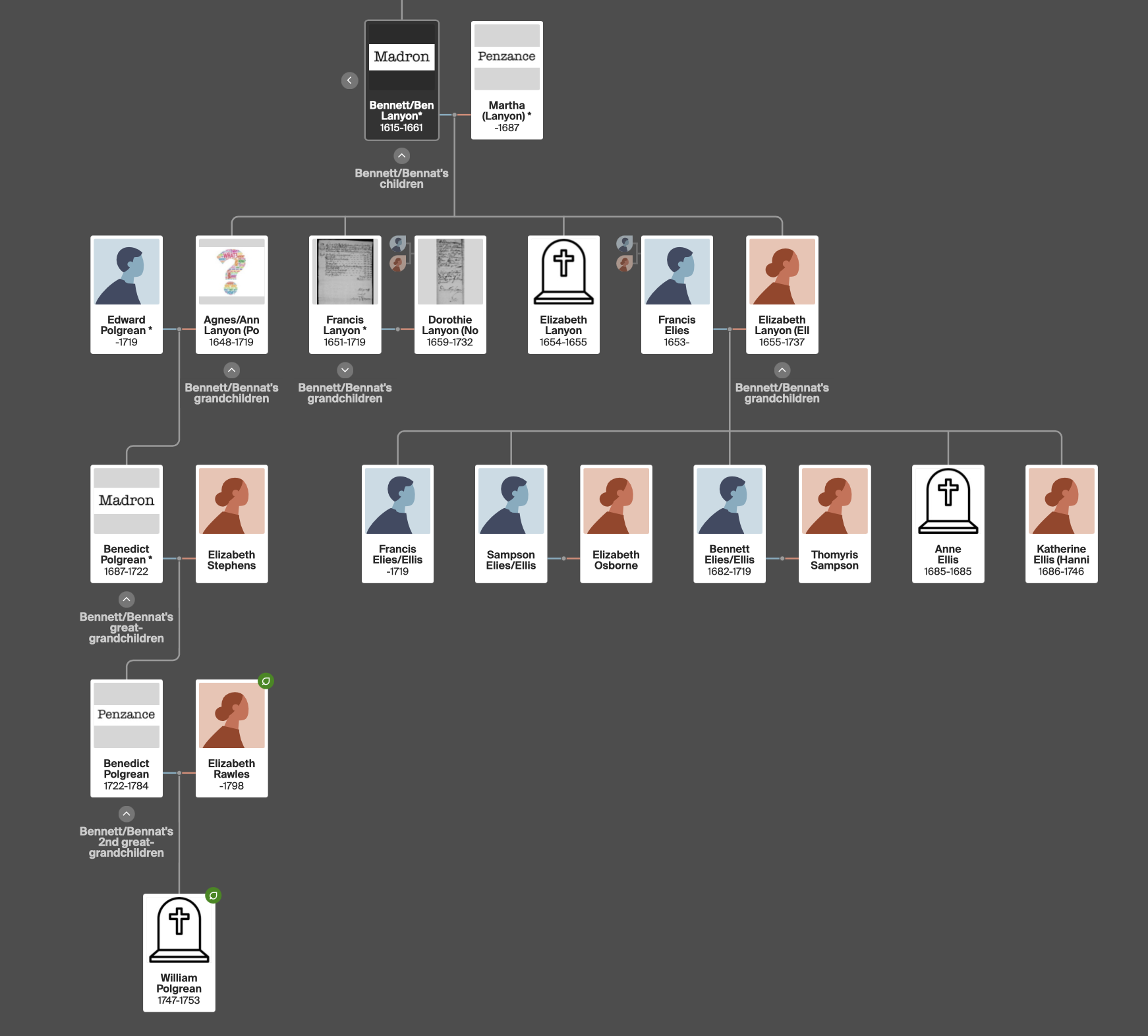
Bennett, Francis’ son and heir, was baptised in 1615 eight years after his parents married. Perhaps there were other children born before him? He too took the Protestation Oath in 1641/2. In 1647 he married Martha. They had four children:
Agnes 1648 – married Edward Polgrean at Zennor in 1687. Their only child was Benedict. He married Elizabeth Stephens in Jun 1721 and in Jun 1722, just a month after his son Benedict’s baptism, he died.
Francis 1651-1719 he married his cousin Dorothie Noy (née Lanyon) when he was aged 50. Their only child Martha died aged 4. His estate was left to his nephew Benedict Polgrean in 1719. Less than three years later Benedict was dead too.
Elizabeth 1654-1655 died in infancy
Elizabeth 1655- married Francis Ellis (Elies) – 4 children: Bennett, Sampson, Francis and Katherine
Bennett’s line finishes here.
Bennett’s Tree
Sampson Lanyon 1616-
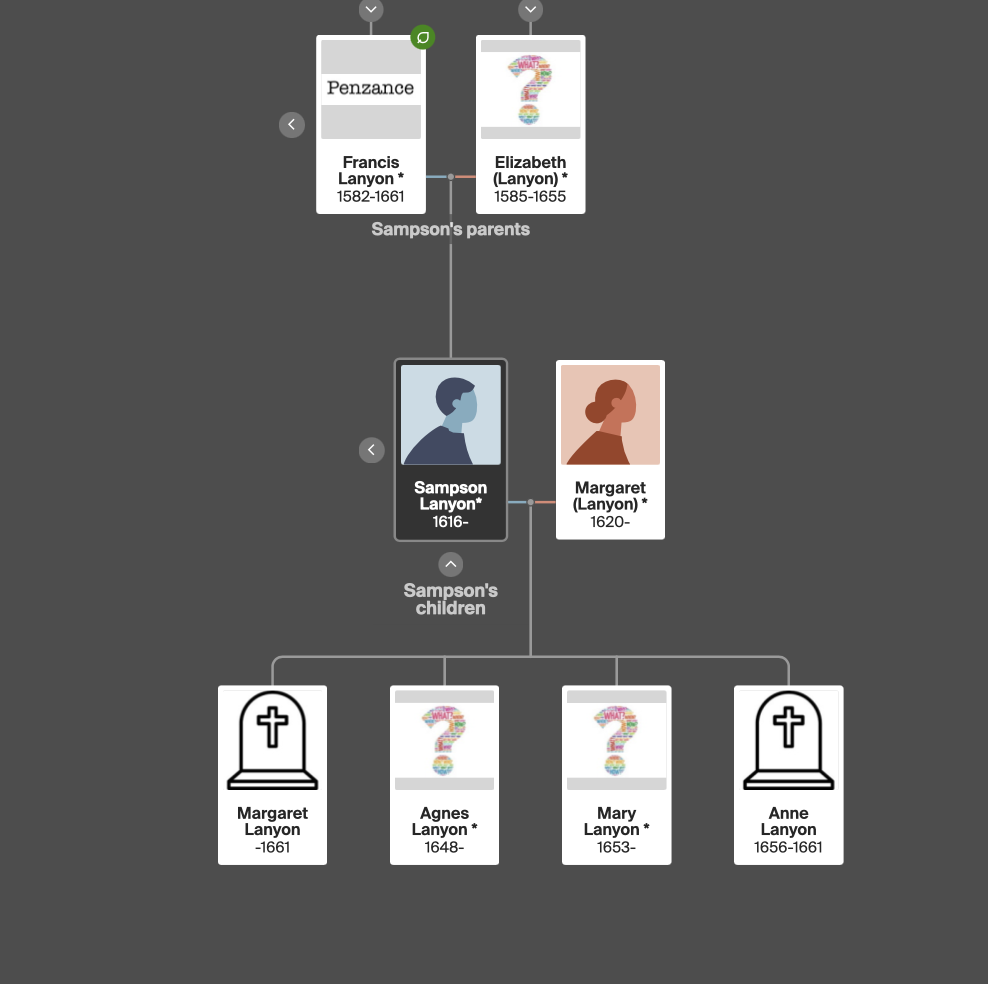
Sampson was baptised in 1616 in Madron. In 1647 he married Margaret and had four children:
Agnes 1648- no further trace
Mary 1653- no further trace
Anne 1656-1661 died in infancy
Margaret -1661 died in infancy
Sampson’s line finishes here.
Sampson’s tree
Susanna Lanyon 1619-
Susanna was baptised at Madron in 1619. In 1640 she married William Tregeco. There are no further records of this family.






















 The Lanyons