
Tobias and Mary Lanyon were ‘cousins german’ or first cousins, next of kin and co-administrators of Abel Angove of Trevenson, Illogan. The only problem was which Tobias and Mary Lanyon and how were they connected to Abel Angove?
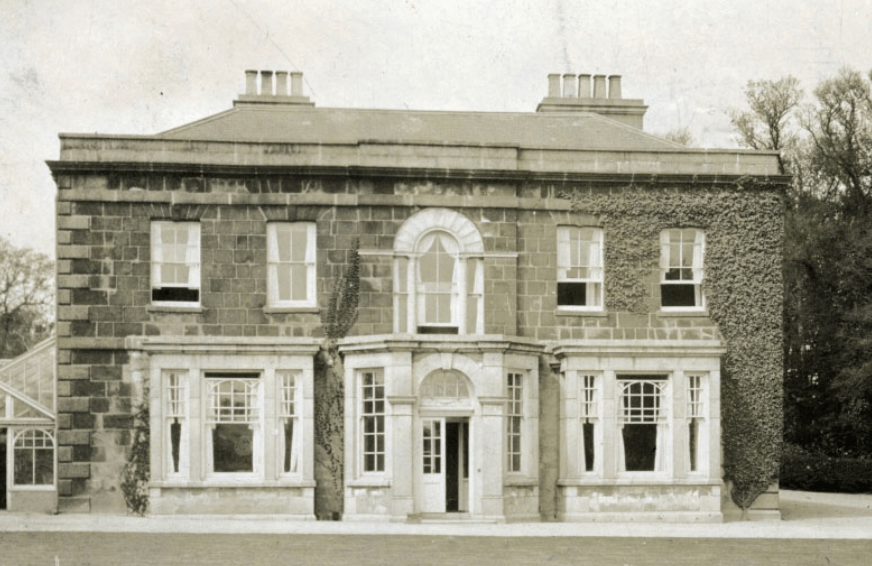
Abel Angove died following a fall from his horse, he was buried on 5 Aug 1767. There is a letter at Kresen Kernow from Francis Basset claiming the horse (the cause of death) by ‘deodhand’ as Lord of the Manor of Tehidy. (Source – TEM/1/10 dated 4 Aug 1767- Francis didn’t hang around, the letter was written before Abel was interred!!)
Abel was an attorney and a widower, he had married Jane Phillips the daughter of Mr. Henry Phillips in 1729 at Phillack. Jane died 13 Aug 1730 and Abel never remarried or had children.
Why were Lanyons his next of kin? I started digging!
Abel was the son of Abel Angove gent. He was born in 1673 the son of Reginald/Reynald Angove.
The Parochial History of Cornwall founded on the manuscript histories of Mr Hals and Mr Tonkin by Davies Gilbert (Vol II p.234, 1838) gives the following information about Reginald Angove.
“In this parish, at….,liveth Reginald An-Gove, gent. i.e. Reginald the smith, a sirname (sic) assumed in memory of his first ancestor, who was by trade and occupation a smith.
And of this sort of sirname in England, thus speaks Verstegan.
‘From whence came smith, all be it knight or ‘squire? But from the smith that forgeth in the fire.’
This Reginald Angove is that crafty tinner, whom common fame reports to have gotten a considerable estate by labouring, adventuring, and dealing in tin, both in the mines below and blowing houses above ground, by indirect arts and practices; for which, about the 8th of William and Mary (1697) he was indicted before the jury of tinners (whereof the writer of these lines was summoned for one) amongst other things, for putting hard heads of false metal and lead in the midst of slabs of tin, melted and cast in his blowing house, in testimony whereof some pieces or slabs thereof was cut in pieces, and the fallacy detected; whereupon the Grand Jury returned the bill of indictment, indorsed (sic), Billa Vera. But on his trial there was given a verdict of acquittal.‘
Trying to work out which Tobias and Mary Lanyon were ‘next of kin’ was a challenge. There are several Tobias Lanyons and lots of Mary Lanyons. I was able to eliminate any that died before 1767 when Abel died, any that were dead before 1779 when a lease was assigned which named them both as co-administrators. (Source – CRO X473/94). Tobias Lanyon gent of Penzance was mentioned in a mortgage assignment (Source-CRO X446/5) which seemed to preclude the Gwinear Tobias Lanyons.
There was a suitable candidate: Tobias Lanyon the son of Francis Lanyon and Phillipp Nicholls (Botrea branch) and he had a spinster sister called Mary Lanyon.
Tobias was baptised in Sancreed in 1702 and in 1717 ‘Tobias son of Francis Lanyon, gent, was apprenticed to John Tonkin of Penzance, tobacconist.’ Tobias never married and died in 1778.
His sister Mary was baptised at Sancreed in 1690, she too never married and died in 1779.
But that still didn’t explain how they were related to Abel Angove.
A plaque in Illogan church lists both Abel Angoves and names both wives as Jane.
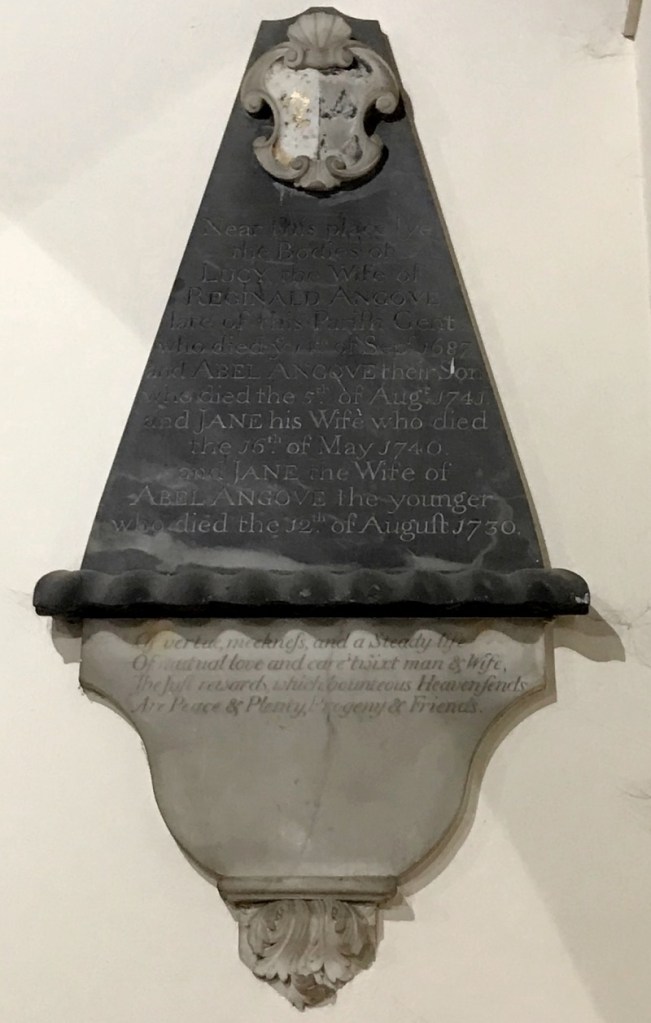
Jane Phillips was the wife of Abel Angove the younger but who was Abel’s mother?
There is no record of a marriage for Abel Angove senior. His wife was called Jane and that’s as much as we know for certain. It does however seem likely that she was a Lanyon.
I found Abel’s will:
The Will of Abel Angove of Illogan 1740
I Abel Angove of Trevonson in the Parish of Illugan and County of Cornwall Gent resigning my Soul to Almighty God my Creator in hopes of his mercy and forgiveness through the alone Merrits and Intercession of my most Blessed Saviour and Redeemer Jesus Christ doe by this my last Will and Testament dispose of my Real and Personal Estate as followeth I give unto my most dutifull Daughter Lucy Angove the Sum of One Thousand Pounds in lieu and Bar of a Instrument in Writing Tripartite dated Eleaventh day of June One Thousand Seaven Hundred and Thirty the one half to be paid her within Six Months after my decease and the other half to be paid her within Nine Months after the Six Months before mentioned and the farther Sum of Five Hundred Pounds to be paid her within two Years after my decease and alsoe Ten Pounds to buy her Mourning the which Ten Pounds I doe order my Executor hereafter named to pay at my decease I Give unto the Poor of this Parish the Sum of five Pounds I mean those that receive no Pay from the said Parish to be distributed by my Executor within one Month after my decease I give unto my most dutiful Son Abel Angove all my Lands Goods and Chattles that I dye posses’d of in paying my Debts and Legacy’s And I do hereby make and constitute my said Son Abel Angove Executor of this my last Will and Testament hereby revoking all other Wills at any time heretofore made by me declaring this to be my last Will In Witness whereof I have to this my Will (the whole Written with my own hand) Sett my hand and Seale this first day of August 1740 Abel Angove
(Attestation Clause)
Mary Lanyon _ Edward Angove Junr._ Richard Gribbell Proved at London 15 September 1741
Source: National Archives ref: PROB 11/711/373
Transcribed by Ros Dunning and reproduced with permission of Cornwall OPC.
Sadly it doesn’t mention his wife or her family. Jane died in 1740 a year before he did.
It didn’t take long to find a suitable candidate: Jane Lanyon the daughter of Tobias Lanyon and Jane Tresilian of Sancreed. Tobias was the brother of Francis Lanyon and uncle to Tobias and Mary the co-administrators of Abel’s estate.
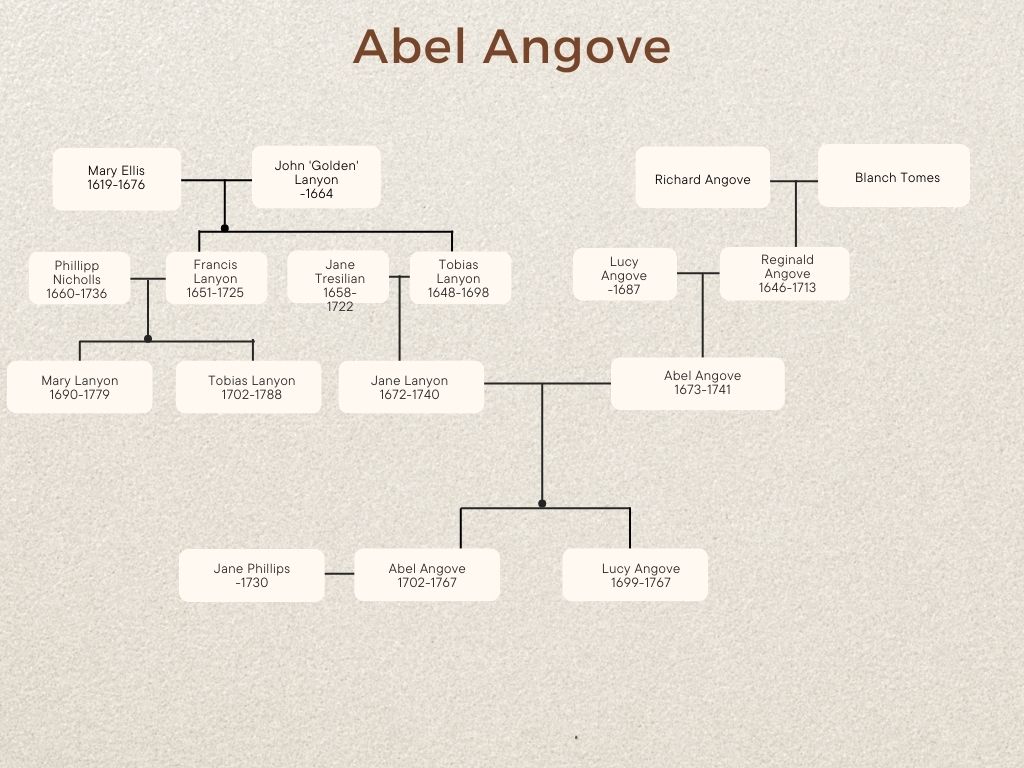
Whilst I have no proof that Jane Lanyon was Abel Angove’s wife it does seem likely.
 The Lanyons