
Occasionally you come across a document which really helps to paint an accurate picture of a person.
Whilst searching through the online archives at Kresen Kernow (Cornish Record Office) I found a legal opinion dated 1689 for Sir John Coryton against Sir James Tillie. This is of interest to us as Sir John’s servant was called John Lanyon.
From the documents held at Kresen Kernow John Lanyon was witnessing Sir John Coryton’s documents from 1674 onwards so by 1689 he must have been a trusted member of staff.
Sir John Coryton was the 2nd baronet of Newton Ferrers. He was married to Lady Elizabeth.
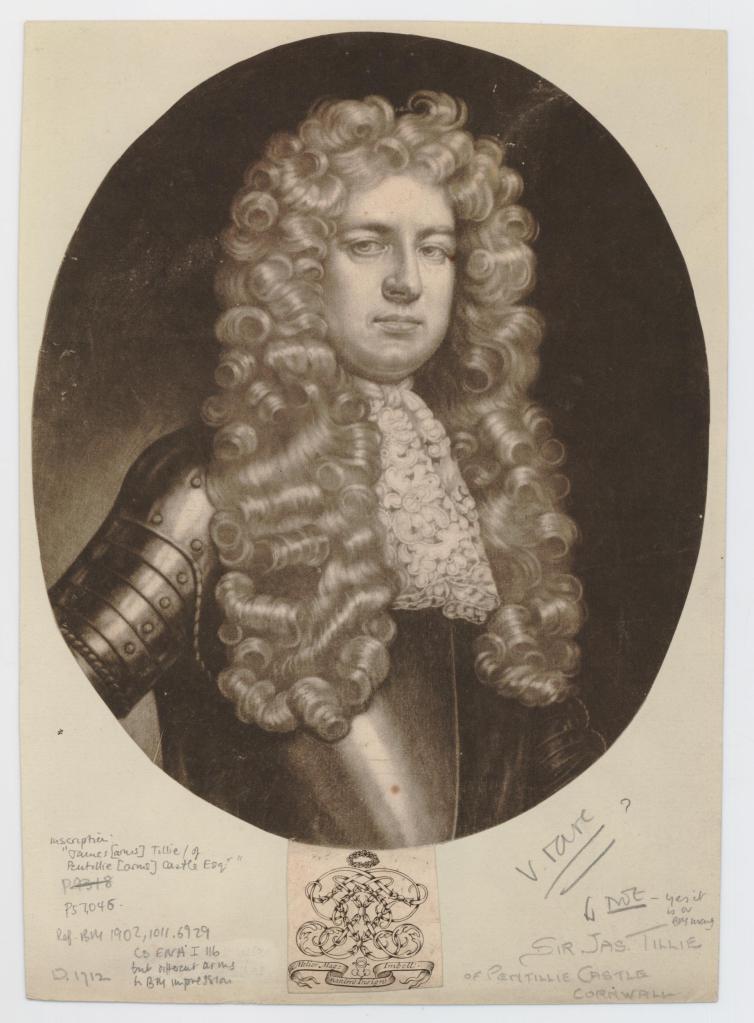
Sir James Tillie was Sir John Coryton’s land agent. He wanted to be married to Lady Elizabeth!
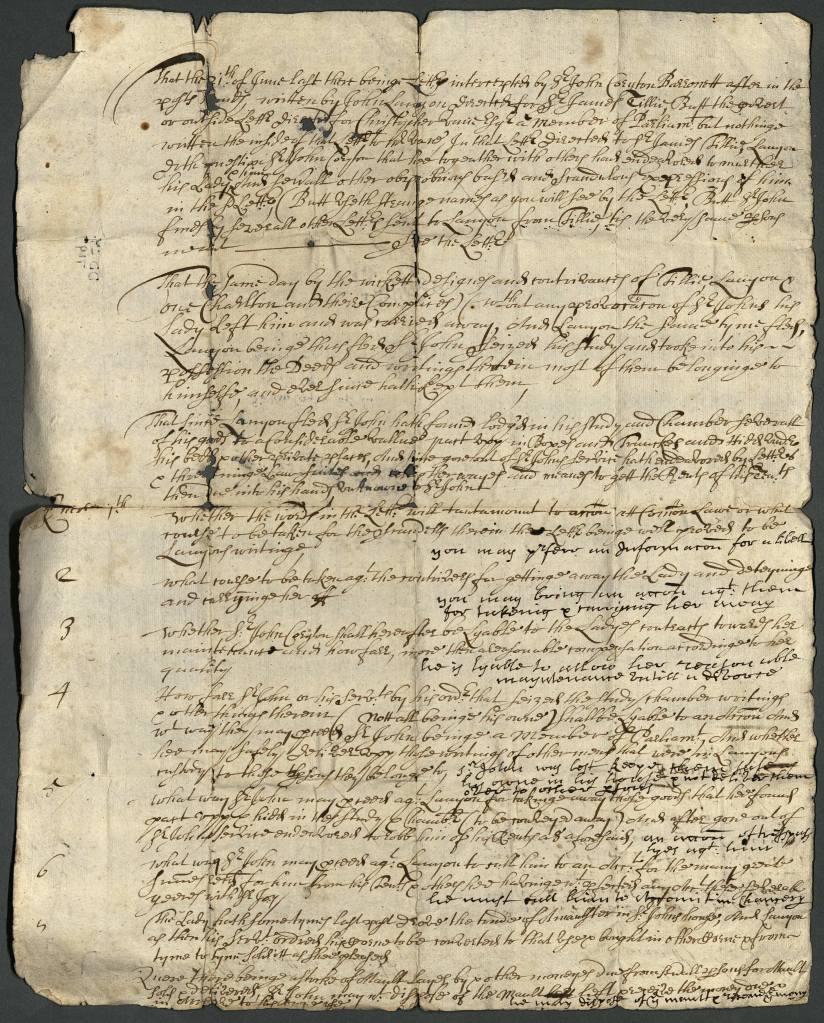
The counsel’s opinion for Sir John Coryton against Sir James Tillie details how Sir John’s wife Elizabeth had been ‘carried off’ by Sir James Tillie. Sir John was advised that he could take action against the man/men who carried off his wife but he was liable to give her reasonable maintenance until a divorce.
The document also explains that Lady Coryton had been a ‘maltster’ (a brewer) in Sir John’s house and he was advised that he could sell the stock and receive the proceeds. The legal opinion goes on to explain that if Lady Coryton was with child which Sir John did not want to inherit then he must sue for divorce but must have full proof of adultery.
Elizabeth was the daughter of Sir Richard Chiverton who had been Lord Mayor of London from 1657-1658.
Whilst all this was going on John Lanyon had been busy defrauding Sir John. He wrote secret letters to James Tillie threatening to murder John Coryton and his wife. When Lady Elizabeth left her husband and was ‘carried away’, John Lanyon, realising the game was up, fled.
After he’d gone papers and goods belonging to Sir John were found in Lanyon’s study. These showed that he had been threatening Sir John’s tenants and trying to obtain rents and properties.
Conveniently Sir John died mysteriously at the age of only 42. There is speculation that he was poisoned. Lady Elizabeth married Sir James Tillie who divided the Newton Ferrers estate and built ‘Pentillie’. John Lanyon escaped prosecution.

James Tillie died in 1713 and his will left instructions that he was not to be buried but placed in a vault sitting in a sturdy chair in his finest clothes with his pipe so he could await resurrection! His instructions were carried out but his body was later moved and then lost. 300 years later it was found!
So what happened to John Lanyon and where does he fit on the tree?
Clearly John Lanyon was an educated man. If he was working for Sir John from 1674 onwards then he was probably born early 1650s.
There are currently 315 John Lanyons on the family tree but there is only one candidate that really stands out and that is John Lanyon 1652-1720. (See post ‘William ‘Generosi’ Lanyon of Breage.)
John was the eldest son and heir of John Lanyon a ‘sea and sand barge daily labourer’.
The Parochial History of Cornwall stated that John Lanyon senior:
‘…had a son named John Lanyon who having had his education under Hugh Boscawen, gent, Master of Arts, who kept a school at St Michael Penkevill Church, became afterwards a steward to Trefusis, St Aubyn, Coryton and lastly came into the service of Brook Lord Chandos, and having by these services accumulated considerable riches he gave lands and built and endowed an almshouse for the poor people.’

After he fled he must have headed to London and persuaded Lord Chandos to hire him. He later married Sarah Symons. We now have a pretty good idea how he acquired ‘considerable riches’! Perhaps the alms houses were a way to atone for past sins!
For more information see Nigel Baker’s article on John Lanyon:
https://www.keaparishcouncil.org.uk/lanyon-alms-houses-author-councillor-nigel-baker

 The Lanyons