The Lanyons moved all over the world; the collapse of the Cornish mining industry led to thousands of cornishmen and their families emigrating to countries with mines in search of work. One of those countries was Chile.
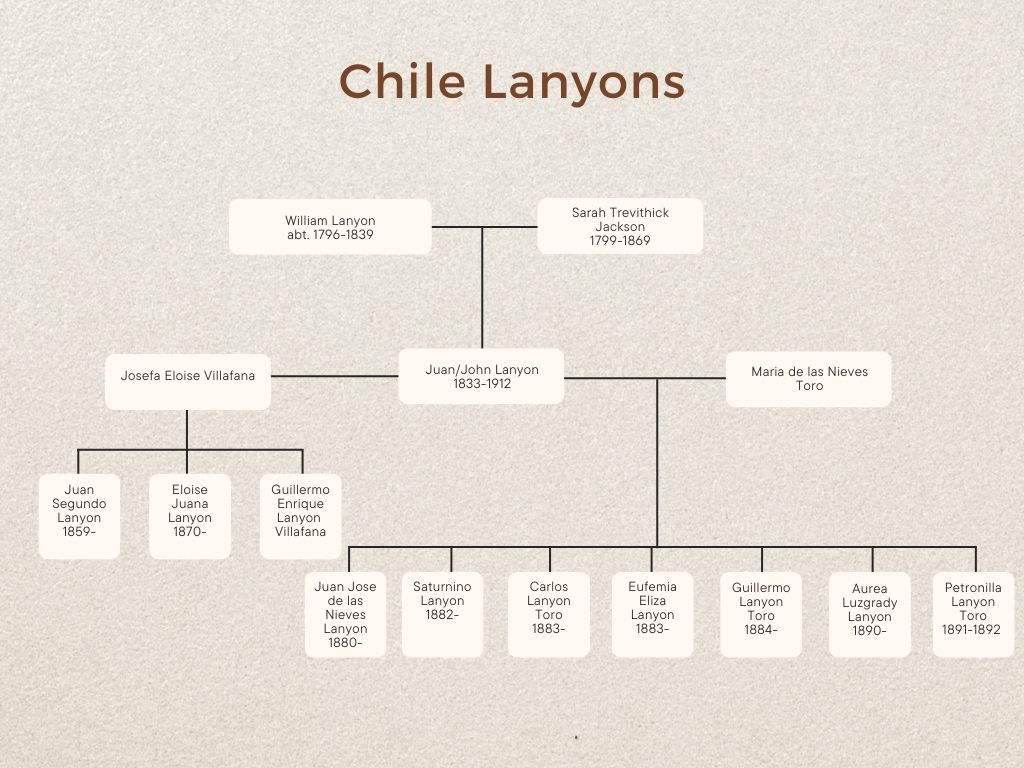
In the 1850s John Lanyon arrived in Chile to work for an English mining company at the El Morado mine. He was quickly renamed Juan and married a local girl – Josefa Eloisa Villafana at Copiapo, Atacama on 10 July 1858.
So where did this John/Juan Lanyon come from?
I wasn’t the first person to ask this question, William Lamparter also discovered a family called Lanyon in Chile and wrote to them. Their responses (in Spanish) led to this post. Thankfully I had Google translate and have managed to piece together this story which may or may not be right! The letters are written by Juan Jose Lanyon b.1880, the son of John/Juan Lanyon.
The letters were written in 1948/49 and it quickly becomes apparent that both William and Juan have an obsession: William is obsessed by genealogy and Juan is obsessed with the ‘missile’ he has designed, el Meteoro!
William is trying his hardest to prise family history from Juan who is obsessed with finding someone to market and sell his missile design.
There is however a slight problem: unbeknown to Juan, William is a gay furniture retailer from North Carolina who has not the slightest interest in Juan’s invention and Juan has clearly designed a missile that will never work!
Juan writes a twelve page ‘epistle’ laying out the history of his invention and his attempts (all unsuccessful) to market it to the Americans and British.
Juan admits that “….some engineers and industrial institutions to whom I proposed to do it, considered it delusional.” The British consul was a bit kinder with his rejection “…both Mr Englehurst and Mr Latorre were greatly surprised by the apparatus as a whole and they believed that it was going to have some ‘resonance’ (I bet they did!)…..a few weeks later the secretary of the English consulate returned the documents to me stating that the consulate officer whom they had consulted did not consider it practical.“
Juan also mentions his other inventions – “I have also devised a warship that is invulnerable to torpedoes and becomes invisible to the enemy by sea (but not to planes).“
Juan explains that his idea for the missile came from watching fireworks at festivals when he was young. Perhaps the designers of the V2 rocket also gained inspiration from watching fireworks when they were young. The difference is that Juan’s missile was based on the Catherine Wheel firework!
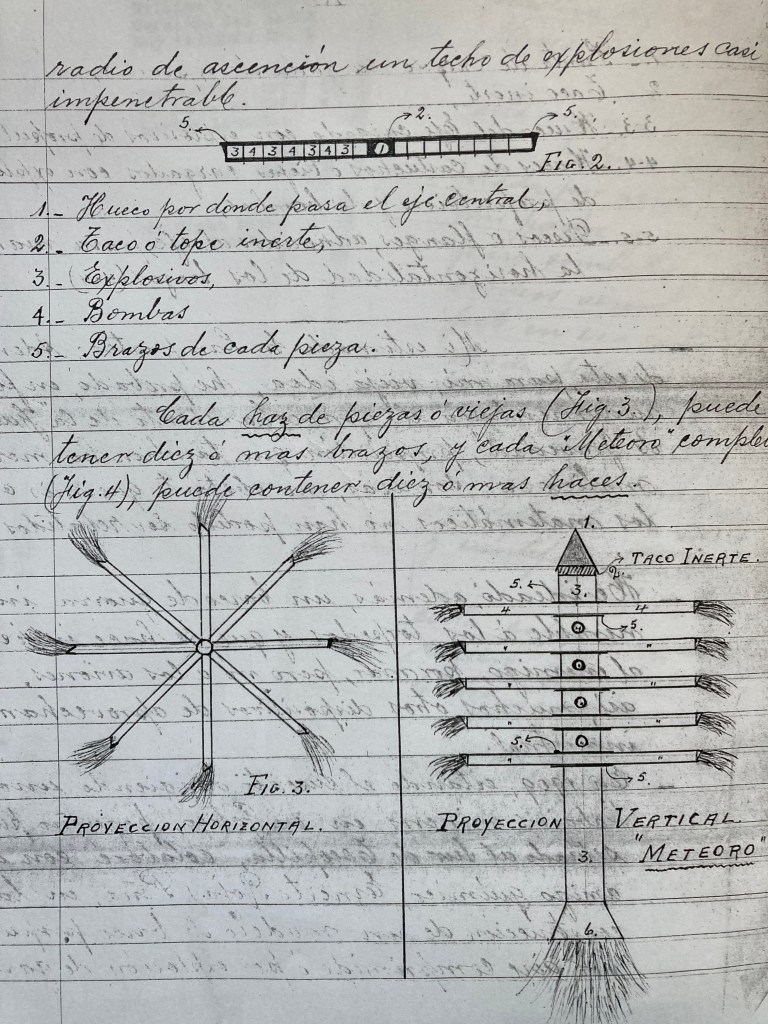
Juan tells William he “…will surely win honours and awards in life and perhaps a statue” if he can get a North American company to build his missile!
And so the correspondence continues with William asking questions about Juan’s Lanyon forbears and Juan responding “I have vague memories that the parish where he was baptised was Madron…..now regarding my invention called Meteor….“
In January the following year he writes again and mentions Madron again and moves straight on “….regarding my invention called Meteor…“
At this point I think William realises that he will not get any further with this little branch of the Lanyon family and abandons the correspondence. I’ve picked up the baton and found out the following information.
John/Juan Lanyon was baptised at Illogan, Cornwall on 9 Nov 1833. His parents were William Lanyon and Sarah Jackson. John was the seventh of nine children. Four of them died in childhood.
- Elizabeth 1821-1879 emigrated to Australia
- Frances 1822-1823 died in infancy
- William 1824- bef. 1861 married two children and died before 1861
- Frances 1827-1895 emigrated to Australia
- Joseph 1829-1840 died age 11
- James 1831-1837 died age 7
- John/Juan 1833-1912 emigrated to Chile
- Richard 1836- no trace
- Edward 1837-1839 died in infancy
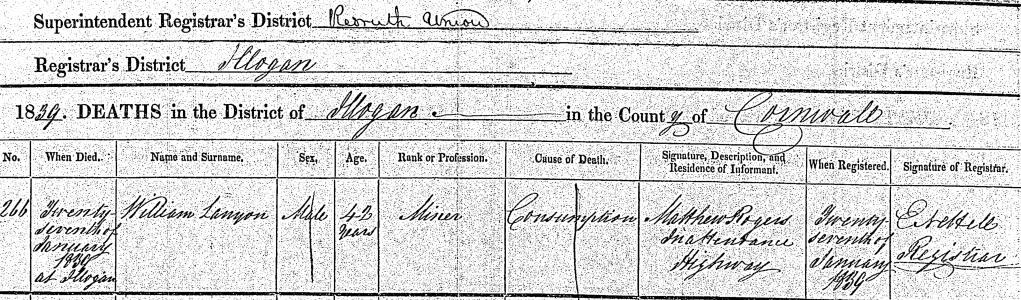
John’s father William Lanyon died in 1839, he had consumption (TB). His death certificate states that he was aged 42 giving a date of birth about 1797. William was a miner and had married his wife at Illogan on 14 October 1820 and that was all I could find out. There was no trace of a baptism anywhere in Cornwall or Devon. As he died before the first census in 1841 I couldn’t see where he was born.
I found Sarah, his wife, on the 1841 census with four of his children: William, Frances, John and Richard. Sarah was listed as a widow and 15 year old William was a miner and probably supporting his whole family. I couldn’t find her on the 1851 census and suspect she has been mis-transcribed. By 1861 she was living with a niece and was called Sally Lanyon.
I found four of her children living together on the 1851 census: her daughter Frances age 22 was a mine labourer, sons John age 17 and Richard age 15 are copper miners. Her daughter Elizabeth, was married and now called Williams, was also living with Frances and her young children.
Shortly after the 1851 census both girls emigrated to Victoria, Australia. William was married and had two children but died before the 1861 census. I don’t know what happened to Richard but John headed to South America.
I turned to the early 1948 letters from Juan Jose Lanyon.
“My father kept many documents that he revoked the Edict of Nantes and the Huguenots were persecuted. Many of them fled to Germany. Among them my great grandfather. The last name was Lanion but he changed the ‘i’ to a Greek ‘y’ registering as Lanyon on arrival in England.“
That threw the cat among the pigeons! It was the first time there had ever been any mention of Lanyons from Germany. I couldn’t find any evidence that the Lanyons had ever lived in Germany in the 18th Century.
He went on to mention that his father’s brother Pablo had died in the Canadian war of Secession (I couldn’t find anything to support that) and another brother Federico died of yellow fever in Tocopilla where he was buried (I couldn’t find anything to support that either.)
He went on “…my father also told me that the Lanyon family by direct maternal descent was related to Jorge Stephenson the inventor of the locomotive.“
A little research revealed that Juan’s mother Sarah/Sally Jackson was the daughter of William Jackson and Frances Trevithick of Illogan who must have been related to Richard Trevithick from Illogan. Richard Trevithick did indeed invent a locomotive. Bingo!
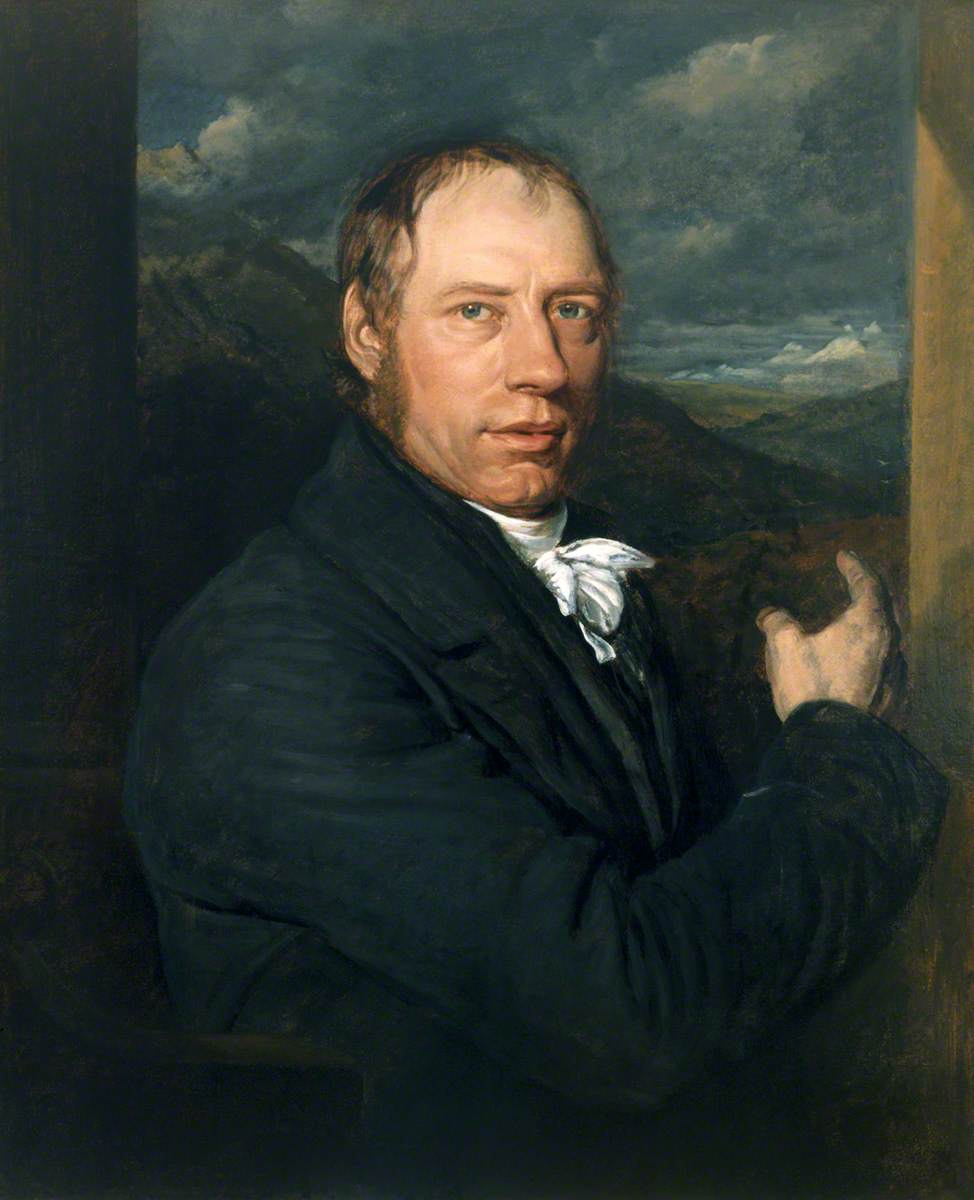
The story about George Stephenson wasn’t exactly wrong but something had been lost in translation. I went back over what Juan’s son had written. Perhaps they weren’t Huguenots but just non-conformists, perhaps Germany was really St Germans in Cornwall?
Whilst we can’t say for sure where this little branch of Lanyons originated we can say that a tiny strand of Richard Trevithick’s DNA lives on in Chile!
 The Lanyons