John Lanyon and Mary Ellis had a large family but their descendants quite often left no traceable issue.
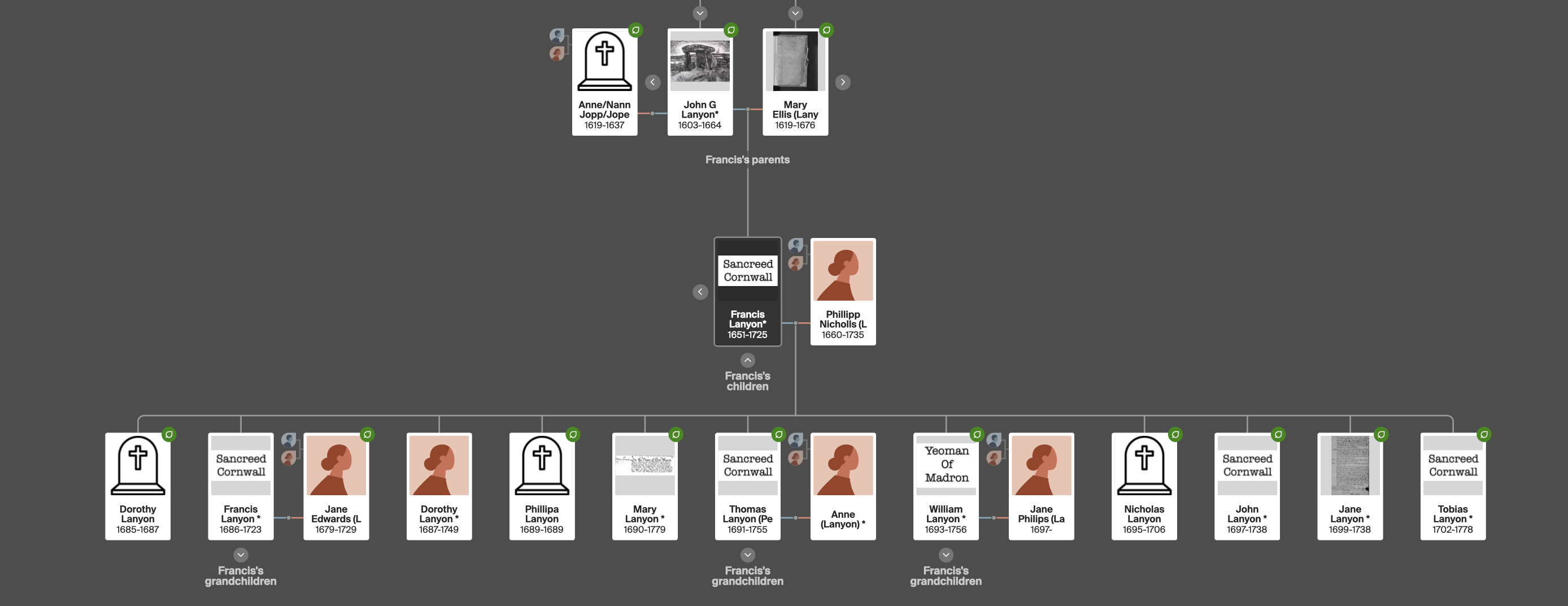
Francis Lanyon 1651-1725 had six sons.
- Francis 1686-1723
- Thomas 1691-1755
- William 1693-1756
- Nicholas 1695-1706 (died young)
- John 1697-1738 never married
- Tobias 1702-1778 never married
Only three of them, Francis 1686-1723, Thomas 1691-1755 and William 1693-1756 had sons of their own.
Francis Lanyon 1686 – 1723

Francis married Jane Edwards at Morvah in 1715. They had five children, the fifth was born following the death of Francis in 1723.
- Jane 1716 – 1716
- Dorothy 1717-1778 married John Tellum (three children)
- Francis 1719-1730
- Jane 1722-1807 – spinster
- Benoni John 1723-1777 (Benoni means ‘son of my sorrow’)
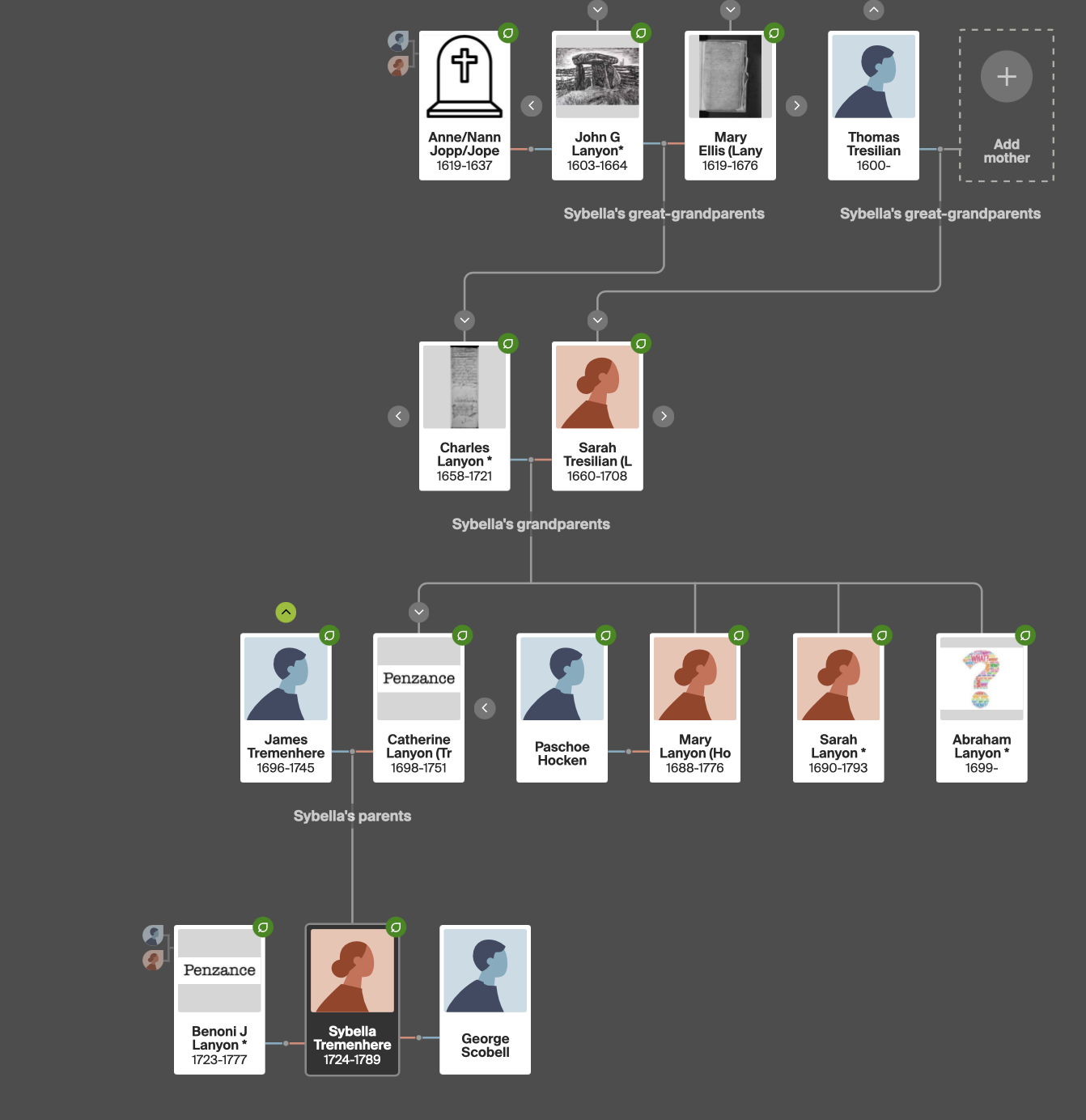
Benoni was baptised three months after his father’s death. He was an attorney and married Sybella Tremenhere, the daughter of James Tremenhere and Catherine Lanyon, a grand-daughter of John Lanyon and Mary Ellis.
Benoni John had no children.
Thomas 1691-1755
Thomas married Ann (surname unknown) and worked as a pewterer in Bristol (see separate post for his life story.) He had one son, Francis, born 1725 – no further trace of him.
William 1693-1756
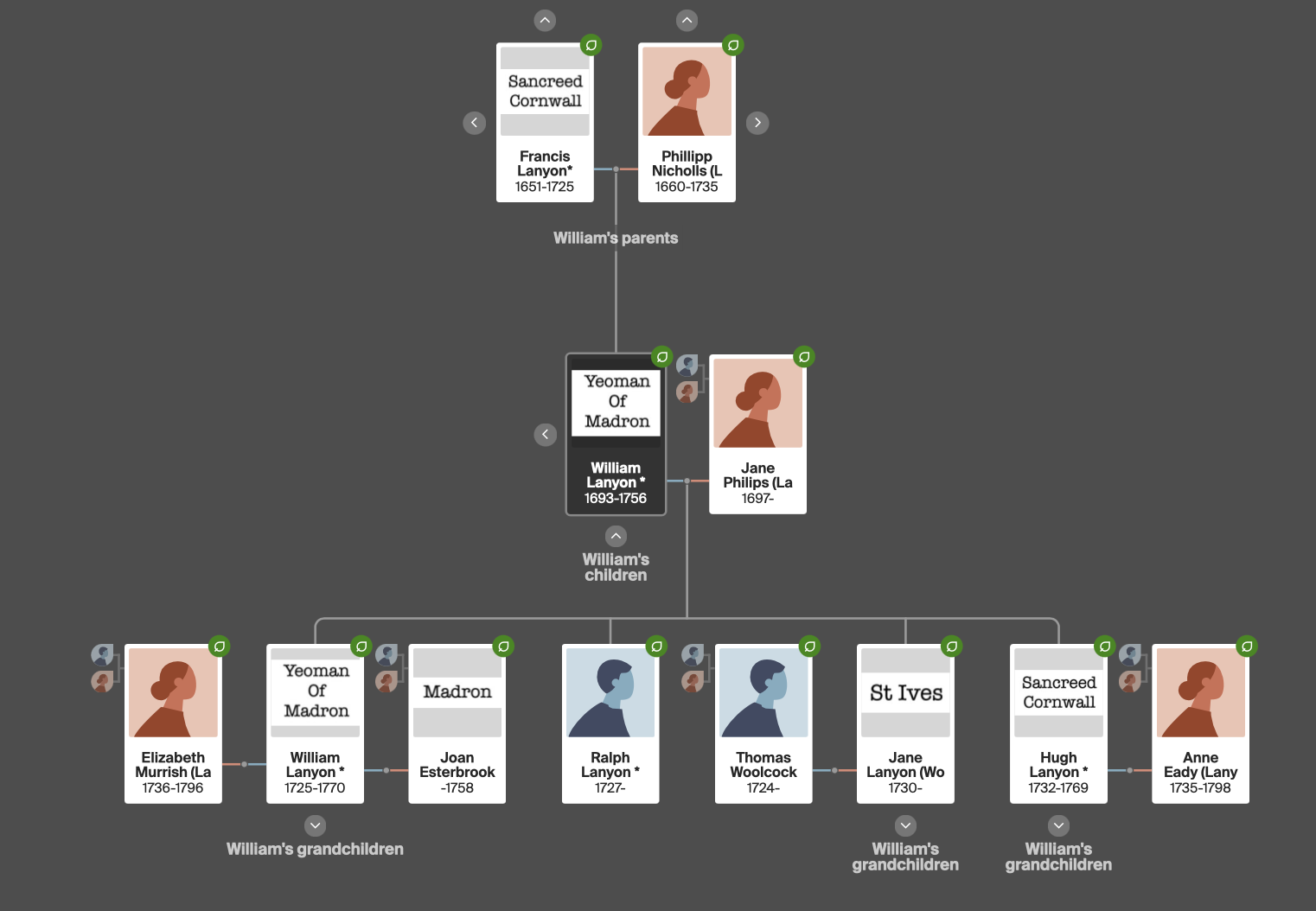
William was a yeoman of Madron and married Jane Philips at Zennor in August 1725.
They had four children:
- William 1725-1790
- Ralph 1727-
- Jane 1730
- Hugh 1732-1769
William 1725-1790
William was baptised at Zennor in February 1725. He married twice, first to Joan Esterbrook in 1751. Joan died before 1758. They had two children:
- William 1751- aft 1770. William inherited the estate at Boswarthen but there is no further trace of him
- Mary 1752- ? there is no mention of her in her father’s will so presumably she died young.
William then married for a second time to Elizabeth Murrish (1736-1796) on 2 Aug 1758. They had four children.
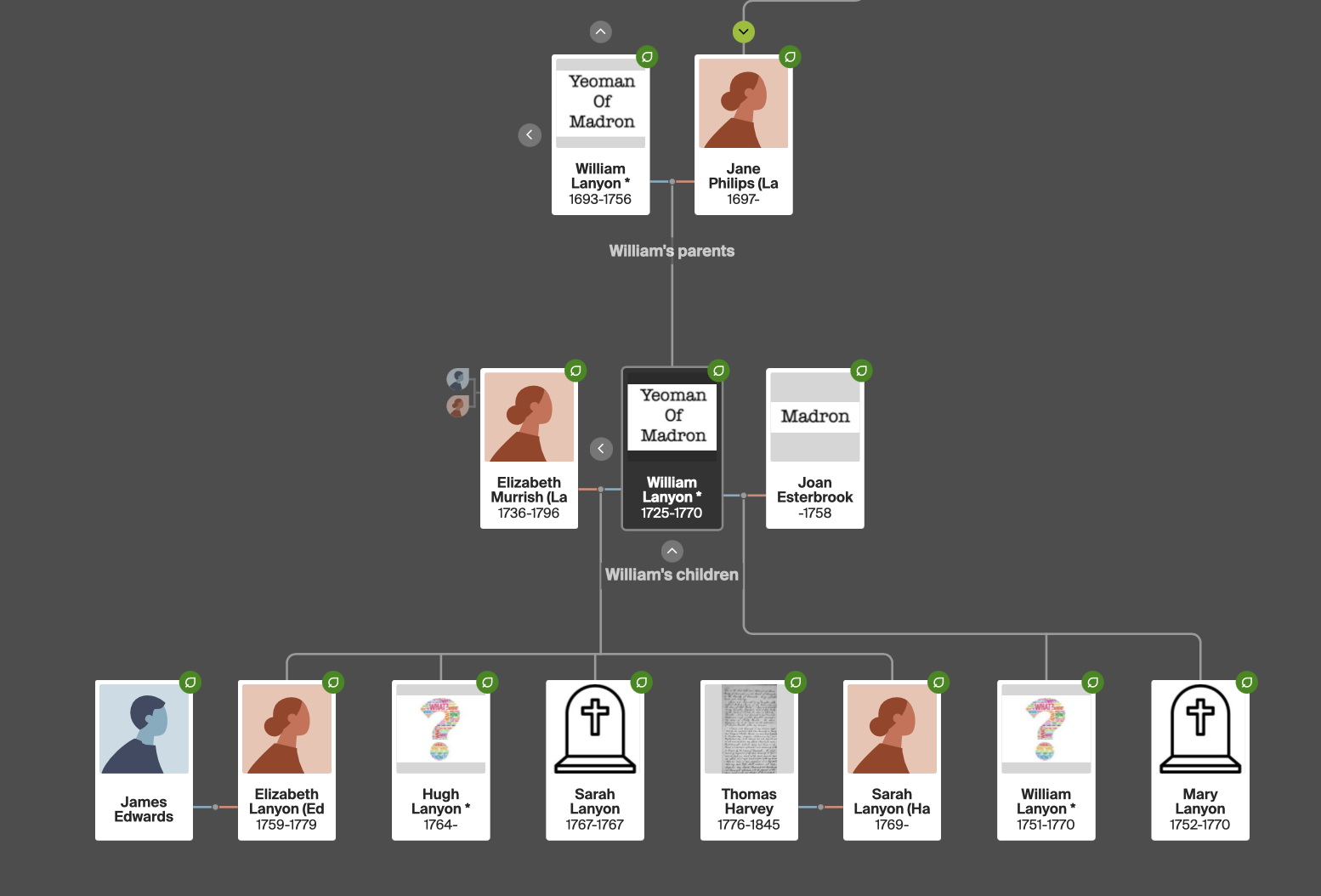
- Elizabeth 1759-1779. She married James Edwards.
- Hugh 1764- mentioned in his father’s will of 1770 but no further trace
- Sarah 1767-1767
- Sarah 1769- she married Thomas Harvey
There are no traceable male heirs of this line.
Hugh Lanyon 1732-1769
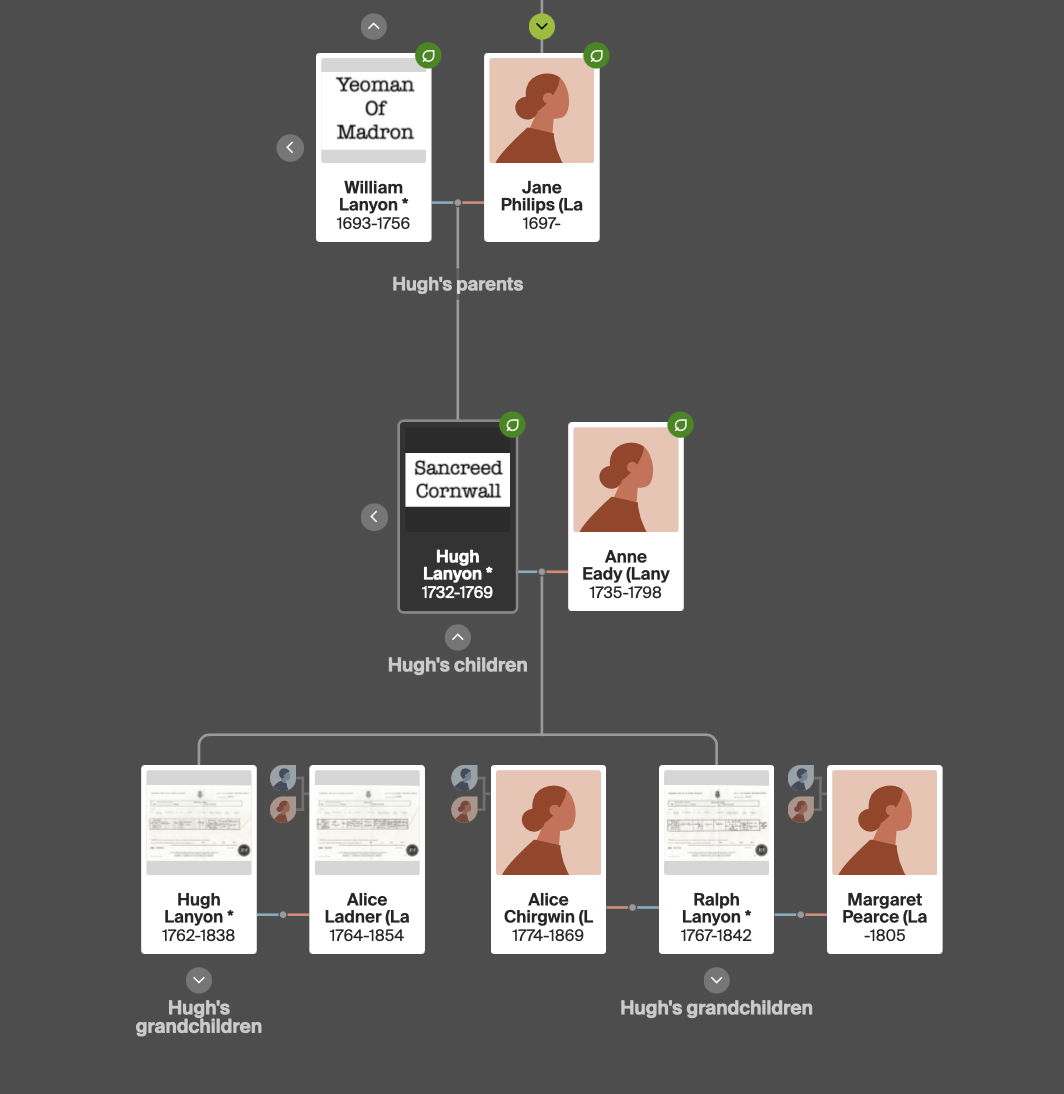
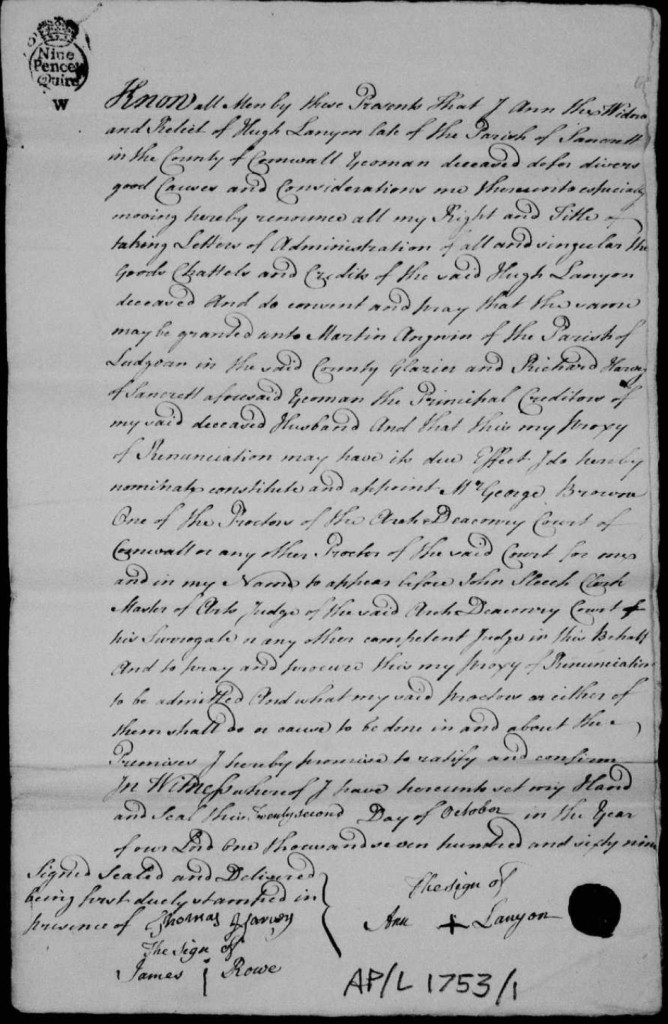
Hugh was baptised at Zennor in 1732. In 1762 he married Anne Eady at Sancreed and they had two sons, Hugh and Ralph. Hugh senior was a yeoman which meant he owned some land. Hugh died in 1769 when his youngest son was just two. He died intestate and his wife renounced administering his estate to Martyn Angwin, Richard Harvey and William Lanyon 1725-1770 (her brother-in-law) his principal creditors.
Hugh Lanyon (Junior) 1762-1838
Hugh and Anne’s eldest son was also called Hugh, he was baptised at Sancreed in 1762, three months after his parents marriage. Hugh was an agricultural labourer and he married Alice Ladner at Sancreed in 1805. They had four children:
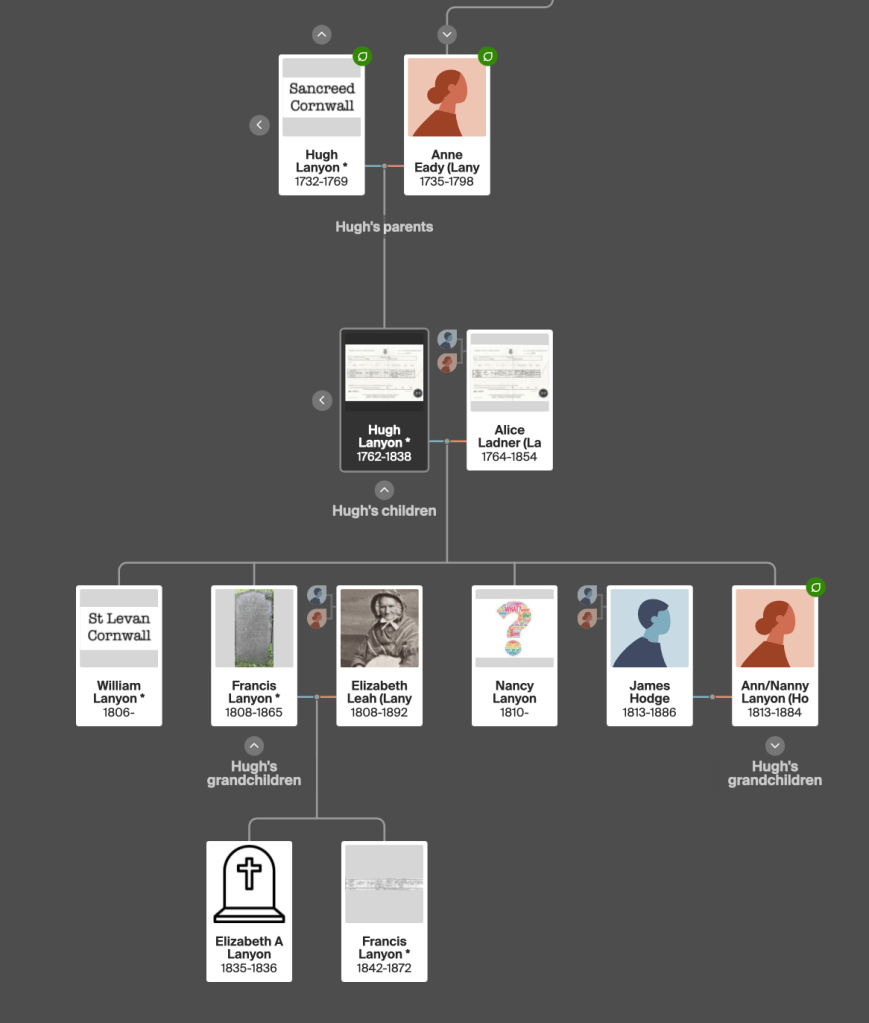
- William 1806- no further trace
- Francis 1808-1865
- Nancy 1810 – no further trace, she may have died in infancy
- Nanny 1813- Nanny married James Hodge, an agricultural labourer at St Buryan in 1837 and they had 3 children.
In 1819 Hugh and Alice were imprisoned for six weeks for larceny.
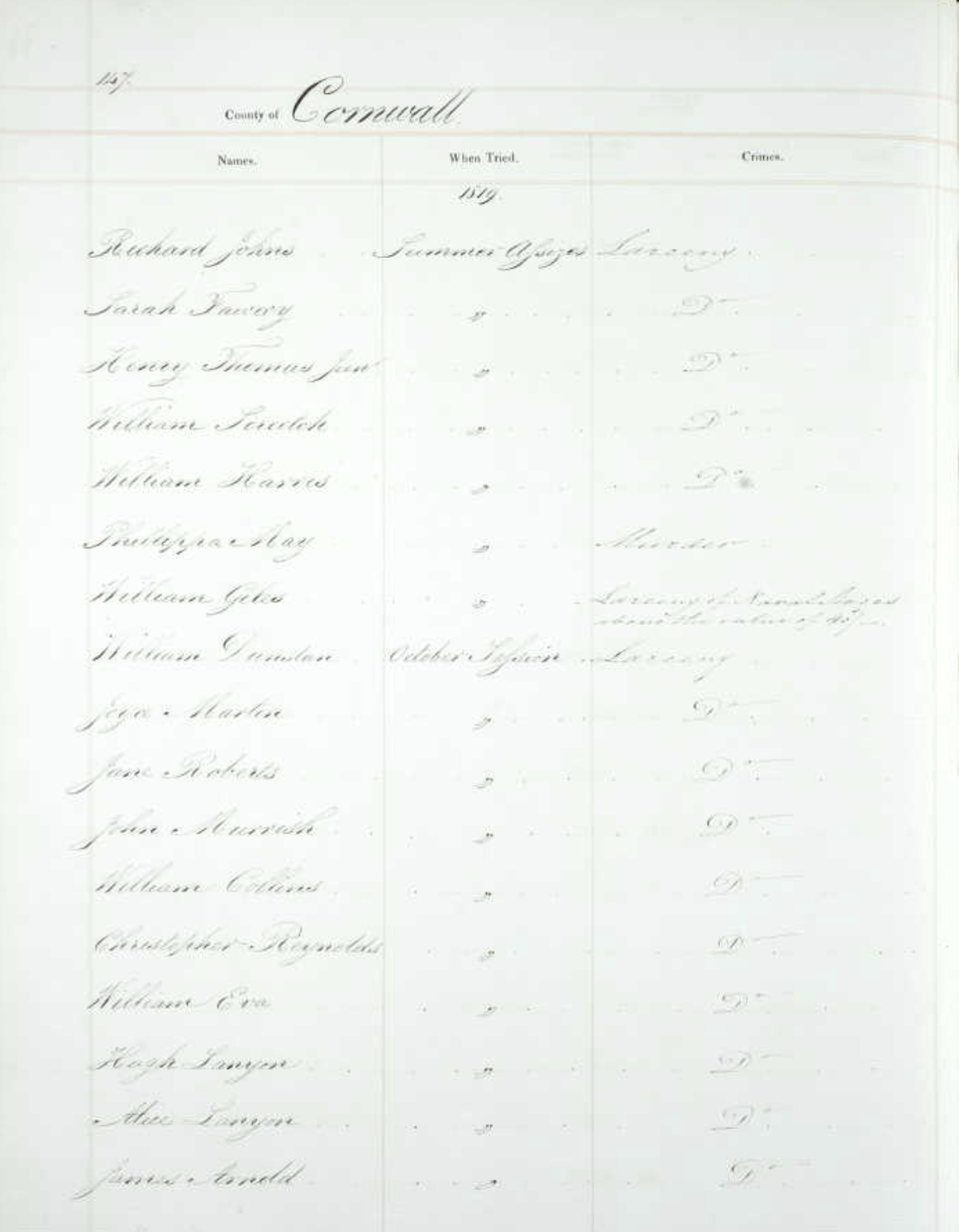
Hugh died in 1838 at the Penzance Union Poorhouse aged 80, the cause of death was debility. Alice died in 1854 at the Union Workhouse Madron age 90.
Francis Lanyon 1808-1865 & Betsy Lanyon 1808-1892
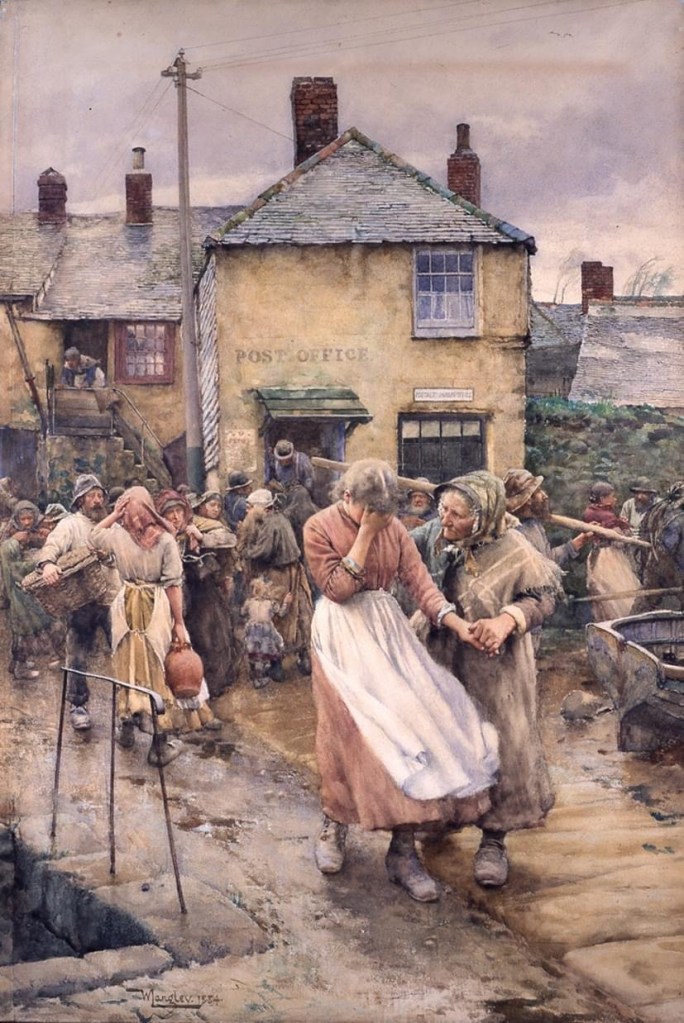
Hugh and Alice’s only surviving son Francis married Elizabeth (Betsy) Leah at Paul in 1834. Francis was a Newlyn fisherman and Elizabeth Leah was featured in a series of photographs and paintings depicting Newlyn fishwives.
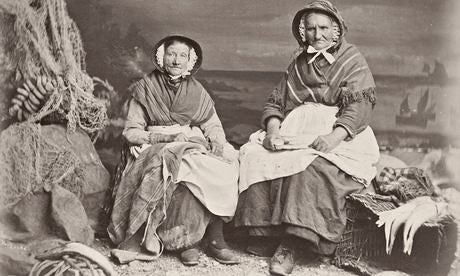
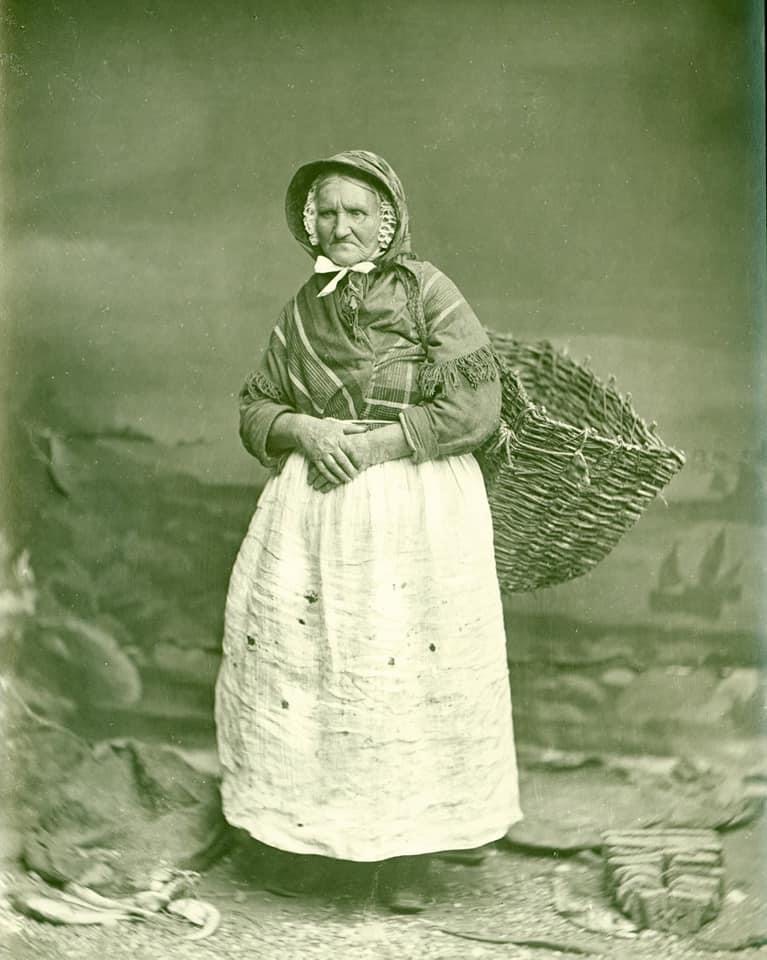
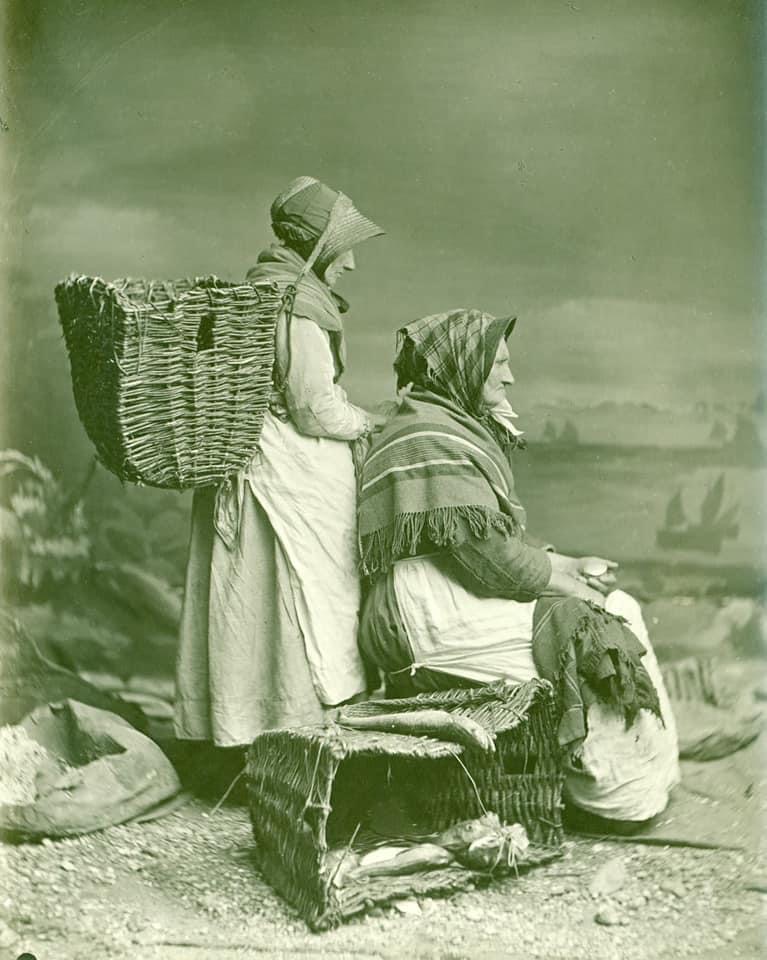
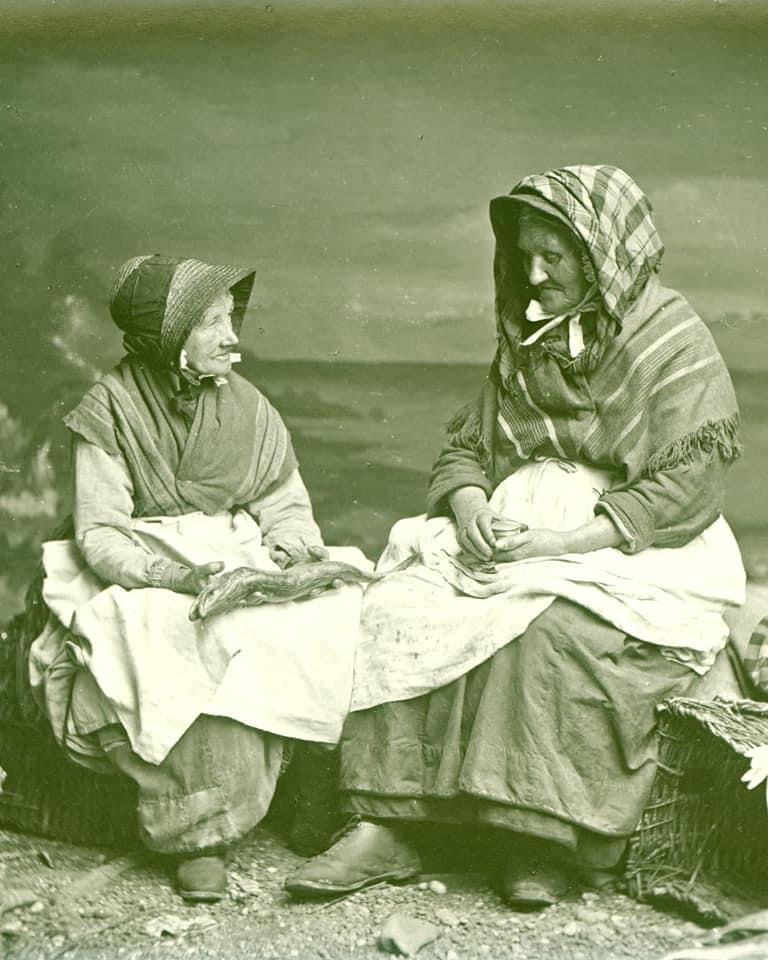
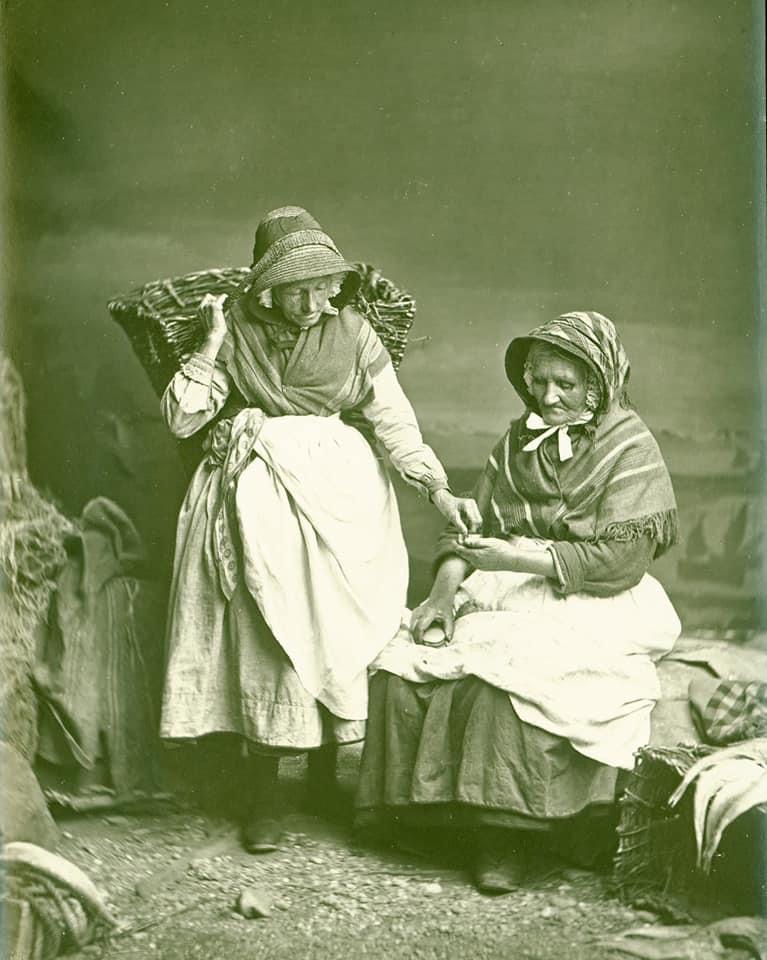
Source: The photos are of Betsy Lanyon and Blanche Courtney taken in the Gibson Mount’s Studio in Penzance circa 1885. Penlee House Gallery & Museum, Penzance.
Francis and Elizabeth had three children: Grace, Elizabeth and Francis. Only Francis survived to adulthood.
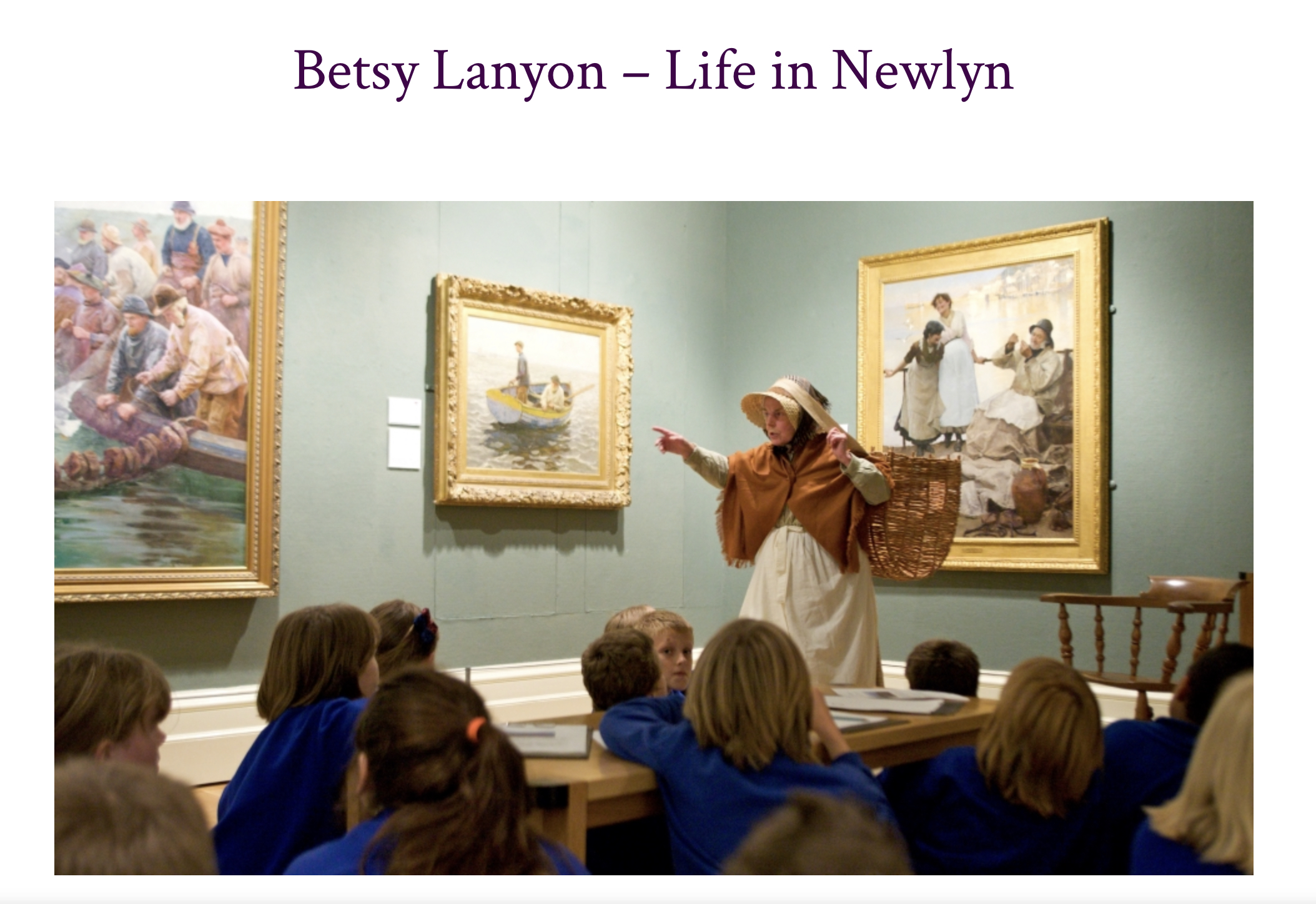
Francis senior died in 1865 and Elizabeth/Betsy died at Newlyn in 1892 but Betsy Lanyon lives on… she is now a ‘living’ part of history and talks to visitors at the Penlee House Gallery & Museum about life in Newlyn in the 19th century.
Francis Lanyon 1842-1872
Betsy and Francis’ son Francis was born at Paul in 1842. The 1871 census for Paul in Cornwall shows that he was living with his mother who was a widow and he was described as age 30 and a ‘cripple and has been for 20 years.’
In 1858 at the age of 16 Francis was found guilty of willfully destroying a tree, the property of Rev. Wm. Veale, clerk at Gulval. He was sentenced to 3 weeks hard labour or a fine of approximately 20 shillings which he couldn’t possibly pay. He had no previous convictions but was sentenced to three weeks on the treadmill. (We’ve already noted that he had been a ‘cripple’ since the age of about ten so three weeks on a treadmill was particularly harsh.)
He was described as 5’2″, dark hair, dark eyes and a dark complexion. Unable to read or write. Freckled, thick lips, scar on nose and left wrist, large eyebrows and slightly pock marked. He was already working as a labourer at Penzance. His weight on entering prison was 133lbs and 3 weeks later it has fallen to 129lbs. Bodmin Gaol was tough. (Source AD/1676/4/5).

Poor Francis died, aged 31, of Scrofulus abscesses (scrofula was TB of the lymph nodes in the neck) and diarrhoea. His mother Betsy lived for another 20 years.
Ralph Lanyon 1767-1842
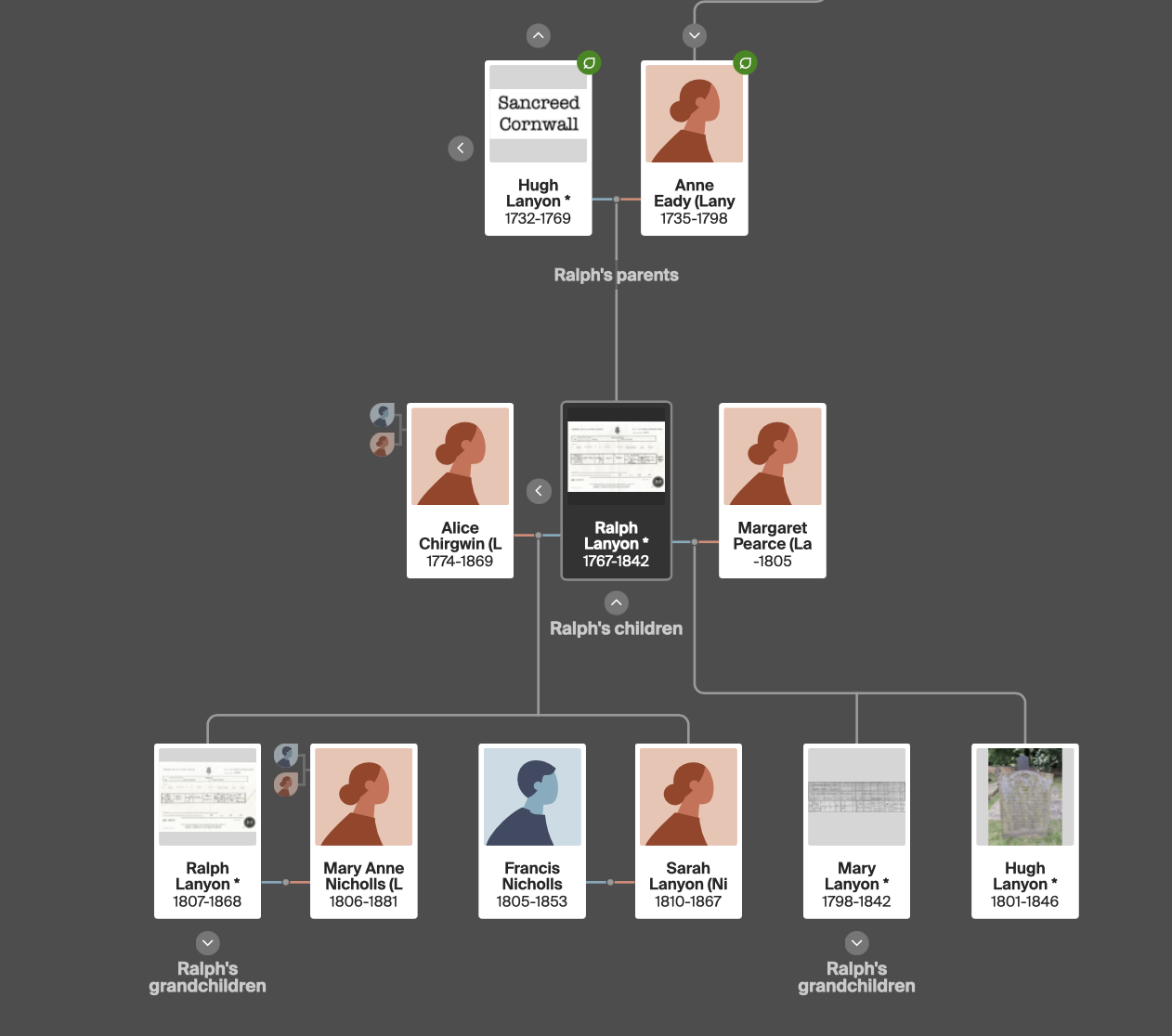
Ralph was the younger son of Hugh Lanyon and Anne Eady. He worked as an agricultural labourer. His first marriage was to Margaret Pearce in 1796 at Paul. There were two children from this marriage.
- Mary 1798- 1842 Mary had 3 illegitimate children: Mary Ann 1825, James 1830 and Matilda Bluett 1834-1841. No further trace of the first two children. She died age 46 of TB.
- Hugh 1801-1846.
Hugh Lanyon 1801-1846
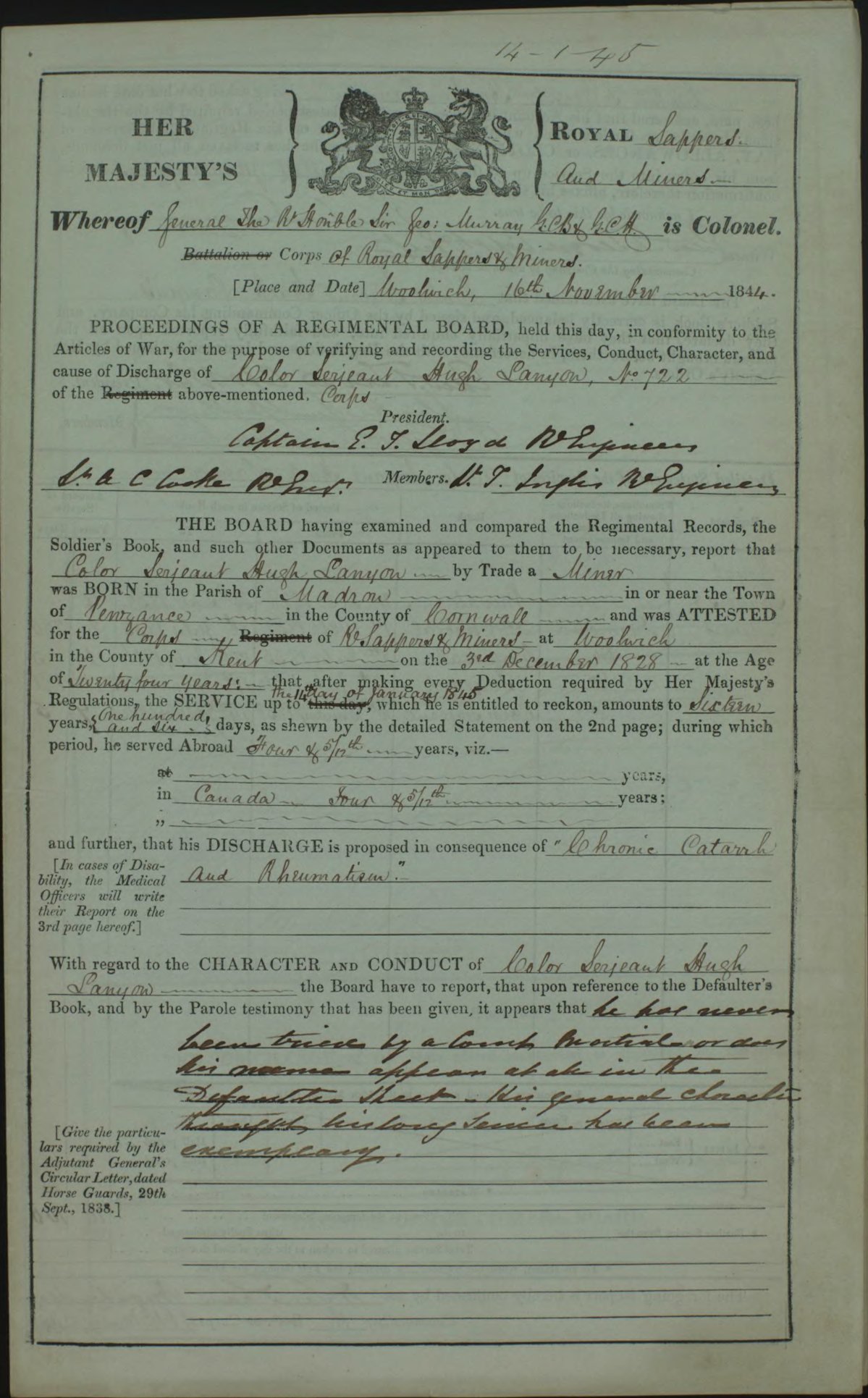
Age 24 Hugh enlisted in the army. He was a Colour Sergeant in the Royal Sappers & Miners. While bound for Vera Cruz in the ship ‘Cambria’ he helped rescue 551 of the passengers and crew of the ‘Kent’ an East India ship which caught fire in the Bay of Biscay in Feb 1825. Connolly, in his ‘History of the Royal Sappers and Miners’ p309, writes of him ‘Sergeant Hugh Lanyon, after Sergeant – Major Forbes’ removal, was appointed to the charge of the detachment at Sandhurst College, and carried on the file details in every way to the satisfaction of the authorities. For many years, as a private and non-commissioned officer, he worked at the College, and his example had the best effect on the successive parties with which he served. As a practical sapper he was one of the ablest and most skilful in the corps, and in the rapidity with which he threw up earth works was unsurpassed. Sir Charles Pasley has done him the honour by noticing the extraordinary labours of the sergeant in his ‘Practical Operations for a Siege’. His willing ness and ability in this respect covered, in great measure, his educational deficiencies. In charge of the detachment he displayed his usual industry and exertion, kept his men in perfect discipline and order… so effectively were all the instructions carried out, that the governor of the college, with the sanction of the Master-General, presented him in November (1837) with a case of drawing instruments bearing an inscription ‘flattering to his zeal and services.’ Shortly afterwards he was promoted to colour-sergeant and served in Canada during the rebellion. Somewhat broken in health he was discharged in 1844 and became a surveyor on the Trent and Mersey Canal, working under James Forbes. He died in 1846 at Lawton in Cheshire. He was a ‘remarkable man with rather more brawn than brain one suspects‘ (P.A Lanyon-Orgill). Connolly recounts a story about him while building a stockade at Mississawra in Canada in 1842; ‘six men complained to him of the heavy task they were subjected to in removing timbers about 15 feet long and 12 inches square….Lanyon made no observation, but shouldered one of the unweildy logs and, to the amazement of the grumblers, carried it to the spot unassisted.’ In 1843 he was in Ireland and was sent to explore a sewer running into the Liffe river which might provide a means of entry into Dublin Castle. ‘He did so and found that a strong iron grating existed in the passage, which would effectually prevent the supposed entrance. In this duty, being much exposed to the influence of noxious vapours, he soon afterwards was seized with fever and jaundice, which shortened his days.’ (Connolly). He never married or had any children.
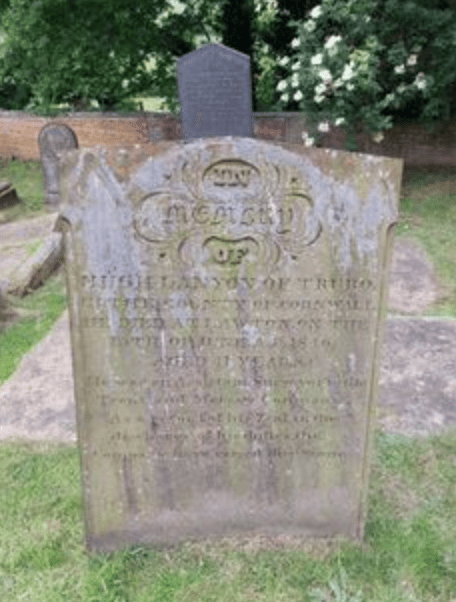
HUGH LANYON OF TRURO,
Headstone at Cheshire
in the county of Cornwall.
He died at Lawton on the
15th of June A.D. 1846:
Aged 41 years
He was an Assistant Surveyor to the
Trent and Mersey Company.
As a record of his Zeal in the
discharge of his duties the
Company have raised this stone.

Ralph senior married for a second time in 1805 to Alice Chirgwin 1774-1869. There were two children from his second marriage:
- Ralph 1807-1868
- Sarah 1810-1867 married Francis Nicholls in 1827 and they had four sons.
Ralph senior died at the Penzance Union Workouse in 1842. He was a pauper and suffering from TB. Alice his wife died at Lelant in 1869, she was still working as a labourer age 64.
The family has come quite a way from the days of the ‘Golden Lanyon’ and his great wealth.
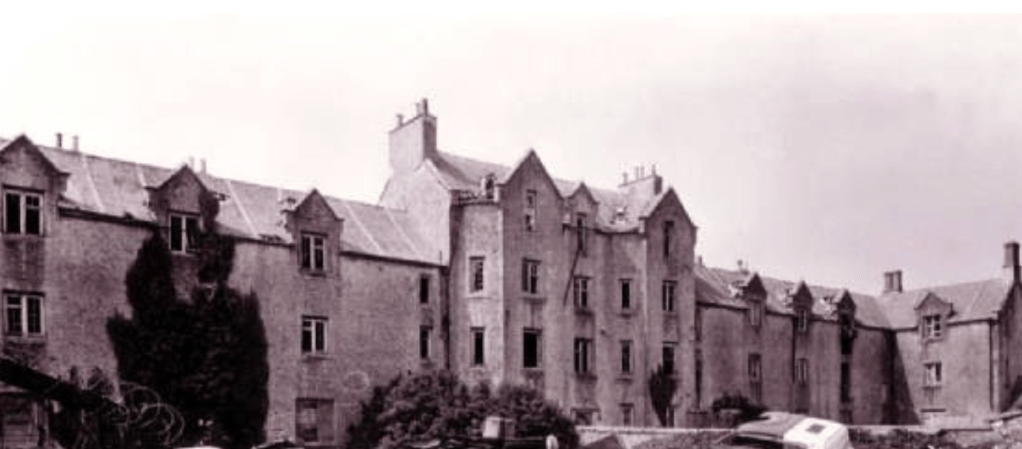
Ralph Lanyon 1807-1868
Ralph was a tin miner. He married Mary Ann Nicholls 1806-1881. They lived at Newbridge, Sancreed. They had six children:
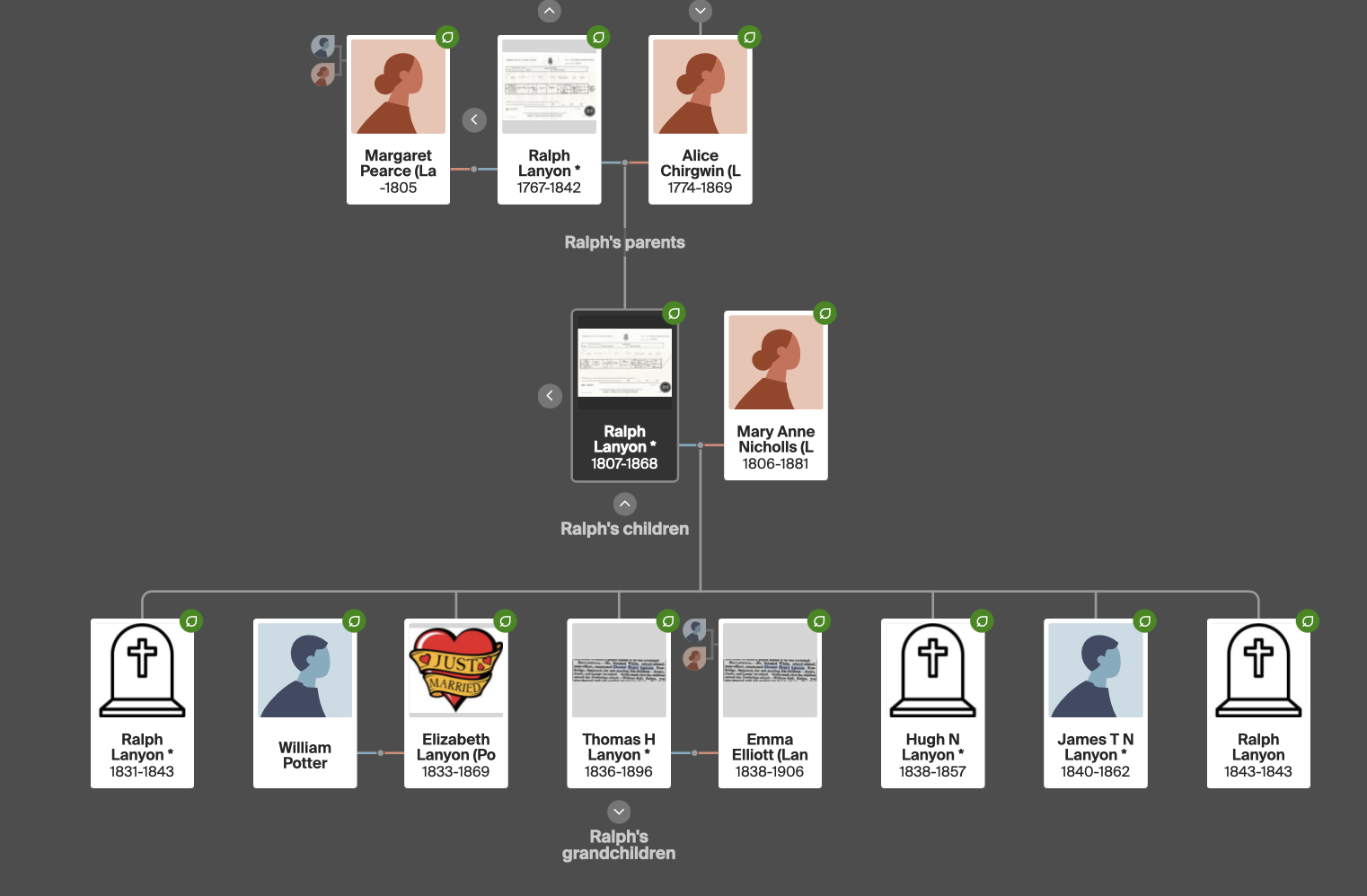
- Ralph 1831-1843 died young
- Elizabeth 1833-1869. Elizabeth was a dressmaker and a charwoman. In 1869 she married William Potter, a widower. She died whilst on honeymoon (of nephritis and congestion of the lungs) at Portsea and William was a widower for a second time!
- Hugh 1838-1857, Hugh died age 20.
- James 1839-1862 he was a tin miner like his father and died of TB age 22.
- Thomas Henry 1840-1896
- Ralph 1843-1843 died in infancy
Ralph died in 1868 of TB. Tuberculosis was very common at this time and, whilst it could affect anybody, it was particularly rife amongst the poor who lived in cramped conditions.
Thomas Henry Lanyon 1840-1896
Of the six children of Ralph and Mary only Thomas had children of his own. He married Emma Elliott and they had nine children.
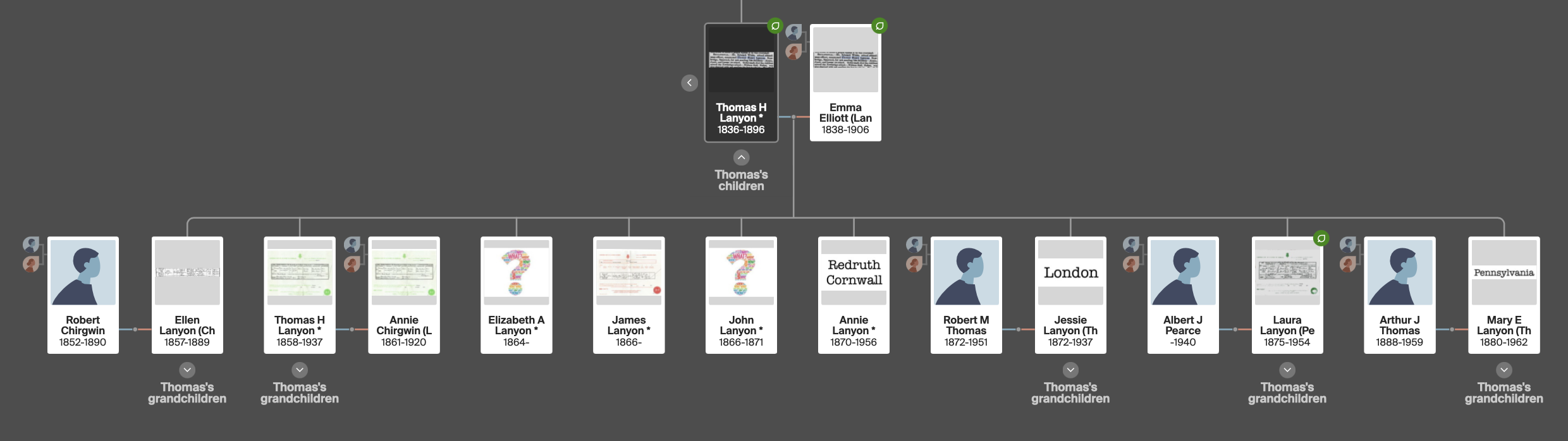
- Ellen 1857-1889 She married Robert Chirgwin in 1879, they had two children but Ellen died in 1889 and Robert in 1890 leaving their children orphans. They were split up and taken in by separate families.
- Thomas Henry 1858-1937
- Elizabeth 1864- she was on the 1871 census but after that there was no further trace
- John 1866-bef. 1871 died in infancy
- James 1866-1935 he worked as both a tin miner and a farm labourer, no marriage or children traced
- Annie 1870-1956 she worked as a dressmaker and never married
- Jessie 1872-1937 in 1896 she married Robert Molesworth Thomas and they had two daughters
- Mary Eveline 1880-1962 she married Arthur James Thomas in 1911 and they had a child
- Laura 1888-1954 in 1906 she married Albert James Pearce and they emigrated to Pennsylvania in the USA.
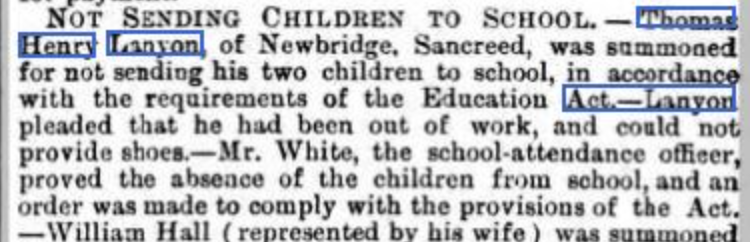
Thomas Henry was fined for not sending his children to school, he explained that he couldn’t afford shoes for them which shows how poor they were. In 1877 Thomas was imprisoned for debt in Bodmin Gaol. Source: AD 1676/5/2
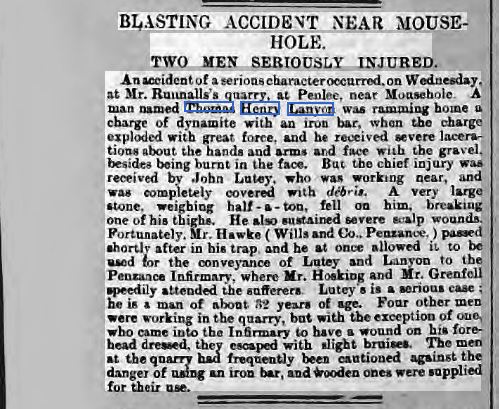
Thomas was also seriously injured in a mining accident. Mining was a dangerous occupation but often it was all that was available.

Out of nine children only one son had children to carry on the family name.
Thomas Henry Lanyon 1858-1937
Thomas was also a tin miner like his father. Later he became a farm labourer. He married Annie Chirgwin in 1890 and they had eight children.
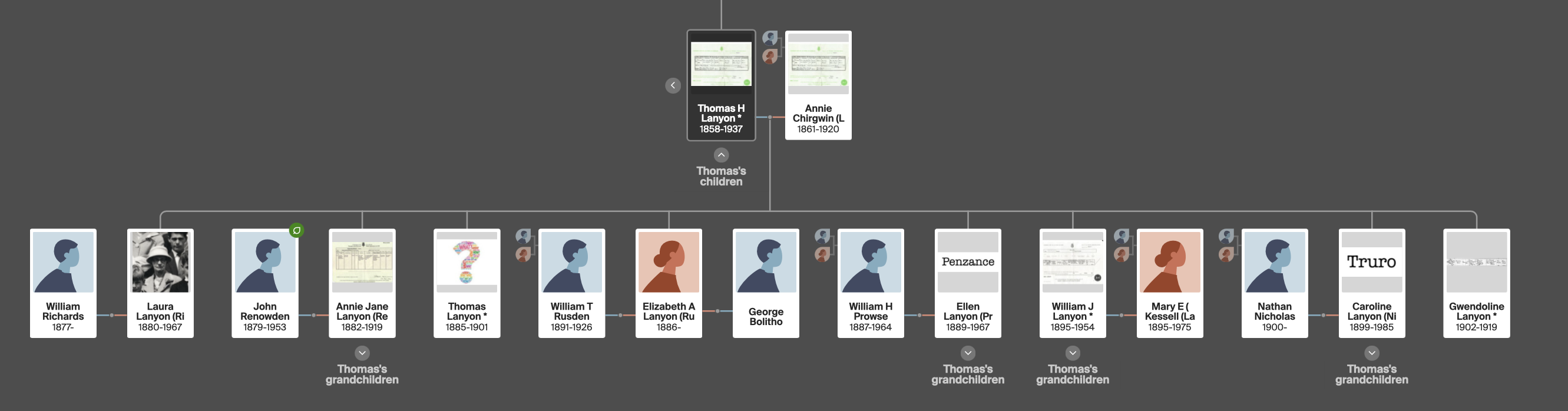
- Laura 1880-1967
- Annie Jane 1882-1919
- Thomas 1885-
- Elizabeth Ann 1886-1965
- Ellen 1889-1967
- William James 1895-1954
- Caroline 1899-1985
- Gwendoline 1902-1919
That’s where we must leave this branch of the family. There were grandchildren so this branch of the family has survived.
 The Lanyons