
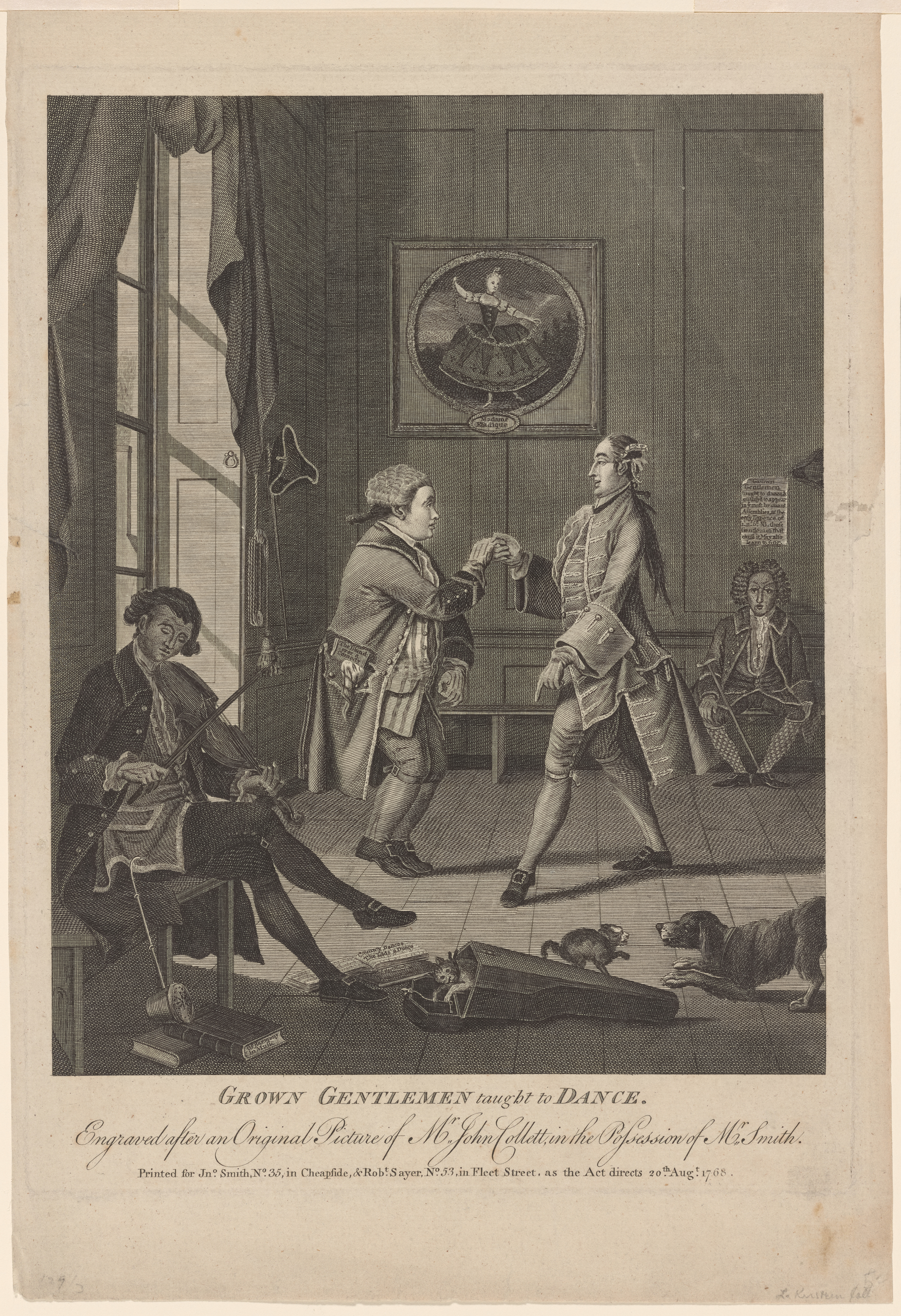
In the 18th century a ‘dancing master’ was a fashionable and profitable job for a gentleman. He would have been at the heart of London society and would have officiated at public balls and advertised his services in the local press.

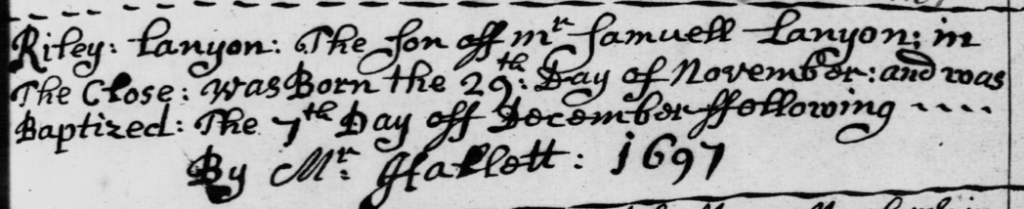
Ryley Lanyon was a dancing master in Bishopsgate Street, London. He was originally born in Exeter on 29 November 1697 and baptised on 7 December. He was the son of Samuel Lanyon. Samuel had another son called Rayly who was baptised at Exeter in 1689 and presumably died before 1697. Ryley/Rayly was obviously a name they wanted to perpetuate.
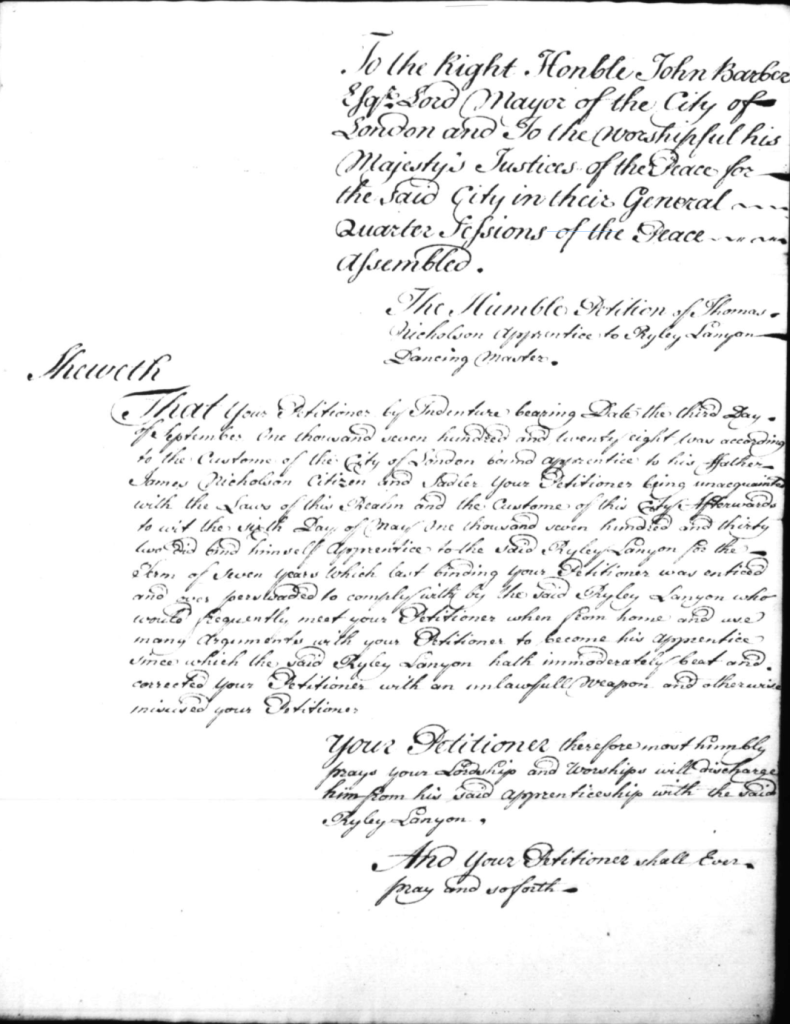
We next see Ryley in the records of London Metropolitan Archives in 1732 when he takes on an apprentice. Thomas Nicholson the son of James Nicholson a sadler. Indenture year 1732 and cost £40 for a seven year apprenticeship. (Source- CLA/047/LJ/13/1733)
A good master would teach his apprentice all he knew and provide board and lodging for seven years. A bad master had almost total control over his apprentice and a free hand to do almost anything he liked. Ryley was a bad master!
In 1733 Thomas Nicholson applied to the Hon. John Barbee Esq, Lord Mayor of the City of London and to the Worshipful his Majesty’s Justices of the Peace’ to be discharged from his apprenticeship because Ryley Lanyon ‘hath immoderatly beat and corrected your petitioners with an unlawful weapon…’
In the 18th century most apprentices would expect to be disciplined and corporal punishment was commonplace. For Thomas to make this appeal, the beating from Ryley must have been particularly bad.
We don’t know the outcome of the appeal.
We next see Ryley in the records when he makes his will. It mentions just one relative, his wife, Sarah Lanyon to whom he leaves everything.
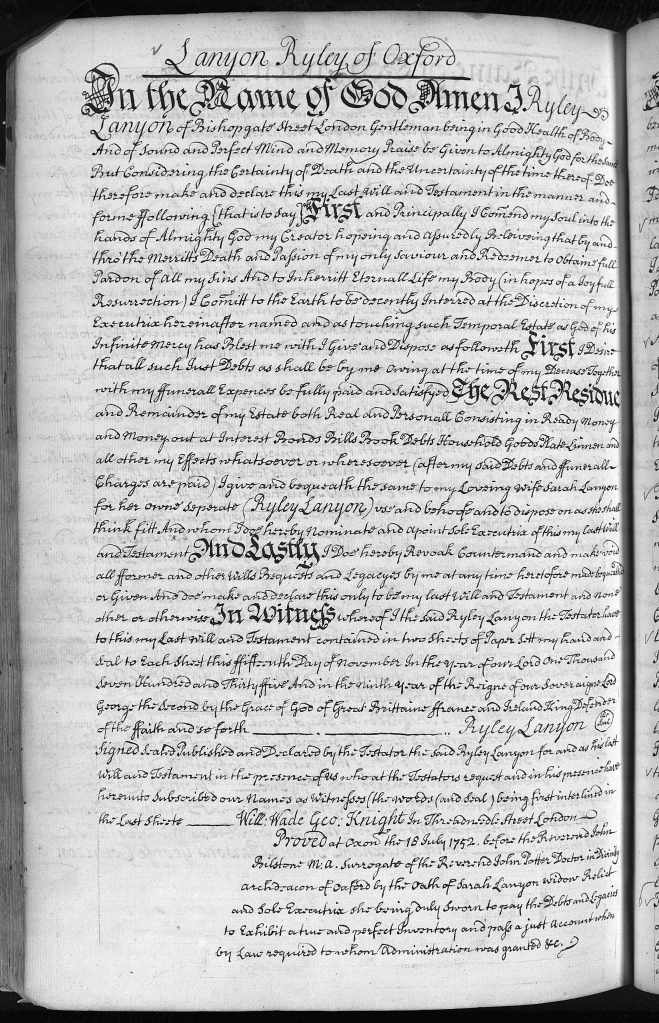
The will was proved on the 18 July 1752 and Ryley was buried at St Ebbe, Oxford.
Searching through London records I came across an Anne Ryley Lanyon spinster of Aldgate who had a clandestine marriage with James Howell, bachelor on 6 July 1722. James was a mathematical instrument maker. Could she be a relative of Ryley? I also found a marriage in London between a Samuel Lanyon and an Ann Riley on 7 Oct 1676.
On digging a bit further I found a baptism of a Samuel Lanyon son of James Lanyon in July 1656 at Exeter, Devon.
In 1677 there was an apprenticeship listed between John Lanyon, son of James Lanyon, wool comber of Exeter and Samuel Lanyon, of the Grocer’s Company London. So it looks as though Samuel had taken on his younger brother John to be trained to become a grocer.
On 2 December 1683 John Lanyon married Susanna Osmand at Stoke Canon in Devon.
Are they all related? Possibly! There are insufficient records to say with any certainty.
Can I fit them onto the main Lanyon tree? No. James Lanyon, father of Samuel and John, must have been born in the 1630s or earlier and I don’t have a James Lanyon born around that time. So for the time being Ryley and this little group of people are in the ‘Loose Lanyons’ section.

 The Lanyons