Thomas Lanyon – Pewterer of Bristol

Researching a family often necessitates many hours trawling through online resources for any mention of the family surname. A trawl through the Somerset Heritage Centre online index produced the deeds for a farm and lands at St Decumans and the name Thomas Lanyon.

The record starts on 13 Aug 1601. ‘Thomas Fulford of Fulford, Devon, Esq. enfeoffed to John Hooper of Ould Cleve, yeoman, a messuage known as Hooper’s Tenement and ten acres of land, part of the manor of Williton Fulford’ The deeds show the various tenants over the years. In 1715/6 John Leach of Bristol, ‘powterer’ and Sarah his wife (daughter and heir of Robert Mawdsley of Bristol, mariner and brother of Richard Mawdsley of Williton mortgaged the property to Arthur Thomas of Bristol, ‘powterer’. On 1 Jul 1718 John Leach mortgaged the property , by lease and release, to Abraham Lloyd, merchant, John Andrews, merchant, Richard Stafford, merchant and Samuel Cox, soapboiler, all of Bristol.

On 13 Mar 1718/19 John Rowe Esq and Martin Innys and Milborn Taylor, gents, all of Bristol , assigned the property to Daniel Woolmer, haberdasher, Thomas Lanyon, pewterer and George Bridges the younger, distiller, all of Bristol and John Roberts of Bedminster, cotton weaver (all creditors of John Leach, who was now bankrupt.)

So who was Thomas Lanyon and where does he fit on the tree?

Thomas was working as a pewterer (a tinsmith) from around 1715 and is last mentioned in 1755.
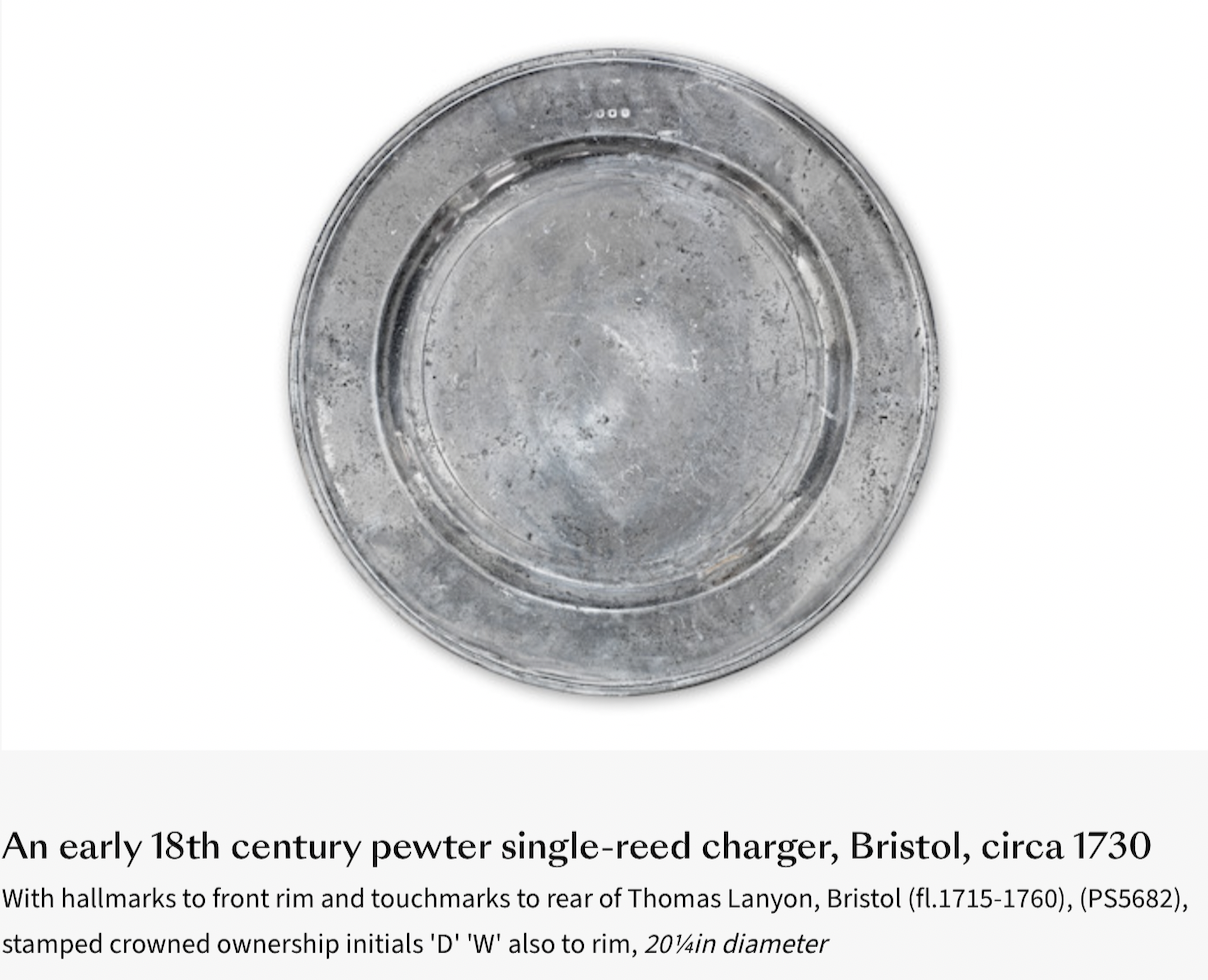
In 2021 this charger made by Thomas sold for £318.

Thomas was apprenticed to John Batcheler of Bristol on 2 Feb 1707 and is free by 9 Apr 1715. He’s mentioned in the Poll Books of 1721 and 1739 as of St Nicholas Bristol, the last mention of him in is 1755.
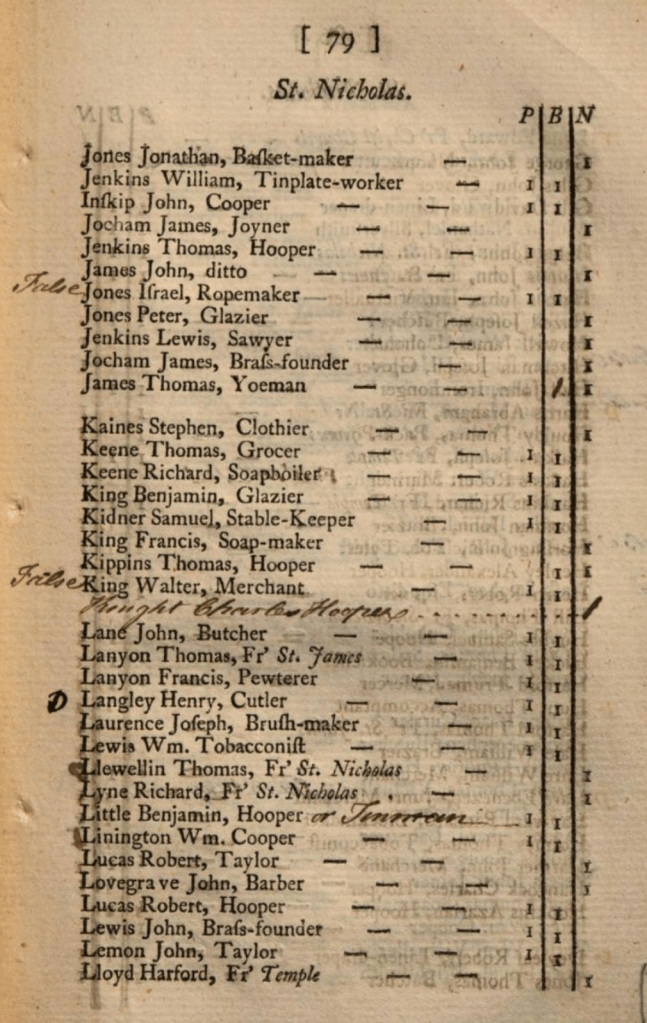
Poll Book 1754 mentions father and son.

We know Thomas Lanyon married someone called Anne before 1725 but I can’t find a record of the marriage anywhere in England. Her name is mentioned alongside Thomas’ apprentices.

They had at least one son, Francis Lanyon, who was baptised on 29 Aug 1725 at St Nicholas, Bristol. He was also working as a pewterer on 26 Jun 1747. In the 1754 Poll Book he is listed as of St Nicholas in Bristol.
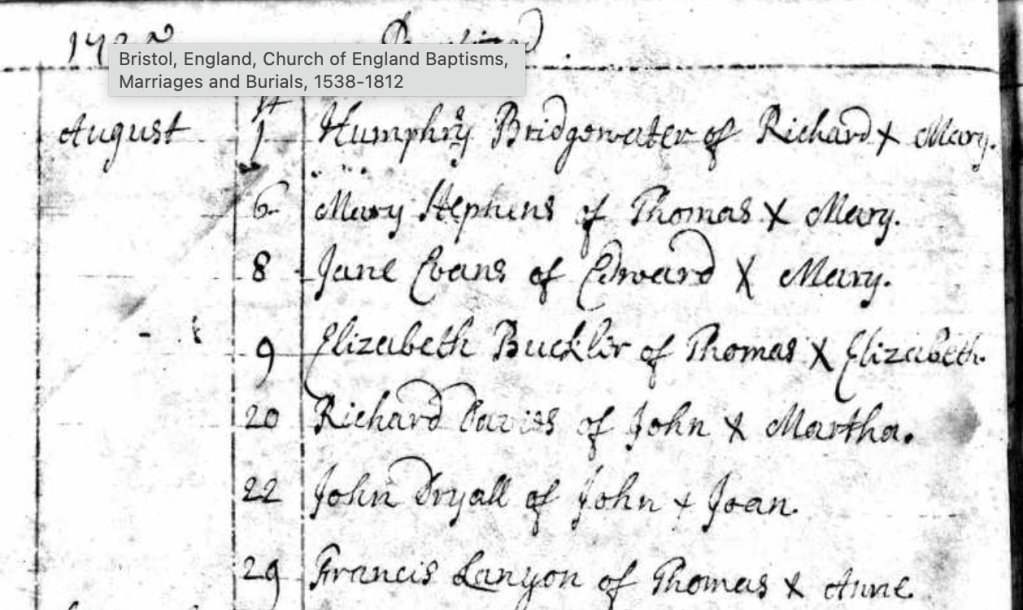
Baptism of Francis Lanyon – St Nicholas Bristol

Thomas had at least two apprentices; Thomas Page who was indentured to Lanyon between 1729 and 1737 and Robert Bush who was indentured at a cost of £50 between the years 1748 and 1755. In 1765 he was based in the High Street in Bristol.

To give you an idea of the size of Lanyon’s business, in the 1740s he exported 1148lbs of pewter in one year. The book ‘Old Pewter, its Makers and Marks’ described Thomas Lanyon as being from Bristol and Coventry but I can’t find any records placing him in Coventry.
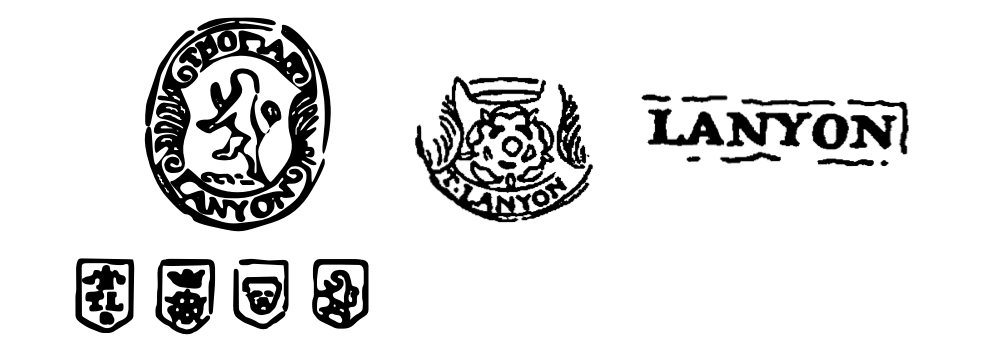
Lanyon’s Pewter Marks

The same book mentions a Thomas Lanyon of Coventry in 1774. This could be a son or even a grandson but I can find no trace of a baptism, marriage or burial.

A trawl through St Nicholas, Bristol’s parish registers reveals two baptisms which may be relevant: William & Anne Lanyen, twin children of Eli and Anne Lanyen, baptised on 3 Dec 1723 and three days later, William Lanyen and Anne Lanyen both buried 6 Dec 1723. Who was Eli Lanyen and was he any relation to Thomas Lanyon?

Sadly the records do not give us any answers. We don’t know if Eli was related to him or if it was just a coincidence that two men called Lanyon/Lanyen had wives both called Anne and were baptising children at the same time in the same area.

To complicate things even further there is a marriage of an Ann Lanyon/Lanion to a William Wayne/Wain at St Nicholas Bristol on 10 Sep 1758. They had a daughter Anna Maria Wayne. William Wayne was a metallurgist who went to Cornwall with his daughter, presumably after his wife died, to teach the Cornish metallurgy (Jane Veale Mitchell research). Both William and Anna feature in several Lanyon wills and are left very large bequests. They are related to Tobias and Mary Lanyon (the children of Francis Lanyon and Phillipp Nicholls of Sancreed).

Tobias’ Will, proved 1779, mentions ‘…my nephew William Wayne gentleman late of the City of Bristol, now residing with me (at Penzance) and my niece Anna Maria Wayne his daughter….’ Tobias bequeathes them £5000!

Tobias’ Will – PROB 11/1050/103

Tobias’ sister, Mary, also had her will proved in 1779. She bequeathes her nephew William Wayne £1000 and her niece, his daughter, £2000.
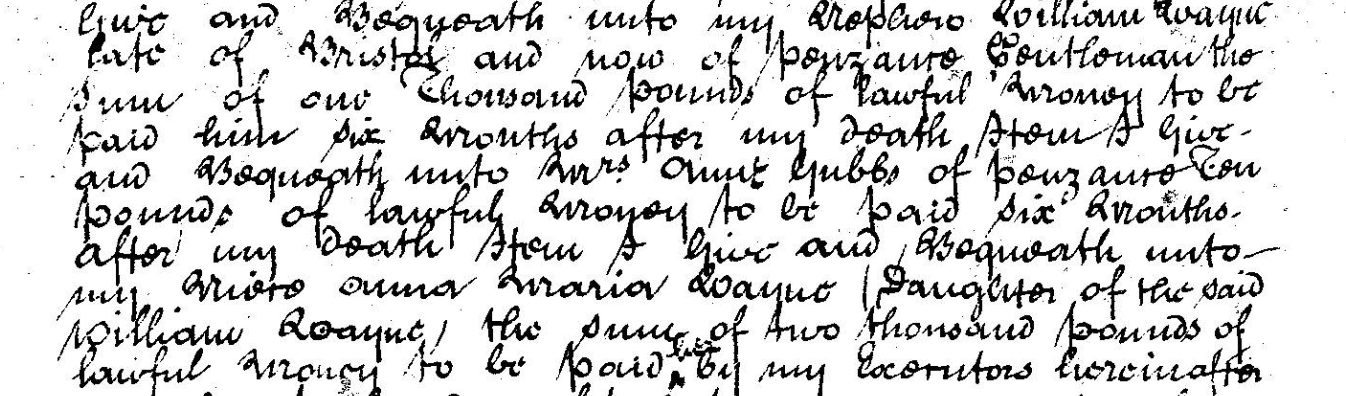
Mary’s Will – PROB/11/1051/117

Tobias and Mary clearly regard William Wayne as their nephew which implies that his wife, Ann Lanyon, was their niece.

It was time to look at Tobias & Mary’s branch of the tree and see what information I could find.
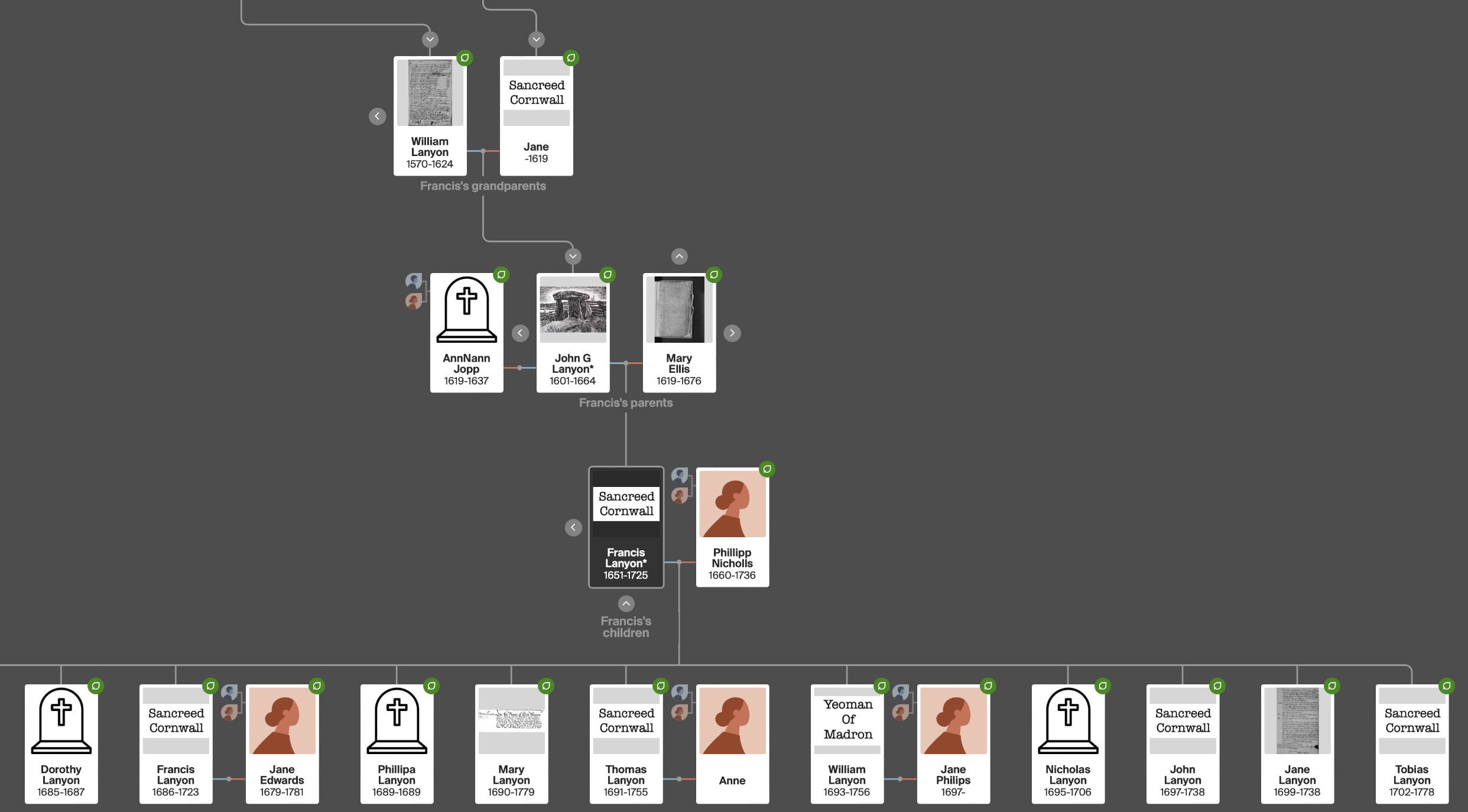
The Sancreed branch of the Lanyon family tree.

Tobias and Mary were the children of Francis Lanyon and Phillipp Nicholls of Sancreed. Francis was the son of John Lanyon, called ‘The Golden Lanyon’ as he made so much money from tin. John was a grandson of John Lanyon Esq and Phelype Milliton.

Tobias and Mary had a brother called Thomas and whilst I cannot prove that he was the Thomas who was a successful pewterer in Bristol, it does seem likely.

Tobias and Mary’s sister Jane died in 1738 and she leaves her brother Thomas the sum of one guinea in gold to buy him a ring.
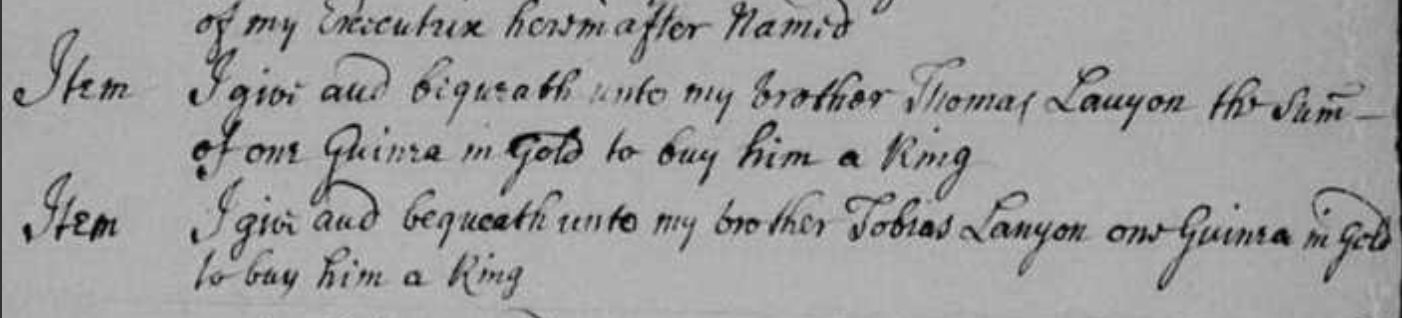
Thomas had a son called Francis Lanyon, perhaps he was named after his father, who died in 1725, or his elder brother Francis, who died in 1723.

This branch of the tree now looks like this –
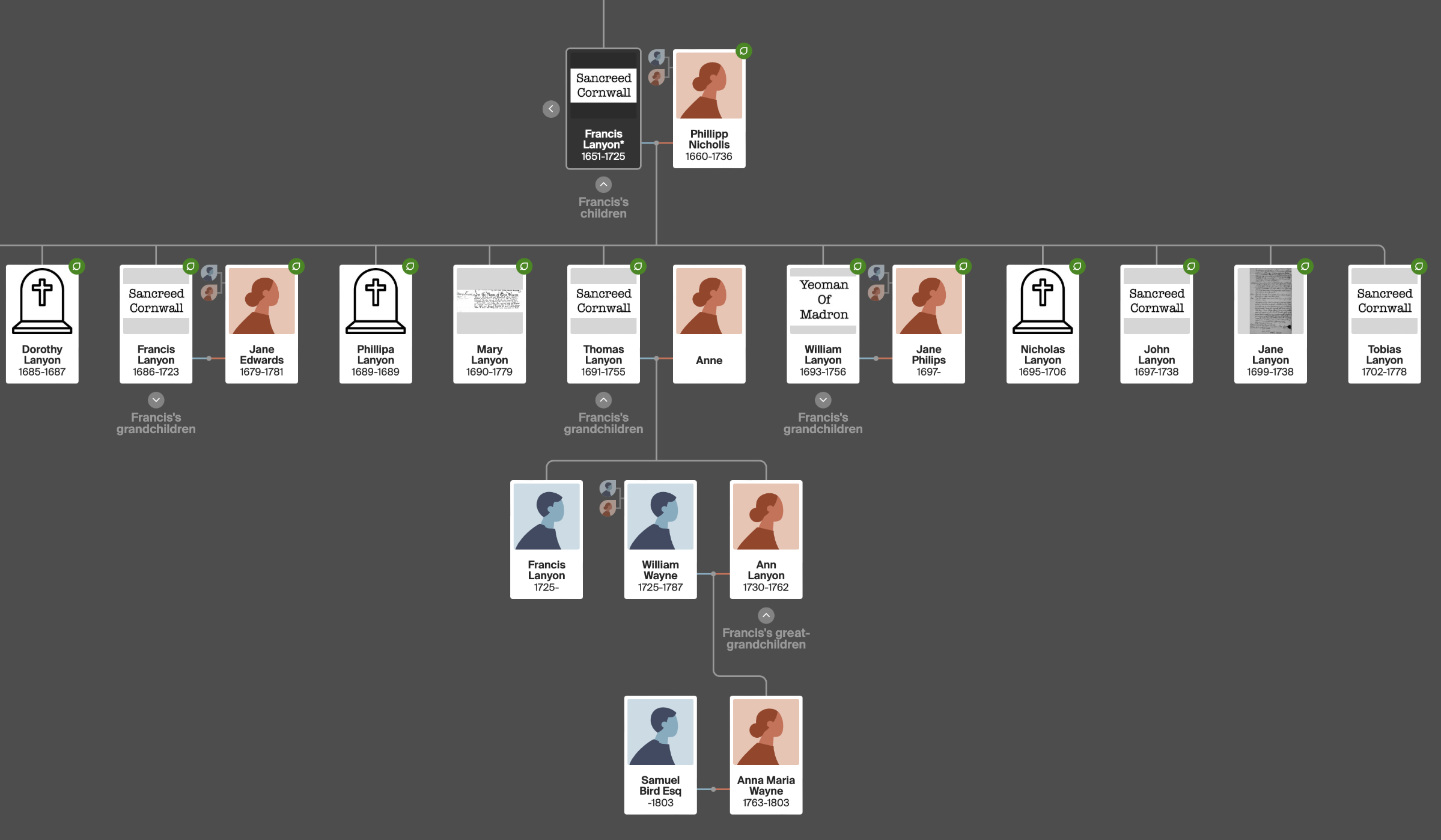
So Thomas Lanyon of Bristol was born in Sancreed, Cornwall in 1691 and died sometime after 1755. We don’t know what happened to his wife, Anne. We know that his son Francis became a pewterer but we don’t know if he married or had any children (the Thomas Lanyon working as a pewterer in Coventry in 1774 may be his son). There is no record of a birth of a daughter Ann Lanyon but we do have a record of her marriage to William Wayne.
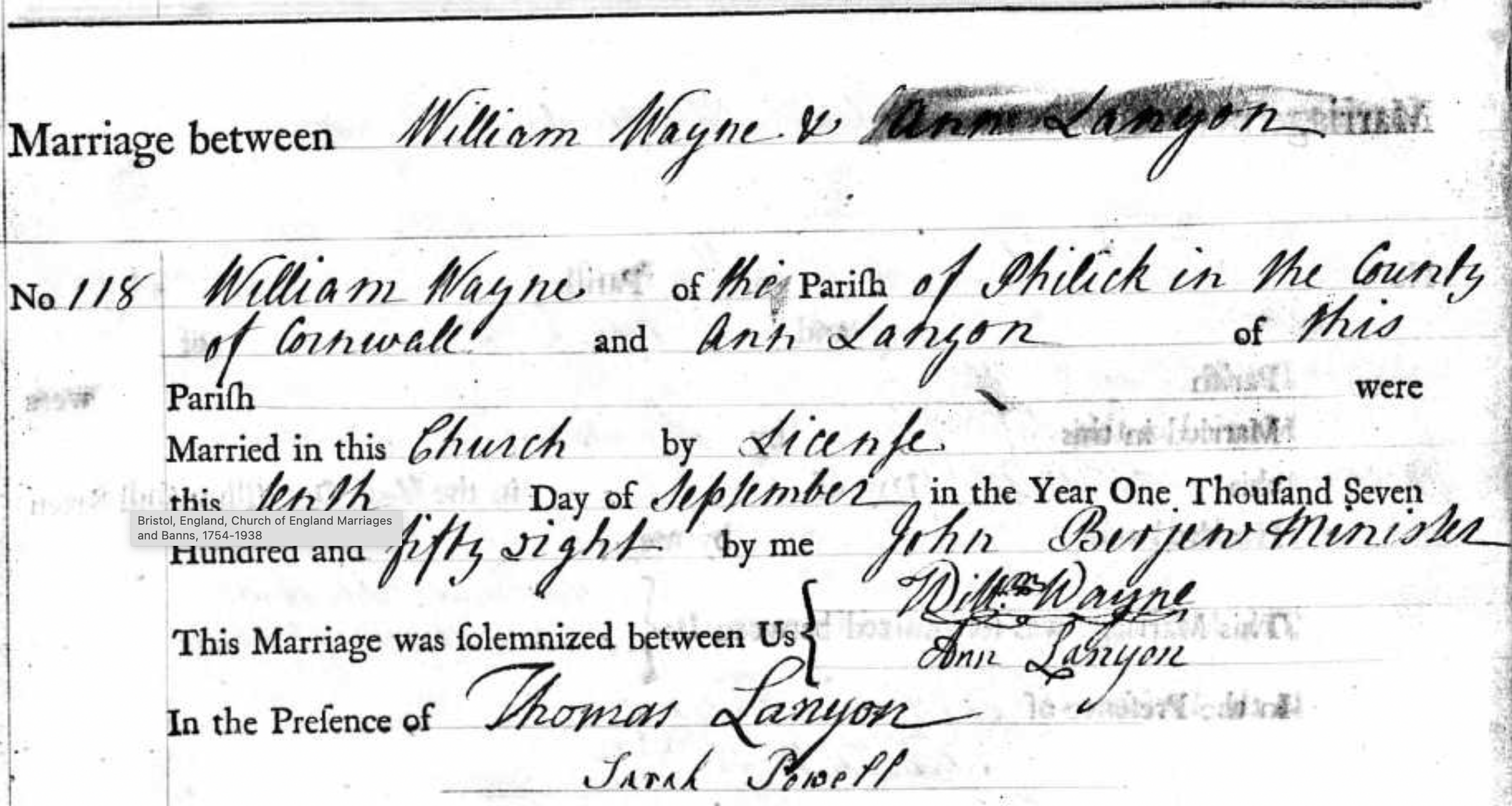
Bristol, England, Church of England Marriages and Banns, 1754-1938

Their marriage was solemnised in the presence of one Thomas Lanyon!

Anna Maria Wayne married Samuel Bird Esq. in London in 1784.
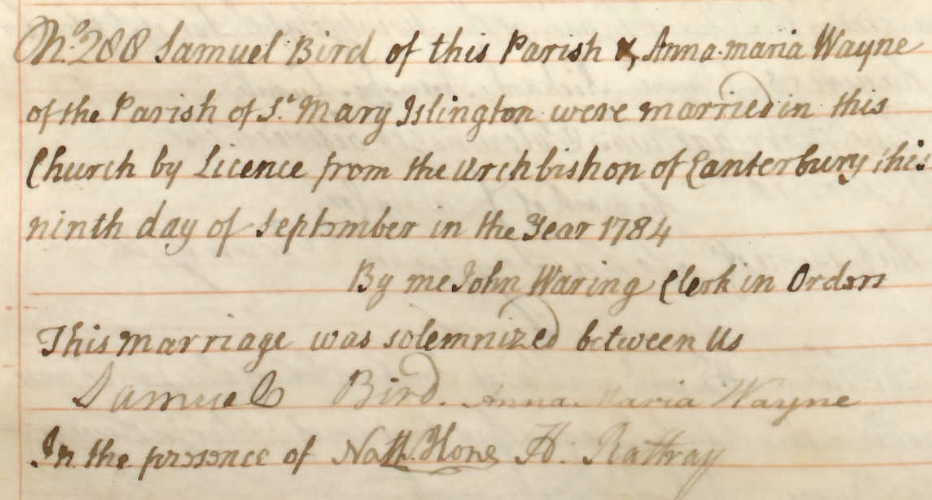
Marriage Register – St James Piccadilly, Westminster

By 1790 William Wayne was dead and administration of Tobias’ will passed to Anna Maria Bird the residuary legatee.

I found one possible burial entry for William at St Philip and St Jacob in Bristol on 19 Feb 1787. If it is ‘our’ William Wayne, he died of asthma.
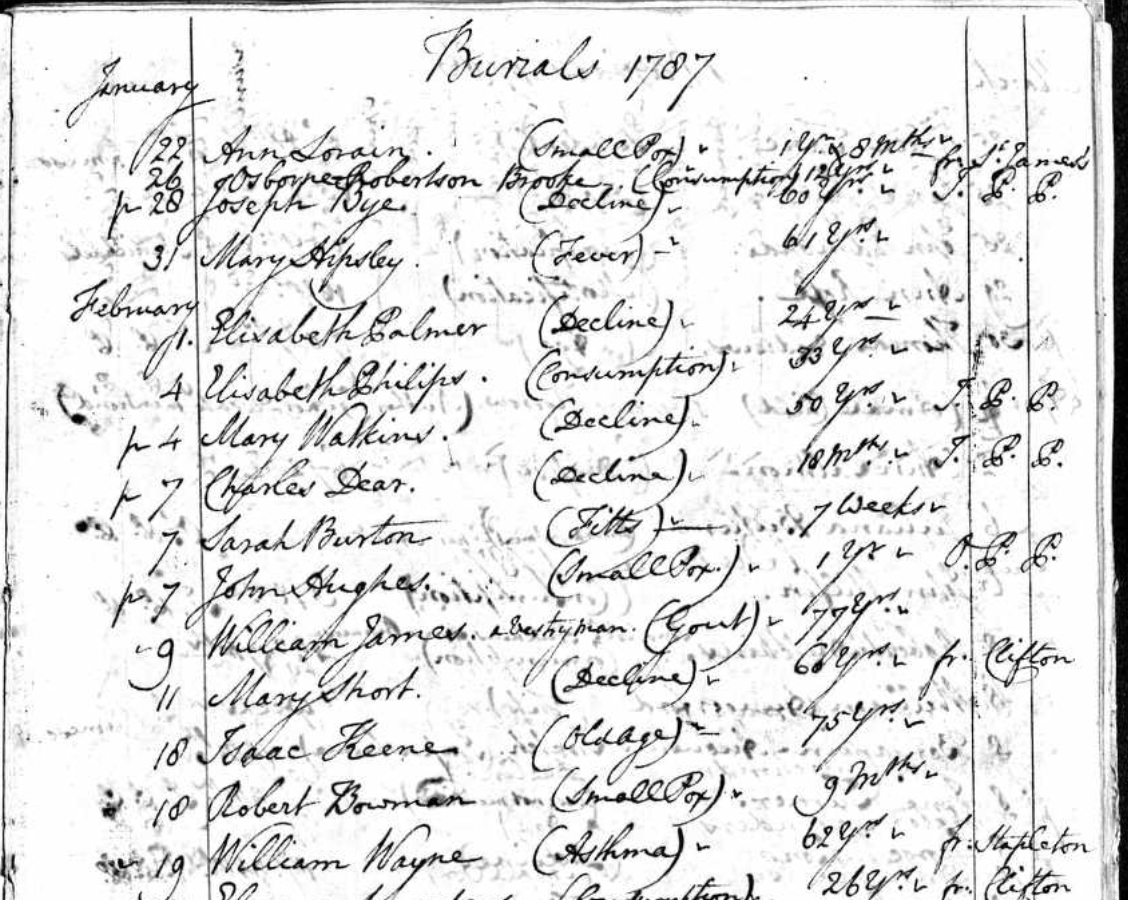
Bristol Archives; Bristol, England; Bristol Church of England Parish Registers; Reference: P/St P&J/R/1/5

Anna was left a very wealthy young woman with bequests of several thousand pounds, a huge sum at that time.

Sadly she died on 8 Apr 1803, at East Stonehouse in Devon, but her will requests that she be interred at Sancreed in Cornwall. She was just 40, widowed, and suffering from Consumption (TB). She and Samuel were childless so her fortune was left to various cousins. There is a plaque in Sancreed church which reads:-

‘Sacred to the memory of Anna Maria Bird, widow of Samuel Bird, of Ridgeway in the county of Devon, Esqr. She died the 8th day of April, 1803; aged 40 years. Her body is deposited in a vault with the remains of her relatives, Josiah Lanyon, Esqr, and Jane his sister.’ (https://sancreedopccornwall.tripod.com/id1.html)

Josiah Lanyon? I think that should read Tobias!
The ‘Loose Lanyons’ of Sancreed

There is a small group of Lanyons in the parish of Sancreed who don’t fit on the Lanyon tree. We know almost nothing about them but they are worth mentioning as they demonstrate that there were other cadet branches of the tree in the 16th century. They must all be related but it isn’t possible to prove that.

George Lanyon

George was living in the parish in the 1560s and was probably born in the 1530-1540s. There is no record of a marriage for him but a daughter Jane was baptised on 22 Sep 1566. Then on the 2 Oct 1566 George also baptised an illegitimate daughter called Alsen! His first daughter must have died as he baptised another daughter called Jane on 22 Feb 1568 and his final child was Elyzabeth baptised on 25 Apr 1575. (The children’s names were all spelt Lanyne.) With two daughters called Jane perhaps that was his wife’s name?

It’s challenging to see if the name is Lanyne or Lamyne. In fact it’s challenging to read anything in these early registers! Just to make things even more complicated there is a family called Lanner living in the parish at the same time.
Sancreed Parish Register

The only other record we have for George is his burial on 16 Nov 1592.

His daughter Jane Lanyne may be the Jeane who married George Bossens/Bossence in Sancreed in 1601 and they had seven sons: Thomas, Benatt, William, Richard, John, Sampson and George. All good Lanyon names!
Sampson Bosence was baptised 25 Apr 1612, married Earth Richards at Madron on 23 Apr 1637.

There is no trace of what happened to Alsen or Elyzabeth.

Jane Veale Mitchell (early 20th century researcher) states that George is a son of William ‘Generosi’ Lanyon of Breage. It is possible and she would have seen William’s will, which has now been lost, which may have confirmed the relationship.

Digory Lanyne

Digory married Jane on 4 Feb 1564 making him a contemporary of George. A brother perhaps? There are no children of this marriage baptised and no record of a burial for Digory. It’s also the only instance of the name Digory in the Lanyon family.

There is a Jane Lamyne buried at Sancreed 13 May 1583, another Jane Lamyne buried 22 Jun 1592 and a Jane Lanyne widdowe buried on 16 Nov 1607. Any one of them could be Digory’s wife or possibly even George’s wife.

Fraunces Lanyne

We know where Fraunces (Francis) fits on the tree; he was the eldest son of John Lanyon Esq. He married Ales Trewren at Sancreed in 1584. The Trewrens were a Sancreed family and Francis and Ales’ children were baptised in the parish.

  • Richard 8 Sep 1585, he became the heir to John Lanyon Esq when his father Francis died in 1593
  • Elizabeth 11 Nov 1587 (she was an illegitimate child)
  • John 10 Dec 1587

William Lanyne

Francis’ brother William also settled in Sancreed and baptised his children there. We can also place him on the tree. He also had other children whose baptisms weren’t recorded or have been lost from the register.

William married Jane on 19 Nov 1592. She was buried 21 Sep 1619 and William himself died in 1624, his surname in the burial register is recorded as Lanion. His will is signed by Benat Lanion. Both his daughters called Elizabeth survived to adulthood!

  • Elizabeth 31 Oct 1593
  • John 8 Jun 1596 buried 15 Sep 1601
  • Jane 24 Oct 1602
  • William Dec 1603
  • Elyzabethe 17 Jul 1607
Benat signed William’s will of 1624

Thomas Lanyne

Thomas baptised a son called John on 16 Mar 1585. It was the only child Thomas baptised at Sancreed.

Could Thomas be an unrecorded brother of Francis and William?

Rou Lanyne

Rou should probably be Row, a popular first name and surname at the time. He baptised a daughter called Mary on the 28 Jun 1592. There is no further trace of either Row or Mary.

Benat Lanyne

Benat had four children baptised. He was married to Jane on 20 Nov 1593. her burial is recorded on 13 Jun 1621 and Benat’s on 4 Apr 1629. By the time of his death his surname has become Lanion.

  • Watter (sic) 22 Sep 1594 buried 4 Oct 1594 (surname spelt Layne) – probably should be Walter
  • Thomas 8 Feb 1595
  • Mary 24 Feb 1596 buried 7 Jun 1597 (surname spelt Laynne)
  • Jane 6 Jul 1599

It seems likely that Benat Lanyne was a son of Walter Lanyon and Elizabeth Nanspyan but there is no proof.

Cyprian Lanyne

On 13 Nov 1585 a John Lanyne baptised Cyprian Lanyne at Sancreed. Where does this John Lanyne fit on the tree? (A John Lanyne married Mary at Sancreed in 1584, presumably this is the same John.) A Cyprian Lamin signed the 1641/2 Protestation Return for Gulval. This is such an unusual name that I think it likely that it is the same person but is the surname Lamin or Lanyne and is he from this family or unrelated?

There is no record of a marriage or burial for Cyprian.

Raphe Lanyne

Raphe Lanine married one of his wives at Sancreed, further cementing the families ties with the parish. Raphe married Jennett on 26 Sep 1591 and she was buried there 14 Oct 1601 (Raphe’s name becomes Raffe!). Raphe’s will was proved 13 Jan 1604/5 so we know what year he died. His will mentions his wife, Ann, but there is no record of their marriage. Just to confuse things further the Sancreed parish register lists a marriage for a Raphe Lamin to an Ann on 10 May 1606 and a burial of a Raphe Lanine on 29 Apr 1614. Could he be an undocumented son of Raphe?

If only we had a few more records, wills (with signatures to compare) and property transactions which might just clarify things! If only the record keepers had neat writing and the pages weren’t lost or damaged….. if only they could spell!

The Scandalous Vicar of Sancreed

In 17th century Sancreed one parish priest, the Rev. John Smyth, caused considerable furore. In 1639 two of his parishioners , George Orchard and John Lanyon, both of the local gentry, brought a case against him in the Consistory Court. The Archdeacon of Cornwall appointed the incumbents of Phillack, Mullion, St Allen, Ludgvan, Madron and St Just in Penwith to hear evidence in Sancreed church.

Phil Williams / Sancreed church

The first accusations levelled against Smyth was that he had torn down a pew which his predecessor, the Rev. John Dodd, had put up in the chancel for the use of his wife and family. The interrogatory stated that the pew ‘was now in the buttery or dairy of your house, to the great grief and trouble of the minds of the parishioners there to see things dedicated to holy uses to be so profanely used or rather abused.’ Dodd’s wife, Avice, said that her husband had erected the pew about ten years before, ‘but, when Smyth came he refused to let her occupy it and nailed it up, but some schoolboys pulled it open, whereupon Mr Smyth demolished the whole.’

Smyth had been vicar of Sancreed for some eighteen months and had been the instrument whereby Dodd had been removed, having brought a law-suit against him on the grounds of simony. (Simony is the act of selling church offices and roles or sacred things. It is named after Simon Magus, who is described in the Acts of the Apostles as having offered two disciples of Jesus payment in exchange for their empowering him to impart the power of the Holy Spirit to anyone on whom he would place his hands.)

Simon Magus, Paul & Nero – Sibeaster, Public domain, via Wikimedia Commons

The second accusation against Smyth was that he had built a large new pew in the passage way between the body of the church and the rood loft, thus obstructing the free transit of the parishioners from north to south. Thomas Gibbes of Sancreed, aged 66, remembered ‘all his time the alley between the rood loft and the pews in the body of the church and also many parishioners buried in the alley. The minister’s pew was on the east side of the rood loft looking westward toward the people until of late Mr Smyth built a new seat or pew in the alley which is thereby stopped up.’

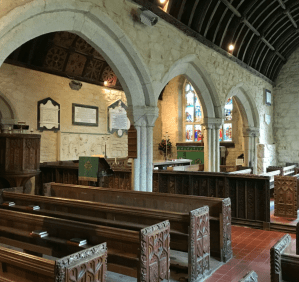
The interior of Sancreed church today

More serious was the charge that Smyth demolished an altar which stood in the chancel, whereon the parishioners were accustomed to place their tithes ‘and to write such things as concern their parish business and whereon sometimes the consecrated bread and wine was set at the time of administering the sacrament of the Lord’s Supper’. During divine service Smyth thought fit to remark on his demolition of this altar, saying that he never saw any sheep or oxen to be sacrificed upon that altar but have been in the company of asses, men and boys, two or three at a time.’ Thomas Treuren deposed that Smyth removed the altar stone because it was an annoyance to him in the administration of the Holy Communion. His evidence was, however, blighted because he owed money to John Lanyon, the moneylender, one of the two parishioners who brought the suit against their vicar.

All these may well have been complaints brought against a priest who, in a conservative-minded parish, moved too quickly in introducing innovations. There, may, too, have been some local sympathy with the ousted predecessor. The remaining charges showed that the situation in the parish was even more disturbed. He was stated by Orchard and Lanyon to be ‘a great vexer, molster (sic) and troubler of the parishioners with unnecessary law-suits and that you now have or lately had 40, 30 or at least 20 law-suits in the ecclesiastical court against men of the parish and have said that you will so vex your parishioners with law-suits that they shall not be able to help one another and that you would make them all appear at London one after another and that you would be a little devil amongst them.’

Smyth had threatened to sue them all for the tithe of turves, and when told by Hugh Levelis that many leaseholders would not be allowed by the terms of their leases to cut turves, replied then I will sue them because they shall forfeit their leases to their landlords.’

A further charge was that ‘in the time of divine service you have divers times departed out of the church of Sancreed in your surplice and worn your surplice into an ale-house’. One of the witnesses agreed that this was so, but only once or twice at prayer time ‘to reproach such as went to drink tobacco or ale (sic) and so came in again.’

Smyth was also said to have neglected to take children in his arms when baptising them ‘to the great grief of the parents and contrary to the rites and ceremonies of the Church of England’. All these accusation might be considered, in a certain sense, of a domestic nature. The last was designed to embroil Smyth even further – ‘that you did not read the King’s proclamation concerning the late treacherous seditions in the North and Scotland but caused your clerk to read it.’

The result of this action in the Consistory Court is unfortunately not known, but Smyth remained Vicar of Sancreed and 29 years later a similar series of charges was brought against him.

Part 2

The Rev John Smyth certainly caused a great deal of talk among his parishioners in the 1660s and his inability to conform with the usual standards of behaviours brought him considerable notoriety. In 1668, when he appeared for the second time before the Consistory Court, Mary Lanyon, widow, was the prosecutrix. Of her husband (John), soon after the burial service, Smyth was reported to have said ‘the old hog is dead and thrown into a pit. He took a field from one, a lease from another, a cow from a third and a horse from a fourth and has left his estates to the lioness and her whelps to make her jointure great.’ There were many other accusations levelled against the vicar. John Lanyon (son of Mary) gave corroborative evidence saying that in 1665, when William Binder, one of the church wardens had asked Smyth how the presentments should be made at the Visitation, the vicar had used abusive language. Lanyon reproved him and was met with the rejoinder ‘Pish, thou mayest make what presentments thou wilt but when thou hast paid the fees of the Visitation thou mayest take thy presentments and wipe thy breech with them.’ A certain Humphrey Nicholas seems to have been a particular object of his dislike. Elizabeth Tonkyns, who had been in Smyth’s service for twelve months, deposed that he was very litigious and had threatened to sue Nicholas for treading off the church path which led through the glebe. At Easter 1666, Nicholas was unwell and sent his offering to the vicar, who declined to receive it, and on the Sunday Nicholas ‘went to the Lord’s table with the rest of the parishioners and kneeled down, hoping to partake of the blessed sacrament – but Mr Smyth administered the same to all the rest of the people there but refused to administer the same to this deponent in the presence of all the people there present to the deponent’s very great grief.’

Smyth was said to be an extortioner, forcing a parishioner topay 2s 6d yearly for a cow and a calf pasturing in Sancreed whereas by parish custom he ought only to pay 3d a year.’ He was said to be a frequent visitor at ale-houses – in Penzance one evening he ‘drank to the height of mirth and lay there in the same house all that night’. He was said to scorn civil authority and in one sermon to have asked ‘what are these petty Justices and petty commissioners and dunghill officers to me when I am in my place?’

There was a suggestion that Smyth encouraged the flouting of authority. On one occasion he had taken his text from Proverbs, ‘Stolen waters are sweet’, and taking occasion to distinguish what was stolen waters, declared that extortion and wronging the poor was stolen waters – saying ‘if this be not stolen waters I wonder to the devil what is stolen waters? And in the same sermon declared that it was lawful and that there was very good reason why the poor people should steal, saying ‘and from whom should they steal? Why from such rich people as are so uncharitable that they will not give to the poor.’ When the hope was expressed that he would not preach such a sermon again, he declared that it is better to steal than to starve.’

Proverbs 9-17

Many of these accusations were, no doubt, somewhat frivolous, eccentricities which had been remembered, sometimes out of context, in order to make the list of charges as formidable as possible. One charge however, was most particular – the conversion of the parish almshouses. Edward Chergwyn deposed that ‘for the last three or four years Mr Smyth hath taken possession of the public almshouses of the parish of Sancreed which for forty years and more has been employed to the use of the ancient poor people of the parish’ and Reginald Madderne, the local tailor, said in his evidence, ‘he has converted the almshouses adjoining the churchyard into a house for his sheep.’ Richard Olivey went further: ‘Mr Smyth seized the almshouses, turned out some poor people and made it a sheep house, pulled off the roof and used the timber for his stable, Olivey completed the charges: ‘he is reputed to be of debauched life and conversation and addicted to lasciviousness and much given to obscene and wanton talking’. On his visits to the nearby church of Paul, ‘sometimes to preach, he puts his horse at the ale-house there and doth oftentimes go there himself when he goes to fetch his horse at his departure.’

John Olivey, who was constable of the parish in 1666 asserted that ‘he found Mr Smyth very backward in paying his rates and often would give this deponent ill words when he came to demand them.’ During the same year Olivey called on the vicar, armed with a warrant under the seals of the deputy lieutenants, warning the able-bodied men of the parish to appear before Colonel Godolphin ‘to bear arms imposed on the parishioners of Sancreed about the beginning of the late dangerous times of war between England and Holland.’ One of the parishioners, by name Ladner, was warned to carry the arms contributed by the vicar. Smyth told the constable ‘in a very passionate and rigorous manner’ that Ladner was not fit to serve the King, ‘neither shall he serve the King.’

What, one wonders, were the vicar’s replies to these accusations. Unfortunately they are not available, but it is not difficult to appreciate the difficulties of his position. Smyth was a vicar of an isolated country parish for over 30 years during a period of war and civil disturbance, when preferment was gained by those with soft tongues and easy ways. Smyth had neither. he quarrelled with the most influential of his parishioners and cracked bawdy jokes (in Cornish) with his serving – maids; he frequented taverns and abused the local magistrates. Little wonder then that this eccentric and somewhat earthy cleric fell foul of his ‘respectable’ parishioners.

This was part of an article written by H.L Douch curator of the Royal Institution of Cornwall for the ‘West Briton’ – Published Jul 30th & Aug 13th 1962

It is worth noting that John Lanyon (senior) was church warden at Sancreed.

From Cornwall OPC Database-

  • 17 Jan 1675 Mary Smyth, wife of John Smyth vicar, buried at Sancreed

Two possible entries for John’s burial:

  • 29 Apr 1681 John Smyth Vicar of Paule buryed at Sancreed in Woollen (Hoblyn’s Transcripts)
  • 19 Apr 1692 John Smyth (pencil note – vicar) buried at sancreed – (Hoblyn’s Transcripts)

It does seem beyond coincidence that both the vicar of Sancreed and Paul were both called John Smyth!

Paskis Lanyon

Paskis Lanion married Thomas Shetford at St Just in Penwith in 1625. Who was Paskis Lanion? If only the answer was straight forward!

A quick trawl through the Cornwall Online Parish Clerks database revealed no baptisms for a Paskis/Paksis/Pascha/Pasca/Paska/Paskes/Paskas Lanion/Lanyon.

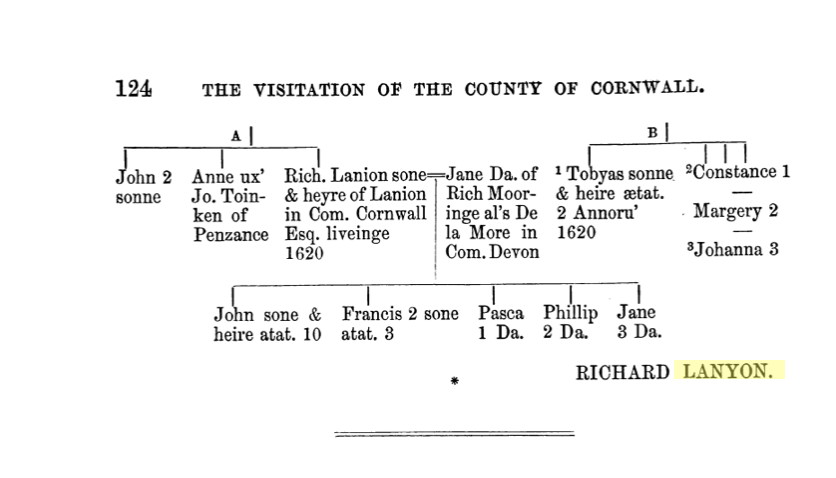
However the Heralds Visitation for Cornwall 1620 does have a suitable candidate:

Vivian’s Herald’s Visitation of Cornwall 1620

Richard Lanyon Esq submitted his tree showing that his wife was Jane Mooring alias De La More from Devon and their eldest daughter was called Pasca but was she old enough to get married in 1625?

Their eldest son was John aged 10 in 1620 so therefore born in 1610. Could Pasca be older than John? When did Richard marry Jane? The Royal Institution of Cornwall has a marriage settlement between Richard Lanyon and Jane his wife dated 1608 so presumably they married about 1608. The letter from Mrs Rose Tolman confirms that Jane’s mother was called Pascha Risdon so eldest daughter was named after her grandmother.

If we list all Richard and Jane’s children we may see a gap where Pasca could fit.

  • John baptised 13 Jul 1610 Madron
  • Unbaptised child buried 12 Nov 1611 Madron
  • Unbaptised child buried 12 Jun 1612 Madron
  • Philippa 2nd daughter baptised 20 Apr 1613 Padstow
  • Francis 2nd son – deposition taken 1635 when he is aged 16 so born in about 1619
  • Elizabeth baptised 17 Nov 1622 St Merryn

The children with no baptisms recorded are:

  • Pasca eldest daughter born before 1613 when Philippa is baptised
  • Jane 3rd daughter born after 1613 and before 1622
  • Richard not listed on Herald’s Visitation so presumably born after 1620
  • Thomas not listed on Herald’s Visitation so presumably born after 1620
  • Margerie – from Richard Lanyon Esq’s will it is implied that Elizabeth and Margerie are the youngest daughters

The latest Pasca could have been born was 1613 and with John born in 1610 and two unbaptised babies born in 1611 and 1612 it looks likely that Pasca was probably born about 1608/9 which would make her about 16 years of age at the time that the marriage to Thomas Shetford took place. So she is a possible candidate.

Richard Lanyon Esq’s will of 1636 left all his daughters £30 or £40 apart from Pasca who received 5 shillings which implies that in 1636 she was already married and had received her ‘portion’. Sadly the will does not mention her married name.

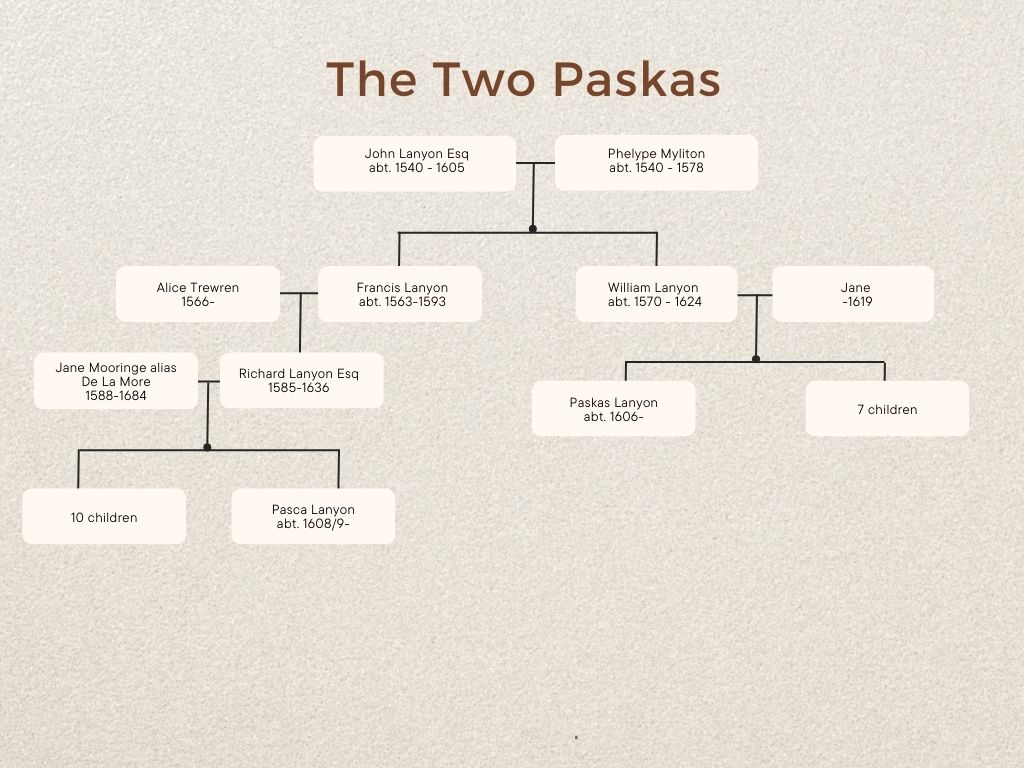
The only problem is that there is a second Paskas who is also a candidate.

Richard Lanyon Esq’s uncle William has a daughter also called Paskas.

William’s daughter’s baptism isn’t recorded but we know she existed from his will. Again we’ll have to list his other children and see where she could fit in:

  • Elizabeth baptised 31 Oct 1593 Sancreed
  • John baptised 8 Jun 1596 and buried 15 Sep 1601 at Sancreed
  • John born after Sep 1601
  • Jane baptised 24 Oct 1602 Sancreed
  • William baptised Dec 1603 Sancreed
  • Elyzabethe baptised 17 Jul 1607 Sancreed

Both daughters called Elizabeth survived and are mentioned in William’s will of 1624!

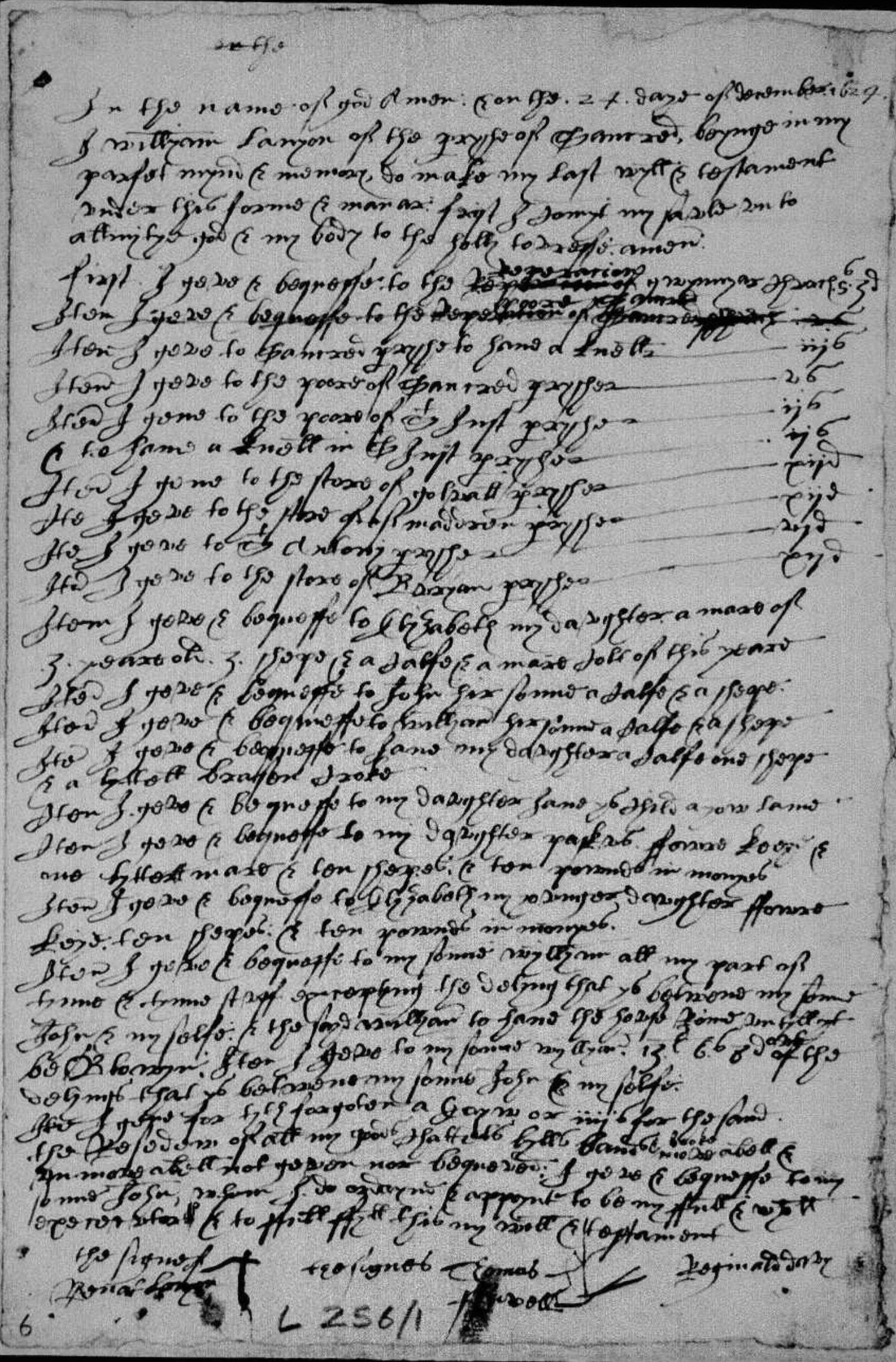
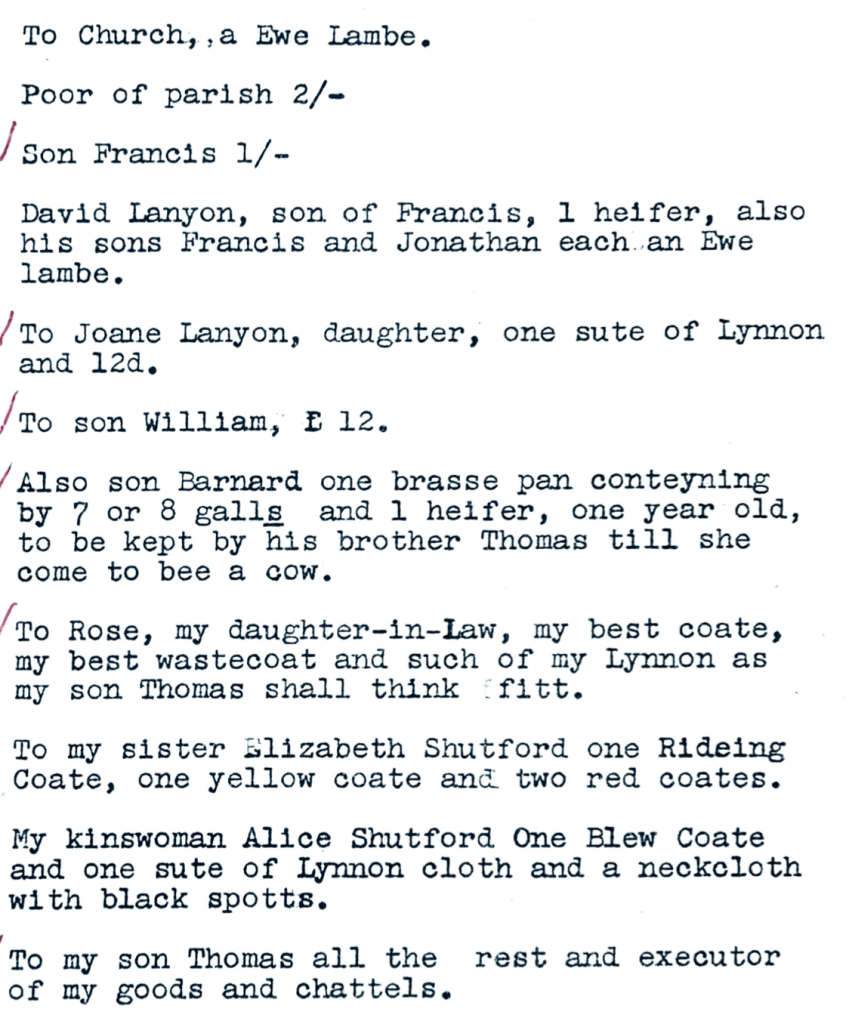
William’s Will of 1624 – Source CRO AP/L/256

Abstract:-

WILLIAM LANYON of Sancreed written: 24 Dec 1624 proved: 8 Feb 1624/5

poor of Sancreed – 3 sh.
poor of St. Just – 5 sh.
poor of Gulval – 12 d.
poor of Maddern – 12 d.
poor of Antony – 12 d.
poor of Buryan – 12 d.
daughter: ELIZABETH – mare, 3 sheep, calf, mare colt
JOHN her son – calf & a sheep
WILLIAM her son – calf & a sheep
daughter: JANE – calf, 1 sheep, brazen crock
daughter JANE’s child – a ewe lamb
daughter: PASKAS – 4 kyne, mare, 10 sheep, 10 pounds
youngest daughter: ELIZABETH – 4 kyne, 10 sheep, 10 pounds
son: WILLIAM – all my part of tin and tin stuff, 13 pounds, 6 sh., 3 d.
son: JOHN – all the rest & executor

The will implies that Paskas is younger than Jane and older than Elizabeth his youngest daughter which suggests that she was born between 1602 and 1607. So aged about 18-23 in 1625 when the marriage to Thomas Shetford took place.

It’s interesting that William leaves 5 shillings to the poor of St Just as that’s the town that Thomas Shetford comes from.

Who was Thomas Shetford?

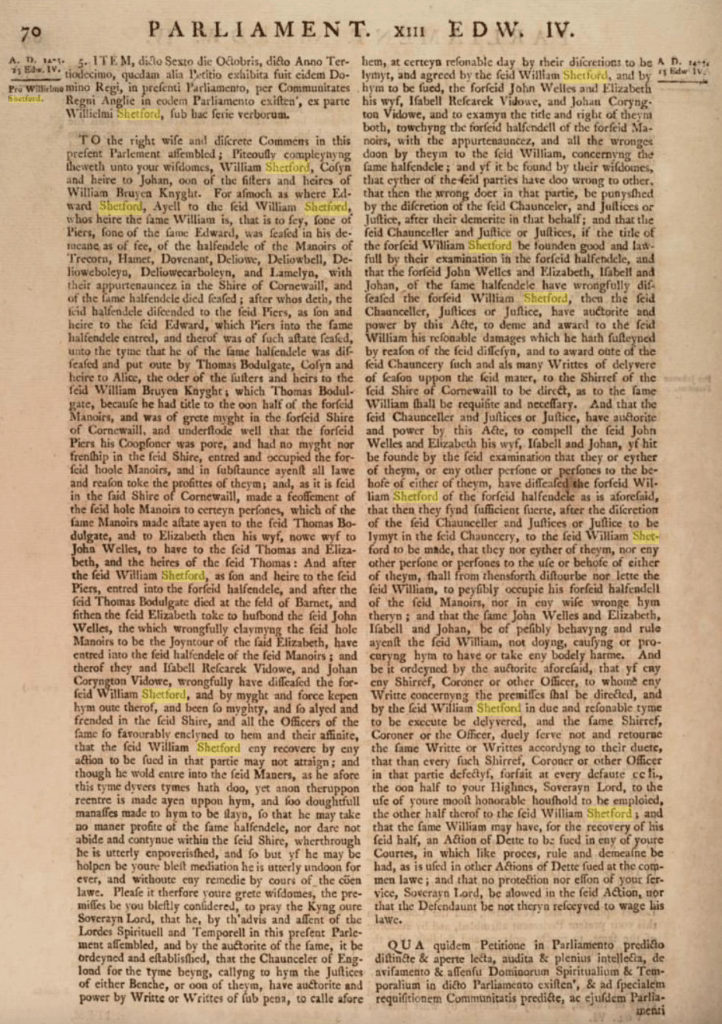
The Shetford/Shutford (and occasionally Shitford!) family originally came from Somerset. They were cheated out of a half share in six manors in Cornwall by Sir Thomas Bodulgate during the Wars of the Roses.

Source – History of Parliament Edward IV

We know very little about Thomas, the parish registers for St Just in Penwith start quite late but with the little we know we can create a tree that might be correct.

  • We know that Paskis Lanion married Thomas Shetford at St Just in Penwith in 1625 so he was probably born about 1600
  • There is a baptism for a Margarett Shetfod (Sic) daughter of Thomas on 14 Nov 1630 at St Just listed in the Exeter Bishop’s Transcripts
  • 16 Oct 1647 marriage at St Just between Elizabeth Shetford (daughter of Thomas) and John Rawlyn (Source – OPC)
  • Baptism of Alse Shutford, daughter of Thomas 20 Dec 1633 St Just (Source- FHL film number 0226217, 0226218, 962681)
  • Burial of Paskes Shetford, widow 19 Dec 1681/2 St Just in Penwith (Source – OPC)
  • The will of Joan Lanyon (Shutford) 1655 (Source – NA PROB 11/257/72) Joan was the wife of David Lanyon of Madron and her will mentions her Shutford relatives

There is also a record at Kresen Kernow (The Cornish Record Office) which mentions Thomas and William Shilford.

Lease, tenement, Treloweth Wartha, Illogan

Parties: 

1) Right Honourable John Lord Robartes, Baron of Truro.

2) William Lanyon, Yeoman, of St Just, Cornwall.

Property: Tenement, Treloweth Wartha, Illogan, Cornwall.

Consideration: £130.

Term: 99 years, or the natural lives of [?] Lanyon, John Lanyon his brother and William Shilford, son of Thomas Shilford.

Annual rent: 46 shillings 8 pence, one capon or 12 pence, a harvest day or 6 pence.

Heriot: Best beast or £3.

Reference numberCL/1/124
Date3 Oct 1635

I think it should be William and Thomas Shitford/Shetford rather than Shilford. Could Thomas have a son called William and could these Lanyons be Paskas’ brothers?

The Paskas born in Sancreed had brothers called John and William. ‘William Lanyon Yeoman of St Just’ listed in the lease is definitely not the St Merryn family of Lanyons.

There is a marriage of a William Shetford and Mary Edward at St Just on 26 Nov 1653, they had two daughters: Rebecea (sic) bapt. 1655 and Ellizabeth (sic) bapt. 1657.

There is a legal dispute between John Lanyon and William Shutford in 1659, the year Thomas Shutford died. Source – NA C 10/48/84

Lanyon v Shutford. 

Plaintiffs: John Lanyon. Defendants: William Shutford, James Pratt and Robert Baynard. Subject: property in Sancreed, Cornwall.

This is the hypothetical tree I’ve created from all those snippets of information.

We still haven’t conclusively answered the question which Paskis Lanion married Thomas Shutford in 1625 but I think the Paskas born to William Lanyon of Sancreed is the more likely candidate.

William Lanyon died in 1624 (his wife had died in 1619) and left Paskas £10 and some cattle. The following year she married Thomas from the neighbouring parish of St Just in Penwith.

Ultimately geography may be the best clue, the distance between St Just and Sancreed (near Penzance) is a lot smaller than the distance between St Just and St Merryn (near Padstow).

With thanks to Louise Quigley who first posed this question in 2014 and the Penwith Genealogy Group who produced some great answers and evidence.

The Reluctant Grooms!

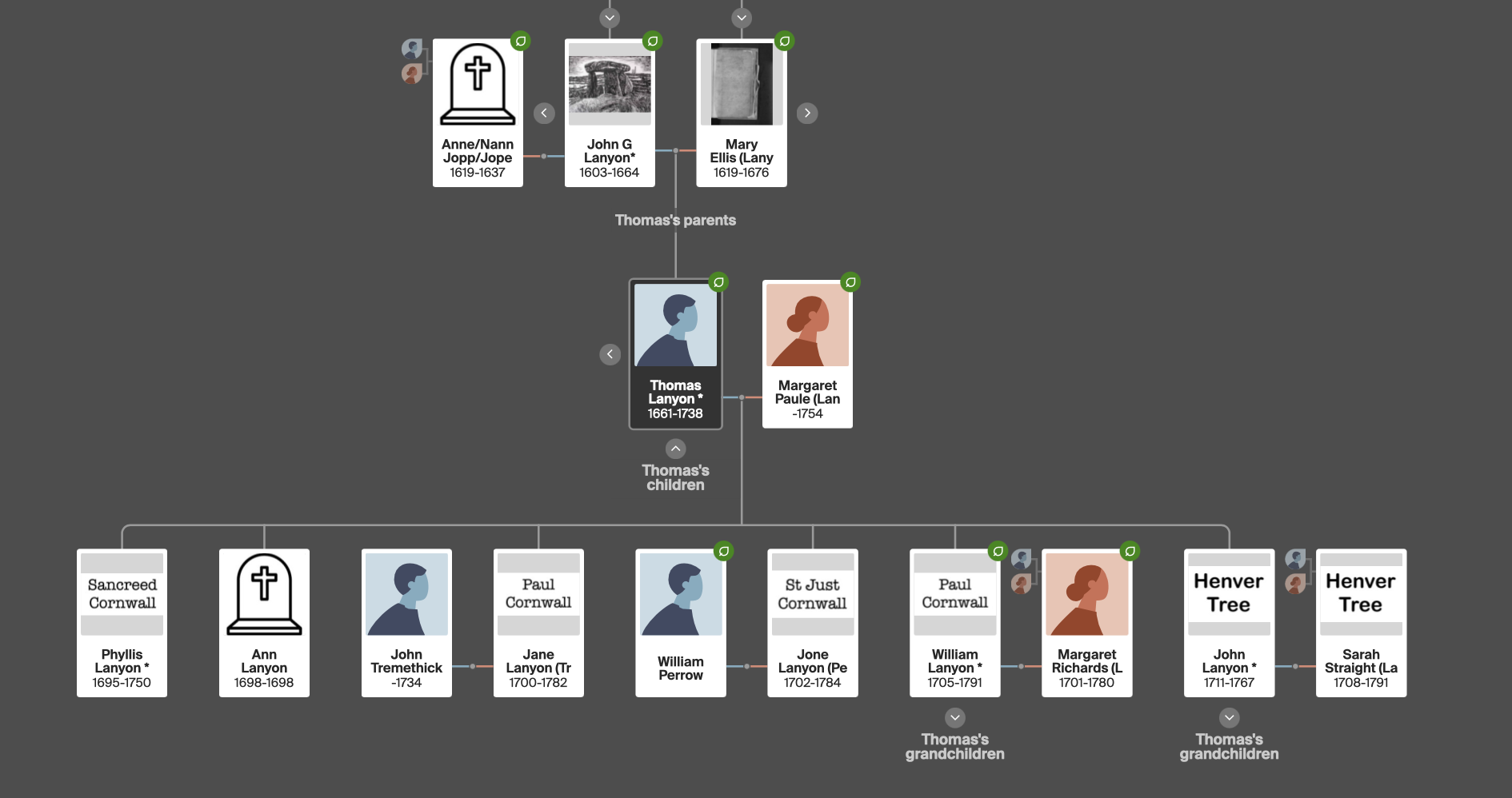
The final branch of the Botrea tree are the sons of Thomas Lanyon 1661-1738.

Thomas & Margaret’s tree

Thomas was just 3 years old when his father died in 1664. Of the eight children he had only William and John survived to produce their own families and carry on the family name.

John (1711-1767) married Sarah Straight and moved to St Allen in Cornwall and founded a whole new and very successful branch of the family. (See St Allen Branch). William (1705-1791) married Margaret Richards and despite living to the grand old age of 86 only had one surviving son.

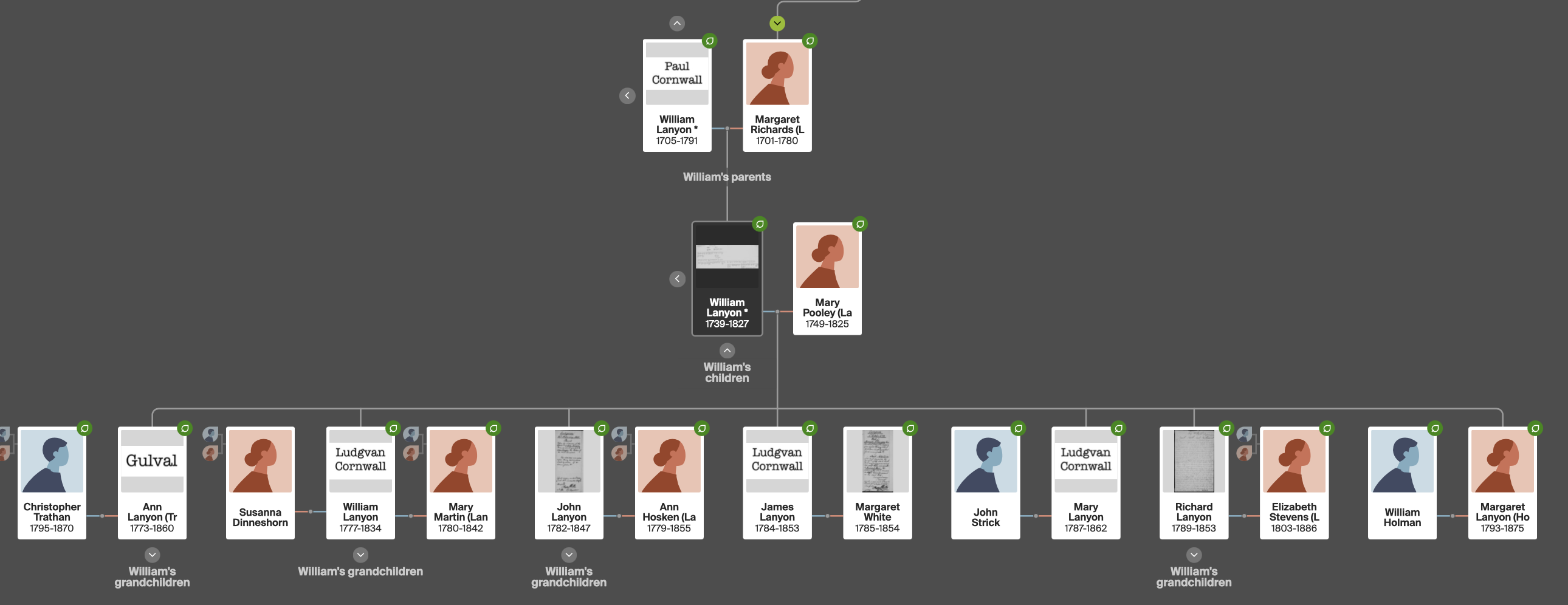
William Lanyon 1739-1827

William was born at Paul, he married Mary Pooley at Ludgvan (near Marazion) Cornwall in 1776.

William & Mary’s tree

Their children:

  • William 1777-1834
  • John 1782-1847
  • James 1784-1853
  • Mary 1787-1862 married John Strick at Ludgvan in 1810
  • Richard 1789-1853
  • Ann 1791-1860 married Christopher Trathan, a labourer, at Gulval in 1814, one son, William Lanyon Trathan b 1817
  • Margaret 1793-1875 spinster

William Lanyon 1777-1834

William Lanyon’s first child was illegitimate and born to Susan Dinneshorn when he was 19. William Lanyon senior and junior were charged a £30 bastardy bond by church wardens and the parish poor law overseer for Susan’s base child. The son, George, was born in 1796 and married Ann Edmonds at Ludgvan in 1827. He died in 1829 and left a will, George Lanyon yeoman of Ludgvan – 2 guineas to my father and all the rest of my goods to my wife Ann sole executrix. There were no children of this marriage but Ann Edmonds had a daughter Grace Jennings born in 1836.

Bastardy Bond 1796 Ludgvan

William married Mary Martin in 1803 and he had a further nine children:

  • Juliana 1804-1877 married Matthew Trewhella 1827 – six children, emigrated to Connecticut, USA.
  • Margaret 1806-1887 married Jasper Allen 1834 – ten children, emigrated to Connecticut.
  • Mary 1806- married Richard Edmonds 1825, three children
  • Jane 1806-1815 died young
  • William Argell Perrow Lanyon 1808-1884 was a farmer, he never married but lived with his illegitimate son, Alfred Lanyon, who was born about 1856. No further trace of Alfred.
  • Joseph Martin Lanyon 1811-1870
  • Henry Lanyon 1814-1871
  • Jane 1815-1837 died at Rospeath (family home) age 21
  • James 1822-1885

Of those nine children only four sons had children of their own who carried on the Lanyon name, William, Joseph, Henry and James.

Joseph, Henry and James all emigrated to Connecticut, USA.

The Great Emigration

Between 1815 and 1915 many thousands of people emigrated from Cornwall to seek a better life. They headed to countries like the USA, Australia and South Africa. They were ‘economic migrants’. When tin mining was no longer profitable and mines closed many Cornish men moved to mining areas all over the world. As a result of the Great Emigration, there are now more than six million people of Cornish descent around the world, some of them are called Lanyon!

Three of William’s sons emigrated to Connecticut, USA.

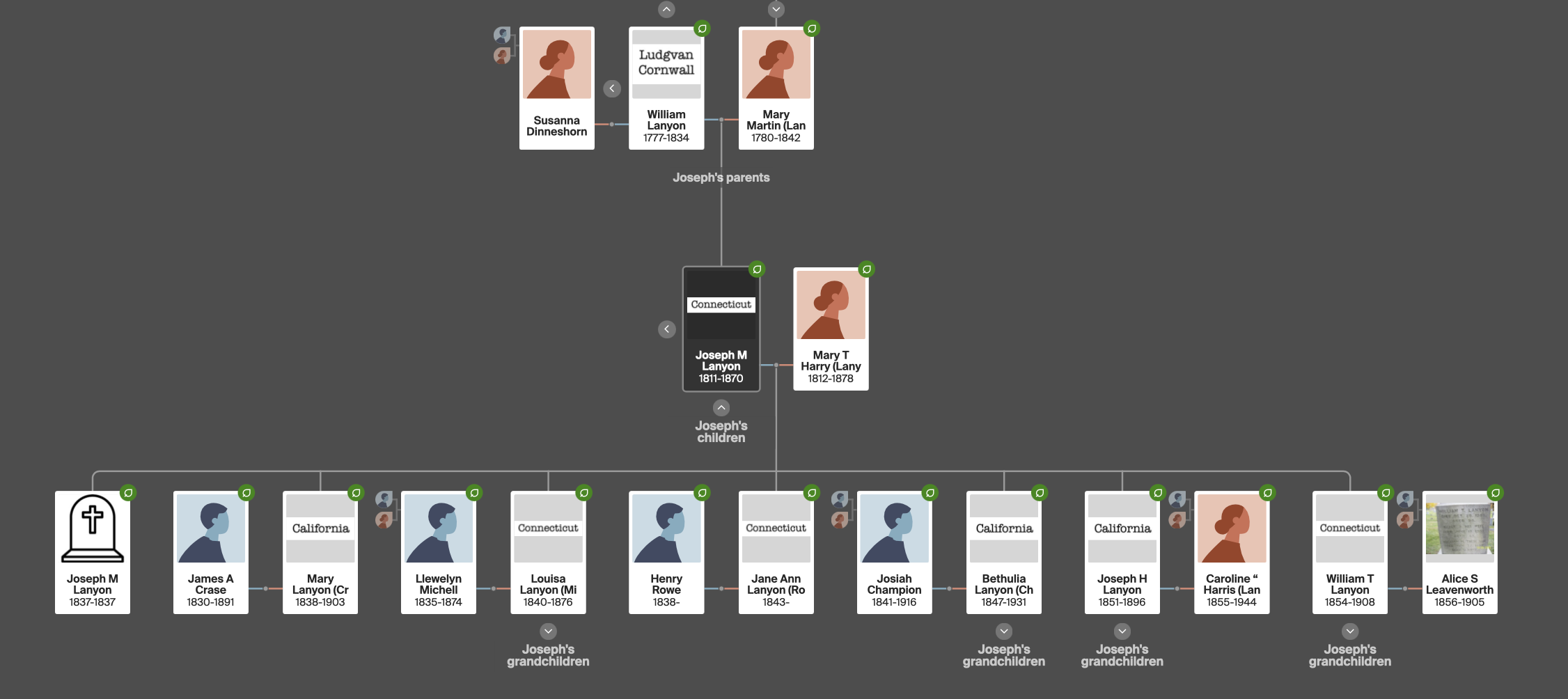
Joseph Martin Lanyon 1811-1870

Joseph married Mary Thomas Harry in 1835 at Ludgvan and by 1844 they had emigrated to Connecticut, USA. Joseph was a miner. Their children

Joseph & Mary’s tree
  • Joseph Martin 1837-1837 died in infancy
  • Mary 1838-1900 married James A Crase in 1857 at Connecticut and moved to California. Five children.
  • Louisa 1840-1876 married Llewellyn Michell who died in 1874. Five children who all died in infancy.
  • Jane 1843- married Henry Rowe at Connecticut. One child.
  • Bethulia 1847-1931 married Josiah Champion in 1865. Three children.
  • Joseph H Lanyon 1851-1900. Married Caroline Harris. Six children.
  • William T Lanyon 1854-1908 a stonemason, married Alice Sophia Leavenworth. Three children.

And there we must leave Joseph Martin Lanyon’s family. His brother Henry also emigrated to Connecticut.

Henry Lanyon 1814-1871

Henry was born at Ludgvan, married Elizabeth Sarah Wills at Bath in Somerset in 1840. He died at Connecticut in 1871.

Henry & Elizabeth’s tree
  • Mary Jane 1841-1913 born in Gloucestershire, England – spinster who died in Canada.
  • Emily Millicent 1843-1927 also born in Gloucestershire. Three marriages: Nathaniel Williams – one daughter; William Taylor – eight children; John Catron – two children. She died in Pennsylvannia in 1927.
  • James M 1845-1903 a butcher, born in Connecticut married Emma Bristol – 2 sons Wilbur & James.
  • William Wills 1847-1905 married Sarah Bronson Thrall – four children. William died in Los Angeles.
  • Joseph M Lanyon 1849-1850 died in infancy
  • Arabella 1852-1933 spinster died in California
  • Julia 1854- no trace
  • Elizabeth 1856- no trace
  • Susan Gertrude 1858-1923 married in 1876 to Herbert Rudy Hawley – three children. Susan died in New Jersey.
  • Henry John 1866- no trace

James Lanyon 1822-1885

James was the third son of William Lanyon and Mary Martin. He was also born at Ludgvan in Cornwall and emigrated in the 1840s to Connecticut. There he married Lucretia Brooks in 1843. They had three children.

James & Lucretia’s tree
  • William J 1844-1844 died in infancy
  • Mary 1846-1846 died in infancy
  • Wesley 1848-1928 married Eleanora Harriett Allen in 1848 and they had three children.

That’s where we leave William and Mary Martin’s branch of the tree and move to his brother John Lanyon.

John Lanyon 1782-1847

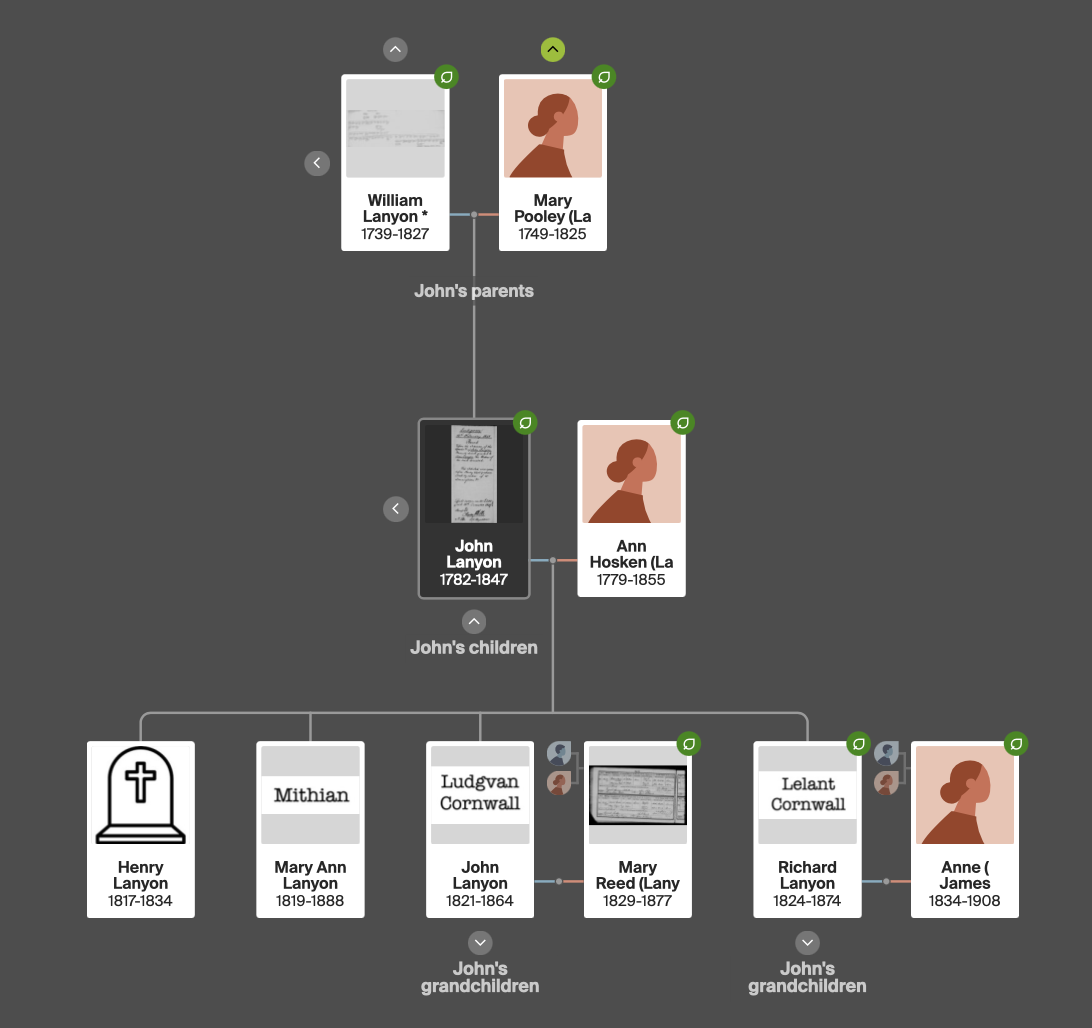
John was a farmer and miller, he lived at Tregarthen at Ludgvan. In 1815 he married Ann Hosken. They had four children.

John & Ann’s tree
  • Henry 1817-1834 died young no children
  • Mary Ann 1819-1888 she was a spinster and died at Mithian in 1888
  • John 1821-1864
  • Richard 1824-1874

Farming-Städel Museum, PDM-owner, via Wikimedia Commons

John Lanyon 1821-1864

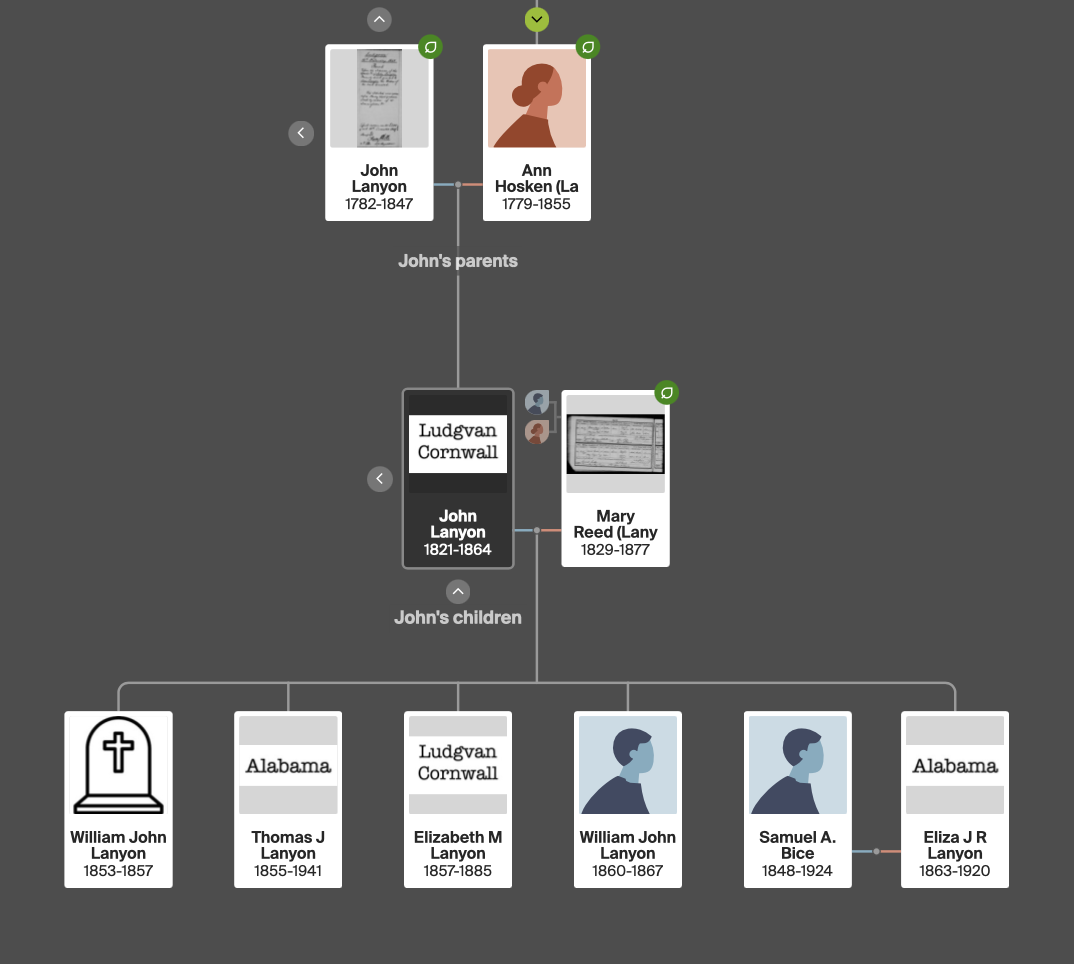
John was also a farmer at Tregarthen, he married Mary Reed at Ludgvan in 1852. He died when he was just 42.

John & Mary’s tree
  • William John 1853-1857 died in infancy
  • Thomas James 1855-1941 no trace of a marriage or children, he died in Alabama
  • Elizabeth Margaret 1857-1885 died unmarried
  • William John 1860-1867 died in infancy
  • Eliza Jane Reed 1863 1920 married Samuel A Bice, no children. Died in Alabama

Without any surviving children this branch died out.

Richard Lanyon 1824-1874

Richard was a farmer in 1854 he married Anne (Nanny) James. They had seven children but only one child ever married.

Richard & Ann’s tree
  • James 1855-1932 never married and lived with his unmarried siblings. He died age 77 at New Farm in Crowan.
  • Emily 1856-1916 spinster lived with unmarried siblings
  • Anne 1862-1870 died young
  • Jane 1864-1937 married John James Liddicoat – one child.
  • Richard 1865-1932 never married and lived with unmarried siblings
  • John 1867-1951 he was a farmer, he never married but was living with Maude Lanyon, a widow, in 1939.
  • Emma 1870-1930 spinster lived with unmarried siblings

With so many unmarried children it’s not surprising that this male line died out!

Richard Lanyon 1789-1853

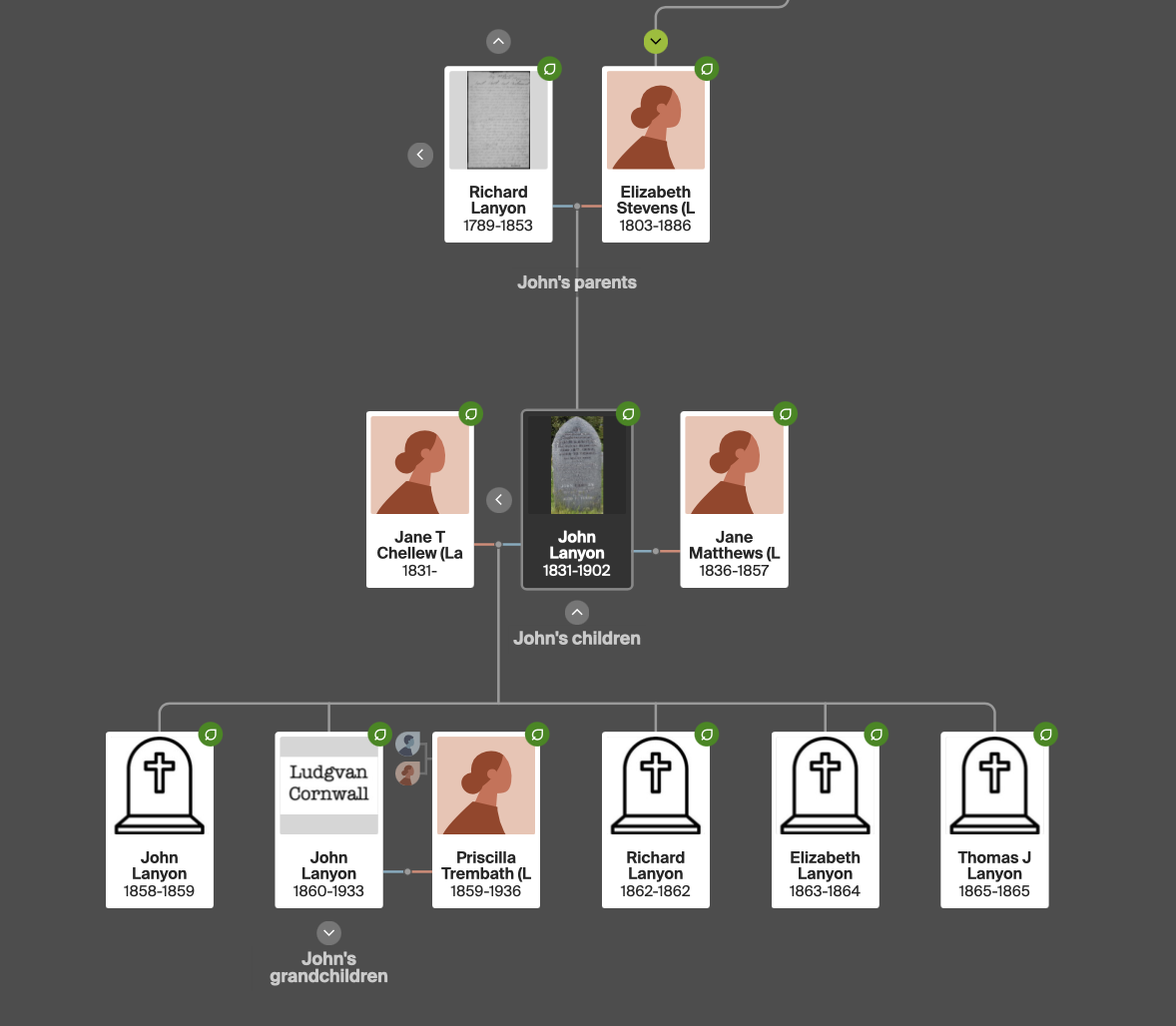
We go back to William and Mary Pooley’s children. Richard was a farmer at Rospeath, Ludgvan. At Zennor, in 1826, he married Elizabeth Stevens and had eight children.

Richard & Elizabeth’s tree

  • Elizabeth (Betsy) Stevens 1827- married Thomas Richards no further trace
  • John 1829-1829 died in infancy
  • John 1831-1902
  • Mary 1833-1833 died in infancy
  • Mary 1835- married William Bennetts – eleven children
  • James 1837-1837 died in infancy
  • James 1839-1912
  • Margaret 1841-1842 died in infancy

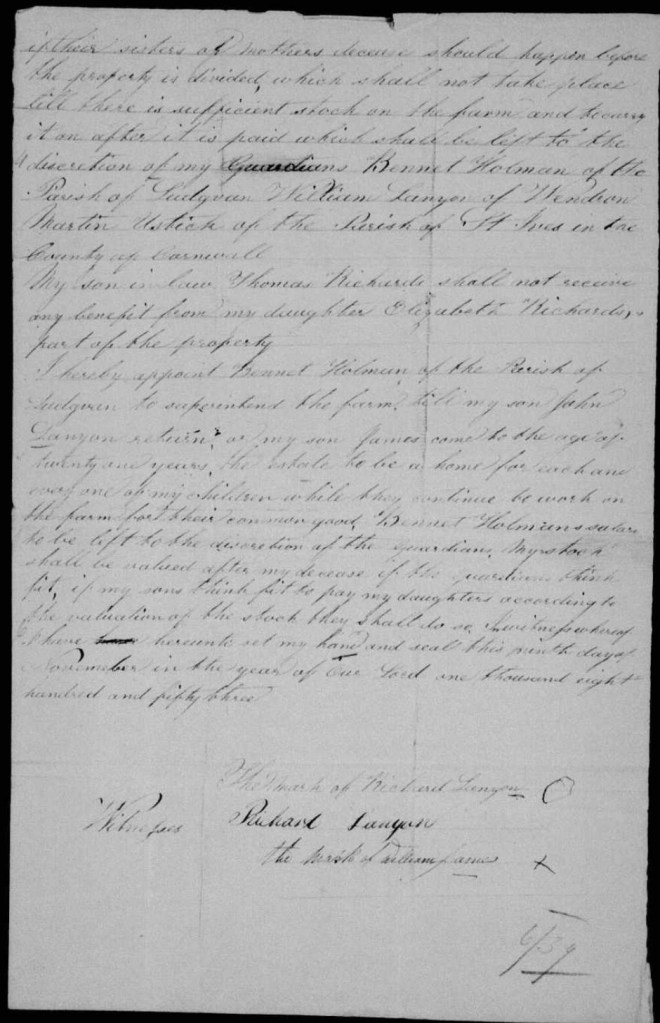
Richard died in 1853 and his will specifically excluded his son in law Thomas Richards. “Thomas Richards shall not receive any benefit from my daughter Elizabeth Richard’s part”.

Of Richard and Elizabeth’s eight children only two sons had children of their own, John and James.

John Lanyon 1831-1902

John was a farmer at Rospeath, Ludgvan and his ‘claim to fame’ is that he had two wives, both called Jane!

John’s marriages
  • Jane Matthews – married Jan 1857. Jane died nine months later in Sep 1857 so it is possible she died in childbirth with their first child.
  • Jane T Chellew was his second wife. He married her in Jan 1858. They had five children and four of them died in infancy. Only John 1860-1933 survived. Jane died in 1869, leaving a nine year old son.

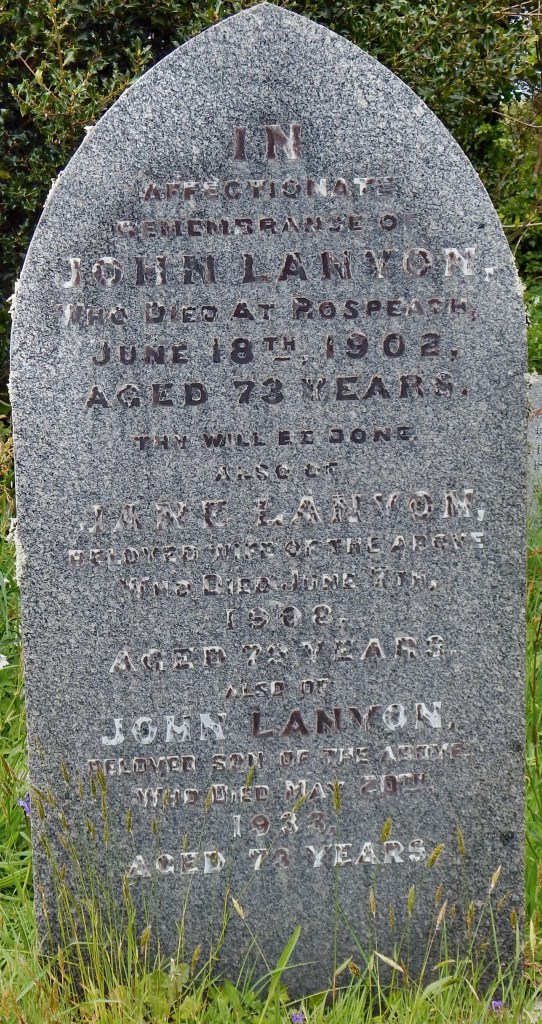
John Lanyon’s grave at Ludgvan.

John Lanyon 1860-1933

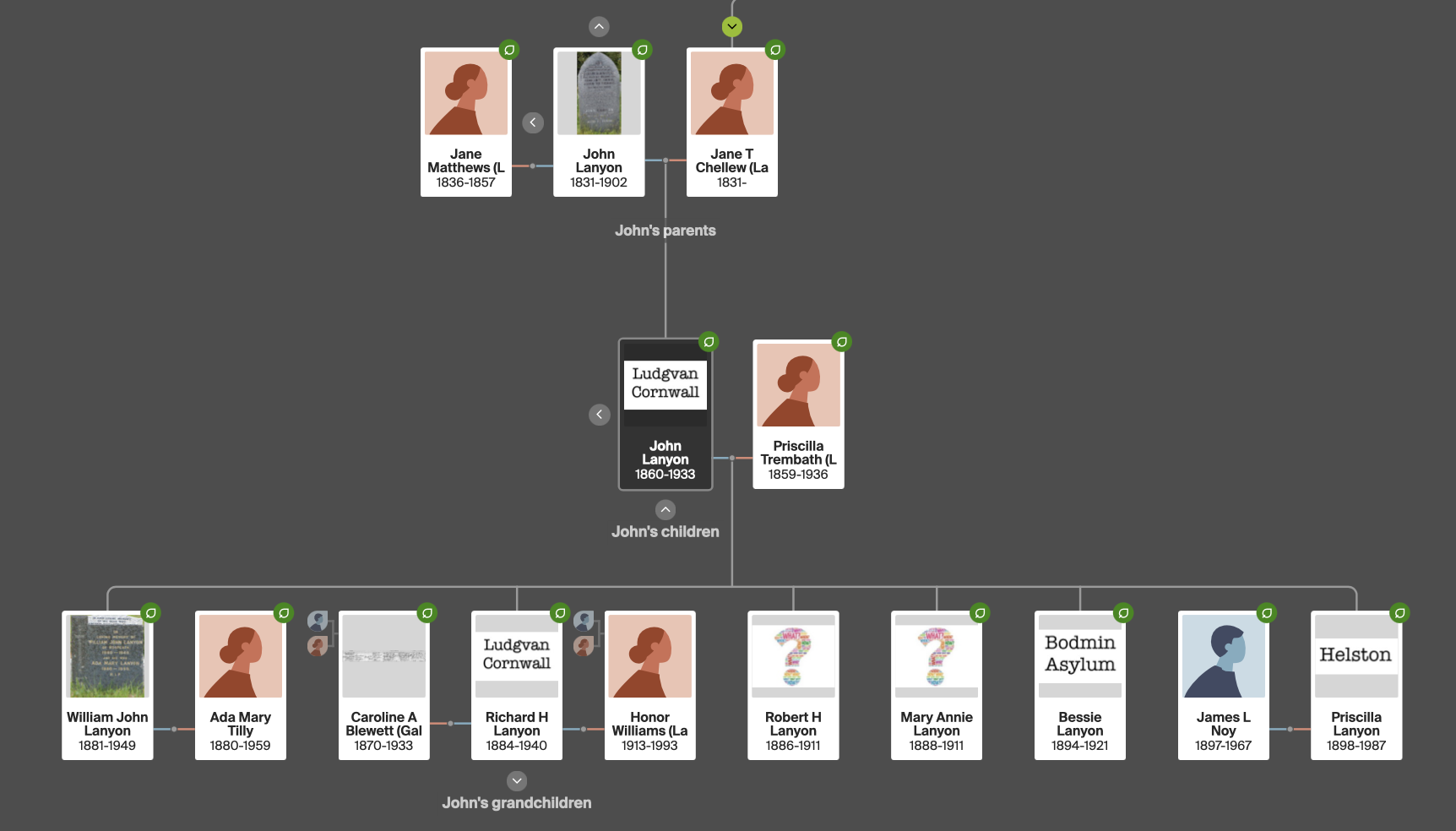
John was baptised at Ludgvan 29 Dec 1861, the only surviving son of John Lanyon and Jane Chellew. He was a farmer at Rospeath, Ludgvan. He married Priscilla Trembath in 1883. They had six children.

John & Priscilla’s tree
  • William John 1881-1949 married Ada Mary Tilly – no children.
  • Richard Henry 1886-1940 married Honor Jeffrey – four children
  • Robert Henry 1886-aft. 1911 farm labourer no further trace
  • Mary Annie 1888-aft. 1911 no further trace
  • Bessie 1894-1921 bessie died at Bodmin Asylum age 27.
  • Priscilla 1898-1987 she married James Leonard Noy in 1931 – no children

We must leave this branch of the family here.

Bodmin Asylum – Unknown author, Public domain, via Wikimedia Commons

James Lanyon 1839-1912

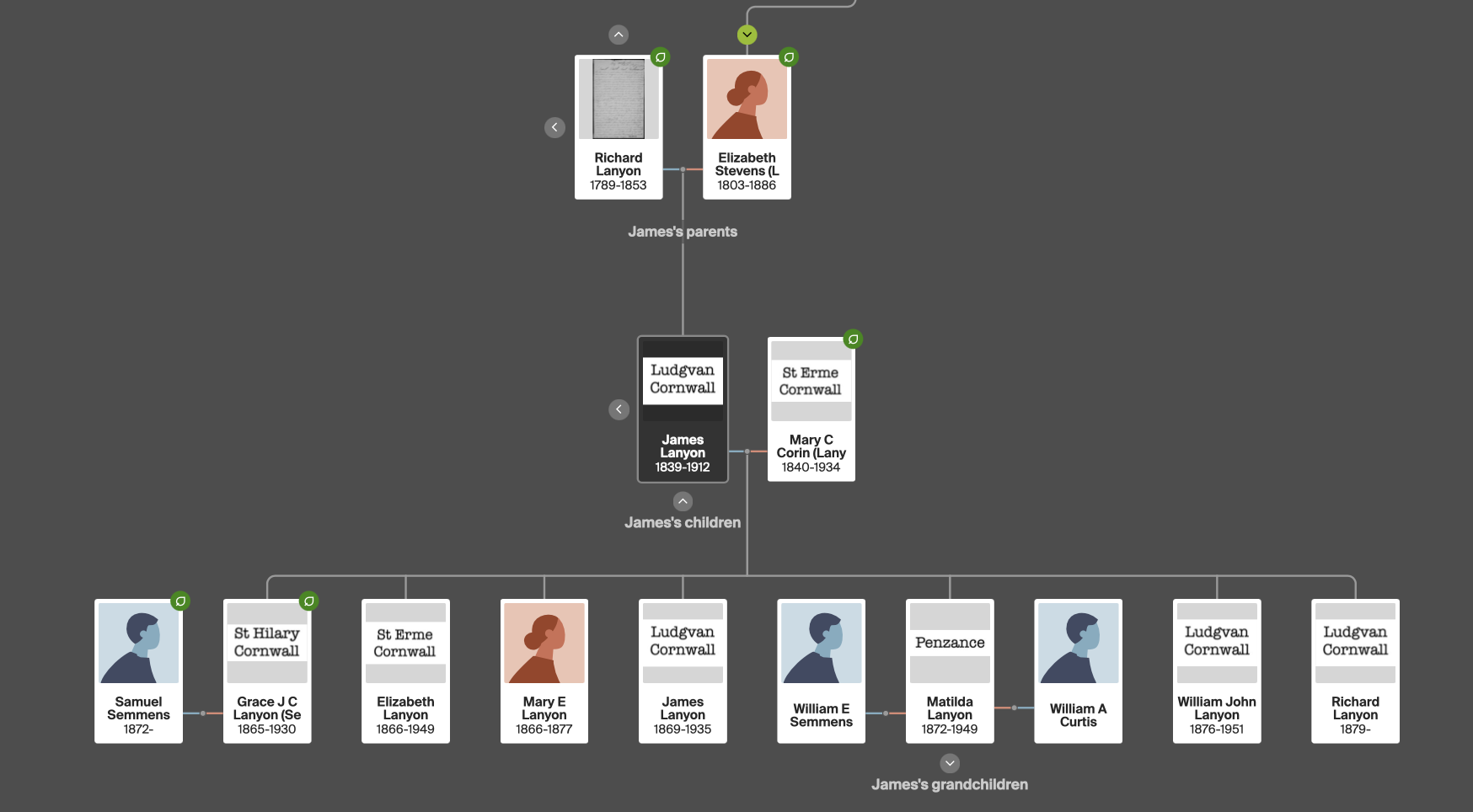
James was the son of Richard Lanyon and Elizabeth Stevens. He worked as a farmer and a miner. In 1863 he married Mary Carlyon Corin at Ludgvan and they had seven children.

  • Grace Jane Corin 1865-1930 married Samuel Semmens – no children
  • Mary Elizabeth 1866-1877 died young
  • Elizabeth 1866-1949 spinster died at St Erme in 1949
  • James 1869-1935 bachelor of Chy Vellan farm at Ludgvan.
  • Matilda 1872-1949 married 1901 William Ernest Semmens – one son Ernest Semmens. Matilda married for a second time in 1923 to William A Curtis, at Penzance.
  • William John 1876-1951 never married
  • Richard 1879- never married

Yet again with so many unmarried children this branch of the tree died out.

James & Mary’s tree

In just eight or nine generations this branch of the Lanyon tree has almost died out in Cornwall due to the reluctant grooms. Why did so many of them remain unmarried?

The Diminishing Tree

John Lanyon and Mary Ellis had a large family but their descendants quite often left no traceable issue.

The ‘Golden’ Lanyon’s children

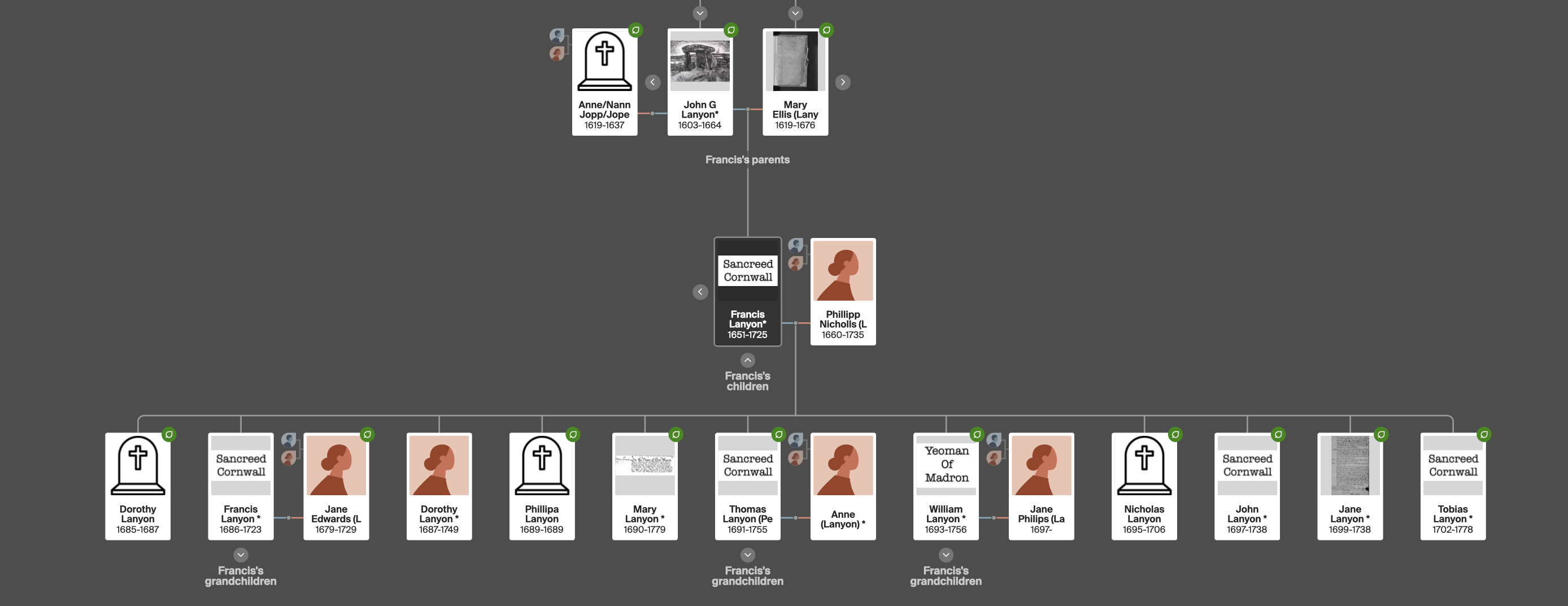
Francis Lanyon 1651-1725 had six sons.

  • Francis 1686-1723
  • Thomas 1691-1755
  • William 1693-1756
  • Nicholas 1695-1706 (died young)
  • John 1697-1738 never married
  • Tobias 1702-1778 never married

Only three of them, Francis 1686-1723, Thomas 1691-1755 and William 1693-1756 had sons of their own.

Francis Lanyon 1686 – 1723

Francis & Jane’s tree

Francis married Jane Edwards at Morvah in 1715. They had five children, the fifth was born following the death of Francis in 1723.

  • Jane 1716 – 1716
  • Dorothy 1717-1778 married John Tellum (three children)
  • Francis 1719-1730
  • Jane 1722-1807 – spinster
  • Benoni John 1723-1777 (Benoni means ‘son of my sorrow’)

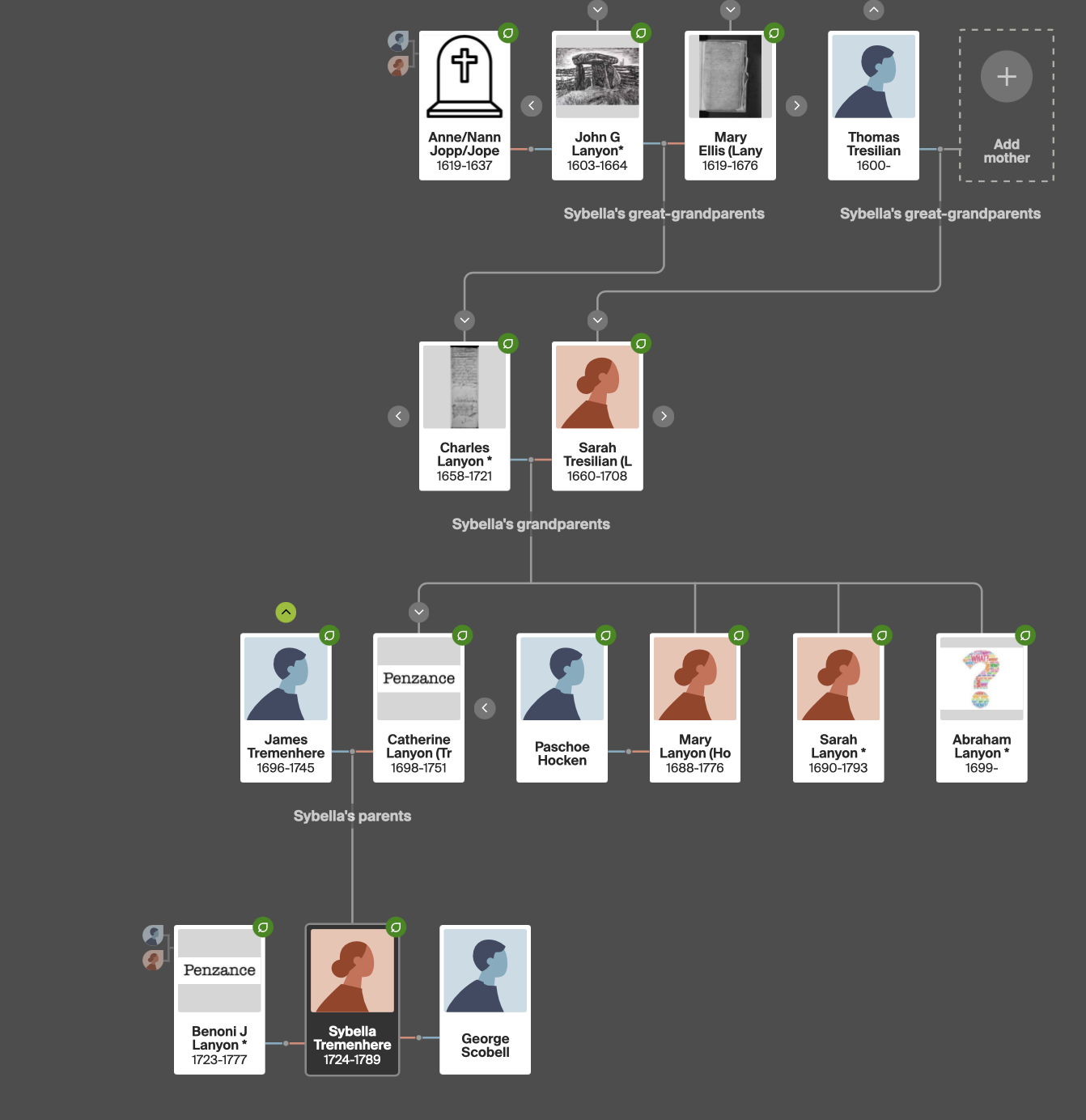
Benoni was baptised three months after his father’s death. He was an attorney and married Sybella Tremenhere, the daughter of James Tremenhere and Catherine Lanyon, a grand-daughter of John Lanyon and Mary Ellis.

Benoni John had no children.

Thomas 1691-1755

Thomas married Ann (surname unknown) and worked as a pewterer in Bristol (see separate post for his life story.) He had one son, Francis, born 1725 – no further trace of him.

William 1693-1756

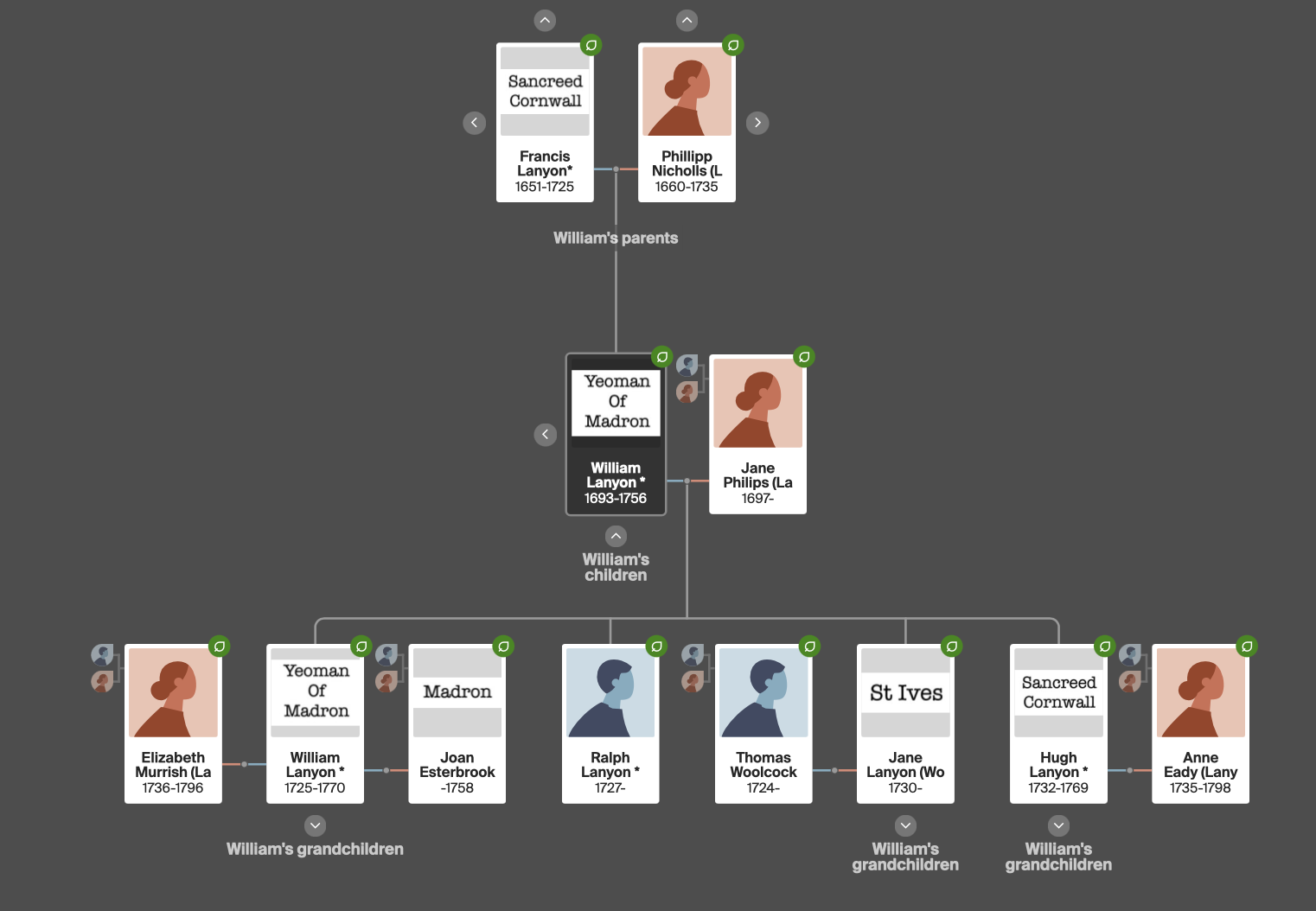
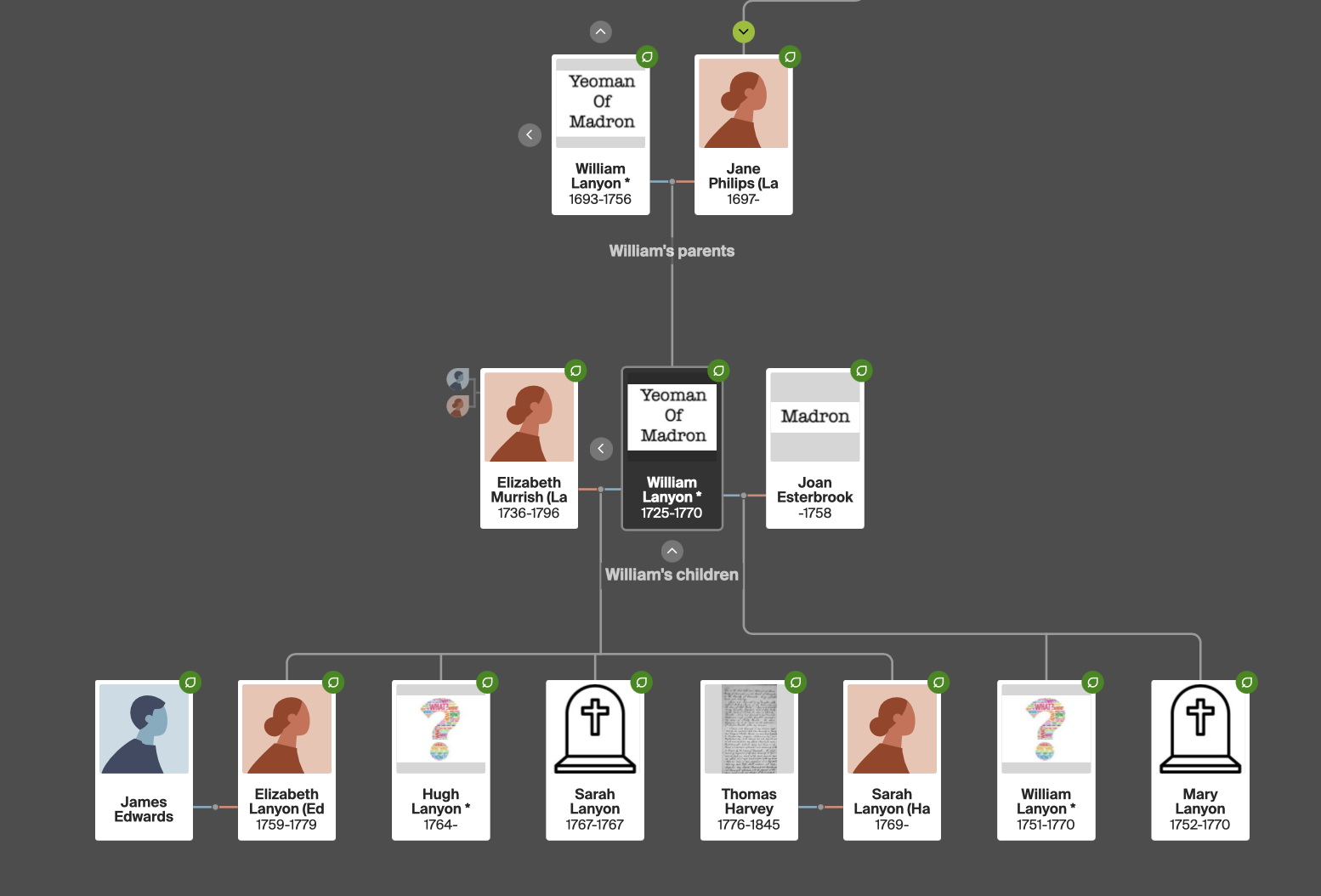
William was a yeoman of Madron and married Jane Philips at Zennor in August 1725.

They had four children:

  • William 1725-1790
  • Ralph 1727-
  • Jane 1730
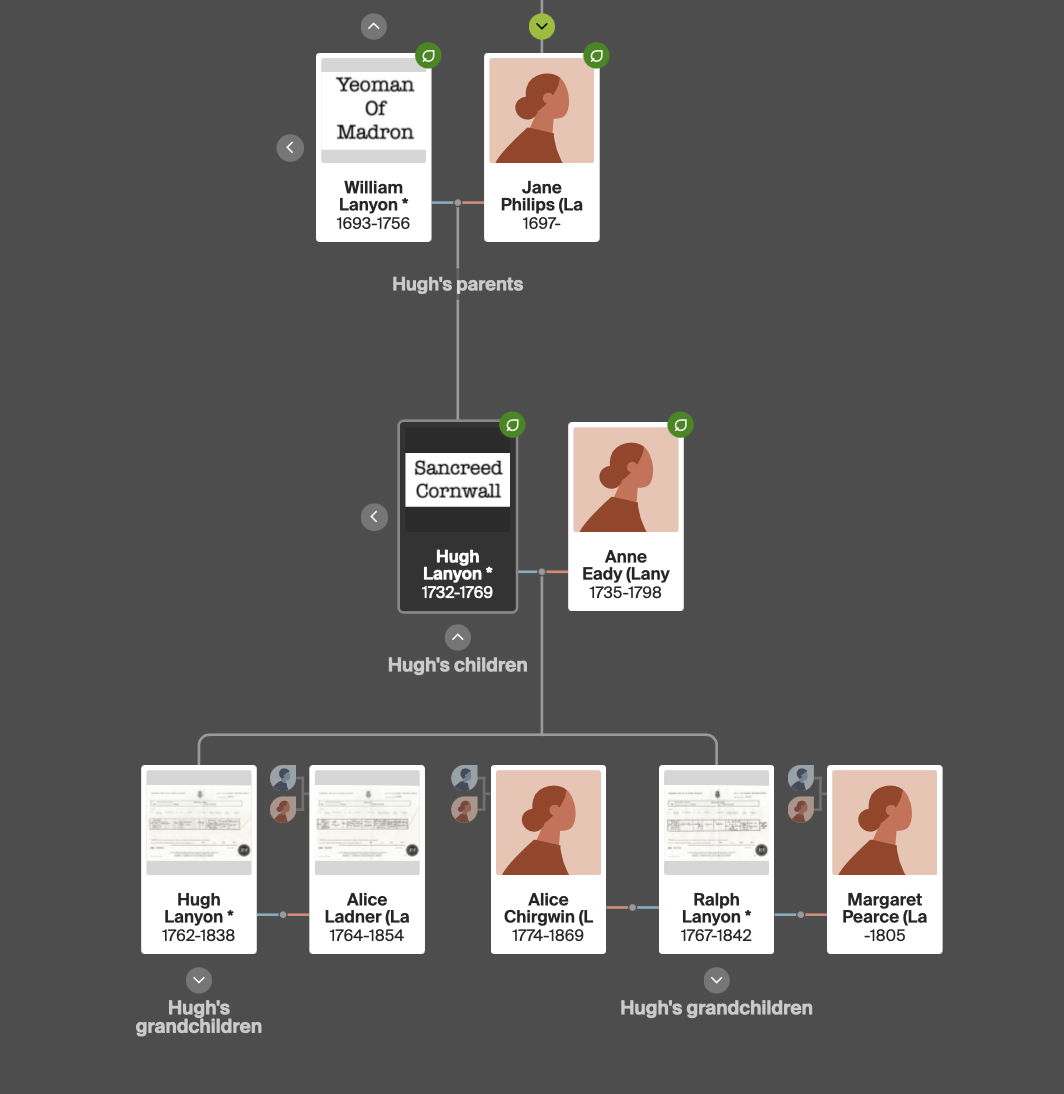
  • Hugh 1732-1769

William 1725-1790

William was baptised at Zennor in February 1725. He married twice, first to Joan Esterbrook in 1751. Joan died before 1758. They had two children:

  • William 1751- aft 1770. William inherited the estate at Boswarthen but there is no further trace of him
  • Mary 1752- ? there is no mention of her in her father’s will so presumably she died young.

William then married for a second time to Elizabeth Murrish (1736-1796) on 2 Aug 1758. They had four children.

William’s tree
  • Elizabeth 1759-1779. She married James Edwards.
  • Hugh 1764- mentioned in his father’s will of 1770 but no further trace
  • Sarah 1767-1767
  • Sarah 1769- she married Thomas Harvey

There are no traceable male heirs of this line.

Hugh Lanyon 1732-1769

Hugh’s tree

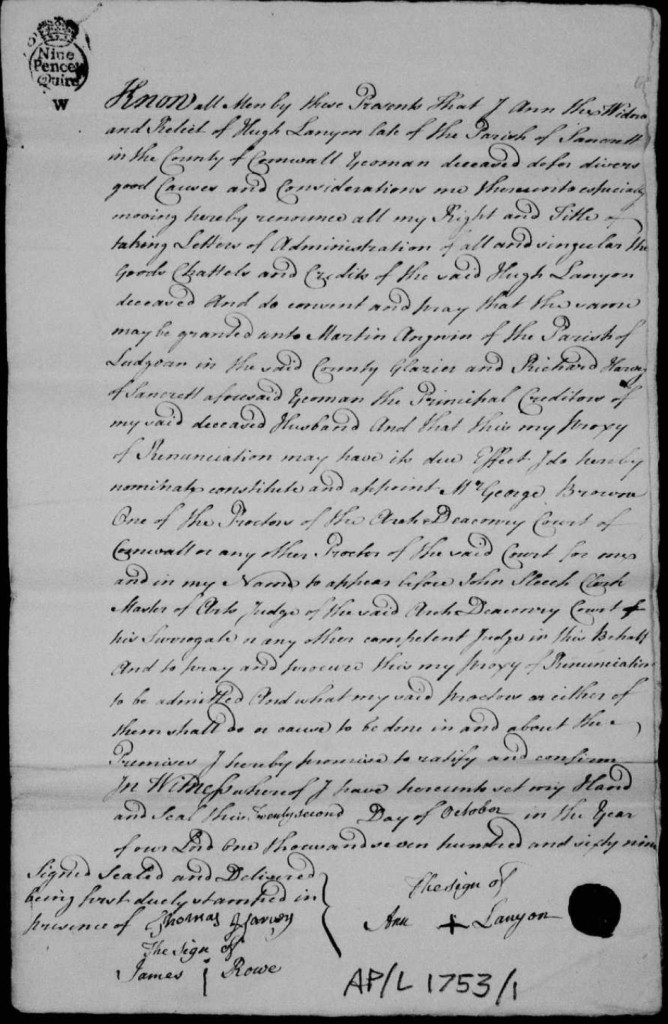
Hugh was baptised at Zennor in 1732. In 1762 he married Anne Eady at Sancreed and they had two sons, Hugh and Ralph. Hugh senior was a yeoman which meant he owned some land. Hugh died in 1769 when his youngest son was just two. He died intestate and his wife renounced administering his estate to Martyn Angwin, Richard Harvey and William Lanyon 1725-1770 (her brother-in-law) his principal creditors.

Ann renouncing Hugh’s estate – Source – CRO AP/L/1753

Hugh Lanyon (Junior) 1762-1838

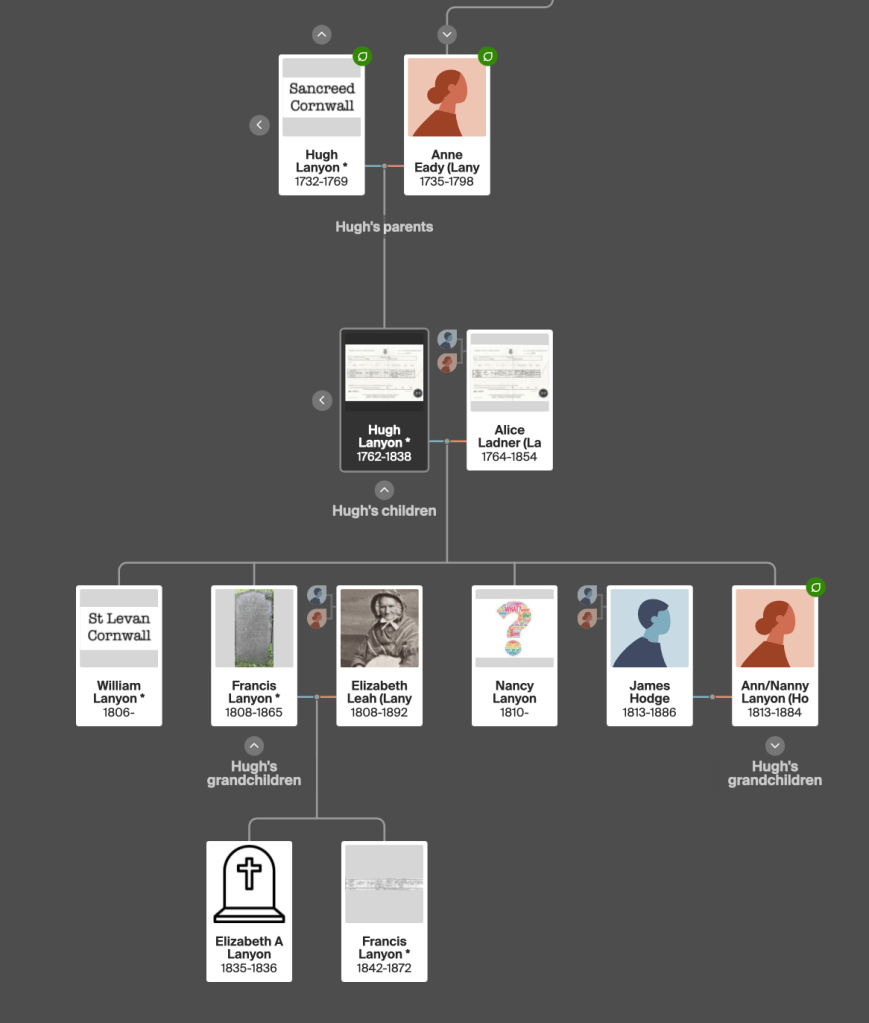
Hugh and Anne’s eldest son was also called Hugh, he was baptised at Sancreed in 1762, three months after his parents marriage. Hugh was an agricultural labourer and he married Alice Ladner at Sancreed in 1805. They had four children:

  • William 1806- no further trace
  • Francis 1808-1865
  • Nancy 1810 – no further trace, she may have died in infancy
  • Nanny 1813- Nanny married James Hodge, an agricultural labourer at St Buryan in 1837 and they had 3 children.

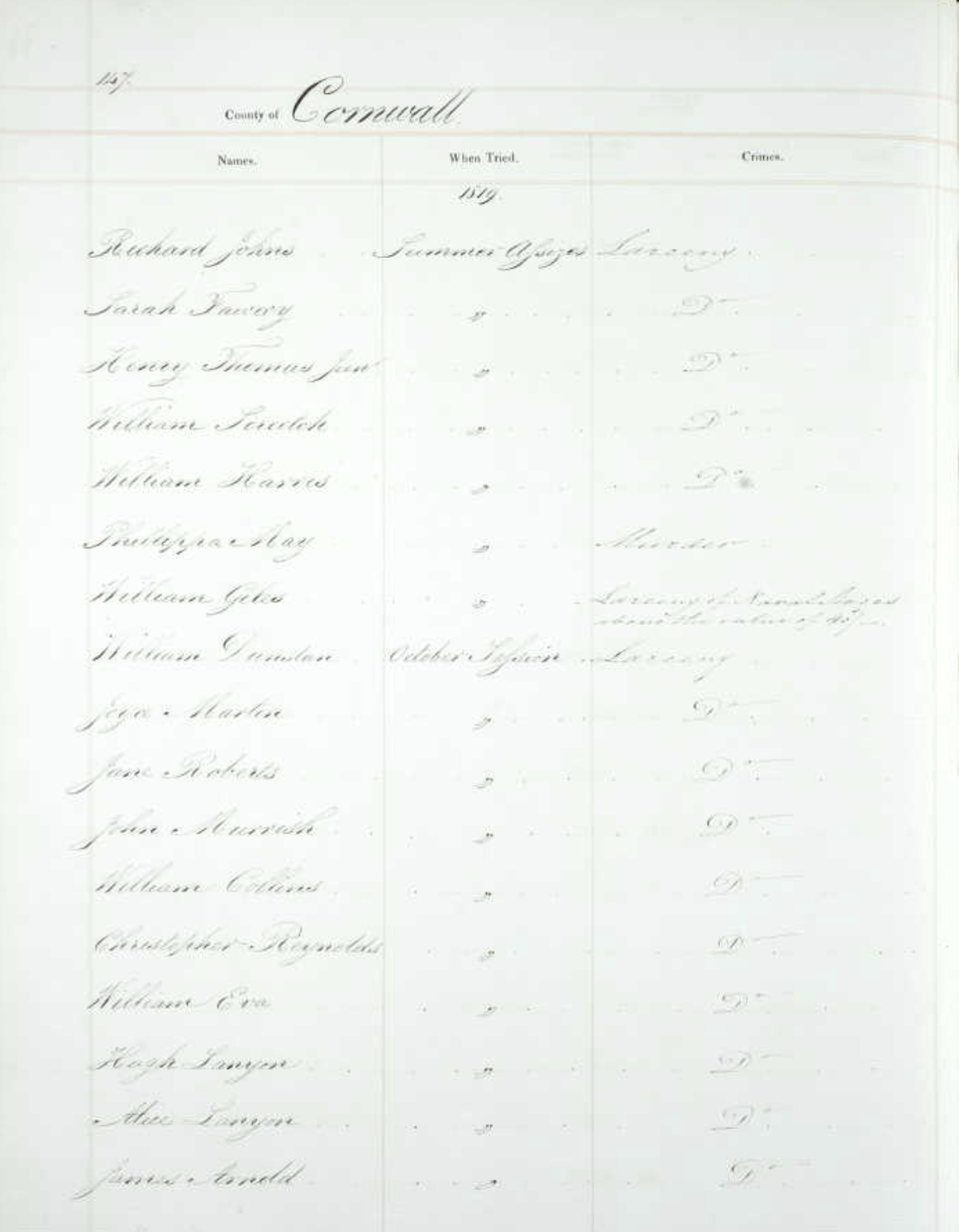
In 1819 Hugh and Alice were imprisoned for six weeks for larceny.

Criminal Register Cornwall 1819

Hugh died in 1838 at the Penzance Union Poorhouse aged 80, the cause of death was debility. Alice died in 1854 at the Union Workhouse Madron age 90.

Francis Lanyon 1808-1865 & Betsy Lanyon 1808-1892

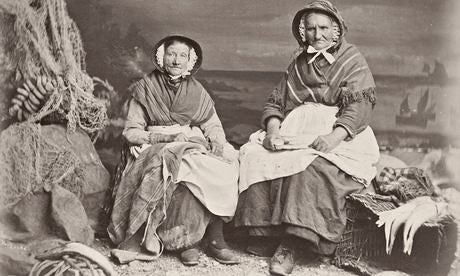
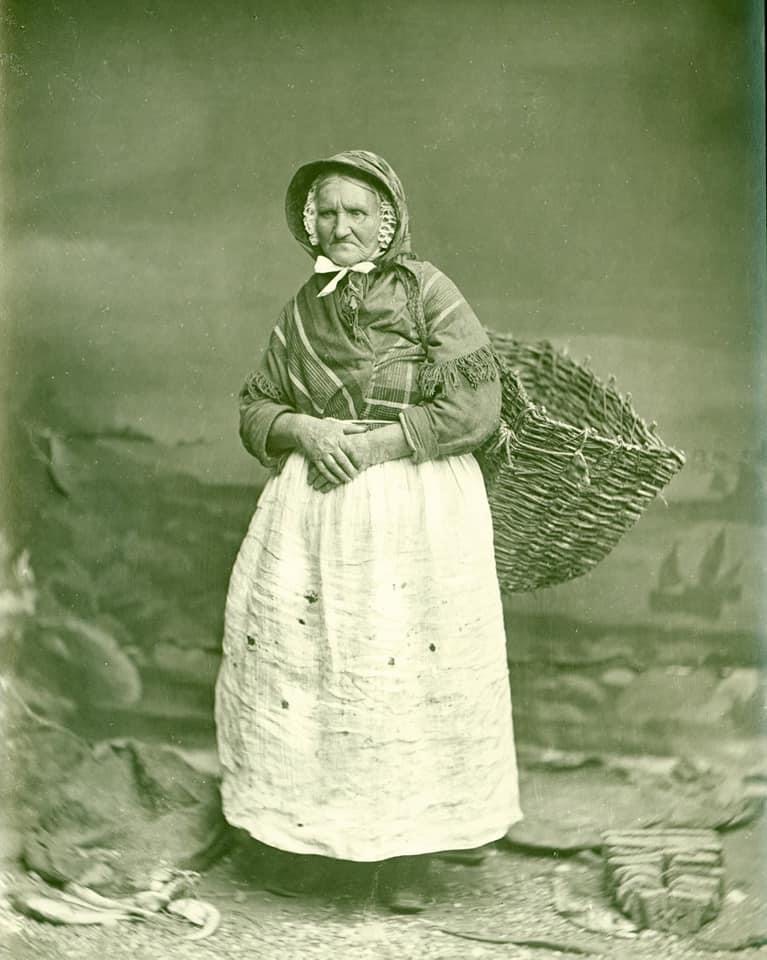
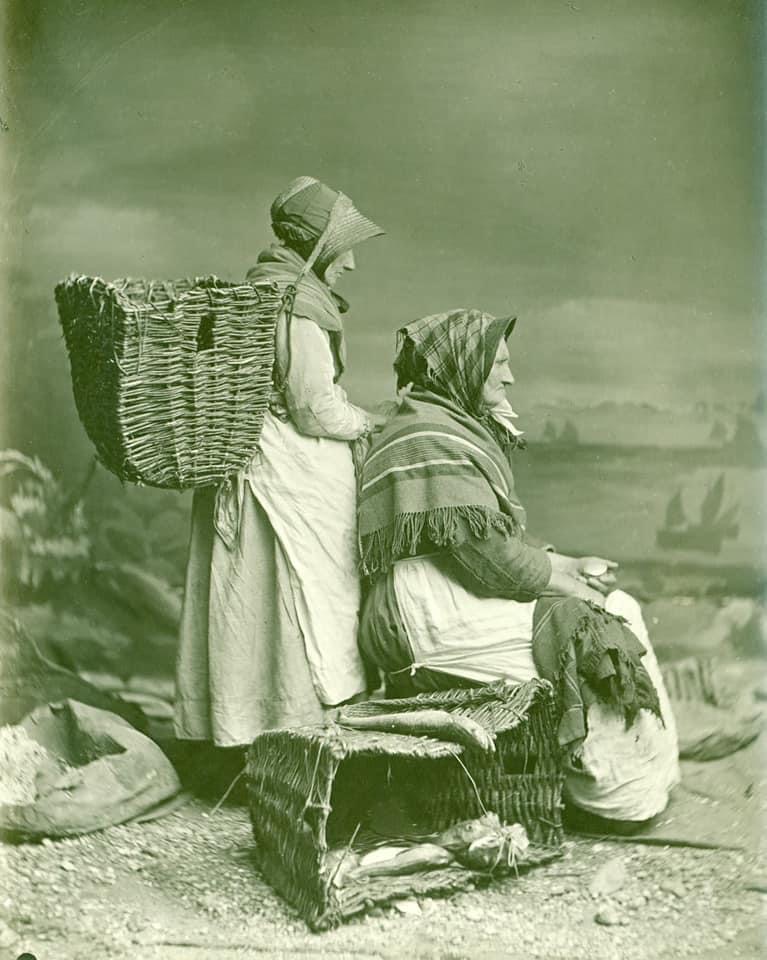
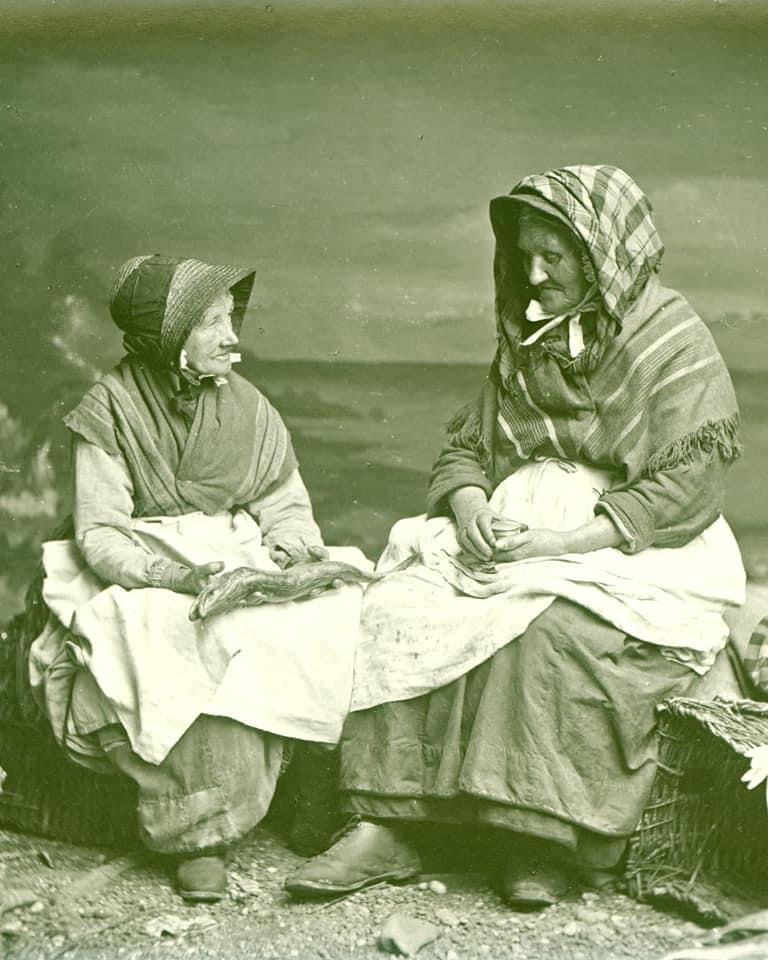
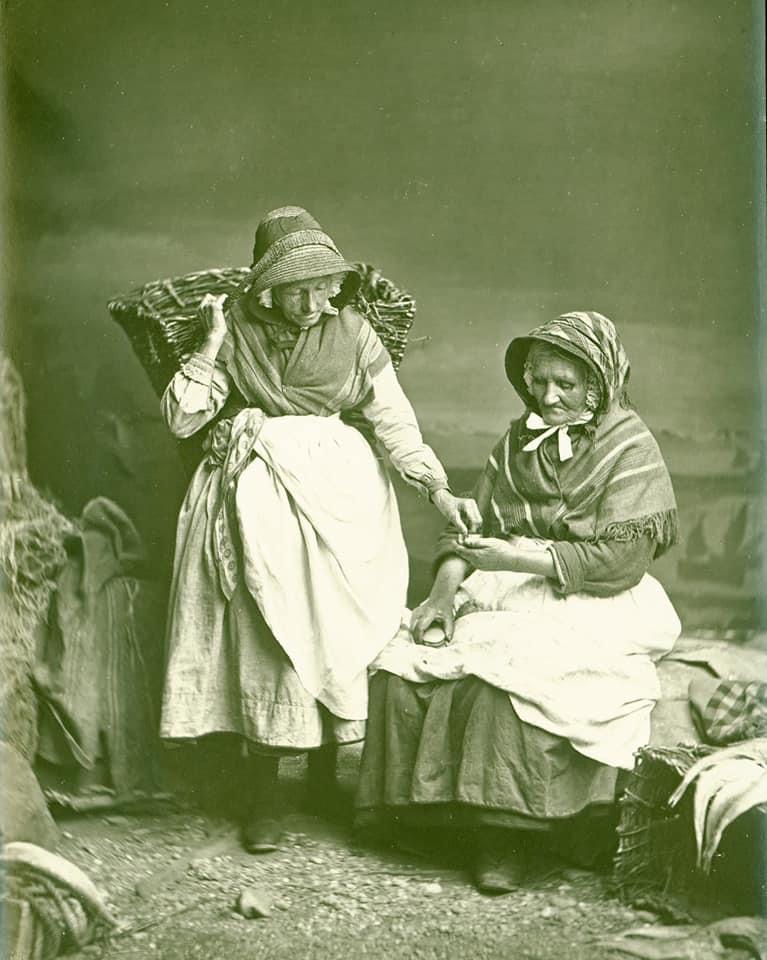
Hugh and Alice’s only surviving son Francis married Elizabeth (Betsy) Leah at Paul in 1834. Francis was a Newlyn fisherman and Elizabeth Leah was featured in a series of photographs and paintings depicting Newlyn fishwives.

Source: The photos are of Betsy Lanyon and Blanche Courtney taken in the Gibson Mount’s Studio in Penzance circa 1885. Penlee House Gallery & Museum, Penzance.

Francis and Elizabeth had three children: Grace, Elizabeth and Francis. Only Francis survived to adulthood.

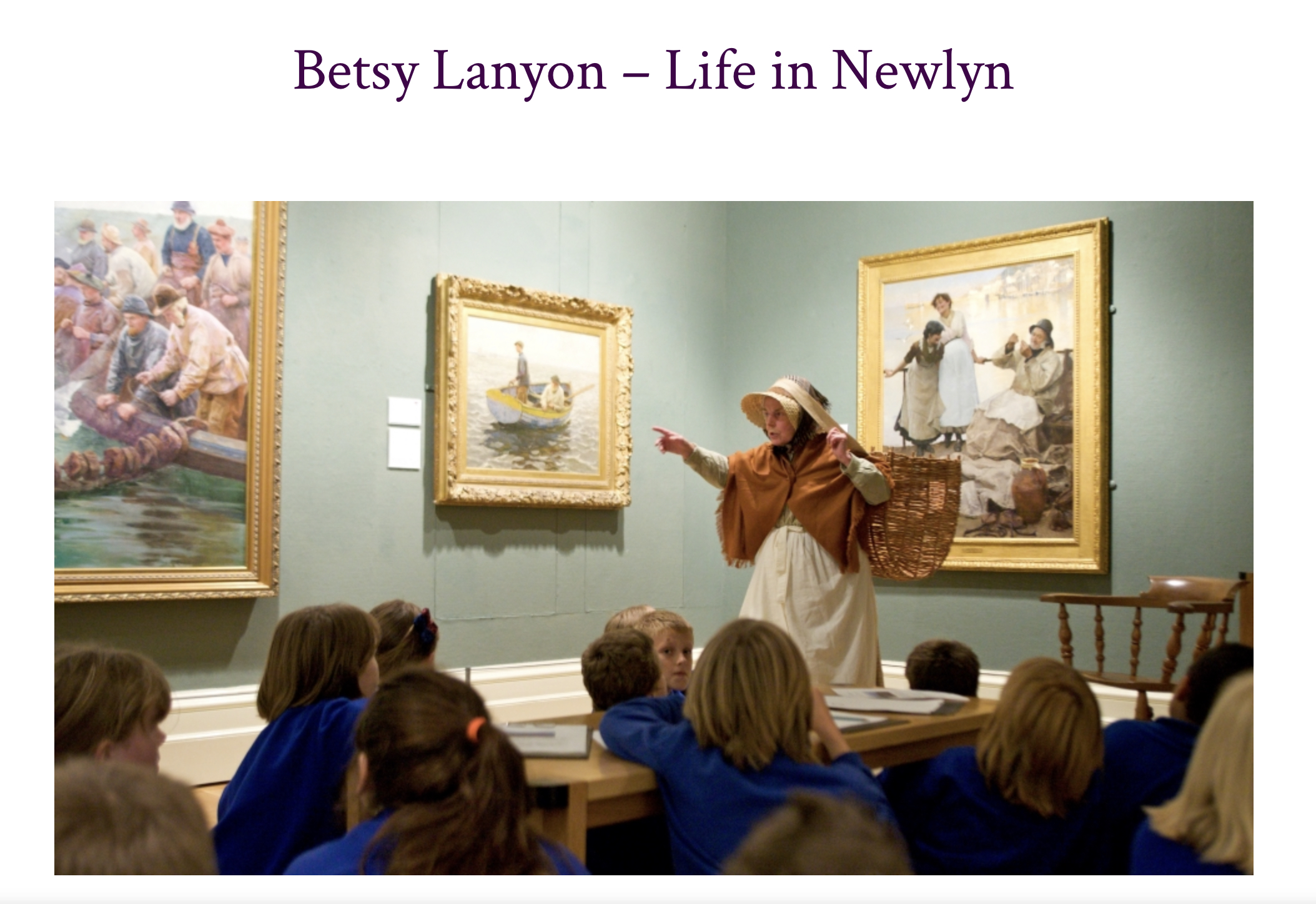
Francis senior died in 1865 and Elizabeth/Betsy died at Newlyn in 1892 but Betsy Lanyon lives on… she is now a ‘living’ part of history and talks to visitors at the Penlee House Gallery & Museum about life in Newlyn in the 19th century.

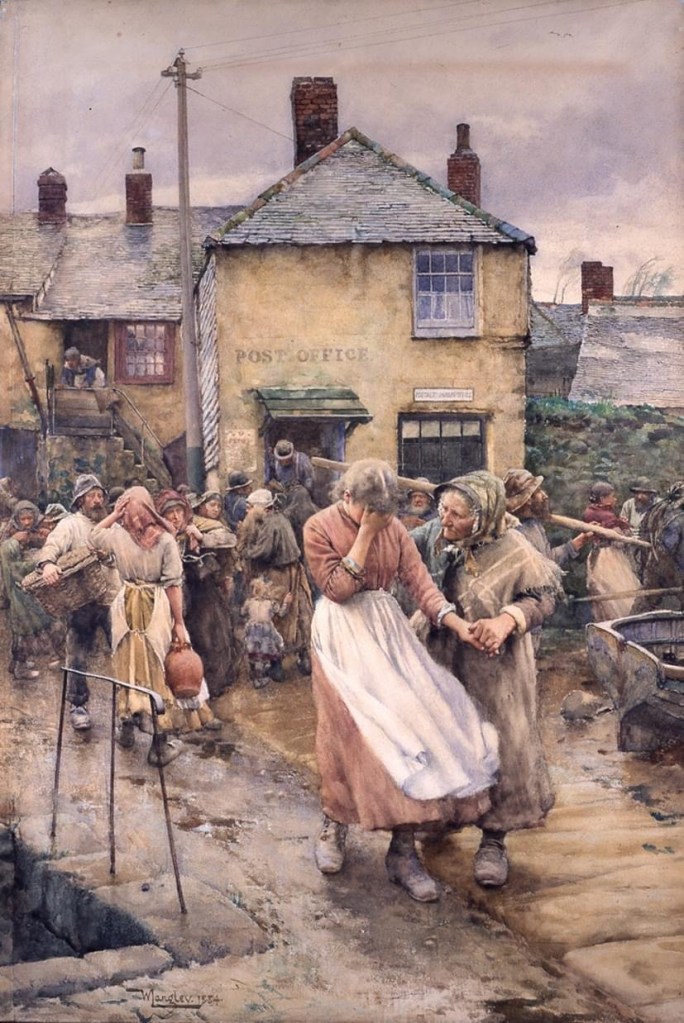
Betsy Lanyon appears to have been the model for the old woman in this Walter Langley painting. Penlee House Gallery and Museum, Penzance.

Francis Lanyon 1842-1872

Betsy and Francis’ son Francis was born at Paul in 1842. The 1871 census for Paul in Cornwall shows that he was living with his mother who was a widow and he was described as age 30 and a ‘cripple and has been for 20 years.’

In 1858 at the age of 16 Francis was found guilty of willfully destroying a tree, the property of Rev. Wm. Veale, clerk at Gulval. He was sentenced to 3 weeks hard labour or a fine of approximately 20 shillings which he couldn’t possibly pay. He had no previous convictions but was sentenced to three weeks on the treadmill. (We’ve already noted that he had been a ‘cripple’ since the age of about ten so three weeks on a treadmill was particularly harsh.)

He was described as 5’2″, dark hair, dark eyes and a dark complexion. Unable to read or write. Freckled, thick lips, scar on nose and left wrist, large eyebrows and slightly pock marked. He was already working as a labourer at Penzance. His weight on entering prison was 133lbs and 3 weeks later it has fallen to 129lbs. Bodmin Gaol was tough. (Source AD/1676/4/5).

British Library, Public domain, via Wikimedia Commons

Poor Francis died, aged 31, of Scrofulus abscesses (scrofula was TB of the lymph nodes in the neck) and diarrhoea. His mother Betsy lived for another 20 years.

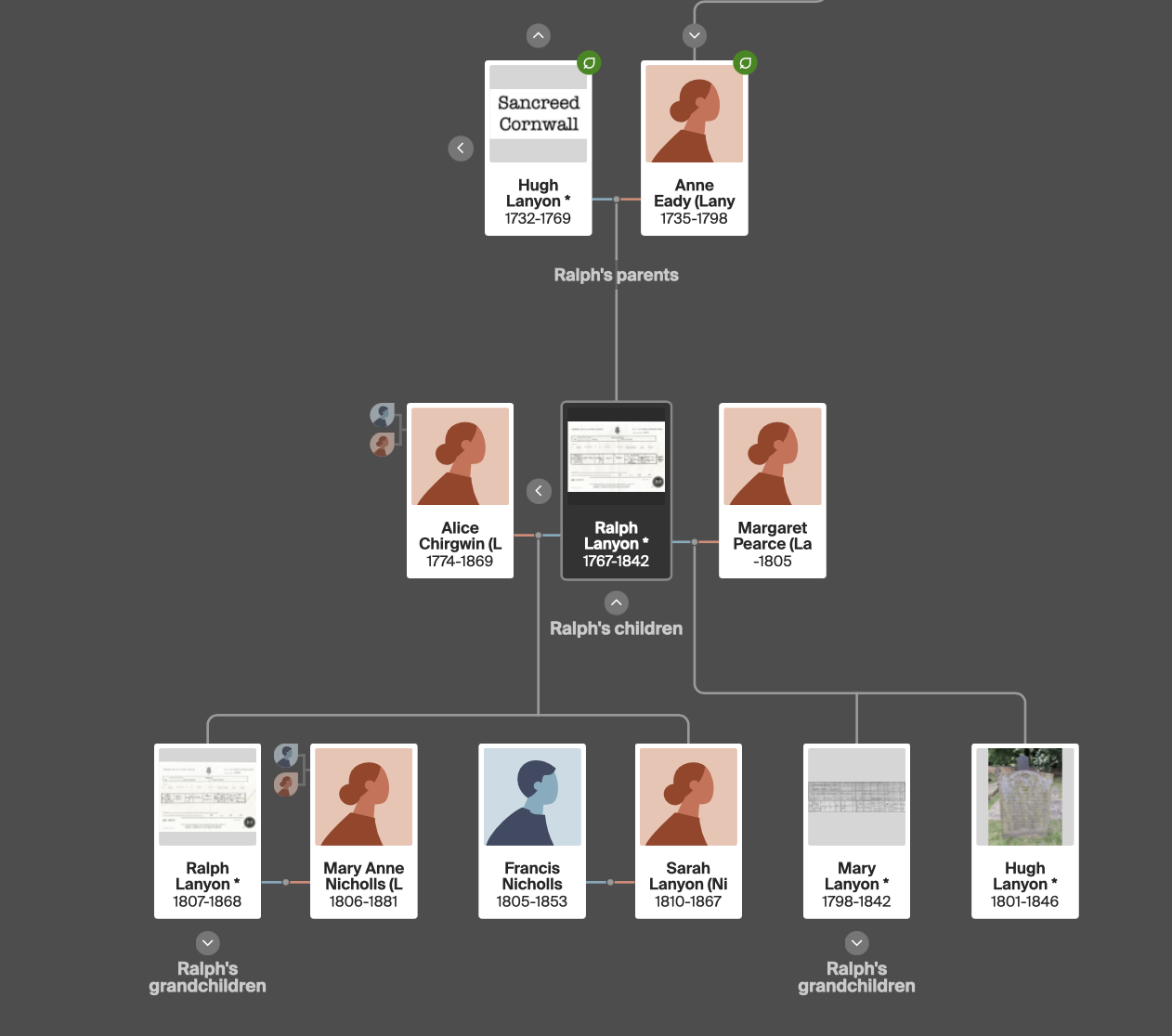
Ralph Lanyon 1767-1842

Ralph was the younger son of Hugh Lanyon and Anne Eady. He worked as an agricultural labourer. His first marriage was to Margaret Pearce in 1796 at Paul. There were two children from this marriage.

  • Mary 1798- 1842 Mary had 3 illegitimate children: Mary Ann 1825, James 1830 and Matilda Bluett 1834-1841. No further trace of the first two children. She died age 46 of TB.
  • Hugh 1801-1846.

Hugh Lanyon 1801-1846

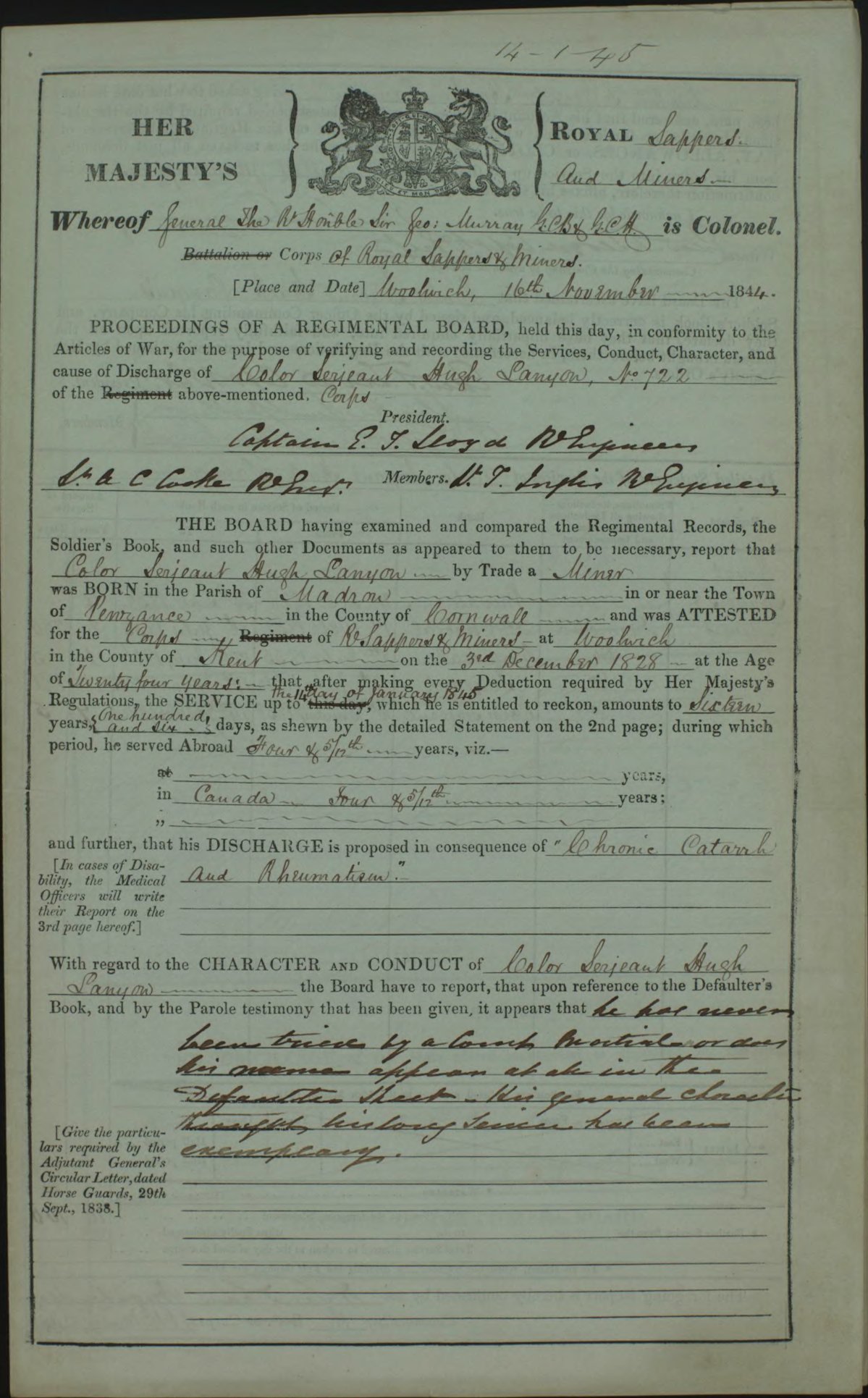
Age 24 Hugh enlisted in the army. He was a Colour Sergeant in the Royal Sappers & Miners. While bound for Vera Cruz in the ship ‘Cambria’ he helped rescue 551 of the passengers and crew of the ‘Kent’ an East India ship which caught fire in the Bay of Biscay in Feb 1825. Connolly, in his ‘History of the Royal Sappers and Miners’ p309, writes of him ‘Sergeant Hugh Lanyon, after Sergeant – Major Forbes’ removal, was appointed to the charge of the detachment at Sandhurst College, and carried on the file details in every way to the satisfaction of the authorities. For many years, as a private and non-commissioned officer, he worked at the College, and his example had the best effect on the successive parties with which he served. As a practical sapper he was one of the ablest and most skilful in the corps, and in the rapidity with which he threw up earth works was unsurpassed. Sir Charles Pasley has done him the honour by noticing the extraordinary labours of the sergeant in his ‘Practical Operations for a Siege’. His willing ness and ability in this respect covered, in great measure, his educational deficiencies. In charge of the detachment he displayed his usual industry and exertion, kept his men in perfect discipline and order… so effectively were all the instructions carried out, that the governor of the college, with the sanction of the Master-General, presented him in November (1837) with a case of drawing instruments bearing an inscription ‘flattering to his zeal and services.’ Shortly afterwards he was promoted to colour-sergeant and served in Canada during the rebellion. Somewhat broken in health he was discharged in 1844 and became a surveyor on the Trent and Mersey Canal, working under James Forbes. He died in 1846 at Lawton in Cheshire. He was a ‘remarkable man with rather more brawn than brain one suspects‘ (P.A Lanyon-Orgill). Connolly recounts a story about him while building a stockade at Mississawra in Canada in 1842; ‘six men complained to him of the heavy task they were subjected to in removing timbers about 15 feet long and 12 inches square….Lanyon made no observation, but shouldered one of the unweildy logs and, to the amazement of the grumblers, carried it to the spot unassisted.’ In 1843 he was in Ireland and was sent to explore a sewer running into the Liffe river which might provide a means of entry into Dublin Castle. ‘He did so and found that a strong iron grating existed in the passage, which would effectually prevent the supposed entrance. In this duty, being much exposed to the influence of noxious vapours, he soon afterwards was seized with fever and jaundice, which shortened his days.’ (Connolly). He never married or had any children.

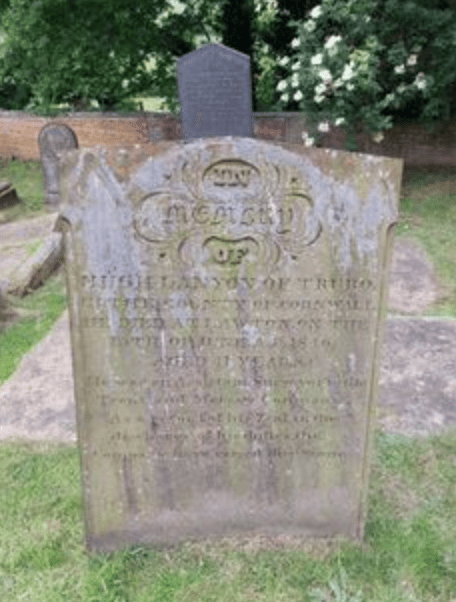
HUGH LANYON OF TRURO,
in the county of Cornwall.
He died at Lawton on the
15th of June A.D. 1846:
Aged 41 years
He was an Assistant Surveyor to the 
Trent and Mersey Company.
As a record of his Zeal in the
discharge of his duties the
Company have raised this stone.

Headstone at Cheshire
CONNOLLY(1855) Vol2, p337 (Plate 11) ROYAL SAPPERS & MINERS, UNIFORM 1813.jpg
Hugh Lanyon’s discharge papers

Ralph senior married for a second time in 1805 to Alice Chirgwin 1774-1869. There were two children from his second marriage:

  • Ralph 1807-1868
  • Sarah 1810-1867 married Francis Nicholls in 1827 and they had four sons.

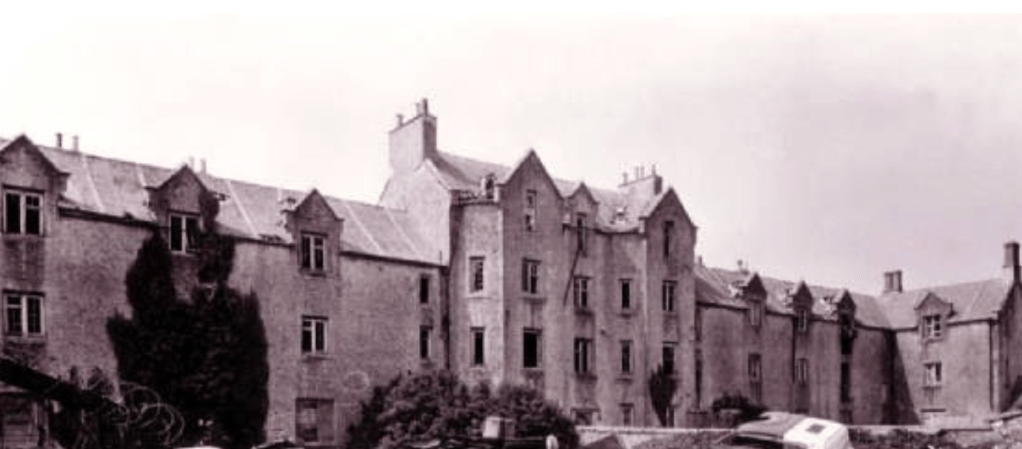
Ralph senior died at the Penzance Union Workouse in 1842. He was a pauper and suffering from TB. Alice his wife died at Lelant in 1869, she was still working as a labourer age 64.

The family has come quite a way from the days of the ‘Golden Lanyon’ and his great wealth.

The forbidding looking Penzance Union Workouse

Ralph Lanyon 1807-1868

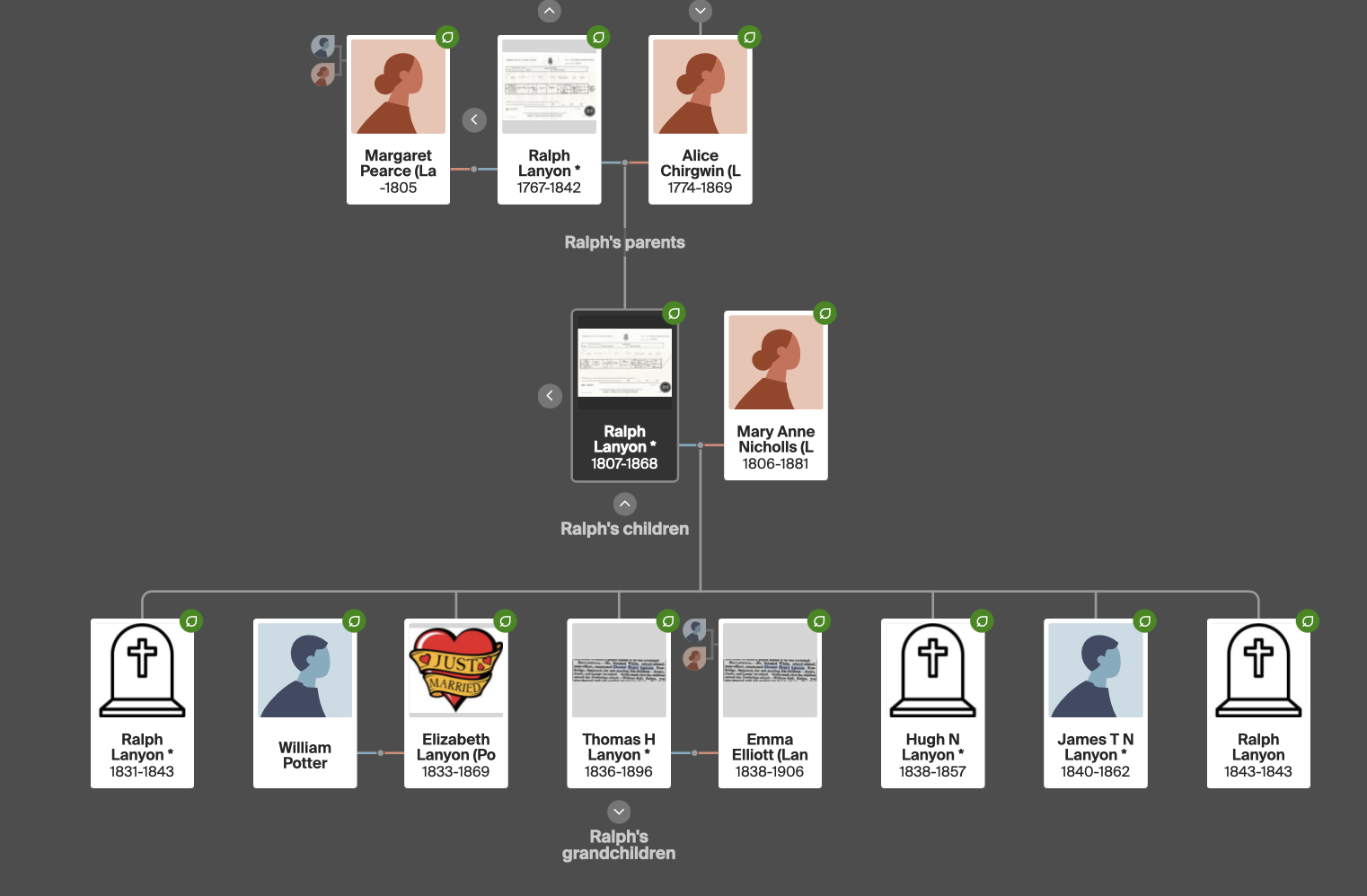
Ralph was a tin miner. He married Mary Ann Nicholls 1806-1881. They lived at Newbridge, Sancreed. They had six children:

Ralph & Mary’s tree
  • Ralph 1831-1843 died young
  • Elizabeth 1833-1869. Elizabeth was a dressmaker and a charwoman. In 1869 she married William Potter, a widower. She died whilst on honeymoon (of nephritis and congestion of the lungs) at Portsea and William was a widower for a second time!
  • Hugh 1838-1857, Hugh died age 20.
  • James 1839-1862 he was a tin miner like his father and died of TB age 22.
  • Thomas Henry 1840-1896
  • Ralph 1843-1843 died in infancy

Ralph died in 1868 of TB. Tuberculosis was very common at this time and, whilst it could affect anybody, it was particularly rife amongst the poor who lived in cramped conditions.

Thomas Henry Lanyon 1840-1896

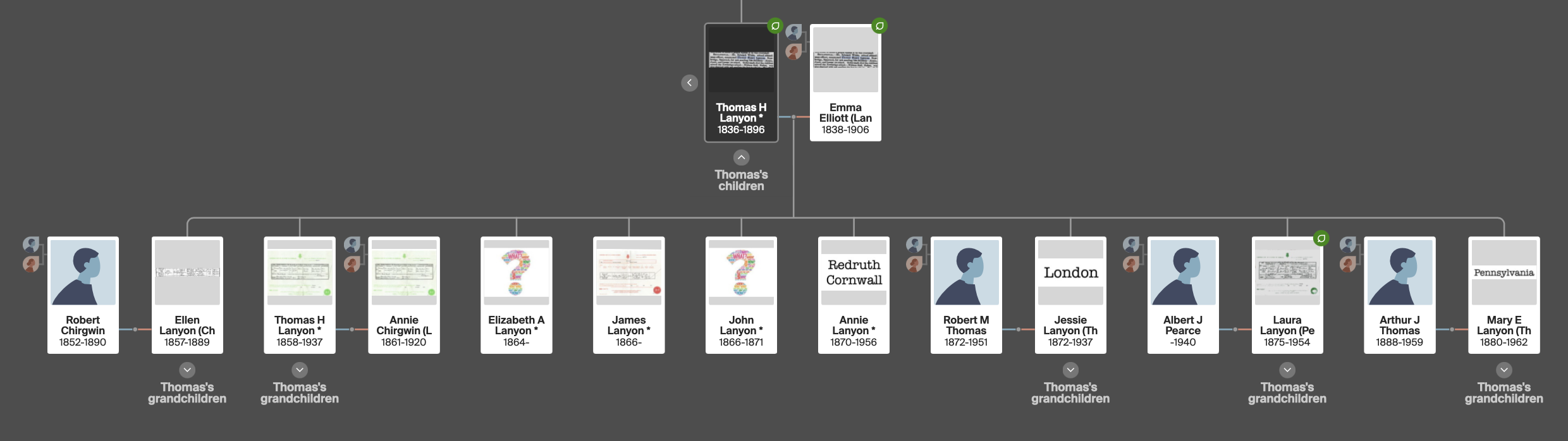
Of the six children of Ralph and Mary only Thomas had children of his own. He married Emma Elliott and they had nine children.

Thomas & Emma’s tree
  • Ellen 1857-1889 She married Robert Chirgwin in 1879, they had two children but Ellen died in 1889 and Robert in 1890 leaving their children orphans. They were split up and taken in by separate families.
  • Thomas Henry 1858-1937
  • Elizabeth 1864- she was on the 1871 census but after that there was no further trace
  • John 1866-bef. 1871 died in infancy
  • James 1866-1935 he worked as both a tin miner and a farm labourer, no marriage or children traced
  • Annie 1870-1956 she worked as a dressmaker and never married
  • Jessie 1872-1937 in 1896 she married Robert Molesworth Thomas and they had two daughters
  • Mary Eveline 1880-1962 she married Arthur James Thomas in 1911 and they had a child
  • Laura 1888-1954 in 1906 she married Albert James Pearce and they emigrated to Pennsylvania in the USA.

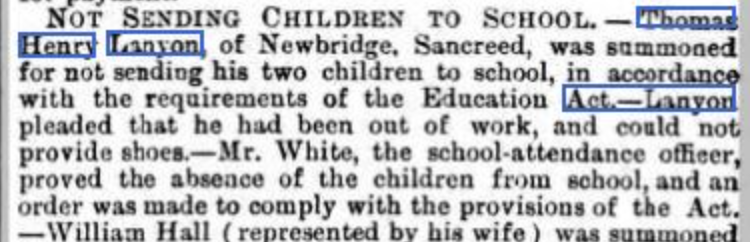
Thomas Henry was fined for not sending his children to school, he explained that he couldn’t afford shoes for them which shows how poor they were. In 1877 Thomas was imprisoned for debt in Bodmin Gaol. Source: AD 1676/5/2

1879 newspaper cutting-Petty Sessions Nov 1879

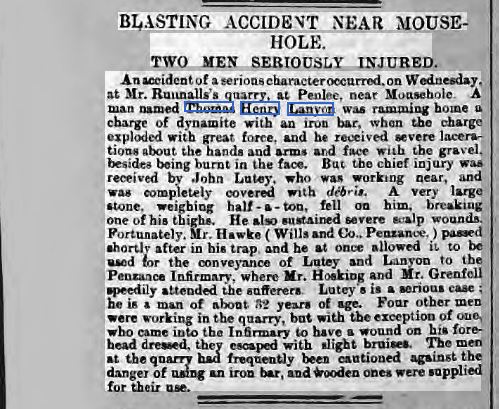
Thomas was also seriously injured in a mining accident. Mining was a dangerous occupation but often it was all that was available.

Cornish Telegraph 15 Jan 1878

Cornish Miners – John Charles Burrow (1852—1918), Public domain, via Wikimedia Commons

Out of nine children only one son had children to carry on the family name.

Thomas Henry Lanyon 1858-1937

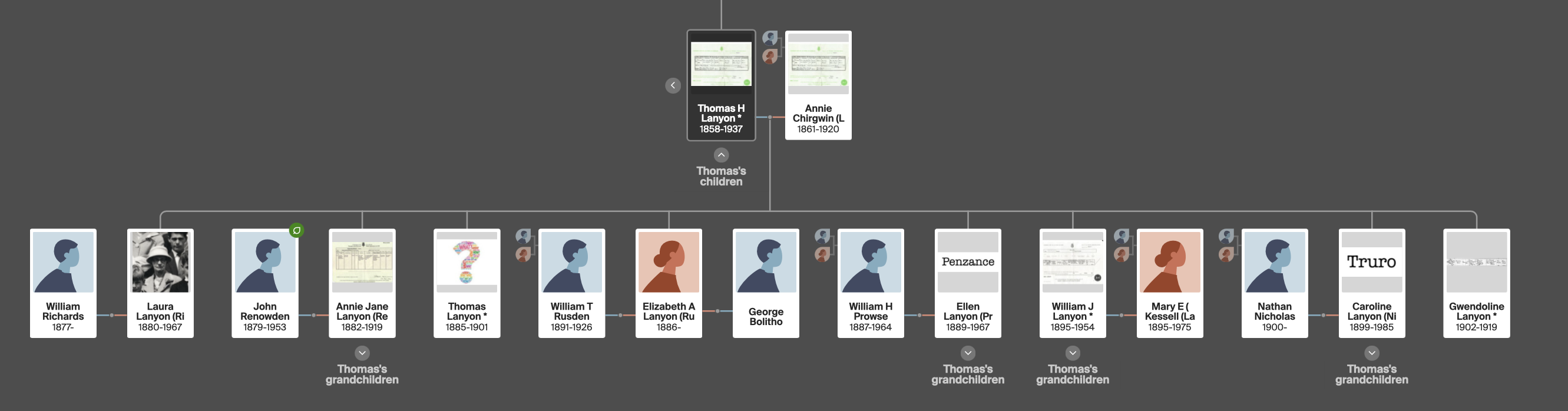
Thomas was also a tin miner like his father. Later he became a farm labourer. He married Annie Chirgwin in 1890 and they had eight children.

Thomas & Annie’s family
  • Laura 1880-1967
  • Annie Jane 1882-1919
  • Thomas 1885-
  • Elizabeth Ann 1886-1965
  • Ellen 1889-1967
  • William James 1895-1954
  • Caroline 1899-1985
  • Gwendoline 1902-1919

That’s where we must leave this branch of the family. There were grandchildren so this branch of the family has survived.