Press Gang

Britain may have ruled the waves with its huge navy of sailing ships but the only way it could man all those ships was by impressment or the ‘press gang’. From the late 17th century until the early 19th century men between the ages of 18-55 could be forced to serve in the navy. Today we’d probably call it kidnapping!
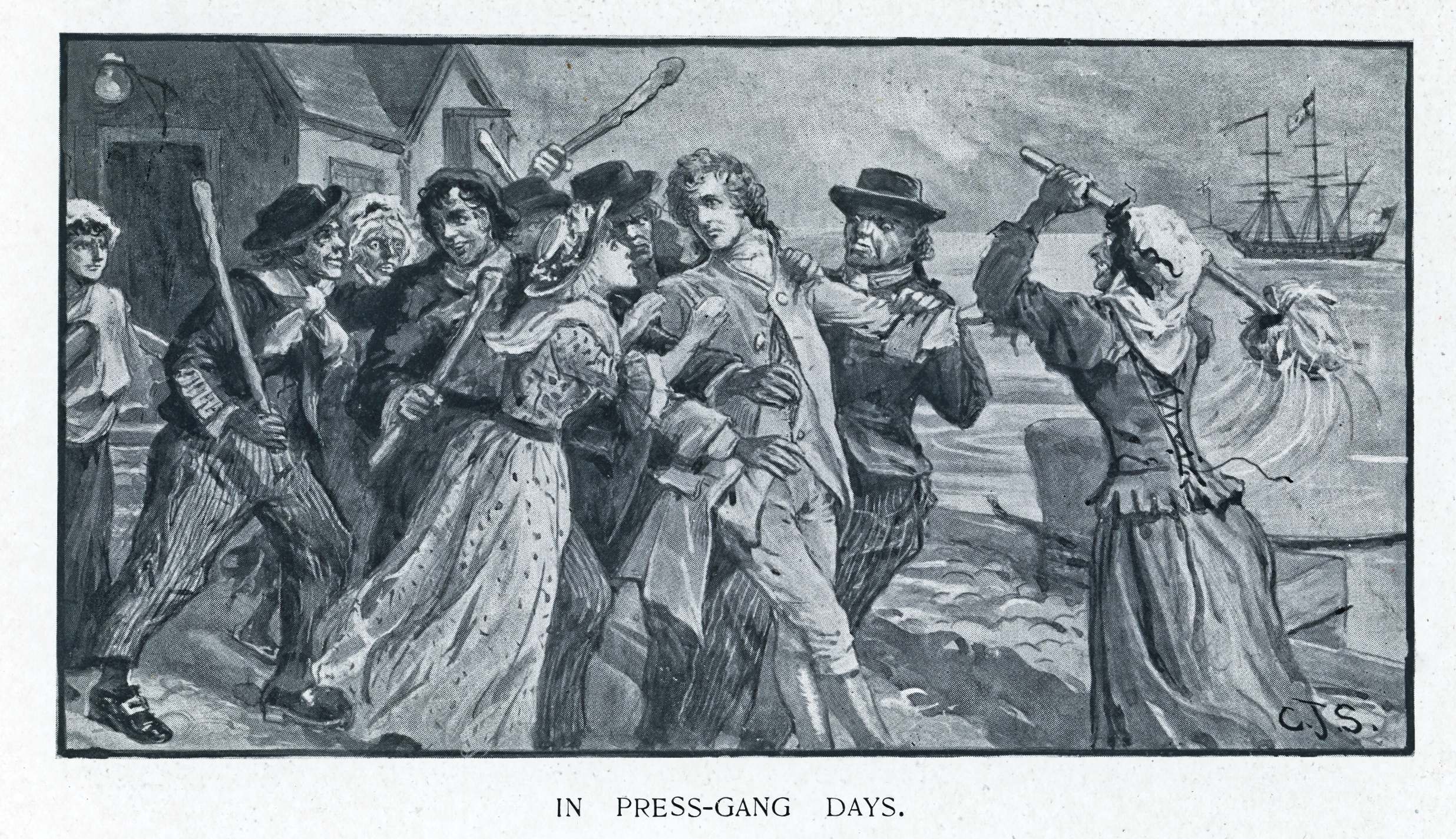
Charles Joseph Staniland, Public domain, via Wikimedia Commons

The navy preferred sea faring men so merchant seaman and fishermen were liable to be ‘pressed’ and this made coastal communities particularly vulnerable. Merchant seamen ashore (easily identifiable by their uniforms) would be asked to volunteer to join the navy, if they refused they could be seized or plied with drink and taken. Many seamen were ‘pressed’ whilst at sea. Their ships, usually homeward bound, would be stopped and the merchant seamen seized and placed on the navy ships.

Understandably the press gangs were very unpopular and fights often broke out when men were seized from their communities. Wives and children suffered from poverty and hardship when their husbands and fathers were seized. Having been seized it was difficult to return and deserters could face the death penalty.

The Neglected Tar – Unknown author, Public domain, via Wikimedia Commons

At Trafalgar half of the navy’s 120,000 men were pressed into service.

Richard Lanyon of Marazion

This post is about Richard Lanyon of Marazion and what happened when the Press Gang arrived in town.

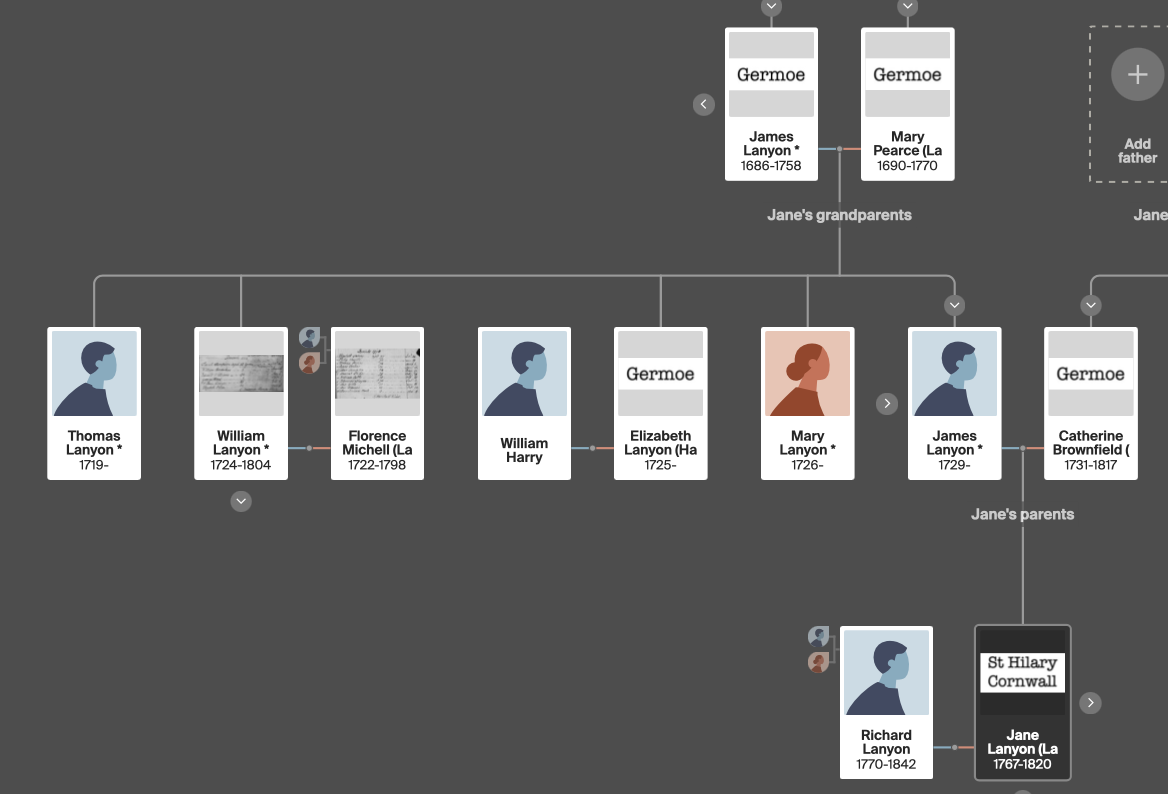
Richard was born in 1770 the youngest son of William Lanyon and Florence Michell. In 1794 he married his cousin Jane Lanyon (the daughter of James Lanyon and Catherine Brownfield) at St Hilary in Cornwall. (See St Hilary branch of the Lanyon tree.)
Richard was the blacksmith at Marazion. The town opposite St Michael’s Mount.

Richard also served as a sergeant in the 2nd Regiment of Mount’s Bay Volunteers. Britain was at war with France and all over the country there were volunteer regiments prepared to defend the country in the event of an invasion.

Marazion : St Michael’s Mount Wall Painting by Lewis Clarke, CC BY-SA 2.0 https://creativecommons.org/licenses/by-sa/2.0, via Wikimedia Commons

On the 9 October 1804 the volunteers had been at a field day practising their fighting skills. The day went well and the officers bought the men a ‘few’ drinks to celebrate. That evening the press gang, led by Lieutenant Andrew Wills arrived in town in search of seamen who had deserted. Accompanied by the constable they went to a home expecting to find one of the deserters, instead they found Richard Lanyon with several others.

Richard was still wearing his uniform, sash and sword and several of the men with him still had on their volunteer uniforms. Lanyon in particular abused and insulted the lieutenant and his party and obstructed them in searching for the deserters. “Lanyon then ordered the drum to beat to arms and sent for ball cartridges.” A great riot ensued and the lieutenant and his people in their retreat to their boat were pelted with stones, fired at with ‘balls’ and some of them were assaulted.

A letter to Earl Spencer from J. Le Blanc explaining what had happened stated “Lanyon was somewhat intoxicated“!
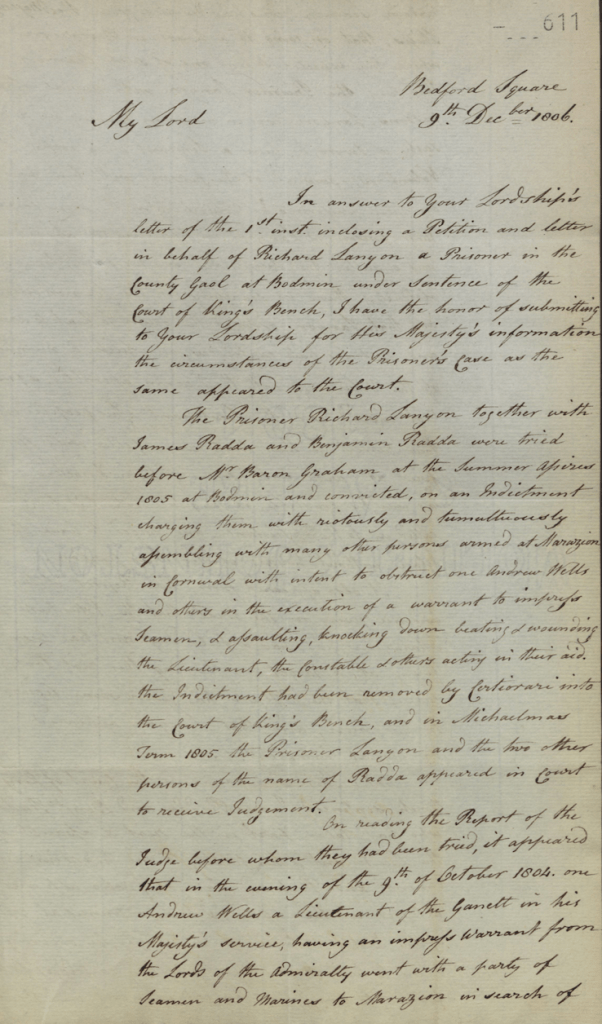
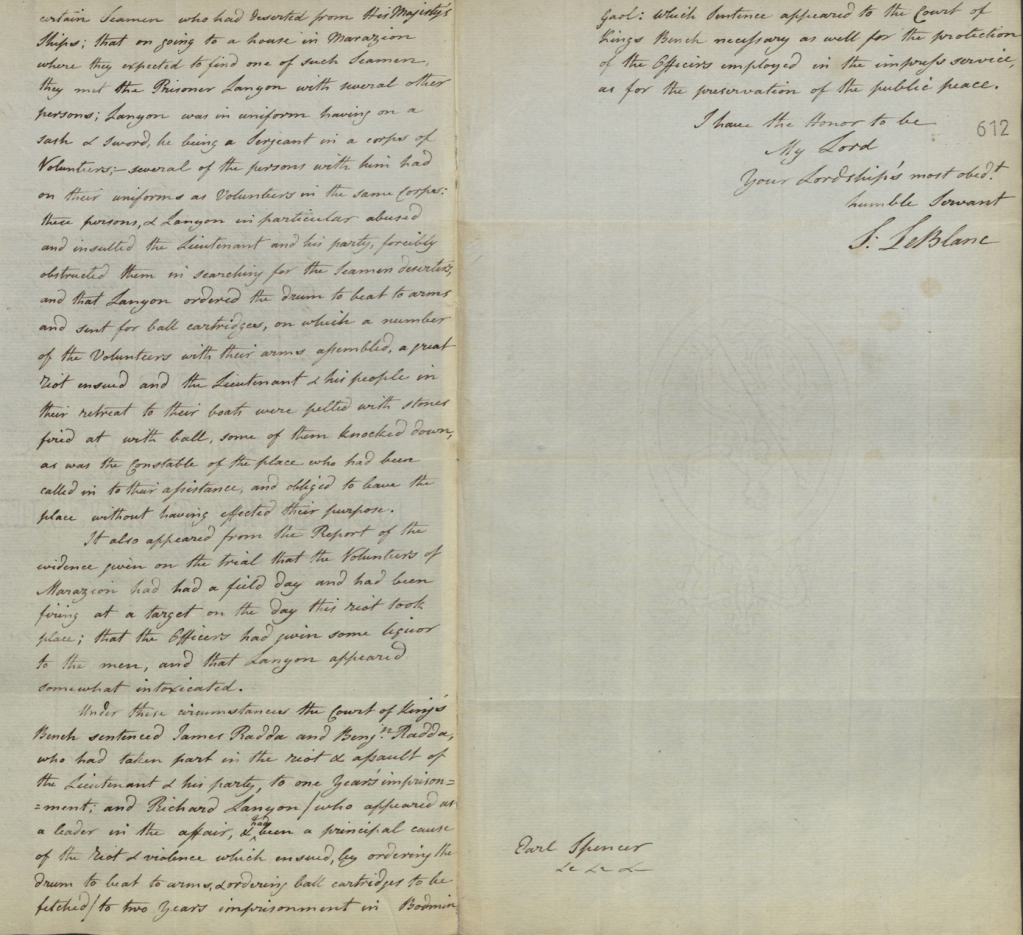
Richard and his nephews James and Benjamin Rodda were arrested and tried before Mr Baron Graham at the summer assizes at Bodmin in 1805. They were convicted on an indictment charging them with “riotously and tumultuously assembling with many other persons armed at Marazion in Cornwall with intent to obstruct one Andrew Wills and others in the execution of a warrant to impress seamen…

The trial was the transferred to the Court of the King’s Bench in Westminster, London.

The Roddas were sentenced to one year in prison and Lanyon was sentenced to two years. After a year he appealed for an early release. Mr Gryles, a gentleman of considerable property in Marazion, gave a reference and stated that Lanyon was of previous good character and always a ‘man of fair and upright character’, he also had a wife and several children who had suffered ‘the severest deprivations by means of the long confinement’ but the appeal fell on deaf ears and Richard served two years.

Richard eventually returned home and was still living in Marazion in 1841. He’s listed on the census living with his youngest daughter Julia. His wife Jane had died in 1820. Richard died shortly after the 1841 census.

Press gangs finally came to an end with the fall of Napoleon in 1815.
Thomas, William and John Lanyon x 2!

James Lanyon and Mary Pearce had six great grandsons to carry on the family name: two called Thomas, two called William and two called John!

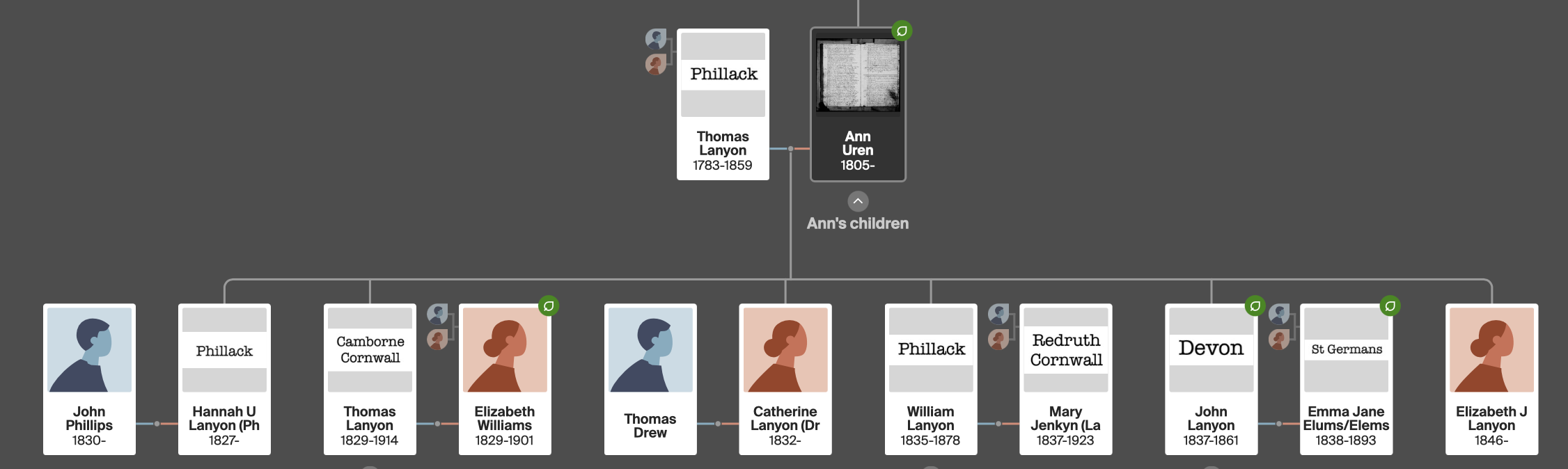
Thomas Lanyon 1783-1859

Thomas was baptised in Marazion in 1783 and married Ann Uren at Gwinear in 1826. Thomas was a shoemaker. He and Ann had six children:

  • Hannah Uren 1827- married John Philips at Phillack in 1850 one daughter traced
  • Thomas 1829-1914 was a blacksmith and he married Elizabeth Williams in 1854. Four children.
  • Catherine 1832- she was a labourer and may be the Catherine Lanyon who married Thomas Drew in 1852, no further trace.
  • William 1835-1878 he was an engine driver and married Mary Jenkyn at Phillack in 1859, six children of which only two daughters survived to adulthood.
  • John 1837-1861 was a boilermaker and steam engineer, he married Emma Jane and had three children, we’ll follow his daughter Mary Ann Lanyon in a separate post ‘The Woman in the White Apron’.
  • Elizabeth J 1846- she’s on the 1851 census and then no further trace

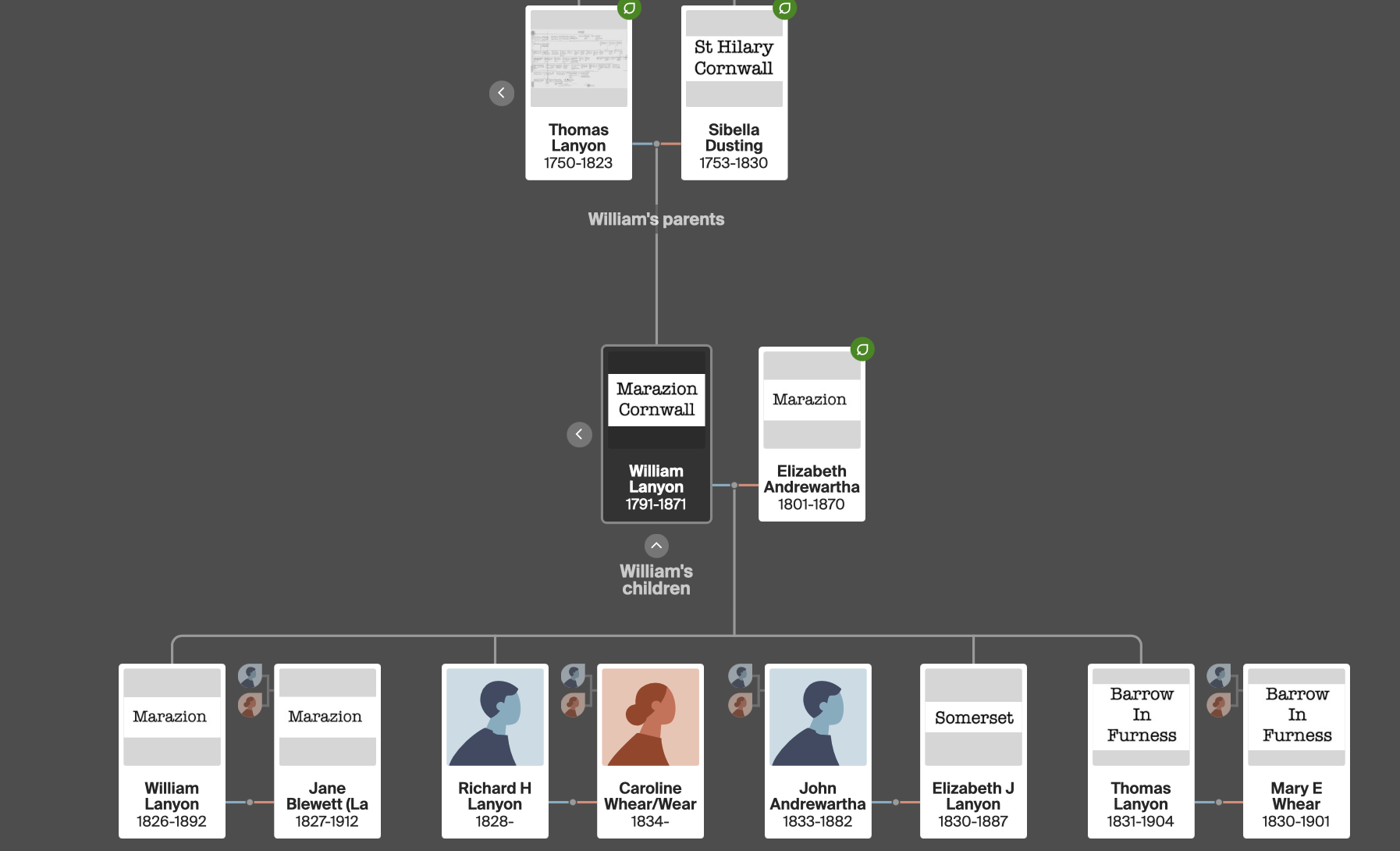
William Lanyon 1791-1871

William was a cordwainer/shoemaker like his brother Thomas. He married Elizabeth Andrewartha at St Hilary in 1825. They had four children:

  • William 1826-1892 he was a miner and married Jane Bleweth at St Hilary in 1850 – eight children
  • Richard Henry 1828- 1871 he was a cordwainer, no trace of a marriage or children
  • Elizabeth Jane 1830-1887 married John Andrewartha at Penzance in 1855 – six daughters
  • Thomas 1831-1904 he married Mary Whear in 1851. He was a miner and by 1881 he had moved his family to Barrow in Furness, twelve children
Apprentice domestic shoemaker in the 19th century. Image taken from The Band of Hope Review November 1861. Public domain, via Wikimedia Commons

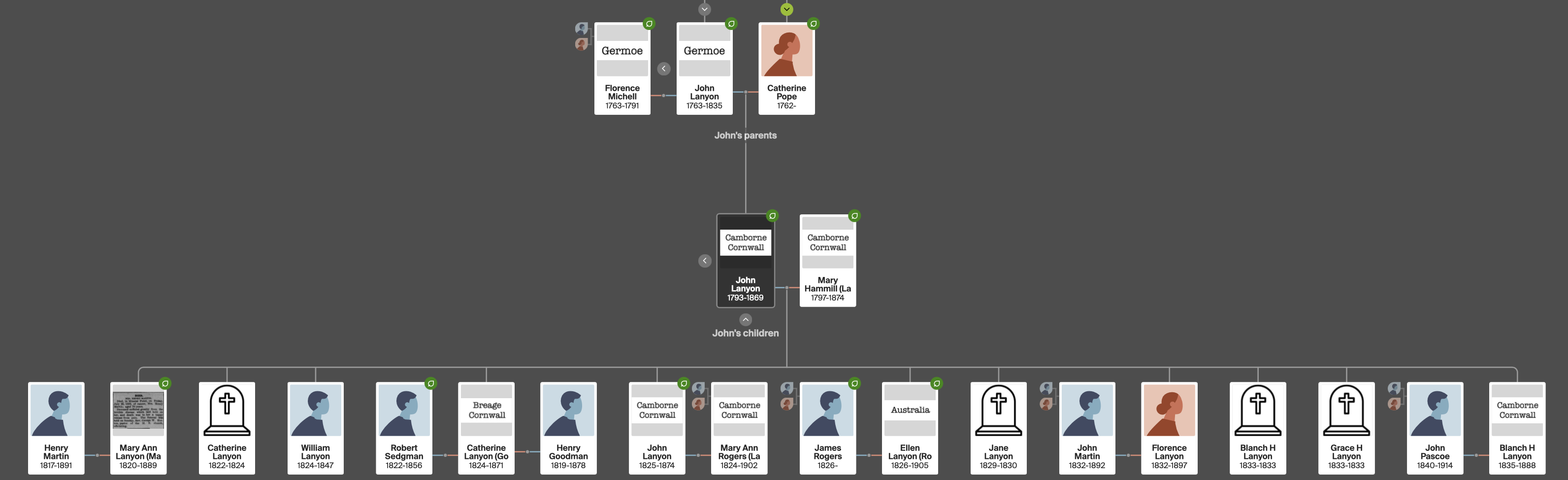
John Lanyon 1793-1869

John was baptised at Breage in 1793 and married Mary Hammill at Sithney in 1817. He was a tin miner. They had eleven children:

John & Mary’s tree
  • Mary Ann 1820-1889 married Henry Martin and four children, emigrated to Mineral Point Wisconsin
  • Catherine 1822-1824 died in infancy
  • Catherine 1824-1871 born in the Scilly Isles, married Robert Sedgman a mariner, at Porthleven in 1851, he died in 1856 and in 1858 she married Henry Goodman, a miner, and they had three daughters.
  • William 1824-1847 born at St Mary’s in the Scilly Isles and died at Bodmin Asylum age 22, he was suffering from TB and epilepsy
  • John 1825-1874 born at St Mary’s in the Scilly Isles he was a tin miner, he married Mary Rogers at Sithney in 1848. They had nine children
  • Ellen 1826-1905 baptised at Sithney and married James Rogers there in 1847, three children
  • Jane 1829-1830 died in infancy
  • Florence 1832-1897 married John Martin in 1850, four children and emigrated to Mineral Point Wisconsin
  • Blanch Hammill 1833-1833 died in infancy
  • Grace Hammill 1833-1833 died in infancy (it’s not clear if they are twins)
  • Blanch Hammill 1835-1888 married John Pascoe a miner at Camborne in 1861, five children

Scilly Isles and Sithney, Cornwall

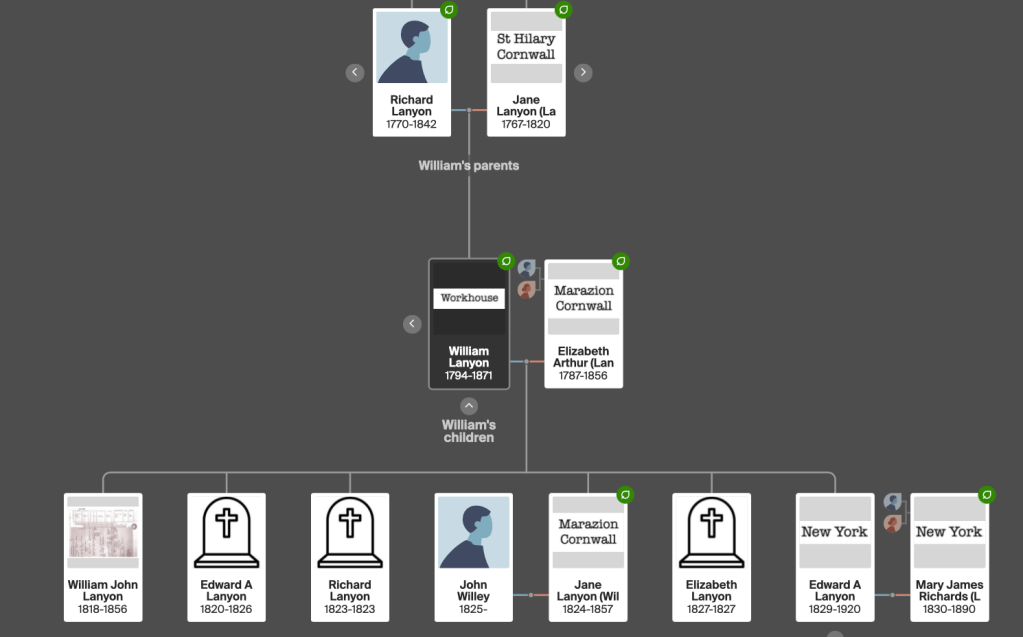
William Lanyon 1794-1871

William was baptised at St Hilary in 1794. He was a blacksmith and married Elizabeth Arthur at St Hilary in 1818. They had six children:

  • William John 1818-1856 he was a journeyman carpenter, he died age 38 of Phthisis Pulmonalis (TB) he was a bachelor
  • Edward Arthur 1820-1826 died young
  • Richard 1823-1823 died in infancy
  • Jane 1824-1857 she was a dressmaker, she married John Wiley and had a daughter Bessie Jane in 1855. Jane senior died in 1857
  • Elizabeth 1827-1827 died in infancy
  • Edward Arthur 1829-1920

John Lanyon 1808-1885

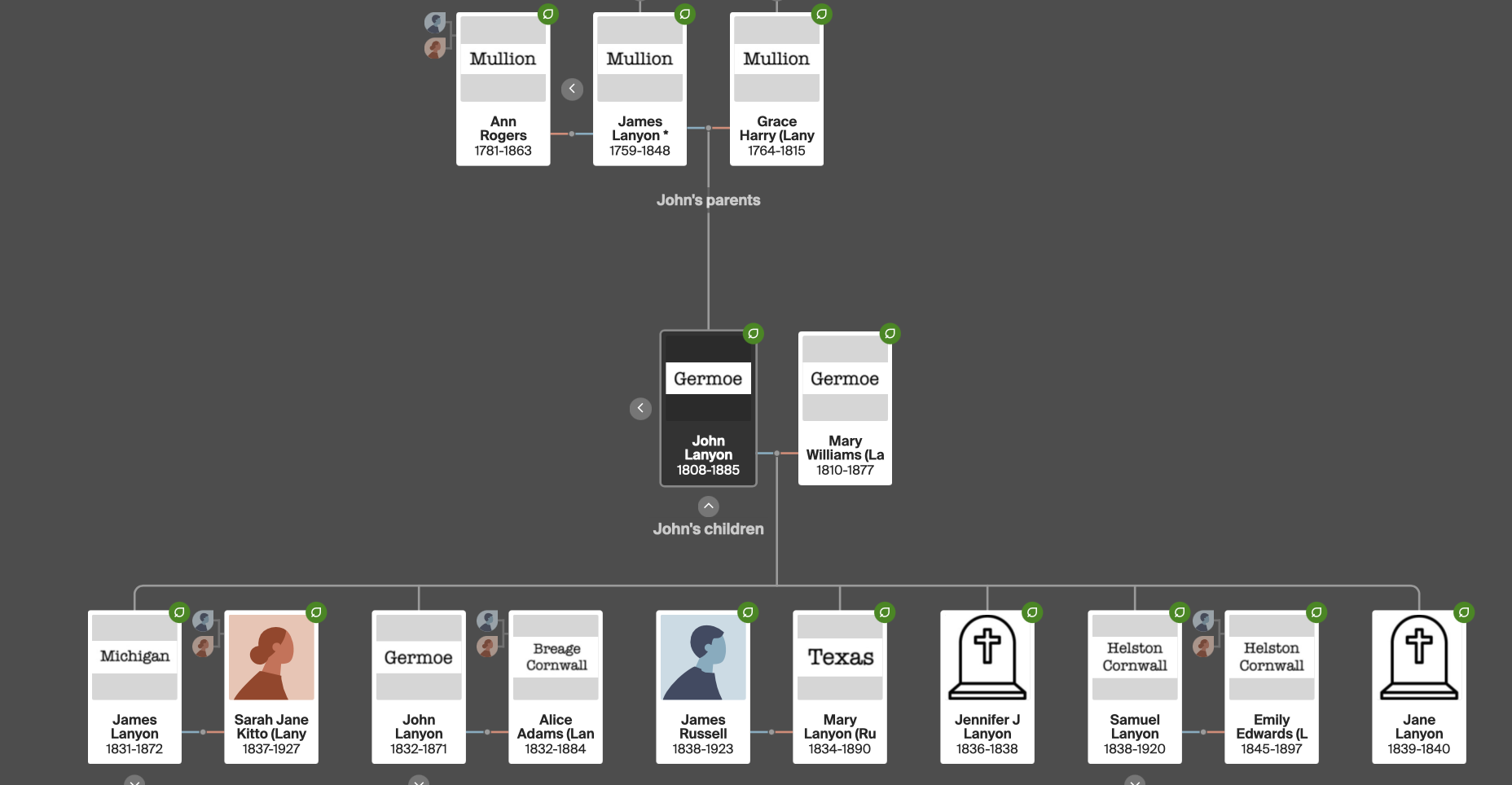
John was born at Germoe abt. 1808, he was a tin miner and married Mary Williams at Germoe in 1830. Their children:

  • James 1831-1871 he was a tin miner, married Sarah Jane Kitto at Breage in 1856 – five children. He died at Detroit Michigan 1871
  • John 1832-1871 he was a tin dresser, married Alice Adams at Crowan in 1860 – four children – he drowned at Sarawak in Malaysia in 1871
  • Mary 1834-1890 married James Russell at Helston in 1861 – eight children, emigrated to Texas
  • Jennifer Jennings 1836-1838 died in infancy
  • Samuel 1838-1920 he was also a tin dresser, married Emily Edwards at Helston in 1866 – two children, his son John Edwards emigrated to South Africa
  • Jane 1839-1840 died in infancy

Thomas Lanyon 1819-1855

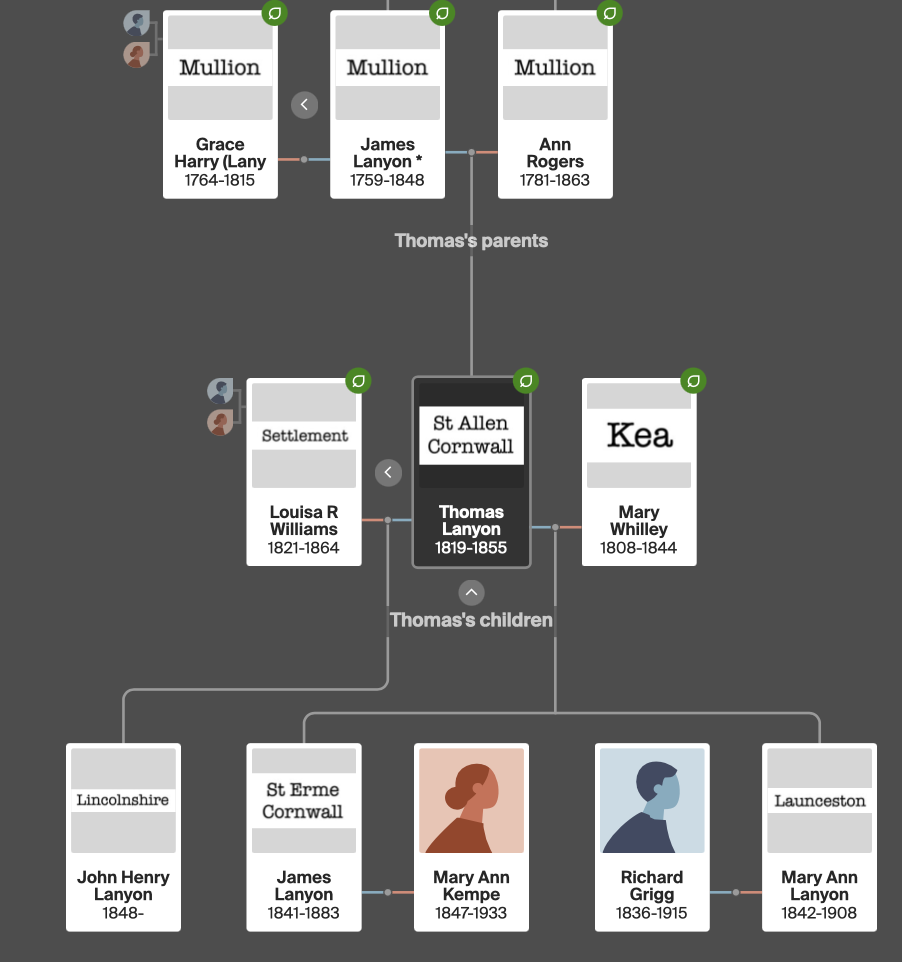
Thomas was baptised at Mawgan in Meneage in 1819. He was a farm labourer. His first marriage was to Mary Whilley and there were two children:

  • James 1841-1883
  • Mary Ann 1842-1908

Mary Whilley died in 1844 and was buried at Kea. He them married for a second time to Louisa Rawling Williams at St Allen in 1845. There was one child from this marriage:

  • John Henry 1849-1935

Thomas died of kidney disease in 1855 aged just 36. We’ll find out what happened to his widow and children in the post ‘Pauper’s Passport’.

Barnard Lanyon

The St Hilary branch of the family tree started with Barnard Lanyon.

Barnard was the youngest son of David (Davy) and Joan, he was baptised on 10 Jun 1638 at Madron and was just three years old when his father died in 1641. When his mother died in 1655 she left him ‘a brass pann conteyning 7 or 8 galls and 1 heifer to be kept by Thomas till she becomes a cow’.

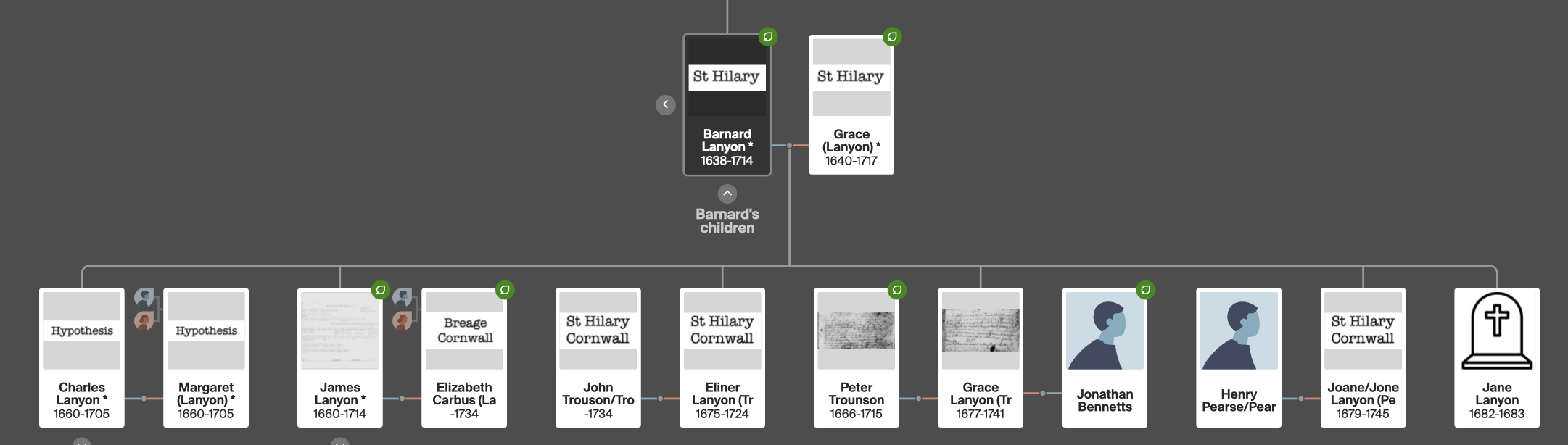
He married Grace, sadly we don’t know her surname or the date of marriage but in the 1660s and 1670s they were having children. The baptisms of some of the children are not recorded so there is a bit of guess work involved.

  • Charles abt. 1660-1705 married Margaret
  • James abt. 1660-1714 married Elizabeth Carbus
  • Eliner 1675-1724 married John Trouson
  • Grace 1677-1741 married Peter Trouson & Jonathan Bennetts
  • Joane 1679-1745 married Henry Pearce
  • Jane 1682-1683 died infancy

Charles Lanyon 1660s

We don’t know when Charles was born or died or even when he married but from the records of the baptisms of some of his children his wife is named as Margaret. Their children:

  • Charles -1683 there is a burial of a Charles Lanyon son of Charles (from the date of the burial of this child it looks as if Charles the father was born early 1660s)
  • Charles 1687- There is a Charlis Lalion baptised on 2nd Feb 1687 at St Hilary no father is named, could this be a son of Charles or even a son of Barnard? Or a separate family altogether? (There is a Charles Lanyon who married Eleanor Nines at Perranuthoe in 1715 could that be this Charles as that marriage doesn’t appear to fit anywhere else?)
  • Walter -1694 died in infancy
  • David 1693-1773
  • Francis 1695-1770
  • Thomas 1697-1737
  • Margaret 1699- there is a Margaret Lenine who married a William John (Bond) at Ludgvan on 5 Jun 1725 who may be this Margaret
  • Joseph 1704-1704 died in infancy

James Lanyon 1660s

There is no record of James’ baptism or his burial but we do know he married Elizabeth Carbus at St Hilary on 20 Apr 1685. Two children traced:

  • James 1686-1758
  • Margaret 1690-1693 died in infancy

Eliner Lanyon 1675-aft. 1724

Eliner was baptised at St Buryan in 1675. She married John Trouson/Trownson at St Hilary in 1724. No children of this marriage. John was buried in 1734 but no trace of a burial for Eliner/Eleanor.

Grace Lanyon 1677-1741

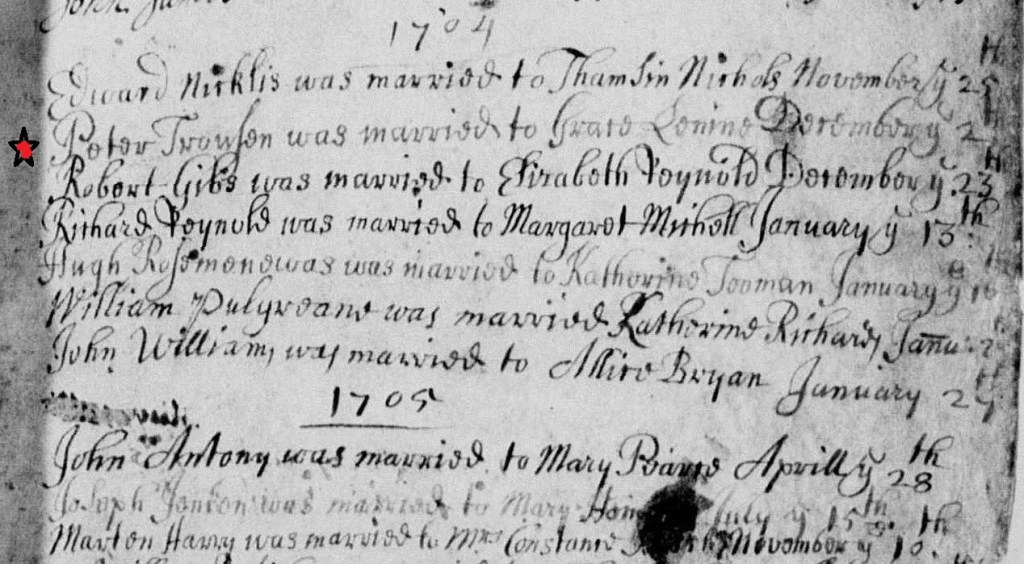
Grace was baptised at St Buryan in 1677. She married Peter Trouson at Ludgvan in 1704. They had four children, at least three died as a children. Peter died in 1715 and Grace married Jonathan Bennetts at Madron in 1732. She was buried at Madron in 1741.

Marriage of Peter & Grace Ludgvan Parish Register.

Joane Lanyon 1679-1745

Joane was baptised at St Buryan in 1679 and named after her grandmother, Barnard’s mother. She married Henry Pearse at St Hilary in 1709 and had three children: John, Jane and Francis. Joane was buried at St Hilary in 1745.

Barnard was buried at Marazion in 1714 and Grace his wife, was buried at St Hilary in 1717. They didn’t leave a will which might have helped confirm their children’s names.