
Joan died in 1344 and Sibyl returned to Tregamynyan. When she went back to her home at Madron she brought her mother’s (possibly step-mother’s) jewels and other goods with her. Perhaps she felt they were rightly hers. Evidently her family thought otherwise and this led to her being charged with the theft. Her husband John was charged as an accessory to a felony as he permitted her to come home with the goods. If found guilty he would have faced being outlawed and his lands forfeit.
Having been charged, John appealed to a higher court and then left home to join the Earl of Derby’s army who were going to France.

The 100 Years’ War started in 1337 and continued until 1453. In 1345 Edward III decided to send an army to France lead by Henry, Earl of Derby, his cousin.
A patent Roll of 24 Edward III (24th year of Edward III’s reign) explicitly states that John was charged before the Earl’s expedition of 1345. The Patent Roll does not disclose what John de Lynyen did in France but on their return The Earl of Derby (now also the Earl of Lancaster) gave personal testimony at Westminster on 3 June 1350 to John’s ‘good service in Gascony’ which obtained a royal pardon for him. John was able to return to Cornwall a free man.

Map of the Gascon Campaign
Whilst we don’t know what John did in Gascony it seems possible that he fought at the Battle of Auberoche.
The Earl of Derby gave personal testimony at Westminster on 3 June 1350 to John’s ‘good service in Gascony’ which obtained a royal pardon for him.
The National Archives at Kew Ref: SC 8/254/12666 & 12667
Old Cornwall Journal “The Lanions of Lanion, Madron, Cornwall: An Incident in the Family History” 1964
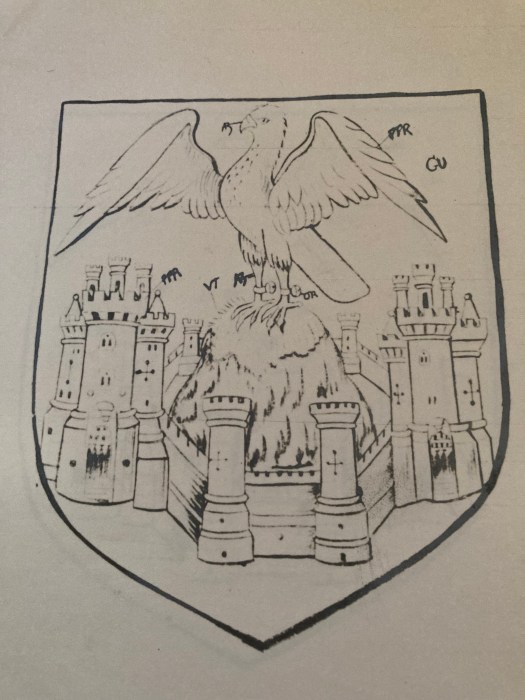
Lanyon Coat of Arms
Family Motto
“Vive Ut Vivas”
Live and Let Live
Another tradition, repeated by Bottrell, of Bosawa in St Buryan, (a house owned by the Lanyons), says ‘In the hall of this house there hung suspended on the wall a coat of mail, a buff jacket and a huge pair of jackboots of Cordovan leather, the monster spurs still buckled on them which once belonged to some renowned Lanyon: over the stone cut Lanyon arms an old rusty sword.‘
Could these boots have been John de Lynyens?
“Traditions and Hearthside Stories of West Cornwall” by William Bottrell.

 The Lanyons