The earliest Lanyon is Roger De Linyeine/Leniein who died before 1215. He was married to Agnes Beauchamp (Bello Campo) and after his death she pleaded for a third part of two acres which she claimed as her dowry on Hugh de Bello Campo. She was successful and passed her land to her son/stepson John de Linyeine. (A Cornish Acre is apparently approx 300 acres but the size varied over time.)
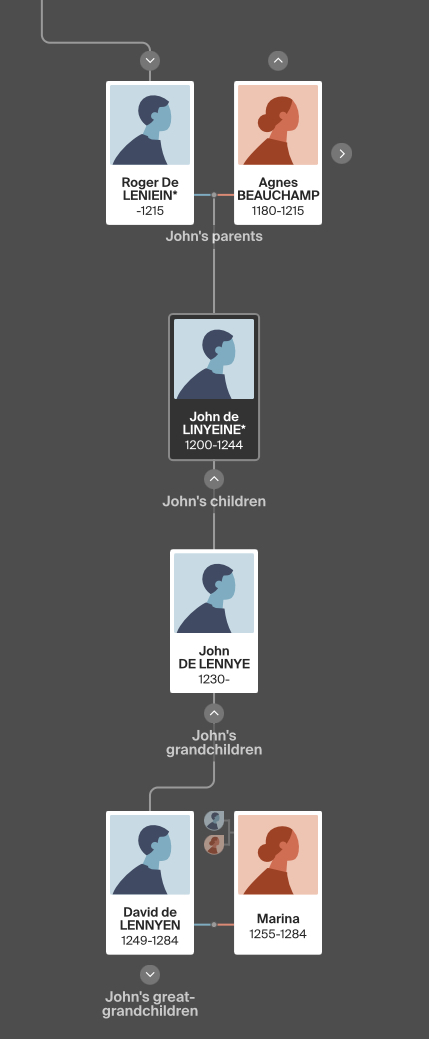
Lanyon was subject to the Domesday Manor of Binnerton held by Hugh de Bello Campo. Agnes may have been the daughter of Stephen de Beauchamp and Stephen was the son of Hugh.
“Cornub Agnes que fuit uxor Rogeri de Leniein optulit se quarto die versus Hugonem de Bello Campo de placito tercie partis duarum acrarum terre cum pertinentiis in Leniein, quam ipsa clamat in dotem versus eum: et Hugo non venit etc. Et summonito etc. Judicum. Tercia pars capitur in manum…”
CRR Curia Regis Rolls, John 15-16, C.T.Fowler (Ed.), (Public Records Office, 1971),p.193.

The next time we see the name Lanyon is in 1244 in the Cornwall Feet of Fines. Roger’s son John receives two small parcels of land from Stephen de Bello Campo, one at Little Bosullow and one in Lower Drift in Sancreed. John guarantees no interference to the water supply to the mill.

One of the few ways to find families at this time is through property transactions and legal disputes. A charter of 1284 gives us the name of John de Leynen’s son, David and his wife Marina.

“At Lanzaveton (Launceston) 1 month from Easter day, in the 28th year of King Henry (1 May 1244). Before Henry de Tracy, Gilbert de Preston and Robert de Haya, justices itinerant, and other liegemen of our lord the King then there present. Between John de Linyeine (Lanyon in Madron), plaintiff, and Hugh de Bello Campo (Beauchamp) [tenant] whom Stephen de Bello Campo vouched to warranty, & who warranted to him 3 ferlings of land in Botuolo bichan (Little Bosullow in Madron) & 1 ferling of land in Drek bichan. John acknowledged the whole of the said land to be the right of Hugh. For this Hugh granted to John the 3 Ferlings in Botuolo bichan, to have and to hold to John and his heirs of Stephen and his heirs for ever, rendering therefor 40 1/2 (?) at the four terms of St Andrew (30 Nov.), Mid Lent, the Nativity of St John the Baptist (24 June), & St Michael (29 Sept.) for all services & demand. Moreover John granted for himself & his heirs that the water which runs from Retsic (Rissick) to Netcurran shall be a free stream by the land of the said John in Retsic as far as the mill of the said Stephen at Netcuran, as in contained in a charter made between Roger father of the said John and Hugh de Bello Campo, without hindrance from John or his heirs for ever.”
Cornwall Feet of Fines, Volume 1, Joseph Hambley Rowe (Ed), (Devon & Cornwall Record Society, Exeter, 1914), pp.39/40.
Charter of 1284 confirms that David, husband of Marina was the son of John de Leynen. The charter also mentions the properties obtained by John de Leynen in 1244.
“John de Leynen to David his son and William de Trenyer chaplain and to the heirs of the body of the said David by Marina his wife. Charter with warranty of all his lands and messuages in the towns of Lennyen, Resik, Bossewolonwyan, Polgon, Hendrenythyn, Boswolnel and Trengwenton, with two mills corn and fulling in Lenyen, and the rent, service and homage of Ralph de Pendyn and his heirs for land there, and of Michael Pennek, Sara his wife and their heirs for land in Trethyn by Treudreuen.”
Dated Lanyen Friday before St Peter’s Chains 12 Edward I

Zoom in and out to see Madron and surrounding areas in Cornwall.
 The Lanyons