
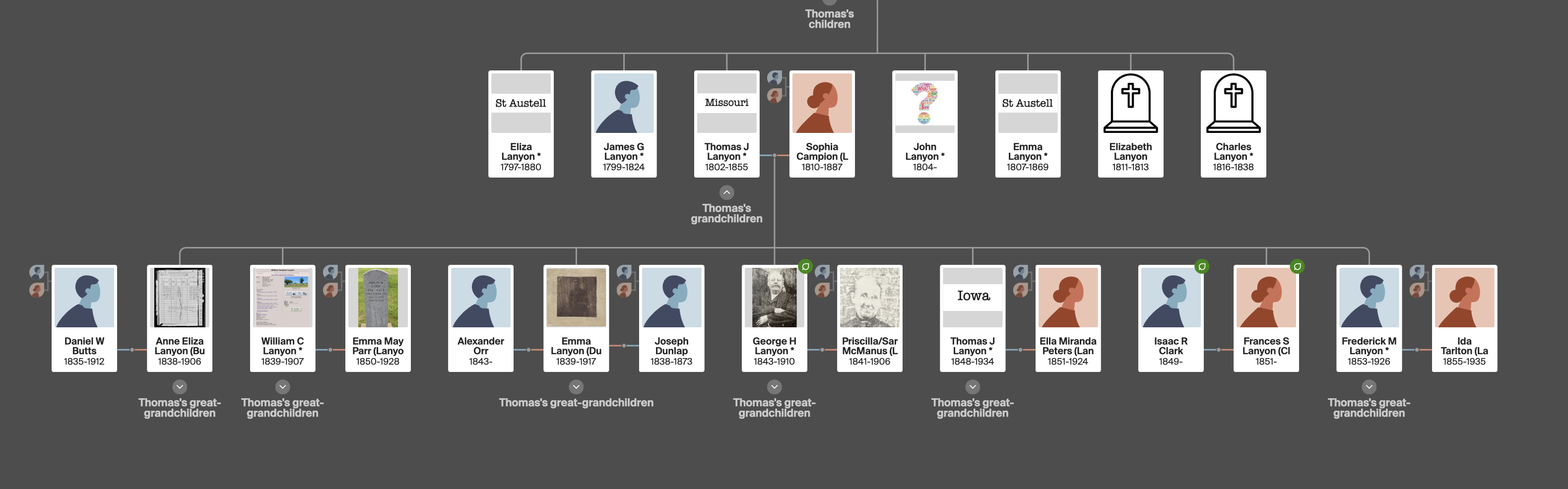
Eliza Lanyon died at St Austell on 18 May 1880 aged 82. A Miss Jewell wrote to Eliza’s niece, Mrs Annie Eliza Butts (nee Lanyon) (Little Sioux, Iowa) in July 1880.
“You will have received my letter informing you of your aunt’s death. I have now to say that I gave your address to the Executor, Mr. Rowse of St Austell so that he may write to you when he wants to do so…..”. It soon becomes apparent that Mr Rowse is a bit of a scoundrel!
Some eighteen months later WT Sanders writes to Mrs Butts: “As you are no doubt aware the distribution of the estate according to the terms of the will was left entirely in the hands of Mr Rowse. Mrs Sanders has written to him on the subject of her legacy but he has not made any reply. In October last I was at St Austell and saw him about it….he pleaded pressure of business ….and that he had been waiting for an account from the auctioneer which he had that very day received, therefore was in a position to draw a cheque and settle the affairs….nothing further has been heard from him. Taking this conduct into consideration and the time which has elapsed since Miss Lanyon’s death it has been thought desirable that you as the residuary legatee should at once take some steps…to enforce the administration of the estate and with this object in view should instruct a solicitor to act on your behalf.”
WT Sanders recommends the solicitor, Mr Harrison. In Feb 1882 Mr Harrison writes to Mrs Butts informing her that he has written to Mr Rowse and it transpires that Eliza Lanyon’s will has not even been proved. Mr Harrison writes to Anne’s brother Thomas James Lanyon in 1884.
“Mr Rowse has again and again promised to prove the will and wind up the estate…..The probate court ordered on our application some months since that if he did not prove the will he would be liable to be arrested. This order is still in force and a copy of it has been served on Mr Rowse but he has not proceeded to wind up the estate, not withstanding that we have endeavoured by personal interviews and otherwise to induce him to do so.”
Later they write again to Thomas: “….we regret to say that Mr Rowse has failed to fulfil his promises and there is we think no alternative but to take proceedings to have Miss Lanyon’s estate administered in the Chancery Division of the High Court. This we endeavoured to avoid as the costs ….are heavy. The £300 we obtained from Mr Rowse is on account bearing interest at 3%.”
They write again on Dec 31st 1885 “We have not been able to obtain a further sum from Mr Rowse…..we fear it will be necessary to take further proceedings against Mr Rowse to enforce a settlement. He now alleges as the reason for not closing the estate , that he has been unable to obtain payment of a mortgage debt, and it may be necessary to sell the property included in the security. Please say if you desire us to proceed in the Supreme Court to obtain administration of the estate.”
August 1886 and Frankfort Chambers in Plymouth send a telegram to Thomas Lanyon: “We very much regret to inform you that Mr Harrison …is at home ill and we fear it may be some weeks before he will be able to attend to business.”
The saga continues with Mr Rowse employing various delaying tactics. In March 1887 Thomas Rowse writes: “I have been pressing for settlement of the mortgage debt and have had two letters from the parties….saying that Mr Williams was undecided and that they were endeavouring to get the money from some friends and they beg for a little further indulgence.”!
At this point a Jason. H. Morris gets involved and writes to Thomas in July 1889 (over nine years after Eliza’s death!)
“Friend Thomas. I have had an interview with Mr Harrison, your solicitor here…he has not done his best for the interest of the estate, I am sure, and I drove that admission from him that he withheld from the heirs more than legal fees. I can see that he is disposed to treat me very ‘gingerly’ and I think I am going to be able to work quite harmoniously with him from this time on. I go to St Austell next week and….then go straight at Mr Rowse for blood. …..My only fear is that he has been using your aunt’s money and now cannot pay for it. In that case all that can be done is to clean out what he has and lock him up for the balance.”
Jason Morris writes again that month: “My arrival here was exceedingly inopportune, as Mr Rowse went to the north of England the Saturday before my arrival…..he returned with a new wife….and I jumped him red hot a half hour later. He was very affable but he is as dishonest as his hide will hold. He promises now to give me a detailed statement of account by one week from today, and I know he does not intend to settle with me then. I feel very sure I shall have to pull him up to London before I get any satisfaction from him….The annuity- Miss Selina will not sell or compromise it…about £173 will buy a government annuity and if she dies next week the government will keep the £173. The only way I can see it is for you to buy U.S Bonds enough to have the coupons pay $50 and deposit them in a bank here until she ceases to call for her interest and then pull down your bonds. She is 45 years old, tough as thunder, likely to live till 90 and so up along.”
Jason Morris writes to Thomas again in August 1889. “Friend Lanyon….you say right when you say “put him through” and “lock him up if he don’t pay” etc. I should have done it without your order for he is the most cheeky dishonest chap I ever met…..I took the trail he came off from with his new wife and followed it up to Lichfield Staffordshire on a hunt for his money as I was sure he had money and equally certain he had sequestered it good and hard. I have found £400…tucked away. The annuity – I have studied that a good bit….and conclude the best thing to do is leave that on Rowse. True he may never pay it but when we have got all we can we shall have less than belongs to us and I have little sympathy for Selina. She is strong as a mule and twice as stubborn, wouldn’t compromise a penny in any way and Miss Jewell told me she listened at your aunt’s door when the will was being made, knew all its provisions perfectly and then never ceased teasing and hounding your aunt to make the codicil until it was done. I think I can prove Rowse indebted over £700 now and I hope to make it greater before I sue him. I feel pretty sure of catching him for something more I know he has got it the only question being whether I can find it but my reputation and pride are at stake and you folks can afford to be as patient. As I can for I feel certain of making you all admit some day that you sent the right man.”
That is the last letter and we are left wondering if the intractable case was ever resolved.
Last Will and Testament of Eliza Lanyon of St Austell 17th Feb 1880
I give and bequeath to:
- Sophia Lanyon widow of my late brother Thomas Lanyon the sum of £100
- Frederick Mitchell son of Frederick Mitchell of Gwennap £100
- Annie Eliza Butts, the daughter of my late said brother Thomas Lanyon, £50
- Nanny Mitchell the widow of William Mitchell £50
- Sarah Sanders wife of Samuel Sanders of Saltash £5 to buy a mourning ring
- Hannah Geach of Saltash, spinster, £5 to buy a mourning ring
- Thomas Rowse, £50
- Wesleyan Theological Training College at Richmond £50
- Wesleyan Foreign Missionary Society £50
- St Austell Wesleyan Sunday School £10
- Town Missionary Society £10
- British and Foreign Bible Society £10
- Wesleyan Worn Out Ministers and Minster’s Widows fund £30
- Children’s Home in London connected to Wesleyan Society £30
- Mrs Henry Andrew of St Austell £2 to buy a mourning ring
- Ellen Kate, Laura and Julia Andrew daughters of Mrs Henry Andrews 20 shillings each
- Anna Maria Bice, daughter of Malachi Bice of St Austell 20 shillings
- The eldest sons of Henry Andrew of Sherborne 20 shillings each
- Thomas Rowse £19 19 shillings to be distributed to the poor connected with the Wesleyan Society
- Edward Geach of Trethurgey £5
- Clara and ? daughters of Walker Hicks of St Austell 50 shillings each
- Selina Whetter if living with me at the time of my death…?
- Sarah Sanders – portrait of Charles Geach, silver sugar tongs and large sofa rug, my crimson and white antimacasser, drawing room scrap book, album and photographs
- Suitable mourning clothing for my servant Selina Whetter
- Selina Whetter the bed she normally sleeps on and bed linen and all my undergarments. But in case she shall during any illness from which I may suffer or at any time previous to my death be guilty of unkindness or any other misconduct which in the opinion of the executor renders her unworthy of the bequests to her by this will then such bequests shall be null and void (Eliza evidently has a good measure of Selina!)
- All the rest and remainder of my clothing I give to Mrs Joseph James Lanyon of Penzance and Jane Lanyon of Falmouth
- Caroline Hancock daughter of Joseph James Lanyon half a dozen silver tea spoons, my gold watch and chain from my Spanish Figures under the large glass shade
- Bessie Butterworth daughter of JJ Lanyon half a dozen silver dessert spoons
- Jane Lanyon of Falmouth half a dozen tea spoons, a fire screen,
- Ellen Lanyon of Falmouth half a dozen ? and my worked wool chair
- All the rest and remainder of my silver forks I give unto my first cousin Joseph James Lanyon of Penzance and plated cake basket
- Ella Ann wife of John Lovering of St Austell?
- Thomas Rowse the Spanish Figures under the two small glass shades and a pair of small globes
- Elizabeth Lovering of Fore St St Austell my electro plated coffee pot
- Mrs Fred Stephen of Hombal in St Mewan the portaits of my uncle and aunt and also a figure which is on the chiffonier.
- Jane Lanyon and Thomas Rowse all my books
- Hannah Geach the specimens under the glass shade on the mantelpiece and the thermometer under glass
- I give to Jane Lanyon and her sister Ellen my dessert set between them.
- Jane Lanyon and Mrs Joseph Lanyon all my ornaments on mantelpieces and chiffionier except those I have before given
- My neighbour Mrs John Pearse my small cotton crochet antimacasser with leaves
- All the rest and residue and remainder of my real estate and personal estate not otherwise disposed of unto and amongst the children of my late brother Thomas now in America
What a detailed will and it really gives a glimpse into life in Victorian times for a well to do spinster.

 The Lanyons