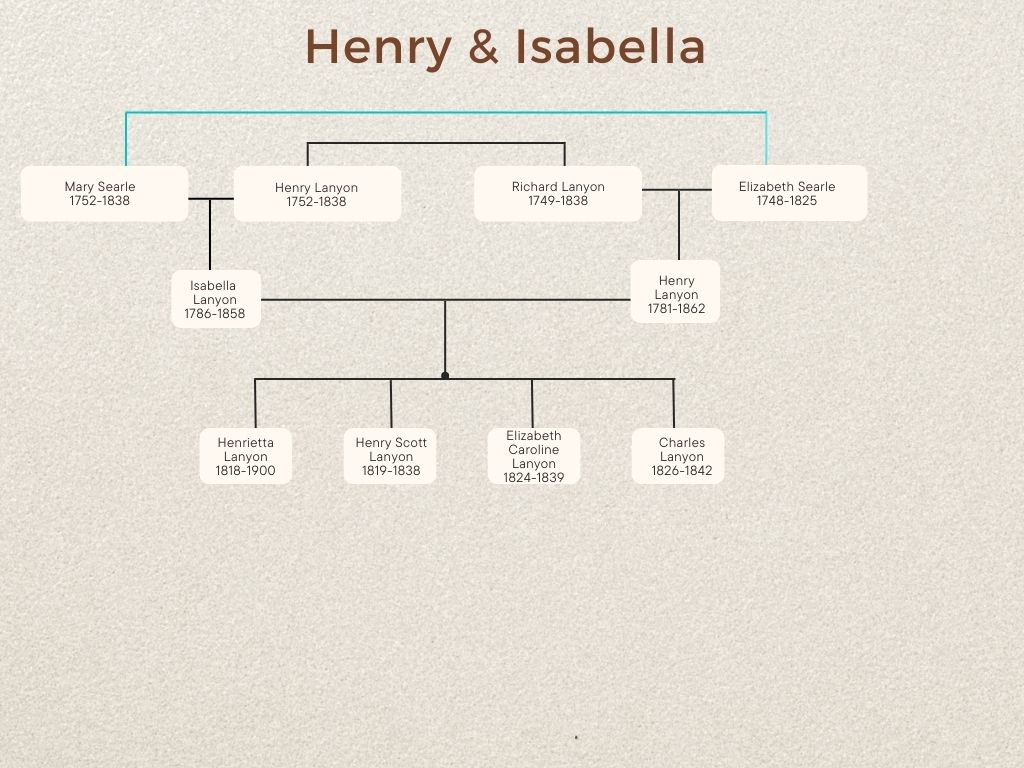
Henry was Richard and Elizabeth’s third son, he married his cousin Isabella. Henry was determined to join the navy and ran away three times so they bought his uniform and his training began.
In retirement he was renowned for his stirring tales of naval battles but it has proved difficult to find any records to substantiate these claims. There is an account of his naval career written by George Carter a grandson of Simon Lanyon of Mineral Point, Wisconsin who was a nephew of Henry Lanyon.
An account of the service of Captain Lanyon with the British Fleet in the War between Great Britain and the United States 1812-1814.
At Detroit, Michigan
The British Navy Lists record that Henry Lanyon was Navigation Master of His Majesty’s Ship ‘Horatio’, commanded by the Rt. Hon. Lord George Stuart which sailed from Spithead for America in 1812.
The Lanyon family records state that Captain Lanyon placed the British flotilla before Detroit when it fell to the arms of England.
James’ “History of the War Between Great Britain and the United States” states that armed British ships blockaded the lake at Detroit and aided in its capture on August 16, 1812 by British troops, which had been conveyed there by boats. The American Commander, Brigadier General Hull, in reporting his defeat to the American Secretary of War, under date of August 26, 1812, wrote:
“The body of the lake being commanded by the British armed ships, and the shores and rivers by gun boats, the army was totally deprived of all communication by water.”
The foregoing historical record confirms the Lanyon family record as to the activities of the British flotilla that Captain Lanyon placed before Detroit in 1812.
At Washington & Baltimore
The British Navy Lists record that Henry Lanyon was master of His Majesty’s ship ‘Tonnant’, carrying 80 guns, which sailed from England to North America in 1814.
James’ History of the War states that the ‘Tonnant’ was the flagship of Sir Alexander Cochrane, K.B., Vice Admiral and Commander in Chief of His Britannic Majesty’s ships and vessels upon the North American Station. Mahan’s History of the War states that Admiral Cochrane was in charge of both the Atlantic and Gulf Coast fleet of 20 war vessels and 4000 troops.
James’ History (Volume 2) contains the following statement in regard to the Tonnant, of which Captain Lanyon was the Sailing Master:-
“On the 24th of July (1814) the (British) squadron arrived at Bermuda, and there joined Vice Admiral Cochrane, having received on board the Tonnant Major General Ross and his staff , sailed for Chesapeake Bay; and on the 14th of August arrived, and joined the Albion, Rear Admiral Cockburn, off the mouth of the Potomac. On the next day, Major General Ross, accompanied by Rear Admiral Cockburn, went on shore to reconnoitre. It was during the excursion with General Ross, that rear Admiral Cockburn suggested the facility of an attack upon the city of Washington; and General Ross determined as soon as the troops should arrive from Bermuda, to make the attempt. On the 17th August, Rear Admiral Malcolm, with the troops, arrived and joined Vice Admiral Cochrane off the mouth of the Potomac; and the whole (including the ‘Tonnant’ with Captain Lanyon as Sailing Master) proceeded to the Patuxent, about 20 miles further up the bay.”
The Lanyon family records state that Captain Lanyon was under great disadvantage from the removal of navigation marks and also from the recent loss of a leg, which confined him to his quarters on the Tonnant, but nevertheless he successfully directed the steering by means of a relay of men from his quarters to the man at the helm. By this means as officer constantly sent him reports on the banks of the Chesapeake Bay. From that information Captain Lanyon directed the steering up the bay perfectly and without accident.
Being a Navigation Master and not a man-of-arms, Captain Lanyon took no part in the land operations around Washington and Baltimore, which in fact, he was physically unable to do, having only one leg. However his successful navigation of the British fleet up Chesapeake Bay made it possible for troops to land from the ships and speedily march to Washington, which was captured and partially burned on August 24 and 25 1814.
James’ History states that ‘the types and printing presses and materials of the Government paper at Washington were destroyed” and that a party of British troops under Captain Wainwright of the Tonnant destroyed a few stores and buildings in the Washington Navy Yard. The Government paper referred to was the National Intelligencer, published by Mr. Gales, a British subject, whose hostile statements had angered British commanders and they ordered his printing office to be burned. However on being told that the adjoining buildings would likely take fire, the printing office was spared, although as before stated, its types and printing materials were destroyed, which evidently greatly hampered Government printing in Washington for a time thereafter. Gales and Seaton afterwards did considerable Government printing, including the first American state papers.
After failure of the bombardment of Fort McHenry, Admiral Cochrane returned his flag to the ‘Tonnant’, as shown by his report written on board the ‘Tonnant’ in the Chesapeake under the date September 17, 1814. (James’ History page 514.) Admiral Cochrane’s report states that he hoisted his flag on the ‘Surprise’ so as to be able to pass further up the river for the attack on Fort McHenry, the ‘Tonnant’ being too large a vessel to navigate within range of the Fort. It is not known whether Captain Lanyon accompanied Admiral Cochrane and Francis Scott Key aboard the ‘Surprise’, but it seems quite certain that they must have met while Key was detained on the ‘Tonnant’ before the bombardment of Baltimore.
It was during the bombardment of Fort McHenry that the ‘Star Spangled Banner’ was written by Francis Scott Key.
The Star Spangled Banner
The Star Spangled Banner – The Lyrics
At New Orleans
After the failure of the British attack at Baltimore Sir Alexander Cochrane, with the ‘Tonnant’ and the Surprise, sailed for Halifax on September 19, 1814, to hasten the construction of flat bottomed boats intended to be employed in a great expedition on foot, according to James’ History, page 331.
James’ History next records that on December 8, 1814, Admiral Cochrane in the ‘Tonnant’, along with several other ships, arrived and anchored off Chandleur’s Island near New Orleans. In capturing several American gun vessels there, a boat from the ‘Tonnant’ was sunk and several of the crew killed or wounded (James’ History, pages 524-525.)
Admiral Cochrane in his report on the New Orleans campaign paid the following tribute to the officers and men of his squadron, which included the ‘Tonnant’, of which Captain Lanyon was the Navigation Master.
“In justice to the officers and men of the squadron under my command, who have been employed upon this expedition, I cannot omit to call the attention of my Lords Commissioners of the Admiralty to the laborious exertions and great privations which have been willingly and cheerfully borne, by every class, for a period of nearly six weeks.”
Maj Gen. Sir John Lambert, Commander of the British troops at the attack on New Orleans, reported their failure in a letter to earl Bathurst, written on board HMS ‘Tonnant’, off Chandleur’s Island, January 28, 1815 (James’ History page 505.)
Final action of the British fleet under Admiral Cochrane was its participation in the capture of Fort Bowyer on Mobile Point just as the war ended on February 11, 1815.
In action at Trafalgar, H.M.S. Tonnant accepting Monarca’s surrender – Nicholas Pocock, Public domain, via Wikimedia Commons
The Royal Cornwall Gazette (Dec 26th 1889) also featured an article about the Lanyons of Henver & St Allen.
They describe Henry Lanyon as “an officer in the Royal Navy…a man of considerable renown, being one of those skilful sailing masters in the service at the beginning of this century (19th) and constantly engaged in the memorable struggles of that period, and Admiral Lord Nelson frequently recognised his great aptitude for manoeuvring the fleet when in action, as in no small degree contributing to his brilliant success.”
The website Genealogy Trails mentions Simon Lanyon of Wisconsin:
“Mr. Lanyon’s uncle, Henry Lanyon, piloted the British fleet up the Potomac River to take Washington, in 1812; he was afterward Captain of a man-of-war, and was known as ‘Capt. Cork,’ on account of his cork leg.“
Sadly the only records I can locate are the Navy Lists which confirm that Henry Lanyon became a Master on 9 Nov 1809 and so far I haven’t found anything to link him to the ‘Tonnant’.
Jane Veale Mitchell (early 20th century Lanyon researcher) states that between 1809-1815 he served on HMS Truriculo, HMS Horatio and HMS Abercromby. By 1815 he was reserved on half pay. “Those who knew him at Truro remember his stirring tales.”
In 1817 he married his cousin Isabella Lanyon, the daughter of his uncle Henry Lanyon and Mary Searle. They had four children, sadly three of them died young.
Henrietta 1818-1900 spinster
Henry Scott 1819-1838 died young
Elizabeth Caroline 1824-1838 died young of ‘water on the brain’
Charles 1826-1842 was a draper, he died of Consumption (TB)
Henry died in Dec 1862, his wife Isabella died in 1858.
Henry & Isabella’s grave
Henrietta donated a lectern with her name on it and steps to Truro Cathedral and left her father’s gold jewelled sword and snuff box (a gift from the King of Sweden – Henry had piloted his ship) to the Cathedral but they have now disappeared.
There is a stained glass window in their memory at St Allen church.
In caram memoriam Henrici Lanyon RN obiit 8 Decembris 1862 et Isabella Lanyon obiit 18 Maii 1852 a filia sua Henrietta Lanyon (To the dear memory of Henry Lanyon RN who died 8th December 1862 and Isabella Lanyon who died 18th May 1858 from their daughter Henrietta Lanyon). Reproduced with permission of Michael Charter of Cornish Stained Glass Windows https://www.cornishstainedglass.org.uk




 The Lanyons