
William was the second documented son of John Lanyon of Breage and Tamsin Tapprell.
William was baptised at Breage in Aug 1600. In Oct 1618 he married Susannah Burdon at Breage. We know very little about William; he signed the Protestation Return of 1641/2 for Breage and apart from baptising his children the only other record we have of him is his will of 1643. He must have been a farmer as his will values the corn and the corn in the ground.
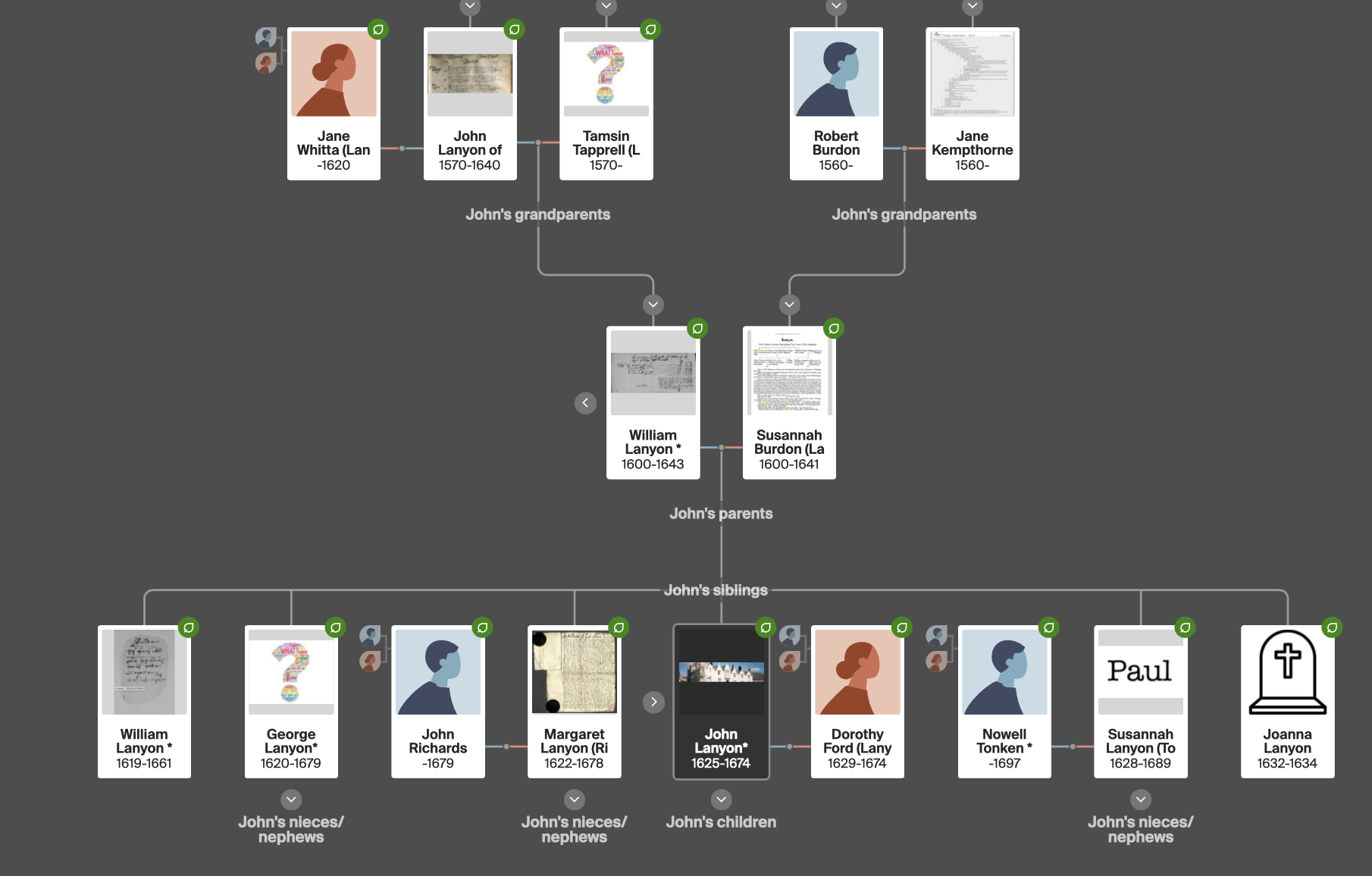
His children:
- William 1619-1661 William was the eldest son and heir, he never married and when he died he left everything to his sister Margaret Richards

- George 1620-aft.1643 He is mentioned in his father’s will of 1643 so must have been alive then but no trace of him after that. No mention of him in his brothers’ wills of 1661 and 1674. His sister Margaret’s will mentions his daughter Elizabeth.
- Margaret 1622-1679 she married John Richards and had at least one child Susannah Richards who was baptised in 1655. Her brother William left all his estate to her and brother John left her the huge sum of £1000 in his will, she was buried at St Columb Minor on 20 Jan 1686. Susannah Richards married George Beare, gent of St Ervan in 1676. In 1680 there is a Bill of Complaint between George Beare the younger, Susannah his wife defendants complaint of Philip Lanion Esq, Thomas Yonge gent and Hester his wife. (Source- CRO AR/17/127)
- John 1625-1674
- Susannah 1628-1689 she married Nowell Tonken, a merchant of Newlyn, in Nov 1664 at Paul, Cornwall. They had two children: Dorothy and Susannah.
- Joanna 1632-1634 died in infancy
William senior died in 1643.
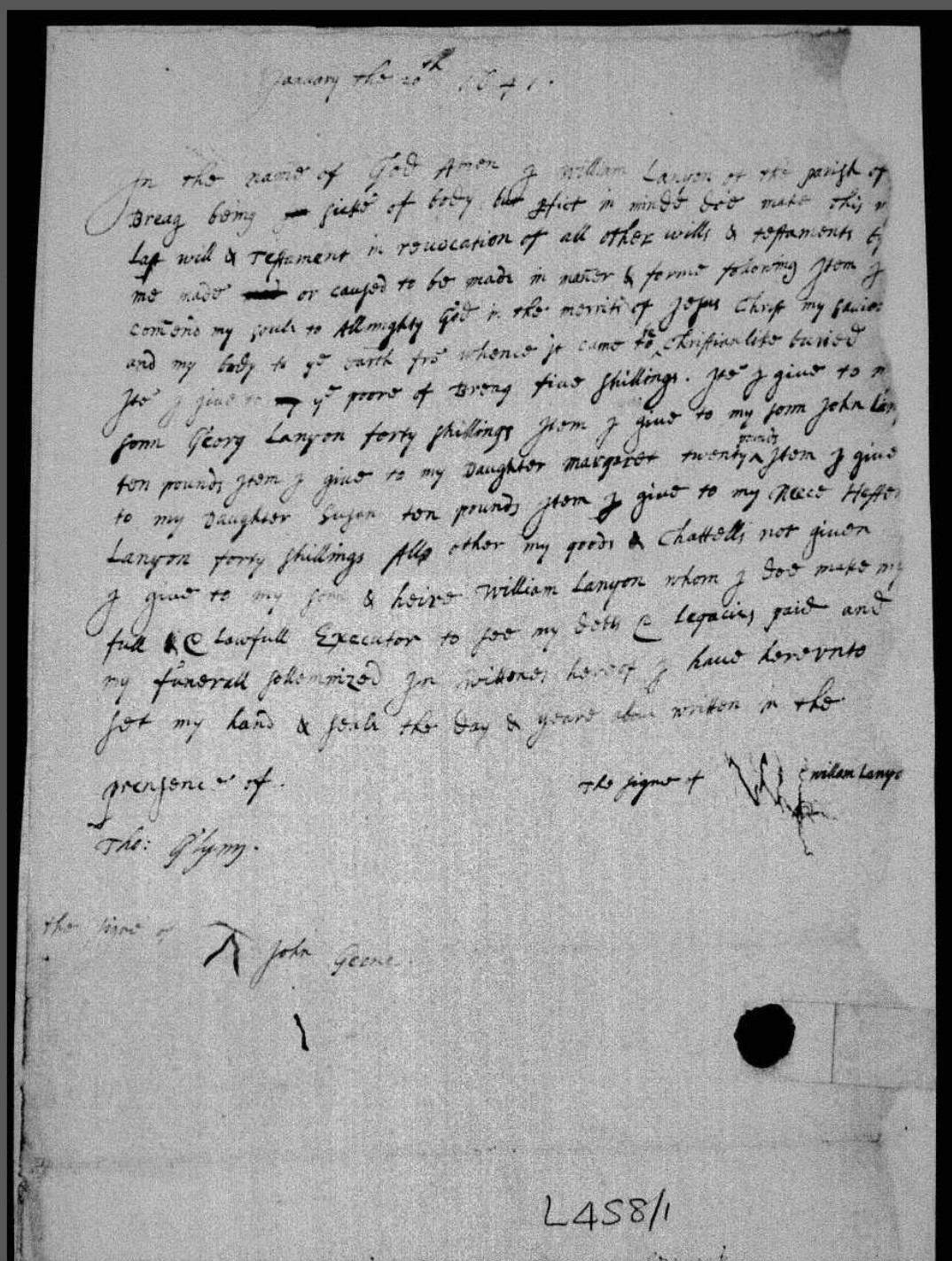
There is no mention of his wife Susannah so presumably she predeceased him. He leaves:
- To my son George 40 shillings
- To my son John £10
- To my daughter Margaret £20
- To my daughter Susan £10
- To my niece Hester Lanyon 40 shillings
- All the rest to my son William
Hester seems to feature in many of the wills!
John Lanyon 1625-1674
John was the third son of William Lanyon and Susannah Burdon. He married Dorothy Ford at St Andrews Church in Plymouth on 14 May 1656. They had two children:
- William -1665 died in infancy
- Margaret 1668-1671 died in infancy
There was an inscription in St Andrews Church in Plymouth (gradually worn away and in time will disappear altogether) Wife & Children of John Lanyon-
Under this stone a root with blameless green
To sense, but not to faith do lie unseen
Excepting when the righteous rising sun
Shall quicken them by Resurrection
Into that glorious state ordained of God
Of those who live their mercies and their rod
Ecclesiastical History of Plymouth – J Brooking, Devon 1873
The church was bombed during the Blitz in 1941 so presumably this inscription has been lost.
We don’t know when Dorothy died but at some stage before 1674 he appears to have married his cousin Hester Lanyon (the daughter of John Lanyon and Anne Goldsmith). There were no children of this marriage. Hester is described as his relict in a legal document. We don’t know if this marriage took place or if a mistake was made in the legal document.
John was a merchant in Plymouth and in 1672 he was Mayor of Plymouth. He was also the navy agent there.
He was friends with Samuel Pepys who mentions him in his diary:
30th. Up betimes, and with W. Hewer, who is my guard, to White Hall, to a Committee of Tangier, where the business of Mr. Lanyon
[John Lanyon, agent of the Navy Commissioners at Plymouth. The cause of complaint appears to have been connected with his contract for Tangier. In 1668 a charge was made against Lanyon and Thomas Yeabsley that they had defrauded the king in the freighting of the ship ‘Tiger’ (‘Calendar of State Papers,’ 1668-69, p. 138).]
took up all the morning; and where, poor man! he did manage his business with so much folly, and ill fortune to boot, that the Board, before his coming in, inclining, of their own accord, to lay his cause aside, and leave it to the law, but he pressed that we would hear it, and it ended to the making him appear a very knave, as well as it did to me a fool also, which I was sorry for. Thence by water, Mr. Povy, Creed, and I, to Arundell House, and there I did see them choosing their Council, it being St. Andrew’s-day; and I had his Cross
[The cross of St. Andrew, like that of St. Patrick, is a saltire. The two, combined with the red cross of St. George, form the Union flag.]
set on my hat, as the rest had, and cost me 2s., and so leaving them I away by coach home to dinner, and my wife, after dinner, went the first time abroad to take the maidenhead of her coach, calling on Roger Pepys, and visiting Mrs. Creed, and my cozen Turner, while I at home all the afternoon and evening, very busy and doing much work, to my great content. Home at night, and there comes Mrs. Turner and Betty to see us, and supped with us, and I shewed them a cold civility for fear of troubling my wife, and after supper, they being gone, we to bed. Thus ended this month, with very good content, that hath been the most sad to my heart and the most expenseful to my purse on things of pleasure, having furnished my wife’s closet and the best chamber, and a coach and horses, that ever I yet knew in the world: and do put me into the greatest condition of outward state that ever I was in, or hoped ever to be, or desired: and this at a time when we do daily expect great changes in this Office: and by all reports we must, all of us, turn out. But my eyes are come to that condition that I am not able to work: and therefore that, and my wife’s desire, make me have no manner of trouble in my thoughts about it. So God do his will in it!


John Lanyon to the Navy Commissioners. Finds the Milford may be supplied with a mainmast here. Wishes the old debts might be discharged; cannot persuade the carpenters without ready money to make the mast, as since the peace, they have been employed on merchant ships at 2s. 6d. per day. [Ibid. No. 166.]
John Lanyon to the Navy Commissioners. In expectation of satisfaction for his disbursements, will get ready a mast for the Milford frigate, which shall be despatched in a few days. [Ibid. No. 36.] Source – State Papers
John died in Paris in 1674 and was buried at the Shalanton Protestant Church. He left a detailed will mentioning many family members.
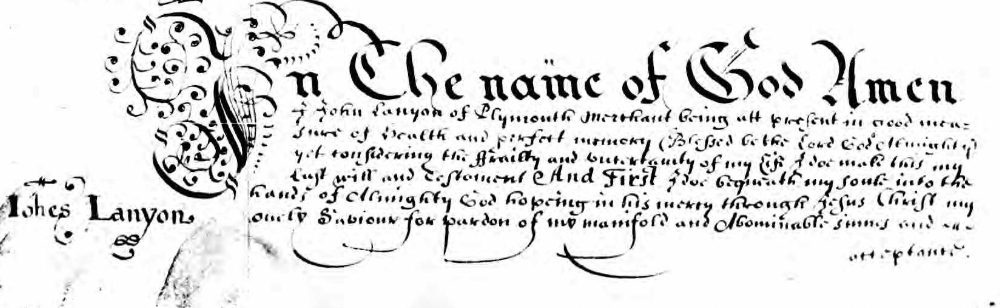
It’s a lengthy will that is impressive with the size and breadth of his bequests to the poor people of various towns and parishes, but it also gives us the information to deduce John was the son of William Lanyon and Susanna Burdon of Breage, baptised in 1625.
John left £50 to the parish of Breage in Cornwall, and also 40 shillings yearly forever, to be paid from “my interest in three prize tin bounds in or near the said parish”.
John’s will mentions his uncle Mr Philip Lanyon. This confirms that John’s father William had a brother called Philip, and they are more than likely both the sons of John Lanyon that was baptising children in Breage at the start of the 1600s.
The will also mentions John Lanyon of Plymouth’s sister, Margaret Richards and Margaret’s daughter Susanna, and another sister Susanna Tonkin, wife of Nowell Tonkin, and their daughter Dorothy Tonkin.
There is no mention of brothers William and George in his will written 15 Sept 1674 in Paris. William died in 1661 and presumably George had also died.
John mentions various ‘cousens’, among them are Hester Lanyon whom he bequests £700 “in case she should survive me and acquit my executors of my obligation for £30 per annum payable to her by me during her natural life.” This suggests there is a pre-existing arrangement possibly arranged and set down in the will of either his brother William or George. The will continues “out of this £700, my cousen Hester do pay or make good unto her sisters, my cousens, Mary and Ann £10 to each during their natural lives.” (John does not call Hester his wife.)
Other cousins/kinsmen mentoned are:
James Trewolla, my kinsman, John Trewolla his brother, Mary Trewolla his sister and Jane Trewolla his sister. John then gives an extra bequest to Jane Trewolla, calling her his cousin, and stating that she recieves “£50 pounds more in consideration of £5 which I received off my uncle Glynn to improve for her advantage.”
John Lanyon also gives to the grandchildren (un-named) of his aunt Glynn and to his cousin Thomas Glynn and his wife.
He was a great benefactor and left money to several parishes and money for almshouses in Plymouth (built 1679) and money for the Educational Foundation of John Lanion. There is an inscription in the boardroom of the Borough Workhouse in Plymouth:-
“to the memorie of a great benefactor to the poore of this town”
He also left £50 to Totnes in Devon and legal proceedings over this legacy give us more information about the family.
Chancery proceedings ante 1714 – Writ 297/99 Year 1679
John Lanyon merchant late of Plymouth personal estate valued at £20,000 did by his last will and testament dated 15 Sep 1674 bequeath a legacy of £50 to Totnes in Devon, which sum the Mayor and Burgesses were claiming of the Executors Captain Philip Lanyon, his sister Margaret Richards and niece Hester Lanyon.
In this chancery lawsuit the Totnes claimants speak of Hester Lanyon as John’s relict “who has since married Thomas Yonge”.
John Lanyon’s ‘personal estate’ consisted of ready money, rings, plate, jewels, bonds, judgments and the claimants accused the executors Philip Lanyon, Margaret Richards and Hester Lanyon of trying to defeat John Lanyon’s wish by pretending that the testator’s estate was not of the value it seemed to be.
Answer to Totnes: To this accusation Captain Philip Lanyon replied that after paying all legacies mentioned in John Lanyon’s will of 1674 there might be a small surplus left, but that he does not believe the testator’s estate to be of the value of £20,000 in fact, the said John Lanyon owed him over £600 on his house.
Note: In John Lanyon’s will he states the opposite, that his Uncle Philip owed him that amount on the house the said Captain lived in.
With no children to follow him this little branch of the tree now comes to an end.
 The Lanyons