
In 17th century Sancreed one parish priest, the Rev. John Smyth, caused considerable furore. In 1639 two of his parishioners , George Orchard and John Lanyon, both of the local gentry, brought a case against him in the Consistory Court. The Archdeacon of Cornwall appointed the incumbents of Phillack, Mullion, St Allen, Ludgvan, Madron and St Just in Penwith to hear evidence in Sancreed church.

The first accusations levelled against Smyth was that he had torn down a pew which his predecessor, the Rev. John Dodd, had put up in the chancel for the use of his wife and family. The interrogatory stated that the pew ‘was now in the buttery or dairy of your house, to the great grief and trouble of the minds of the parishioners there to see things dedicated to holy uses to be so profanely used or rather abused.’ Dodd’s wife, Avice, said that her husband had erected the pew about ten years before, ‘but, when Smyth came he refused to let her occupy it and nailed it up, but some schoolboys pulled it open, whereupon Mr Smyth demolished the whole.’
Smyth had been vicar of Sancreed for some eighteen months and had been the instrument whereby Dodd had been removed, having brought a law-suit against him on the grounds of simony. (Simony is the act of selling church offices and roles or sacred things. It is named after Simon Magus, who is described in the Acts of the Apostles as having offered two disciples of Jesus payment in exchange for their empowering him to impart the power of the Holy Spirit to anyone on whom he would place his hands.)

The second accusation against Smyth was that he had built a large new pew in the passage way between the body of the church and the rood loft, thus obstructing the free transit of the parishioners from north to south. Thomas Gibbes of Sancreed, aged 66, remembered ‘all his time the alley between the rood loft and the pews in the body of the church and also many parishioners buried in the alley. The minister’s pew was on the east side of the rood loft looking westward toward the people until of late Mr Smyth built a new seat or pew in the alley which is thereby stopped up.’
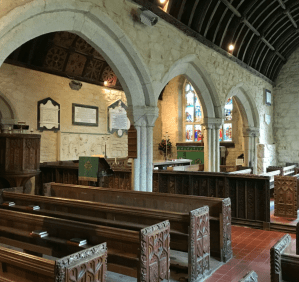
More serious was the charge that Smyth demolished an altar which stood in the chancel, whereon the parishioners were accustomed to place their tithes ‘and to write such things as concern their parish business and whereon sometimes the consecrated bread and wine was set at the time of administering the sacrament of the Lord’s Supper’. During divine service Smyth thought fit to remark on his demolition of this altar, saying that he ‘never saw any sheep or oxen to be sacrificed upon that altar but have been in the company of asses, men and boys, two or three at a time.’ Thomas Treuren deposed that Smyth removed the altar stone because it was an annoyance to him in the administration of the Holy Communion. His evidence was, however, blighted because he owed money to John Lanyon, the moneylender, one of the two parishioners who brought the suit against their vicar.
All these may well have been complaints brought against a priest who, in a conservative-minded parish, moved too quickly in introducing innovations. There, may, too, have been some local sympathy with the ousted predecessor. The remaining charges showed that the situation in the parish was even more disturbed. He was stated by Orchard and Lanyon to be ‘a great vexer, molster (sic) and troubler of the parishioners with unnecessary law-suits and that you now have or lately had 40, 30 or at least 20 law-suits in the ecclesiastical court against men of the parish and have said that you will so vex your parishioners with law-suits that they shall not be able to help one another and that you would make them all appear at London one after another and that you would be a little devil amongst them.’
Smyth had threatened to sue them all for the tithe of turves, and when told by Hugh Levelis that many leaseholders would not be allowed by the terms of their leases to cut turves, replied ‘then I will sue them because they shall forfeit their leases to their landlords.’
A further charge was that ‘in the time of divine service you have divers times departed out of the church of Sancreed in your surplice and worn your surplice into an ale-house’. One of the witnesses agreed that this was so, but only once or twice at prayer time ‘to reproach such as went to drink tobacco or ale (sic) and so came in again.’
Smyth was also said to have neglected to take children in his arms when baptising them ‘to the great grief of the parents and contrary to the rites and ceremonies of the Church of England’. All these accusation might be considered, in a certain sense, of a domestic nature. The last was designed to embroil Smyth even further – ‘that you did not read the King’s proclamation concerning the late treacherous seditions in the North and Scotland but caused your clerk to read it.’
The result of this action in the Consistory Court is unfortunately not known, but Smyth remained Vicar of Sancreed and 29 years later a similar series of charges was brought against him.
Part 2
The Rev John Smyth certainly caused a great deal of talk among his parishioners in the 1660s and his inability to conform with the usual standards of behaviours brought him considerable notoriety. In 1668, when he appeared for the second time before the Consistory Court, Mary Lanyon, widow, was the prosecutrix. Of her husband (John), soon after the burial service, Smyth was reported to have said ‘the old hog is dead and thrown into a pit. He took a field from one, a lease from another, a cow from a third and a horse from a fourth and has left his estates to the lioness and her whelps to make her jointure great.’ There were many other accusations levelled against the vicar. John Lanyon (son of Mary) gave corroborative evidence saying that in 1665, when William Binder, one of the church wardens had asked Smyth how the presentments should be made at the Visitation, the vicar had used abusive language. Lanyon reproved him and was met with the rejoinder ‘Pish, thou mayest make what presentments thou wilt but when thou hast paid the fees of the Visitation thou mayest take thy presentments and wipe thy breech with them.’ A certain Humphrey Nicholas seems to have been a particular object of his dislike. Elizabeth Tonkyns, who had been in Smyth’s service for twelve months, deposed that he was very litigious and had threatened to sue Nicholas for treading off the church path which led through the glebe. At Easter 1666, Nicholas was unwell and sent his offering to the vicar, who declined to receive it, and on the Sunday Nicholas ‘went to the Lord’s table with the rest of the parishioners and kneeled down, hoping to partake of the blessed sacrament – but Mr Smyth administered the same to all the rest of the people there but refused to administer the same to this deponent in the presence of all the people there present to the deponent’s very great grief.’
Smyth was said to be an extortioner, forcing a parishioner to ‘pay 2s 6d yearly for a cow and a calf pasturing in Sancreed whereas by parish custom he ought only to pay 3d a year.’ He was said to be a frequent visitor at ale-houses – in Penzance one evening he ‘drank to the height of mirth and lay there in the same house all that night’. He was said to scorn civil authority and in one sermon to have asked ‘what are these petty Justices and petty commissioners and dunghill officers to me when I am in my place?’
There was a suggestion that Smyth encouraged the flouting of authority. On one occasion he had taken his text from Proverbs, ‘Stolen waters are sweet’, and taking occasion to distinguish what was stolen waters, declared that extortion and wronging the poor was stolen waters – saying ‘if this be not stolen waters I wonder to the devil what is stolen waters?‘ And in the same sermon declared that it was lawful and that there was very good reason why the poor people should steal, saying ‘and from whom should they steal? Why from such rich people as are so uncharitable that they will not give to the poor.’ When the hope was expressed that he would not preach such a sermon again, he declared that ‘it is better to steal than to starve.’

Many of these accusations were, no doubt, somewhat frivolous, eccentricities which had been remembered, sometimes out of context, in order to make the list of charges as formidable as possible. One charge however, was most particular – the conversion of the parish almshouses. Edward Chergwyn deposed that ‘for the last three or four years Mr Smyth hath taken possession of the public almshouses of the parish of Sancreed which for forty years and more has been employed to the use of the ancient poor people of the parish’ and Reginald Madderne, the local tailor, said in his evidence, ‘he has converted the almshouses adjoining the churchyard into a house for his sheep.’ Richard Olivey went further: ‘Mr Smyth seized the almshouses, turned out some poor people and made it a sheep house, pulled off the roof and used the timber for his stable‘, Olivey completed the charges: ‘he is reputed to be of debauched life and conversation and addicted to lasciviousness and much given to obscene and wanton talking’. On his visits to the nearby church of Paul, ‘sometimes to preach, he puts his horse at the ale-house there and doth oftentimes go there himself when he goes to fetch his horse at his departure.’
John Olivey, who was constable of the parish in 1666 asserted that ‘he found Mr Smyth very backward in paying his rates and often would give this deponent ill words when he came to demand them.’ During the same year Olivey called on the vicar, armed with a warrant under the seals of the deputy lieutenants, warning the able-bodied men of the parish to appear before Colonel Godolphin ‘to bear arms imposed on the parishioners of Sancreed about the beginning of the late dangerous times of war between England and Holland.’ One of the parishioners, by name Ladner, was warned to carry the arms contributed by the vicar. Smyth told the constable ‘in a very passionate and rigorous manner’ that Ladner was not fit to serve the King, ‘neither shall he serve the King.’
What, one wonders, were the vicar’s replies to these accusations. Unfortunately they are not available, but it is not difficult to appreciate the difficulties of his position. Smyth was a vicar of an isolated country parish for over 30 years during a period of war and civil disturbance, when preferment was gained by those with soft tongues and easy ways. Smyth had neither. he quarrelled with the most influential of his parishioners and cracked bawdy jokes (in Cornish) with his serving – maids; he frequented taverns and abused the local magistrates. Little wonder then that this eccentric and somewhat earthy cleric fell foul of his ‘respectable’ parishioners.
This was part of an article written by H.L Douch curator of the Royal Institution of Cornwall for the ‘West Briton’ – Published Jul 30th & Aug 13th 1962
It is worth noting that John Lanyon (senior) was church warden at Sancreed.
From Cornwall OPC Database-
- 17 Jan 1675 Mary Smyth, wife of John Smyth vicar, buried at Sancreed
Two possible entries for John’s burial:
- 29 Apr 1681 John Smyth Vicar of Paule buryed at Sancreed in Woollen (Hoblyn’s Transcripts)
- 19 Apr 1692 John Smyth (pencil note – vicar) buried at sancreed – (Hoblyn’s Transcripts)
It does seem beyond coincidence that both the vicar of Sancreed and Paul were both called John Smyth!

 The Lanyons