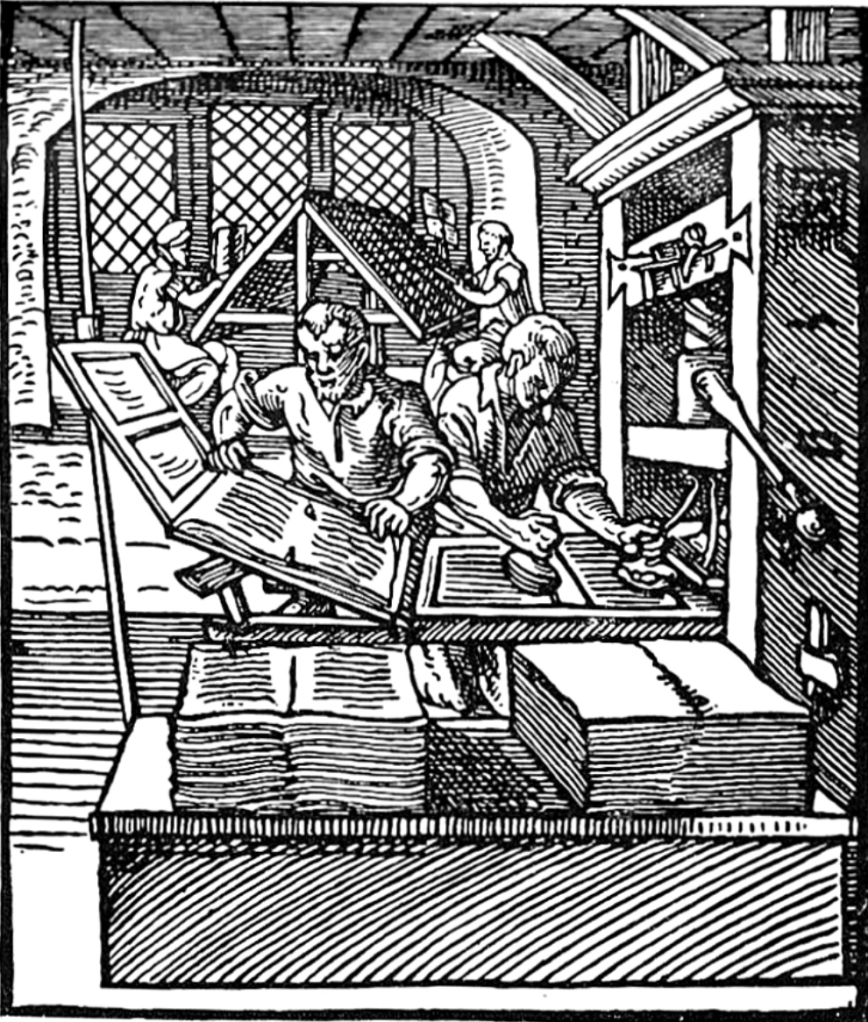
With the introduction of printing in 1476 there were attempts to standardise spelling in Britain but it wasn’t until the first dictionaries began to appear in the mid 17th century that spelling settled down. Often words were spelt the way people pronounced them. In Tudor Cornwall the name Lanyon was pronounced La-nine hence the spelling Lanine, Lanyne, Lenine. Add to that the difficulty in reading old documents and it’s easy for an ‘n’ to become an ‘m’, so other varients like Lamyne and Lamin appeared. Slight changes in pronunciation resulted in Lanion (LanIon) and Lanyon (LanYon). By the 18th century the accepted spelling became Lanyon. To further complicate things there are families called Lamin, Lemin and Lemon who are quite separate from the Lanyons.
It can be really difficult to know if a variant of the name is actually the same family or another family altogether.
When I found the record of a marriage between John Lamelyn and Johan Tregian it was difficult to know if he belonged on the Lanyon tree or not.
Henderson’s MSS gives details of this marriage in 1524.
“Thomas Lamelyn to John his son and heir in marriage with Johan daughter of Thomas Tregian for their lives Lamelyn als Gunvenowe Hole Juxte Tregony Nethercombe 16 Henry VIII”
So in 1524 a John Lamelyn married Johan the daughter of Thomas Tregian. Thomas Tregian already features on the Lanyon family tree. His daughter, Thomasine, married William Laniene Esq around the beginning of the 16th century. Almost all the Lanyons I’ve found can trace their ancestry back to William and Thomasine.

We know so much about William as he was the head of the family when the first Herald’s Visitation took place in Cornwall and he submitted his tree in 1531, his eldest son Richard, did so again at the second visitation in 1573 and Richard’s grandson submitted more information in 1620 when the third and final visitation took place.
The purpose of the Herald’s Visitations was to register and regulate the coats of arms of nobility, gentry and boroughs and to record pedigrees. They are a great resource for family historians but the information they hold is not complete or always accurate. Many families concentrated on recording the details of their eldest son and heir as he would be the person who would have the right to bear arms. Some families embellished their pedigrees especially if they were new to wealth and titles.
The Visitation shows William Laniene Esq with a sister Isabel who married Thomas Trewren but William and Isabel may have had other siblings and cousins which aren’t recorded. So it is possible that Thomas Lamelyn and his son John are related.
Thomas Tregian was born about 1440 at Truro in Cornwall. He was a prosperous tin merchant and shipper and in 1512 he is recorded as owning the ship “Jesus” of Truro. He invested his profits in land and owned several manors in Cornwall. He married Elizabeth Penwarne about 1467. His second marriage was to Margaret (née Kyngdom) the widow of the historian John Borlase of Pendeen. His children were from his first marriage.
Thomas Tregian’s will exists and helps us build his tree.
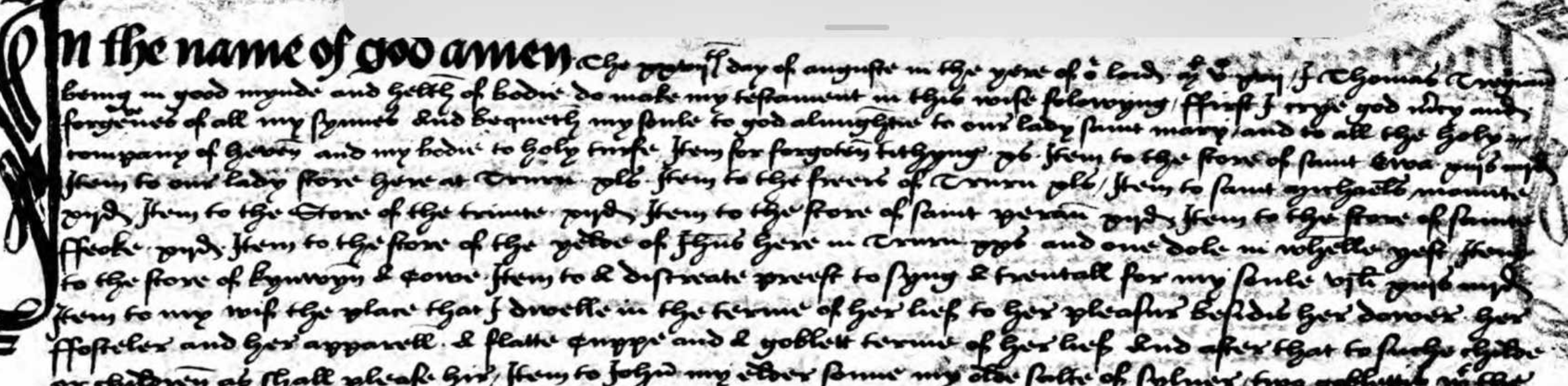
Transcript:-
“In the name of God amen. The 27th day of Auguste in the yere of or lord 1517. I Thomas Tregian being in good mynde and helth of. bodie do make my testament in this wise folowyng. First I crye God m’cy and forgivenes of all my synnes and bequeth my soule to God Almightie to our Lady saint Mary and to all the holy company of hcven and my bodie to holy turfe. Item for forgotcn tithyng 10s. Item to the store of saint Ewa 18s. 4d. Item to our Lady store here at Truru 40s. Item to the freres of Truru 40s. Item to saint Michaels Mounte 12d. Item to the store of the Tiinite 12d. Item to the store of saint Peran 12d. Item to the store of sainte Peoke 12(3. Item to the store of the gelde of .Thus here in Truru 20s. and one dole in whelle Yest. Item to the store of Kynwyn a cowe. Item to a discreate preest to syng a trentall for my soule £6 13s 4d. Item to my wif the place that I dwelle in the terrne of her lief to her plcasur besides her dower her Hosteler [fosterlean] and her apparell a flatte cuppe and a goblett tonne of her liof and after that to sucho childe or children as shall please hir. Item to John my elder sonne my olde salte of sylver, 2 gohlettis with the cover of sylver and gilto, the best bedde the Tubull in the halle, all coi)tenors and hanging clothes bothe in the hallo and in the plor [parlour]. Item to Peers my sonne 12 qter pooos of Tynnn waying by the Kyngis beame three thousand pounde, one qter of the shyppe called the Jhus, the place that William ffornaby dwellith in Chidawe, half of my blowying house, the place that Pascowe fflotcher dwellith in, all my right in Poldisse worke and in Whelle Yeste in Kyllcvrethe downe, my best two saltes of sylver and gilte, oon dosen of spones of sylver and my best standing cuppe of sylver after his moder’s decesse 2 flatte cuppes of aylver. Item to Jane my doughtor £40 to her mariage. Item to Thomysen my doughter a m. [thousand] of tynne wayed by the Kyngis beame. Item to Sir Raynolde my sonne 40s in money and he to synge 30 masses for my soule also more a gowne of blacke furred w’ lambe and a flatte olde cuppe of sylver. Item to Benet Tregian I forgive all that he owith me before this dayo. Item to Peers Treworva a furred gowne w”‘ blake. Item to John Edwarde a coote or a gowne and all that he owith me p’donat. And if it fortune that eny of my children dye without issue that then the same parte to be divided amongeste the other that lyveth equally. And I ordeigne my wif my sonne John and my sonne Peers myn executours, they to fulfill my said wille. In witnes whereof the said Thomas wrote his testament in man’ and forme as ys above rehearsed with his owne hande.”
His will mentions his sons John, Peers and Sir Raynolde (a priest) and daughters Thomasine and Jane.
He bequeathes Thomasine “…a m. (thousand) of tynne wayed by the Kyngis beame.”
He bequeathes Jane “…my doughter £40 to her mariage.” This tells us she isn’t yet married.
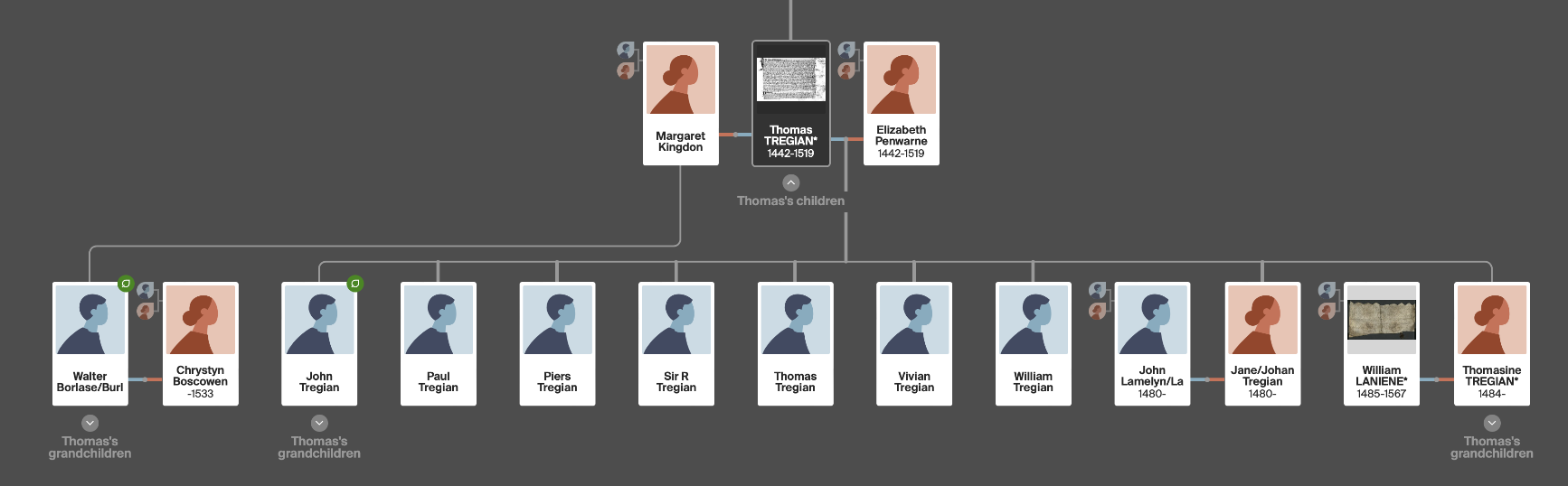
The will also tells us by omission that by 1517, when it was written, that Thomas Tregian’s sons Paul, Vivian, Thomas and William must have died.
So could Thomas’ daughter Jane be the Johan that married John Lamelyn? It’s possible. The names Johan, Joan and Jane are often interchangeable at this time and sometimes it’s hard to tell if a letter is an ‘a’ or an ‘o’, although in this case the ‘a’ in Jane is quite clear when compared to the ‘o’ in Doughter.

So what other evidence is there?
Charles Henderson’s record states that John is the son and heir of Thomas Lamelyn. Is there any evidence for a family called Lamelyn at this time?
The National Archives and Kresen Kernow have the following records relating to the name ‘Lamelyn’:-
- WM/217 – A Jn Lamelyn is listed as a witness at Polruan in 1399. Kresen Kernow
- C/241/249/22 – A John Lamelyn is listed as a constable in 1465. NA
- ART/3/12 – A Thomas Lamelyn was listed as a witness at Tywardreth. KK
- C/131/102/7 – A Thomas Lamelyn gent of Lamelyan, Cornwall is listed as a debtor. NA
- ME/628 – A Thomas Lamelyn Esq is listed as a witness in 1519. KK
- C1/1519/74 – Motion v. Lamelyn. Rent due from the parsonage of Lanteglos which was leased to Lamelyn by prior of St John’s Bridgwater, Cornwall. NA
- C1/363/39 – Spenser v. Lamelyn. 1504-1515. NA
- R/1626 – Property grant to Jn Lamelyn 1508. KK
- E/150/177/10 & C/142/58/13 – Inquisition Post Mortem of Thomas Lamelyn 1536-37. NA
Spenser v. Lamelyn is the most interesting. Thomas Spenser, the vicar of Lanteglos, and Thomas Lamelyn, a parishioner of Lanteglos. Spenswer complains that Lamelyn interrupted the sacrament at easter last ‘with his knyff drawen’ and seizure of oblations and tithes at Lanteglos.
So there was definitely a family calling themselves Lamelyn in Cornwall in the 15th-16th century. The Cornwall OPC database has just a handful of entries for the names Lamelyn, Lamellen, Lamellin and Lamelling.
Having started, thinking I had found another variation of the name Lanyon, I now accept that Thomas Lamelyn was from a different family. Sometimes family history leads you down all sorts of pathways and sadly sometimes they are dead ends
 The Lanyons