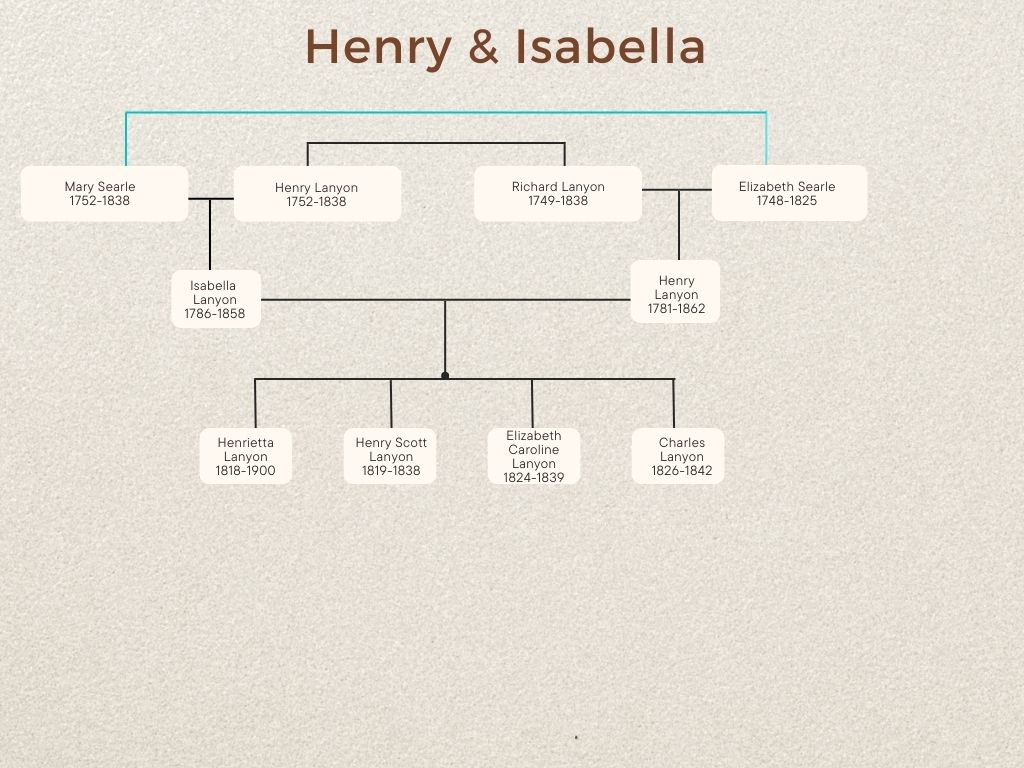
Henry was Richard and Elizabeth’s third son, he married his cousin Isabella. Henry was determined to join the navy and ran away three times so they bought his uniform and his training began.
In retirement he was renowned for his stirring tales of naval battles but it has proved difficult to find any records to substantiate these claims. There is an account of his naval career written by George Carter a grandson of Simon Lanyon of Mineral Point, Wisconsin who was a nephew of Henry Lanyon.
An account of the service of Captain Lanyon with the British Fleet in the War between Great Britain and the United States 1812-1814.
At Detroit, Michigan
The British Navy Lists record that Henry Lanyon was Navigation Master of His Majesty’s Ship ‘Horatio’, commanded by the Rt. Hon. Lord George Stuart which sailed from Spithead for America in 1812.
The Lanyon family records state that Captain Lanyon placed the British flotilla before Detroit when it fell to the arms of England.
James’ “History of the War Between Great Britain and the United States” states that armed British ships blockaded the lake at Detroit and aided in its capture on August 16, 1812 by British troops, which had been conveyed there by boats. The American Commander, Brigadier General Hull, in reporting his defeat to the American Secretary of War, under date of August 26, 1812, wrote:
“The body of the lake being commanded by the British armed ships, and the shores and rivers by gun boats, the army was totally deprived of all communication by water.”
The foregoing historical record confirms the Lanyon family record as to the activities of the British flotilla that Captain Lanyon placed before Detroit in 1812.
At Washington & Baltimore
The British Navy Lists record that Henry Lanyon was master of His Majesty’s ship ‘Tonnant’, carrying 80 guns, which sailed from England to North America in 1814.
James’ History of the War states that the ‘Tonnant’ was the flagship of Sir Alexander Cochrane, K.B., Vice Admiral and Commander in Chief of His Britannic Majesty’s ships and vessels upon the North American Station. Mahan’s History of the War states that Admiral Cochrane was in charge of both the Atlantic and Gulf Coast fleet of 20 war vessels and 4000 troops.
James’ History (Volume 2) contains the following statement in regard to the Tonnant, of which Captain Lanyon was the Sailing Master:-
“On the 24th of July (1814) the (British) squadron arrived at Bermuda, and there joined Vice Admiral Cochrane, having received on board the Tonnant Major General Ross and his staff , sailed for Chesapeake Bay; and on the 14th of August arrived, and joined the Albion, Rear Admiral Cockburn, off the mouth of the Potomac. On the next day, Major General Ross, accompanied by Rear Admiral Cockburn, went on shore to reconnoitre. It was during the excursion with General Ross, that rear Admiral Cockburn suggested the facility of an attack upon the city of Washington; and General Ross determined as soon as the troops should arrive from Bermuda, to make the attempt. On the 17th August, Rear Admiral Malcolm, with the troops, arrived and joined Vice Admiral Cochrane off the mouth of the Potomac; and the whole (including the ‘Tonnant’ with Captain Lanyon as Sailing Master) proceeded to the Patuxent, about 20 miles further up the bay.”
The Lanyon family records state that Captain Lanyon was under great disadvantage from the removal of navigation marks and also from the recent loss of a leg, which confined him to his quarters on the Tonnant, but nevertheless he successfully directed the steering by means of a relay of men from his quarters to the man at the helm. By this means as officer constantly sent him reports on the banks of the Chesapeake Bay. From that information Captain Lanyon directed the steering up the bay perfectly and without accident.
Being a Navigation Master and not a man-of-arms, Captain Lanyon took no part in the land operations around Washington and Baltimore, which in fact, he was physically unable to do, having only one leg. However his successful navigation of the British fleet up Chesapeake Bay made it possible for troops to land from the ships and speedily march to Washington, which was captured and partially burned on August 24 and 25 1814.
James’ History states that ‘the types and printing presses and materials of the Government paper at Washington were destroyed” and that a party of British troops under Captain Wainwright of the Tonnant destroyed a few stores and buildings in the Washington Navy Yard. The Government paper referred to was the National Intelligencer, published by Mr. Gales, a British subject, whose hostile statements had angered British commanders and they ordered his printing office to be burned. However on being told that the adjoining buildings would likely take fire, the printing office was spared, although as before stated, its types and printing materials were destroyed, which evidently greatly hampered Government printing in Washington for a time thereafter. Gales and Seaton afterwards did considerable Government printing, including the first American state papers.
After failure of the bombardment of Fort McHenry, Admiral Cochrane returned his flag to the ‘Tonnant’, as shown by his report written on board the ‘Tonnant’ in the Chesapeake under the date September 17, 1814. (James’ History page 514.) Admiral Cochrane’s report states that he hoisted his flag on the ‘Surprise’ so as to be able to pass further up the river for the attack on Fort McHenry, the ‘Tonnant’ being too large a vessel to navigate within range of the Fort. It is not known whether Captain Lanyon accompanied Admiral Cochrane and Francis Scott Key aboard the ‘Surprise’, but it seems quite certain that they must have met while Key was detained on the ‘Tonnant’ before the bombardment of Baltimore.
It was during the bombardment of Fort McHenry that the ‘Star Spangled Banner’ was written by Francis Scott Key.
The Star Spangled Banner
The Star Spangled Banner – The Lyrics
At New Orleans
After the failure of the British attack at Baltimore Sir Alexander Cochrane, with the ‘Tonnant’ and the Surprise, sailed for Halifax on September 19, 1814, to hasten the construction of flat bottomed boats intended to be employed in a great expedition on foot, according to James’ History, page 331.
James’ History next records that on December 8, 1814, Admiral Cochrane in the ‘Tonnant’, along with several other ships, arrived and anchored off Chandleur’s Island near New Orleans. In capturing several American gun vessels there, a boat from the ‘Tonnant’ was sunk and several of the crew killed or wounded (James’ History, pages 524-525.)
Admiral Cochrane in his report on the New Orleans campaign paid the following tribute to the officers and men of his squadron, which included the ‘Tonnant’, of which Captain Lanyon was the Navigation Master.
“In justice to the officers and men of the squadron under my command, who have been employed upon this expedition, I cannot omit to call the attention of my Lords Commissioners of the Admiralty to the laborious exertions and great privations which have been willingly and cheerfully borne, by every class, for a period of nearly six weeks.”
Maj Gen. Sir John Lambert, Commander of the British troops at the attack on New Orleans, reported their failure in a letter to earl Bathurst, written on board HMS ‘Tonnant’, off Chandleur’s Island, January 28, 1815 (James’ History page 505.)
Final action of the British fleet under Admiral Cochrane was its participation in the capture of Fort Bowyer on Mobile Point just as the war ended on February 11, 1815.
In action at Trafalgar, H.M.S. Tonnant accepting Monarca’s surrender – Nicholas Pocock, Public domain, via Wikimedia Commons
The Royal Cornwall Gazette (Dec 26th 1889) also featured an article about the Lanyons of Henver & St Allen.
They describe Henry Lanyon as “an officer in the Royal Navy…a man of considerable renown, being one of those skilful sailing masters in the service at the beginning of this century (19th) and constantly engaged in the memorable struggles of that period, and Admiral Lord Nelson frequently recognised his great aptitude for manoeuvring the fleet when in action, as in no small degree contributing to his brilliant success.”
The website Genealogy Trails mentions Simon Lanyon of Wisconsin:
“Mr. Lanyon’s uncle, Henry Lanyon, piloted the British fleet up the Potomac River to take Washington, in 1812; he was afterward Captain of a man-of-war, and was known as ‘Capt. Cork,’ on account of his cork leg.“
Sadly the only records I can locate are the Navy Lists which confirm that Henry Lanyon became a Master on 9 Nov 1809 and so far I haven’t found anything to link him to the ‘Tonnant’.
Jane Veale Mitchell (early 20th century Lanyon researcher) states that between 1809-1815 he served on HMS Truriculo, HMS Horatio and HMS Abercromby. By 1815 he was reserved on half pay. “Those who knew him at Truro remember his stirring tales.”
In 1817 he married his cousin Isabella Lanyon, the daughter of his uncle Henry Lanyon and Mary Searle. They had four children, sadly three of them died young.
Henrietta 1818-1900 spinster
Henry Scott 1819-1838 died young
Elizabeth Caroline 1824-1838 died young of ‘water on the brain’
Charles 1826-1842 was a draper, he died of Consumption (TB)
Henry died in Dec 1862, his wife Isabella died in 1858.
Henry & Isabella’s grave
Henrietta donated a lectern with her name on it and steps to Truro Cathedral and left her father’s gold jewelled sword and snuff box (a gift from the King of Sweden – Henry had piloted his ship) to the Cathedral but they have now disappeared.
There is a stained glass window in their memory at St Allen church.
In caram memoriam Henrici Lanyon RN obiit 8 Decembris 1862 et Isabella Lanyon obiit 18 Maii 1852 a filia sua Henrietta Lanyon (To the dear memory of Henry Lanyon RN who died 8th December 1862 and Isabella Lanyon who died 18th May 1858 from their daughter Henrietta Lanyon). Reproduced with permission of Michael Charter of Cornish Stained Glass Windows https://www.cornishstainedglass.org.uk
John was the youngest son of Thomas Lanyon and Margaret Paule and Thomas was the youngest son of the Golden Lanyon of Botrea, Sancreed.
Thomas Lanyon’s tree
John Lanyon 1711-1767
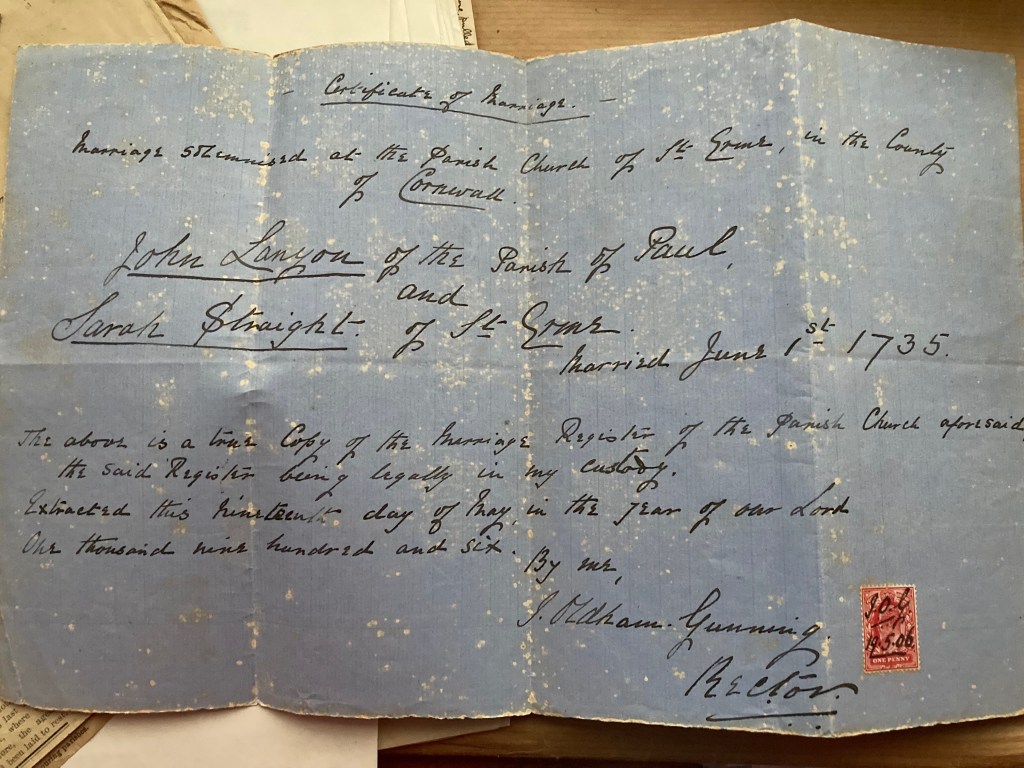
John was baptised at Paul in 1711 and married Sarah Straight of St Erme in 1735. John was a farmer.
Copy of the marriage record from St Erme issued by the rector in 1906
John and Sarah had six children:
Margaret 1736-1802 married John Searle, a labourer at Newlyn East in 1759 – six children
John 1740-1771 unmarried
William 1743-1763 unmarried
Richard 1746-1747 died in infancy
Richard 1749-1838 married Elizabeth Searle
Henry 1752-1838 married Mary Searle
Margaret, Richard and Henry married siblings. This post will follow Richard and Henry’s children.
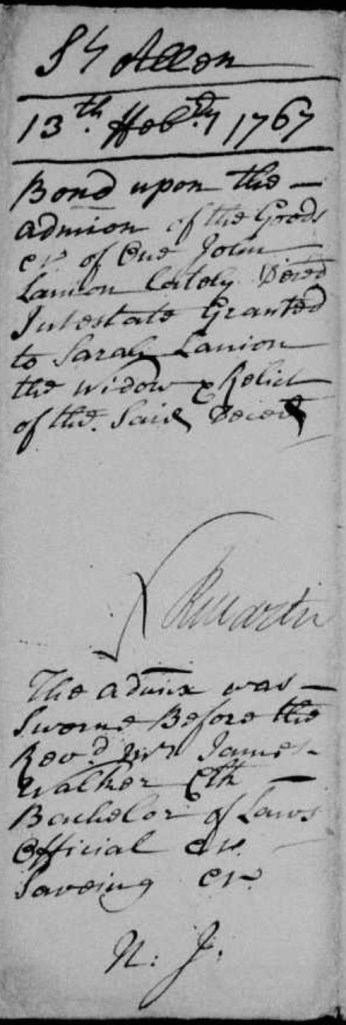
John died intestate in 1767 and administration of his estate was passed to Sarah his widow, Richard Straight, his brother-in-law and James Fox of Lostwithiel.
Source – CRO AP/L/1732
Sarah was mentioned in a legal document of 1787 about the farm Henver Wartha: Copyhold land on the Manor of Cargol, Newlyn East leased to Sarah Lanion (sic) widow, Henry Lanion son and John her grandson.
Sarah died in 1791 at the age of 82.
Richard Lanyon 1749-1838
Richard was baptised at St Allen on New Year’s Day 1749. In 1774 he married Elizabeth Searle. There is a mention of a Richard Lanyon in St Allen in Dec 1775 as a master cordwainer taking on an apprentice Stephen Harris. Although the time frame fits with this Richard I’m not sure it is him. Richard was a yeoman and farmed at Polstein in St Allen.
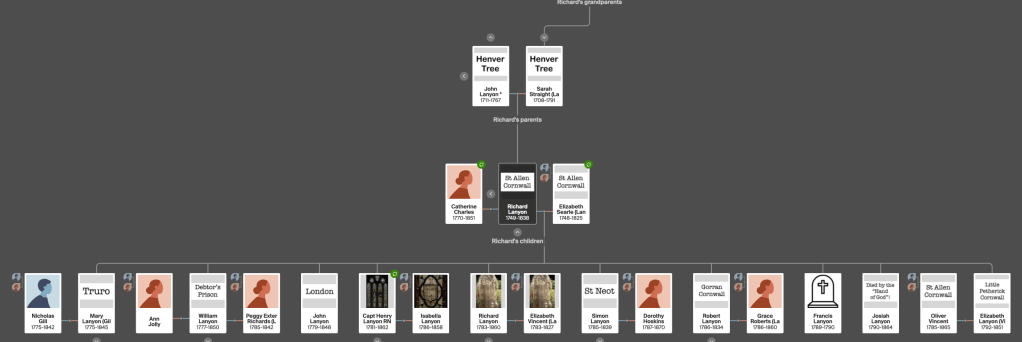
Richard Lanyon’s tree
Richard and Elizabeth had ten children:
Mary 1775-1845 married Nicholas Gill at St Allen in 1801 – eight children
William 1777-1850 married Peggy Exter Richards
John 1779-1848 no trace of a marriage a possible burial in London in 1848
Henry Lanyon 1781-1862 married Isabella Lanyon
Richard 1738-1860 married Elizabeth Vincent
Simon 1785-1839 married Dorothy Hoskins
Robert 1786-1834 married Grace Roberts
Francis 1789-1790 died in infancy
Josiah 1790-1864 was a shopkeeper, and later an agricultural labourer, he married Sally Messer at Gwennap in 1822. By 1851 he was no longer living with her and she was running the grocers shop. On the 1861 census she is listed as the head of house and a former school mistress and he is listed as a boarder at an alternative address. They had one daughter: Elizabeth Martha Lanyon born in 1822 she married Thomas Johns in 1843 and he was dead by 1846. They had two daughters. Josiah was found dead in a ditch after a fit in 1864 and died ‘by the hand of God’ Source – Royal Cornwall Gazette.
Elizabeth 1792-1831 married Oliver Vincent at St Allen in 1820 – seven children
Richard and Elizabeth lived at Polstein estate, St Allen. Elizabeth died there in 1825 at the age of 77. In 1827 at the age of 78 Richard married again! His second wife was Catherine Charles age 57, she was a widow.
Richard died at Lanner in 1838 at the age of 89, he left a will.
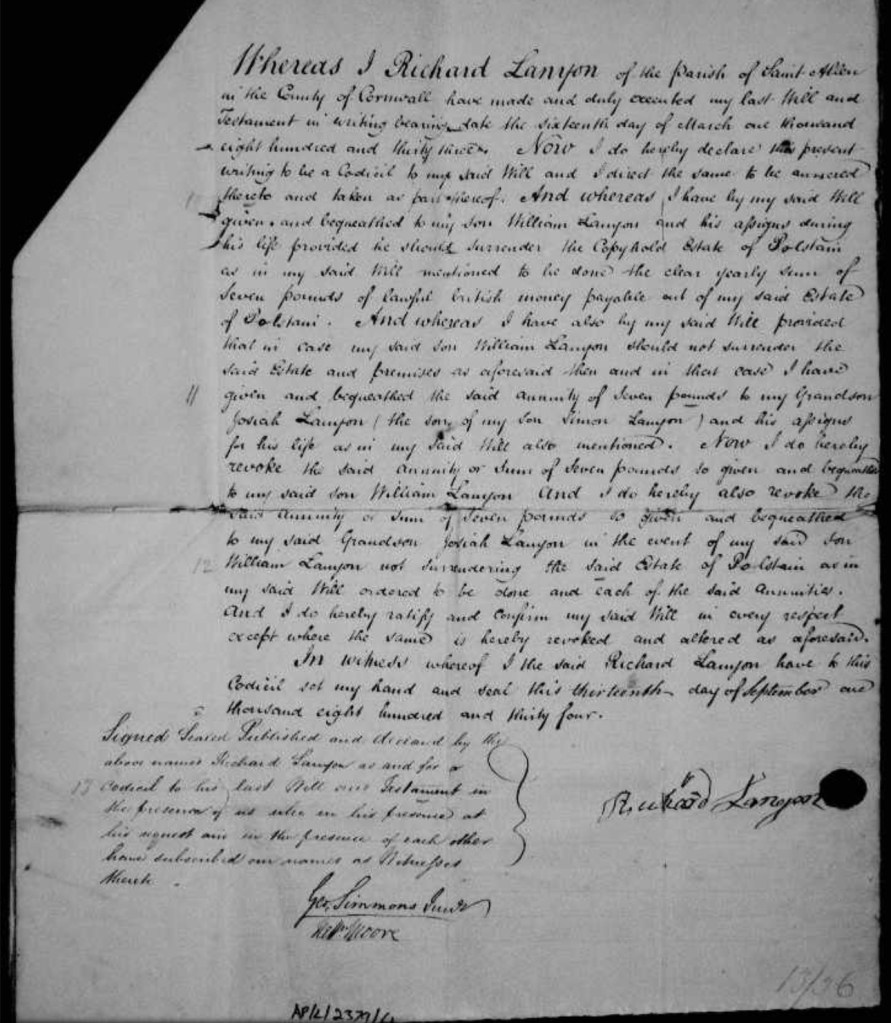
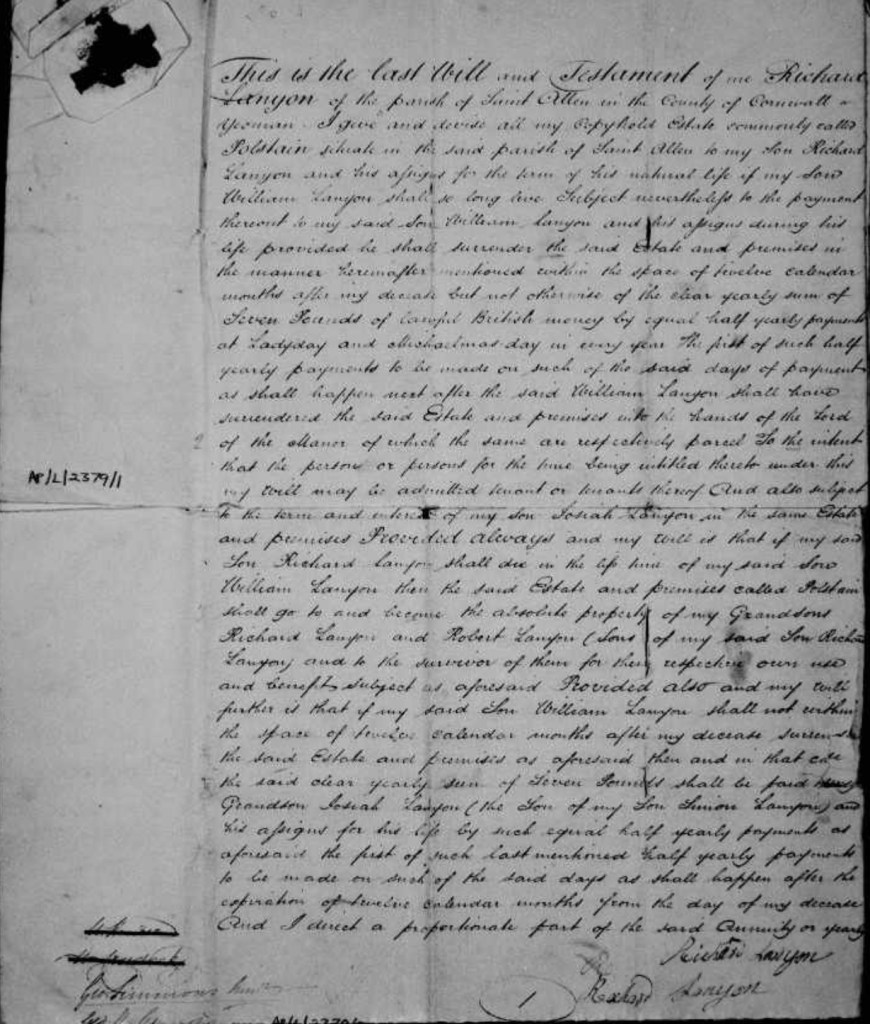
Richard’s will CRO AP/L/2379
Partial Transcript:
Date of will 1833 and codicil 1834
I give estate called Polstein in Par St Allen to my son Richard Lanyon and his assigns for his natural life if my son William Lanyon shall so long live subject nevertheless to payment thereout to my said son William Lanyon providing he shall surrender said estate and premises in manner hereinafter mentioned….after William shall have surrendered said estate into hands of the Lord of the Manor of which same are respectively parcel….subject to the term and interest of my son Josiah.
If son William die then estate to my grandsons Richard Lanyon and Robert Lanyon (sons of said son Richard) £7 to be paid yearly to my grandson Josiah Lanyon, son of my son Simon Lanyon
I bequeath £100 to my son Richard
Residue of estate to my grandson Richard Lanyon son of my son Richard
Codicil
Revoked £7 to William Lanyon his son also to Josiah Lanyon his grandson.
Proved 27th Sep 1839 effects under £300.
Henry Lanyon 1752-1838
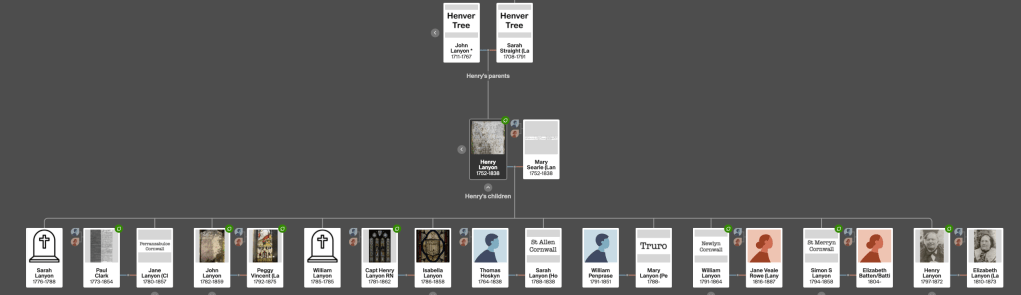
Henry was baptised at St Allen in 1752 and married Mary Searle (sister of his brother’s wife Elizabeth) at Crantock in 1775. They had ten children as well.
Henry’s tree
Sarah 1776-bef. 1788 died young
Jane 1780-1857 married widower Paul Clark, a farmer at St Allen in 1814. They lived at Perranzabuloe and had two children
John 1782-1859 married Peggy Vincent
William 1785-1785 died in infancy
Isabella 1786-1858 married her cousin Henry Lanyon
Mary 1787- married William Penprase at St Allen in 1809 – ten children
Sarah 1788-1838 baptised in 1788 but may have been born earlier married Thomas Hoskyn at St Allen in 1803 – four children
William 1791-1864 married Jane Veale Rowe
Simon Searle 1794-1858
Henry 1797-1872 married his cousin Elizabeth Lanyon
Henry was a yeoman farmer and his estate was Trevalsa at St Allen. He was married to Mary for 63 years and he died just 3 weeks after her. His older brother Richard died three weeks after him.
Burial register for St Allen 1838
Henry died at Trefannick Farm where his daughter Sarah lived with her husband lived. (Sarah died in Nov 1838 of a paralytic seizure at Trefannick just a few months after her parents died.)
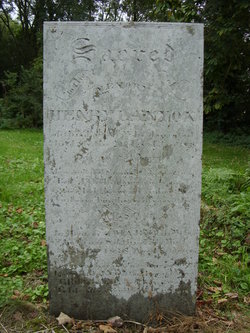
Henry’s grave stone
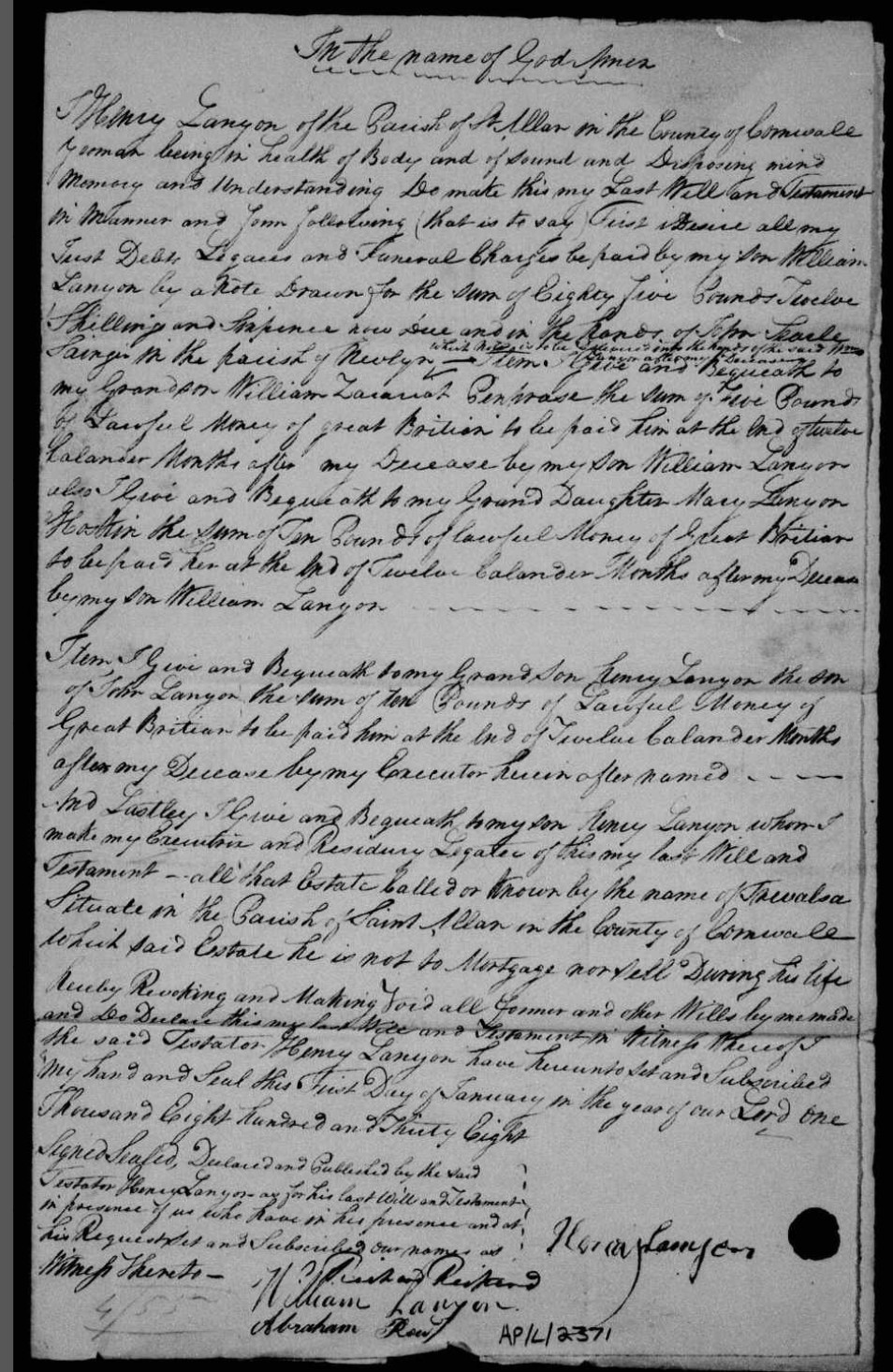
Henry left a will.
Source CRO AP/L/2371
Partial Transcript:
Debts to be paid by my son William Lanyon by a note drawn for £85 12/- 6d now due in the hands of John Searle in the parish of Newland
To my grandson William Zachariah Penprase £5
To my granddaughter Mary Lanyon Hosken £10
To my grandson Henry Lanyon son of John Lanyon £10
To my son Henry Lanyon, executor and residuary legatee of estate called Trevalsa in Par, St Allen
Proved 12 Apr 1838 Value under £450
Richard and Henry were the ancestors of hundreds of Lanyons who ended up all over the world and we’ll follow their sons in separate posts. Get ready for some complicated intermarrying!
The final branch of the Botrea tree are the sons of Thomas Lanyon 1661-1738.
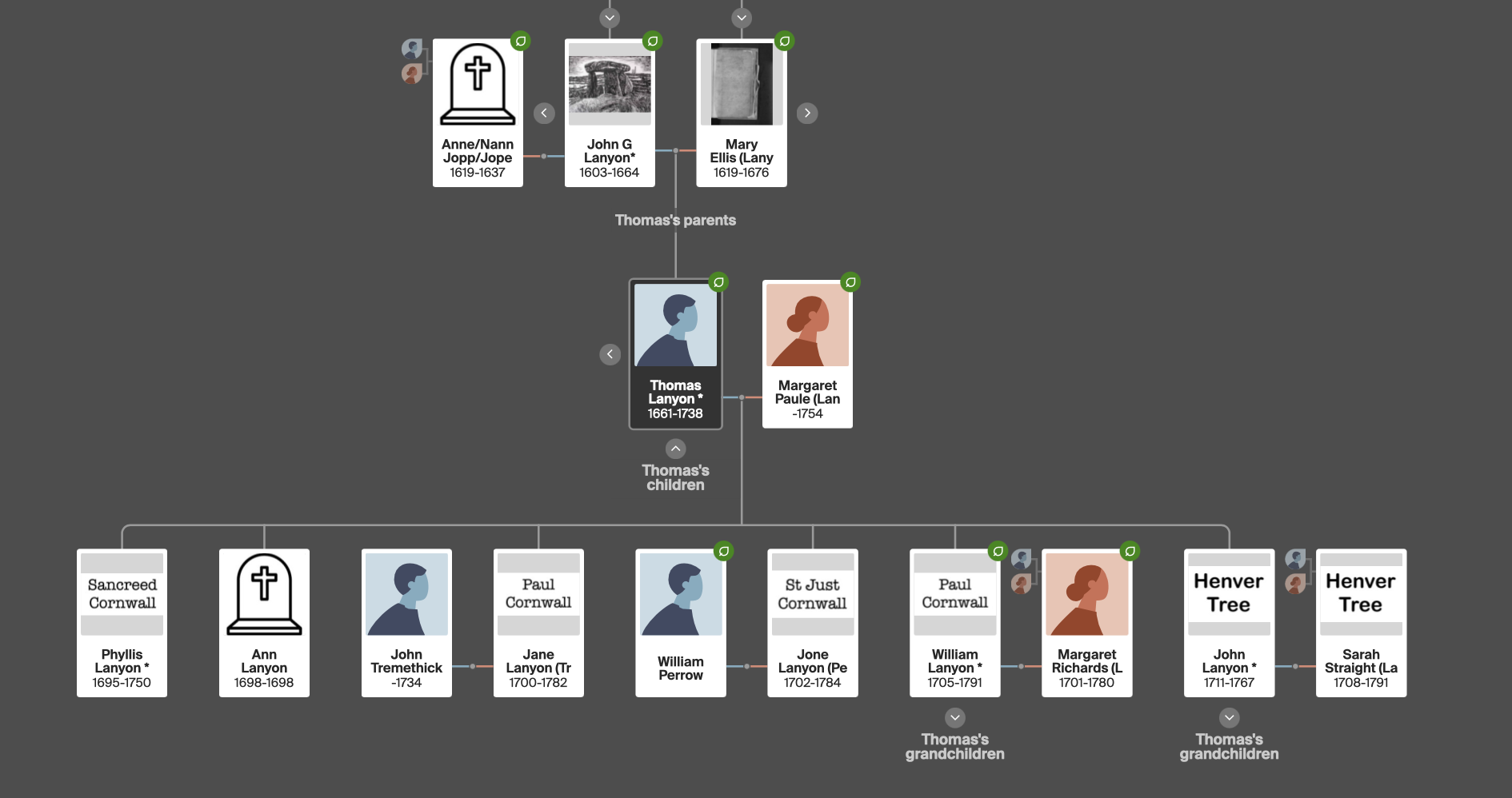
Thomas & Margaret’s tree
Thomas was just 3 years old when his father died in 1664. Of the eight children he had only William and John survived to produce their own families and carry on the family name.
John (1711-1767) married Sarah Straight and moved to St Allen in Cornwall and founded a whole new and very successful branch of the family. (See St Allen Branch). William (1705-1791) married Margaret Richards and despite living to the grand old age of 86 only had one surviving son.
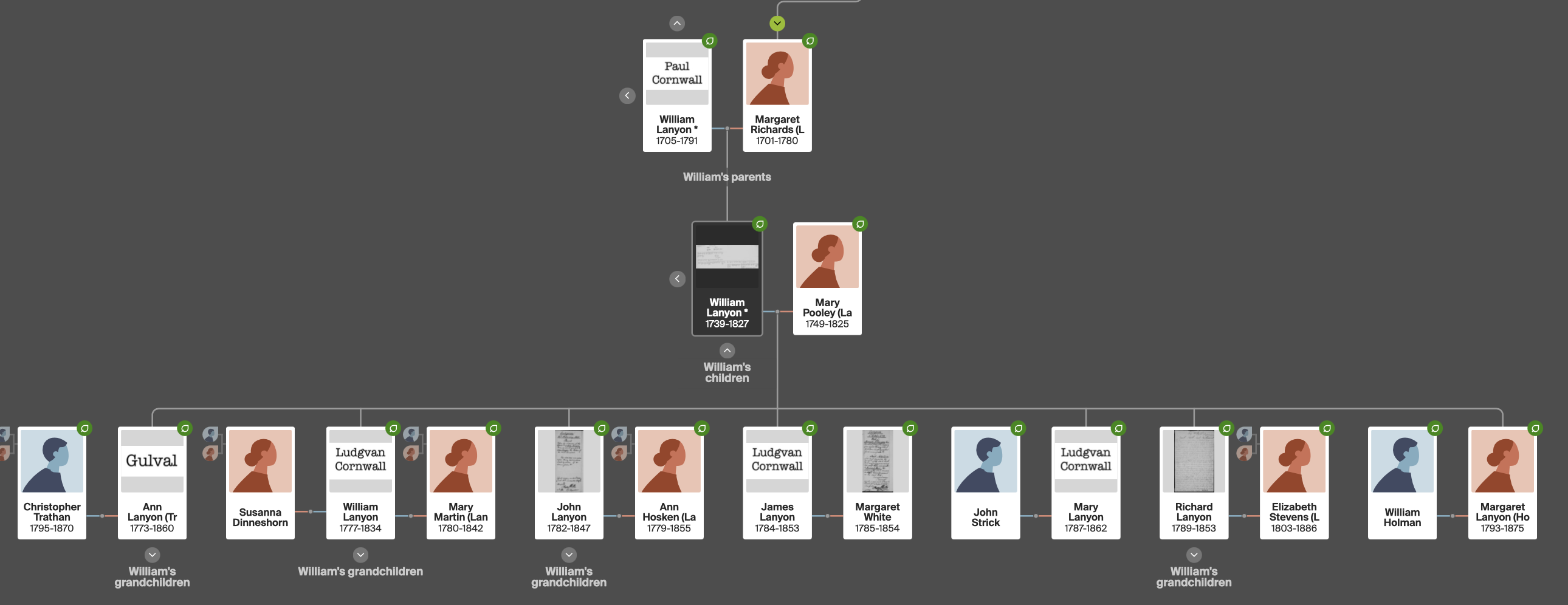
William Lanyon 1739-1827
William was born at Paul, he married Mary Pooley at Ludgvan (near Marazion) Cornwall in 1776.
Mary 1787-1862 married John Strick at Ludgvan in 1810
Richard 1789-1853
Ann 1791-1860 married Christopher Trathan, a labourer, at Gulval in 1814, one son, William Lanyon Trathan b 1817
Margaret 1793-1875 spinster
William Lanyon 1777-1834
William Lanyon’s first child was illegitimate and born to Susan Dinneshorn when he was 19. William Lanyon senior and junior were charged a £30 bastardy bond by church wardens and the parish poor law overseer for Susan’s base child. The son, George, was born in 1796 and married Ann Edmonds at Ludgvan in 1827. He died in 1829 and left a will, George Lanyon yeoman of Ludgvan – 2 guineas to my father and all the rest of my goods to my wife Ann sole executrix. There were no children of this marriage but Ann Edmonds had a daughter Grace Jennings born in 1836.
Bastardy Bond 1796 Ludgvan
William married Mary Martin in 1803 and he had a further nine children:
Juliana 1804-1877 married Matthew Trewhella 1827 – six children, emigrated to Connecticut, USA.
Margaret 1806-1887 married Jasper Allen 1834 – ten children, emigrated to Connecticut.
Mary 1806- married Richard Edmonds 1825, three children
Jane 1806-1815 died young
William Argell Perrow Lanyon 1808-1884 was a farmer, he never married but lived with his illegitimate son, Alfred Lanyon, who was born about 1856. No further trace of Alfred.
Joseph Martin Lanyon 1811-1870
Henry Lanyon 1814-1871
Jane 1815-1837 died at Rospeath (family home) age 21
James 1822-1885
Of those nine children only four sons had children of their own who carried on the Lanyon name, William, Joseph, Henry and James.
Joseph, Henry and James all emigrated to Connecticut, USA.
The Great Emigration
Between 1815 and 1915 many thousands of people emigrated from Cornwall to seek a better life. They headed to countries like the USA, Australia and South Africa. They were ‘economic migrants’. When tin mining was no longer profitable and mines closed many Cornish men moved to mining areas all over the world. As a result of the Great Emigration, there are now more than six million people of Cornish descent around the world, some of them are called Lanyon!
Three of William’s sons emigrated to Connecticut, USA.
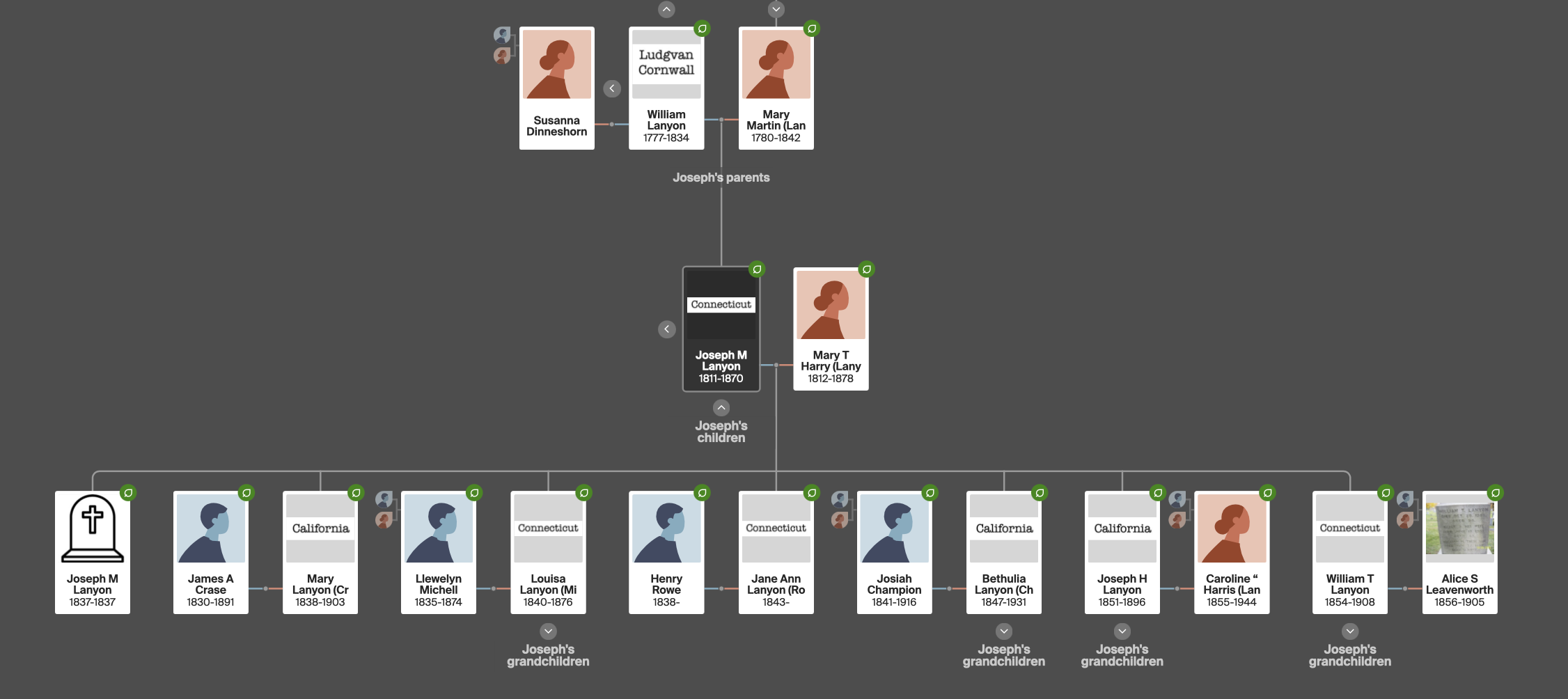
Joseph married Mary Thomas Harry in 1835 at Ludgvan and by 1844 they had emigrated to Connecticut, USA. Joseph was a miner. Their children
Joseph & Mary’s tree
Joseph Martin 1837-1837 died in infancy
Mary 1838-1900 married James A Crase in 1857 at Connecticut and moved to California. Five children.
Louisa 1840-1876 married Llewellyn Michell who died in 1874. Five children who all died in infancy.
Jane 1843- married Henry Rowe at Connecticut. One child.
Bethulia 1847-1931 married Josiah Champion in 1865. Three children.
Joseph H Lanyon 1851-1900. Married Caroline Harris. Six children.
William T Lanyon 1854-1908 a stonemason, married Alice Sophia Leavenworth. Three children.
And there we must leave Joseph Martin Lanyon’s family. His brother Henry also emigrated to Connecticut.
Henry Lanyon 1814-1871
Henry was born at Ludgvan, married Elizabeth Sarah Wills at Bath in Somerset in 1840. He died at Connecticut in 1871.
Henry & Elizabeth’s tree
Mary Jane 1841-1913 born in Gloucestershire, England – spinster who died in Canada.
Emily Millicent 1843-1927 also born in Gloucestershire. Three marriages: Nathaniel Williams – one daughter; William Taylor – eight children; John Catron – two children. She died in Pennsylvannia in 1927.
James M 1845-1903 a butcher, born in Connecticut married Emma Bristol – 2 sons Wilbur & James.
William Wills 1847-1905 married Sarah Bronson Thrall – four children. William died in Los Angeles.
Joseph M Lanyon 1849-1850 died in infancy
Arabella 1852-1933 spinster died in California
Julia 1854- no trace
Elizabeth 1856- no trace
Susan Gertrude 1858-1923 married in 1876 to Herbert Rudy Hawley – three children. Susan died in New Jersey.
Henry John 1866- no trace
James Lanyon 1822-1885
James was the third son of William Lanyon and Mary Martin. He was also born at Ludgvan in Cornwall and emigrated in the 1840s to Connecticut. There he married Lucretia Brooks in 1843. They had three children.
James & Lucretia’s tree
William J 1844-1844 died in infancy
Mary 1846-1846 died in infancy
Wesley 1848-1928 married Eleanora Harriett Allen in 1848 and they had three children.
That’s where we leave William and Mary Martin’s branch of the tree and move to his brother John Lanyon.
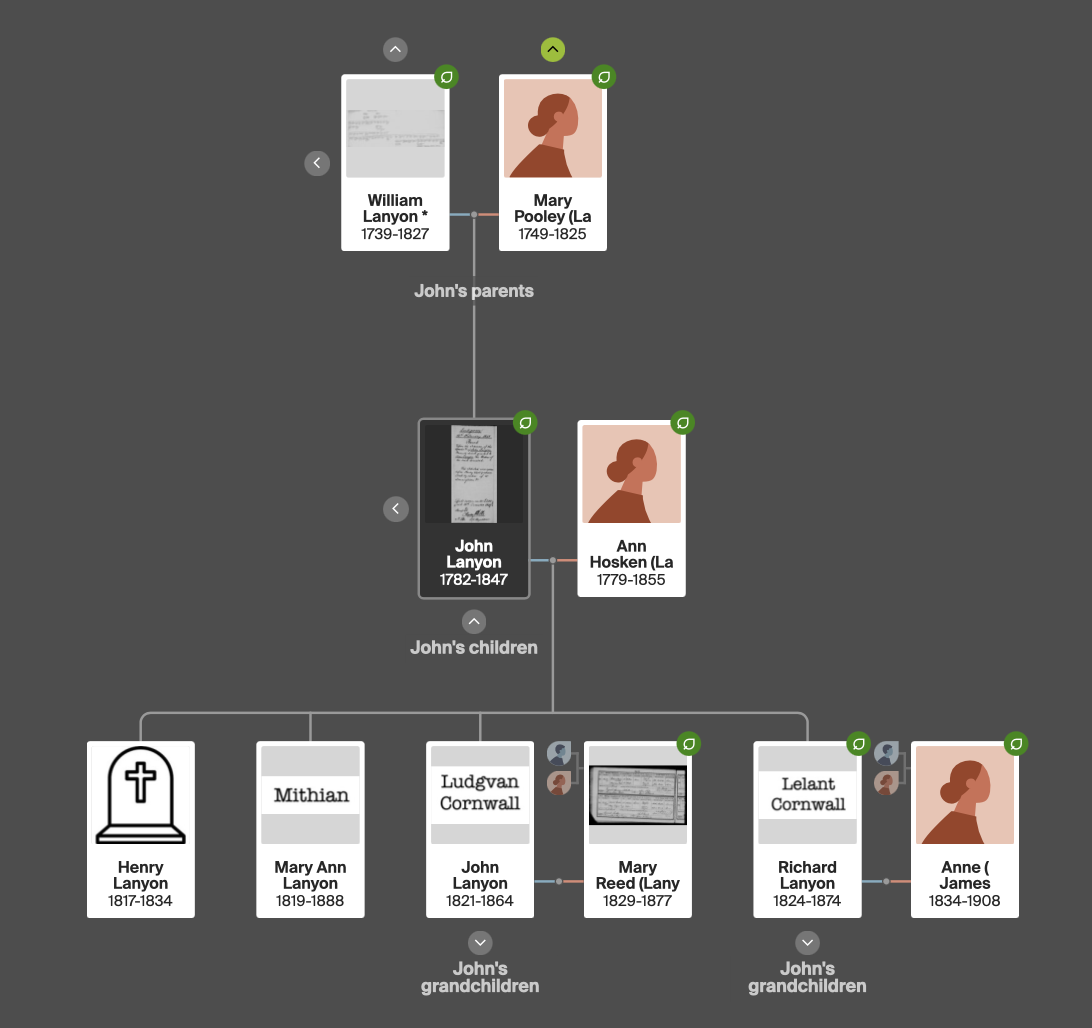
John Lanyon 1782-1847
John was a farmer and miller, he lived at Tregarthen at Ludgvan. In 1815 he married Ann Hosken. They had four children.
John & Ann’s tree
Henry 1817-1834 died young no children
Mary Ann 1819-1888 she was a spinster and died at Mithian in 1888
John 1821-1864
Richard 1824-1874
Farming-Städel Museum, PDM-owner, via Wikimedia Commons
John Lanyon 1821-1864
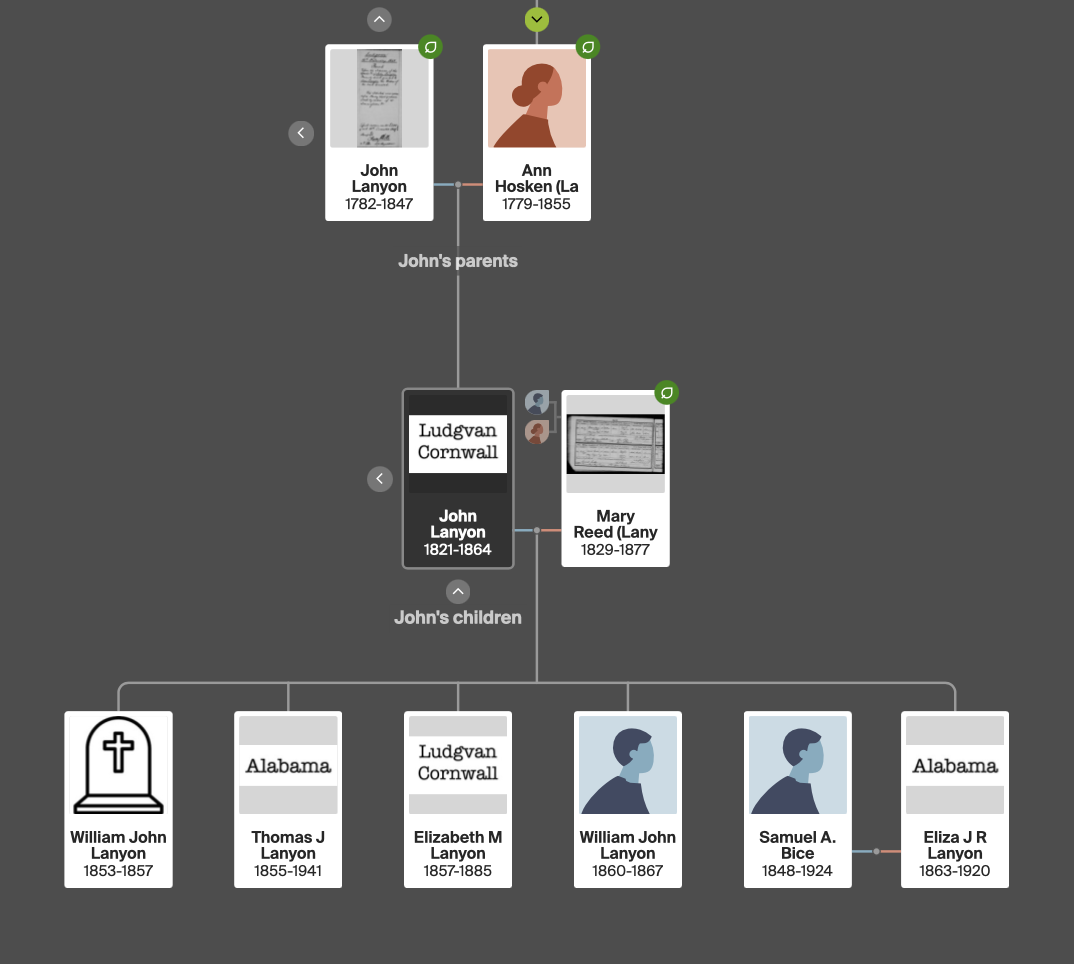
John was also a farmer at Tregarthen, he married Mary Reed at Ludgvan in 1852. He died when he was just 42.
John & Mary’s tree
William John 1853-1857 died in infancy
Thomas James 1855-1941 no trace of a marriage or children, he died in Alabama
Elizabeth Margaret 1857-1885 died unmarried
William John 1860-1867 died in infancy
Eliza Jane Reed 1863 1920 married Samuel A Bice, no children. Died in Alabama
Without any surviving children this branch died out.
Richard Lanyon 1824-1874
Richard was a farmer in 1854 he married Anne (Nanny) James. They had seven children but only one child ever married.
Richard & Ann’s tree
James 1855-1932 never married and lived with his unmarried siblings. He died age 77 at New Farm in Crowan.
Emily 1856-1916 spinster lived with unmarried siblings
Anne 1862-1870 died young
Jane 1864-1937 married John James Liddicoat – one child.
Richard 1865-1932 never married and lived with unmarried siblings
John 1867-1951 he was a farmer, he never married but was living with Maude Lanyon, a widow, in 1939.
Emma 1870-1930 spinster lived with unmarried siblings
With so many unmarried children it’s not surprising that this male line died out!
Richard Lanyon 1789-1853
We go back to William and Mary Pooley’s children. Richard was a farmer at Rospeath, Ludgvan. At Zennor, in 1826, he married Elizabeth Stevens and had eight children.
Richard & Elizabeth’s tree
Elizabeth (Betsy) Stevens 1827- married Thomas Richards no further trace
John 1829-1829 died in infancy
John 1831-1902
Mary 1833-1833 died in infancy
Mary 1835- married William Bennetts – eleven children
James 1837-1837 died in infancy
James 1839-1912
Margaret 1841-1842 died in infancy
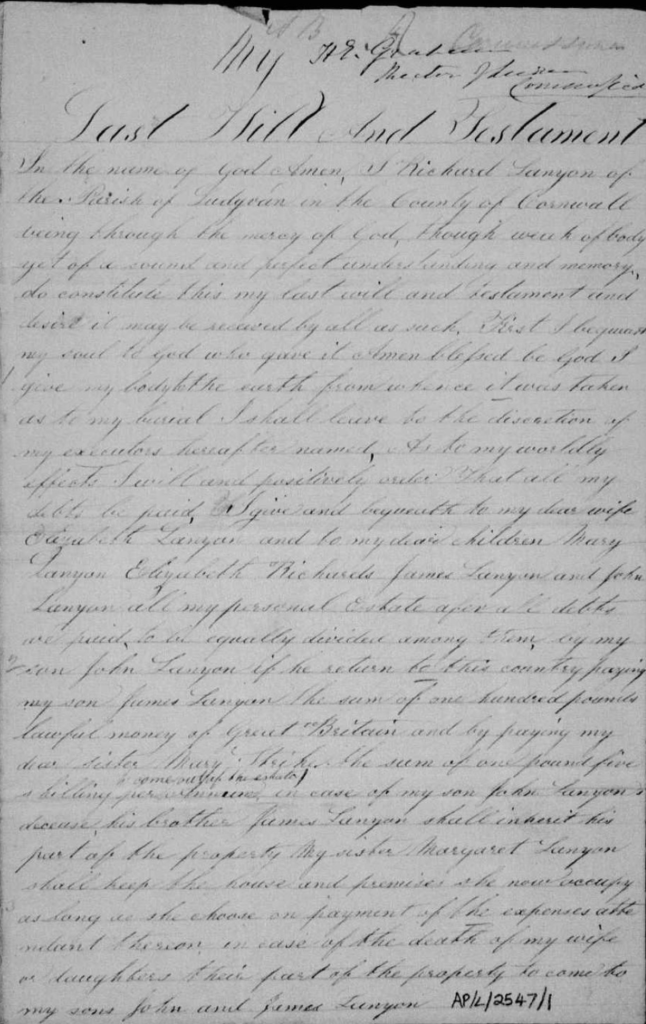
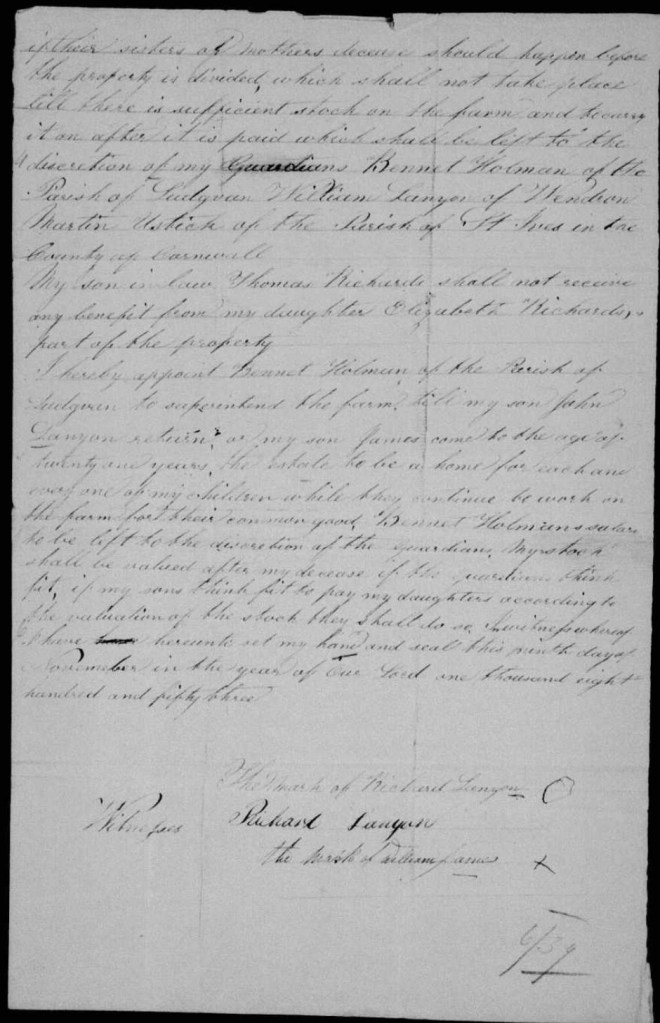
Richard died in 1853 and his will specifically excluded his son in law Thomas Richards. “Thomas Richards shall not receive any benefit from my daughter Elizabeth Richard’s part”.
Of Richard and Elizabeth’s eight children only two sons had children of their own, John and James.
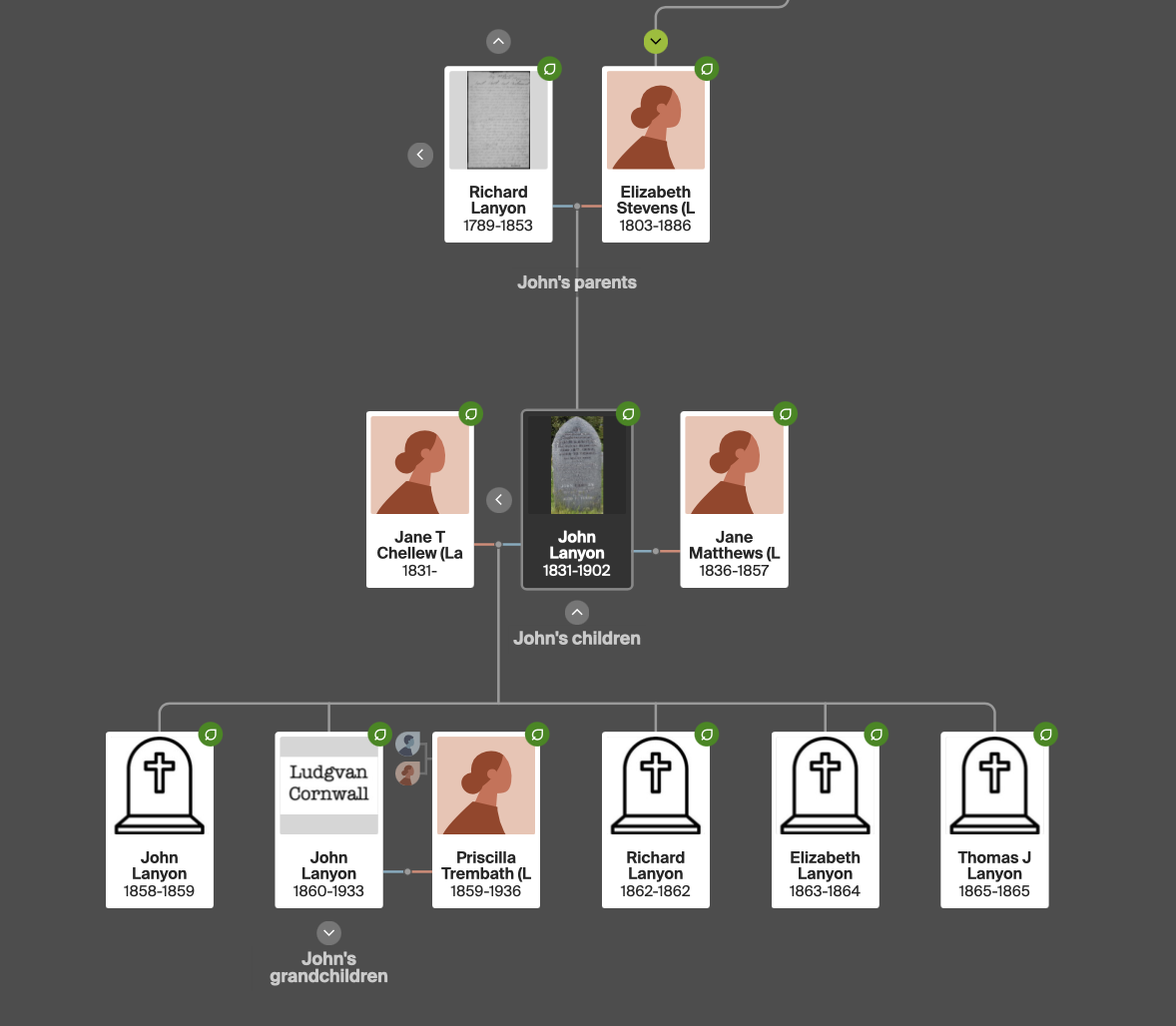
John Lanyon 1831-1902
John was a farmer at Rospeath, Ludgvan and his ‘claim to fame’ is that he had two wives, both called Jane!
John’s marriages
Jane Matthews – married Jan 1857. Jane died nine months later in Sep 1857 so it is possible she died in childbirth with their first child.
Jane T Chellew was his second wife. He married her in Jan 1858. They had five children and four of them died in infancy. Only John 1860-1933 survived. Jane died in 1869, leaving a nine year old son.
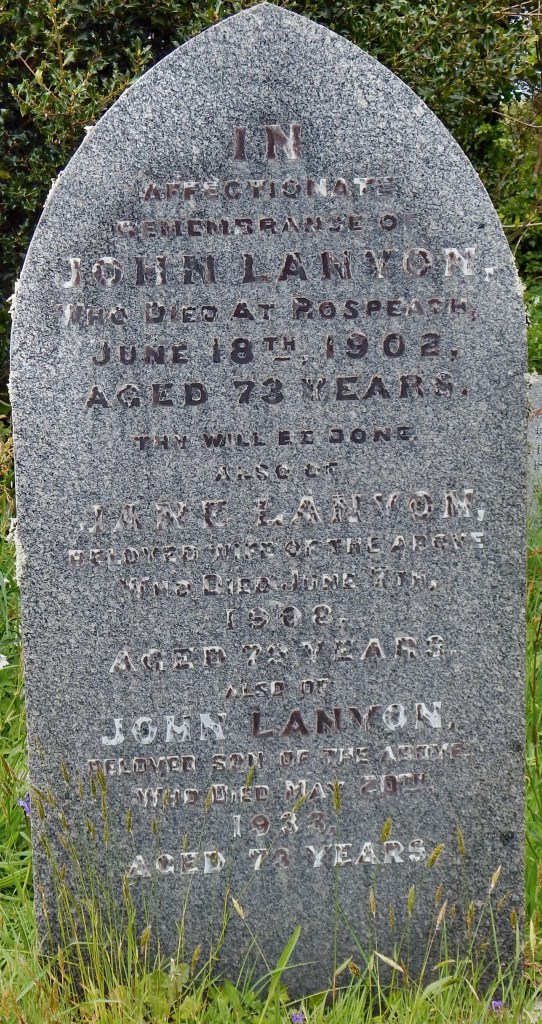
John Lanyon’s grave at Ludgvan.
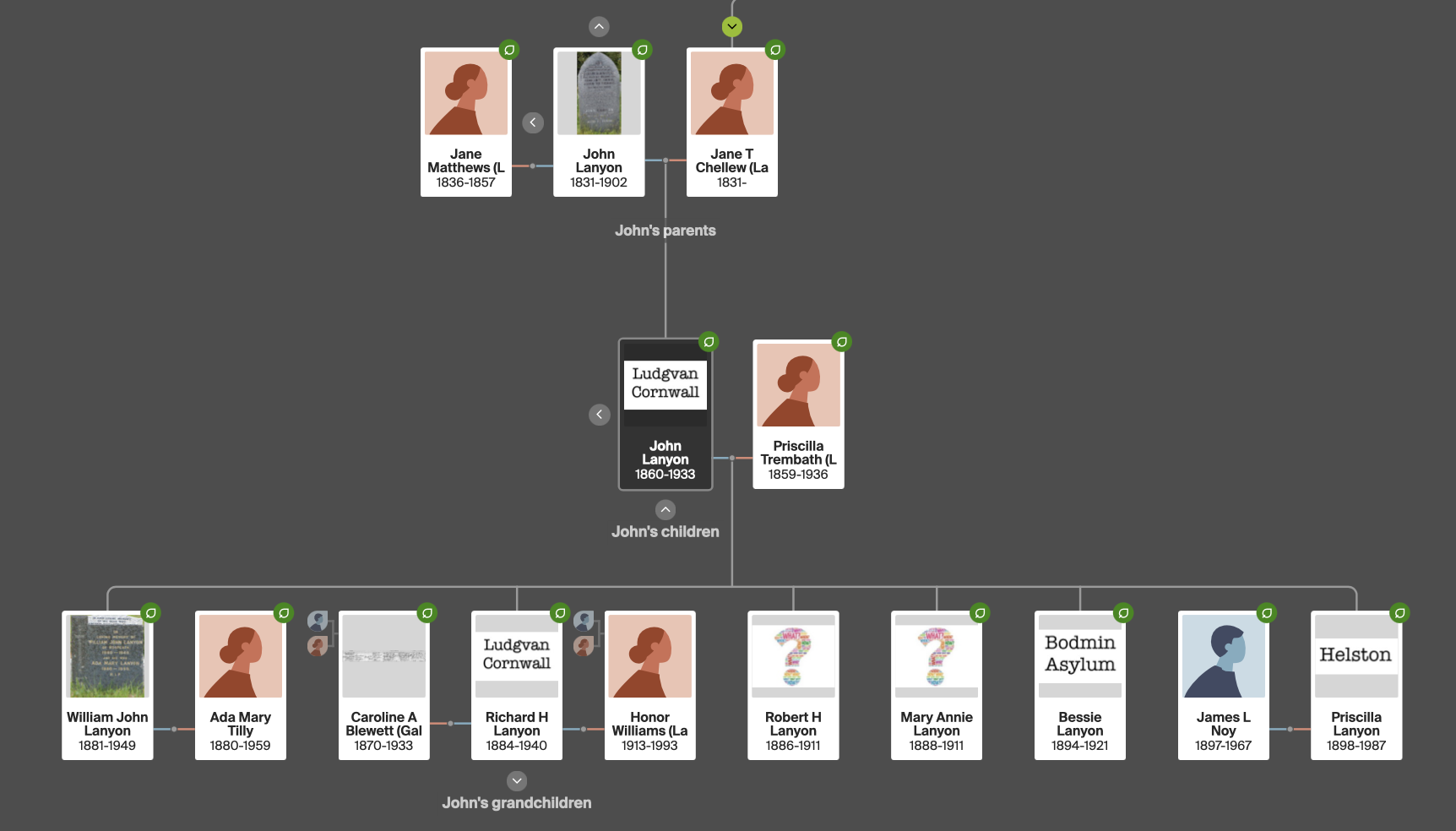
John Lanyon 1860-1933
John was baptised at Ludgvan 29 Dec 1861, the only surviving son of John Lanyon and Jane Chellew. He was a farmer at Rospeath, Ludgvan. He married Priscilla Trembath in 1883. They had six children.
John & Priscilla’s tree
William John 1881-1949 married Ada Mary Tilly – no children.
Richard Henry 1886-1940 married Honor Jeffrey – four children
Robert Henry 1886-aft. 1911 farm labourer no further trace
Mary Annie 1888-aft. 1911 no further trace
Bessie 1894-1921 bessie died at Bodmin Asylum age 27.
Priscilla 1898-1987 she married James Leonard Noy in 1931 – no children
We must leave this branch of the family here.
Bodmin Asylum – Unknown author, Public domain, via Wikimedia Commons
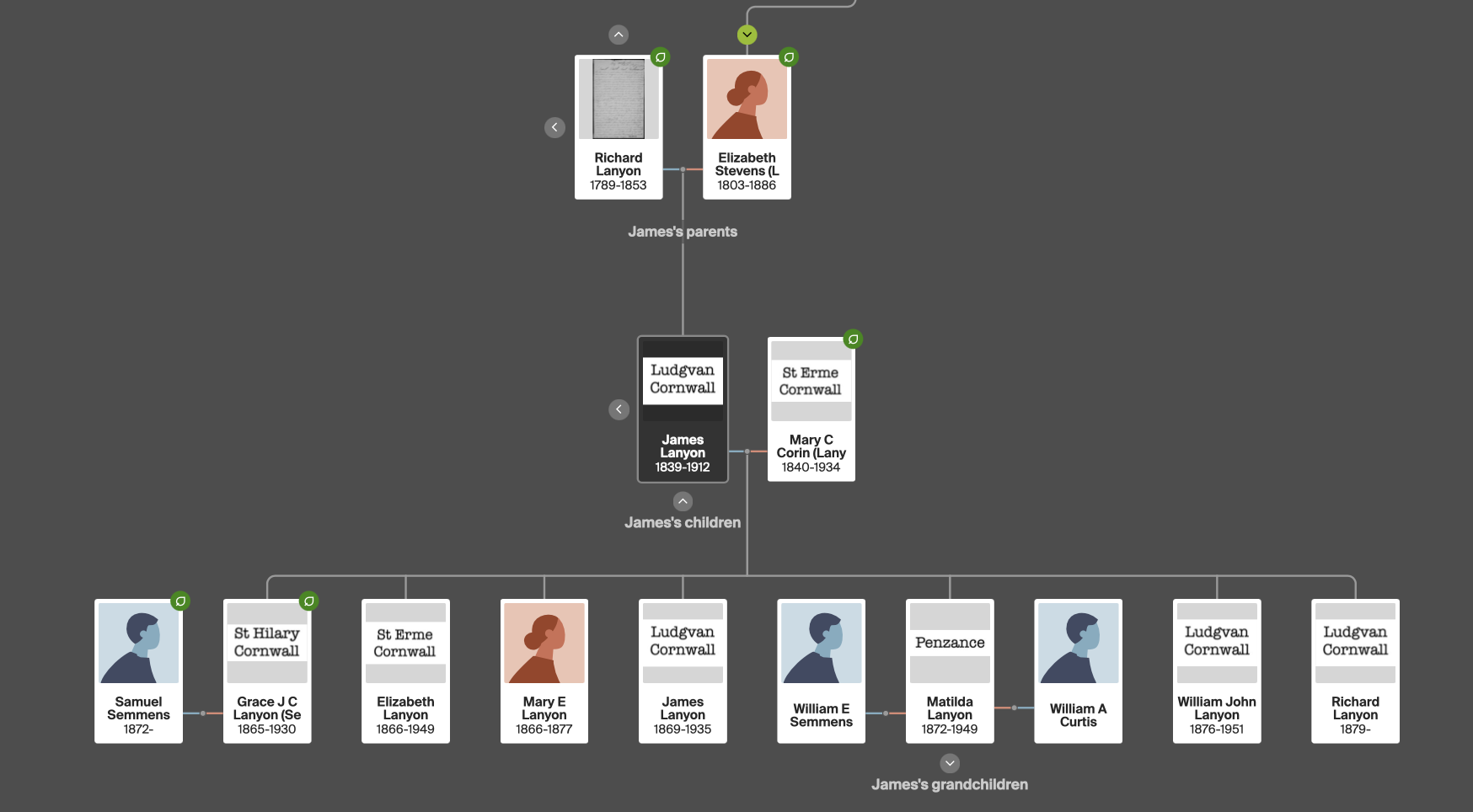
James Lanyon 1839-1912
James was the son of Richard Lanyon and Elizabeth Stevens. He worked as a farmer and a miner. In 1863 he married Mary Carlyon Corin at Ludgvan and they had seven children.
Grace Jane Corin 1865-1930 married Samuel Semmens – no children
Mary Elizabeth 1866-1877 died young
Elizabeth 1866-1949 spinster died at St Erme in 1949
James 1869-1935 bachelor of Chy Vellan farm at Ludgvan.
Matilda 1872-1949 married 1901 William Ernest Semmens – one son Ernest Semmens. Matilda married for a second time in 1923 to William A Curtis, at Penzance.
William John 1876-1951 never married
Richard 1879- never married
Yet again with so many unmarried children this branch of the tree died out.
James & Mary’s tree
In just eight or nine generations this branch of the Lanyon tree has almost died out in Cornwall due to the reluctant grooms. Why did so many of them remain unmarried?
John Lanyon and Mary Ellis had a large family but their descendants quite often left no traceable issue.
The ‘Golden’ Lanyon’s children
Francis Lanyon 1651-1725 had six sons.
Francis 1686-1723
Thomas 1691-1755
William 1693-1756
Nicholas 1695-1706 (died young)
John 1697-1738 never married
Tobias 1702-1778 never married
Only three of them, Francis 1686-1723, Thomas 1691-1755 and William 1693-1756 had sons of their own.
Francis Lanyon 1686 – 1723
Francis & Jane’s tree
Francis married Jane Edwards at Morvah in 1715. They had five children, the fifth was born following the death of Francis in 1723.
Jane 1716 – 1716
Dorothy 1717-1778 married John Tellum (three children)
Francis 1719-1730
Jane 1722-1807 – spinster
Benoni John 1723-1777 (Benoni means ‘son of my sorrow’)
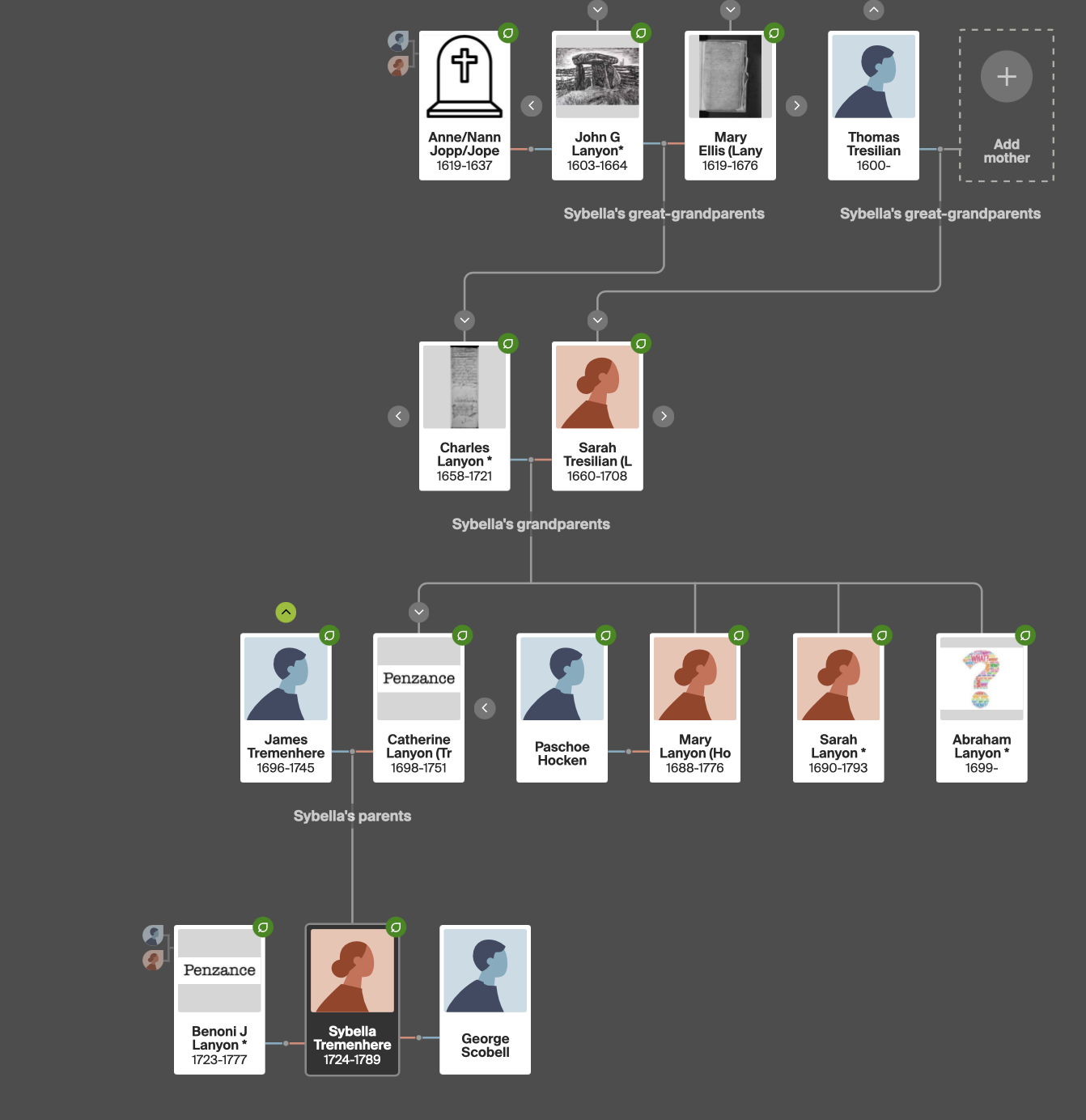
Benoni was baptised three months after his father’s death. He was an attorney and married Sybella Tremenhere, the daughter of James Tremenhere and Catherine Lanyon, a grand-daughter of John Lanyon and Mary Ellis.
Benoni John had no children.
Thomas 1691-1755
Thomas married Ann (surname unknown) and worked as a pewterer in Bristol (see separate post for his life story.) He had one son, Francis, born 1725 – no further trace of him.
William 1693-1756
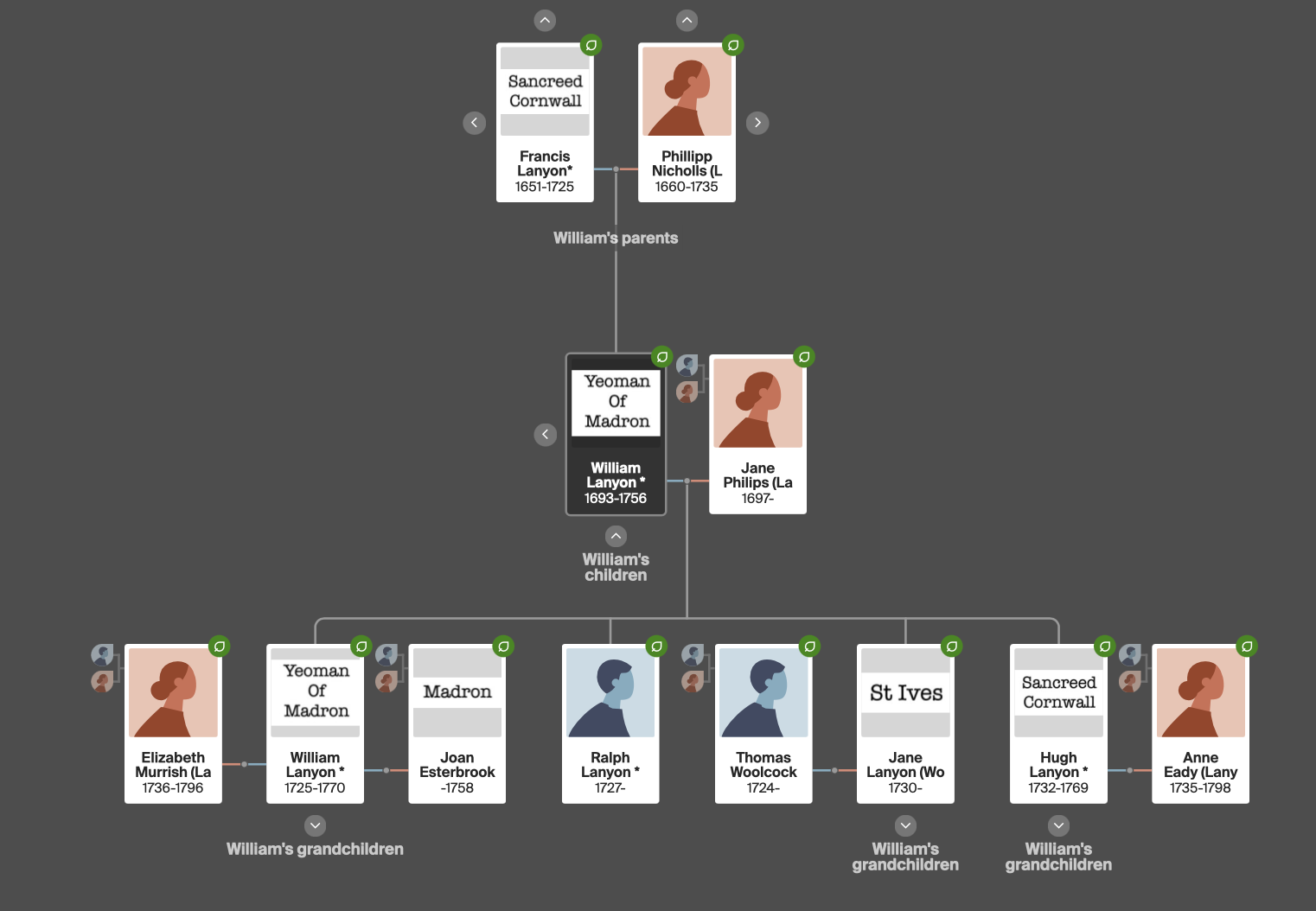
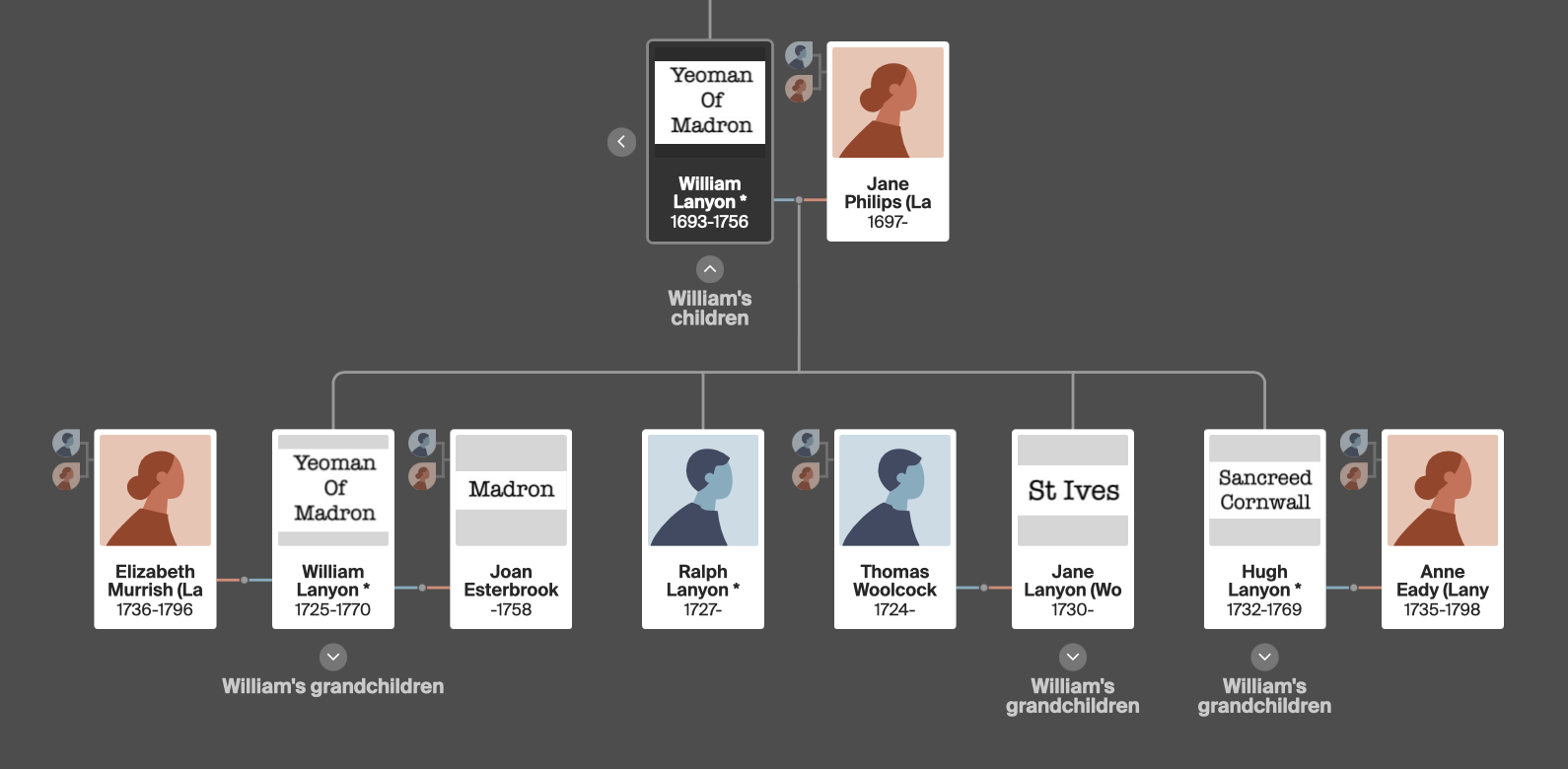
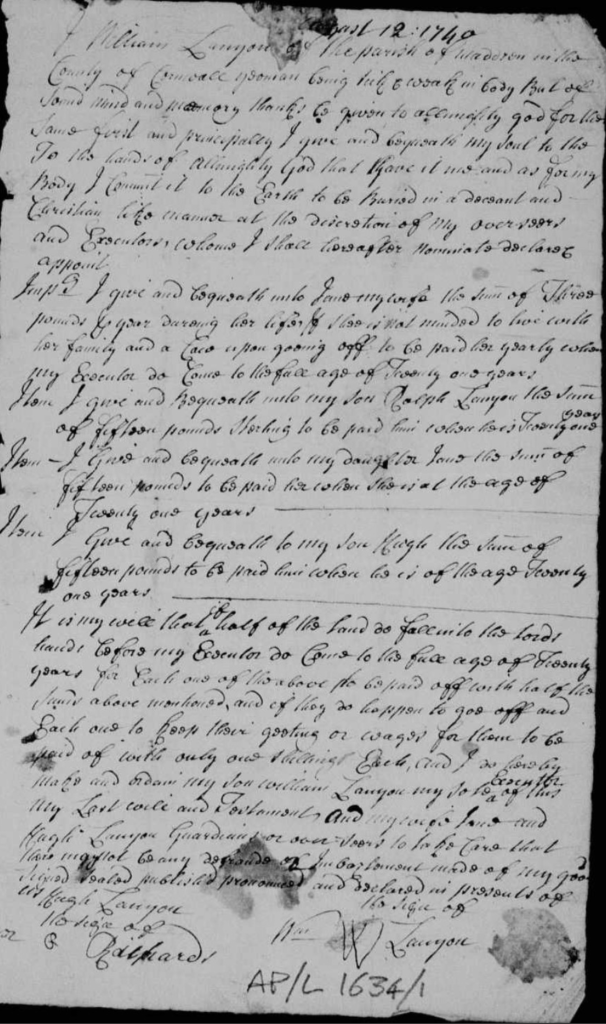
William was a yeoman of Madron and married Jane Philips at Zennor in August 1725.
They had four children:
William 1725-1790
Ralph 1727-
Jane 1730
Hugh 1732-1769
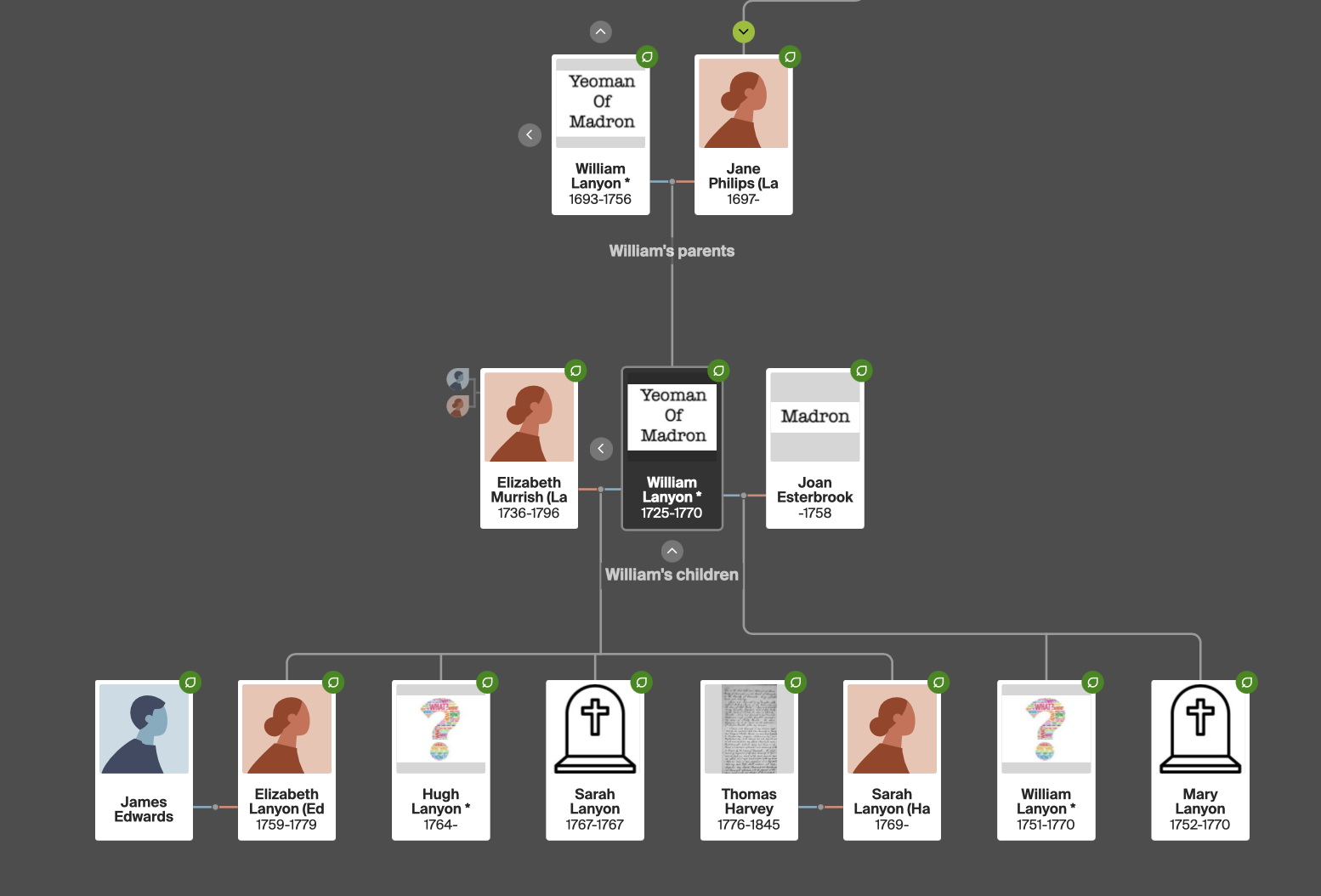
William 1725-1790
William was baptised at Zennor in February 1725. He married twice, first to Joan Esterbrook in 1751. Joan died before 1758. They had two children:
William 1751- aft 1770. William inherited the estate at Boswarthen but there is no further trace of him
Mary 1752- ? there is no mention of her in her father’s will so presumably she died young.
William then married for a second time to Elizabeth Murrish (1736-1796) on 2 Aug 1758. They had four children.
William’s tree
Elizabeth 1759-1779. She married James Edwards.
Hugh 1764- mentioned in his father’s will of 1770 but no further trace
Sarah 1767-1767
Sarah 1769- she married Thomas Harvey
There are no traceable male heirs of this line.
Hugh Lanyon 1732-1769
Hugh’s tree
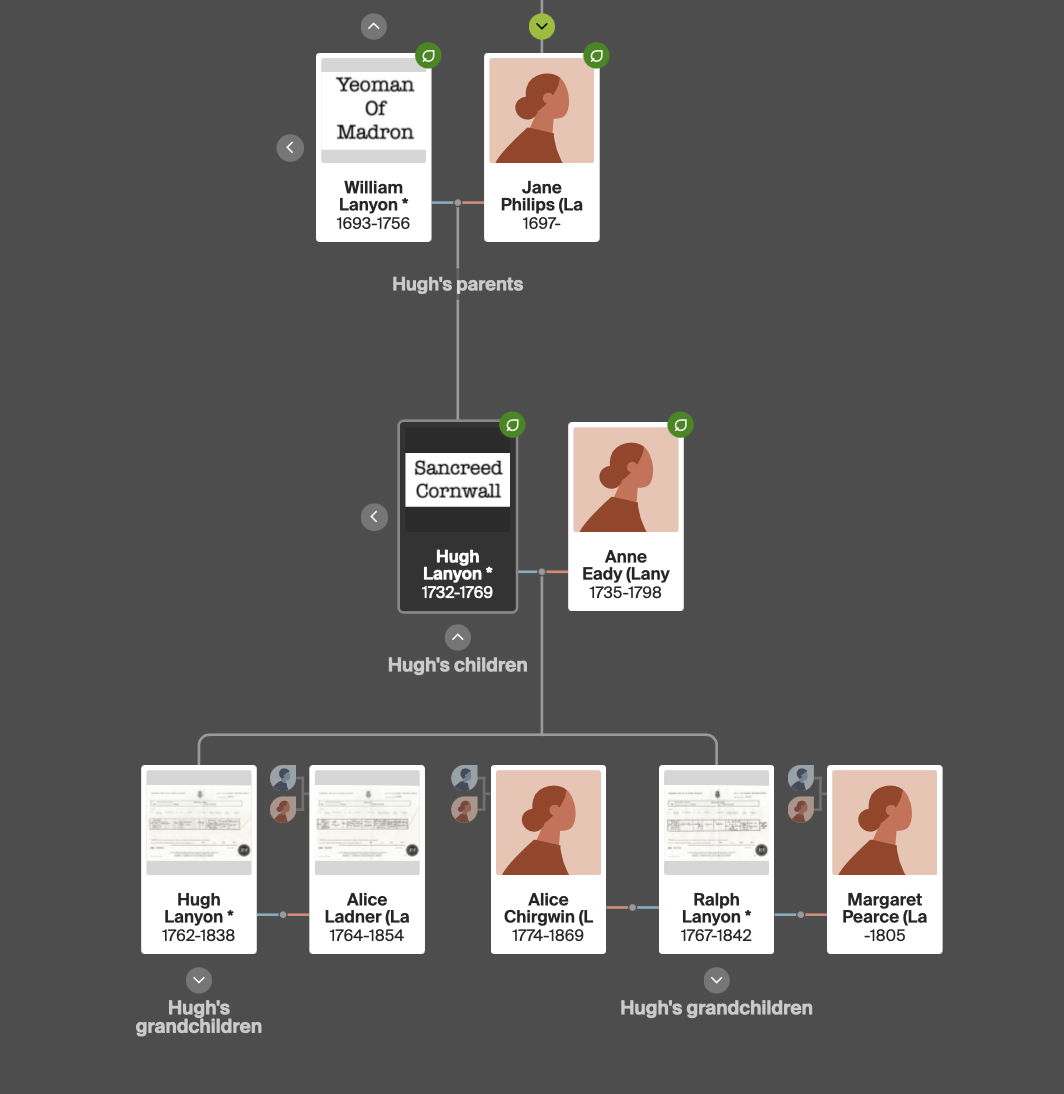
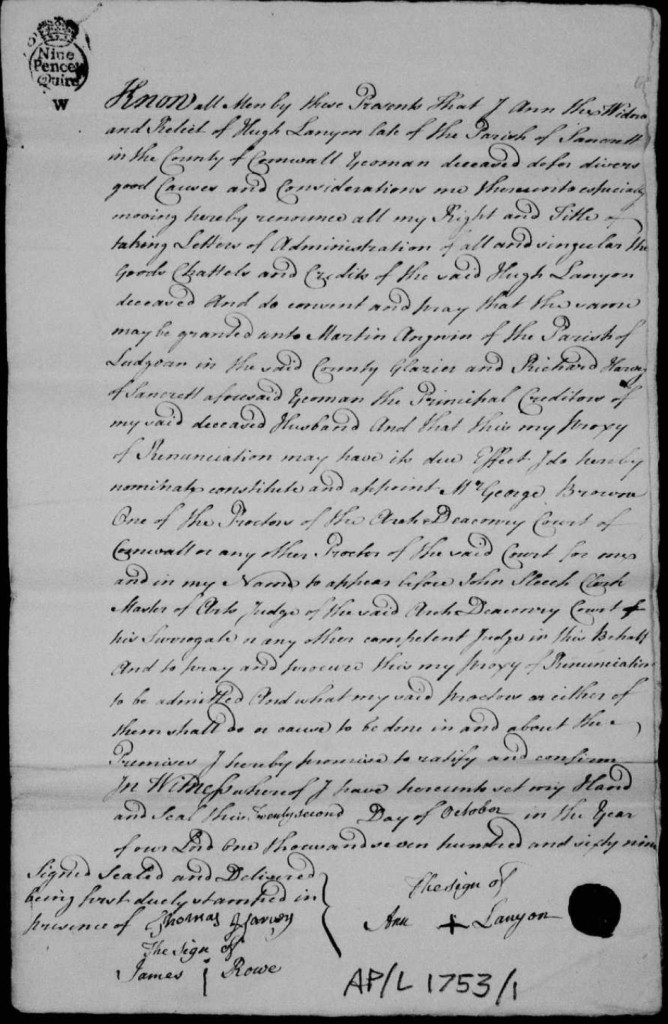
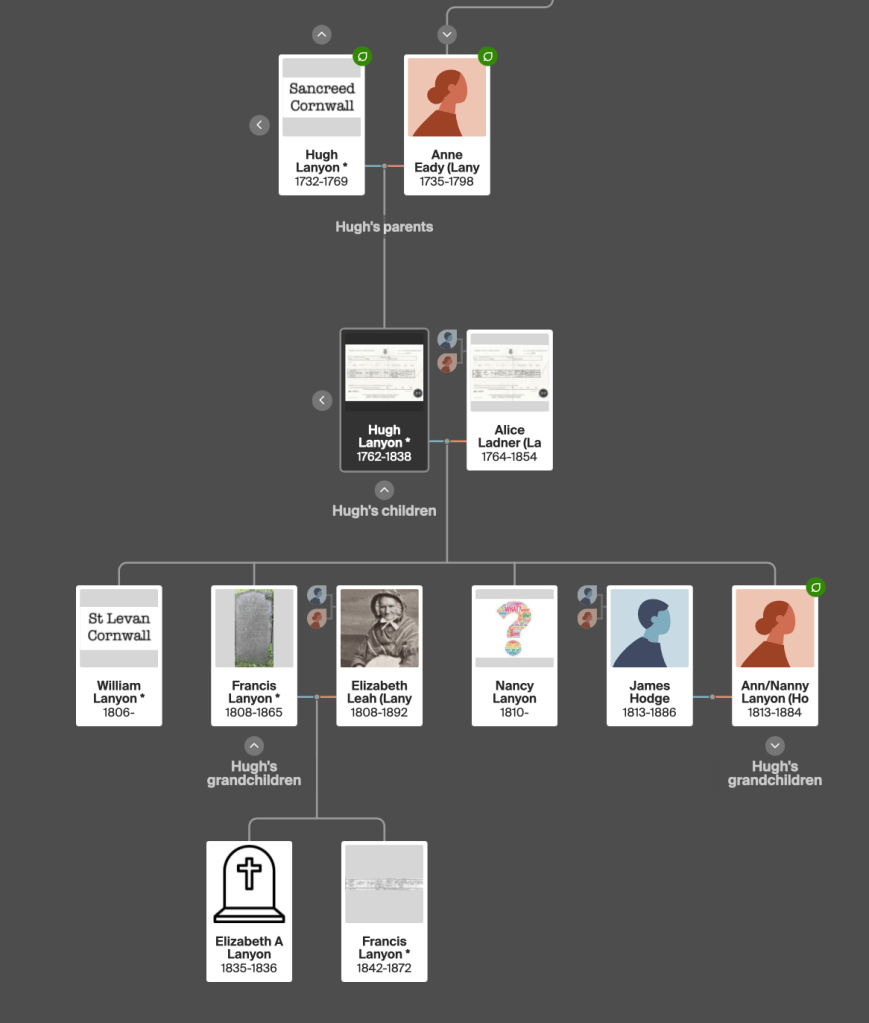
Hugh was baptised at Zennor in 1732. In 1762 he married Anne Eady at Sancreed and they had two sons, Hugh and Ralph. Hugh senior was a yeoman which meant he owned some land. Hugh died in 1769 when his youngest son was just two. He died intestate and his wife renounced administering his estate to Martyn Angwin, Richard Harvey and William Lanyon 1725-1770 (her brother-in-law) his principal creditors.
Ann renouncing Hugh’s estate – Source – CRO AP/L/1753
Hugh Lanyon (Junior) 1762-1838
Hugh and Anne’s eldest son was also called Hugh, he was baptised at Sancreed in 1762, three months after his parents marriage. Hugh was an agricultural labourer and he married Alice Ladner at Sancreed in 1805. They had four children:
William 1806- no further trace
Francis 1808-1865
Nancy 1810 – no further trace, she may have died in infancy
Nanny 1813- Nanny married James Hodge, an agricultural labourer at St Buryan in 1837 and they had 3 children.
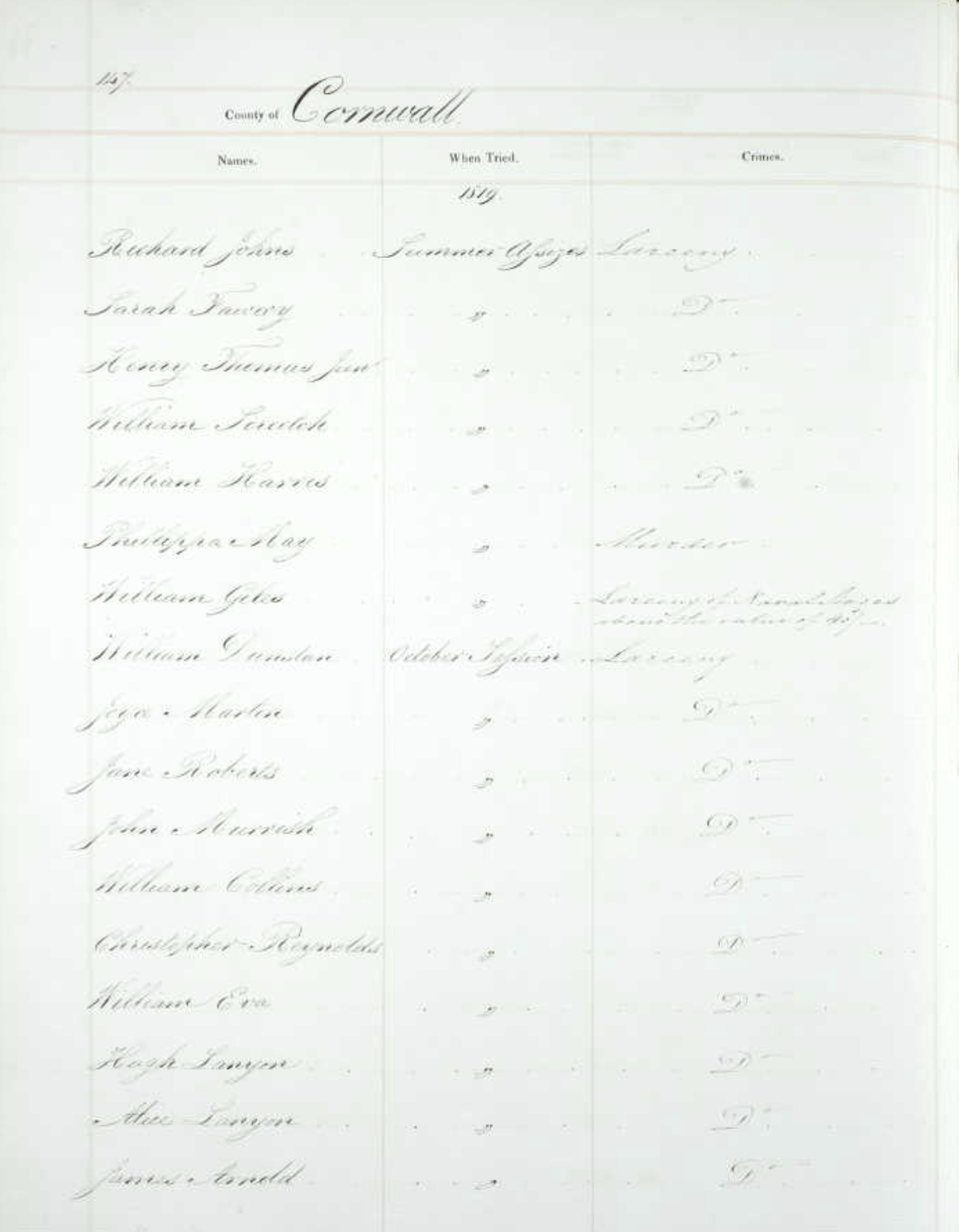
In 1819 Hugh and Alice were imprisoned for six weeks for larceny.
Criminal Register Cornwall 1819
Hugh died in 1838 at the Penzance Union Poorhouse aged 80, the cause of death was debility. Alice died in 1854 at the Union Workhouse Madron age 90.
Francis Lanyon 1808-1865 & Betsy Lanyon 1808-1892
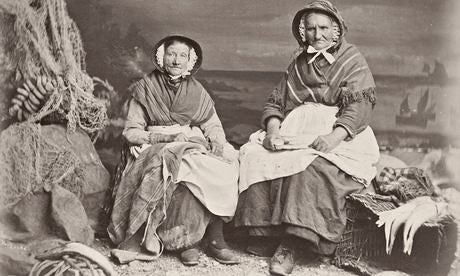
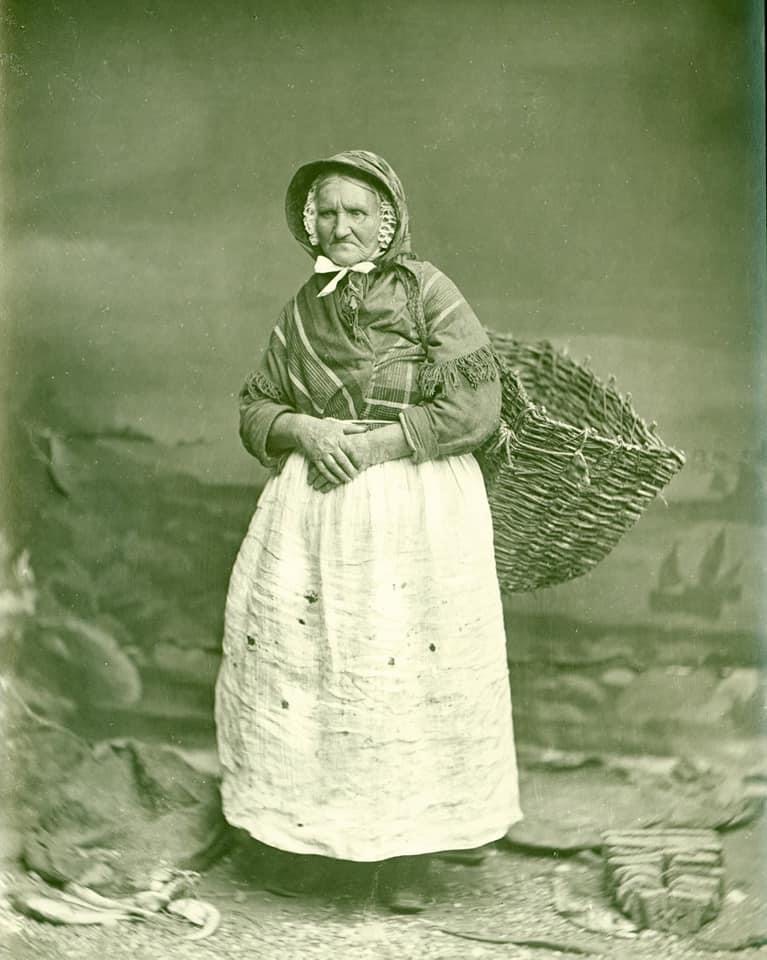
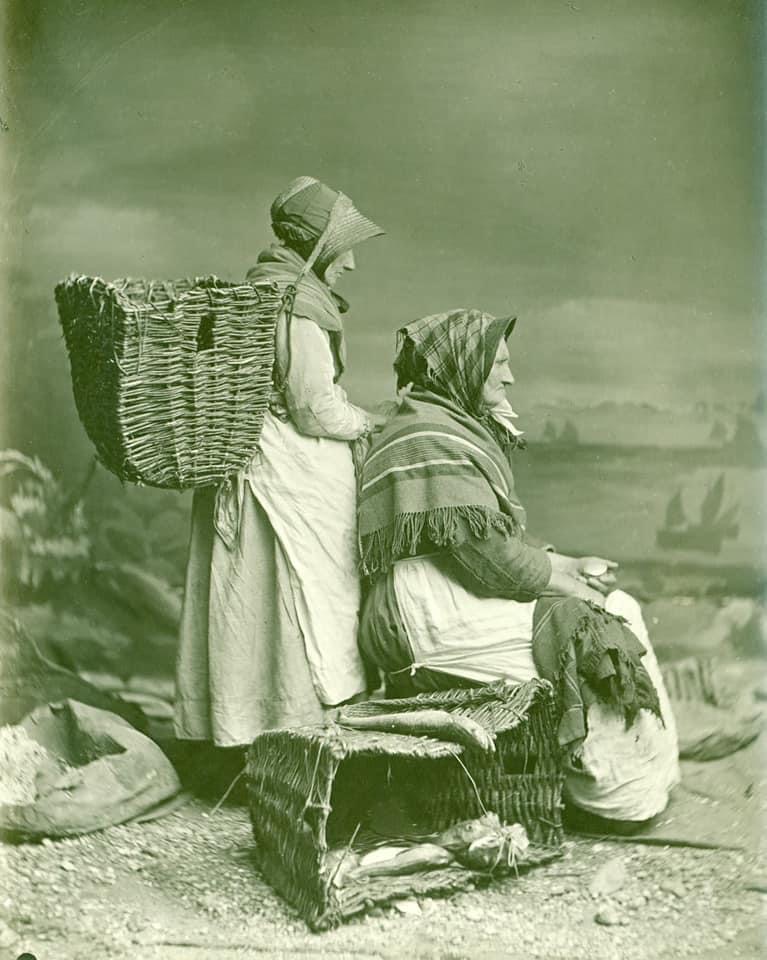
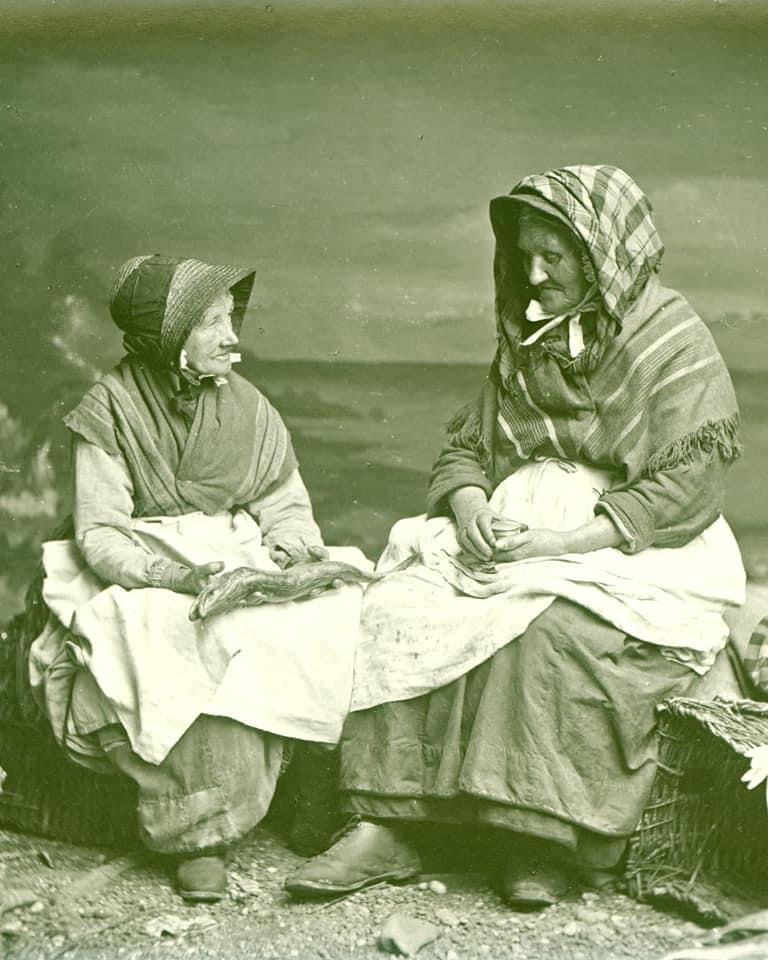
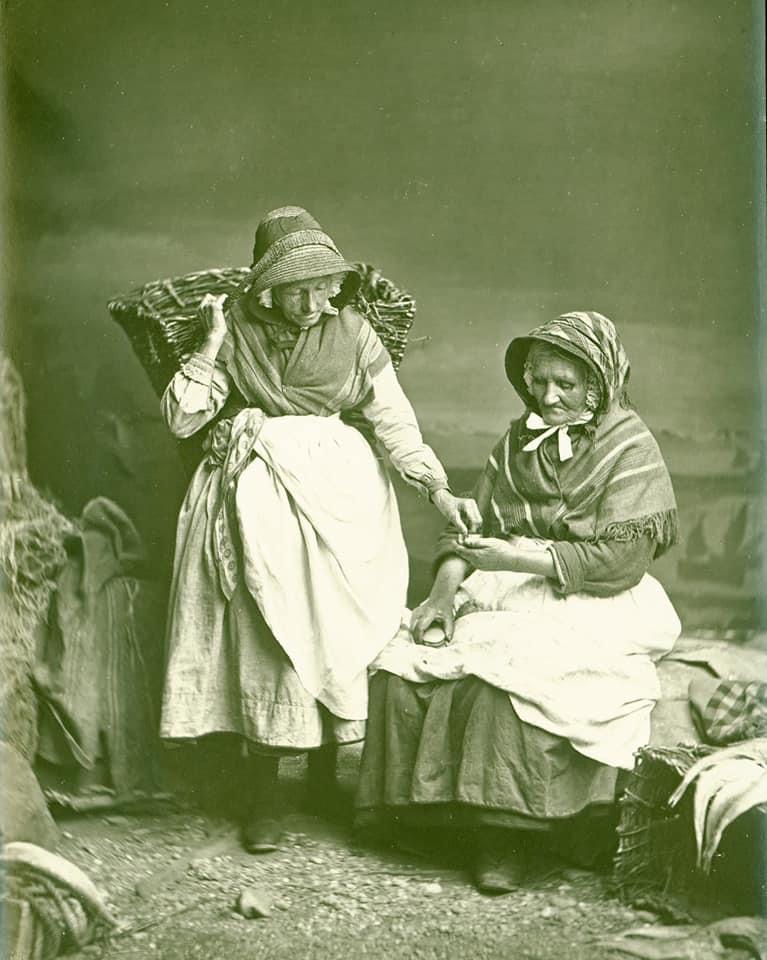
Hugh and Alice’s only surviving son Francis married Elizabeth (Betsy) Leah at Paul in 1834. Francis was a Newlyn fisherman and Elizabeth Leah was featured in a series of photographs and paintings depicting Newlyn fishwives.
Source: The photos are of Betsy Lanyon and Blanche Courtney taken in the Gibson Mount’s Studio in Penzance circa 1885. Penlee House Gallery & Museum, Penzance.
Francis and Elizabeth had three children: Grace, Elizabeth and Francis. Only Francis survived to adulthood.
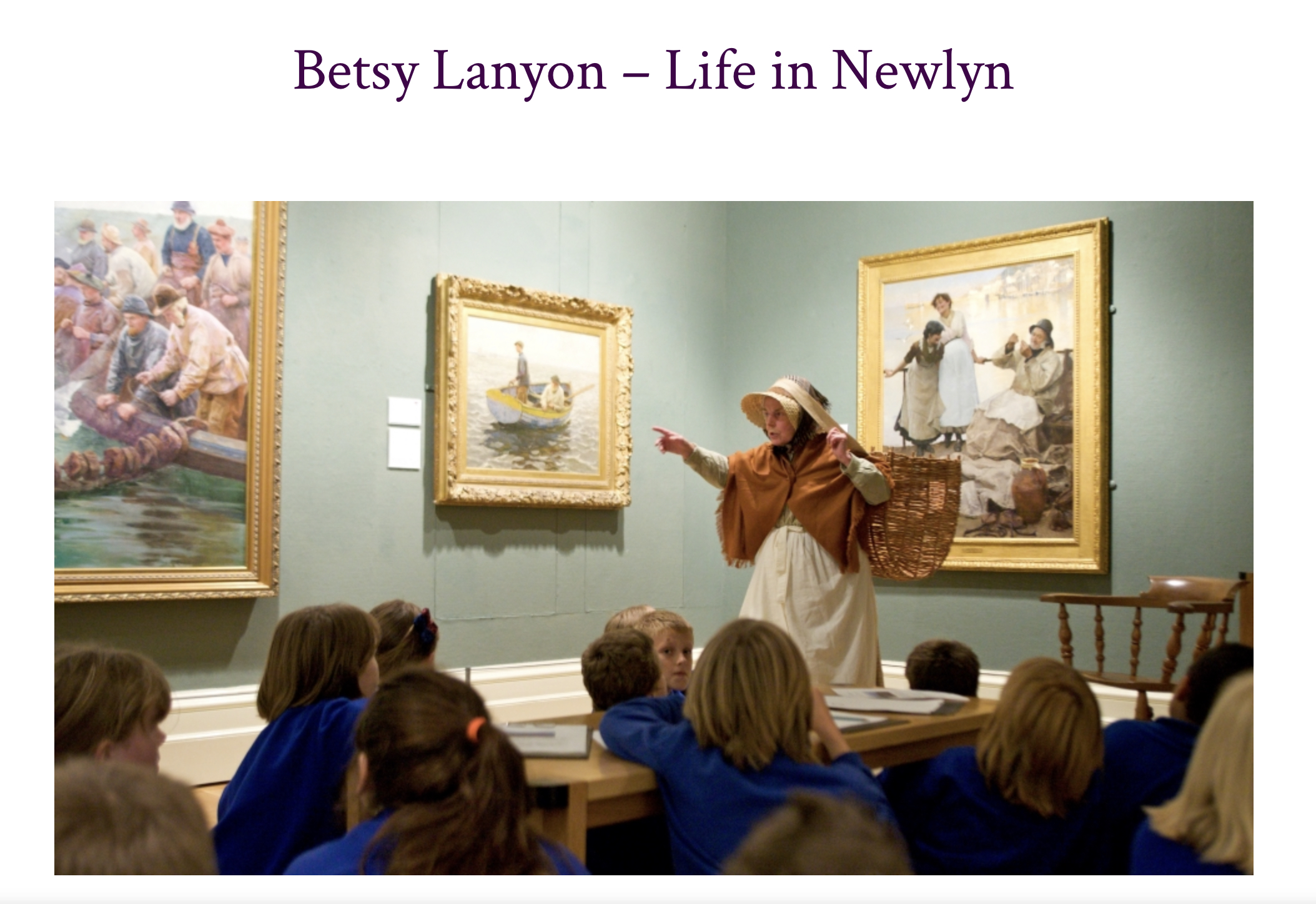
Francis senior died in 1865 and Elizabeth/Betsy died at Newlyn in 1892 but Betsy Lanyon lives on… she is now a ‘living’ part of history and talks to visitors at the Penlee House Gallery & Museum about life in Newlyn in the 19th century.
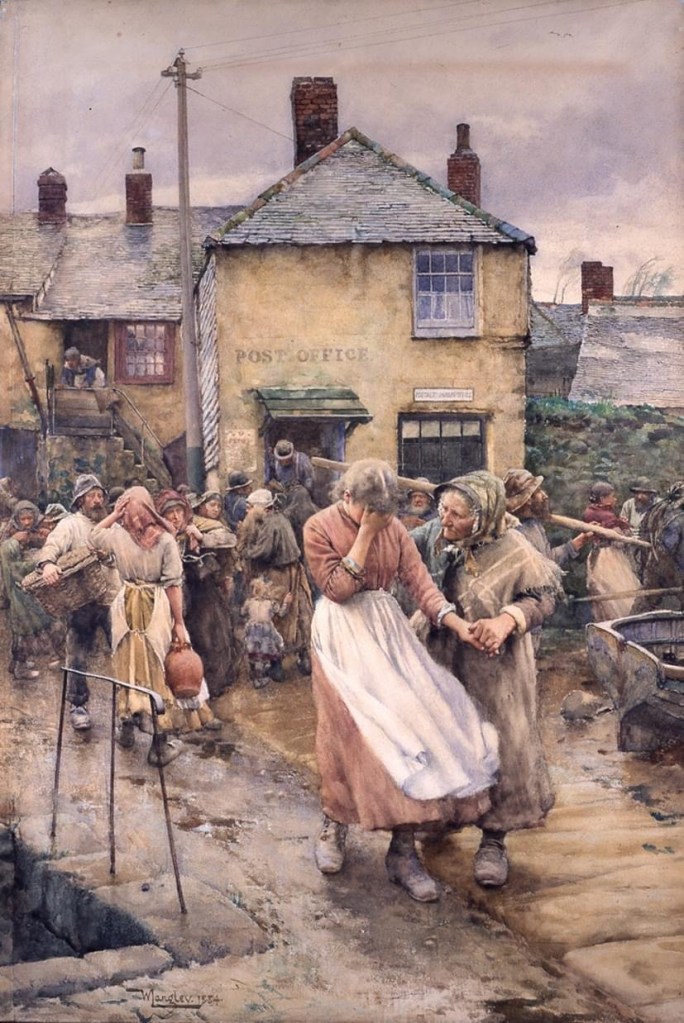
Betsy Lanyon appears to have been the model for the old woman in this Walter Langley painting. Penlee House Gallery and Museum, Penzance.
Francis Lanyon 1842-1872
Betsy and Francis’ son Francis was born at Paul in 1842. The 1871 census for Paul in Cornwall shows that he was living with his mother who was a widow and he was described as age 30 and a ‘cripple and has been for 20 years.’
In 1858 at the age of 16 Francis was found guilty of willfully destroying a tree, the property of Rev. Wm. Veale, clerk at Gulval. He was sentenced to 3 weeks hard labour or a fine of approximately 20 shillings which he couldn’t possibly pay. He had no previous convictions but was sentenced to three weeks on the treadmill. (We’ve already noted that he had been a ‘cripple’ since the age of about ten so three weeks on a treadmill was particularly harsh.)
He was described as 5’2″, dark hair, dark eyes and a dark complexion. Unable to read or write. Freckled, thick lips, scar on nose and left wrist, large eyebrows and slightly pock marked. He was already working as a labourer at Penzance. His weight on entering prison was 133lbs and 3 weeks later it has fallen to 129lbs. Bodmin Gaol was tough. (Source AD/1676/4/5).
British Library, Public domain, via Wikimedia Commons
Poor Francis died, aged 31, of Scrofulus abscesses (scrofula was TB of the lymph nodes in the neck) and diarrhoea. His mother Betsy lived for another 20 years.
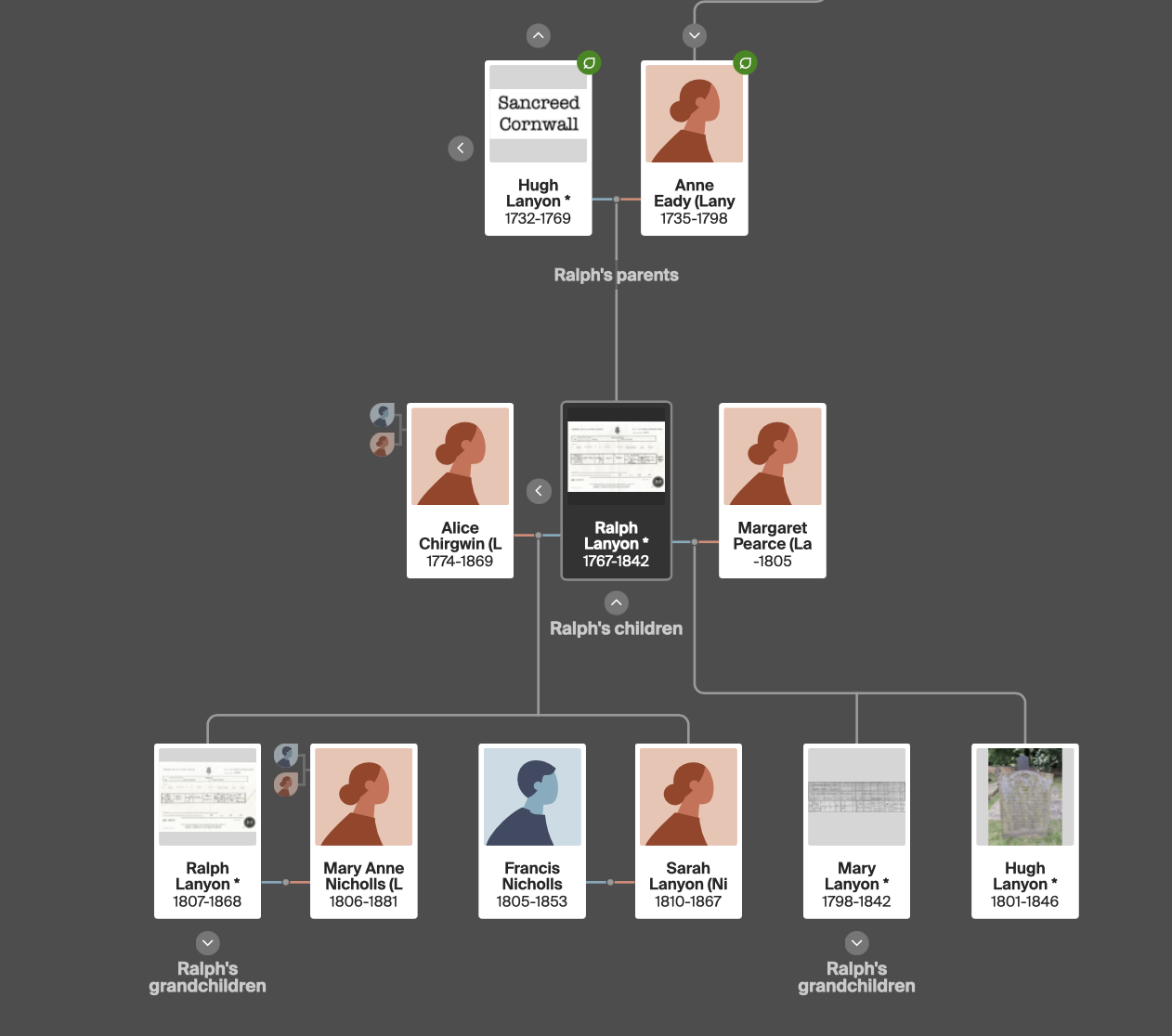
Ralph Lanyon 1767-1842
Ralph was the younger son of Hugh Lanyon and Anne Eady. He worked as an agricultural labourer. His first marriage was to Margaret Pearce in 1796 at Paul. There were two children from this marriage.
Mary 1798- 1842 Mary had 3 illegitimate children: Mary Ann 1825, James 1830 and Matilda Bluett 1834-1841. No further trace of the first two children. She died age 46 of TB.
Hugh 1801-1846.
Hugh Lanyon 1801-1846
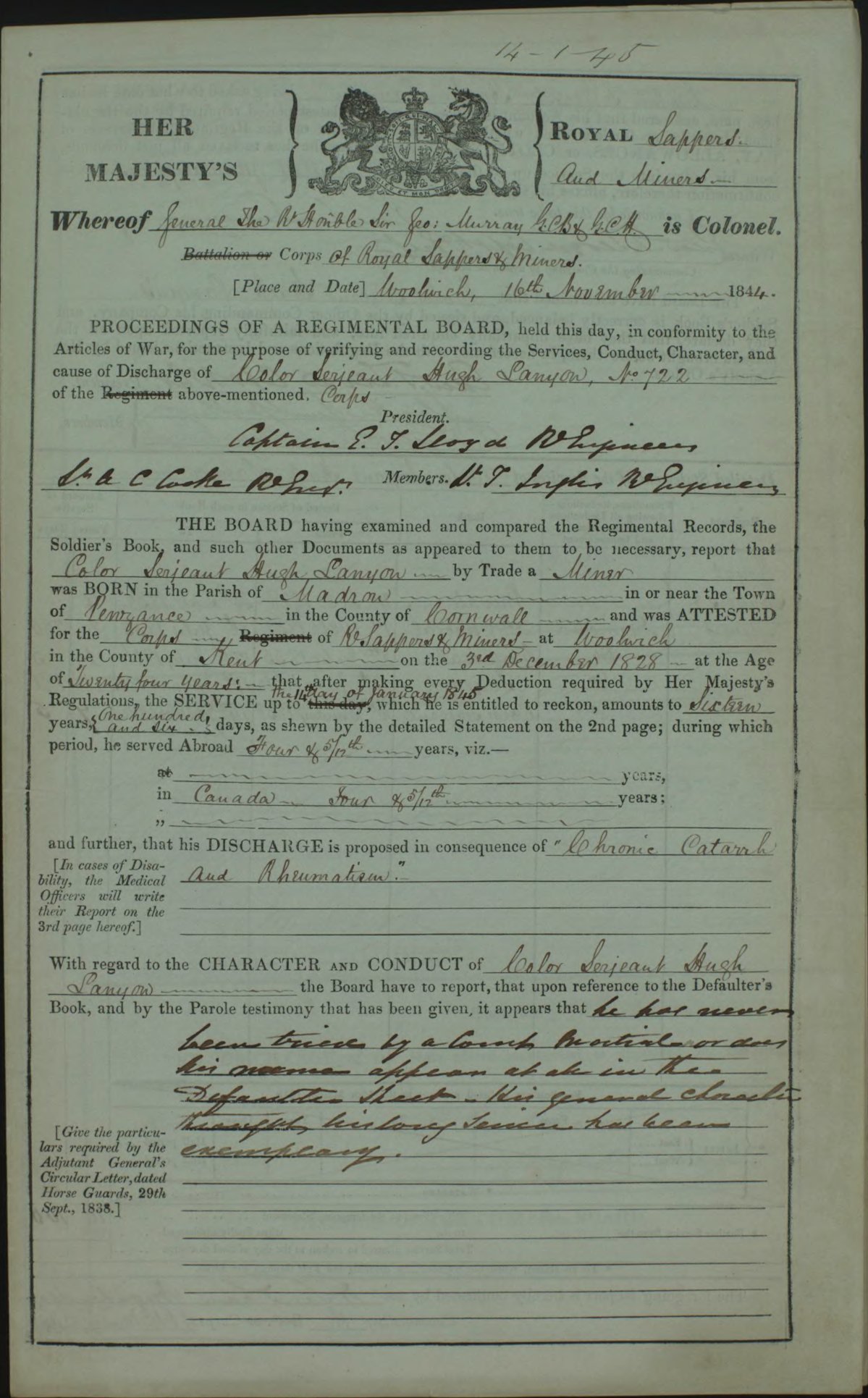
Age 24 Hugh enlisted in the army. He was a Colour Sergeant in the Royal Sappers & Miners. While bound for Vera Cruz in the ship ‘Cambria’ he helped rescue 551 of the passengers and crew of the ‘Kent’ an East India ship which caught fire in the Bay of Biscay in Feb 1825. Connolly, in his ‘History of the Royal Sappers and Miners’ p309, writes of him ‘Sergeant Hugh Lanyon, after Sergeant – Major Forbes’ removal, was appointed to the charge of the detachment at Sandhurst College, and carried on the file details in every way to the satisfaction of the authorities. For many years, as a private and non-commissioned officer, he worked at the College, and his example had the best effect on the successive parties with which he served. As a practical sapper he was one of the ablest and most skilful in the corps, and in the rapidity with which he threw up earth works was unsurpassed. Sir Charles Pasley has done him the honour by noticing the extraordinary labours of the sergeant in his ‘Practical Operations for a Siege’. His willing ness and ability in this respect covered, in great measure, his educational deficiencies. In charge of the detachment he displayed his usual industry and exertion, kept his men in perfect discipline and order… so effectively were all the instructions carried out, that the governor of the college, with the sanction of the Master-General, presented him in November (1837) with a case of drawing instruments bearing an inscription ‘flattering to his zeal and services.’ Shortly afterwards he was promoted to colour-sergeant and served in Canada during the rebellion. Somewhat broken in health he was discharged in 1844 and became a surveyor on the Trent and Mersey Canal, working under James Forbes. He died in 1846 at Lawton in Cheshire. He was a ‘remarkable man with rather more brawn than brain one suspects‘ (P.A Lanyon-Orgill). Connolly recounts a story about him while building a stockade at Mississawra in Canada in 1842; ‘six men complained to him of the heavy task they were subjected to in removing timbers about 15 feet long and 12 inches square….Lanyon made no observation, but shouldered one of the unweildy logs and, to the amazement of the grumblers, carried it to the spot unassisted.’In 1843 he was in Ireland and was sent to explore a sewer running into the Liffe river which might provide a means of entry into Dublin Castle. ‘He did so and found that a strong iron grating existed in the passage, which would effectually prevent the supposed entrance. In this duty, being much exposed to the influence of noxious vapours, he soon afterwards was seized with fever and jaundice, which shortened his days.’ (Connolly). He never married or had any children.
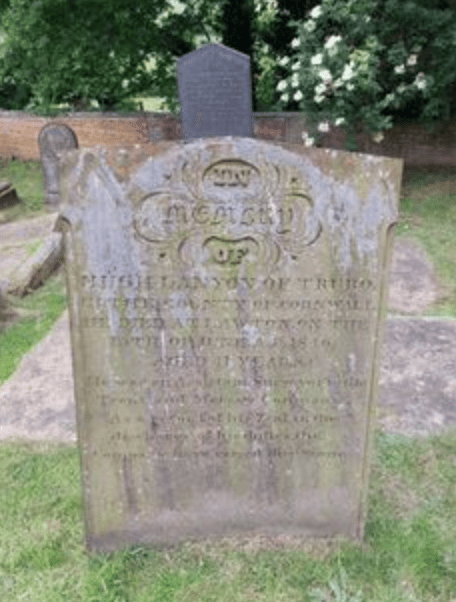
HUGH LANYON OF TRURO, in the county of Cornwall. He died at Lawton on the 15th of June A.D. 1846: Aged 41 years He was an Assistant Surveyor to the Trent and Mersey Company. As a record of his Zeal in the discharge of his duties the Company have raised this stone.
Ralph senior married for a second time in 1805 to Alice Chirgwin 1774-1869. There were two children from his second marriage:
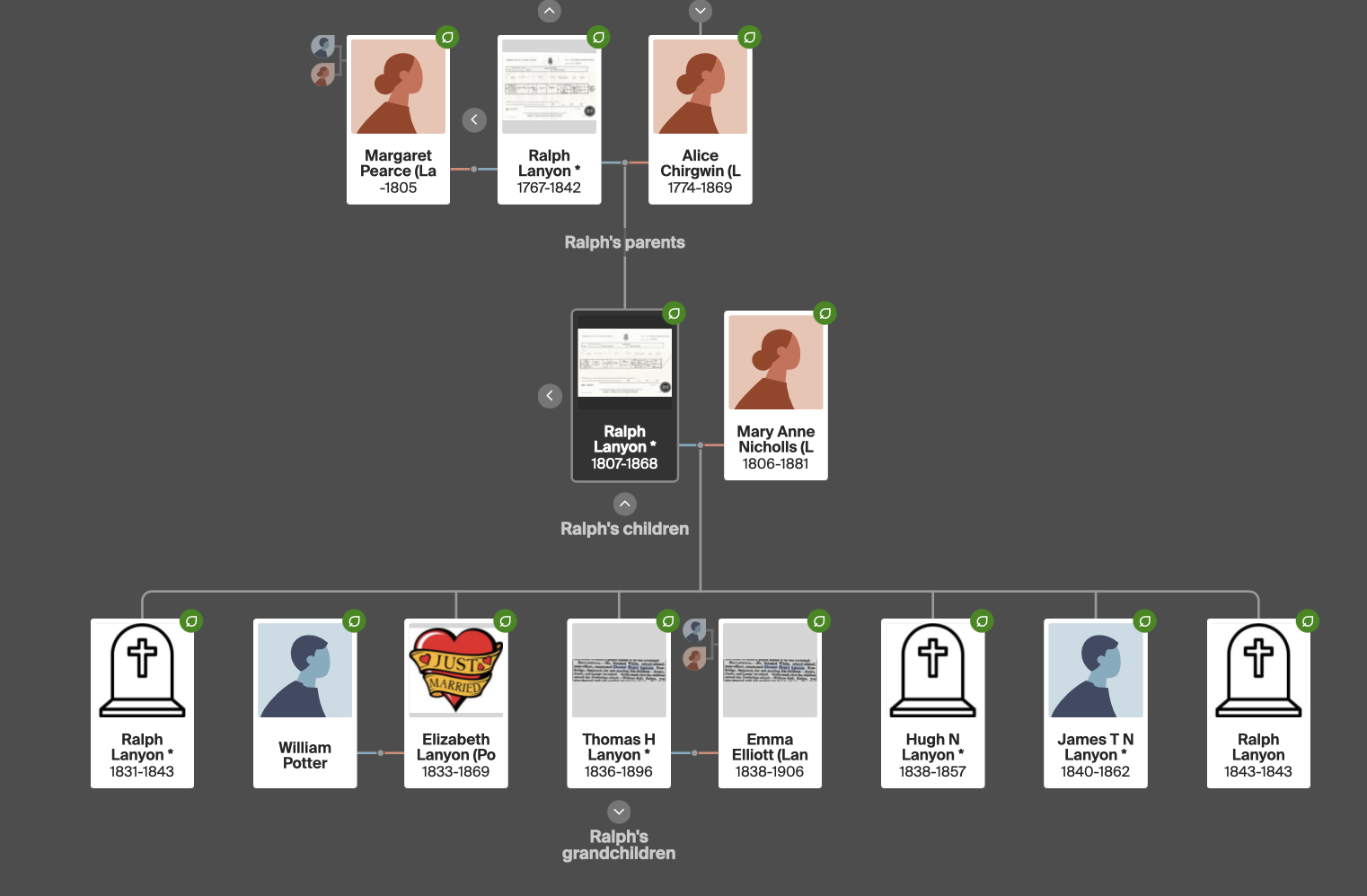
Ralph 1807-1868
Sarah 1810-1867 married Francis Nicholls in 1827 and they had four sons.
Ralph senior died at the Penzance Union Workouse in 1842. He was a pauper and suffering from TB. Alice his wife died at Lelant in 1869, she was still working as a labourer age 64.
The family has come quite a way from the days of the ‘Golden Lanyon’ and his great wealth.
Elizabeth 1833-1869. Elizabeth was a dressmaker and a charwoman. In 1869 she married William Potter, a widower. She died whilst on honeymoon (of nephritis and congestion of the lungs) at Portsea and William was a widower for a second time!
Hugh 1838-1857, Hugh died age 20.
James 1839-1862 he was a tin miner like his father and died of TB age 22.
Thomas Henry 1840-1896
Ralph 1843-1843 died in infancy
Ralph died in 1868 of TB. Tuberculosis was very common at this time and, whilst it could affect anybody, it was particularly rife amongst the poor who lived in cramped conditions.
Thomas Henry Lanyon 1840-1896
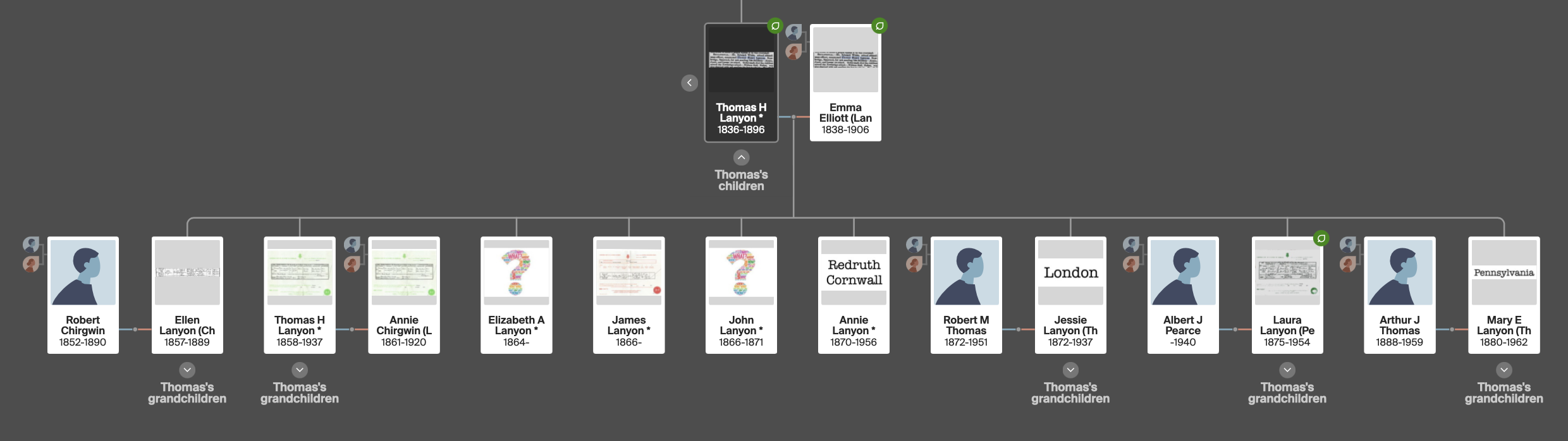
Of the six children of Ralph and Mary only Thomas had children of his own. He married Emma Elliott and they had nine children.
Thomas & Emma’s tree
Ellen 1857-1889 She married Robert Chirgwin in 1879, they had two children but Ellen died in 1889 and Robert in 1890 leaving their children orphans. They were split up and taken in by separate families.
Thomas Henry 1858-1937
Elizabeth 1864- she was on the 1871 census but after that there was no further trace
John 1866-bef. 1871 died in infancy
James 1866-1935 he worked as both a tin miner and a farm labourer, no marriage or children traced
Annie 1870-1956 she worked as a dressmaker and never married
Jessie 1872-1937 in 1896 she married Robert Molesworth Thomas and they had two daughters
Mary Eveline 1880-1962 she married Arthur James Thomas in 1911 and they had a child
Laura 1888-1954 in 1906 she married Albert James Pearce and they emigrated to Pennsylvania in the USA.
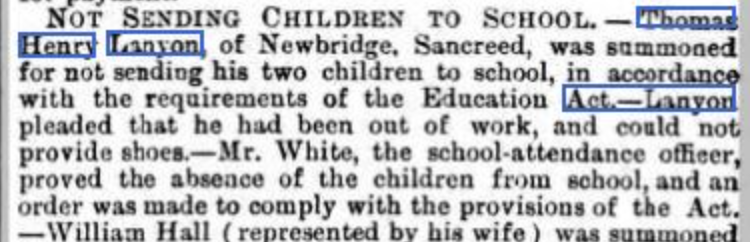
Thomas Henry was fined for not sending his children to school, he explained that he couldn’t afford shoes for them which shows how poor they were. In 1877 Thomas was imprisoned for debt in Bodmin Gaol. Source: AD 1676/5/2
1879 newspaper cutting-Petty Sessions Nov 1879
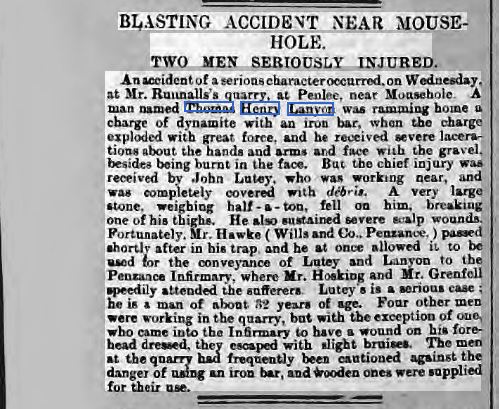
Thomas was also seriously injured in a mining accident. Mining was a dangerous occupation but often it was all that was available.
Cornish Telegraph 15 Jan 1878
Cornish Miners – John Charles Burrow (1852—1918), Public domain, via Wikimedia Commons
Out of nine children only one son had children to carry on the family name.
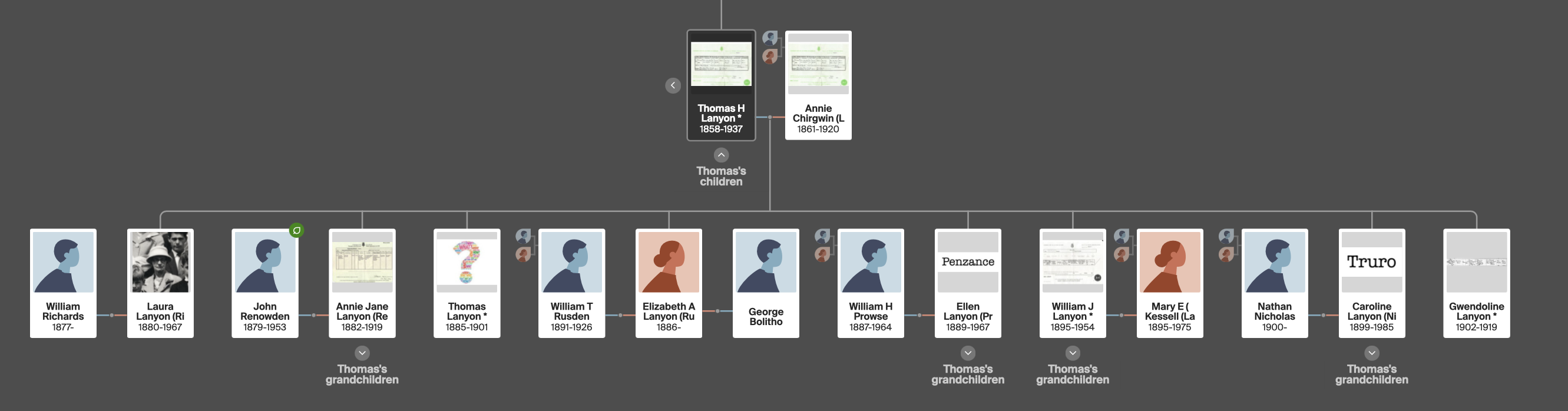
Thomas Henry Lanyon 1858-1937
Thomas was also a tin miner like his father. Later he became a farm labourer. He married Annie Chirgwin in 1890 and they had eight children.
Thomas & Annie’s family
Laura 1880-1967
Annie Jane 1882-1919
Thomas 1885-
Elizabeth Ann 1886-1965
Ellen 1889-1967
William James 1895-1954
Caroline 1899-1985
Gwendoline 1902-1919
That’s where we must leave this branch of the family. There were grandchildren so this branch of the family has survived.
Despite having fourteen children the Golden Lanyon had only twelve great great great grandsons to carry on the family name on the Botrea branch of the Lanyon family. There may be unrecorded children, and children who have moved away from Cornwall and not been traced, but it is a diminishing tree.
Diminishing Botrea Branch
The Fowey Boys
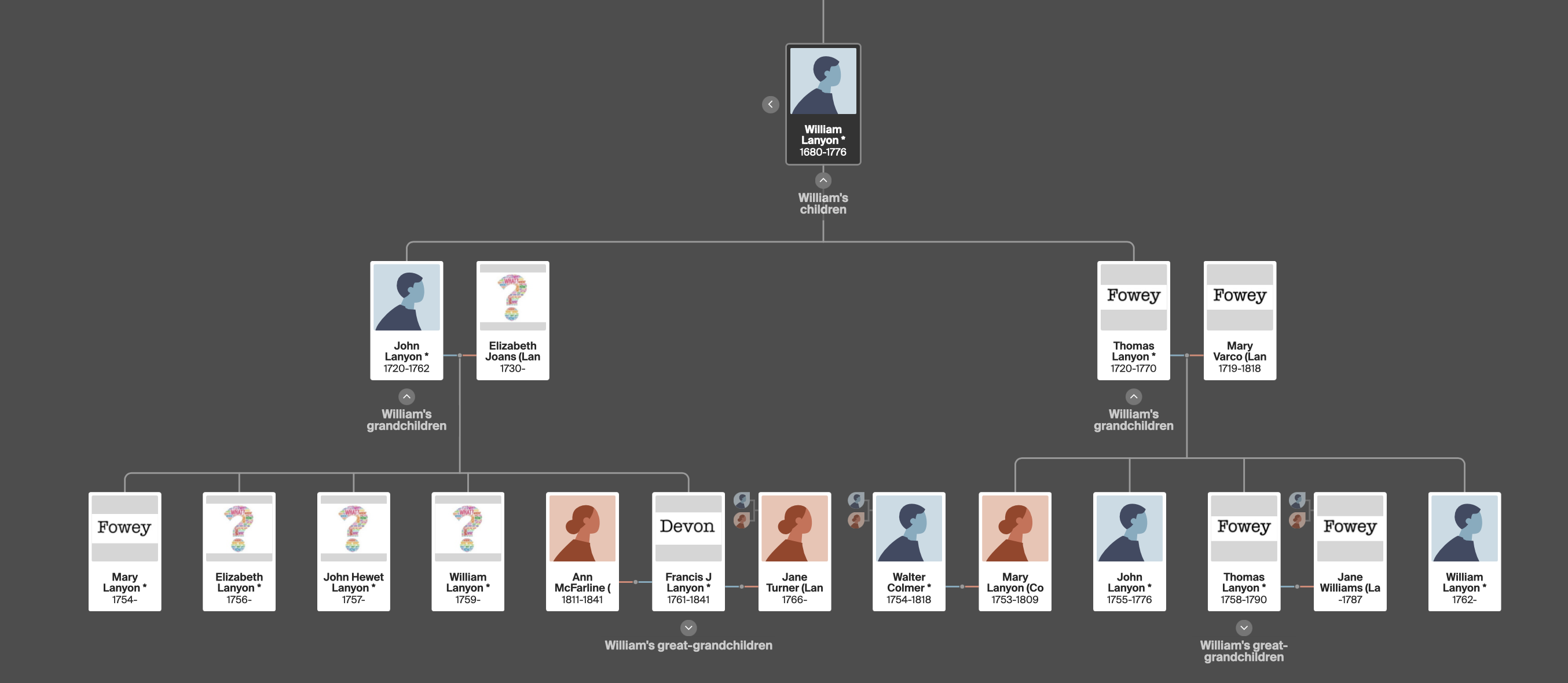
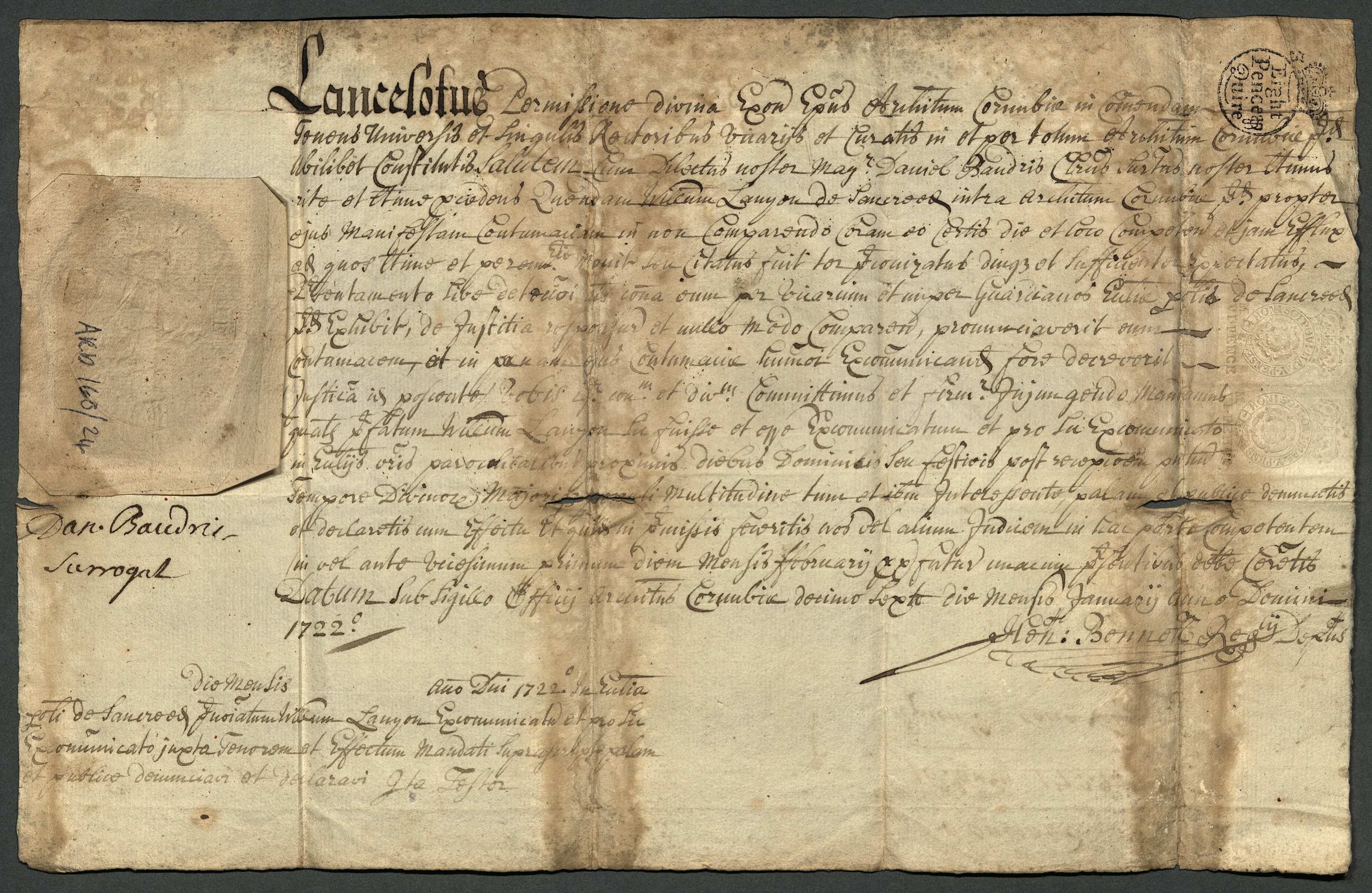
John and Thomas (the sons of William Lanyon 1680-bef. 1776) both lived in Fowey, initially I couldn’t find their parents or where they fitted on the tree. It was the wills of William’s brother Robert and his wife Grace Chennall which helped me resolve the problem.
We don’t know the name of William’s wife but as both his eldest grand daughters are called Mary we may surmise that is her name or perhaps they were named after their great grandmother, Mary Ellis.
William’s tree
John Lanyon abt. 1720-1762
John was born about 1720 but there is no trace of a baptism, he married Elizabeth Joans from Fowey, at Lostwithiel, on 26 Jul 1753. John was the Officer of Excise in Fowey.
They had five children:
Mary 1754-1809
Elizabeth 1756- no further trace
John Hewet 1757- no further trace
William 1759- no further trace
Francis Joans (Jones) 1761-1841
It is possible that only Francis and Mary survived to adulthood and he is the only ‘nephew’ mentioned by Grace Lanyon (Chennall) in her will.
Smugglers – John Atkinson
Francis Joans Lanyon 1761-1841
Francis Joans Lanyon was a shipwright and married Jane Turner in 1786 at Charles the Martyr, Plymouth, Devon. Their children:
Francis Joans Lanyon’s tree
John 1788-1791 died in infancy
John Francis 1792-1863 married Jane Hicks at Plymouth in 1815, they had no children but lived with her widowed mother Betsy and nieces. From the 1859 census we can see that John was a bread baker. He died in 1863 and left an estate valued at under £200.
Jane 1795-1872 was baptised at Devonport and married Edward Wills. They had four sons two of which were called Napoleon and Horatio! Perhaps Edward fought at Trafalgar? Edward died before 1826 as Jane remarried William Honey and had another five children including William Lanyon Honey and John Francis Lanyon Honey.
Eliza 1798-1799 died in infancy
Elizabeth 1805- no further trace
Francis -1791 died in infancy
Then in 1831 Francis Joans Lanyon married Ann McFarline at East Stonehouse, Devon. They are shown on the 1841 census he is aged 80 and she is aged 30! The 1841 census doesn’t show their relationship.
1841 census East Stonehouse, Devon
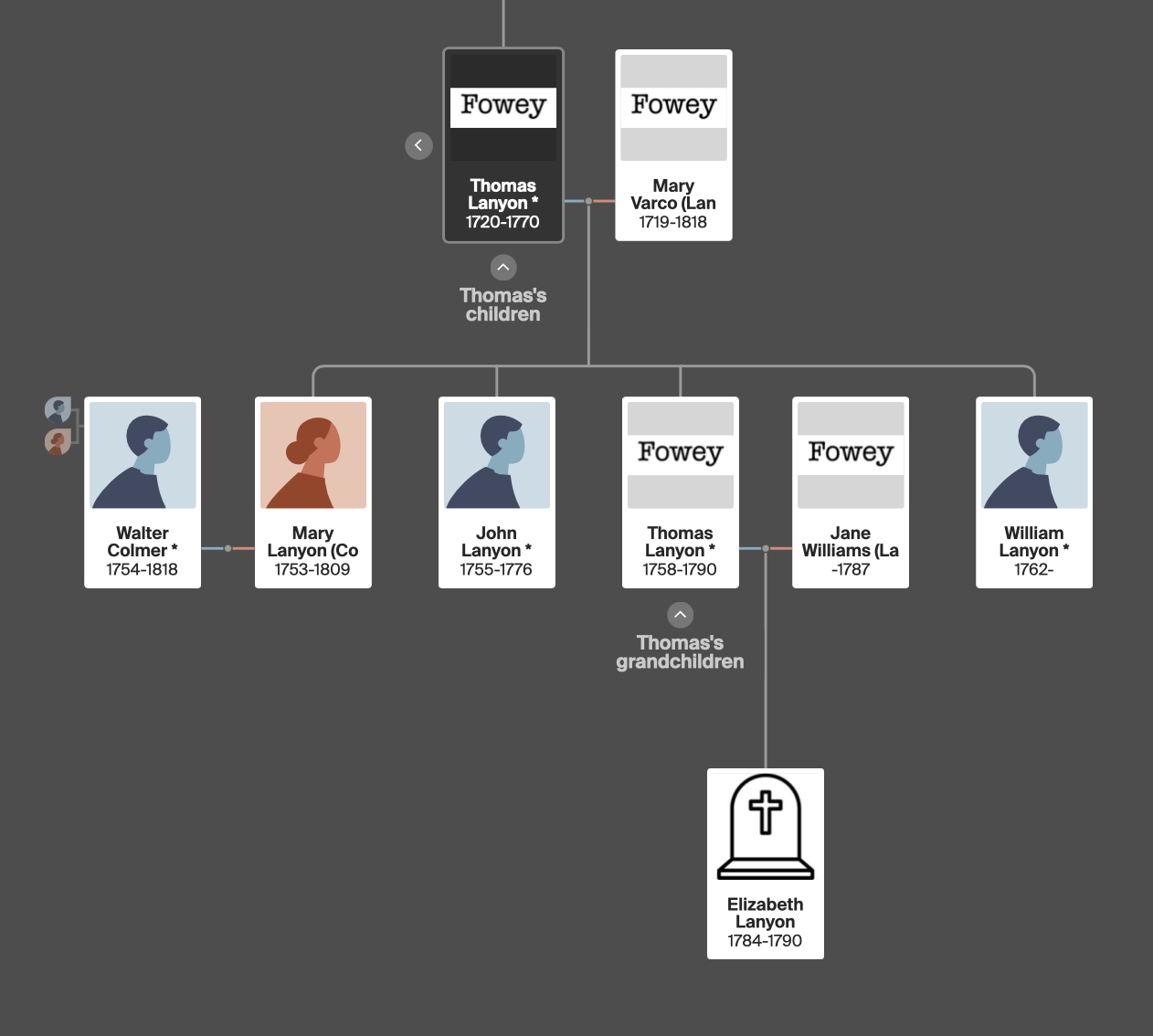
Thomas Lanyonabt. 1720-1770
William’s second son was Thomas born about 1720, he was a victualler and maltster in Fowey. Thomas married Mary Varco at Fowey in 1752. Their children:
Thomas & Mary’s tree
Mary 1753- was born at Fowey and she married Walter Colmer at Fowey in 1774 and had 9 children, the eldest was called John Lanyon Colmer.
John 1755- no further trace
Thomas 1758-1790 he married Jane Williams by licence at Fowey in 1784. He was a ‘salt officer’. He and Jane had a daughter Elizabeth. Jane died Nov 1787, Thomas died Sep 1790 and Elizabeth died Oct 1790 aged just 6.
William 1762- no further trace
Thomas Lanyon and his wife Mary Varco ran the Dolphin Inn at Fowey, the Dolphin’s biggest competitor was the Ship Inn (John Rashleigh and Alice Lanyon’s first town home.)
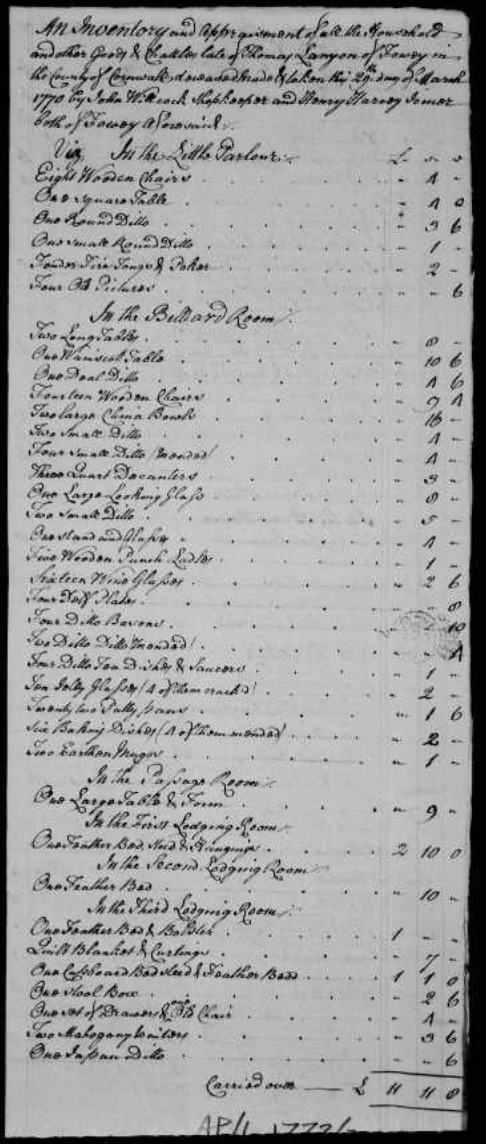
Thomas died in 1770 and left a wonderfully detailed inventory of goods which gives a real glimpse into their lives. The will describes the furnishings in each room.
Part of the inventory of Thomas’ administration- Source: CRO AP/L/1772
Following Thomas’ death Mary continued to run the inn and in 1771 Philip Rashleigh’s expenses listed ” the widow Lanyon’s bill for the entertainment on election day £2 4/-“. Source – Old Cornish Inns by H.L Douch. 1966.
The Dolphin was taken over by her son in law Walter Colmer and daughter Mary but by 1817 it was defunct.
Mary was buried on 12 Aug 1818 at Fowey aged 99! (Royal Cornwall Gazette.)
The Golden Lanyon had six surviving sons and sixteen surviving grandsons.
John Lanyon & Mary Borlase
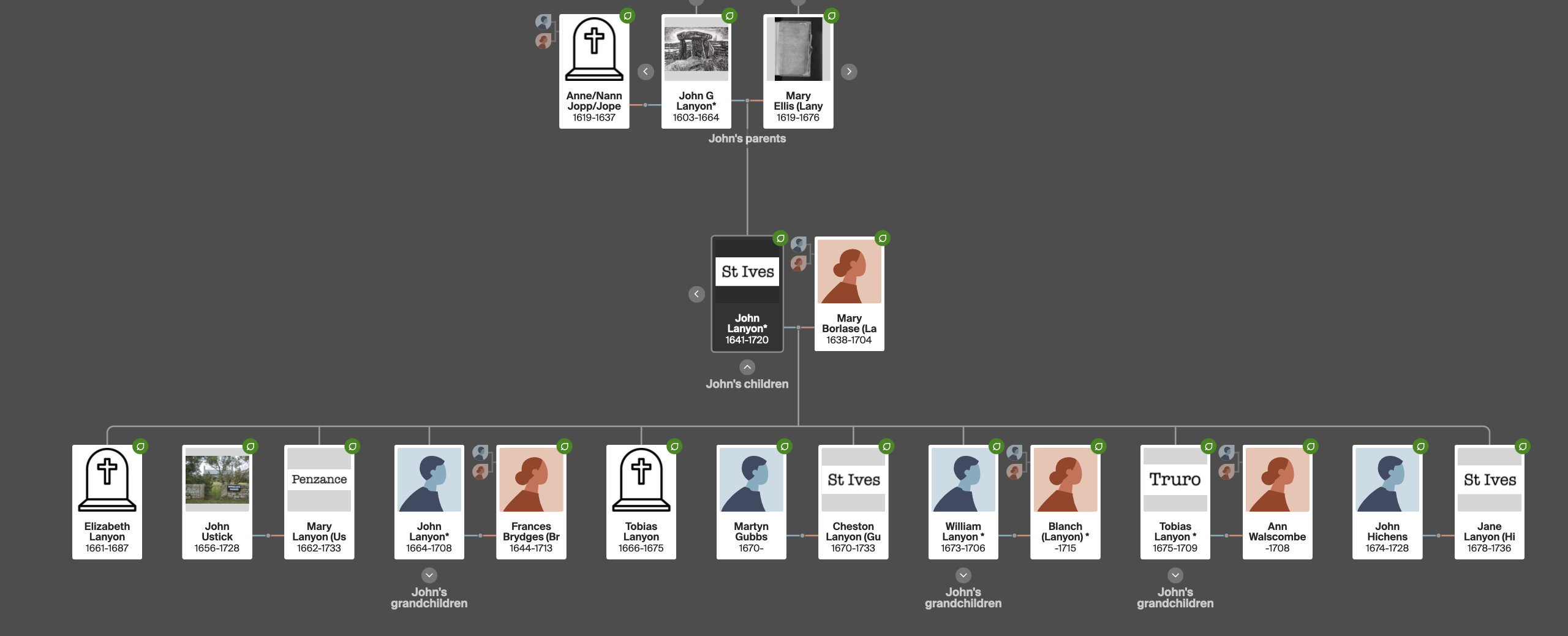
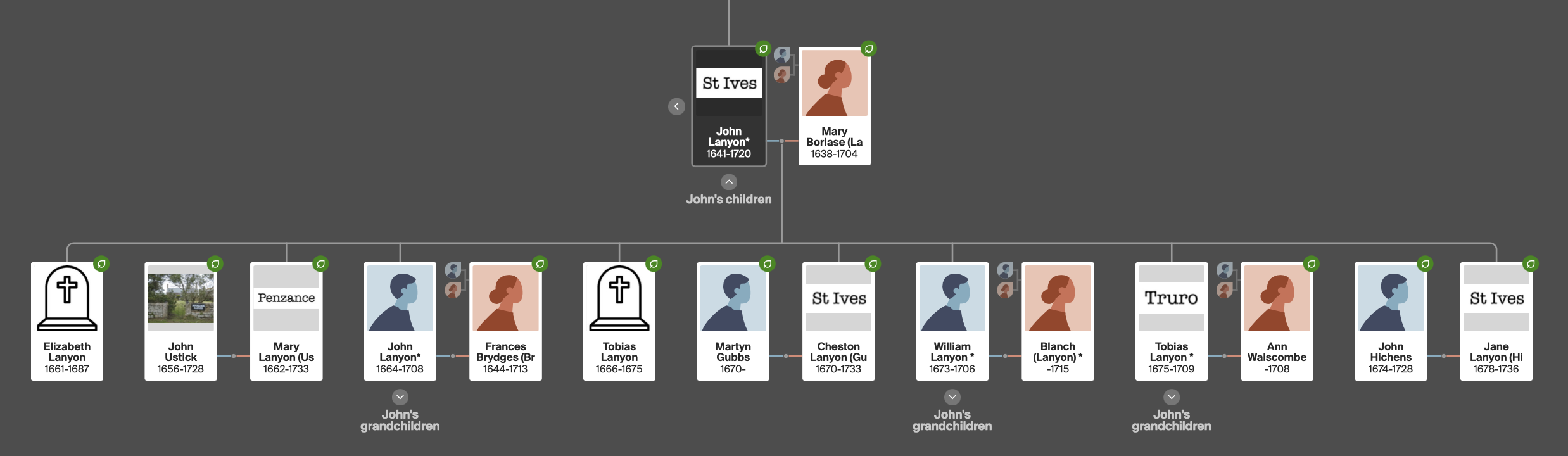
His eldest son John married Mary Borlase. They had three sons who survived to adulthood and married. John, William and Tobias.
John Lanyon & Mary Borlase’s sons.
John Lanyon 1664-aft. 1708
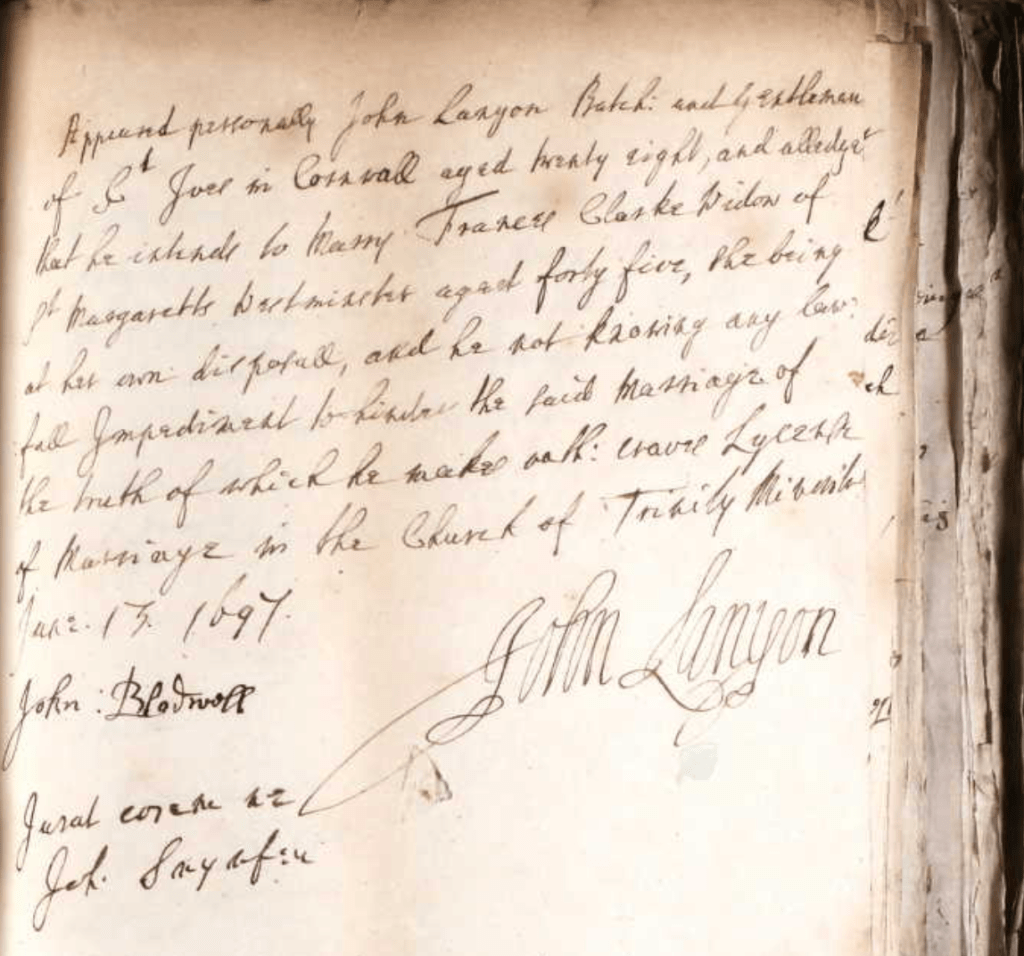
John and Mary Borlase’s eldest son, also called John, married Lady Frances Brydges. They were married by licence on 14 Jun 1697 at Trinity Church, London, Frances Clarke widow aged 45 and John Lanyon bachelor of St Ives age 28. The ages on the marriage register don’t quite match the baptism records. If John was baptised in 1664 he would have been 33 not 28. But Frances was also somewhat economical with the truth about her age!
She was born circa 1644 at Wilton Castle, the daughter of John Brydges, 2nd Baronet of Wilton and his wife Lady Mary Pearle. Frances’s first husband was Dr William Brabourne and by him she had 4 sons and a daughter. William died in 1684 and she then married Henry Clarke. He must have died sometime before 1697 when she married for the third time to John Lanyon. She was aged about 53 and John was about 33.
London & Surrey Marriage Allegations and Bonds
Frances was the sister of James, Lord Chandos 1642-1714.
James Brydges Lord Chandos Government Art Collection, Public domain, via Wikimedia Commons
James was the father of the James Brydges the first Duke of Chandos
Duke of Chandos by Herman van der Mijn, Public domain, via Wikimedia Commons
John and Frances had no children and there is no trace of their deaths. John appears to still be alive in 1708 and Frances was still alive in 1713.
Tobias Lanyon 1675-1709
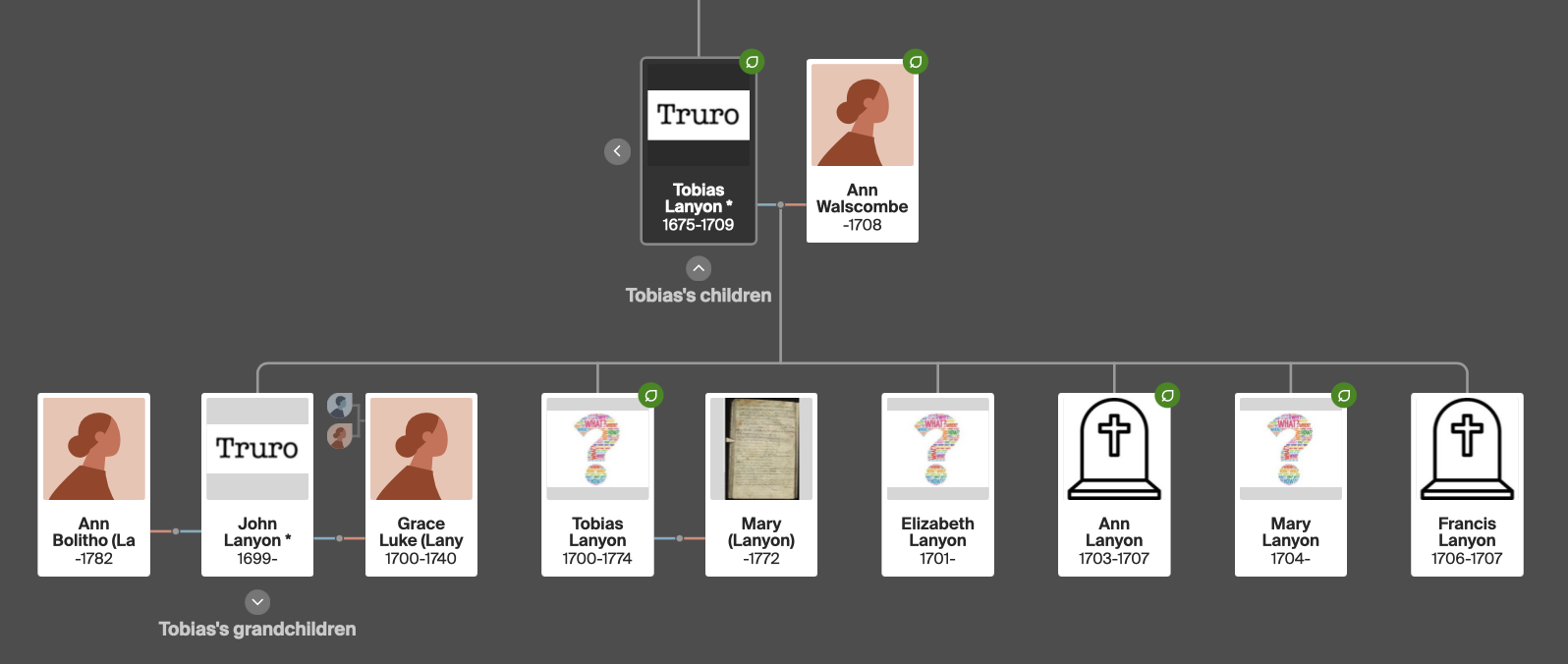
Tobias married Ann Walscombe at Truro in 1696. (Name is spelt Leanion in the parish register.)
Tobias & Ann’s tree
Their eldest child was John baptised 12 May 1699 at Truro. In 1722 Philip Webber of Falmouth, attorney was paid £52.00 to take on John as an apprentice. John married Grace Luke in 1716. Their children-
John & Grace’s tree
Ann 1717- no futher trace
Jane 1720 – married Roge Harding. Her sister Susannah’s will calls her Jane Harding.
Grace 1722-1724 died in infancy
Elizabeth 1725- no further trace
Tobias 1727-1796 he married Elizabeth Gray in 1752 at Redruth and they had one daughter Jane born in 1753. No further trace of Jane. He then married Catherine Brown in 1786. In 1742 a consideration of £8 was paid to Richard Stone for an apprenticeship for Tobias. He was later described as a shopkeeper of Redruth.
Susannah 1730-1780 spinster
John’s second wife was Mrs Ann Bolithoe, they married at Kenwyn near Truro in 1744.
We don’t know when John died but Ann died at Maker in Cornwall in 1782, Susannah also died at Maker so perhaps they were living together.
William Lanyon & Jane Keigwin
William was the Golden Lanyons second son, he and Jane had three sons that married. William, Martyn and Robert.
William Lanyon & Jane Keigwin’s tree
William Lanyon 1680-bef. 1776
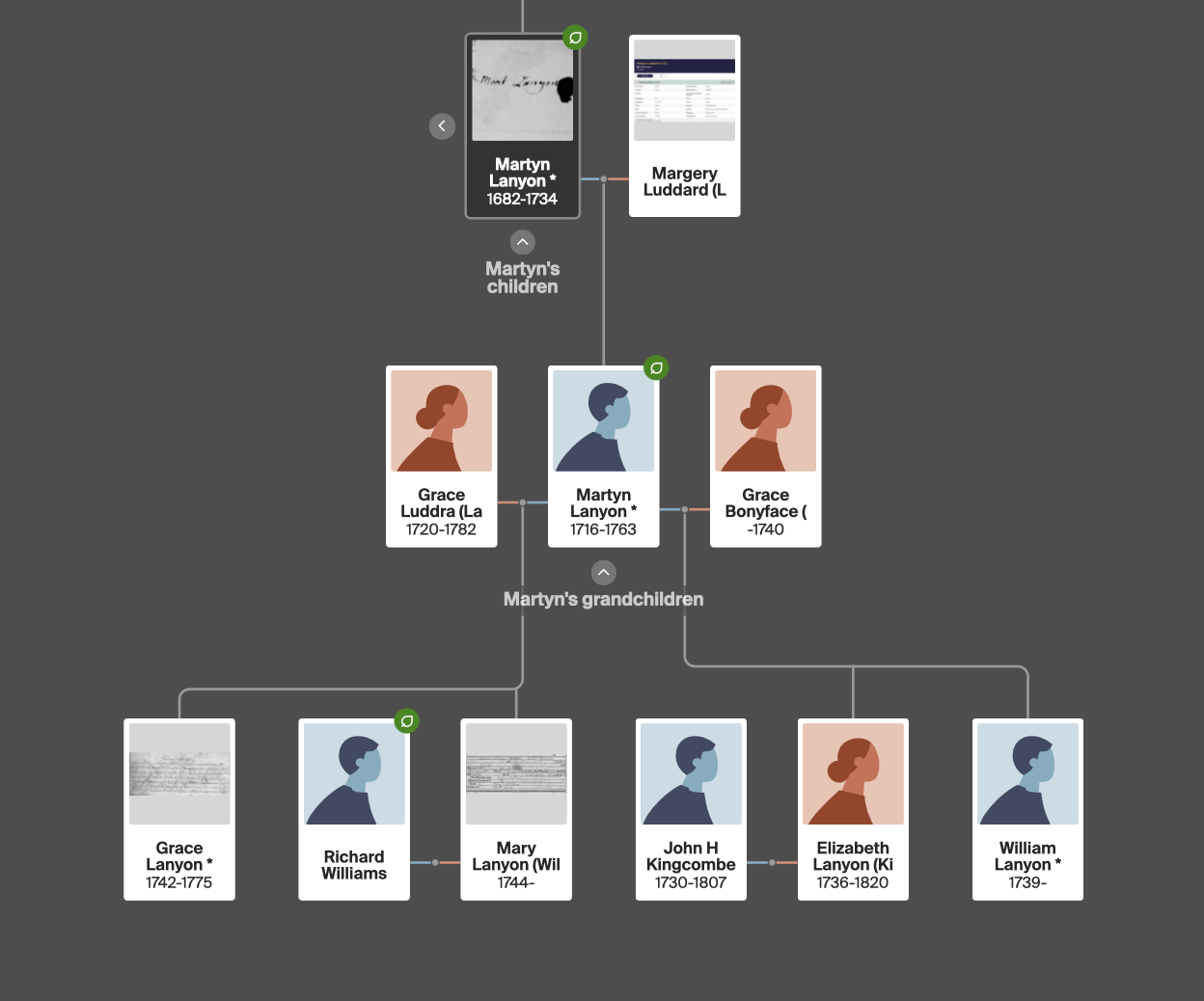
William was baptised in Sancreed in 1680. I couldn’t trace a marriage, however a William Lanyon of Sancreed is excommunicated on 16 Jan 1722 for contumacy (stubborn refusal to obey or comply with authority, especially disobedience to a court order or summons.) Source: NA ARD/160/24 (National Archives – Archdeaconery of Cornwall.)
Excommunication of William Lanyon 1722
There is no trace of a marriage for William however Grace Chennall’s will leaves enough information for us to place John and Thomas Lanyon as his sons. John and Thomas lived in Fowey and it is possible that the family moved there following William’s excommunication.
William died before 1776 as he is mentioned in his brother Robert’s will as ‘my late brother’.
See more about John & Thomas in the post ‘The Fowey Boys.’
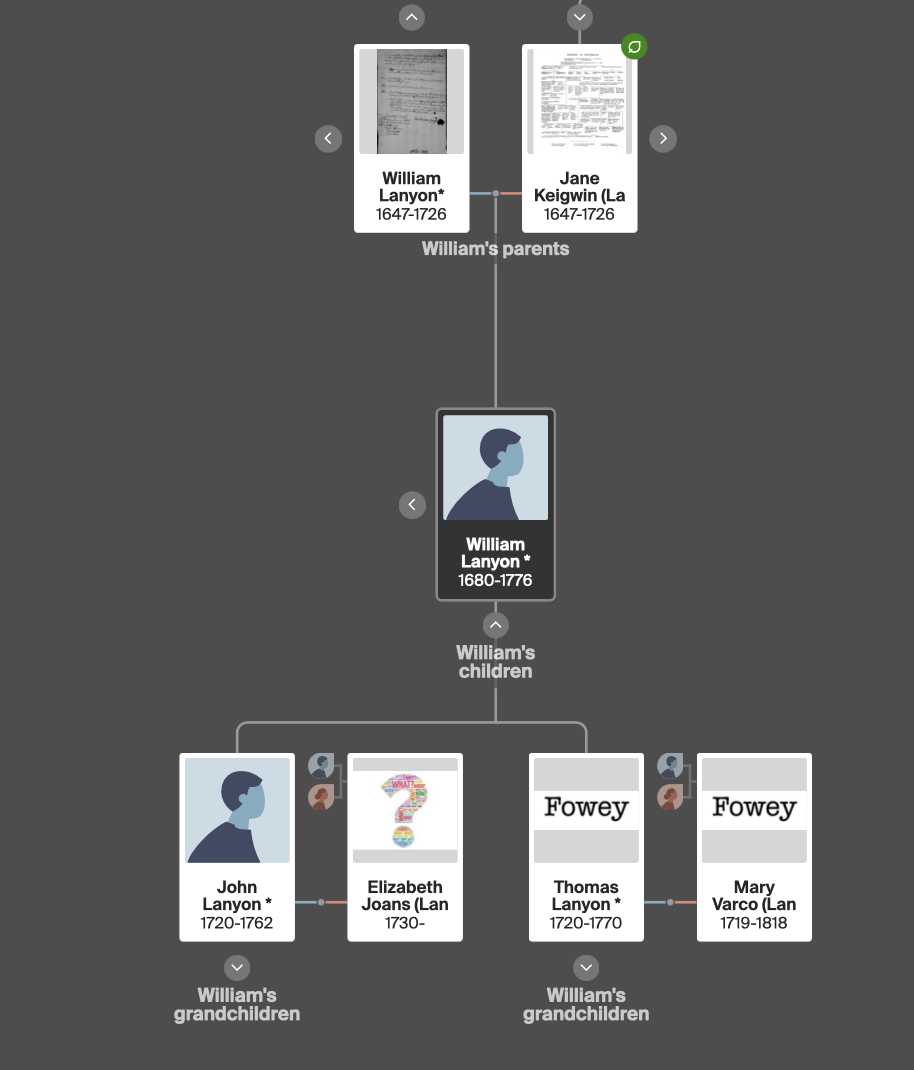
Martyn Lanyon 1682-1734
Martyn was baptised at Sancreed in 1682 and married Margery Luddard at Liskeard in 1722. (Name spelt Laynion in the register.) Forty was quite old for a first marriage but I haven’t found any trace of a previous marriage. There was a Martyn Lanyon who married a Grace Bonyface on 5 Aug 1736 at Plymouth St Andrew and a Martyn Lanyon married Grace Luddra at Yealmpton, Devon on 8 Aug 1742. Could this Martyn be a son of Martyn Lanyon of Liskeard? Liskeard is close to the border between Devon and Cornwall. Martyn is an unusual name in the Lanyon family, Jane Keigwin’s father was called Martyn so this seems to be the origin of the name.
Martyn was an innkeeper at Liskeard and was buried there on the 11 Aug 1734.
Robert was baptised at Sancreed on 29 Sep 1688. He married Grace Chennall on 14 Oct 1755 at Perranarworthal, Cornwall when he was 67 years old! If he had an earlier marriage I haven’t yet found it.
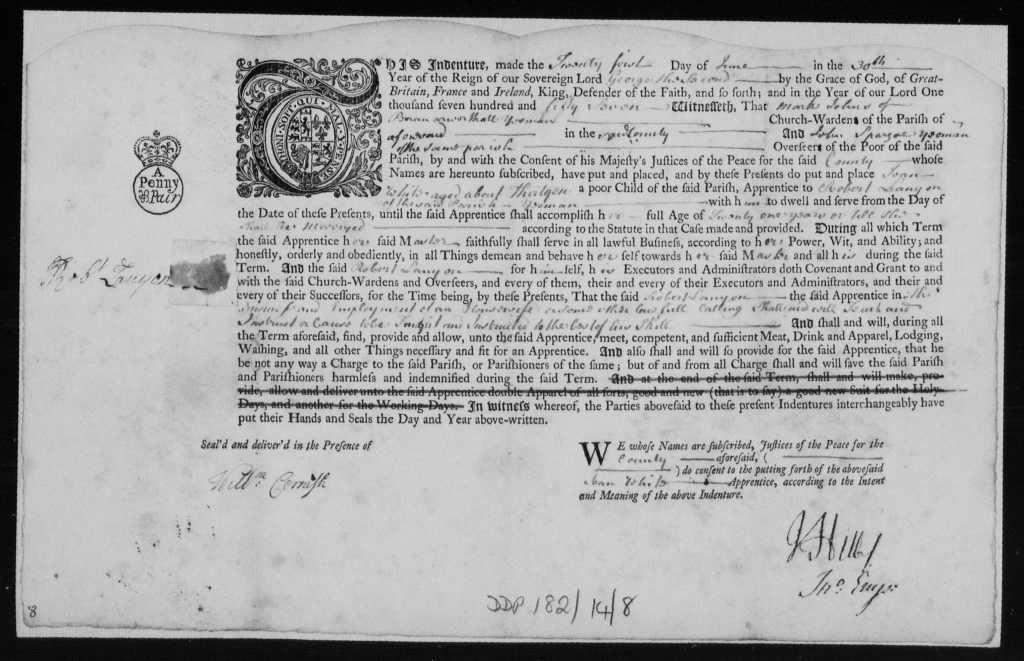
On 21 Jun 1757 he took on Joan White age 13 as an apprentice in housewifery. She was indentured to him until the age of 21.
He was buried on 23 Feb 1776 at Feock in Cornwall. There is a tablet over the side door of Feock church “Robert Lanyon of Sancrete of this county, gent, 1776 age 83”.
His will mentions no children but it does mention other relatives.
Transcript of Will: Exeter Consistery Court 30 Aug 1773 – Proved 1776
Robert Lanyon yeoman of Penryn.
First my kinswoman Isabella Rogers, wife of John Rogers of St Michael
Kinsman Mathias Andrews. (the husband of his deceased sister Isabel) of St Michael, also Mathias Andrews my cloathes chest and all my wearing apparel.
To kinswomen Jane, Margery and Isabella, daughters of Mathias Andrews
To William Lapp, Plymouth and his two sisters Mary and Elizabeth.
To John Lanyon, grandson of my late brother William Lanyon, my silver goblet and my two handle silver cup and silver tankard.
To younger brother of said John Lanyon £10
To before named kinsman John Lanyon, his heirs and assigns, my messuage and tenement called Ennis-an-Mannen, St Creet, and dwelling house etc at Penryn called Chennalls House, also my several tin bounds called Ennis-an-Mannen bounds, Church lane Bounds and Tronach Mill Bound, also 1/5 part or share in all other tin bounds called Great Vrane, Wheal reeth, Wheal Yelt, and Wheal-an-Speeren Bound, St Crett, according to the customs of the Stannary of Penwith and Kirrier.
I give and bequeath to my old friend and acquaintance Samuel Tresidder, town of Falmouth, one guinea to buy him a mourning ring.
The rest to my beloved wife Grace.
Seal shows falcon’s wing extended over two large towers and a large door castle with one hole above each side of door and waves of the sea.
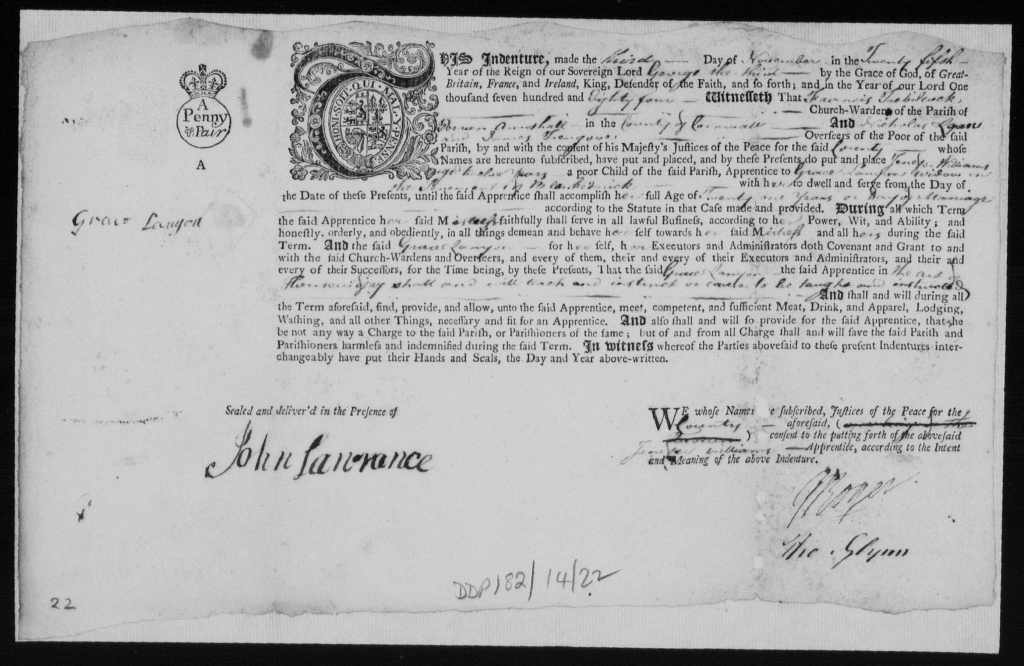
His wife Grace was 25 years younger than her husband and lived on at Feock until 1791. In 1784 she took in Jenefer Williams age 12 as an apprentice indenture for Housewifery. Grace was described as a widow of Perranarworthal.
Reproduced by kind permission of OPC Cornwall – transcribed by John Warren
Source: Source:- LDS Film No. 1596395 – Poor law records for Perranarworthal, 1724-1860
Grace died in 1791 and left a will which helps clarify her brother-in-law William’s grandson.
Partial Transcript: Will of Grace Lanyon widow of Robert Lanyon of Penryn
My silver tankard and silver goblet to my nephew Francis Jones Lanyon (in fact he was her great nephew) of the borough of Looe to keep in remembrance of me.
My niece Grace, daughter of my late brother John Chennall and Maria her sister, wife of William Mitchell of Penryn
(William Mitchell was a mason and Grace Lanyon appears very worried about her niece Grace Tiss ? marrying this man.) Source – Jane Veale Mitchell note.
Tobias Lanyon & Jane Tresilian
Tobias, the third son, married Jane Tresilian and had one surviving son, Charles.
Charles Lanyon 1689-1768
Charles was baptised at Sancreed on 8 Mar 1689. He married Joan Noye at Morvah on 5 Oct 1713. The parish register notes that they were both from the town of Paul. Charles was a merchant at Paul. They had four children: Sarah b.1716, Charles b.1718 and Mary b.1719 and Thomas b.1722. There is no further trace of any of the children.
Charles died at Penzance in 1768 and his wife died the following year.
Francis Lanyon & Phillipp Nicholls
Francis was the fourth son, he married Phillipp Nicholls and they had five sons.
Francis & Phillipp’s tree
Francis Lanyon 1686-1723
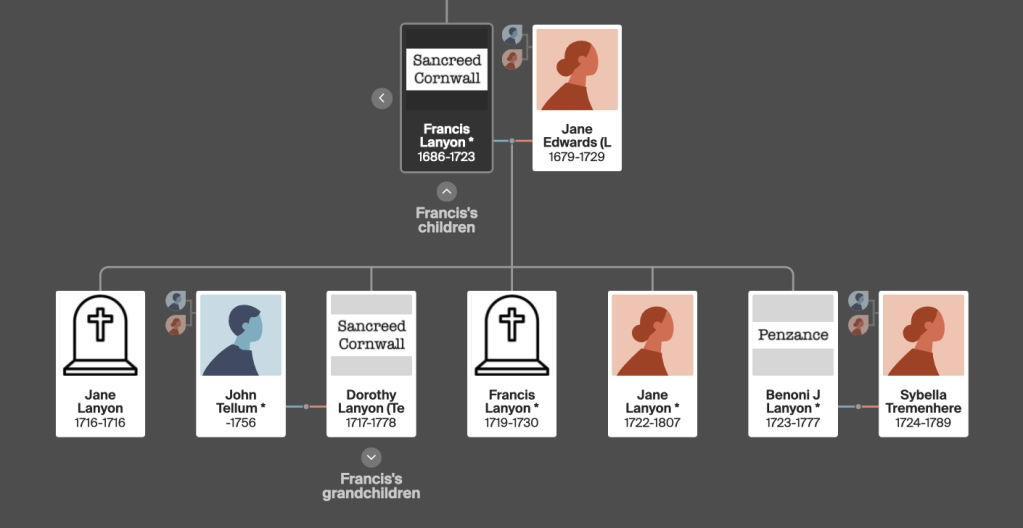
Francis was baptised at Sancreed 29 Dec 1686, he married Jane Edwards of Penzance at Morvah on 10th Aug 1715. They had five children:
Jane 1716-1716 died in infancy
Dorothy 1717-1757. She married John Tellum at Lostwithiel in 1750. They had 3 children and he died before the third was born. She died seven years after the marriage.
Francis 1719-1730 died young
Jane 1722-aft. 1778 She is mentioned in her aunt’s will of 1778.
Benoni John 1723-1777 Born three months after the death of his father. Benoni means ‘son of my sorrow’. He was an attorney and married Sybella Tremenheere at Madron in 1769. No children.
Francis & Jane’s tree
Thomas Lanyon 1691-1743
Thomas was baptised 10 Feb 1691 at Sancreed. He became a pewterer in Bristol. You can read all about him in the post ‘Thomas Lanyon Pewterer of Bristol.’
William Lanyon 1693-1756
William was baptised at Sancreed on 3 Mar 1693. He was a yeoman and married Jane Philips on 18 Aug 1725 at Zennor. They had four children.
William & Jane’s tree
William 1725-1770 He married Joan Esterbook 1751 and Elizabeth Murrish 1758.
Ralph 1727- no further trace
Jane 1730-1799 She married Thomas Woolcock. One daughter Grace.
Hugh 1732-1769 He married Anne Eady and had two sons.
John was baptised at Sancreed 15 Sep 1697 and was buried there in 1738. No trace of a marriage or children.
Tobias Lanyon 1702-1778
Tobias was born in 1702 and in 1717 he was apprenticed to John Tonkin of Penzance, a tobacconist, for a fee of £20. Tobias never married.
In 1769 Richard Carew’s book ‘Survey of Cornwall’ was rereleased and Tobias was listed as one of the subscribers. ‘Tobias Lanyon Esq of Penzance.’
He also left a will which details some of the family relationships.
Abstract: Tobias Lanyon of Penzance, gentleman.
Sister in law Jane Lanyon (Edwards) widow of my late brother Francis and his daughter Jane Lanyon.
Remembers his late housekeeper and gives her land in Camborne and Illogan
Nephew James Tellum
Godson John Tresilian Reichenberg, son of John Rodolpus Reichenberg, gent, his interest in tenement of Treledvas, Buryan.
God daughter Grace Pendar, daughter of Benjamin Pendar gent, £100
To my kinsman William Nicholls of Trereife, Esq. and his sister Mrs Francis Harris, wife of William Harris of Kenegy Esq.
To my kinsman John Nicholls Esq. of Lincoln’s Inn Fields
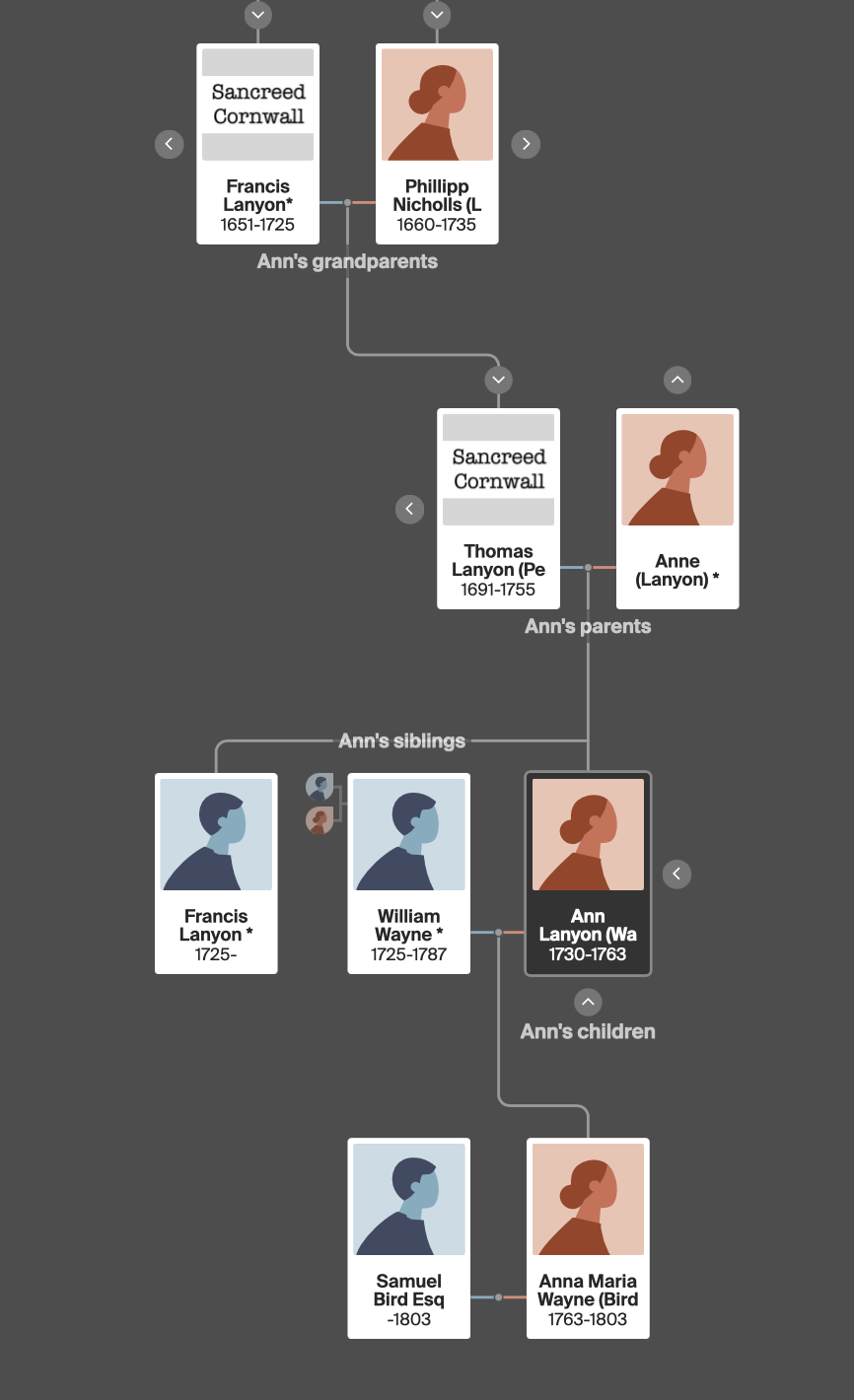
To sister Mary Lanyon of Penzance, spinster, and then to my nephew William Wayne, gent, late of Bristol (bought to Cornwall to teach the Cornish metallurgy) and niece Anna Maria Wayne, his daughter. In the end she inherits all his wealth and married Samuel Bird Esq.
William Wayne 1725-1787 married Ann Lanyon and their daughter Anna Maria Wayne 1763-1803 is the person mentioned in Tobias’ will. Ann Lanyon was the daughter of Thomas Lanyon, pewterer of Bristol.
Thomas & Anne’s tree
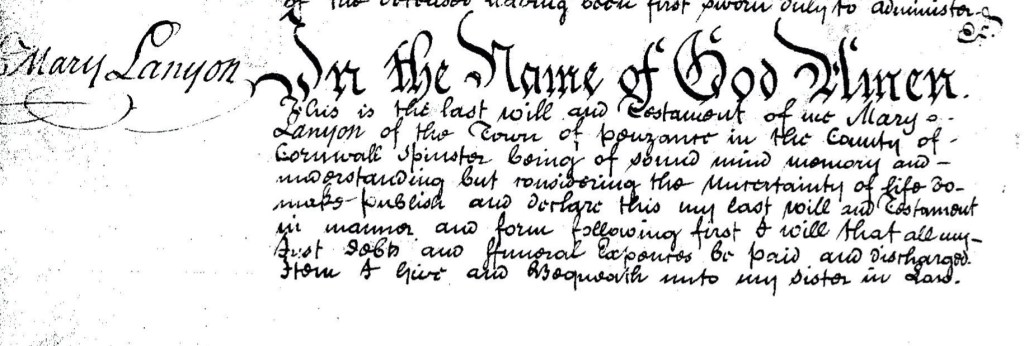
Tobias’ sister Mary was born 1690 and died in 1779 a spinster. She left a detailed will which shows how wealthy she was.
Mary Lanyon’s will Source: NA PROB 11/105/117
Sister-in-law Jane Lanyon of the parish of Paul, widow of my brother Francis Lanyon annuity £10
Niece Jane Lanyon daughter of my brother Francis annuity £10
Nephew John Tellum late of Penzance annuity of £10
Mrs Sibilla Lanyon widow of my nephew Benoni John Lanyon £100
Joan Tresilian widow of John Tresilian £100
Sarah Lanyon of Penzance spinster daughter of the late Charles Lanyon £100
Spinster Jane Bullock who used to live with me £100
Nephew James Tellum carpenter £300
Jane and Catherine Ustick daughters of late Stephen Ustick Esq of Botallack in St Just £100 each
Cousin William Nicholls of Trereife £100 guineas
Mary Stewart Nicholls daughter of my cousin William Nicholls Esq. £20 guineas
Frances Harris wife of William Harris Esq £20 guineas
Mary Ustick widow of the late Henry Ustick of Breage £5 guineas
Catherine Lanyon daughter of late Henry Lanyon of Breage £100 (Gwinear branch)
David Dennis of Penzance gent £100 guineas
David Carthors of Penzance gent £100 guineas
Cousin John Nicholls of Lincoln’s Inn London Esq £1000
Nephew William Wayne late of Bristol and now of Penzance £1000
Mrs Olive? Gubbs of Penzance £10
Niece Anna Maria Wayne £2000
William Wayne & David Dennis executors £100 each
Thomas Lanyon & Margaret Paule
The Golden Lanyon’s youngest son was Thomas who married Margaret Paule in 1681 at Breage. They had two sons who survived to adulthood: William and John.
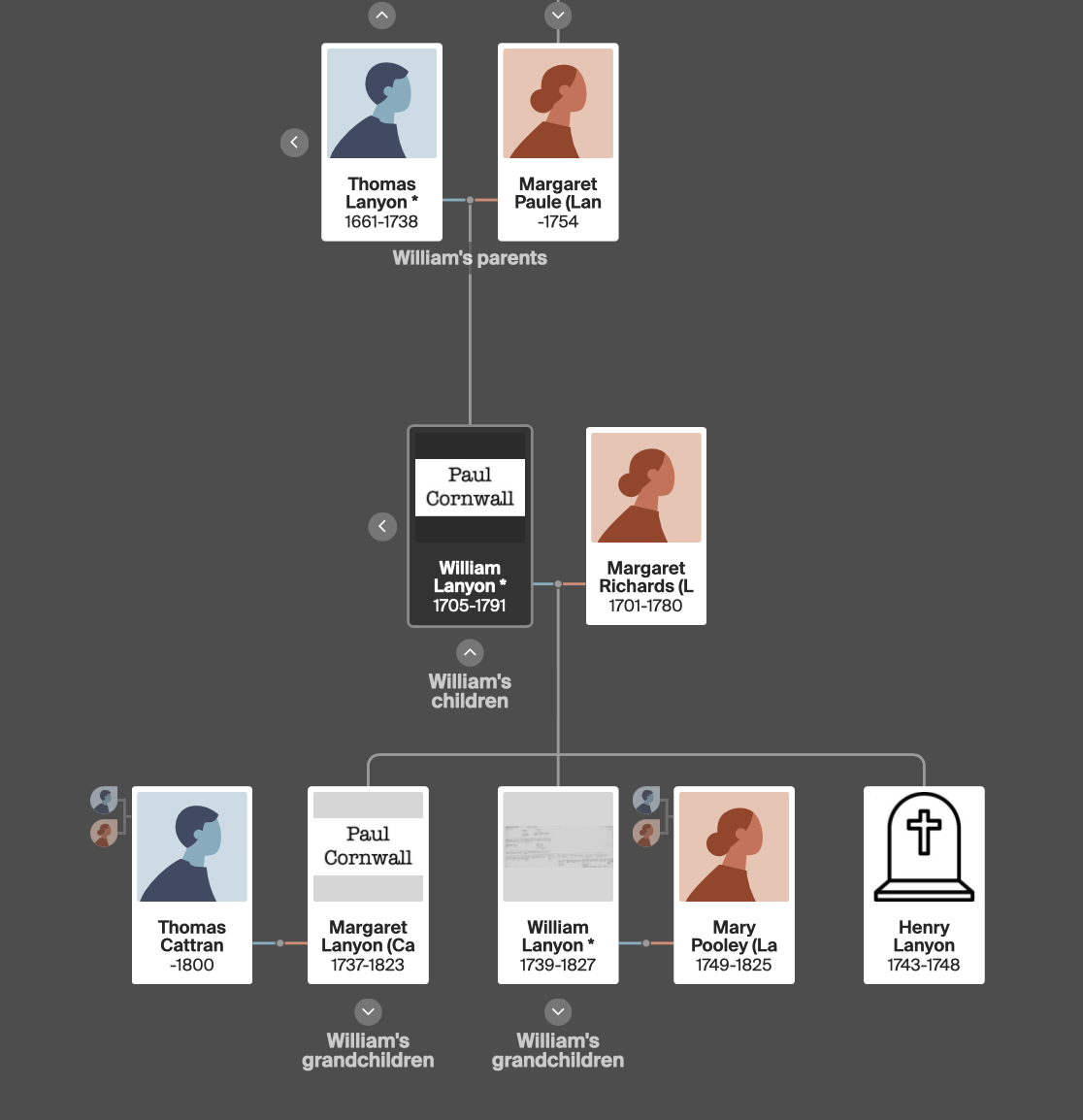
William Lanyon 1705-1791
William was baptised at Paul on 25 Mar 1705. 1733 he married Margaret Richards. They had three children:
Margaret 1737-1823 Married Thomas Cattran 1757 at Paul six children
William 1739-1827 Married Mary Pooley 1776 at Ludgvan, seven children
Henry Lanyon 1743-1748 died in infancy
William & Margaret’s tree
John Lanyon 1711-1767
John was baptised at Paul on 8 Apr 1711, married Sarah Straight at St Erme in 1735. They moved to St Allen and lived at their farm at Henver Wartha.
They had a large family and this was the start of the St Allen branch of the tree.
John & Sarah’s treeCopy of the marriage entry of John Lanyon and Sarah Straight issued in 1906
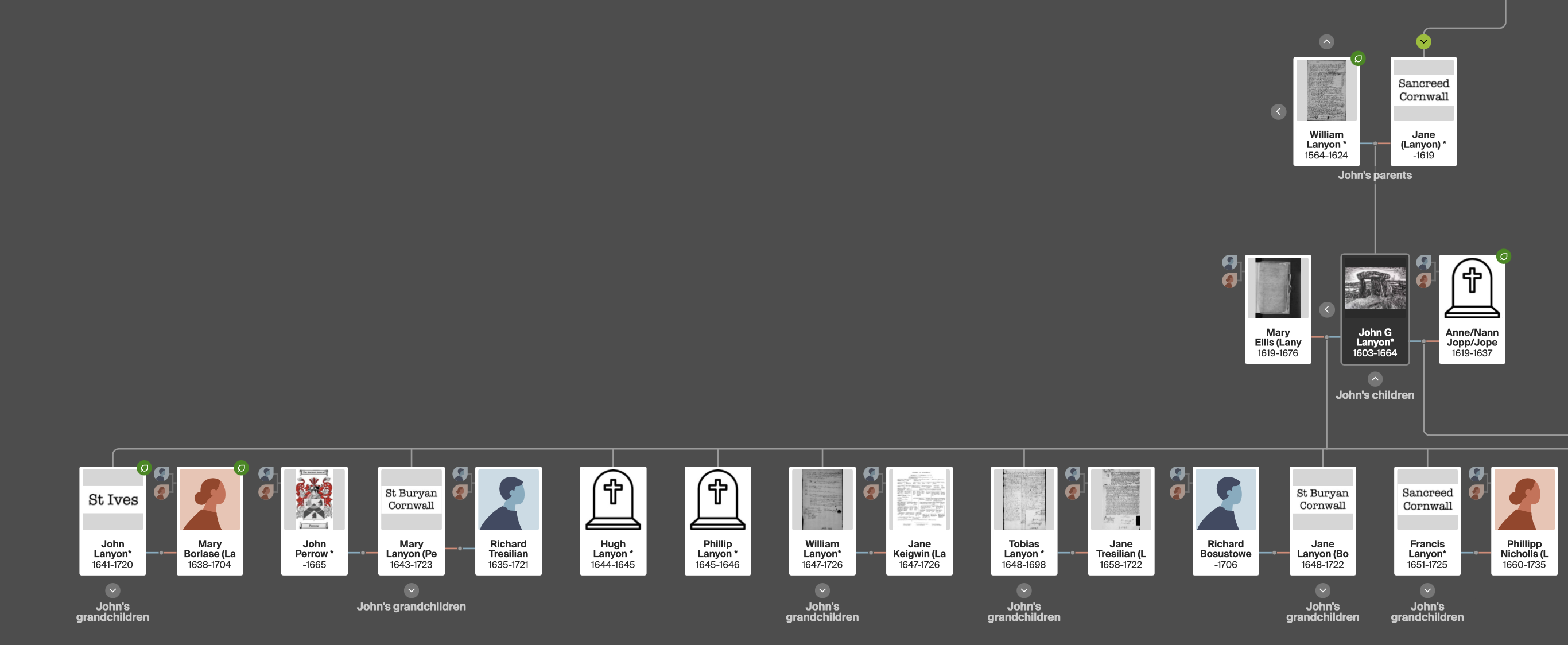
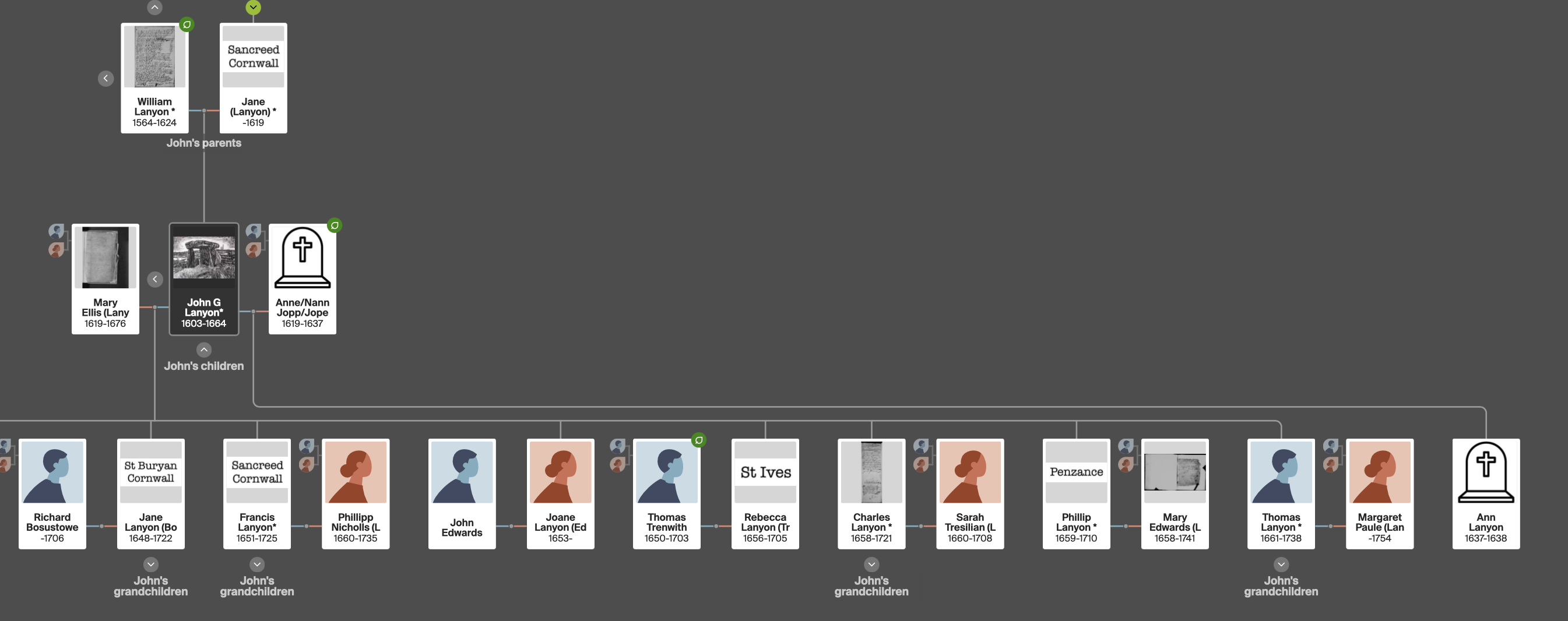
The Golden Lanyon was so named due to his great wealth. His first wife Ann/Nan Jopp died as did his first child, Alsen. He then married Mary Ellis and they went on to have 13 children (displayed over two trees below.)
John 1641-1720
Mary 1643-1723
Hugh 1644-1645
Phillip 1645-1646
William 1647-1726
Tobias 1648-1698
Jane 1648-1722
Francis 1651-1725
Joanne 1653-
Rebecca 1656-1705
Charles 1658-1721
Phillip 1659-1710
Thomas 1661-1738
The Golden Lanyon’s tree 1
The Golden Lanyon’s tree 2
John Lanyon 1641-1720
John was the eldest, born in Sancreed in 1641. Aged twenty he married his cousin Mary Borlase. Mary was the daughter of John Borlase and Cheston Pawley and the granddaughter of Walter Borlase and Mary Lanyon of Breage (see Breage branch). They married at Morvah on 27 Dec 1661.
John was Mayor of St Ives in 1685, 1690 and 1696. In 1697 there is a legal agreement between John Lanion gent of St Ives and his brother William Lanion gent of Botrea over the Balleswidden mine at St Just.
Mary 1662-1733 married John Ustick at Morvah in 1883 – 11 children
John 1664-
Tobias 1666-1675 died young
Cheston 1670-1733 married Martyn Gubbs at St Ives in 1698
William 1673-1706 no marriage found.
Tobias 1675-1709
Jane 1678-1736 married John Hichens at St Ives in 1705 – 7 children
Elizabeth -1687 died young
John Lanyon junior of St Ives tree
Mary Lanyon 1643-1723
Mary married John Perrow at St Buryan in 1662 and they had one child also called John. Her husband died in 1668 and in 1673 Mary married Richard Tresilian, they had two children, Marye and James.
William Lanyon 1647-1726
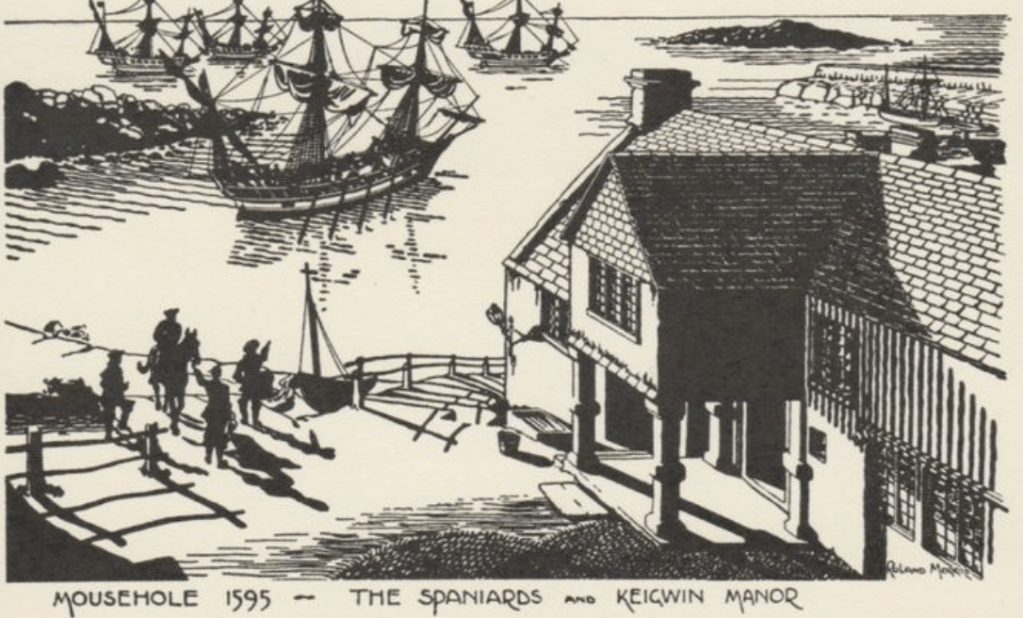
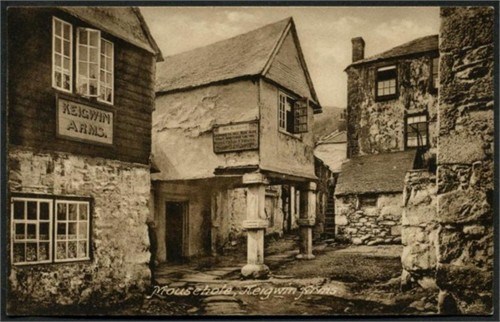
In 1670 William married Jane Keigwin at St Burian. Jane was the great grand daughter of Jenkin Keigwin and Thomasine Rawe of Mousehole. Jenkin was killed by canon fire on 23 Jul 1595 when his home at Mousehole was attacked by Spaniards who sacked the town.
Jenkin’s house is still standing in Mousehole, the oldest building in the village.
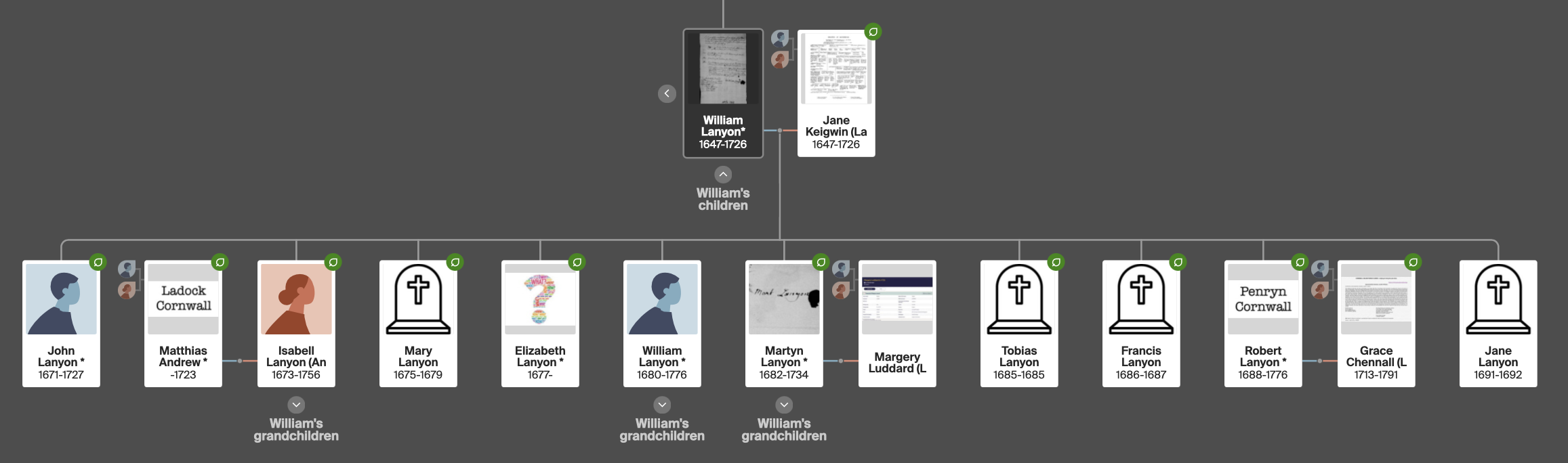
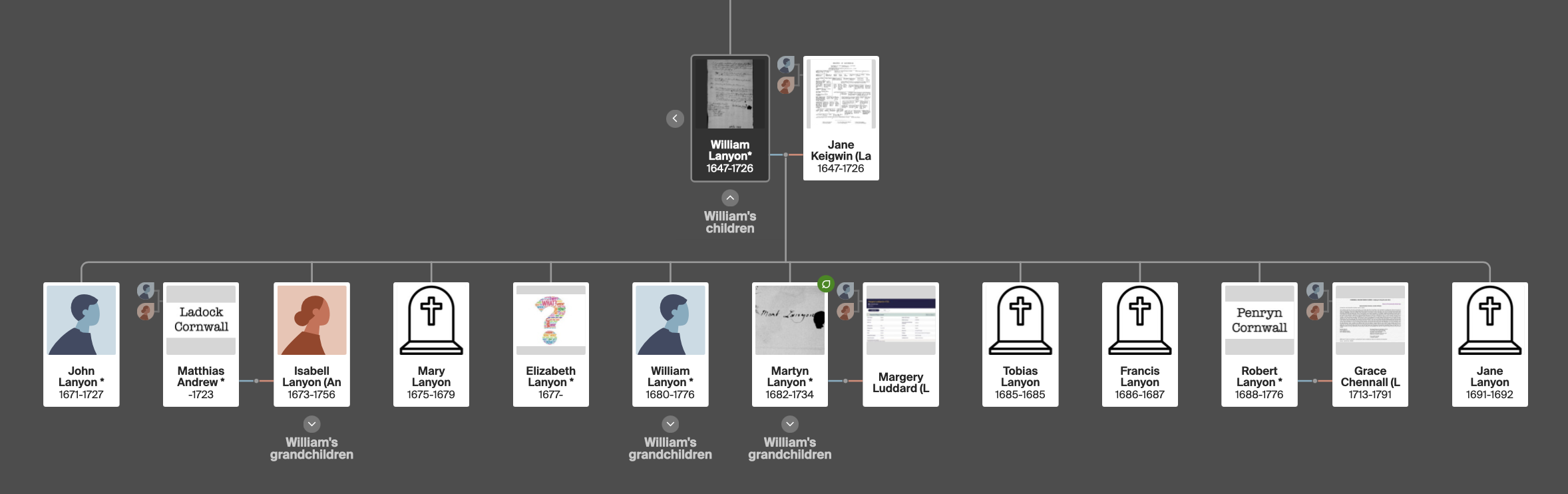
William and Jane had 10 children.
John 1671-1727 – mentioned in his father’s will of 1727 but no further trace.
Isabel 1673-1756 married Matthias Andrew and had six children.
Mary 1675-1679 died in infancy
Elizabeth 1677- no further trace, the name Elizabeth Lanyon is very common.
William 1680-1776 (he died aged 96!)
Martyn 1682-1734
Tobias 1685-1685 died in infancy
Francis 1686-1687 died in infancy
Robert 1688-1776 married Grace Chennall in 1755 when he was 67 years old! A second marriage perhaps but no trace of any children.
Jane 1691-1692 died in infancy
William & Jane’s tree
Jane Lanyon 1648-1722
In 1670 Jane married Richard Bosustowe at St Buryan. They had two daughters, Mary and Jane. Jane died at St Levan in 1722.
Tobias Lanyon 1648-1698
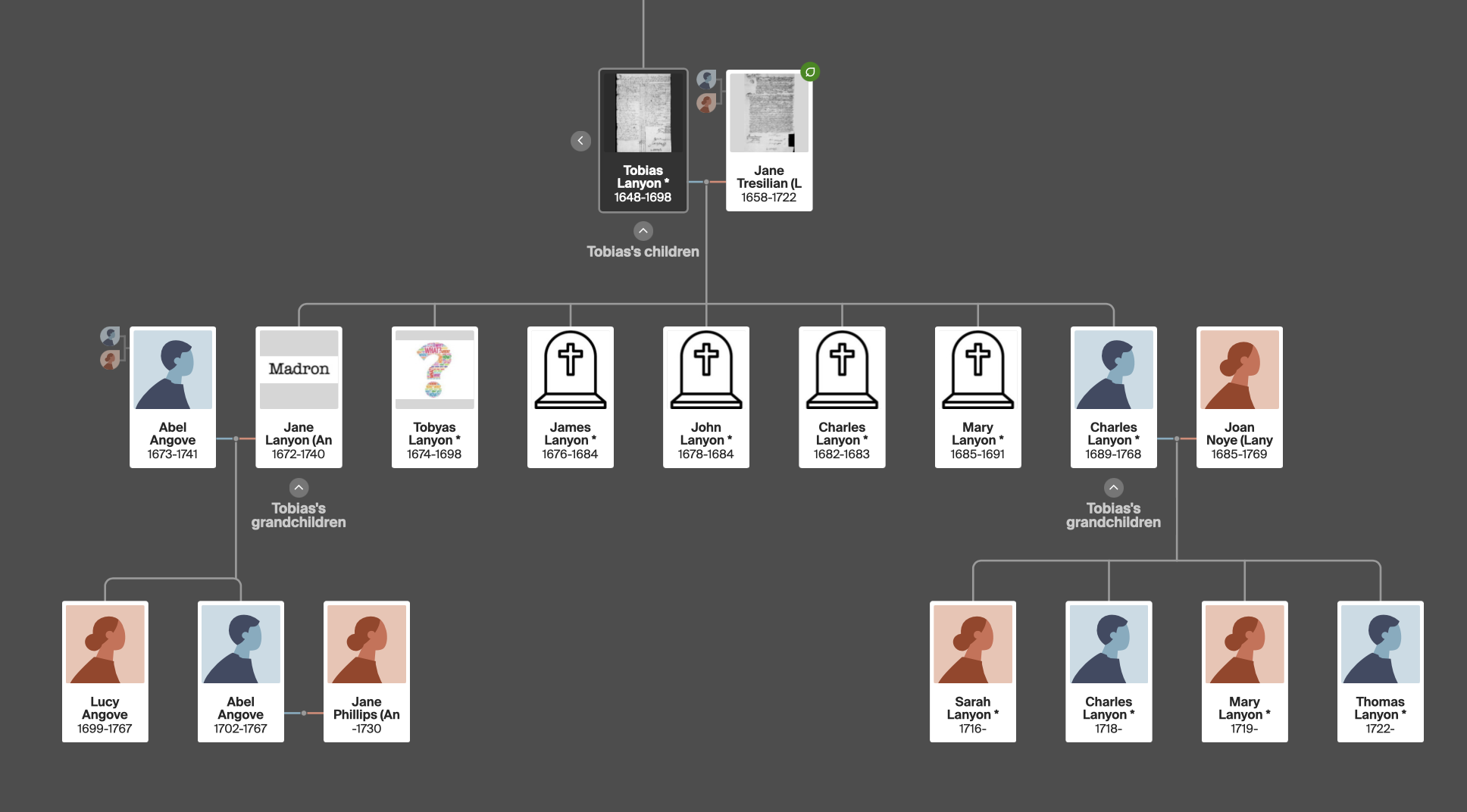
In 1670 Tobias also married at St Buryan to Jane Tresilian. They had seven children but only four Lanyon grandchildren and we don’t know what happened to them.
Tobias & Jane’s tree
Jane 1672- married Abel Angove of Illogan (see post ‘Abel Angove’)
Tobyas 1674- still alive in 1714
James 1676-1684 died young
John 1678-1684 died young
Charles 1682-1683 died in infancy
Mary 1685-1691 died in infancy
Charles 1689-1768 married Joan Noye at Morvah in 1713, they had three children: Sarah, Mary, Thomas and Charles and no further trace of any of them.
I did find a legal dispute Lanyon v Lanyon – Chancery Proceedings Ante 1714
Tobias Lanyon gent having died, his wife Jane and his brother Charles said that the deceased had paid John Trewren for conveyance but that John Ustick (the husband of his niece Mary Lanyon) had not given Tobias the elder the receipt for Reprovance Vean asked for, and which Jane asked for after his death. (John Ustick would rather be torn by wild horses than do it!).
This legal dispute implies that Tobyas the younger was still alive at 1714.
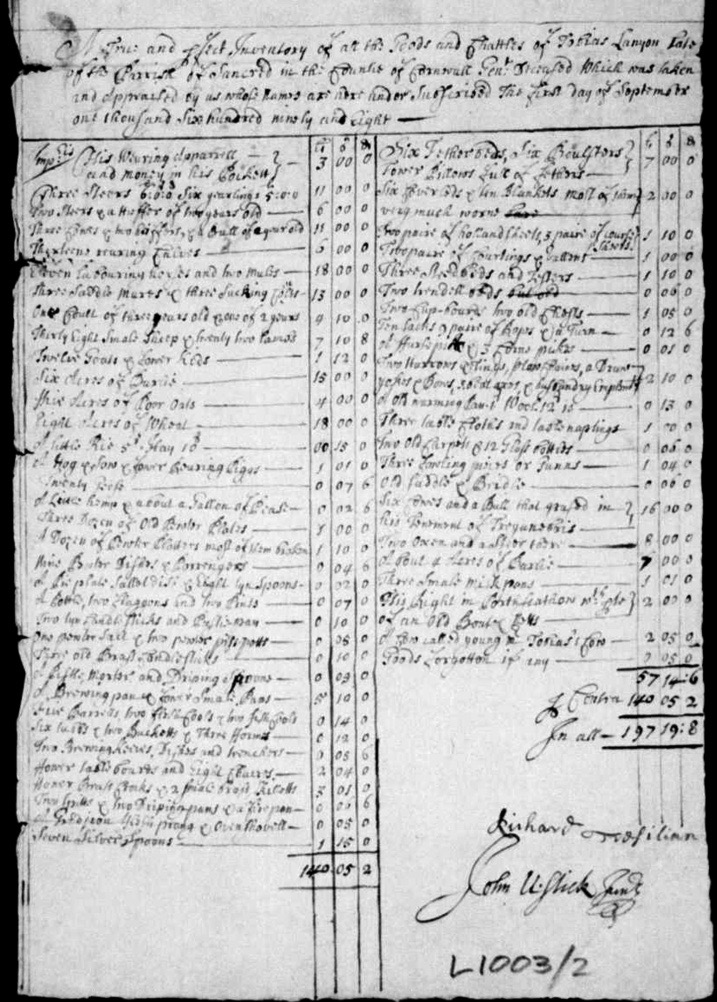
Inventory of Tobias Lanyon will of 1698 – Source CRO AP/L/1003
Tobias’ inventory was signed by John Ustick and Richard Tresilian.
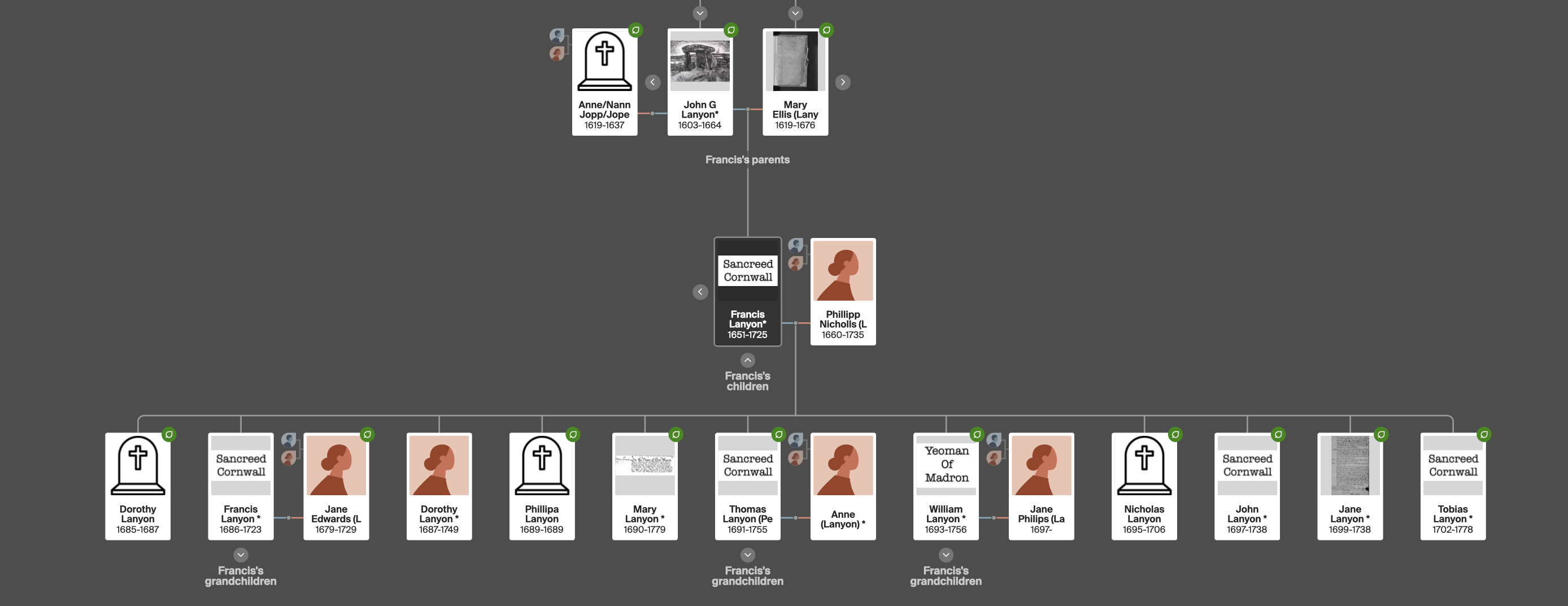
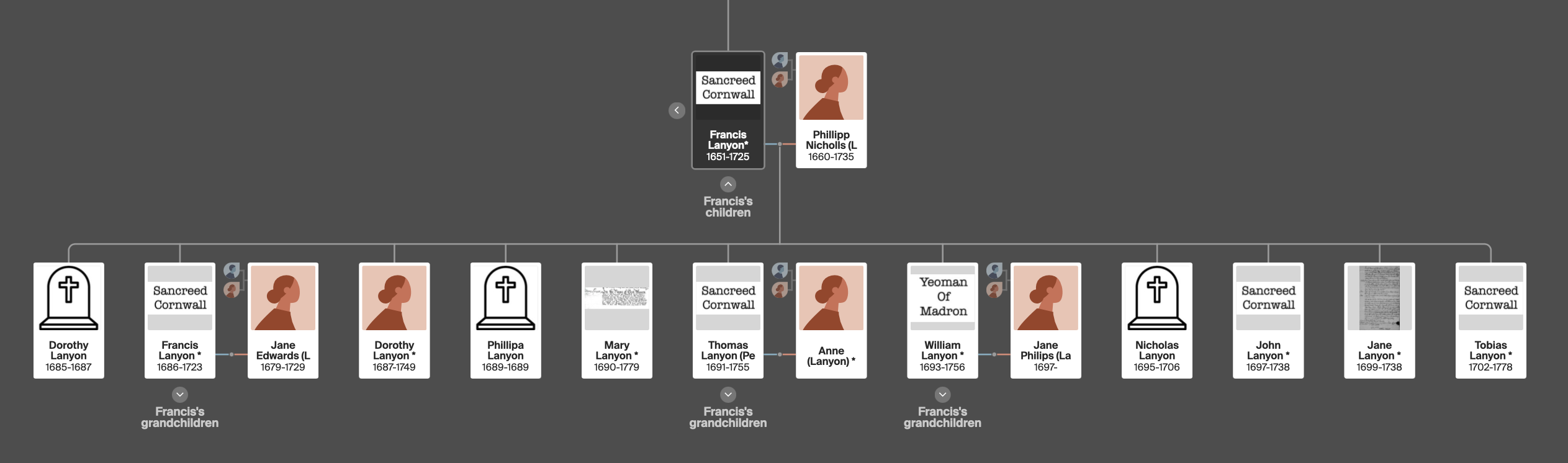
Francis Lanyon 1651-1725
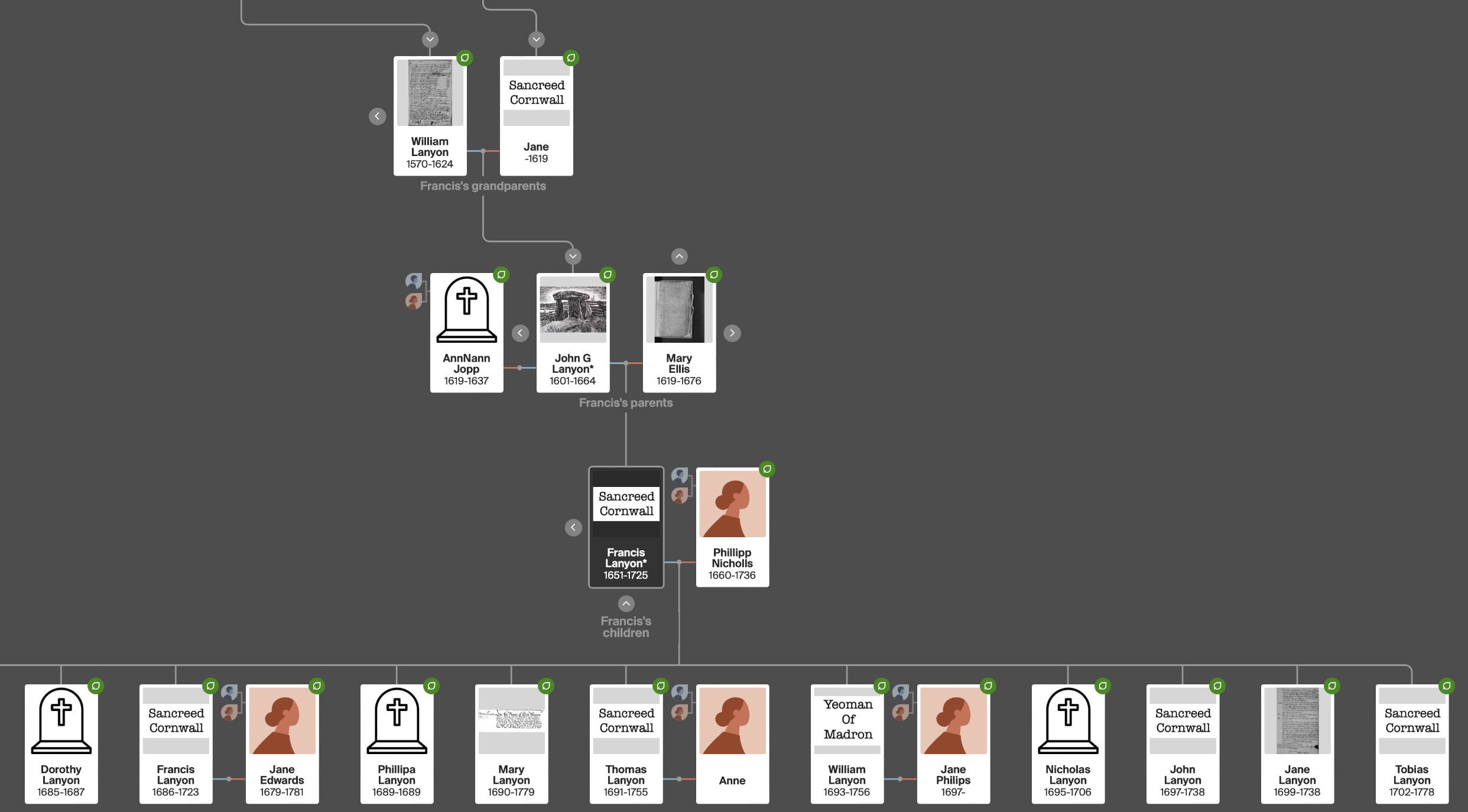
Francis married Phillipp Nicholls on 31 Dec 1681 at Madron. They had ten children.
Francis & Phillipp’s tree
Dorothy 1685-1687 died in infancy
Francis 1686-1723
Phillipa 1689-1689 died in infancy
Mary 1690-1779
Thomas 1691-1743
William 1693-1756
Nicholas 1695-1706 died in infancy
John 1697-1738
Jane 1699-1738
Tobias 1702-1778
I found a reference to Francis Lanyon in ‘A Compendium of the History and Geography of Cornwall’ by Rev JJ Daniell 1908.
p 454 Sancreed
The author talks about the poor state of this parish church and adds the following footnote:-
“This question of seating was a trouble in many parishes. the vicar here, John Smyth, was sore tried…at a later time even Francis Lanyon of Sancreed, gentleman, being a man of considerable estate and married into a very worthye family, viz., Mrs Phillip Nicholl, niece to the worshipful Colonel Godolphin esq ‘was actually without a convenient seat.’ The Lanyons of Botrea and later Tregonebris were for many generations the leading family in Sancreed.”
These comments were apparently penned by Bishop Sparrow after his visitation to Sancreed on 15 July 1671.
Joane married John Edwards at Ludgvan in 1674, no further trace.
Elizabeth Lanyon 1654-1737
Elizabeth married Francis Elies at Sancreed in 1681, they had three children: Bennet, Anne and Caterina.
Rebecca Lanyon 1656-1705
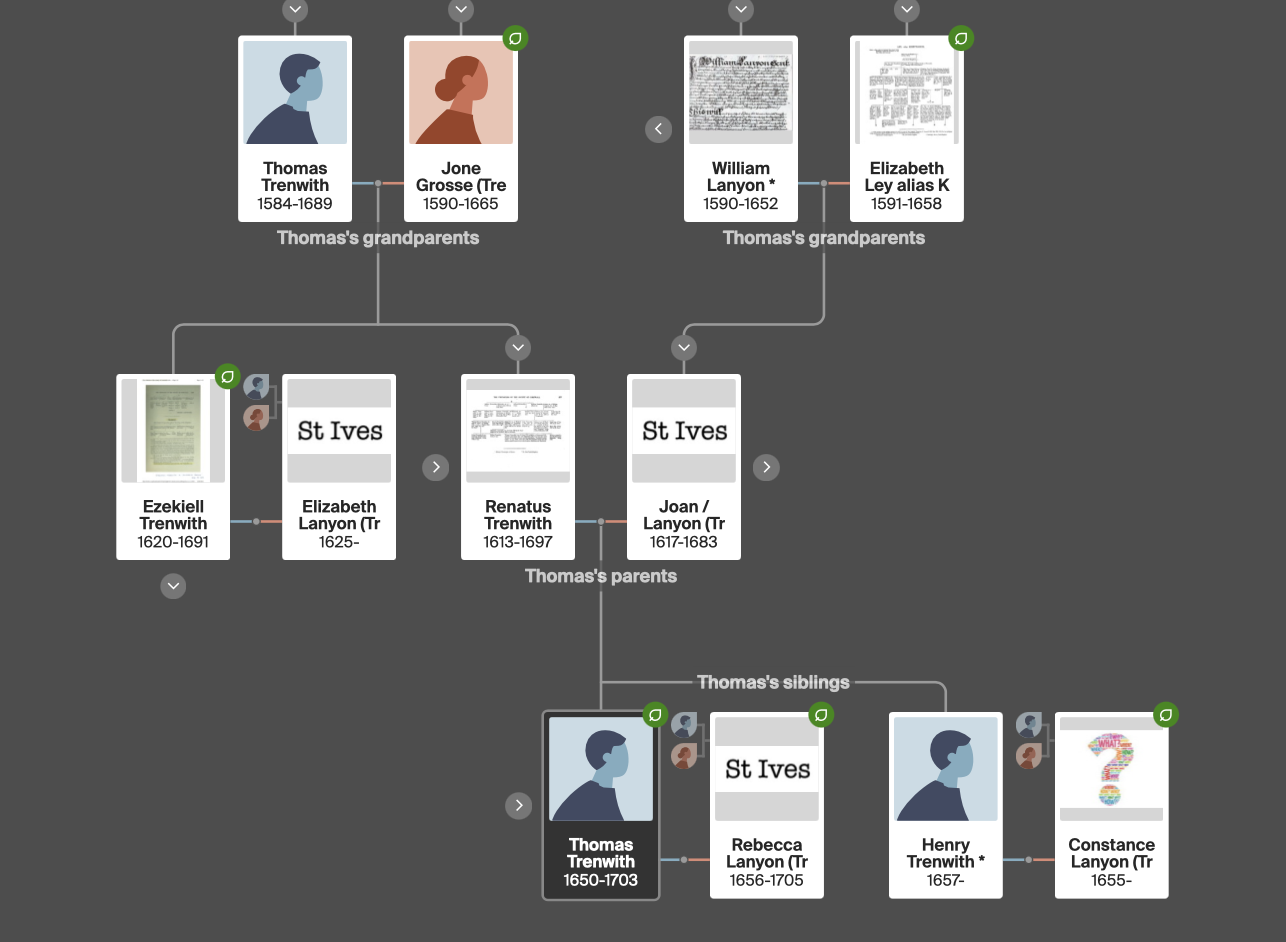
Rebecca married her cousin Thomas Trenwith at Towednack, Cornwall in 1676. (Her name is spelt Rovena in the register). Thomas was the son of Renatus Trenwith and Joan/Johanna Lanyon of Gwinear. (see Gwinear branch.)
Thomas went to Oxford University and was Mayor of St Ives in 1684.
Thomas and Rebecca had eight children.
Trenwith & Lanyon tree
Charles Lanyon 1658-1721
The Sancreed parish register lists his baptism as Charels son of Mr John Leanyne and Marie.
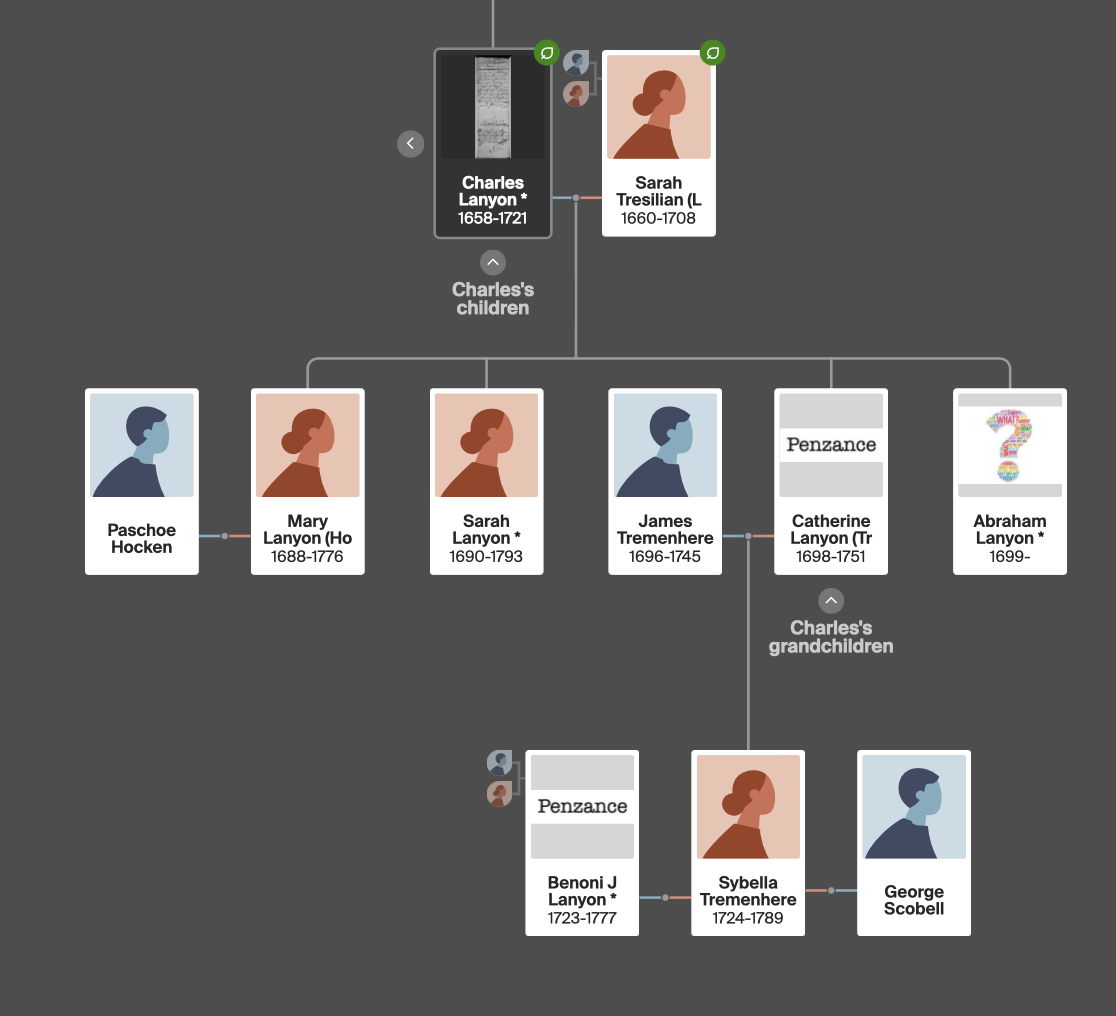
Charles married Sarah Tresilian about 1686 and they had four children:
Charles & Sarah’s tree
Mary 1688- married Paschoe Hockin at St Buryan 1710
Sarah 1690-1793 (age 102!!) she never married (see post ‘Sarah’s Pew’)
Catherine 1698-1751 married James Tremenhere at St Levan in 1720 – five children.
Abraham Lanyon 1699- no further trace.
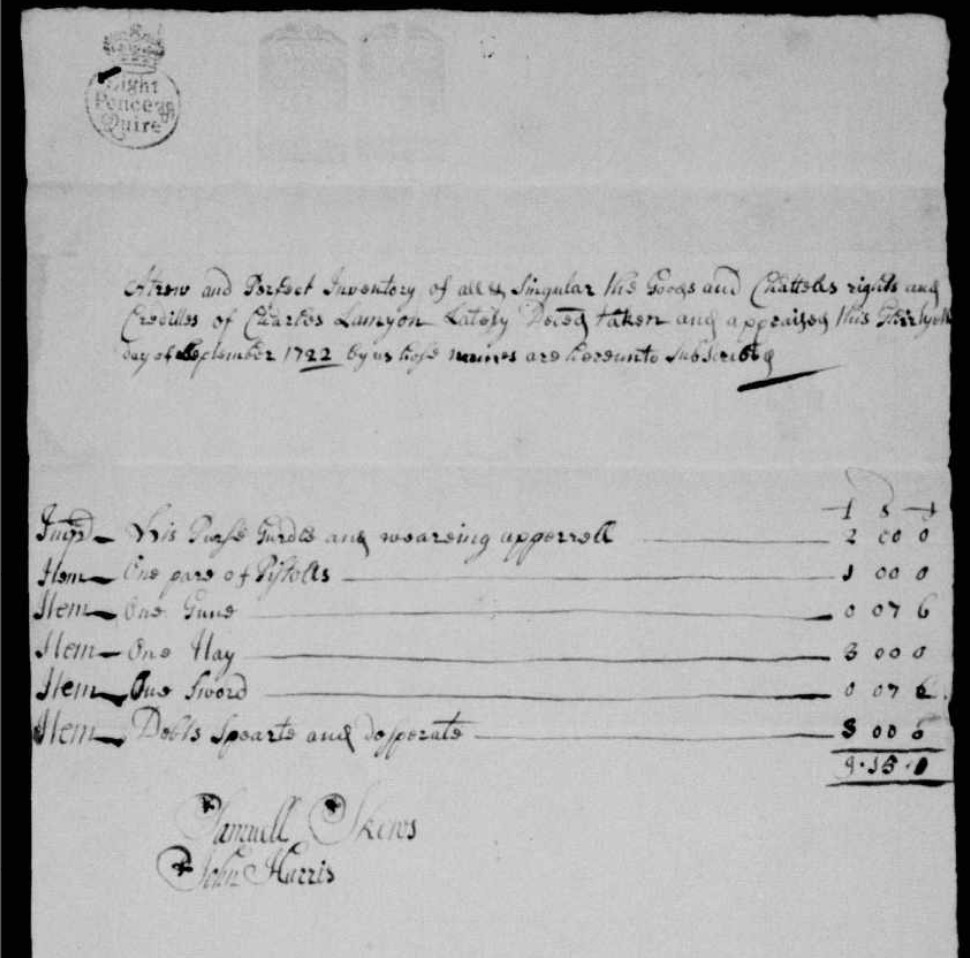
Charles Lanyon’s will of 1722 (Source Bodmin Probate Registry) lists the following:
A purse, girdle and wearing apparel, one pair of pistols, one gun, one sword, to a friend.
Charles Lanyon 1722 – Inventory
Phillip Lanyon 1659-
Phillip was the seventh son but he still managed to inherit land in Sancreed and money from both parents.
There is an Ann Lanyon d/o Philipp baptised at Madron in 1678, she could be a daughter of this Philipp, it isn’t clear. Phillip married Mary Edwards at Ludgvan in 1683 but no further children traced.
There is a burial of a Phillip Lanion at Eastern meeting Society of Friends at Liskeard on 16 Jul 1697, also an Elizabeth Lanion buried 29 May 1689 of Liskeard. It is possible that it is the same Phillip. Could the Phillip buried at Liskeard be a woman?
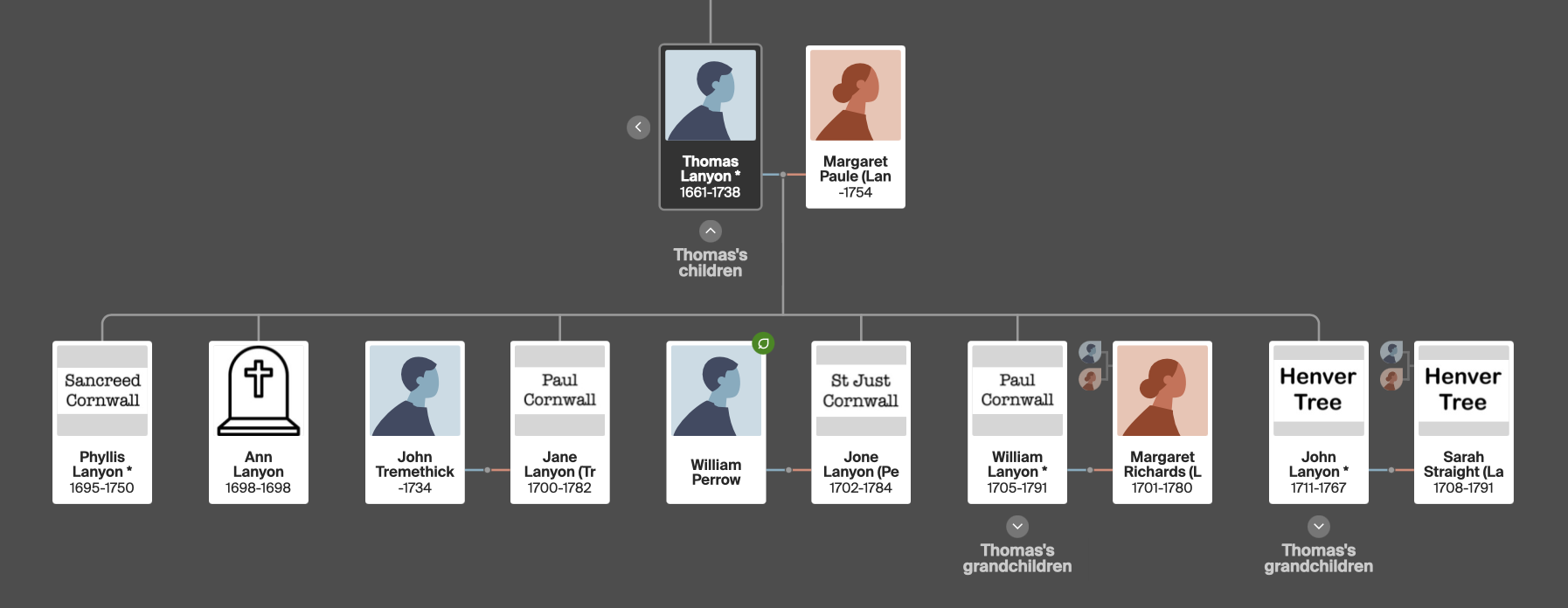
Thomas Lanyon
Thomas was born in 1661 just three years before his father died. He was left land and money by both parents. He married Margaret Paule at Breage in 1681.
Thomas & Margaret’s tree
Phyllis 1695-1750 – spinster
Anne 1698-1699 – died in infancy
Jane Lanyon 1700-1782 – married John Tremethick
Jone Lanyon 1702-1784 – married William Perrow – 2 children
William 1705-1791 – married Margaret Richards – 3 children
John 1711-1767 – married Sarah Straight and started the St Allen branch of the family.
And just like that the Botrea branch of the family has grown! With so many children and grandchildren I have concentrated on the male grandchildren and their families. It becomes a journey of wealth to poverty over the course of the generations.





























 The Lanyons