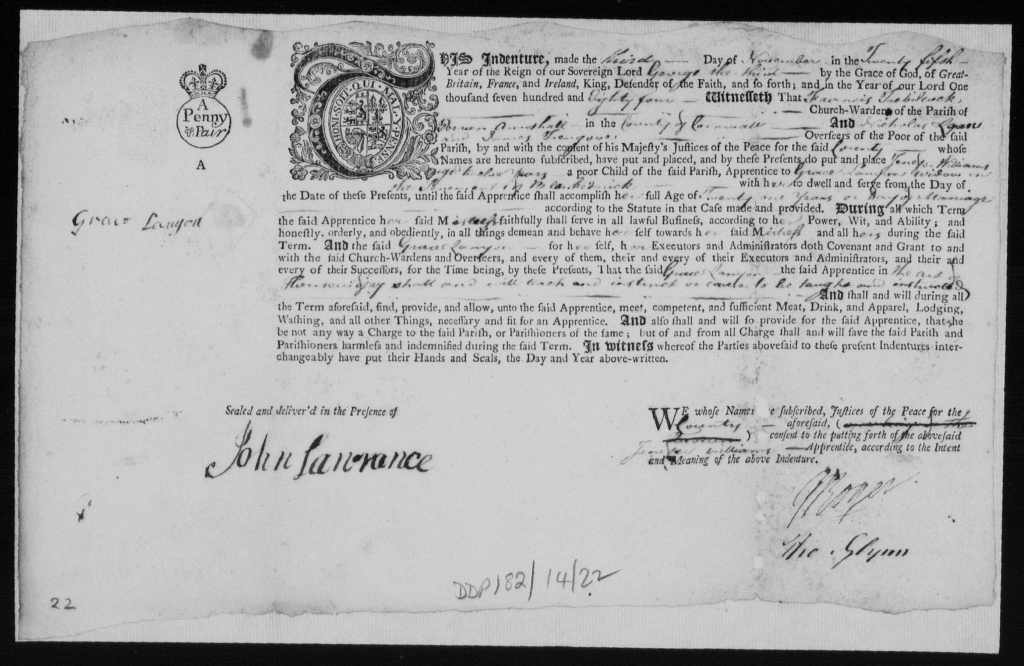
The ‘Golden’ Lanyon

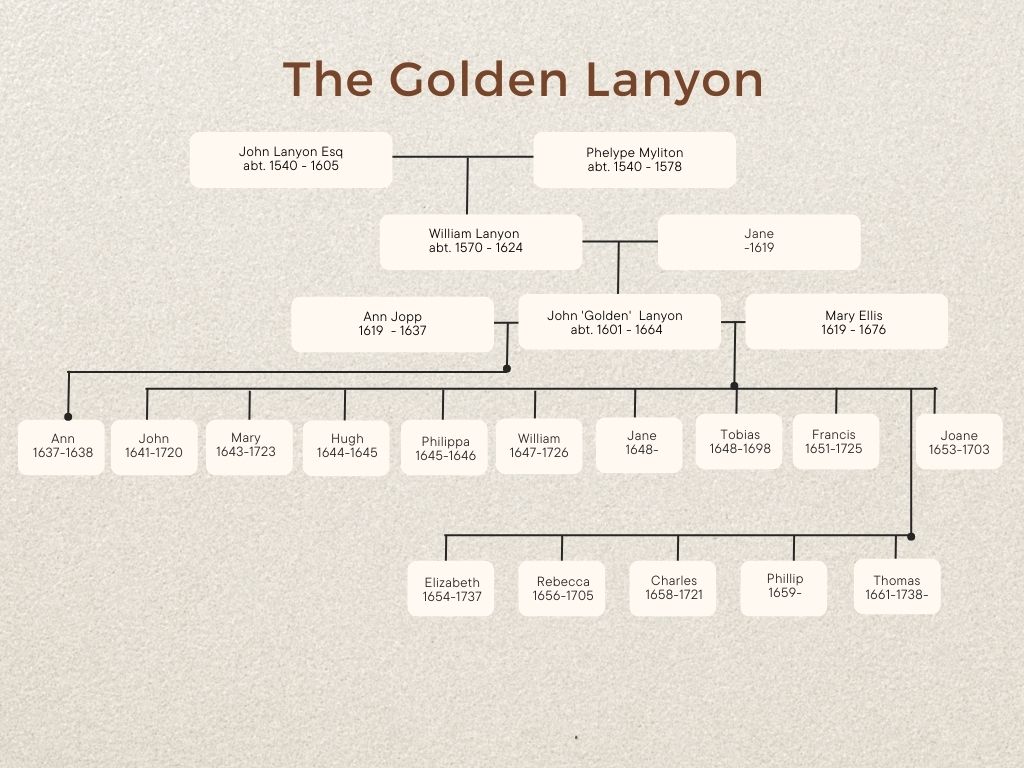
John ‘Golden’ Lanyon was the eldest surviving son of William Lanyon who died at Sancreed in 1624 and the grandson of John Lanyon Esq. He was “commonly called ‘the Golden Lanyon’ as having gotten great riches by tin, which he divided among his numerous issue”. source – ‘The Parochial History of Cornwall’ – Davied Gilbert 1838 – Volume 2. He was also according H.L Douch in his article on John Smyth the vicar of Sancreed, a moneylender. (See the post ‘The Scandalous Vicar of Sancreed’).

His siblings were:

  • Elizabeth 1593- who married John Nowell alias Peares at Sancreed in 1617.
  • John 1596-1601 died in infancy
  • Jane 1602- married Thomas Flavell 21 Nov 1619 at Sancreed.
  • William 1603-1687 married Grace at Illogan 24 Nov 1636 (when he was aged 33), and was buried at Illogan 27 Feb 1687. (There is a Catheren Lanyne buried at Illogan in 1623, could this be a first wife to William?)
  • Paskas abt. 1606 – we’ll cover her in a separate post.
  • Elizabettie abt. 1607- Elizabettie was still alive in 1624 as she was mentioned in William’s will but we don’t know what happened to her.

John ‘Golden’ Lanyon’s baptism wasn’t recorded but he must have been born after the death of his elder brother in 1601 and before his brother William in 1603.

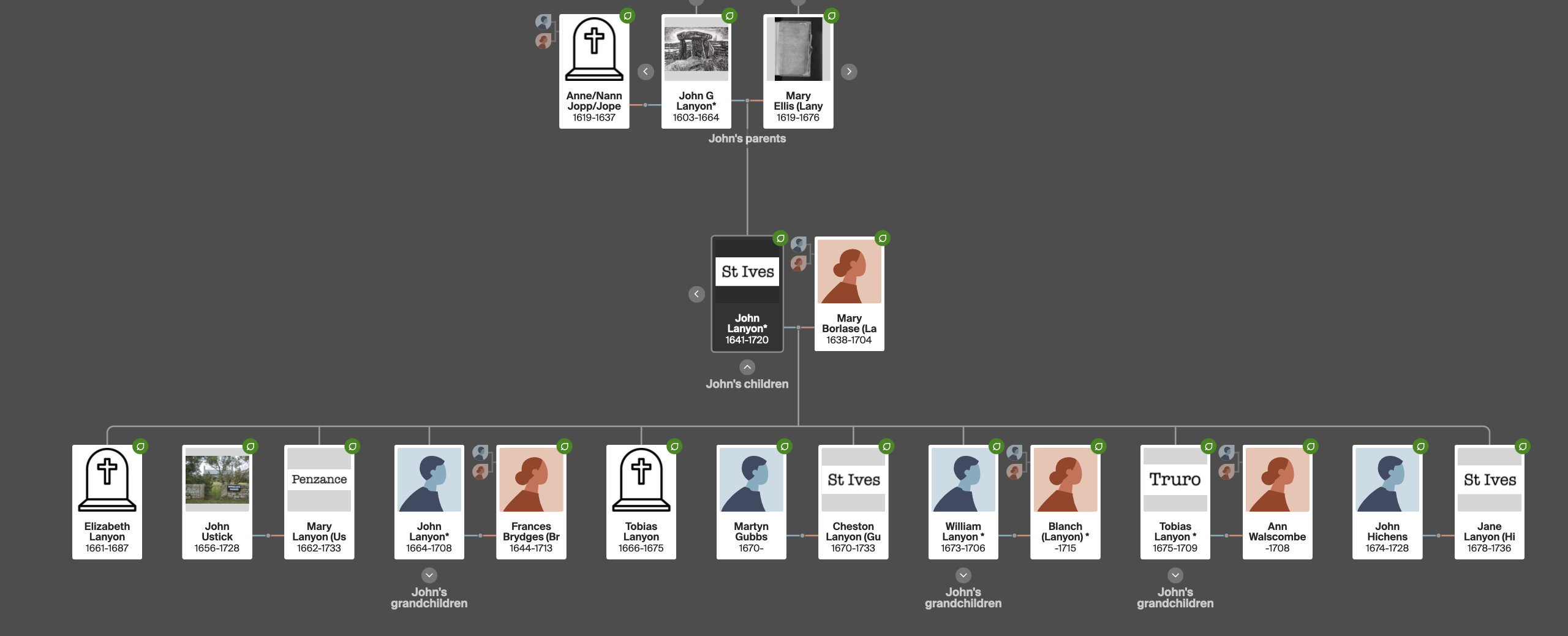
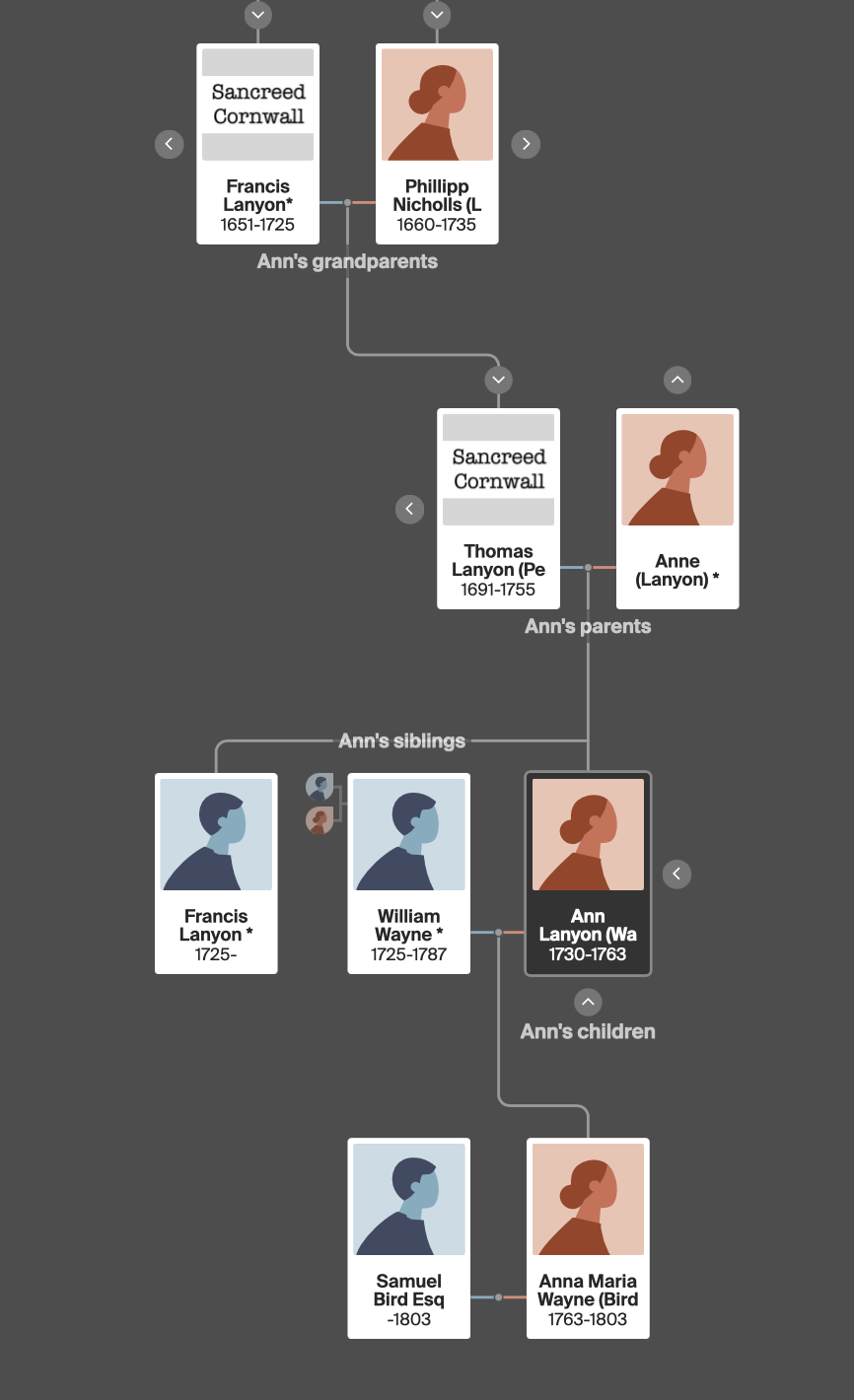
His first marriage was to Ann (Nan) Jopp on 29 Oct 1636 at Sancreed. Ann died in childbirth, she was buried on 2 Feb 1637 aged just 17. Her daughter also called Ann was baptised the same day. Baby Ann was buried on 2 Sep 1638 at Sancreed.

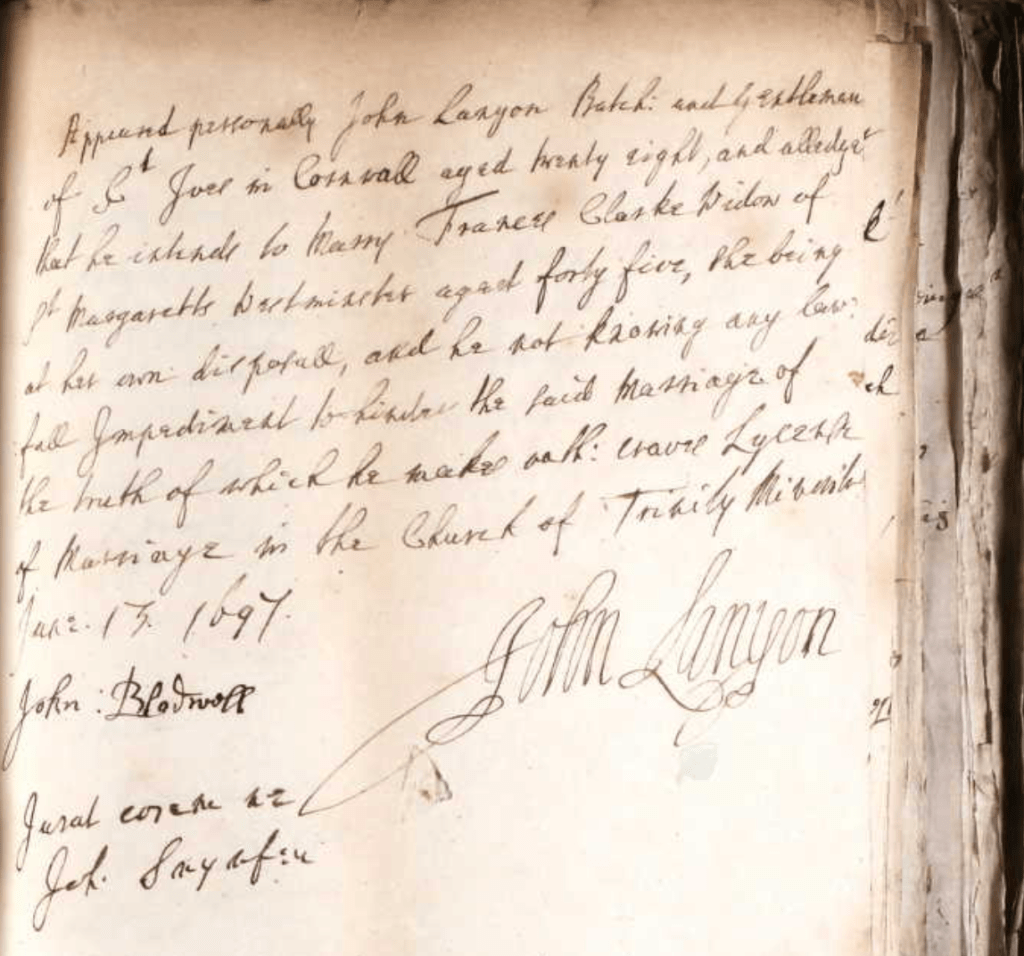
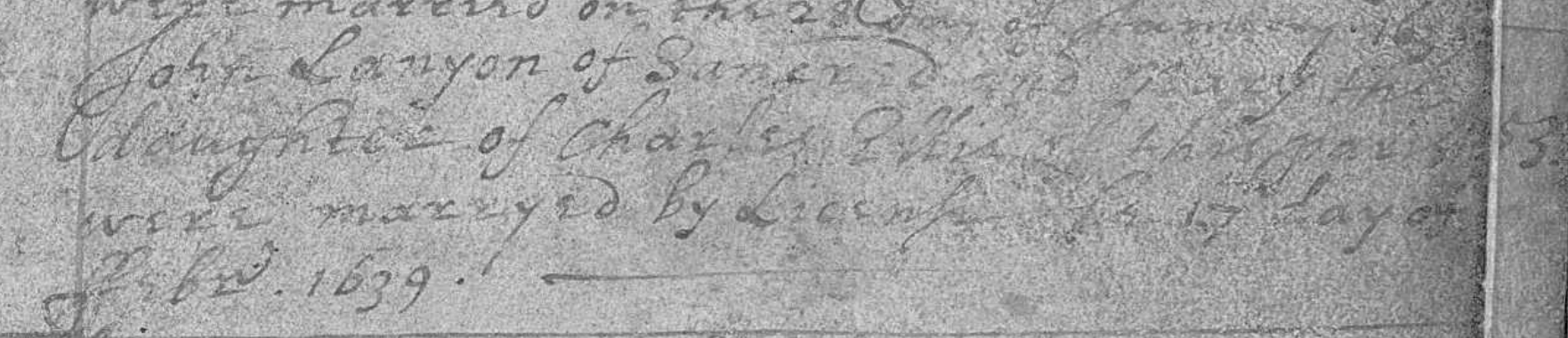
On 17 Feb 1639 John and Mary Ellis, the daughter of Charles Ellis and Alice Penwarne, were married by licence at Sancreed.

Sancreed Parish Register 1639

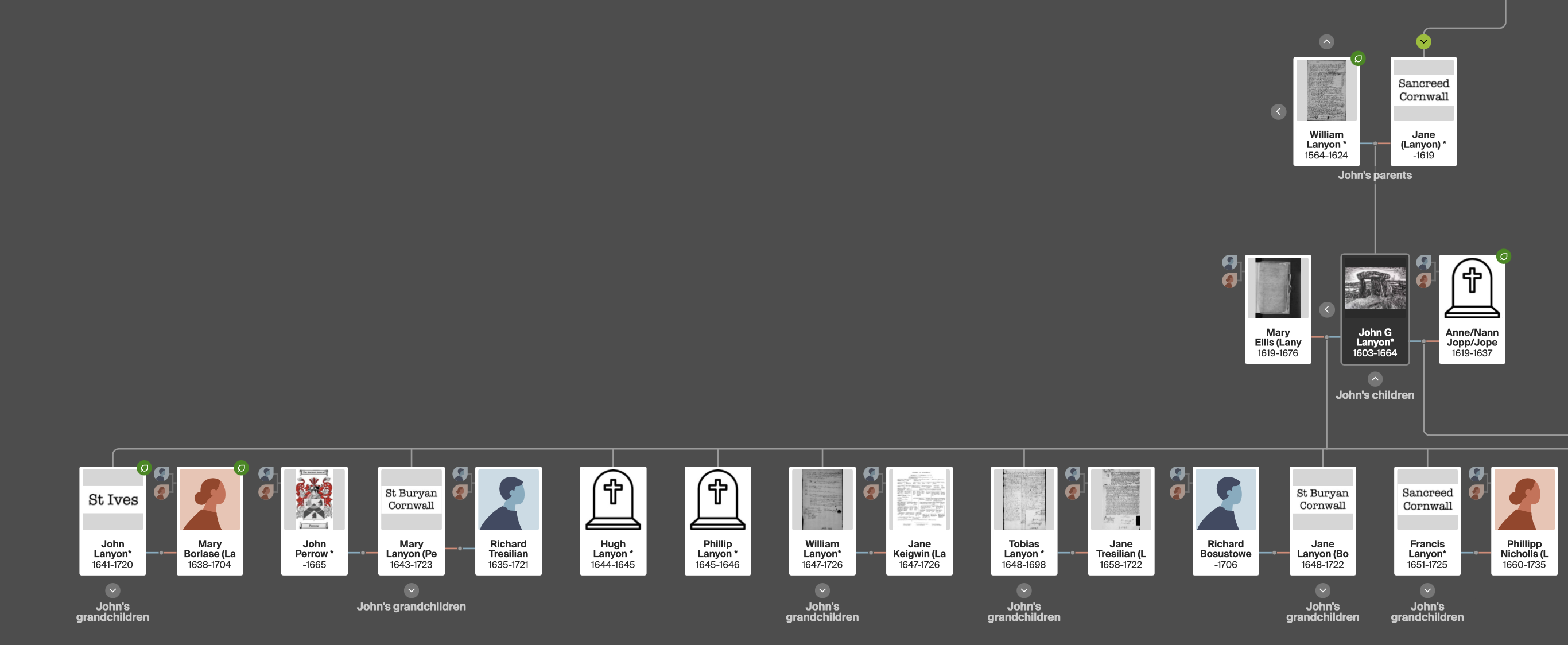
Mary was aged 20 and went on to have fourteen children of which only two died in infancy.

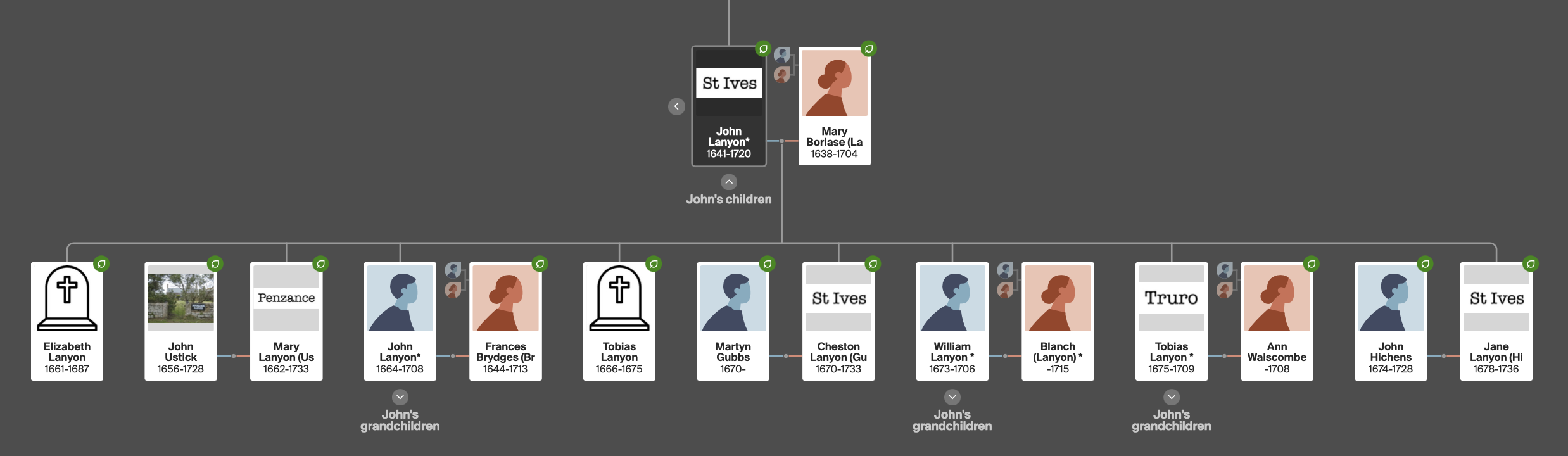
  • John 1641-1720
  • Mary 1643-1723
  • Hugh 1644-1645
  • Philippa 1645-1646
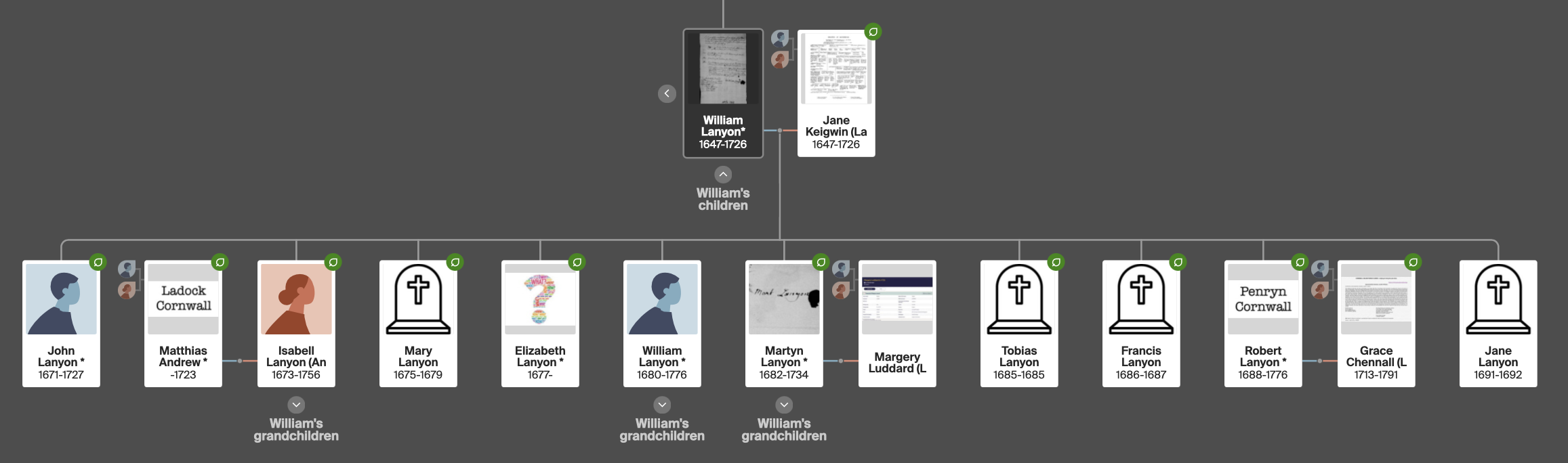
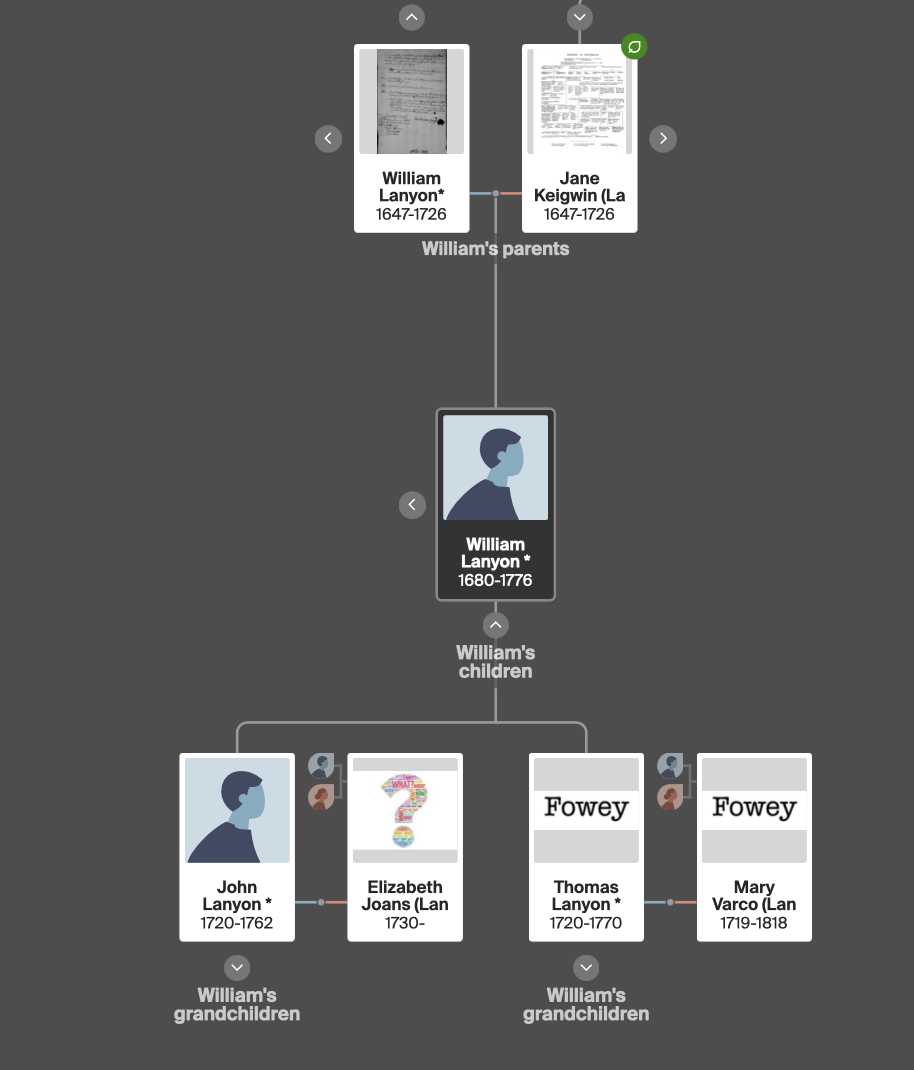
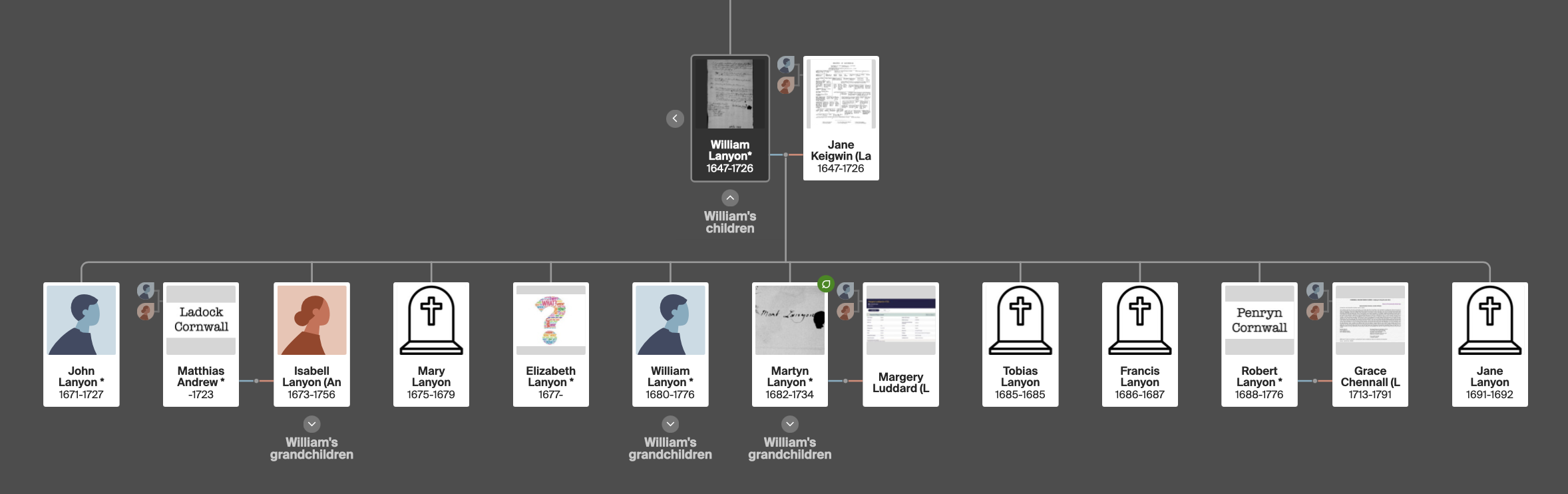
  • William 1647-1726
  • Jane Jan 1648-
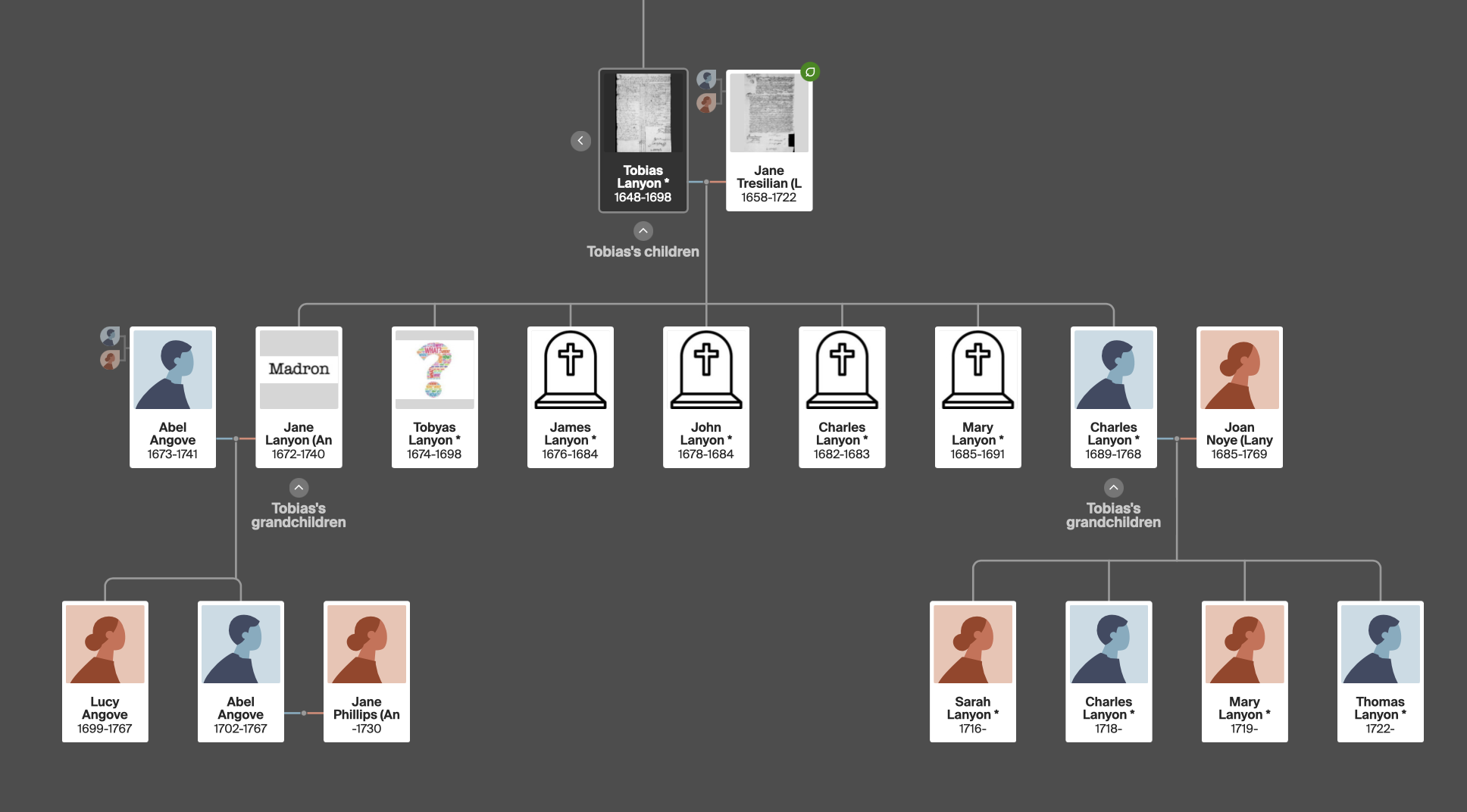
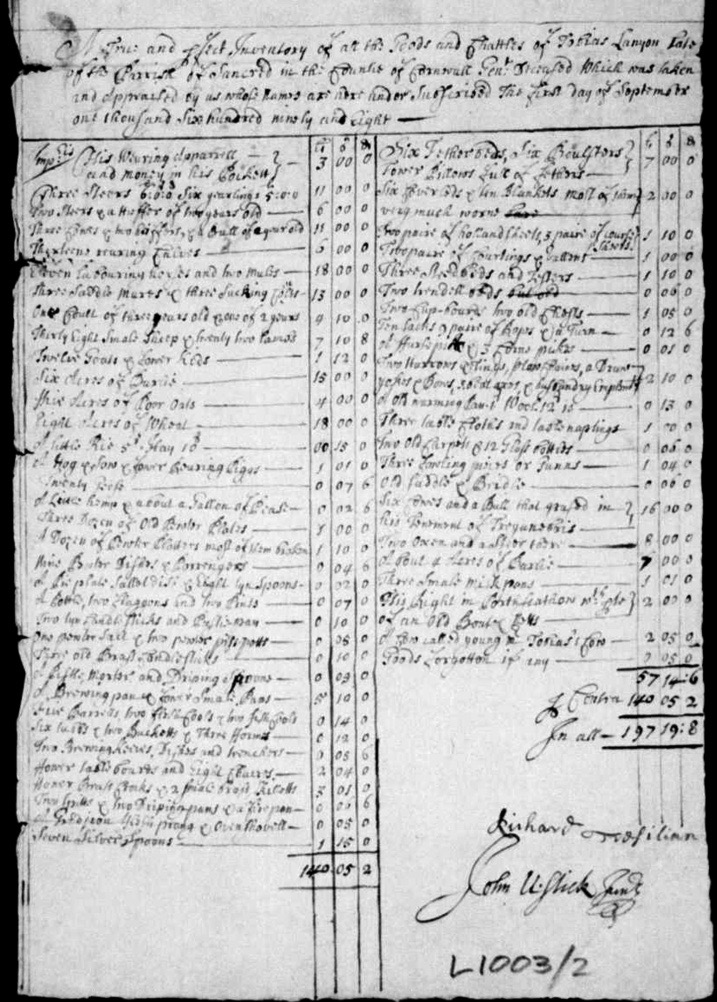
  • Tobias Nov 1648-1698
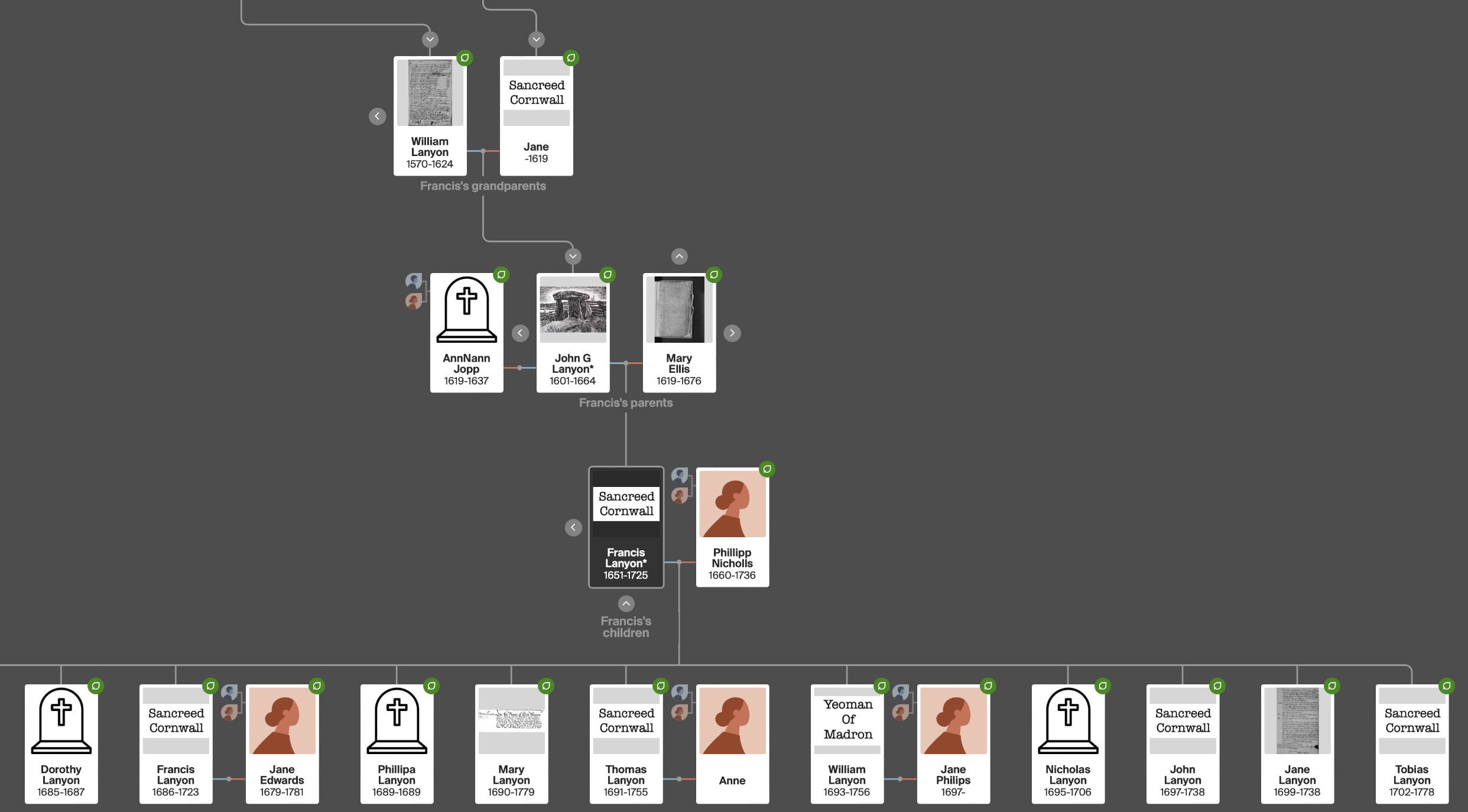
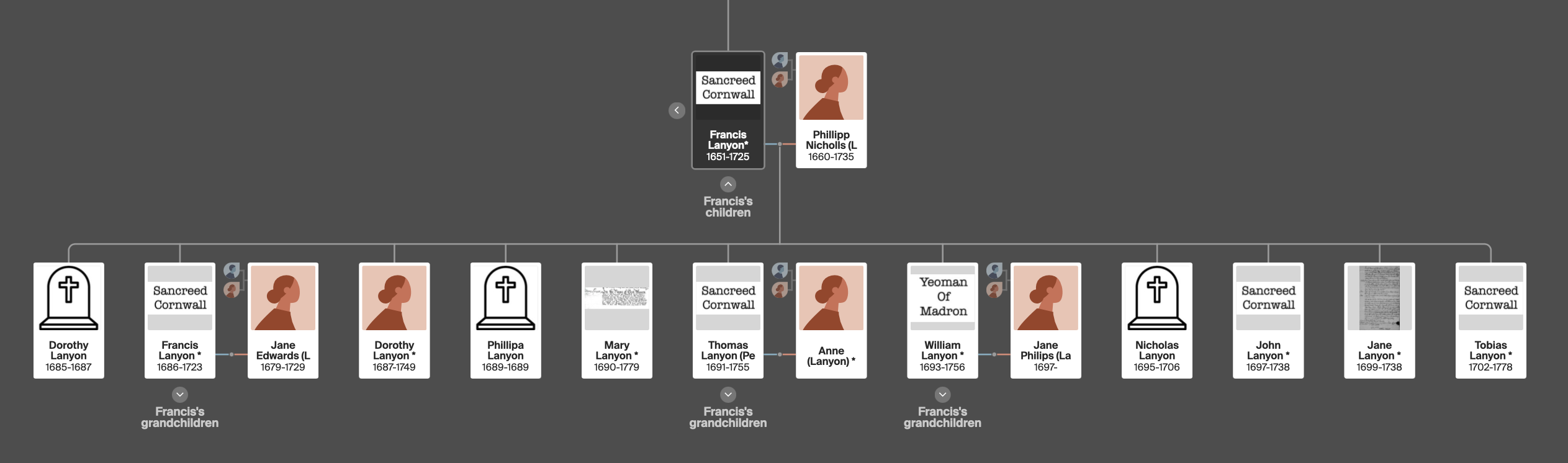
  • Francis 1651-1725
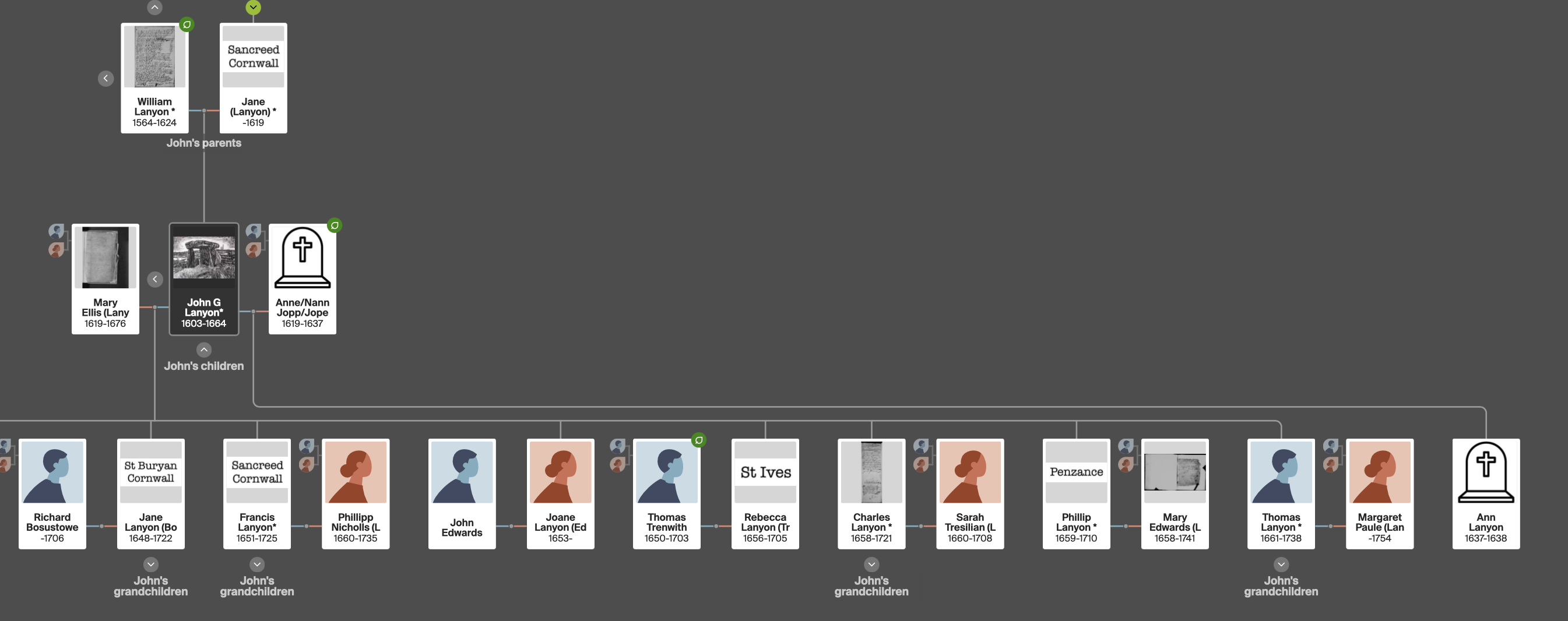
  • Joane 1653-1703
  • Elizabeth 1654-1737
  • Rebecca 1656-1705
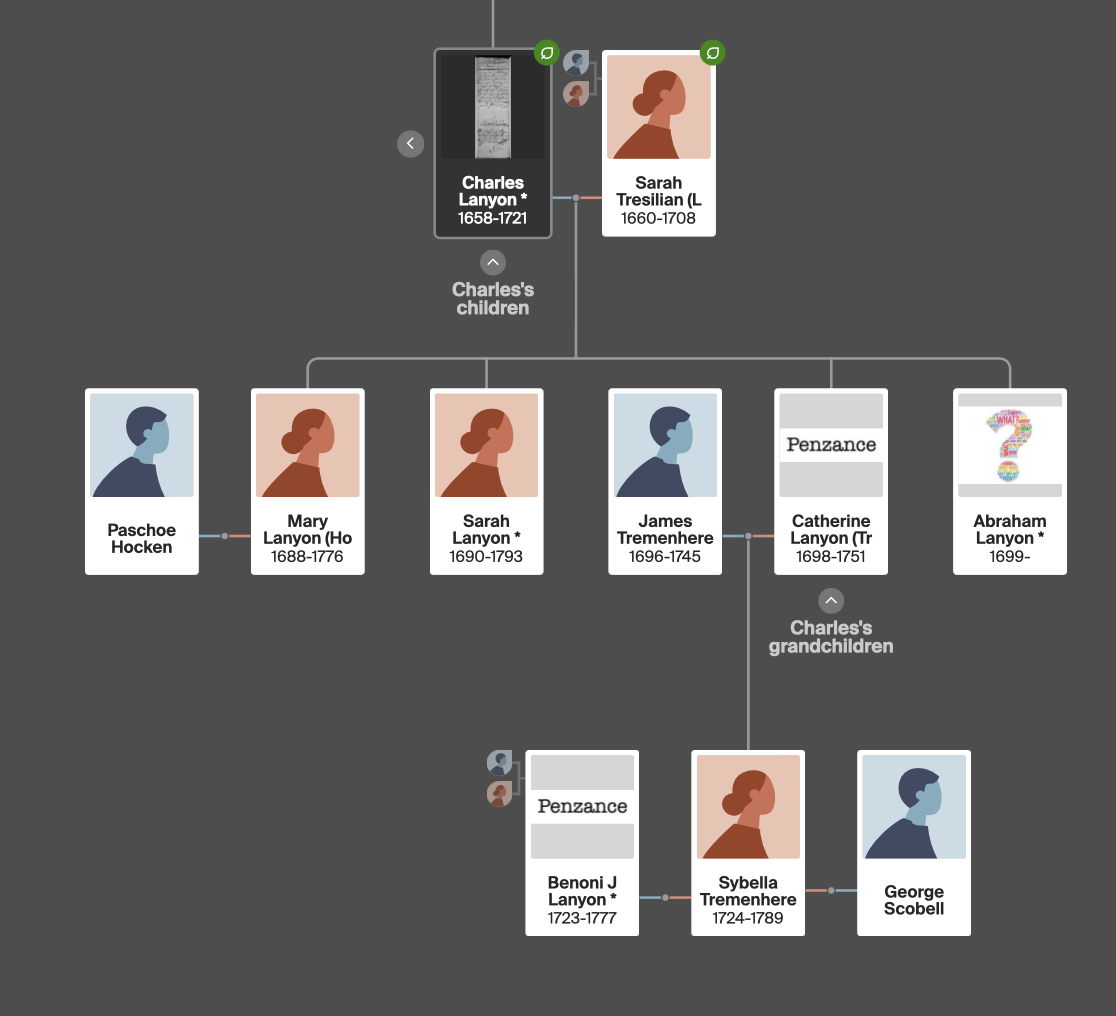
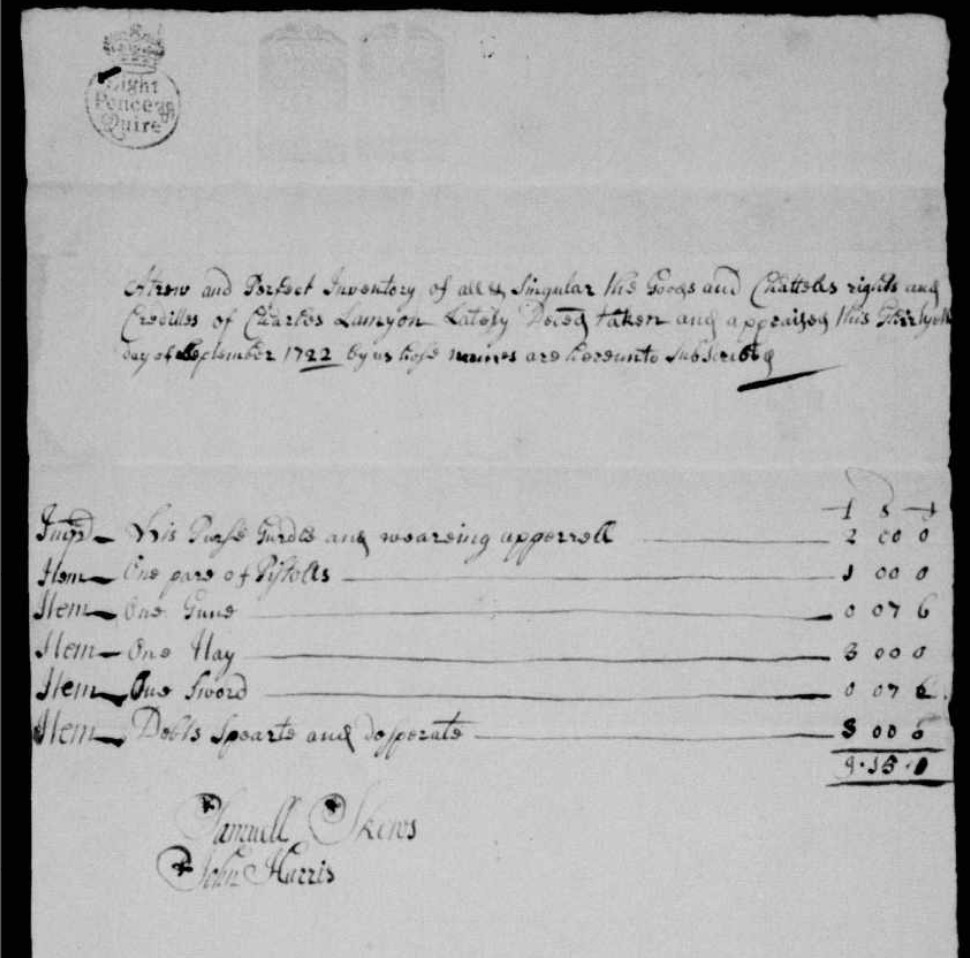
  • Charles 1658-1721
  • Phillip 1659-
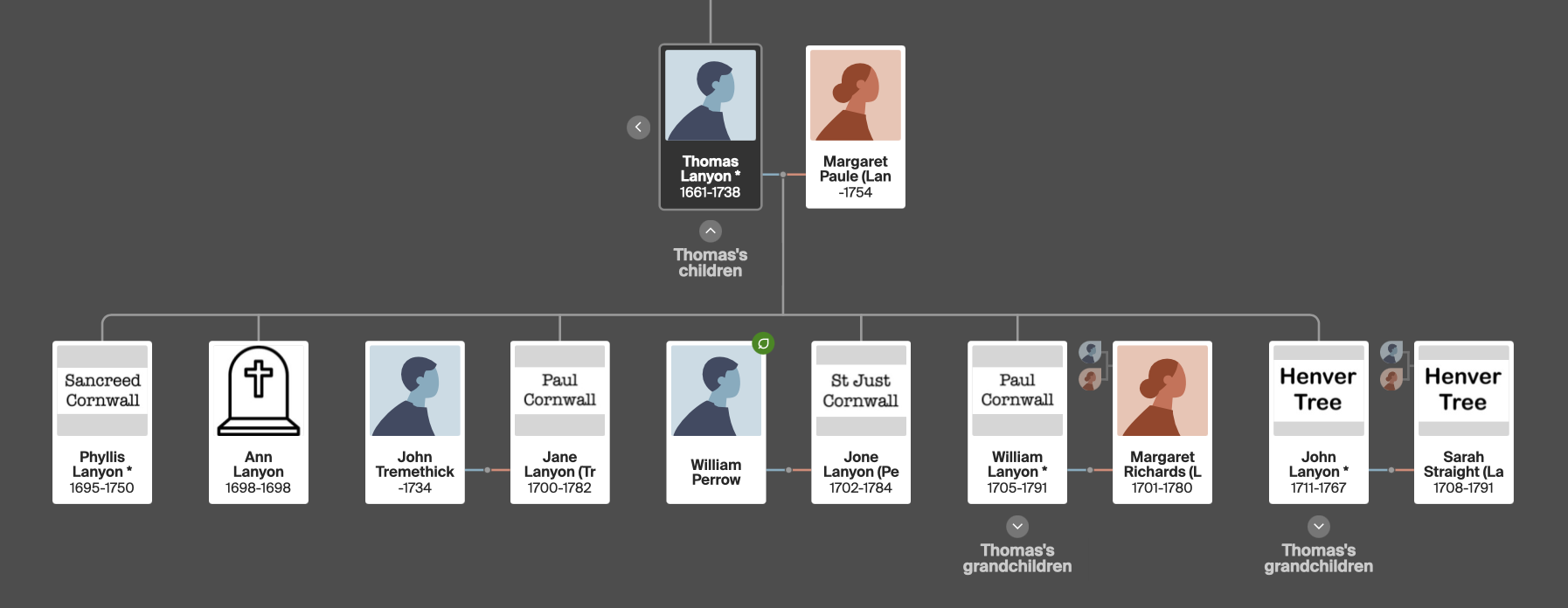
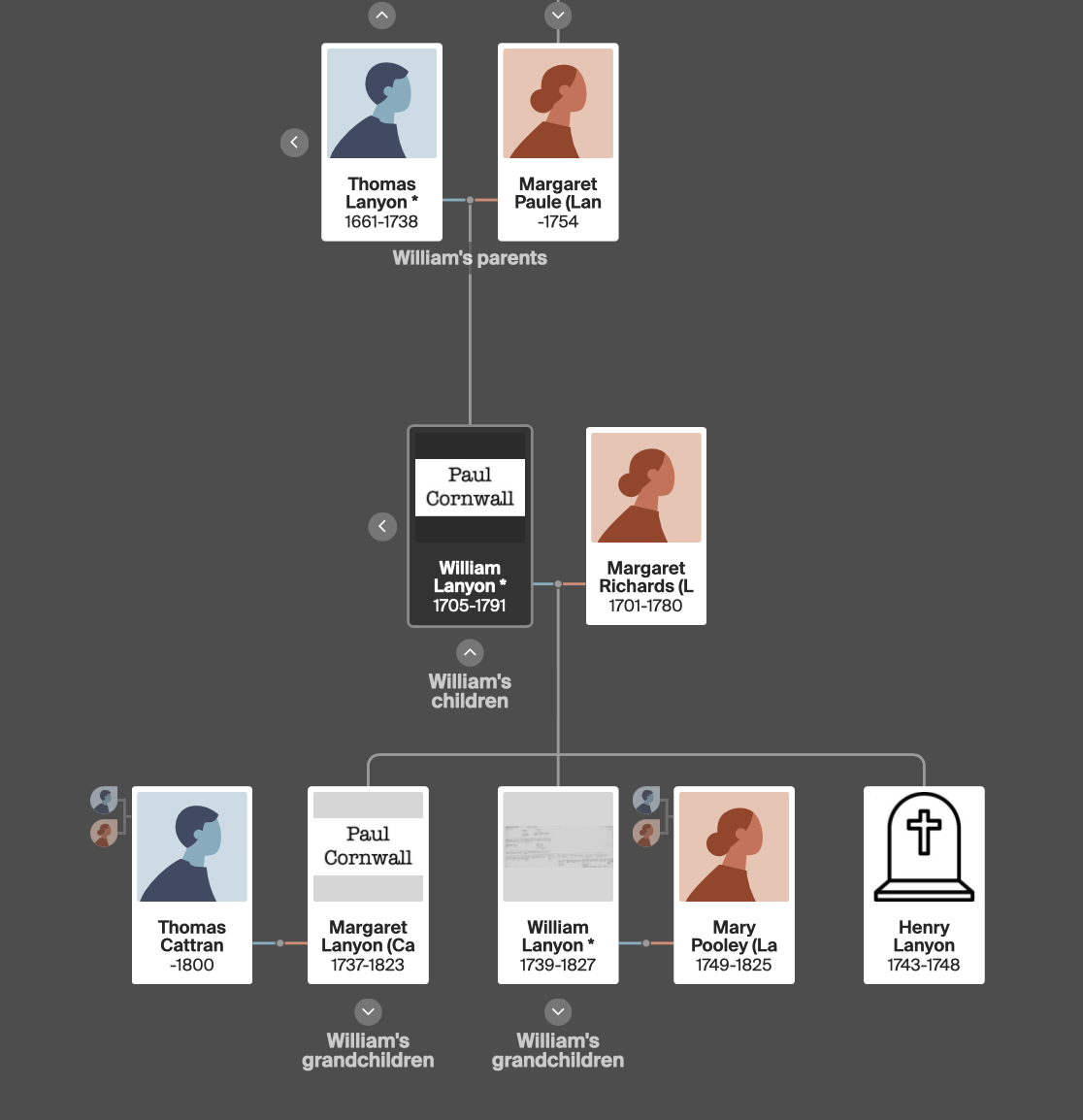
  • Thomas 1661-1738

John & Mary were the founders of the Botrea branch of the Lanyon family and with twelve surviving children it was quite a branch!

The children of John Lanyon and the Botrea branch of the Lanyon tree.

John and Mary lived at Botrea house in Sancreed.

In 1659 his cousin John Lanyon of Morvah sold John Lanyon of Botrea House, Sancreed the Manor of Tregaminion for £1500. – Source Henderson MSS Vol XII p83 Bundle 15.

John was buried on 17 Apr 1664 at Sancreed. After his burial John Smyth the unconventional vicar at Sancreed stated ‘the old hog is dead!’ Mary Lanyon, his widow, prosecuted John Smyth in the Consistory Court in 1668 (see post ‘Scandalous Vicar of Sancreed’).

He left a detailed will – note the name Johannes Lamon!

Source: NA PROB 11/315/384

In the name of God Amen Johannes Lamon Dated the Eleaventh day of Aprill In the yeare of our Lord God One Thousand Six Hundred Sixty and Foure 1664 I John Lamon of Bottreth in the parish of St Crett in the County of Cornwall gentleman being now in perfect mind and memory Thanks be to God doe make this my last will and Testament in manner and forme following First I doe bequeath my soule into the hands of my Redeemer And my body to receive Christian burial Amen First I doe give and bequeath to the reparacion of the parish Church of St Crett Twenty shillings Item I doe give and bequeath To the poorest sort of the Parish of St Crett Twenty shillings Item I doe give the whole houses that I have built in the Trerise in the parish of St Crett to the poorest sort of people of St Crett parish for ever to remaine and the little plott of land which is excepted upon my deed for ever To be disposed by my Executor or their Assigns for ever.

  • Item I doe give and bequeath to the reparacion of the parish Church of the parish of St Just Tenn shillings
  • Item I doe give and bequeath to the poorest sort of St Just Tenn shilling
  • Item I doe give and bequeath to my daughter Mary the wife of John Perrow Five pounds in money
  • Item I doe give and bequeath to my daughter Joane Lamon Three Hundred pounds of good English money
  • Item I doe give and bequeath to my daughter Jane Lamon Two hundred and Fifty pounds of good English money
  • Item I doe give and bequeath to my daughter Rebecca Lamon Two Hundred and Fifty pounds of good English money
  • Item I doe give and bequeath to my sonne William Lamon All my Estate in Bottreth and in Bossence and in Deanerall Chegwine vean Treronacke and Treronacke Mill and Lanes and Mannen within the parish of St Crett Lease and Fee And all my Estate of the houses and Land that I Did buy of Thomas Chergwine of Penzance And the Fee land that I did buy of David Graffe being the land that Mrs Margery Rogers hath a Lease of it in Penzance And the One halfe of all my houshould goods And the One halfe of all my Tynn Bounds And Two Hundred pounds in money
  • Item I doe give and bequeath to my sonne Tobias Lamon all my Estate in Tredgion issueing Lease and Fee in Tregenebres within the parish of St Crett And all my Fee land in Brane in St Crett parish and two Hundred and Fifty pounds in money
  • Item I doe give and bequeath to my sonne Francis Lamon All my Estate in Reynald Madderne ?‐‐‐ living in Trigenibres within the parish of St Crett and my Fee land in Cardeney within the parish of Burian And Two Hundred pounds in money
  • Item I doe give and bequeath to my sonne Charles Lamon All my Estate in Bowanante and Bowanante Vean within the parish of St Crett and the Fee Estate of Boddeneak within the parish of St Crett and Two Hundred pounds in money
  • Item I doe give and bequeath to my sonne Philipp Lamon All my Fee land in Laves Treaven and Nanceathon within the parish of St Crett and three Hundred and Fifty pounds in money
  • Item I doe give and bequeath To my sonne Thomas Lamon All my Fee land in Terdeny in Burian parish which I did buy of Mr William Keygwine and Mr William Madderne And Two Hundred and Fifty pounds in money
  • Item I doe give and bequeath to the Child That is in my wife if shee be with Child att the tyme of my death Two Hundred pounds in money
  • Item I doe give and bequeath to my sonne John Lamon the Fee Estate of the Land in Keygwin within the parish of St Just which I bought of Mr Peeter Cely and Foure young mares which I have att Tregenminion And the one halfe of all my Tynn bounds
  • Item I doe give and bequeath To my wife Mary Lamon the living in Sennen parish called Bussume (words illegible) But if she doe stay Unmarried I doe make her my Childrens (words illegible) doe give her all my goods and Chattells moveable and unmoveable (words illegible) given But if shee doe marry she is to have the living in (words illegible) called Busume during her life and noe longer and Thirty pounds (words illegible) if doe stay a widow woman she is to have the benfitt and profits of the (word illegible) of Bownonce and Bownance vean And the one halfe of all the profits of Reonald Madderne is living and the one halfe of all the profits of ?‐‐‐ living in Tregenebres And the one halfe of the profits of Bottreth (words illegible) of yeares And the one halfe of all the benefit All the rest of my Children is portions towards their maintenance until they come of yeares But if shee doe not marry I doe make her my full and whole Executor and to fulfil this my last will and Testament But if shee doe marry I doe make my sonne William Lamon and my sonne Tobias full and whole Executor Joyntly and to fulfil this my last will and Testament ?‐‐‐ call their mother to give a Just ?‐‐‐. of what she did re come which should be due to them as to any of their brothers or sisters That they may have it from her to pay them I doe give to my man Francis Ellis Twenty shillings I doe appoint and ordaine my brother in Lawe Pascoe Ellis and my sonne John Lamon to see that my wife may be carefull to maintain my Children and to put their ?‐‐‐ in good hands whereby they may have it when they come to yeares.

By kind permission of the Cornwall OPC – Transcription: Kath Chaveli/Judith Upton

https://www.cornwall-opc-database.org/search-database/more-info/?t=wills_transcriptions&id=7744

His will shows just how wealthy he was and how many of his children were still very young at the time of his death. His youngest child Thomas was just three years old.

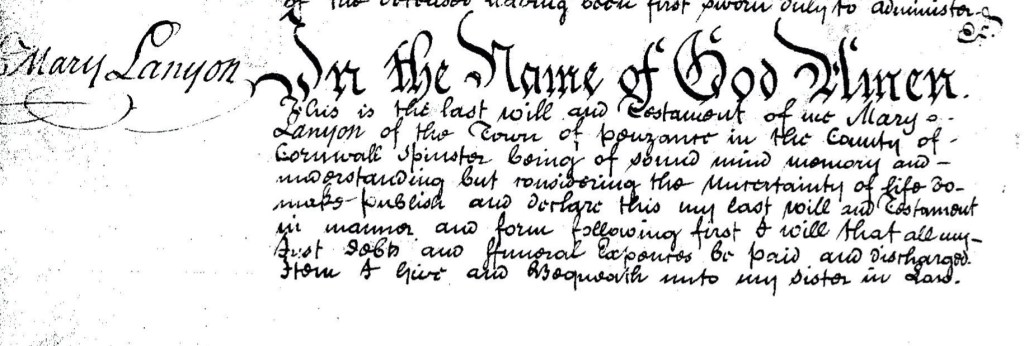
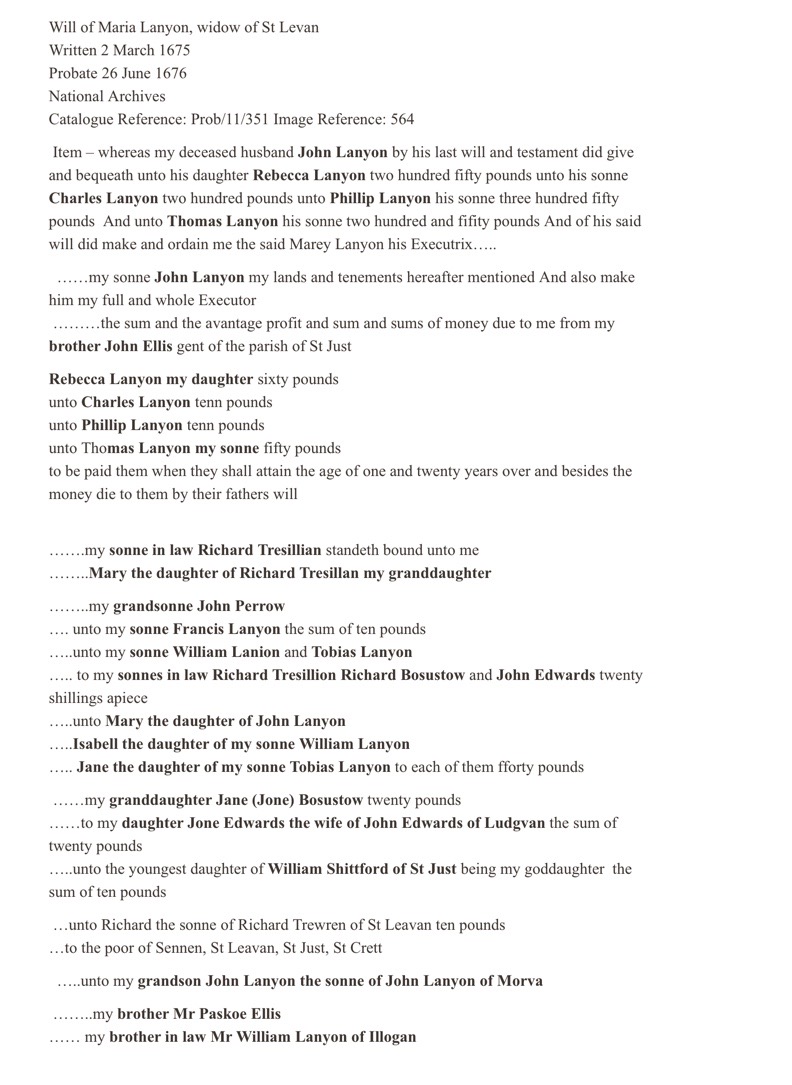
His wife Mary outlived him by twelve years, she never remarried. She left a will which gives us the names of a number of her grandchildren and helps us to build the next generation on the tree.

Will of Maria Lanyon widow of St Levan – Source NA PROB/11/351

The Children of John Lanyon Esq

John Lanyon Esq had at least three wives (see the post ‘The Two Johns’) but surprisingly few documented children. His first marriage to Phelype Myliton produced two sons: Francis and William.

John Lanyon’s tree

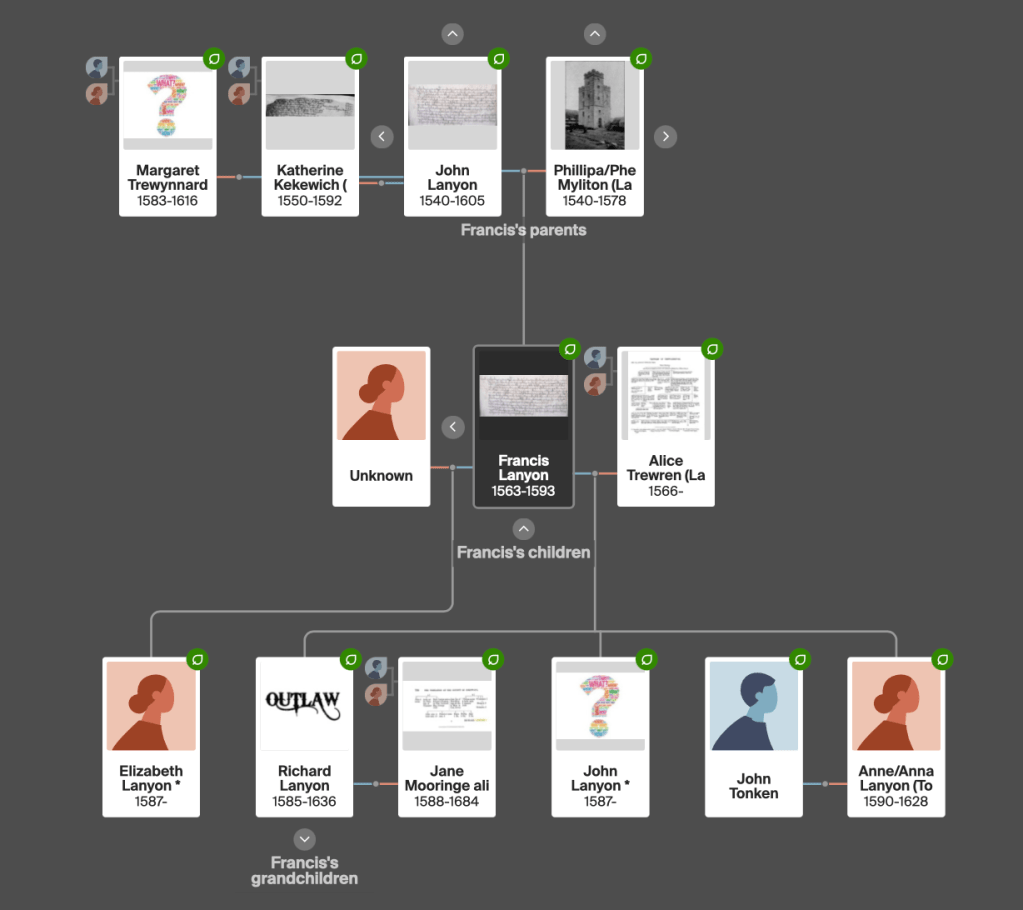
Francis Lanyon abt. 1563-1593

Francis Lanyon was born about 1563; in 1584 he married Alice (Ales) Trewren, the daughter of John Trewren and Elizabeth Chiverton. There were three documented children of this marriage: Richard baptised 8 Sep 1585 at Sancreed, (see the post ‘Richard Lanyon Esq ‘Outlaw’ ‘), John baptised 10 Dec 1587 and Anne born about 1590. Francis also had an illegitimate daughter who was baptised 11 Nov 1587 at Sancreed, a month before his son John was baptised. We don’t know what happened to Elizabeth or what his wife Alice thought!

Less than six years later Francis was dead, he was aged about 30. Administration of his estate was granted to his widow on 17 Oct 1593 (will lost). Eight year old Richard Lanyon becomes the heir to John Lanyon Esq. Alice appears to have raised her family at Sancreed, staying close to her own family.

Their daughter Anne Lanyon married John Tonken on 8 Nov 1612 at Madron. No further trace of their son John.

Francis Lanyon’s tree

William Lanyon abt. 1570-1624

William was the second son, we don’t know when he was born, perhaps the early 1570s. On 19 Nov 1592 he married Jane at Sancreed. Their children were: Elizabeth, John, John, Jane, William, Paskas and Elizabettie. (Two daughters both called Elizabeth and both survived!)

William Lanyon’s tree

See the Post about Paskis Lanion for more information.

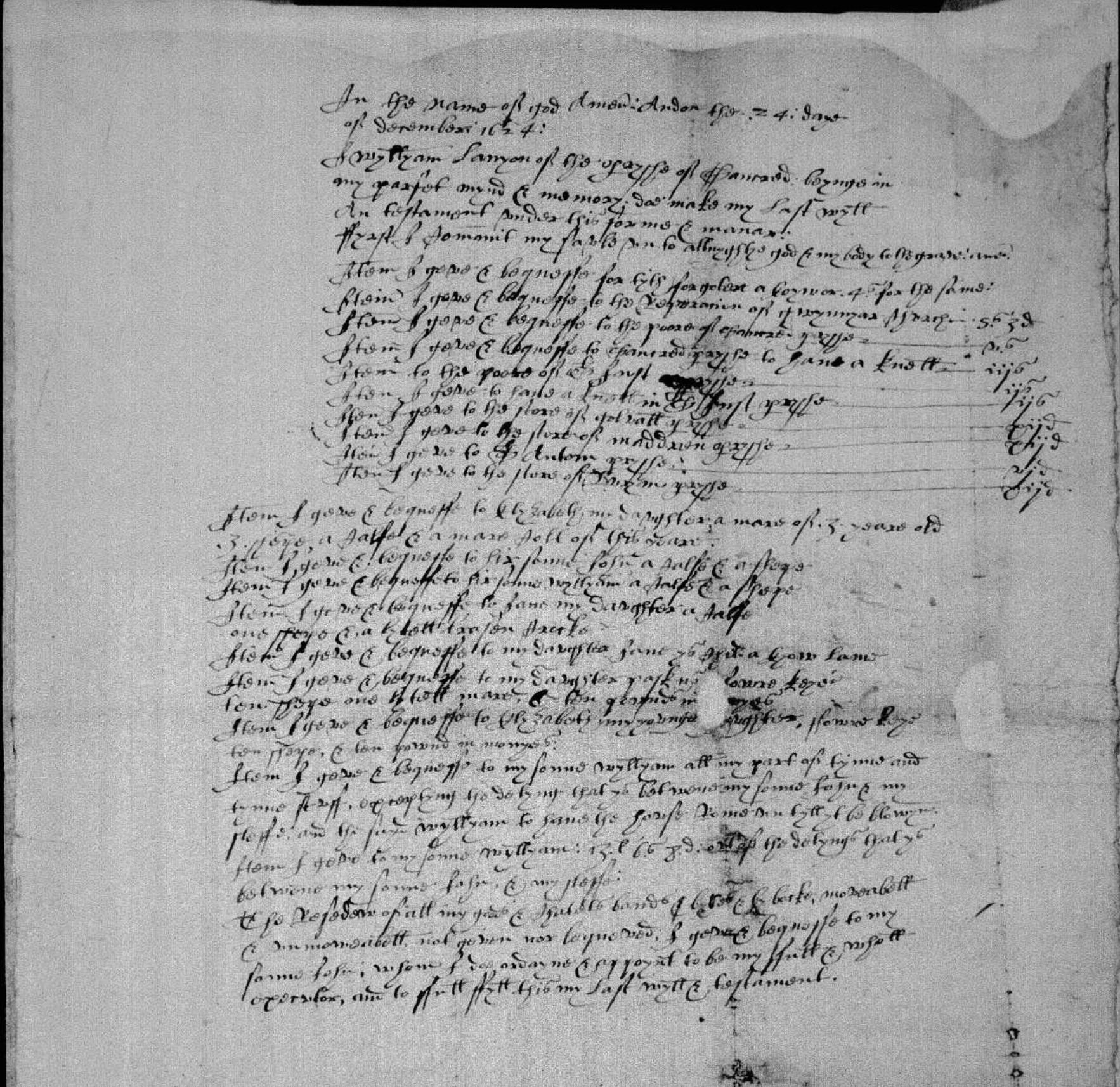
William was buried on 17 Jan 1624 at Sancreed, fortunately he left a detailed will which helpfully names his children. He also leaves a great inventory of goods and chattels worth £170, a considerable sum at that time.

Source – CRO AP/L/256

George Lanyon abt. 1586-aft. 1633

John Lanyon’s esquire’s second wife was Katherine Kekewich and they had at least one son called George who was blind. George was born about 1586 and was still alive in 1633 (see post “The Two Johns”).

We don’t know what happened to George, there is no record of his burial, no will and he’s not mentioned in any Lanyon wills.

Elizabeth Lanyne -1659

See post ‘The Neilder Connection’

Elizabeth lived at Menheniot in Cornwall. There is one other Lanyne living there at the same time, a woman called Grace Lanyne who married James Short in 1620. She may be a sister to Elizabeth as she doesn’t fit anywhere else on the tree!

John Lanyon – 1587

The Madron parish register records the burial of John Lanyon the son of John Lanyon Esq on 2 Jul 1587. This must be the burial of a child but there is no record of a baptism so we have no idea if he was baptised before or after Phelype’s death or whether his mother was Phelype or Katherine, he may even have been an illegitimate child.

Four, possibly five, children seems a small number of children for the time, perhaps John Lanyon Esq had others who weren’t recorded.

See also the post ‘John Lanyon of Penwinnick Estate’ under the Breage branch.

The Children of Richard Lanyon Esq

Richard Lanyon married Margaret Treskillard and they had at least twelve children, including two sons both called John!

His children were: John, John, Richard, William, Raphe, Edward, Clement, Syman, Thomasine, Maude, Joane and Jane.

To find out more about his sons see separate posts “The Two Johns’, ‘John the Younger’ and ‘Richard, Edward and Raphe Lanyon’. This post is about his daughters.

Thomasine Lanyon

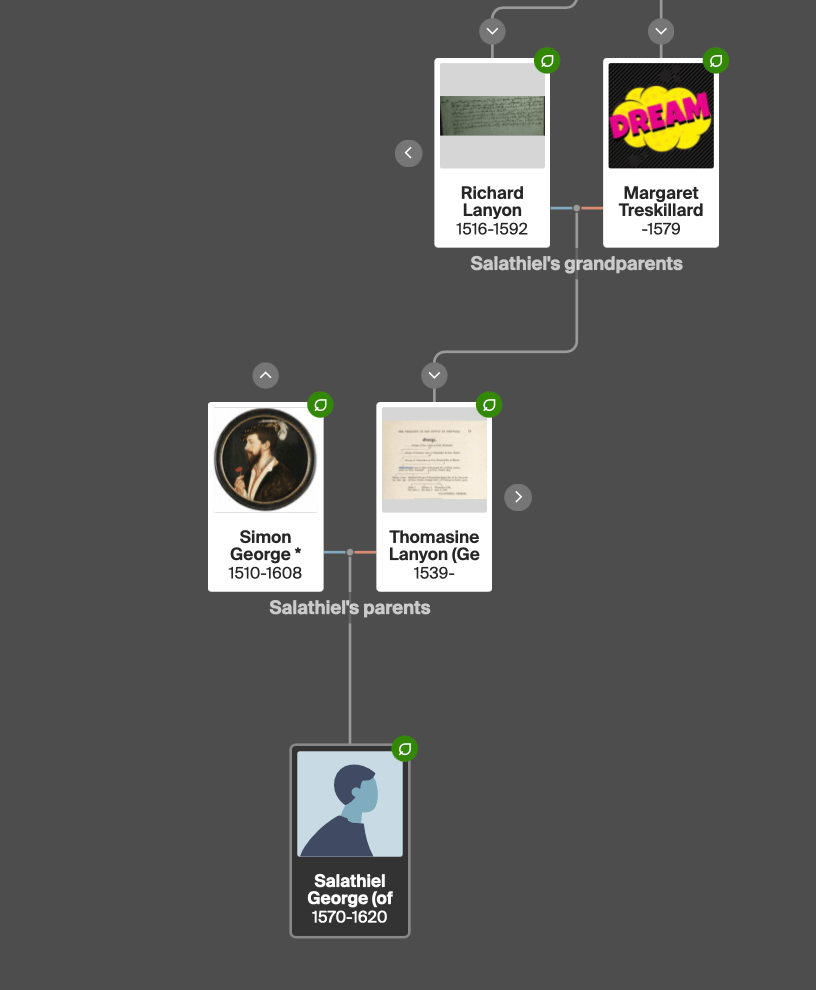
Richard’s eldest daughter was Thomasine, named after her grandmother Thomasine Tregian. Thomasine married Simon George and they had at least two children: Simon and Salathiell George of Trenouth who was still alive in 1620.

Mention of Salathiell is found in a book of illustrations by Hans Holbein called Facsimiles of original drawings by Hans Holbein, in the collection of His Majesty for the Portraits of Illustrious Persons of the Court of Henry VIII, Francis Bartolozzi, 1884. This painting below is said to be of Simon George, Salathiell’s father, a minor figure in the court of Henry VIII.

Simon George by Hans Holbein the Younger, Public domain, via Wikimedia Commons

From the Bartolozzi book;

“Simon George, of Quocoute, in the country of Cornwall, was the son of a private gentleman of his names, who acquired property at that place, and lived there, and whose father came from Gloucestershire into Dorsetshire, and settled at Osmondton, in the latter country; his mother was descended from a good family of the name Hussey. He married Thomasine, daughter of Richard Lanyon, a gentleman of an ancient Cornish house, and had by her two sons, Simon, who died without issue; and Salathiel, who settled at Trenouth, and was living there in 1620, having at that time three daughters, Anne, Elizabeth, and Thomasine.”

Maude Lanyon

Maude was the second daughter and born about 1539. She married Henry Rosewarne from Camborne, Cornwall. Their daughter Elizabeth was baptised 9 Feb 1558 at Camborne. There may be other children but I haven’t traced them. Henry died in 1570 and Maude was buried 24 Feb 1619 at Camborne.

Joane Lanyon

Joane was baptised 24 Jun 1548 at Gwinear. On 15 Feb 1567 she married Otes Merefeild (sic), gent of St Columb and St Ives and the son of Walter Merefild (sic) and Jane Beare, at St Columb Major/Gwinear. They had at least four daughters: Marye, Johan, Johane, Alse. No further trace of their daughters. Otes was still alive in 1605 as he ‘prayed’ over the will of his brother in law, John Lanyon Esq. Joane was still alive after 1630 as her brother Edward’s will mentions a legacy ‘to my sister Jane Merefield’. She would have been 82 at the time of his death.

Jane Lanyon

Jane married Richard Crane on 5 Oct 1561 at Camborne. The register records the name as Lawyne. She had three sons: Richard, and twins John and Richard. The twins were buried a day after they were baptised on 10 Sep 1578. Her first son also called Richard was baptised and the Herald’s Visitation shows him as the father of 5 children. Richard senior died in 1606 but there is no record of Jane’s burial.

Syman & Clement Lanyon

Syman was the seventh son and Clement was the eighth. They were recorded on the Herald’s visitation so presumably they were still alive at that time however there is no trace of either man in any other records. Like many younger sons they may have been sent out of Cornwall or even overseas to find their fortune.

William ‘Generosi’ Lanyon of Breage

William Laniene and Thomasine Tregian had four sons: Richard, William & Walter and a previously undocumented son – Edward.

Richard was the son and heir, Walter lived at Madron, we lose track of Edward after 1586 and William founded the Breage branch of the Lanyon tree.

William ‘Generosi’ Lanyon had 8 children and with the exception of Baldwin it’s not clear who gave birth to each child. I’ve noted the dates of marriage as we don’t have dates of baptism for any of them except Baldwin.

William was probably born about 1520 in Gwinear. There is no mention of any Lanyon on the Breage Subsidy Roll of 1543 so his move to that area happened after that date, possibly 1569.

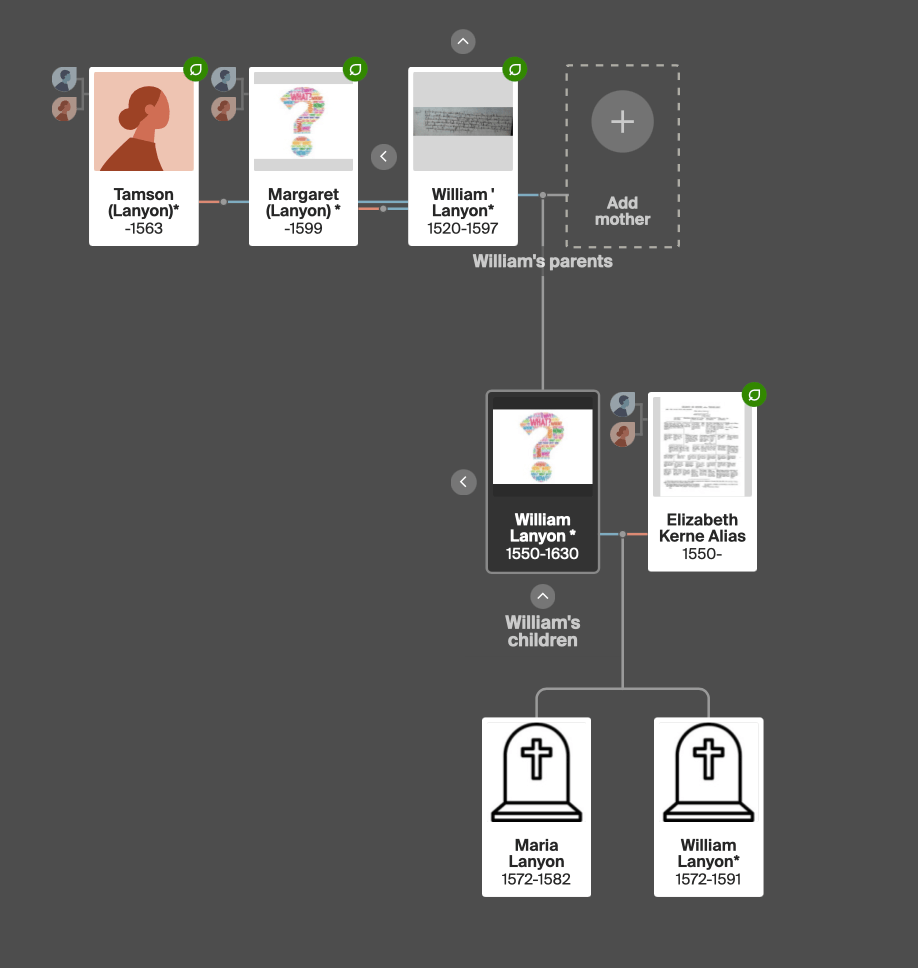
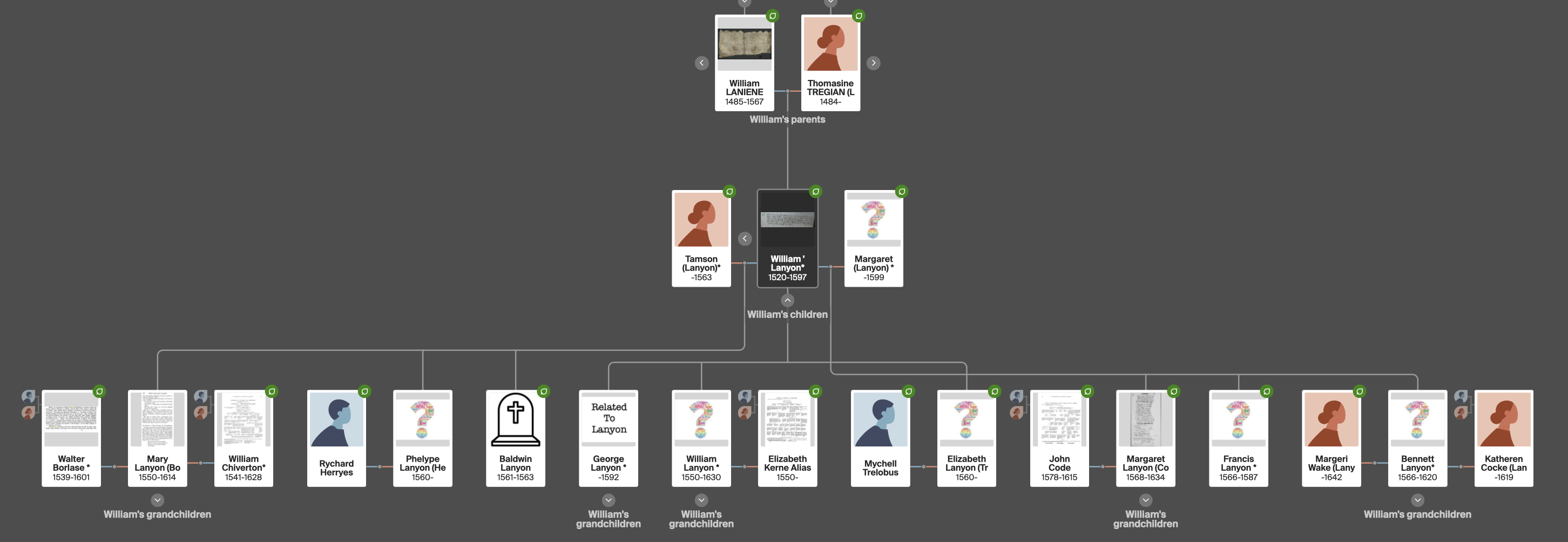
William’s first wife was Tamson, we don’t know the date of marriage nor how many children they had. William and Tamson had a son Baldwin who was buried on 24 Jun 1563 at Gwinear aged 2 and Tamson was buried two days later.

Sometime after 1563 William married Margaret. Variously I’ve seen her named as Margaret Tresilian or Margaret Kekewich but can’t find any proof for either.

There are a further seven children but it is not clear if they are from the first or second marriage.

  • William abt. 1550-1630
  • Phelype abt. 1558-
  • Mary -1614
  • Elizabeth abt. 1560-
  • Margaret abt. 1560-1634
  • Bennett abt. 1566-
  • Francis abt. 1566-

In 1553 William is mentioned in a pre-marital settlement on Benedict Penrose and Jone Lanyon, his sister. William is a trustee and is called ‘junior’ as his father William Laniene is still alive.

William is listed on the 1569 Muster Roll for Breage, Cornwall. “Furnished long bow sheaf arrows steel cap and black bill. Willm Lanyne”

In 1581 William Lanyon of Tregonen in Breage, gent, and William Lanyen (sic) junior his son and heir to William Painter of Trelysick heir in St Erth ‘Trelysick Walbert in Erghe’. (Source – Royal Institution of Cornwall.) This is the only mention of their home ‘Tregonen’ that I’ve come across. Tregonen may be Tregonning today.

In 1582 William was appointed overseer by John Rashleigh of Fowey (his brother-in-law).

William appears in the records again in 1595 at Helston, William Lanion (sic) gent of Breage, 4 pieces of tin of 1726lbs for coining.

He was buried on 7 Aug 1597 at Breage and left a will which is now sadly lost. In the Breage parish records he is described as ‘generosi’ due to his generosity.

Jane Veale Mitchell suggests that George Lanyon, gent, of Sancreed is the son of this William. I have found no documentary evidence but she did have access to wills which are now destroyed.

William Lanyon’s Children

William Lanyon abt.1550-1630

William Junior (eldest son and heir) married Elizabeth Kerne alias Tresilian the daughter of Paskowe Kerne alias Tresilian and Margaret Vivyan. They married at Breage in 1572 which makes it likely that he was born in the 1550s. They had two children:

  • William -1591 died in infancy
  • Maria -1592 died in infancy

William died at Breage in 1630 with no other heirs.

Mary Lanyon -1614

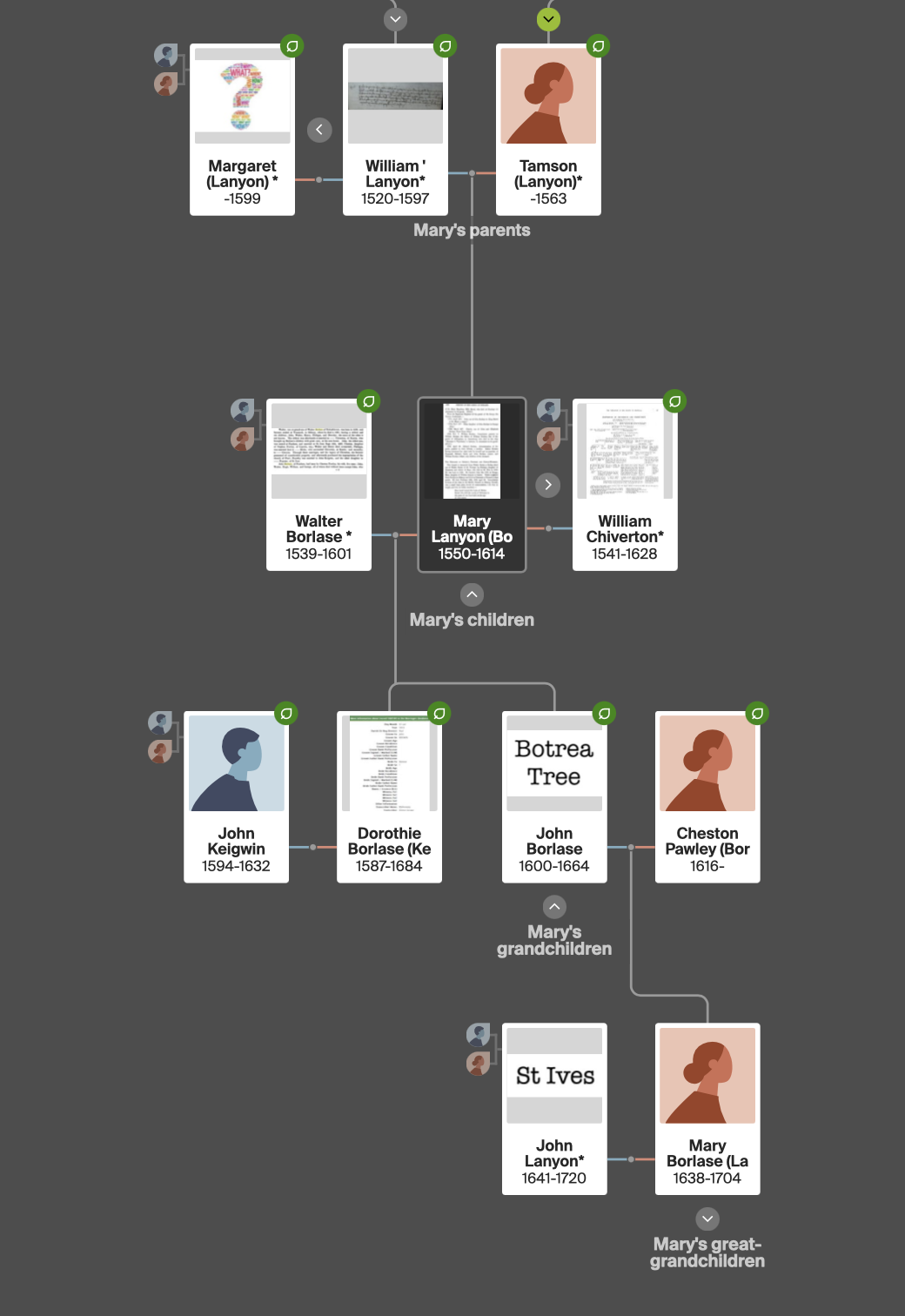
Mary married Walter Borlase at Breage in 1576 so was probably born in the 1550s. They had nine children:

  • William 1577-1653
  • Philippa 1579-1682 married Nicholas Hicks
  • Thomas 1583-
  • Walter 1584-1679
  • Harry 1585-1653
  • Mary 1586-1681
  • Dorothie 1587-1684 married John Keigwin
  • John 1600-1664 married Cheston Pawley, their daughter Mary Borlase married John Lanyon of St Ives (Botrea branch of the tree.)
  • Ann

Walter Borlase died in 1601 and Mary married William Chiverton.

Elizabeth Lanyon abt. 1560

Elizabeth married Mychell Trelobus at Breage in 1581. No further information about them.

Phelype Lanyon abt. 1558-

Phelype Lanyon married Rychard Herryes at Breage in 1583. No further information about them.

Margaret Lanyon abt. 1550-1634

Margaret married John Code at Breage in 1584. They had five children: John, Blancia, Loveday, Thomasin and Elizabeth. John’s grand daughter Patience married Ralph Lanyon (the son of Thomas Lanyon and Mary Levelis of Madron.)

Francis Lanyon bef. 1566-aft. 1587

Francis is mentioned in a legal document of 1587 which shows he is at least 21 and therefore born 1566 or earlier. There is no further trace of him.

“ME Edgcumbe family of Cotehele, Calstock and Mount Edgcumbe, Maker.

Ref No ME/501Title: Quitclaim, land in  Menyghye Veor, Wendron

Date 1 May 1587

Description

Parties: 1) Bennett Lanyen and Francis Lanyen, gentlemen of Breage

2) William Lanyen of Breage, gentleman, father of party 1.

Property: Land held of demise of Edward Sparnan, gentleman, deceased, in Menyghye Veor in Wendron.”

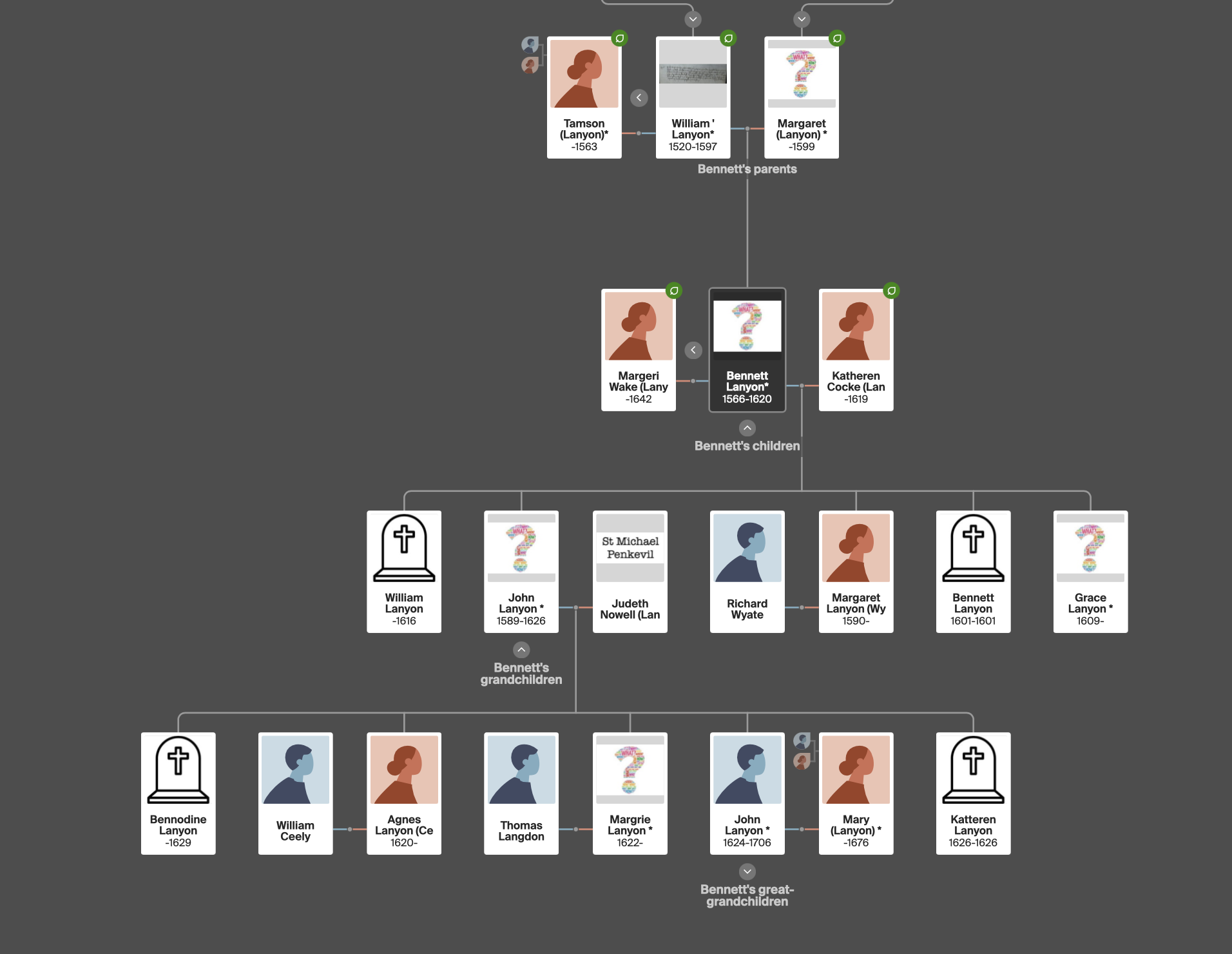
Bennett Lanyon bef. 1566

Bennett married in 1589 to Katheren Cocke and they had four children:

  • John aft. 1589-aft. 1626
  • Bennet 1601-1601 died in infancy
  • Grace 1609- no further trace
  • William – 1616 died young

His second marriage was to Margeri Wake in 1620 at St Michael Penkevil. No children traced from this marriage.

Bennett’s descendants

John Lanyon aft. 1589-aft. 1626

John, the son of Bennett, married Judith Nowell at St Michael Penkevil on 26 Apr 1618. They had four children:

In 1641/2 he or his son John, signed the Protestation Return for St Michael Penkevil – name spelt John Lanine. If he signed the protestation return he must have been alive in 1641/2. There is only one Lanyon that signed the Protestation Return so it seems likely that it was signed by his son and he was dead by this date.

  • Margrie 1622- a Margery Lanyne married Thomas Langdon at Truro St Mary in 1654, it’s possible that it is this Margery
  • Agnes born abt 1620. there is no evidence that Agnes was John & Judith’s daughter but she married William Ceely at St Michael Penkevil 22 Jun 1646 and there is no other Lanyon family in the town at that time.
  • John 1624- aft. 1664 married with five children
  • Kateren 1626-1626 died in infancy
  • Bennodine -1629 died in infancy

St Michael Penkevil Church is close to Lamorran on the map.

John Lanyon 1624-aft. 1664

John was the son of John & Judith. He is probably the person who signed the 1641/2 Protestation Return. In 1664 he paid Hearth Tax in St Michael Penkevil.

The Parochial History of Cornwall by Davies Gilbert. 1838 described him thus:

“Mr. John Lanyon of this parish, a sea sand barge daily labourer.”

John married Mary, we don’t know the surname of John’s wife as his marriage wasn’t recorded but they had five children:

  • Johane 1648- no further trace
  • John 1652-1726
  • Elizabeth 1657- no further trace
  • Anne 1662- no further trace
  • Bennett – 1661 died young

We don’t have any record of what happened to his daughters, but we do know what happened to his son John.

John Lanyon 1652-1726

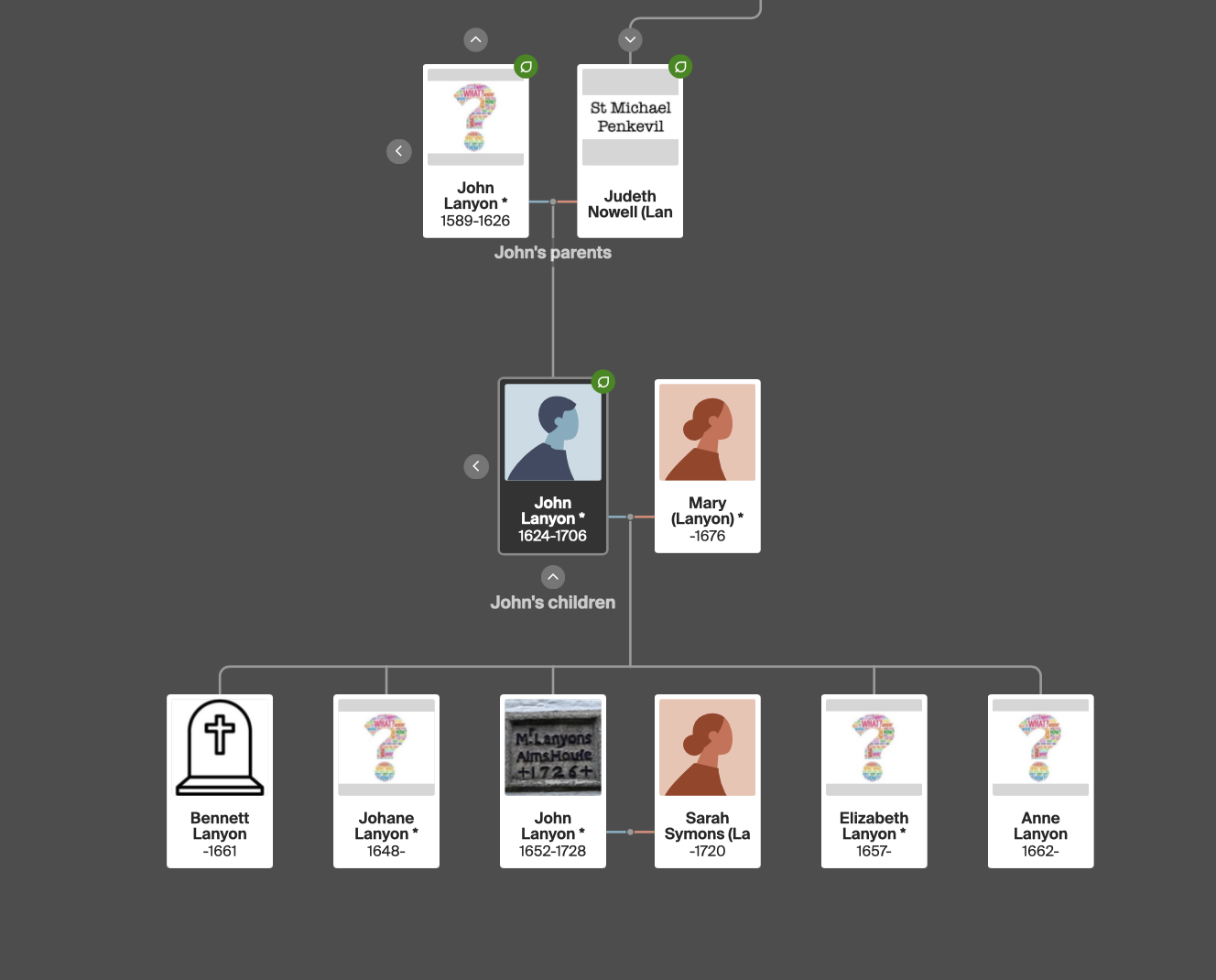
John was the eldest son and heir of John Lanyon, a ‘sea sand barge daily labourer’ and his wife Mary.

The Parochial History of Cornwall stated that John senior:

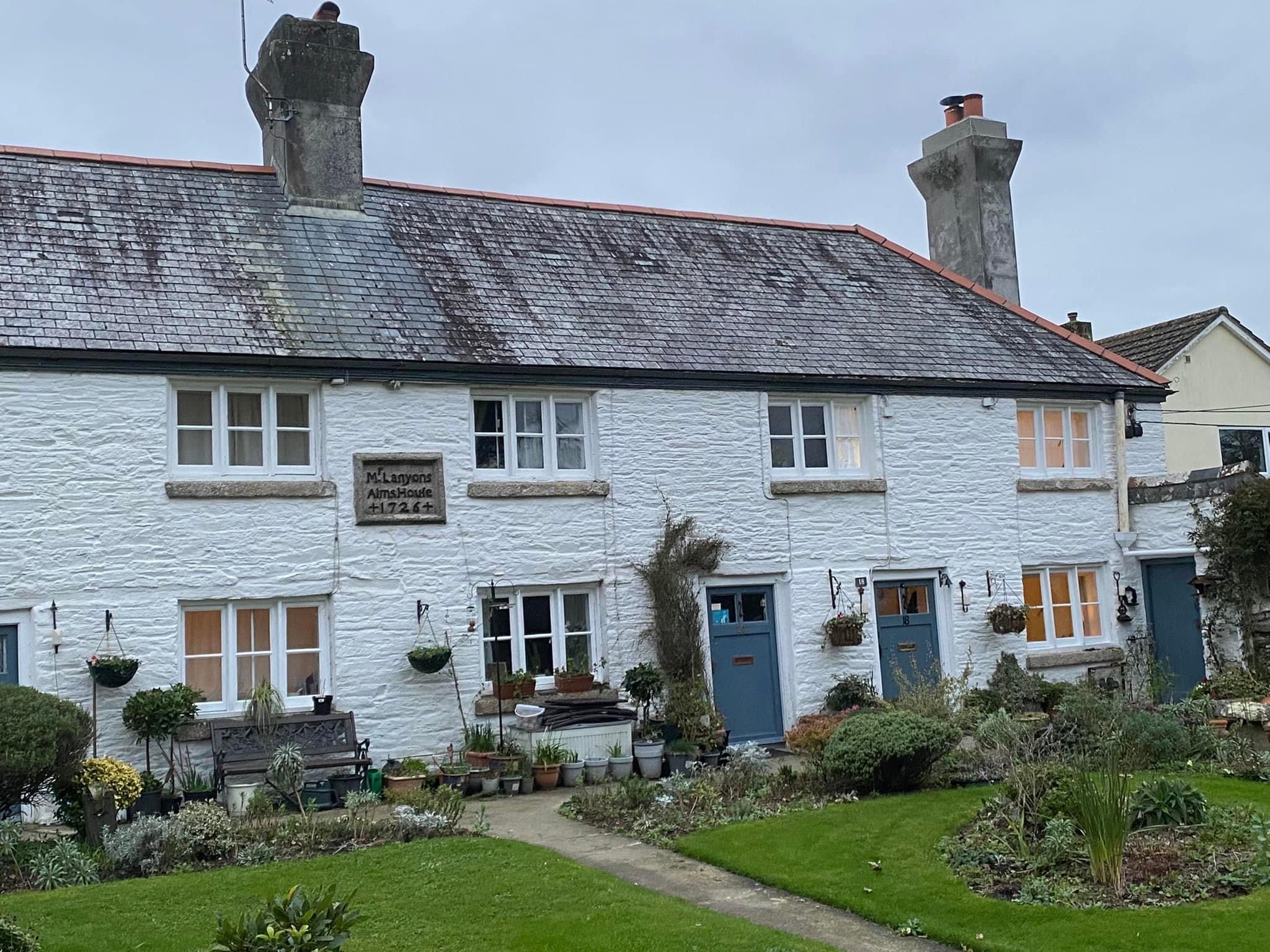
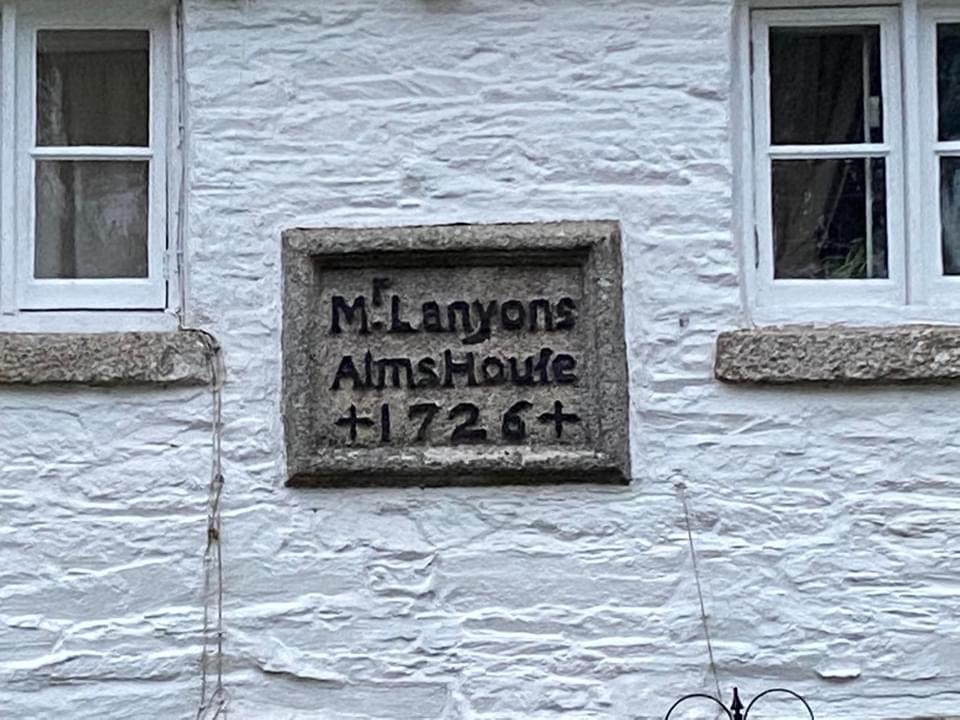
had a son named John Lanyon who having had his education under Hugh Boscawen, gent, Master of arts, who kept a school at St Michael Penkevill Church, became afterwards a steward to Trefusis, St Aubyn, Coryton and lastly came into the service of Brook Lord Chandos, and having by these services accumulated considerable riches he gave lands and built and endowed an almshouse for poor people.”

The almshouses built in 1726 are still there today.

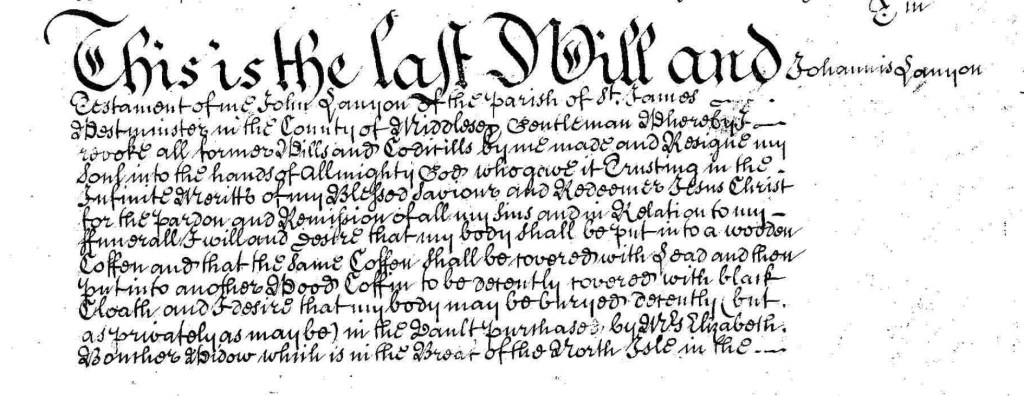
John may have married Sarah Symons although I cannot find a record for this. He didn’t have any children and died in 1726 at St James in London but left a very interesting will naming lots of Cornish people.

The Will of John Lanyon of St James Westminster – Source NA/PROB 11/620/334

In his will he asks to be buried ‘as near as may be to my wife Sarah.

Mentions brother -in-law Jonah Symons of Mylor (he was a clothier).

Niece Anne Tresidder, wife of Nicholas Tresidder of Budock.

Brother-in-law Richard Oliver, Wymouth, wool stapler.

Codicil dated 1726 mentions sister-in-law Mesdames Francis and Jobson.

Benjamin Brown, son of late brother-in-law Benjamin Brown.

My kinswoman Mrs Lanyon, widow of Thomas Lanyon and daughter. We don’t know which Thomas Lanyon he is referring to.

There is also a property transaction dated 29 Sep 1683 (Source – CRO CY/378) which links John to the Symons family.

  1. James Tillie – Middle Temple Esq
  2. Richard Symons of Kea, yeoman and John Lanyon of Kea, yeoman. Bargain and sale Lanner Wood and Lambe Wood in Kea, part of Manor of Landegay. To have two years ‘for the rynding, felling, cutting down, coaling, working upp and faggotting’ these coppice woods.
  3. This was witnessed by a John Lanyon as well.

(See the post ‘Poisoned?’ in The Black Sheep category, for more information about John.)

And here ends the Breage branch of the tree.

In many parishes, during the Civil War and Interegnum, records were poorly kept or omitted altogether. The government appointed lay people to take on this task rather than priests and as there was a charge for registering births – 4d (and it was births, not baptisms at this time), marriages 1/- and burials 4d many people did not record their family’s life events. The Breage branch may end here but there were probably descendants of this branch that we just cannot trace.

Francis Lanyon’s Descendants

Francis Lanyon’s tree

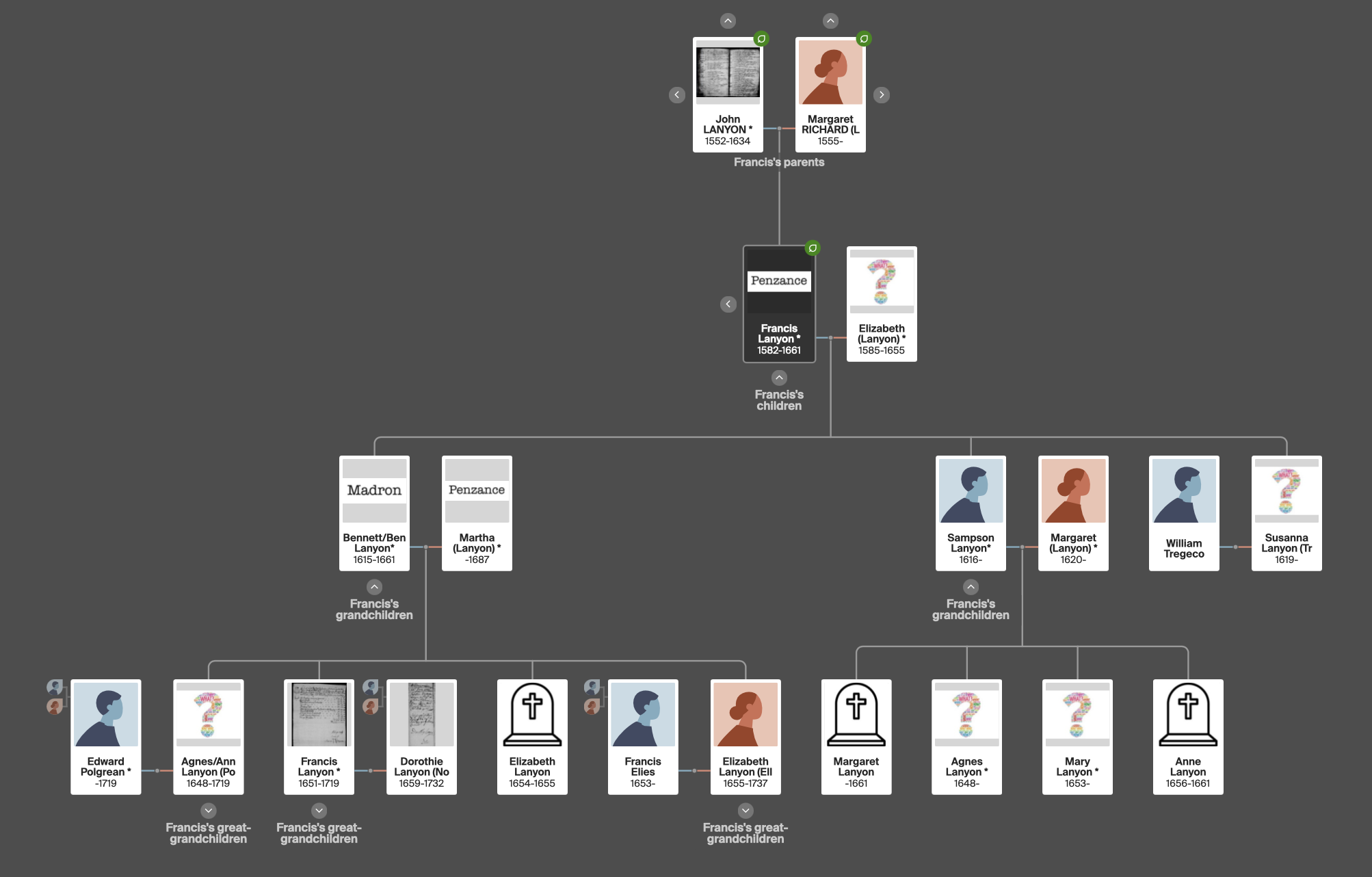
Francis Lanyon was the eldest son and heir of John & possibly Margaret Richard and he is described as a ‘gentleman’. He married Elizabeth on 19 Jun 1607 at Madron (sadly most women did not have their surnames recorded in the Madron register so we don’t know which family Elizabeth was from.) He was a Penzance merchant.

Francis signed the Protestation return of 1641/2. He appears on the Subsidy Roll for Charles I in Oct 1641 and paid £3 on goods.

I Oct 1655 the mayor of Penzance granted him the profits of ‘key and pier’ (quay) for one year for £25.

In Oct 1656 the ship Dunkerke landed at Mousehole and Francis was paid 12/-

The Penzance mayoral records also show that Francis and Thomas Jenkin were paid 12d for repairing the quay’s mansards.

Francis and Elizabeth had three surviving children: Bennett, Sampson and Susanna.

Bennett Lanyon 1615-1661

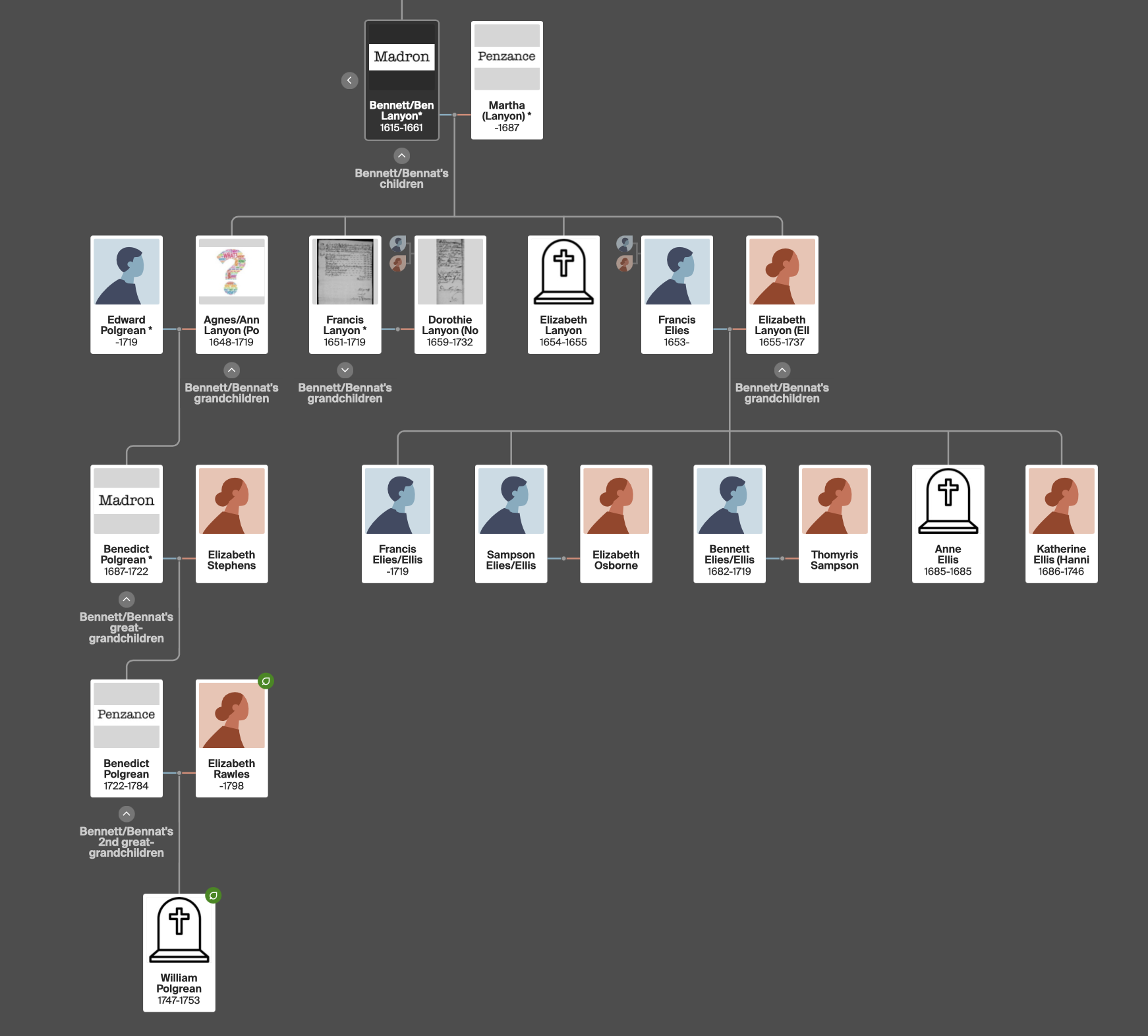
Bennett, Francis’ son and heir, was baptised in 1615 eight years after his parents married. Perhaps there were other children born before him? He too took the Protestation Oath in 1641/2. In 1647 he married Martha. They had four children:

  • Agnes 1648 – married Edward Polgrean at Zennor in 1687. Their only child was Benedict. He married Elizabeth Stephens in Jun 1721 and in Jun 1722, just a month after his son Benedict’s baptism, he died.
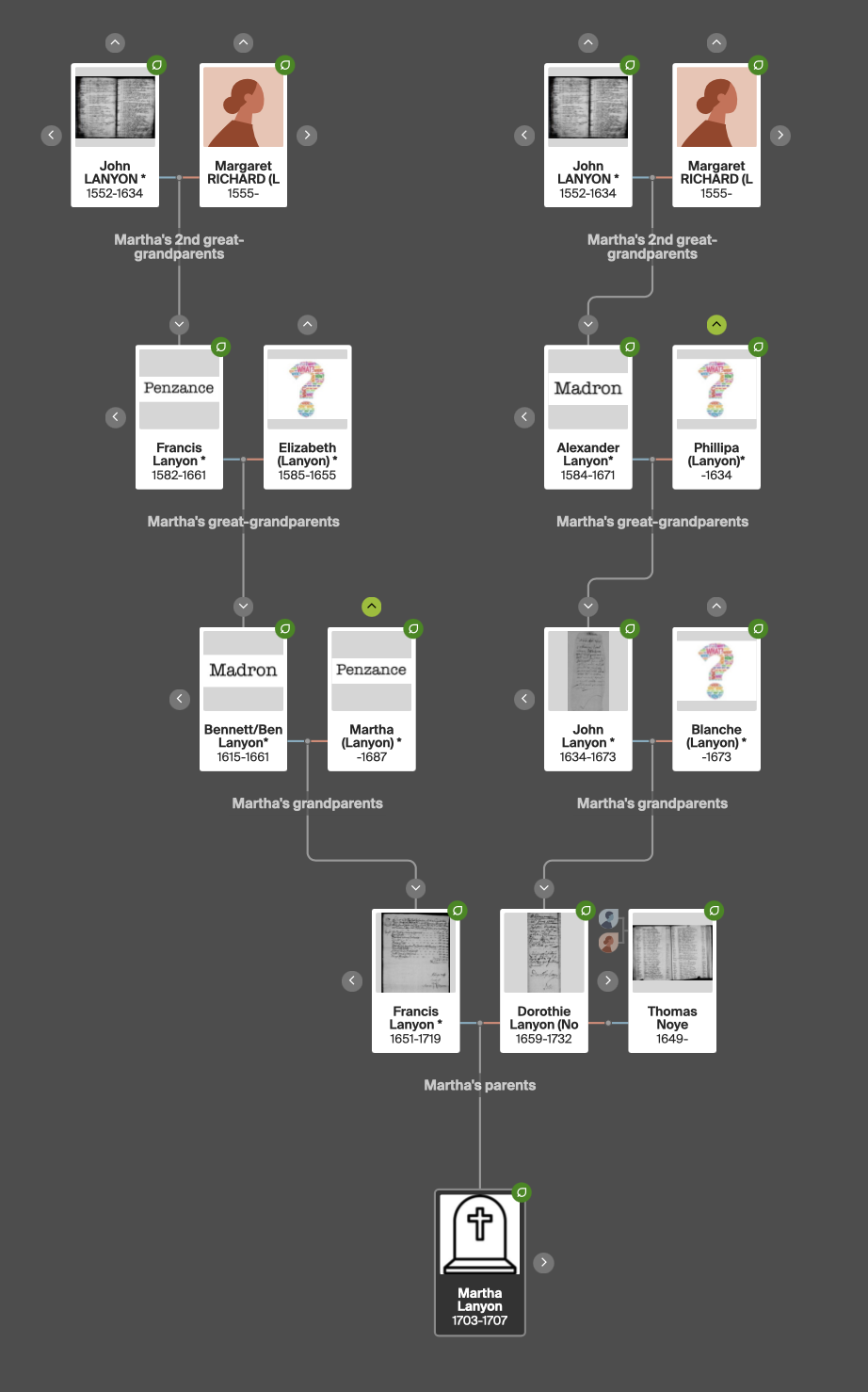
  • Francis 1651-1719 he married his cousin Dorothie Noy (née Lanyon) when he was aged 50. Their only child Martha died aged 4. His estate was left to his nephew Benedict Polgrean in 1719. Less than three years later Benedict was dead too.
  • Elizabeth 1654-1655 died in infancy
  • Elizabeth 1655- married Francis Ellis (Elies) – 4 children: Bennett, Sampson, Francis and Katherine

Bennett’s line finishes here.

Bennett’s Tree

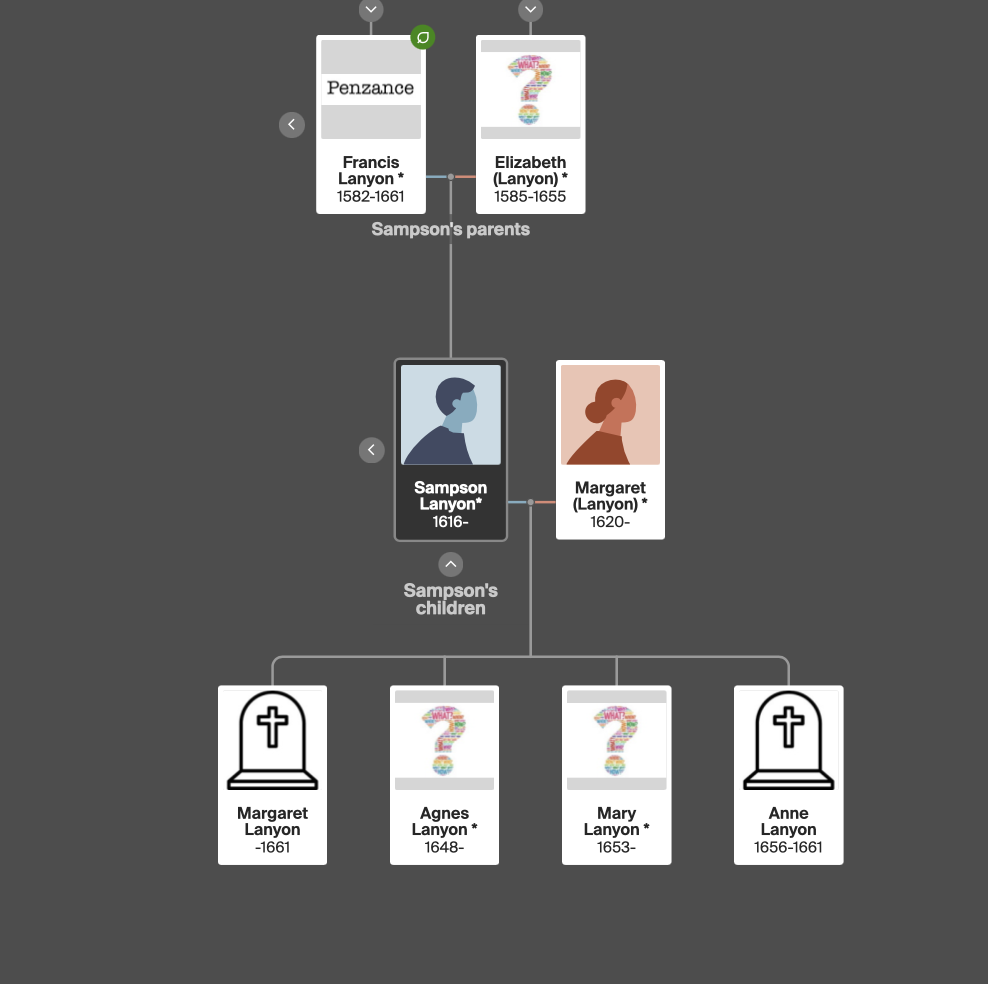
Sampson Lanyon 1616-

Sampson was baptised in 1616 in Madron. In 1647 he married Margaret and had four children:

  • Agnes 1648- no further trace
  • Mary 1653- no further trace
  • Anne 1656-1661 died in infancy
  • Margaret -1661 died in infancy

Sampson’s line finishes here.

Sampson’s tree

Susanna Lanyon 1619-

Susanna was baptised at Madron in 1619. In 1640 she married William Tregeco. There are no further records of this family.
Here ends Francis’ line.

Alexander Lanyon’s Descendants

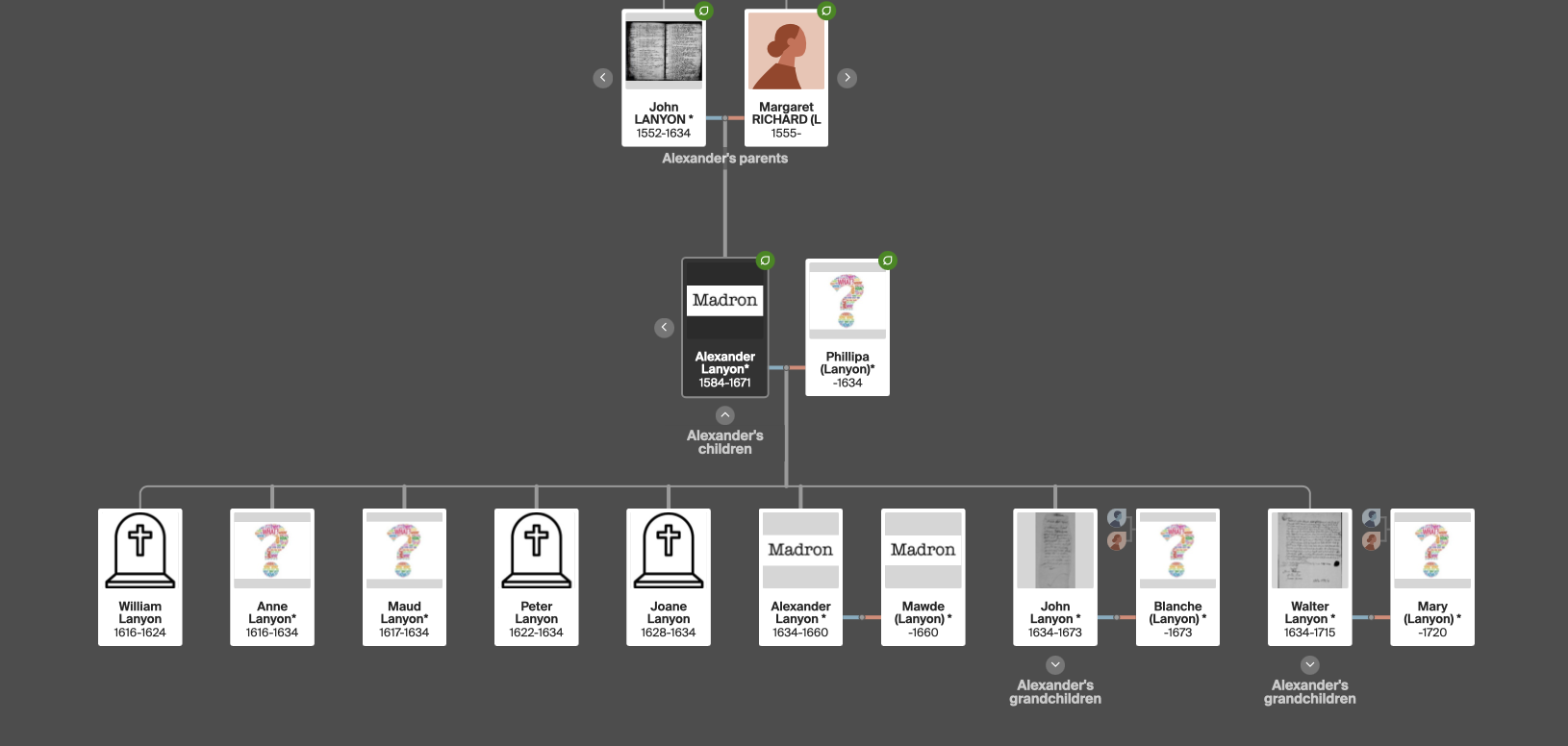
Alexander Lanyon married Philippa at Madron in 1614.

Alexander Lanyon’s tree

The parish registers have lots of gaps at this time so wills can be an additional source of information. John Lanyon’s 1634 will mentions numerous grandchildren and from that we can start to build a tree.

Anne and Maud were still alive in 1634 but there is no further trace of them. They may have married and their marriages have not been recorded or they may have died.

  • Alexander aft. 1616-1624
  • Anne 1616-aft. 1634
  • Maud 1617-aft. 1634
  • Peter 1622-bef. 1634
  • Joane 1628-bef.1634
  • Walter bef.1634-1715
  • John bef.1634-1673
  • Alexander aft. 1634-1660
  • William -1624

The only children who have recorded marriages are Walter, John and Alexander.

Alexander Lanyon aft. 1634-1660

Alexander wasn’t mentioned in his grandfather’s will so must have been born after 1634. He and his wife died within nine months of one another in 1660. We don’t know what caused their deaths but given that they were both only in their twenties perhaps they both died of TB which killed so many young people. They had no children so this line died out.

Walter Lanyon bef. 1634-1715

Walter Lanyon’s tree

Walter was the heir and he lived at the barton of Lanyon after his father. He married Mary and they had two sons:

  • John 1665-1733 married Margery Ustick – one son John
  • Thomas 1670-1723 married Alice Baynard – no children

Walter died 8 Sep 1715 at Madron and left a will.

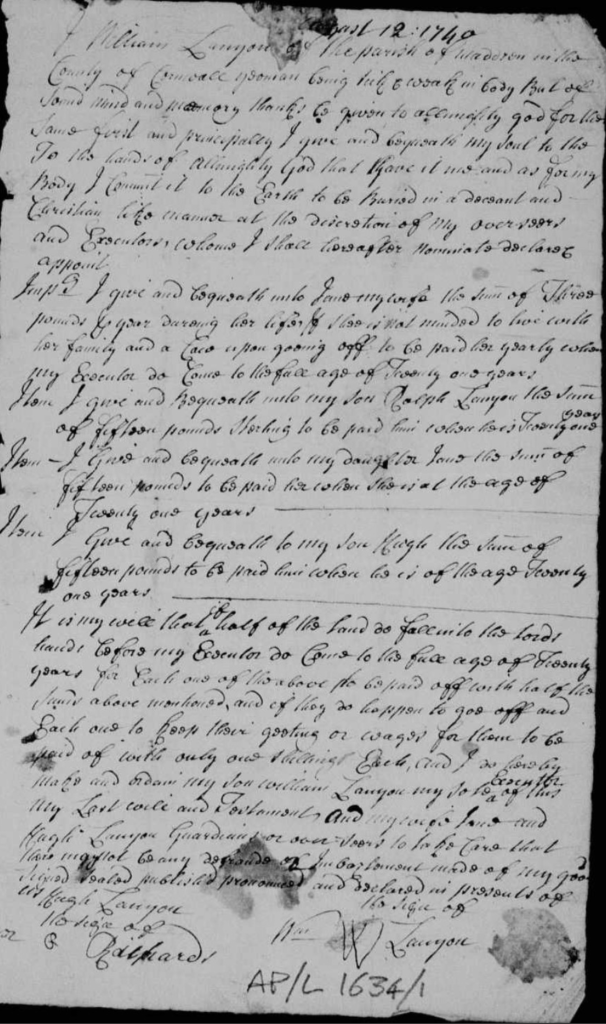
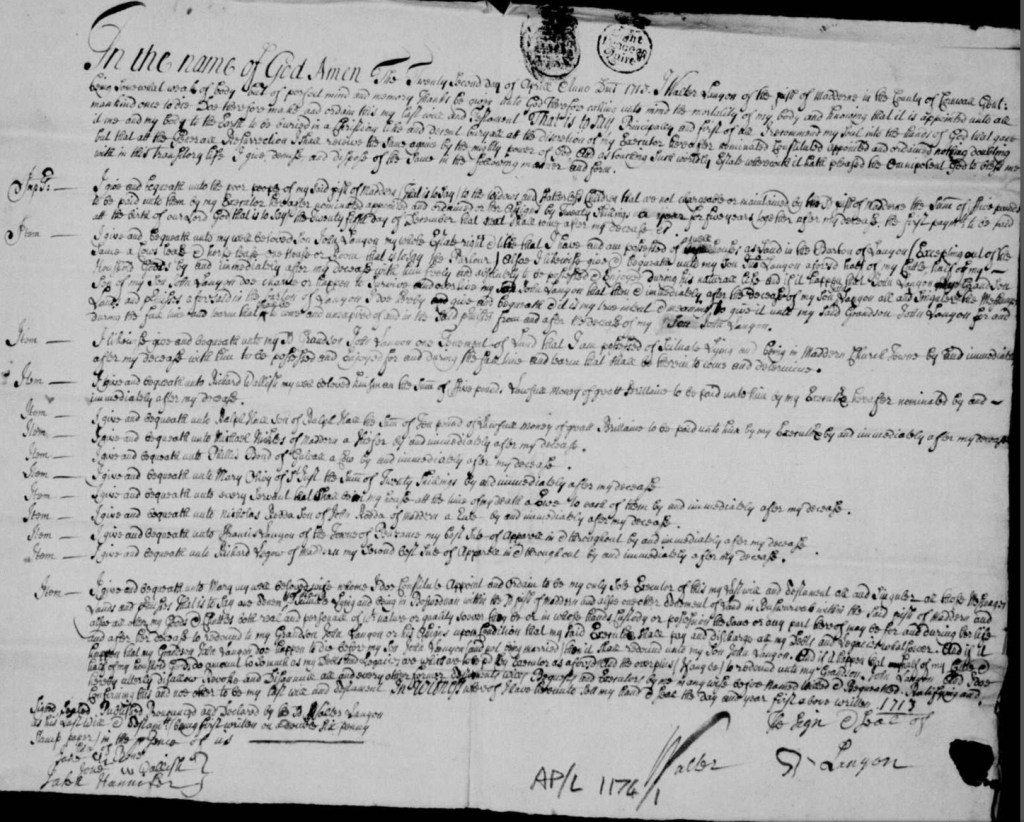
Walter’s will 1715 – Source CRO/AP/L/1174

The will gives his son John the barton of Lanyon, son Thomas half his goods and cattle and his wife Mary land in Boswednan, Madron and Boswarva and these lands to go to his grandson John after her death.

He also leaves his suit of ‘best apparel’ to Francis Lanyon of Penzance and £3 to his beloved henchman Richard Wallish.

Walter’s son John married Margery Ustick in 1691 and their only child John was born the following year. John died in 1733 and the estate passed to his son, Walter’s grandson.

John junior married Elizabeth Huthnance the daughter of Henry Huthnance, the vicar of Breage. They had a daughter, also called Elizabeth, born in 1718. John’s wife died but there is no record of her burial. John remarried in 1725 to a Lanyon cousin, Jane Andrew. (She was the daughter of Isabel Lanyon and Matthias Andrew of Sancreed.) They didn’t have any children.

In 1954 William Lamparter corresponded with Miss Dorothy E B Hichens, the niece of John Hichens, who was then aged 90 and the great grandson of Richard Hichens who held the lease at ‘Lanyon’. She stated “The only thing I can tell you about Elizabeth Lanyon is a story handed down the family and told to me by my grandmother – that Elizabeth’s mother having died, the child was neglected by her father and her mother’s family paid a gypsy to steal her. They brought her up after which she presumably returned and married my ?? grandfather.”

His only daughter Elizabeth married Richard Hutchens (Hichens), they had four children: Richard, Jane, Elizabeth and Thomas.

John Lanyon was without a male heir and when he died in 1784 aged 92 he left the barton of Lanyon to his favourite granddaughter, Jane Hutchens. John was the last Lanyon to live at the old ancestral home.

John Lanyon’s will 1784 – Source CRO/AP/L/1878

Jane Hutchens renounced the bequest and from 1784 Mr John Hosking of Landithy, Madron took a 99 years lease of Lanyon for his two sons John and Thomas who failed to make a success of the farm and Mrs Elizabeth Hutchens’ grand sons, Richard and Thomas took the remainder of the lease and much improved the Lanyon estate. The old manor house was pulled down and a new house built. Thomas’ son, Richard Hutchens, died at Lanyon in 1889.

Jane Hutchens renounces the bequest from her grandfather. Source – CRO/AP/L/1878

This is the end of Walter’s line.

On 29 March 1927 Jane Veale Mitchell wrote the following:-

“Last Tuesday the weather improved and I went off to keep an appointment at Carne, in Morva with Mr John Hichens (St Ives family) whose great-grandfather Richard held Lanyon in Madron and Rissick in Madron, under 99 years lease or remainder. (For several weeks I have missed him when he came into Penzance; then we met and I went out). How glad I was, you can imagine when he brought in a great armful of oldish deed for me to see. Between us (and you too) we are sworn to secrecy in regard to these deeds, as the man would be pestered for them; as it is, he gave me the one I longed for and which explicitly explained what my instinct told me must be a fact i.e. that a Lanyon, as his fathers before him, lived and died at Lanyon in Madron in the year 1784, the very last one in the old Manor House, before Mr Hosking (who renewed the lease from Philip Rashleigh’s assigns) tore it down and built the present farmhouse.”

John Lanyon – bef. 1634-1673

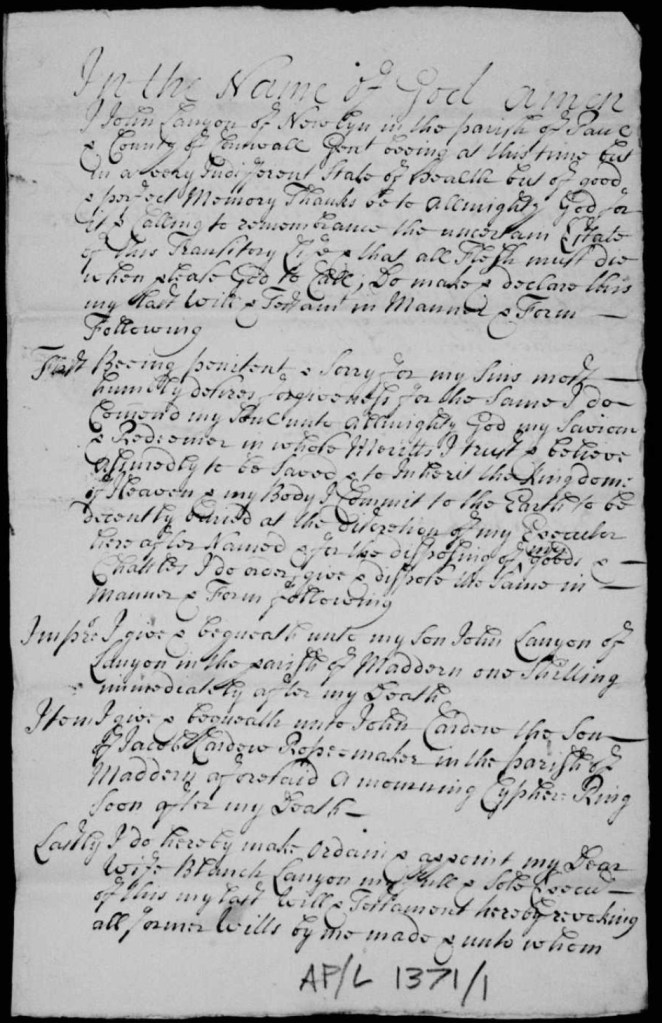
John was the second surviving son of Alexander and Philippa. John Lanyon married Blanche about 1648, the marriage was not recorded but their first child was born about 1650.

John & Bennett Lanyon’s tree

They had seven children:

  • Mary – 1654 died in infancy
  • Margaret 1649-aft. 1673 no further trace
  • Bennett abt. 1650-aft. 1673
  • David 1650-1656 died in infancy
  • Dorothie 1659-1732 she married Thomas Noye in 1678 – six children. Then in 1701 she married her cousin Francis Lanyon – they had one daughter Martha who died age 4.
  • Rebecca 1661-1706 she married Humphrey Stodden – three children
  • Philippa 1666-aft. 1673 no further trace
  • Mary – 1654 died in infancy

We’re covered Dorothie in the post ‘Lanyons, Trewrens and Noys’.

Bennett Lanyon abt. 1650-aft. 1673

Bennett was born about 1650. He was the executor of his father’s will. We know he married but we don’t know his wife’s name. He had six children:

  • Mary 1673-1673 died in infancy
  • John 1673-1733 married Blanche Pendar
  • Mary 1675-1676 died in infancy
  • Ann 1677- married Alexander Johns in 1706 no further trace
  • Blanch 1678- no trace
  • Walter 1681- no trace

John Lanyon 1673-1733

John and Blanche married in 1723 when John was aged 50. His son John may have been from an earlier unrecorded marriage.

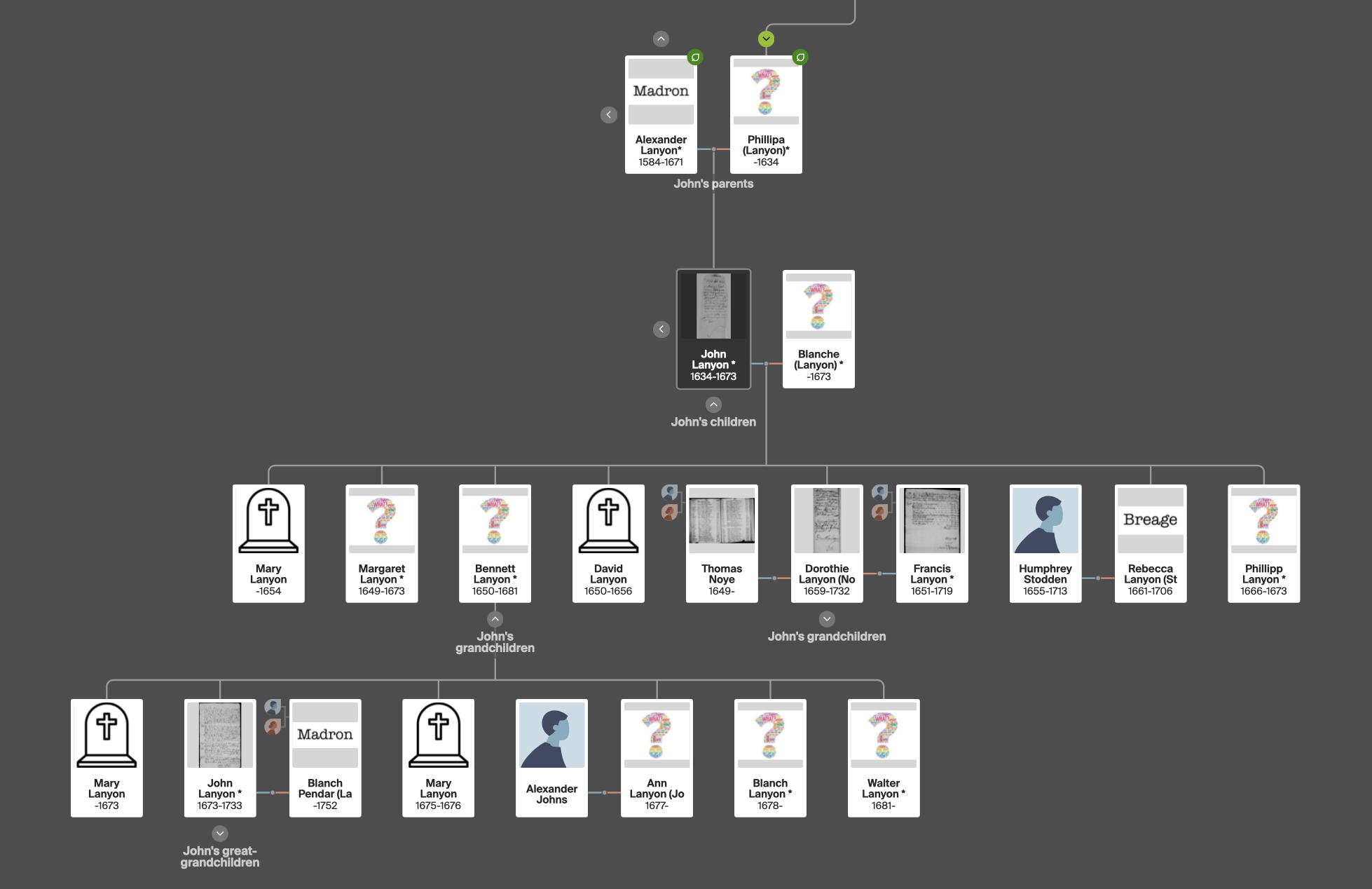
John died in 1733 and his will begins “being penitent and very sorry for my sins”. One wonders what he had done!

John Lanyon’s will 1733 source: CRO/AP/L/1371

There is no record of John and Blanche’s son being baptised, married or buried. His father left him 1/- in his will which suggests he had already inherited. In 1752 he had the role of Accessionable Manor’s Commissioner and we know nothing else about him.

And this is where we must leave Alexander’s line, there are no more traceable Lanyon descendants.

Interestingly on 5 Mar 1781 an Alexander Lanyon died in Penzance aged 100. There is no record of any Alexander Lanyon being baptised about 100 years earlier. Could he be a descendant of this line?

Lanyons, Trewrens and Noys

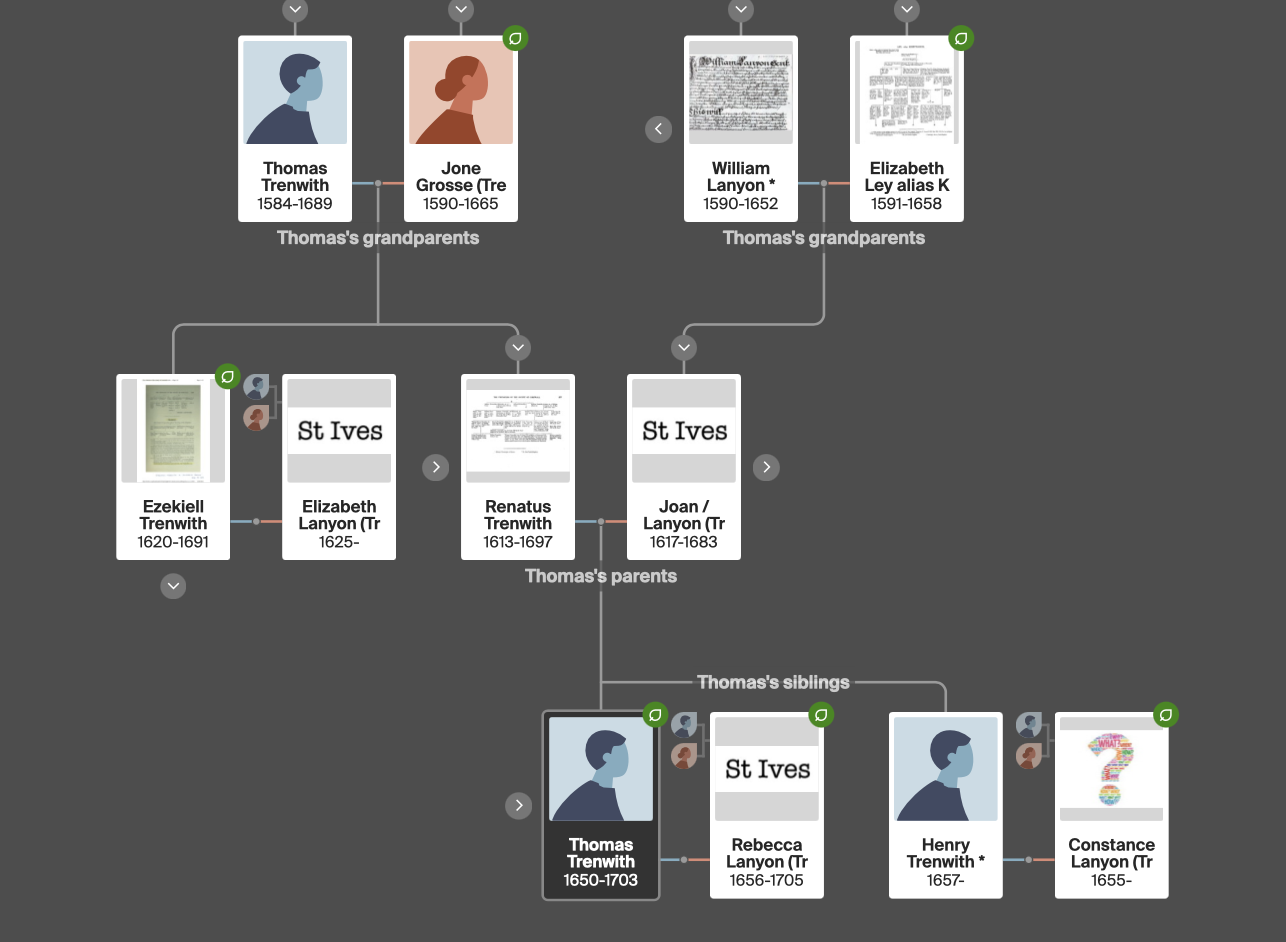
The Lanyons, Trewrens and Noy (Noye) families intermarried over several generations.

Lanyon & Trewren families in Tudor times

The Trewren family lived in Sancreed Cornwall. Driff or Drift was the ancient seat of the family—“Dryffe“ wrote Norden in 1584, “The howse of Thomas Tre-wryn.” This family was settled here as early as 1340; they moved from this place to Trewardreva, Constantine.

Map of Sancreed Cornwall – The Lanyon family had homes at Madron, Bosullow, Sancreed, Paul and Morvah in the 15th, 16th & 17th century.

Jane Trewren married Sampson Noy on 22 Jul 1587 at Madron, Jane died giving birth to her seventh child Chesten on 6 Feb 1600. Two years later Sampson married his friend, John Lanyon’s daughter, Ane Lanyon and he had a further ten children!

Lanyon & Noy family

John Lanyon had a son called Alexander who married Philippa, he mentions them in his will of 1634. Their son John was also mentioned in the will but we don’t know when he was born. John junior married Blanche possibly in 1648 because their first child Margaret was born in 1649. Their fourth child Dorothie was born in 1659 and in 1678 she married Thomas Noy. Thomas died in 1699 and Dorothie then married her cousin Francis Lanyon at Morvah in 1701. Francis was fifty when he married for the first time and Dorothie was forty two. Their only child Martha died aged four.

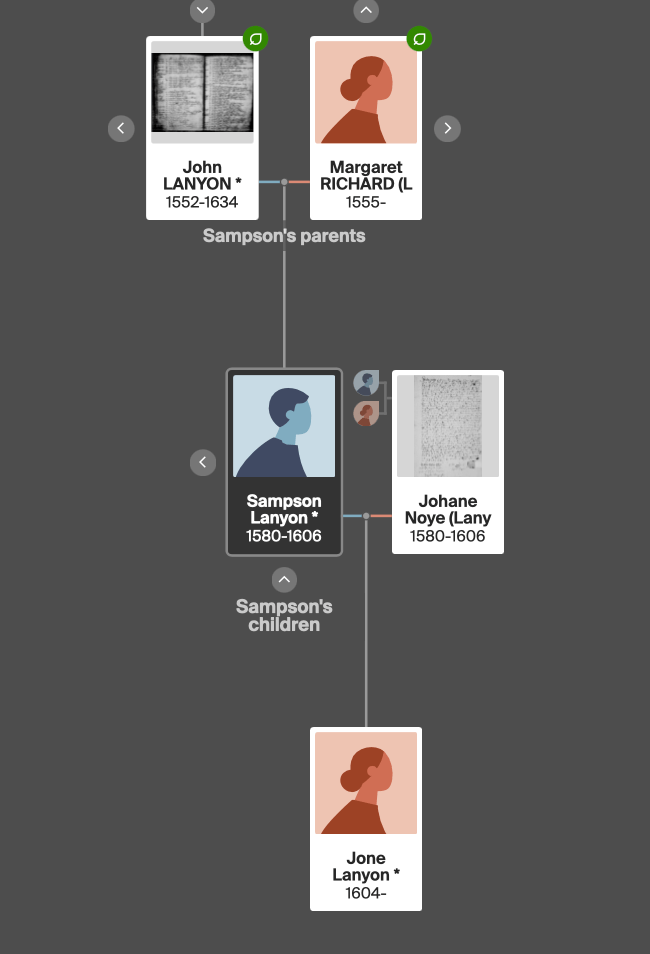
Sampson Lanyon married Johane Noy at Madron in 1602. There is no record of his birth but it is possible that he was an unrecorded son of John Lanyon and Margaret Richard and was named after his grandfather Samspon John Richard. Johane Noy was a daughter of Johane Noy widow of Sancreed who died in 1606. I can’t trace a marriage for Johane who died in 1606 but it seems likely that she was connected to Samspon Noy as he took the inventory of her goods for her will in 1606 along with John Lanyon (gent).

The Noys also married into the Gwinear Lanyon branch of the family.

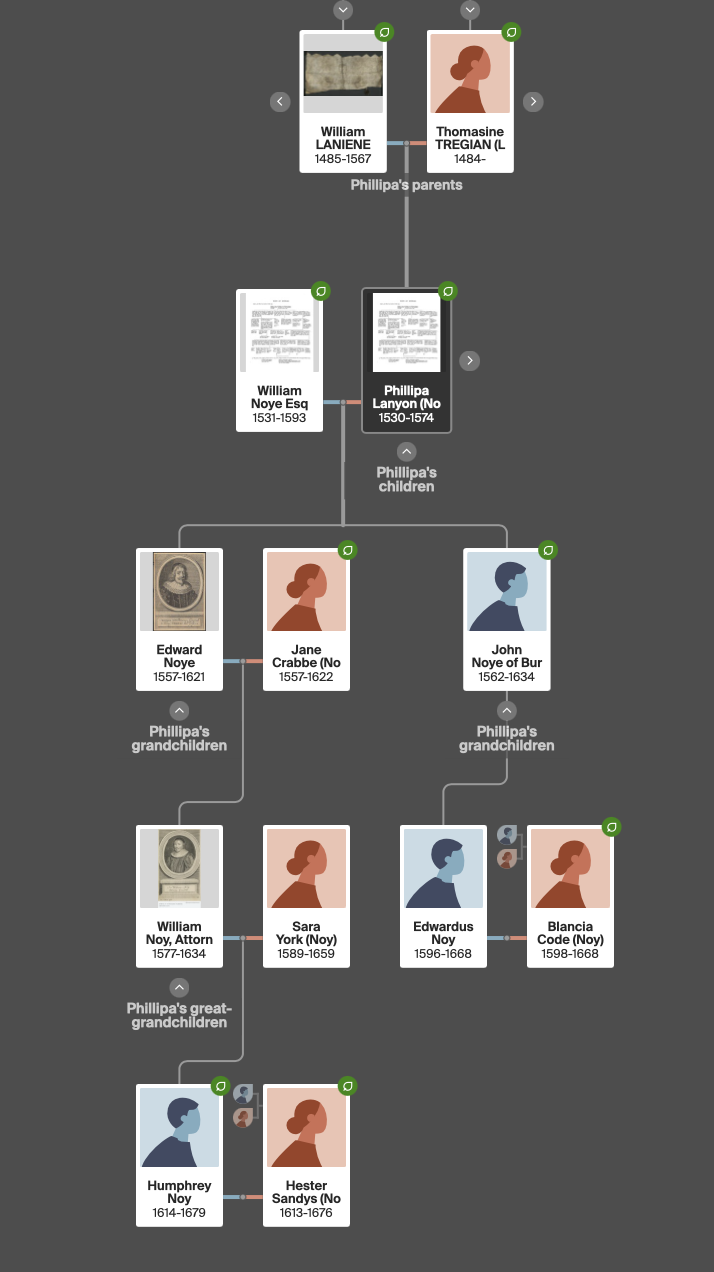
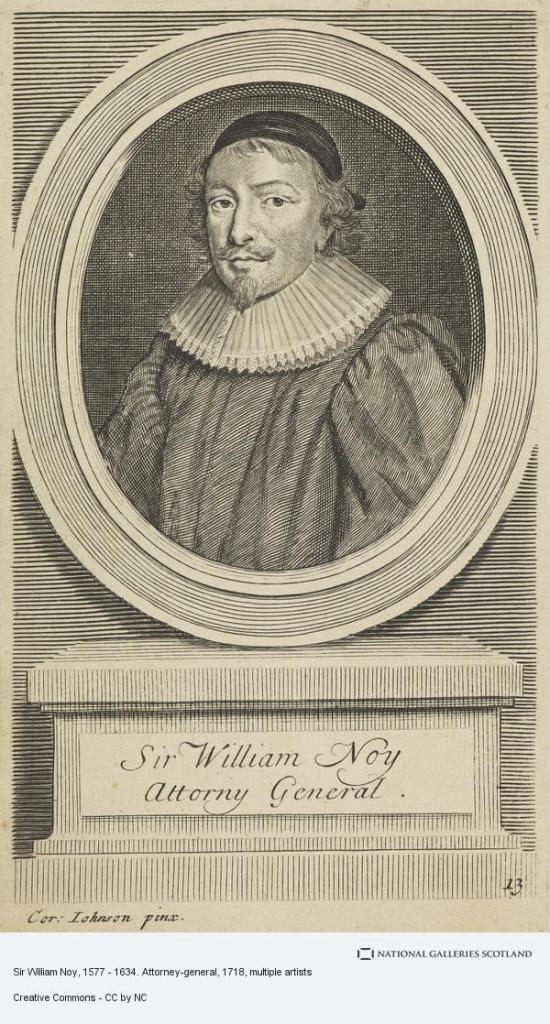
William Noy of Buryan married Phillipa Lenyne about 1556 at Gwinear. The Herald’s Visitation shows Philippa as the daughter of Edward Lenyne but Edward didn’t have any daughters. It seems more likely that Philippa was the daughter of William Laniene Esq and Thomasine Tregian. William and Philippa had at least three sons: William, John and Edward. Edward married Jane Crabb and their son William Noy of Carnanton and of Lincoln’s Inn became Attorney General to Charles I.

Sir William Noy – Attorney General

William Noy’s son was Humphrey Noy of Carnanton. He was born 1614. He married Hester Sandys, the daughter of Henry Lord Sandys. Humphrey served as a colonel in Charles I’s army. His estates were sequestered by Parliament and he was fined a tenth under the Articles of Truro. He lived for many years on the charity of his friends. He died at Mawgan in Pydar and was buried there on 12 Dec 1679. Hester was buried at St Buryan in Cornwall on 5 May 1676.

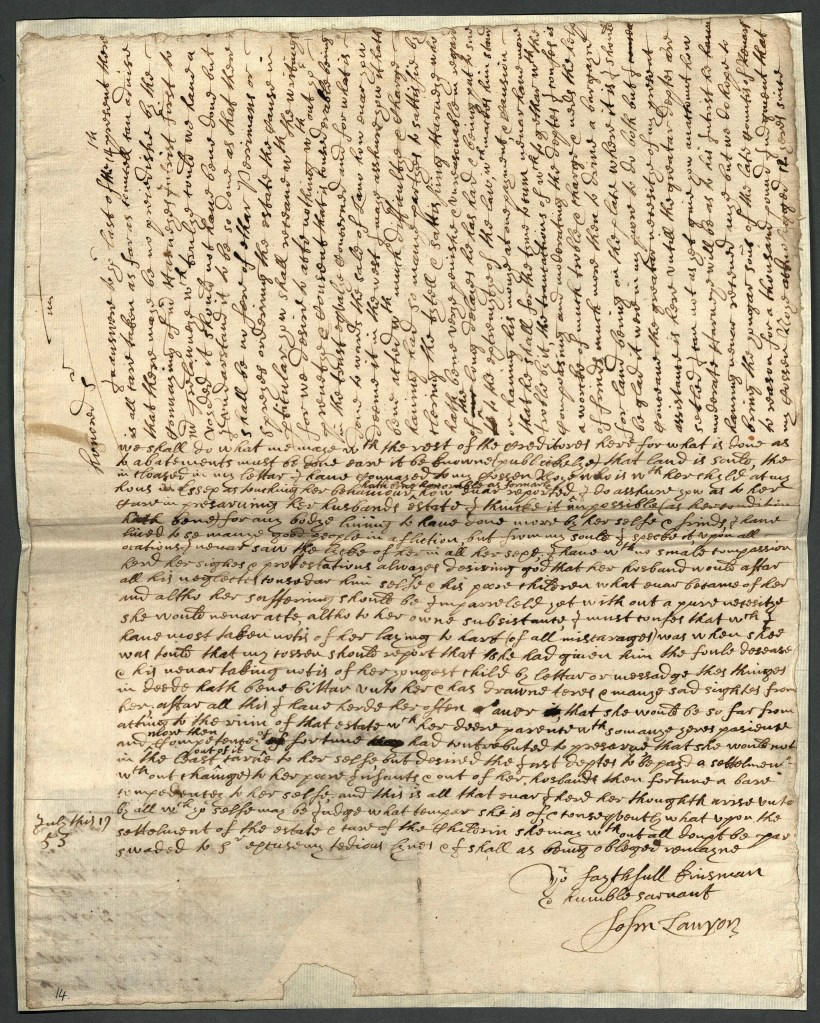
For a time Hester Noy lived at the home of John Lanyon in Essex. John Lanyon wrote to his cousin Rashleigh about Hester and the letter still survives.

Honored Sir,
In answer to your last of the 14th present there is all care taken as far as counsel can advise that there may be no prejedishe [prejudice?] by the conveying of Mr Harveys intrist [interest] first to Mr Trelawney which truly could we have avoided it should not have been done but I understand it will be so done as that there shall be [in or no]  […?…] of either Perrimans or Spreyes ordering the estate the cause in particular you shall receive with the writings for we desire to act nothing without your [pre…?…] consent that is considerable being in the trust equally concerned and for what is done towards the sale of [land?] however you deem it in the west I may assure you it hath been acted with much difficulty and charge having had so many parties to satisfy closing the [tytell? title?] and satisfying Harveye who hath been very peevish and unreasonable in regard of the long delays he has had and being put to [sue?] ? to the extremety of the law, which [makes?] him stand on having his money at one payment, and caution that he shall for the time [to come?] never have more trouble by it, the transactions of which together with the [composing?] and moderating the deptes [debts?] I confess is a work of much trouble and charge and needs the help of friends much more then to drive a bargain for land being on the place where it is I should be glad it were in my [p..?..] to do both but I [c..?..] the greater necessity of my present assistance is here until the greater depts [debts?] are settledI can not as yet give you an account how moderate Harveye will be as to his intrist [interest?] he having never received any but we do hope to bring the younger sons of the late Countis [Countess?] of […?…] to reason for a thousand pound judgement that my cousin Noye [a…?…] 12 years since, we shall do what we may with the rest of the creditors here for what is done as to abatements must be done [save?] it be known (publicly) that land is sold, the in cloased [enclosed] in my letter I have conveyed to my cossen Noye who is with her child at my house in Essex as touching her behaviour how ever reported [following inserted] hath been honorable as formally, I do assure you as to her care in preserving her husbands estate I think it impossible (as her condition has been) for any body living to have done more by herself and friends, I have lived to see many good people in affliction, but from my soul I speak it, upon all occasions never saw the like of her in all herself. I have with no small compassion heard her sighs and protestations always desiring god that her husband would after all his neglects consider himself and his poor children what ever became of her and also her suffering should be [impass..?.. impossible?] yet without a [purse?] necessity she would never ask, although to her own subsistance, I must confess that which I have most taken notice of her laying to heart (of all miscarriages) was when she was told that my cossen should report that she had given him the foul disease and his never taking notice of her youngest child by letter or message these things indeed hath been bitter unto her and has drawn tears and many sad sighs from her. After all this I have heard her often aver that she would be so far from acting to the ruin of that estate which her dear [parent?] with so many years [patience?] and more then [than?] competencey of fortune had contributed to [preserve?] that she would not in the least out of it carve to her self, but desired the just debts to be paid a settlement without [charge?] to her poor infants and out of her husbands then fortune a base competency to her self, and this is all that ever I heard her thought arise unto by all which your self may be judge what temper she is of, and consequently what upon the settlement of the estate and care of the children she may without all doubt be persuaded to.  Sir excuse my tedious lines and I shall as being obliged remain                                                                                              your faithful kinsman                                                                                             

and humble servant                                                                                                     

John Lanyon

Source – Cornish Record Office RS/1/62 dated 19 Jul 1653
transcribed by Louise Quigley

John Lanyon’s daughter Hester (1635-1700) may have been named after Hester Noy.

Arthur Herbert Lanyon

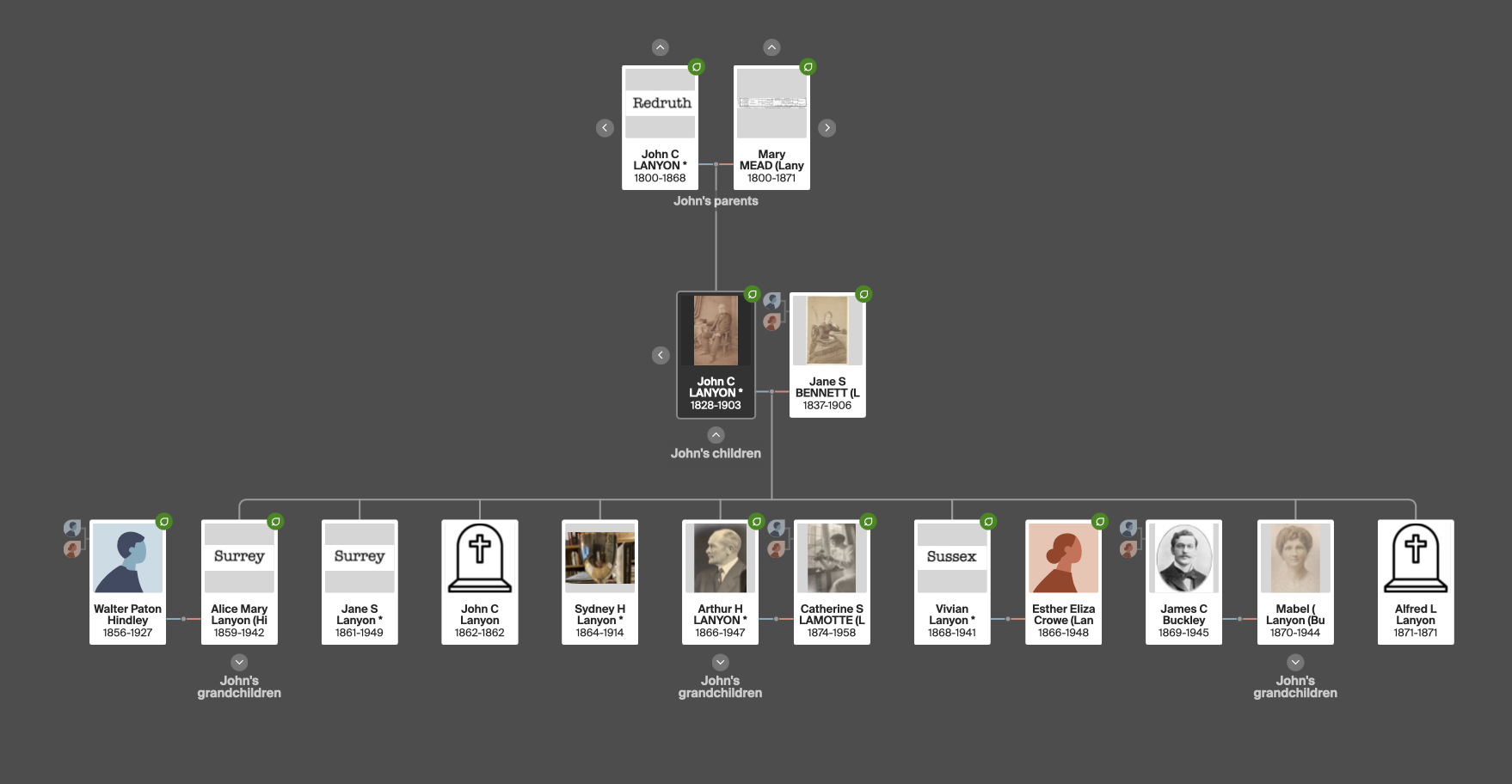
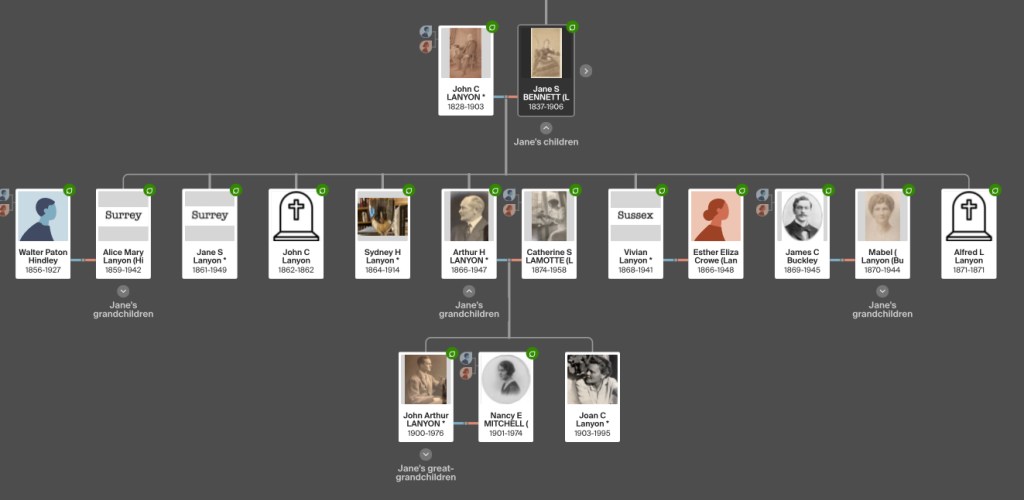
Arthur was the third son of John Charles Lanyon and Jane Stacy Bennett. Their first son John Charles died as a baby and it was soon apparent that the second son Sydney Howard Lanyon had a variety of health problems.

John Charles Lanyon’s tree

Sydney suffered with severe eczema. After Wellington College he attended Cambridge University where he suffered from appendicitis and failed his degree. He was rejected by the army before the first world war and committed suicide on 24th Oct 1914 by jumping off Westminster Bridge in front of his nephew Noel Hindley. His body was eventually found at Rotherhithe on 4th Nov 1914.

He left his estate to his brother Arthur who was the reluctant heir to the family business.

Arthur’s other siblings were: Alice who married Walter Paton Hindley. Jane who never married or worked and died age 88 in 1949. Vivian who worked as a colonial agent and married his nurse, Eliza Crowe. They never had any children. Mabel who married James Buckley, a venereologist and had four children. Arthur’s youngest brother, Alfred Leonard Lanyon died in infancy.

Arthur Herbert Lanyon

Arthur left Harrow in Dec 1883 at the age of 17 to join the family business JC Lanyon & Sons. On 22 Apr 1899 he married Catherine Septima Lamotte at St John the Evangelist, Croydon. (Catherine was descended from Huguenot refugees).

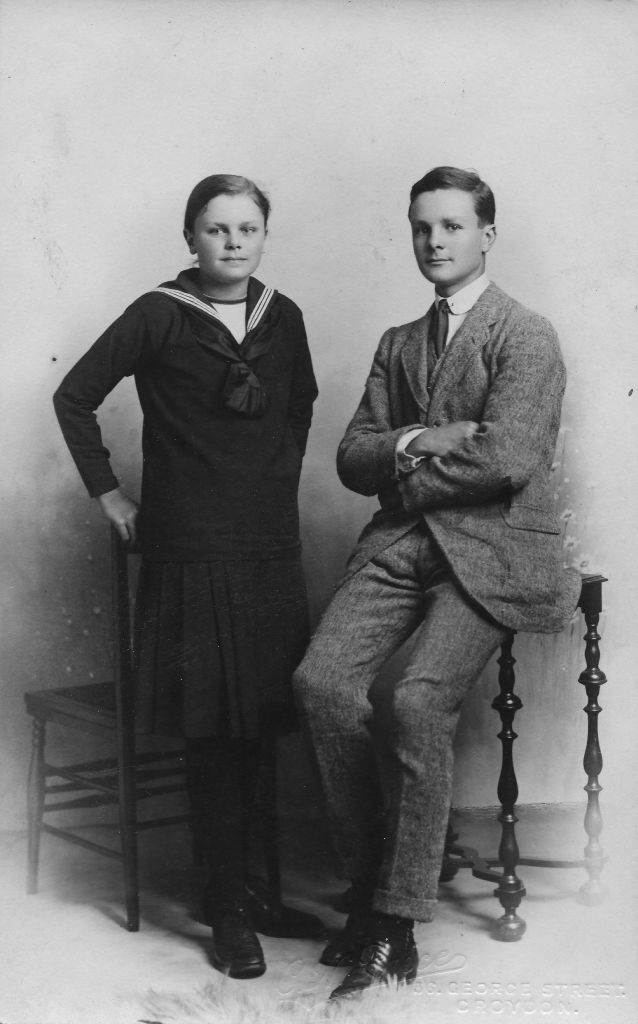
Their son John Arthur Lanyon was born in 1900 and their daughter Joan was born three years later.

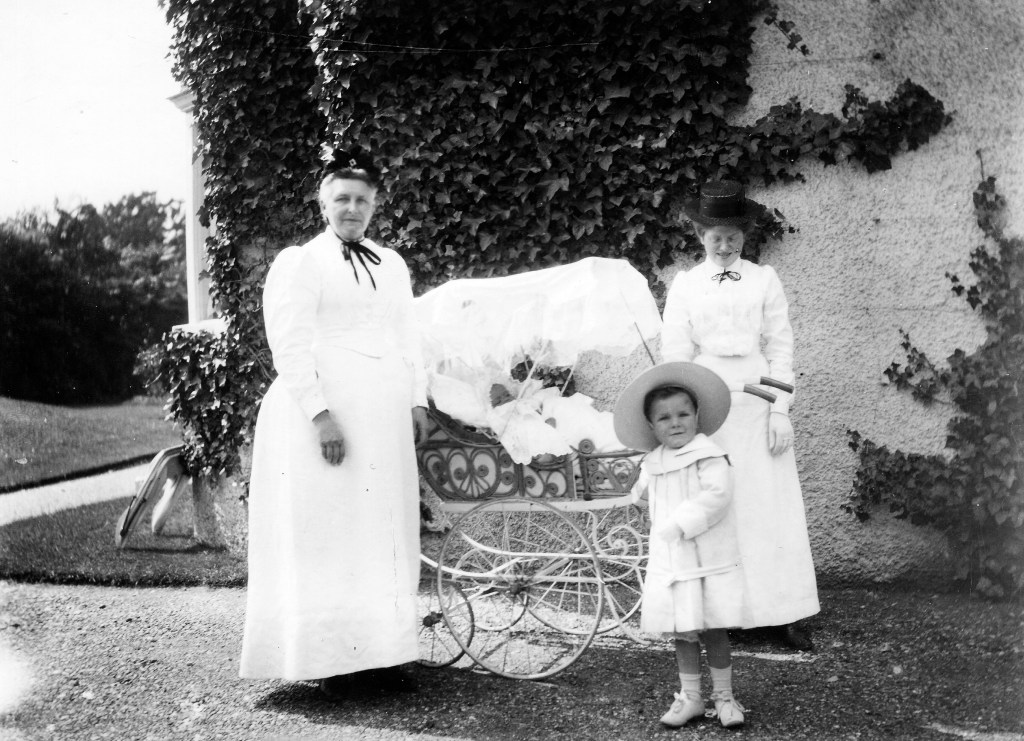
John Arthur Lanyon and baby sister Joan about 1903.

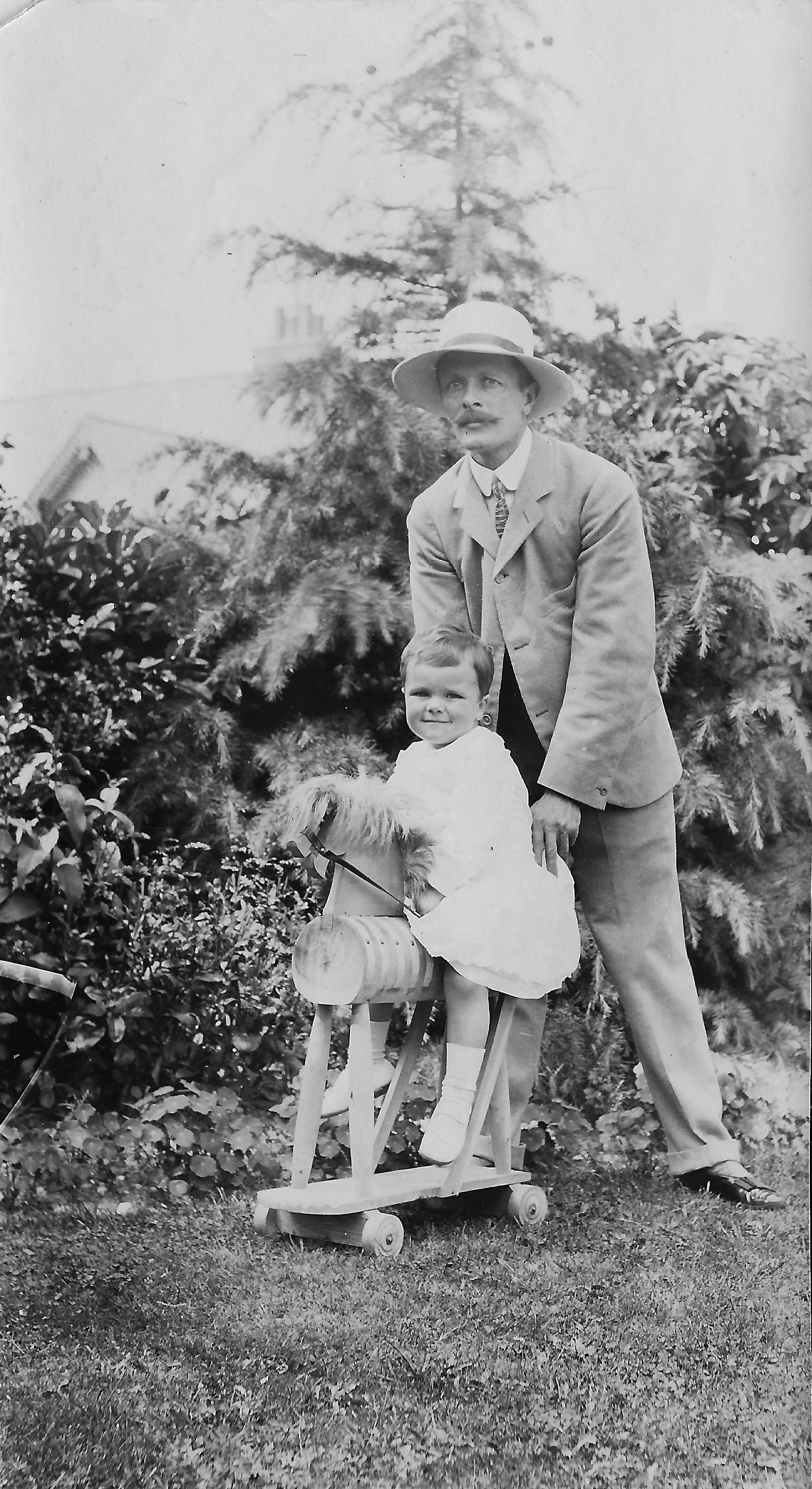
John with his father Arthur and formal portrait aged about 5.

John and Joan with their mother Catherine Septima Lamotte.

The early photos were taken at Sanderstead, Surrey, the family home. At age 11 John was a pupil at Farnborough school. In 1918 he was briefly in the Royal Artillery and then he went on to read chemistry at New College Oxford.

Joan didn’t attend school. She was mildly epileptic and her mother disapproved of school so a governess, Cath Blakeney was hired.

Joan became a senior commander in the ATS during the second world war however during peacetime she didn’t work. She travelled extensively, played polo and never married. Joan died aged 92 in 1995.

Joan Catherine Lanyon

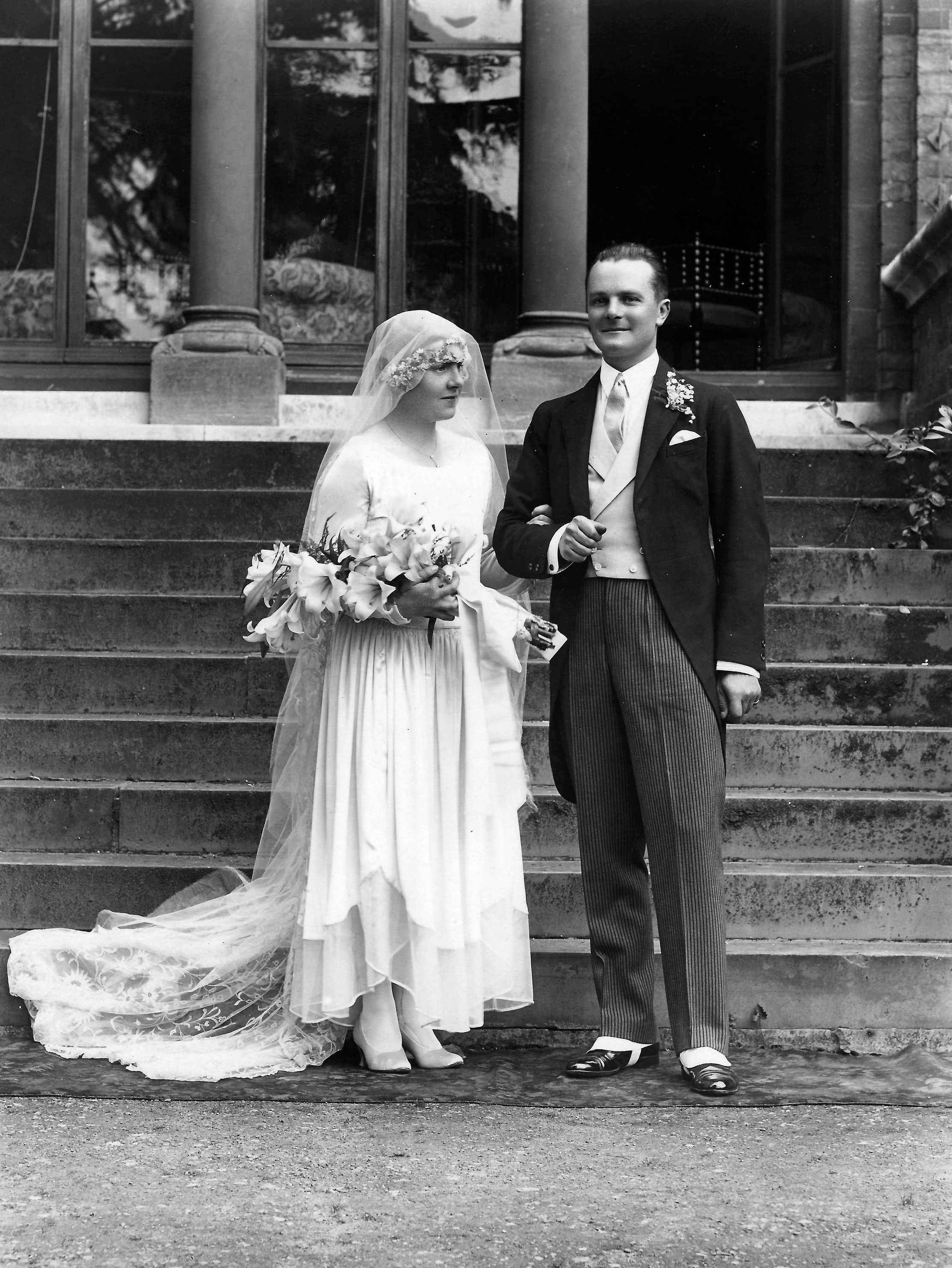
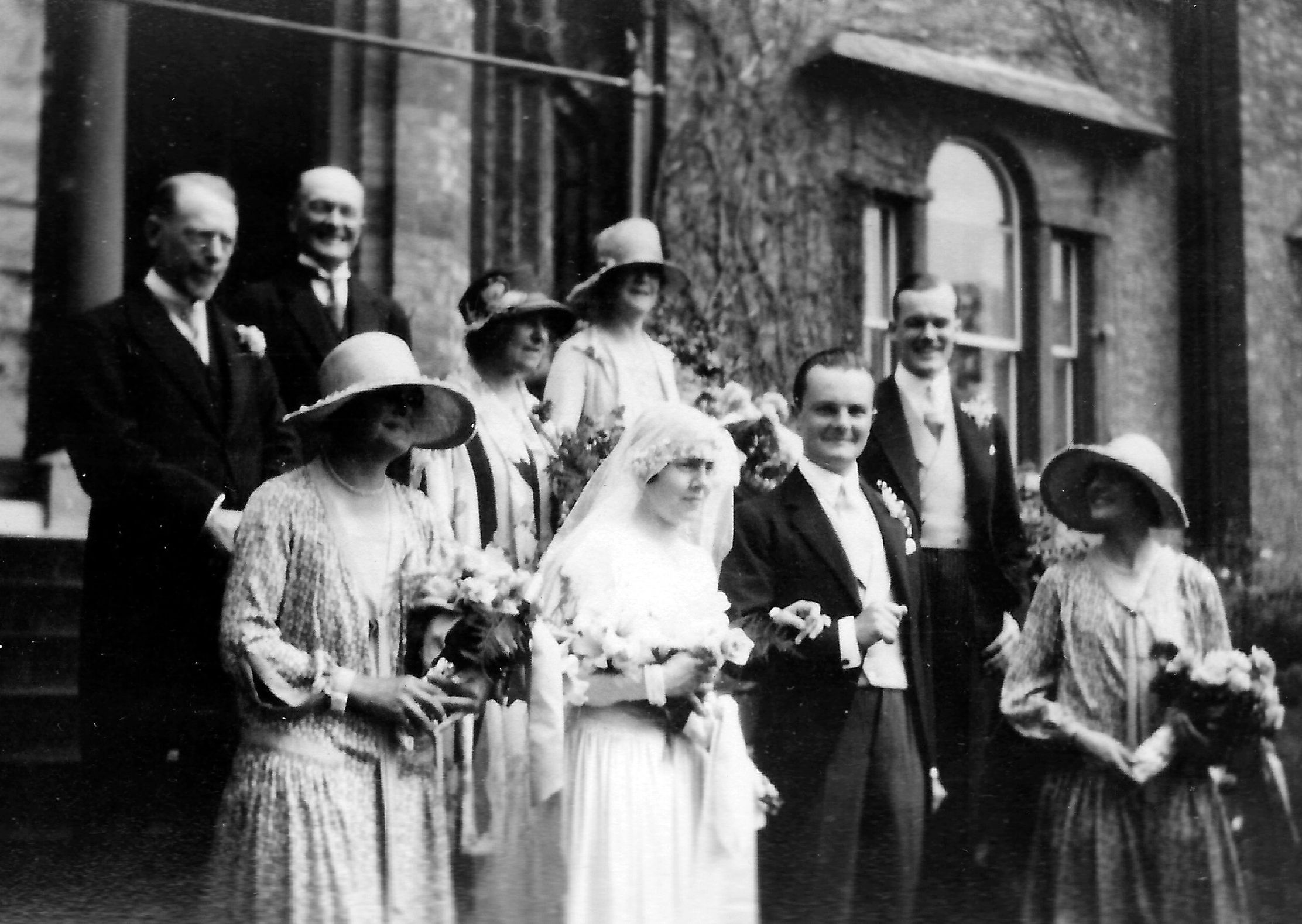
In 1927 John married Nancy Eleanor Mitchell and worked as a research chemist at ICI.

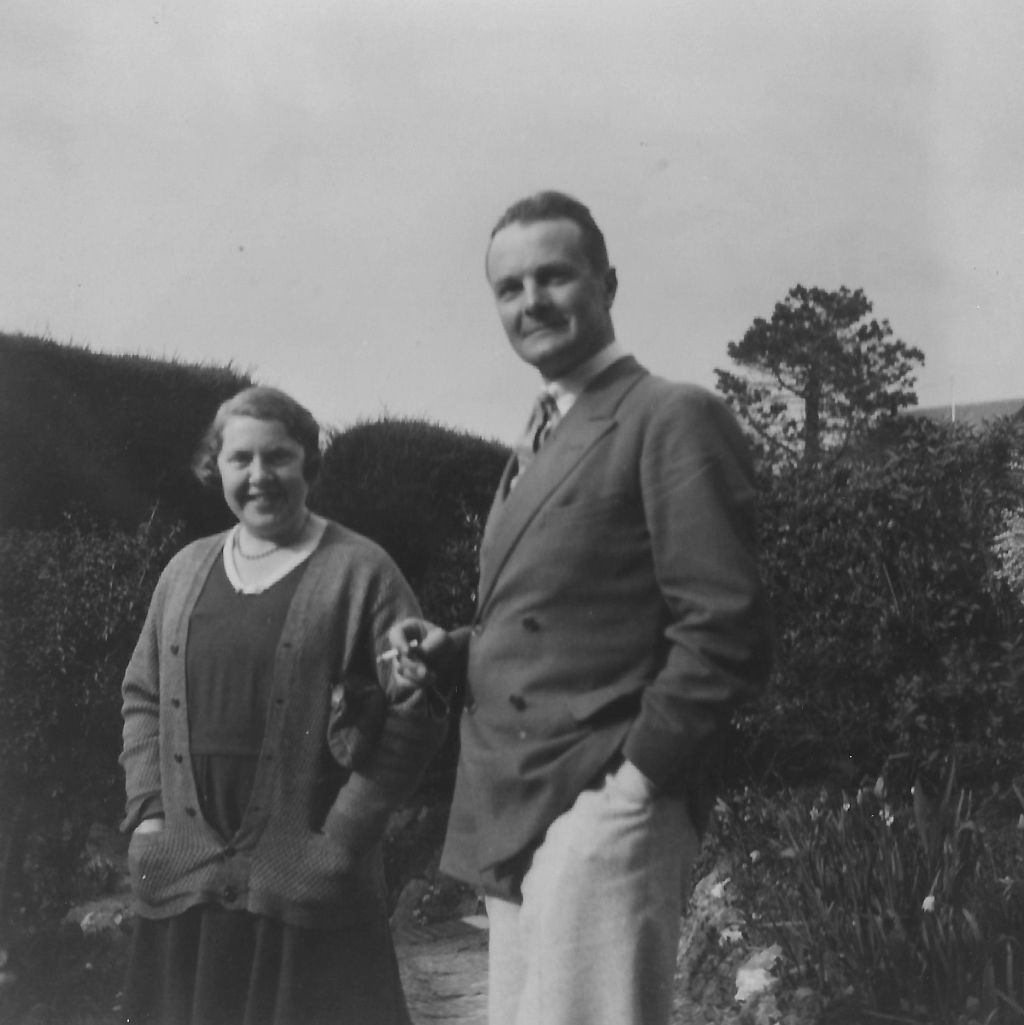
John and Nancy Lanyon
John and Nancy

John and Nancy had five children.

Descended from the Yetholm Gypsies

Nancy Eleanor Mitchell (1901-74) married John Arthur Lanyon. Nancy was the only daughter of Isaac Haig Mitchell and Margaret Hunter. Margaret’s story is told in the post ‘DNA Detective’, this is the story of Isaac’s family.
Isaac Haig Mitchell was a mechanical engineer who became a trade unionist. You can read about him on Wikipedia and see his portrait at the National Portrait Gallery in London.

Isaac was named after an uncle also called Isaac Haig Mitchell who was born in 1831. I eventually tracked him down to New York, America where he was working as a clerk and married to Sarah. He died of arthritis chronic inflammation of the joints aged just 36 in 1868, just a year after his nephew Isaac was born.

Isaac Haig Mitchell by Bassano NPG x83999
© National Portrait Gallery, London

Isaac’s complicated family tree!

Isaac’s father was Alexander Mitchell 1816-1894 he was born in Eccles and lived all his life in the borders area, dying in Hawick in 1894.

Alexander Mitchell 1816-1894

He was a wool dyer and scourer (scouring is washing the wool to remove all the dirt and grease). Wool was a big industry in this area and many people worked from home, spinning and weaving. Hawick was known for its tweed and cashmere industries.

Alexander’s first wife was Mary Gadd from Leicestershire. They had 7 children together but sadly Mary died of puerperal fever aged 37, five days after giving birth to her seventh child. Baby Alison also died. Alexander was now a widower with six young children to care for.

Alexander may also be the father of Mary Little’s illegitimate son Alexander Mitchell who was born in 1856 and grew up to be a dyer and scourer. (Mary Little was the niece of John Hunter who was the father of Margaret Hunter who married Isaac Haig Mitchell and this may be how the two families knew each other.)

In 1860 Alexander married Isabella Cairns age 27 and the mother of an illegitimate son born in 1859, James Adie Cairns. They were both living at the same address when they married so perhaps Alexander was the father of her child although he had another son named James from his first marriage who was still alive in 1861 so it seems unlikely.

Isabella & Alexander had three children: Isabella, Margaret Douglas & Isaac Haig. Alexander is described as  the step father of James Adie Cairns who sadly died age 4 of Phthisis Abdominalis (abdominal tuberculosis). Sometime before 1881 they adopted a child, John Murray born 1871, the son of Elizabeth Murray. Elizabeth may be a relative or a friend. In 1871, aged 23 she was admitted to Roxburgh Poorhouse as she was a pauper, pregnant and unmarried. Ending up in the poorhouse usually meant the woman’s family has disowned her and thrown her out. 

By 1891 John Murray was no longer with the family, I couldn’t find a record of his death but did locate a record that showed a John Murray joining the Kings Own Scottish Borderers Militia in 1890. After that there are too many John Murrays to identify what happened to him.

The 1891 census shows that Alexander and Isabella had two grandsons living with them: William Paterson and Alexander Brown Mitchell. These are both the illegitimate sons of Isaac’s older sister Isabella. Isabella was a power loom weaver and as she was able to support herself financially and had support from her family she didn’t end up in the poorhouse.

William’s father is named as William Paterson a solicitor’s clerk. William (junior) changed his name to Mitchell from Paterson. This William Mitchell was staying with Isaac in London in 1901 when Nancy Eleanor was born.

Isabella Cairns is descended from the Cairns family in Yetholm Roxburgh. Yetholm is the gypsy capital of Scotland and most of the families in this small village were descended from or intermarried with the gypsy community.

Isabella’s mother was Margaret Douglas and the Douglas family were a well known gypsy family.
Walter Baxter / Kirk Yetholm Gypsy stone inscription

Map of the Borders Area of Scotland.

Unlike his peers Isaac stayed on at school and did an engineering apprenticeship. On the 1891 census he was boarding at Newcastle Upon Tyne where he joined the Amalgamated Society of Engineers. In 1892 he moved to New York and found work as a millwright and joined the Socialist Labour Party of America. In 1894 he moved back to Galashiels in Scotland and founded a branch of the Independent Labour Party. He moved to Glasgow where he was the ASE’s delegate on the TUC. In 1899 he became the first general secretary of the General Federation of Trade Unions.

In 1899 he also married Margaret Hunter and in 1901 their daughter Nancy Eleanor was born.

Isaac & Nancy

They moved to London and he was elected as a Progressive Party alderman on London City Council. In 1907 he accepted an offer to work for the Board of Trade. He became known as ‘Haig Mitchell’ and grew a distinctive beard.

Isaac after 1907

His first wife Margaret died in 1922. On 29 Jul 1927 he married a widowed neighbour Avis Chatterley Baird. Avis died in 1986 aged 100!

Isaac

In 1941 Isaac wrote an article “The Road to Peace”

Isaac died on 15 Mar 1952 at Wandsworth, London. After his death Avis wrote to his daughter Nancy and the letter gives us an insight to his traits as he aged.

DNA Detective – The Search for Margaret Hunter

When I started working on the family tree I very quickly progressed on all branches apart from Margaret Hunter’s family. I was completely stumped.
Margaret Hunter

Margaret was the mother of Nancy Eleanor Mitchell and Nancy’s birth certificate gave me her maiden name of Hunter. I found Margaret’s marriage to Isaac Haig Mitchell on 29 Oct 1899 and the marriage certificate stated that her age was 33 and that her father was called John Hunter, a deceased hosiery worker.

Margaret’s marriage certificate

I easily found Isaac and Margaret on the 1901 and 1911 census. In 1901 Margaret is listed as age 34, born in Scotland and on the 1911 census she is described as age 44, born in Hawick and living in Sutton, Surrey. (I haven’t yet managed to find them on the 1921 census.)

1911 Census return

I then started a search for a Margaret Hunter born about 1866/67 in Hawick the daughter of John Hunter a hosiery worker. There weren’t any candidates so I expanded the search to the whole of Roxburgh and, as Margaret Hunter is a fairly common name, I found lots. I found a few with father’s called John but none of them was a hosiery worker or similar and whilst people did change their occupations I thought it unlikely that a man would, in middle age, change from mining or agriculture to become a hosiery worker.

I decided to search in the 1871 census for a 4/5 year old Margaret Hunter in Hawick and then the whole of Roxburgh and again had no real luck. I then searched the 1881 census (the Mormon Church has transcribed this whole census and it is easy and free to search) for the whole of the UK and found a Margaret Hunter born in 1865 in Scotland with a father called John Hunter who was a weaver now living in Cumberland. After months of searching I thought I had at last found ‘our’ Margaret. At age 16 this Margaret had an illegitimate child who was raised by his grandparents. Her father John Hunter was a blind weaver born in Scotland but as there are thousands of John Hunters born in Scotland I thought I couldn’t go any further and I left the story there and moved onto another branch of the tree.

Months later I returned to this branch of the tree and decided to look for John Hunter’s death certificate. He was recorded as deceased on Margaret’s marriage certificate so his death must have occurred sometime after the 1881 census and before October 1899. I eventually found his death on 10th Feb 1887 in Carlisle. He was 68, a woolen weaver and his daughter Margaret registered the death. The only problem was she was called Margaret Martin now. It was fairly easy to find her marriage and then to find her on the 1901 census with Mr Martin so she couldn’t possibly be ‘our’ Margaret.

I started again from a slightly different angle. I had found a record for a burial of a Margaret Mitchell in Banstead Surrey on 15 Nov 1921. Margaret was recorded as being 53 years old giving an approximate date of birth as 1868. I had assumed this was ‘our’ Margaret as there was only one death of a Margaret Mitchell in this area. I decided to obtain the death certificate just to confirm the information. When the certificate arrived many weeks later it stated that she was the wife of George Mitchell a ‘carman’ so she wasn’t ‘our’ Margaret. 

The wrong burial!


I spent several days searching for her death. Her death wasn’t registered near her residence in Surrey so I had no idea where to look. Eventually I found her death registered in Lambeth/Brixton on 5 Aug 1922 where she is recorded as being age 55 giving an approximate date of birth as 1867. (She died of stomach cancer and pneumonia.)

Death certificate


I now searched in Scotland for every Margaret Hunter born between 1864-1870, there are lots! I then checked the census and married up every one of them with a family. Some had fathers called John Hunter. I was able to eliminate any John who was still alive after 1899. I was able to eliminate any Margaret who was still a spinster after 1899. I was able to eliminate any Margaret who married someone other than Issac Haig Mitchell and was still married in 1901. I then eliminated any John Hunter who’s occupation didn’t fit with the description ‘hosiery worker’, so all the miners, heavy labourers, farmers etc. Slowly but surely I whittled the list down and still could not find ‘our’ Margaret.
I then took a different approach. I decided to look for all John Hunters in Hawick who were working in any capacity in the wool/cloth industry. Hawick and the surrounding towns in Roxburgh  are famous for their wool industries so there were quite a few candidates but one stood out.

1871 census for 50 Loan Street, Hawick. John Hunter age 40, wool frame work knitter but the only problem was he was unmarried. He did however have a daughter called Margaret Hunter. Unfortunately she was aged 11 and therefore born 1860 which is several years before ‘our’ Margaret was supposedly born.

I searched for a birth of Margaret Hunter in 1859/60/61 in Hawick. Again without success.

I then concentrated on John Hunter and slowly but surely worked out the story.

In 1851 John Hunter was recorded on the Hawick census as age 19, a woollen frame work knitter and living as a lodger with the Thomson family. His place of birth is listed as Langholm Dumfries.
I found him again in 1861 lodging with Margaret Graham and her mother Margaret Notman at Myreslaw Green in Hawick. He was age 27, a power stocking frame tender, unmarried. 

Margaret Graham is listed as a married seamstress. The following children are also listed at the same property: Elizabeth Graham age 12, Joan Graham age 9, John Hunter age 6, William Hunter age 3 and Margaret Hunter age 1, all born in Hawick. The relationships are listed against the head of the house Margaret Notman so it’s not always clear if they are actually related to the lodger John Hunter.

1861 Census Hawick

By 1871 John Hunter was listed as the head of the household and the children were listed as his sons and daughters. Margaret Graham is listed as his married housekeeper and there were two more children: Isabella age 7 and Mary age 2. Unfortunately his surname was transcribed as Hanler and hers as Crahan which made the search a little more tricky!

1871 Census Hawick incorrectly transcribed.

It appears as though John Hunter was co-habiting with Margaret Graham. I decided to search for a birth for a Margaret Graham born 1859/60/61 in Hawick, without success. I then tried using the surname Notman and hit the jackpot!

Margaret’s birth record

Margaret Notman (or Graham) 27 Mar 1860 in Hawick. Margaret is listed as illegitimate but there is a note “Margaret Notman wife of George Graham who the informant declares she has not seen for 9 years”. So having been abandoned by her husband George Graham (a mason’s journeyman) in 1851 she went back to her parents and later met John Hunter, who she lived with until her death in 1877 age 47. 

After her death John Hunter continued to live in Hawick with his daughter Isabella and appears on the 1881 census still working as a wool frame work knitter. He died on 4 Nov 1890 at the Melrose District Asylum age 62. Cause of death was paralysis of the insane four years (late stage Syphilis). The death was registered by Andrew Butler, Isabella’s husband.

John Hunter’s death record

By 1881 Margaret Notman/Hunter had left home and I spent quite a long time looking for her on the census. The most credible entries I found were: 

  1. Margaret L Hunter age 21, birth year 1860 Hawick, Roxburgh. Working as a tablemaid at The Scores, St Andrews, Fife. (I couldn’t find a Margaret L Hunter born in 1860 in Roxburgh).
  2. B) Margaret Hunter age 18, birth year 1863 Roxburgh. Working as a domestic servant and described as a visitor staying with Robert & Helen Gilholm at their home in Ancrum Roxburgh. I did find a Margaret Stodda Hunter born in Roxburgh 1863 but it wasn’t ‘our’ Margaret.

By 1891 there was no obvious candidate for her in the UK census. I decided to look at both Margaret Notman/Graham’s family and John Hunter’s family to see if Margaret had gone to live with any of them. 

Margaret’s Tree

John Hunter (born 20 Nov 1830) was the son of John Hunter born about 1792 and Margaret Budge baptised 7 Aug 1794 Langholm. He had several brothers and sisters. His elder sister Agnes Gaskill Hunter was born in 1815, she married Andrew Little and their first child was born in 1833. They had several children and their daughter Margaret Little was born in 1837. In 1856 Margaret Little gave birth to an illegitimate child called Alexander Mitchell in Hawick. He grew up to be a wool scourer and dyer. It’s pure speculation but I wondered if he could be the illegitimate son of Isaac Haig Mitchell’s father who was also called Alexander Mitchell who was also a wool scourer and dyer. It would perhaps explain how ‘our’ Margaret knew Isaac Haig Mitchell.

John Hunter’s Tree
Alexander Mitchell, father of Isaac Haig Mitchell and possible father of Alexander Mitchell born 1856.

Alexander Mitchell/Little died age 28 of pulmonary consumption. In 1879 he was involved in a Sheriff Court paternity case with Sarah McWatters over the paternity of her daughter Ellen L Stainton McWatters. He went on to marry Betsy Young the year before he died.

I still don’t know where ‘our’ Margaret was in 1891. But it appears that at age 39 she married 32 year old Isaac Haig Mitchell. In 1901 age 41 she gave birth to Nancy Eleanor Mitchell, her only child. She maintained the lie about her age for the rest of her life.

Margaret with her daughter Nancy Eleanor Mitchell

Of course this was all speculation until my husband submitted a DNA test to ancestry.com and we discovered several distant cousins all descended from John Hunter and Margaret Notman/Graham which confirmed at long last that I had indeed found ‘our’ Margaret Hunter.

What happened to Margaret’s brothers and sisters?

Elizabeth Graham her half sister was born about 1849. There are a couple of possible marriages but I could not find anything to prove which was correct.

Joan/Jane Graham/Hunter born 1852 may or may not be George Graham’s daughter. By 1871 she is no longer with the family, she may have died or moved away. No further trace of her.
John Hunter born 1855 and died 3 May 1930 Kilmarnock. He married Isabella Wilson and they had 7 children. Their youngest, born in 1898, was called Maggie Notman Hunter.

William Hunter born 1857 married Agnes Sanderson Hutton and moved to Peebles. They had 4 children, the youngest was born in 1886 and was called Margaret Notman Hunter.

Isabella Hunter born 1863 died 5 Feb 1931 Paisley. She was run over by a lorry and killed, there is a procurator fiscal’s report attached to her death certificate. She married Andrew Butler and had 6 children, the eldest was born in 1885 called Margaret Notman Butler.

James Hunter born 7 Mar 1867 and died 6 Sep 1867 of whooping cough.

Mary Hunter born 17 Aug 1868 and died 19 Mar 1877 of tubercular meningitis.

Without DNA I would never have ben able to confirm that this was indeed ‘our’ Margaret Hunter.