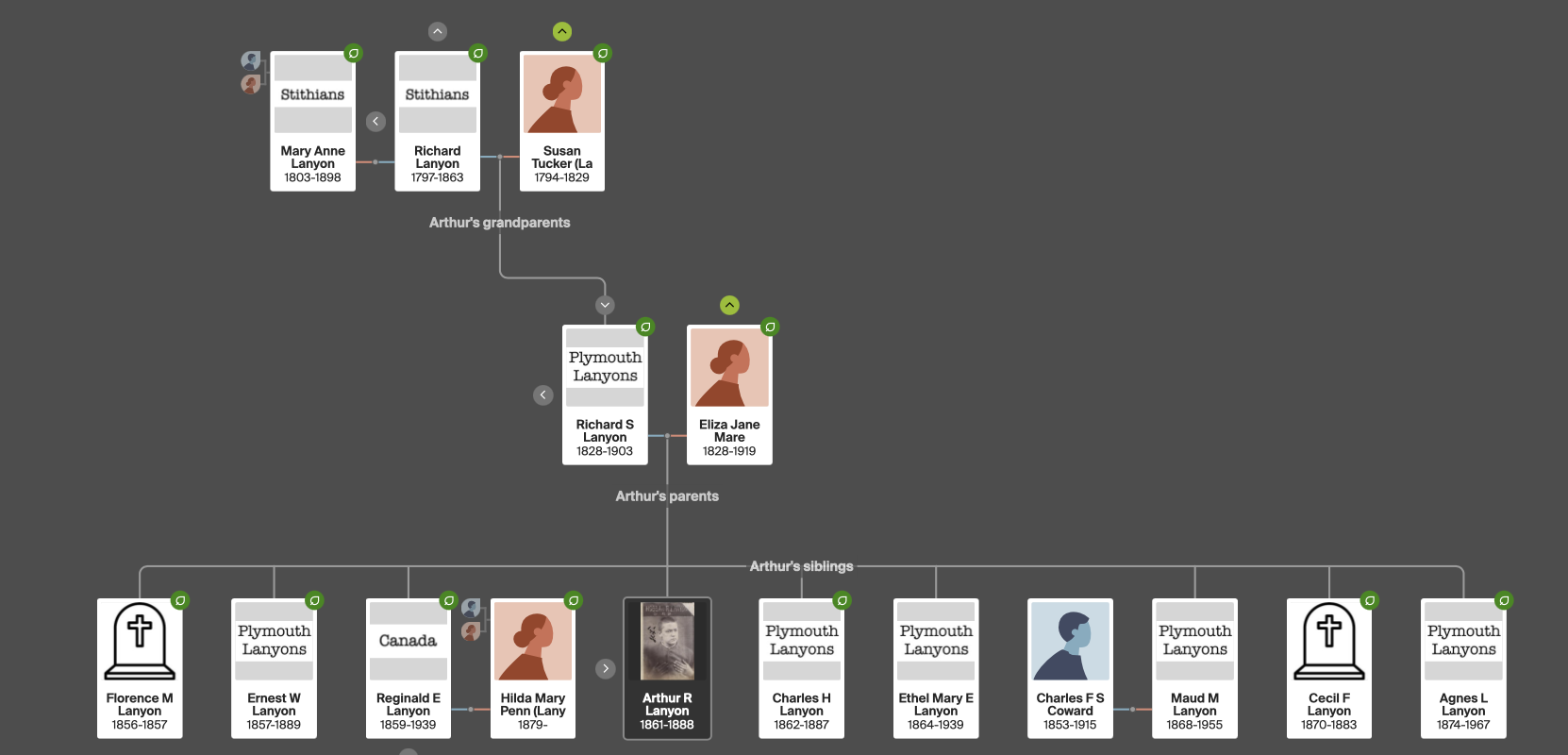
Arthur Richard Lanyon was born in Plymouth in 1861, he was the son of Richard Sampson Lanyon 1828-1903 and Eliza Jane Mare.
Arthur Lanyon’s tree
Richard was a gunpowder manufacturer (like his father) and a merchant in Plymouth. Arthur was one of nine children. They were a very respectable family. When Arthur left school age 16 he joined the post office as a clerk and worked in Exeter. The post office soon noticed that letters were going missing so they ‘posted’ a letter containing three half sovereigns which were marked and they waited to see what would happen.
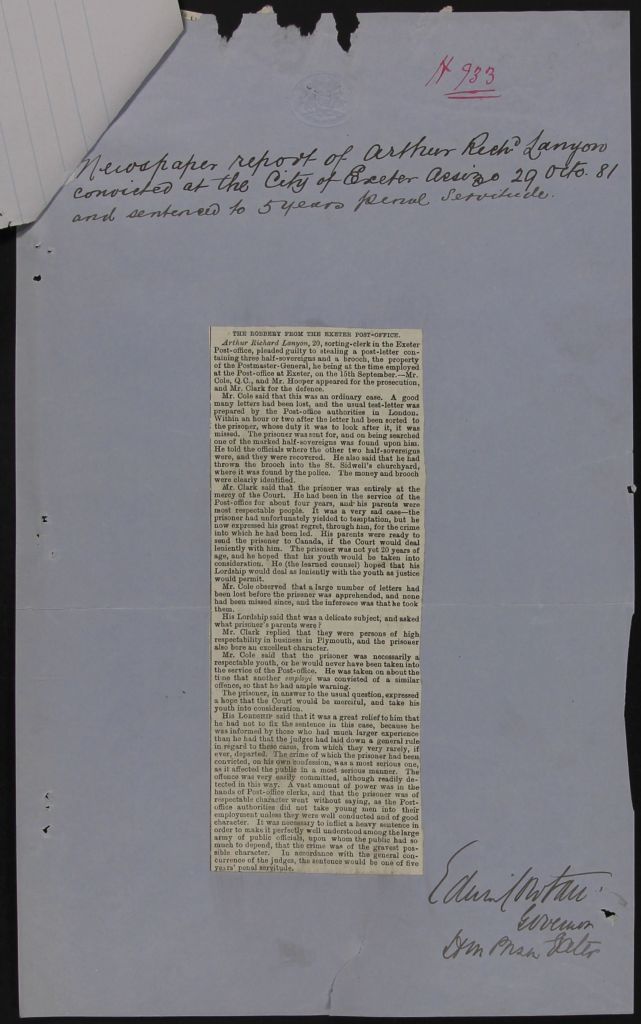
When the letter went missing Arthur was searched and the marked sovereigns recovered. Arthur was charged with larceny of postal letters, found guilty on the 29 October 1881 and sentenced to five years penal servitude. Appeals for leniency due to his age were ignored. His parents offered to send him to Canada instead, the appeal fell on deaf ears. Arthur was sent to Pentonville Prison.
Arthur’s photo from Pentonville Prison
Newspaper report of his conviction from his prison file.
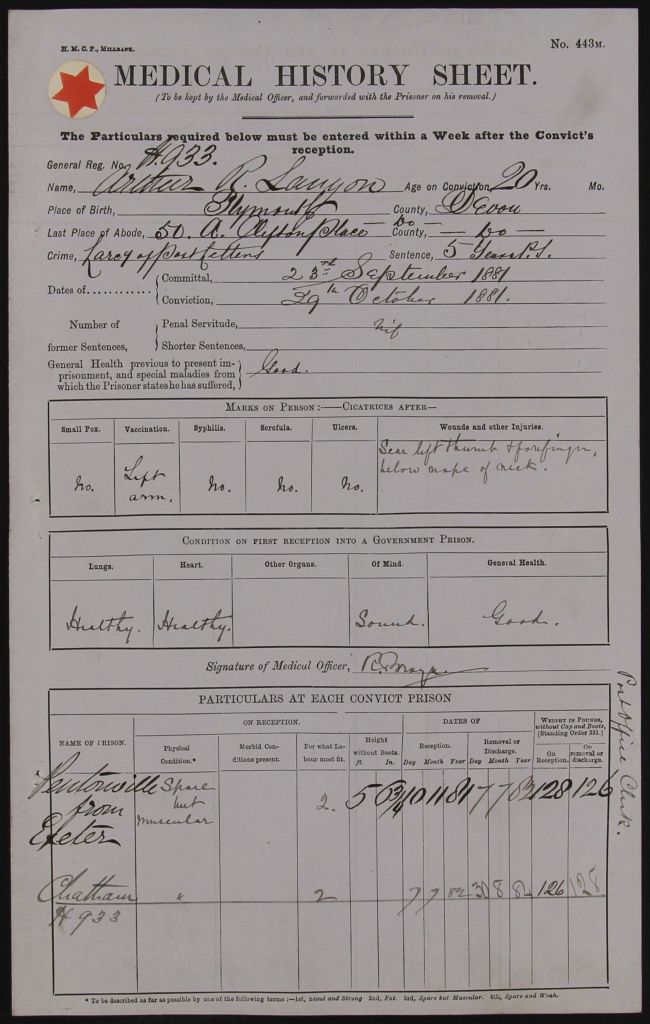
On entering prison Arthur was a healthy young man and his prison medical record notes nothing untoward.
Arthur’s medical sheet
On release his parents sent him to Canada. It was a chance of a new life. Arthur died in Vancouver on 5 August 1888 at the age of 27.
This post is about the Irish War of Independence 1919-1921.
This story starts on 21 January 1919 at Soloheadbeg when the Third Tipperary Brigade of the IRA ambushed and murdered two policemen of the Royal Irish Constabulary (RIC) who were escorting a consignment of explosives. The four men who carried out the ambush were Sean Hogan, Daniel Breen, Sean Tracy and Seamus Robinson, known as the ‘Big Four’.
Following the attack they went on the run and spent months moving around and often sleeping rough.
Public domain, via Wikimedia Commons
Sean Hogan was the ‘most wanted man in Ireland’ and in May 1919 he was finally captured and would almost certainly have faced the death penalty.
Sean Hogan – Public domain, via Wikimedia Commons
Hogan was to be transferred by train to Cork. A member of the RIC, who was also an IRA informant, hatched a plan to rescue him from the train.
The ambush took place at the Knocklong station in Limerick on 13 May 1919. It was the day of Hogan’s 18th birthday.
Hogan was escorted by four armed RIC officers (Michael Enright, Peter Wallace, John Thomas and Jeremiah Ring). The train was attacked by a group of armed men as it passed through the station. Sean Tracy and Ned O’Brien entered the car carrying Hogan and they opened fire on the police officers. Constable Michael Enright was killed immediately. A hand to hand fight then broke out on the train and more IRA volunteers joined in. Sgt Peter Wallace was shot and later died of his injuries.
Hogan was freed and he and the volunteers escaped, although some were injured. David O’Byrne, the local butcher, used his meat cleaver to break open Hogan’s handcuffs. The wounded were taken to Shanahan’s farm at Glenlora where they were treated. A huge manhunt began but Hogan and most of the attackers escaped.
Public domain, via Wikimedia Commons
Constable John Thomas was awarded the Constabulary Medal ‘for exceptional courage’. A year later he was abducted by the IRA to prevent him giving evidence at the trial of one of the Knocklong gang. Fortunately he escaped.
The IRA informant was Constable Jeremiah Ring.
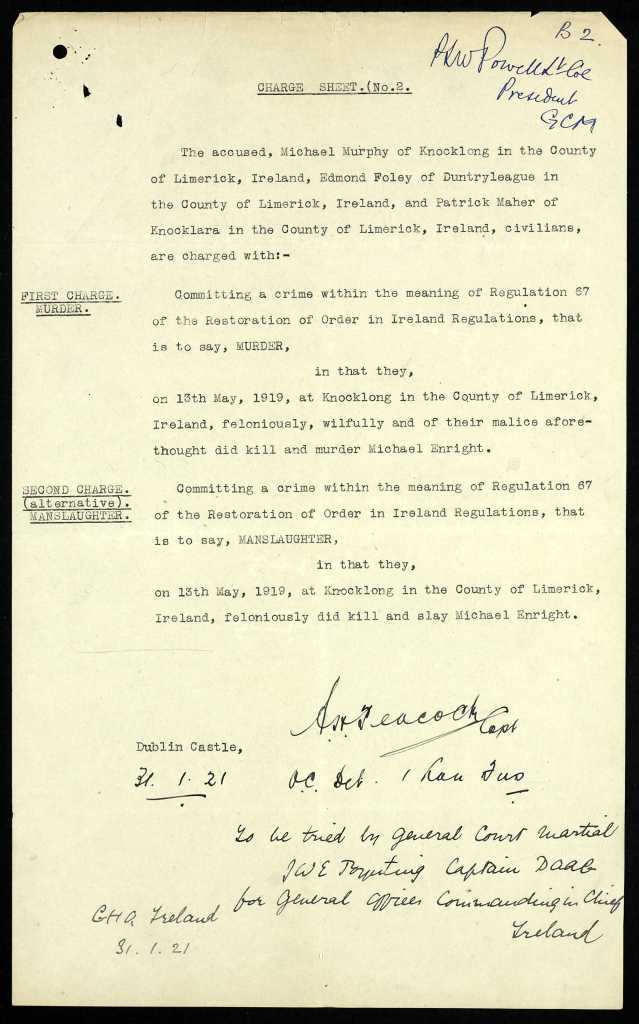
Eventually three men were charged with the murders: Edward Foley, Paddy Maher and Michael Murphy. Edward Foley had taken part in the ambush but Maher and Murphy were innocent men.
Foley and Maher in prison – Public domain, via Wikimedia Commons
There were two civilian trials where they were found not guilty. The authorities then decided on a third military trial and the men were court-martialled.
Charge Sheet Knocklong Trial
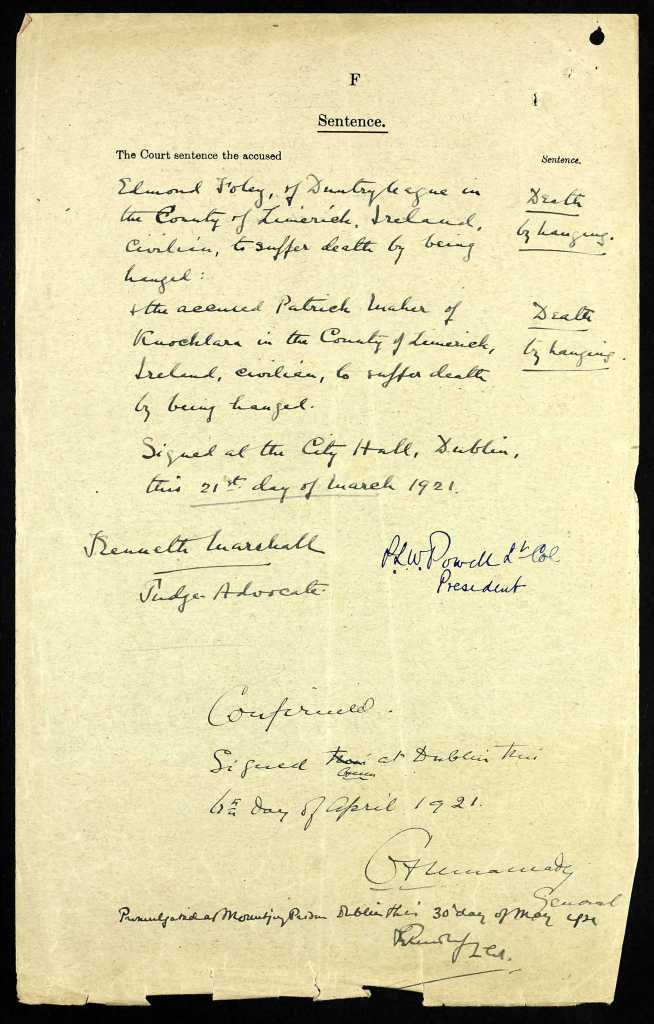
All three were found guilty. Foley and Maher were sentenced to death and Murphy imprisoned. Maher and Murphy were completely innocent of the crime.
Foley and Maher (not Mayer as stated in the newspaper) sentenced to death
Edward Foley and Paddy Maher were hanged at Mountjoy prison on 7 Jun 1921 and were buried within the prison grounds. They were part of the ‘Forgotten Ten’ who were buried there after being executed during the uprising. Their bodies were eventually moved and they were given a state funeral on 14 October 2001.
Michael Murphy was imprisoned and freed after the truce. He had been a private in the First Battalion Irish Guards and served in France. His army number was 10236. The lawyer for the defence described him as “a man of the most distinguished service with the Irish Guards in France.“
So why is this post of any interest to the Lanyon family?
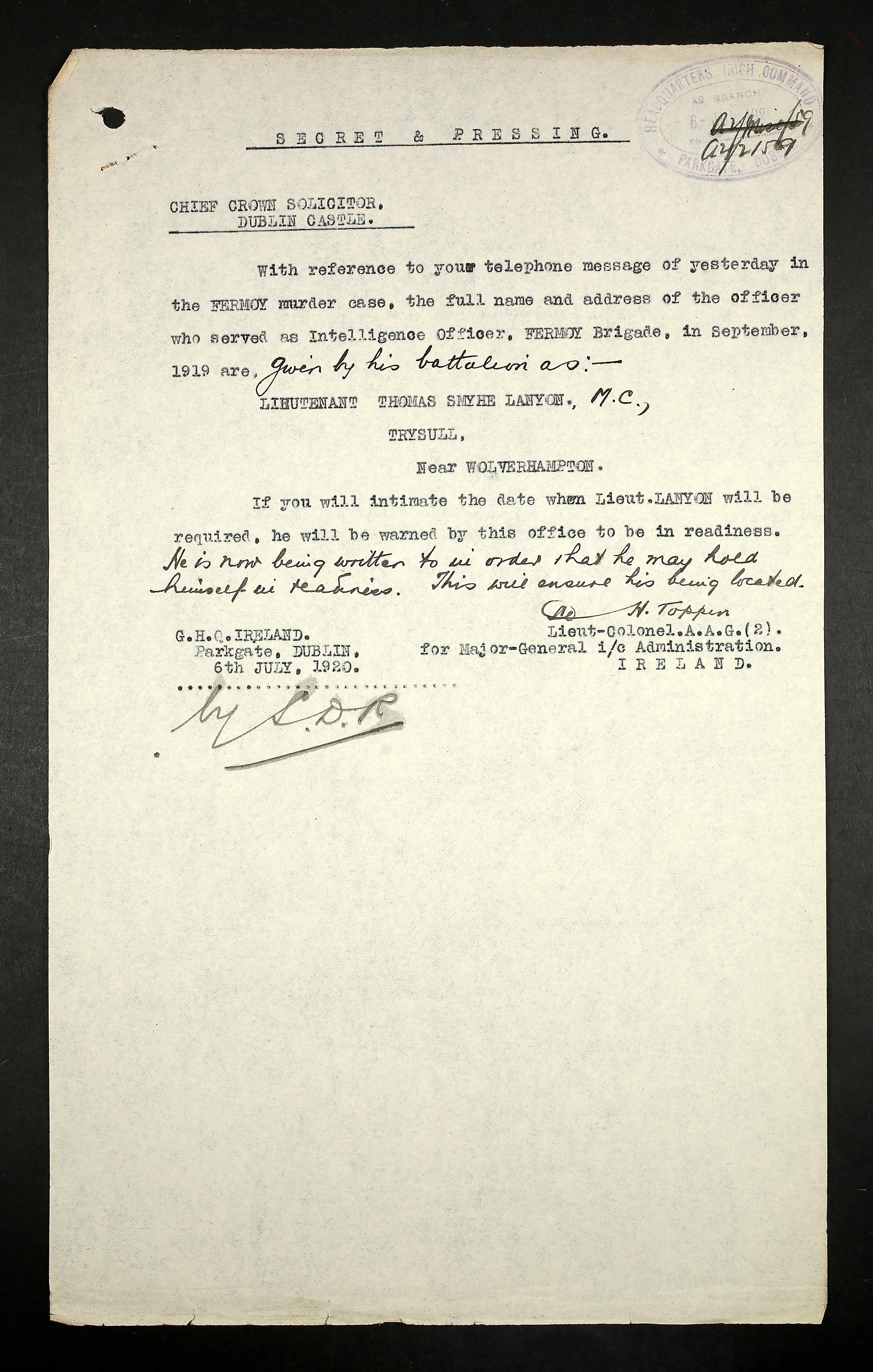
Lieutenant Thomas Smythe Lanyon M.C. was the Intelligence Officer for the Fermoy Brigade in 1919. He was called to attend the court-martial but doesn’t appear to have actually given evidence.
Thomas was in the King’s Shropshire Light Infantry during the First World War and was awarded a Military Cross:-
“For conspicuous gallantry and devotion to duty during a hostile raid on our trenches. Throughout an intense bombardment of all kinds of projectile he moved about the line, encouraging the men and setting a splendid example to all ranks. At one moment he was buried by a trench mortar on his way to visit one of his posts; and finding, on reaching it, that the whole garrison had become casualties, he promptly made a block with fresh men and repulsed the raiders with rifle and machine-gun fire. His fearlessness and energy were most marked.”
Shropshire Light Infantry Facebook Page
Where does Thomas fit on the tree?
Thomas married Vera Wrangle in 1922 and I don’t know what happened to him afterwards. It seems strange that I can discover so much and then hit a brick wall!
The military files relating to this were classified as Secret and sealed for 100 years and were only opened this year. (Source- NA WO/35/105)
There is a small group of Lanyons in the parish of Sancreed who don’t fit on the Lanyon tree. We know almost nothing about them but they are worth mentioning as they demonstrate that there were other cadet branches of the tree in the 16th century. They must all be related but it isn’t possible to prove that.
George was living in the parish in the 1560s and was probably born in the 1530-1540s. There is no record of a marriage for him but a daughter Jane was baptised on 22 Sep 1566. Then on the 2 Oct 1566 George also baptised an illegitimate daughter called Alsen! His first daughter must have died as he baptised another daughter called Jane on 22 Feb 1568 and his final child was Elyzabeth baptised on 25 Apr 1575. (The children’s names were all spelt Lanyne.) With two daughters called Jane perhaps that was his wife’s name?
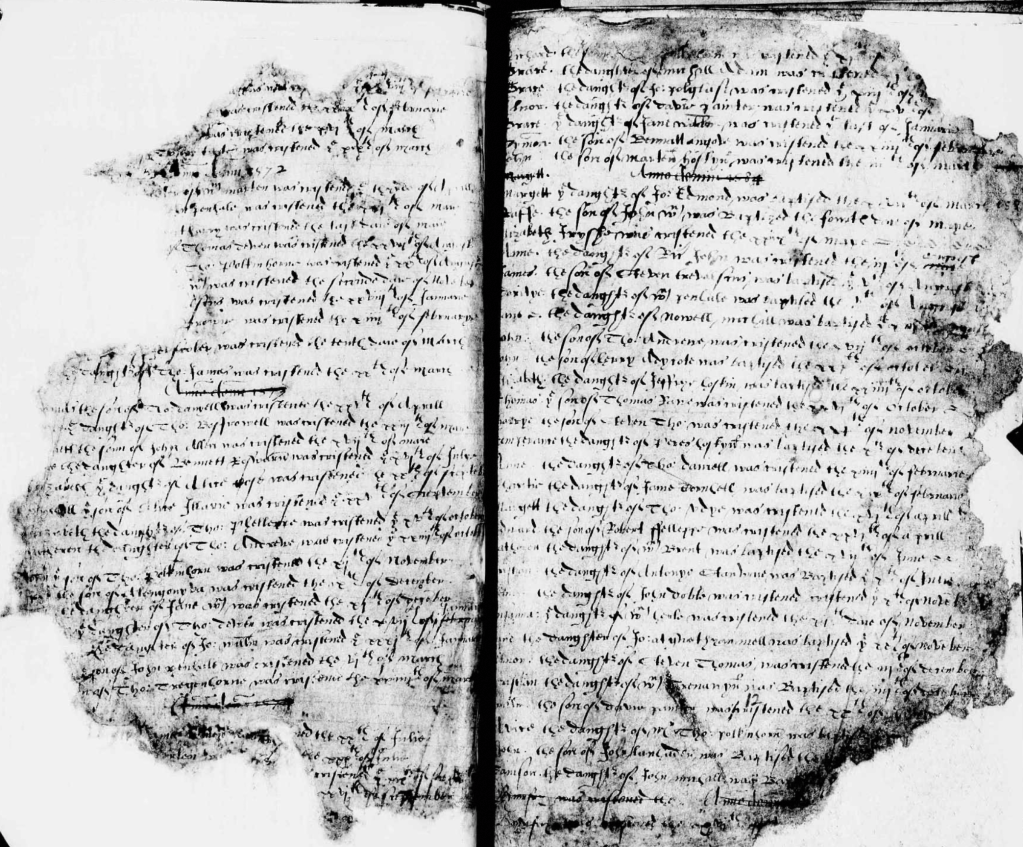
It’s challenging to see if the name is Lanyne or Lamyne. In fact it’s challenging to read anything in these early registers! Just to make things even more complicated there is a family called Lanner living in the parish at the same time.
Sancreed Parish Register
The only other record we have for George is his burial on 16 Nov 1592.
His daughter Jane Lanyne may be the Jeane who married George Bossens/Bossence in Sancreed in 1601 and they had seven sons: Thomas, Benatt, William, Richard, John, Sampson and George. All good Lanyon names!
Sampson Bosence was baptised 25 Apr 1612, married Earth Richards at Madron on 23 Apr 1637.
There is no trace of what happened to Alsen or Elyzabeth.
Jane Veale Mitchell (early 20th century researcher) states that George is a son of William ‘Generosi’ Lanyon of Breage. It is possible and she would have seen William’s will, which has now been lost, which may have confirmed the relationship.
Digory Lanyne
Digory married Jane on 4 Feb 1564 making him a contemporary of George. A brother perhaps? There are no children of this marriage baptised and no record of a burial for Digory. It’s also the only instance of the name Digory in the Lanyon family.
There is a Jane Lamyne buried at Sancreed 13 May 1583, another Jane Lamyne buried 22 Jun 1592 and a Jane Lanyne widdowe buried on 16 Nov 1607. Any one of them could be Digory’s wife or possibly even George’s wife.
Fraunces Lanyne
We know where Fraunces (Francis) fits on the tree; he was the eldest son of John Lanyon Esq. He married Ales Trewren at Sancreed in 1584. The Trewrens were a Sancreed family and Francis and Ales’ children were baptised in the parish.
Richard 8 Sep 1585, he became the heir to John Lanyon Esq when his father Francis died in 1593
Elizabeth 11 Nov 1587 (she was an illegitimate child)
John 10 Dec 1587
William Lanyne
Francis’ brother William also settled in Sancreed and baptised his children there. We can also place him on the tree. He also had other children whose baptisms weren’t recorded or have been lost from the register.
William married Jane on 19 Nov 1592. She was buried 21 Sep 1619 and William himself died in 1624, his surname in the burial register is recorded as Lanion. His will is signed by Benat Lanion. Both his daughters called Elizabeth survived to adulthood!
Elizabeth 31 Oct 1593
John 8 Jun 1596 buried 15 Sep 1601
Jane 24 Oct 1602
William Dec 1603
Elyzabethe 17 Jul 1607
Benat signed William’s will of 1624
Thomas Lanyne
Thomas baptised a son called John on 16 Mar 1585. It was the only child Thomas baptised at Sancreed.
Could Thomas be an unrecorded brother of Francis and William?
Rou Lanyne
Rou should probably be Row, a popular first name and surname at the time. He baptised a daughter called Mary on the 28 Jun 1592. There is no further trace of either Row or Mary.
Benat Lanyne
Benat had four children baptised. He was married to Jane on 20 Nov 1593. her burial is recorded on 13 Jun 1621 and Benat’s on 4 Apr 1629. By the time of his death his surname has become Lanion.
Watter (sic) 22 Sep 1594 buried 4 Oct 1594 (surname spelt Layne) – probably should be Walter
Thomas 8 Feb 1595
Mary 24 Feb 1596 buried 7 Jun 1597 (surname spelt Laynne)
Jane 6 Jul 1599
It seems likely that Benat Lanyne was a son of Walter Lanyon and Elizabeth Nanspyan but there is no proof.
Cyprian Lanyne
On 13 Nov 1585 a John Lanyne baptised Cyprian Lanyne at Sancreed. Where does this John Lanyne fit on the tree? (A John Lanyne married Mary at Sancreed in 1584, presumably this is the same John.) A Cyprian Lamin signed the 1641/2 Protestation Return for Gulval. This is such an unusual name that I think it likely that it is the same person but is the surname Lamin or Lanyne and is he from this family or unrelated?
There is no record of a marriage or burial for Cyprian.
Raphe Lanyne
Raphe Lanine married one of his wives at Sancreed, further cementing the families ties with the parish. Raphe married Jennett on 26 Sep 1591 and she was buried there 14 Oct 1601 (Raphe’s name becomes Raffe!). Raphe’s will was proved 13 Jan 1604/5 so we know what year he died. His will mentions his wife, Ann, but there is no record of their marriage. Just to confuse things further the Sancreed parish register lists a marriage for a Raphe Lamin to an Ann on 10 May 1606 and a burial of a Raphe Lanine on 29 Apr 1614. Could he be an undocumented son of Raphe?
If only we had a few more records, wills (with signatures to compare) and property transactions which might just clarify things! If only the record keepers had neat writing and the pages weren’t lost or damaged….. if only they could spell!
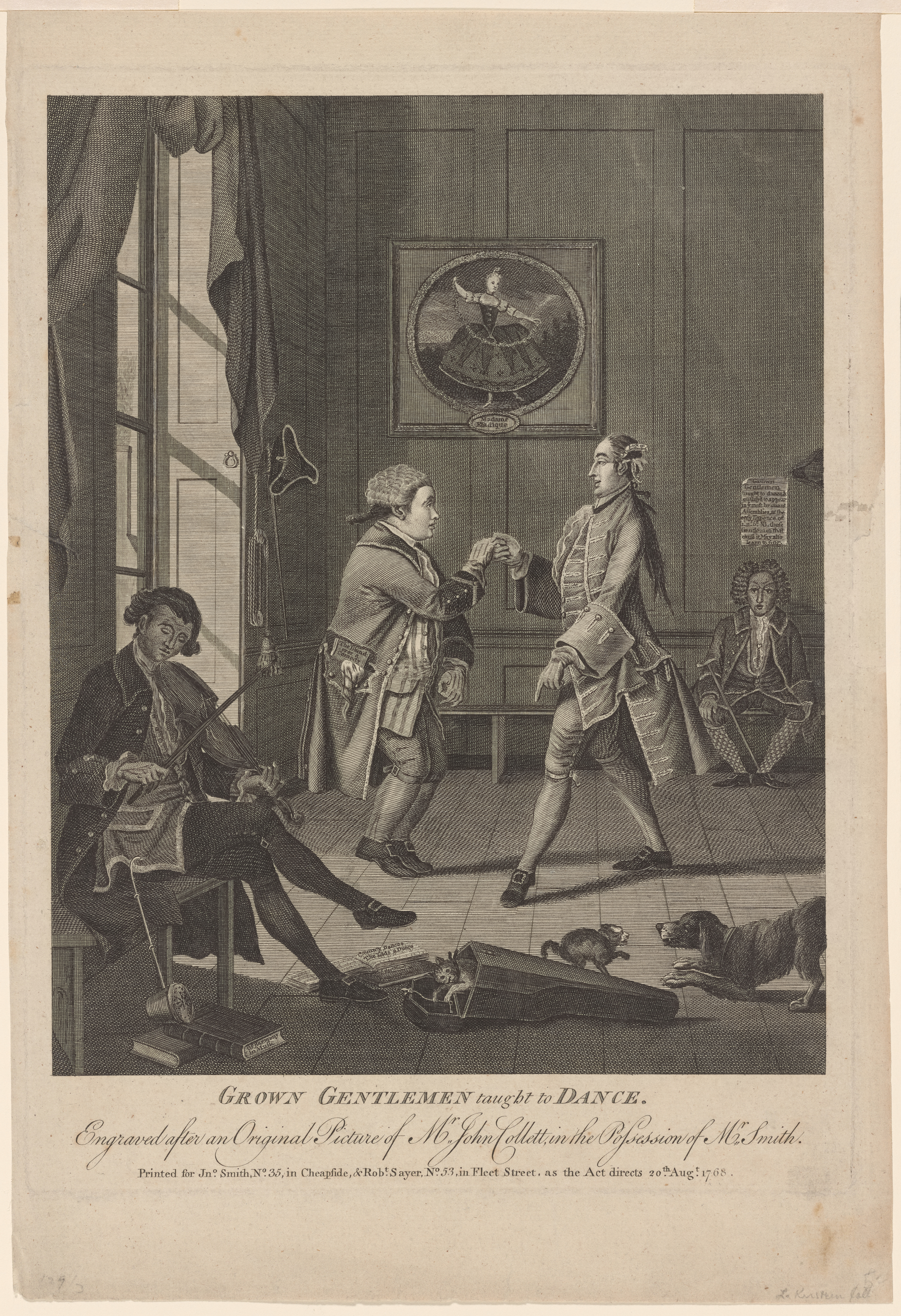
In the 18th century a ‘dancing master’ was a fashionable and profitable job for a gentleman. He would have been at the heart of London society and would have officiated at public balls and advertised his services in the local press.
British Museum, Public domain, via Wikimedia Commons
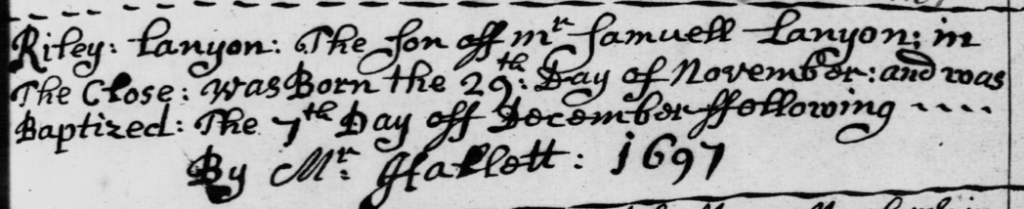
Ryley Lanyon was a dancing master in Bishopsgate Street, London. He was originally born in Exeter on 29 November 1697 and baptised on 7 December. He was the son of Samuel Lanyon. Samuel had another son called Rayly who was baptised at Exeter in 1689 and presumably died before 1697. Ryley/Rayly was obviously a name they wanted to perpetuate.
Exeter Presbyterian
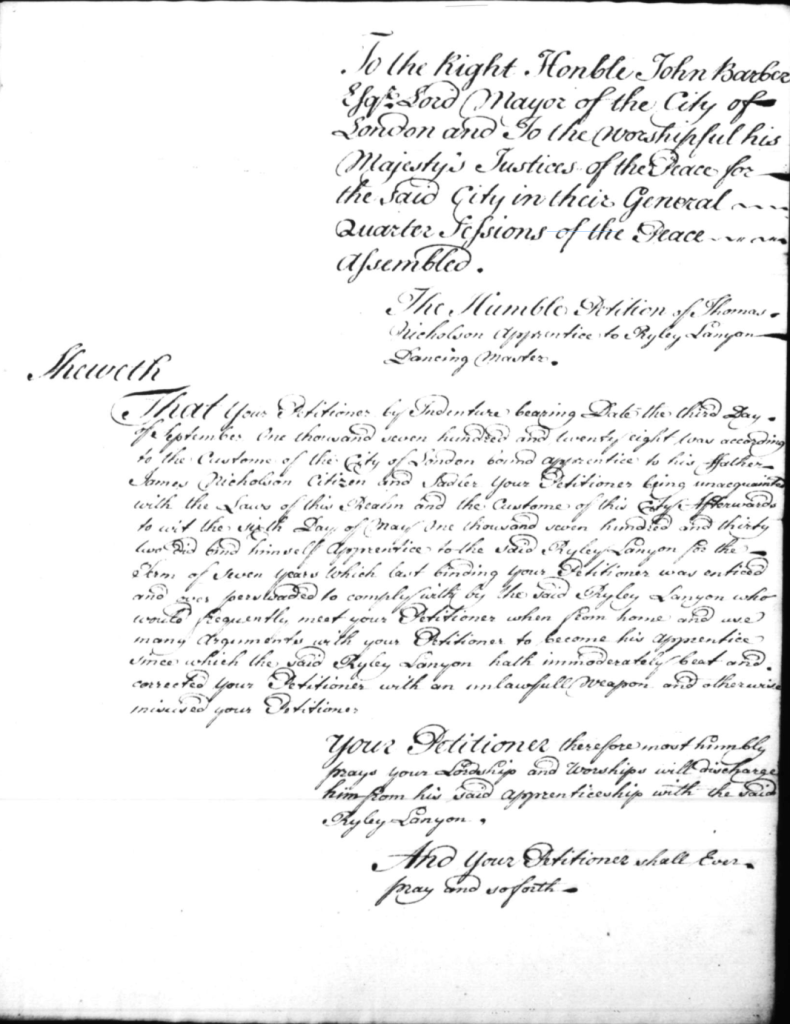
We next see Ryley in the records of London Metropolitan Archives in 1732 when he takes on an apprentice. Thomas Nicholson the son of James Nicholson a sadler. Indenture year 1732 and cost £40 for a seven year apprenticeship. (Source- CLA/047/LJ/13/1733)
A good master would teach his apprentice all he knew and provide board and lodging for seven years. A bad master had almost total control over his apprentice and a free hand to do almost anything he liked. Ryley was a bad master!
In 1733 Thomas Nicholson applied to the Hon. John Barbee Esq, Lord Mayor of the City of London and to the Worshipful his Majesty’s Justices of the Peace’ to be discharged from his apprenticeship because Ryley Lanyon ‘hath immoderatly beat and corrected your petitioners with an unlawful weapon…’
In the 18th century most apprentices would expect to be disciplined and corporal punishment was commonplace. For Thomas to make this appeal, the beating from Ryley must have been particularly bad.
We don’t know the outcome of the appeal.
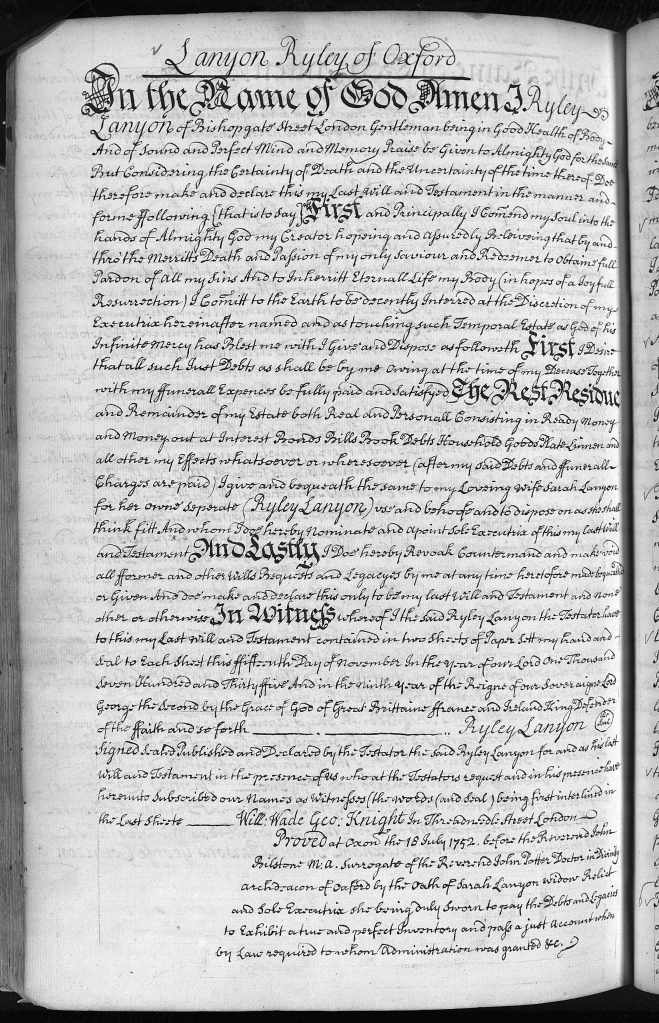
We next see Ryley in the records when he makes his will. It mentions just one relative, his wife, Sarah Lanyon to whom he leaves everything.
The will was proved on the 18 July 1752 and Ryley was buried at St Ebbe, Oxford.
Searching through London records I came across an Anne Ryley Lanyon spinster of Aldgate who had a clandestine marriage with James Howell, bachelor on 6 July 1722. James was a mathematical instrument maker. Could she be a relative of Ryley? I also found a marriage in London between a Samuel Lanyon and an Ann Riley on 7 Oct 1676.
On digging a bit further I found a baptism of a Samuel Lanyon son of James Lanyon in July 1656 at Exeter, Devon.
In 1677 there was an apprenticeship listed between John Lanyon, son of James Lanyon, wool comber of Exeter and Samuel Lanyon, of the Grocer’s Company London. So it looks as though Samuel had taken on his younger brother John to be trained to become a grocer.
On 2 December 1683 John Lanyon married Susanna Osmand at Stoke Canon in Devon.
Are they all related? Possibly! There are insufficient records to say with any certainty.
Can I fit them onto the main Lanyon tree? No. James Lanyon, father of Samuel and John, must have been born in the 1630s or earlier and I don’t have a James Lanyon born around that time. So for the time being Ryley and this little group of people are in the ‘Loose Lanyons’ section.
John Collett, Public domain, via Wikimedia Commons
Wills are a great way to build a tree especially when there are gaps in the baptism, marriage and burial records.
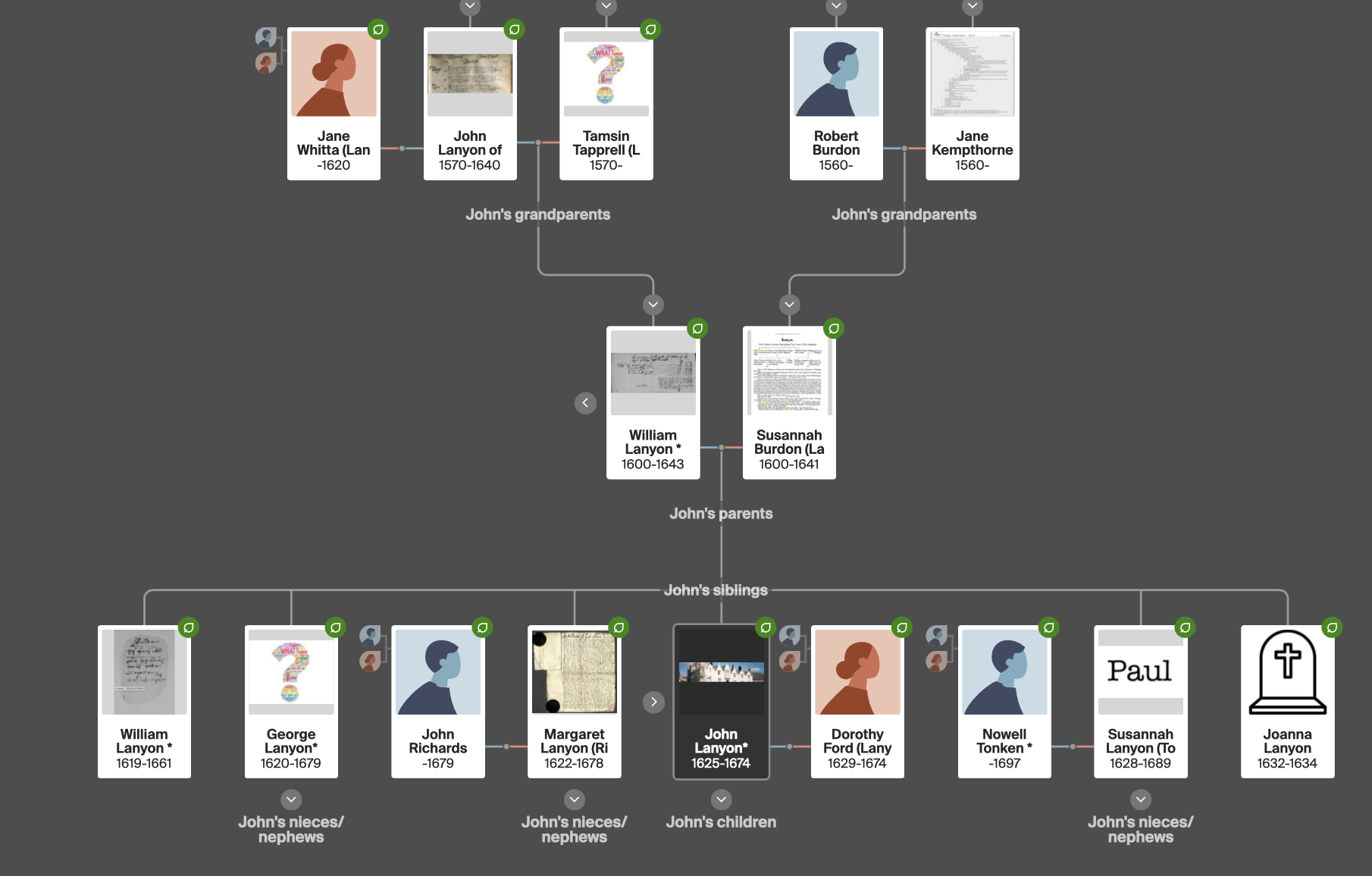
Margaret Richard’s will (which I came across by accident whilst looking for another document) helped with the early Breage Lanyons.
Margaret was baptised on the 27 Oct 1622 at Breage, the daughter of William Lanyon and Susannah Burdon. William must have been a farmer as his will inventory values his corn and the corn in the ground.
Margaret married John Richards but we don’t have a date of marriage. When her older brother William died unmarried in 1661 he left his estate to her.
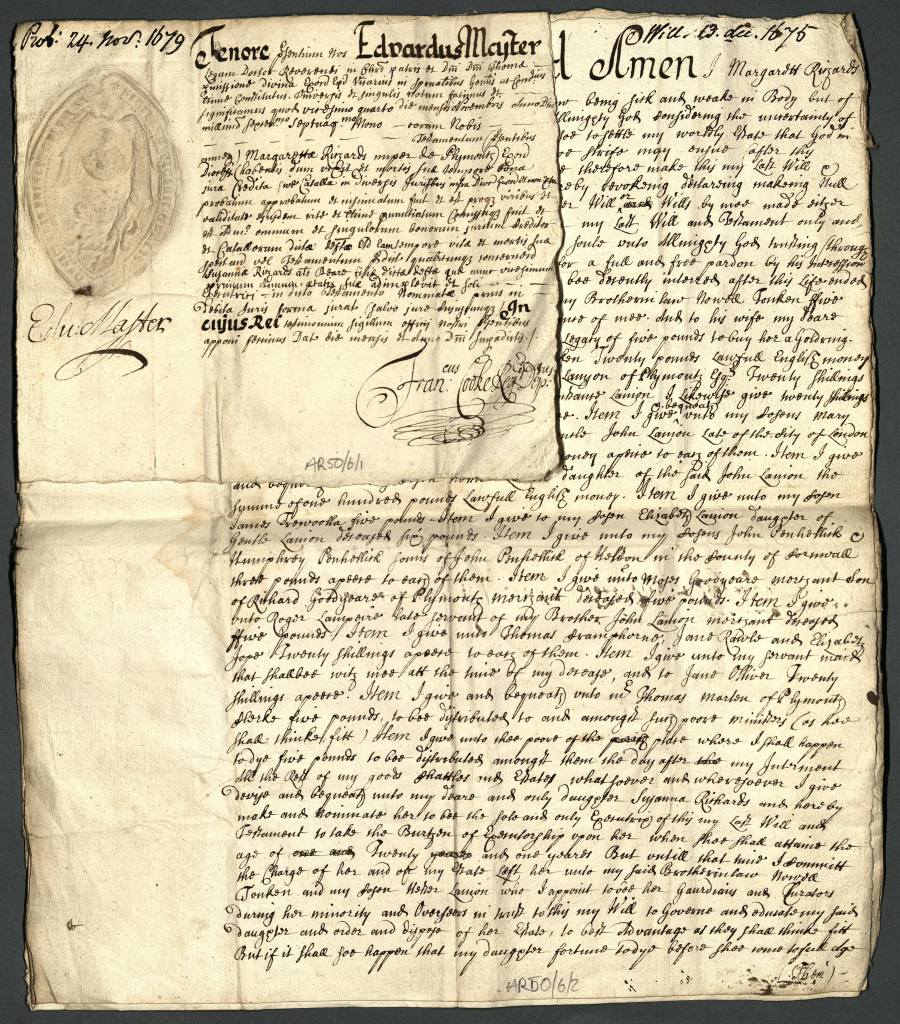
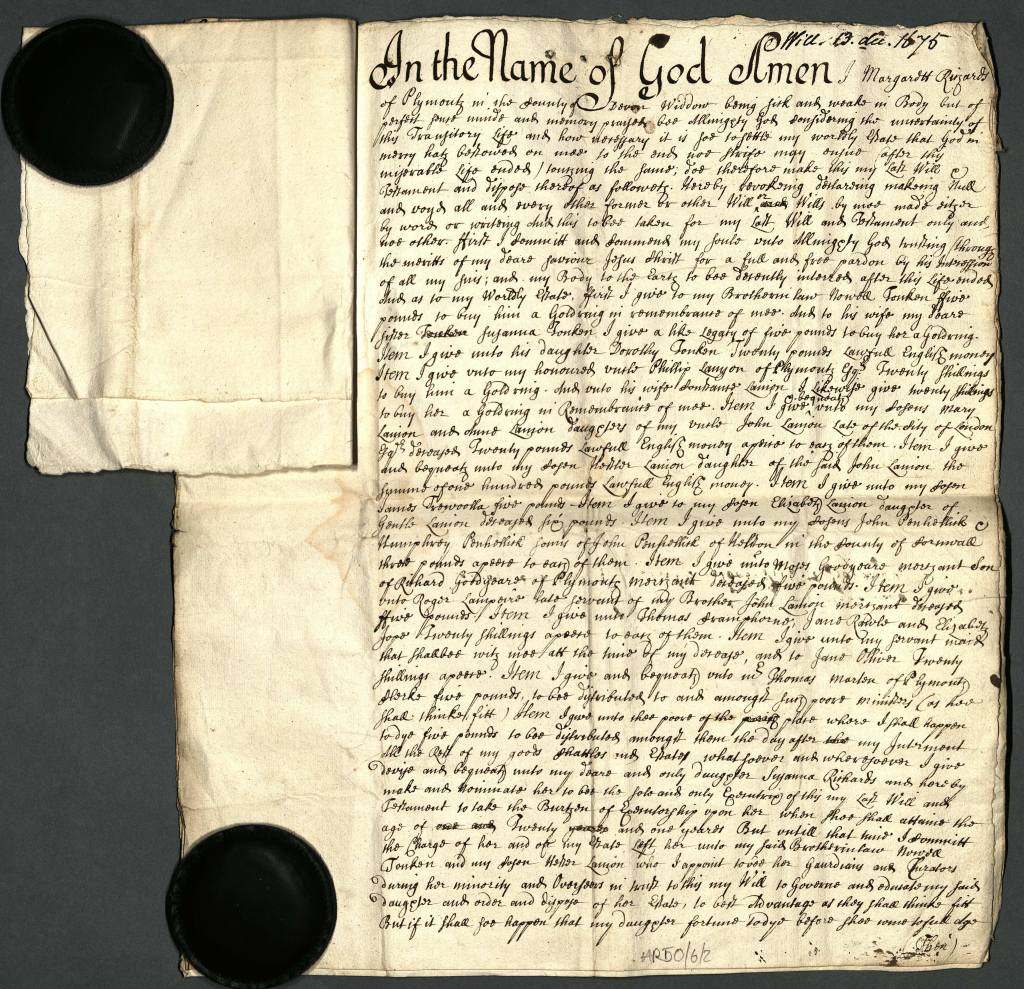
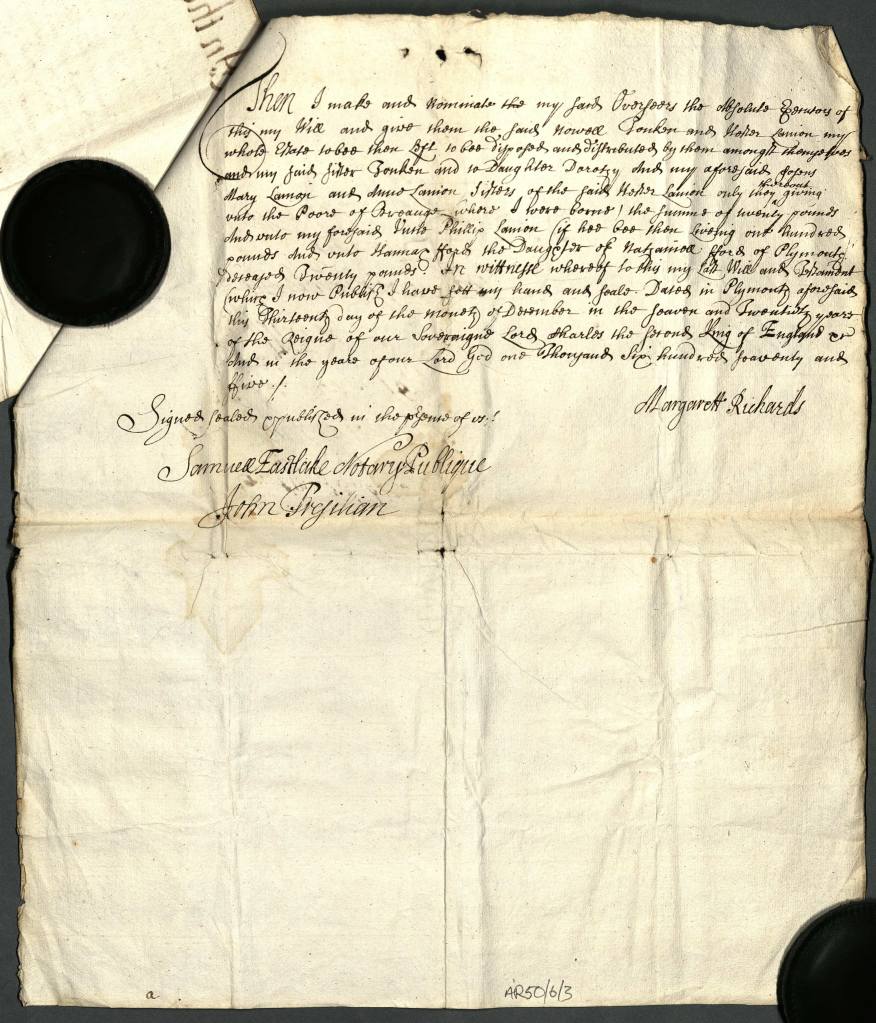
Margaret made a will in 1675 (it was proved in 1679) and her will helps confirm relationships on this very early branch of the tree.
Margaret’s will CRO AR/50/6
She is described as Margaret Richards of Plymouth, ‘widdow, being sick and weake in body but of perfect minde and memory’ and she mentions the following relatives:
My brother-in-law Nowell Tonkin £5 for a mourning ring
My sister Susannah Tonkin £5 for a ring
Their daughter Dorothy Tonkin £20
Uncle Philip Lanyon of Plymouth Esq 20 shillings for a ring
His wife Constance Lanyon 20 shillings for a ring
Mary and Anne Lanyon daughters of my Uncle John late of the City of London £20 (John was Chief Engineer to Charles I) £20 each
Hester Lanyon daughter of Uncle John £100 (again Hester is described as a cousin and not the wife of her brother John Lanyon)
Cousin James Trewollah £5
Cousin Elizabeth Lanyon daughter of George Lanyon £5
Cousin John Penhellick and Humphrey Penhellick sons of John Penhellick of Helston £3 each (not sure where they fit on the tree)
Roger Lampoire? servant of my brother John Lanyon £5
All the rest to my dear and only daughter Susannah Richards.
Nowell Tonkin and Hester Lanyon to be her guardians
Interestingly the name Lanyon is spelt two ways in this will; Lanyon and Lanion.
Until this document we had no idea that George had a daughter. Now we know he had a daughter but we’ve no idea what happened to her! So the search continues!
Occasionally you come across a document which really helps to paint an accurate picture of a person.
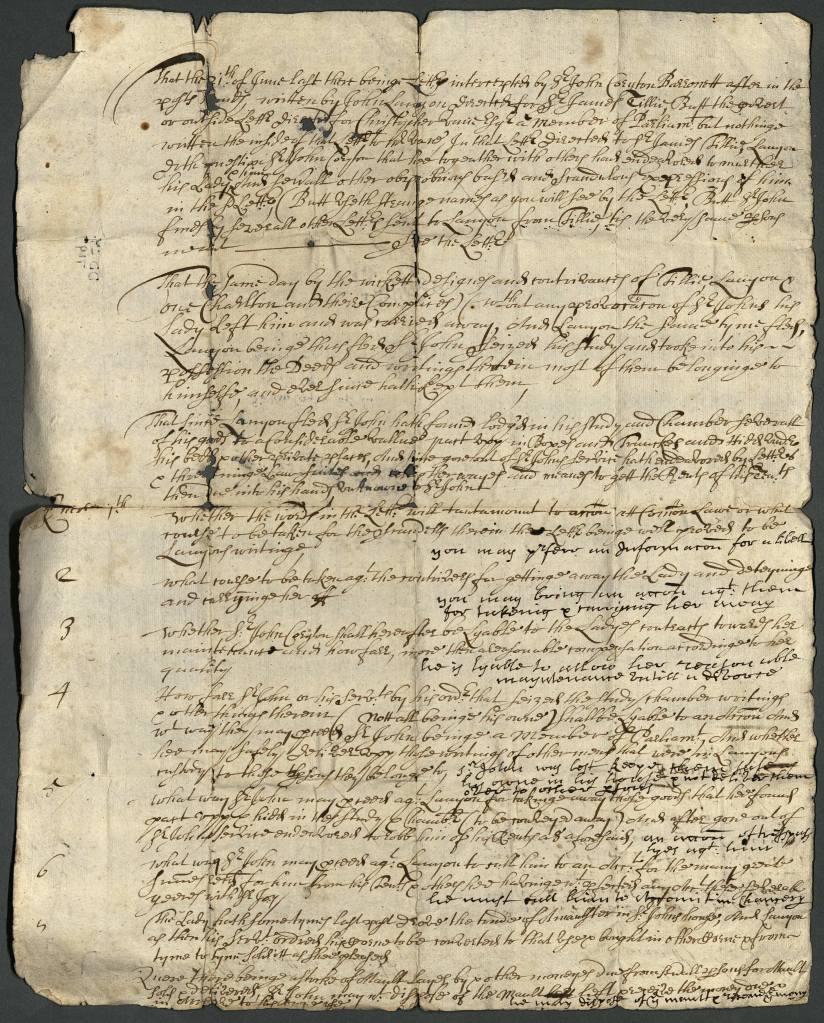
Whilst searching through the online archives at Kresen Kernow (Cornish Record Office) I found a legal opinion dated 1689 for Sir John Coryton against Sir James Tillie. This is of interest to us as Sir John’s servant was called John Lanyon.
From the documents held at Kresen Kernow John Lanyon was witnessing Sir John Coryton’s documents from 1674 onwards so by 1689 he must have been a trusted member of staff.
Sir John Coryton was the 2nd baronet of Newton Ferrers. He was married to Lady Elizabeth.
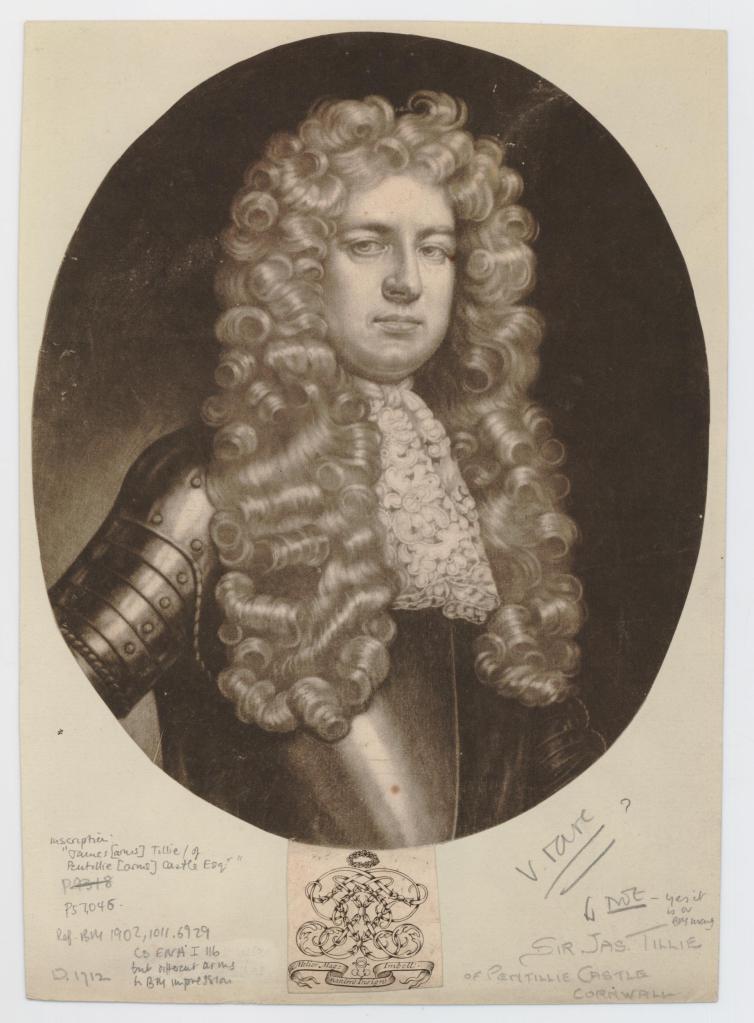
Sir James Tillie was Sir John Coryton’s land agent. He wanted to be married to Lady Elizabeth!
Sir James Tillie – Creative Commons Licence
The counsel’s opinion for Sir John Coryton against Sir James Tillie details how Sir John’s wife Elizabeth had been ‘carried off’ by Sir James Tillie. Sir John was advised that he could take action against the man/men who carried off his wife but he was liable to give her reasonable maintenance until a divorce.
The document also explains that Lady Coryton had been a ‘maltster’ (a brewer) in Sir John’s house and he was advised that he could sell the stock and receive the proceeds. The legal opinion goes on to explain that if Lady Coryton was with child which Sir John did not want to inherit then he must sue for divorce but must have full proof of adultery.
Elizabeth was the daughter of Sir Richard Chiverton who had been Lord Mayor of London from 1657-1658.
Whilst all this was going on John Lanyon had been busy defrauding Sir John. He wrote secret letters to James Tillie threatening to murder John Coryton and his wife. When Lady Elizabeth left her husband and was ‘carried away’, John Lanyon, realising the game was up, fled.
After he’d gone papers and goods belonging to Sir John were found in Lanyon’s study. These showed that he had been threatening Sir John’s tenants and trying to obtain rents and properties.
Legal Opinion 1689 – Source CY/7197
Conveniently Sir John died mysteriously at the age of only 42. There is speculation that he was poisoned. Lady Elizabeth married Sir James Tillie who divided the Newton Ferrers estate and built ‘Pentillie’. John Lanyon escaped prosecution.
Rod Allday / Pentillie Castle
James Tillie died in 1713 and his will left instructions that he was not to be buried but placed in a vault sitting in a sturdy chair in his finest clothes with his pipe so he could await resurrection! His instructions were carried out but his body was later moved and then lost. 300 years later it was found!
So what happened to John Lanyon and where does he fit on the tree?
Clearly John Lanyon was an educated man. If he was working for Sir John from 1674 onwards then he was probably born early 1650s.
There are currently 315 John Lanyons on the family tree but there is only one candidate that really stands out and that is John Lanyon 1652-1720. (See post ‘William ‘Generosi’ Lanyon of Breage.)
John was the eldest son and heir of John Lanyon a ‘sea and sand barge daily labourer’.
The Parochial History of Cornwall stated that John Lanyon senior:
‘…had a son named John Lanyon who having had his education under Hugh Boscawen, gent, Master of Arts, who kept a school at St Michael Penkevill Church, became afterwards a steward to Trefusis, St Aubyn, Coryton and lastly came into the service of Brook Lord Chandos, and having by these services accumulated considerable riches he gave lands and built and endowed an almshouse for the poor people.’
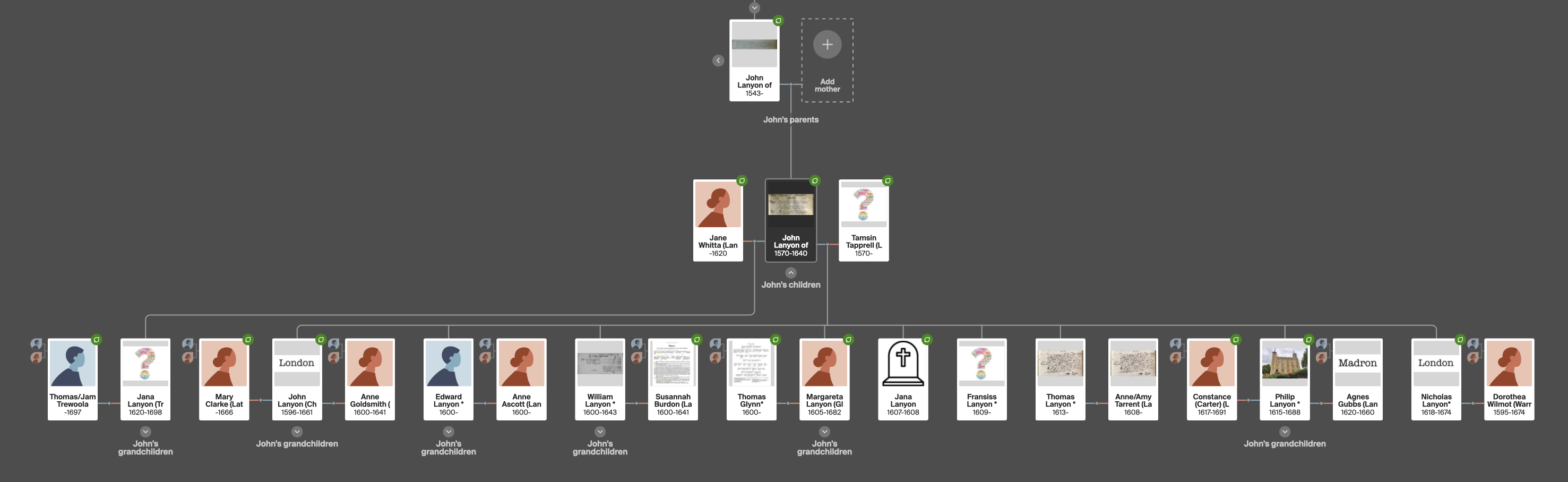
John Lanyon’s branch of the tree.
After he fled he must have headed to London and persuaded Lord Chandos to hire him. He later married Sarah Symons. We now have a pretty good idea how he acquired ‘considerable riches’! Perhaps the alms houses were a way to atone for past sins!
For more information see Nigel Baker’s article on John Lanyon:
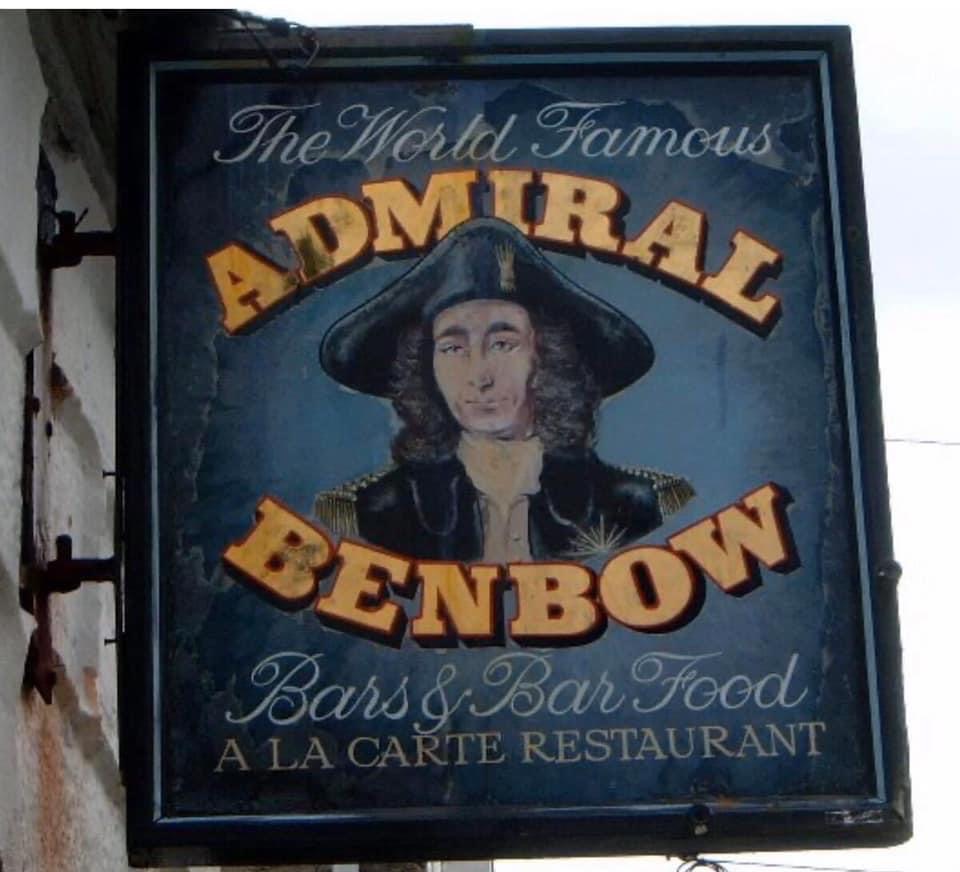
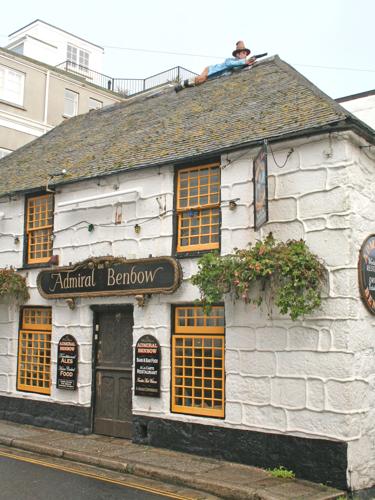
The Admiral Benbow pub in Penzance advertises that it has been serving ‘pirates, smugglers and rum since 1695’!
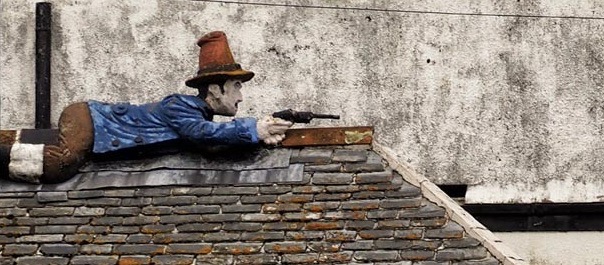
The ‘man on the roof’ of the pub is Octavious Lanyon reputedly the head of the Benbow Brandy Men.
Octavious Lanyon
The government levied duties on a whole range of goods: tea, salt, muslin, silk and brandy. Salt was especially important for the Cornish fishing industry so the taxes were unpopular and many Cornish people had no qualms about smuggling in order to survive. The locals called it ‘Cornish Free Trade’!
Smuggling routes ran from France through the Channel Islands and on to Cornwall. Smugglers often met in local pubs to plan their activities. The Admiral Benbow was the meeting place of the Benbow Brandy Men.
There is a tunnel under the pub (only discovered a few years ago) which led down to the harbour and allowed the smugglers to move their goods out of sight of the revenue men.
Octavious Lanyon was the head of the smugglers and he climbed onto the roof to create a diversion during a raid by the revenue men. He is thought to have been shot and seriously injured.
Some of the gang were captured. John Martin alias Shelly, Walter Cross, John Williams, William Stone alias Quinn, James Bell, William Bell and Benjamin Savory were found guilty of ‘being persons of malicious minds and dispositions’ and of being on the vessel Happy Go Lucky which had fired on the revenue ship.
The Admiral Benbow pub was the inspiration for Robert Louis Stevenson’s ‘Treasure Island’ and it features in the first chapter of the book as the inn owned by Jack Hawkin’s parents.
So who was Octavious Lanyon?
There aren’t any records of a baptism, marriage or burial of anyone called Octavious Lanyon in Cornwall. If he existed it must be an alias. There are plenty of Lanyons in the Penzance area at that time but identifying who Octavious might have been is impossible without more information.
The group of Lanyons associated with St Agnes have proved to be quite tricky to pin down. The following is ‘my attempt’ to use the records available to produce a tree. I emphasise it’s my attempt and may not be right!
It’s worth reading the post ‘John Lanyon of Penwinnick Estate’ (Breage Branch) first as that lays out the main players.
Gaps in the records have made it difficult to say with any certainty how this branch of the tree fits together.
The reason there are gaps in the records!
In 1616 at St Agnes an Edward Lenion baptised his son Thomas Lenion and three years later he baptised a son called Humphrye.
There is no trace of a marriage for Edward before 1616. There is a marriage for an Edward Lanyon to an Anne Ascott at Colan in 1627. There is an Edward Lanine and a Humphrie Lanine on the Colan 1641/2 Protestation Return, could that be Edward and his son?
There is a Humphrey/Homphrey Lanyon baptising and burying children in Madron in 1670/80s. Could this Humphrey be the Humphrey son of Thomas Lamone who was baptised on 18 Mar 1649 in Madron and could Thomas Lamone be Thomas (b 1616) son of Edward?
Humphrey had several children baptised in Madron but apart from the burials of the two infant Humphreys there is no further trace of the other children. The names Margaret, Mary and John are too common to be able to state with any certainty that they are these particular people and whilst Ebbott and Arundell are unusual names there is no further trace of them. This little branch dies out through lack of information.
So who is Edward Lanyon/Lenion? He may be an undocumented son of John Lanyon Esq and therefore a brother of John Lanyon who married Tamsin Tapprell at St Agnes in 1596.
He could be the Edward Lanyon son of John Lanyon ‘the elder gentleman’ and his wife Jane who is mentioned in the 1623 document transferring The Penwinnick Estate at St Agnes to Edward Noye. Thomas Tonkin states that this Jane is the daughter of William Whitta. John Lanyon ‘the elder gentleman’ must be the John who married Tamsin Tapprell in 1596 at St Agnes. Jane must be a second wife. We know that John and Tamsin’s eldest son John was born at the earliest in 1596 so a second son called Edward must have been born after that. If that’s the case then he must have married early for his first son to be baptised in 1616.
He could be an undocumented son of Edward Lanyon of Coswin who died at Gwinear in 1630 but Edward of Coswin leaves a will and doesn’t mention any son called Edward so this seems unlikely.
He could even be the undocumented son of Edward Lanyon, the 4th son of William Laniene and Thomasine Tregian who is mentioned in a document of 1586 – source – AR/3/39. There are no records showing any marriage or other children for this Edward so again it seems unlikely.
Polsue’s ‘Parochial History of Cornwall’ – “Penwennick, an estate in the manor of Tywarnhaile, was divided, temp. Henry VIII, between Thomas Kemyell, who possessed a moiety, and Sir John Diamond and Urinas Nicholl, who had a fourth each. The representatives of Kemyell sold their moiety in 1568, to William Whitta ; from Whitta it passed to the Lanyons, who resided here several years, and sold the estate in 1622, to Edward Noy, of Carnanton, who sold it in 1627, to John Tonkin, of Trevaunance. Sir John Diamond’s share passed through several female heirs to Francis Basset, of Tehidy ; who sold it to Thomas Tonkin, in 1705.” That would lend credence to a marriage between John Lanyon and Jane Whitta.
So if Edward is the son of John Lanyon of St Agnes (who baptised a number of children at Breage) the tree now looks like this. We can only say for certain that the last child was a daughter of John and Jane as it is recorded in the parish register. The earlier children may have been from the marriage to Tamsin or the marriage to Jane.
Edward the second son was married to an unknown woman and had two sons: Thomas and Humphrye and then he married Anne Ascott in 1827 at Colan and went on to have another child with her. Alice baptised 1634 at Colan and who was buried at St Enoder in 1672.
In 1650 an Edward Lenion married Grace Long at St Enoder, presumably this was another undocumented child of Edward and Anne Ascott? Grace died in 1667 and was buried at St Enoder.
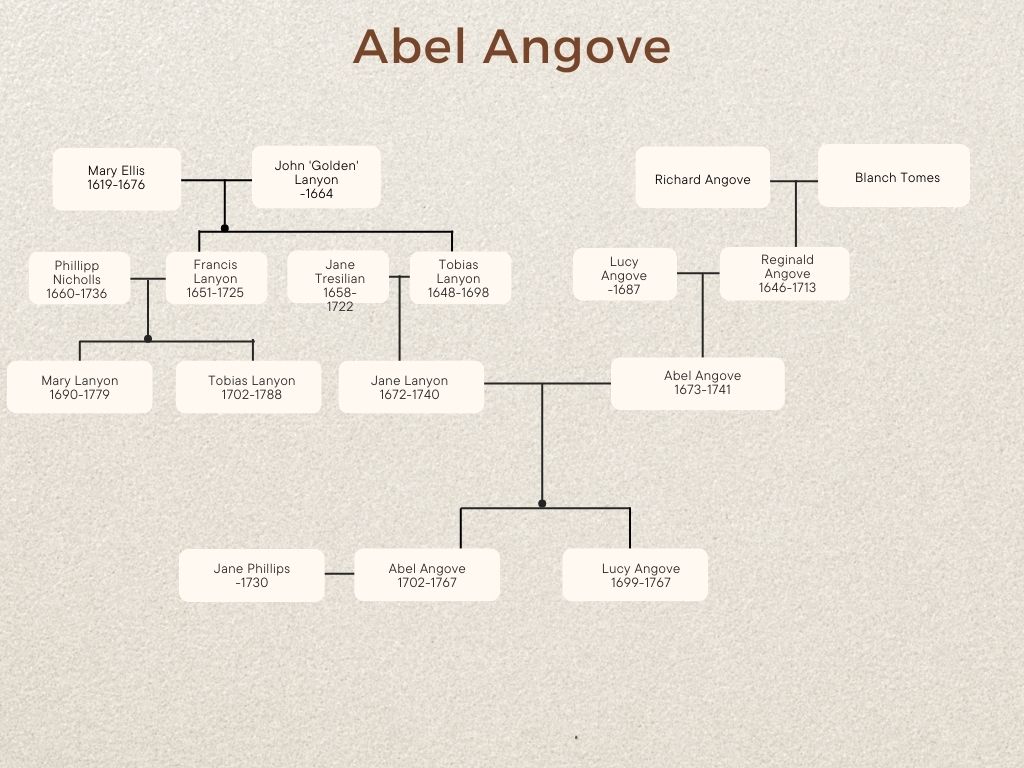
Tobias and Mary Lanyon were ‘cousins german’ or first cousins, next of kin and co-administrators of Abel Angove of Trevenson, Illogan. The only problem was which Tobias and Mary Lanyon and how were they connected to Abel Angove?
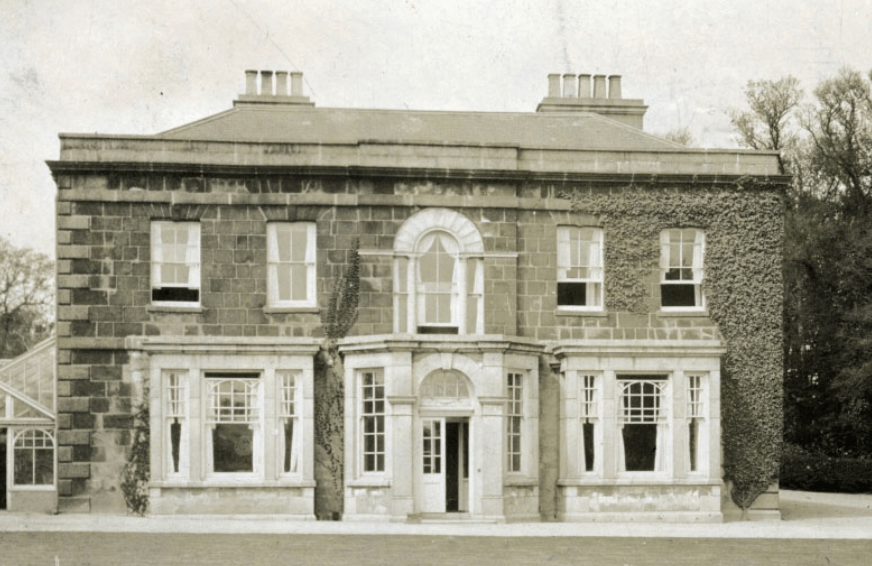
Trevenson House Pool, Illogan
Abel Angove died following a fall from his horse, he was buried on 5 Aug 1767. There is a letter at Kresen Kernow from Francis Basset claiming the horse (the cause of death) by ‘deodhand’ as Lord of the Manor of Tehidy. (Source – TEM/1/10 dated 4 Aug 1767- Francis didn’t hang around, the letter was written before Abel was interred!!)
Abel was an attorney and a widower, he had married Jane Phillips the daughter of Mr. Henry Phillips in 1729 at Phillack. Jane died 13 Aug 1730 and Abel never remarried or had children.
Why were Lanyons his next of kin? I started digging!
Abel was the son of Abel Angove gent. He was born in 1673 the son of Reginald/Reynald Angove.
The Parochial History of Cornwall founded on the manuscript histories of Mr Hals and Mr Tonkin by Davies Gilbert (Vol II p.234, 1838) gives the following information about Reginald Angove.
“In this parish, at….,liveth Reginald An-Gove, gent. i.e. Reginald the smith, a sirname (sic) assumed in memory of his first ancestor, who was by trade and occupation a smith.
And of this sort of sirname in England, thus speaks Verstegan.
‘From whence came smith, all be it knight or ‘squire? But from the smith that forgeth in the fire.’
This Reginald Angove is that crafty tinner, whom common fame reports to have gotten a considerable estate by labouring, adventuring, and dealing in tin, both in the mines below and blowing houses above ground, by indirect arts and practices; for which, about the 8th of William and Mary (1697) he was indicted before the jury of tinners (whereof the writer of these lines was summoned for one) amongst other things, for putting hard heads of false metal and lead in the midst of slabs of tin, melted and cast in his blowing house, in testimony whereof some pieces or slabs thereof was cut in pieces, and the fallacy detected; whereupon the Grand Jury returned the bill of indictment, indorsed (sic), Billa Vera. But on his trial there was given a verdict of acquittal.‘
Trying to work out which Tobias and Mary Lanyon were ‘next of kin’ was a challenge. There are several Tobias Lanyons and lots of Mary Lanyons. I was able to eliminate any that died before 1767 when Abel died, any that were dead before 1779 when a lease was assigned which named them both as co-administrators. (Source – CRO X473/94). Tobias Lanyon gent of Penzance was mentioned in a mortgage assignment (Source-CRO X446/5) which seemed to preclude the Gwinear Tobias Lanyons.
There was a suitable candidate: Tobias Lanyon the son of Francis Lanyon and Phillipp Nicholls (Botrea branch) and he had a spinster sister called Mary Lanyon.
Tobias was baptised in Sancreed in 1702 and in 1717 ‘Tobias son of Francis Lanyon, gent, was apprenticed to John Tonkin of Penzance, tobacconist.’ Tobias never married and died in 1778.
His sister Mary was baptised at Sancreed in 1690, she too never married and died in 1779.
But that still didn’t explain how they were related to Abel Angove.
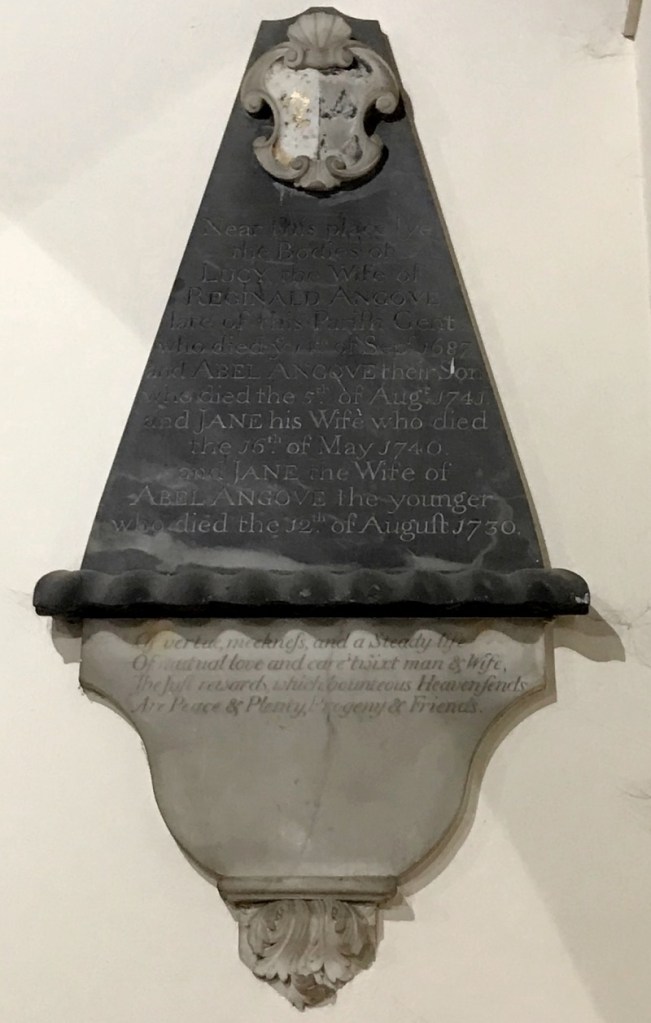
A plaque in Illogan church lists both Abel Angoves and names both wives as Jane.
Memorial Plaque Illogan Church
Jane Phillips was the wife of Abel Angove the younger but who was Abel’s mother?
There is no record of a marriage for Abel Angove senior. His wife was called Jane and that’s as much as we know for certain. It does however seem likely that she was a Lanyon.
I found Abel’s will:
The Will of Abel Angove of Illogan 1740
I Abel Angove of Trevonson in the Parish of Illugan and County of Cornwall Gent resigning my Soul to Almighty God my Creator in hopes of his mercy and forgiveness through the alone Merrits and Intercession of my most Blessed Saviour and Redeemer Jesus Christ doe by this my last Will and Testament dispose of my Real and Personal Estate as followeth I give unto my most dutifull Daughter Lucy Angove the Sum of One Thousand Pounds in lieu and Bar of a Instrument in Writing Tripartite dated Eleaventh day of June One Thousand Seaven Hundred and Thirty the one half to be paid her within Six Months after my decease and the other half to be paid her within Nine Months after the Six Months before mentioned and the farther Sum of Five Hundred Pounds to be paid her within two Years after my decease and alsoe Ten Pounds to buy her Mourning the which Ten Pounds I doe order my Executor hereafter named to pay at my decease I Give unto the Poor of this Parish the Sum of five Pounds I mean those that receive no Pay from the said Parish to be distributed by my Executor within one Month after my decease I give unto my most dutiful Son Abel Angove all my Lands Goods and Chattles that I dye posses’d of in paying my Debts and Legacy’s And I do hereby make and constitute my said Son Abel Angove Executor of this my last Will and Testament hereby revoking all other Wills at any time heretofore made by me declaring this to be my last Will In Witness whereof I have to this my Will (the whole Written with my own hand) Sett my hand and Seale this first day of August 1740 Abel Angove
(Attestation Clause)
Mary Lanyon _ Edward Angove Junr._ Richard Gribbell Proved at London 15 September 1741
Source: National Archives ref: PROB 11/711/373
Transcribed by Ros Dunning and reproduced with permission of Cornwall OPC.
Sadly it doesn’t mention his wife or her family. Jane died in 1740 a year before he did.
It didn’t take long to find a suitable candidate: Jane Lanyon the daughter of Tobias Lanyon and Jane Tresilian of Sancreed. Tobias was the brother of Francis Lanyon and uncle to Tobias and Mary the co-administrators of Abel’s estate.
Whilst I have no proof that Jane Lanyon was Abel Angove’s wife it does seem likely.
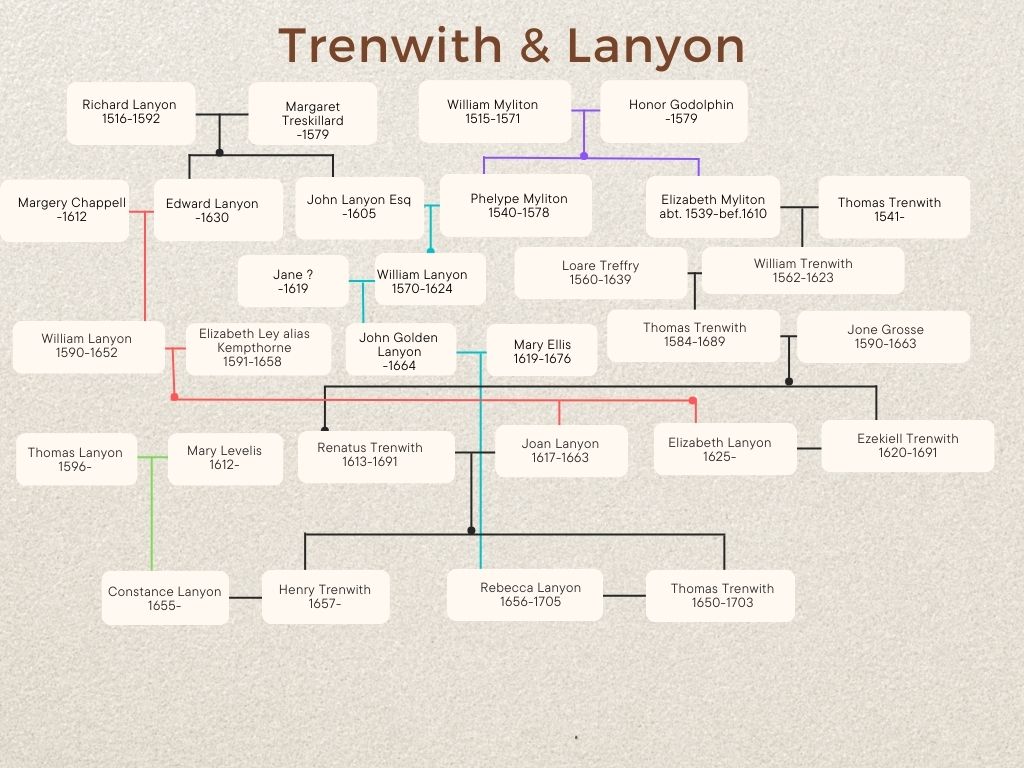
The Trenwith family has connections with the Lanyon family going back to Tudor times. Thomas Trenwith married Elizabeth Myliton, the daughter of William Myliton and Honor Godolphin of Pengersick Castle, Breage. Elizabeth’s sister was Phelype Myliton who married John Lanyon Esq.
It’s a confusing tree and I hope I’ve finally got it right!
The great grandsons of Elizabeth and Thomas; Renatus Trenwith and Ezekiell Trenwith married two sisters. Joan and Elizabeth Lanyon the daughters of William Lanyon and Elizabeth Ley alias Kempthorne. William was the son of Edward Lanyon and Margery Chappell and the nephew of Phelype Myliton and John Lanyon.
Renatus and Joan had a son called Thomas Trenwith and he married Rebecca Lanyon who was the great grand daughter of Phelype Myliton and John Lanyon.
Renatus and Joan had another son called Henry Trenwith and he married Constance (her surname is not mentioned in the Madron parish register) but she could be the daughter of Thomas Lanyon and Mary Levelis.












 The Lanyons