Wills are a great way to build a tree especially when there are gaps in the baptism, marriage and burial records.
Margaret Richard’s will (which I came across by accident whilst looking for another document) helped with the early Breage Lanyons.
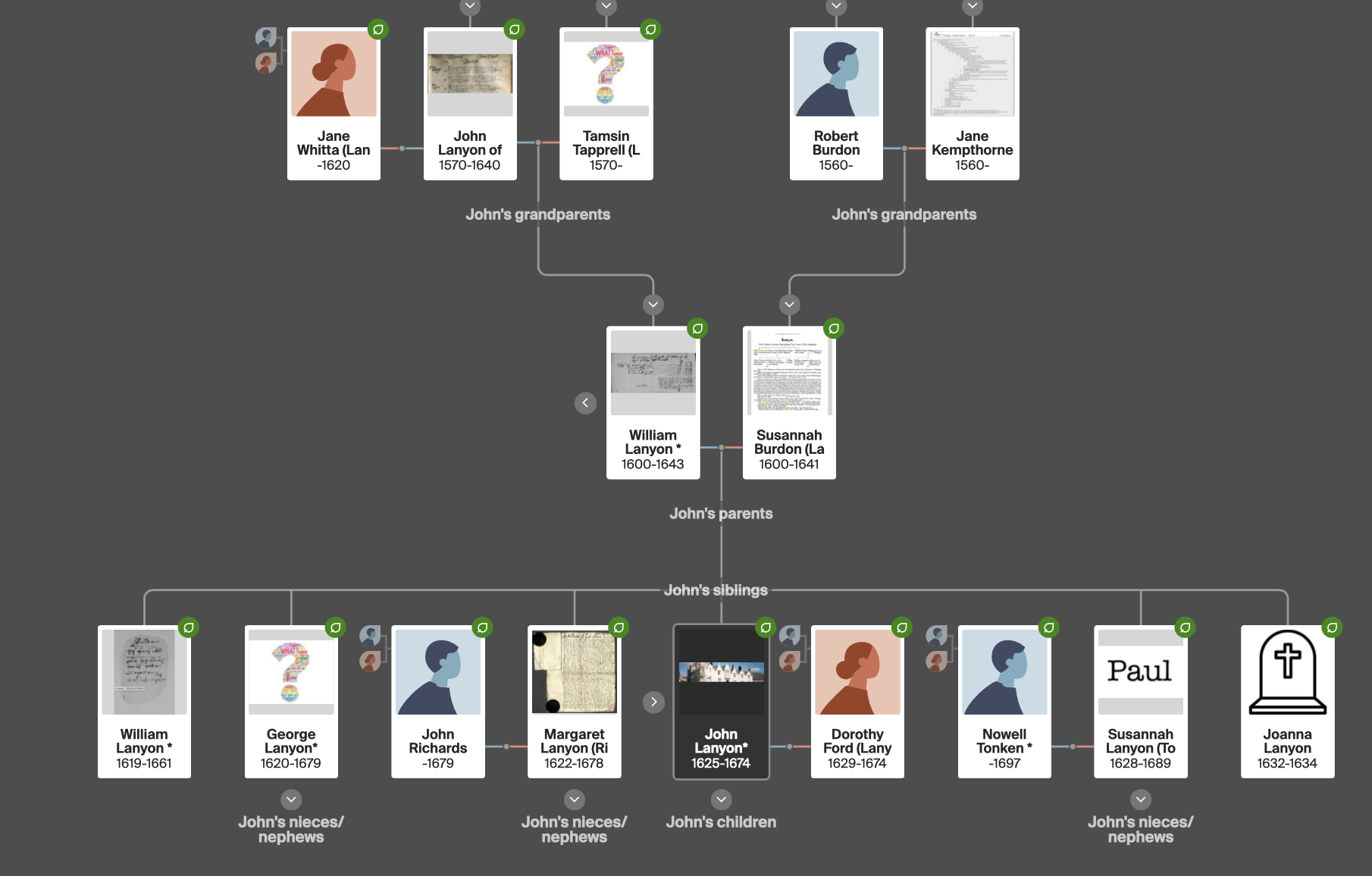
Margaret was baptised on the 27 Oct 1622 at Breage, the daughter of William Lanyon and Susannah Burdon. William must have been a farmer as his will inventory values his corn and the corn in the ground.
Margaret married John Richards but we don’t have a date of marriage. When her older brother William died unmarried in 1661 he left his estate to her.
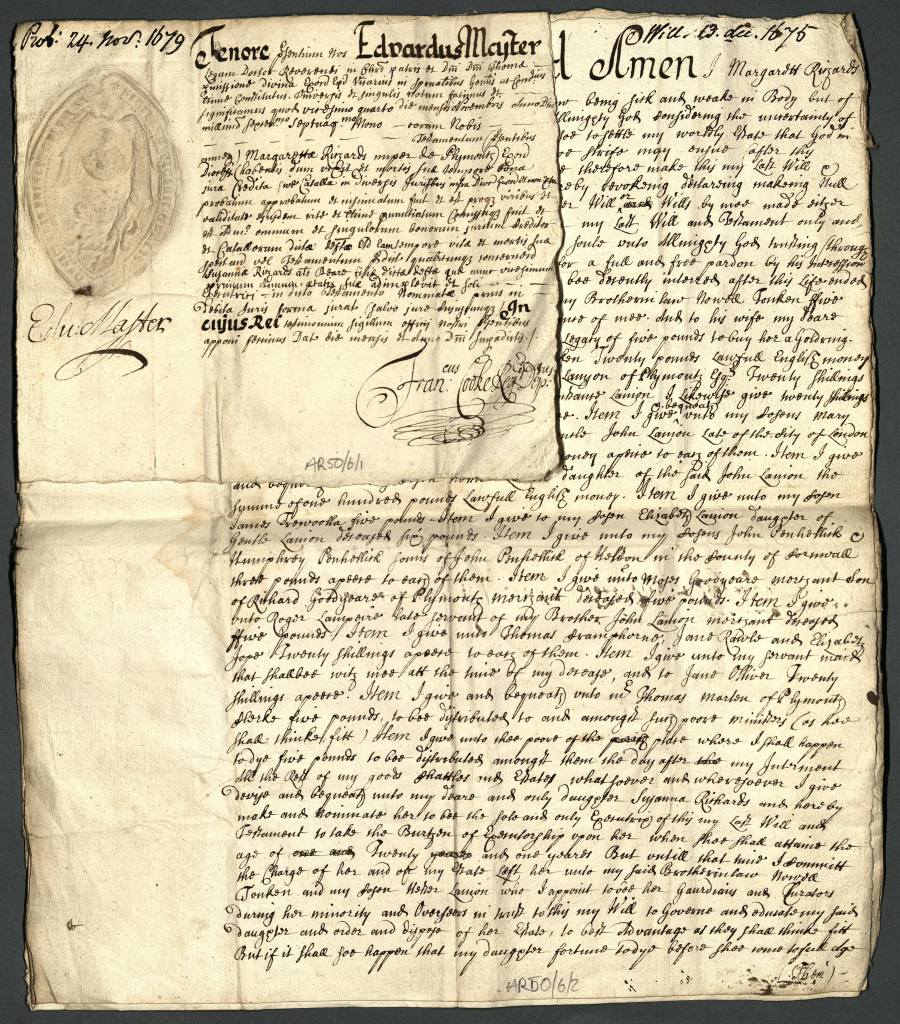
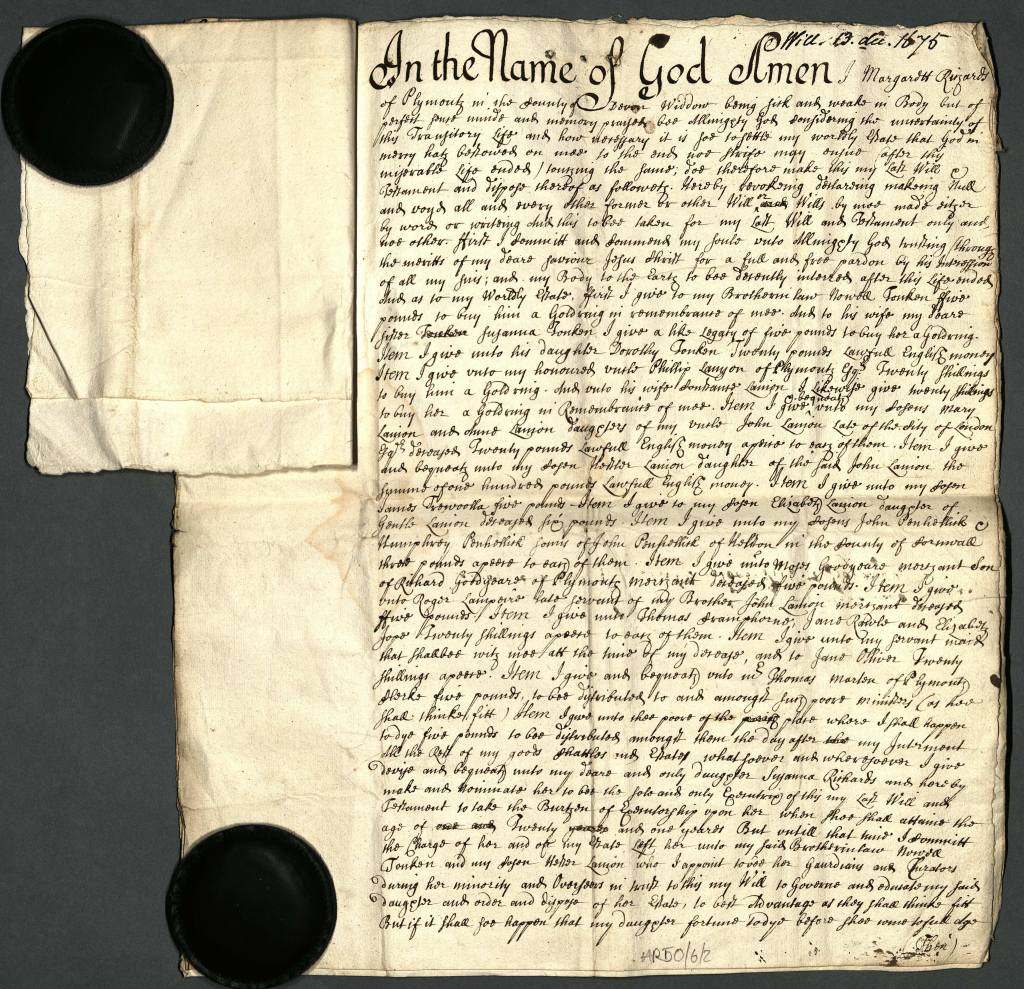
Margaret made a will in 1675 (it was proved in 1679) and her will helps confirm relationships on this very early branch of the tree.
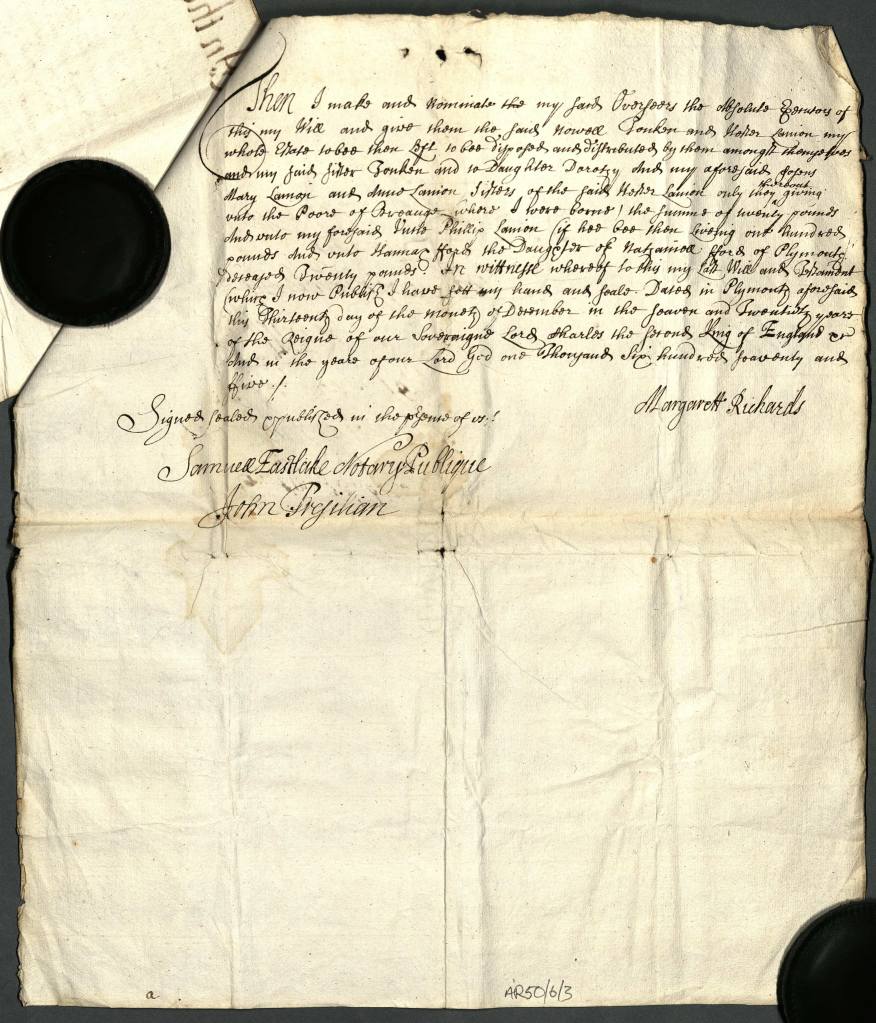
Margaret’s will CRO AR/50/6
She is described as Margaret Richards of Plymouth, ‘widdow, being sick and weake in body but of perfect minde and memory’ and she mentions the following relatives:
My brother-in-law Nowell Tonkin £5 for a mourning ring
My sister Susannah Tonkin £5 for a ring
Their daughter Dorothy Tonkin £20
Uncle Philip Lanyon of Plymouth Esq 20 shillings for a ring
His wife Constance Lanyon 20 shillings for a ring
Mary and Anne Lanyon daughters of my Uncle John late of the City of London £20 (John was Chief Engineer to Charles I) £20 each
Hester Lanyon daughter of Uncle John £100 (again Hester is described as a cousin and not the wife of her brother John Lanyon)
Cousin James Trewollah £5
Cousin Elizabeth Lanyon daughter of George Lanyon £5
Cousin John Penhellick and Humphrey Penhellick sons of John Penhellick of Helston £3 each (not sure where they fit on the tree)
Roger Lampoire? servant of my brother John Lanyon £5
All the rest to my dear and only daughter Susannah Richards.
Nowell Tonkin and Hester Lanyon to be her guardians
Interestingly the name Lanyon is spelt two ways in this will; Lanyon and Lanion.
Until this document we had no idea that George had a daughter. Now we know he had a daughter but we’ve no idea what happened to her! So the search continues!
Occasionally you come across a document which really helps to paint an accurate picture of a person.
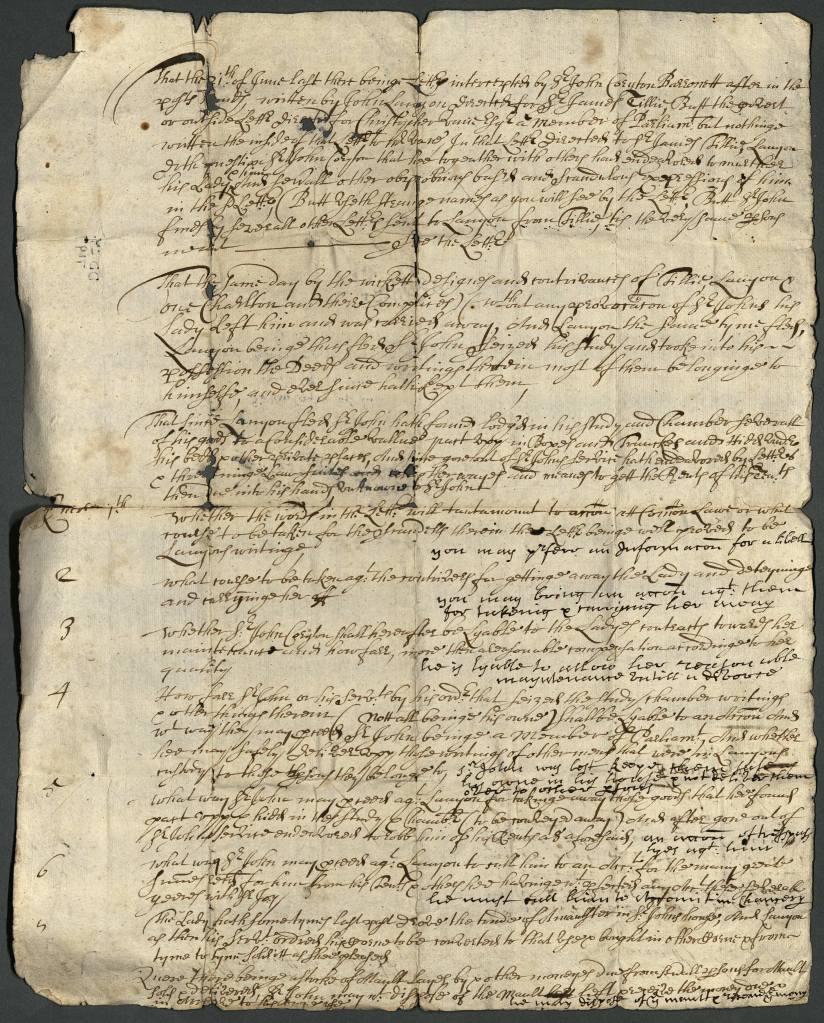
Whilst searching through the online archives at Kresen Kernow (Cornish Record Office) I found a legal opinion dated 1689 for Sir John Coryton against Sir James Tillie. This is of interest to us as Sir John’s servant was called John Lanyon.
From the documents held at Kresen Kernow John Lanyon was witnessing Sir John Coryton’s documents from 1674 onwards so by 1689 he must have been a trusted member of staff.
Sir John Coryton was the 2nd baronet of Newton Ferrers. He was married to Lady Elizabeth.
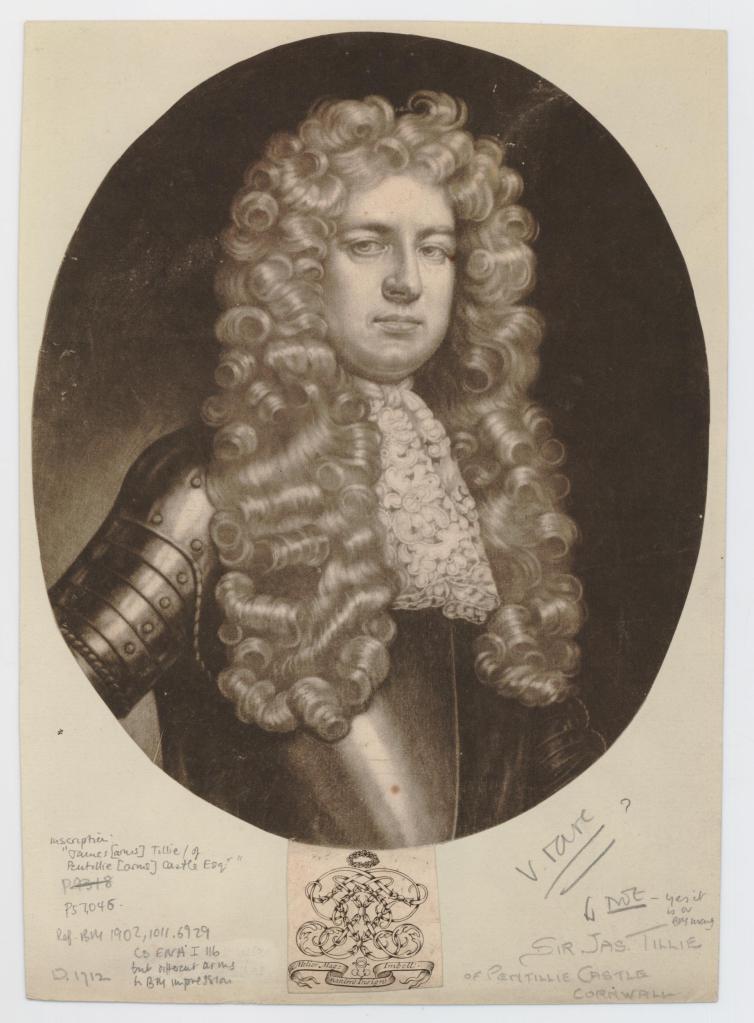
Sir James Tillie was Sir John Coryton’s land agent. He wanted to be married to Lady Elizabeth!
Sir James Tillie – Creative Commons Licence
The counsel’s opinion for Sir John Coryton against Sir James Tillie details how Sir John’s wife Elizabeth had been ‘carried off’ by Sir James Tillie. Sir John was advised that he could take action against the man/men who carried off his wife but he was liable to give her reasonable maintenance until a divorce.
The document also explains that Lady Coryton had been a ‘maltster’ (a brewer) in Sir John’s house and he was advised that he could sell the stock and receive the proceeds. The legal opinion goes on to explain that if Lady Coryton was with child which Sir John did not want to inherit then he must sue for divorce but must have full proof of adultery.
Elizabeth was the daughter of Sir Richard Chiverton who had been Lord Mayor of London from 1657-1658.
Whilst all this was going on John Lanyon had been busy defrauding Sir John. He wrote secret letters to James Tillie threatening to murder John Coryton and his wife. When Lady Elizabeth left her husband and was ‘carried away’, John Lanyon, realising the game was up, fled.
After he’d gone papers and goods belonging to Sir John were found in Lanyon’s study. These showed that he had been threatening Sir John’s tenants and trying to obtain rents and properties.
Legal Opinion 1689 – Source CY/7197
Conveniently Sir John died mysteriously at the age of only 42. There is speculation that he was poisoned. Lady Elizabeth married Sir James Tillie who divided the Newton Ferrers estate and built ‘Pentillie’. John Lanyon escaped prosecution.
Rod Allday / Pentillie Castle
James Tillie died in 1713 and his will left instructions that he was not to be buried but placed in a vault sitting in a sturdy chair in his finest clothes with his pipe so he could await resurrection! His instructions were carried out but his body was later moved and then lost. 300 years later it was found!
So what happened to John Lanyon and where does he fit on the tree?
Clearly John Lanyon was an educated man. If he was working for Sir John from 1674 onwards then he was probably born early 1650s.
There are currently 315 John Lanyons on the family tree but there is only one candidate that really stands out and that is John Lanyon 1652-1720. (See post ‘William ‘Generosi’ Lanyon of Breage.)
John was the eldest son and heir of John Lanyon a ‘sea and sand barge daily labourer’.
The Parochial History of Cornwall stated that John Lanyon senior:
‘…had a son named John Lanyon who having had his education under Hugh Boscawen, gent, Master of Arts, who kept a school at St Michael Penkevill Church, became afterwards a steward to Trefusis, St Aubyn, Coryton and lastly came into the service of Brook Lord Chandos, and having by these services accumulated considerable riches he gave lands and built and endowed an almshouse for the poor people.’
John Lanyon’s branch of the tree.
After he fled he must have headed to London and persuaded Lord Chandos to hire him. He later married Sarah Symons. We now have a pretty good idea how he acquired ‘considerable riches’! Perhaps the alms houses were a way to atone for past sins!
For more information see Nigel Baker’s article on John Lanyon:
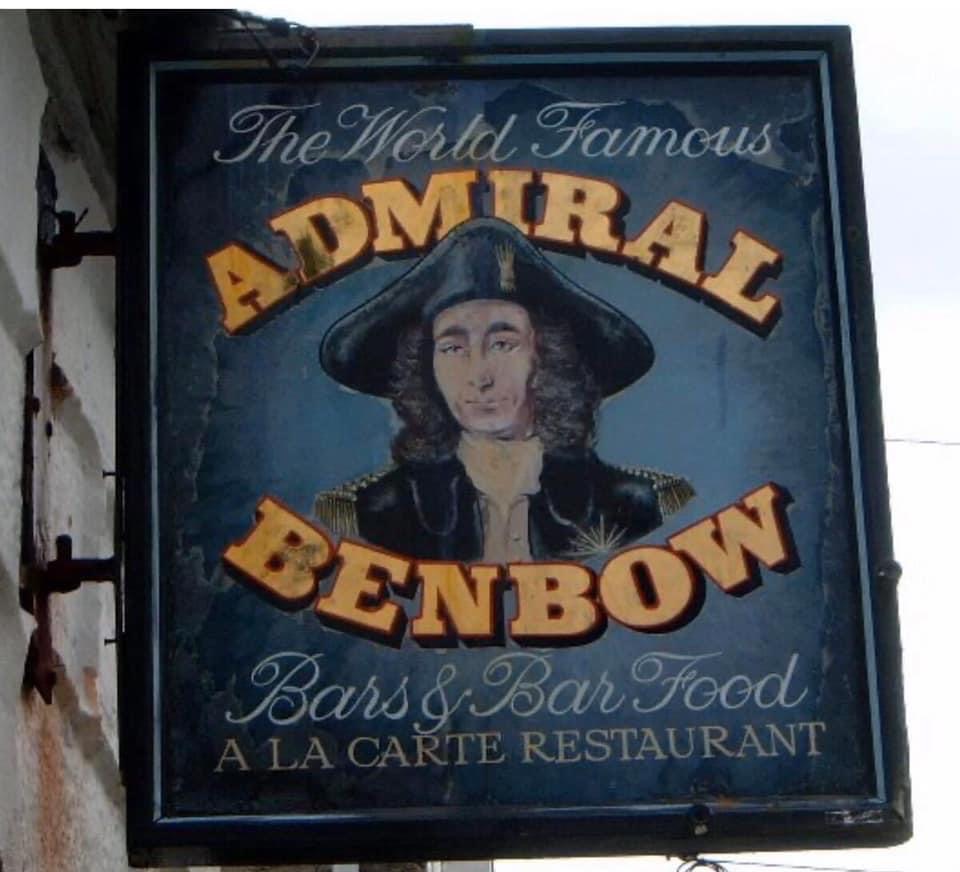
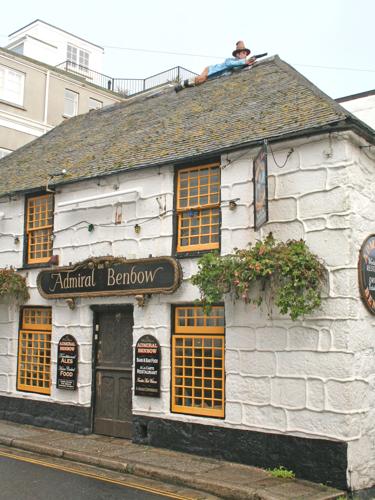
The Admiral Benbow pub in Penzance advertises that it has been serving ‘pirates, smugglers and rum since 1695’!
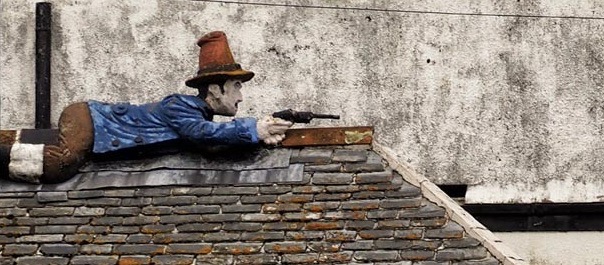
The ‘man on the roof’ of the pub is Octavious Lanyon reputedly the head of the Benbow Brandy Men.
Octavious Lanyon
The government levied duties on a whole range of goods: tea, salt, muslin, silk and brandy. Salt was especially important for the Cornish fishing industry so the taxes were unpopular and many Cornish people had no qualms about smuggling in order to survive. The locals called it ‘Cornish Free Trade’!
Smuggling routes ran from France through the Channel Islands and on to Cornwall. Smugglers often met in local pubs to plan their activities. The Admiral Benbow was the meeting place of the Benbow Brandy Men.
There is a tunnel under the pub (only discovered a few years ago) which led down to the harbour and allowed the smugglers to move their goods out of sight of the revenue men.
Octavious Lanyon was the head of the smugglers and he climbed onto the roof to create a diversion during a raid by the revenue men. He is thought to have been shot and seriously injured.
Some of the gang were captured. John Martin alias Shelly, Walter Cross, John Williams, William Stone alias Quinn, James Bell, William Bell and Benjamin Savory were found guilty of ‘being persons of malicious minds and dispositions’ and of being on the vessel Happy Go Lucky which had fired on the revenue ship.
The Admiral Benbow pub was the inspiration for Robert Louis Stevenson’s ‘Treasure Island’ and it features in the first chapter of the book as the inn owned by Jack Hawkin’s parents.
So who was Octavious Lanyon?
There aren’t any records of a baptism, marriage or burial of anyone called Octavious Lanyon in Cornwall. If he existed it must be an alias. There are plenty of Lanyons in the Penzance area at that time but identifying who Octavious might have been is impossible without more information.
The group of Lanyons associated with St Agnes have proved to be quite tricky to pin down. The following is ‘my attempt’ to use the records available to produce a tree. I emphasise it’s my attempt and may not be right!
It’s worth reading the post ‘John Lanyon of Penwinnick Estate’ (Breage Branch) first as that lays out the main players.
Gaps in the records have made it difficult to say with any certainty how this branch of the tree fits together.
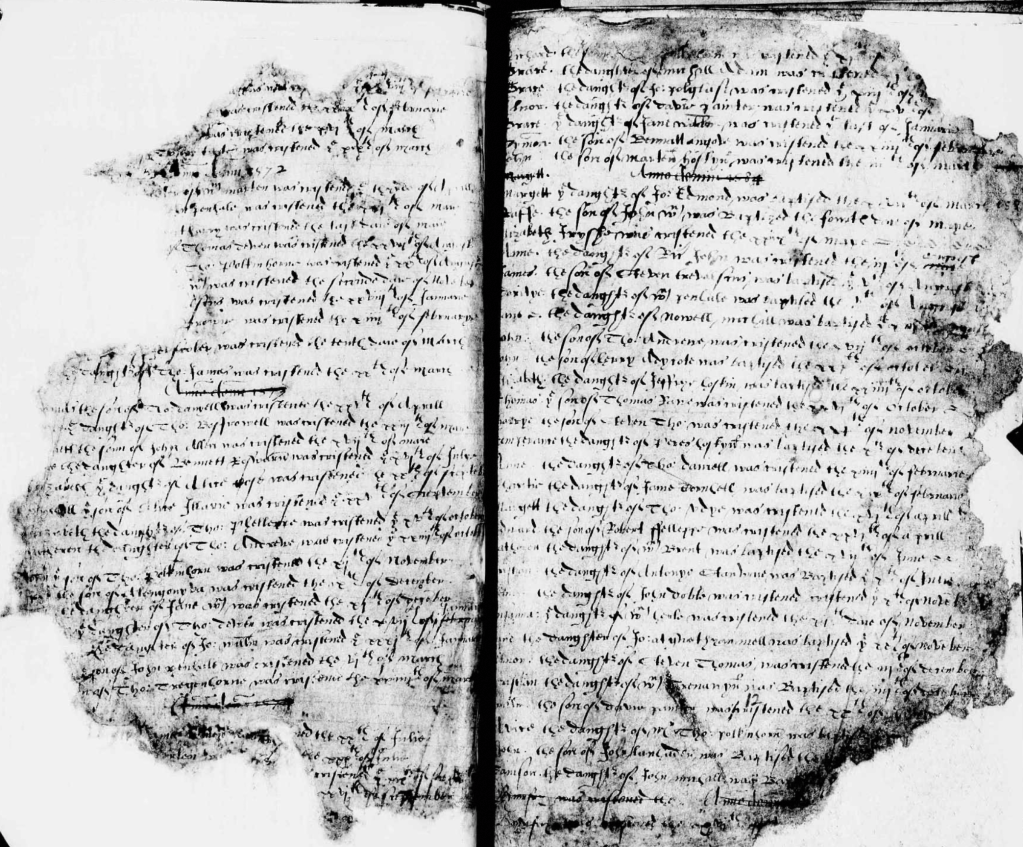
The reason there are gaps in the records!
In 1616 at St Agnes an Edward Lenion baptised his son Thomas Lenion and three years later he baptised a son called Humphrye.
There is no trace of a marriage for Edward before 1616. There is a marriage for an Edward Lanyon to an Anne Ascott at Colan in 1627. There is an Edward Lanine and a Humphrie Lanine on the Colan 1641/2 Protestation Return, could that be Edward and his son?
There is a Humphrey/Homphrey Lanyon baptising and burying children in Madron in 1670/80s. Could this Humphrey be the Humphrey son of Thomas Lamone who was baptised on 18 Mar 1649 in Madron and could Thomas Lamone be Thomas (b 1616) son of Edward?
Humphrey had several children baptised in Madron but apart from the burials of the two infant Humphreys there is no further trace of the other children. The names Margaret, Mary and John are too common to be able to state with any certainty that they are these particular people and whilst Ebbott and Arundell are unusual names there is no further trace of them. This little branch dies out through lack of information.
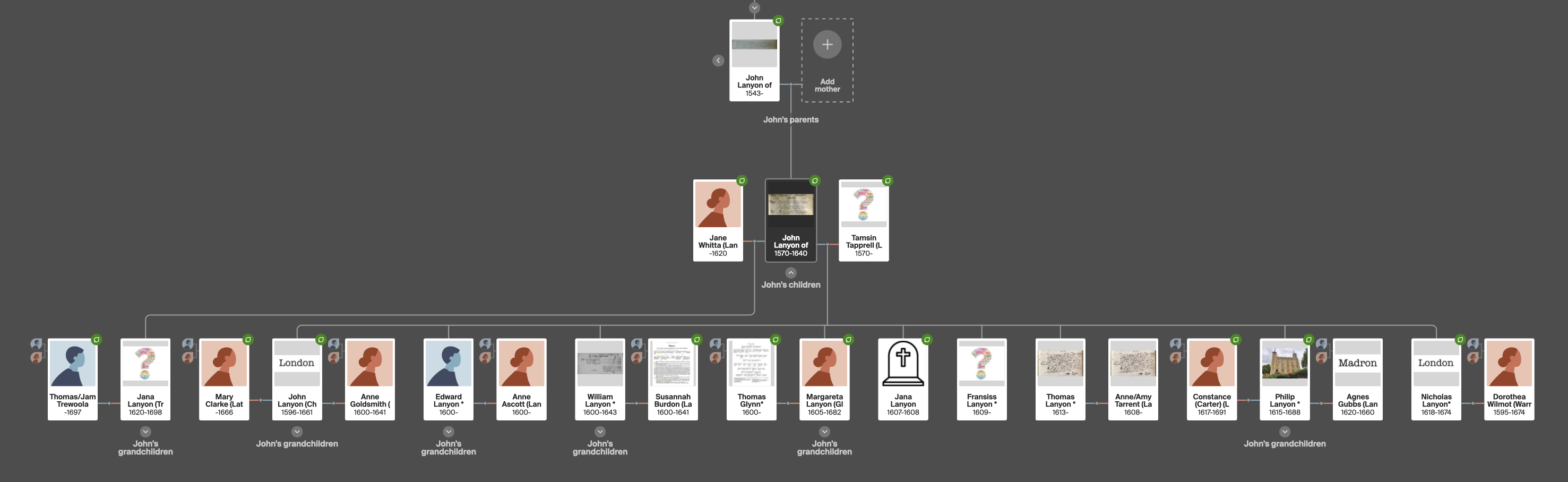
So who is Edward Lanyon/Lenion? He may be an undocumented son of John Lanyon Esq and therefore a brother of John Lanyon who married Tamsin Tapprell at St Agnes in 1596.
He could be the Edward Lanyon son of John Lanyon ‘the elder gentleman’ and his wife Jane who is mentioned in the 1623 document transferring The Penwinnick Estate at St Agnes to Edward Noye. Thomas Tonkin states that this Jane is the daughter of William Whitta. John Lanyon ‘the elder gentleman’ must be the John who married Tamsin Tapprell in 1596 at St Agnes. Jane must be a second wife. We know that John and Tamsin’s eldest son John was born at the earliest in 1596 so a second son called Edward must have been born after that. If that’s the case then he must have married early for his first son to be baptised in 1616.
He could be an undocumented son of Edward Lanyon of Coswin who died at Gwinear in 1630 but Edward of Coswin leaves a will and doesn’t mention any son called Edward so this seems unlikely.
He could even be the undocumented son of Edward Lanyon, the 4th son of William Laniene and Thomasine Tregian who is mentioned in a document of 1586 – source – AR/3/39. There are no records showing any marriage or other children for this Edward so again it seems unlikely.
Polsue’s ‘Parochial History of Cornwall’ – “Penwennick, an estate in the manor of Tywarnhaile, was divided, temp. Henry VIII, between Thomas Kemyell, who possessed a moiety, and Sir John Diamond and Urinas Nicholl, who had a fourth each. The representatives of Kemyell sold their moiety in 1568, to William Whitta ; from Whitta it passed to the Lanyons, who resided here several years, and sold the estate in 1622, to Edward Noy, of Carnanton, who sold it in 1627, to John Tonkin, of Trevaunance. Sir John Diamond’s share passed through several female heirs to Francis Basset, of Tehidy ; who sold it to Thomas Tonkin, in 1705.” That would lend credence to a marriage between John Lanyon and Jane Whitta.
So if Edward is the son of John Lanyon of St Agnes (who baptised a number of children at Breage) the tree now looks like this. We can only say for certain that the last child was a daughter of John and Jane as it is recorded in the parish register. The earlier children may have been from the marriage to Tamsin or the marriage to Jane.
Edward the second son was married to an unknown woman and had two sons: Thomas and Humphrye and then he married Anne Ascott in 1827 at Colan and went on to have another child with her. Alice baptised 1634 at Colan and who was buried at St Enoder in 1672.
In 1650 an Edward Lenion married Grace Long at St Enoder, presumably this was another undocumented child of Edward and Anne Ascott? Grace died in 1667 and was buried at St Enoder.
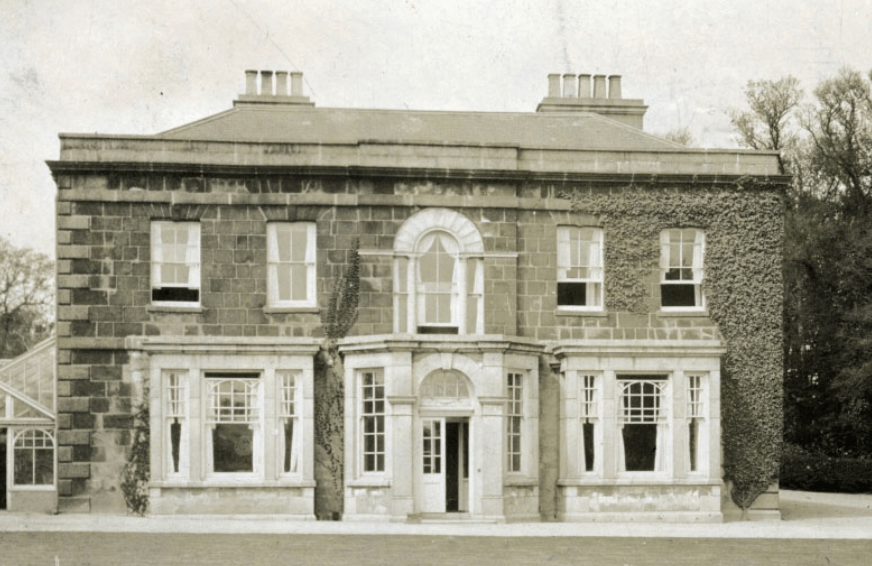
Tobias and Mary Lanyon were ‘cousins german’ or first cousins, next of kin and co-administrators of Abel Angove of Trevenson, Illogan. The only problem was which Tobias and Mary Lanyon and how were they connected to Abel Angove?
Trevenson House Pool, Illogan
Abel Angove died following a fall from his horse, he was buried on 5 Aug 1767. There is a letter at Kresen Kernow from Francis Basset claiming the horse (the cause of death) by ‘deodhand’ as Lord of the Manor of Tehidy. (Source – TEM/1/10 dated 4 Aug 1767- Francis didn’t hang around, the letter was written before Abel was interred!!)
Abel was an attorney and a widower, he had married Jane Phillips the daughter of Mr. Henry Phillips in 1729 at Phillack. Jane died 13 Aug 1730 and Abel never remarried or had children.
Why were Lanyons his next of kin? I started digging!
Abel was the son of Abel Angove gent. He was born in 1673 the son of Reginald/Reynald Angove.
The Parochial History of Cornwall founded on the manuscript histories of Mr Hals and Mr Tonkin by Davies Gilbert (Vol II p.234, 1838) gives the following information about Reginald Angove.
“In this parish, at….,liveth Reginald An-Gove, gent. i.e. Reginald the smith, a sirname (sic) assumed in memory of his first ancestor, who was by trade and occupation a smith.
And of this sort of sirname in England, thus speaks Verstegan.
‘From whence came smith, all be it knight or ‘squire? But from the smith that forgeth in the fire.’
This Reginald Angove is that crafty tinner, whom common fame reports to have gotten a considerable estate by labouring, adventuring, and dealing in tin, both in the mines below and blowing houses above ground, by indirect arts and practices; for which, about the 8th of William and Mary (1697) he was indicted before the jury of tinners (whereof the writer of these lines was summoned for one) amongst other things, for putting hard heads of false metal and lead in the midst of slabs of tin, melted and cast in his blowing house, in testimony whereof some pieces or slabs thereof was cut in pieces, and the fallacy detected; whereupon the Grand Jury returned the bill of indictment, indorsed (sic), Billa Vera. But on his trial there was given a verdict of acquittal.‘
Trying to work out which Tobias and Mary Lanyon were ‘next of kin’ was a challenge. There are several Tobias Lanyons and lots of Mary Lanyons. I was able to eliminate any that died before 1767 when Abel died, any that were dead before 1779 when a lease was assigned which named them both as co-administrators. (Source – CRO X473/94). Tobias Lanyon gent of Penzance was mentioned in a mortgage assignment (Source-CRO X446/5) which seemed to preclude the Gwinear Tobias Lanyons.
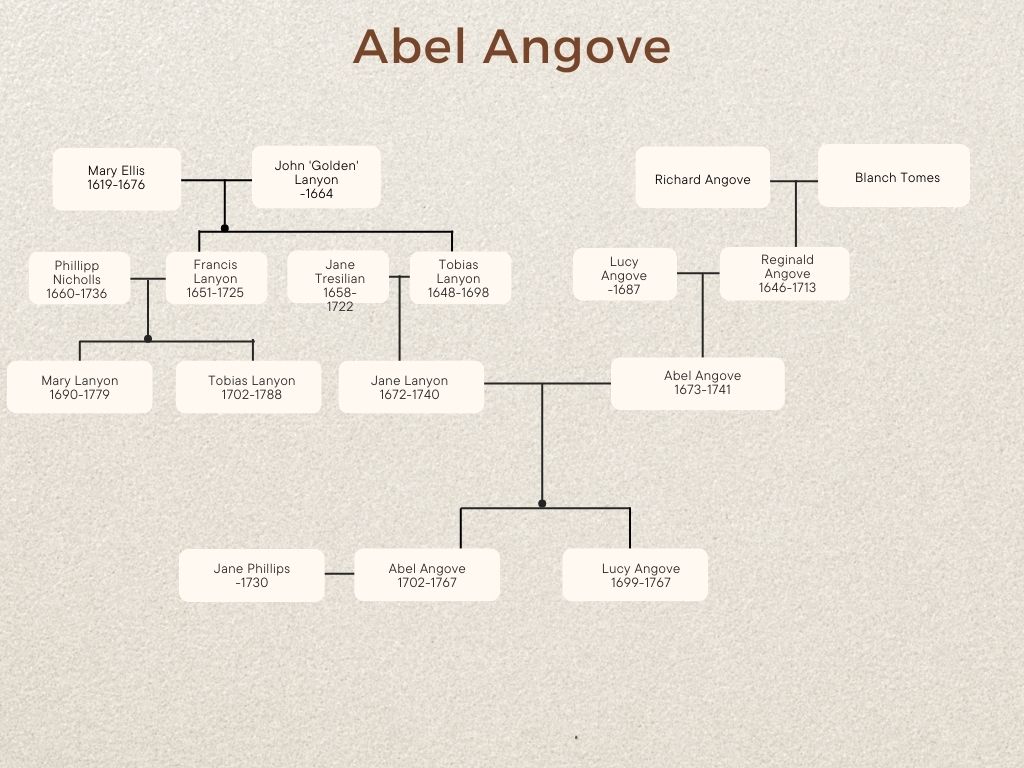
There was a suitable candidate: Tobias Lanyon the son of Francis Lanyon and Phillipp Nicholls (Botrea branch) and he had a spinster sister called Mary Lanyon.
Tobias was baptised in Sancreed in 1702 and in 1717 ‘Tobias son of Francis Lanyon, gent, was apprenticed to John Tonkin of Penzance, tobacconist.’ Tobias never married and died in 1778.
His sister Mary was baptised at Sancreed in 1690, she too never married and died in 1779.
But that still didn’t explain how they were related to Abel Angove.
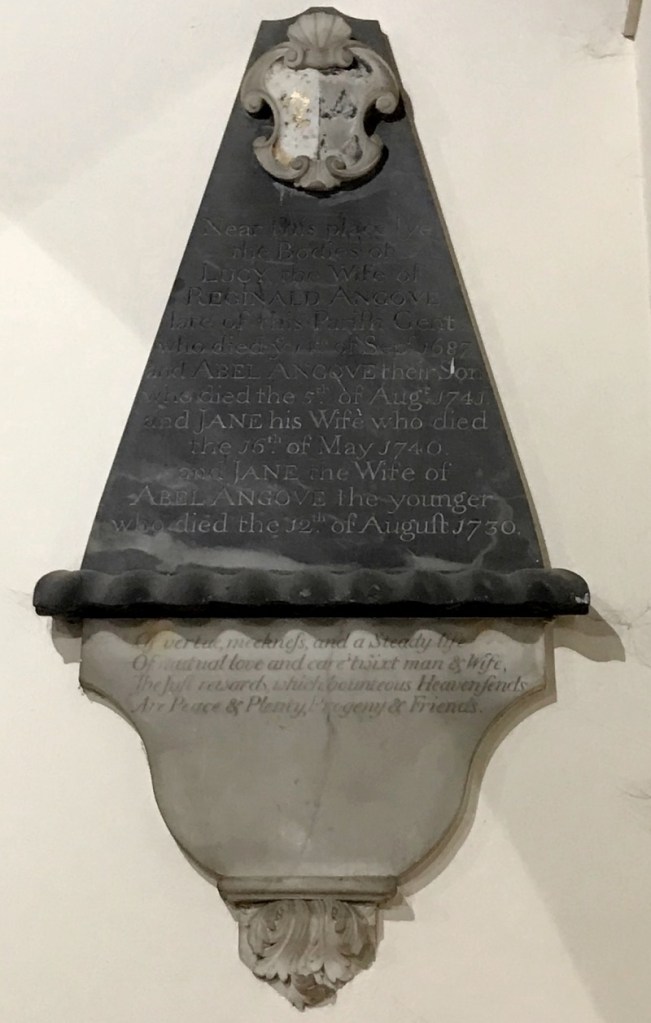
A plaque in Illogan church lists both Abel Angoves and names both wives as Jane.
Memorial Plaque Illogan Church
Jane Phillips was the wife of Abel Angove the younger but who was Abel’s mother?
There is no record of a marriage for Abel Angove senior. His wife was called Jane and that’s as much as we know for certain. It does however seem likely that she was a Lanyon.
I found Abel’s will:
The Will of Abel Angove of Illogan 1740
I Abel Angove of Trevonson in the Parish of Illugan and County of Cornwall Gent resigning my Soul to Almighty God my Creator in hopes of his mercy and forgiveness through the alone Merrits and Intercession of my most Blessed Saviour and Redeemer Jesus Christ doe by this my last Will and Testament dispose of my Real and Personal Estate as followeth I give unto my most dutifull Daughter Lucy Angove the Sum of One Thousand Pounds in lieu and Bar of a Instrument in Writing Tripartite dated Eleaventh day of June One Thousand Seaven Hundred and Thirty the one half to be paid her within Six Months after my decease and the other half to be paid her within Nine Months after the Six Months before mentioned and the farther Sum of Five Hundred Pounds to be paid her within two Years after my decease and alsoe Ten Pounds to buy her Mourning the which Ten Pounds I doe order my Executor hereafter named to pay at my decease I Give unto the Poor of this Parish the Sum of five Pounds I mean those that receive no Pay from the said Parish to be distributed by my Executor within one Month after my decease I give unto my most dutiful Son Abel Angove all my Lands Goods and Chattles that I dye posses’d of in paying my Debts and Legacy’s And I do hereby make and constitute my said Son Abel Angove Executor of this my last Will and Testament hereby revoking all other Wills at any time heretofore made by me declaring this to be my last Will In Witness whereof I have to this my Will (the whole Written with my own hand) Sett my hand and Seale this first day of August 1740 Abel Angove
(Attestation Clause)
Mary Lanyon _ Edward Angove Junr._ Richard Gribbell Proved at London 15 September 1741
Source: National Archives ref: PROB 11/711/373
Transcribed by Ros Dunning and reproduced with permission of Cornwall OPC.
Sadly it doesn’t mention his wife or her family. Jane died in 1740 a year before he did.
It didn’t take long to find a suitable candidate: Jane Lanyon the daughter of Tobias Lanyon and Jane Tresilian of Sancreed. Tobias was the brother of Francis Lanyon and uncle to Tobias and Mary the co-administrators of Abel’s estate.
Whilst I have no proof that Jane Lanyon was Abel Angove’s wife it does seem likely.
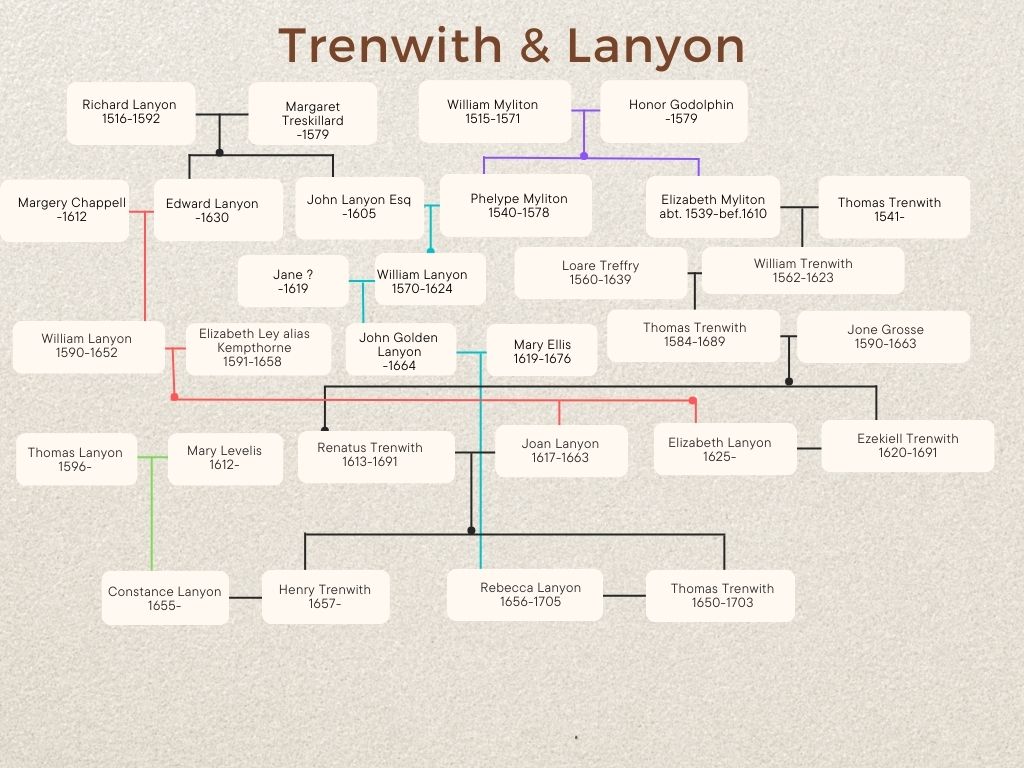
The Trenwith family has connections with the Lanyon family going back to Tudor times. Thomas Trenwith married Elizabeth Myliton, the daughter of William Myliton and Honor Godolphin of Pengersick Castle, Breage. Elizabeth’s sister was Phelype Myliton who married John Lanyon Esq.
It’s a confusing tree and I hope I’ve finally got it right!
The great grandsons of Elizabeth and Thomas; Renatus Trenwith and Ezekiell Trenwith married two sisters. Joan and Elizabeth Lanyon the daughters of William Lanyon and Elizabeth Ley alias Kempthorne. William was the son of Edward Lanyon and Margery Chappell and the nephew of Phelype Myliton and John Lanyon.
Renatus and Joan had a son called Thomas Trenwith and he married Rebecca Lanyon who was the great grand daughter of Phelype Myliton and John Lanyon.
Renatus and Joan had another son called Henry Trenwith and he married Constance (her surname is not mentioned in the Madron parish register) but she could be the daughter of Thomas Lanyon and Mary Levelis.
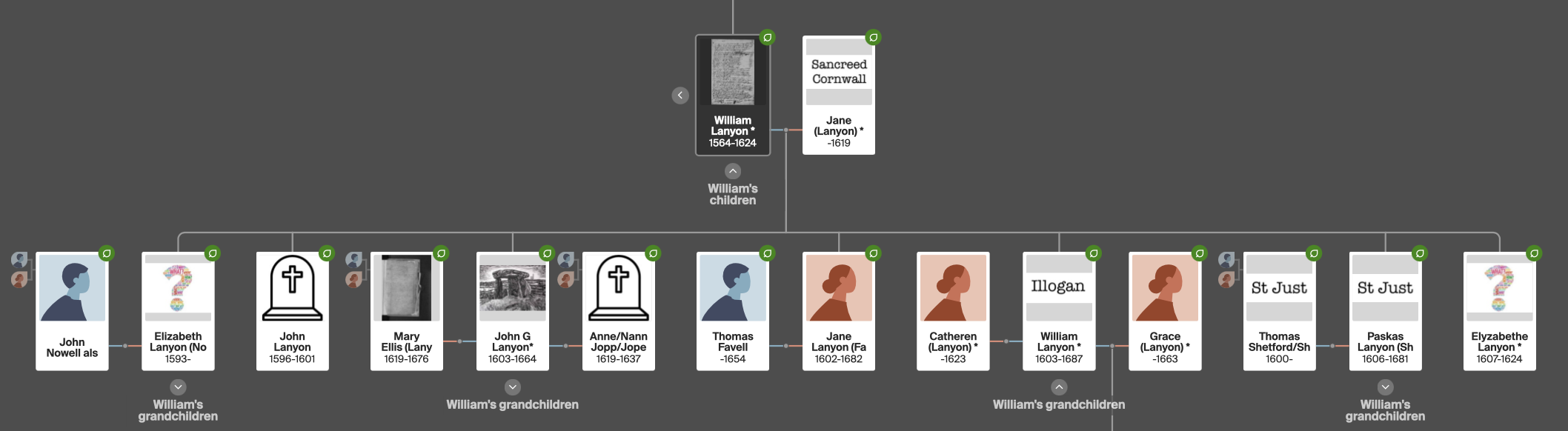
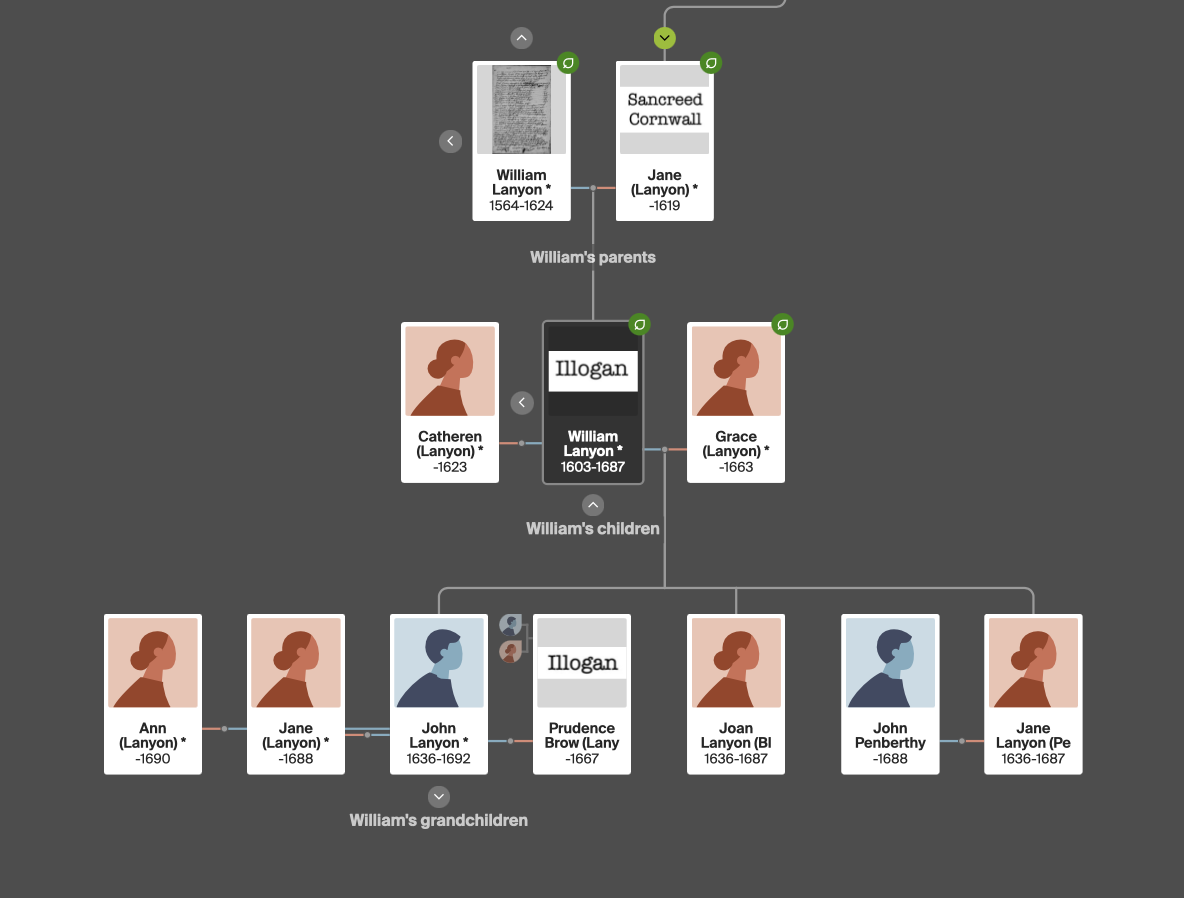
William was the son of William Lanyon and the grandson of John Lanyon Esq.
William was baptised at Sancreed in 1603. He may have had a first wife called Catheren as there was a Catheren Lanyne buried at Illogan in 1623. He married Grace (surname not recorded) at Illogan in 1636. He signed the Protestation Return on 1641/2 as William Lanyne Illogan.
William had three children who’s baptisms and burials have not been traced. Assumption is that they were all born after their parent’s marriage in 1636 and were still alive when their father’s will was proved in 1687.
John aft.1636-aft.1687 married Jane
Jane aft.1636-aft.1687 married John Penberthy – children
Joan aft.1636-aft.1687 married Bloyes, no children at the time of the will.
William’s son John Lanyon was married at least twice. His first wife was Prudence Brow and they married at Illogan in 1663. They had a daughter Grace baptised in 1665 and Prudence died in 1667. John married again to Jane, surname unknown. John had three more children but it isn’t clear if the mother was Jane or Prudence as we don’t know the dates of baptism just the dates of their burials:
William – 9 Jul 1669
Elizabeth – 27 Jun 1669
Thomas – 13 Jul 1669
It appears as though William, Elizabeth and Thomas died in an epidemic – they were buried within three weeks of one another.
There is a John Lanyon who married Ann at Illogan in 1690. Perhaps Jane died after the will and John remarried. No record of any children.
Grace baptised in 1665 married Stephen Cock at Illogan in 1683 and is mentioned in her grandfather’s will. It sounds as though she has had a child and perhaps lost it. ‘If my granddaur Grace Cock have another child in my lifetime £100 to same at 21.’
The John Lanyon of St Ives ‘my kinsman’ mentioned in William’s will is his nephew, the son of John Lanyon and Mary Ellis. William is also mentioned in Mary (Ellis) Lanyon’s will of 1676.
We don’t know much about William of Illogan but we do know he was summoned to appear at the Consistery Court of the 29 April 1663. We don’t know what the summons was for but on the 16 May he “makes humble acknowledgement of his sorrow for not appearing.” Source – letter from HL Douch, curator Royal Institution of Cornwall to WSL Lamparter. 1 Nov 1962.
With no surviving grandchildren called Lanyon this little branch of the family died out.
I spent many months bemoaning the fact that Lanyon parents were not terribly adventurous about naming their children. There are over 300 John Lanyons on my tree and trying to distinguish between them is a nightmare! There are also an awful lot of Williams, Richards, Elizabeths, Janes and Marys but there is definitely only one Elcana Lanion!
I first came across Elcana/Elcaner when I saw a baptism entry in Millet’s transcript of the Madron register:- ‘4 Apr 1670 Bernard son of Eleana Lanion’. I automatically assumed it should be Eleanor and that Bernard was illegitimate. Then I discovered Elcana’s marriage to Honor in 1666. I couldn’t find a baptism or a burial for Elcana despite him having probably the most unusual name in the whole Lanyon family.
A quick trawl on Google revealed that Elkanah was a minor biblical character who was mentioned in the Book of Samuel for having two wives.
I couldn’t find anything else so I tucked the name away and moved on. Some months later I came across a will which mentioned him.
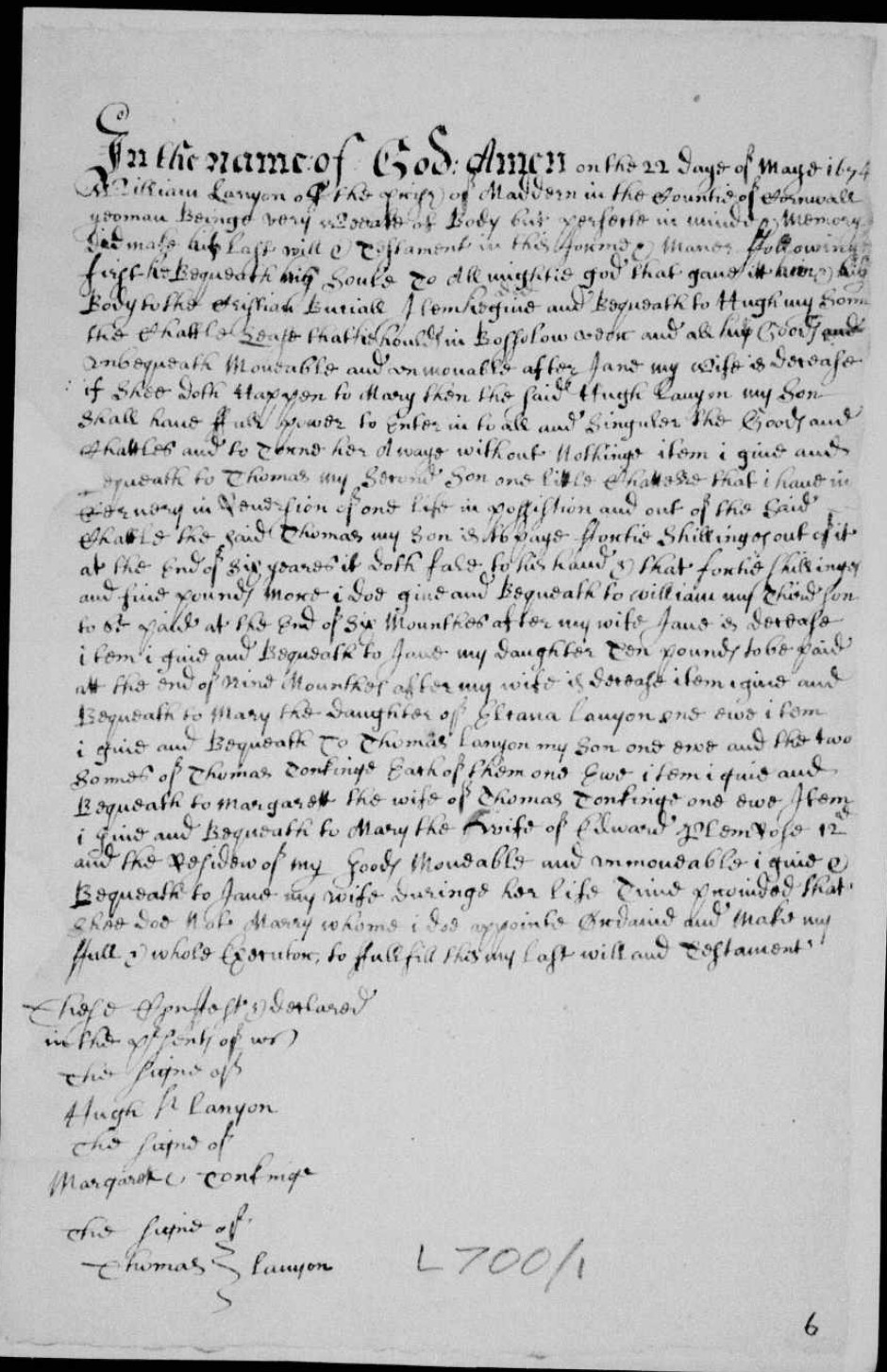
William Lanyon yeoman of Madron died 1674
Transcript:
To my son Hugh, lease of Bosollow Veor after mother’s death.
Jane my wife
Thomas my second son
William my third son
Daughter Jane £10
Mary the daughter of Elcana Lanyon
Margaret wife of Thomas Tonkin
Mary wife of Edward Primrose
Where does this William Lanyon fit on the tree? He is the grandson of Raphe Lanyon.
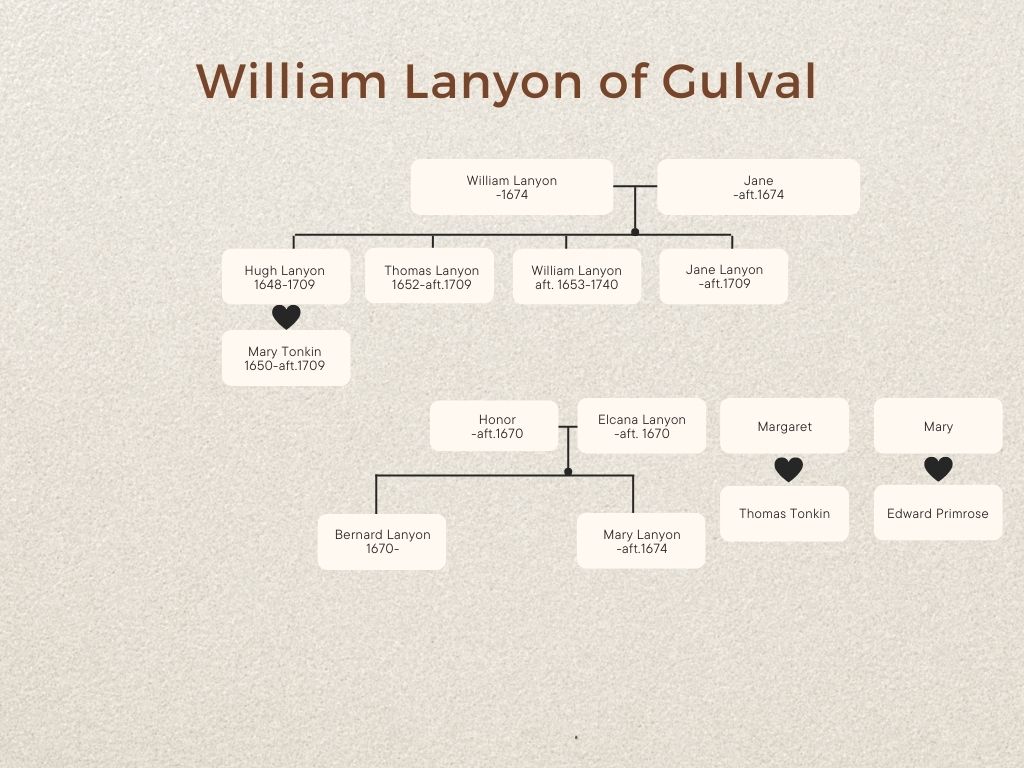
From this will and the Madron parish register we can put together this tree.
Madron parish register lists the baptism of Hugh son of William Lanion of Gulvall in 1648. Hugh is the eldest son according to the will so presumably his parents were married before 1648 but I can’t find a record of this anywhere.
William’s will mentions Mary daughter of Elcana but not the relationship of Elcana or Mary to William. Could Elcana be William’s son and Mary his granddaughter? Or perhaps Elcana is William’s younger brother or even a cousin?
William was probably born in the 1620s if he married in the 1640s. Elcana married Honor in 1666 almost a generation later so could be a son or younger brother. We know from the will that he had a daughter Mary and from the Madron parish register a son called Bernard.
Presumably Margaret (who married Thomas Tonkin) and Mary (who married Edward Primrose) are married daughters of William.
Hugh Lanyon 1648-1709
Hugh was a ‘tynnor’. He married Mary Tonkin from Paul in 1689 but they didn’t have any children.
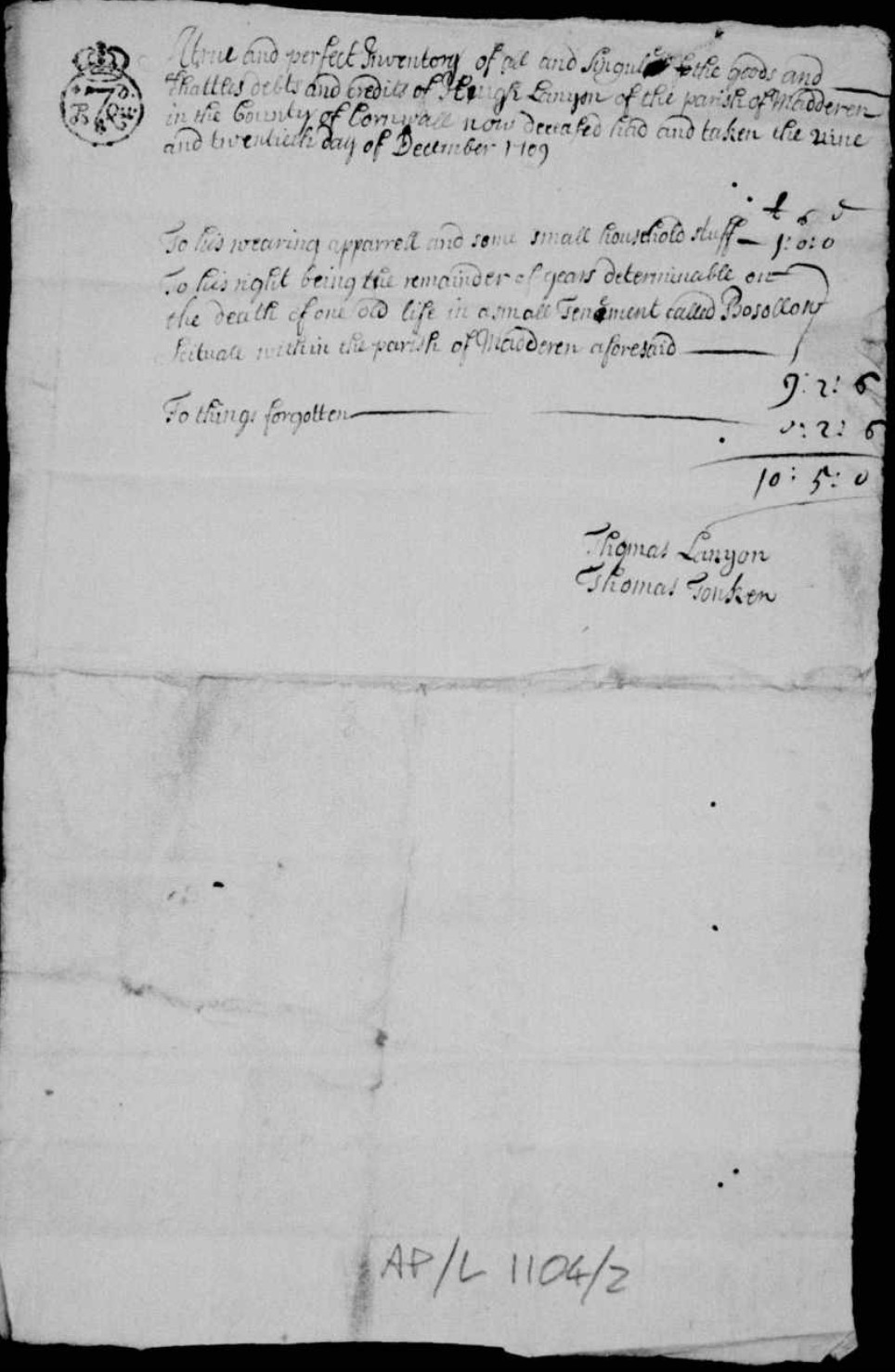
Hugh’s will (Source – CRO AP/L/1104)
Bequeathes 1/- to several named widows
To Mary my beloved wife, the house that I do live in and garden adjoining, with liberty of commons for cattle
To brother Thomas 10/-
Sister Jane wife of William (possibly Harris)
Sister-in-law Margaret Tonkin and to brother William Lanyon all the estate I have in land what is not formerly bequeathed to my wife and executor
2/- 6d for the poor man’s box, parish of Madron
Inventory mentions Bosollow: one old life left on small tenement. Inventory apparently signed by Thomas Lanyon and Thomas Tonkin.
Brother Thomas Lanyon was baptised on 10 Apr 1652 but there is no trace of a marriage or burial. No trace of a baptism for brother William Lanyon. A possible marriage: William Lanyon married Susanna at Madron in 1675 and she died several months later.
Mary Primrose, wife of Edward was buried at Gulval 8 Mar 1729. She had two daughters: Kathren and Mary.
There is no further trace of Elcana, Honor or Bernard so presumably they died (probably before 1674 as they are not mentioned as beneficiaries in William’s will) and their burials are not recorded. There is no further trace of Elcana’s daughter Mary.
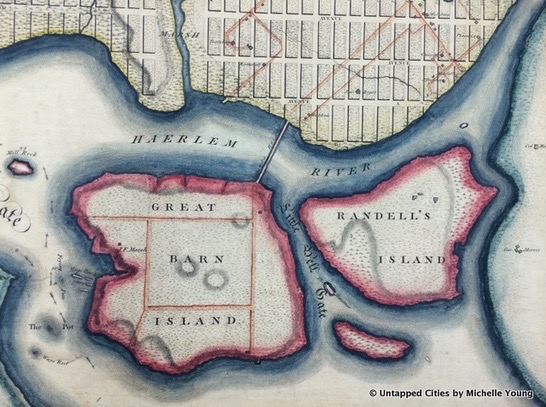
I came across this Lanyon quite by chance whilst looking at a book about the history of Harlem.
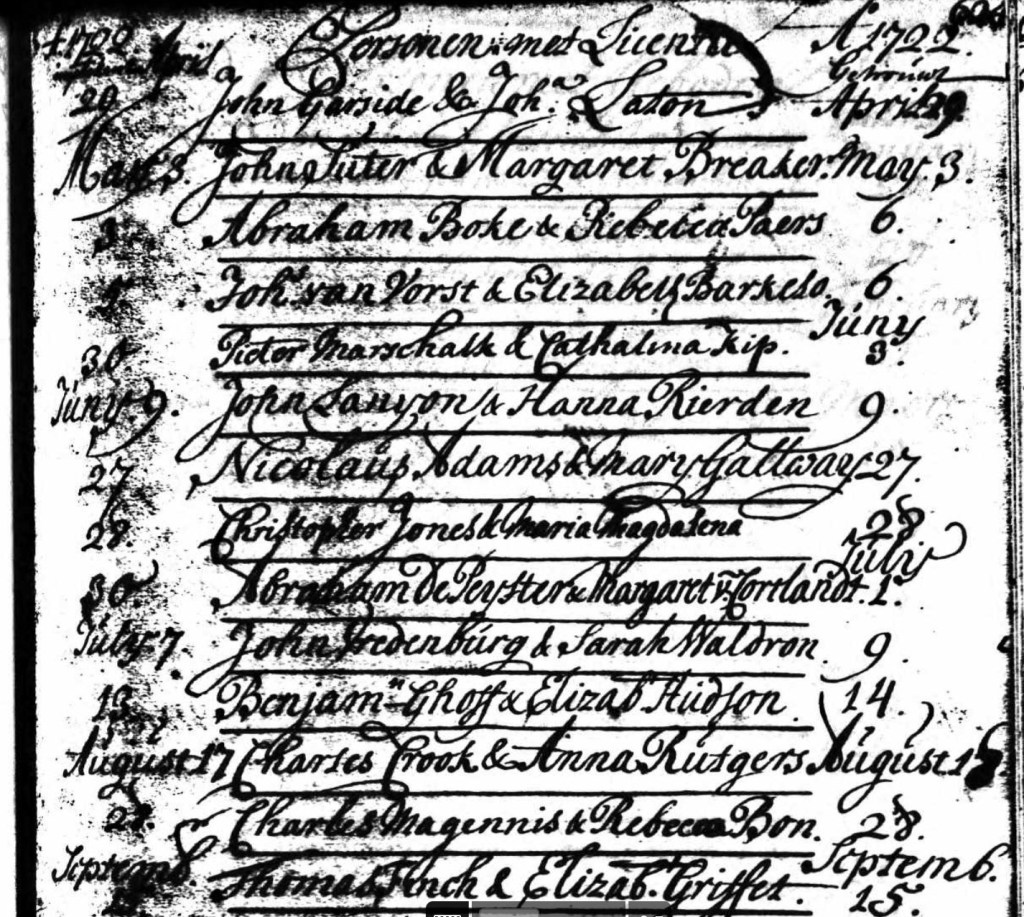
On 9 Jun 1722 John Lanyon married Hanna Rierden in New York.
New York City marriage index 1600-1800
Hanna was the daughter of Thomas Pearsall/Parcell and Christina Van Hattem. She was born about 1680 at Dutch Kills, New York. In 1708 she married Jeremiah Rierden but he died and there were no children of this marriage.
Great Barents Island (now Randalls & Wards Islands) at Harlem was sold 9 Aug 1687 by Jacob Milborne to Thomas Parcell. Thomas Parcell was the son of John Parcell also known as ‘John the butcher’ from Huntingdon county, England, who early settled at Dutch Kills. When John died in 1680 he left his children: Thomas, William, Henry and Catherine an estate worth 6,000 guilders. Thomas, born 1653 and bred a blacksmith, married Christina Van Hattem. On removing to Great Barents Island, he sold his lands at Dutch Kills to Bourgon Broucard and Hans Covert on 21 Jun 1690 for 4,087 pounds. Parcell built a grist mill at the upper side of his island. His son John bought the northern half of the island 4 Jun 1722 and on 29 Mar 1723, Thomas and Christina sold the other half to son-in-law John Lanyon of New York, innkeeper. Parcell died prior to 1732 on Spectacle or Hart Island (Now City Island) which he then owned. His will mentions his children: Nicholas, John, Henry, Hannah and Eda.
Nicholas Parcell married a daughter of the Hon, Rip Van Dam.
John Parcell kept his half of Great Barent’s or Parcell Island until his death in 1751 age 75. He married Leah Van Alst and they had nine children. He gave his share to his son Thomas Parcell who married Deborah Penfold. Thomas was drowned in Hellgate on 1 Aug 1766 in the evening attempting to swim his horse to the island
Henry Parcell succeeded to Hart Island.
Eda married Walter Dobbs.
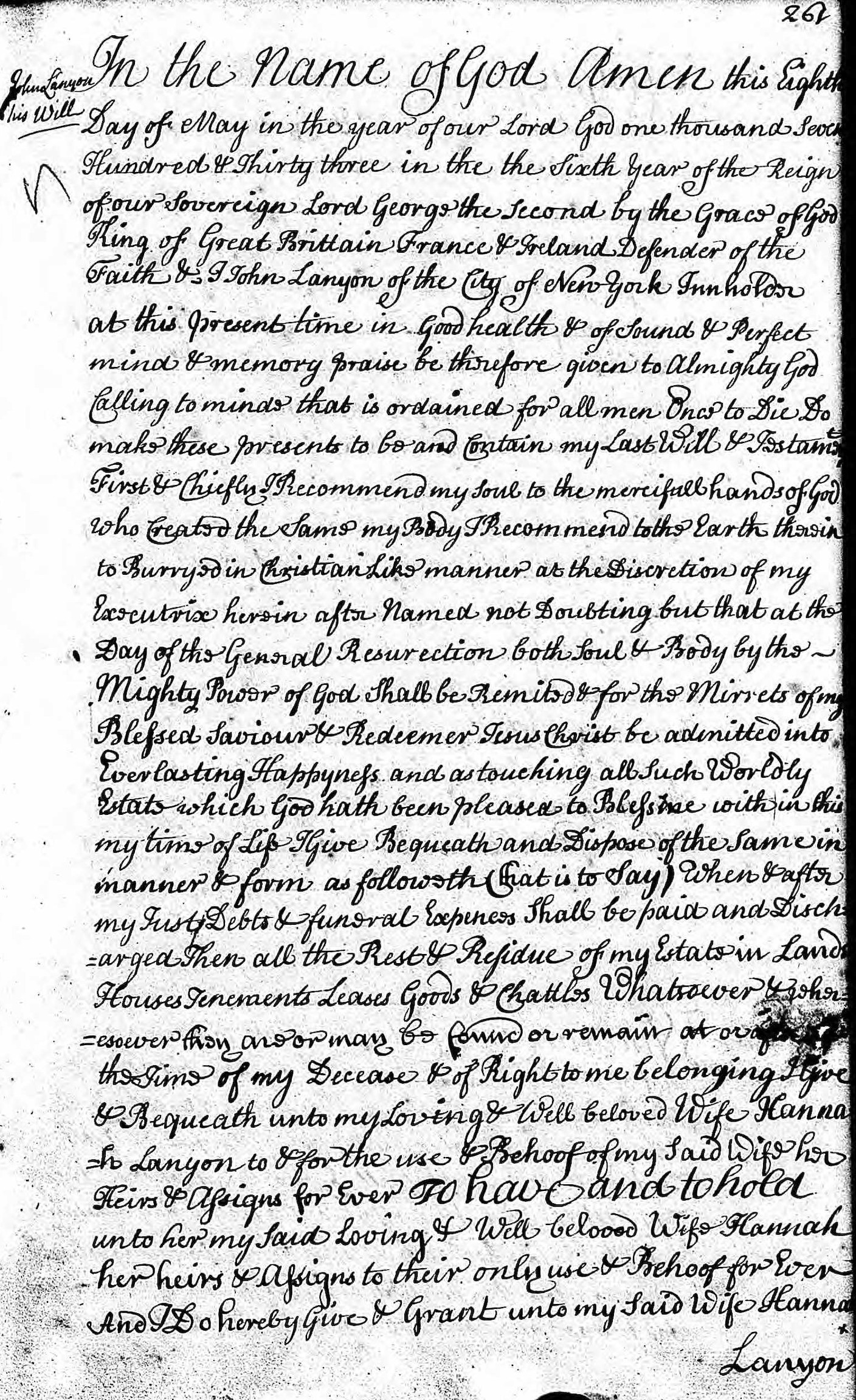
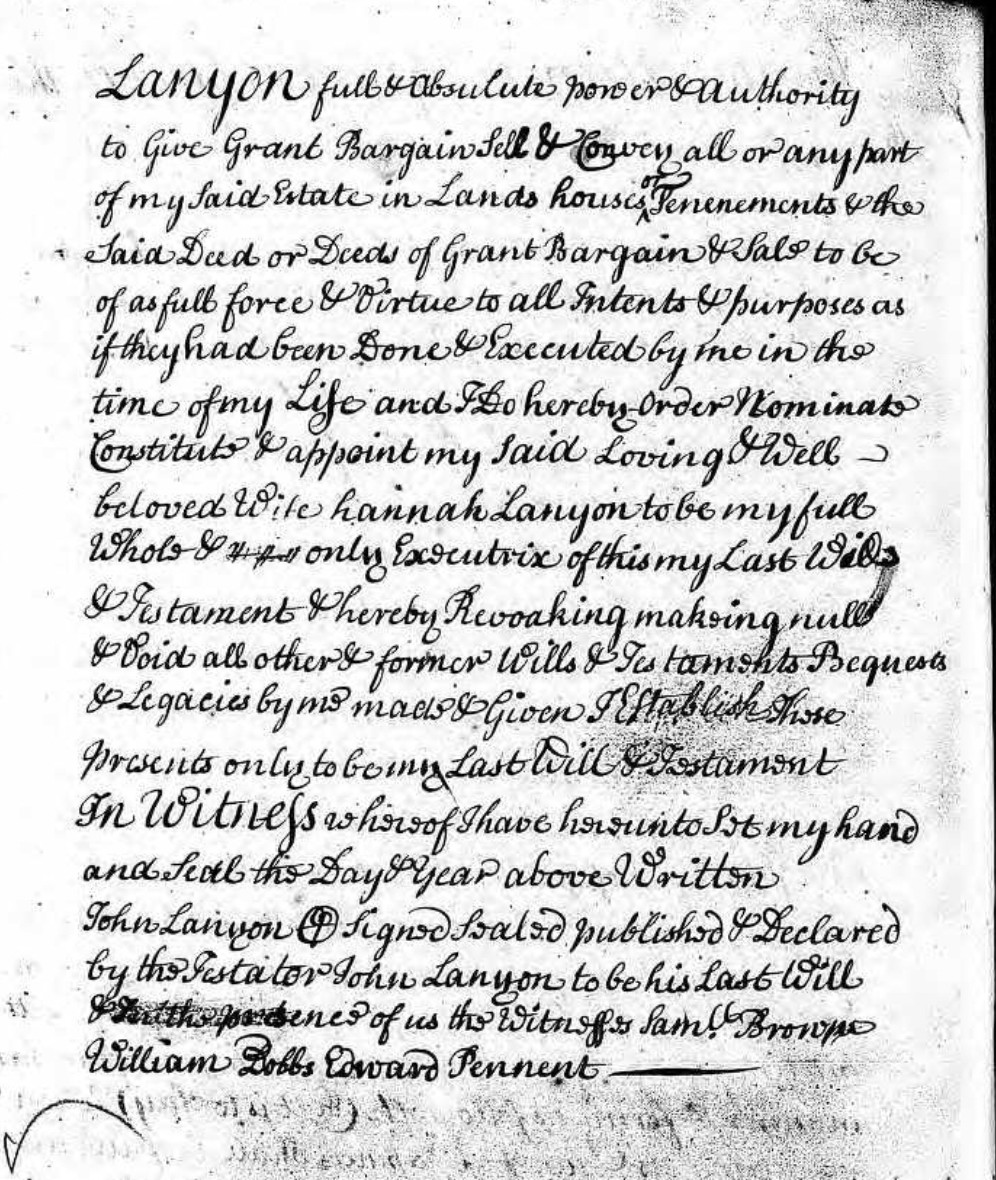
John Lanyon died, probably 1733 and his will was proved 8 Jan 1734.
Hanna and John had no children and there are no clues in his will as to his origins. Could he be the John Lanyon who was the son of Hugh Lanyon and Mary Tonkin (Morvah branch), he was baptised in 1692 and there is no trace of him?
On 17 Jan 1735 Hanna married for a third time, to Thomas Behena. There were no children from this marriage. In 1765 she mortgaged her half of the island.
This is my first attempt at building a website and it shows! About half way through I realised that a different layout might have worked better but it was too late to go back and start again. It’s also a work in progress and new posts and material is added all the time.
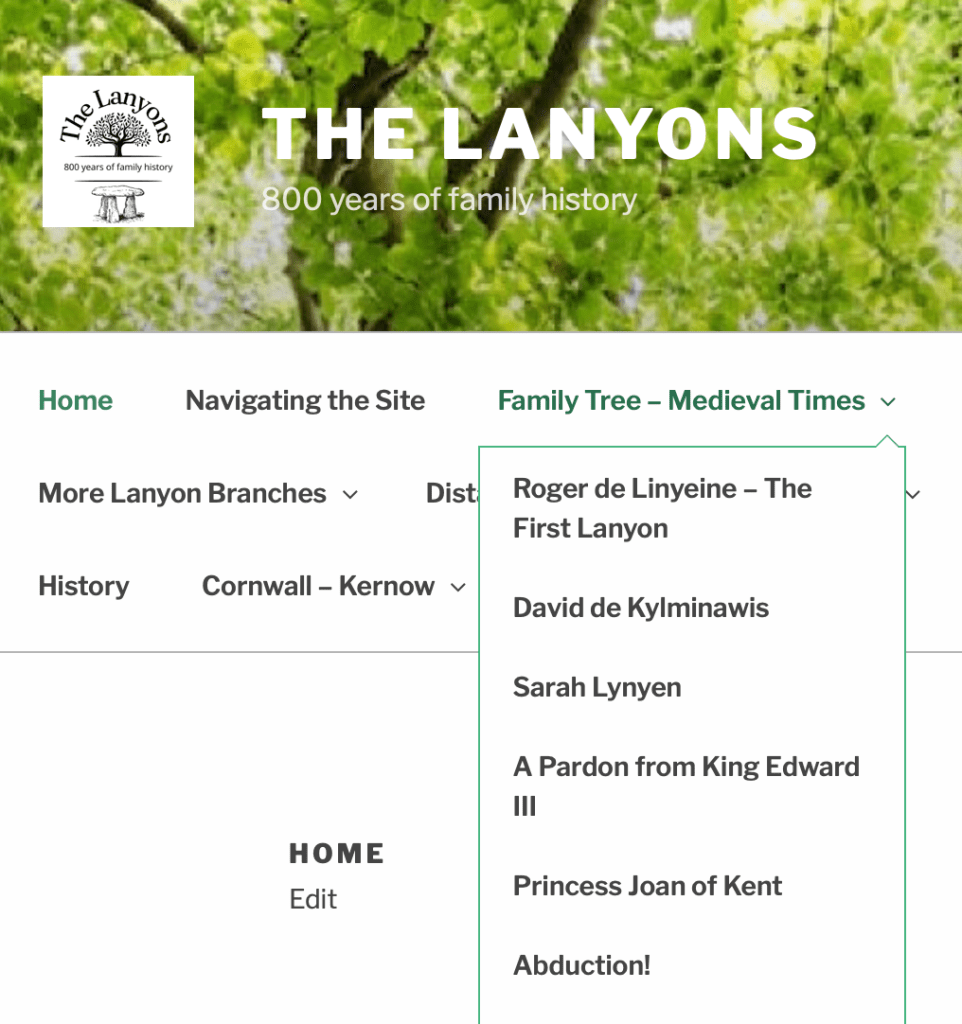
How to find your way round
Home
As the name suggests this is the the starting point.
It’s easier to start with the Medieval Lanyons and work forward, the site layout is broadly chronological however the posts were all written at different times so reading the ‘previous post’ or ‘next post’ won’t necessarily be in order. It’s easier to go back to the drop down and navigate from there.
Medieval Lanyons
The drop down box contains a list of posts which are broadly chronological.
If you double tap the header ‘Family Tree -Medieval Times’ a landing page will open.
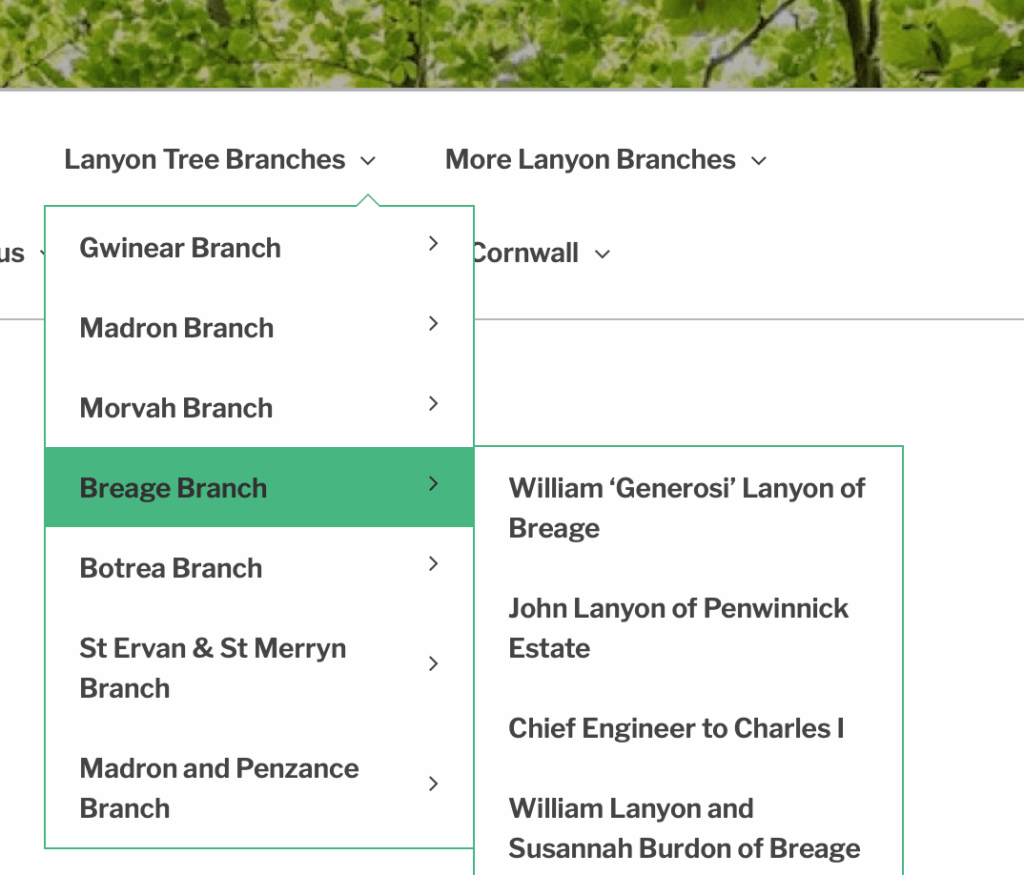
Lanyon Branches
After the Tudor Lanyons the family breaks off into separate branches and each branch has its own set of posts.
‘Lanyon Tree Branches’ are the earlier branches of the family whilst ‘More Lanyon Branches’ are the later branches of the family.
Some of the posts are a bit like Books of the Old Testament with lots of ‘William begat John’ and not much else, I did consider leaving out anyone without a back story but it’s a lot easier to include them.
Distaff Side
The people who have married into the Lanyon family.
The Black Sheep
The bad boys of family history – these are the people the genealogists secretly like! They won’t necessarily be called Lanyon, they’re the people I’ve stumbled upon and then spent months trying to track them down!
‘Loose’ Lanyons
The Lanyons that don’t quite fit on the tree….yet!
Miscellaneous
All those Lanyons and iterations of the name I’ve come across whilst carrying out research.
About
Me! How to contact me and the various sources I’ve used.
History
Some links and information about the bigger historical picture.
Cornwall-Kernow
Somewhere for all the stories about Cornwall that didn’t quite fit anywhere else. This is not a comprehensive list of all things Cornish just a home for some of the information I came across while researching the family.