Lanyon or Lannin?

In 1943 a William Lanyon of Bath was found floating in Bristol harbour.
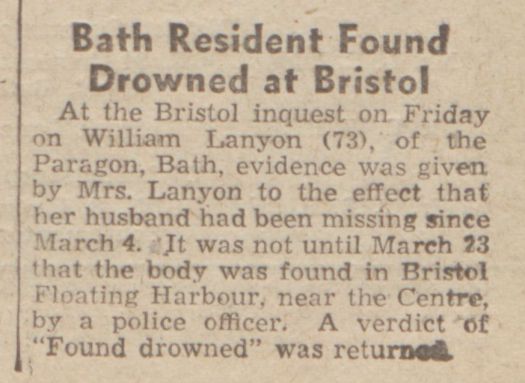
Bath Chronicle and Weekly Gazette 3 April 1943

The newspaper helpfully reported his age so I thought it would be fairly straightforward to identify him and where he belonged on the family tree. I was wrong! The following post is about my search to find where William came from and to fit him on the tree.

The Search

From the dates on the newspaper report I quickly found his death certificate which gave his age as 76 and his address.

Death Certificate

I started to look for a birth circa 1867 and a marriage certificate, as the newspaper mentioned his ‘wife’. I couldn’t find either.

His death certificate listed his address as 27 The Paragon, Bath, Somerset. Today the Paragon is a very desirable area but in the 1930s it was rather run down and full of flats and boarding houses.
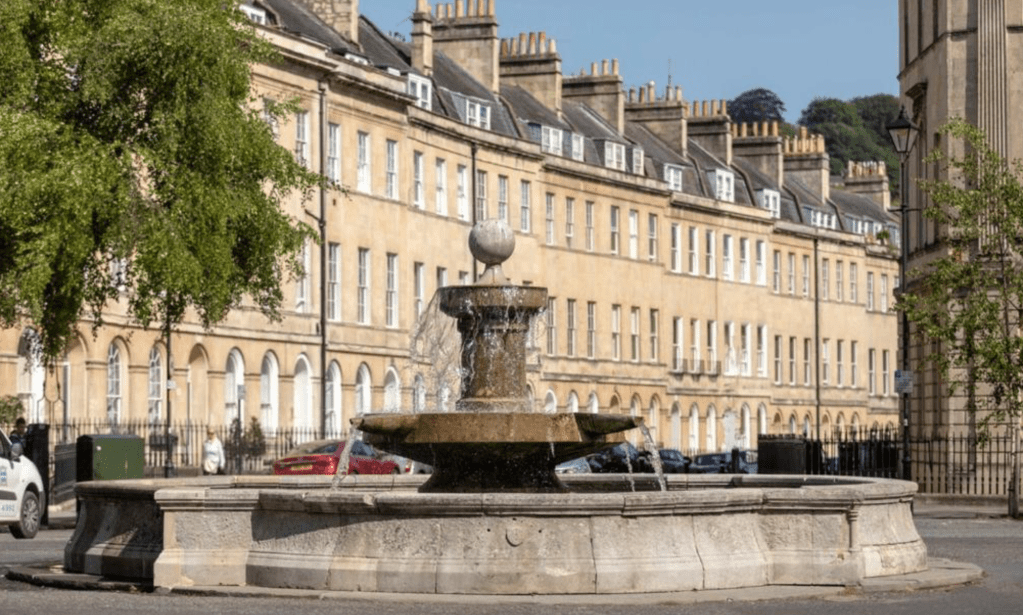
The Paragon Bath

I checked the census returns for 1921 at the Paragon but there was no sign of him. So I decided to check the 1939 register and bingo, I found him.

William Lanyon at 27 The Paragon was living with three women, Cecil, Elsie and Kathleen Lanyon. All four are listed as single so where is the wife mentioned at his inquest in 1943?

The 1939 register includes the full date of birth which is really helpful when trying to track an individual.

  • William – 5 Oct 1866 (retired grocer)
  • Cecil – 9 Jan 1868 (incapacitated)
  • Elsie – 20 May 1869 (unpaid domestic duties)
  • Kathleen – 1 Jun 1874 (unpaid domestic duties)

The closeness of the dates of birth suggested that they may be siblings so I started to search for the birth registrations of Cecil, Elsie and Kathleen. I couldn’t find any of them. I then reversed the search and started looking for their deaths after 1939.

I found a burial at Lansdown cemetery in Bath for a Rhoda Kathleen Lanyon, born 1874 and died 22 Dec 1966. I then found a death record for Elsie Lanyon in Bath in Jan Qtr 1951. So I ordered a digital image of Elsie’s death certificate to see what information it contained. I also found a burial in Lansdown cemetery for an Elsie Kingston Lanyon, where did the name Kingston come from, it wasn’t on her death certificate?

Elsie’s death certificate

The address was correct, it mentions her sister R Lanyon also of the same address, so that was confirmation that Kathleen was indeed Rhoda. It also mentioned that she was a retired school teacher and the daughter of William Lanyon a school master.

I then searched for Cecil Lanyon without any luck, so I added an ‘e’ to the end of her name and searched for Cecile. I found a Cecile Lanyon on the 1901 Irish census, born about 1873 in County Cork. Initially I rejected that as the Irish Cecile was five years younger than my Cecil, but I should remember that women don’t always age 10 years between censuses!
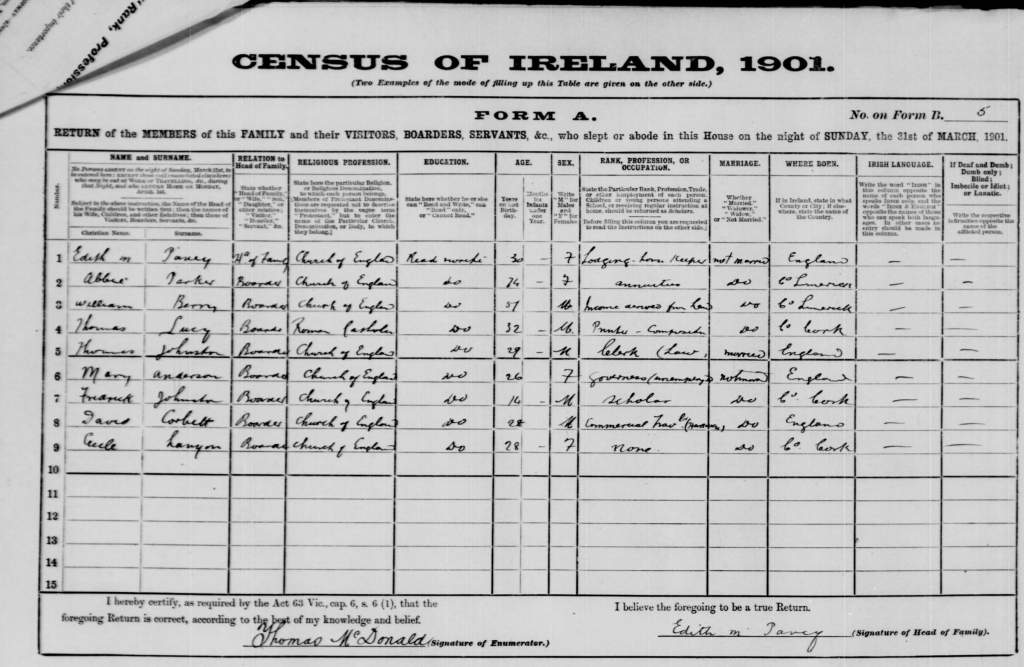
1901 Census of Ireland

Cecile is at the bottom of the form, she is a boarder at 5 Morrison’s Quay in Cork. She can read and write but has no occupation. It also notes that she is Church of England.

I searched the census for any sign of Rhoda/Kathleen Lanyon and found a possible entry.

1901 Irish Census

I found a possible entry at Cloughmacsimon (Ballymodan, Cork).

  • Sarah A Lanyon Head, age 60 retired teacher, widow, born in Charleville
  • Rhoda (R or K) Daughter, age 28, no occupation, single, born Co Cork
  • Susan Jane Daughter, age 25, no occupation, single born Co Cork

I then searched for a birth of William Lanyon circa 1866 in Cork, the son of Sarah. I couldn’t find anything. Nor could I find a birth for Rhoda/Kathleen, Elsie or Cecil Lanyon in Cork.

So where had they come from?

I did find a Rhoda K Lanyon of Bangor signing the Ulster Covenant in 1912. This was a declaration that they were loyal subjects of the King and didn’t want home rule for Ireland.
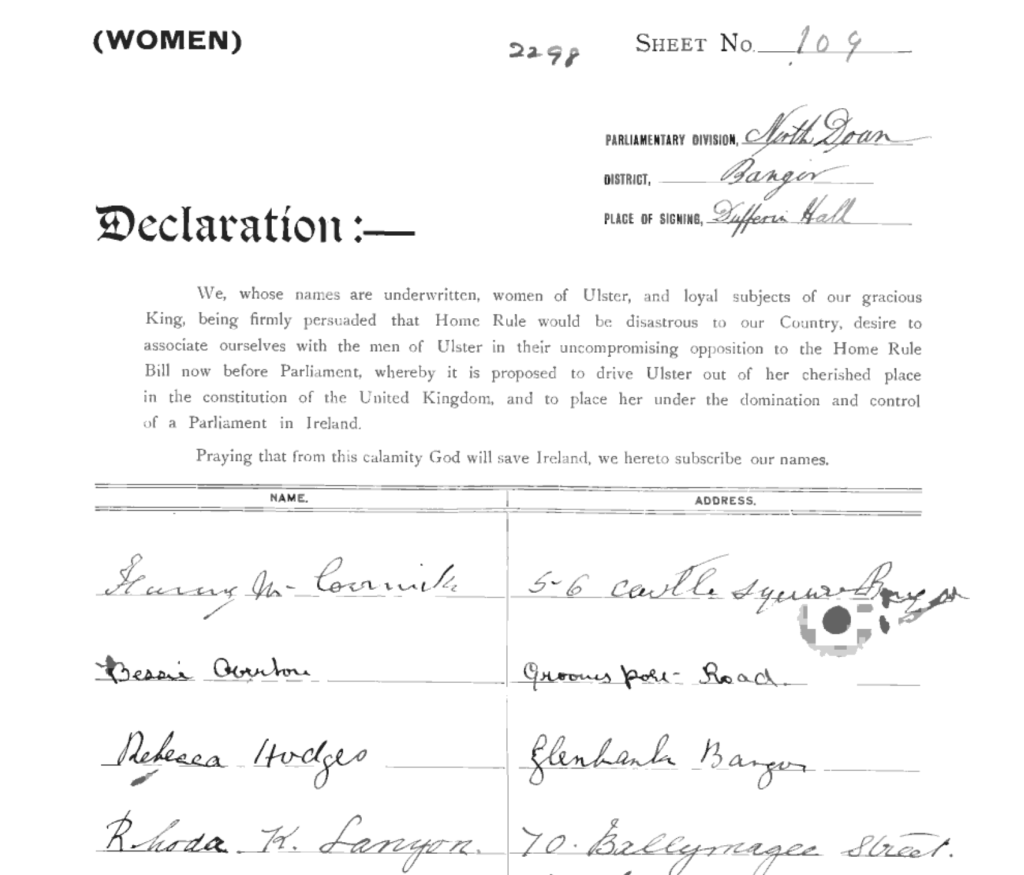
Ulster Covenant

I searched for a birth for Susan Jane Lanyon listed on the 1901 census, but couldn’t find anything.

I moved forward again and searched for probate records on the off chance I would find something useful. I didn’t hold out much hope.

I found Rhoda’s probate record. There was nothing terribly useful.

Probate

I couldn’t find a record for Cecil or William but I struck lucky with Elsie.

Probate

Elsie Lanyon was also known as Ellen Lannin. Now that was very useful!

Back to the internet, I now started looking for the name Lannin and I found them quite quickly in Cork.

Rhoda Kate Lannin born 31 May 1874 in Cork, the daughter of William Lannin and Sarah Howard.
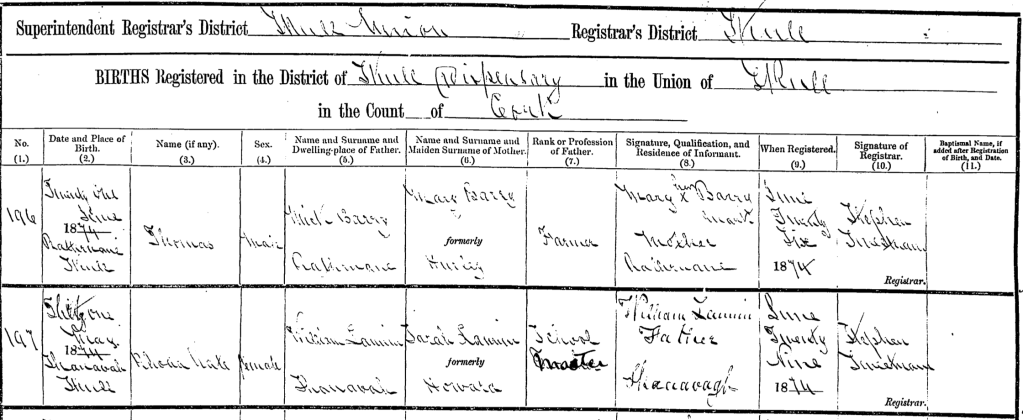
Birth Registration Skull Tipperary, Ireland

The registration shows that Rhoda was the daughter of William Lannin a school master and Sarah Lannin née Howard.

I then searched Irish births and found William’s birth on 5 Oct 1866 at Clonakilty. Son of William Lannin school master and Sarah Howard. A Nicholas Howard is mentioned, a brother to Sarah? Father?

William Lannin’s birth

Even better I found a birth registration for Sarah Maria Lannin on 9 Jan 1868 daughter of William Lannin a school master and Sarah Howard, I had found Cecile. A Mary Howard was present at the birth, a sister? Mother?

Sarah Maria Lannin’s birth

It didn’t take long to find the marriage of William Lannin and Sarah Howard on 1 Aug 1865 at Clonakilty.
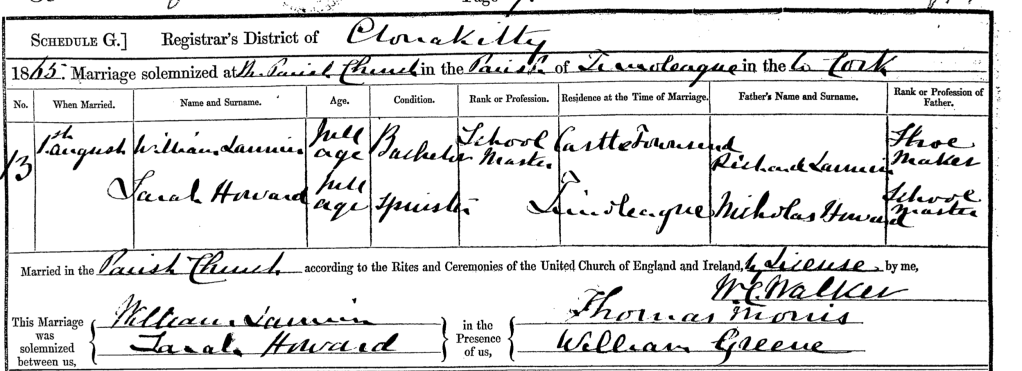
Marriage of William and Sarah

The registration lists Richard Lannin a shoe maker as William’s father and Nicholas Howard, a school master, as Sarah’s father. (There are certainly a fair few shoe makers in the Lanyon family!)

It was straightforward to locate Sarah’s baptismal record on 19 Aug 1838 at Innishannon, Cork, the daughter of Nicholas and Mary. So that explained the names Nicholas and Mary on the grandchildren’s birth registrations.

I searched for a birth/baptism of William Lannin senior but couldn’t find one. I searched for a possible marriage of Richard Lannin and found a marriage record in 1821 at Cork, to an Ellen Kingston, so that explained the Kingston name on Elsie/Ellen’s burial record.

I found another child of William and Sarah, Richard Frederick Charles Lannin b 20 Mar 1871 Skull, Cork. Then I found later records of him joining the Masons in South Africa and his name had changed to Eric Frederick Charles Richard Lanyon, also a school master.

So the tree now looked like this.
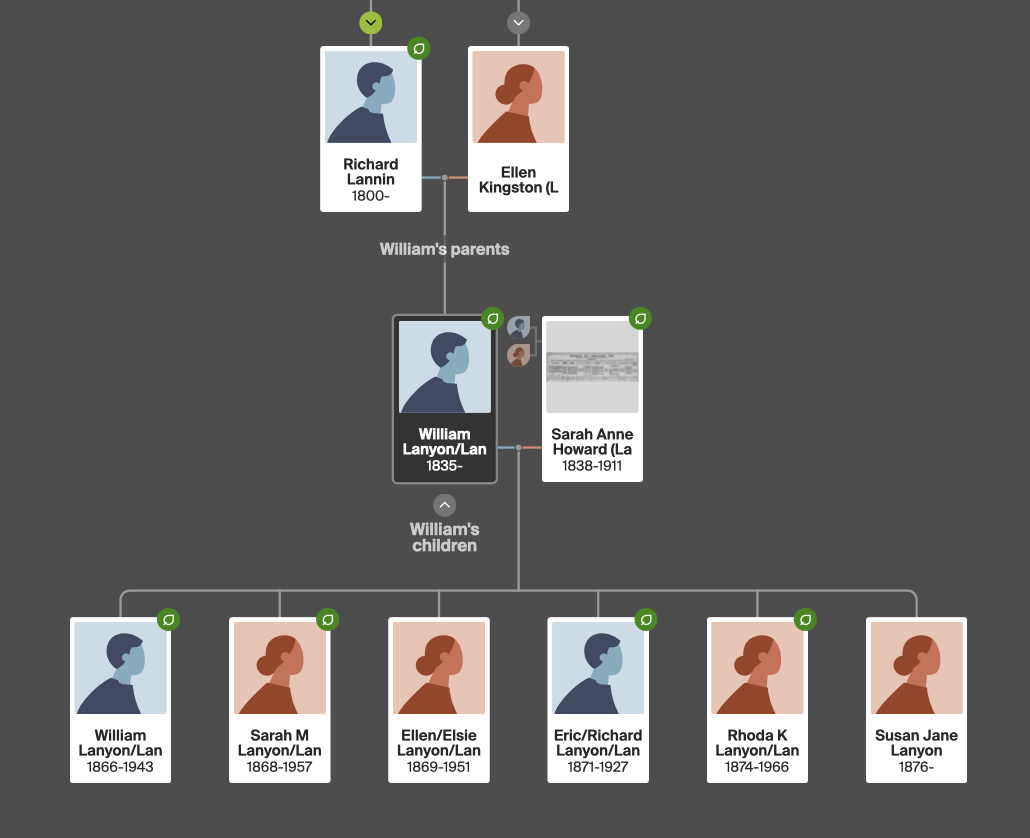
  • William Lannin/Lanyon b 1866 d 1943
  • Sara Maria Lannin/ Cecile Lanyon b 1868 d 1957
  • Ellen Lannin/Elsie Kingston Lanyon b1869 d 1951
  • Richard Frederick Charles Lannin/Eric Frederick Charles Richard Lanyon b 1871 d 1927
  • Rhoda Kate Lannin/Kathleen Lanyon b 1874 d 1966
  • Susan Jane Lanyon b 1876 (no trace of a birth or baptism but this is the name she was using in 1901)

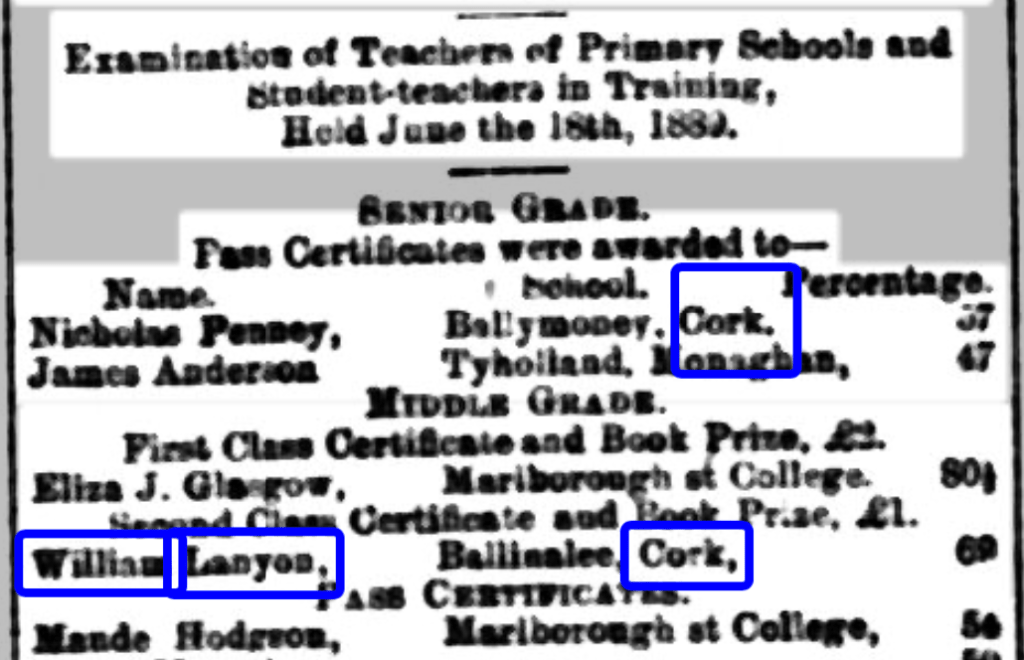
I couldn’t find a birth/baptism/death or burial for William Lannin senior. He was probably born sometime after 1821 when Richard and Ellen were married. I searched for a death from 1875 onwards and didn’t find anything. I did find a small newspaper article which may have related to him.

The results of examinations of teachers of primary schools in 1889. That could well be him although Ballinalee is not in Cork! I think the town should be Ballinadee, which is in Cork.

When I found William’s death registration that confirmed that he was living in Ballinadee.
William’s death certificate 8 May 1892 at Ballinadee

That means that as early as 1889 they were using the name Lanyon rather than Lannin.

I decided to go back a generation and see what I could find and if that helped to make things any clearer.

I found Nicholas Howard and his family.
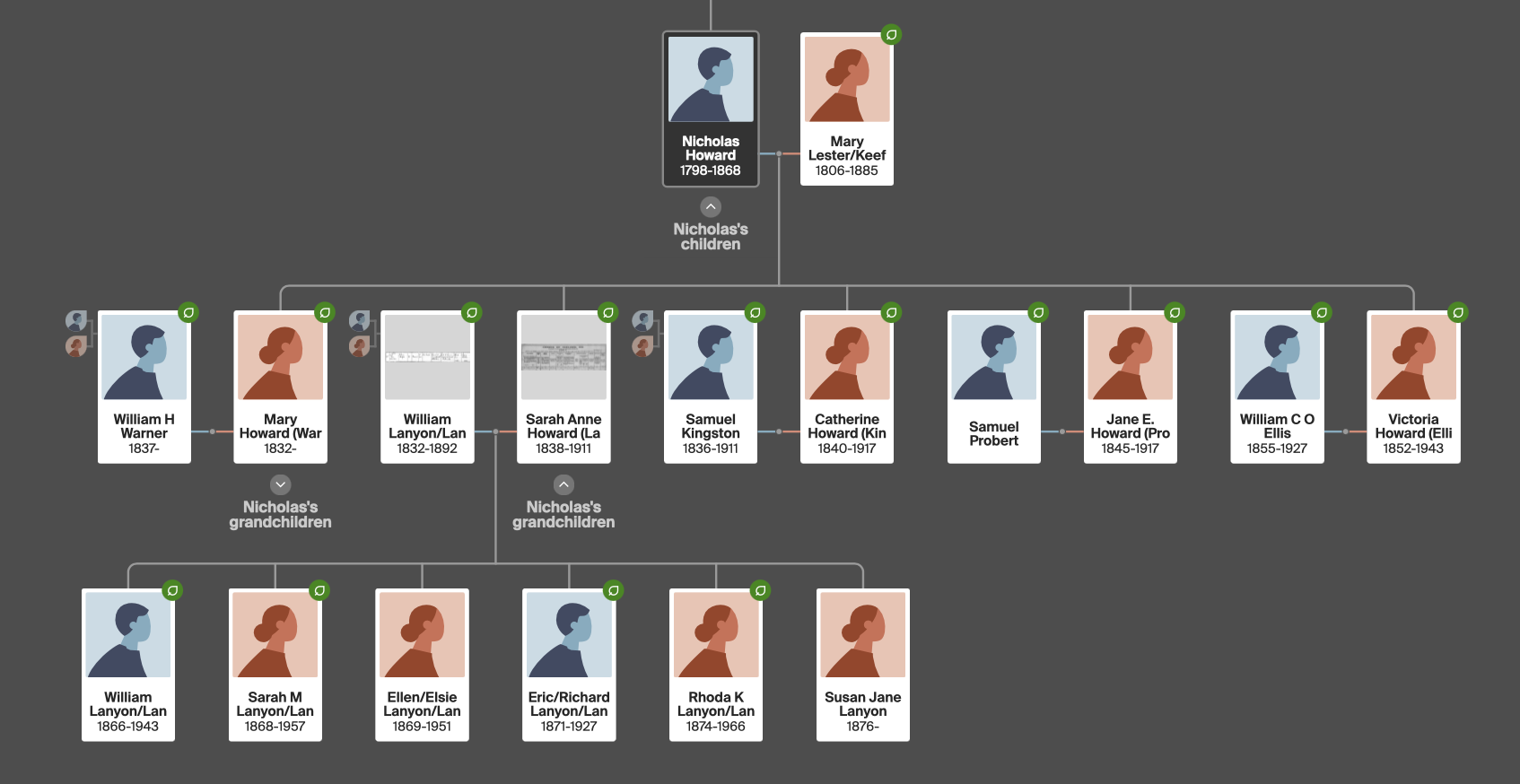
Howard family tree

Nicholas was a school master, baptised 16 Mar 1798 at Innishannon, he died on 8 Feb 1868 at Timoleague, Cork. He married Mary (the records state that her surname is Keefe but their children’s death certificates in the USA state that she was Mary Lester. Perhaps she remarried after Nicholas died?)

I found five daughters but as there are big age gaps between them there may have been more children or stillbirths.

  • Mary Howard born 1830s married William Henry Warner died 19 Jun 1869 age 40 at Bath in Somerset (she was suffering from TB)
  • Sarah Anne Howard who married William Lannin
  • Catherine Howard b 1840 married Samuel Kingston and died 1917 in Indiana USA
  • Jane E Howard b 1849 married Samuel Probert and died in 1917 in Indiana USA
  • Victoria Howard b 1853 married William Charles Osmand Ellis from Bath Somerset and died in 1943 in Bath

Mary Howard/Warner’s death certificate

With two of Sarah Anne’s sisters living in Bath it’s easy to see how her children would end up in the same city. In 1871 Victoria Howard appears on the census living at The Paragon in Bath. In 1878 she married William Ellis.
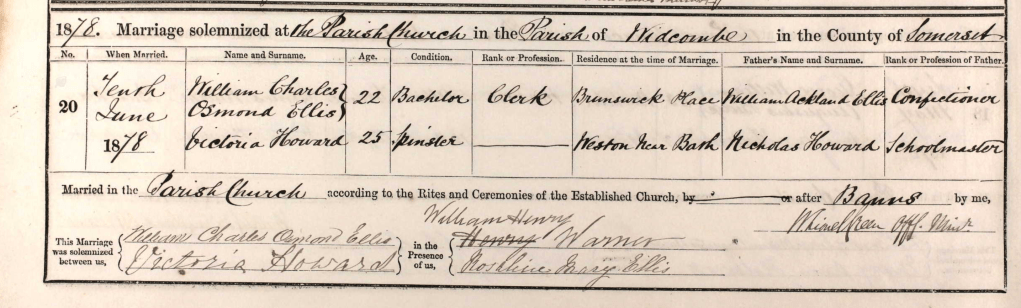
Victoria Howard’s marriage certificate from Somerset.

Catherine Howard married a Samuel Kingston and I tried to work out their family tree as we’ve seen the name Kingston before.

Samuel Kingston b 1831 was the son of Samuel Kingston and Ellen Brenan. Samuel and Ellen had a large family. Perhaps Samuel senior was related to the Ellen Kingston who married Richard Lannin in 1821?

Despite all the searching I still don’t know why they changed their name from Lannin to Lanyon.

Perhaps they read about Sir Charles Lanyon, famous architect, Mayor of Belfast and MP in the papers and wanted to enjoy a little reflected glory? If that was the case why did they feel the need to change their christian names too?

Perhaps the reasons lie in the fight for home rule and the Easter uprising of 1916.
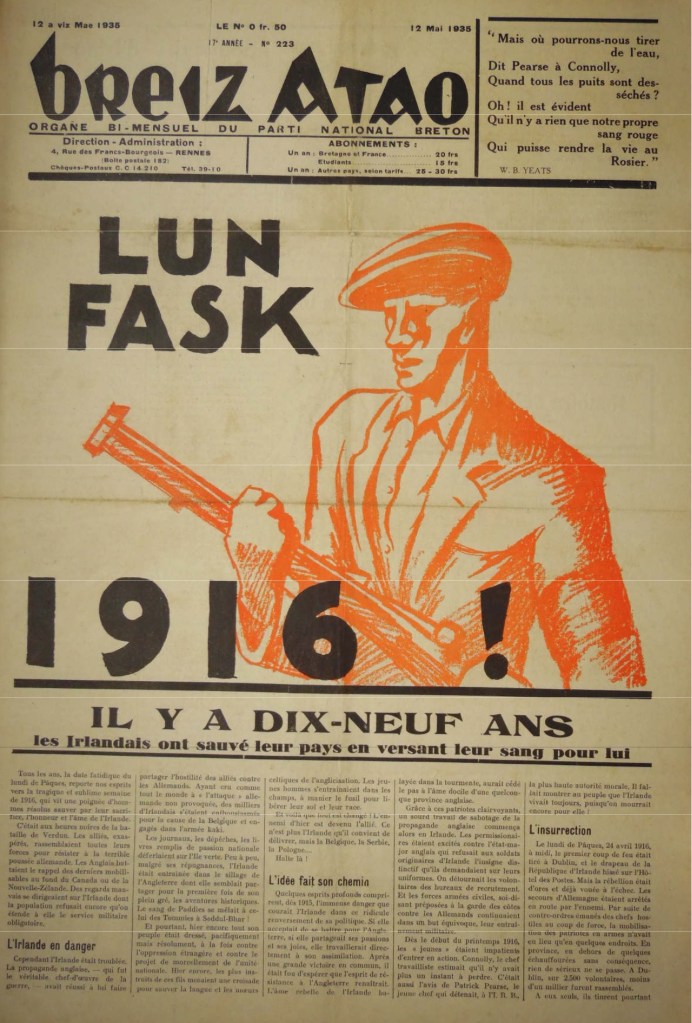
Breiz Atao, Public domain, via Wikimedia Commons

Rhoda Lanyon in 1912 signed the Ulster Covenant which was against home rule for Ireland. Perhaps as a protestant family in southern Ireland they experienced problems and felt they had to move to England. Naturally they would go to family already settled there, which is how they ended up in Bath in Somerset. Perhaps they stayed with aunt Victoria at The Paragon?

If you can answer any of the questions posed in this post then please get in touch!
‘For Those In Peril On The Sea’

This post was going to be about the Lanyons who served in the navy but when I started researching I discovered that we’ve had our fair share of drownings. Without wishing to be macabre this is the story of the Lanyons who died at sea and in other bodies of water. It’s also the story of those who put their lives on the line to rescue others.

Edmund Lanyon 1675-1695

Edmund served on HMS Weymouth, a 50 gun fourth rate ship launched in 1693 at Portsmouth dockyard. Edmund was the son of John and Thamsina Lanyon of Gulval in Cornwall. He was baptised on 18 May 1675. We know almost nothing about him apart from the administration of his estate which was granted on 15 June 1695. He is described as ‘of Madderne’ (Madron in Cornwall). Administration was granted to Francis Lanyon of Penzance, cordwainer and principal creditor, William Landrey of Nyott and Johnum Doe.

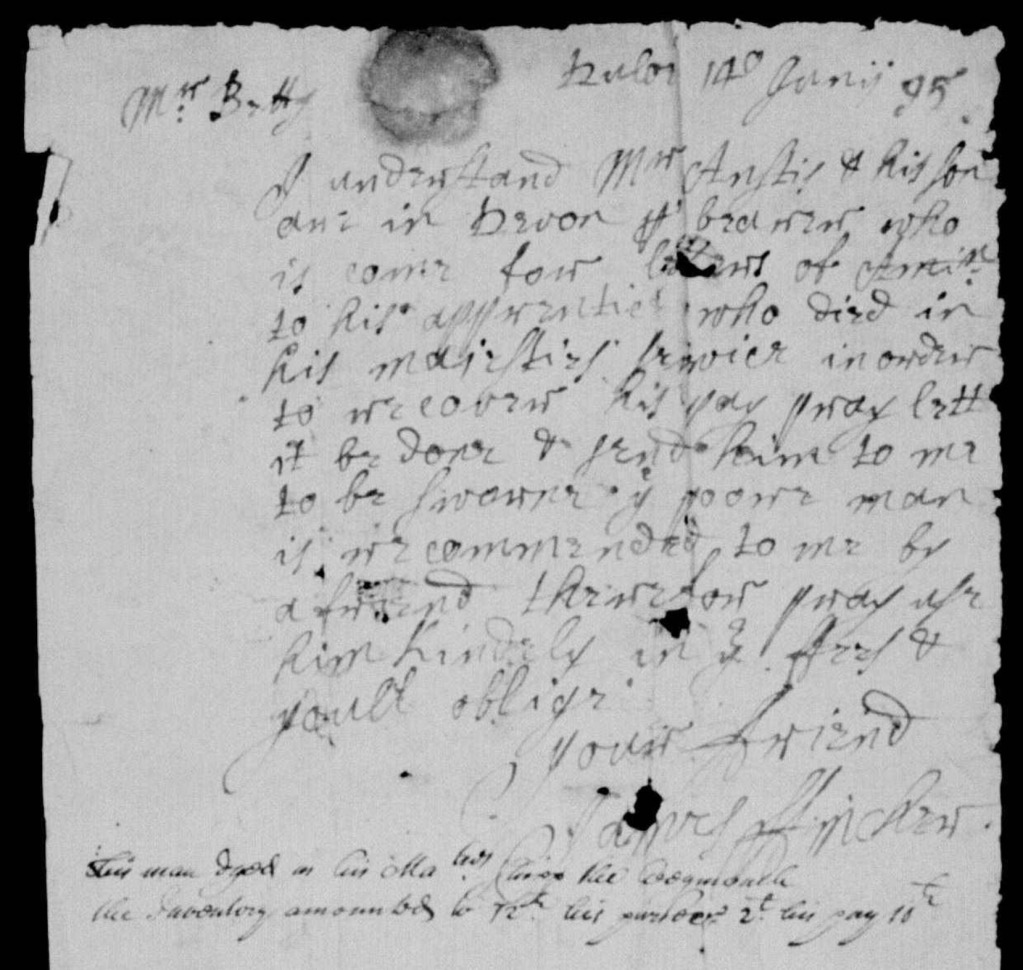
There is a letter with the administration papers. It’s not easy to read but I think it says the following:

Mr Betty  ? 14th Junij 95

I understand MAnstis & his son are in Devon ? ? who is come for letters of Administration to his apprentice who died in his Majesties service in order to recover his pay pray lett it be done & send him to me to be sworn by some man if he commended to me by a friend therefor pray use him kindly in the? trust? Youll oblige

Your friend

James Fincher

(Different hand)

This man served in his Maties Service the Weymouth

The Inventory amounts to 12sh ?….?…

CRO AP/L/969

It appears that Edmund was an apprentice when he died at the age of 20 in his Majesty’s service.

Benjamin Lanyon 1704-1746

Benjamin was the youngest child of Hugh Lanyon and Mary Tonkin. Hugh was a merchant at Paul in Cornwall and he died when Benjamin was a toddler in 1706.

In 1725 Benjamin married Mary Quick at Madron and they had two daughters, Mary and Anne.

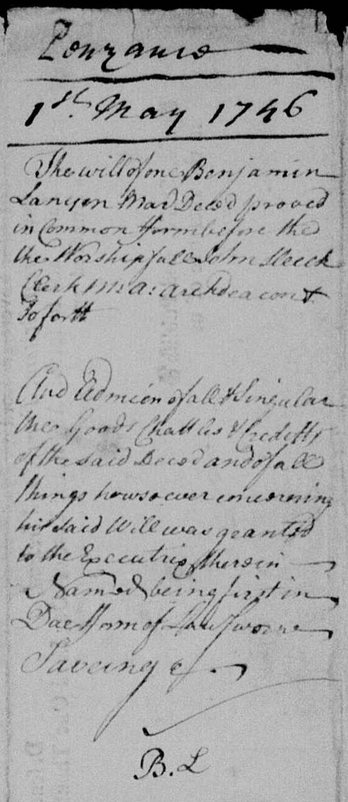
We know that Benjamin was a mariner from his will which was proved on 1 May 1746.

In the Name of God, Amen, I Benjn Lanyon Marriner belonging to his Majs. Sloop Lizard being in Bodily health an of……sound and disposing Mind and Memory; and considering the perills and dangers of the seas and other uncertainties of this Transitory Life, do, (for avoiding Controversies after my Decease) make, publish and declare this my last Will and Testament, in manner following: That is to say, first I recommend my Soul to God that gave it, and my Body I comitt to the Earth or Sea as it shall please God to Order; and as for all my Worldly Estate, I give, bequeath, and dispose thereof as followeth: That is to say all my singular such salary wages, trinkets, Bounty Money, Prize money, Fighting Money, short Allowance money and all other—-

Wages, Sum and Sums of Money, Lands, tenements, Goods, Chattles and Estate whatsoever, as shall be any ways due, owing, or belonging unto me at the Time of my Decease, I give, devise, and bequeath the same unto my well Beloved Wife Mary Lanyon of Penzance in the County of Cornwall—-

CRO AP/L/1543

William Lanyon -1763

We don’t know when William was born or the name of his father. We know his mother was called Sarah and she was a widow in 1763 but we can’t place her on the tree with any certainty.

I have an abstract of his will which describes him as a bachelor and seaman of HMS Rochester and he leaves his estate to his mother.

Charles Lanyon 1780-1802

Charles was baptised at Sancreed in Cornwall on 16 May 1780, the son of Richard Lanyon and Mary Nicholas. Like William above, I have an abstract of his administration from Somerset House.

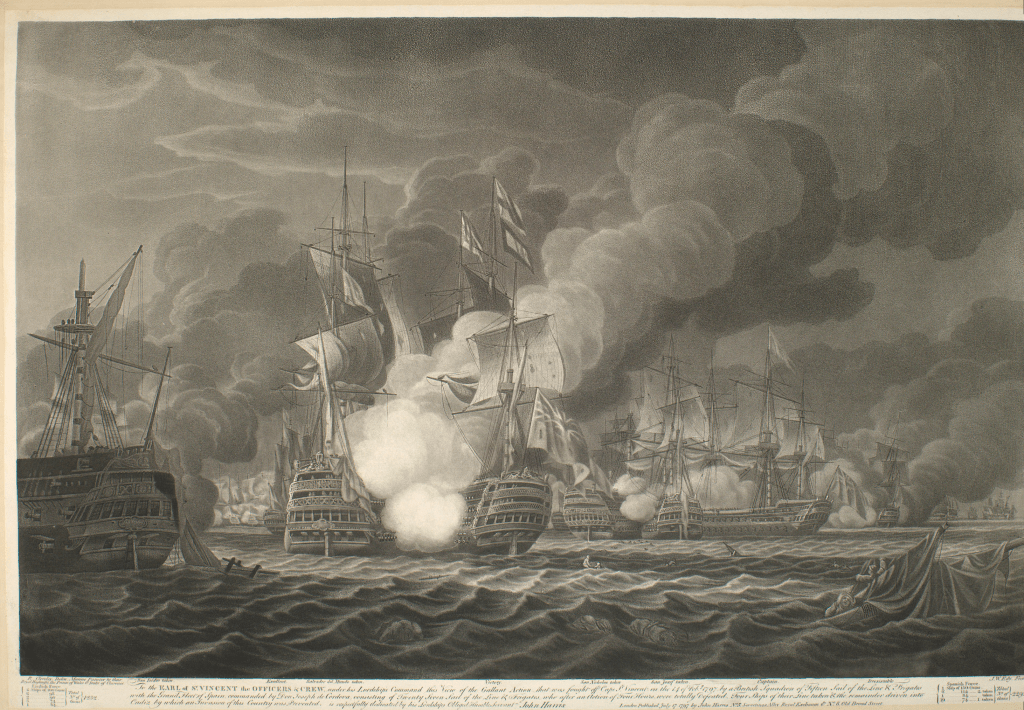
The administration was proved in 1802 and was granted to Charles Lanyon the father. Richard is described as a bachelor, seaman onboard HMS Excellent. HMS Excellent was an active 74-gun, Arrogant-class ship of the line in the Royal Navy. The abstract mentions ‘Asia’ but I can find no connection between HMS Excellent and Asia at this time. In 1802 it was involved with the revolt by the West India Regiment in Dominica and perhaps he was killed in that uprising.

HMS Excellent at the Battle of Cape St Vincent in 1797 (Public Domain)

William Lanyon 1742-1807

William was baptised at St Just in Penwith on 21 December 1742, the son of John Lanyon and Anne Hicks. He was the fifth of seven children and is later described as a tinner. In 1663 he married Sarah Rowe at St Just and they had three children William, Sarah and Anne. His son William was transported to Australia, not once but twice! Sarah died in 1786 and the following year William married for a second time to Jane Colliver at St Ives.

William and Jane had five children but they all appear to have died in infancy.

In 1768 William inherited £20 and ‘one half of Martin Edwards stamps on tenement of Trewellard’. In 1805 his brother John left him 1 shilling in his will.

In July 1807 he drowned at Newquay. We don’t know the circumstances of his death, perhaps he was working as a fisherman?

William Lanyon 1810 – 1831

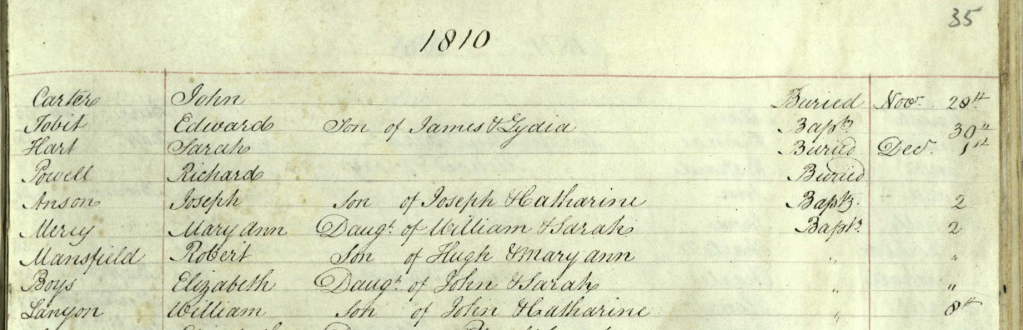
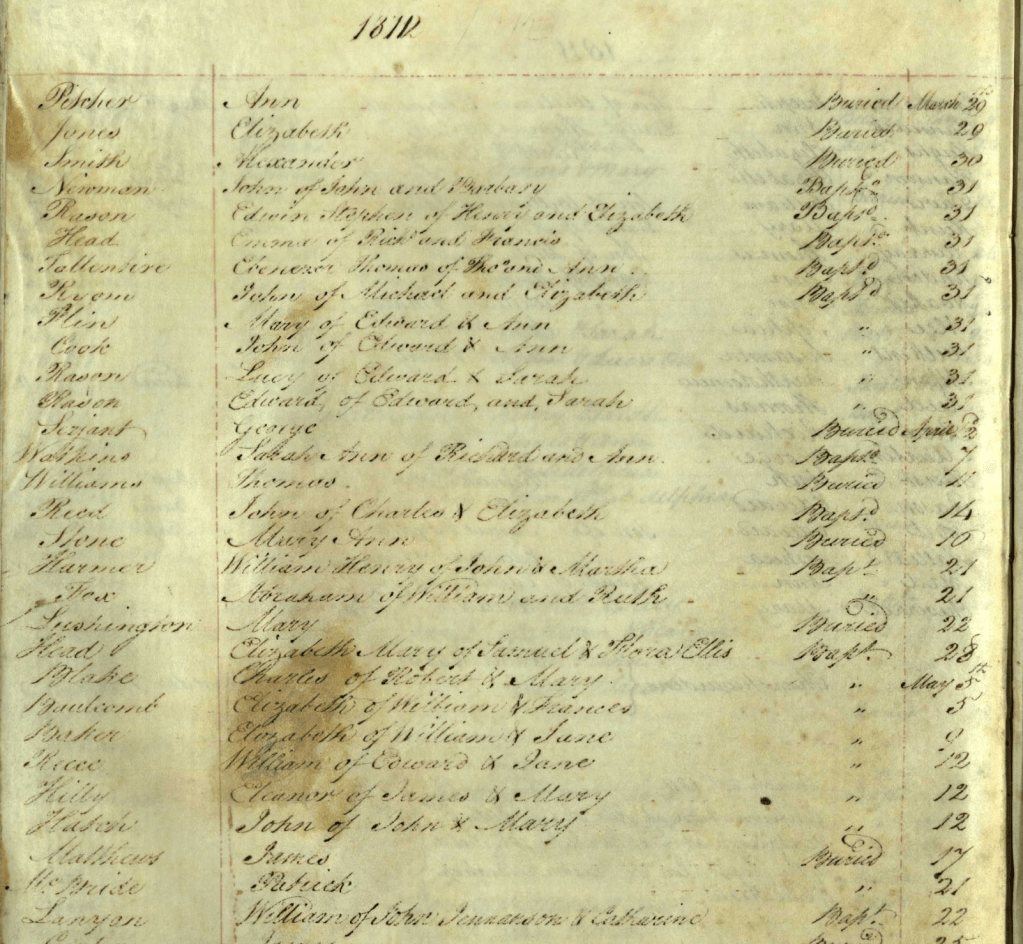
William was the son of John Jenkinson Lanyon, a navy purser and Catherine Mortimer, a socialite. The records at Eastbourne St Mary show that William was baptised on 8 December 1810 and again on 22 May 1811!

Eastbourne St Mary Parish Register 1810
Eastbourne St Mary Parish Register 1811

It is possible that the first William was baptised when his mother was pregnant, died, and then the second child was also baptised William.

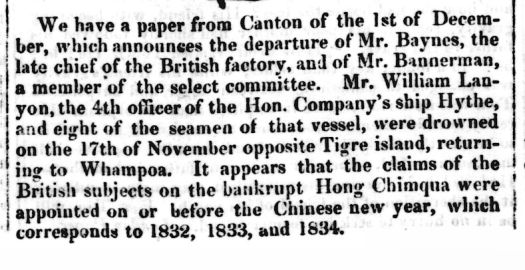
William worked for the East India Company and drowned on 17 November 1831 at Canton in China.

Belfast Commercial Chronicle 5 May 1832

William’s older brother John Hamilton Mortimer Lanyon emigrated to Australia and founded Lanyon homestead at Canberra, one of Australia’s most important historic properties. Charles his younger brother was the famous Belfast architect.

John Lanyon 1797 – 1840

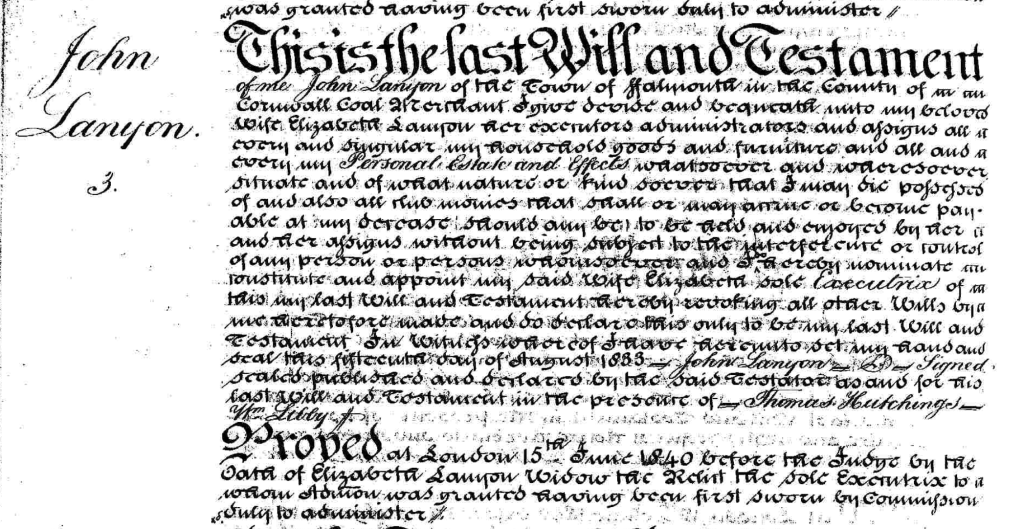
I found John’s will long before I could place him on the tree. His will was proved in 1840 so it was easy to find his death certificate.

Death certificate of John Lanyon

His will mentions his wife Elizabeth.

NA PROB 11/1929/125

The Royal Cornwall Gazette 3 April 1840 reported:-

On Thursday the 26th ult. as Mr. Lanyon, grocer and coal-dealer, of Falmouth, was going across the harbour to St. Mawes, in a small punt, she was upset by a sudden squall, just off the mouth of St. Mawes creek, and sunk. We regret to state that Mr. Lanyon was drowned; but a little boy 13 years of age, called Gilbert, who was with him, swam towards the shore, and after being in the water a considerable time, was picked up by a boat from St. Mawes, the accident having been seen from that place. The body was not found till Saturday morning.

I had all this information about John Lanyon but struggled to place him on the tree. He married Elizabeth Philp on 31 July 1832. I knew he was born abt. 1797 from the age declared on his death certificate. The only baptism I could locate for 1797 was for John son of John and Ann Lanyon at Gwennap in Cornwall but how they fit onto the tree is as yet unknown.

Sophia Lanyon 1826 – 1847

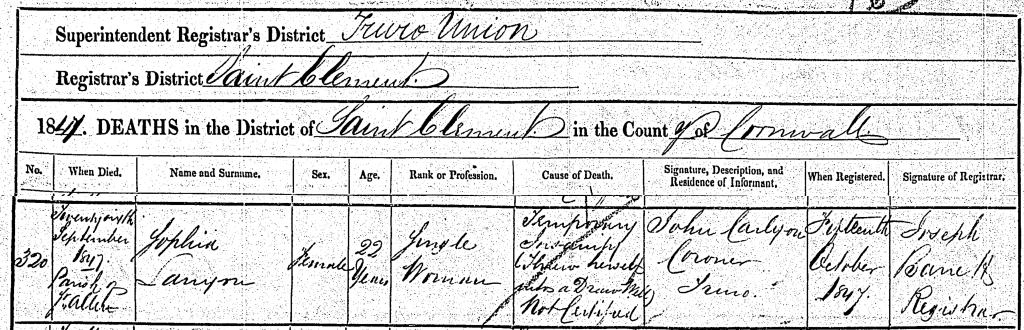
Sophia was one of fourteen children born to John Lanyon and Peggy Vincent of St Allan, Cornwall. She was baptised on 19 February 1826. We know nothing of her life apart from the manner of her death. On 26 September 1847 she committed suicide by throwing herself down a well whilst suffering from temporary insanity.

Sophia’s death certificate

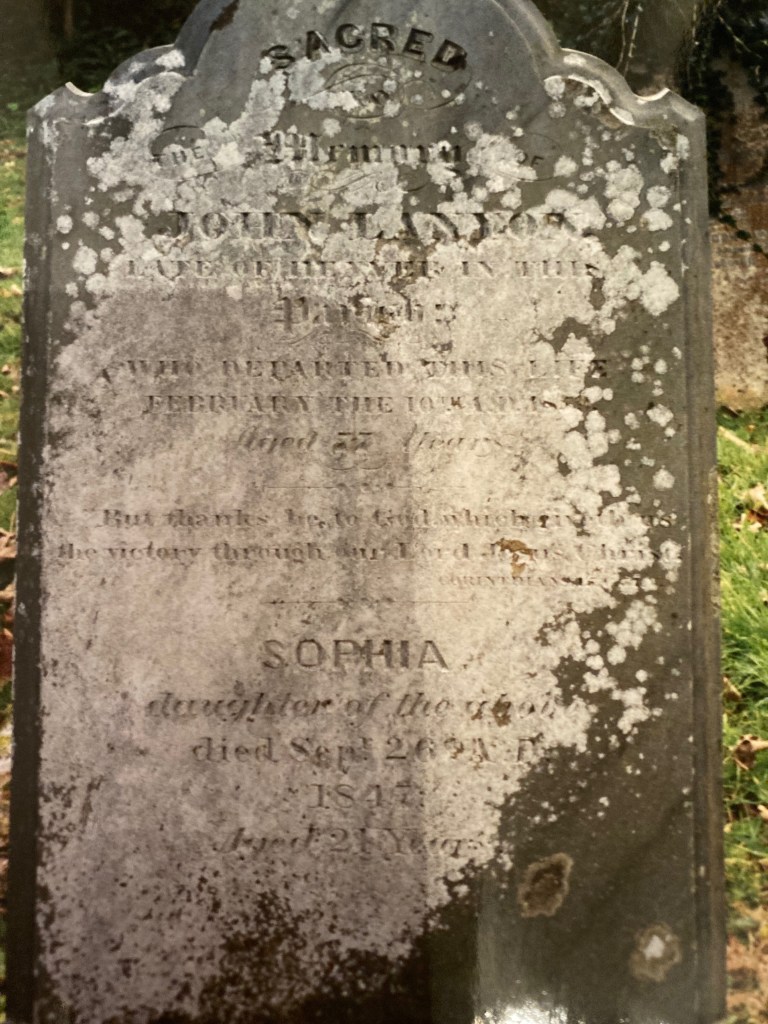
She shares a grave with her father John.

Grave of John and Sophia Lanyon at St Allan Church

Elizabeth Mary Lanyon 1829 – 1858

Elizabeth was baptised 10 August 1829 in Guernsey, Channel Islands, the daughter of William Clothier and Harriette Baptiste. She married James George Lanyon, a cordwainer, who was originally born in Liskeard but moved to St Peter Port in Guernsey.

They had six children together, the last born in 1857. In 1858 Elizabeth drowned on a boat trip to the island of Herm.

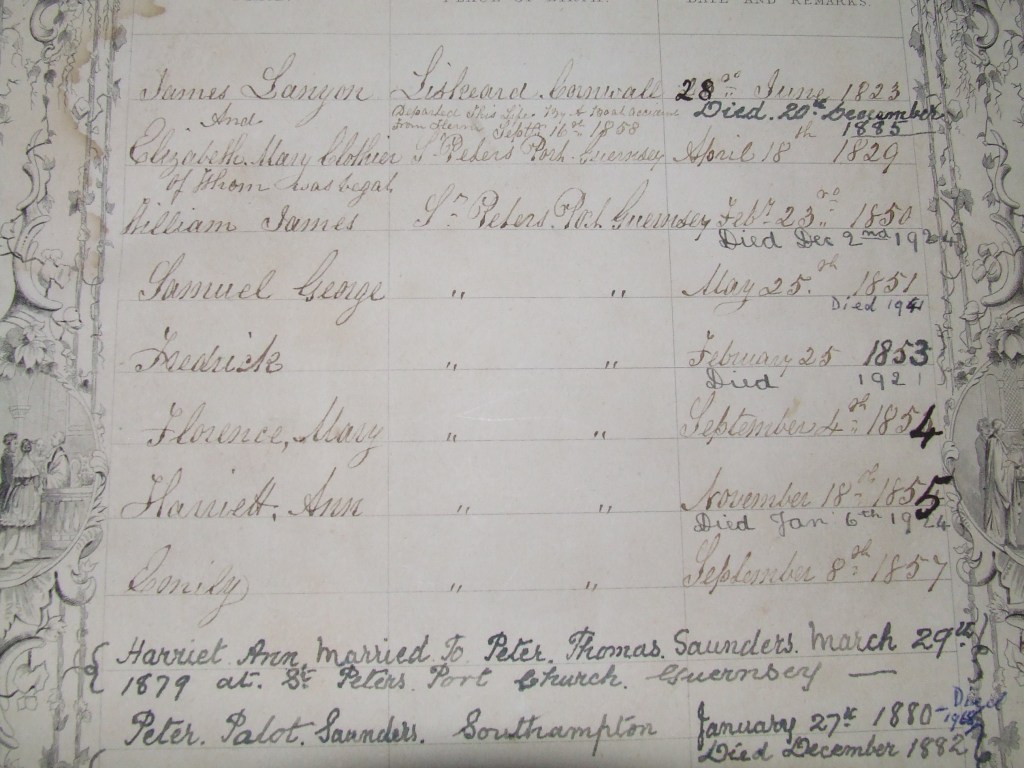
The Guernsey Lanyon family bible lists James and Elizabeth and their children.

Lanyon family bible

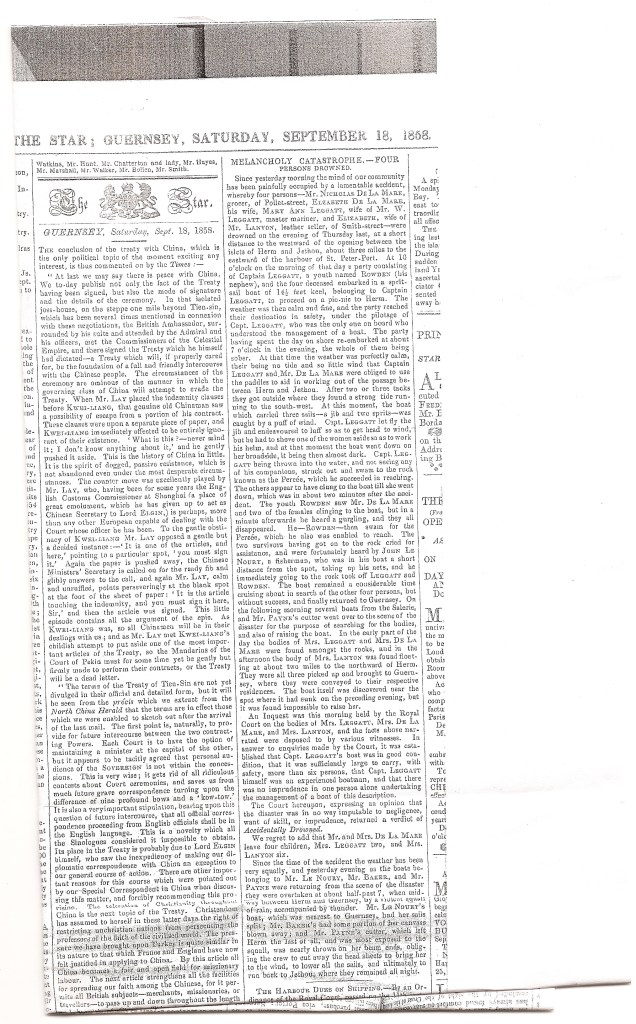
The Star newspaper reported the incident.

The Star 18 Sep 1858

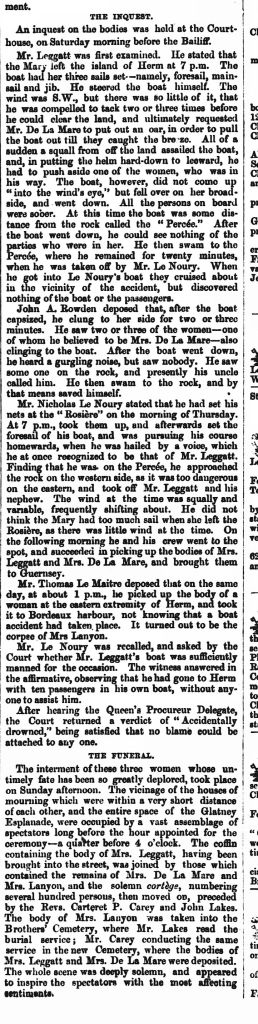
An inquest was held and The Jersey Independent and Daily Telegraph reported it:-

Jersey Independent

James married again to Martha Anna Collings and went on to have a further seven children.

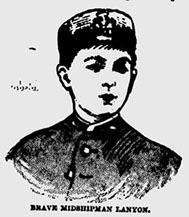
Herbert Marsden Lanyon 1876 – 1893

Herbert was the son of Herbert Owen Lanyon and Amelia Hind. He was born 14 August 1876 at Belfast in Ireland. He joined the navy in 1891 and was training to be a midshipman. In 1892 he was sent to the Mediterranean Squadron to HMS Victoria where he was appointed ADC to Capt, the Hon Maurice A Bourke. The Victoria was the flagship of the Mediterranean Squadron and was commanded by Admiral Tryon.

Herbert Marsden Lanyon

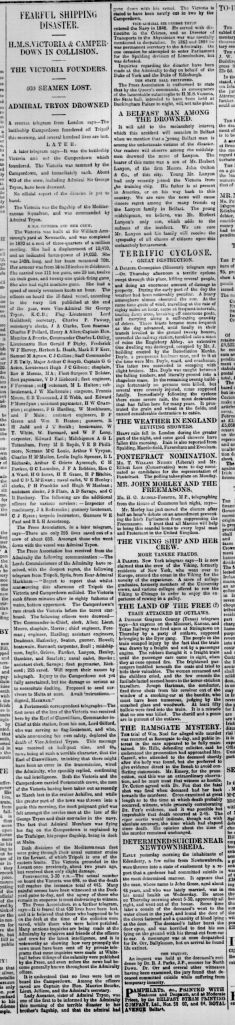
On 22 June 1893 HMS Victoria was in collision with the Camperdown and went down off Tripoli with the loss of Admiral Tryon, Herbert and nearly 400 others. Herbert was actually on the bridge at the time of the collision. (A Book of Heroes by Alfred H Miles.)

Ulster Echo 23 Jun 1893

No lives were lost on the Camperdown and she managed to dock in Malta.

Titanic

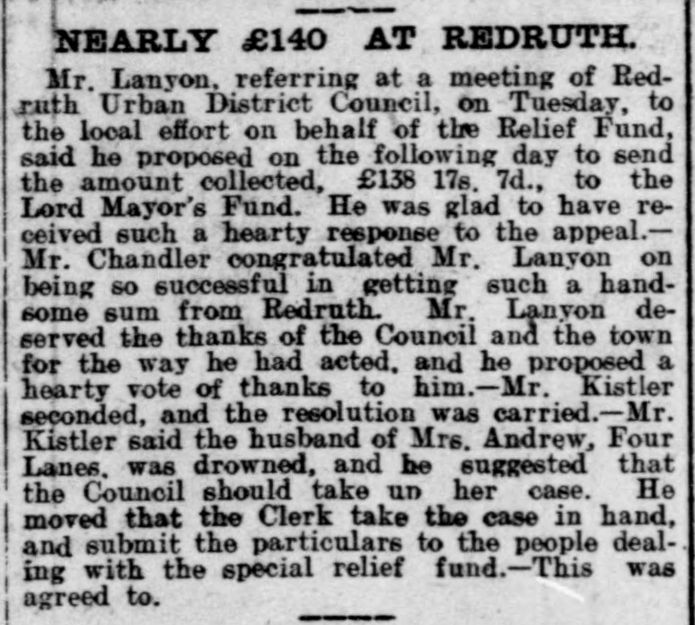
I even found a distant connection to the Titanic disaster in 1912. A Mr Lanyon collected almost £400 at Redruth for the Titanic Relief Fund. I have no idea which Mr Lanyon this refers to as there are several in this area at this time.

West Briton and Cornwall Advertiser 30 May 1912

Sydney Howard Lanyon 1864 – 1914

Sydney was born in Croydon in 1864 the son of John Charles Lanyon and Jane Stacey Bennett. His father was a successful businessman but Sydney doesn’t seem to have inherited any of his business acumen. He failed at Cambridge and suffered with severe eczema. He was even rejected by the army.

On 24 October 1914 he committed suicide by jumping off Westminster Bridge, in front of his nephew Noel Hindley. His body was found at Rotherhithe on 4 November.

His inquest was reported in the papers:

On Thursday an inquest was held at Rotherhithe on Sidney Lanyon, 50, of independent means, who was found in the Thames off the Canada Wharf, Surrey Commercial Docks, on Wednesday. Arthur Lanyon, merchant, of Brighton, identified the body as his brother, who was living at the Langham Hotel, Portland-place at the time of his death. He knew of nothing that was worrying him ; he had plenty of money. He left the hotel on Oct. 24th, and nothing was known of his movements since. P. S. 50 Thames, who found the body in the river, said deceased was fully dressed, and there were no marks of violence. Doctor Macaulay said death was due to suffocation from drowning. An open verdict was returned.

J Lanyon

I cannot identify which Lanyon this story refers to but it must be included in this post.

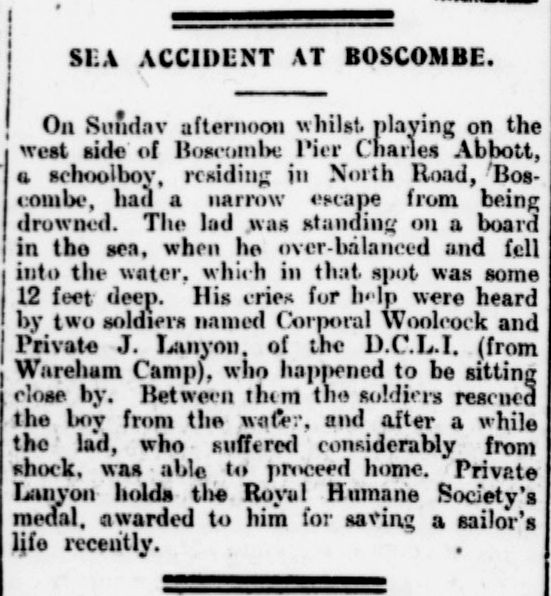
He was a private in the Duke of Cornwall’s Light Infantry and The Swanage and Wareham Guardian reported that on 19 June 1915 that he and Corporal Woolcock rescued a drowning boy at Boscombe.

The Swanage and Wareham Guardian

The most remarkable thing is that J Lanyon already possessed a Royal Humane Society medal for saving a sailor’s life!

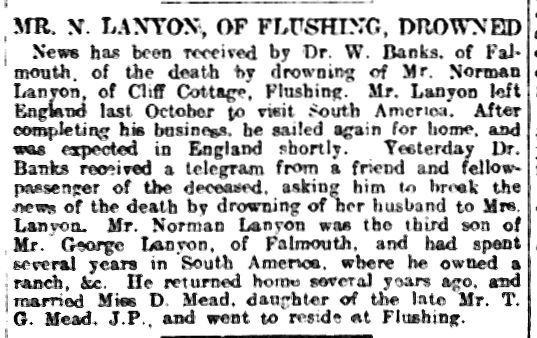
Norman Lanyon 1869 – 1917

Norman was born on Christmas day 1869, the son of George Lanyon and Ida Crisp.

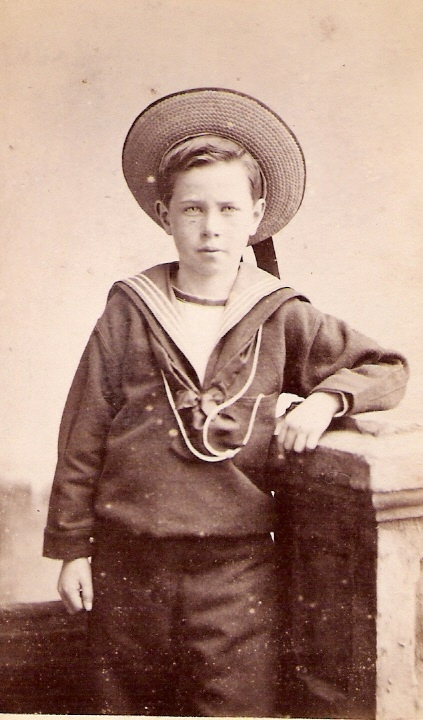
Norman pictured wearing his sailor outfit

In 1917 Norman was shipwrecked in the English Channel when the boat he was travelling home in was hit by a torpedo.

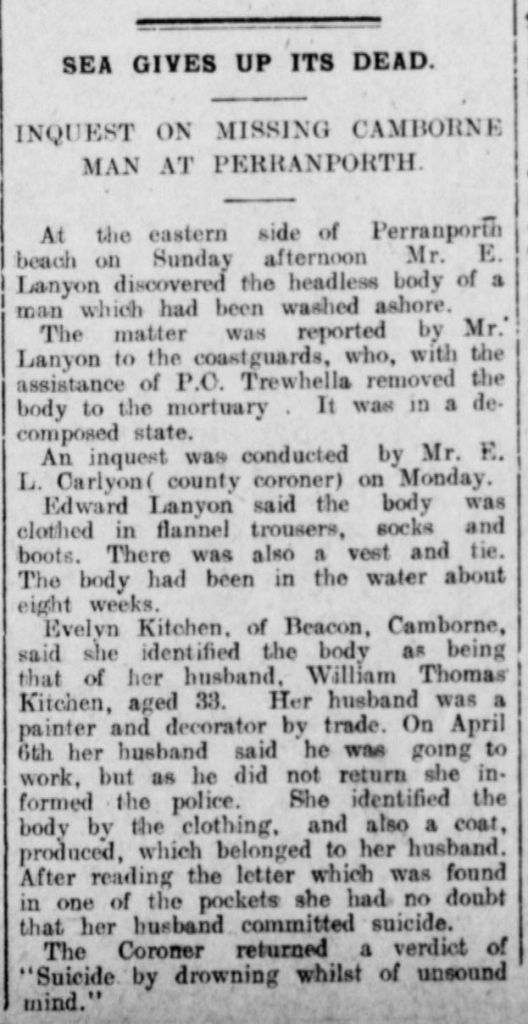
Edward Lanyon

In 1927 Edward Lanyon found a headless body on the beach at Perranporth, Cornwall. I haven’t been able to work out which Edward Lanyon this is.

St Austell Gazette 18 May 1927

John Henry Lanyon 1880 – 1935

John was born in Guernsey in 1880, the son of James George Lanyon and Martha Anna Collings. James lost his first wife Elizabeth in a boating accident so perhaps he made sure all his children could swim.

In 1931 John rescued a boy drowning in a river in Lincoln and was awarded a Royal Humane Society medal.

Lincolnshire Echo 1935

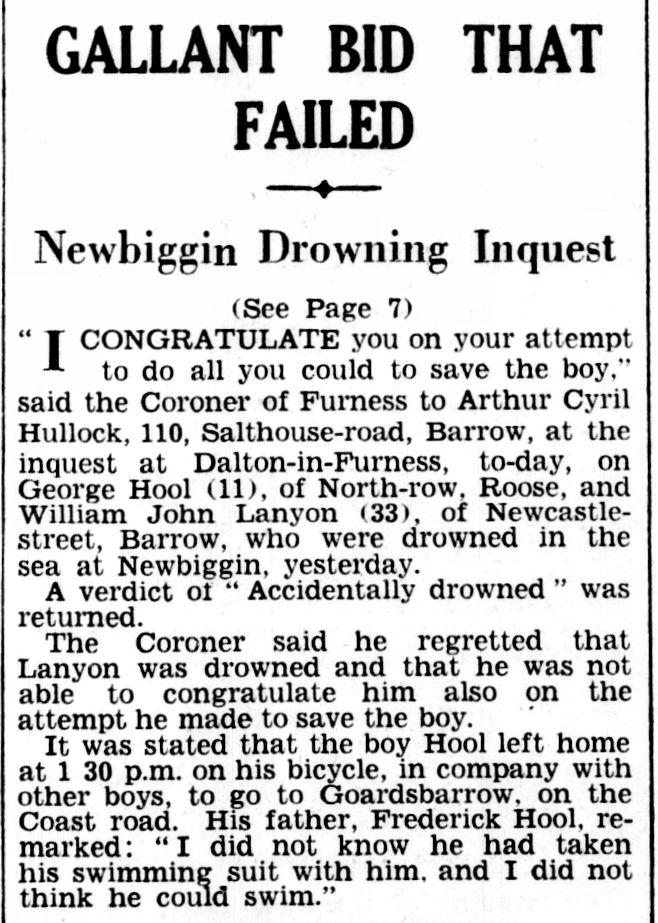
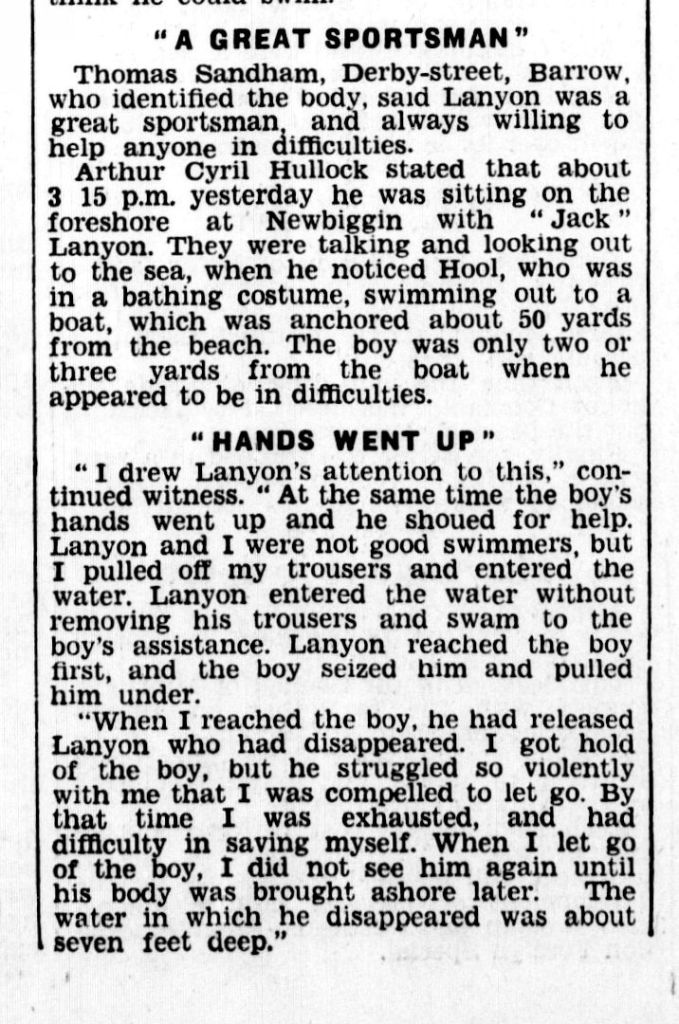
William John (Jack) Lanyon 1904 – 1937

William was born in Barrow-in-Furness, the son of George Henry Lanyon and Hannah Fanny Prouse. The 1921 census describes him as an apprentice plater at Vickers naval construction works.

In 1937 he died whilst trying to rescue a drowning child.

Lancashire Evening Post 11 Aug 1937
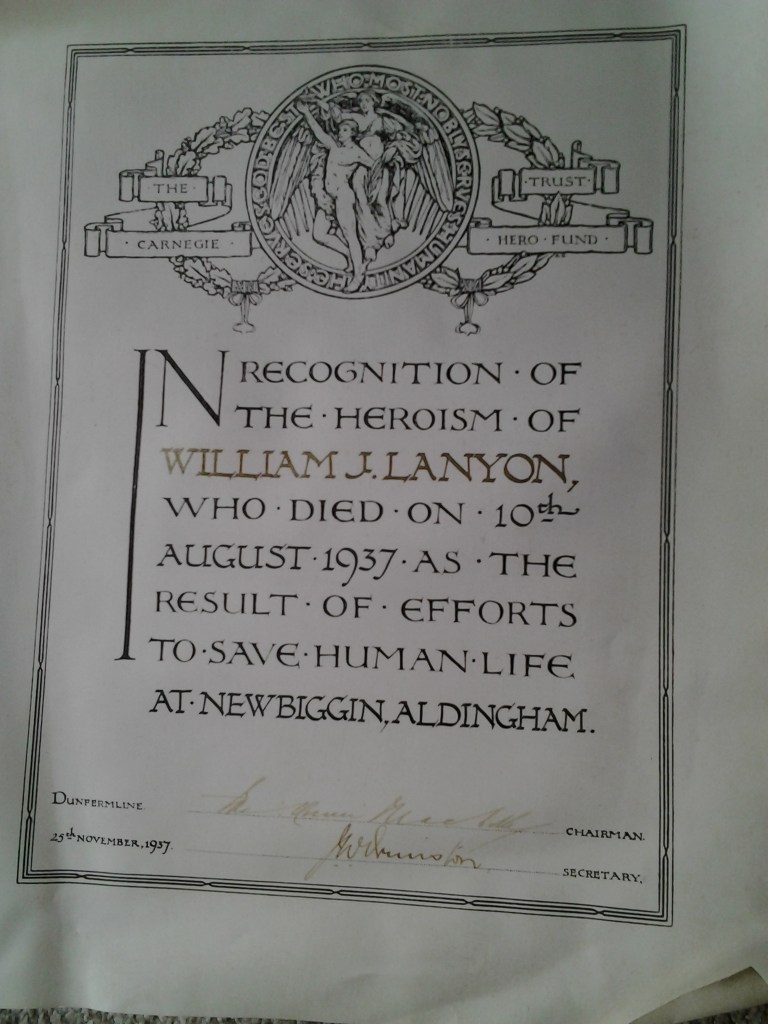
Jack’s bravery certificate.

And finally a puzzle!

In 1943 a William Lanyon of Bath was found floating in Bristol harbour.

Bath Chronicle and Weekly Gazette 3 April 1943

The newspaper helpfully reported his age so I thought it would be fairly straightforward to identify him and where he belonged on the tree. I was wrong!

You can follow my search for William in a separate post, ‘Lanyon or Lannin?’

Fined 6 pence

Whilst exploring the National Archives catalogue I came across an extract from the Lostwithiel Sessions which opened a really complicated can of worms!

On 11 January 1781 Richard Lanyon and his wife, Elizabeth, charged with assault against Sarah Bishop, base child of Richard Lanyon, changed their plea to guilty and were fined 6d each. (Source – QS/1/4/292-298)

That was the first mention of Richard Lanyon’s illegitimate daughter, I had to find out more!

It didn’t take long to find the baptism of Sarah Lenyne Bishop at Newlyn East on 14 March 1774, the base daughter of Mary Bishop. Assuming that Sarah was baptised shortly after her birth that would make her just 6 or 7 at the time of the assault. At a time when it was common for children to be chastised this must have been far more serious to lead to an actual charge of assault.

Who was Richard Lanyon?

He was baptised on 1 January 1749 at St Allen, the son of John Lanyon (Lanion) and Sarah Straight. John and Sarah had six children: Margaret 1736-1802, John 1740-1771, William 1743-1763, Richard 1746-1747, Richard 1749-1838 and Henry 1752-1838. The three surviving children married into the Searle family. Margaret married John Searle and Richard and Henry married two sisters, Elizabeth and Mary Searle.

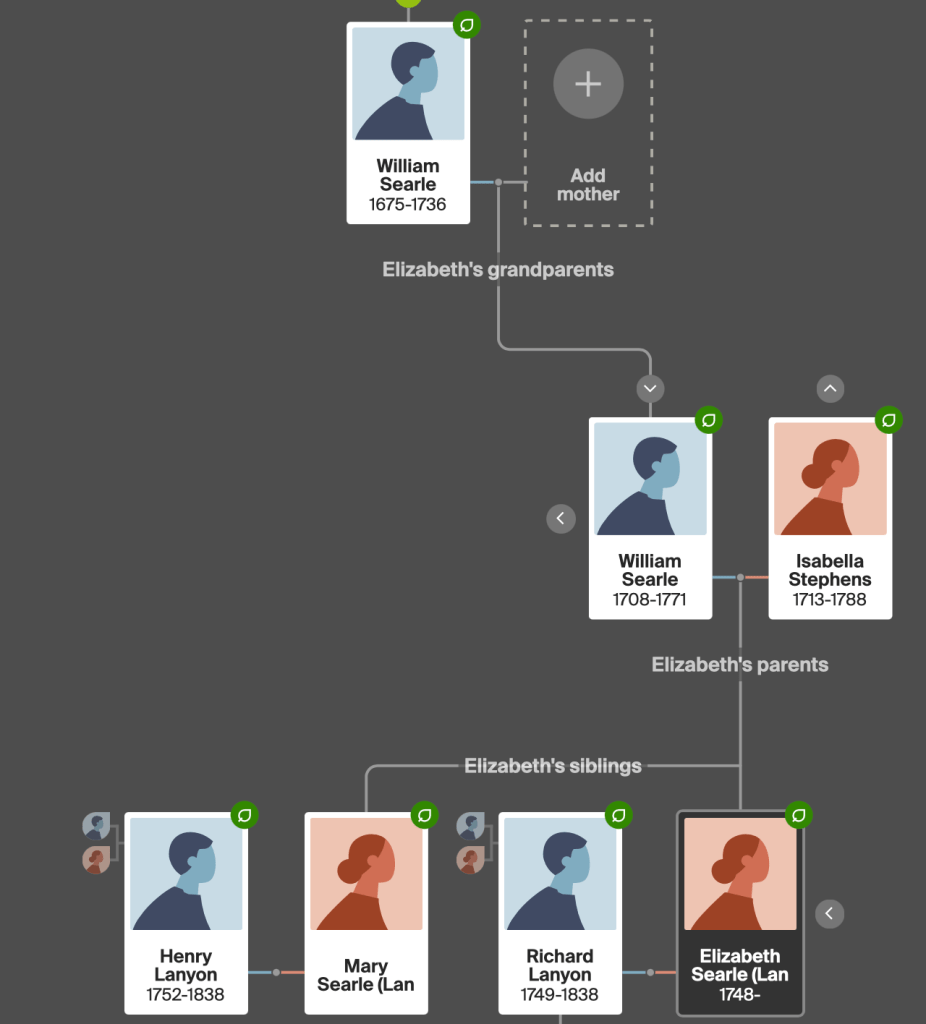
Elizabeth and Mary Searle were the children of William Searle and Isabella Stephens. William Searle jr was the son of William Searle 1675-1736.

The Searle Tree

Richard Lanyon was a yeoman and his mother, Sarah Straight (Lanyon) bought the farm Polstain, at Zelah near St Allen, for him. He later bought the farm Lanner. On 18 April 1774, just four months after his illegitimate daughter Sarah was baptised, he married Elizabeth Searle at St Allen. He and Elizabeth had 10 children. Elizabeth died in 1825 and in 1827 Richard married again to a widow, Catherine Charles. He died on 17 February 1838 at the age of 89.

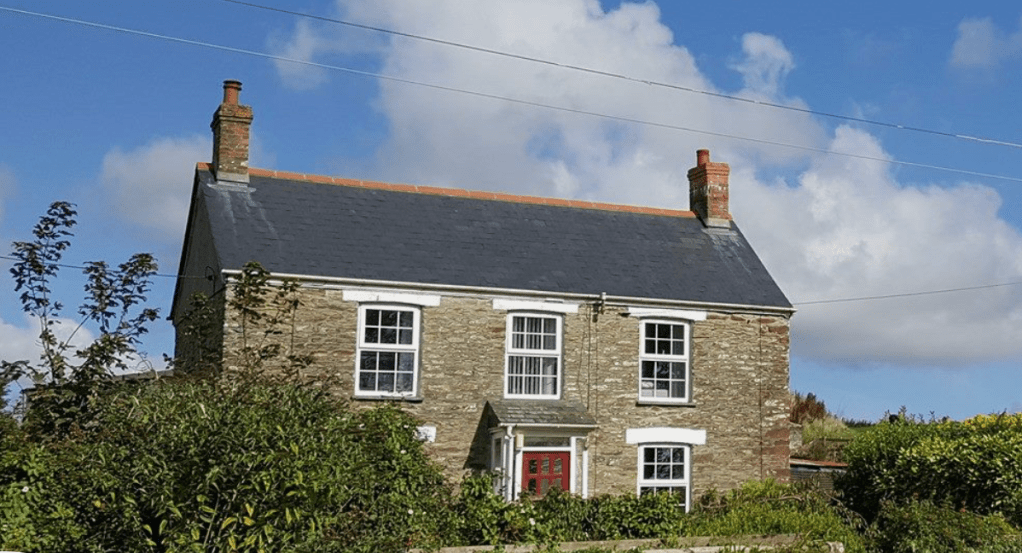
Polstain still exists today.

Polstain Farm

So why is this a ‘can of worms’?

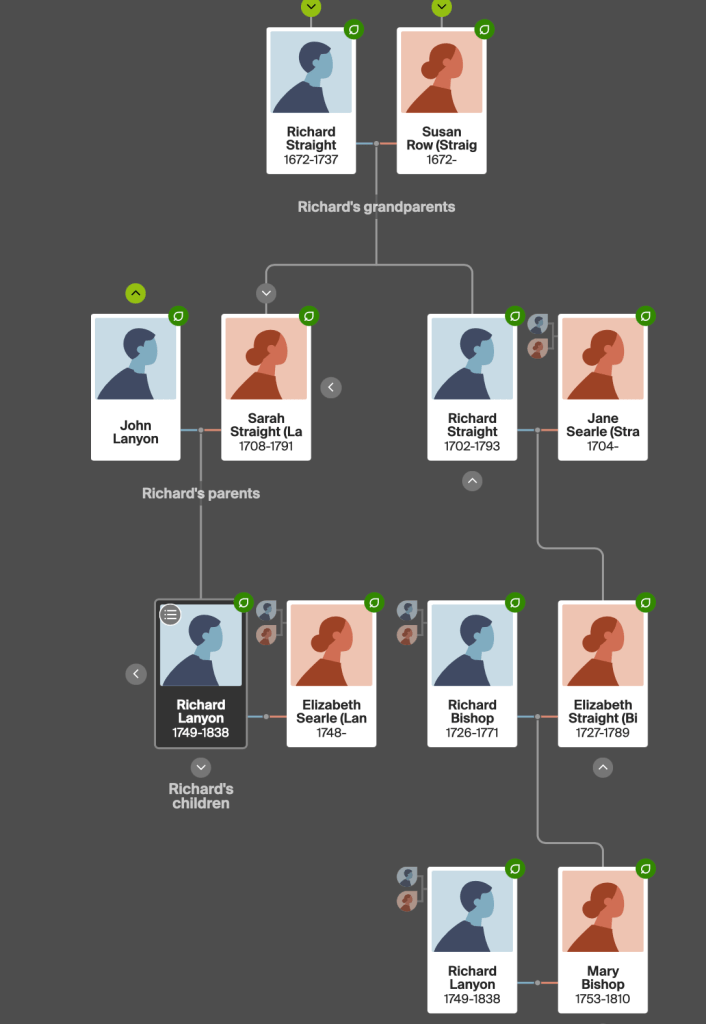
Richard Lanyon’s mother, Sarah Straight was the sister of Mary Bishop’s grandfather, making Richard and Mary first cousins, once removed. The family connections don’t end there.

Poor old Ancestry’s family tree templates can’t quite cope with that! Richard appears twice!

Straight family tree

But it gets even more complicated because Mary Bishop’s grandmother is Jane Searle (Straight) 1704- and Jane was the sister to Richard Lanyon’s father-in-law, William Searle 1708-. So Mary Bishop’s granny was Elizabeth Searle (Lanyon)’s aunt!

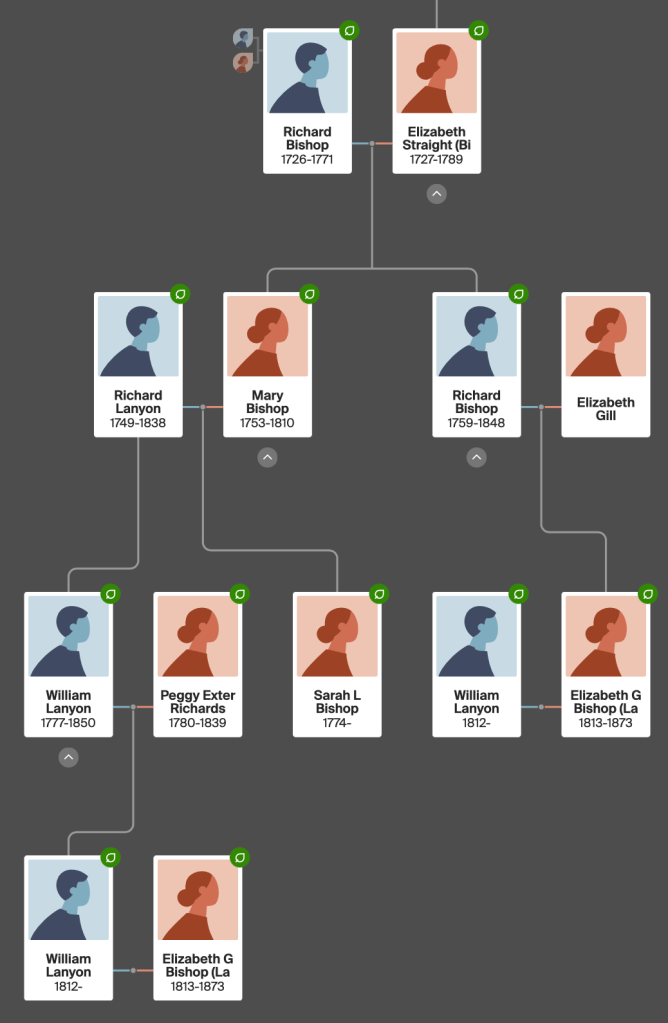
To complicate things further Mary Bishop had a brother called Richard (1759-1848) and Richard Bishop married Elizabeth Gill. Their daughter Elizabeth Gill Bishop married William Lanyon, the grandson of Richard Lanyon and Elizabeth Searle!

Bishop, Lanyon, Gill Tree

So that’s all clear then?

So what of Sarah Lenyne Bishop?

Her existence can’t have been a secret, the whole family are interrelated and must surely have known about Mary Bishop’s illegitimate child. When Sarah was born Richard Lanyon was unmarried, why did he not marry Mary? We’ll never know.

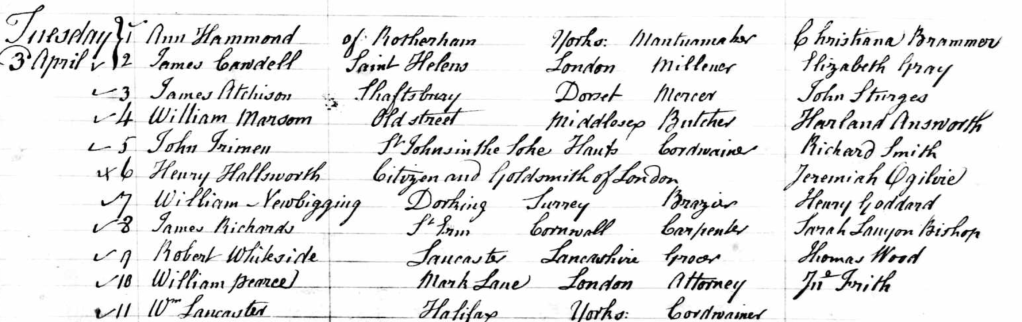
We’ll also never know the reason for the assault but just a few months after the Lostwithiel Sessions Sarah Lanyon Bishop was apprenticed to James Richards of St Erme, a carpenter. Did Richard Lanyon pay for her apprenticeship?

Apprenticeships Tuesday 3 April 1781

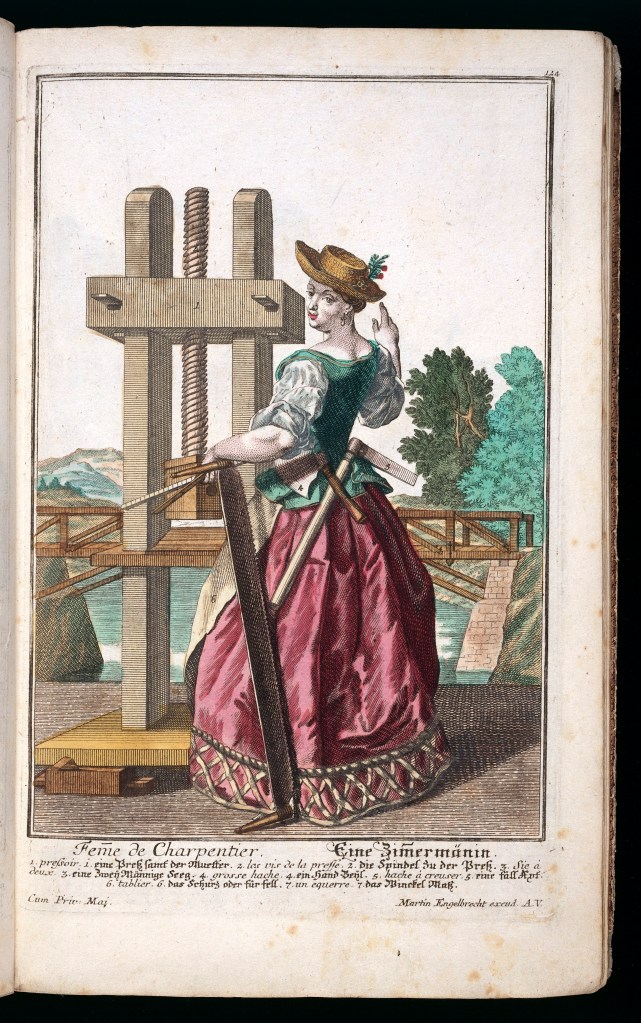
Carpentry is an unusual job for a girl but not completely unknown, the other female apprentices were training to become mantua-makers and milliners, why did Sarah end up as a carpentry apprentice?

Is there a family connection between the Lanyons and Richards families? Richard Lanyon’s son William married a Peggy Exter Richards, could she be related to James of St Erme? That’s a question for another day!

L0038569 Feme de Charpentier, A female Carpenter
Credit: Wellcome Library, London. Wellcome Images
images@wellcome.ac.uk
http://wellcomeimages.org
Feme de Charpentier, A female Carpenter with tools costume and apparatus
Coloured engraving
18th Century By: Martin Engelbrecht50 coloured plates / engraved by Martin Engelbrecht, from 18th-cent. German works.
Published: c. 1721

Copyrighted work available under Creative Commons Attribution only licence CC BY 4.0 http://creativecommons.org/licenses/by/4.0/

Sadly we don’t know what happened to Sarah. There is no trace of a Sarah Lanyon/Lenyne Bishop marrying or being buried in England. There are lots of Sarah Bishops the name is quite common and it’s not possible to prove if any of them is our Sarah Bishop.

Sarah’s mother, Mary, died unmarried in 1810 at Newlyn East. She was buried on 4 August.

Richard Lanyon left a will but there is no mention of Sarah. His estate was valued at under £300.

Medieval Soldier

Family historians are always looking for new sources of information so I was delighted to find the site medievalsoldier.org which has lists of lots of medieval soldiers. I searched and found one relevant entry:

William Lanyen – Man at arms naval service, serving under Hugh Courtenay, the Earl of Devon (ref: 14180500) this gives us the year 1418.

William was listed on a muster roll held at the National Archives ref: E101/49/34 m.8

So who was William Lanyen and where does he fit on the tree? If he was fighting in 1418 he could have been born sometime during the period 1380 to 1400 and the tree at that time is a little complicated.

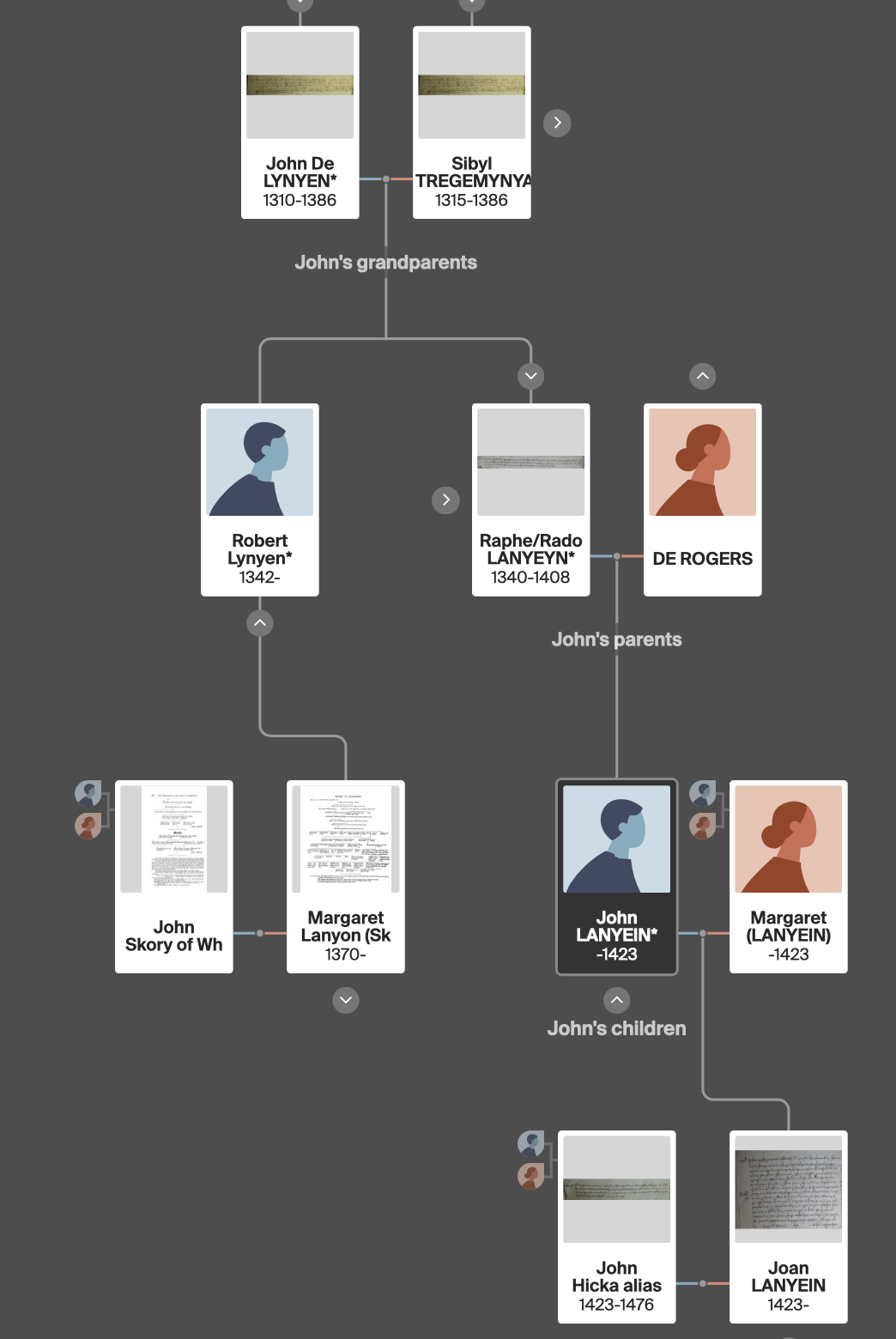
Raphe/Radolphus Lanyeyn was born abt. 1340 and died after 1408. We know his wife was from the de Rogers family, but not her first name. The source for that was a letter from Jane Veale Mitchell to Edward Bullmore: “….in the Rolls Office Chancery Lane, a Radolphus Lanyon asks that Tregaminion then in possession of his brother in law de Rogers might have come to him and his descendents because they had no children, written in old french dated 1327.”

We don’t know which roll this information came from or why Raphe’s brother in law was then in possession of the estate called Tregaminion.

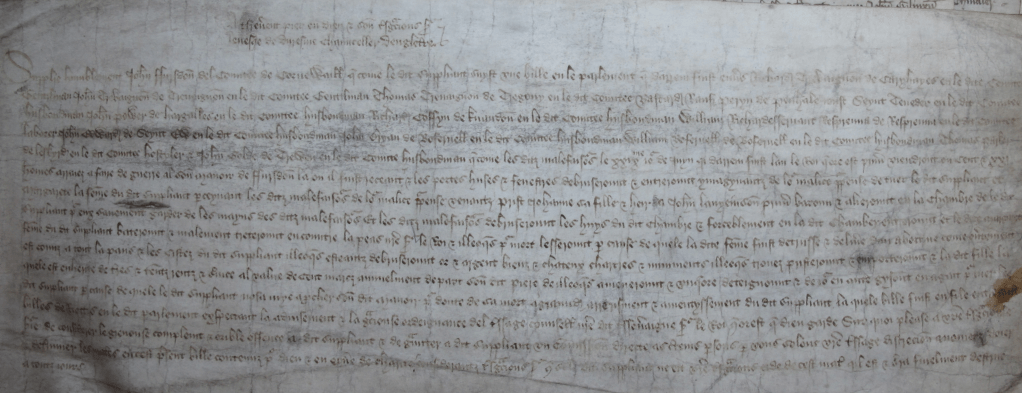
Raphe had a son called John Lanyein who died bef. 1423. His widow Margaret remarried John Fursdon and there is an interesting document: Early Chancery proceedings: C1 Bundle 5/41 which mentions John Fursdon, Margaret and Margaret’s daughter, Joan Lanyein who was born bef. 1423.

Early Chancery proceedings: C1 Bundle 5/41

You can read all about Joan and how she was John Lanyein’s heir, in the post ‘Abduction’. https://thelanyonstree.com/2022/08/17/abduction/

If William Lanyen, our naval man at arms, was born abt. 1380 to 1400 then he would have been a contemporary of John and Joan Lanyein but he can’t have been a brother as surely he would have inherited? Which suggests he must have been a cousin from a cadet branch of the family.

There are no other records of this William and we don’t even know if he survived or was killed during his service in the navy.

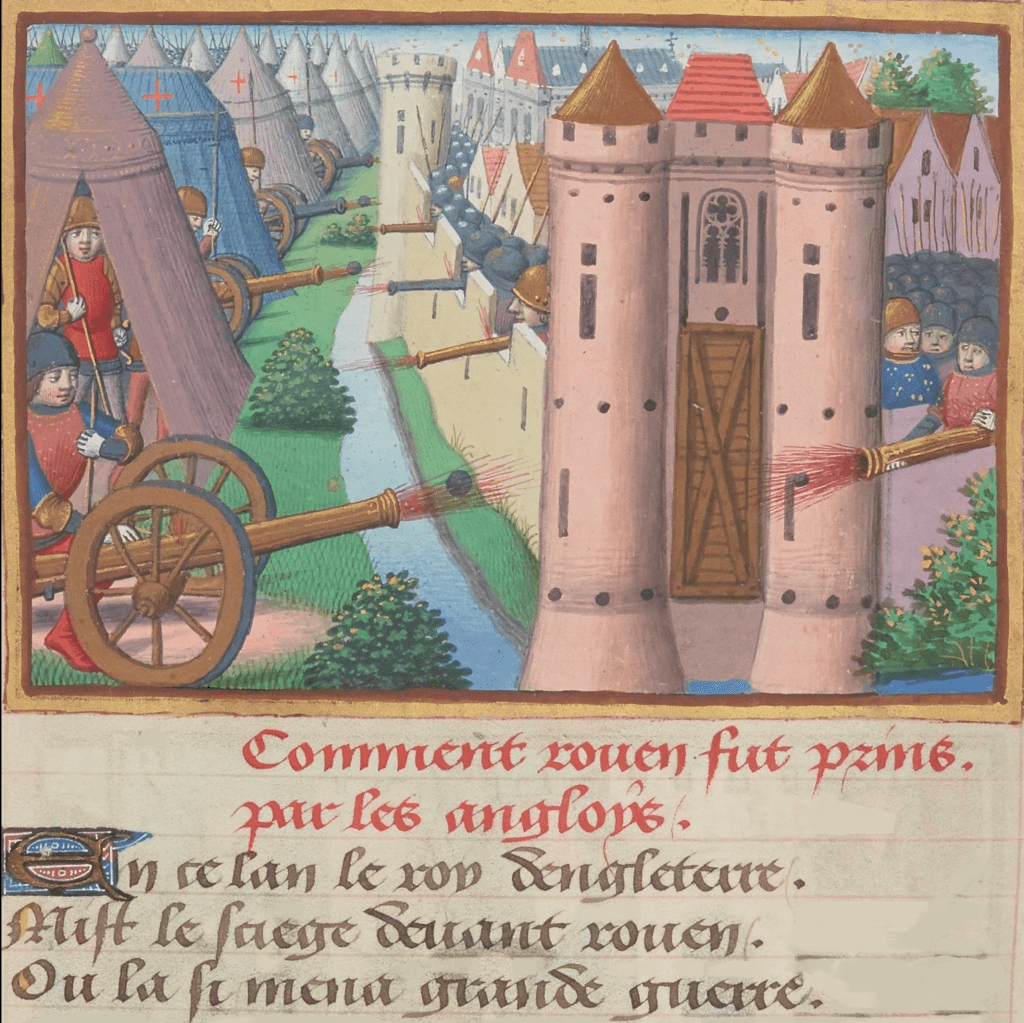
We can however find out a little about the way he lived. In 1415 England defeated the French at Agincourt and in the following years the two countries fought the ‘Hundred Years War’. In 1418 England was laying siege to the city of Rouen, and Rouen could not be taken until the English had control of the sea.

The Siege of Rouen

The southwest—Devon and Cornwall—was one of England’s most important naval regions. The Earl of Devon provided ships and fighting men under contract to the Crown.

Devon & Cornish men were especially valued because they:

  • Were experienced sailors and coastal fighters
  • Knew Channel waters well
  • Were used to defending against Breton and French raids

The siege at Rouen depended on supplies reaching the English and the job of the navy was to escort the ships carrying, food, weapons and horses and to fight off French attackers.

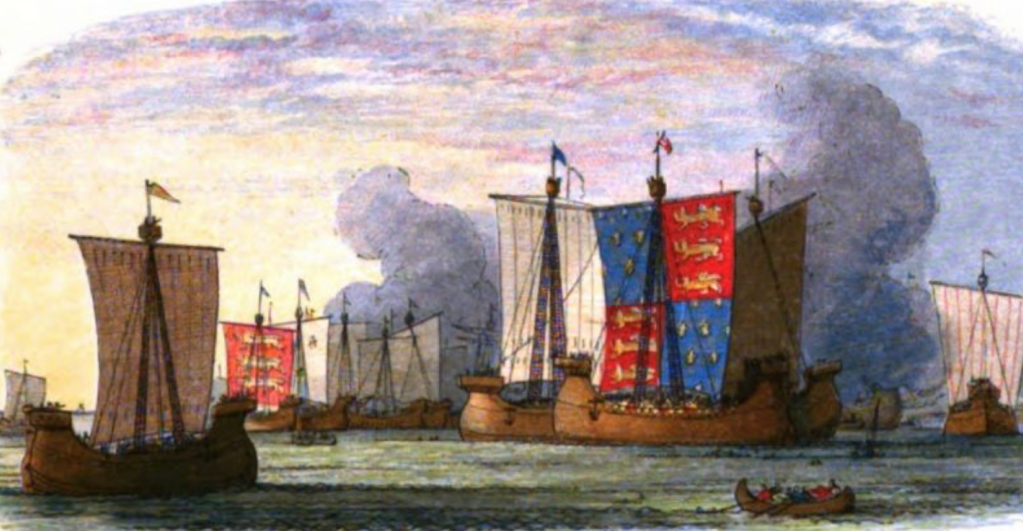
A naval man at arms was not a sailor, he was a soldier. Ships at this time rarely had guns and they fought by grappling the enemy ship and pulling it close enough for the archers to shoot and the men at arms to board and fight the enemy. A man at arms had status greater than an archer but not as high as a knight. Pay was about 12d a day and there was a chance to ransom and loot.

Despite the opportunities to make money it was a very hard life on board. The soldiers often slept outside in the cold and damp and they ate a poor diet. The risk of being killed in action was high and the risk of accidental death for example, from falling overboard whilst wearing chain mail was also high.

Medieval ships fighting

The English ships prevented supplies getting through to Rouen and eventually the city was starved into submission in January 1419.

Ralph Lanyeyn

Family historians are lucky to find a documented legal dispute from the 14th century to help build their family tree. Ralph’s dispute with Princess Joan of Kent gives us valuable information which confirms names and relationships but it’s not the only record available about Ralph.

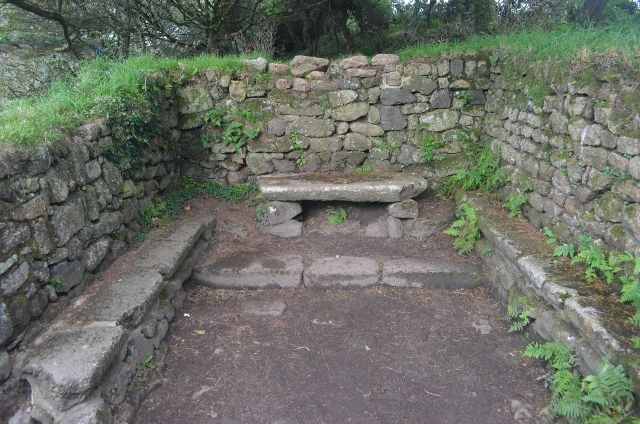
In 1390 the Bishop of Exeter granted a licence to celebrate divine service in the chapel of St Mary at Lanyen in Madron (Lysons 1817). Today the chapel is a ruin but it gives an idea of the size of Ralph’s home, the barton of Lanyon in the late 14th century.

Madron Chapel by Ashley Dace, CC BY-SA 2.0 https://creativecommons.org/licenses/by-sa/2.0, via Wikimedia Commons

There are also three records in the Court of Common Pleas which relate to Ralph.

CP40/561 Easter 1401. Roger Boswarneth sues Ralph Lanyeyn for a debt.

CP40/589 1408 Ralph Lanyeyn sues Luke de Pensans for detinue (the crime of wrongful detention of goods or personal possessions) for a chest of charters.

CP40/589 1408 Alice Reda sues Ralph Lanyeyn, John Cornyssh, Robert Pensans, Richard Joce (tailor), Ralph Joce, Richard Dere & David Shade for trespass.

At a time when there are no records of baptisms, marriages or burials these records prove that Ralph was still alive in 1408.

I also have a letter from Jane Veale Mitchell to Edward Augustus Bullmore dated 23 Jan 1926 which states:

‘In Rolls Office, Chancery Lane, a Radolphus Lanyon asks that Tregamynyan, then in possession of his brother-in-law de Rogers, might come to him and his descendants, because they had no children. Written in old French, date 1327.’

This throws up a query, is the date 1327 correct? Is it the same Ralph Lanyeyn? The original letter has been transcribed, could the transcriber have got it wrong? It’s possible.

We don’t know when Ralph was born but 1327 seems far too early. If Ralph is married with descendants in 1327 then he is a very great age in 1408!

We know that Ralph’s parents were John de Lynyen and Sibyl de Tregamynion. This is confirmed by the record in Calendar Close Rolls CCR Ric II Vol 30 p.71.

We know that John de Lynyen’s father was David de Kylminawis as CCR Hen IV Vol 4 states that ‘David de Kylmynawis to John his firstborn son and heir, and to the heirs of his body by Sibyl daughter of Jocelin de Tregamynion…’

So where does the Radolphus Lanyon mentioned in Jane’s letter fit in? I haven’t found the original record she mentions but I think the date 1327 must be wrong and that the Radolphus Lanyon she mentions is Ralph Lanyeyn, the son of John & Sibyl. This then gives us the name of his brother-in-law, de Rogers, and leaves us wondering why the property Tregamynion at Morvah should be in his possession?

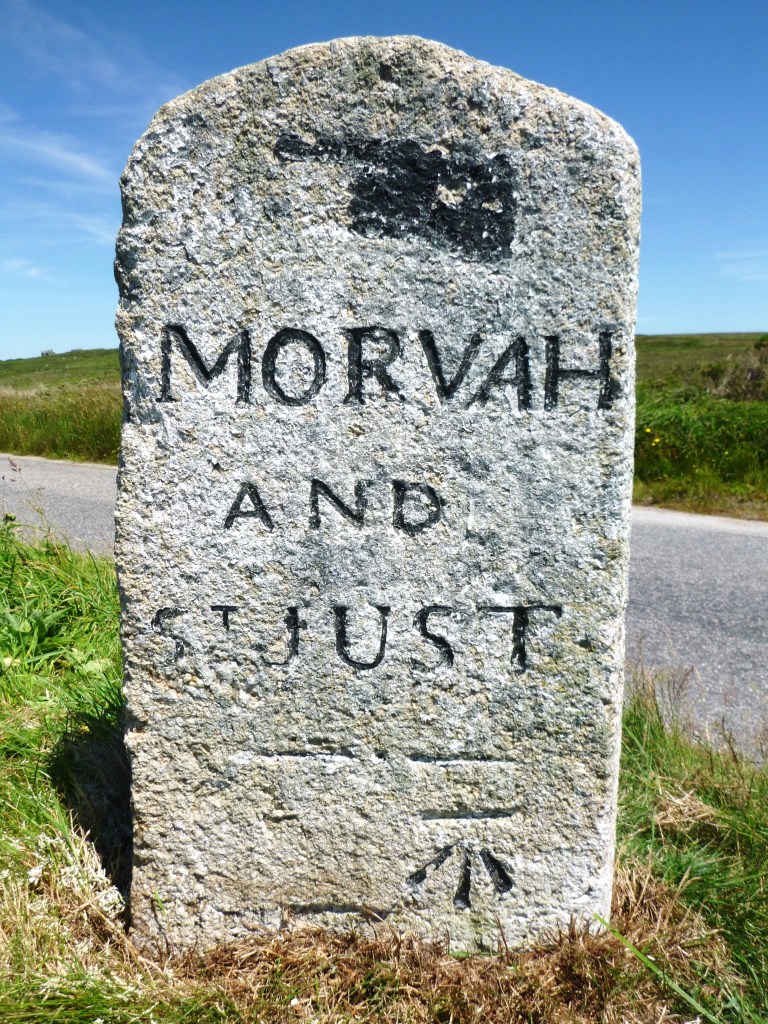
Rosy Hanns / Old Guide Stone on Bosullow Common, south east of Morvah

And that’s the fun of researching your family history, a few records discovered and a whole load of new queries to puzzle over!

Wimbledon

Having just watched the men’s tennis final I’m going to add a post about our slightly tenuous family connection to Wimbledon.

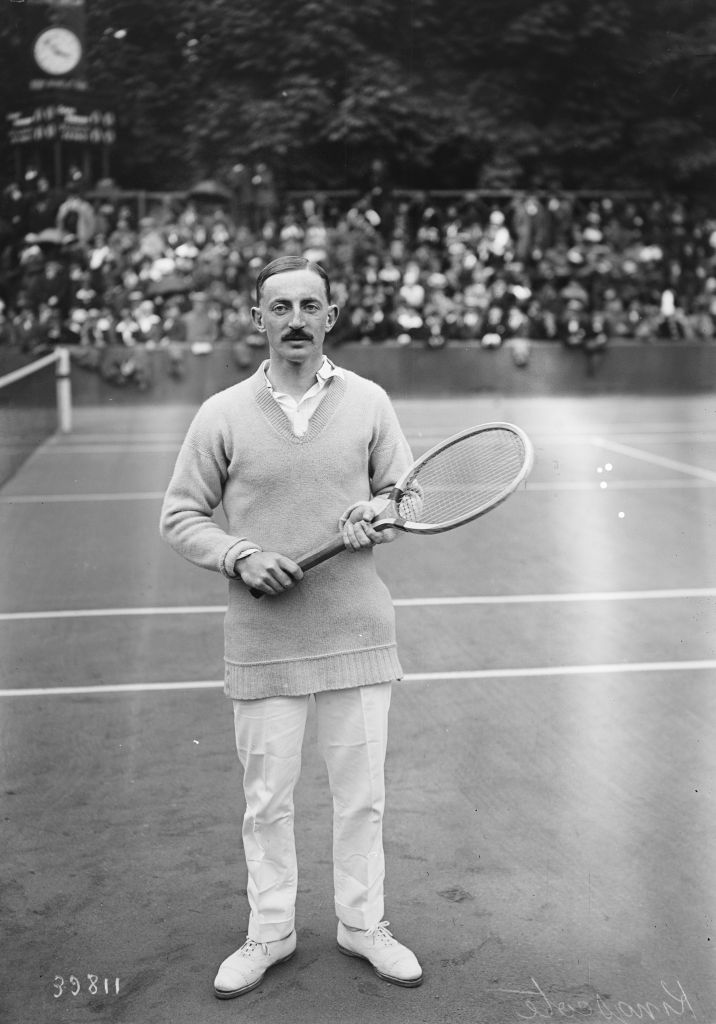
Algernon Robert Fitzhardinge Kingscote was born on the 3 Dec 1888 at Bangalore in India. The son of Howard and Adeline Kingscote. Adeline was the famous author, Lucas Cleeve.

He joined the army, 107th Company Royal Garrison Artillery and during World War I he fought at the First Battle of the Aisne earning the rank of Lieutenant-Colonel and the award of the Military Cross.

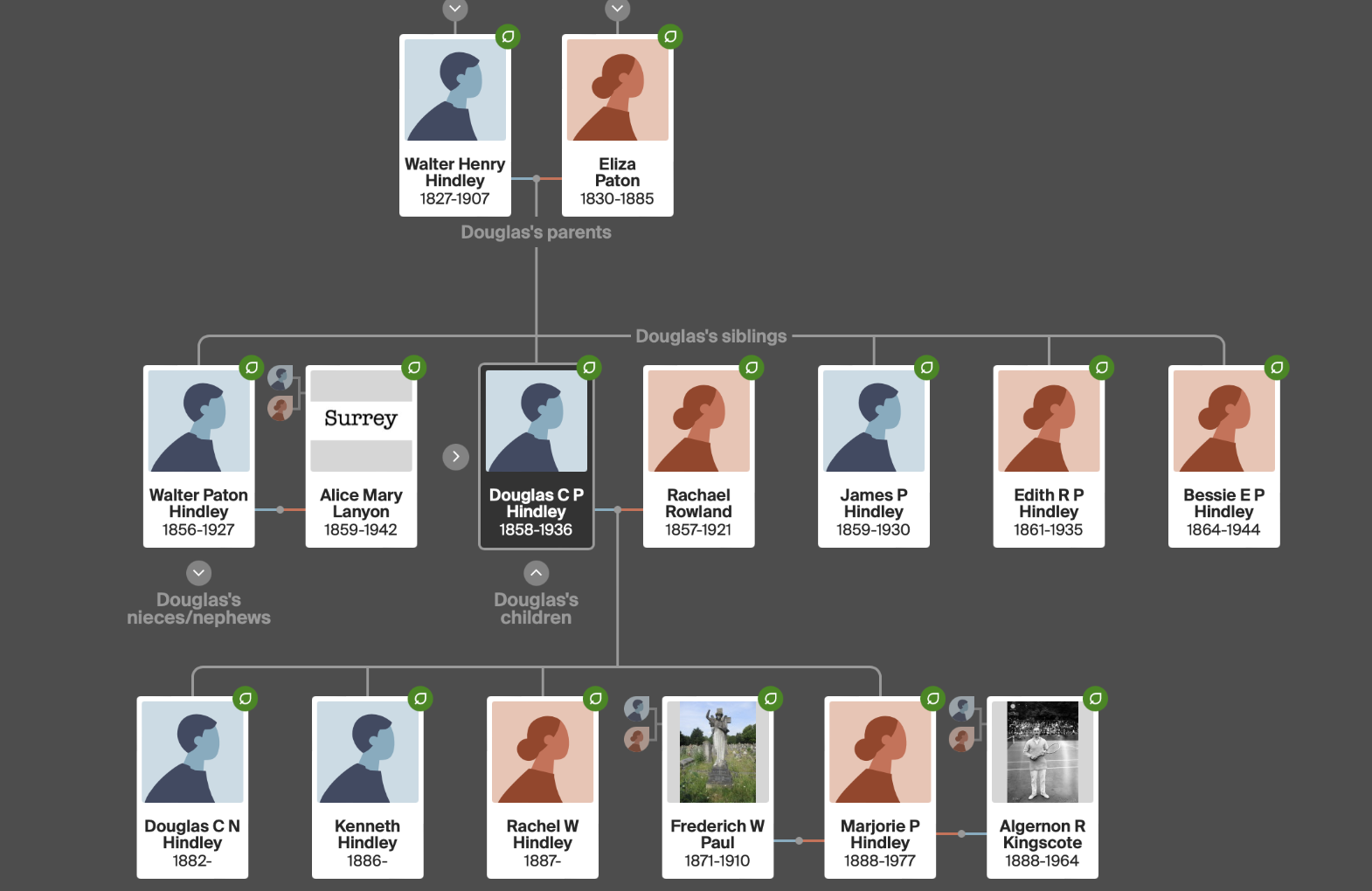
On 9 Sep 1919 (9/9/1919) he married Marjorie Paton Hindley in London. Marjorie was the daughter of Douglas and Rachael Hindley. Douglas was the brother of Walter Paton Hindley who married Alice Mary Lanyon.

Alice Mary Lanyon was the daughter of John Charles Lanyon and Jane Stacey Bennett. She was Marjorie Paton Hindley’s aunt and also my husband’s great grand aunt. (I said it was tenuous!)

So having established a tenuous connection to Algernon Kingscote what is his connection to Wimbledon?

Algernon Kingscote learned playing tennis in Switzerland, where he won numerous championships.  He was crowned Swiss champion in 1908 and champion of Bengal in 1913. At Wimbledon in 1919, he lost in the all comers final. He won the singles title at the Australasian Championship in 1919. He reached the men’s doubles final at Wimbledon in 1920. In 1921 Kingscote was a runner-up at the Monte Carlo Championships. He represented Great Britain in the Davis Cup seven times between 1919 and 1924.

Algernon Kingscote – Sport & General Press Agency Ltd., Public domain, via Wikimedia Commons

At the 1922 Wimbledon Championship he established the routine of bowing to the Royal Box, a tradition which lasted until 2003.

Algernon Kingscote in 1914 – Agence Rol, Public domain, via Wikimedia Commons

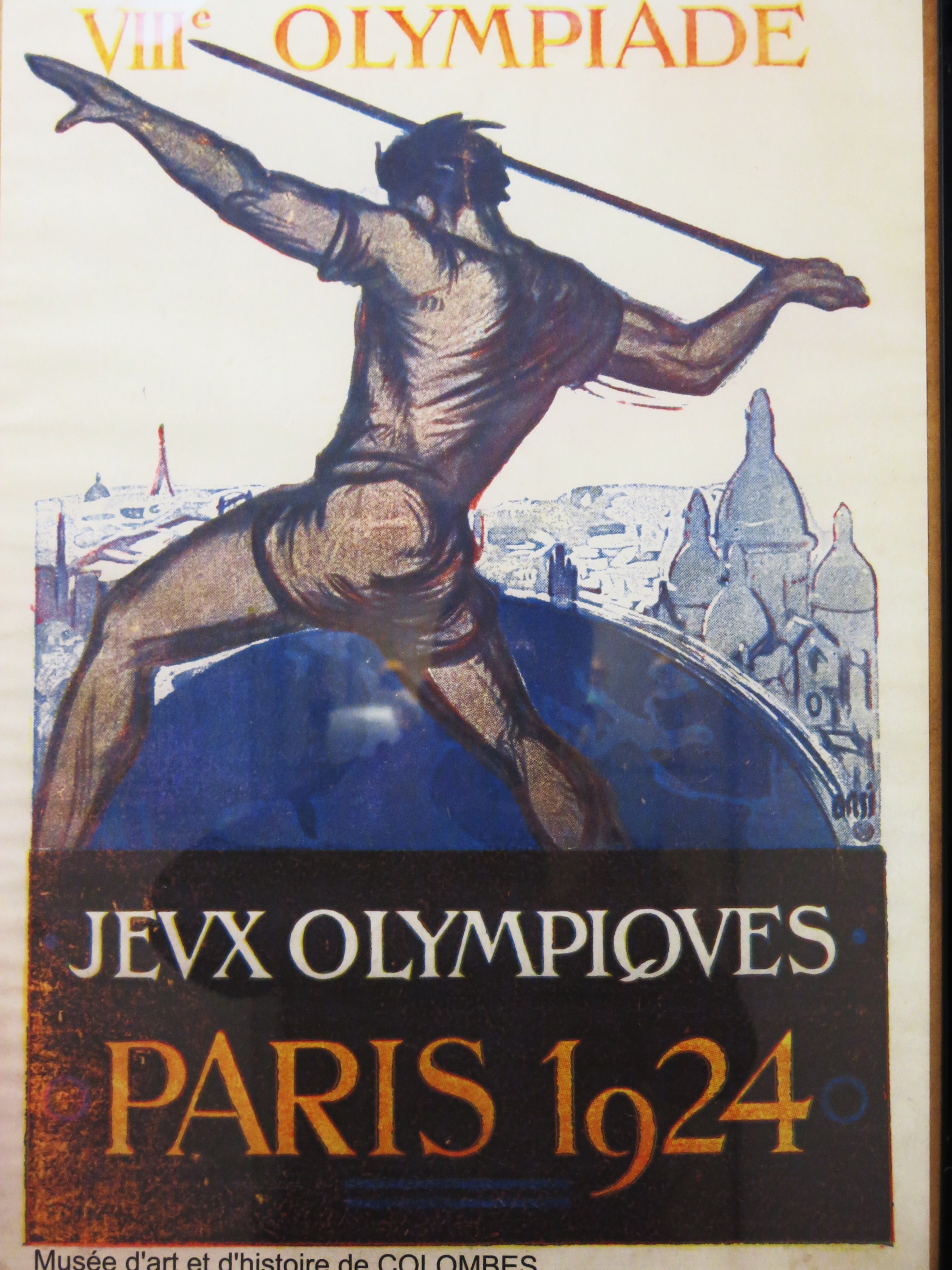
He also competed at the Summer Olympics in Paris in 1924.

Tangopaso, Public domain, via Wikimedia Commons

At the outset of the Second World War he was sent back into action again at the age of 52. He died on 21 Dec 1964 at Woking in Surrey.

The Gonja of Ghana

The Lanyons have travelled all over the world and there are branches of the family on most continents. A Lanyon is even listed as a ruler of the Northern State of Gonja in Ghana!

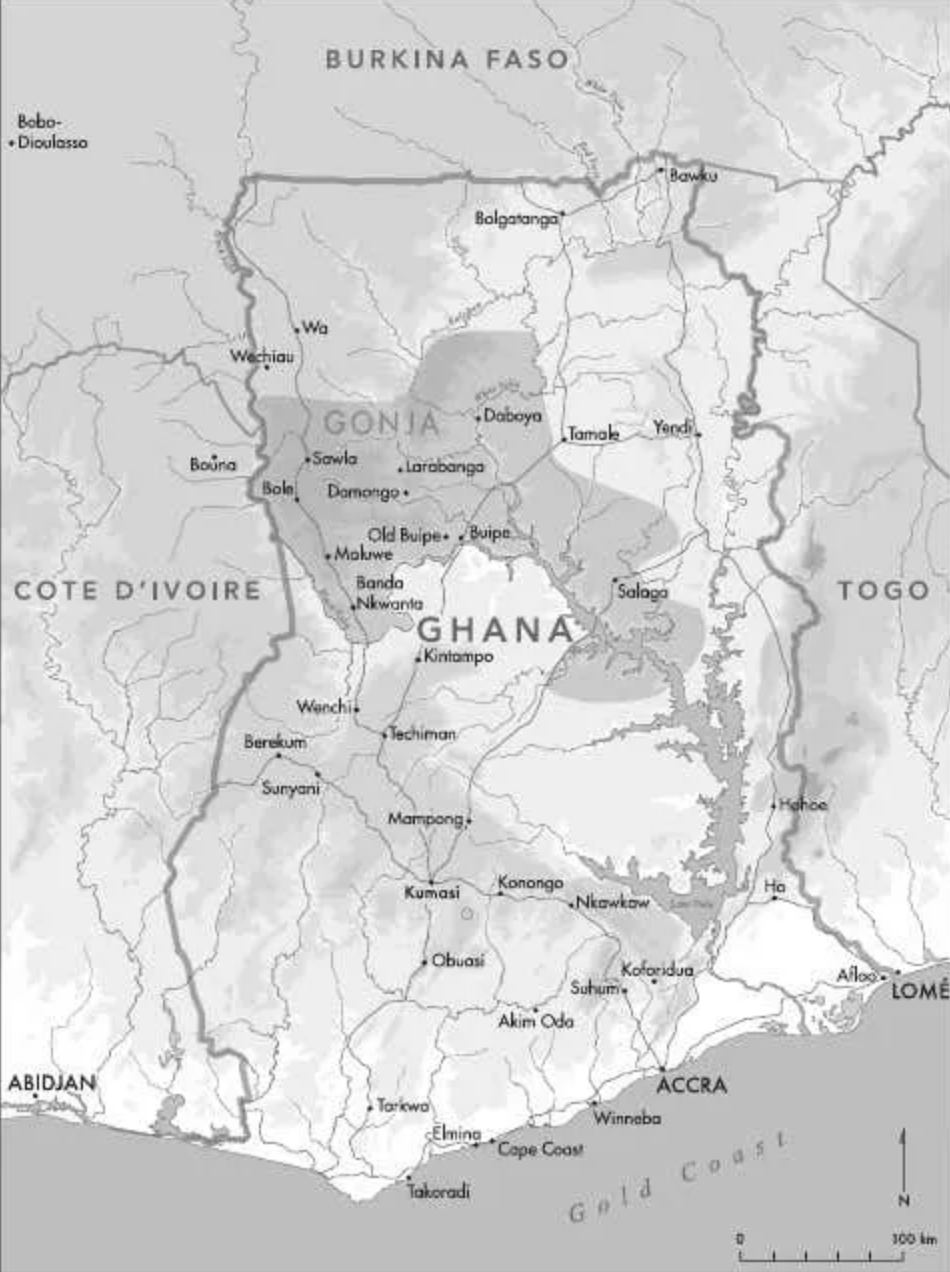
Gonja was created by Mande Conquerors around the beginning of the 17th century. According to Wikipedia the capital is Yagbum.

Map of Ghana showing Gonja region.

The first ruler of Gonja was Sumalia Ndewura Jakpa, a slave trader.

Precolonial Gonja society was stratified into castes, with a ruling class, a Muslim trader class, an animist commoner class, and a slave class. Its economy depended largely on trade in slaves from Central Africa and kola nuts, particularly through the market town of Salaga, sometimes called the “Timbuktu of the South.”

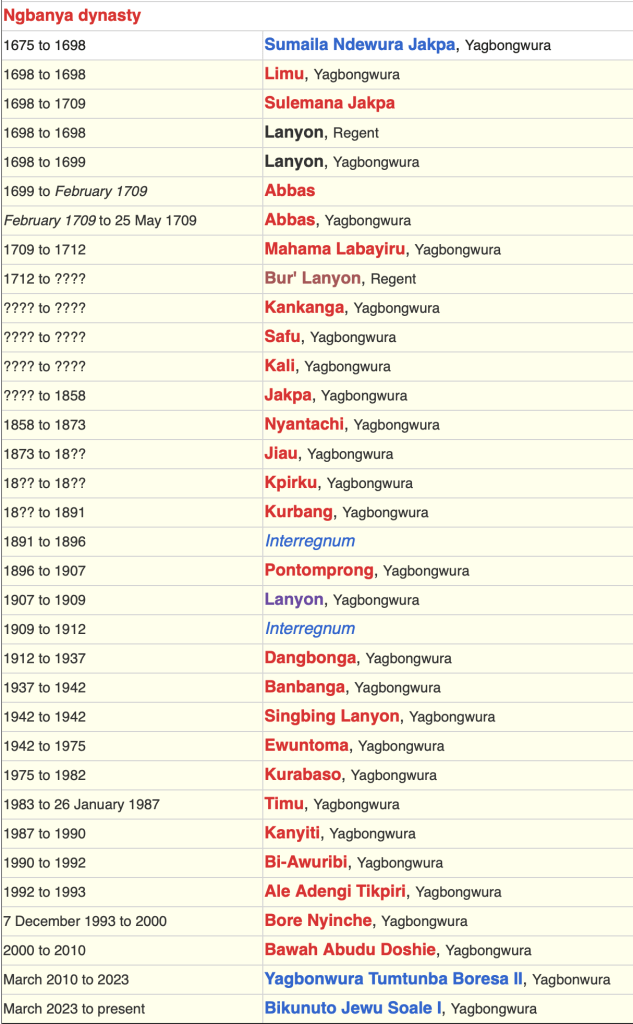
Wikipedia gives a list of rulers of Gonja.

Apparently between 1698 and 1699 Lanyon was regent and Yagbongwura (paramount ruler). I suspect the name Lanyon may have been used to fill a gap in the list!

1907 – 1909 Lanyon was again listed as Yagbongwura. Curiously Wikipedia identifies this Lanyon as Colonel Sir William Owen Lanyon, who died of cancer in New York in 1887.

William was born in Ireland in 1842 the son of Sir Charles Lanyon and his wife Elizabeth Owen. He was a British colonial administrator and army officer.

William Owen Lanyon – Wikimedia Commons

He was invalided in the Ashanti campaign which may be his connection to Gonja.

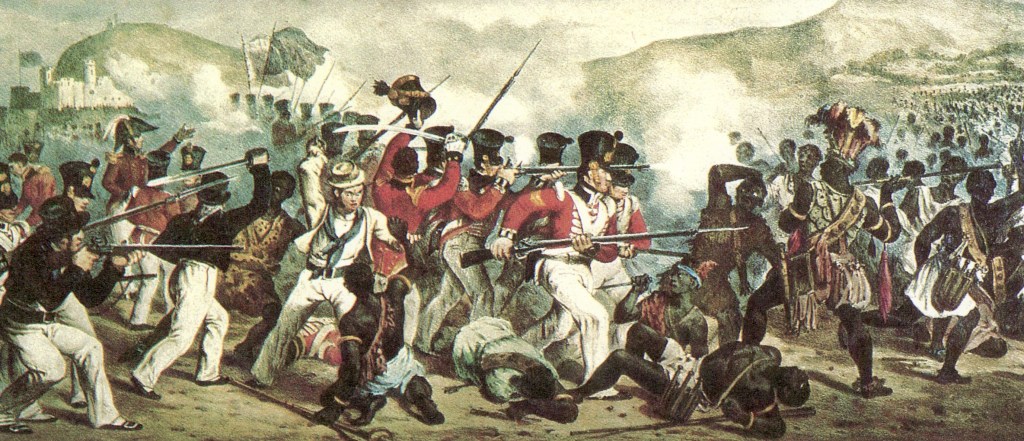
The Anglo-Ashanti wars lasted 70 years finally ending in 1900. The wars established the British Gold Coast and the country became a British protectorate.

Defeat of the Ashantees, by the British forces under the command of Coll. Sutherland, July 11th 1824.” Wikimedia Commons

It’s not clear how William Owen Lanyon went from fighting in the Ashanti wars to being listed as a ruler of Gonja twenty years after his death but it makes life interesting for family historians!

We’re Getting There!

Sometimes when researching family history you find a tiny story which really has to be retold.

This is the story of William Henry Lanyon’s ‘Difficult Journey.’

William Henry was the son of Richard Lanyon and Susan Tucker of Acton Castle. He was the eldest son born in 1825 and appears to have been quite an unusual man. Although he was married and had a large family he chose to live apart from them.

He was a gunpowder manufacturer and merchant and evidently needed to travel to London on business.

The Royal Cornwall Gazette reports that on 24 June 1869 William contacted Mrs Dobb from the Royal Hotel and ordered a bus to call at his residence at Strangways Terrace in Truro to take him to the train station. Unfortunately his booking was forgotten, the omnibus didn’t call and he missed his train.

George Shillibeer‘s first omnibus – Wikimedia Commons

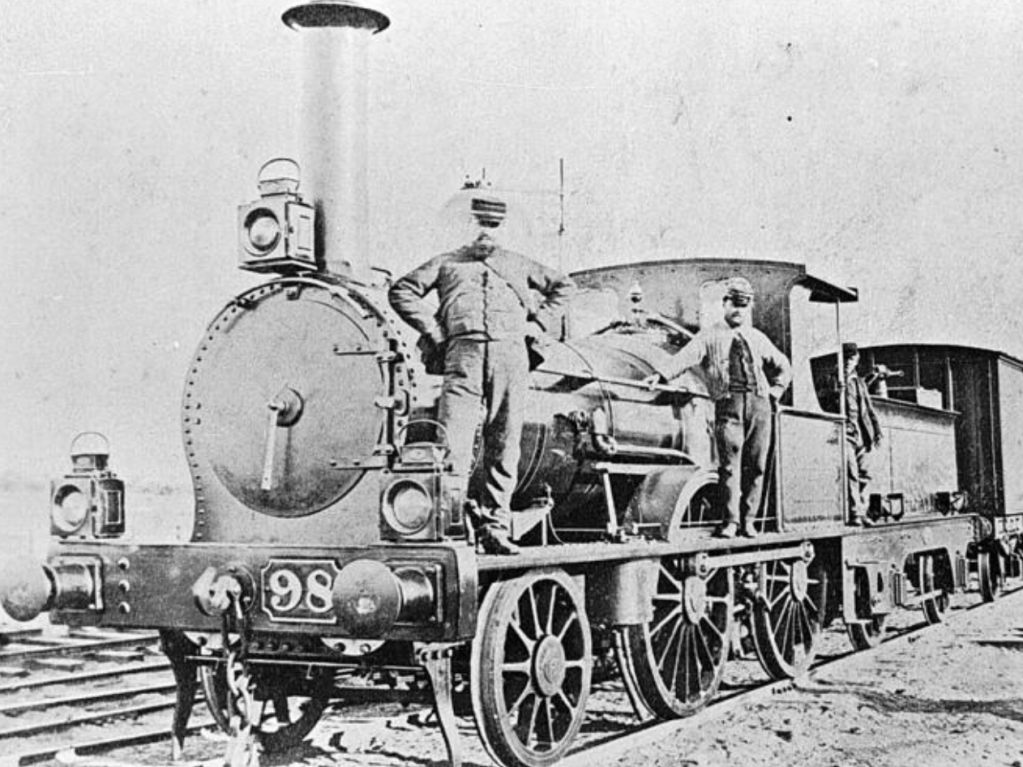
William then did something that many modern rail travellers wish they could do….he ordered a special train to be got ready which took him to Bristol to catch the train up to London! The Victorian equivalent of an Uber!

The cost of this special run was £68 and William planned to claim that from the landlady of the Royal Hotel, Mrs Dobb, who had taken the original booking.

Victorian Railways F class 2-4-0 type steam locomotive – Wikimedia Commons

William made it to London but sadly we don’t know if Mrs Dobb ever paid him the £68.

The Shepherd

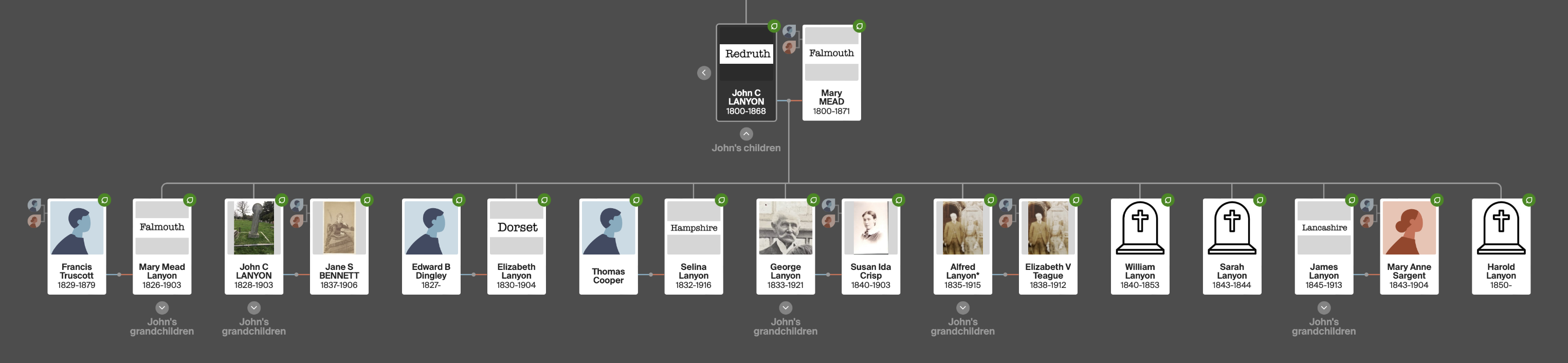
George Lanyon, the second son of John Charles Lanyon and Mary Mead, was nicknamed “The Shepherd”. This post is my attempt to find out why.

George was born 3 Oct 1833 at Redruth in Cornwall. His father owned an ironmongers on Fore Street and in his later years was a successful merchant tanner and ironmonger.

John Charles Lanyon died in 1868 and left a detailed will, there was no mention of his second son George and that was the first indication that all was not well.

JC Lanyon’s eldest son, also called John Charles, his third son Alfred and fourth surviving son Thomas all receive generous bequests and businesses. (The estate was valued at £35,000 in 1868.) But there was nothing for George, why?

George Lanyon appeared on the 1851 census as a seventeen year old ‘assistant’, presumably to his father. Sometime after 1851 and before 1861 he emigrated to Tasmania. His elder brother was already trading in Adelaide in Australia (he was a partner in Adelaide’s department store ‘Harris Scarfe’) perhaps George set out to emulate him?

Initially I thought George may have acquired his nickname ‘The Shepherd’ through a business interest in sheep farming in Tasmania however the story is a little more interesting than that!

On 3 July 1861 George married Susan Ida Crisp at Hobart in Tasmania.

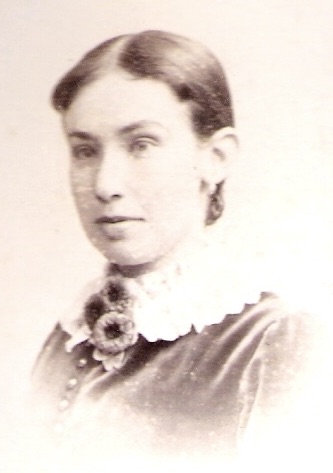
Susan Ida Crisp

By 1862 they had returned to Cornwall and their first child Catherine Rosina Lanyon was born at Falmouth.

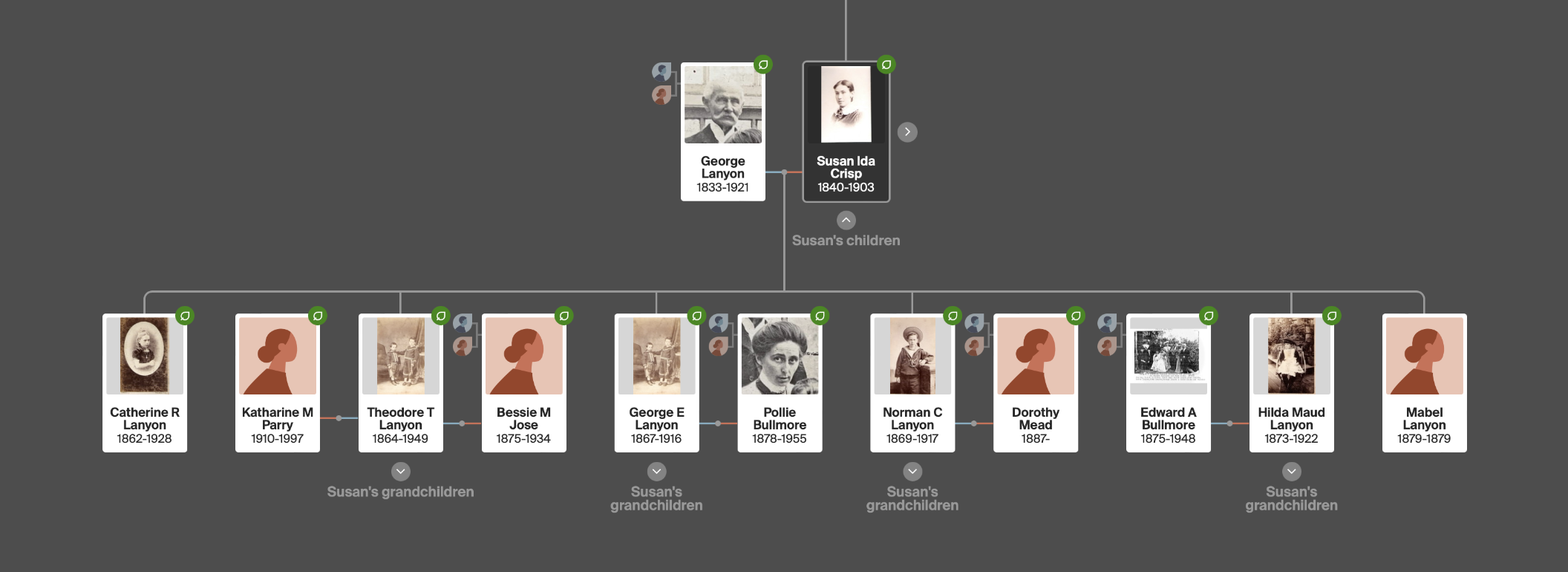
Their children:

  • Catherine Rosina 1862
  • Theodore Tasman 1864
  • George Edward 1867
  • Norman Crisp 1869
  • Hilda Maud 1873
  • Mabel 1879 who died in infancy

In 1871 the census describes George as a tanner employing 10 men, by all appearances a successful businessman like his brothers.

A closer look at Susan Ida Crisp revealed why he may have been given his nickname and also why he was left nothing in his father’s will.

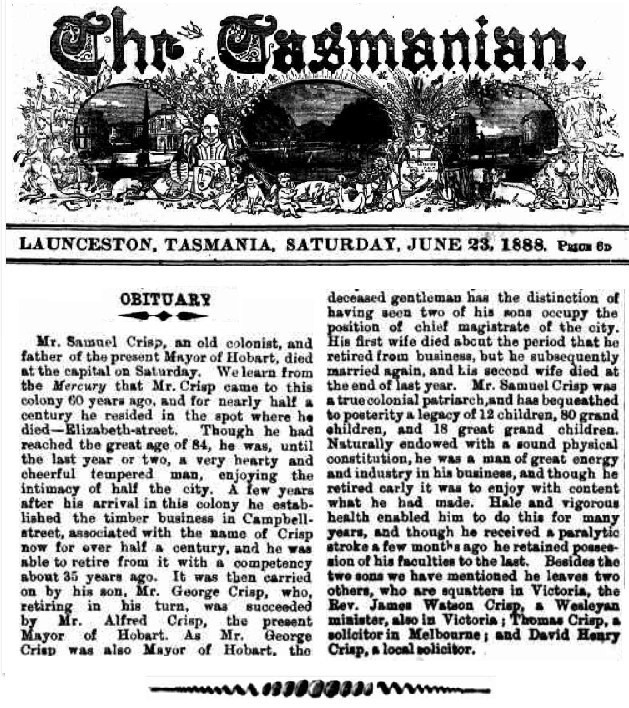
Susan was the daughter of Samuel Crisp and Elizabeth Sams. She was born in Hobart in 1840. Samuel’s obituary describes him as one of the original colonists.

What they failed to mention is how he arrived in Tasmania….transported for life for sheep stealing!

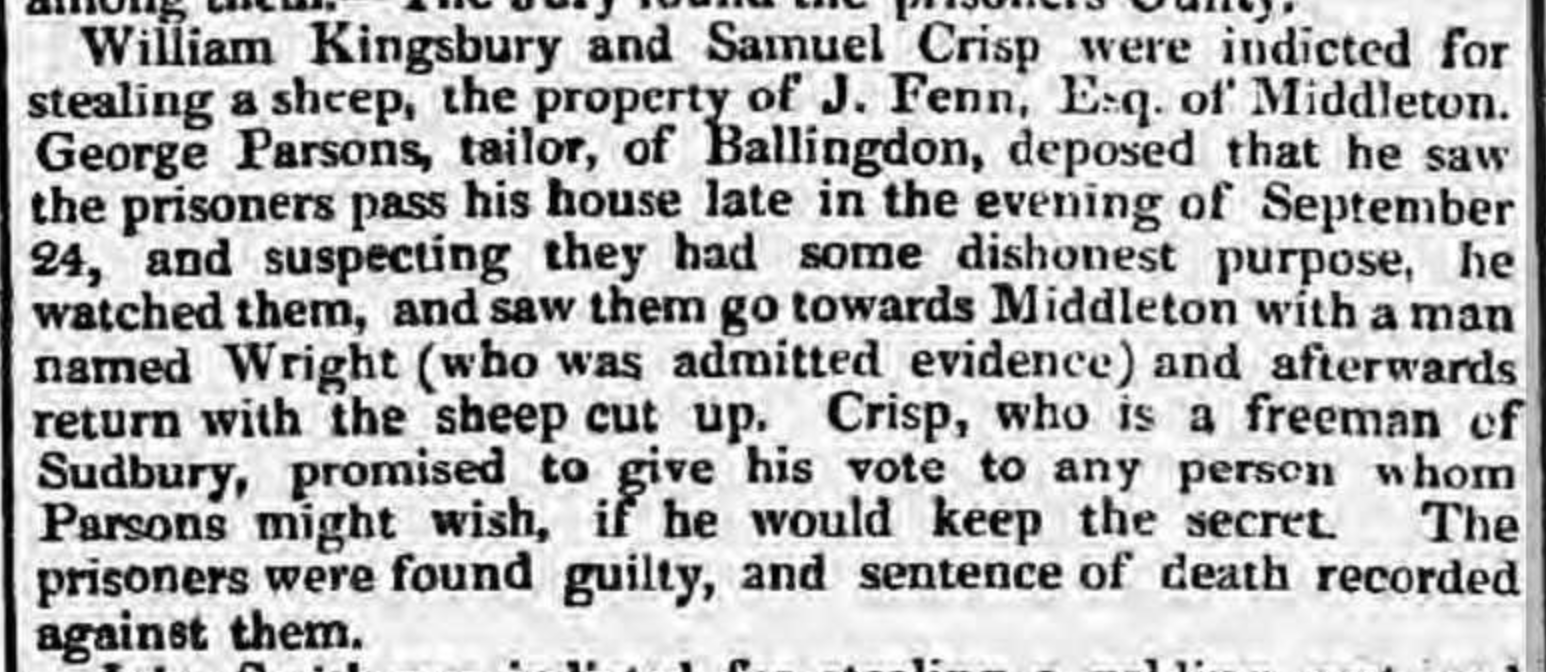
Samuel Crisp was born in Sudbury in Suffolk in 1805. In 1820 he was sentenced to a month in prison for larceny, stealing 18 yards of ribbon from the shop of John Holman. Shortly after this he married Elizabeth Sams and they had two young sons, Samuel born 1823 and George born 1824. In September 1825 Samuel was caught sheep stealing. The Bury and Norwich Post for December 1825 has this report:

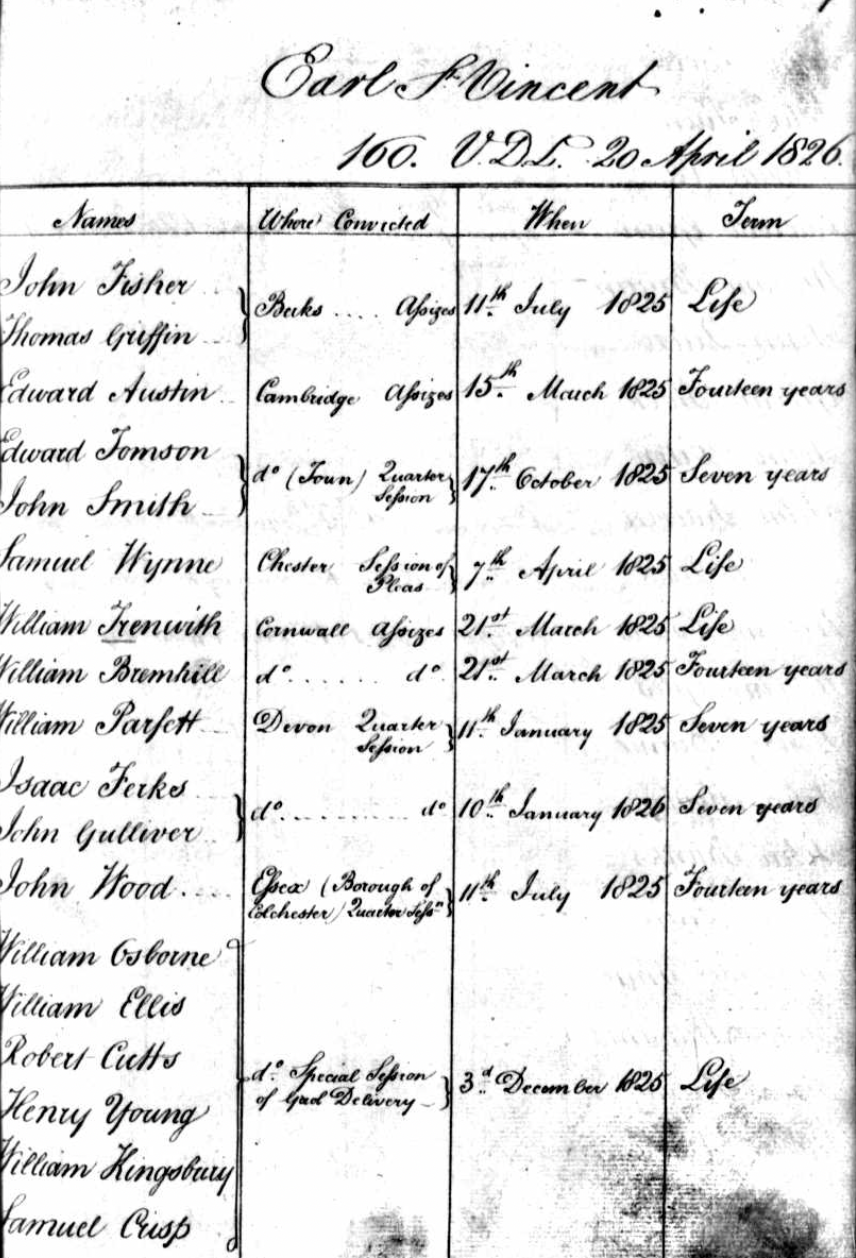
He was found guilty. The sentence of death was commuted to transportation for life and Samuel aged just 20 was transported to Tasmania on the ship “Earl St Vincent” which set sail on 20 Apr 1826.

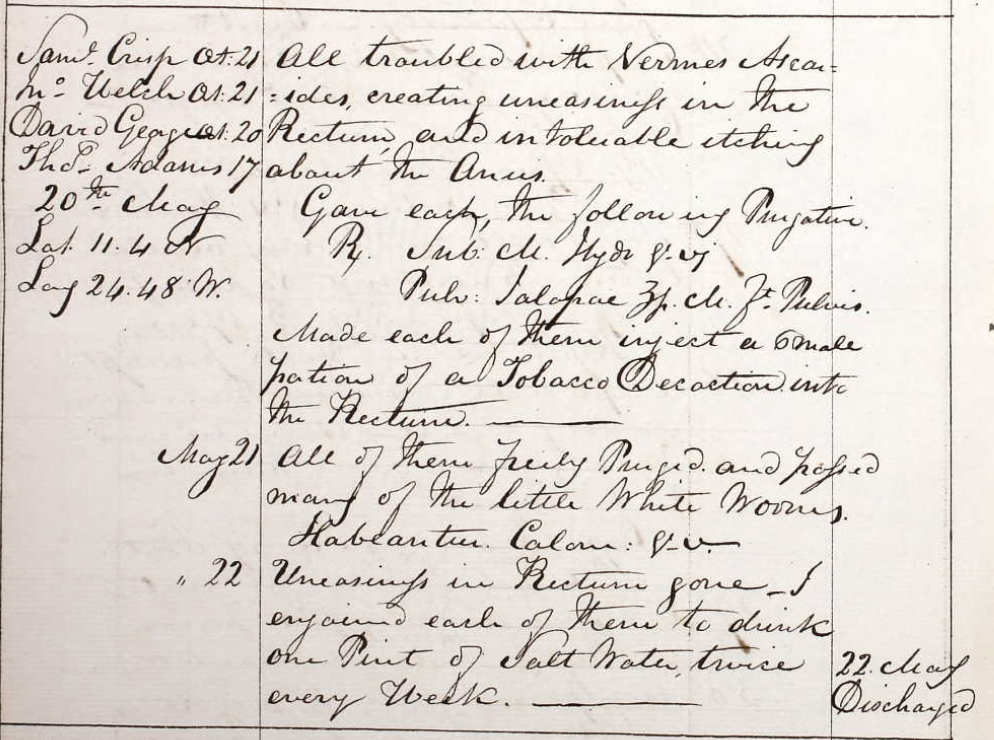
The Royal Navy kept detailed records and the ship’s surgeon records the following:-

So 200 years later we know Samuel and three others were suffering with worms which caused intolerable itching! The treatment sounds even worse; they were given a purgative and then had to inject a decoction of tobacco into their rectums! To prevent the worms returning they were told to drink a pint of salt water twice every week.

The journey to Tasmania took 110 days and the ship contained 180 prisoners.

Two years later Samuel’s wife and sons followed him to Tasmania and they produced another 5 children whilst he was still a prisoner.

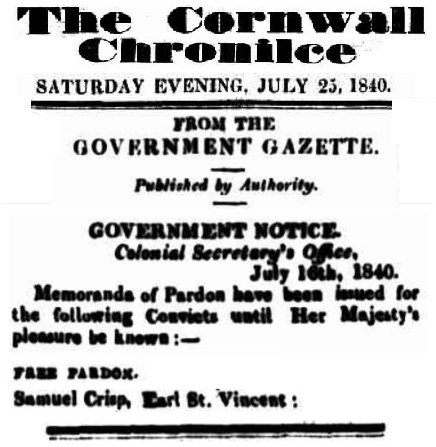
By 1840 “The Hobart Town Courier and Van Diemen’s Land Gazette” reported that he had been given a free pardon.

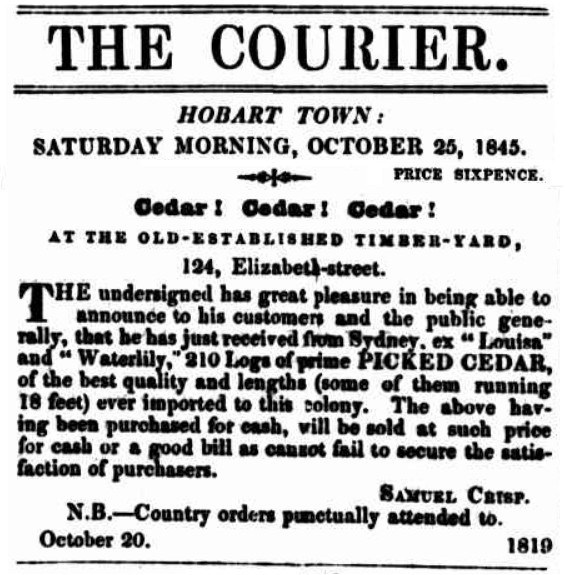
Now a free man Samuel set about creating a successful timber business, Crisp & Gunn.

Samuel and Elizabeth had twelve children. In 1853 Elizabeth died and Samuel remarried to an Elizabeth Farquarson. By the time of his death, aged 84, he had 80 grand children and 18 great grand children. He had become a respectable member of Hobart society. His children became solicitors and his son James was a Wesleyan minister. His grandsons served as Mayor of Hobart.

Samuel Crisp

So what became of his grandchildren in Cornwall?

Catherine Rosina never married. She lived with her father in Falmouth and died there in 1928.

Catherine Rosina Lanyon

Theodore Tasman 1867-1949. Theodore was a paymaster Admiral in the Royal Navy. There were four children from his first marriage.

George Edward 1869-1916. George was a doctor. There were six children from his marriage to Pollie Bullmore.

Theodore & George Lanyon

Norman Crisp 1869-1917. Norman married his cousin Dorothy Mead and they had three sons. He was shipwrecked in the English channel by a torpedo and drowned.

Norman Crisp Lanyon

Hilda Maud 1873-1922. Hilda married Edward Augustus Bullmore (Pollie Bullmore’s brother). He too was a doctor. They had two sons.

Hilda Maud Lanyon

George Lanyon and his family lived at Tasman Villa in Falmouth (circled) just behind what is now the Greenbank Hotel.

Susan Ida died in 1903 and George in 1921, at the grand old age of 88. He outlived all his siblings and three of his six children.

George is on the back row (left) standing behind his daughter in law Pollie.

Edward Augustus Bullmore, who was married to Hilda, collaborated with Jane Veale Mitchell to research the Lanyon family tree. He left his papers to William Smith Lamparter so that he could continue the research. In turn those papers made their way to me and ultimately led to the creation of this website.

So now we know why George Lanyon was nicknamed “The Shepherd”. If you have a better theory please get in touch!
Thomas Lanyon – Pewterer of Bristol

Researching a family often necessitates many hours trawling through online resources for any mention of the family surname. A trawl through the Somerset Heritage Centre online index produced the deeds for a farm and lands at St Decumans and the name Thomas Lanyon.

The record starts on 13 Aug 1601. ‘Thomas Fulford of Fulford, Devon, Esq. enfeoffed to John Hooper of Ould Cleve, yeoman, a messuage known as Hooper’s Tenement and ten acres of land, part of the manor of Williton Fulford’ The deeds show the various tenants over the years. In 1715/6 John Leach of Bristol, ‘powterer’ and Sarah his wife (daughter and heir of Robert Mawdsley of Bristol, mariner and brother of Richard Mawdsley of Williton mortgaged the property to Arthur Thomas of Bristol, ‘powterer’. On 1 Jul 1718 John Leach mortgaged the property , by lease and release, to Abraham Lloyd, merchant, John Andrews, merchant, Richard Stafford, merchant and Samuel Cox, soapboiler, all of Bristol.

On 13 Mar 1718/19 John Rowe Esq and Martin Innys and Milborn Taylor, gents, all of Bristol , assigned the property to Daniel Woolmer, haberdasher, Thomas Lanyon, pewterer and George Bridges the younger, distiller, all of Bristol and John Roberts of Bedminster, cotton weaver (all creditors of John Leach, who was now bankrupt.)

So who was Thomas Lanyon and where does he fit on the tree?

Thomas was working as a pewterer (a tinsmith) from around 1715 and is last mentioned in 1755.

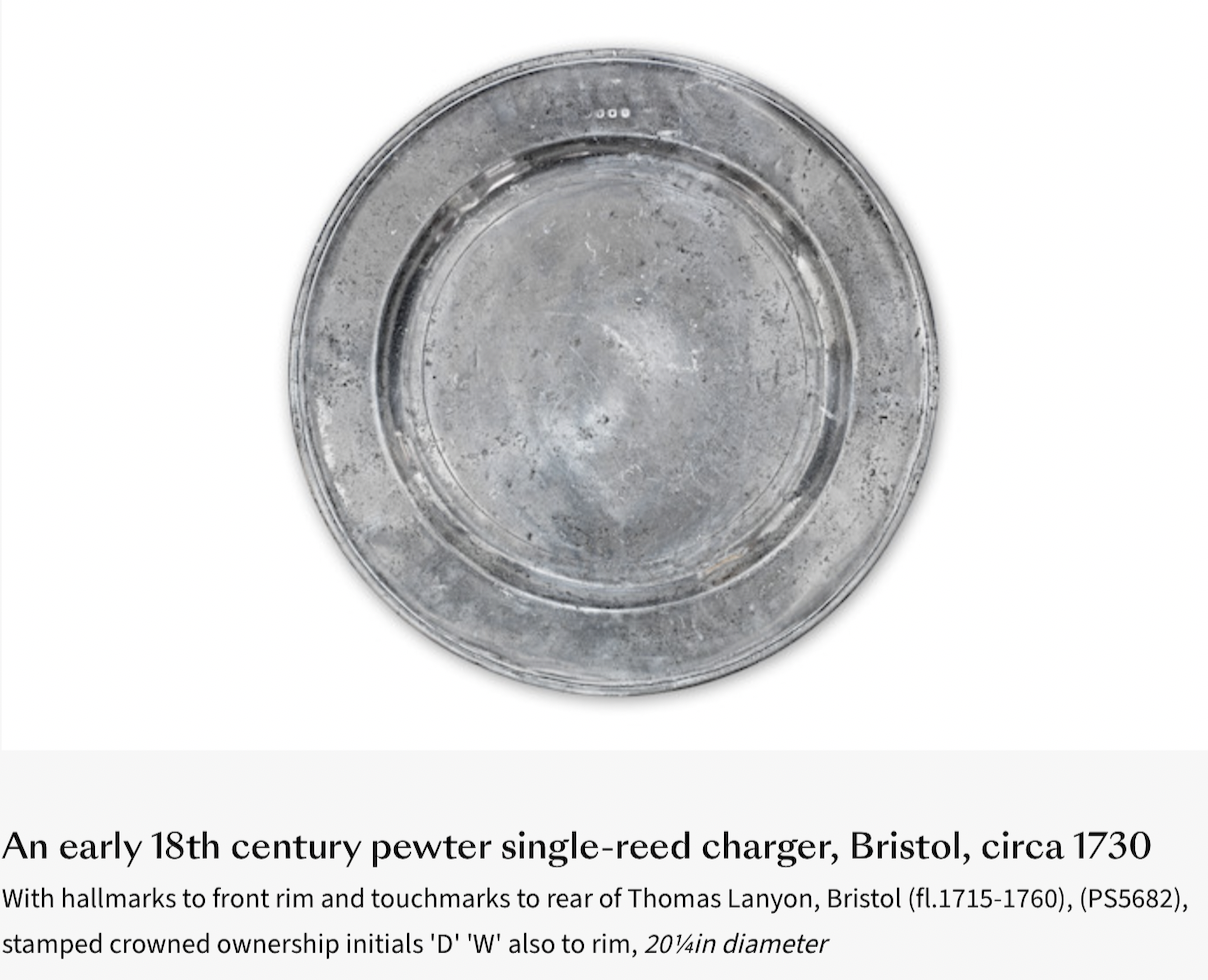
In 2021 this charger made by Thomas sold for £318.

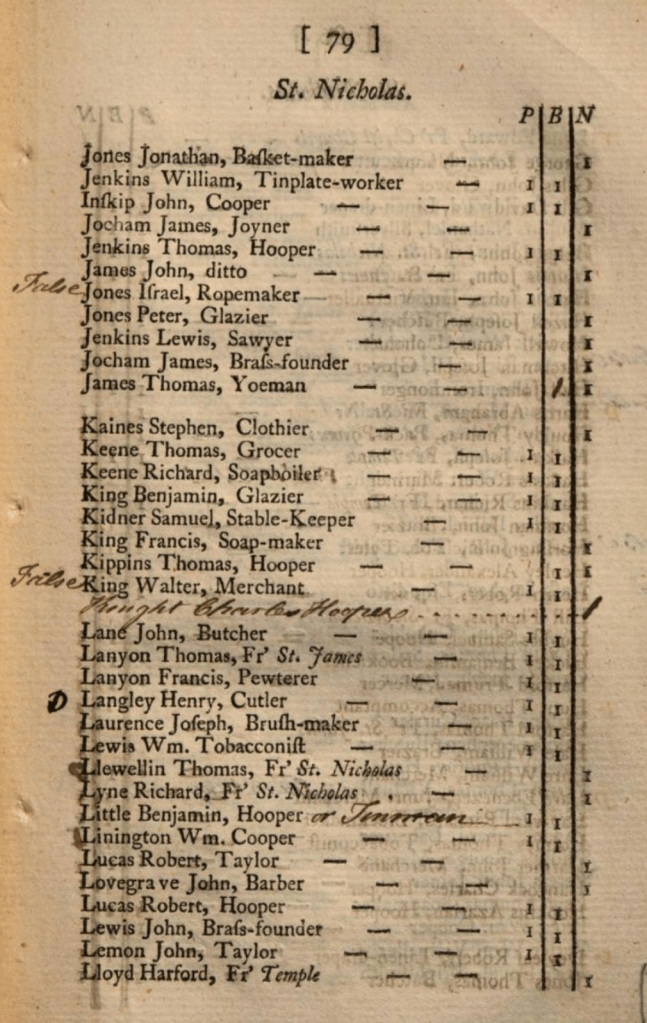
Thomas was apprenticed to John Batcheler of Bristol on 2 Feb 1707 and is free by 9 Apr 1715. He’s mentioned in the Poll Books of 1721 and 1739 as of St Nicholas Bristol, the last mention of him in is 1755.

Poll Book 1754 mentions father and son.

We know Thomas Lanyon married someone called Anne before 1725 but I can’t find a record of the marriage anywhere in England. Her name is mentioned alongside Thomas’ apprentices.

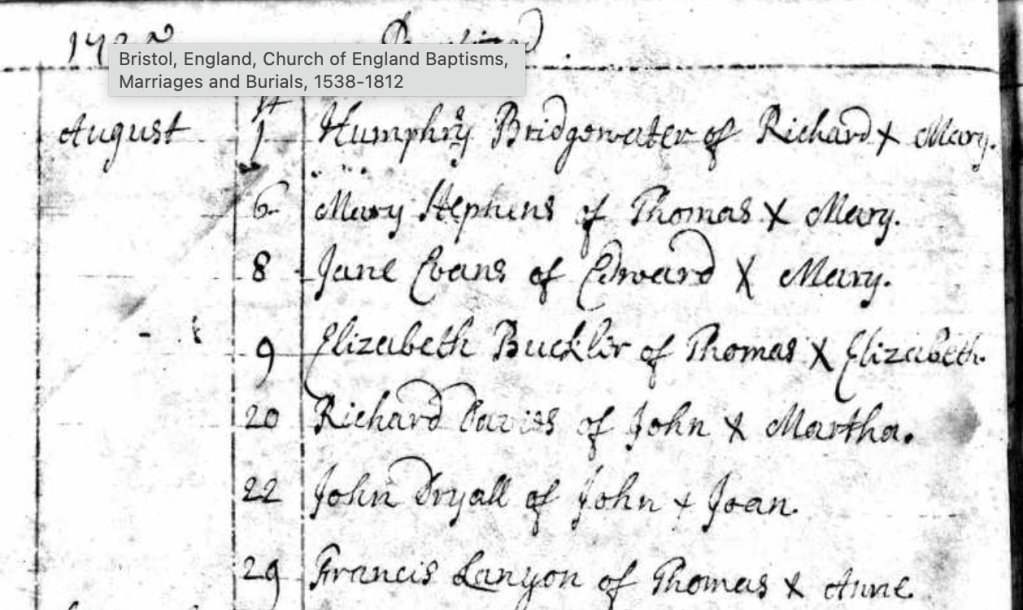
They had at least one son, Francis Lanyon, who was baptised on 29 Aug 1725 at St Nicholas, Bristol. He was also working as a pewterer on 26 Jun 1747. In the 1754 Poll Book he is listed as of St Nicholas in Bristol.

Baptism of Francis Lanyon – St Nicholas Bristol

Thomas had at least two apprentices; Thomas Page who was indentured to Lanyon between 1729 and 1737 and Robert Bush who was indentured at a cost of £50 between the years 1748 and 1755. In 1765 he was based in the High Street in Bristol.

To give you an idea of the size of Lanyon’s business, in the 1740s he exported 1148lbs of pewter in one year. The book ‘Old Pewter, its Makers and Marks’ described Thomas Lanyon as being from Bristol and Coventry but I can’t find any records placing him in Coventry.

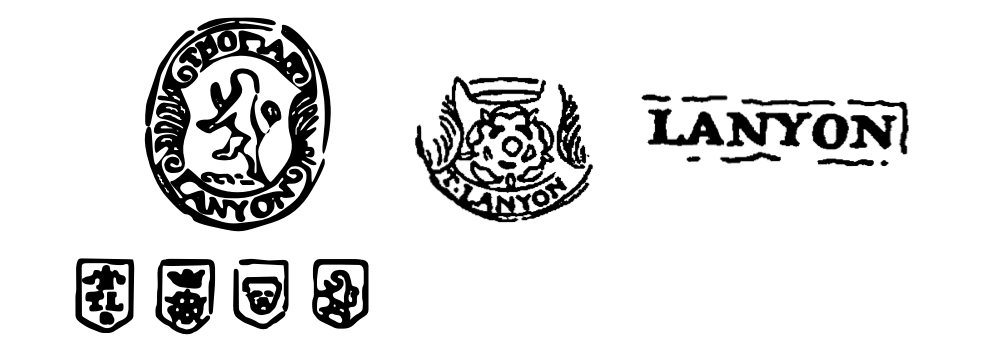
Lanyon’s Pewter Marks

The same book mentions a Thomas Lanyon of Coventry in 1774. This could be a son or even a grandson but I can find no trace of a baptism, marriage or burial.

A trawl through St Nicholas, Bristol’s parish registers reveals two baptisms which may be relevant: William & Anne Lanyen, twin children of Eli and Anne Lanyen, baptised on 3 Dec 1723 and three days later, William Lanyen and Anne Lanyen both buried 6 Dec 1723. Who was Eli Lanyen and was he any relation to Thomas Lanyon?

Sadly the records do not give us any answers. We don’t know if Eli was related to him or if it was just a coincidence that two men called Lanyon/Lanyen had wives both called Anne and were baptising children at the same time in the same area.

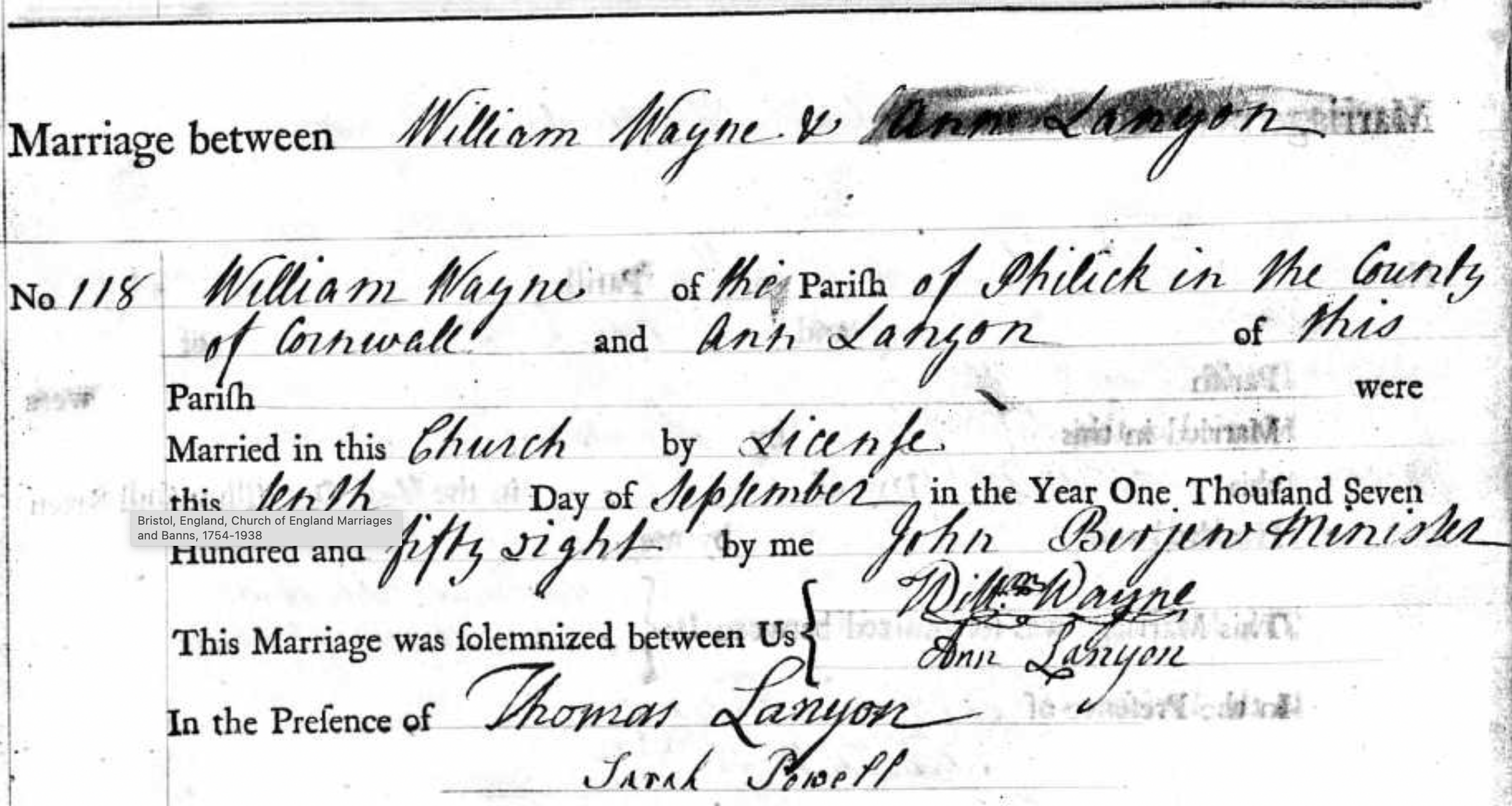
To complicate things even further there is a marriage of an Ann Lanyon/Lanion to a William Wayne/Wain at St Nicholas Bristol on 10 Sep 1758. They had a daughter Anna Maria Wayne. William Wayne was a metallurgist who went to Cornwall with his daughter, presumably after his wife died, to teach the Cornish metallurgy (Jane Veale Mitchell research). Both William and Anna feature in several Lanyon wills and are left very large bequests. They are related to Tobias and Mary Lanyon (the children of Francis Lanyon and Phillipp Nicholls of Sancreed).

Tobias’ Will, proved 1779, mentions ‘…my nephew William Wayne gentleman late of the City of Bristol, now residing with me (at Penzance) and my niece Anna Maria Wayne his daughter….’ Tobias bequeathes them £5000!
Tobias’ Will – PROB 11/1050/103

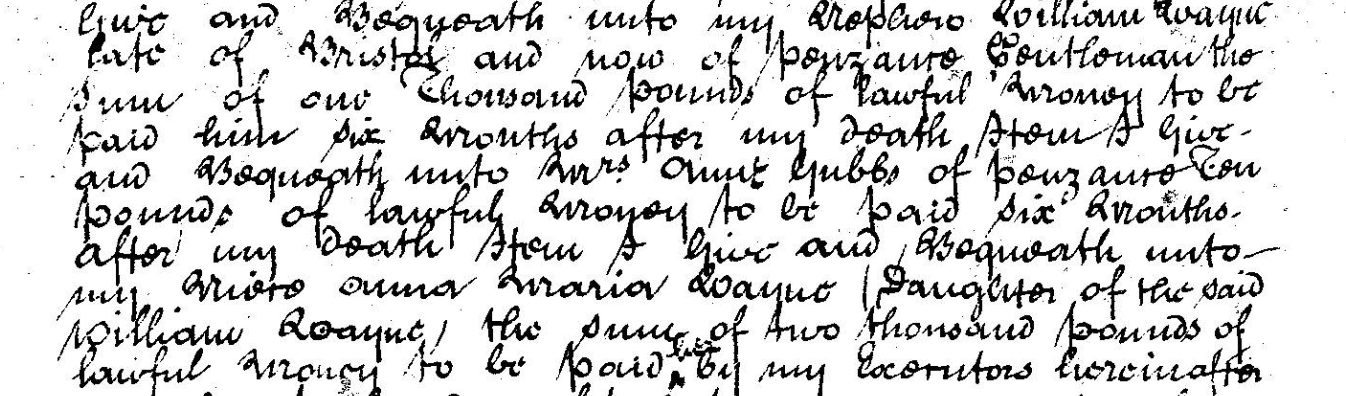
Tobias’ sister, Mary, also had her will proved in 1779. She bequeathes her nephew William Wayne £1000 and her niece, his daughter, £2000.

Mary’s Will – PROB/11/1051/117

Tobias and Mary clearly regard William Wayne as their nephew which implies that his wife, Ann Lanyon, was their niece.

It was time to look at Tobias & Mary’s branch of the tree and see what information I could find.

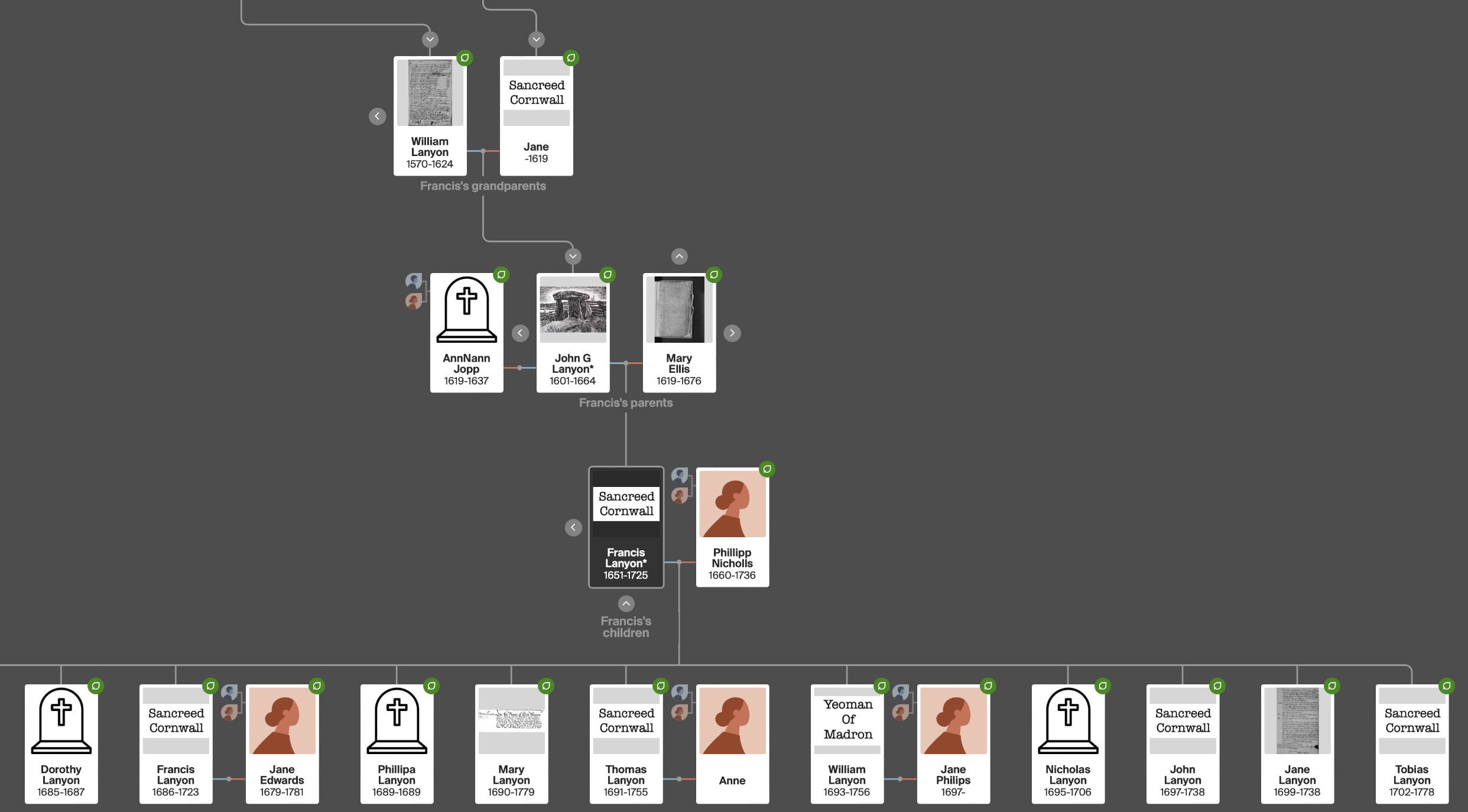
The Sancreed branch of the Lanyon family tree.

Tobias and Mary were the children of Francis Lanyon and Phillipp Nicholls of Sancreed. Francis was the son of John Lanyon, called ‘The Golden Lanyon’ as he made so much money from tin. John was a grandson of John Lanyon Esq and Phelype Milliton.

Tobias and Mary had a brother called Thomas and whilst I cannot prove that he was the Thomas who was a successful pewterer in Bristol, it does seem likely.

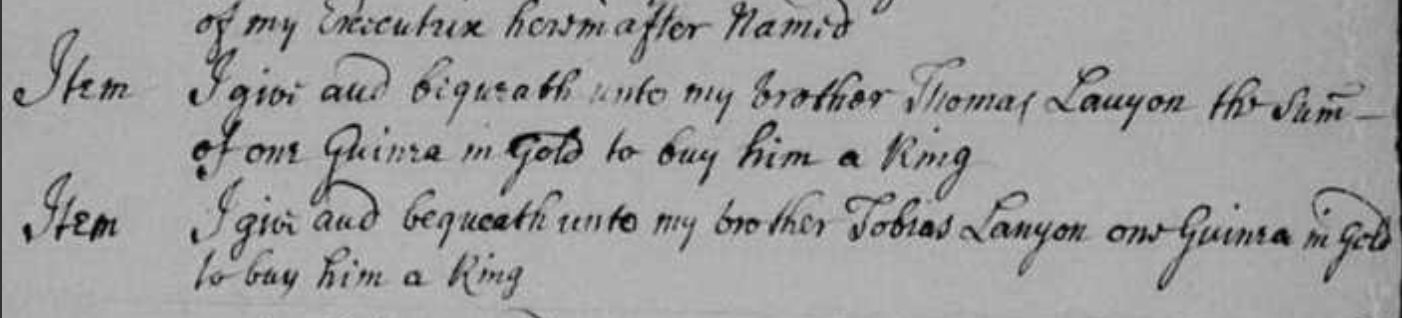
Tobias and Mary’s sister Jane died in 1738 and she leaves her brother Thomas the sum of one guinea in gold to buy him a ring.

Thomas had a son called Francis Lanyon, perhaps he was named after his father, who died in 1725, or his elder brother Francis, who died in 1723.

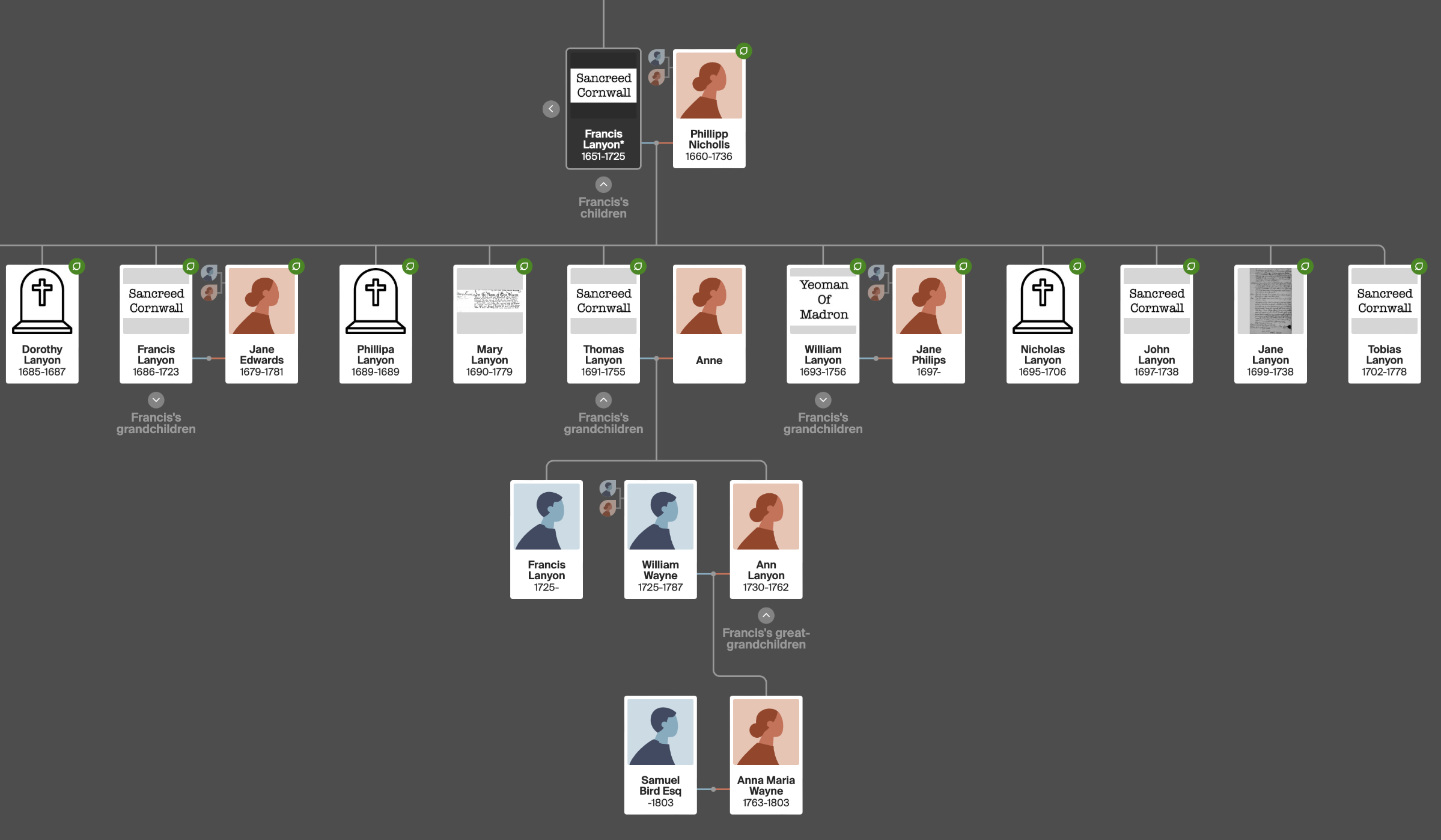
This branch of the tree now looks like this –

So Thomas Lanyon of Bristol was born in Sancreed, Cornwall in 1691 and died sometime after 1755. We don’t know what happened to his wife, Anne. We know that his son Francis became a pewterer but we don’t know if he married or had any children (the Thomas Lanyon working as a pewterer in Coventry in 1774 may be his son). There is no record of a birth of a daughter Ann Lanyon but we do have a record of her marriage to William Wayne.

Bristol, England, Church of England Marriages and Banns, 1754-1938

Their marriage was solemnised in the presence of one Thomas Lanyon!

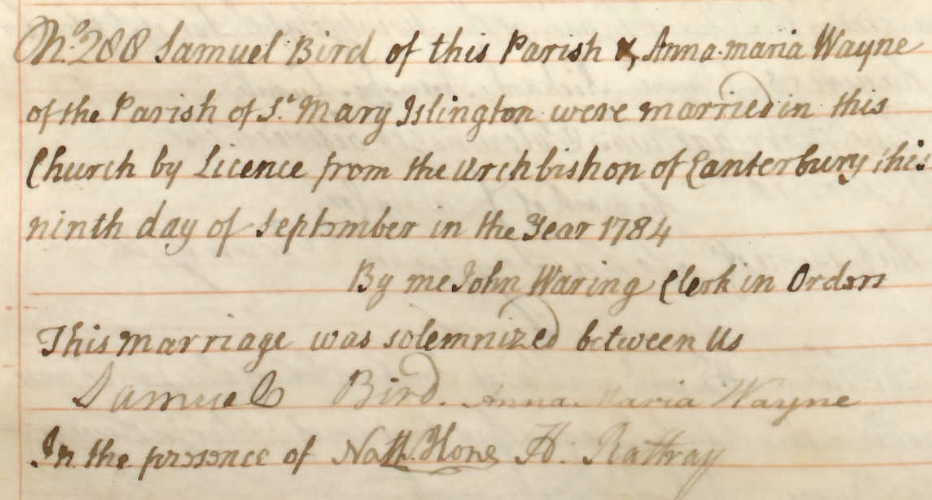
Anna Maria Wayne married Samuel Bird Esq. in London in 1784.

Marriage Register – St James Piccadilly, Westminster

By 1790 William Wayne was dead and administration of Tobias’ will passed to Anna Maria Bird the residuary legatee.

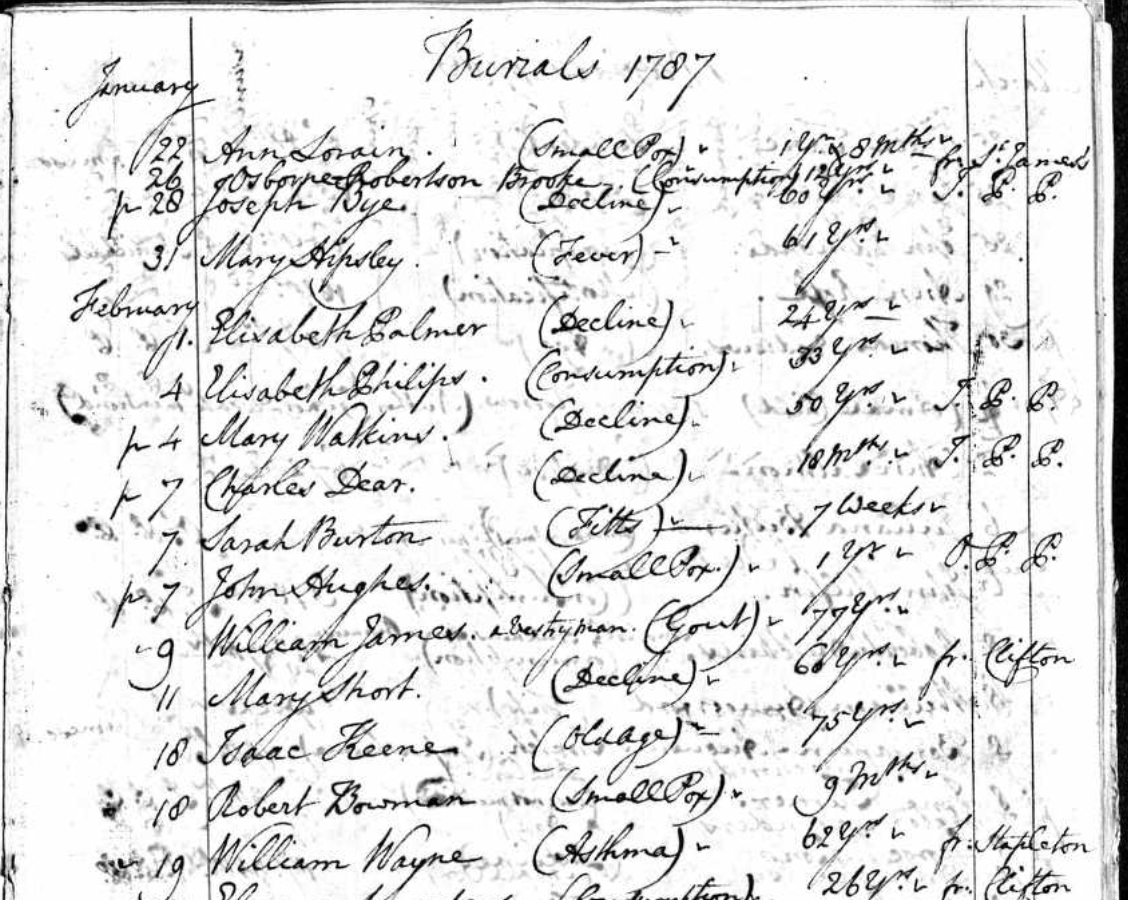
I found one possible burial entry for William at St Philip and St Jacob in Bristol on 19 Feb 1787. If it is ‘our’ William Wayne, he died of asthma.

Bristol Archives; Bristol, England; Bristol Church of England Parish Registers; Reference: P/St P&J/R/1/5

Anna was left a very wealthy young woman with bequests of several thousand pounds, a huge sum at that time.

Sadly she died on 8 Apr 1803, at East Stonehouse in Devon, but her will requests that she be interred at Sancreed in Cornwall. She was just 40, widowed, and suffering from Consumption (TB). She and Samuel were childless so her fortune was left to various cousins. There is a plaque in Sancreed church which reads:-

‘Sacred to the memory of Anna Maria Bird, widow of Samuel Bird, of Ridgeway in the county of Devon, Esqr. She died the 8th day of April, 1803; aged 40 years. Her body is deposited in a vault with the remains of her relatives, Josiah Lanyon, Esqr, and Jane his sister.’ (https://sancreedopccornwall.tripod.com/id1.html)

Josiah Lanyon? I think that should read Tobias!