Princess Joan of Kent

We learn about the next generation of the Lanyon family from a legal dispute of 1386 with Princess Joan of Kent, the widow of Edward the Black Prince, who fought at Crecy. She would have been queen but her husband died before his father, Edward III, and the throne passed to her son, Richard II.
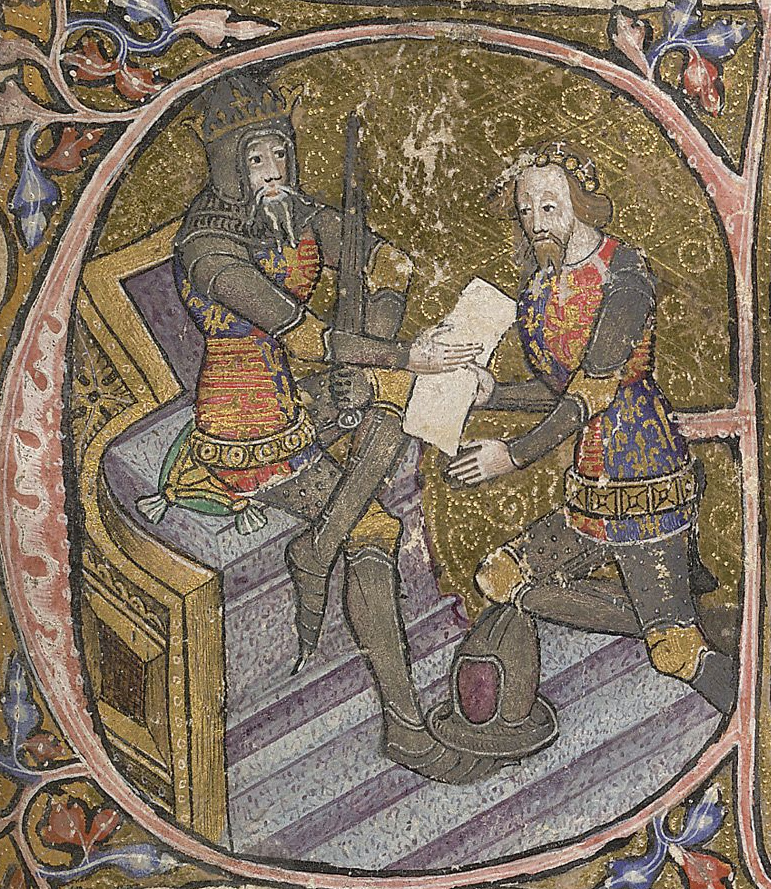
Edward III and the Black Prince

The legal dispute between Princess Joan and the Tregamynyans and Lanyons had rumbled on for many years and was only settled after Joan’s death in 1385.

Joan of Kent from illustrated manuscript, Cotton MS Nero D VII, folio 7v, aka: The Benefactors’ Book of St Albans Abbey (‘the Golden Book of St Albans’)

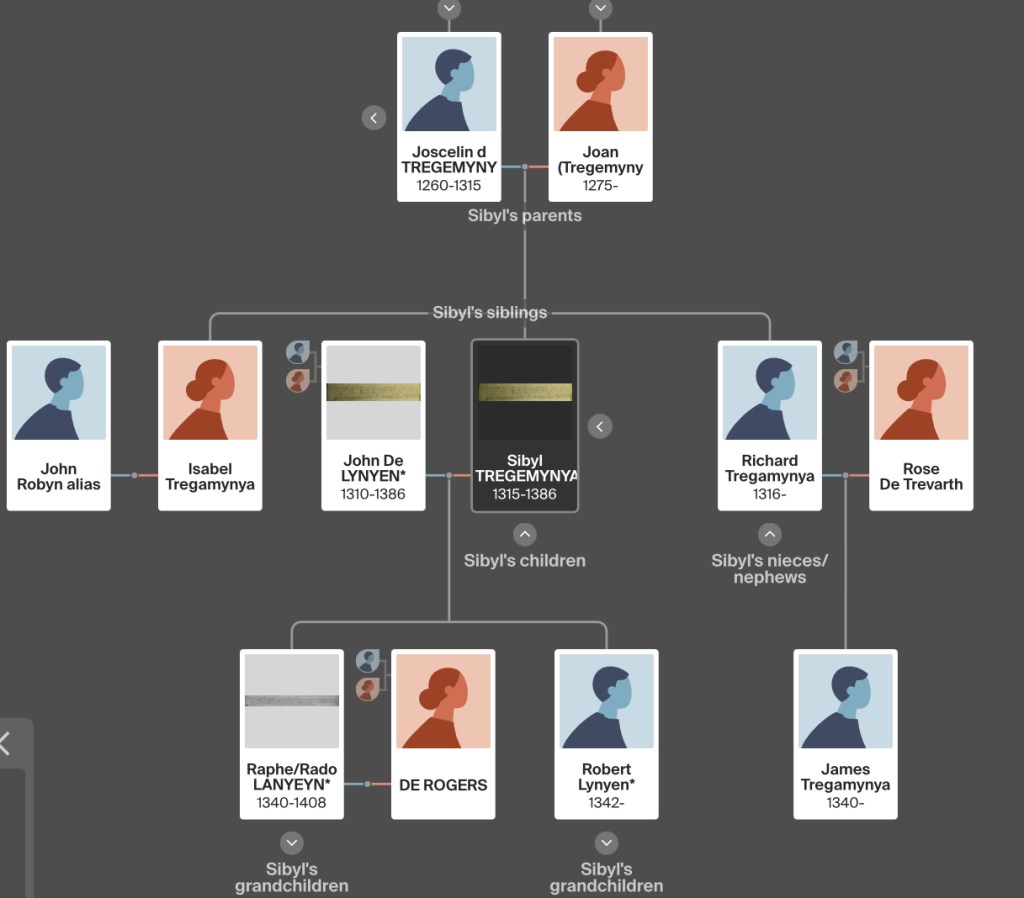
When James Tregamynyan died without heirs the estate passed to his aunt Sibyl Lanyeyn and her sister Isabel. Isabel was married to John Robyn. Sibyl, Isabel and John Robyn granted the lands to John Lanyeyn but he was ousted by James Park (Keeper of the Fees for Princess Joan of Kent) who claimed that Robyn was a villein of the princess. Consequently when the pincess died the land passed to the king who granted it to a man named Langueth. Raphe Lanyeyn, John and Sibyl’s son, requested that this should be repealed.

The judgement favoured Raphe Lanyeyn but Alexander Langueth was later allowed a rent free life interest in Isabel & John Robyn’s portion.

Richard II – Westminster Abbey, Public domain, via Wikimedia Commons

“To John Aston Escheator in Cornwall. Order to remove the King’s hand and meddle no further with a moiety of the lands of Joceus de Tregemyngnoun, delivering to Ralph son of John Lanyeyn any issues thereof taken; as the king. Has learned by inquisition, taken by the Escheator that the said Joceus was seized of 12 messuages, 3 carucates of land and 20s of rent in Tregemynyan, Trenwen, Croghton, Tregessyelle, Keguyn and Bossnyoun, that he had a son named Richard and two daughters Sibyl & Isabel and died, that Richard his son & heir had a son named James. And died, that the said James died without issue, that Sibyl the said first daughter married John Lanyeyn, that they had a son named Ralph and the said John died, that Isabel his second daughter married John Robyn, a villein of the princess as of her dower in Cornwall, that the said Sibyl and John Robyn with Isabel his wife were seized of all the premises and granted the same to the said Ralph and the heirs of his body, that he was seized thereof by virtue of that grant, taking all the profits, until be reason of John Robyn’s neifty (servitude, bondage, or villeinage) James Park, Keeper of the fees of the Princess of Cornwall seized all the premises, thrusting out the said Ralph and that for that cause the same are in the king’s hand by the death of the princess; and now at suit of the said Ralph, after deliberation in chancery with the justices, the king reckons the seizure insufficient in regard to one moiety of the premises being aware that his other’s feodary seized that moiety without process of law.”

Source: Calendar Curia Rolls 9 Richard II Vol 3 (1386)

Calendar of Close Rolls, Ric II, vol. III, 1385-1389, (Public Record Office, 1921), p.71 (1386 order to remove King’s hand from moiety of lands of Joyce de Tregemyngnoun, delivering petitioner any issues taken thereof)

Calendar of Patent Rolls, Ric II, vol. III, 1385-1389, (Public Record Office, 1900), p.304 (1387 grant for life to petitioner of all lands and tenements late of James Tregamynyon).

Legal Dispute with Princess Joan – SC 8/305/15206 National Archives
The Tregamynyan family tree

David de Kylminawis

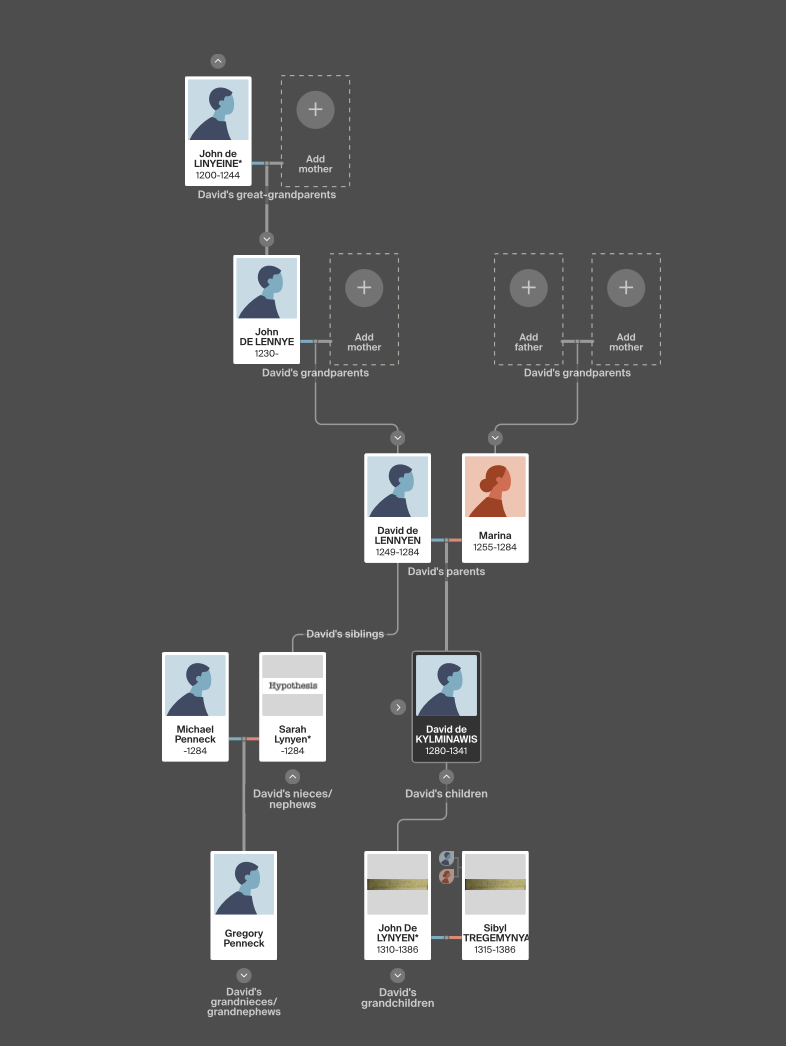
David was born about 1280 and died after 1341. David may have been the brother of Sarah Lynyen. It’s not possible to say with any certainty but they were both living at the same time. The tree below shows the possible relationship.

Kylminawis – Kyl may be the equivalent to the Scottish Kil meaning church so Kylminawis possibly refers to St Minver in North East Cornwall.

A Cornish language expert has also suggested that the name Kylminawis is near identical to the earliest recorded spellings of Kilminorth, Talland on Cornwall’s southeast coast. Those spellings are ‘Kilminawyd’ and ‘Kylmynawyd’ 1284, It’s thought to contain the words ‘kyl’ meaning ‘nook, back, ridge’ and ‘menowes’ meaning ‘awl, or a hill, stone or piece of land shaped like an awl.’ I haven’t been able to find any connection to this area and the 1341 charter mentions David’s bake house in Portzwyhan which is now Port Quin which is on the north coast near St Minver. There are also family connections to St Ervan, St Merryn, Padstow and Harlyn.

In the Fine Rolls there is a mention of a David de Kilminand in Cornwall, is this David the father of David de Kilminawis?

1272 Fine Roll Henry III – David de Kilminand – Cornwall – gives half a mark for having a pone order to the Sheriff of Cornwall.

In the context of medieval English Fine Rolls (records of payments to the King for favours and legal concessions), a pone refers to a legal writ used to remove a case from a lower court (such as a county court) to a higher court, specifically the Court of Common Pleas at Westminster. 

In 1341 there is a charter which mentions David de Kylminawis and his son John who married Sibyl de Tregamynyan.

St Enodoc’s Church at St Minver by Peter Skynner,


Edward III – Unknown author, Public domain, via Wikimedia Commons

“David De Kylmynawis to John his firstborn son & heir, and to the heirs of his body by Sibyl daughter of Joceli de Tregaminion his wife, with remainder to the grantor and his heirs. Charter with warranty of all his messuages, lands etc. In Kylmynawis, namely yards, gardens, woods, meadows, moors, turbaries, launds an pastures, and his corn mill there with multiple, waters and watercourses or beads, his bake house with garden in the town of Portzwyhan, the rent and service of John de Landewarnek and his heirs for lands held of the grantor in Kylcoys, of Simon de Kylcoys there, of Paternus and Robert brothers of the grantor for lands of him held for their lives in Kylcoys, of Margery his sister likewise in Araweyte, and the reversion of all lands of the said John, Simon, Paternus, Robert and Margery which they claim to hold for life of the grantor and his heirs when it shall fall in.”

Dated Kylminawis, Friday before St Barnabas 15 Edward III

Source: CCR Calendar Curia Rolls, Henry IV, Vol.4, 1441-47, (Public Records Office, London, 1937), 452/3.

Portzwyhan is Port Quin today.

Port Quin and St Minver in North Cornwall.