Phillimores Marriage Records show that on 3 May 1615 Elizabeth Lanyne married Oliver Neilder at Menheniot in Cornwall. Despite several attempts I couldn’t initially place Elizabeth on the Lanyon tree, who was she?
Early marriage records rarely mention the parent’s names and Elizabeth is one of the most common names in the Lanyon family so I decided to look at Oliver Neilder in more depth to see if I could discover anything useful.
Oliver Neilder baptised at least four children at Menheniot in the early 17th century: Marye 1619, Jane 1621, John 1624 and Elizabeth 1627. The Menheniot parish register also lists the following burials: Elizabeth Neilder was buried on 15 Jan 1659 (she was noted as being ‘old’) and Oliver Neilder was buried the following year on 26 Sep 1660 (he’s noted as ‘old senr’.)
Neither Oliver nor Elizabeth left a will so that avenue for research was closed. I did find Oliver Nealder (sic) listed on the 1641/2 Protestation Return for Menheniot but that was it. I then turned to Kresen Kernow (The Cornish Record Office) and the National Archives to see if there was anything useful there.
I found just one relevant record at Kresen Kernow. Assignment of land at Trenant, the parties were Oliver Nealder, yeoman of Menheniot and Peter Carveth also a yeoman of Menheniot (BRA991/120).
The National Archives were more forthcoming. I found records of litigation between the Neilder family and the Kekewich family. I’ve come across the Kekewich family before whilst researching the Lanyons so I was curious to find out more.
The Kekewich’s were one of the most powerful families in Cornwall in the late 16th and early 17th centuries. The family resided at Catchfrench near Saltash and Trehawke near Menheniot. So Oliver and Elizabeth Neilder were neighbours of the Kekewich family.
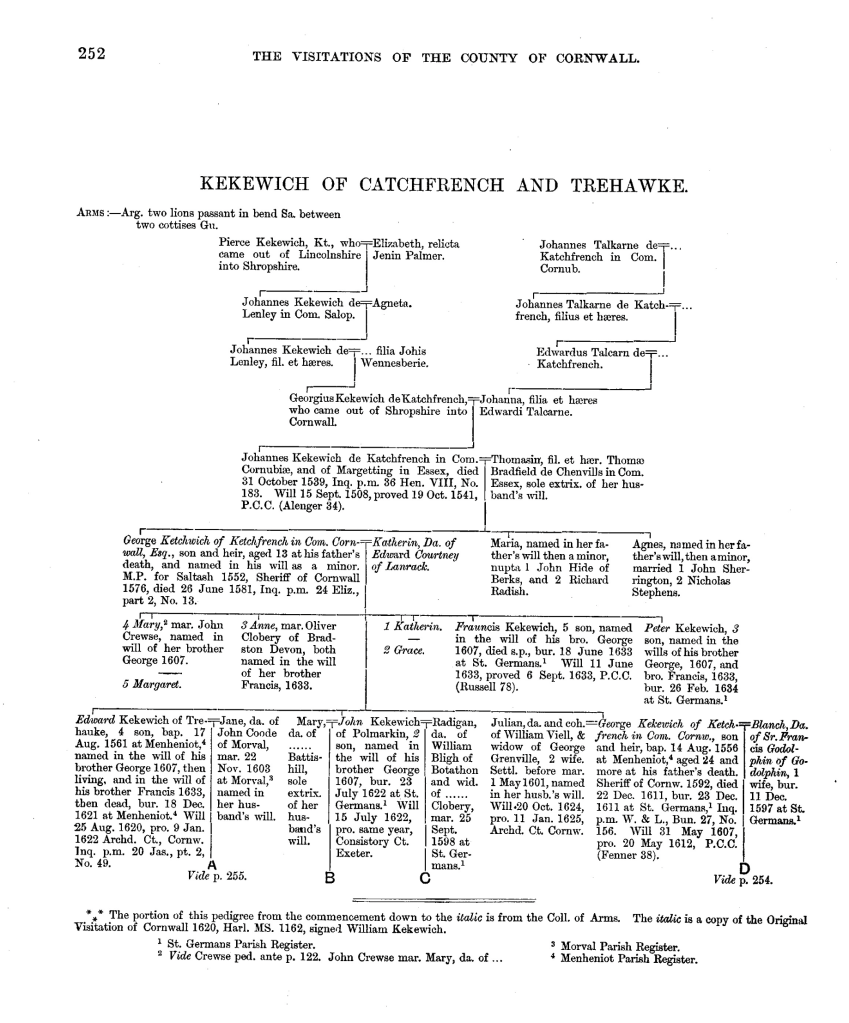
The Herald’s Visitation of Cornwall gives us the Kekewich family tree for that period.
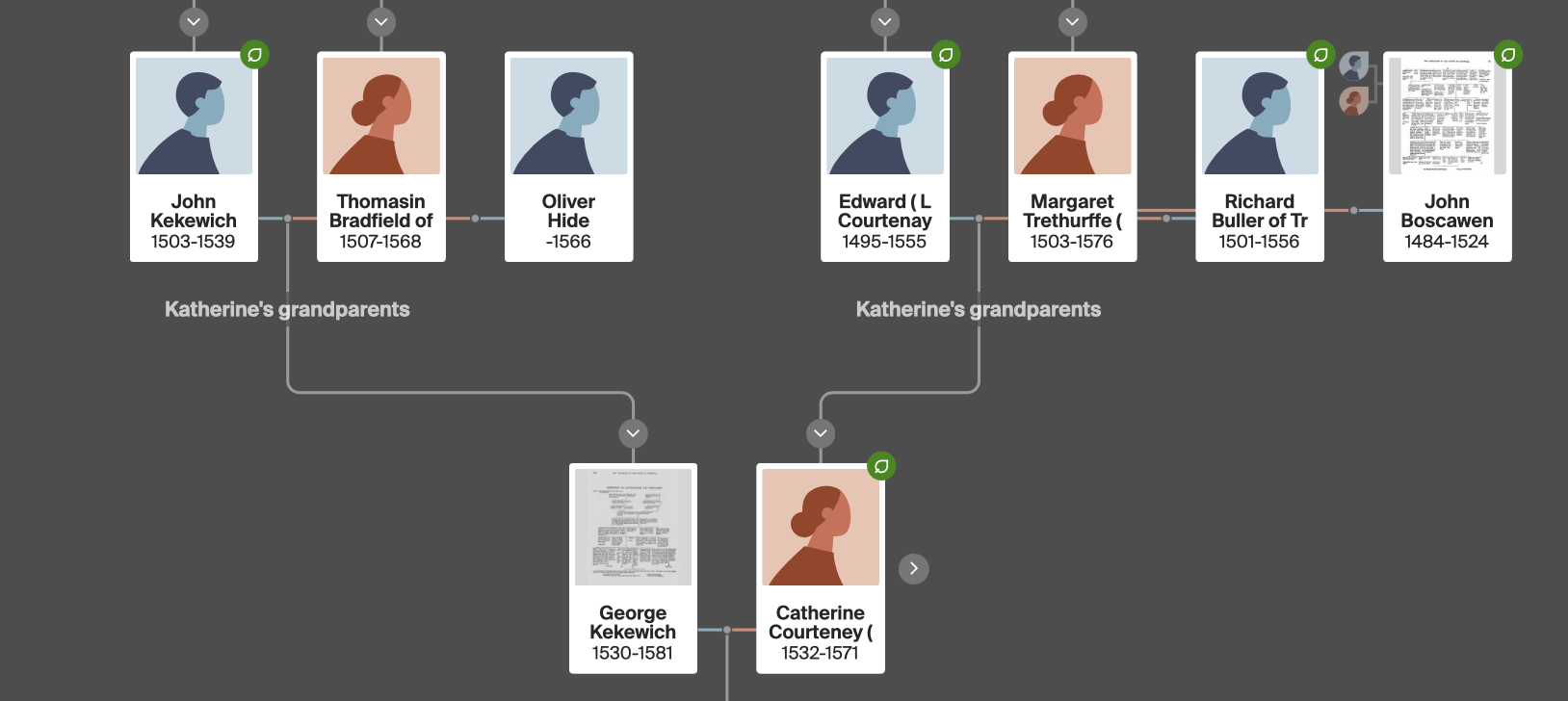
George Kekewich married Katherine/Catherine Courtney, descended from an aristocratic family. Her mother Margaret, daughter of Thomas Trethurfe, was one of the co-heirs of Edward Courtenay, Earl of Devon. Margaret married three times; first to John Boscowen, second to Edward Courtenay of Landrake and third to Richard Buller of Tregarrick.
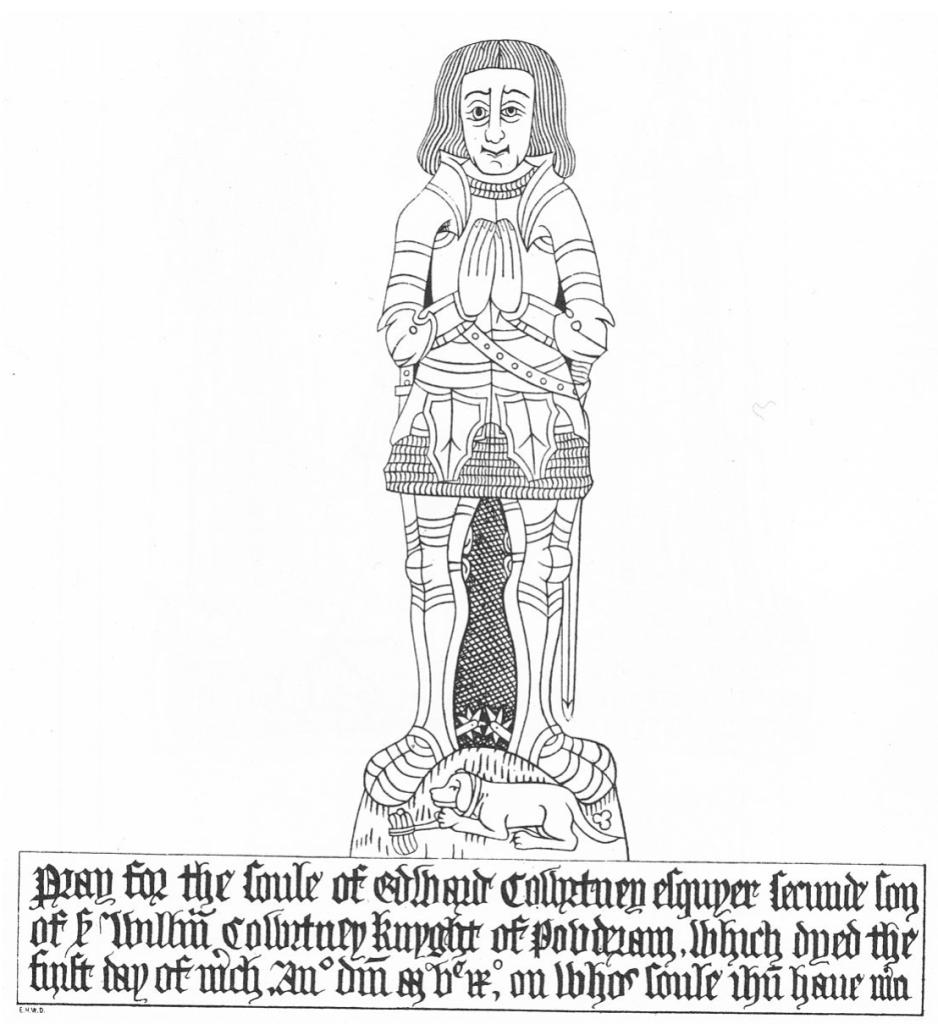
Edward Courtenay 1509 brass – Dunkin, E.H.W. The Monumental Brasses of Cornwall, 1882, Plate XXIKekewich – Courtenay family tree
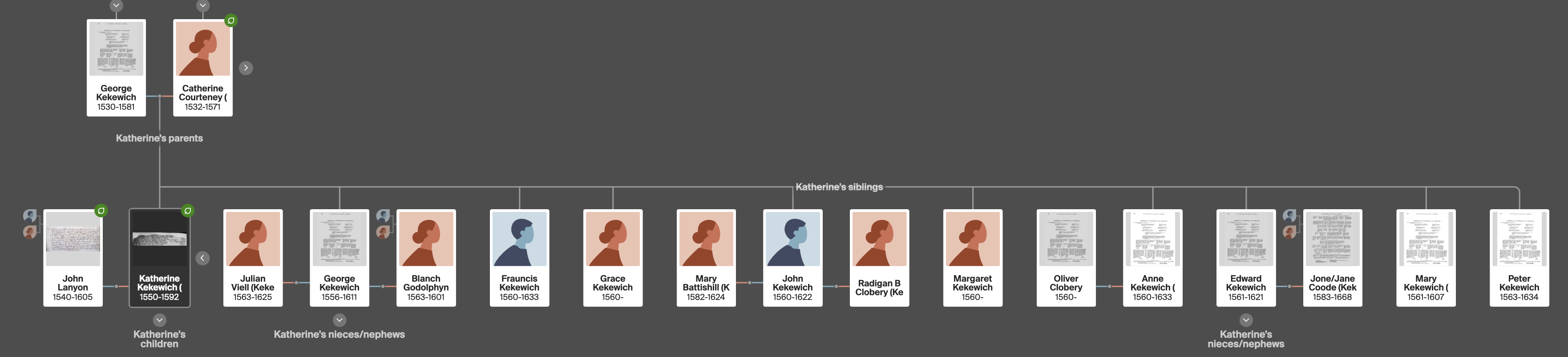
George and Katherine Kekewich had several children but we’re interested in their first born daughter Katherine and their fourth son Edward. Edward Kekewich of Trehawke was baptised on the 17 Aug 1561 at Menheniot, he married Jane, the daughter of John Coode of Morval on 22 Nov 1603 at Morval. Edward was buried at Menheniot on 18 Dec 1621. Edward and Jane’s second son, Peter Kekewich, was born in 1605 and he was the man involved in litigation with the Neilder family.
The children of George & Catherine Kekewich
National Archives document C9/47/58 Neilder v. Kekewich 1668 states that Nicholas Honey on behalf of his stepchildren, Oliver and Elizabeth Neilder, who were under 18 started the litigation. Honey stated that in 1657 Oliver Neilder was 83 years old (giving him a birthdate about 1574) and he was blind and decayed in memory. Honey alleged that Peter Kekewich and his brother-in-law Roger Porter were not related to Oliver Neilder and had conned the elderly man.
Peter Kekewich and Roger Porter (the husband of Peter’s sister, Elizabeth) responded that Oliver wasn’t quite so blind or so poor in memory, despite his age. They also pointed out that Oliver Neilder’s wife Elizabeth (Lanyne) was cousin germane to Peter Kekewich and Roger’s wife. (National Archives C10/178/69 & C8/352/249)
A cousin germane is a first cousin so Elizabeth Neilder (Lanyne) must have been the daughter of one of Edward Kekewich’s sisters. Edward had five sisters: Katherine, Grace, Anne, Mary and Margaret. We know that Anne married Oliver Clobery of Bradston, Devon and Mary married John Crewse so we can discount them.
That leaves Katherine, Grace and Margaret as possible mothers. George Kekewich’s will of 1581 is in the National Archives (PROB 11/64/488) and it shows that his eldest daughter Katherine/Catherine had married a Lanyon.
His will states that his daughter “Cate Lanyan have the sixe pounds thirtene shillings Fower pence given her by her grandmother Buller and three poundes sixe shillings eighte pence for to make the whole somme Tenne poundes.”
PROB 11/64/488
So ‘Cate’ had married a Lanyon, but which one?
Richard Carew’s ‘Survey of Cornwall’ states:
“Diverse other Gentlemen there dwell in this Hundred: as Lanyne the husband of Kekewich his father married Militon and beneath s. a castle a. standing in waves b. over the same a falcon hovering with bells o.”
Richard Carew National Trust, Public domain, via Wikimedia Commons
We know that John Lanyon (the son of Richard Lanyon Esq) married Phelype Militon on 18 Jan 1562 at Breage. Their eldest son Francis married Alice Trewren in 1584. John & Phelype’s second son William married Jane at Sancreed in 1592. There is one other son, John who is described as the son of John Lanyon esq. and he was buried at Madron in 1587, he appears to be a child but his age isn’t given. Phelype Militon was buried 29 Dec 1578 at Breage.
So which ‘son’ of John Lanyon married Cate Kekewich?
John and Phelype’s son Francis was born at the earliest in 1563 and he married Alice Trewren in 1584. He was still married to her at the time of his death in about 1593. Cate Lanyon was named in her father’s will which was dated 1581 so whilst it was just about possible for Francis to have married her when he was aged 17 or 18 years old she would have to have died before 1584, when he married Alice. There is no evidence that Cate Lanyon was buried at this time. Francis did have an illegitimate daughter called Elizabeth who was baptised in 1587 however I think it highly unlikely that Cate Kekewich would have had an illegitimate daughter who was later described as a cousin germane by her nephews. I think we can safely disregard Francis as a possible husband to Cate and father to Elizabeth Neilder.
That leaves his second son William Lanyon as a possible candidate. We don’t know when William was born but it must have been 1564 at the earliest and it could have been a few years later. The oldest he could have been was just 17 and that’s if Cate married the same year as the will was written. If she was married a year or two before that William would have been only 15 or 16. We don’t know when Cate was born but she was the eldest daughter of George Kekewich and Katherine Courtenay. Their date of marriage is suggested as 1555 at Landrake, in Cornwall. We know that their eldest son and heir was baptised on 14 Aug 1556, it seems likely that Cate was born soon after. Her mother Katherine Courtenay died in 1571 so all nine children must have been born before that date. This makes Cate several years older than William Lanyon.
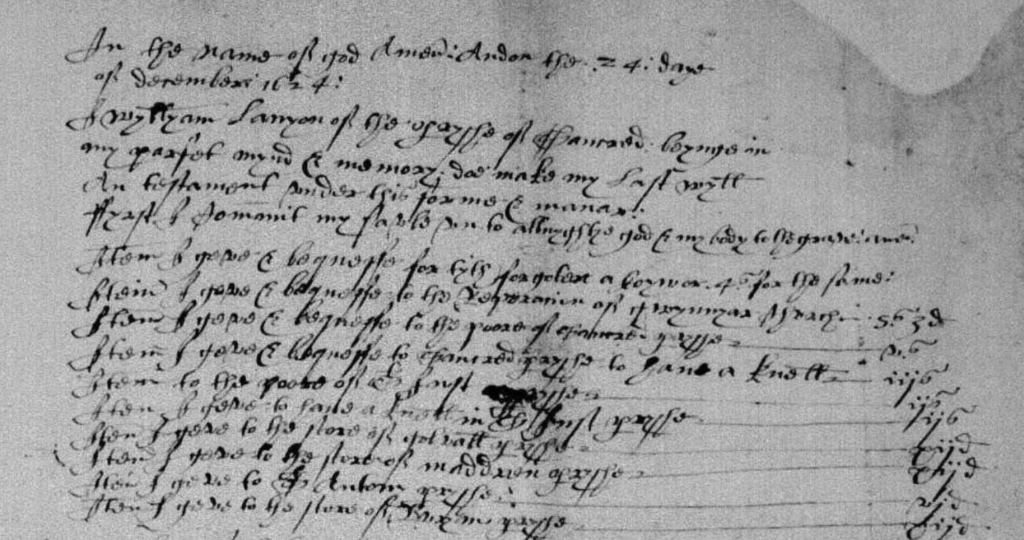
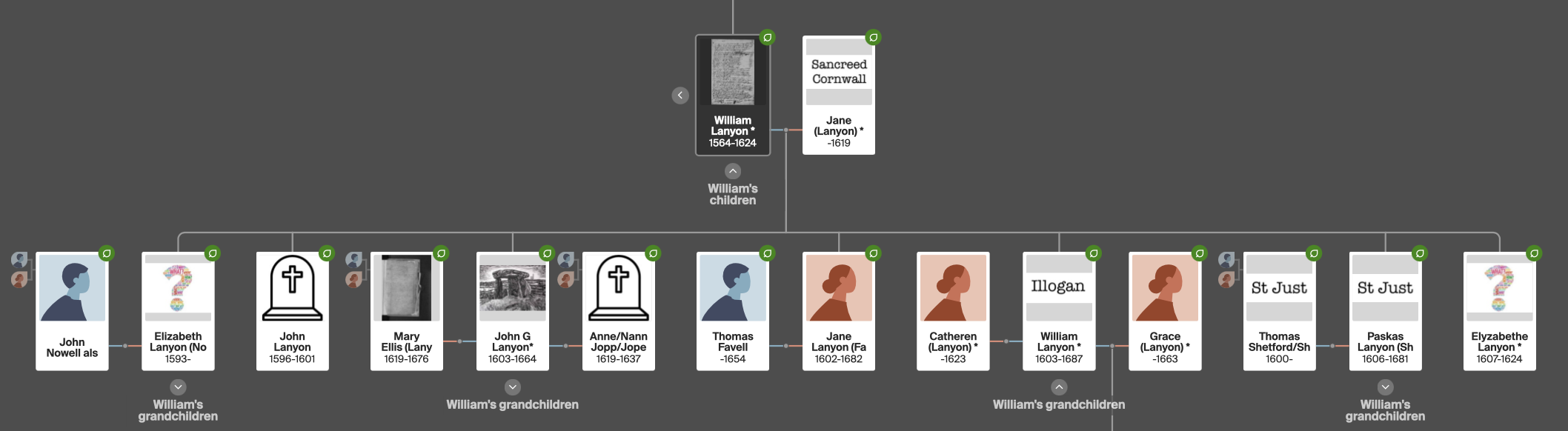
William Lanyon did marry a woman called Jane at Sancreed in 1592 and they had six children. He died in 1624 and his will survives and names his children. He had two daughters, both called Elizabeth! The eldest was born in 1593 after his marriage to Jane so Cate couldn’t be her mother. The youngest was born in 1607 and would be too young to marry Oliver Neilder in 1615.
William Lanyon’s 1624 will naming his children
George Kekewich was an MP for Saltash and Sheriff of Cornwall, Katherine Courtenay was descended from an aristocratic family, would they have married their eldest daughter to a teenage second son?
It seems much more likely that Cate Kekewich married the recently widowed John Lanyon, the eldest son and heir to Richard Lanyon Esq and the head of the Lanyon family.
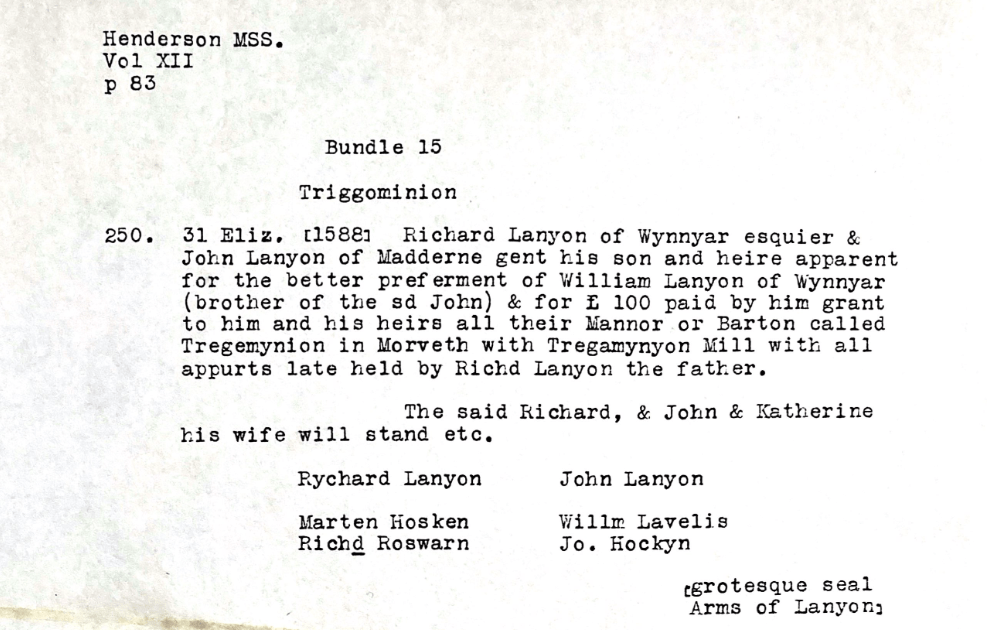
Whilst there is no record of a marriage for John Lanyon and Cate Kekewich there is a record which may help prove the relationship. In 1589 Richard Lanyon Esq and his eldest son John sold Tregemynion in Morvah to Richard’s fourth son William. The agreement is signed by Richard, John and Katherine his wife. (Hendersons MSS Vol XII p.83)
Abstract from Hendersons MSS
So it appears as though sometime after 29 Dec 1578, when Phelype Militon died, and before 1581 when George Kekewich’s will was written, that John Lanyon married for a second time to a woman named Katherine.
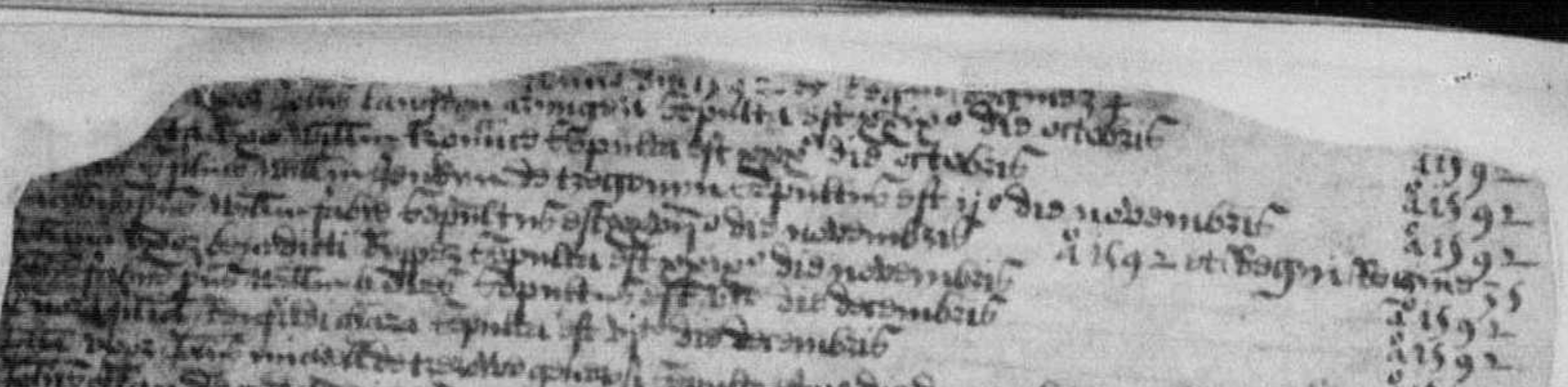
Breage parish register also has an interesting entry for a burial. On 29 Oct 1592 there is the following entry ‘uxor Johis Lanyon armiger’. Sadly the page is damaged so the wife’s name is not legible but John Lanyon, who has the right to bear arms, buried his wife. There is only one John Lanyon who has the right to bear arms at this time.
Breage Parish Register Burials
There are no records of any children of this marriage being baptised or buried. However looking at the wills of Cate’s brothers gives us some more clues. George Kekewich the younger’s will was written 22 Jun 1607 and proved 20 May 1612. It states:
“I give the blynde Lanian, my kinsman xx s a year towards his mayntenance untill my heire accomplish the age of xxj years.”
National Archives PROB 11/119/518
So Cate’s brother had a ‘kinsman’ called Lanian who was blind.
Cate’s brother Francis also left a will which was written 20 May 1633 which states:
“I give George Lanion twenty shillings a year during my lease of Manoby with the proviso that he wander not the country as a beggar contrary to God’s and Man’s laws. Hoping the rest of his friends will make up the rest that must be paid for his board.” (National Archives PROB 11/164/299)
So it appears as though Cate Lanyon had a son called George who was blind. He’s not mentioned in any Lanyon wills however most of the 16th century Cornish wills were destroyed during World War II bombing.
There is no record of a baptism, marriage or death of George Lanyon and we wouldn’t know anything about him but for these wills. None of the wills mentions Elizabeth Lanyne or Oliver Neilder.
Whilst none of this is actual proof that Elizabeth Neilder was the daughter of Katherine Kekewich and John Lanyon Esq it’s probably as close as we’ll come.
We know what happened to Elizabeth, she died an old woman in Menheniot. Perhaps ‘Blynde George’ lived out his life with her?
1569 was the year the first lottery was held in England, the prize was £5000. It was also the year Mary Queen of Scots was first imprisoned and of the Northern Rebellion against Elizabeth I.
Mary Queen of Scots François Clouet, Public domain, via Wikimedia Commons
It was also an important year for the Lanyon family.
In 1567 William Laniene esq died. We don’t know his date of birth but his eldest son was born about 1516 and he had older sisters so it is estimated that William was born in the 1480s. There is an Inquisition Post Mortem of William Laniene of Coswynwollard, Gwinnear from 1586 which gives the date 20 Mar 1567 as the date of his death. This Inquisition gives his son Richard’s age as 70 (in 1586), so he was already 51 when he inherited his father’s estate in 1567.
In 1562 at the time of his son John’s marriage to Phelype Myliton, Richard was living at Tregaminian in Morvah. In 1567 he moved to Coswynwollard in Gwinear (now called Lanyon.)
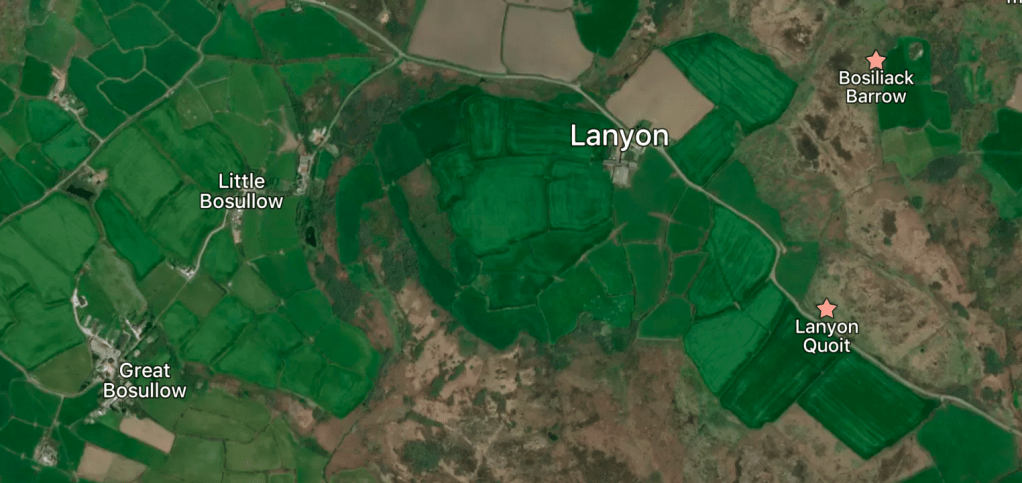
Map of the Lanyon Estate at Gwinear
We don’t know which lands, if any, William Laniene senior intended for his sons as there is no will. In 1569 Richard granted estates to his brothers.
William ‘Generosi’ Lanyon
Richard’s brother William had been living at the family estate in Gwinear. His first wife Tamson was buried there on 26 Jun 1563. His son Baldwin was baptised at Gwinear on 1 Apr 1561 and buried 24 Jun 1563 just two days before his mother.
William was given the estate Tregonen at Breage. He appears on the Breage Muster Roll of 1569 ‘Furnished long bow sheaf arrows steel cap and black bill’ and he lived there until his death in 1597. His burial is listed in the Breage parish register where he is described as ‘generosi’.
Tregonning Hill near Breage which may be the location of Tregonen
Walter Lanyon
Walter married Elizabeth Nanspyan of St Erth. He is listed on the 1569 Muster Roll for St Erth ‘Bow shaft arrows, ability B’. His father owned land at St Erth as it is listed on the 1523 Penwith Subsidy Roll as having a value of 41 shillings (the same as the Gwinear estate.)
In 1569 he was given the tenancy of the Barton of Lanyon (the ancestral family home) at Madron by his brother Richard. Hendersons MSS 30534 pt 7 gives details of the lease and confirms the names of Walter’s son (John) and three grandsons (Francis, Alexander and David) also their ages.
The ancestral home at Lanyon near Madron. Bosullow was also part of the estate.
Edward Lanyon
The only record we have of William Lanyon having a son called Edward is a record from Kresen Kernow (Cornwall Record Office) AR/3/39 dated 11 Feb 1586. It’s a lawsuit over Crugmoreck in St Merryn.
“…..that Richard Lanyen esquire, on 20 September 1569 (11 Elizabeth), had granted to party (1-Edward Lanyen) 30 acres of land, being one close called Crukemorecke (parish of Seynt Meryn), for (1) to hold for term of 6 years from St Bartholomew last past [24 Aug 1569]; on the following 26 Sep [1569], (2-George Arundell)-(3-John Michall) forcibly entered the tenement and ejected him from it…”
The case goes on to mention that the sheriff of Cornwall Peter Edgecombe esq was a kinsman of Edward. Peter was the son of Joan Tregian the daughter of Thomas Tregian and that Edward was the son of Thomasine Tregian the daughter of Thomas Tregian.
We don’t know what happened to Edward after 1586. We don’t know if he had any children. All we know is that Richard Lanyon esq granted him the lease of the estate in Crugmoreck in 1569. There is an Edward Leyne on the Padstow muster roll of 1569 ‘bow 6 arr, ability a-ar’. Could this be the same person?
We don’t know where Crugmoreck lies today but the Lanyons owned lands at Harlyn, St Ervan, St Merryn and Padstow. Perhaps Crugmeer is the location?
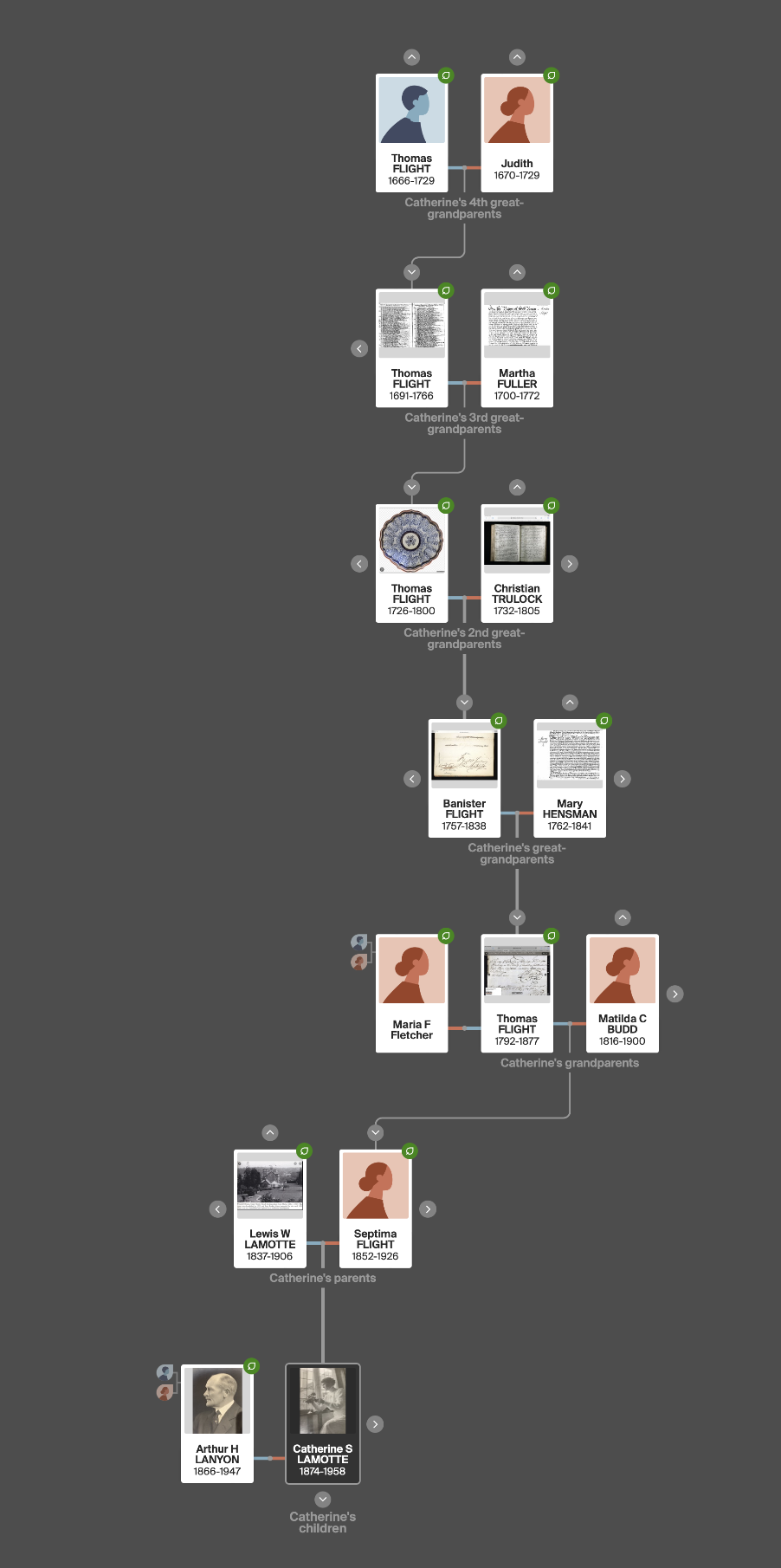
Septima Flight married Lewis Lamotte and their daughter Catherine Septima Lamotte married Arthur Herbert Lanyon in 1899. The Flights are an interesting family and probably deserve their very own website.
Thomas Flight and Judith
Thomas Flight lived in Henley in Berkshire and the little we know about him comes from his wife’s will. We don’t know when he was born or when he married but presumably it was before 1691 when his eldest son Thomas was born. When Judith died in 1729 she was a widow and her will described Thomas as a baker. They had 5 daughters and 4 sons all named in Judith’s will.
Thomas Flight and Martha Fuller
Thomas and Judith’s eldest son Thomas Flight married Martha Fuller 1st Aug 1720 at St. Leonards, Wallingford, Berkshire. Thomas was buried on 8th Aug 1767 at Bunhill Fields in London. His burial record records that he was a dissenter. His will names his children: Joseph, Thomas, John, Ann, Mary, Elizabeth and Hanson, son in law Joseph Pattison and grandson Joseph Pattison. He left the sum of £1600 to his wife to be shared amongst his children. His eldest son Joseph inherited his lands in Farringdon and his youngest son, Hanson, inherited his lands at Abingdon. His sons Thomas and Joseph are his executors.
His daughter Martha Pattison died in 1766
His son Joseph was a turpentine merchant and wheelwright. He died in 1788.
His son John was a maltster and draper. He died in 1769.
His youngest son was Hanson.
Hanson Flight and Martha Underhill
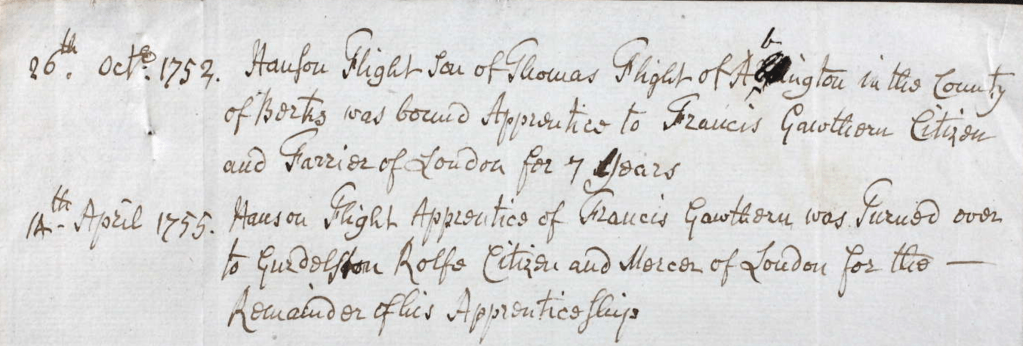
In 1752 aged 15 Hanson was apprenticed to Francis Gawthern a citizen and farrier of London for seven years however three years later his apprenticeship was passed to Gurdolfston Rolfe a citizen and mercer of London.
Freedom of the City Admission Papers
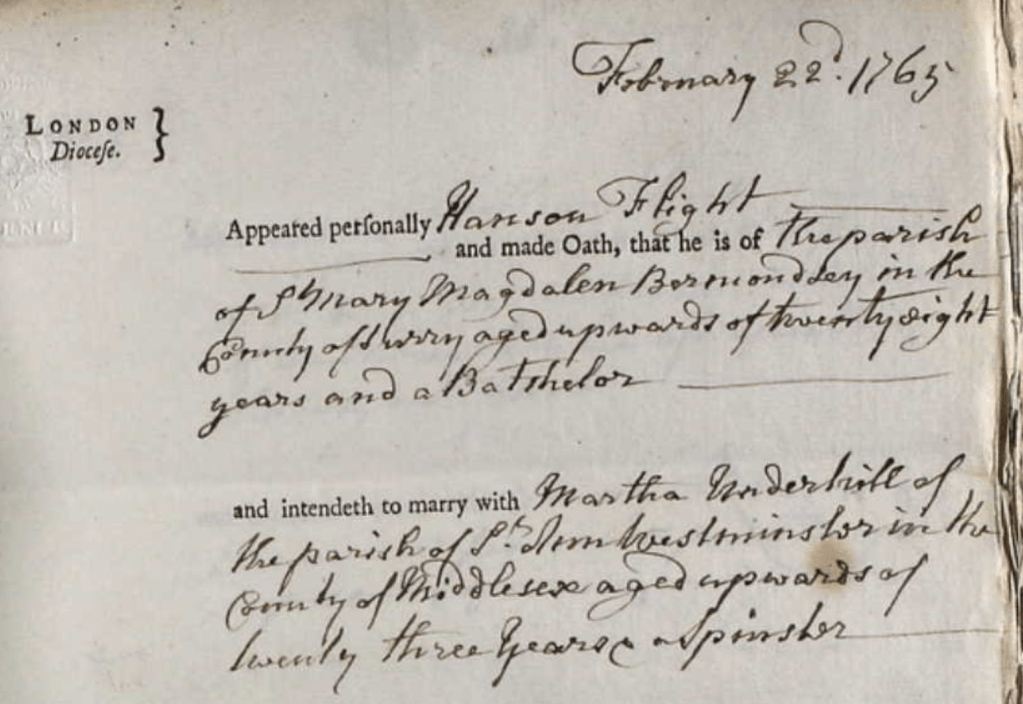
Hanson Flight and Martha Underhill pledged to marry at Bermondsey, Surrey in Feb 1765 and married at St Anne, Soho two days later on the 24th.
London and Surrey, England, Marriage Bonds and Allegations
Hanson and Martha had at least two sons:
Joseph 1773 – 1811 married Jane Greenwood in 1801
Hanson 1776
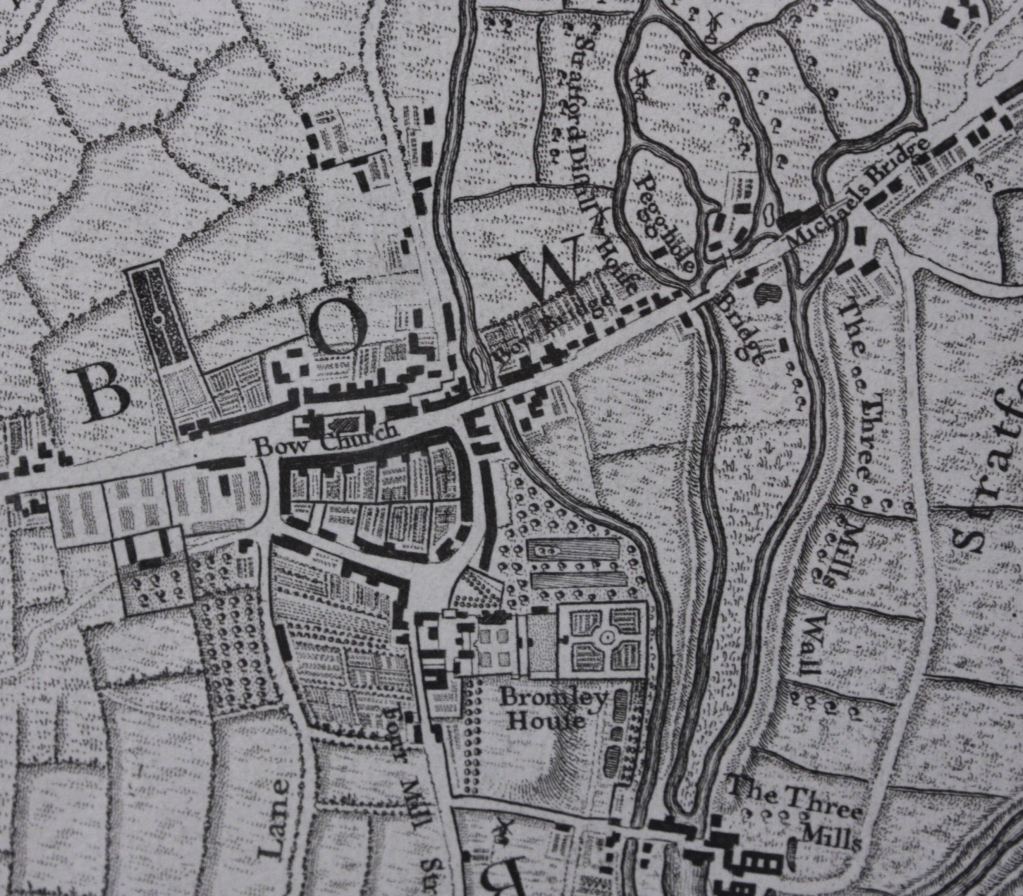
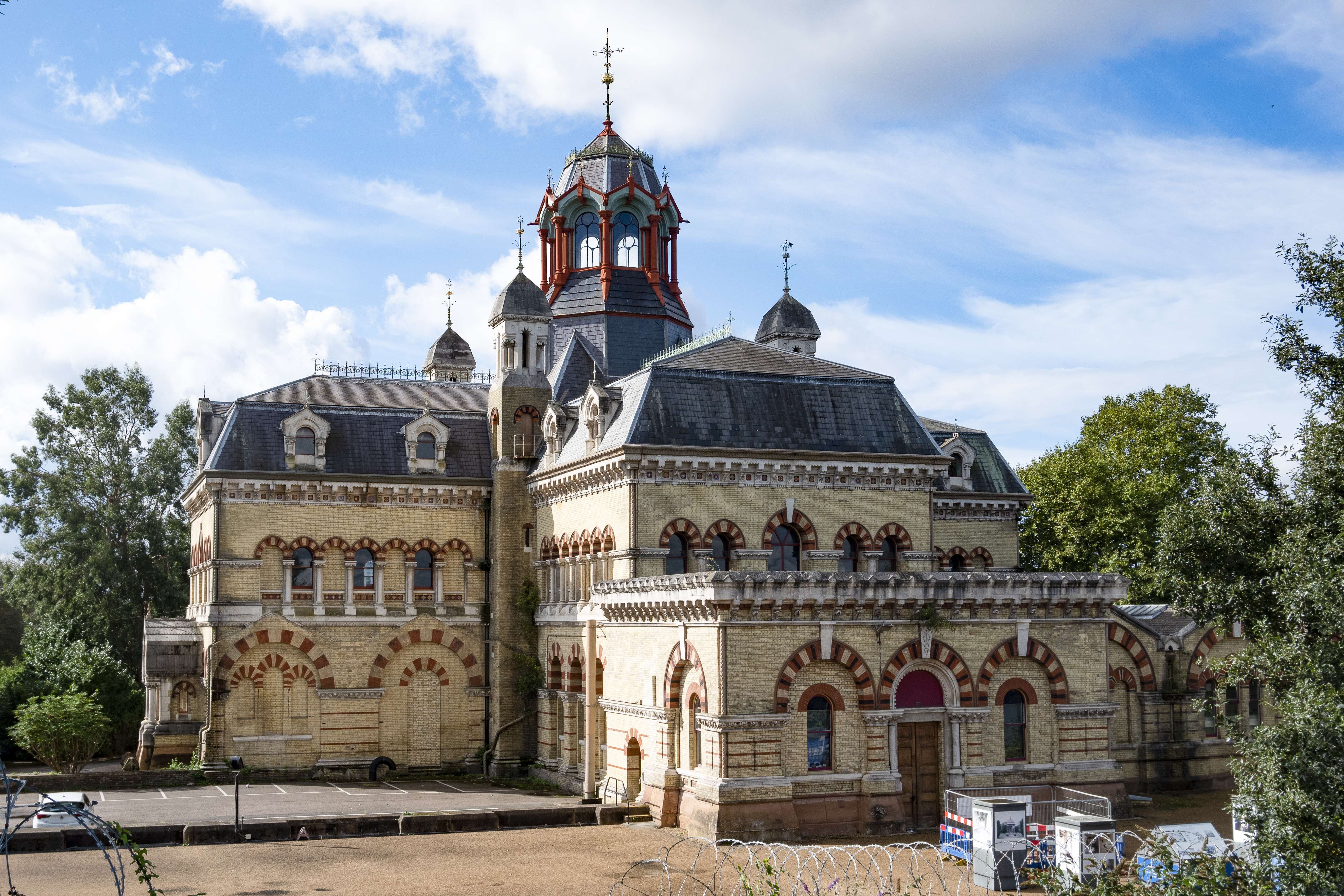
Joseph was a miller and lived at the Abbey Mills at Barking. Joseph was attacked and murdered by footpads at Bow Bridge, River Lea at Stratford on 2nd Feb 1811. He left a wife and six children under the age of 10.
Bow Bridge at Stratford
The Abbey Mills no longer exist but on the site today is the Abbey Mills pumping station.
Joseph Flight’s son was also called Hanson and worked as a collector to a draper.
Joseph’s great great great great granddaughter also married a Lanyon!
I was surprised to discover that there is a flourishing branch of the Lanyon family tree in Fiji!
After a little research I discovered this branch is descended from the Gwinear branch of the tree.
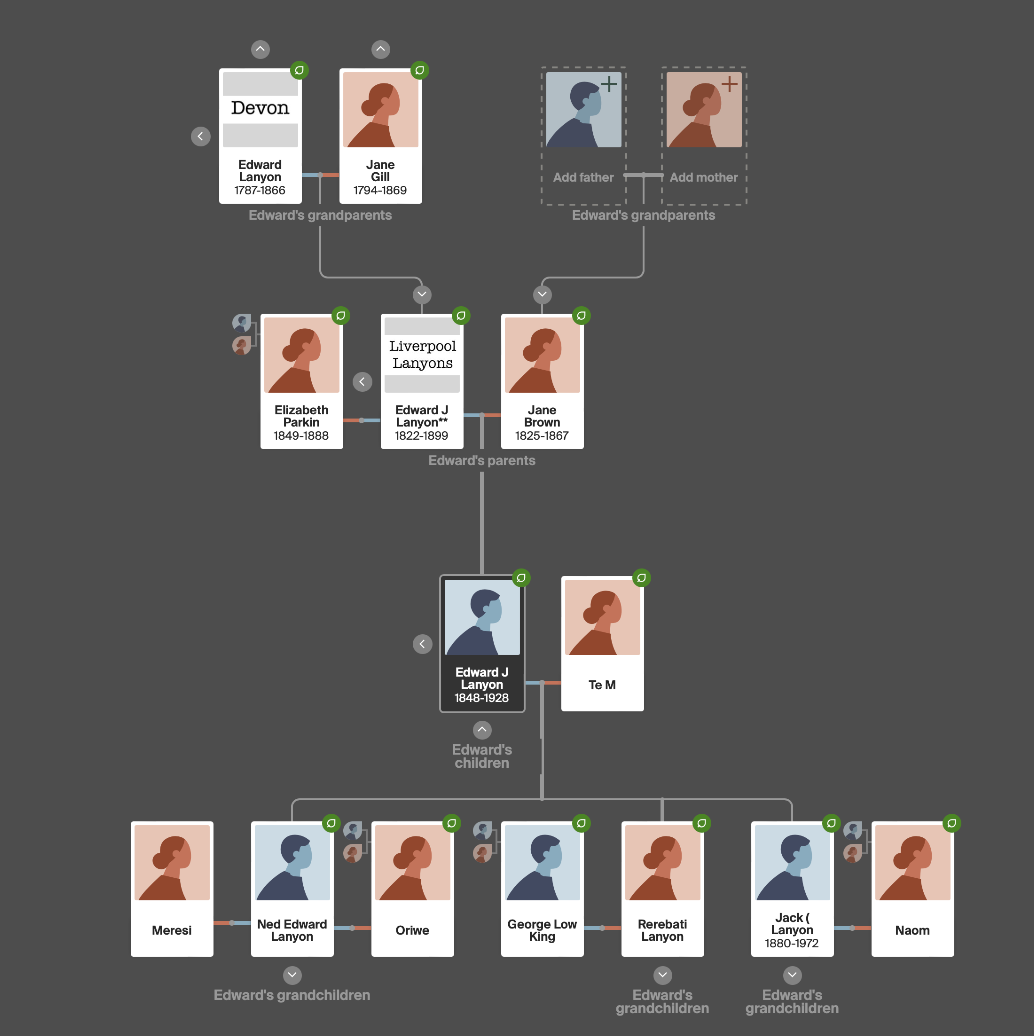
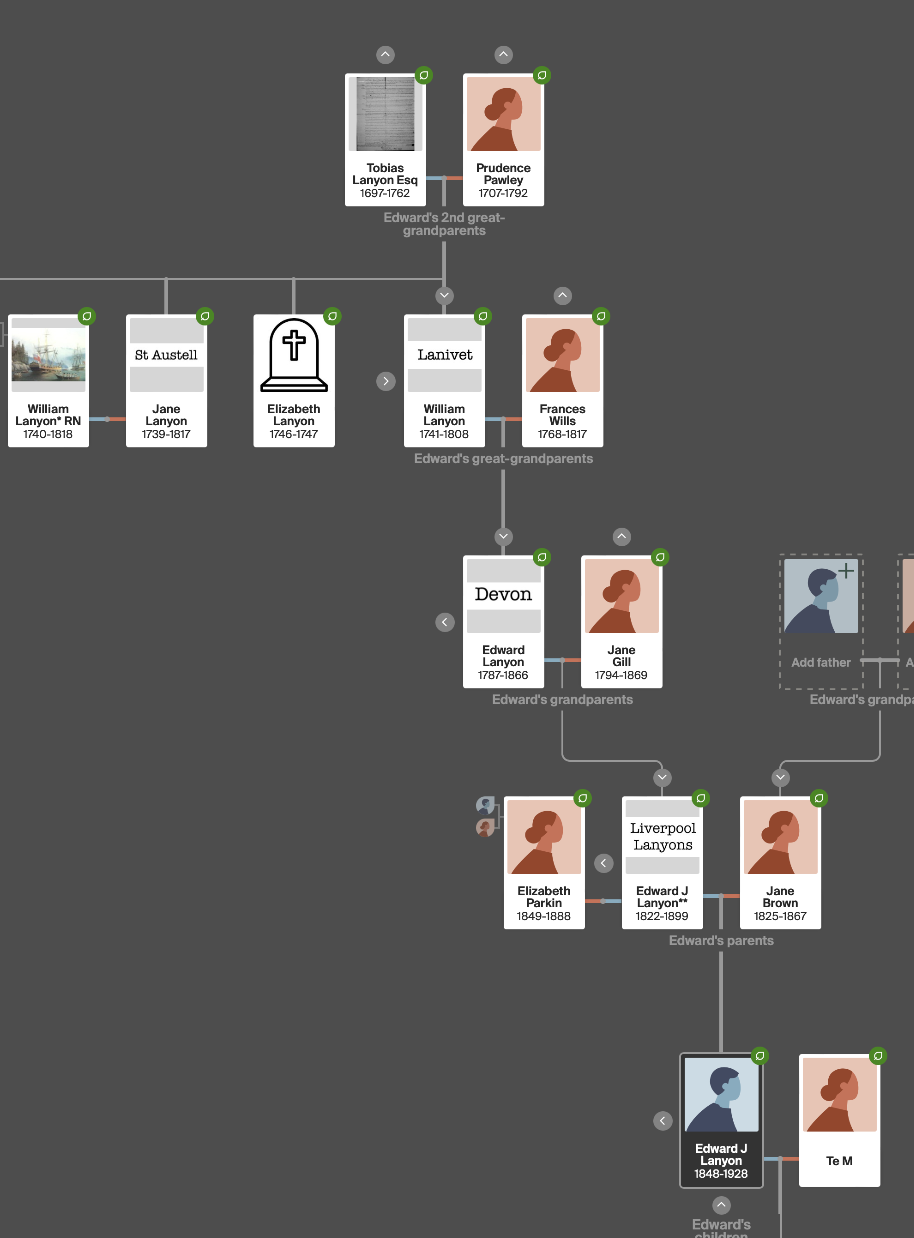
Edward James Lanyon 1848-1928 was the son of Edward James Lanyon and Jane Brown. He was born in Aylesbury, Buckinghamshire and for a long time there was no further trace of him. Then I came across the Fiji Lanyons on a Facebook post and a whole new avenue opened up!
Edward James Lanyon travelled out to the other side of the word to become a plantation owner. He was very successful, he married Te Maotarawa in Fiji and they had three children:-
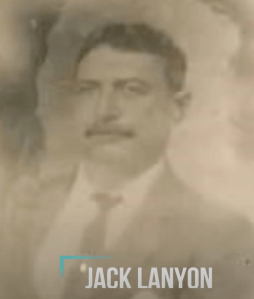
Jack (John) Lanyon abt 1880-1972
Rerebati Lanyon
Ned (Edward) Lanyon
Jack married Naom and they had five children:-
Rerepati Elizabeth Lanyon 1910-
Wilson Lanyon 1910-1999
George Lanyon
Tapanou Lanyon
Mary Lanyon
Rerebati married George Low King and they had two daughters Mereka and Beri
Ned married Oriwe and they had five sons and his second wife was Meresi:-
Jack Lanyon 1940-1980
Edward Koaia Lanyon
David Lanyon
Frank Lanyon
John Lanyon
Curiously Edward James Lanyon was a great great nephew of William Lanyon RN who sailed with Captain Cook. Perhaps the desire to sail to the other side of the world is in the genes!
The Milliner – Richard Edward Miller, Public domain, via Wikimedia Commons
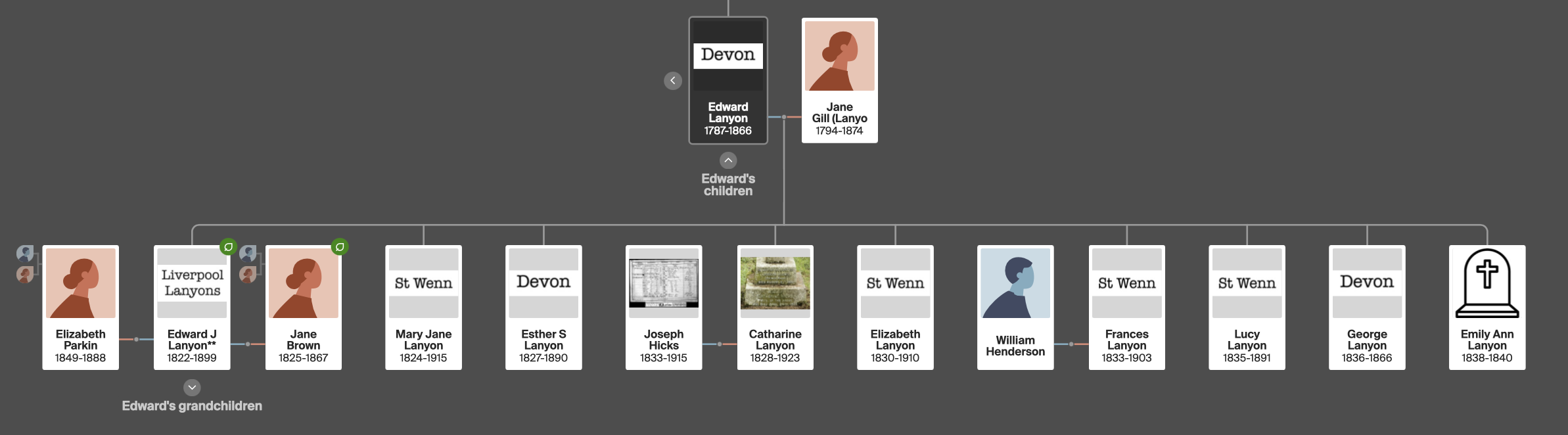
Edward Lanyon was the son of William Lanyon and Frances Wills. He was baptised on 20 Jul 1787 at St Ewe in Cornwall. He married Jane Gill in 1821 at High Bickington, Devon. They had nine children:-
Map of St Ewe near Mevagissey, High Bickington near Barnstaple and Ilfracombe.
Edward was an excise man. In 1851 the family were living at Ilfracombe and Edward was still working at the age of 63.
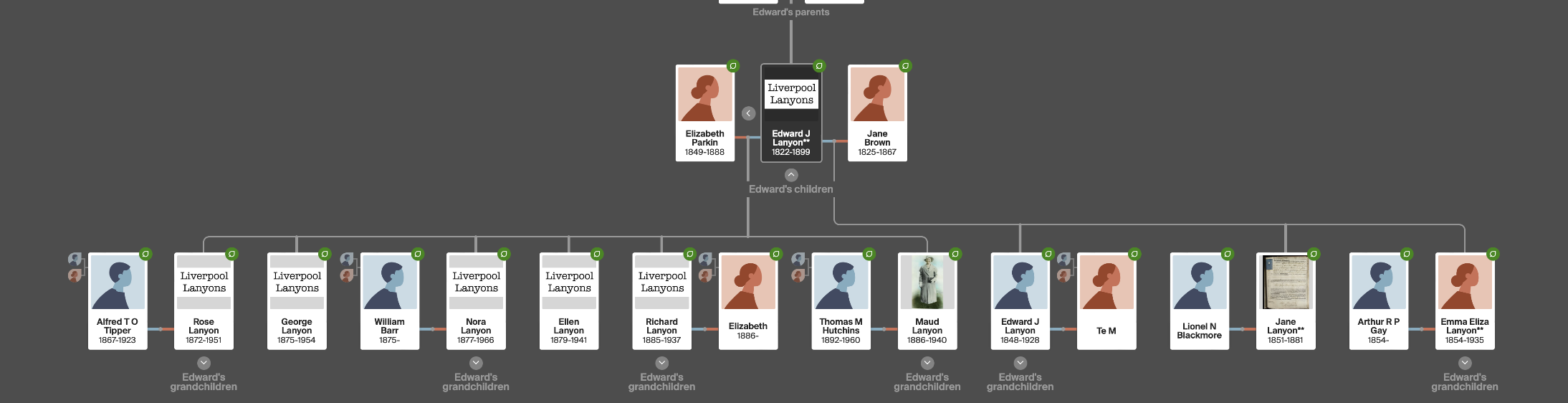
Edward’s eldest son Edward James Lanyon was an inland revenue officer, he married twice, first to Jane Brown who died before 1867 and second to Elizabeth Parkin. There were three children from the first marriage:-
Edward James Lanyon 1848-1928 he founded the Fiji branch of the Lanyon family
Jane Lanyon 1851-1881
Emma Eliza Lanyon 1854-1935
In 1867 Edward married Elizabeth Parkin in Barnstaple, Devon. They moved to Liverpool and they had six children:-
Rose Lanyon 1872-1951
George Lanyon 1875-1954
Nora Lanyon 1877-1966
Ellen Lanyon 1879-1941
Richard Lanyon 1885-1937
Maud Lanyon 1886-1940
Of Edward senior’s daughters only two married and they had no children. Catherine married Joseph Hicks and Frances Lanyon married William Henderson. All the daughters were at one time working as milliners or hat makers.
Over the decades the census shows them living together with Joseph and Catherine Hicks in London and Cornwall. Joseph was a warehouseman, a manufacturer of women’s clothing and a milliner. They must have been fairly successful as they were all able to live ‘on their own means’.
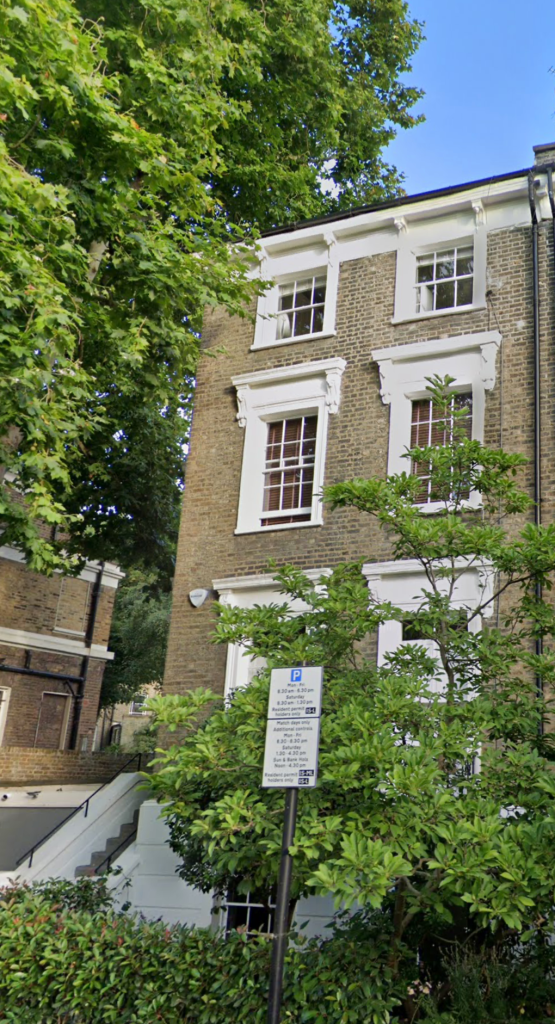
In 1881 they were living at 13 Alwyne Road, Islington, London and employed three servants.
13 Alwyne Road today.
Their younger brother George worked as a draper and a grocer, he died aged just 30 from TB.
Occasionally you come across a document which really helps to paint an accurate picture of a person.
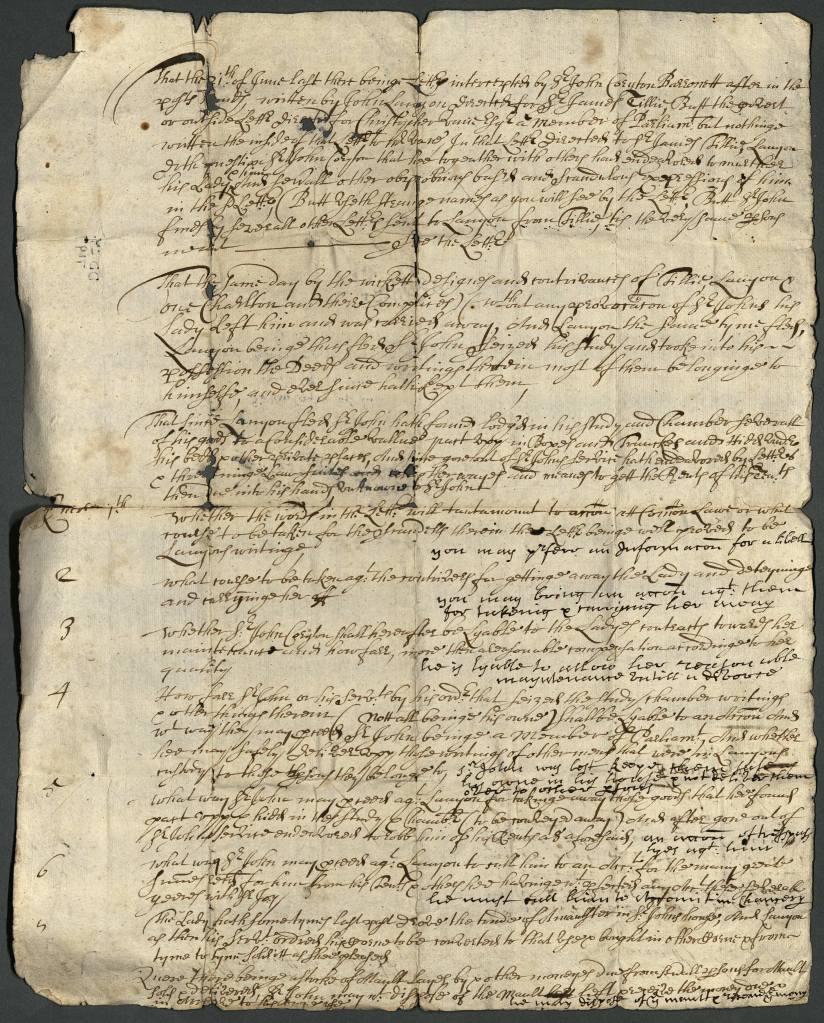
Whilst searching through the online archives at Kresen Kernow (Cornish Record Office) I found a legal opinion dated 1689 for Sir John Coryton against Sir James Tillie. This is of interest to us as Sir John’s servant was called John Lanyon.
From the documents held at Kresen Kernow John Lanyon was witnessing Sir John Coryton’s documents from 1674 onwards so by 1689 he must have been a trusted member of staff.
Sir John Coryton was the 2nd baronet of Newton Ferrers. He was married to Lady Elizabeth.
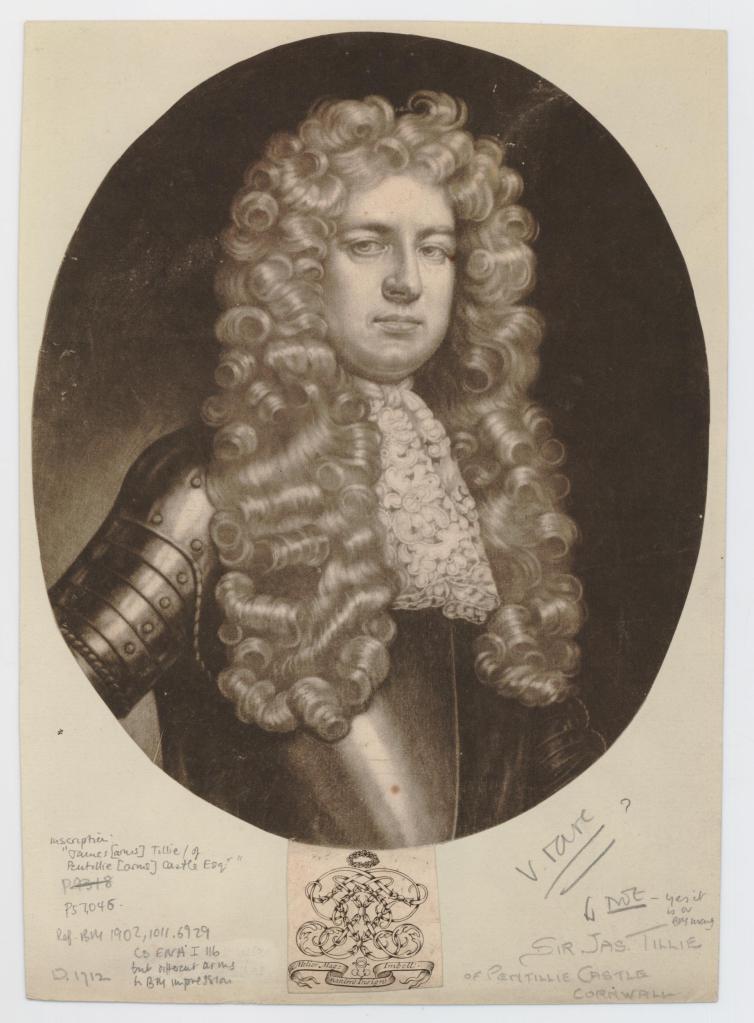
Sir James Tillie was Sir John Coryton’s land agent. He wanted to be married to Lady Elizabeth!
Sir James Tillie – Creative Commons Licence
The counsel’s opinion for Sir John Coryton against Sir James Tillie details how Sir John’s wife Elizabeth had been ‘carried off’ by Sir James Tillie. Sir John was advised that he could take action against the man/men who carried off his wife but he was liable to give her reasonable maintenance until a divorce.
The document also explains that Lady Coryton had been a ‘maltster’ (a brewer) in Sir John’s house and he was advised that he could sell the stock and receive the proceeds. The legal opinion goes on to explain that if Lady Coryton was with child which Sir John did not want to inherit then he must sue for divorce but must have full proof of adultery.
Elizabeth was the daughter of Sir Richard Chiverton who had been Lord Mayor of London from 1657-1658.
Whilst all this was going on John Lanyon had been busy defrauding Sir John. He wrote secret letters to James Tillie threatening to murder John Coryton and his wife. When Lady Elizabeth left her husband and was ‘carried away’, John Lanyon, realising the game was up, fled.
After he’d gone papers and goods belonging to Sir John were found in Lanyon’s study. These showed that he had been threatening Sir John’s tenants and trying to obtain rents and properties.
Legal Opinion 1689 – Source CY/7197
Conveniently Sir John died mysteriously at the age of only 42. There is speculation that he was poisoned. Lady Elizabeth married Sir James Tillie who divided the Newton Ferrers estate and built ‘Pentillie’. John Lanyon escaped prosecution.
Rod Allday / Pentillie Castle
James Tillie died in 1713 and his will left instructions that he was not to be buried but placed in a vault sitting in a sturdy chair in his finest clothes with his pipe so he could await resurrection! His instructions were carried out but his body was later moved and then lost. 300 years later it was found!
So what happened to John Lanyon and where does he fit on the tree?
Clearly John Lanyon was an educated man. If he was working for Sir John from 1674 onwards then he was probably born early 1650s.
There are currently 315 John Lanyons on the family tree but there is only one candidate that really stands out and that is John Lanyon 1652-1720. (See post ‘William ‘Generosi’ Lanyon of Breage.)
John was the eldest son and heir of John Lanyon a ‘sea and sand barge daily labourer’.
The Parochial History of Cornwall stated that John Lanyon senior:
‘…had a son named John Lanyon who having had his education under Hugh Boscawen, gent, Master of Arts, who kept a school at St Michael Penkevill Church, became afterwards a steward to Trefusis, St Aubyn, Coryton and lastly came into the service of Brook Lord Chandos, and having by these services accumulated considerable riches he gave lands and built and endowed an almshouse for the poor people.’
John Lanyon’s branch of the tree.
After he fled he must have headed to London and persuaded Lord Chandos to hire him. He later married Sarah Symons. We now have a pretty good idea how he acquired ‘considerable riches’! Perhaps the alms houses were a way to atone for past sins!
For more information see Nigel Baker’s article on John Lanyon:
William was the son of William Lanyon and the grandson of John Lanyon Esq.
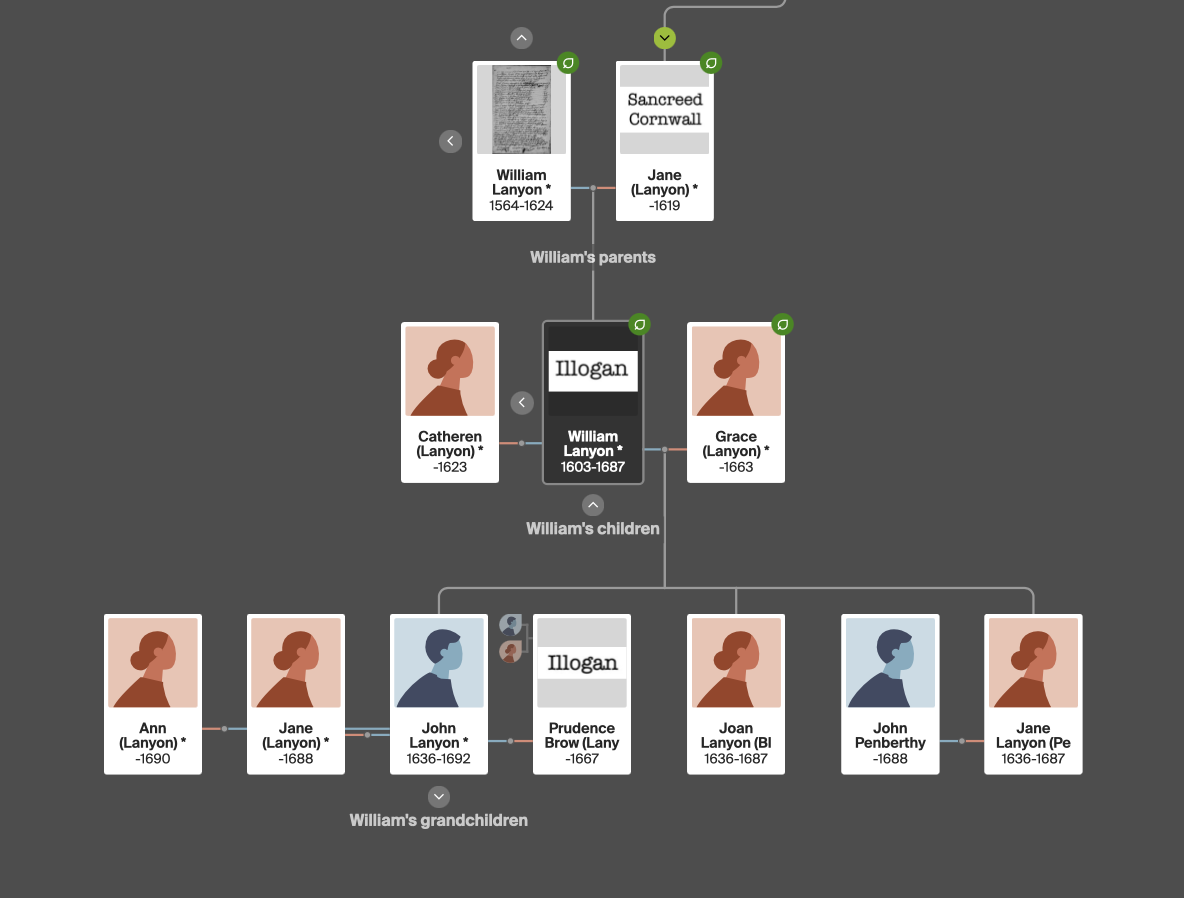
William was baptised at Sancreed in 1603. He may have had a first wife called Catheren as there was a Catheren Lanyne buried at Illogan in 1623. He married Grace (surname not recorded) at Illogan in 1636. He signed the Protestation Return on 1641/2 as William Lanyne Illogan.
William had three children who’s baptisms and burials have not been traced. Assumption is that they were all born after their parent’s marriage in 1636 and were still alive when their father’s will was proved in 1687.
John aft.1636-aft.1687 married Jane
Jane aft.1636-aft.1687 married John Penberthy – children
Joan aft.1636-aft.1687 married Bloyes, no children at the time of the will.
William’s son John Lanyon was married at least twice. His first wife was Prudence Brow and they married at Illogan in 1663. They had a daughter Grace baptised in 1665 and Prudence died in 1667. John married again to Jane, surname unknown. John had three more children but it isn’t clear if the mother was Jane or Prudence as we don’t know the dates of baptism just the dates of their burials:
William – 9 Jul 1669
Elizabeth – 27 Jun 1669
Thomas – 13 Jul 1669
It appears as though William, Elizabeth and Thomas died in an epidemic – they were buried within three weeks of one another.
There is a John Lanyon who married Ann at Illogan in 1690. Perhaps Jane died after the will and John remarried. No record of any children.
Grace baptised in 1665 married Stephen Cock at Illogan in 1683 and is mentioned in her grandfather’s will. It sounds as though she has had a child and perhaps lost it. ‘If my granddaur Grace Cock have another child in my lifetime £100 to same at 21.’
The John Lanyon of St Ives ‘my kinsman’ mentioned in William’s will is his nephew, the son of John Lanyon and Mary Ellis. William is also mentioned in Mary (Ellis) Lanyon’s will of 1676.
We don’t know much about William of Illogan but we do know he was summoned to appear at the Consistery Court of the 29 April 1663. We don’t know what the summons was for but on the 16 May he “makes humble acknowledgement of his sorrow for not appearing.” Source – letter from HL Douch, curator Royal Institution of Cornwall to WSL Lamparter. 1 Nov 1962.
With no surviving grandchildren called Lanyon this little branch of the family died out.
Paskis Lanion married Thomas Shetford at St Just in Penwith in 1625. Who was Paskis Lanion? If only the answer was straight forward!
A quick trawl through the Cornwall Online Parish Clerks database revealed no baptisms for a Paskis/Paksis/Pascha/Pasca/Paska/Paskes/Paskas Lanion/Lanyon.
However the Heralds Visitation for Cornwall 1620 does have a suitable candidate:
Vivian’s Herald’s Visitation of Cornwall 1620
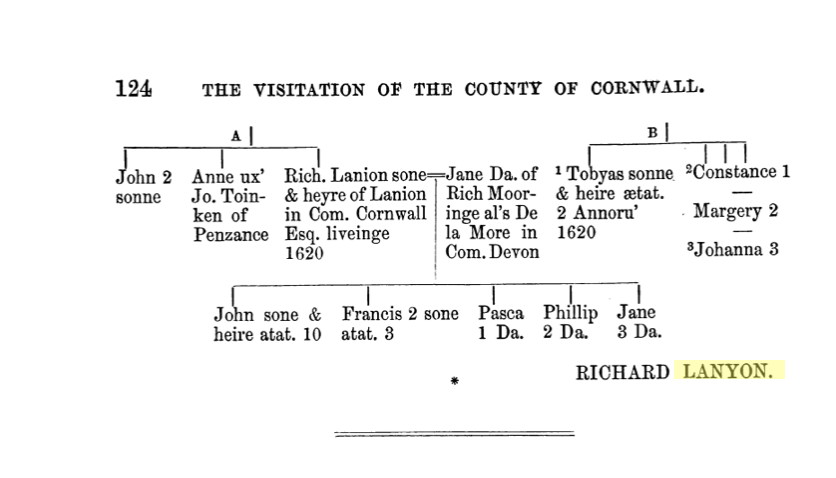
Richard Lanyon Esq submitted his tree showing that his wife was Jane Mooring alias De La More from Devon and their eldest daughter was called Pasca but was she old enough to get married in 1625?
Their eldest son was John aged 10 in 1620 so therefore born in 1610. Could Pasca be older than John? When did Richard marry Jane? The Royal Institution of Cornwall has a marriage settlement between Richard Lanyon and Jane his wife dated 1608 so presumably they married about 1608. The letter from Mrs Rose Tolman confirms that Jane’s mother was called Pascha Risdon so eldest daughter was named after her grandmother.
Francis 2nd son – deposition taken 1635 when he is aged 16 so born in about 1619
Elizabeth baptised 17 Nov 1622 St Merryn
The children with no baptisms recorded are:
Pasca eldest daughter born before 1613 when Philippa is baptised
Jane 3rd daughter born after 1613 and before 1622
Richard not listed on Herald’s Visitation so presumably born after 1620
Thomas not listed on Herald’s Visitation so presumably born after 1620
Margerie – from Richard Lanyon Esq’s will it is implied that Elizabeth and Margerie are the youngest daughters
The latest Pasca could have been born was 1613 and with John born in 1610 and two unbaptised babies born in 1611 and 1612 it looks likely that Pasca was probably born about 1608/9 which would make her about 16 years of age at the time that the marriage to Thomas Shetford took place. So she is a possible candidate.
Richard Lanyon Esq’s will of 1636 left all his daughters £30 or £40 apart from Pasca who received 5 shillings which implies that in 1636 she was already married and had received her ‘portion’. Sadly the will does not mention her married name.
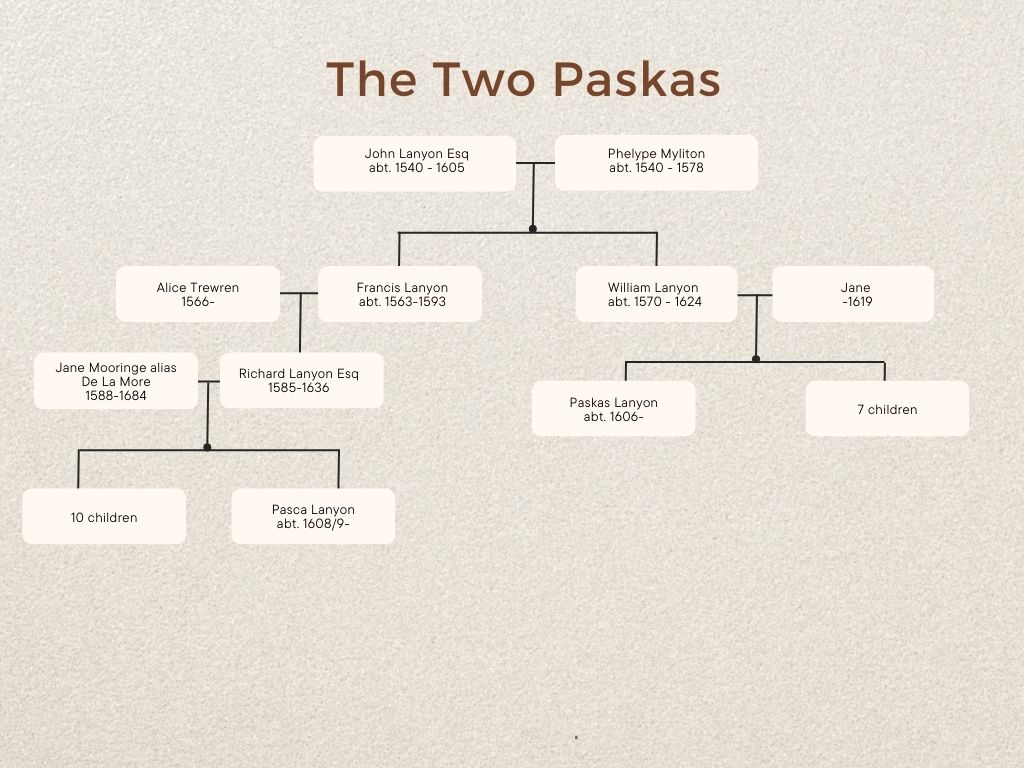
The only problem is that there is a second Paskas who is also a candidate.
Richard Lanyon Esq’s uncle William has a daughter also called Paskas.
William’s daughter’s baptism isn’t recorded but we know she existed from his will. Again we’ll have to list his other children and see where she could fit in:
Elizabeth baptised 31 Oct 1593 Sancreed
John baptised 8 Jun 1596 and buried 15 Sep 1601 at Sancreed
John born after Sep 1601
Jane baptised 24 Oct 1602 Sancreed
William baptised Dec 1603 Sancreed
Elyzabethe baptised 17 Jul 1607 Sancreed
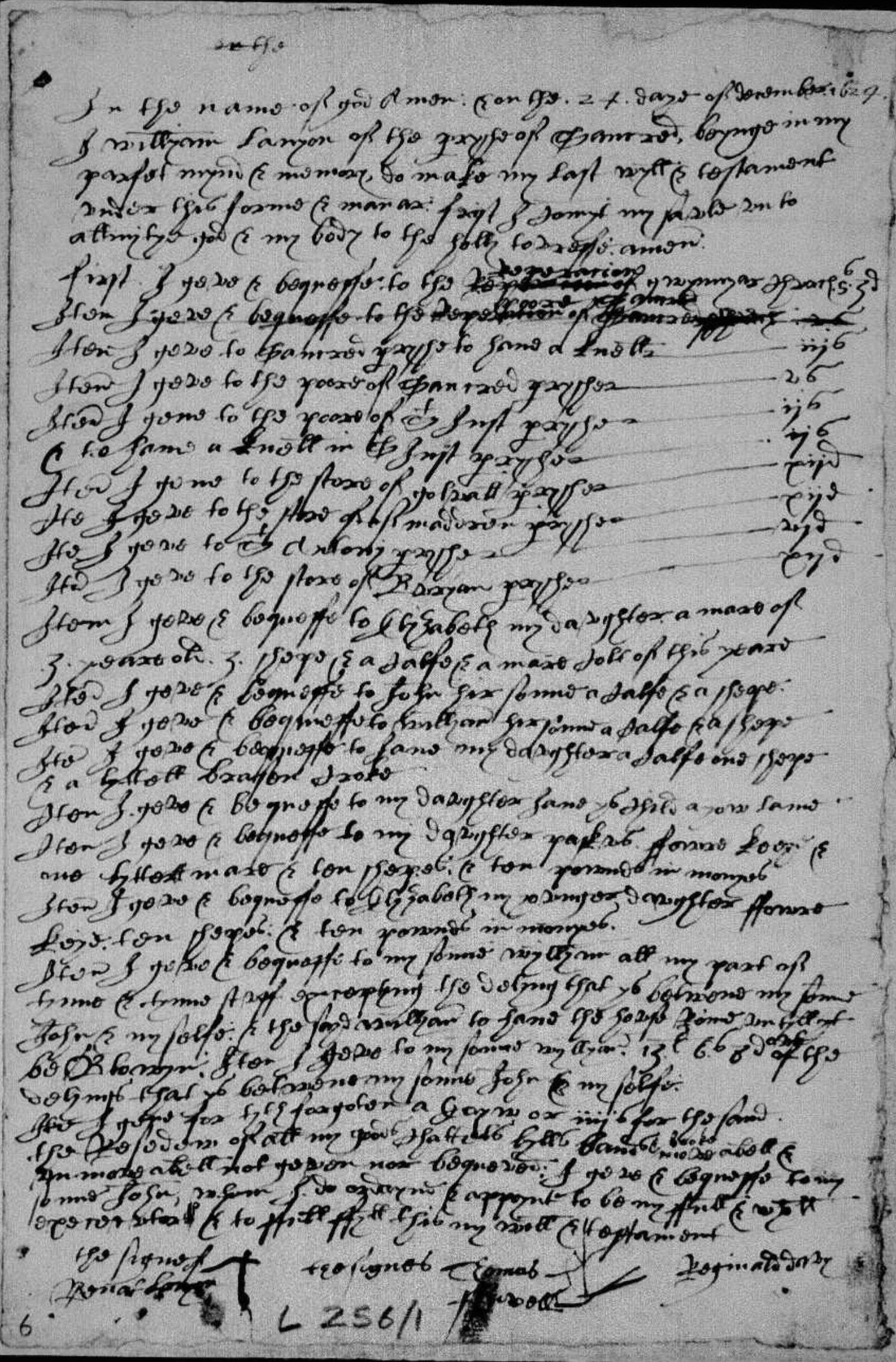
Both daughters called Elizabeth survived and are mentioned in William’s will of 1624!
William’s Will of 1624 – Source CRO AP/L/256
Abstract:-
WILLIAM LANYON of Sancreed written: 24 Dec 1624 proved: 8 Feb 1624/5
poor of Sancreed – 3 sh. poor of St. Just – 5 sh. poor of Gulval – 12 d. poor of Maddern – 12 d. poor of Antony – 12 d. poor of Buryan – 12 d. daughter: ELIZABETH – mare, 3 sheep, calf, mare colt JOHN her son – calf & a sheep WILLIAM her son – calf & a sheep daughter: JANE – calf, 1 sheep, brazen crock daughter JANE’s child – a ewe lamb daughter: PASKAS – 4 kyne, mare, 10 sheep, 10 pounds youngest daughter: ELIZABETH – 4 kyne, 10 sheep, 10 pounds son: WILLIAM – all my part of tin and tin stuff, 13 pounds, 6 sh., 3 d. son: JOHN – all the rest & executor
The will implies that Paskas is younger than Jane and older than Elizabeth his youngest daughter which suggests that she was born between 1602 and 1607. So aged about 18-23 in 1625 when the marriage to Thomas Shetford took place.
It’s interesting that William leaves 5 shillings to the poor of St Just as that’s the town that Thomas Shetford comes from.
Who was Thomas Shetford?
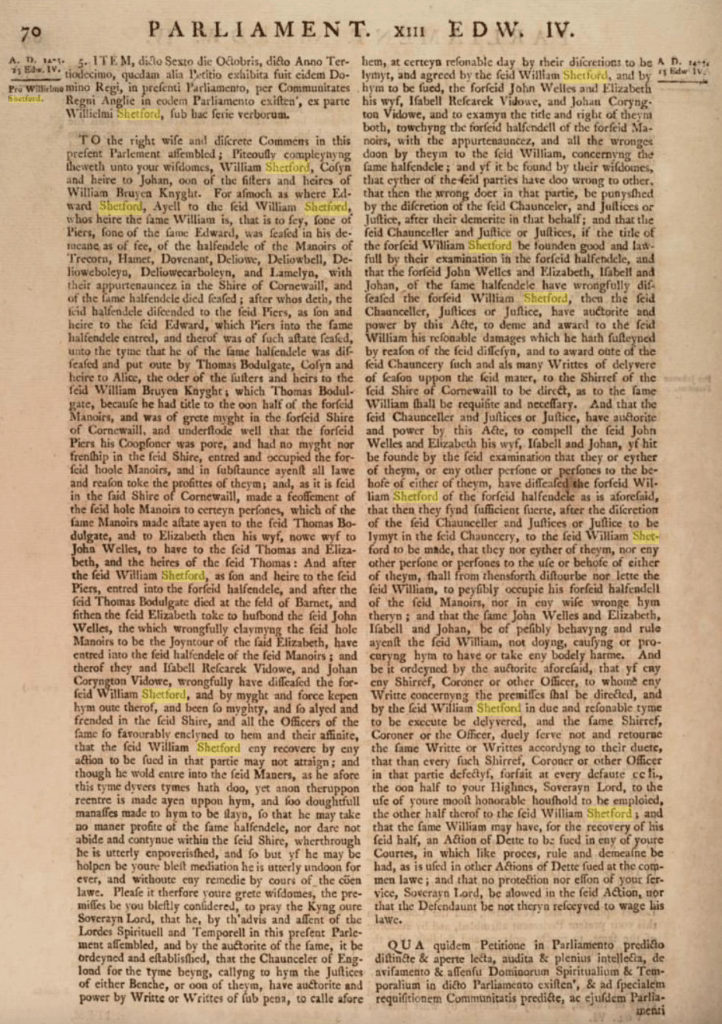
The Shetford/Shutford (and occasionally Shitford!) family originally came from Somerset. They were cheated out of a half share in six manors in Cornwall by Sir Thomas Bodulgate during the Wars of the Roses.
Source – History of Parliament Edward IV
We know very little about Thomas, the parish registers for St Just in Penwith start quite late but with the little we know we can create a tree that might be correct.
We know that Paskis Lanion married Thomas Shetford at St Just in Penwith in 1625 so he was probably born about 1600
There is a baptism for a Margarett Shetfod (Sic) daughter of Thomas on 14 Nov 1630 at St Just listed in the Exeter Bishop’s Transcripts
16 Oct 1647 marriage at St Just between Elizabeth Shetford (daughter of Thomas) and John Rawlyn (Source – OPC)
Baptism of Alse Shutford, daughter of Thomas 20 Dec 1633 St Just (Source- FHL film number 0226217, 0226218, 962681)
Burial of Paskes Shetford, widow 19 Dec 1681/2 St Just in Penwith (Source – OPC)
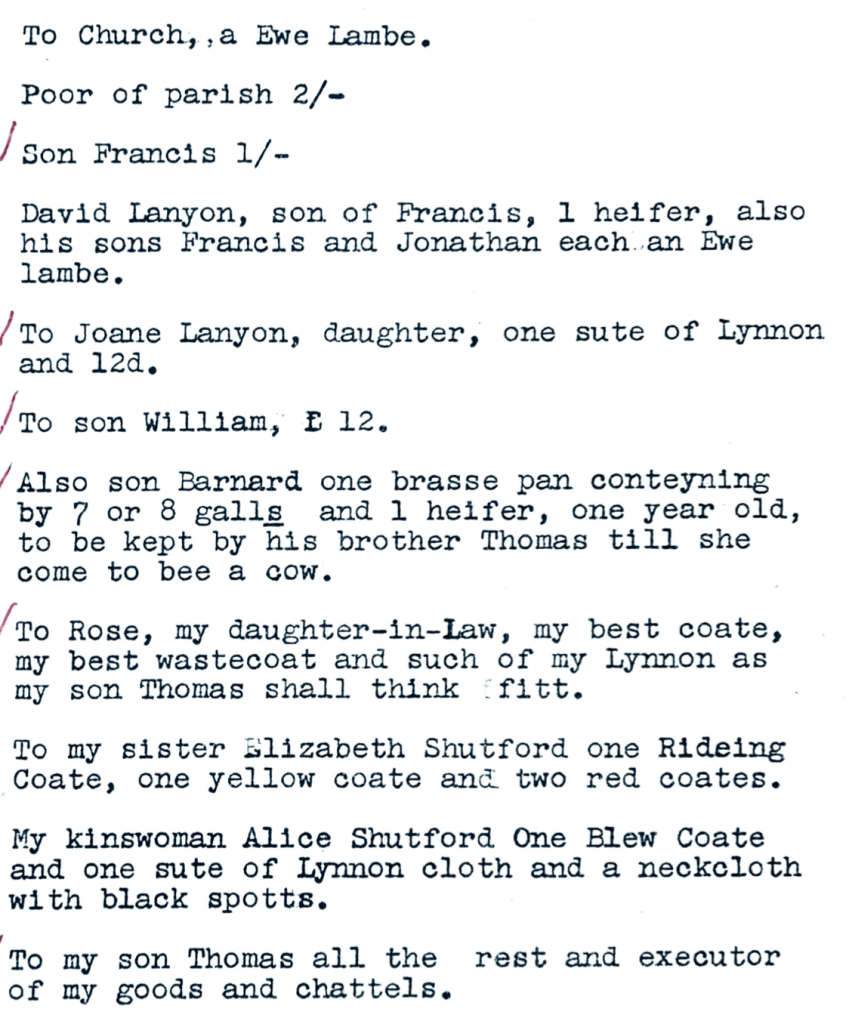
The will of Joan Lanyon (Shutford) 1655 (Source – NA PROB 11/257/72) Joan was the wife of David Lanyon of Madron and her will mentions her Shutford relatives
There is also a record at Kresen Kernow (The Cornish Record Office) which mentions Thomas and William Shilford.
Lease, tenement, Treloweth Wartha, Illogan
Parties:
1) Right Honourable John Lord Robartes, Baron of Truro.
Term: 99 years, or the natural lives of [?] Lanyon, John Lanyon his brother and William Shilford, son of Thomas Shilford.
Annual rent: 46 shillings 8 pence, one capon or 12 pence, a harvest day or 6 pence.
Heriot: Best beast or £3.
Reference number
CL/1/124
Date
3 Oct 1635
I think it should be William and Thomas Shitford/Shetford rather than Shilford. Could Thomas have a son called William and could these Lanyons be Paskas’ brothers?
The Paskas born in Sancreed had brothers called John and William. ‘William Lanyon Yeoman of St Just’ listed in the lease is definitely not the St Merryn family of Lanyons.
There is a marriage of a William Shetford and Mary Edward at St Just on 26 Nov 1653, they had two daughters: Rebecea (sic) bapt. 1655 and Ellizabeth (sic) bapt. 1657.
There is a legal dispute between John Lanyon and William Shutford in 1659, the year Thomas Shutford died. Source – NA C 10/48/84
Lanyon v Shutford.
Plaintiffs: John Lanyon. Defendants: William Shutford, James Pratt and Robert Baynard. Subject: property in Sancreed, Cornwall.
This is the hypothetical tree I’ve created from all those snippets of information.
We still haven’t conclusively answered the question which Paskis Lanion married Thomas Shutford in 1625 but I think the Paskas born to William Lanyon of Sancreed is the more likely candidate.
William Lanyon died in 1624 (his wife had died in 1619) and left Paskas £10 and some cattle. The following year she married Thomas from the neighbouring parish of St Just in Penwith.
Ultimately geography may be the best clue, the distance between St Just and Sancreed (near Penzance) is a lot smaller than the distance between St Just and St Merryn (near Padstow).
With thanks to Louise Quigley who first posed this question in 2014 and the Penwith Genealogy Group who produced some great answers and evidence.
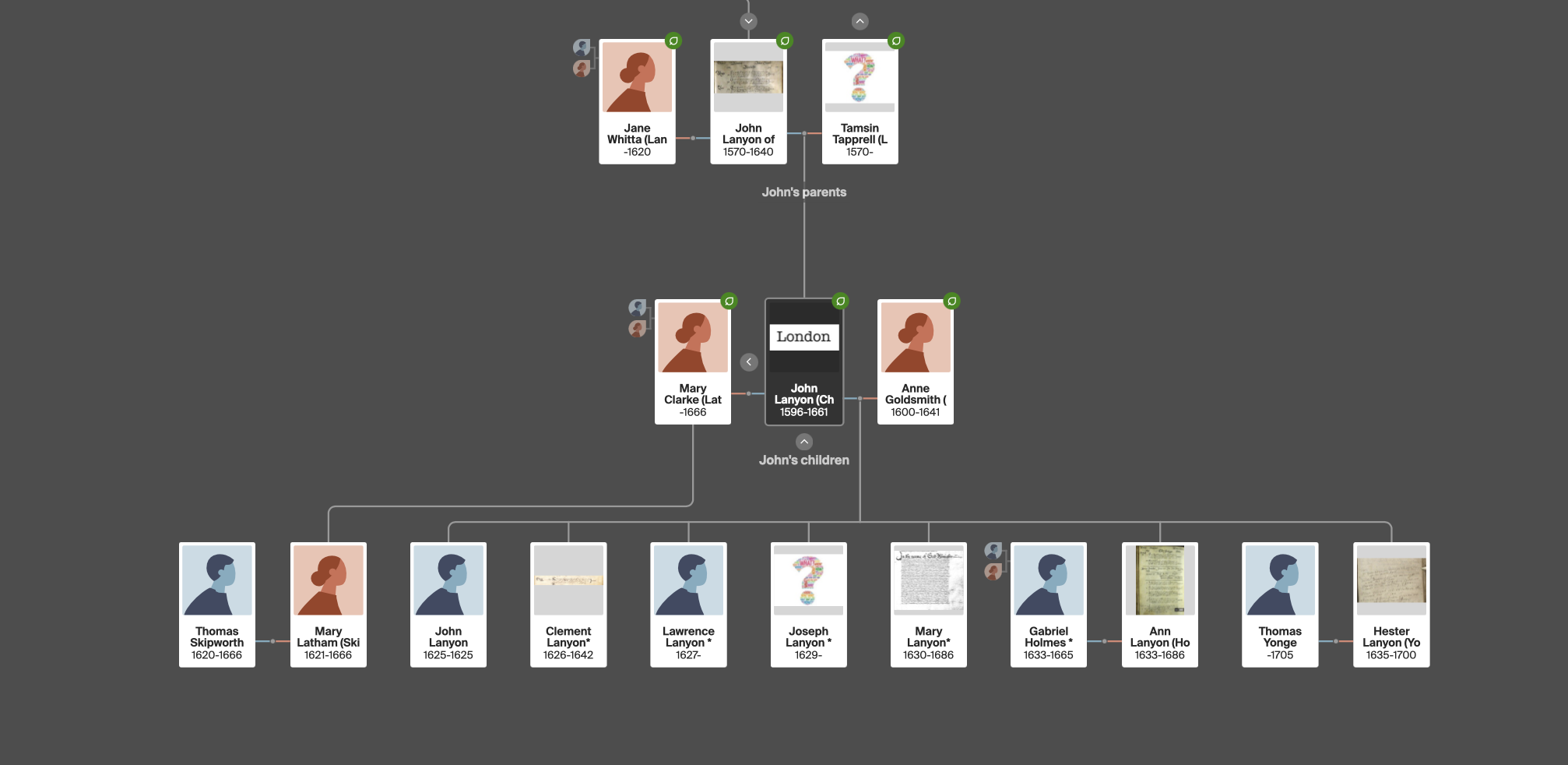
John Lanyon was born after 1596 and before 1600 at either St Agnes or Breage, there is no baptism recorded for him. His parents John & Tamsin were married at St Agnes in 1596 and his younger brother William was baptised at Breage in 1600.
By 1618 John is in London. He was listed on an indenture dated 19 Oct 1618-
John Lanion gent of New Place Essex in chancery indenture re- properties in Breage.
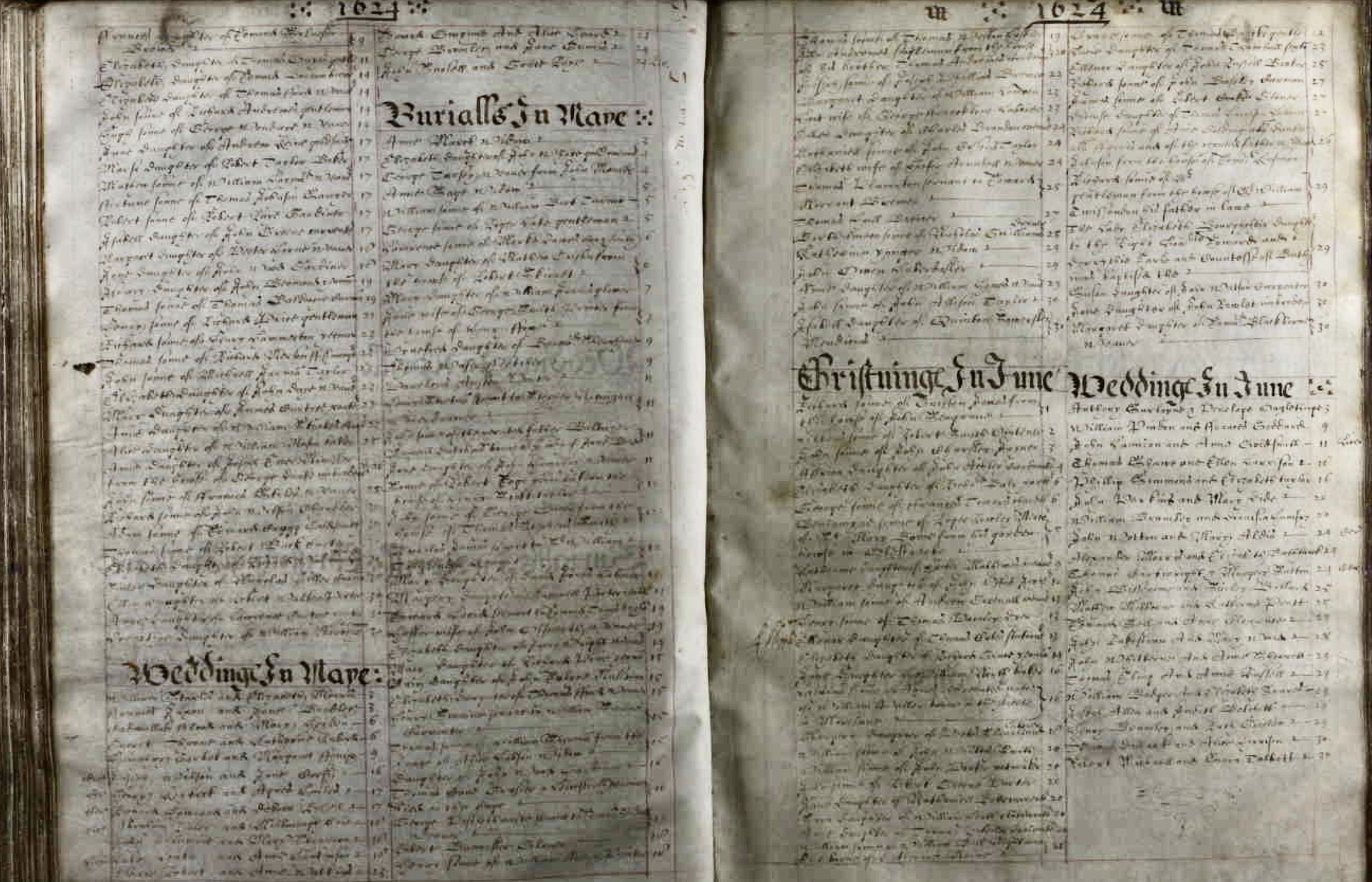
On 11 Jun 1624 John married Anne Goldsmith at Saint Giles Cripplegate, London.
St Giles Cripplegate Parish Register – Source London Metropolitan Archives
It appears as though they returned to Breage as some of their children were baptised there.
John – 1625 a John, son of John Lanyon, was buried at Breage in Jun 1625
Clemens 1626- baptised at Breage 11 Jun 1626 no further trace
Lawrence 1627- baptised at Holborn in London no further trace
Joseph 1629- baptised at Holborn in London no further trace
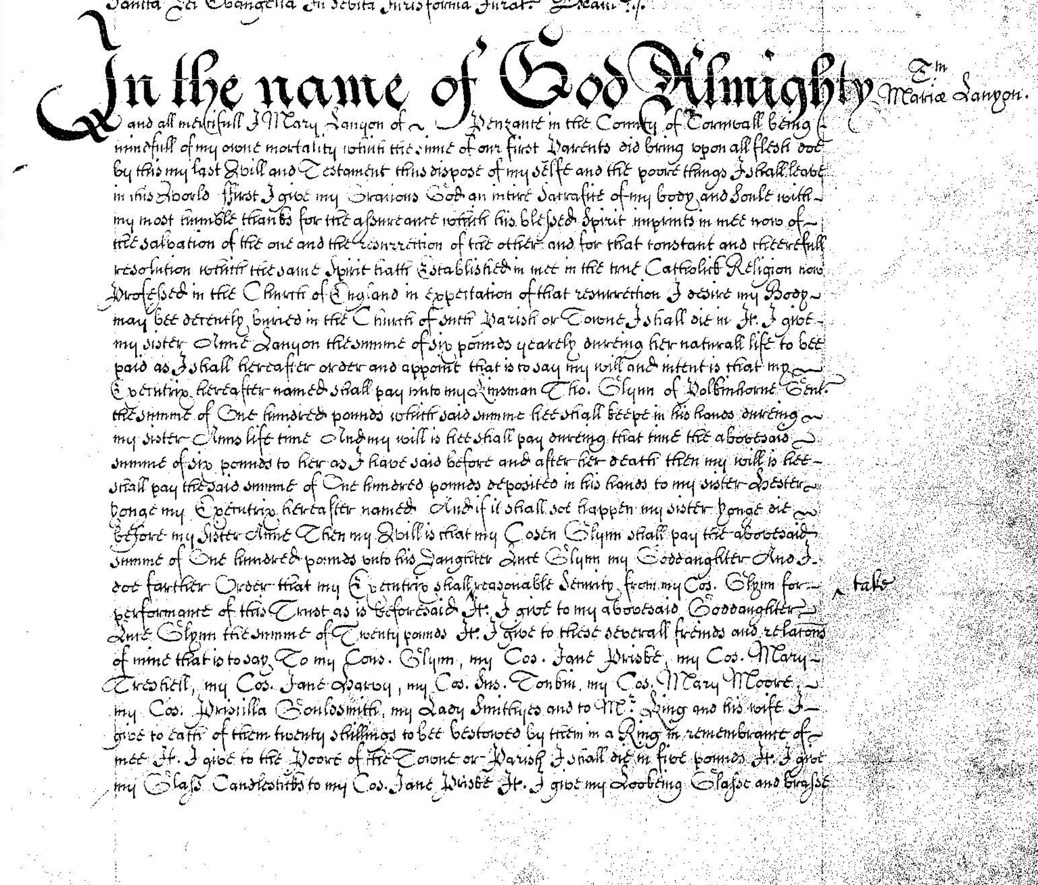
Mary 1630-1686 she was a spinster and was buried in Penzance in 1686, she left a great will which mentions lots of relatives
Source – NA/PROB/11/386
Partial transcript:
To my sister Anne Lanyon the sum of £6 yearly for her natural life
To my kinsman Thomas Glynn of Polkinghorne gent the sum of £100 which he shall keep in his house during my sister Anne’s lifetime to pay her £6 yearly and then to my sister Hester
Thomas Glynn’s daughter my goddaughter Jane Glynn the sum of £20
Cousins Glynn, cousin Jane Prisbe?, Mary Treshell?, cousin Jane Darby, cousin ? Tonkin, cousin Mary Moore, cousin Priscilla Goldsmith, Mr. King and his wife – 20 shillings each for a ring in remembrance of me
Poor of the town or parish £5
Glass candlesticks to Jane Prisbe?
Looking glass and brass candlesticks to Susanna Glynn
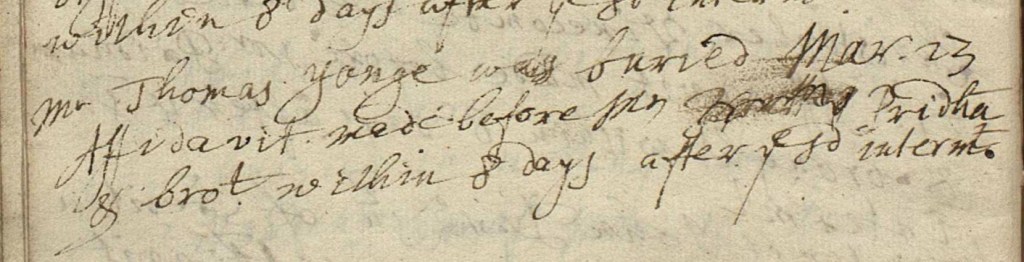
Sister’s picture and great cabinet to brother Yonge
Watch to cousin Thomas Glynn the younger
Chamber furniture to Hester Yonge
My china and earthenware as my sister will part with to cousin Jane Darby
My cousins Grace and Jane Daniell
My sister Yonge
We can place some of these cousins on the tree.
John and Anne’s other children were:
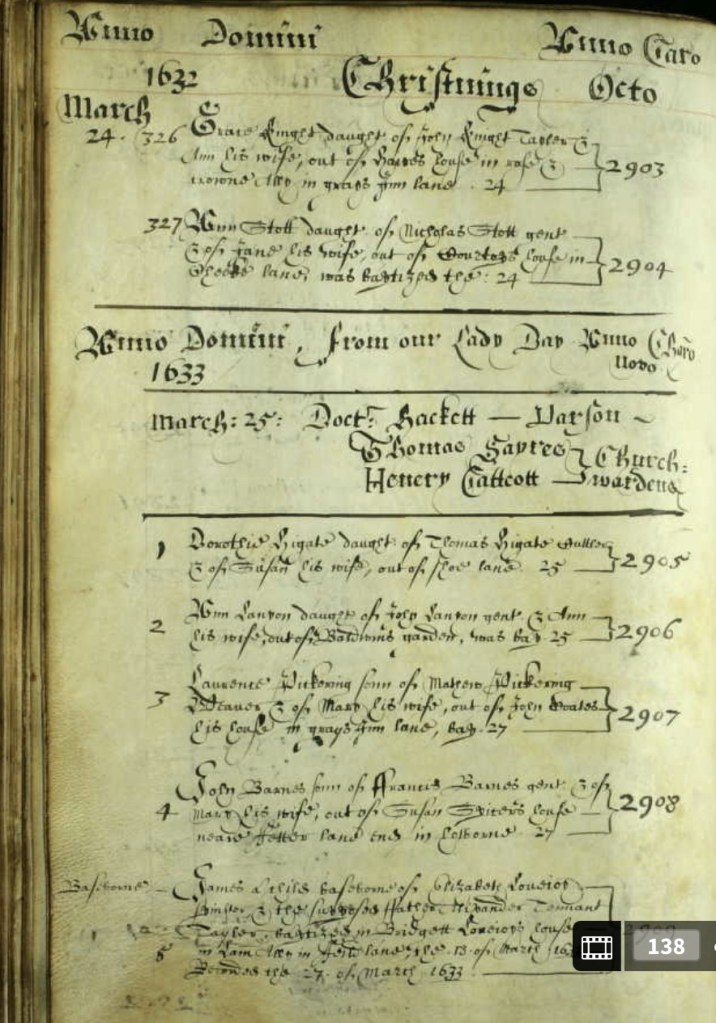
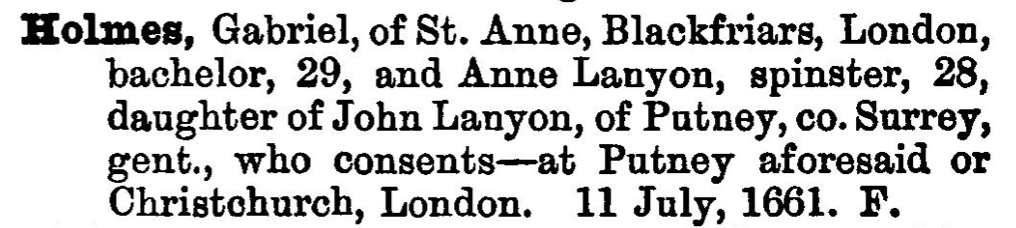
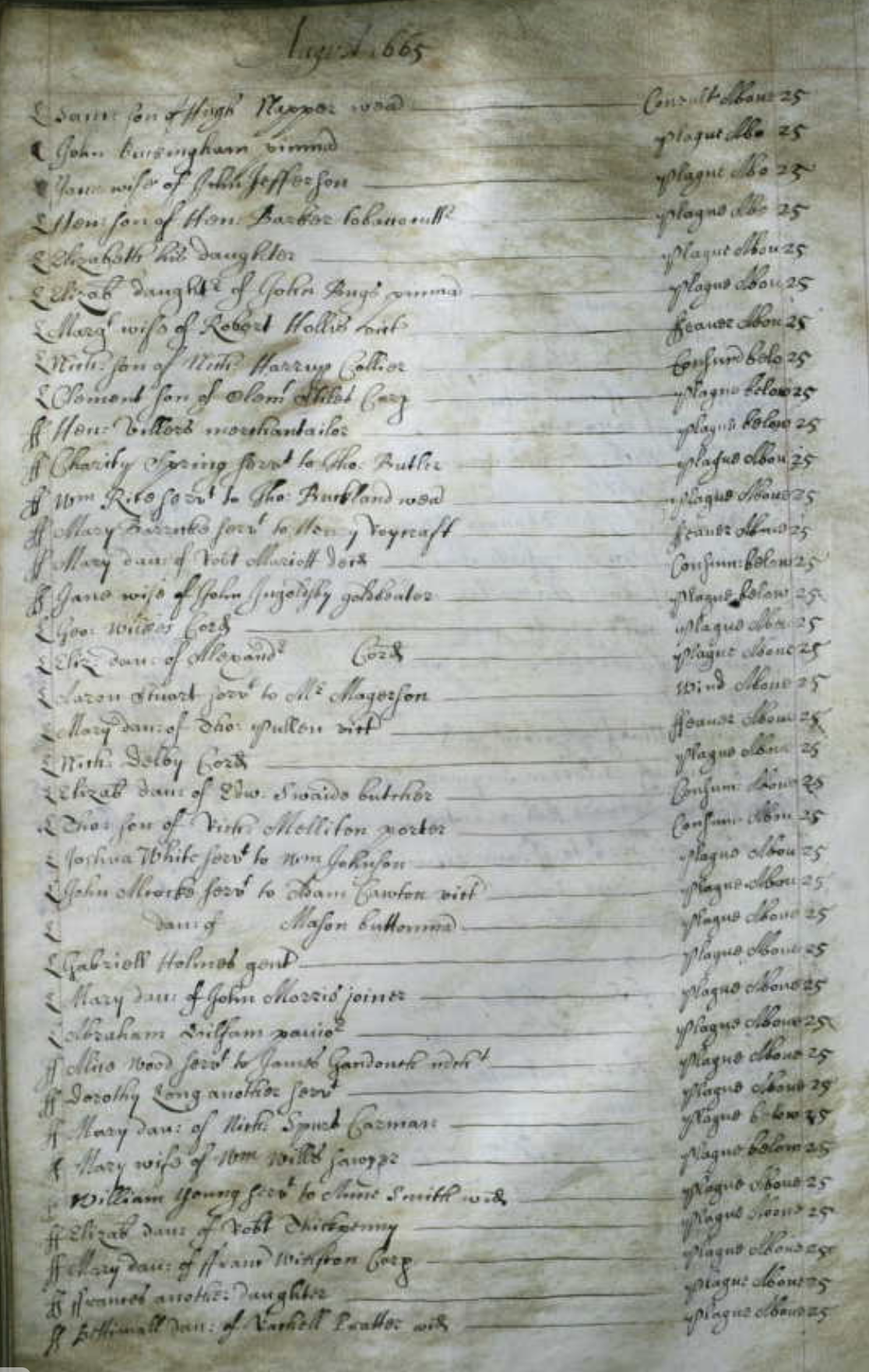
Ann 1633-aft. 1686 Ann was baptised at Holborn in London in 1633 she is mentioned in her sister’s will so presumably is still alive in 1686. She is called Ann Lanyon in the will however there is a marriage of an Ann Lanyon daughter of John Lanyon who married Gabriel Holmes in 1661. A Gabriel Holmes gent, died of plague and was buried at St Giles Cripplegate in 1665. (There is an Ann Lanyon buried at St Clement Danes on 19 Aug 1691- could it be this Ann? Why would she be called Lanyon and not Holmes?)
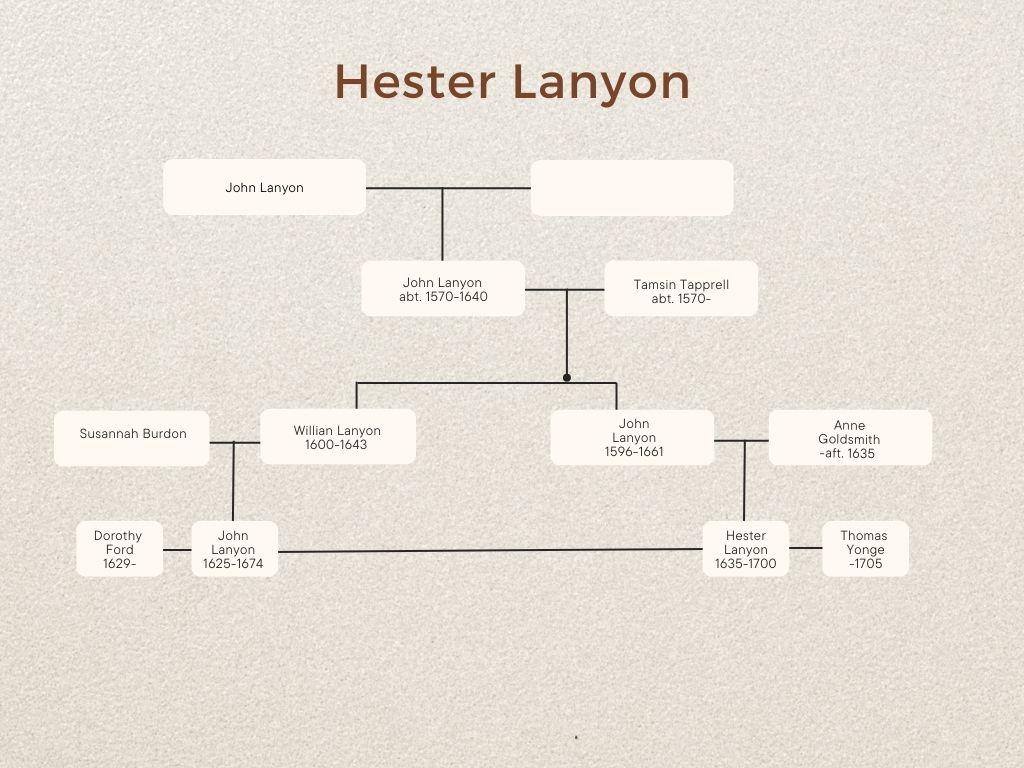
Hester 1635-1700 she was baptised in Holborn London, she married Thomas Yonge and she may have been married to her cousin John Lanyon.
Ann’s baptism (2906) Parish Register St Andrew HolbornLondon Marriage Licences 1521-1869 Gabriel Holmes, gent, died of Plague and buried 25 August 1665 -St Giles Cripplegate register – source London Metropolitan Archives
Hester’s sister Mary left a will (dated 1686) that refers to her as Hester Yonge and sister Yonge, Mary also has a clause giving her sister’s picture and great cabinet to brother Yonge.
Hester’s tree
Her possible first husband John Lanyon of Plymouth died in 1674 in Paris, he left a detailed will which helps us fit him into the tree. He mentions his uncle Mr Philip Lanyon, this confirms that John’s father William had a brother called Philip. He leaves a generous bequest to the town of Breage. John mentions various cousins among them are Hester Lanyon who he bequeathes £700 “in case she should survive me and acquit my executors of my obligation for £30 payable to her by me during her natural life”. The will continues “…out of this £700 my cousin Hester do pay or make good unto her sisters, my cousins, Mary and Ann £10 each during their natural lives.” (Source- NA/PROB/11/344/542)
After his death there are legal proceedings over his estate.
Chancery Proceedings Ante 1714 – Writ 297/99 Year 1679
John Lanyon merchant late of Plymouth personal estate valued at £20,000 did by his last will and testament dated 15 Sep 1674 bequeath a legacy of £50 to Totnes in Devon, which sum the Mayor and Burgesses were claiming of the Executors Captain Philip Lanyon, his sister Margaret Richards and niece Hester Lanyon.
In this chancery lawsuit the Totnes claimants speak of Hester Lanyon as John’s relict “who has since married Thomas Yonge”.
There is no trace of a marriage between Hester and either John Lanyon or Thomas Yonge but they are referred to in the Chancery proceedings. Although John Lanyon’s will describes her as his cousin rather than his wife. Was Hester Lanyon John’s second wife? Until we can find other documentary evidence we can’t be sure.
Hester Yonge was buried on 6 Apr 1700 at Colebrooke, Devon.
Colebrooke Devon Parish Register
Hester’s husband Thomas Yonge died in 1705 at Colebrooke.
We’ll look at Hester’s husband John Lanyon of Plymouth in more detail in another post.
What of Hester’s father John?
John Lanyon was Proof Master and Chief Engineer to Charles I from 1630-39. In 1640 John went to Flanders and wrote to Whitehall from Brussels sealing the letter with the Lanyon (Madron) arms. As the principal engineer he was responsible for forts and castles. It was his misfortune to land such an illustrious post just as the monarchy was about to be swept aside in the Civil War.
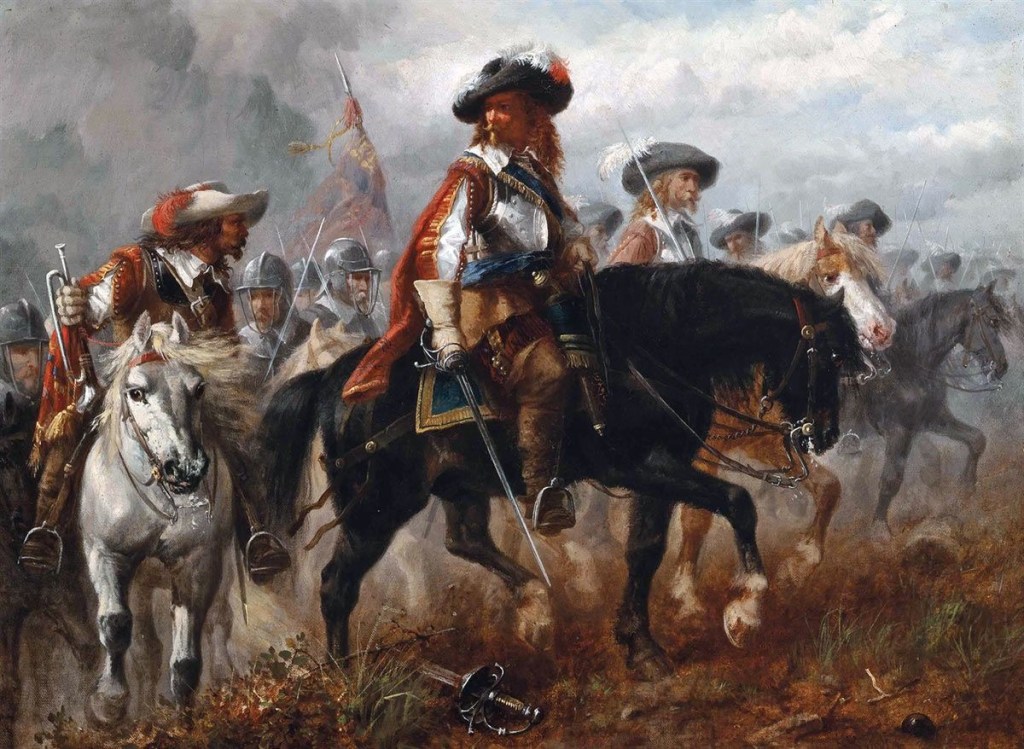
King Charles I and Prince Rupert before the Battle of Naseby 14 June 1645 during the English Civil War – Wikimedia Commons
During the Civil War John Lanyon had a tough time; he was plundered, sequestered and imprisoned. In 1661 he petitioned the Lord Treasurer to pay his fee due at Midsummer last. He had been promised £240 a year as chief engineer. Sir William Compton certified that John Lanyon had £240 a year granted him by the late King as chief engineer and that “he is well skilled in his art and deserving of the said salary.” (Source- Charles II State Papers Vol 36 – 1661).
His wife, Anne Goldsmith, must have died because John remarried Mary Latham (née Clarke) the widow of Ralph Latham Esq of Upminster, Essex, late barrister Middle Temple, London. Ralph died in 1642 so sometime after that date the marriage took place. There were no children of this marriage.
John died in Sep 1661 and was buried at Surrey. His widow Mary died in 1666 and her will mentions her children from her first marriage and step daughters Mary, Anne and Hester Lanyon.
Will of Mary Lanyon 1666 – Source NA PROB/11/320
As far as we can ascertain none of John’s sons survived and none of his daughters had children of their own so this little branch of the tree died out.





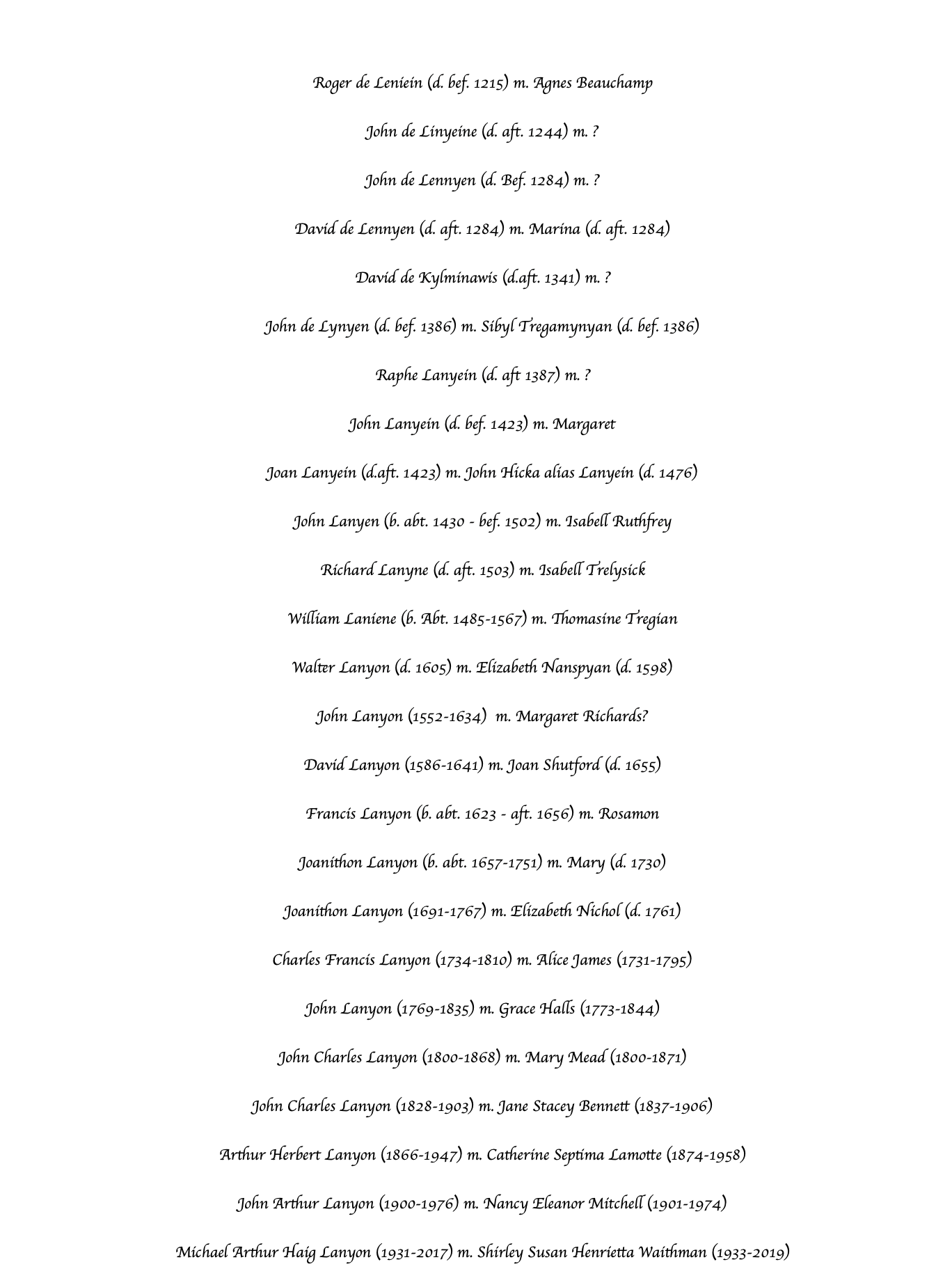









 The Lanyons