
Researching a family often necessitates many hours trawling through online resources for any mention of the family surname. A trawl through the Somerset Heritage Centre online index produced the deeds for a farm and lands at St Decumans and the name Thomas Lanyon.
The record starts on 13 Aug 1601. ‘Thomas Fulford of Fulford, Devon, Esq. enfeoffed to John Hooper of Ould Cleve, yeoman, a messuage known as Hooper’s Tenement and ten acres of land, part of the manor of Williton Fulford’ The deeds show the various tenants over the years. In 1715/6 John Leach of Bristol, ‘powterer’ and Sarah his wife (daughter and heir of Robert Mawdsley of Bristol, mariner and brother of Richard Mawdsley of Williton mortgaged the property to Arthur Thomas of Bristol, ‘powterer’. On 1 Jul 1718 John Leach mortgaged the property , by lease and release, to Abraham Lloyd, merchant, John Andrews, merchant, Richard Stafford, merchant and Samuel Cox, soapboiler, all of Bristol.
On 13 Mar 1718/19 John Rowe Esq and Martin Innys and Milborn Taylor, gents, all of Bristol , assigned the property to Daniel Woolmer, haberdasher, Thomas Lanyon, pewterer and George Bridges the younger, distiller, all of Bristol and John Roberts of Bedminster, cotton weaver (all creditors of John Leach, who was now bankrupt.)
So who was Thomas Lanyon and where does he fit on the tree?
Thomas was working as a pewterer (a tinsmith) from around 1715 and is last mentioned in 1755.
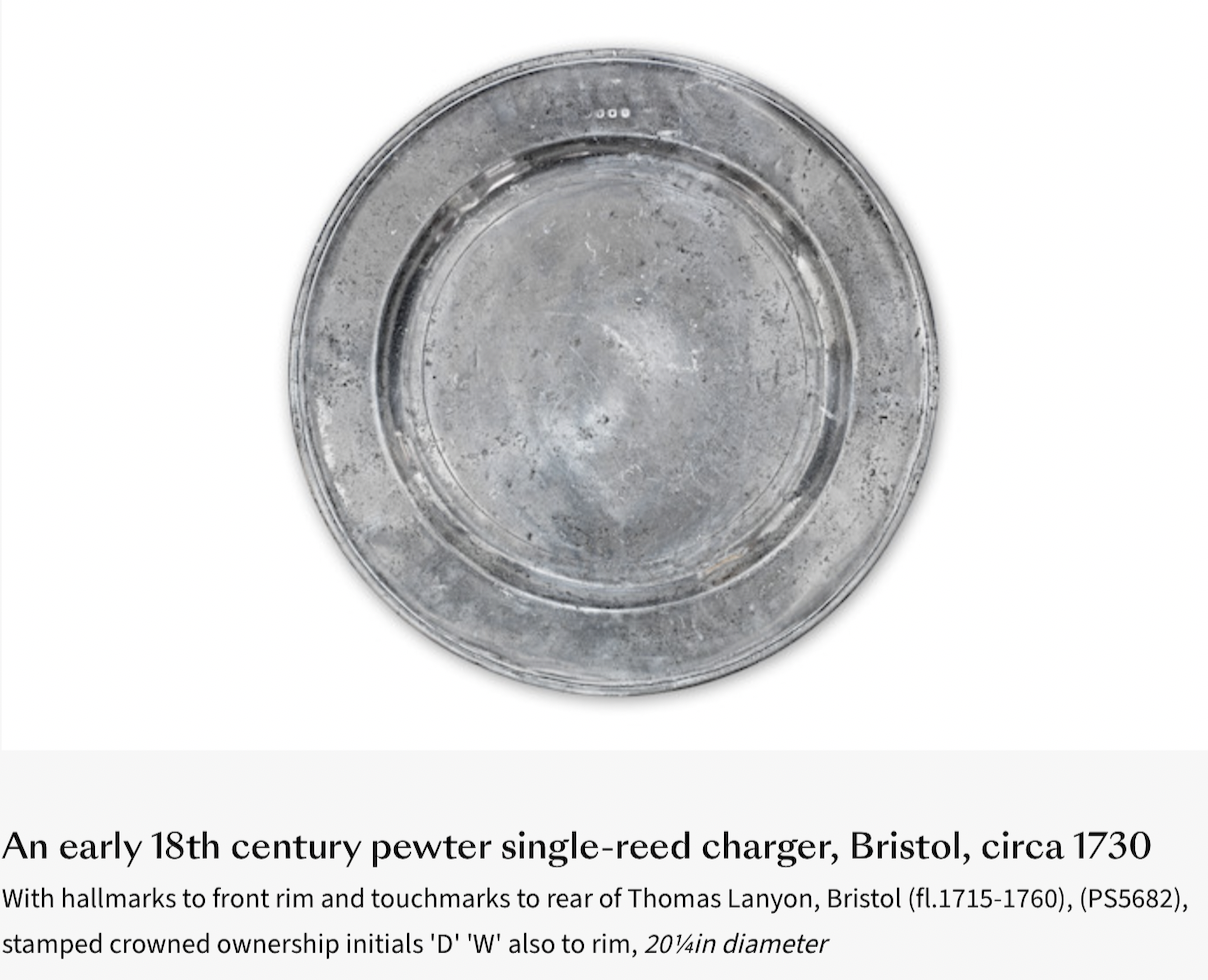
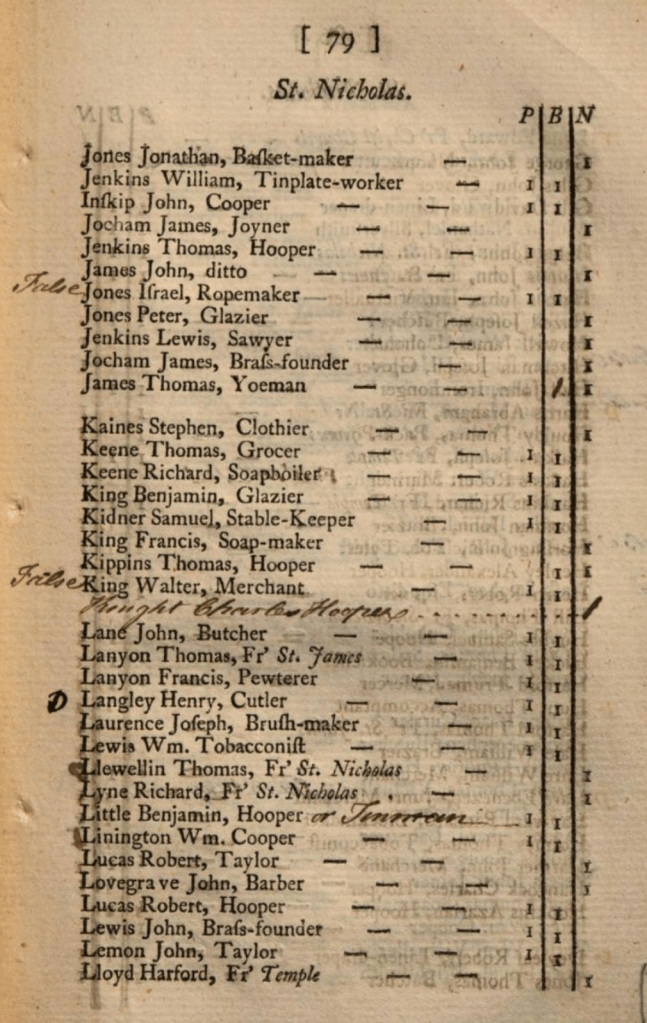
Thomas was apprenticed to John Batcheler of Bristol on 2 Feb 1707 and is free by 9 Apr 1715. He’s mentioned in the Poll Books of 1721 and 1739 as of St Nicholas Bristol, the last mention of him in is 1755.
We know Thomas Lanyon married someone called Anne before 1725 but I can’t find a record of the marriage anywhere in England. Her name is mentioned alongside Thomas’ apprentices.
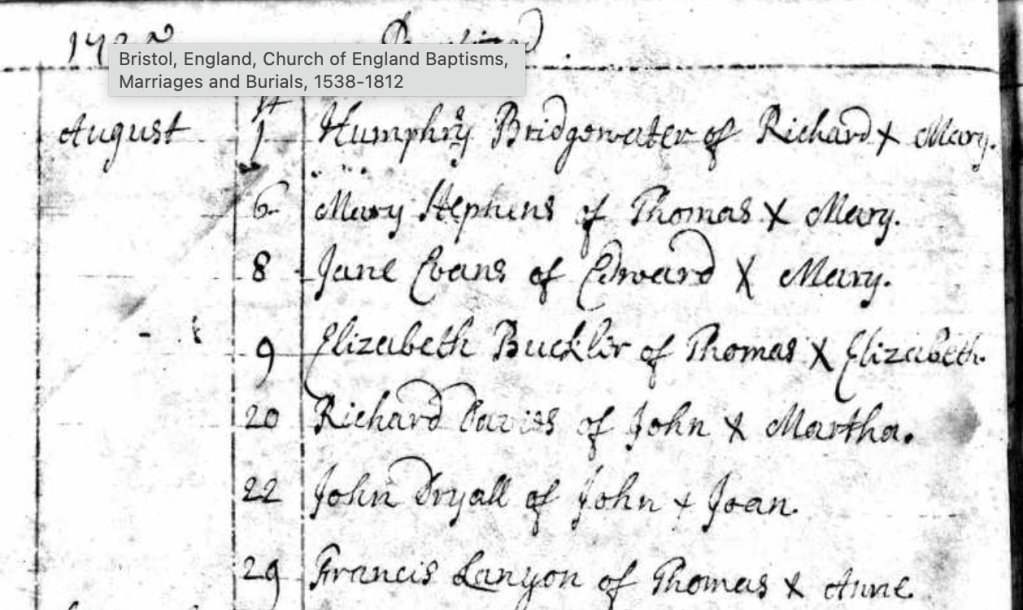
They had at least one son, Francis Lanyon, who was baptised on 29 Aug 1725 at St Nicholas, Bristol. He was also working as a pewterer on 26 Jun 1747. In the 1754 Poll Book he is listed as of St Nicholas in Bristol.
Thomas had at least two apprentices; Thomas Page who was indentured to Lanyon between 1729 and 1737 and Robert Bush who was indentured at a cost of £50 between the years 1748 and 1755. In 1765 he was based in the High Street in Bristol.
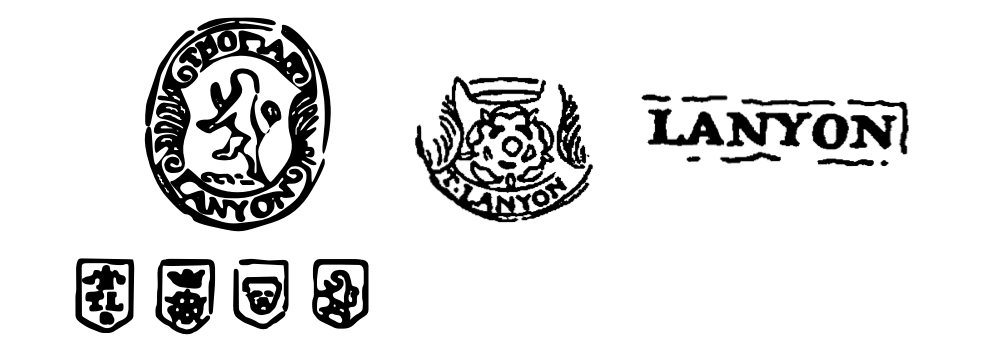
To give you an idea of the size of Lanyon’s business, in the 1740s he exported 1148lbs of pewter in one year. The book ‘Old Pewter, its Makers and Marks’ described Thomas Lanyon as being from Bristol and Coventry but I can’t find any records placing him in Coventry.
The same book mentions a Thomas Lanyon of Coventry in 1774. This could be a son or even a grandson but I can find no trace of a baptism, marriage or burial.
A trawl through St Nicholas, Bristol’s parish registers reveals two baptisms which may be relevant: William & Anne Lanyen, twin children of Eli and Anne Lanyen, baptised on 3 Dec 1723 and three days later, William Lanyen and Anne Lanyen both buried 6 Dec 1723. Who was Eli Lanyen and was he any relation to Thomas Lanyon?
Sadly the records do not give us any answers. We don’t know if Eli was related to him or if it was just a coincidence that two men called Lanyon/Lanyen had wives both called Anne and were baptising children at the same time in the same area.
To complicate things even further there is a marriage of an Ann Lanyon/Lanion to a William Wayne/Wain at St Nicholas Bristol on 10 Sep 1758. They had a daughter Anna Maria Wayne. William Wayne was a metallurgist who went to Cornwall with his daughter, presumably after his wife died, to teach the Cornish metallurgy (Jane Veale Mitchell research). Both William and Anna feature in several Lanyon wills and are left very large bequests. They are related to Tobias and Mary Lanyon (the children of Francis Lanyon and Phillipp Nicholls of Sancreed).
Tobias’ Will, proved 1779, mentions ‘…my nephew William Wayne gentleman late of the City of Bristol, now residing with me (at Penzance) and my niece Anna Maria Wayne his daughter….’ Tobias bequeathes them £5000!

Tobias’ sister, Mary, also had her will proved in 1779. She bequeathes her nephew William Wayne £1000 and her niece, his daughter, £2000.
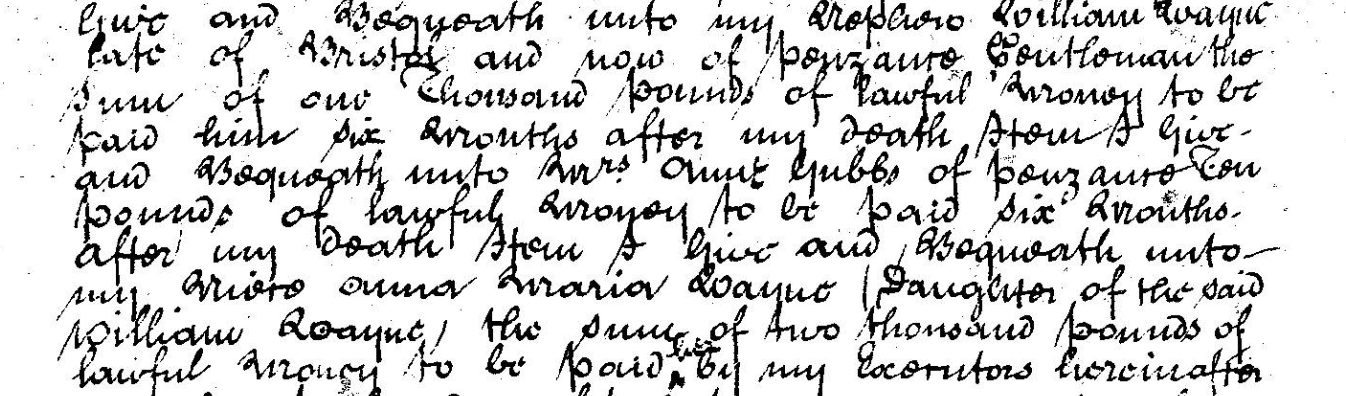
Tobias and Mary clearly regard William Wayne as their nephew which implies that his wife, Ann Lanyon, was their niece.
It was time to look at Tobias & Mary’s branch of the tree and see what information I could find.
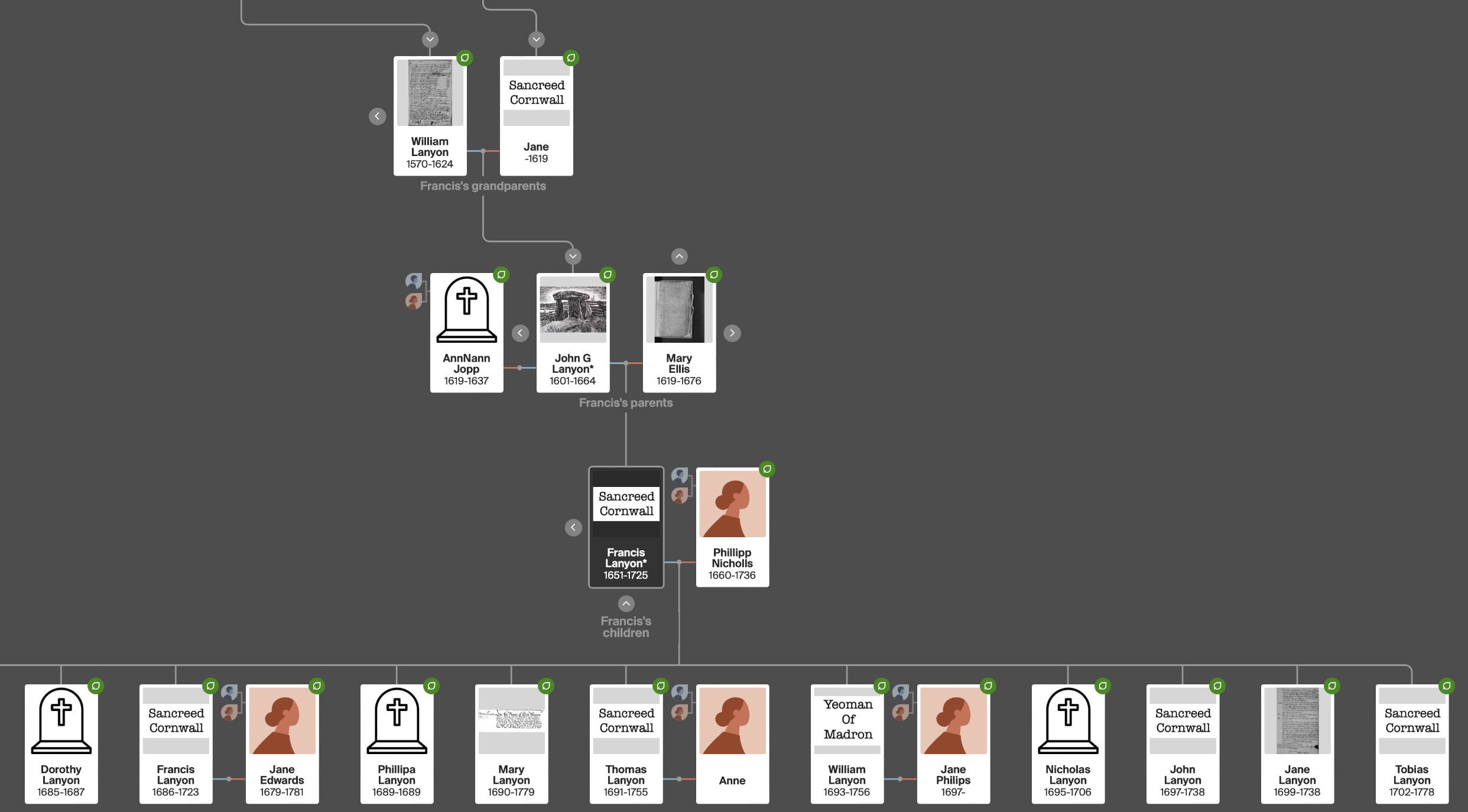
Tobias and Mary were the children of Francis Lanyon and Phillipp Nicholls of Sancreed. Francis was the son of John Lanyon, called ‘The Golden Lanyon’ as he made so much money from tin. John was a grandson of John Lanyon Esq and Phelype Milliton.
Tobias and Mary had a brother called Thomas and whilst I cannot prove that he was the Thomas who was a successful pewterer in Bristol, it does seem likely.
Tobias and Mary’s sister Jane died in 1738 and she leaves her brother Thomas the sum of one guinea in gold to buy him a ring.
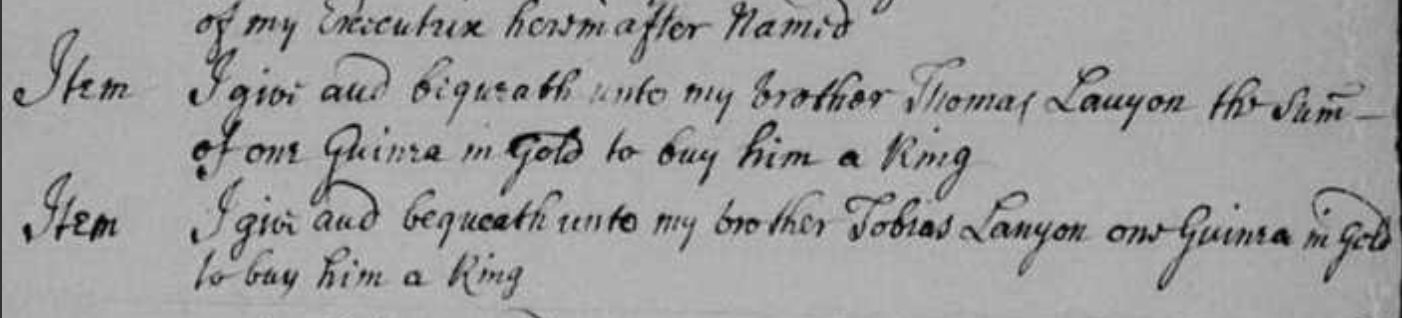
Thomas had a son called Francis Lanyon, perhaps he was named after his father, who died in 1725, or his elder brother Francis, who died in 1723.
This branch of the tree now looks like this –
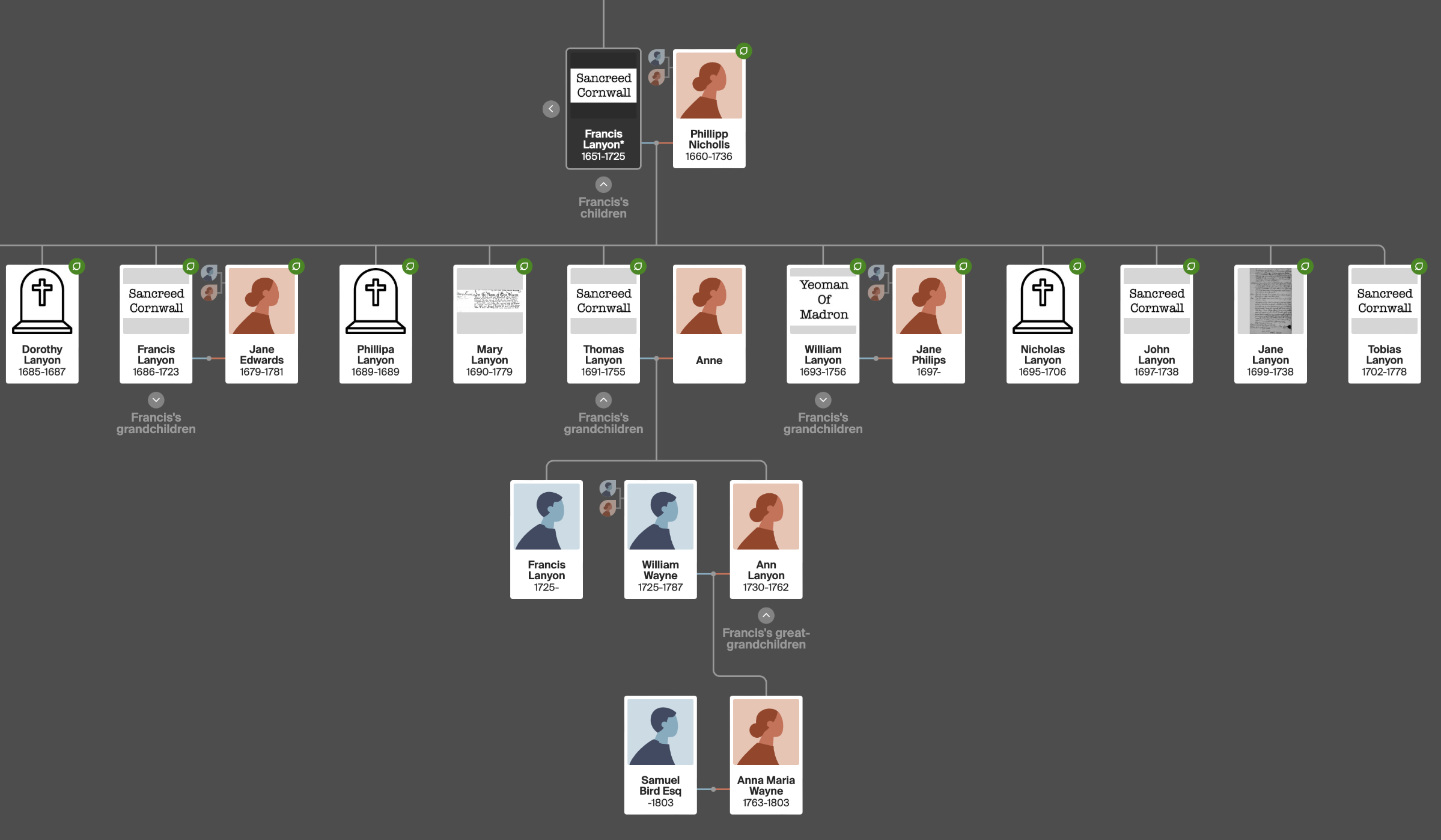
So Thomas Lanyon of Bristol was born in Sancreed, Cornwall in 1691 and died sometime after 1755. We don’t know what happened to his wife, Anne. We know that his son Francis became a pewterer but we don’t know if he married or had any children (the Thomas Lanyon working as a pewterer in Coventry in 1774 may be his son). There is no record of a birth of a daughter Ann Lanyon but we do have a record of her marriage to William Wayne.
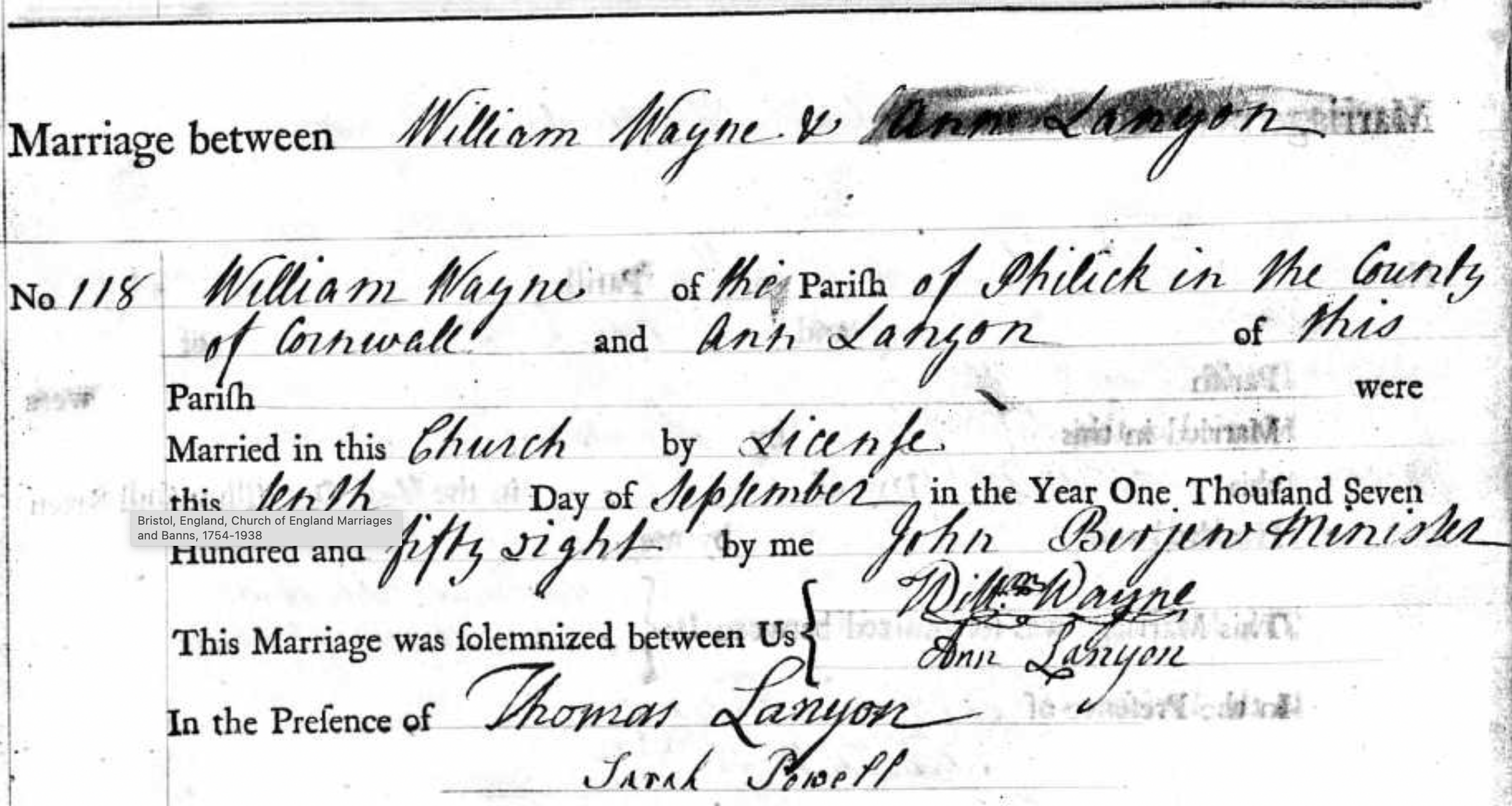
Their marriage was solemnised in the presence of one Thomas Lanyon!
Anna Maria Wayne married Samuel Bird Esq. in London in 1784.
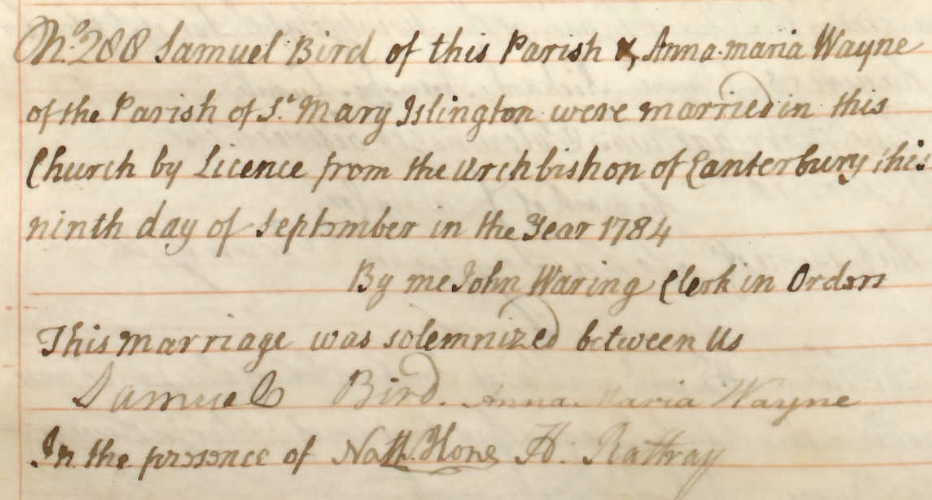
By 1790 William Wayne was dead and administration of Tobias’ will passed to Anna Maria Bird the residuary legatee.
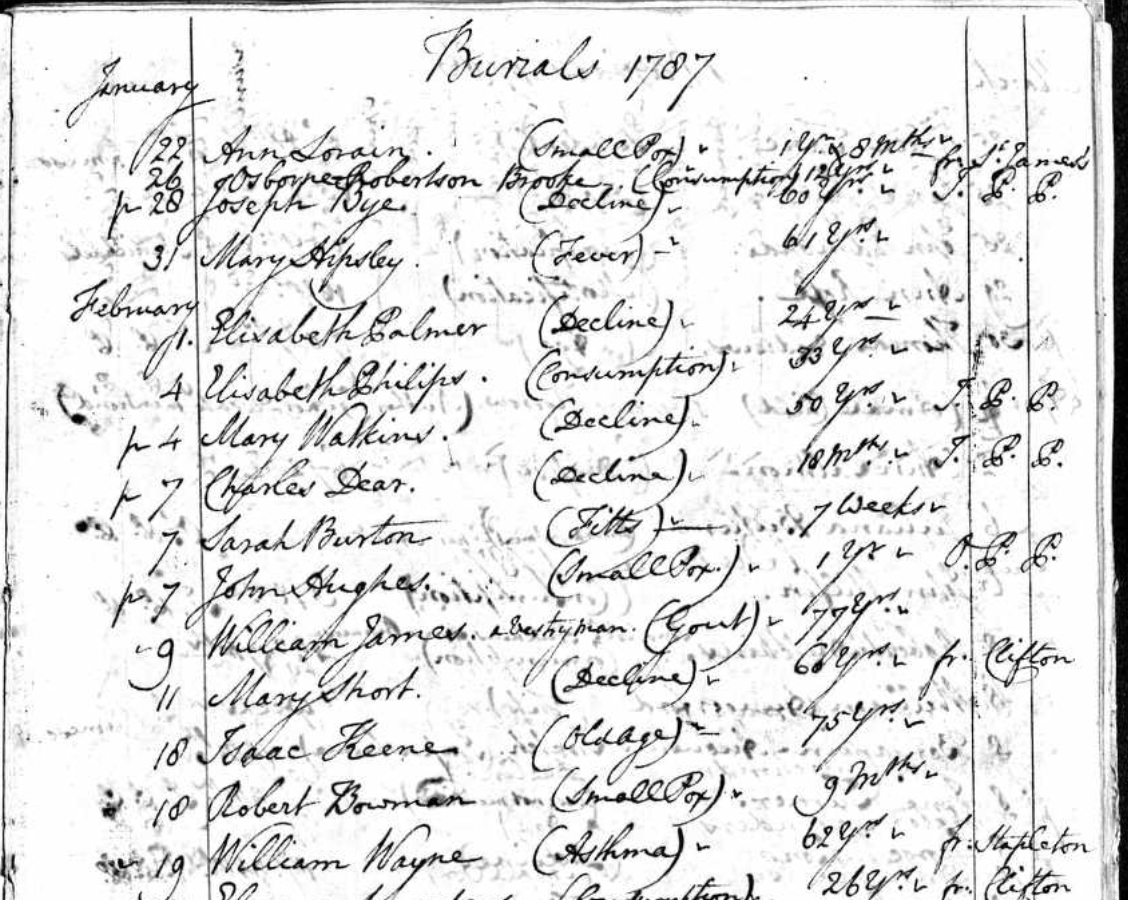
I found one possible burial entry for William at St Philip and St Jacob in Bristol on 19 Feb 1787. If it is ‘our’ William Wayne, he died of asthma.
Anna was left a very wealthy young woman with bequests of several thousand pounds, a huge sum at that time.
Sadly she died on 8 Apr 1803, at East Stonehouse in Devon, but her will requests that she be interred at Sancreed in Cornwall. She was just 40, widowed, and suffering from Consumption (TB). She and Samuel were childless so her fortune was left to various cousins. There is a plaque in Sancreed church which reads:-
‘Sacred to the memory of Anna Maria Bird, widow of Samuel Bird, of Ridgeway in the county of Devon, Esqr. She died the 8th day of April, 1803; aged 40 years. Her body is deposited in a vault with the remains of her relatives, Josiah Lanyon, Esqr, and Jane his sister.’ (https://sancreedopccornwall.tripod.com/id1.html)
Josiah Lanyon? I think that should read Tobias!
 The Lanyons