The Children of John Lanyon of Madron

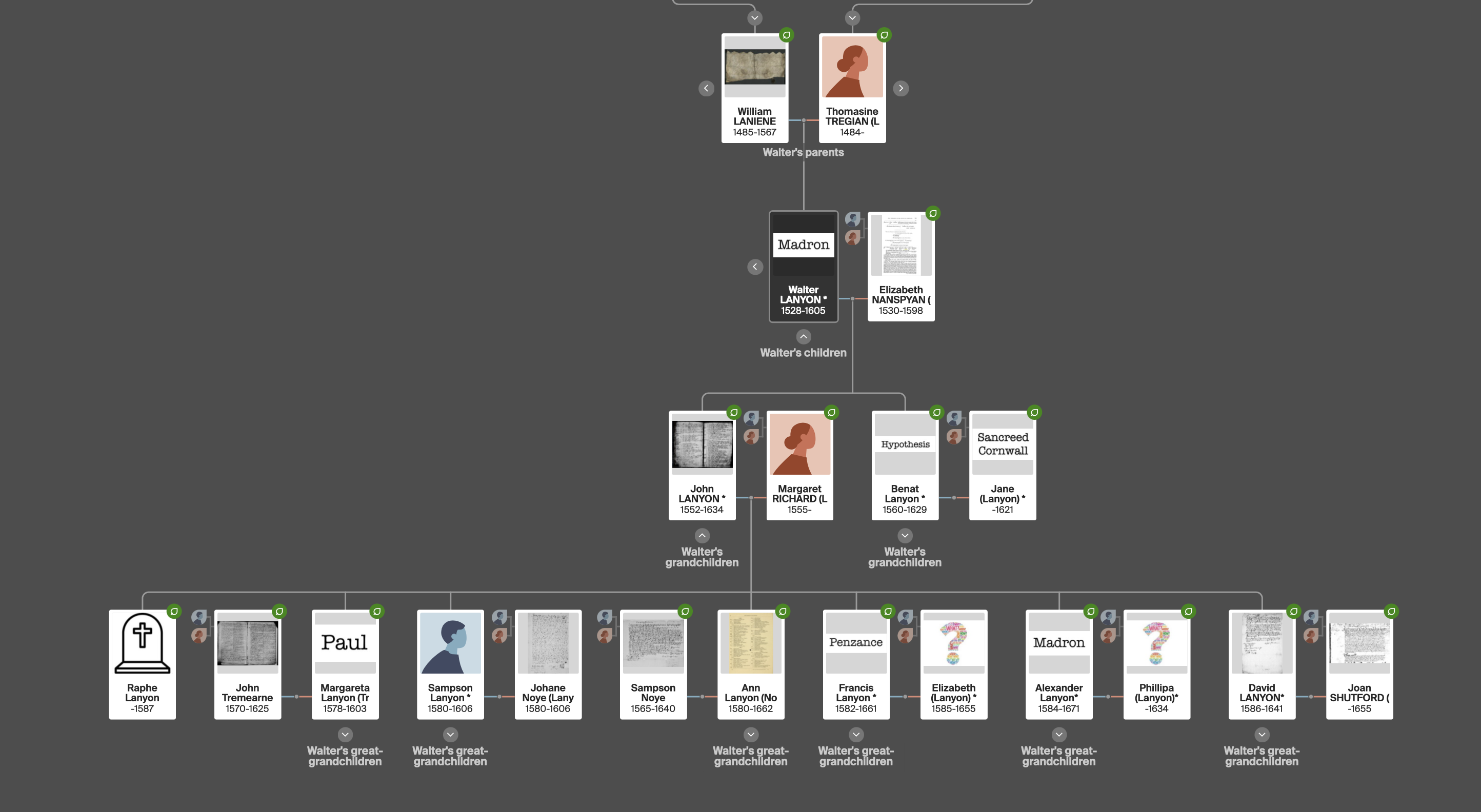
John Lanyon was the son of Walter Lanyon and Elizabeth Nanspyan.

John’s wife was probably Margaret the daughter of Sampson John Richard, they married at Madron on 24 Nov 1578. Jane Veale Mitchell notes that this John lived at Penolva near Paul but I don’t know the source of this fact.

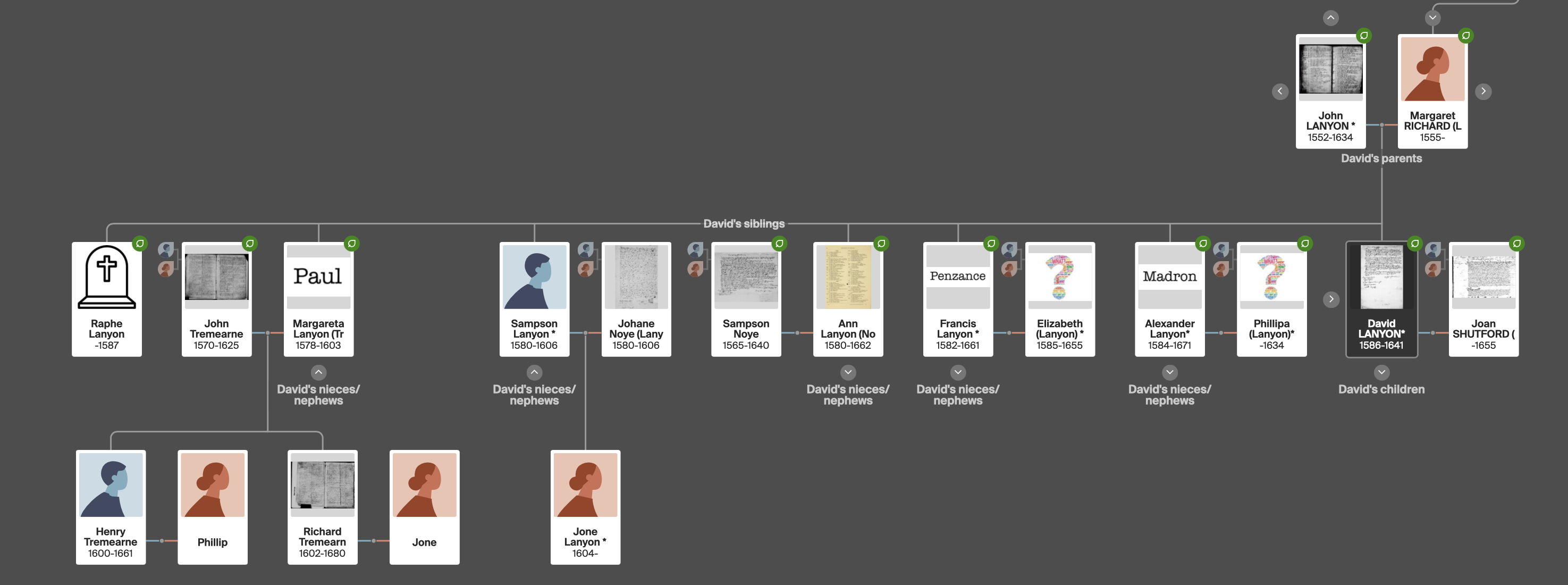
They may have had a daughter Margareta who married Rev John Tremearne, the vicar of Paul in 1598. Margareta had two sons: Henry and Richard. Margareta died at Paul in 1603. John may have had a son called Samspon. There is no birth record but a Samspon Lanyon married a Johane Noy in 1602 at Sancreed. He could have been named after his grandfather Samspon John Richard.

John Lanyon moved to the Barton of Lanyon following the death of his father Walter in 1605.
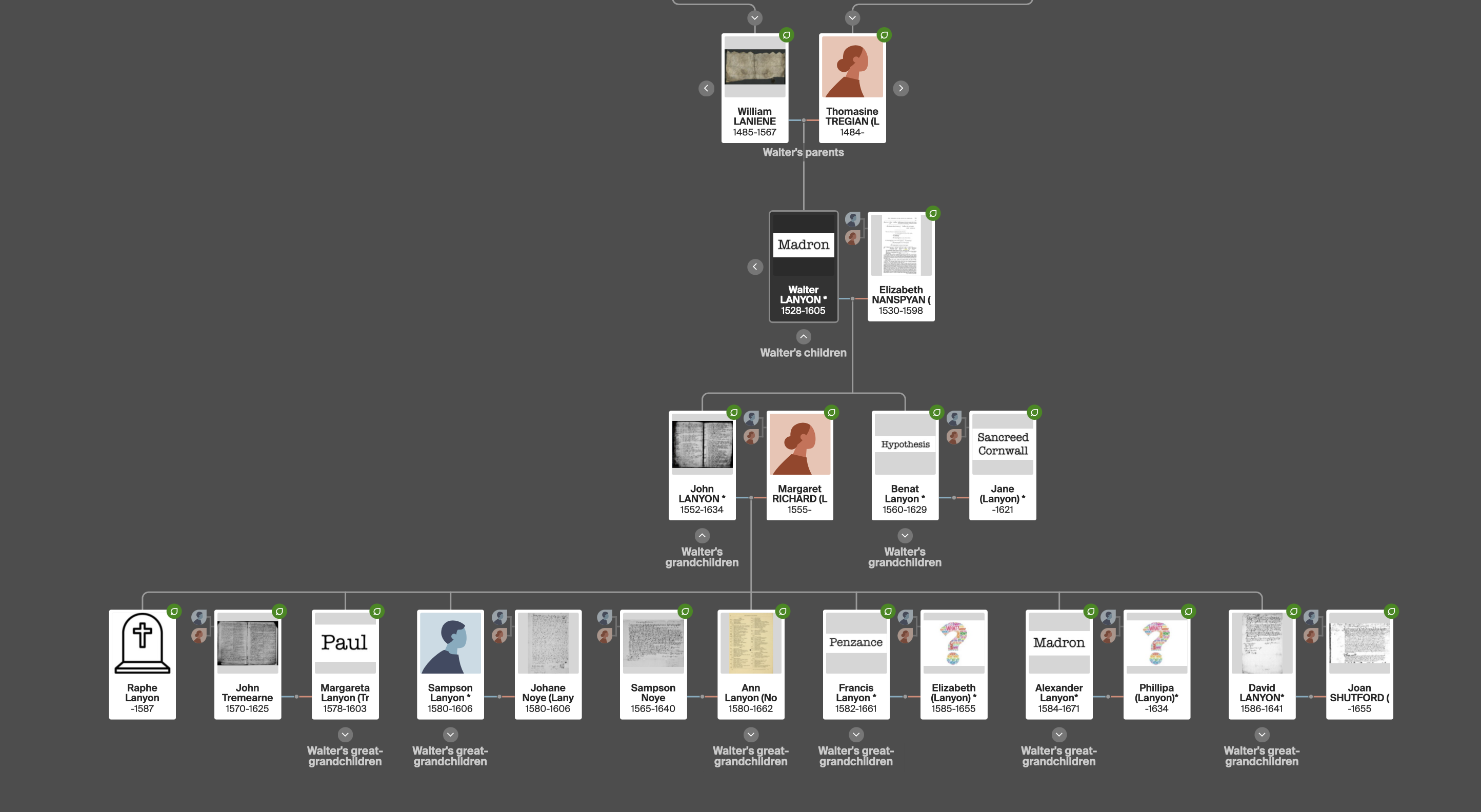
John Lanyon of Madron’s family tree

Ann Lanyon abt. 1585 – 1662

John’s daughter Ann married Sampson Noye on 24 January 1602 at Madron. Sampson was the widower of Jane Trewren the great niece of Ann’s great aunt Isabel Lanyon (William Laniene Esq’s sister) who married Thomas Trewren. (See post ‘Lanyons, Trewrens and Noys’). Sampspon married Jane Trewren in 1587 and they had several children.

  • Amy 1589-bef. 1680
  • Elizabeth 1593-1609
  • Robert 1594-1642
  • Richard 1597-1598
  • Thomas 1597-1642 married Elizabeth – five children
  • Jane 1599-1601
  • Chesten 1600-1655 married Maddern Champion – son Noye Champion

He went on to have several more children with his second wife, Ann Lanyon.

  • Sampson 1602-1654
  • George 1602-1653
  • Richard 1606-1683
  • Elizabeth 1609-
  • Sarah 1610-1640
  • William 1611-1673
  • Thomas 1612-1652
  • Margaret 1614-1629
  • John 1615-1629
  • Walter 1616-1694

Ann was buried on 25 Dec 1662 at Madron some twenty two years after her husband.

Francis Lanyon 1582 – 1661

Francis Lanyon was the eldest son. He was a successful Penzance merchant who married Elizabeth on the 19 Jun 1607 at Madron. Sadly the maiden names of women are rarely mentioned in the Madron register.

I found three children:

  • Bennett 1615-1661
  • Sampson 1616-
  • Susanna 1619-

Francis is listed as taking the oath on the 1641 Madron Protestation Return. The Protestation Returns of 1641–1642 are lists of English males over the age of 18 who took, or did not take, an oath of allegiance “to live and die for the true Protestant religion, the liberties and rights of subjects and the privilege of Parliaments.”

Francis is mentioned in Penzance Mayoral records:

  • Guildhall Penzance Mayor grants to Francis Lanion the profits of key (quay?) and pier for one year for £25
  • Paid Mr Lanion 12/- on report of Dunkirk landed at Mousehole
  • To Francis Lanion for repaying the quay’s man Suarez 12d (mansards?)
  • To Thomas Jenkin and Francis Lanyon for repaying the quay’s mansards. 12d

Francis was buried 22 May 1661 at Madron.

Alexander Lanyon 1584 – 1671

Alexander Lanyon was the second son (he may have been named after Alexander Nanspyan, his grandmother’s uncle who was named on the Sithney Muster Roll of 1535), he married Philippa on 23 Feb 1614 at Madron and they had at least nine children. Some are mentioned in their grand father’s 1634 will which helps determine when they may have been born or died.

  • Alexander aft. 1616-1624
  • Anne 1616-aft. 1634
  • Maud 1617-aft. 1634
  • Peter 1622-bef. 1634
  • Joane 1628-bef. 1634
  • Walter bef. 1634-1715
  • John bef. 1634-1673
  • Alexander aft. 1634-1660
  • William – 1624

Alexander leased the Barton of Lanyon from his cousin Jonathan Rashleigh and his descendants lived there until the late 18th century. Alexander was buried 24 Oct 1671.

David Lanyon 1586 – 1641

David (Davy) Lanyon was the youngest surviving son. His father’s will and the Madron parish registers refer to him as Davy. He married Joan Shutford, we don’t know the date of the marriage but Davy was buried 22 Jan 1641, and his will states that his son Thomas is 21, so he must have been born in 1620. His other children are all younger so estimated date of marriage is 1619 or earlier.

David Lanyon gentleman – will Source CRO/AP/L/441

The transcript of Davy’s will:

“I doe give and bequeathe all my goods and chattels unto Joan Lanion my wife whom I doe make and ordaine to be my full and whole executrix and she to educate and maintain my children according to their degrees and calling till they or either or any of them accomplish the yeares of twenty one and then to give them portions according to her discretion and according to her ability.

  • Item: My will is that after the decease of my wife my sonne Thomas shall have and enjoy all my terme and tyme in part of the tenement in Bussalloe that I hold by the devise of Sir Francis Langdon, Br, and Zenobia Prideaux, widdowe, deceased. (Zenobia Prideaux was the daughter of James Nanspyan, Elizabeth Nanspyan’s brother and a cousin of David’s father John.)
  • Item: I doe give and bequeathe unto the said Thomas my sonne, ye land belonging to Lanion Mill after the decease of my wife during the terme and tyme I have therein.”

Signed Francis Lanion snr in the presence of Richard Carthew and Will Noye.

Davy and Joan lived at Little Bosullow which had been held by the Lanyons since the 13th century.

Davy and Joan’s children were:

  • Thomas 1620-1695
  • Joan 1622-1660
  • Francis abt. 1623 – aft. 1655
  • Ann 1628 – bef. 1634
  • William 1634-1708
  • Barnard 1638-1714

Francis and William were cordwainers (shoemakers and leather workers).

Joan Lanyon née Shutford was buried on 18 Jan 1655 at St Buryan. She left a will full of detail about her clothes. It gives us a rare glimpse into their lives.
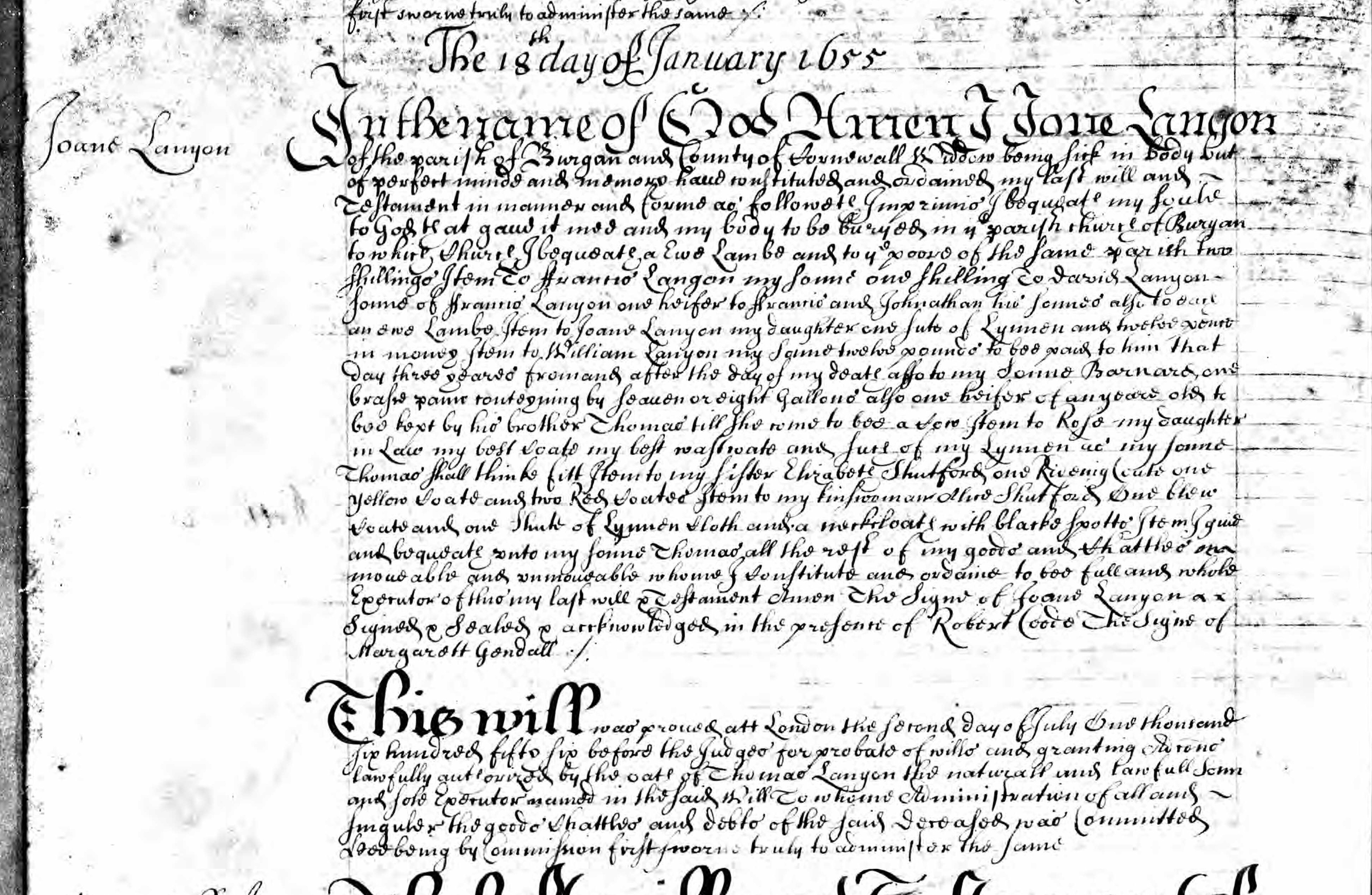
Source NA/PROB/11/257/72

The transcript of Joan’s will:

  • To church, a ewe lambe.
  • Poor of the parish 2/-
  • Son Francis 1/-.
  • David Lanyon son of Francis, 1 heifer, also his sons Francis and Jonathan each an ewe lambe.
  • To Joane Lanyon, daughter, one sute of Lynnon and 12d.
  • To son William £12
  • Also son Barnard one brasse pan conteyning by 7 or 8 galls and 1 heifer, one year old, to be kept by his brother Thomas till she come to bee a cow.
  • To Rose my daughter-in-law, my best coate, my best waistcoat and such of my lynnon as my son Thomas shall think fitt.
  • To my sister Elizabeth Shutford one rideing coate, one yellow coate and two red coates.
  • My kinswoman Alice Shutford one blew coate and one sute of lynnen cloth and a neck cloth with black spots.
  • To my son Thomas all the rest and executor of my goods and chattels.”

Daughter in law Rose was the wife of Joan’s son Francis Lanyon.
17th century clothing


Richard, Edward and Raphe Lanyon

Richard & Margaret Lanyon’s children

Richard Lanyon and Margaret Treskillard had a large family, eight sons and four daughters who all survived to adulthood. This post is about three of their sons, Richard, Edward and Raphe. (See the post ‘The Two Johns’ for information about their eldest son.)

Richard Lanyon abt. 1550-abt.1598

Richard was the third son of Richard Lanyon Esq and Margaret Treskillard. He was born about 1550 and possibly dead by 1598 but there are no records for either event.

His first wife was Margery and they married at Gwinear on 6 Jun 1581. I was unable to find any children of this marriage however the early 20th century researcher Jane Veale Mitchell found four children: William baptised 1590 at Gwinear (there is a William born in 1590 the son of Edward Lanyon but Jane appears to have found a second William, perhaps mentioned in a will) and John baptised 1591, Agnes and Tiberia. William and John must have died in infancy as the will entails his property on his daughters.

“Richard Lanyon gent of Madron mentions Avice his wife and property Roscadghill and Nanselverne in Madron and trustees Alexander Penrose and Raphe Lanyon gent (bought 20 Eliz {1578} from Henry, late Earl of Rutland?) Richard Lanyon being seized in an estate of fee a tenement called Roscadghill Lanion and one moitie of land called Nanselverne (Maddern) and two daughters and heirs Agnes and Tiberia. Upon his marriage with Avice his late wife did enfeoffe lands to feoffes – to himself – then to Avice for life, then male heirs of Richard and Avice then to right heirs of Richard. Later on marriage of Tiberia (youngest daughter) he wished his property to go to her and so disinherit the elder daughter Agnes. But Avice did not consent and survived both daughters. Richard Lanyon died without heirs male.”

Source: MS Rawlinson C.789 (Oxford) Dated 40 Eliz {1598}. Transcript by Jane Veale Mitchell.

Richard’s second wife was Avice, there is no record of this marriage but it must have happened before 1598. There is no record of burials for Tiberia and Agnes. There is a burial for an Avice Lanyon 24 October 1634 at Morvah and I found a legal dispute between Avice and a James Dingle and his wife.

Source: Chancery Proceedings – Index PRO 1621-1660

It appears that Tiberia married James Dingle of Madron before 1612 as that was the year that James Dingle baptised a daughter called Tiberia. Mother’s name is not listed however Tiberia is such an unusual name I feel she must be the mother. In 1627 James Dingle baptised a son called Thomas.

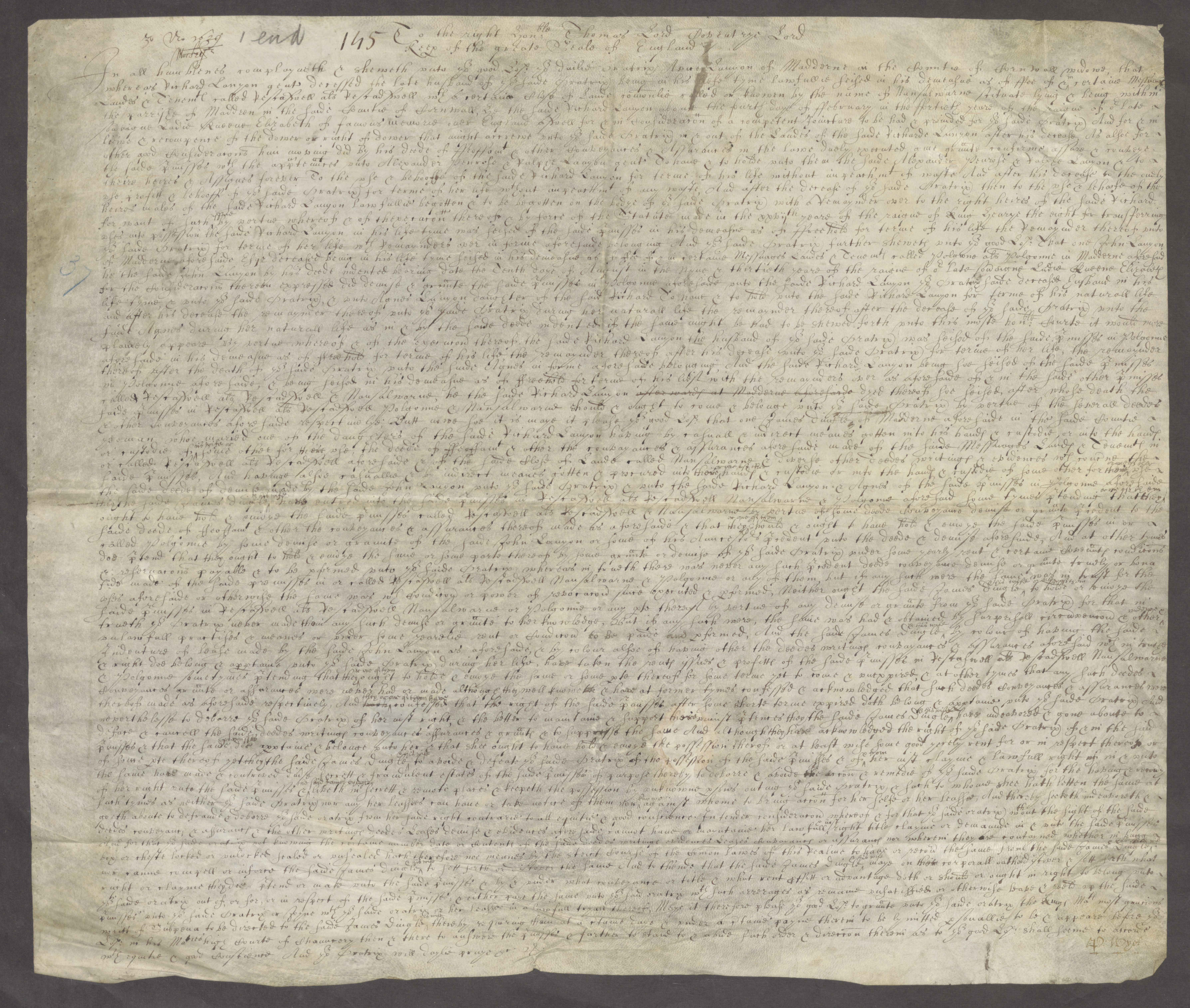
There is a document in the National Archives which details the property issue between Avice Lanyon and James Dingle. NA C3/408/37

NA C3/408/37

Map showing the location of Rosecadghill and Nancealverne today.

Edward Lanyon abt. 1550-1630

Edward was the fifth son born abt. 1550s-60s and buried 27 Sep 1630 at Gwinear.

He married Margery Chappell and whilst there is no record of their marriage there is a room in the east wing of Lanyon Manor at Gwinear which has initials EL & ML 1624 with two joined hands in between. Margery was buried in 1612.

They had three sons:

  • Raphe buried in 1584.
  • William 1590-
  • Edmund 1592-

Edmund is mentioned in his father’s 1630 will:- “I doo give and b to my son Edmunde Lanyon if he now be living £5 yearly during his life for his better maintenance to be paid qtly by equal portions or within a fortnight after every qtr.”

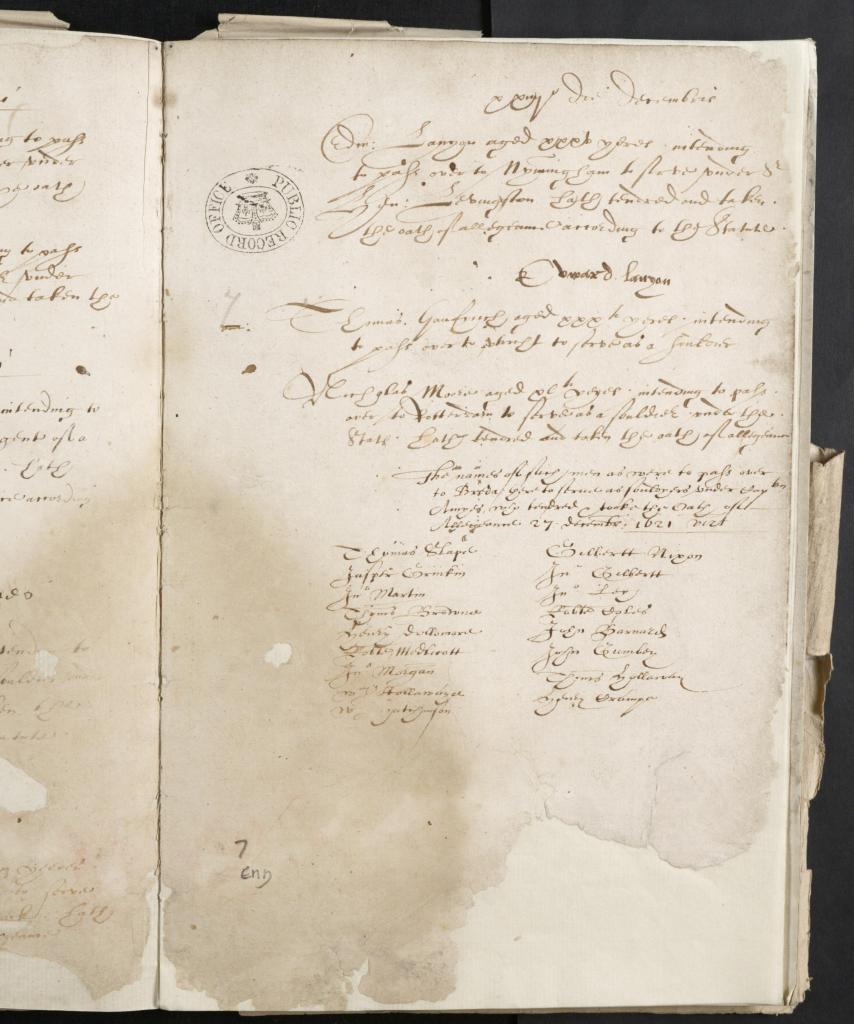
Edmund was a soldier and on 24 Dec 1621 he obtained a ‘Licence to Pass Beyond the Seas’ and went to Holland, presumably to fight in the Dutch Revolt. We don’t know if he survived.

Register of Licences to Pass Beyond the Seas – Passport!

Edward’s son William married Elizabeth Ley alias Kempthorne. They had six daughters and just one surviving son, Tobias. The Gwinear branch of the Lanyon family is descended from this Tobias.

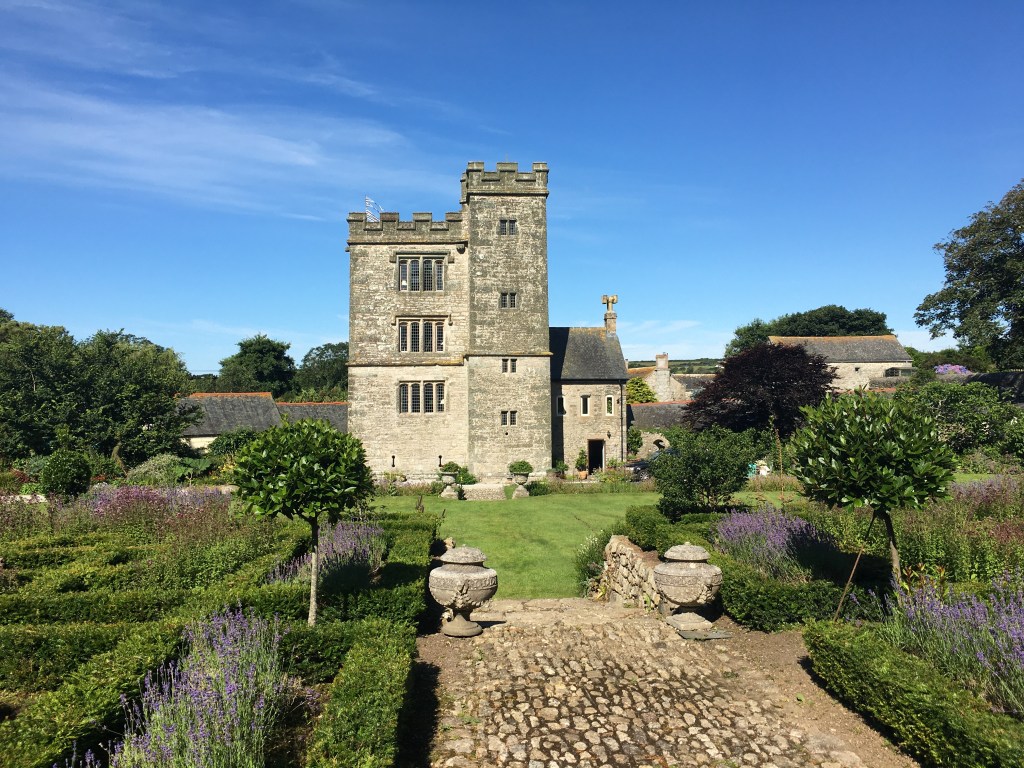
Lanyon Manor still stands today. Above the door is the coat of arms.

Lanyon Manor

Raphe Lanyon abt. 1560-1604

Raphe was the sixth son. He was probably born in the 1550s-60s. He was buried on 13 Jan 1604/5 at Madron.

His first marriage was to Margaret Pope on 7 Nov 1587 at Breage.

They had at least one son:- William who married Mary Lavelis on 21 Feb 1605.

  • William married Mary Lavelis

Raphe’s second marriage was to Jenat on 26 Sep 1591 at Sancreed. (His surname was spelt Lanyne in the parish register.) They had three sons:-

  • Richard 1594 baptised at Madron
  • Thomas 1596 baptised at Madron
  • John 1599 baptised at Madron

Jenat died on 14 April 1601.

Raphe married a third time after 1601 but I cannot find a trace of this marriage. He left a will which mentions his wife Ann. They had one son:-

  • Symon 1604-1604 died in infancy

We also know from the will that Raphe lived at Bossolow Vean. His son and grandson, both called William lived at Bossolow Vean.

Jane Veale Mitchell describes Raphe as a ‘family favourite’ often mentioned in wills but those wills are now lost and sadly she didn’t transcribe them.

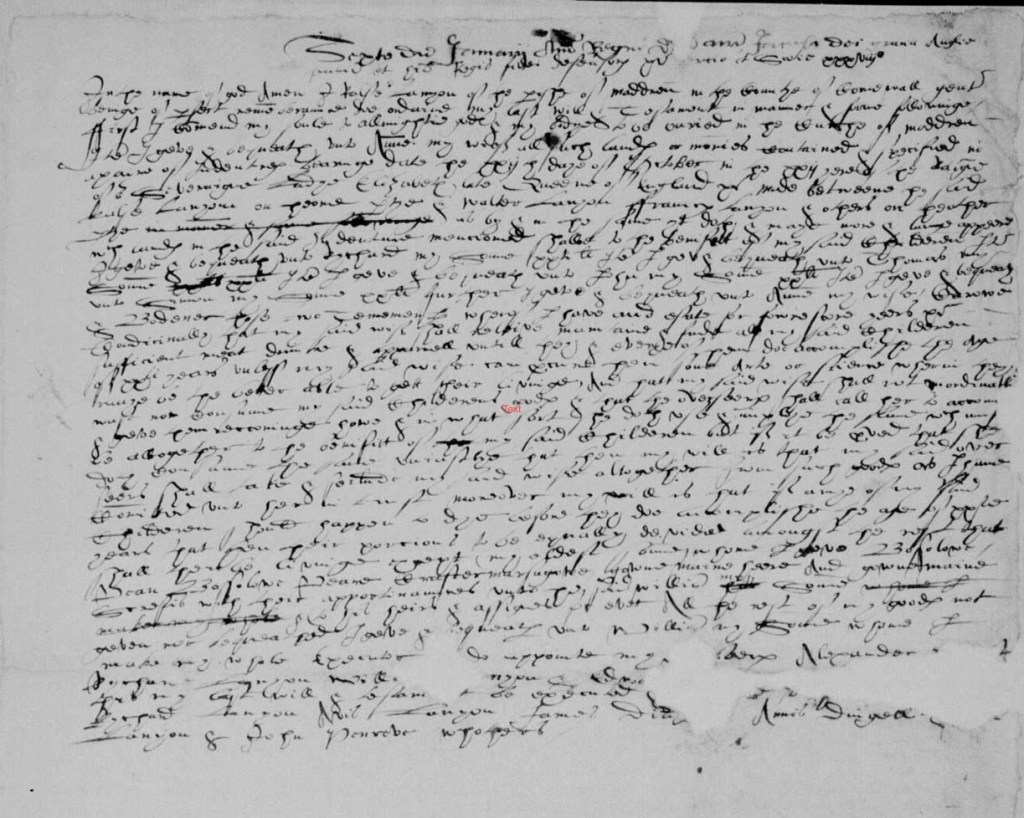
Raphe’s will.

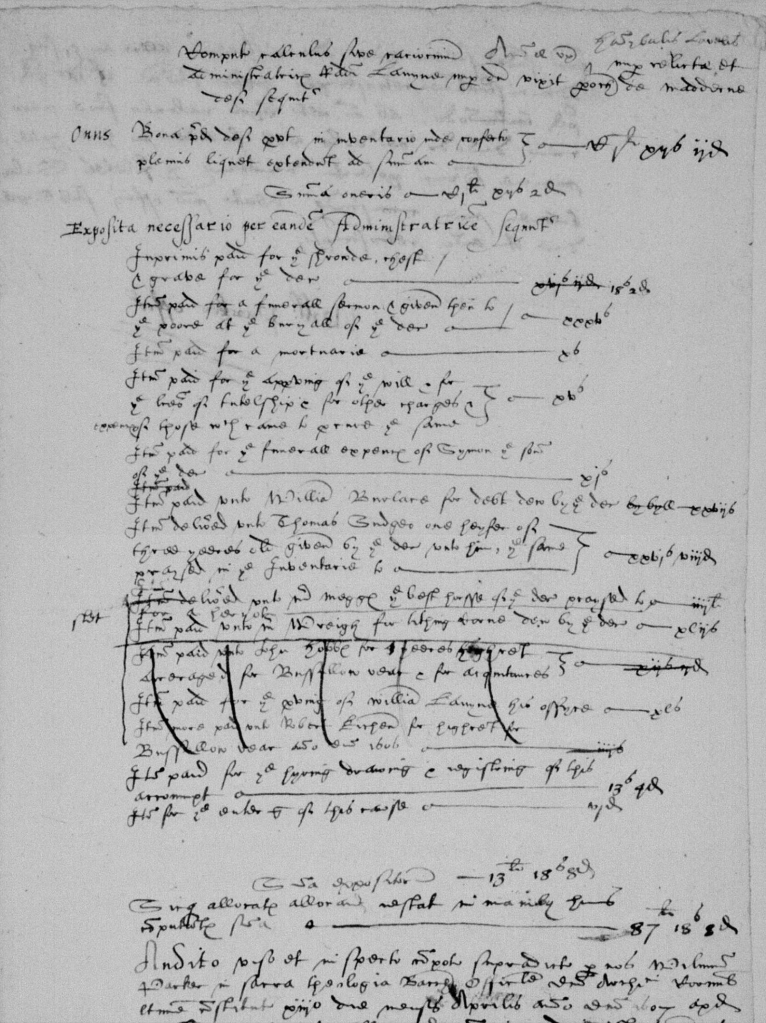
There is also an invoice from the lawyer which details Symon’s burial.

William of Morvah

William Lanyon was the fourth son of Richard Lanyon Esq and Margaret Treskillard. He was probably born in the 1550s-60s and he was buried 31 May 1619 at Morvah.

William Lanyon of Morvah’s tree

In 1589 Richard Lanyon and his eldest son John Lanyon sold the Tregamynyan Estate to William for £100.

The Foot of Fines from Westminster for the Trinity Term of the 31st year of the reign of Elizabeth I includes a fine passed between William Lanion gent. and Richard Lanion Esq. It states that Richard Lanion Esq. gave to his fourth son, William Lanion gent., with the agreement of his eldest son John Lanion gent., the Manor of “Tregamynyan” which included three messuages (dwellings), ten acres of meadow, sixty acres of pasture, one hundred and fifty acres of furze, one water-mill etc.

The Manor of Tregaminion remained the possession of William’s descendants until it was sold by the cousins of the Lanyons of Lanyon in Madron to John Borlase Esq. of Pendeen, during the reign of Queen Anne (1702 – 1714).

Record keeping in Morvah didn’t begin until the 17th century so most of the information we have about William and his family comes from his will.

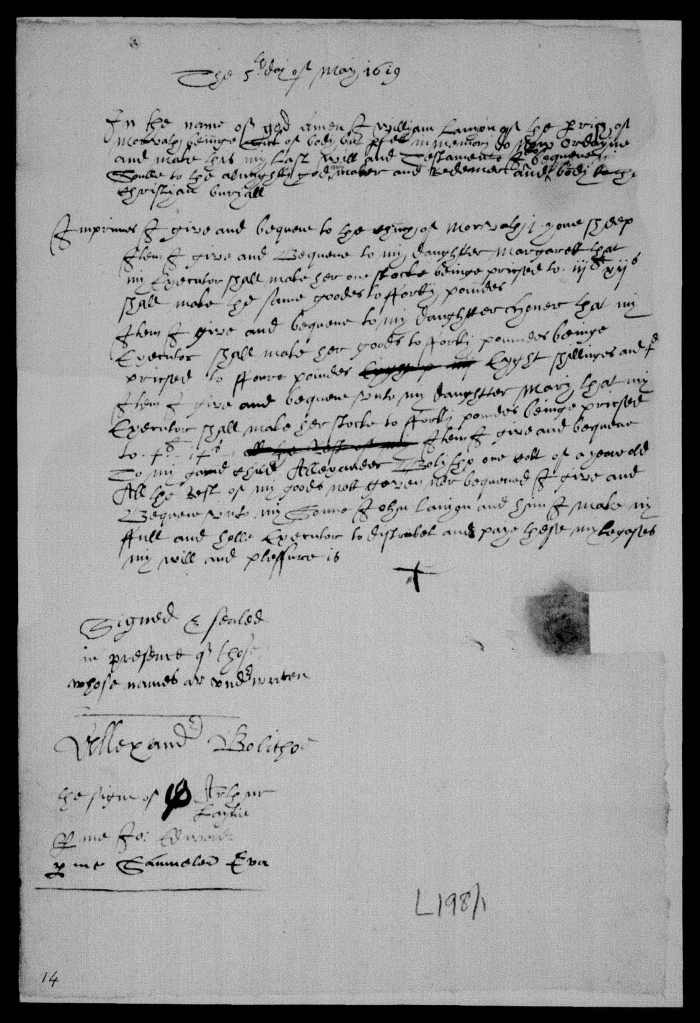
William’s Will of 1619

Will of William Lanyon Source: CRO/AP/L/198

His will lists his children:

  • Elizabeth who married William Bolitho 9 Jun 1614 at Helston, their son Alexander is mentioned in the will and is given a colt.
  • Margaret who married William Bosustow 24 Oct 1619 at Morvah.
  • Honor who married Stephen Thomas on 17 Nov 1631 at Helston. She was left £40 in her father’s will.
  • Mary who married Martin Samson on 23 Jan 1631 at Madron. She was also left £40 in her father’s will.
  • John Born 1602 and was buried 26 Dec 1664 at Trerife, Sancreed. He married Ann Edwards 4 Feb 1625.

There is no mention of a wife so presumably she predeceased him. There is no record of his marriage but as he has two grand daughters called Blanche perhaps his wife was so named.

Tony Atkin / Morvah Church

A child called Aves Lanion daughter of William Lanion died at Morvah in 1614.

From the large gap in ages between his children he may have had two wives and two families but there is no record of this.

In 1820 Gilbert noted that Morvah church contained a pew with the Lanion arms and the initials WL dated 1593. Sadly that no longer exists.

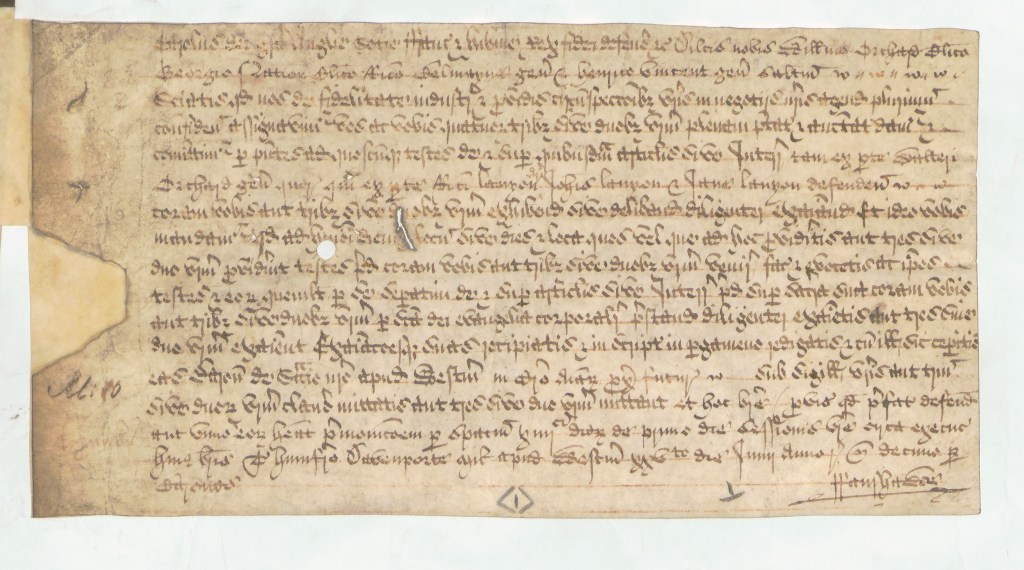
When William died in 1619 his son John was under eighteen and therefore still a minor. In 1622 the Court of Ward and Liveries held an Inquisition Post Mortem to determine his right to inherit.

Source: National Archives WARD 7/58/14

View of the Court of Ward and Liveries – Unknown author, Public domain, via Wikimedia Commons

The Inquisition

National Archives WARD 7/58/14

John Lanyon 1602-1664

John was born about 1602 as he was 17 when his father died in 1619. In 1625 he married Ann Edwards at Morvah. They had one son also called John who was born at Morvah in 1630.

In 1659 John Lanyon and his son sold Tregaminian to their cousin John ‘Golden’ Lanyon of Botrea, Sancreed and they moved to Trereife House.

John senior died on 21 Dec 1664 and is described as ‘gentleman of Trereife.’

Rod Allday / Trereife House

John Lanyon 1630-1699

John Lanyon Junior was born 1630 and married Anne Jones daughter of Francis Jones Esq of Sennen sometime before 1663 when their only son Hugh was born. There is a jointure settlement on marriage of John Lanyon of Trereife and Anne Jones of Sennen dated 30 Jan 1670.

John died on 2 Jun 1699 at Trereife.

Hugh Lanyon 1663-1706

Hugh Lanyon’s tree

Hugh was the only child of John and Anne Jones (he appears to have been named after her uncle Hugh Jones Esq). At the age of 21 on 21 Jan 1684 Hugh Lanyon of Sancreed released to John Borlase ‘his right in Trereife.

In 1689 Hugh married Mary Tonkin of Paul and they had six children:

  • John 1692-
  • Ann -1699 died in infancy
  • Hugh 1697-1768. Hugh junior married a Catherine Lanyon (obviously a cousin but I can’t find the connection) and they both lived in the Scilly isles. There is no trace of any children.
  • Ann 1699-1754 spinster
  • Lydia 1703-1704 died in infancy
  • Benjamin 1704-1746 he was a mariner on His majesty’s sloop ‘Lizard’. He died in 1746 aged just 43. Benjamin married Mary Quick at Madron in 1728. They had two children, Mary and Ann. Ann died aged 11 and there is no further trace of Mary, the name is too common to be sure we’ve found the right person.

Hugh senior is described as a merchant of Newlyn and at his death in 1706 administration of his estate was granted to John Borlase his principal creditor. (Source – CRO/AP/L/1060).

His son John was born in 1692 and there is no further trace of him. I’ve often wondered if he was the John Lanyon innkeeper of New York who inherited part of the Delavall Lands in Harlem. (I’ll cover this story in another post.)

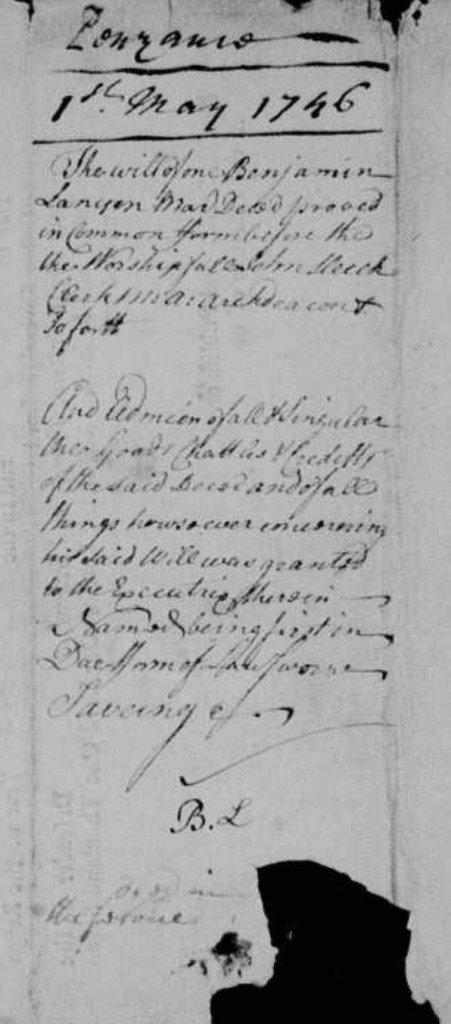
Benjamin’s will – everything was left to wife Mary – Source CRO/AP/L/1543

Benjamin was the last of the Morvah branch of the family.

The Sons of William Laniene Esq

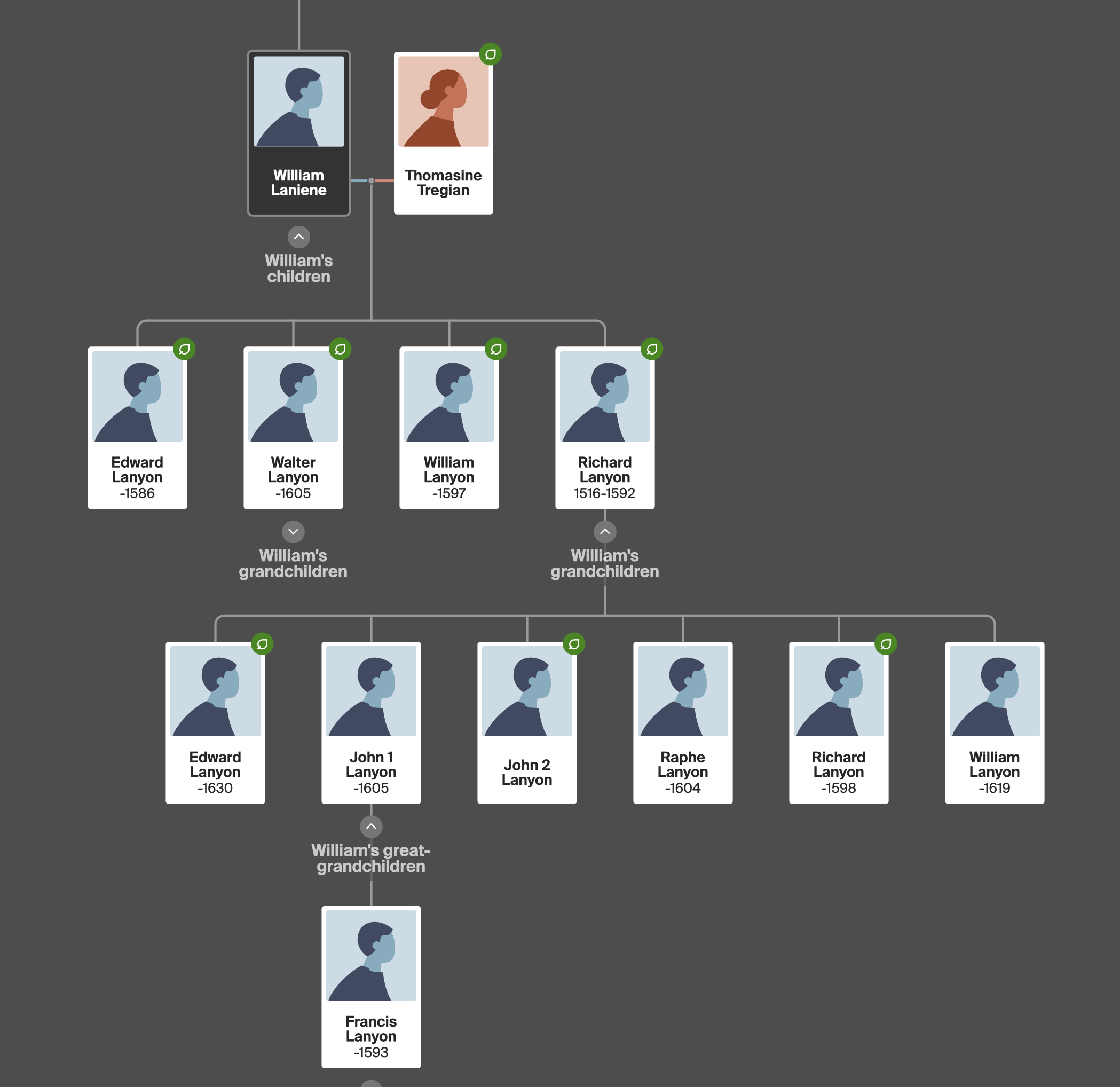
William had nine daughters and four sons: Richard his son and heir, William, Walter and Edward.

Richard Lanyon Esq 1516-1592

Richard Lanyon Esq was born about. 1516 and was buried 18 Dec 1592 at Gwinear, Cornwall. He married Margaret Treskillard and they had at least twelve children, eight sons and four daughters.

Margaret was the daughter of Thomas Treskillard and Elizabeth Penwarne. Thomas of Treskillard Manor, Illogan, died before 1533 (we know this as his 2nd wife Isabel was mentioned as his widow in a legal dispute of 1533). Elizabeth Penwarne was born at Penwarne Manor Mevagissey.

Penwarne Manor Cornwall

Margaret married Richard Lanyon Esq abt. 1535.

Margaret was famous for having a dream about the location of a new tin mine.

“Richard Lanyon of Gwinear found a rich tin work as a result of a dream of his wife, and made nearly £4000 in four years”.

Source: ‘Tudor Cornwall’ by John Chynoweth.

“Some have found Tynne-workes of great value, through means no less strange, then extraordinaire, to wit, by dreams. As in Edward the sixth time, a Gentlewoman, here to one Tresculierd, and wife to Lanine, dreamed that a man of seemly personage told her how in such a Tenement of her land, she should find so great store of Tynne as would serve to enrich both her selfe and her posterity. This she revealed to her husband: and he putting the same in trial found a work which in four years was worth his welneere so many thousand pounds.”

Source: ‘The Survey of Cornwall and an Epistle Concerning the Excellencies of the English Tongue’. By Richard Carew 1602

Richard Carew (1555-1620), aged 32, as High Sheriff & Deputy-Lieutenant of Cornwall (English). National Trust, Public domain, via Wikimedia Commons.

£4000 in four years was a huge amount of money in Tudor times. This is the family at the height of its success. In less than a hundred years much of it would be lost by Richard and Margaret’s great grandson.

In 1561 he was described in his son’s marriage settlement as Richard of Morvah so he must have been living at Tregamynyan at that time. By 1569 two years after the death of his father he was living at the family manor at Gwinear and was listed on the 1569 Muster Roll for Gwinear.

Corslet mourion long bow sheaf of arrows bill a gelding with his…. Richard Lanyne gent furnushed. Ability a, ar‘ (Archer).

The 1569 Muster Roll was to include all men between 16 and 60. For wages over £5 a certain amount of weaponry/armour had to be provided. For goods over £10 the same applied, bow, arrows and bill being the lowest contribution rising to furnishing horses at the higher end with goods over £400 or an income of over 100 marks anyone with a park was expected to supply horse.

Property Transactions

In 1578 sale by John Noy yeoman of Madron to Richard Lanyon of land in Newlyn.

Source: Royal Institution of Cornwall

1587 Property Transaction: Richard Lanyon of Gwinear esquire and John Lanyon of Madron his son and heir to Nicholas Botistowe of Newlyn of three gardens and a hemp plot.

Source: Royal Institution of Cornwall

Map of Cornwall showing Newlyn & Paul

Richard died in 1592 and was buried at Gwinear on the 18th December, thirteen years after his wife’s death.

William Lanyon abt. 1520-1597

William ‘Generosi’ Lanyon (William’s second son) was probably born after 1516 and died 7 Oct 1597 at Breage, Cornwall. (see separate post about William Lanyon – Breage Branch.)

Walter Lanyon abt. 1520-1605

Walter Lanyon was probably born 1520s-30s. He married Elizabeth Nanspyan the daughter of John Nanspyan and Joan Tregose of Godrevy Manor, St Erth. Elizabeth was buried 28 Sep 1598 at Madron and Walter was buried 12 May 1605 at Madron.

There are no records of any children born to this couple however a property lease shows at least one son, John.

“Tenant Walter Lanyon, mort., Elizabeth ux and John (80) filius by grant of Richard Lanyon esq and John Lanyon 11 Eliz. Previous tenant John Angove. Also a corn mill and stamps. John Lanyon gent by grant of Richard Lanyon of Nancothan esq 5 James holds Lanyon Rysech (except the mills) on lives of Francis Lanyon, 50, Alexander, 48, and David ,46. Rent £6.”

Source – Henderson’s MSS 30534 pt 7 (transcribed in a letter from Rose Tolman to William Lamparter 6 Jun 1970).

This proves that Walter and Elizabeth were tenants of Richard Lanyon esq (his brother) and John Lanyon, (his nephew) in 1569. It confirms the lease to Walter’s son and grandsons when the property is owned by Richard Lanyon of Nancothan in 1608. Walter’s son John was aged 80 in 1632 when the lease was renewed by Jonathan Rashleigh (the new owner of Madron) and it confirms the ages of Walter’s three grandsons.

There are few mentions of Walter in the records, I could only find the following:

1569 Muster Roll of St Erth – Water (sic) Lanyne – Bow shaft arrows, ability B

21st Apr 1577 Peter and Hellynor servants of Walter Lanyon gent married at Madron. (Source: Madron Parish Register.)

Edward Lanyon -aft. 1586

Edward Lanyon – There is no record of a baptism, marriage or burial and most family trees don’t include him. Initially it looked as though he was not on the 1569 Muster Roll, however there is an Edward Leyne on the 1569 Muster Roll for Padstow (near Crugmorreck) which could be him. He died aft. 1586 but there is no trace of a burial. Perhaps he left Cornwall to find his fortune as many younger sons did.

Most records show William Laniene having only three sons however he must have had at least one more as there is a legal document that names him.

Lawsuit over Crugmorreck, St Merryn

Parties: 1) Edward Lanyen 2-3) George Arundell and John Michall.

Letters patent of Queen Elizabeth, giving record of a lawsuit in court of the Queen’s Bench, enrolled Easter term, 1570 (12 Elizabeth), in which (1) had brought a bill in Hilary term last past [1570] against (2)-(3) ‘in custod’ marr’ maresc’ Domine Regine’ in a plea of trespass and ejection of farm. Recites that Richard Lanyen esquire, on 20 September 1569 (11 Elizabeth), had granted to party (1) 30 acres of land, being one close called Crukemorecke (parish of Seynt Meryn), for (1) to hold for term of 6 years from St Bartholomew last past [24 August 1569]; on the following 26 September [1569], (2)-(3) forcibly entered the tenement and ejected him from it, to (1)’s damages of 20 marks. Now on Wednesday 12th/19th April (Wednesday after 18 of Easter) 1570, (2)-(3) came to reply, pleading not guilty. (1) said that Peter Edgecombe esquire was sheriff of Cornwall, and a kinsman of (1), being son of Elizabeth, daughter of Joan daughter of Thomas Tregian, who was also father of Thomasina, mother of (1); therefore an order was given to have come 12 men of the view of Seynt Meryn before the Queen at Westminster on Friday 3 November (Friday after the morrow of All Souls). Later it was respited until Saturday 9 October 1574 (Saturday after the octave of Michaelmas, 16 Elizabeth), unless previously [resolved?] on 16 August at Launceston Castle by form of statute. On which date [9 October] some of the jurors impanelled came (namely Thomas Trenance de Wythyell, William Achyb gentleman, Richard Braye de Saynt Clare, and William Kyllyowe de St Tethe), and some not, so that others present were appointed at the request of (1), namely Thomas Hawke, William Lytell, Edward Murthe gentleman, Richard Drenyok, Thomas Bugge, William Blygh de Polhille, Thomas Roche and John Frenche. Then (1), though solemnly summoned, did not appear, and his bill against (2)-(3) was not further prosecuted. So (1) to be in mercy for a false claim, and (2)-(3) to go free without a day. Royal seal. Dated 28 Elizabeth.

So Edward Lanyon states that his mother is Thomasine Tregian, daughter of Thomas Tregian.

Source: CRO AR/3/39

There is no record of a marriage or burial for Edward but he may have had descendants.

There are another two possible sons of William Laniene

William may have had other sons who are not documented as they were born after the first Herald’s Visitation of 1531 and died before the second visitation.

There is a John Lanyon who was buried at Gwinear 22nd Jul 1563. Could he be an undocumented son of William Laniene and Thomasine Tregian?

Could this John be the father of Sader (Sarah?) Lanyon who was also buried at Gwinear on 30th Mar 1565 and listed as the daughter of John? A John Lanyon was also listed as the father of Richard Lanyon who was buried at Gwinear on 15 Oct 1547. It’s impossible to say with any certainty how they are all related.

Gwinear Church – Jowaninpensans, CC BY-SA 4.0 https://creativecommons.org/licenses/by-sa/4.0, via Wikimedia Commons

There was also a George Lanyne, gent who was baptising children at Sancreed in the 1560s and was probably born in 1530s who may also be a relative. He was buried at Sancreed on 16th Nov 1592. The description of him as a gentleman indicates that he could be the son of an esquire or gentleman.

John Lanyon the son of Walter and Elizabeth

John Lanyon was the son of Walter Lanyon and Elizabeth Nanspyan. He was born in 1552, we know that from a lease signed in 1632 which gives his age as 80.

Walter & Elizabeth’s tree

It seems likely that he was the John Lanyon who married Margaret daughter of Sampson John Richard on 24 Nov 1578 at Madron, Cornwall. The Marriage register was started in 1577 and John’s marriage was one of the first recorded.

We know that John had at least four children which are mentioned in his will of 1634. We know the years his three sons were born as they are also mentioned in the 1632 lease.

  • Ann abt. 1580 – 1662
  • Francis 1582 – 1661
  • Alexander 1584 – 1669
  • David 1586 -1641

John may have had more children. There is a Margareta Lanyon who married the Reverend John Tremearne, Vicar at Paul on 21st May 1598 and she could be his daughter. Sadly she died on 14 Feb 1603 at Paul leaving two sons Henry and Richard.

John and Margaret Lanyon lived at Paul (Penolva Farm) until they inherited barton of Lanyon following Walter’s death in 1605. Jane Veale Mitchell mentions them at the Penolva property but I haven’t yet found documentary evidence to back that up. Perhaps it was mentioned in a will that she saw but which has since been lost.

Another hypothesis is that John and Margaret were the parents of Sampson Lanyon (possibly named after Sampson John Richard) who married Johane Noye on 19 Jul 1602 at Sancreed, Cornwall. Johane was the daughter of Johane Noye who died in 1606 and it is her will which names Sampson Lanyon.
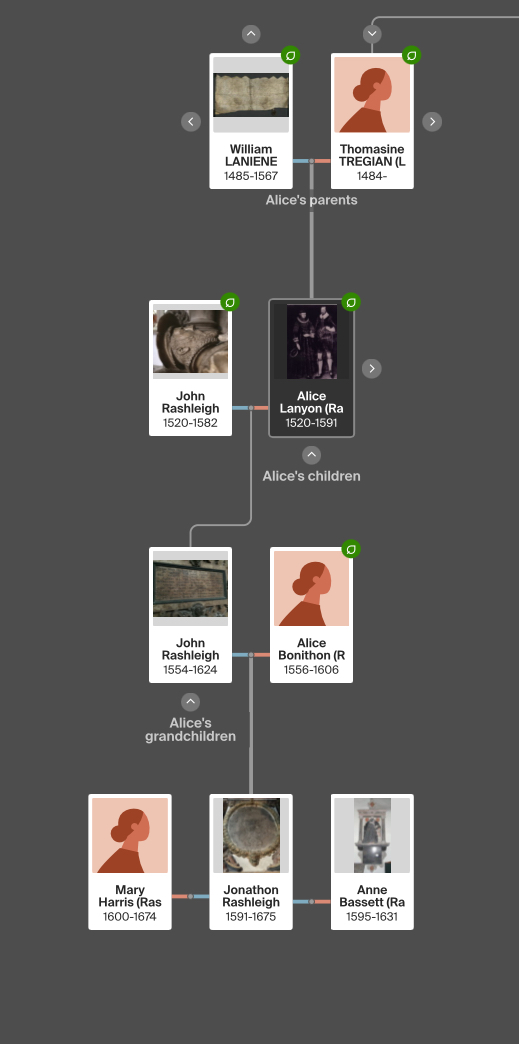
Sampson & Margareta Lanyon possible issue from John & Margaret
JOHANE NOYE of Sancreed, widow

written: 26 Jun 1605
proved: 4 Sep 1606

parish of Sancreed  1 ewe sheep
parish of Maddern  12 d.
for forgotten tithes  1 ewe sheep
son: WILLIAM NOYE  best brass pan of 5 gallons, 2 tin platters, 2 milche
 	cows, 1 heifer, 2 silver spoons, 3 ewes, 3 wethers
daughter: MARGARET  my Irish rug, 2 silver spoons
WILLIAM NOYE's 3 children  12 d. apiece
MARTEN HARRY's 3 children  12 d. apiece
daughter: JOHANE  1 ewe, 1 wether, 2 silver spoons, a coser, a latte?, 
	& my best petticoat
ELIZABETH HOSKEN  1 ewe sheep
WILLYAM HOSKEN's children  1 ewe lamb
RICHARD HOSKEN's children  1 ewe lamb
poor children of Sancreed  3 pounds of wool
RICHARD HOSKEN  3 pounds of my best wool
WILLIAM HOSKEN  1 ewe lamb
JOHANE LANYON  1 heifer & her calf
SAMPSON LANYONE  all the rest & executor

Johane ( ) Noye

witnesses: RICHARD PARKEAGE, clerk, RICHARD ( ) HOSKEN, JOHN ( ) NANGILLIAN, RICHARD BREACHE

Inventory taken 31 August 1606 by JOHN LANYON, gent, SAMPSON NOYE, WILLIAM LANYON & RICHARD BREACHE

AP/N/26
++++++++++

Source: CRO AP/N/26

I did find the following record which shows a connection between the Lanyon & Noye families at Madron.

‘Bargain and sale houses and land at Newlyn Paul

12 Nov 1586

R Rashleigh family of Menabilly
Format Manuscript Extent 1 piece
Description
Parties: 1) Richard Lanyon of Gwinear, esquire, and son John Lanyon of Madron, gentleman to 2) John Noye of Madron, yeoman. Houses and land at Newlyn.’

Source: CRO R/1154

John Lanyon is mentioned in various records. In Mousehole in 1598 A John Lanyne paid 21d on two tenements and a garden in the manor of Alverton.

1605 John signed the inventory of the goods in Raphe Lanyon’s will.

1616 John signed the inventory of the goods in George Lanyon’s will.

John left a will dated 1634 which mentions several Mousehole and Penzance people, tenants and friends.

(John’s surname is spelt various ways – Lannyen, Lamyne, Lanyne, Lanion and Lanyon!)

John died 15 Apr 1634 at Madron. He is described as a ‘gent’.

Madron Parish Register Burials 1634

Will of John Lanion Executed 11 Mar 1634 Proved by Francis Lanion his son.

Bequests of small sums of money are made to the following:-

Alexander Lanion and Davy Lanion my sons. Frances and Thomas sons of Davy Lanion, Gone (Joan) daughter of Davy Lanion. Maud and Ane daughters of Alexander Lanion, Walter and John sons of Alexander Lanion. Margaret and Sara Noy daughters of Sampson Noy, William, Walter, George and Richard Noy sons of Sampson Noy, Elizabeth Jearman (nee Noy) wife of Thomas Jearman. Ane wife of Sampson Noy. Bennet and Sampson Lanion ons of Frances Lanion. Seusane daughter of Frances Lanion. Elezabeath wife of Frances Lanion, Phillip (Philippa) wife of Eleazander (Alexander) Lanion and Jone wife of Davy Lanion.

The Church and poore of Madron. John Treat, John Holla, John Charles and Richard Lanion my god children. Margaret Robins and Jone Robins. John Manly and his sister An Terald. All the rest to Frances Lanion his sonne of Madron who he made executor.

Witnesses: John Osborn (mark), Robert Treuren, Davy Lanione (mark).

Inventory taken by Richard Trewren and John Osborne, yeomen 2 Jun 1634.

Total £39 6s 8d

Source: Exeter Probate Registry – Transcription by Jane Veale Mitchell.

Ane wife of Sampson Noy is John’s daughter Ane Lanyon.
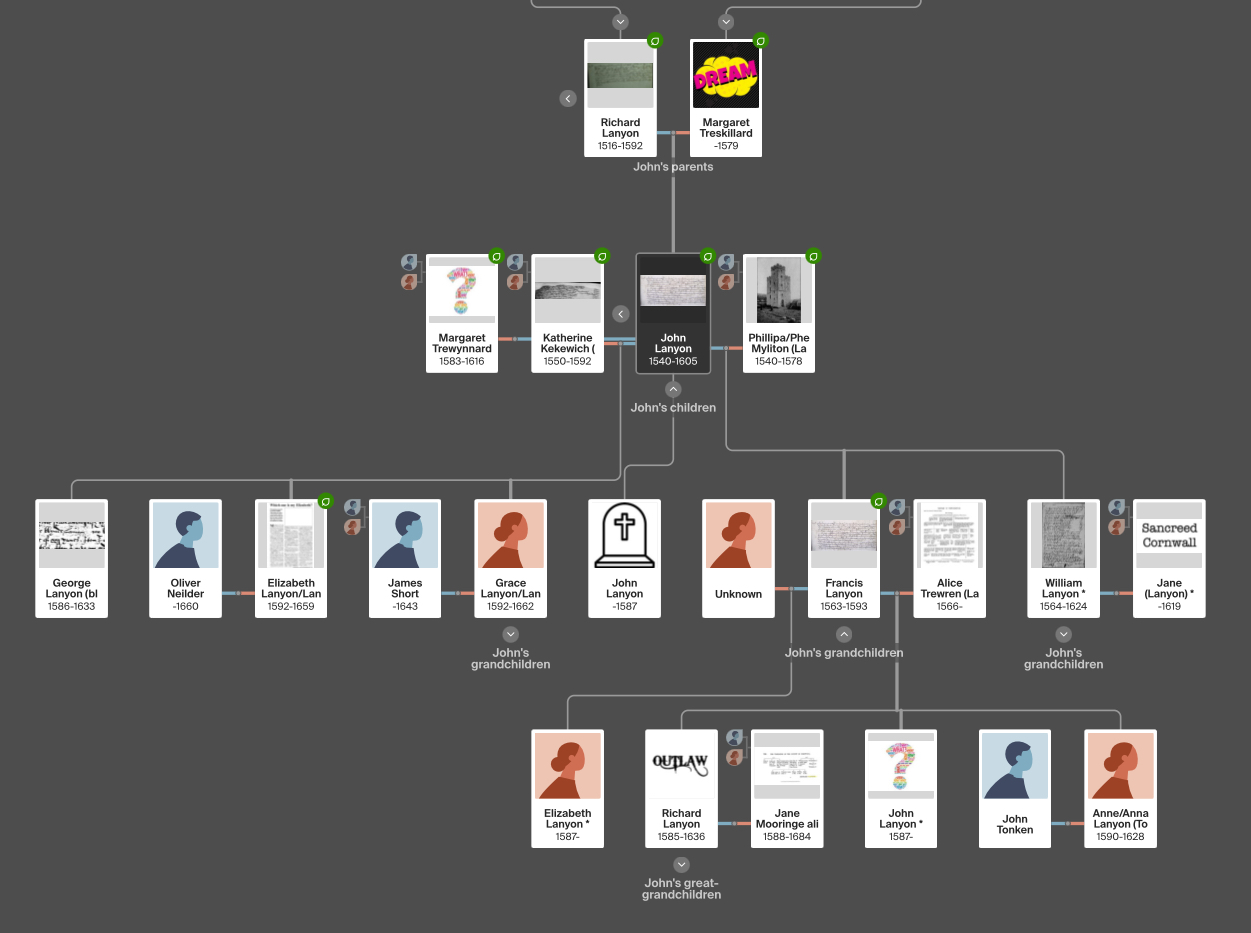
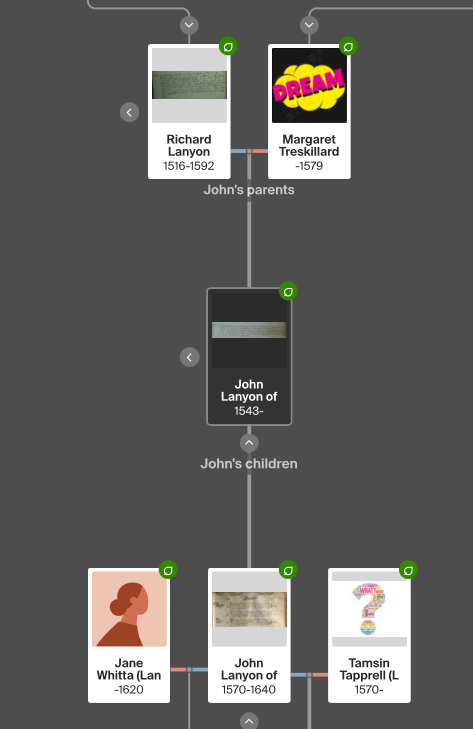
The Two Johns

Richard Lanyon Esq and Margaret Treskillard had two sons both called John!

John 1’s family tree
John Lanyon of Breage (John 2’s) tree

Both sons are listed in J.L.Vivians 1887 edition of:

‘The Visitation of Cornwall: Comprising the Herald’s Visitations of 1530, 1573 and 1620’ by The College of Arms.

Initially this looks like it must be a mistake but Jane Veale Mitchell (an early 20th century Lanyon family history researcher) writes to Dr Bullmore on 10th Sep 1926.

‘I took up these two Johns with the Herald, Coll/Arms and he distinctly states that there were two Johns, sons of Richard and M. Treskillard. John the elder married Mylliton/1563.’

Perhaps when the second son was born the first was ill and not expected to live so the parents hurriedly named their new son John in order to perpetuate the family name and then the first son survived! (the elder John had a son William who also had two daughters both called Elizabeth who were both living at the same time!)

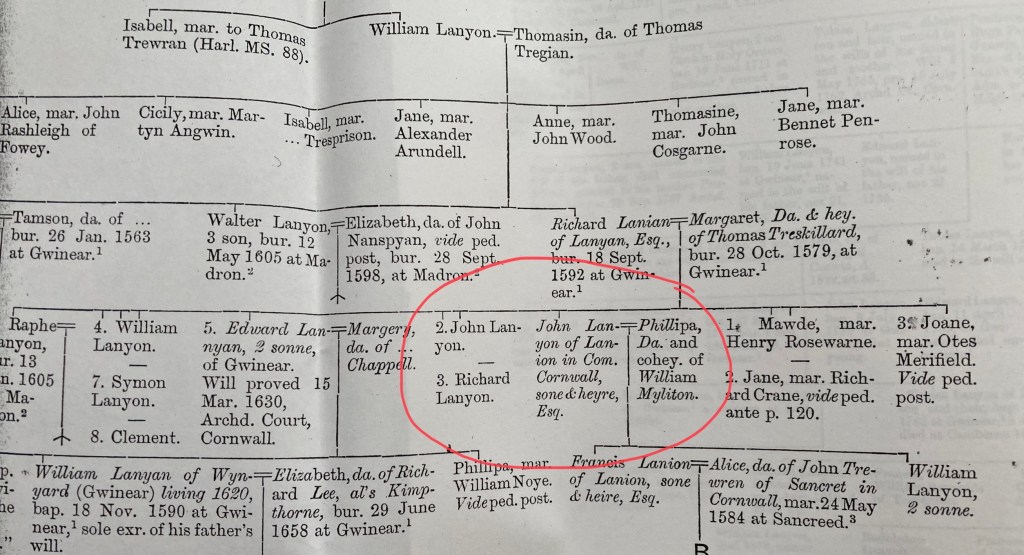
John was probably born late 1530s early 1540s. He married Phelype Myliton on 18th Jan 1562 at Breage, Cornwall. Their marriage is one of the first recorded in the Breage Parish Register.

John the elder (later he was John Lanyon Esq)

Breage Parish Register

Phelype (Philippa) was one of six daughters of Sir William Myliton and Honor Godolphin of Pengersick Castle at Breage. In 1561 the two families agreed a marriage settlement:

William Myliton of Pengersick, William Lanyon of Gwinear and Richard Lanyon of Morvah his son and heir. Upon marriage of John, son of Richard Lanyon and Phelype daughter of William Myliton. Covenant to settle various manors with lands in Gwinear, Madron, Morvah, Buryan, Sennen, St Levan, Kenwyn, St Just, Paul, St Merryn, St Ervan, St Issey and Padstow to the use of Richard Lanyon for life then to John Lanyon and his issue. Source: Royal Institution of Cornwall – Rashleigh MSS.

Pengersick Castle – Alice Penger, CC BY-SA 4.0 https://creativecommons.org/licenses/by-sa/4.0, via Wikimedia Commons

Phelype Myliton had a number of sisters who were her co-heirs after the death of her only brother, William in 1571.

  • Avice Myliton married Richard Erisye and Sir Nicholas Parker
  • Grace Myliton married Nicholas Trefusis and Nicholas Tregodeck
  • Elizabeth Myliton married Thomas Trenwith, Robert Arundell and Thomas Hearle.
  • Eleanor Myliton married John Bonython (21st Jun 1562)
  • Anne Myliton married William Abbott (23rd Nov 1563)
  • Mary Myliton married William Penhellick
  • Margaret Myliton buried 9th Apr 1570

Source – Letter Rose B Tolman to WSL 15 Aug 1971.

John and Phelype’s first son and heir was Francis Lanyon he was followed by William. There may have been other children from this marriage but no records have been found.

In 1569 John Lanyon junior gent took action against John Olliver, Thomas Jarinan, Henry Arthur & William Carno over property in Treveglos in the parish of St Merryn.

Source: Kings Bench Plea Rolls – KB27/1229

In 1571 Honour Myliton (John’s mother-in-law) and John Lanyon lease to Gabriel Robyns land in Treworran Wollas in Breage.

Source: Royal Institution of Cornwall – HD/11/52

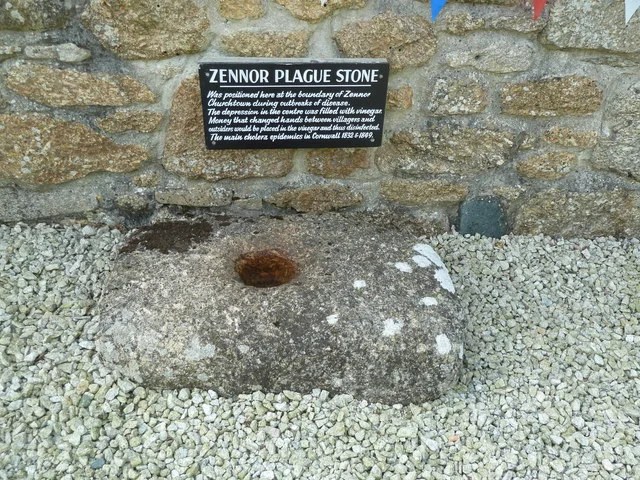
On 29th Dec 1578 Phelype Lanyon died at Madron. Plague had affected the area for several months that year and Madron’s parish register shows a big increase in the number of burials of many local residents. Perhaps Phelype also succumbed?

Zennor plague stone

Sometime after December 1578 and before July 1581 John Lanyon married for a second time to Katherine/Catherine Kekewich, daughter of George Kekewich Esq, MP and Catherine Courtenay. There is no record of the marriage but we know that Katherine married John Lanyon from other records.

George Kekewich’s will written in July 1581 states “To my daughter Cate Lanyon the £6.13.4 given her by her grandmother Buller & £3.6.8 more”.

Katherine is also mentioned in a property transfer.

In 1589 Richard Lanyon Esq, John Lanyon and Katherine his wife transferred to William Lanyon of Gwinear (John’s younger brother) the Manor of Tregamynion. William paid £100 for the estate.

Source: Royal Institution of Cornwall 19 Jan 1589 HJ/3/12. Cornwall Feet of Fines 31 Elizabeth.

Katherine and John had a son called George. There is no trace of George’s baptism or burial but we know he existed from Kekewich family wills.

“I give the blynde Lanian, my kinsman xxs a year towards his mayntenance untill my heire accomplish the age of xxi years.”

Source: The will of George Kekewich, Katherine’s brother, was written 22 June 1607 and proved 20 May 1612. The National Archives; Kew, Surrey, England; Records of the Prerogative Court of Canterbury, Series PROB 11; Class: PROB 11; Piece: 119

‘blynde Lanian’

“I give George Lanion twenty shillings a year during my lease of Manoby with the proviso that he wander not the country as a beggar contrary to God’s and Man’s laws. Hoping the rest of his friends will make up the rest that must be paid for his board.”

Source: The will of Francis Kekewich, Katherine’s brother, who died in 1633. The National Archives; Kew, Surrey, England; Records of the Prerogative Court of Canterbury, Series PROB 11; Class: PROB 11; Piece: 164

There is no mention of George in any Lanyon will yet he appears to have been alive from the 1580s to the 1630s.  How did he survive after his mother’s death?

George’s mother Katherine died 29th Oct 1592 at Breage. The relevant page in Breage’s parish register has been damaged and it is not possible to read the whole entry to confirm her name!

“uxor Johis Lanyon armiger” – wife of John Lanyon Esquire

Breage Parish Register Burials 1592

Sometime between 1592 and 1599 John Lanyon Esq married for a third time. We know this from the sale of the Manor of Treskillard and land at Illogan in 1599 which mentions his wife Margaret. There is no record of this marriage but early parish registers have damaged and missing pages.

John must have inherited this property from his mother Margaret Treskillard.

‘Final concord, Manor of Treskillard (Trescullard), Illogan and Camborne

Parties: 1) Alexander Thomas alias Pendervas, querent

2) John Lanyon, esquire and Margaret his wife and John Trewren, gentlemen, deforciants

Consideration: £60 sterling – Manor of Trescullard  with appurtenances and six messuages, six gardens, sixty acres of land, sixty acres of pasture, one hundred and twenty acres of furze and heath and forty acres of moor, with appurtenances in Trescullard Veor, Truscullard Vean, Trewone, Polcarrowe, Newton, Carmothe, Logan  and Camborne.

Dated at Westminster in the octave of St Michael in the forty first year of Queen Elizabeth after the Conquest.’

Source: Cornish Record Office PD/2/7

The death of John Lanyon Esq is not recorded, nor is there a will however we do have an administration for John Lanyon Esq dated 18 Mar 1605, St Merryn.

John Lanyon Esq of Merrine died June 1604/5, adm of his goods granted to his widow Margaret on 18 March 1605 (Julian calendar). This was “prayed” by Richard Vivian gent, Otes Merifeild, gent, William Marfield gent and Thomas Speare.

Household goods and items connected with a small farm, inc a harrow, a cornpike, two pigs, etc. Total £40 12/- 3d  

Otes Merifeild (sic) was his brother in law. It seems a very small estate for a man who was once so wealthy. Could it have been the estate of a different John Lanyon? Could it have been his younger brother John? There was only one John Lanyon Esq, he did own lands at St Merryn and it seems unlikely that three gentlemen would have been involved with the estate of someone who was impersonating John Lanyon Esq. John Lanyon the younger would not have been entitled to call himself esquire.

If this is John Lanyon Esq son of Richard Lanyon and Margaret Treskillard what happened to his fortune? Perhaps he has already passed much of it onto his children and grandchildren? Perhaps he had lost it through legal disputes, so popular with the landed gentry at this time. I found one such dispute between a John Lanyon, his wife Margaret Trewynnard and others.

A John Lanyon and his wife Margaret Trewynnard were involved in a legal dispute with John Nance alias Trengove in 1600. In the late 16th century Martin Trewynnard mortgaged his manor for £500 to John Nance alias Trengove. He subsequently died and the mortgage was unpaid. John Nance took advantage of Trewynnards heir and pressured him into signing an unfair agreement. When Trewynnard’s heir died his four sisters became the legal heirs. The court ordered the four girls to repay John Nance £450. John Lanyon and his wife Margaret agreed to pay their quarter share by 1603 but they were unable to do so. Margaret’s brother-in-law Christopher Maynwareing agreed to take over their share on condition they paid him by 1604 which they failed to do. John died and by 1608 Margaret was ordered to pay the rest and damages of £10.

Legal Dispute – Source: Anglo American Legal Tradition – AALT C78/449

Is this the same John Lanyon Esq married to Margaret who died at St Merryn in 1605? It’s impossible to say for sure but John Lanyon Esq’s grandson Richard’s ante-nuptial settlement states:

“Richard Lanyon of Nancothan in Madron esquire, to Philippa Risdon of Buckland Brewer esquire (sic) and John Allyn of Little Torrington, gent. Conveyance in consideration of his late marriage with Jane his wife – of all the manor of Treveglos in St Merryn, the barton and demesnes of Nancothan in Madron, the manor of Lanyon etc. the life interest of Margaret Lanyon widow in Treveglos reserved. “

Which implies that it must have been his grandfather who lived at Treveglos in St Merryn.

Alice Lanyon – The First Portrait

Philip Rashleigh settled in Fowey, in the 16th century, as a trader. His son’s marriage to Alice Lanyon resulted in the acquisition of Cornish properties and soon they became prolific merchants and ship owners.

In time they would own property at nearby Menabilly as well as a new townhouse in Fowey (now the Ship Inn.)

According to research they benefited from the dissolution of the monasteries by scrupulously buying land and re-selling at a profit. By marrying into wealthy Cornish families the Rashleighs became huge landowners with significant influence across the county. Many became MPs and it was Menabilly, on the Gribben Peninsula, that provided the family home.

Alice Lanyon’s family tree

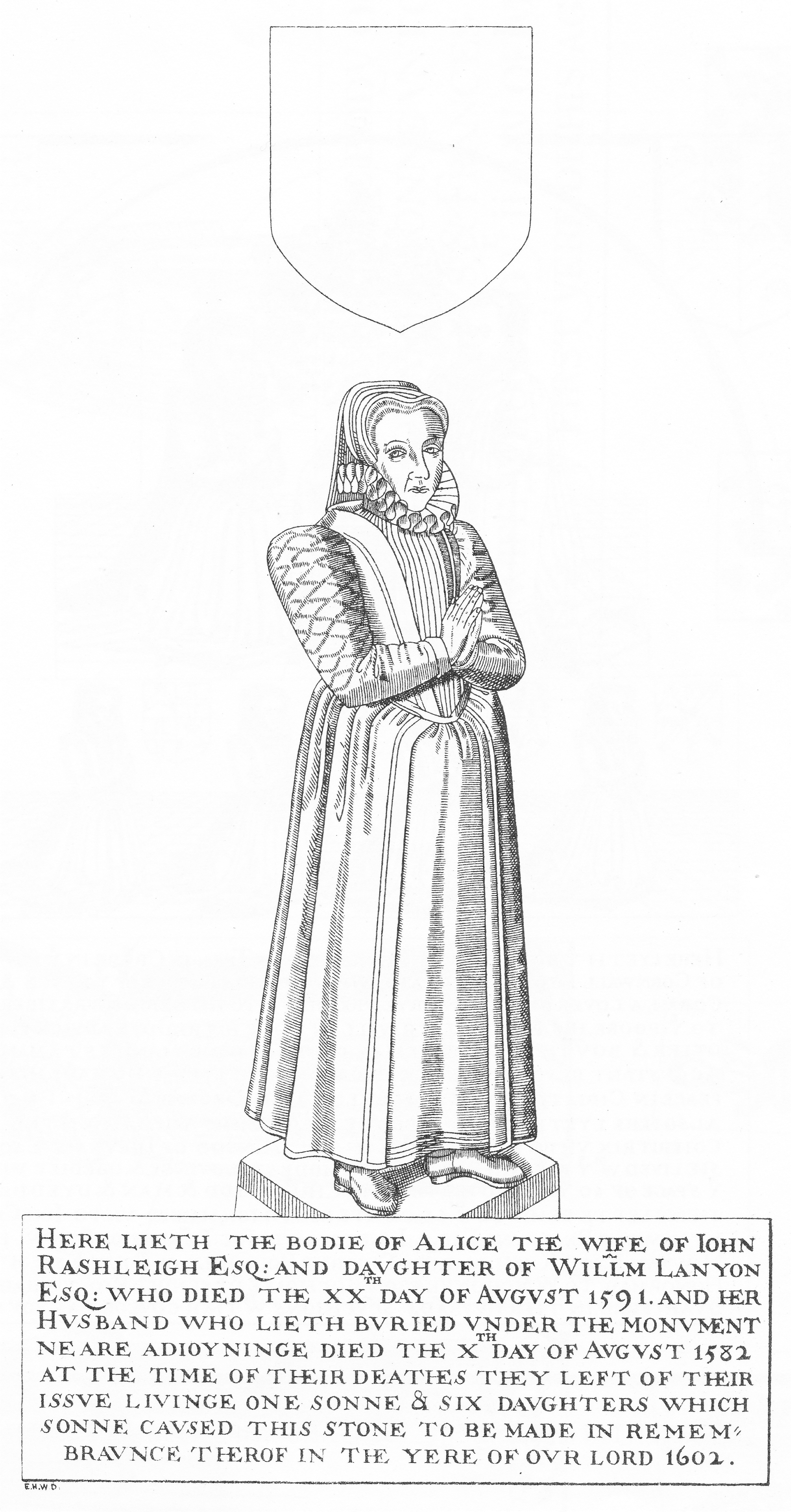
Alice was born abt. 1520 and died 20th Aug 1591 at Fowey, Cornwall. She married John Rashleigh abt. 1540. They had twelve children, eleven girls and one boy. Only six of their daughters survived. Her son John, placed a brass commemoration plaque in Fowey church and it’s still there over 400 years later!

Alice Lanyon brass plaque in Fowey Church Drawn by Dunkin, Edwin Hadlow Wise

The brass plaque is not the only portrait of Alice.

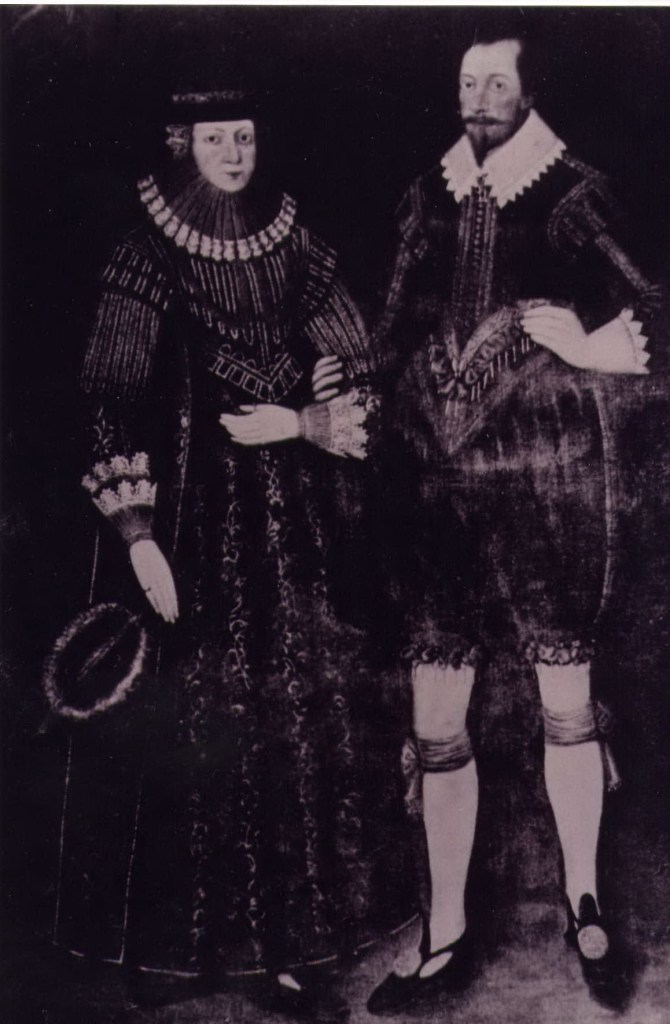
Nicholas Hilliard also painted their portrait.

Alice and John Rashleigh by Hilliard painted 1581

This portrait is the first Lanyon portrait!

Alice and John’s descendants lived at Menabilly, Fowey. The house was later leased to Daphne Du Maurier and became the inspiration for Manderley in the book ‘Rebecca’.

Menabilly

Alice and John’s town house in Fowey is still there today, it’s now called The Ship Inn.

The Ship Inn, Fowey by Len Williams, CC BY-SA 2.0 https://creativecommons.org/licenses/by-sa/2.0, via Wikimedia Commons

The First Esquire – William Laniene

Richard Lanyne (the son of John Lanyen and Isabell Ruthfrey) married Isabel Trelissick. Richard’s son and heir was William Laniene born abt. 1480 but it’s not clear if Isabel Trelissick was his mother or if she was Richard’s second wife. William’s sister, Isabel was born in 1496. There is no trace of any other siblings but Benoit’s 1531 MSS states that Thomas Treuran married Isabell the 1st daughter of Richard Lanyne of Trylyswyke so that implies there must have been at least one other daughter.

William Laniene’s ancestors

William was the first recorded esquire

Lanyon Coat of Arms

Heraldic visitations were tours of inspection undertaken by Kings of Arms. Their purpose was to register and regulate the coats of arms of nobility, gentry and boroughs and to record pedigrees. They took place from 1530 to 1688, and their records provide important source material for historians and genealogists. Much of the Lanyon family information from the 16th & 17th century comes from these visitations. They visited Cornwall in 1531, 1573 and 1620. Families submitted trees to establish their right to bear arms. (The trees weren’t always correct!)

The definition of an Esquire is “the eldest son of a knight and their eldest sons in perpetuity”. Second sons were styled “Gentlemen” and the sons of gentlemen were given the title Mr. (daughters were addressed as Mrs. even when single). A Yeoman was a landowner but not considered genteel enough to be styled Mr or gentleman.

Below yeoman was a husbandman and below that serf/villein/cottar, then came domestic servant and finally in the pecking order vagabond and slave.

Whilst these terms started to fall out of use by the late 17th and 18th centuries in the 16th and early 17th centuries they were still generally adhered to and that’s a huge help to genealogists.

In 1531 William Laniene gave his family tree to the heralds and his right to ‘bear arms’ was documented. The first Lanyon to bear arms may have been born much earlier than William but this is the first documented esquire.

Grant of Arms to Bacon family – British Library, CC0, via Wikimedia Commons

William lived at Gwinear. Perhaps a medieval long house was not sufficiently grand, perhaps it just wasn’t big enough for his large family or perhaps it’s just a bit too cold and windy in West Penwith compared to Gwinear!

William married Thomasine Tregian the daughter of Thomas Tregian of Tregian and Truro and Margaret (daughter of William Kingdon and widow of John Borlase) abt. 1505. William’s large family (at least nine daughters and four sons) married into the important families in the county.

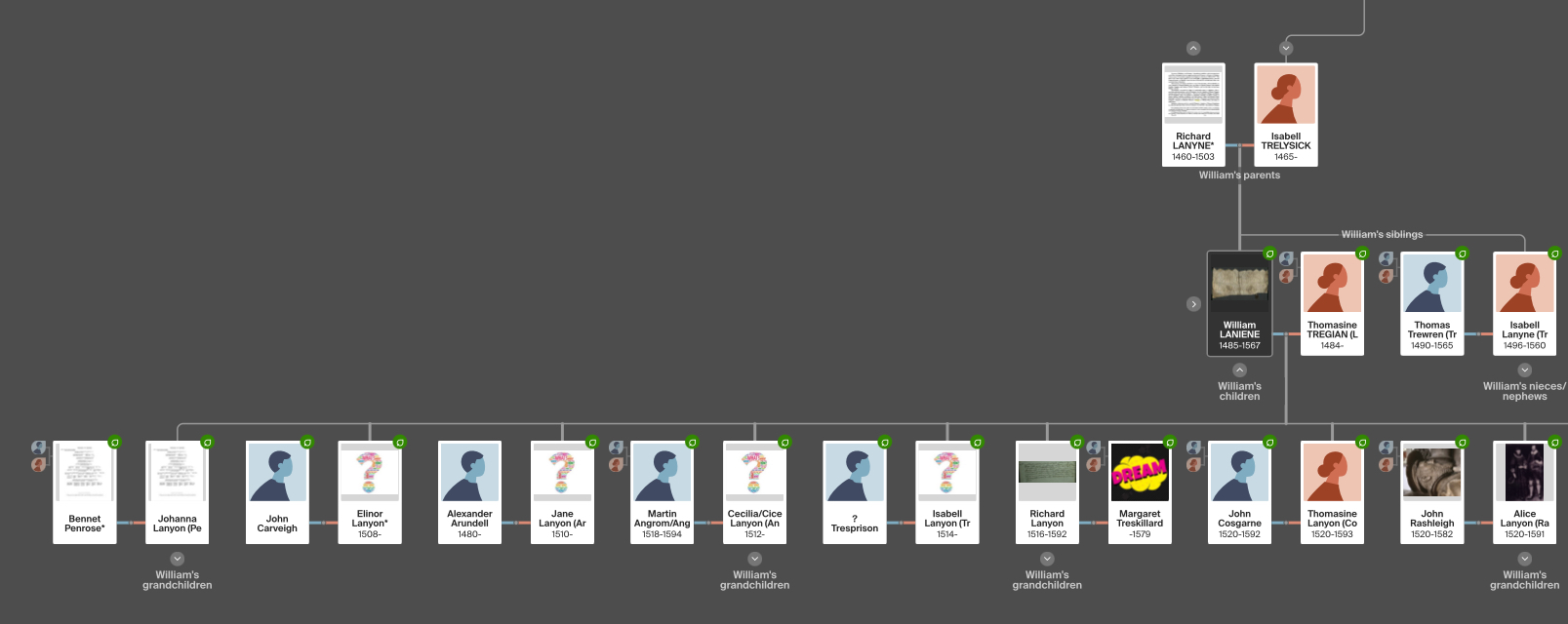
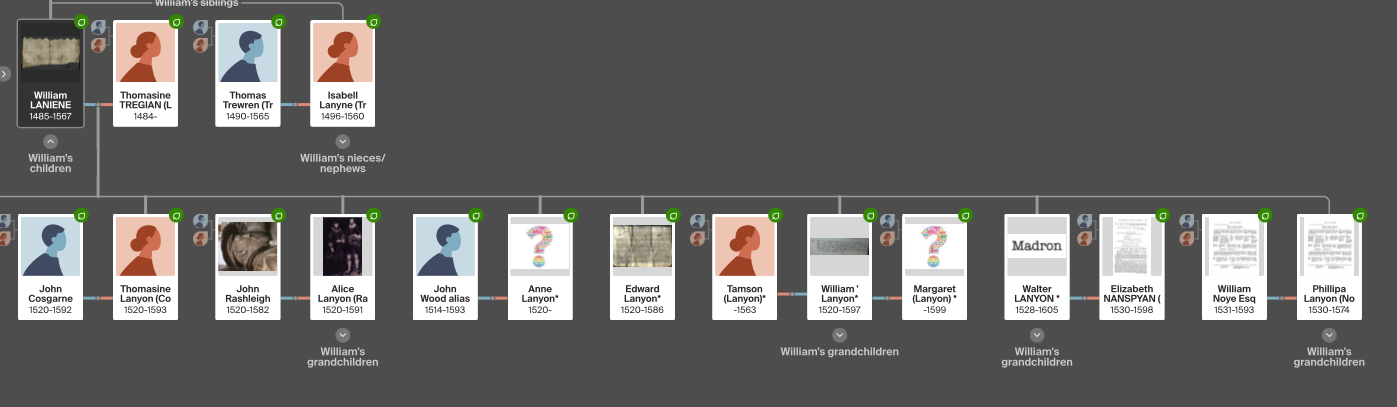
William large family requires two images!

We don’t know the dates of birth for all his children or the order they were born in-

  • Alice born abt. 1520 died 20th Aug 1591 married John Rashleigh abt. 1540.
  • Elinor married John Carveigh.
  • Cecilia/Cicely born abt. 1520 married Martin Angwyn abt. 1540.
  • Isabell married ? Tresprison.
  • Anne married John Wood alias Atwood.
  • Thomasine died 12th April 1593 married John Cosgarne.
  • Jane married Alexander Arundel. Their descendants were the Arundel’s of Leigh.
  • Philippa married Edward Noy Esq abt. 1556
  • Johanna/Joan married Bennet Penrose 1553 (she was the first of his 3 wives so presumably died young.)
  • Richard, his eldest son and heir born abt. 1516 and died 18th Dec 1592 married Margaret Treskillard.
  • Edward died aft. 1586.
  • William ‘Generosi’ died 7th Aug 1597. Married Tamsin and Margaret.
  • Walter died 12th May 1605 married Elizabeth Nanspyan.

William Laniene died 20th Mar 1567. (Source- Inquisition Post Mortem 1586 of William Lanyon Coswinwollard, Gwinear. Source CRO/R/1168)

William owned substantial lands. Gilbert says “this William succeeded his father in considerable estates in Maddern, Morva and other adjoining parishes….”. The Penwith Subsidy Roll of 1509-1523 lists the following: value of land by the year – Willm Lanyine Gwinear 41s, St Erth 41s, Gulval 11s 8d, Madron 111s 8d.

In common with much of the landed gentry in Cornwall at that time William was frequently manipulating and speculating in land often with his relatives.

In a legal dispute from 1504-1515 William Laniene claims a right to part of the estate of the late Michael Ruthfos. Michael left his large estate to a Thomas Ruthfos and his heirs, with remainder to a John Ruthfos and his heirs, and a further remainder to a Richard Ruthfos and his heirs. William Lanyon appears to claim that as Thomas and John Ruthfos died without heirs he, as a son of Richard Lanyon, has a right to the property. If Richard ‘s mother Isabel Ruthfrey was the daughter or heiress of Richard Ruthfos this could explain how he got the name Richard. Variations of the name Ruthfos appear so Ruthfrey is possible.

Legal dispute -Source : Anglo American legal Tradition – aalt.law.uh.edu/AALT7/ChP/C1no341/IMG_0085.htm

Court of Star Chamber 1509-1547

PLAINTIFF: Alan Powe DEFENDANT: William Lanyen, Tamysen (Thomasine) his wife and Thomas Trewren. Messuage and land in Cosswyn Wulward.

PLAINTIFF: William Lanyon DEFENDANT: Thomas William, Jenett his wife, and John and Robert their sons. Source: National Archives STAC 2/30/48

PLAINTIFF: Thomas William DEFENDANT: William Lanyeyn and Thomasyn his wife, Richard Lanyeyn, William Lanyeyn, junior, John Breton, and John Trespryson. Source: National Archives STAC 2/30/48

PLACE OR SUBJECT: Forcible entries in Gwinear COUNTY: Cornwall, William Lanyeyn and Thomas William. Source: National Archives STAC 2/30/48

 Court of Chancery: Six Clerks Office:

John Nanscuvell and William, son and heir of Richard Lanyen. v. John Tremayle and Thomas Deane, feoffees to uses. Messuages, land, rents, and services in Treveben, Tregollas, Trehenben, Trewynnyan by Trewothek, Trearnan, Treneryn, Tregonvoen, Trevethen, Date: 1504 – 1515 Source: A C1/341/56

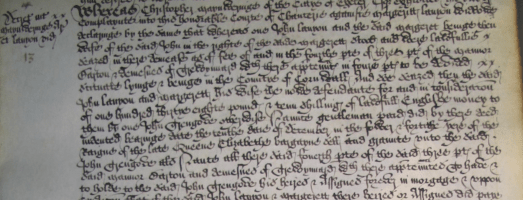
In 1533-38 Thomas Tresculard’s widow Isabel took action against William Lanneyen and others over the detention of deeds relating to messuages and lands in Tresculard and elsewhere.  Source: C1/911

The History of the Family Borlase cites a legal dispute over woods at Bridockke involving Thomasina’s nieces where evidence was given that Thomasina’s brother John referred to William Lanyne as his brother in law. Source: The Genealogist Magazine Vol III 1886.

Mentioned in a deed, 1 Mar 1554, Cornwall, England. Grant of land, Penrose, Sennen and land in Sancreed. Parties: 1) Joyce Penrose of Penrose, gentleman, to 2) Radulph Penrose, John Treuryn and William Lanyon. Penrose [Sennen], Respletha, etc, and Brane, Bosence and Zelena in Sancreed.
William was also a ‘tinner’. In Oct 1556, Cornwall, England, William and his partner David Angove were given a licence, for two years, to search and dig for tin anywhere on the lands of the Earl of Oxford throughout Cornwall. Source: CRO AR/1/852

William is also listed on the ‘Tinner’s Muster Roll’ of 1539 for St Clement, Cornwall. Stannary of Tywarnhaile, Moreske Manor. Whole Harness (the harness and trappings for a horse which might include armour).

In 1539 William could have been almost 60 years of age (Henry VIII would have been 48) and there were threats from Scotland, the low countries, France and Spain so it was possible that he may have had to fight.

Lanyen v Lanyen 1502

Thank goodness the Lanyons were so litigious as it has left us with a paper trail to follow.

Later Medieval Lanyons

John Lanyeyne (the son of John Hicka alias Lanyein) died in 1476 and his heir was also called John Lanyen. The Account Roll of Connerton for 1476/77 records the death of John Lanyeyne who held 2 acres Cornish at Coswynwulward.

Source: (CRO AR/2/195)

Goswyn Lanyon, formerly “Coswynwolward”, in Gwinear: John Lanyeyn, the heir of John Hicka, in Goswyn, 2 acres Cornish, in socage; yearly rent, with common suit of court, 6s. at the 3 dates stated, and 20d. at Michaelmas = 7s. also for offering and aid at Michaelmas, 3d.”

Source: Devon and Cornwall Record Society, Vol 41, 1955, p45.

John Lanyen married Isabell Ruthfrey, daughter of Thomas. The name is variously spelt Ruthfrey, Rathrey and Ruthvey. Their son and heir Richard Lanyne was born abt. 1460.

In 1488, John Lanyen is listed among the free tenants who paid a fine for release of suit of court at Connerton, Gwithian. (CRO AR/2/92.)

There is no record of Isabell’s death but John remarried and his second wife Katryn was in dispute with her step son Richard, in 1502, following John’s death.

Lanyen v Lanyen. 

Plaintiffs: Richard, son and heir of John Lanyen. 

Defendants: Katherine Lanyen, his stepmother, executrix of John Lanyen. 

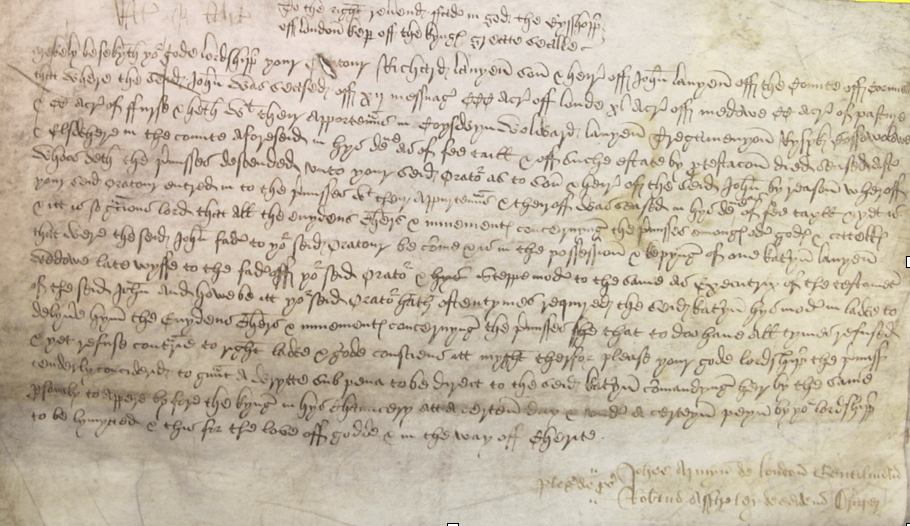
Subject: Detention of deeds relating to messuages and land in Coyswyn, Wolward, Lanyen, Tregamenyon, Rysyk, Bossowolowe, and elsewhere. Cornwall

The dispute shows that John Lanyeyn was in possession of 12 messuages (a dwelling house with outbuildings and land assigned to its use) 300 acres of land, 40 acres of meadow, 200 acres of pasture and 200 acres of furze and heath. The land was situated in Coswyn Wolward, Lanyen, Tregamynyan, Rysyk, Bossowolowe and elsewhere is Cornwall.

Source: Early Chancery Proceedings C1 Bundle 266/4

Court of Chancery C 1460 – Public domain, via Wikimedia Commons

“Mekely besechyth your gode Lordshipp your oratour Richard Lanyen son and heir of John Lanyen of the Counte of Cornwall that where the seid John was seased of XII messuag CCC acre of londs XL acre of medowe CC acre of pasture CC acre of furze and heth with their appurtenances in Coswyn Wolward Lanyen Tregamenyan Rysyk Bossowolowe and elsewhere in the counte aforeseid in hys demesne as of fee tail and of such estate by ptestacon (protestation) died seased after whose deth the premisses descended unto your seid oratour as to son and heir of the seid John by reason whereof your seid oratour entred in to the premisses and their apputenances and thereof was seased in hys demesne as of fee tail and yet is and it is so gracious lord that all the evydens charters and munements concernyng the premisses that were the seid John fader to your seid oratour be come and in the possession and kepyng of one Katryn Lanyen Wedowe late wife to the fader of your seid oratour and steppe moder to the same and executryx of the testament of the seid John and howe be it your seid oratour hath oftentymes required the seid Katryn hys moder in lawe to delyver hym the evydens charters and munements concernyng the premisses and that to do has at all tymes refused and yet refuse contrarie to right lawe and gode constiens (conscience) as might thereof please your gode lordshipp the premiss tenderly considered to grant a derycte sub poena to be direct to the seid Katryn commandyng her by the same personaly to appear by fore the Kyng in hys chauncery at a certen day and under a certeyn payn by your lordshipp to be lymytted and this for the love of godde and in the way of charitie.”

Legal dispute – Court of Chancery Six Clerks Office C1/266/4

David Thomas V Thomas Tregian 1504-1515

From all the properties listed in Lanyen v Lanyen we can see that they were a wealthy family however before his death John Lanyen was in ”great necessities and need” and borrowed £260 from David Thomas.

Source: National Archives C 1/367/7

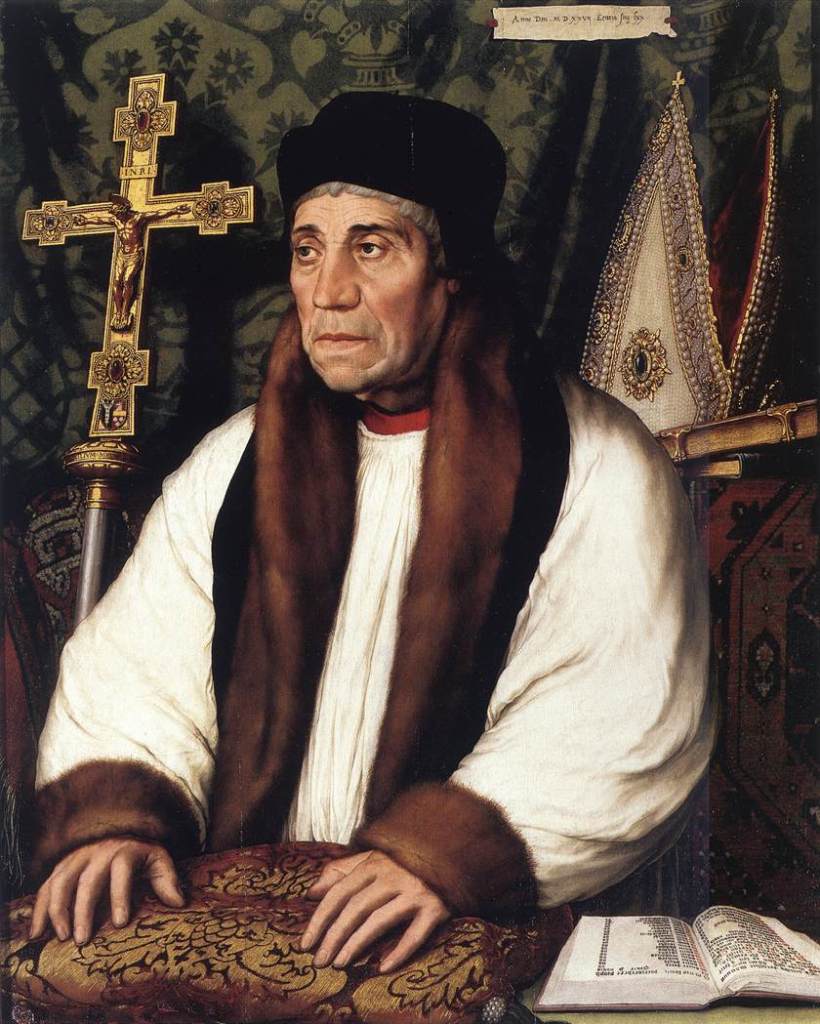
William Wareham Archbishop of Canterbury – Hans Holbein the Younger, Public domain, via Wikimedia Commons

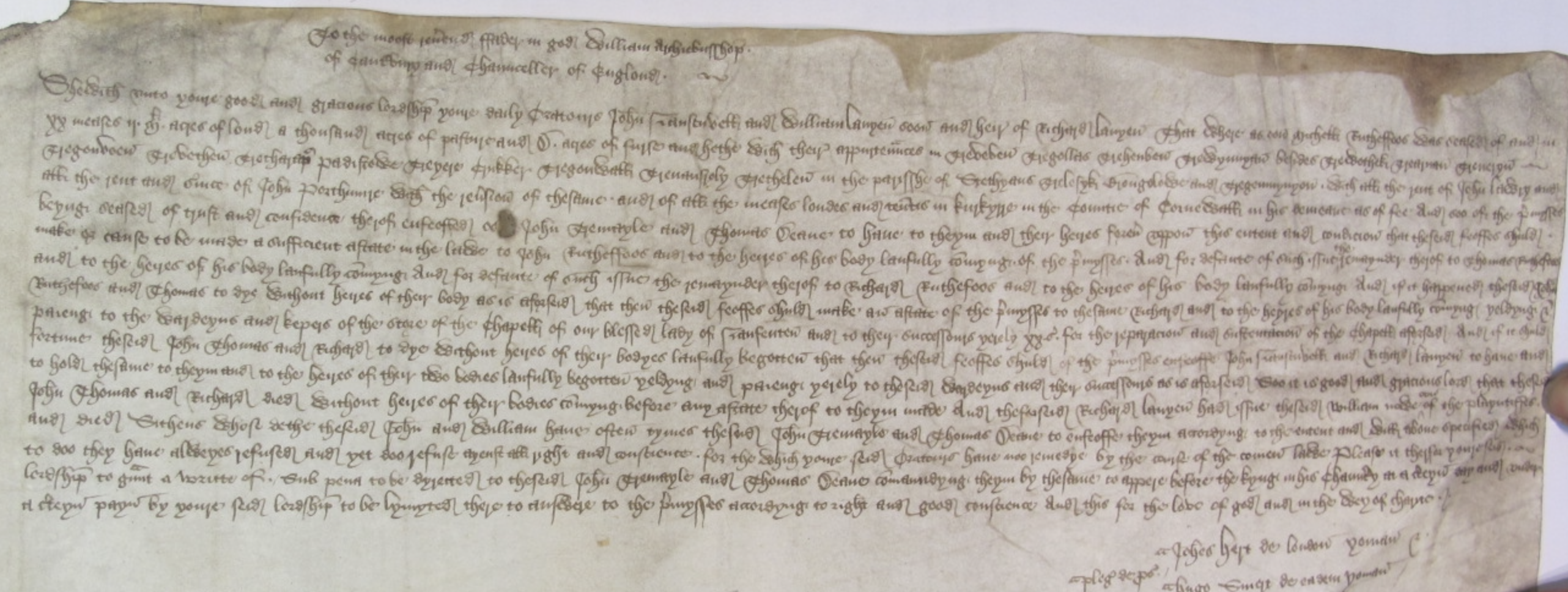
To William Archbishop of Canterbury and Chancellor of England.

John Lannyen being in “great necessitie and nede” borrowed £260 from David Thomas, and for guarantee of repayment “made estate” to D. Thomas of his messuages lands and tents in Lannyen, Resyk, Chy[woo]n and Trenyventon. The conditions of the loan were that D. Thomas should have possession and all the issues and profits of these properties until the loan was repaid. The terms for repayment were that there should be 6 payments of £20, followed by a payment of £40 and a final payment of £100. J. Lannyen guaranteed that his heirs or assignees would honour this agreement. At the time of J. Lannyen’s death only the six £20 payments had been made. Richard Lannyen, son and heir of J. Lannyen then disposessed D. Thomas and installed Thomas Tregian in the said properties. T. Tregian promised D. Thomas that if he was given all the deeds to the said properties and documents relating to the loan that he would take over the loan, of which £140 was still outstanding. D. Thomas handed over all such documentation but T. Tregian has subsequently ignored all requests to repay the outstanding debt.
So begins a period in the family’s history where they spent a great deal of time on litigation which is great for family historians!

Abduction!

This story appeared in the Online History of Parliament.

Plaintiff: John Fursdon. 

Defendants: Richard Trevaignon, of Carhayes, gent., John Trevaignon, of Trevaignon, gent., Thomas Trevaignon, of Tregony, bastard, and many others, nine of whom, mostly husbandmen, are named in the bill of complaint. 

Complaint: They smashed the doors and windows at Fursdon and, as well as taking money, property and documents and causing his wife Margaret to have a miscarriage, they abducted Joan his step-daughter who was the daughter and heir of John Lanyein, Margaret’s first husband.

Date: 1423

John Fursdon of Fursdon in Liskeard.

Son of James Fursdon of Fursdon by his wife Margaret. Married (1) Joan, before 1400; (2) before 1423, Margaret (widow of John Lanyein).

Source: The notice of Oyer and Terminer appeared in the Patent Rolls on 16th June 1424. It covered the complaint but failed to mention the abduction of Joan, daughter and heir of John Lanyein.

CPR H6 Vol 1, p229

The article on the History of Parliament casts doubts about the honesty of Fursdon.

abducted his stepdaughter, Joan heiress, he claimed, to lands worth 100 marks a year

Published in The History of Parliament: the House of Commons 1386-1421, ed. J.S. Roskell, L. Clark, C. Rawcliffe., 1993

In the course of his life, if he himself is to be believed, Fursdon suffered several assaults on his person and depredations of his property. On more than one occasion he brought suits in the King’s bench claiming that bands of armed men had forcibly evicted him from his land, and in the Parliament of 1423-4 he ‘suyst une bille’ against Richard Trevanion of Carhayes and his kinsmen who, he alleged, on 29 June 1423 had come to his house at Fursdon with 121 malefactors, broken down fences, gates, doors and windows, stolen goods worth £40, along with muniments and £9 in cash, assaulted him and his wife (nearly killing the latter and causing her to suffer a miscarriage), and abducted his stepdaughter, Joan (heiress, he claimed, to lands worth 100 marks a year). At other times, so Fursdon said, the Trevanions had lain in wait for him and had so threatened his life that he dared not go about his business except with a great ‘posse’, whereby he suffered much trouble and expense. This bill awaited the attention of the King’s Council with other ‘billes de Riottis’ for several months, and it was only after Fursdon appealed to the chancellor that in June 1424 a commission of oyer and terminer was set up to investigate the affair.

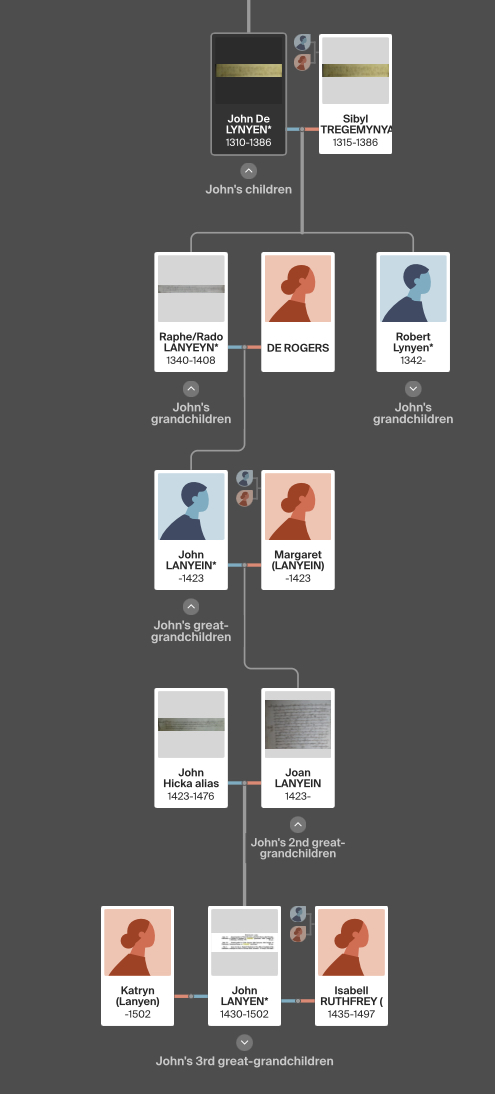
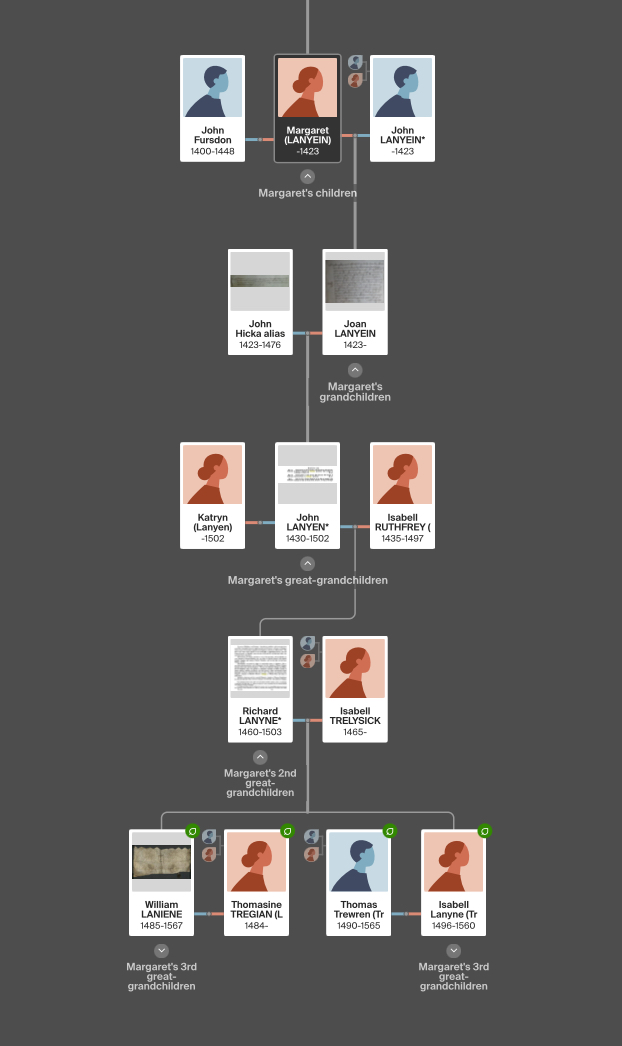
This story leaves us with a problem, where do John, Margaret and Joan Lanyein fit in the family tree?

Lanyon family Tree 14th & 15th Century

We know about Raphe (Radolphus) Lanyeyn involved in the dispute over Tregamynyan in 1388 after Princess Joan’s death. A John Lanyeyn received deeds in October 1446 probably after his father’s death. This John could be the John who died abt. 1476 and is mentioned in the Account Roll of Connerton and would have been the father of the John who married Isabel Ruthfrey. According to Fursdon’s account there must have been a John Lanyein who died before 1423 and left a widow and daughter, Margaret & Joan.

There is a record from Connerton Manor Gwithian Cornwall dated 14 July 1463.

“John Lanyeyn, namely John Hicka, 2 Cornish acres in Coswyn”.

Source: National Archives Kew: AR/2/1337/5

The John Lanyeyn who is deceased in the 1476 Connerton Roll had the same 2 acres at Coswynwulward.

“Goswyn Lanyon , formerly Coswynwulward, in Gwinear.”

‘Connor Downs’ the modern name for Connerton.

It appears as though there was a break in the male line, Joan Lanyein was the heir and married John Hicka who took the Lanyeyn name and became John Hicka alias Lanyeyn.