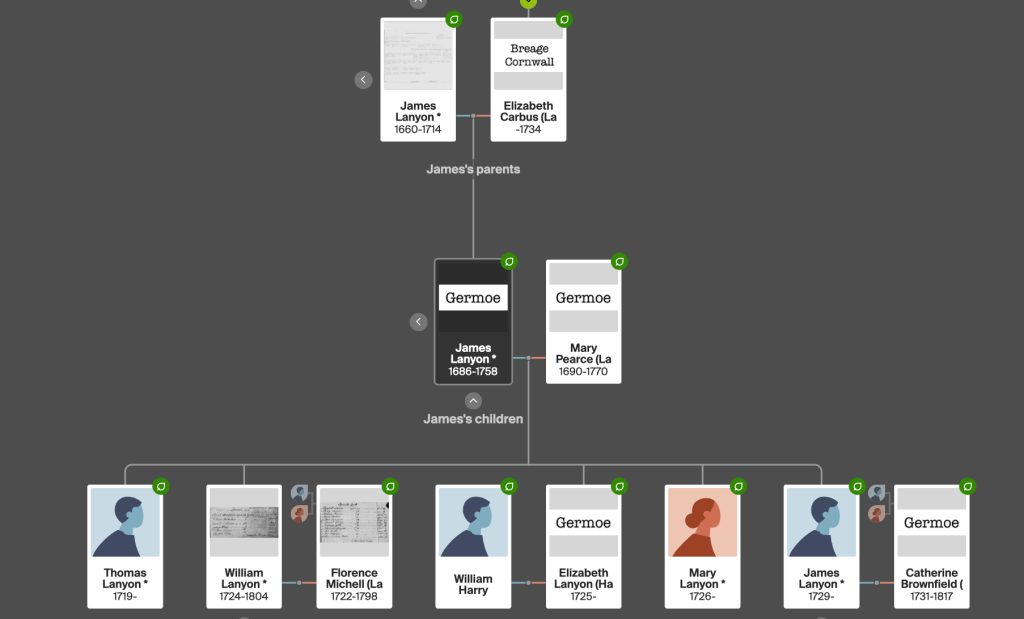
William and James were the sons of James Lanyon and Mary Pearce. James was baptised at Breage in 1686 and married Mary Pearce at Breage in 1712. They had two sons and two daughters, this post is about their sons.
William Lanyon 1724-1804
William was baptised some twelve years after his parents’ marriage, presumably there were other children who died in infancy or stillbirths and miscarriages to account for the large gap. He married Florence Michell at Germoe in 1749. They had eleven children:
William & Florence’s tree
Thomas 1750-1823
Florence 1752-1791
William 1753-1831 William’s first marriage was to Mary Gibbons at St Hilary in 1781 and they had a child, Mary baptised in 1803. She married James Pearce in 1823 and they had nine children. Mary was baptised in Feb 1803 and her father remarried in Jul 1803 so presumably her mother Mary Gibbons died in childbirth. William’s second wife was Honour King and they married at St Hilary (witnesses to the marriage Thomas Lanyon and Benjamin Rodda). Honour Lanyon died on 8 Mar 1807 at St Hilary age 44. On 11 Jul 1807 (he didn’t hang around!) William (widower) married Honour Edwards at Breage (Witnesses: Benjamin Rodda and William Edwards.) They had a daughter called Mary Anne baptised in 1809 and buried at St Hilary in 1813 age 4. So William had three wives, two called Honour and two daughters both called Mary! William was buried at St Hilary in 1831 and without any male heirs his line died out.
Mary 1755- she married James Rodda a widower at St Hilary in 1781. They had seven children including Benjamin who was a witness at his uncle William’s weddings.
James 1757-1758 died in infancy
James 1758-1851
Elizabeth 1760-1809 no trace of a marriage
Catherine 1762- she was baptised at Breage and married Richard Ellis, a carpenter at St Hilary in 1781 – five children
John 1763-1835
Margaret 1765-1855 she was baptised at Germoe in 1765. At Sithney in 1792 a Margaret Lanyon baptised an illegitimate child also called Margaret (not sure if it is this Margaret or not) in 1796 she married Nicholas Edwards, a tinner, at Breage – five children. Nicholas died in 1814 and in 1827 Margaret married John Symons, a widower, at Breage. She died at Godolphin Cross in 1855 aged 89, she was living with her son Nicholas.
Richard 1770-1848 married Jane Lanyon his cousin
With four sons having children of their own this branch of the family is thriving.
James Lanyon 1729-
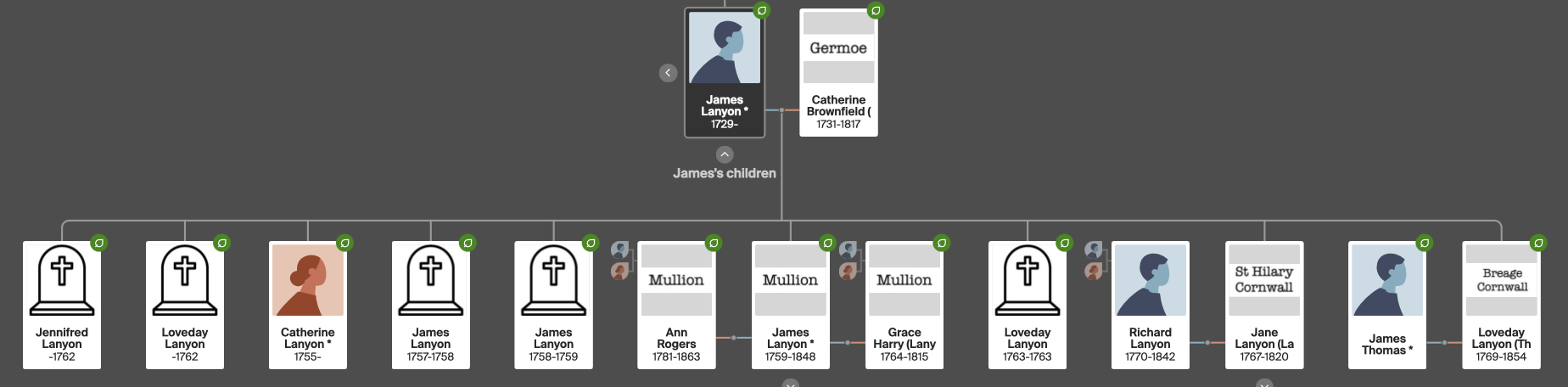
James was William’s younger brother. He was baptised at Germoe in 1729 and married Catherine Brownfield there in 1755. They had nine children:
James & Catherine’s tree
Catherine 1755- no further trace
James 1757-bef.Aug 1758 died in infancy
James Aug 1758-bef. Dec 1759 died in infancy
James 1759-1848
Loveday – Apr. 1762 died in infancy
Jennifred – May. 1762 died in infancy
Loveday 1763-1763 died in infancy
Jane 1767-1820 married Richard Lanyon her cousin, the son of William Lanyon and Florence Michell
Loveday 1769-1854 married James Thomas at Germoe in 1801 – six children
Out of nine children only three survived to adulthood.
James senior died after 1769 (when his last child was born) but there is no trace of his burial, Catherine his wife was buried at Germoe in 1816/7 aged 88.
Saint Germochus or Germoe was an early 6th century saint active in Cornwall and Brittany. he was the patron saint of Germoe, he is said to have been a king and friend of St Breage. In the churchyard there is St Germoe’s chair. I wonder how many Lanyons sat in it?
Barnard had two sons (we think!) Charles and James. There were no baptisms recorded for either and Barnard didn’t leave a traceable will which may have confirmed his children’s names. However there was only one Lanyon family at St Hilary at that time so it is likely that Charles and James were his sons.
Charles’ Sons
We don’t know when Charles was born, died or when he married. The baptism register of St Hilary states that his wife was called Margaret. We don’t even have conclusive proof that he was Barnard’s son but he did name his sons David, Francis and Thomas. David after Barnard’s father and Francis and Thomas after Barnard’s older brothers.
Charles Lanyon’s tree
St Hilary parish register records that Charles Lanyon son of Charles was buried in 1683 and that probably places Charles’ birth in the 1660s. In 1687 there is a Charles Lalion baptised at St Hilary, father’s name not mentioned so he may be Charles’ son or James’ son or not a Lanyon at all.
Charles Lanyon 1687-
Initially I thought this Charles might have married Eleanor Nines at Perranuthoe in 1715 and couldn’t trace any children. Then I had a breakthrough. This Charles is likely the Charles Lanyon who married Grace Berteau at Falmouth in 1709. They had one son:
Charles 1711-1762
Grace was buried in 1714. It’s possible that Charles married Eleanor Nines in 1715 and that the Eleanor Lanyon buried at Mylor in 1733 is his wife however I have a more likely candidate for his second wife – Ann Laurence. Charles Lanyon of Falmouth married Ann Laurence at Philleigh in 1718. Ann died a year later at Feock.
It appears that Charles married for a third time and whilst there is no trace of this marriage when Charles died intestate the administration papers mention his widow and relict Elizabeth. There are baptisms and burials listed in Falmouth for two daughters:
Elizabeth -1723
Elizabeth 1723-1724
There is a possible third daughter, Dorothy. In 1766 there was a Mrs Dorothy Lanyon (Mrs does not necessarily denote a woman is married, it is used to denote a gentlewoman) buried at Constantine. Could this be an unrecorded daughter of Charles?
It’s a bit confusing we have four wives and only one Charles Lanyon to go round!
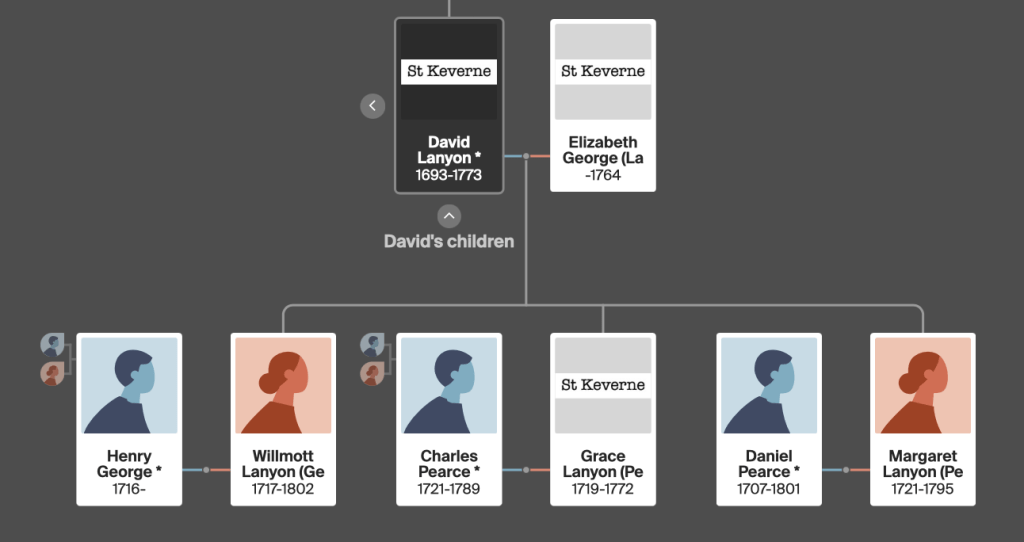
David was Charles’ younger brother, he was baptised at St Hilary in 1693 and he may be the David Lenine who married Elizabeth George at St Anthony in Meneage in 1716. The register describes them both as ‘of St Keverne’.
From this marriage there were three children traced:
Willmott 1717 married Henry George at St Keverne in 1738
Grace 1719 married Charles Pearce at St Keverne in 1745 – four children
Margaret 1721 married Daniel Pearce
David was buried at St Keverne in 1773.
Francis Lanyon 1695-1770
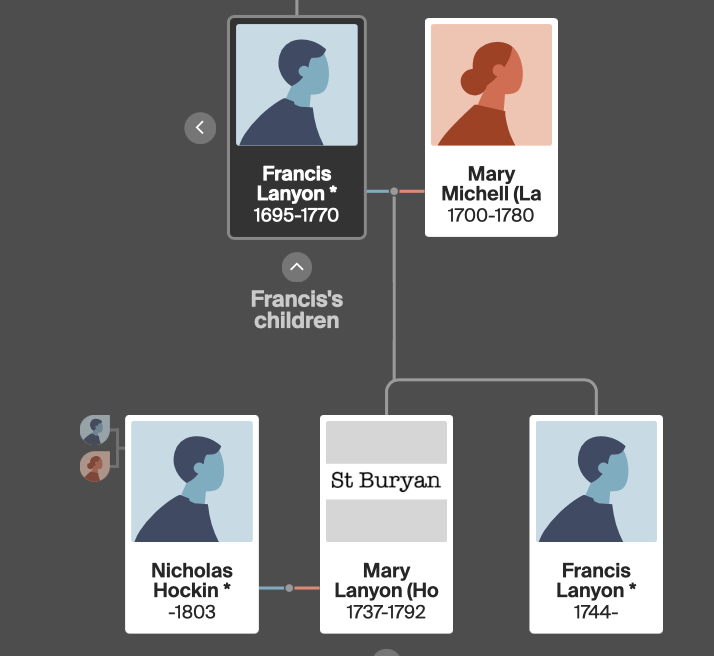
Francis was baptised at St Hilary in 1695 and married Mary Michell there in 1735. Two children traced:
Mary 1737- baptised at St Just in Penwith in 1737 married Nicholas Hockin in 1765
Francis 1744- baptised at St Just in Penwith in 1744 and no further trace
Francis senior was buried at St Just in 1770 and Mary his wife in 1780
Thomas Lanyon 1697-1737
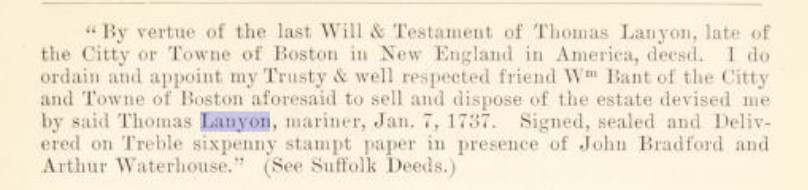
Thomas was baptised at St Hilary in 1697 and may be the Thomas Lanyon, mariner, of Boston, America who died on 7 Jan 1737. (Source ‘Brondson & Box Families Part 1’ by Lucius B Marsh.) Charles Lanyon merchant of Penzance was given power of attorney to sell his estate.
James’ Son
James & Elizabeth’s tree
We know very little about James, we don’t know when he was born or died, we can’t even be sure he was Barnard Lanyon’s son. We do however know that he married Elizabeth Carbus at St Hilary in 1685. There were only two children traced so perhaps James died young. I think Elizabeth was buried at Breage in 1734 but that is just guess work.
James 1686-1758
Margaret 1690-1693 (name is spelt Lannion in the register of baptisms at Germoe) died in infancy.
Others have Elizabeth Carbus being buried in 1689 at Liskeard but that wouldn’t be possible with her daughter being born in 1690.
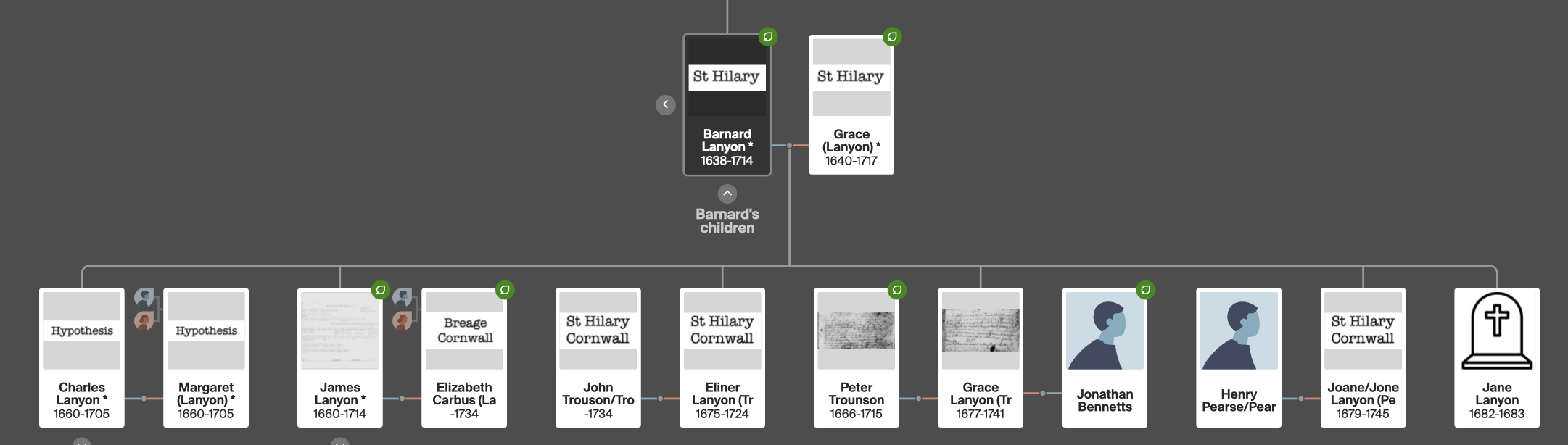
The St Hilary branch of the family tree started with Barnard Lanyon.
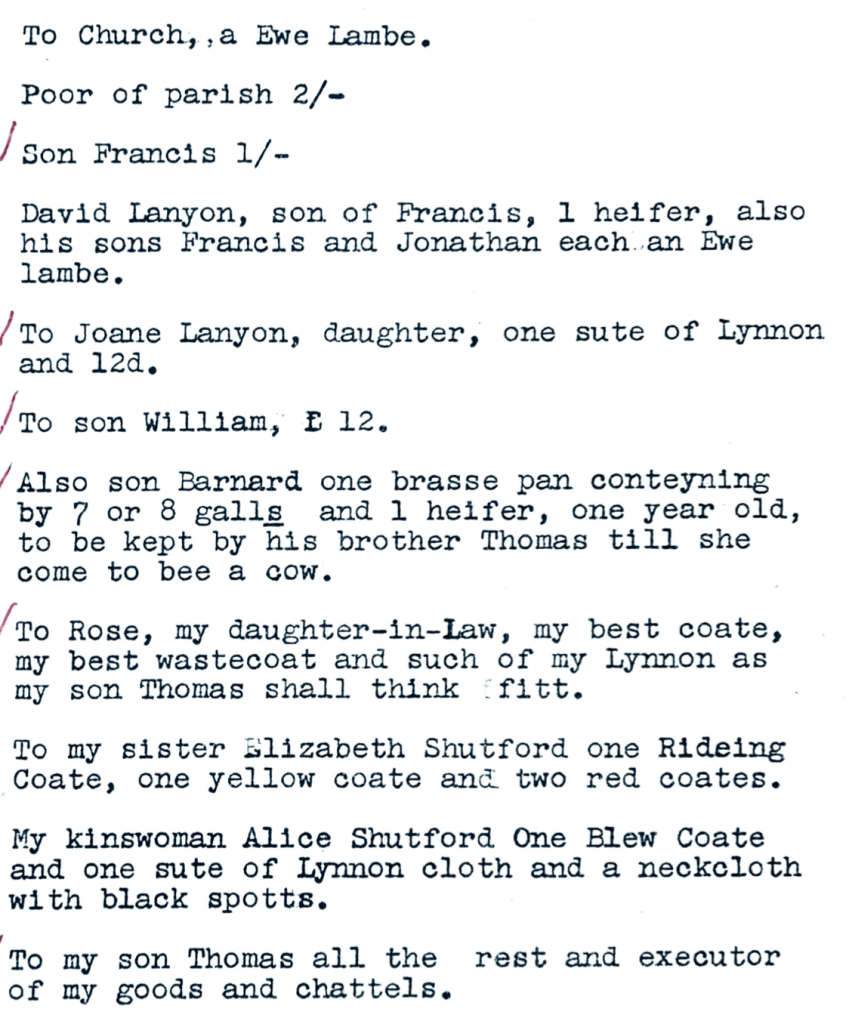
Barnard was the youngest son of David (Davy) and Joan, he was baptised on 10 Jun 1638 at Madron and was just three years old when his father died in 1641. When his mother died in 1655 she left him ‘a brass pann conteyning 7 or 8 galls and 1 heifer to be kept by Thomas till she becomes a cow’.
He married Grace, sadly we don’t know her surname or the date of marriage but in the 1660s and 1670s they were having children. The baptisms of some of the children are not recorded so there is a bit of guess work involved.
Charles abt. 1660-1705 married Margaret
James abt. 1660-1714 married Elizabeth Carbus
Eliner 1675-1724 married John Trouson
Grace 1677-1741 married Peter Trouson & Jonathan Bennetts
Joane 1679-1745 married Henry Pearce
Jane 1682-1683 died infancy
Charles Lanyon 1660s
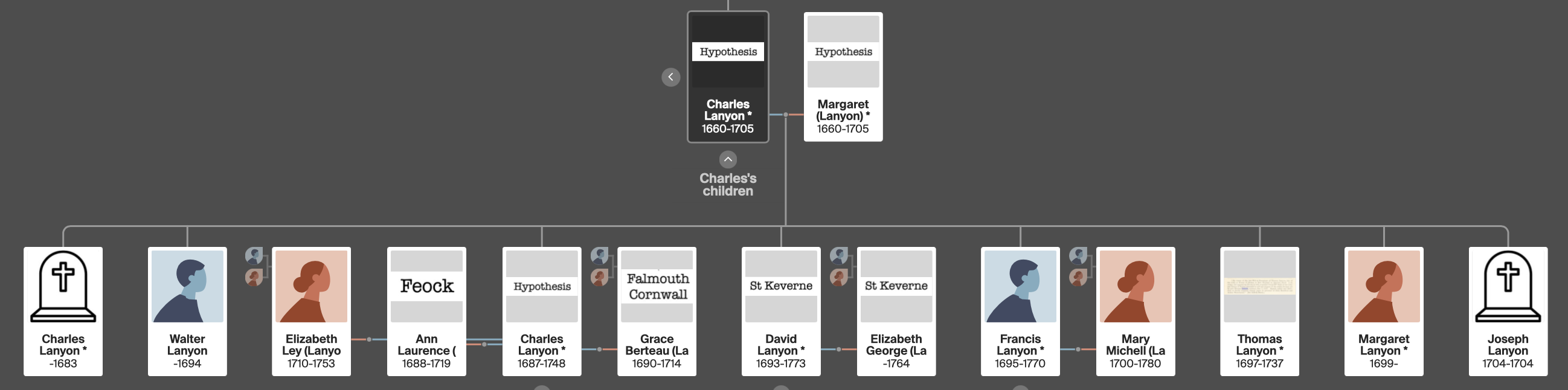
We don’t know when Charles was born or died or even when he married but from the records of the baptisms of some of his children his wife is named as Margaret. Their children:
Charles -1683 there is a burial of a Charles Lanyon son of Charles (from the date of the burial of this child it looks as if Charles the father was born early 1660s)
Charles 1687- There is a Charlis Lalion baptised on 2nd Feb 1687 at St Hilary no father is named, could this be a son of Charles or even a son of Barnard? Or a separate family altogether? (There is a Charles Lanyon who married Eleanor Nines at Perranuthoe in 1715 could that be this Charles as that marriage doesn’t appear to fit anywhere else?)
Walter -1694 died in infancy
David 1693-1773
Francis 1695-1770
Thomas 1697-1737
Margaret 1699- there is a Margaret Lenine who married a William John (Bond) at Ludgvan on 5 Jun 1725 who may be this Margaret
Joseph 1704-1704 died in infancy
James Lanyon 1660s
There is no record of James’ baptism or his burial but we do know he married Elizabeth Carbus at St Hilary on 20 Apr 1685. Two children traced:
James 1686-1758
Margaret 1690-1693 died in infancy
Eliner Lanyon 1675-aft. 1724
Eliner was baptised at St Buryan in 1675. She married John Trouson/Trownson at St Hilary in 1724. No children of this marriage. John was buried in 1734 but no trace of a burial for Eliner/Eleanor.
Grace Lanyon 1677-1741
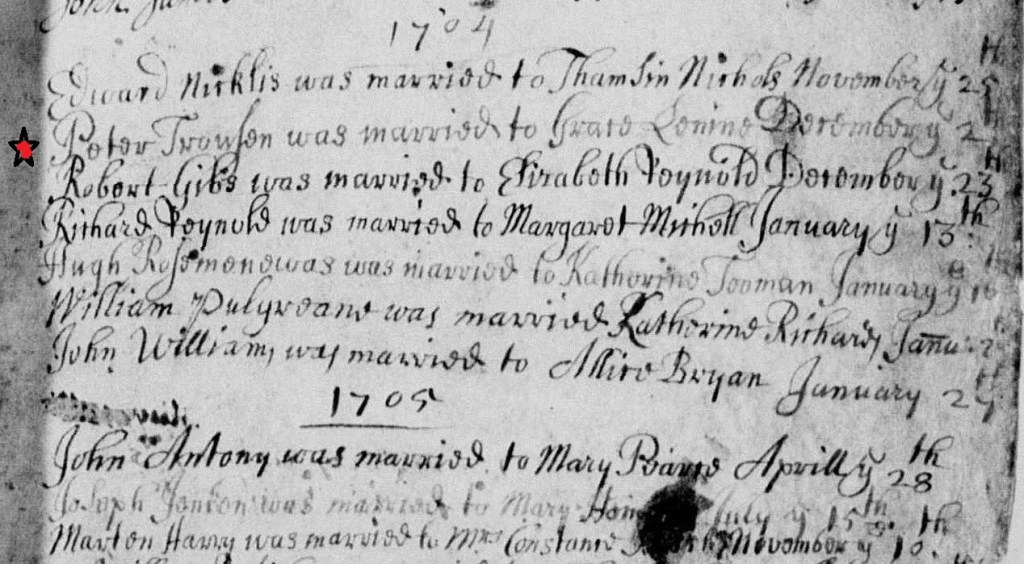
Grace was baptised at St Buryan in 1677. She married Peter Trouson at Ludgvan in 1704. They had four children, at least three died as a children. Peter died in 1715 and Grace married Jonathan Bennetts at Madron in 1732. She was buried at Madron in 1741.
Marriage of Peter & Grace Ludgvan Parish Register.
Joane Lanyon 1679-1745
Joane was baptised at St Buryan in 1679 and named after her grandmother, Barnard’s mother. She married Henry Pearse at St Hilary in 1709 and had three children: John, Jane and Francis. Joane was buried at St Hilary in 1745.
Barnard was buried at Marazion in 1714 and Grace his wife, was buried at St Hilary in 1717. They didn’t leave a will which might have helped confirm their children’s names.
Paskis Lanion married Thomas Shetford at St Just in Penwith in 1625. Who was Paskis Lanion? If only the answer was straight forward!
A quick trawl through the Cornwall Online Parish Clerks database revealed no baptisms for a Paskis/Paksis/Pascha/Pasca/Paska/Paskes/Paskas Lanion/Lanyon.
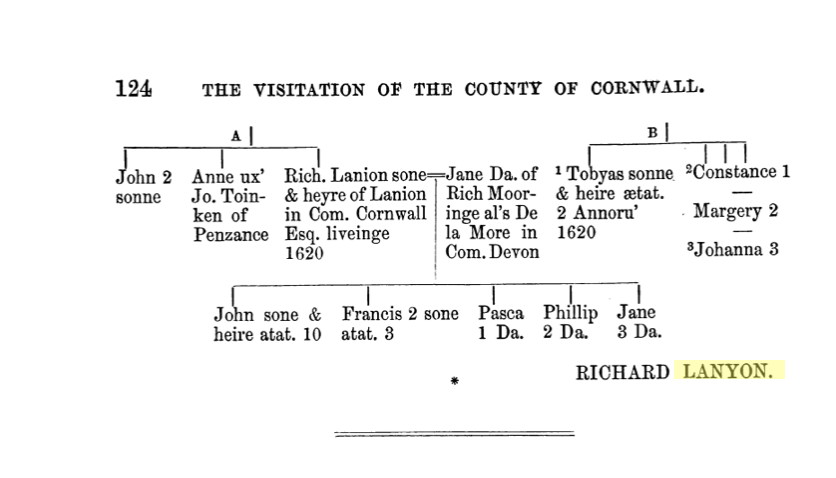
However the Heralds Visitation for Cornwall 1620 does have a suitable candidate:
Vivian’s Herald’s Visitation of Cornwall 1620
Richard Lanyon Esq submitted his tree showing that his wife was Jane Mooring alias De La More from Devon and their eldest daughter was called Pasca but was she old enough to get married in 1625?
Their eldest son was John aged 10 in 1620 so therefore born in 1610. Could Pasca be older than John? When did Richard marry Jane? The Royal Institution of Cornwall has a marriage settlement between Richard Lanyon and Jane his wife dated 1608 so presumably they married about 1608. The letter from Mrs Rose Tolman confirms that Jane’s mother was called Pascha Risdon so eldest daughter was named after her grandmother.
Francis 2nd son – deposition taken 1635 when he is aged 16 so born in about 1619
Elizabeth baptised 17 Nov 1622 St Merryn
The children with no baptisms recorded are:
Pasca eldest daughter born before 1613 when Philippa is baptised
Jane 3rd daughter born after 1613 and before 1622
Richard not listed on Herald’s Visitation so presumably born after 1620
Thomas not listed on Herald’s Visitation so presumably born after 1620
Margerie – from Richard Lanyon Esq’s will it is implied that Elizabeth and Margerie are the youngest daughters
The latest Pasca could have been born was 1613 and with John born in 1610 and two unbaptised babies born in 1611 and 1612 it looks likely that Pasca was probably born about 1608/9 which would make her about 16 years of age at the time that the marriage to Thomas Shetford took place. So she is a possible candidate.
Richard Lanyon Esq’s will of 1636 left all his daughters £30 or £40 apart from Pasca who received 5 shillings which implies that in 1636 she was already married and had received her ‘portion’. Sadly the will does not mention her married name.
The only problem is that there is a second Paskas who is also a candidate.
Richard Lanyon Esq’s uncle William has a daughter also called Paskas.
William’s daughter’s baptism isn’t recorded but we know she existed from his will. Again we’ll have to list his other children and see where she could fit in:
Elizabeth baptised 31 Oct 1593 Sancreed
John baptised 8 Jun 1596 and buried 15 Sep 1601 at Sancreed
John born after Sep 1601
Jane baptised 24 Oct 1602 Sancreed
William baptised Dec 1603 Sancreed
Elyzabethe baptised 17 Jul 1607 Sancreed
Both daughters called Elizabeth survived and are mentioned in William’s will of 1624!
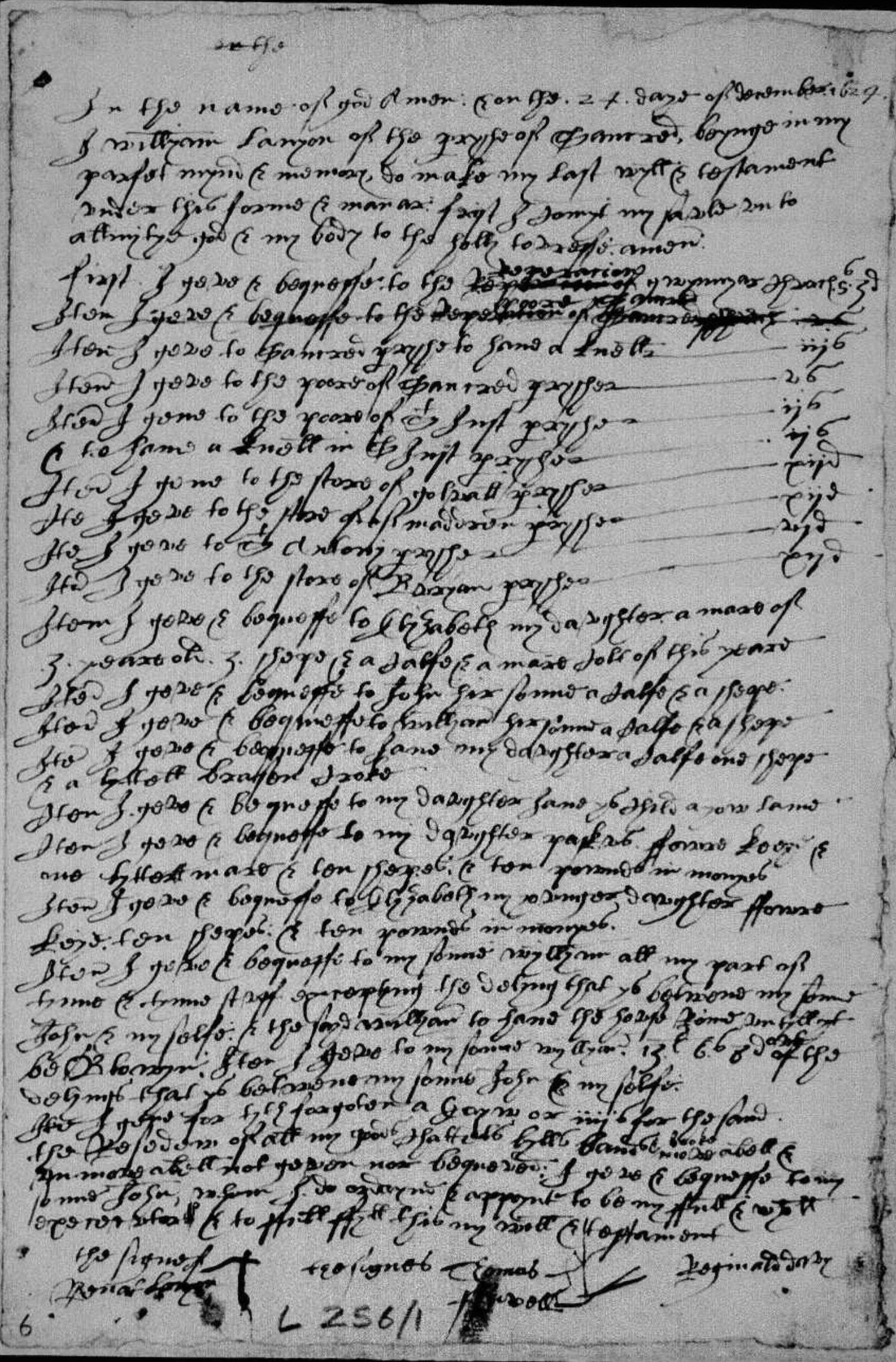
William’s Will of 1624 – Source CRO AP/L/256
Abstract:-
WILLIAM LANYON of Sancreed written: 24 Dec 1624 proved: 8 Feb 1624/5
poor of Sancreed – 3 sh. poor of St. Just – 5 sh. poor of Gulval – 12 d. poor of Maddern – 12 d. poor of Antony – 12 d. poor of Buryan – 12 d. daughter: ELIZABETH – mare, 3 sheep, calf, mare colt JOHN her son – calf & a sheep WILLIAM her son – calf & a sheep daughter: JANE – calf, 1 sheep, brazen crock daughter JANE’s child – a ewe lamb daughter: PASKAS – 4 kyne, mare, 10 sheep, 10 pounds youngest daughter: ELIZABETH – 4 kyne, 10 sheep, 10 pounds son: WILLIAM – all my part of tin and tin stuff, 13 pounds, 6 sh., 3 d. son: JOHN – all the rest & executor
The will implies that Paskas is younger than Jane and older than Elizabeth his youngest daughter which suggests that she was born between 1602 and 1607. So aged about 18-23 in 1625 when the marriage to Thomas Shetford took place.
It’s interesting that William leaves 5 shillings to the poor of St Just as that’s the town that Thomas Shetford comes from.
Who was Thomas Shetford?
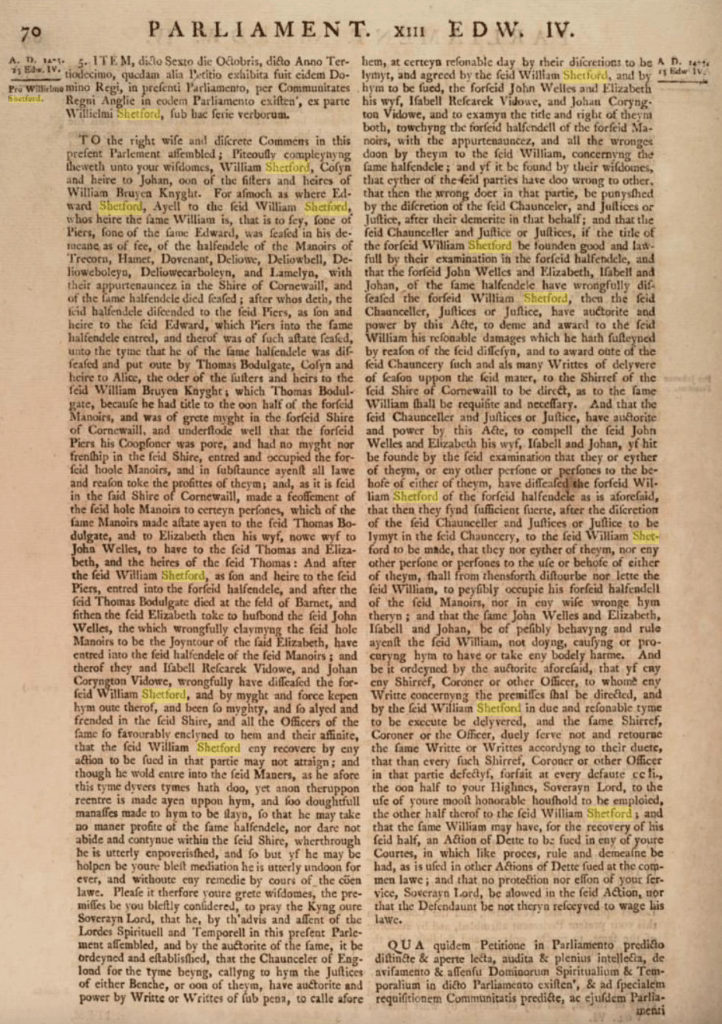
The Shetford/Shutford (and occasionally Shitford!) family originally came from Somerset. They were cheated out of a half share in six manors in Cornwall by Sir Thomas Bodulgate during the Wars of the Roses.
Source – History of Parliament Edward IV
We know very little about Thomas, the parish registers for St Just in Penwith start quite late but with the little we know we can create a tree that might be correct.
We know that Paskis Lanion married Thomas Shetford at St Just in Penwith in 1625 so he was probably born about 1600
There is a baptism for a Margarett Shetfod (Sic) daughter of Thomas on 14 Nov 1630 at St Just listed in the Exeter Bishop’s Transcripts
16 Oct 1647 marriage at St Just between Elizabeth Shetford (daughter of Thomas) and John Rawlyn (Source – OPC)
Baptism of Alse Shutford, daughter of Thomas 20 Dec 1633 St Just (Source- FHL film number 0226217, 0226218, 962681)
Burial of Paskes Shetford, widow 19 Dec 1681/2 St Just in Penwith (Source – OPC)
The will of Joan Lanyon (Shutford) 1655 (Source – NA PROB 11/257/72) Joan was the wife of David Lanyon of Madron and her will mentions her Shutford relatives
There is also a record at Kresen Kernow (The Cornish Record Office) which mentions Thomas and William Shilford.
Lease, tenement, Treloweth Wartha, Illogan
Parties:
1) Right Honourable John Lord Robartes, Baron of Truro.
Term: 99 years, or the natural lives of [?] Lanyon, John Lanyon his brother and William Shilford, son of Thomas Shilford.
Annual rent: 46 shillings 8 pence, one capon or 12 pence, a harvest day or 6 pence.
Heriot: Best beast or £3.
Reference number
CL/1/124
Date
3 Oct 1635
I think it should be William and Thomas Shitford/Shetford rather than Shilford. Could Thomas have a son called William and could these Lanyons be Paskas’ brothers?
The Paskas born in Sancreed had brothers called John and William. ‘William Lanyon Yeoman of St Just’ listed in the lease is definitely not the St Merryn family of Lanyons.
There is a marriage of a William Shetford and Mary Edward at St Just on 26 Nov 1653, they had two daughters: Rebecea (sic) bapt. 1655 and Ellizabeth (sic) bapt. 1657.
There is a legal dispute between John Lanyon and William Shutford in 1659, the year Thomas Shutford died. Source – NA C 10/48/84
Lanyon v Shutford.
Plaintiffs: John Lanyon. Defendants: William Shutford, James Pratt and Robert Baynard. Subject: property in Sancreed, Cornwall.
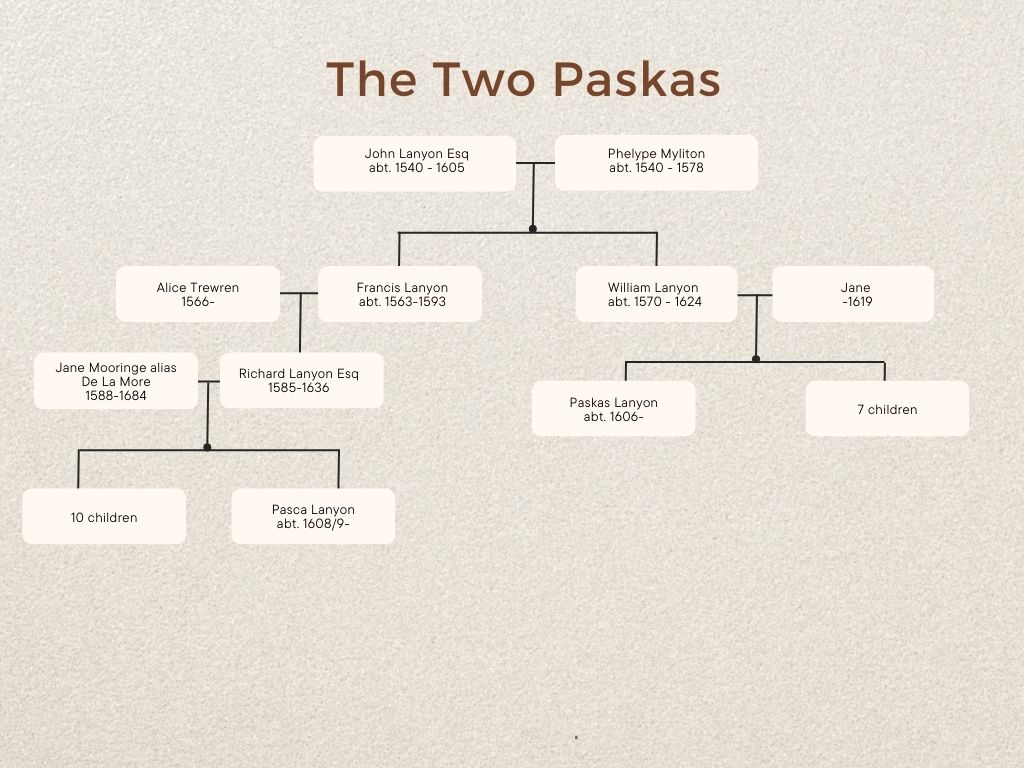
This is the hypothetical tree I’ve created from all those snippets of information.
We still haven’t conclusively answered the question which Paskis Lanion married Thomas Shutford in 1625 but I think the Paskas born to William Lanyon of Sancreed is the more likely candidate.
William Lanyon died in 1624 (his wife had died in 1619) and left Paskas £10 and some cattle. The following year she married Thomas from the neighbouring parish of St Just in Penwith.
Ultimately geography may be the best clue, the distance between St Just and Sancreed (near Penzance) is a lot smaller than the distance between St Just and St Merryn (near Padstow).
With thanks to Louise Quigley who first posed this question in 2014 and the Penwith Genealogy Group who produced some great answers and evidence.
Philip Lanyon was the fifth son of John Lanyon and Tamsin Tapprell of Breage.
Philip was baptised at Breage in 1615.
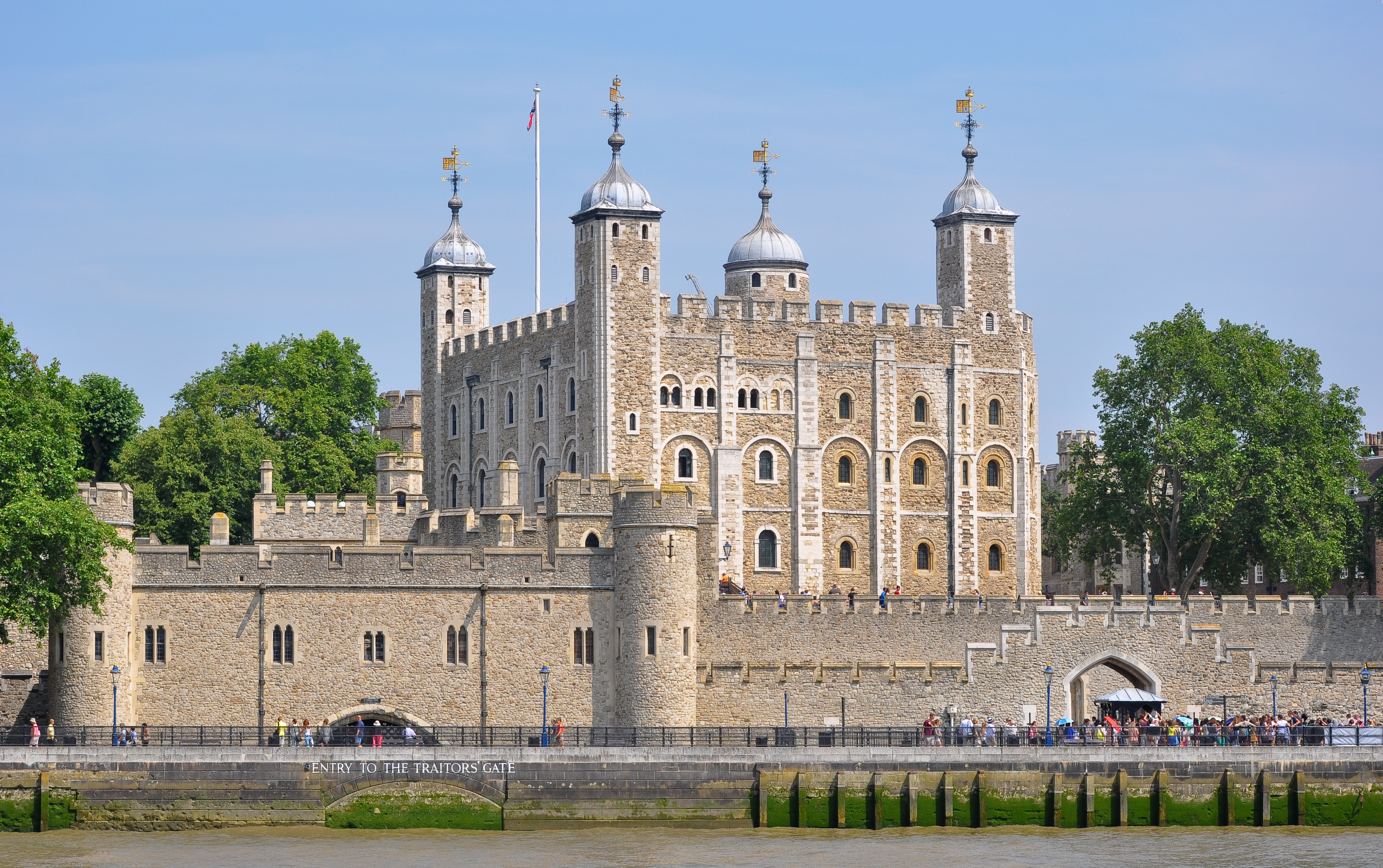
On 29 Feb 1640 he was given a grant of a gunners room in the Tower of London. Fee 6d per diem during pleasure to commence from the death of Nicholas Congon.
Philip signed the Protestation Return of 1641/2 at Penzance and between 1641-1660 he was in partnership with Anthony Gubbs a wholesale merchant in wood and iron. Anthony Gubbs was elected alderman and Mayor of Penzance.
In 1641 (the transcription says 1644 but that is after the baptism of the first child) Philip married Agnes Gubbs, Anthony’s daughter at Madron/Penzance. They had three sons:
Anthony 1641-1649 died young
Philip -1648 died young
Anthony aft. 1649-1680 he was a soldier and died at Tangier in North Africa. Administration of his estate was granted to his father “All to Philip Lanyon, father”.
Tangier 1680 – Hendrick Danckerts, Public domain, via Wikimedia Commons
In 1647 Philip Lanion was an alderman of Penzance.
During the Civil War he was adjutant and captain of the King’s Forces in Cornwall. The land from Lizard Town to St Michael’s Mount held for King Charles I. Lords Goring and Hopton’s horse troops (supporters of the Crown) were driven to Penzance by Parliamentary forces and were welcomed by the town. In revenge two days later Sir Thomas Fairfax’s Parliamentary forces sacked the town in 1648. Philip was plundered of £1000 his estate sequestered and he was imprisoned.
In an appendix to Mary Coate’s ‘Cornwall in the Great Civil War and Interregnum, 1642-1660’ she gives a list of Royalist Commanders in the County of Cornwall in Jan 1646/7 and among the list is Philip Lanyon of Penzance, gent. Fined £10. 16/- 8d. (This was one of the lightest fines which ranged from £10,000 to £3. 6/- 8d. So apparently Philip Lanyon was not the most ardent of Royalists!)
At the Restoration, he petitioned Charles II for what seems to have been the office of supervisor of workmen at all castles and forts throughout the kingdom, but it does not appear that he was successful.
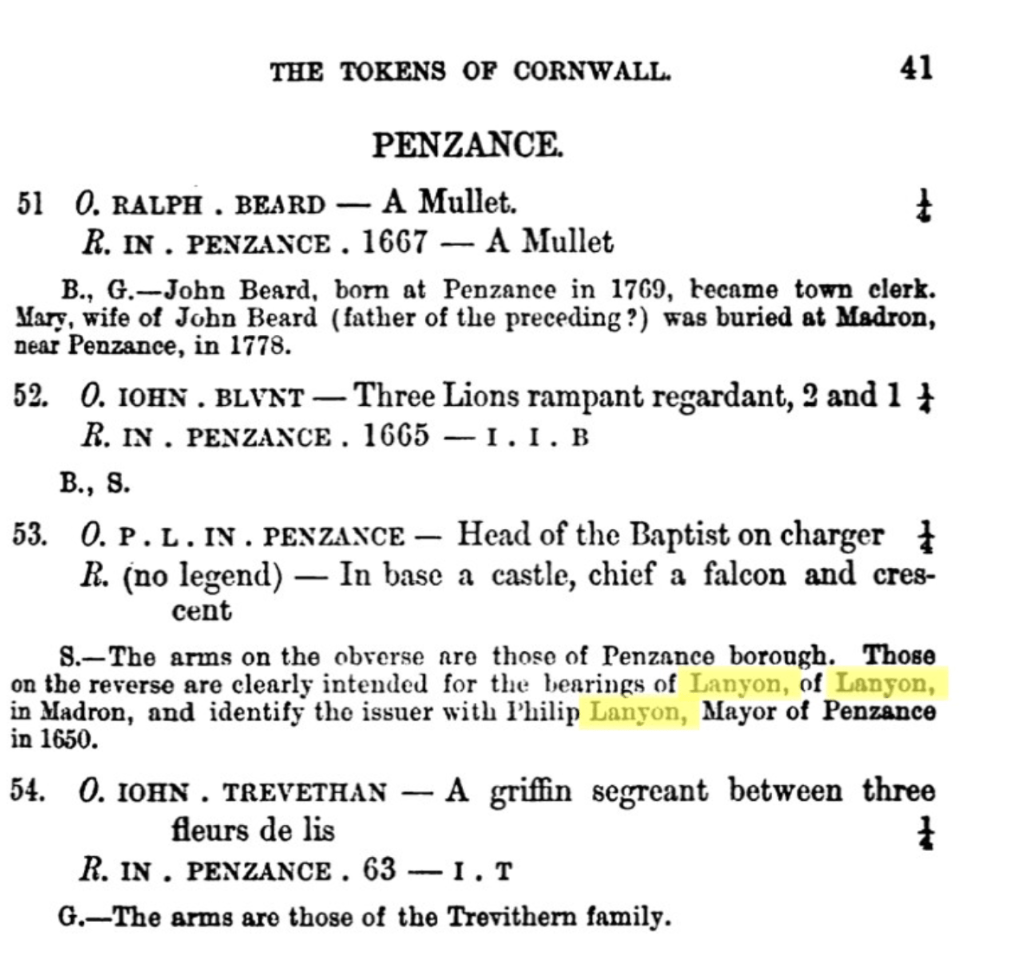
He was Mayor of Penzance in 1650 and he issued a token in Penzance with the arms of the borough on one side and those of Lanyon on the other. There are five known tokens issued by the town between 1663-7. The names of the other merchants whose names appear on these little coins are:- John Trevethan, Anthony Gubbs, John Blunt and Ralph Beard. (Source- ‘Penzance Past and Present’ – West Penwith Resources.)
In 1659 Philip Lanyon was the guardian of a child and administered the estate of William Tonkin of Penzance. In 1689 a legal case Lanyon V. Tonkyn at Plymouth, Devon. A dispute about an inheritance! (Source- NA C8/518/21)
In 1662 Philip married to Constance Carter a widow. No children of this marriage.
In 1667 there was a warrant from the Commissioner of Prizes to Lord Ashley to pay £200 to Philip Lanyon Deputy Treasurer and Commissioner of Prizes at Plymouth. (Source – British Museum Addt MSS, 5752, fol, 164.)
In the 1670s there are many letters listed in Charles II State Papers from Capt. Philip Lanion regarding ships coming and going from Plymouth letters sealed with the Madron arms in black wax.
Charles II – Dulwich Picture Gallery, Public domain, via Wikimedia Commons
In Jul 1671 The King visited Plymouth. The Governor of Plymouth, the Earl of Bath, asked Capt. Philip Lanion if he would allow the Earl to keep a table in the hall of his house and entertain daily for him, the Duke of York, the Duke of Monmouth, the Marquess of Blanquefort and many other nobles.
In his later years Philip was involved in numerous legal disputes.
1657 Court of Chancery – Six Clerks Office NA C/10/55/110 Lanyon v Lanyon. Plaintiffs: Richard Lanyon. Defendants: Elizabeth Lanyon and Philip Lanyon. Subject: property in St Merryn, Cornwall. Document type: bill and two answers.
1661 Court of Chancery – Six Clerks Office NA C7/456/8 Lanyon v Lobb. Plaintiffs: Richard Lanyon. Defendants: Philip Lanyon, [unknown] Lobb and others. Place or subject: money, Cornwall.
1662 Court of Chancery – Six Clerks Office NA C/6/77/96 Lanyon v Hall. Plaintiffs: Philip Lanyon and Constance Lanyon his wife. Defendants: John Hall. Subject: money matters, Devon.
1666 Court of Chancery – Six Clerks Office NA C5/513/100 Lanyon v Eastwicke. Plaintiffs: Philip Lanyon and another. Defendants: Adrian Eastwicke and another. Subject: money matters, Devon.
1666 Court of Chancery – Six Clerks Office NA C/10/82/71 Lanyon v Spernon. Plaintiffs: Philip Lanyon. Defendants: William Spernon. Subject: money matters, Devon.
1667 Court of Chancery – Six Clerks Office NA C7/474/74 Lanyon v Goodall. Plaintiffs: Philip Lanyon. Defendants: John Goodall. Place or subject: money, Devon.
1671 Court of Chancery – Six Clerks Office NA C/5/459/100 Cary v Lanyon. Plaintiffs: Robert Cary. Defendants: Philip Lanyon and Constance Lanyon his wife. Subject: property in Plymouth, Devon.
1674 Chancery: Master Brougham’s Exhibits NA C111/221 PEIRSON v SAWLE: Agreement with bond between Philip Lanyon, Margaret Richards and Hester Lanyon, all of Plymouth, Devon, concerning the estate of John Lanyon of Plymouth, deceased.
1674 Court of Chancery – Six Clerks Office NA C8/188/43 Lanyon v Amy. Plaintiffs: Philip Lanyon. Defendants: William Amy and Thomas Wills. Subject: property in Tintagel, Cornwall.
1675 Court of Chancery – Six Clerks Office NA C6/217/2 Barton v Lanyon. Plaintiffs: Isaac Barton. Defendants: Philip Lanyon. Subject: money matters.
1675 Court of Chancery – Six Clerks Office NA C5/513/101 Lanyon v Barton. Plaintiffs: Philip Lanyon and others. Defendants: Isaac Barton. Subject: money matters.
1676 Court of Chancery – Six Clerks Office NA C8/329/126 Lanyon v Buckham. Plaintiffs: Philip Lanyon and Hester Lanyon. Defendants: John Buckham. Subject: property in Plymouth, Devon.
1678 Court of Chancery – Six Clerks Office NA C/8/297/157 Yeabsly v Lanyon. Plaintiffs: Thomas Yeabsly. Defendants: Philip Lanyon, Thomas Young, Hester Young his wife, William Addis and Thomasine Yeabsly, widow. Subject: money, Devon.
1678 Court of Chancery – Six Clerks Office NA C7/558/33 Lanyon v Young. Plaintiffs: Philip Lanyon. Defendants: Thomas Young, [unknown] Beere and others. Place or subject: money, Devon.
1679 Court of Chancery – Six Clerks Office NA C10/204/98 Trewolla v Lanyon. Plaintiffs: Mary Trewolla. Defendants: Philip Lanyon, Thomas Younge, Hester Younge his wife, George Bere, Susannah Bere his wife and Nowell Tonken. Subject: personal estate of John Lanyon, Plymouth, Devon.
1679 Court of Chancery – Six Clerks Office NA C8/297/99 Mayor of Totnes v Lanyon. Plaintiffs: Mayor etc of Totnes. Defendants: Philip Lanyon, Thomas Younge, Hester Younge his wife and Margaret Richards. Subject: charitable bequest under will of John Lanyon, Totnes, Devon.
1679 Court of Chancery – Six Clerks Office NA C7/574/111 Younge v Lanyon. Plaintiffs: Thomas Younge. Defendants: Philip Lanyon and another. Place or subject: property in Breage, Saltash, Cornwall etc.
1680 Court of Chancery – Six Clerks Office NA C7/576/6 Ford v Lanyon. Plaintiffs: Philip Ford and others. Defendants: Philip Lanyon, [unknown] Addis and others. Place or subject: money, Devon.
1682 Court of Chancery – Six Clerks Office NA C7/589/29 Lanyon v Rashleigh. Plaintiffs: Philip Lanyon and others. Defendants: Jonathan Rashleigh and others. Place or subject: property in Calstock, Cornwall.
1683 Court of Chancery – Six Clerks Office NA C7/575/54 Lanyon v Carkett. Plaintiffs: Philip Lanyon. Defendants: Thomas Young, [unknown] Carkett and others. Place or subject: money, Devon.
1685 Court of Chancery – Six Clerks Office NA C7/117/48 Ford v Lanyon. Plaintiffs: Philip Ford and Philip Ford. Defendants: Philip Lanyon and others. Place or subject: property in Plymouth, Devon.
1686 Court of Chancery – Six Clerks Office NA C5/171/22 Lanyon v Johnson. Plaintiffs: Philip Lanyon. Defendants: Elizabeth Johnson and others. Subject: property in Plymouth, Devon.
1686 Court of Chancery – Six Clerks Office NA C7/573/92 Lanyon v Eastlake. Plaintiffs: Philip Lanyon. Defendants: John Johnson, [unknown] Eastlake and others. Place or subject: estate of Tobias Wiseman, Plymouth, Devon.
1686 Court of Chancery – Six Clerks Office NA C7/573/67 Ford v Young. Plaintiffs: Philip Ford. Defendants: Philip Lanyon, [unknown] Young and others. Place or subject: money, Devon.
1688 Court of Chancery – Six Clerks Office NA C/7/594/71 Lanyon v Eastlake. Plaintiffs: Constance Lanyon, widow and executrix of Philip Lanyon late of Plymouth Devon, esq deceased. Defendants: John Johnson and Elizabeth Johnson his wife, Samuel Eastlake and Rebecca Wiseman. Place or subject: money, Devon.
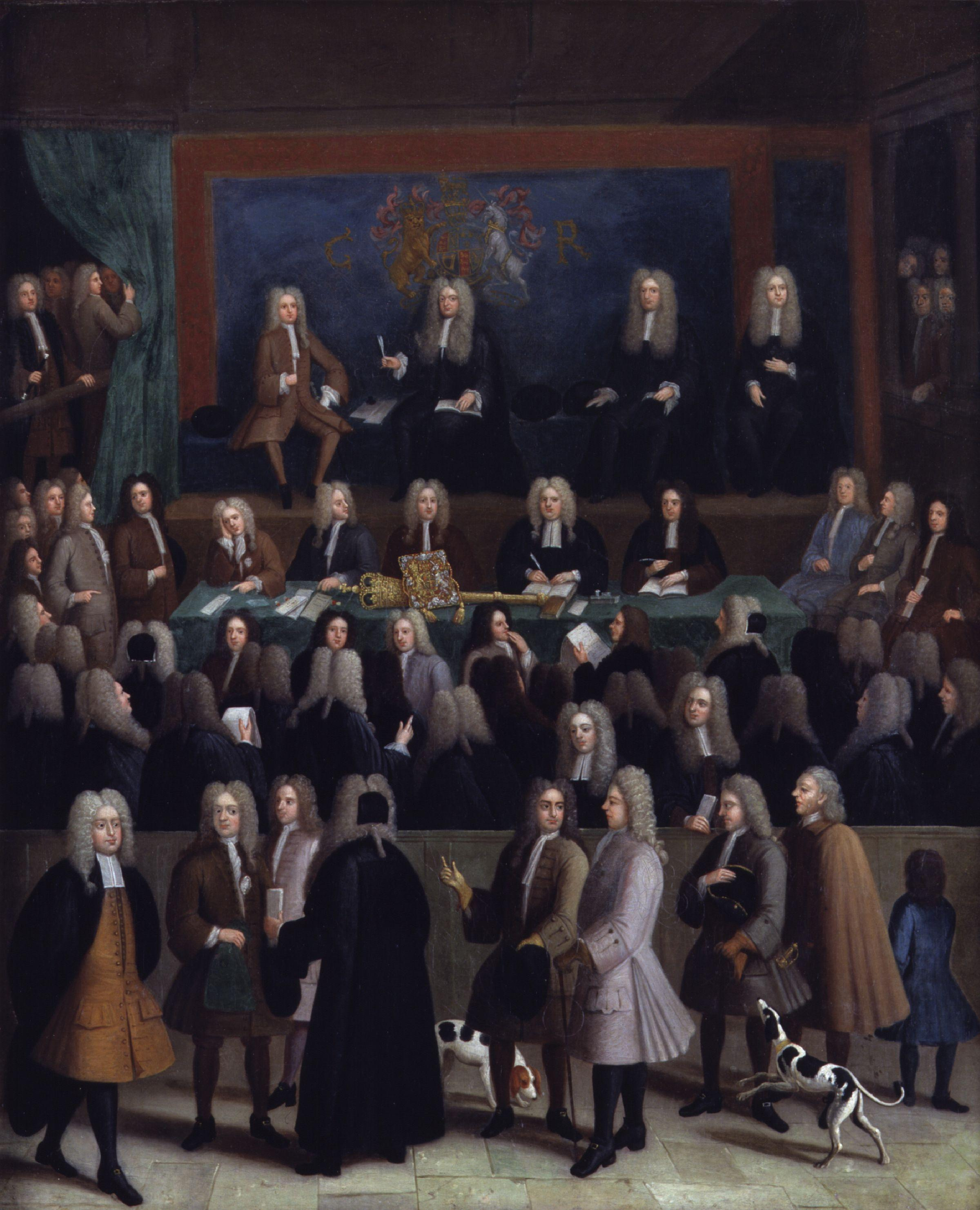
Wow! Wonder what they thought in Court of Chancery – Six Clerks Office every time they saw Philip Lanyon’s name?
Court of Chancery – National Portrait Gallery, Public domain, via Wikimedia Commons
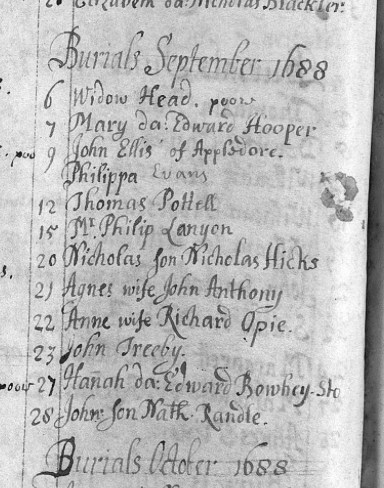
Philip died in Plymouth in 1688 and his widow Constance continued the litigation!
Plymouth St Andrew Parish Register
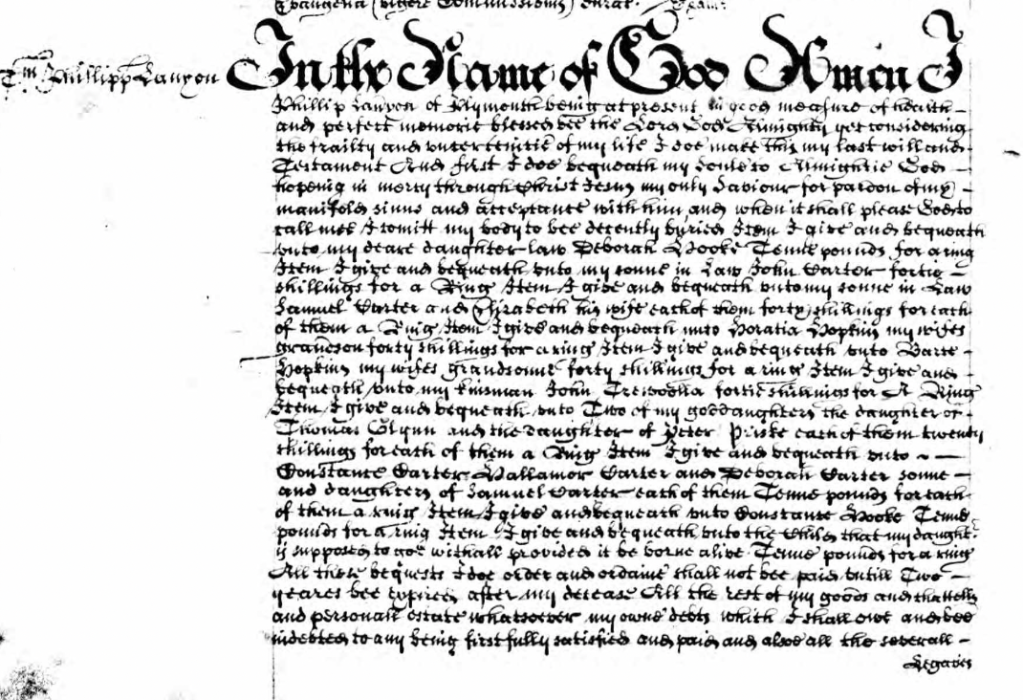
Philip left a will which named his kinsman John Trewolla, his two god daughters, daughters of Thomas Glynn and his wife Constance. He also mentions Constance’s children Samuel, John, Deborah (Hook) and Ann (Hopkins).
Will of Philip Lanyon 1688 – NA PROB 11-393-119
Without any surviving heirs this little branch of the family died out.
William was the second documented son of John Lanyon of Breage and Tamsin Tapprell.
William was baptised at Breage in Aug 1600. In Oct 1618 he married Susannah Burdon at Breage. We know very little about William; he signed the Protestation Return of 1641/2 for Breage and apart from baptising his children the only other record we have of him is his will of 1643. He must have been a farmer as his will values the corn and the corn in the ground.
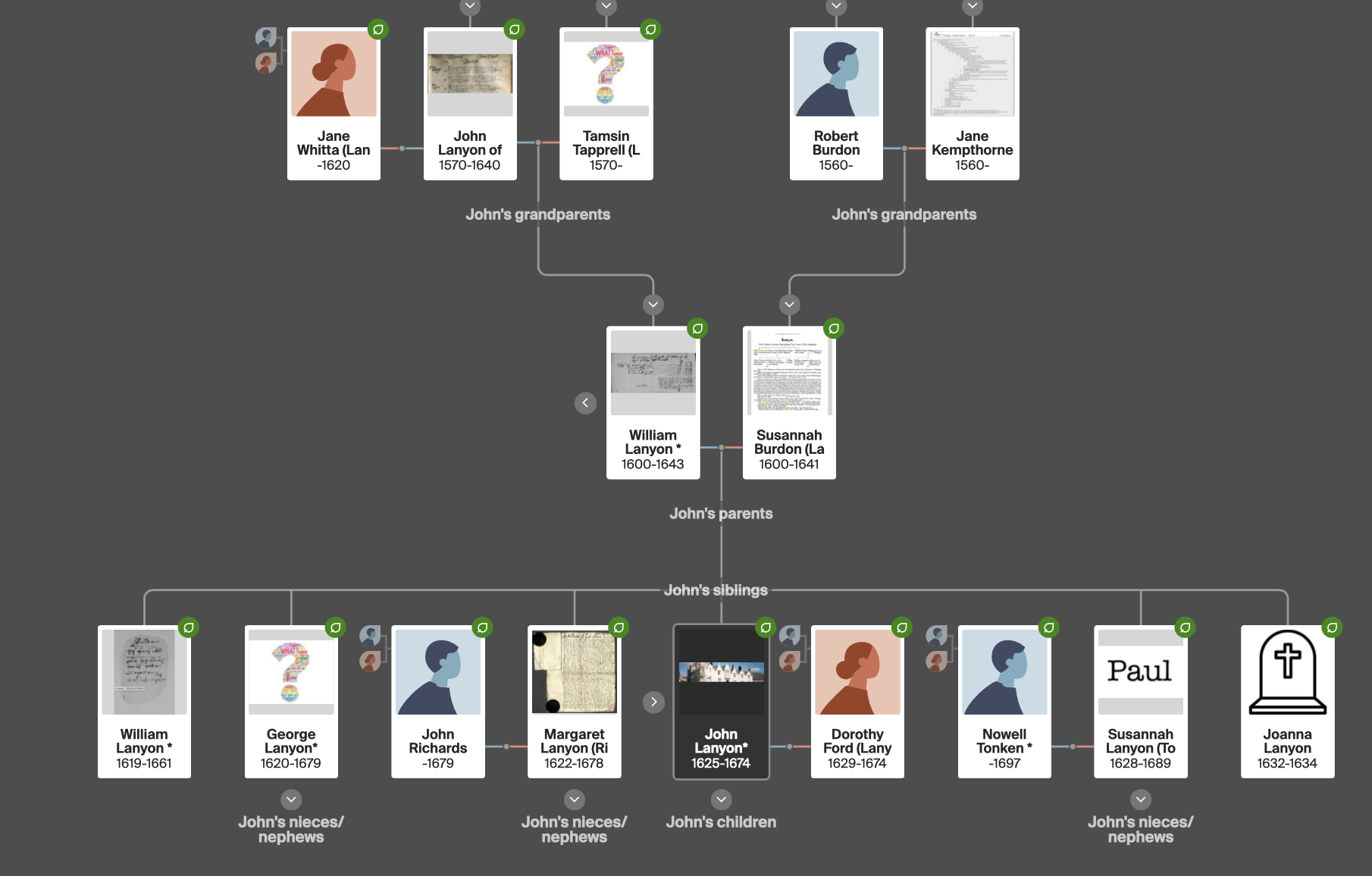
William & Susannah’s tree
His children:
William 1619-1661 William was the eldest son and heir, he never married and when he died he left everything to his sister Margaret Richards
Will of William Lanyon 1661 Source – CRO/AP/L/546
George 1620-aft.1643 He is mentioned in his father’s will of 1643 so must have been alive then but no trace of him after that. No mention of him in his brothers’ wills of 1661 and 1674. His sister Margaret’s will mentions his daughter Elizabeth.
Margaret 1622-1679 she married John Richards and had at least one child Susannah Richards who was baptised in 1655. Her brother William left all his estate to her and brother John left her the huge sum of £1000 in his will, she was buried at St Columb Minor on 20 Jan 1686. Susannah Richards married George Beare, gent of St Ervan in 1676. In 1680 there is a Bill of Complaint between George Beare the younger, Susannah his wife defendants complaint of Philip Lanion Esq, Thomas Yonge gent and Hester his wife. (Source- CRO AR/17/127)
John 1625-1674
Susannah 1628-1689 she married Nowell Tonken, a merchant of Newlyn, in Nov 1664 at Paul, Cornwall. They had two children: Dorothy and Susannah.
Joanna 1632-1634 died in infancy
William senior died in 1643.
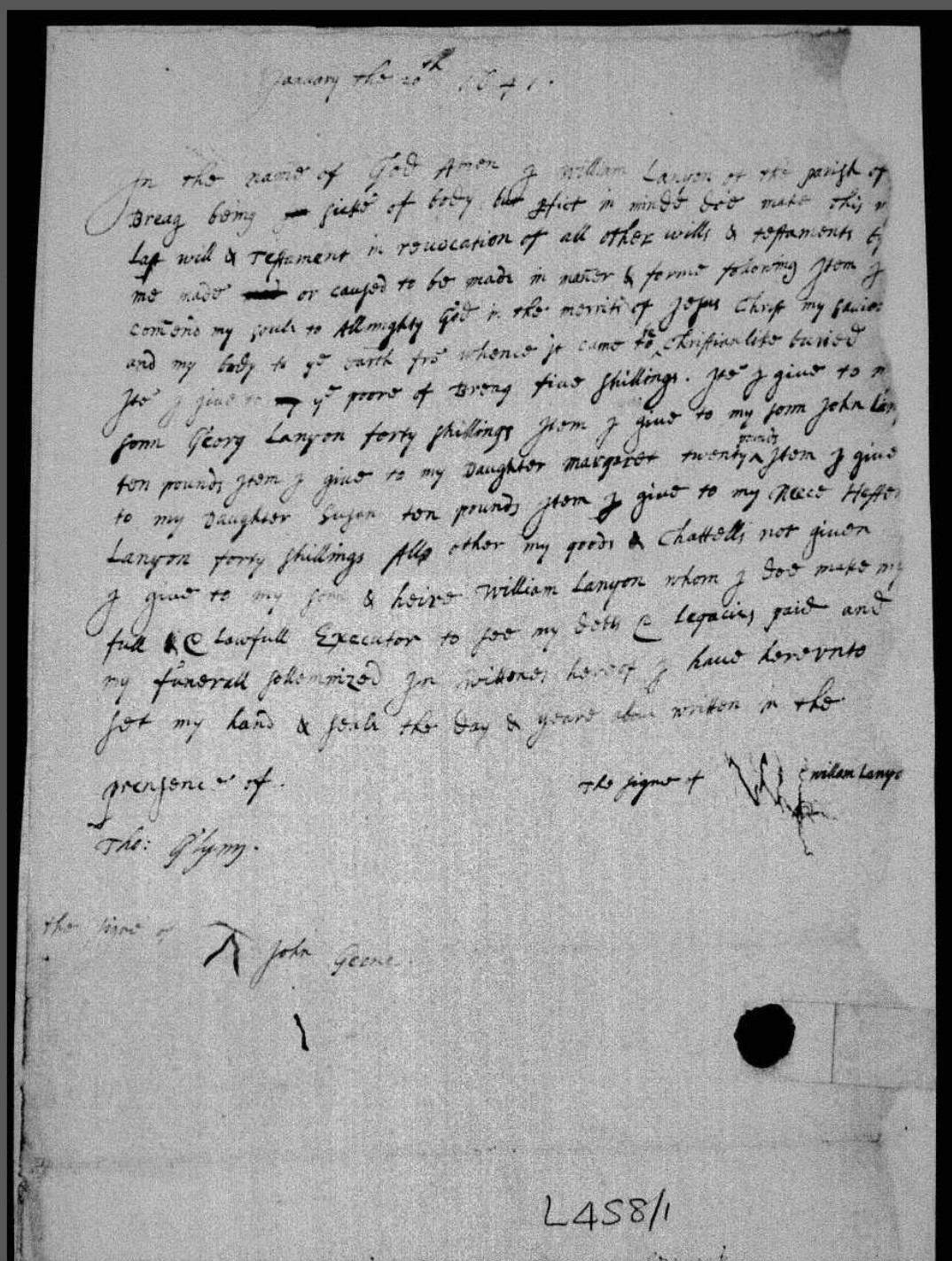
William Lanyon’s will of 1643 – Source CRO AP/L/458
There is no mention of his wife Susannah so presumably she predeceased him. He leaves:
To my son George 40 shillings
To my son John £10
To my daughter Margaret £20
To my daughter Susan £10
To my niece Hester Lanyon 40 shillings
All the rest to my son William
Hester seems to feature in many of the wills!
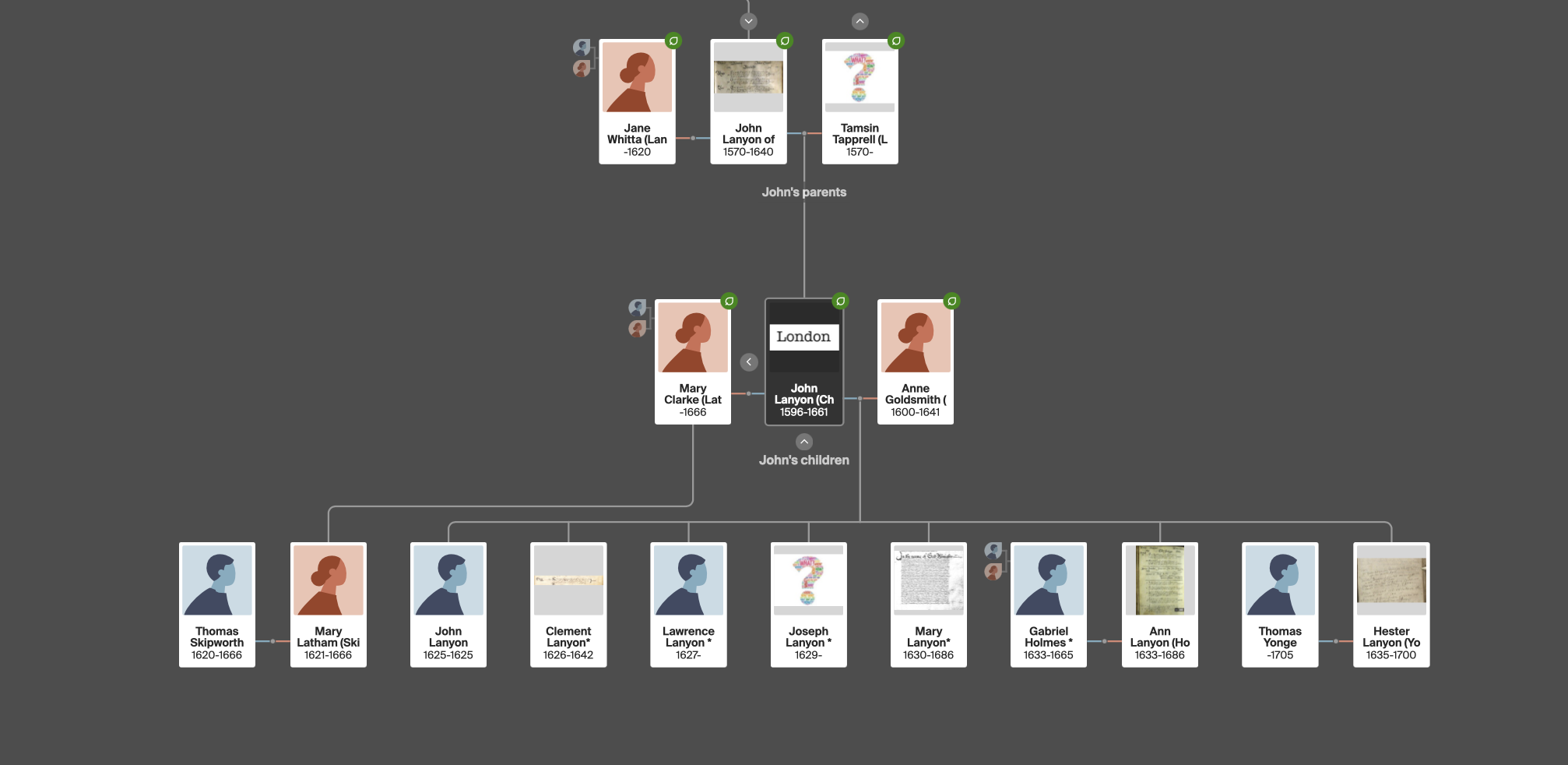
John Lanyon 1625-1674
John was the third son of William Lanyon and Susannah Burdon. He married Dorothy Ford at St Andrews Church in Plymouth on 14 May 1656. They had two children:
William -1665 died in infancy
Margaret 1668-1671 died in infancy
There was an inscription in St Andrews Church in Plymouth (gradually worn away and in time will disappear altogether) Wife & Children of John Lanyon-
Under this stone a root with blameless green
To sense, but not to faith do lie unseen
Excepting when the righteous rising sun
Shall quicken them by Resurrection
Into that glorious state ordained of God
Of those who live their mercies and their rod
Ecclesiastical History of Plymouth – J Brooking, Devon 1873
The church was bombed during the Blitz in 1941 so presumably this inscription has been lost.
We don’t know when Dorothy died but at some stage before 1674 he appears to have married his cousin Hester Lanyon (the daughter of John Lanyon and Anne Goldsmith). There were no children of this marriage. Hester is described as his relict in a legal document. We don’t know if this marriage took place or if a mistake was made in the legal document.
John was a merchant in Plymouth and in 1672 he was Mayor of Plymouth. He was also the navy agent there.
He was friends with Samuel Pepys who mentions him in his diary:
30th. Up betimes, and with W. Hewer, who is my guard, to White Hall, to a Committee of Tangier, where the business of Mr. Lanyon [John Lanyon, agent of the Navy Commissioners at Plymouth. The cause of complaint appears to have been connected with his contract for Tangier. In 1668 a charge was made against Lanyon and Thomas Yeabsley that they had defrauded the king in the freighting of the ship ‘Tiger’ (‘Calendar of State Papers,’ 1668-69, p. 138).] took up all the morning; and where, poor man! he did manage his business with so much folly, and ill fortune to boot, that the Board, before his coming in, inclining, of their own accord, to lay his cause aside, and leave it to the law, but he pressed that we would hear it, and it ended to the making him appear a very knave, as well as it did to me a fool also, which I was sorry for. Thence by water, Mr. Povy, Creed, and I, to Arundell House, and there I did see them choosing their Council, it being St. Andrew’s-day; and I had his Cross [The cross of St. Andrew, like that of St. Patrick, is a saltire. The two, combined with the red cross of St. George, form the Union flag.] set on my hat, as the rest had, and cost me 2s., and so leaving them I away by coach home to dinner, and my wife, after dinner, went the first time abroad to take the maidenhead of her coach, calling on Roger Pepys, and visiting Mrs. Creed, and my cozen Turner, while I at home all the afternoon and evening, very busy and doing much work, to my great content. Home at night, and there comes Mrs. Turner and Betty to see us, and supped with us, and I shewed them a cold civility for fear of troubling my wife, and after supper, they being gone, we to bed. Thus ended this month, with very good content, that hath been the most sad to my heart and the most expenseful to my purse on things of pleasure, having furnished my wife’s closet and the best chamber, and a coach and horses, that ever I yet knew in the world: and do put me into the greatest condition of outward state that ever I was in, or hoped ever to be, or desired: and this at a time when we do daily expect great changes in this Office: and by all reports we must, all of us, turn out. But my eyes are come to that condition that I am not able to work: and therefore that, and my wife’s desire, make me have no manner of trouble in my thoughts about it. So God do his will in it!
Samuel Pepys – Godfrey Kneller, Public domain, via Wikimedia Commons
Pepys Diary – Alfred Garth Jones, FAL, via Wikimedia Commons
John Lanyon to the Navy Commissioners. Finds the Milford may be supplied with a mainmast here. Wishes the old debts might be discharged; cannot persuade the carpenters without ready money to make the mast, as since the peace, they have been employed on merchant ships at 2s. 6d. per day. [Ibid. No. 166.]
John Lanyon to the Navy Commissioners. In expectation of satisfaction for his disbursements, will get ready a mast for the Milford frigate, which shall be despatched in a few days. [Ibid. No. 36.] Source – State Papers
John died in Paris in 1674 and was buried at the Shalanton Protestant Church. He left a detailed will mentioning many family members.
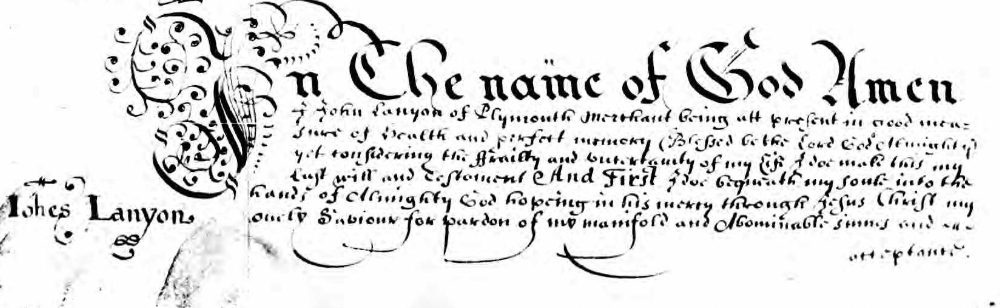
John’s will – Source – NA PROB/11/344
It’s a lengthy will that is impressive with the size and breadth of his bequests to the poor people of various towns and parishes, but it also gives us the information to deduce John was the son of William Lanyon and Susanna Burdon of Breage, baptised in 1625.
John left £50 to the parish of Breage in Cornwall, and also 40 shillings yearly forever, to be paid from “my interest in three prize tin bounds in or near the said parish”.
John’s will mentions his uncle Mr Philip Lanyon. This confirms that John’s father William had a brother called Philip, and they are more than likely both the sons of John Lanyon that was baptising children in Breage at the start of the 1600s.
The will also mentions John Lanyon of Plymouth’s sister, Margaret Richards and Margaret’s daughter Susanna, and another sister Susanna Tonkin, wife of Nowell Tonkin, and their daughter Dorothy Tonkin.
There is no mention of brothers William and George in his will written 15 Sept 1674 in Paris. William died in 1661 and presumably George had also died.
John mentions various ‘cousens’, among them are Hester Lanyon whom he bequests £700 “in case she should survive me and acquit my executors of my obligation for £30 per annum payable to her by me during her natural life.” This suggests there is a pre-existing arrangement possibly arranged and set down in the will of either his brother William or George. The will continues “out of this £700, my cousen Hester do pay or make good unto her sisters, my cousens, Mary and Ann £10 to each during their natural lives.” (John does not call Hester his wife.)
Other cousins/kinsmen mentoned are:
James Trewolla, my kinsman, John Trewolla his brother, Mary Trewolla his sister and Jane Trewolla his sister. John then gives an extra bequest to Jane Trewolla, calling her his cousin, and stating that she recieves “£50 pounds more in consideration of £5 which I received off my uncle Glynn to improve for her advantage.”
John Lanyon also gives to the grandchildren (un-named) of his aunt Glynn and to his cousin Thomas Glynn and his wife.
He was a great benefactor and left money to several parishes and money for almshouses in Plymouth (built 1679) and money for the Educational Foundation of John Lanion. There is an inscription in the boardroom of the Borough Workhouse in Plymouth:-
“to the memorie of a great benefactor to the poore of this town”
He also left £50 to Totnes in Devon and legal proceedings over this legacy give us more information about the family.
Chancery proceedings ante 1714 – Writ 297/99 Year 1679
John Lanyon merchant late of Plymouth personal estate valued at £20,000 did by his last will and testament dated 15 Sep 1674 bequeath a legacy of £50 to Totnes in Devon, which sum the Mayor and Burgesses were claiming of the Executors Captain Philip Lanyon, his sister Margaret Richards and niece Hester Lanyon.
In this chancery lawsuit the Totnes claimants speak of Hester Lanyon as John’s relict “who has since married Thomas Yonge”.
John Lanyon’s ‘personal estate’ consisted of ready money, rings, plate, jewels, bonds, judgments and the claimants accused the executors Philip Lanyon, Margaret Richards and Hester Lanyon of trying to defeat John Lanyon’s wish by pretending that the testator’s estate was not of the value it seemed to be.
Answer to Totnes: To this accusation Captain Philip Lanyon replied that after paying all legacies mentioned in John Lanyon’s will of 1674 there might be a small surplus left, but that he does not believe the testator’s estate to be of the value of £20,000 in fact, the said John Lanyon owed him over £600 on his house.
Note: In John Lanyon’s will he states the opposite, that his Uncle Philip owed him that amount on the house the said Captain lived in.
With no children to follow him this little branch of the tree now comes to an end.
John Lanyon was born after 1596 and before 1600 at either St Agnes or Breage, there is no baptism recorded for him. His parents John & Tamsin were married at St Agnes in 1596 and his younger brother William was baptised at Breage in 1600.
By 1618 John is in London. He was listed on an indenture dated 19 Oct 1618-
John Lanion gent of New Place Essex in chancery indenture re- properties in Breage.
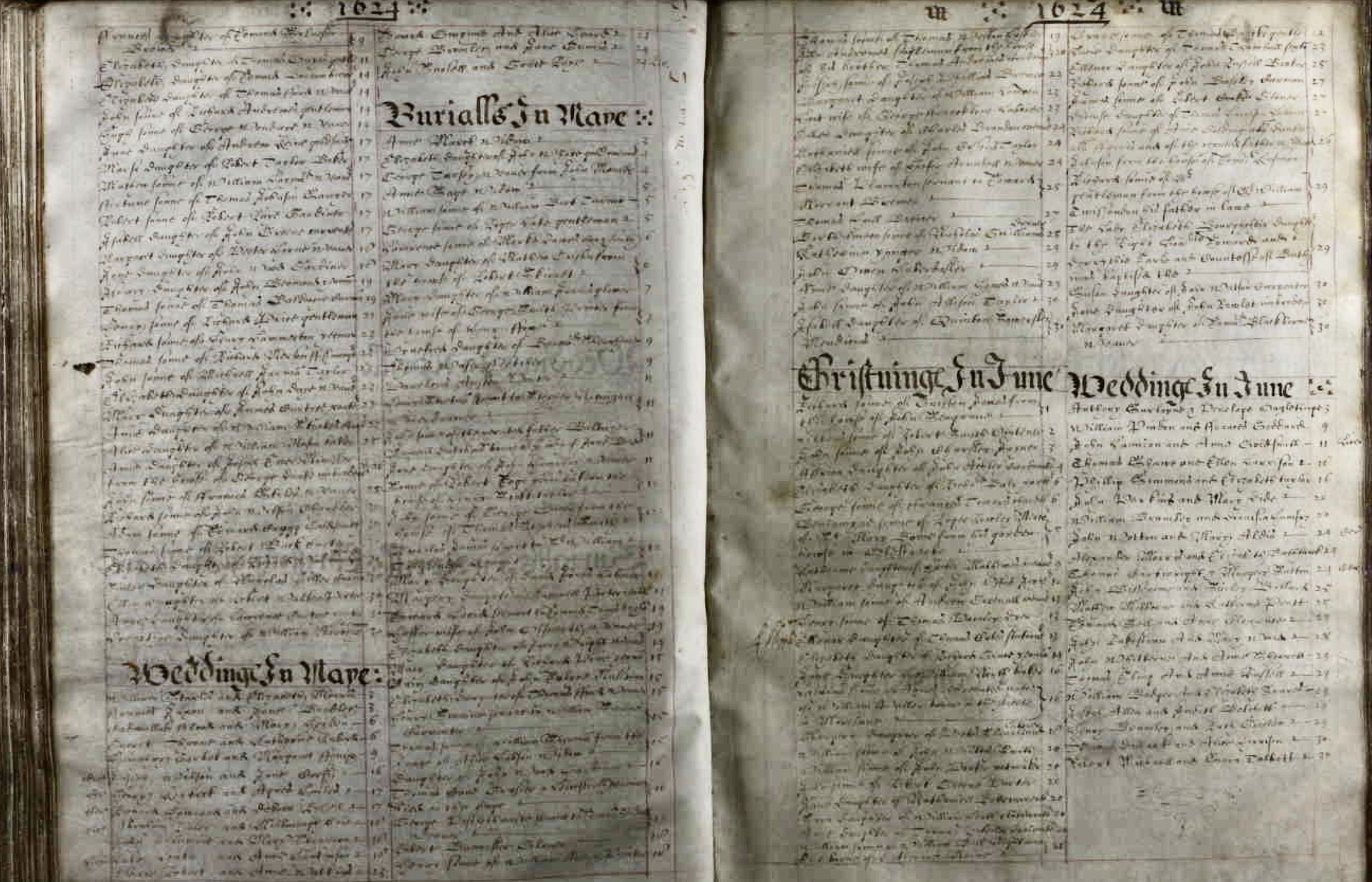
On 11 Jun 1624 John married Anne Goldsmith at Saint Giles Cripplegate, London.
St Giles Cripplegate Parish Register – Source London Metropolitan Archives
It appears as though they returned to Breage as some of their children were baptised there.
John – 1625 a John, son of John Lanyon, was buried at Breage in Jun 1625
Clemens 1626- baptised at Breage 11 Jun 1626 no further trace
Lawrence 1627- baptised at Holborn in London no further trace
Joseph 1629- baptised at Holborn in London no further trace
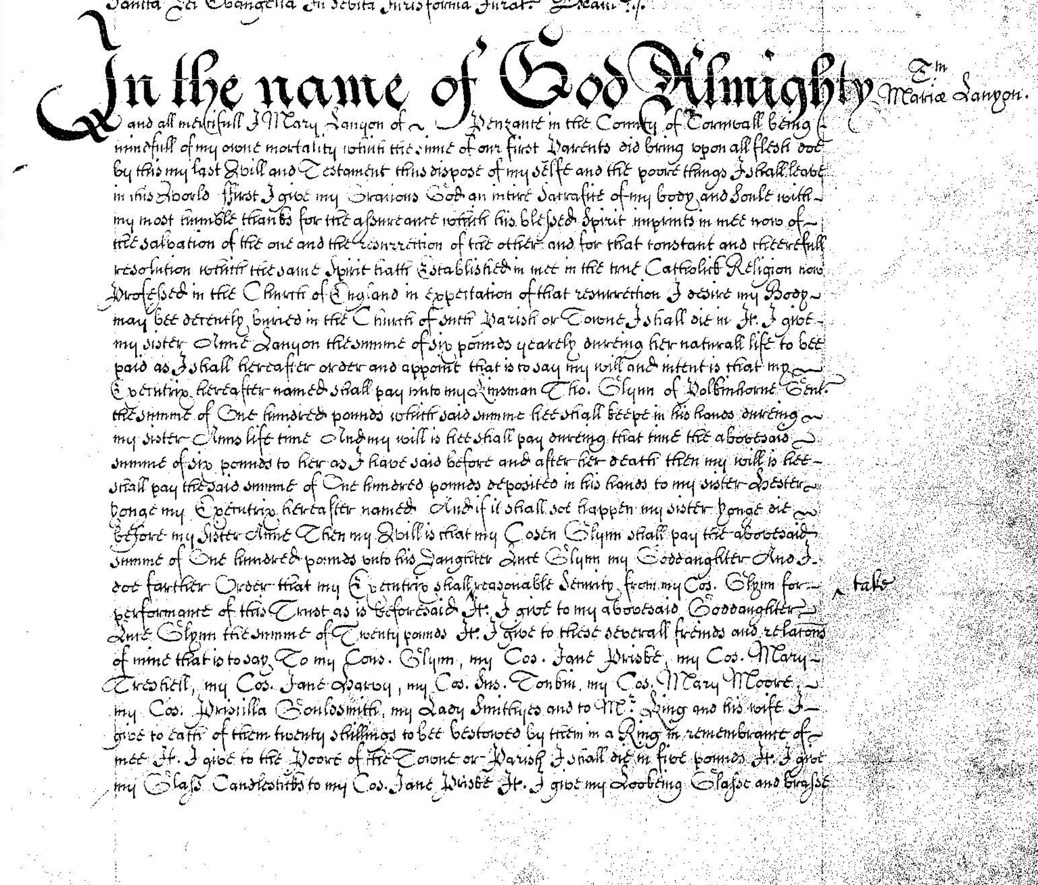
Mary 1630-1686 she was a spinster and was buried in Penzance in 1686, she left a great will which mentions lots of relatives
Source – NA/PROB/11/386
Partial transcript:
To my sister Anne Lanyon the sum of £6 yearly for her natural life
To my kinsman Thomas Glynn of Polkinghorne gent the sum of £100 which he shall keep in his house during my sister Anne’s lifetime to pay her £6 yearly and then to my sister Hester
Thomas Glynn’s daughter my goddaughter Jane Glynn the sum of £20
Cousins Glynn, cousin Jane Prisbe?, Mary Treshell?, cousin Jane Darby, cousin ? Tonkin, cousin Mary Moore, cousin Priscilla Goldsmith, Mr. King and his wife – 20 shillings each for a ring in remembrance of me
Poor of the town or parish £5
Glass candlesticks to Jane Prisbe?
Looking glass and brass candlesticks to Susanna Glynn
Sister’s picture and great cabinet to brother Yonge
Watch to cousin Thomas Glynn the younger
Chamber furniture to Hester Yonge
My china and earthenware as my sister will part with to cousin Jane Darby
My cousins Grace and Jane Daniell
My sister Yonge
We can place some of these cousins on the tree.
John and Anne’s other children were:
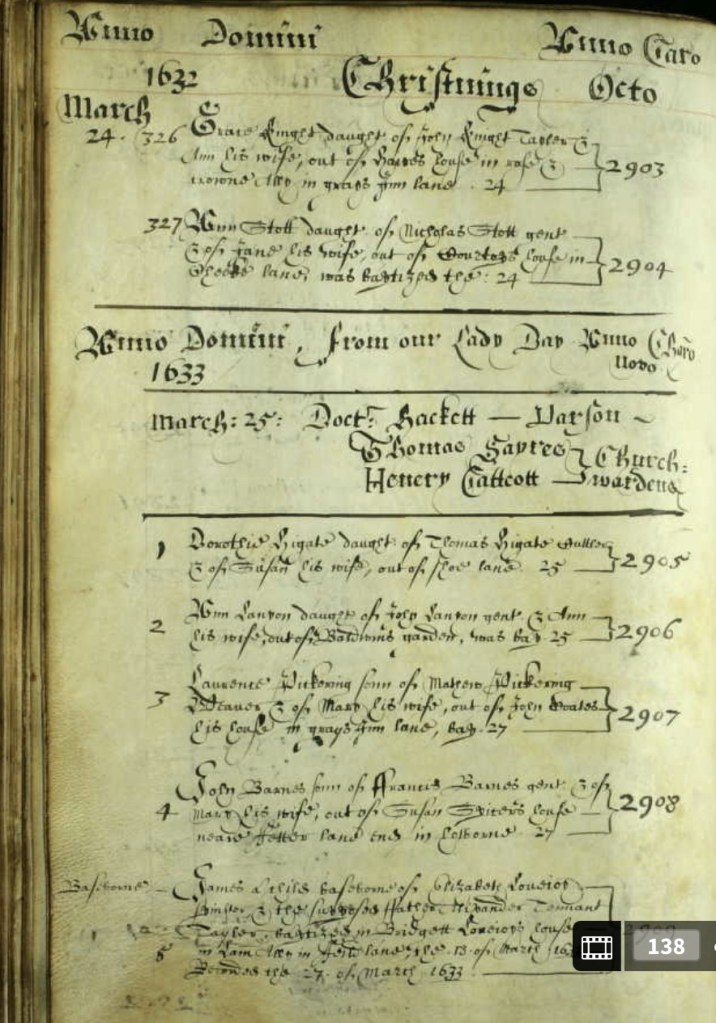
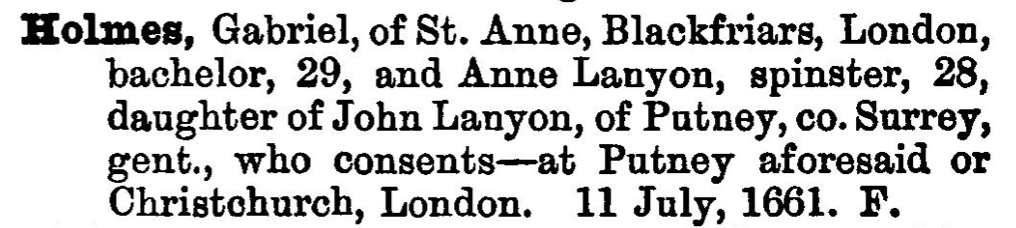
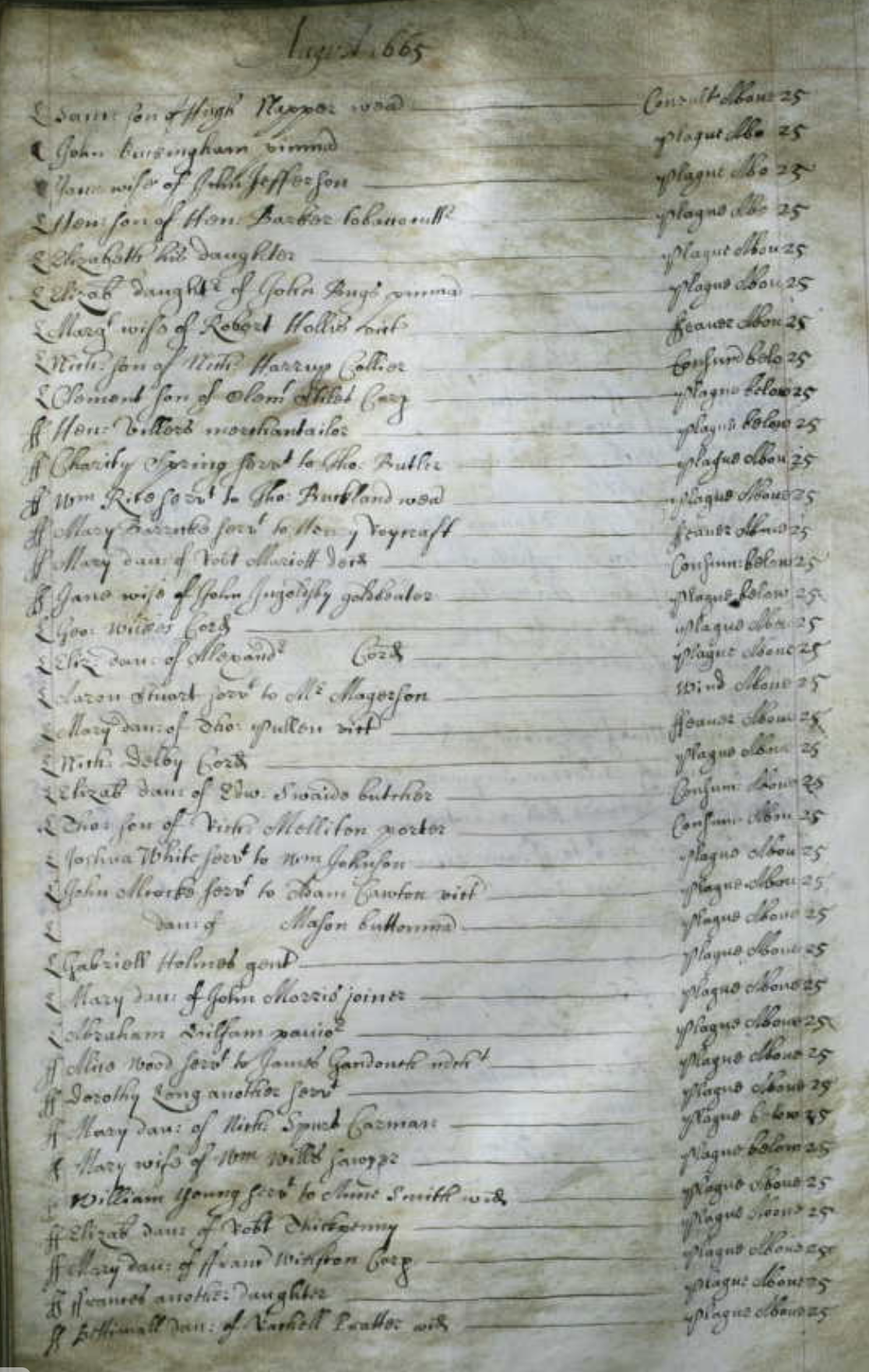
Ann 1633-aft. 1686 Ann was baptised at Holborn in London in 1633 she is mentioned in her sister’s will so presumably is still alive in 1686. She is called Ann Lanyon in the will however there is a marriage of an Ann Lanyon daughter of John Lanyon who married Gabriel Holmes in 1661. A Gabriel Holmes gent, died of plague and was buried at St Giles Cripplegate in 1665. (There is an Ann Lanyon buried at St Clement Danes on 19 Aug 1691- could it be this Ann? Why would she be called Lanyon and not Holmes?)
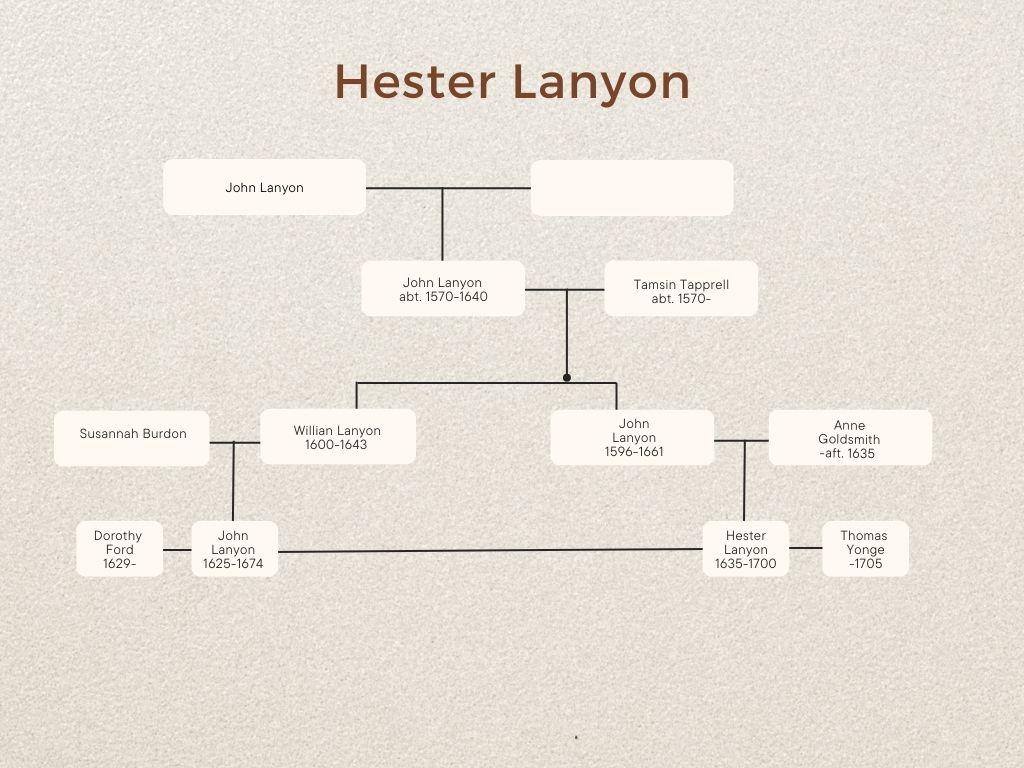
Hester 1635-1700 she was baptised in Holborn London, she married Thomas Yonge and she may have been married to her cousin John Lanyon.
Ann’s baptism (2906) Parish Register St Andrew HolbornLondon Marriage Licences 1521-1869 Gabriel Holmes, gent, died of Plague and buried 25 August 1665 -St Giles Cripplegate register – source London Metropolitan Archives
Hester’s sister Mary left a will (dated 1686) that refers to her as Hester Yonge and sister Yonge, Mary also has a clause giving her sister’s picture and great cabinet to brother Yonge.
Hester’s tree
Her possible first husband John Lanyon of Plymouth died in 1674 in Paris, he left a detailed will which helps us fit him into the tree. He mentions his uncle Mr Philip Lanyon, this confirms that John’s father William had a brother called Philip. He leaves a generous bequest to the town of Breage. John mentions various cousins among them are Hester Lanyon who he bequeathes £700 “in case she should survive me and acquit my executors of my obligation for £30 payable to her by me during her natural life”. The will continues “…out of this £700 my cousin Hester do pay or make good unto her sisters, my cousins, Mary and Ann £10 each during their natural lives.” (Source- NA/PROB/11/344/542)
After his death there are legal proceedings over his estate.
Chancery Proceedings Ante 1714 – Writ 297/99 Year 1679
John Lanyon merchant late of Plymouth personal estate valued at £20,000 did by his last will and testament dated 15 Sep 1674 bequeath a legacy of £50 to Totnes in Devon, which sum the Mayor and Burgesses were claiming of the Executors Captain Philip Lanyon, his sister Margaret Richards and niece Hester Lanyon.
In this chancery lawsuit the Totnes claimants speak of Hester Lanyon as John’s relict “who has since married Thomas Yonge”.
There is no trace of a marriage between Hester and either John Lanyon or Thomas Yonge but they are referred to in the Chancery proceedings. Although John Lanyon’s will describes her as his cousin rather than his wife. Was Hester Lanyon John’s second wife? Until we can find other documentary evidence we can’t be sure.
Hester Yonge was buried on 6 Apr 1700 at Colebrooke, Devon.
Colebrooke Devon Parish Register
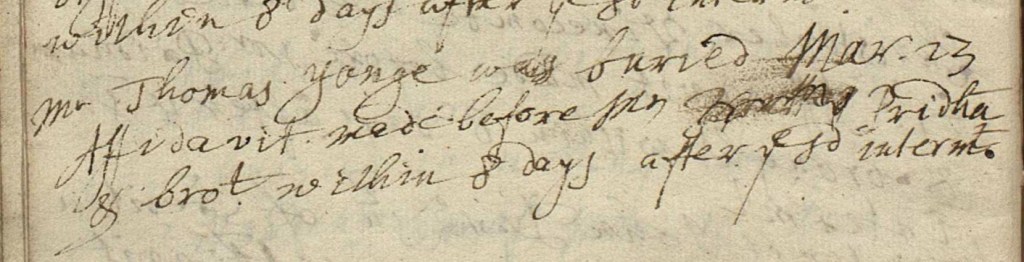
Hester’s husband Thomas Yonge died in 1705 at Colebrooke.
We’ll look at Hester’s husband John Lanyon of Plymouth in more detail in another post.
What of Hester’s father John?
John Lanyon was Proof Master and Chief Engineer to Charles I from 1630-39. In 1640 John went to Flanders and wrote to Whitehall from Brussels sealing the letter with the Lanyon (Madron) arms. As the principal engineer he was responsible for forts and castles. It was his misfortune to land such an illustrious post just as the monarchy was about to be swept aside in the Civil War.
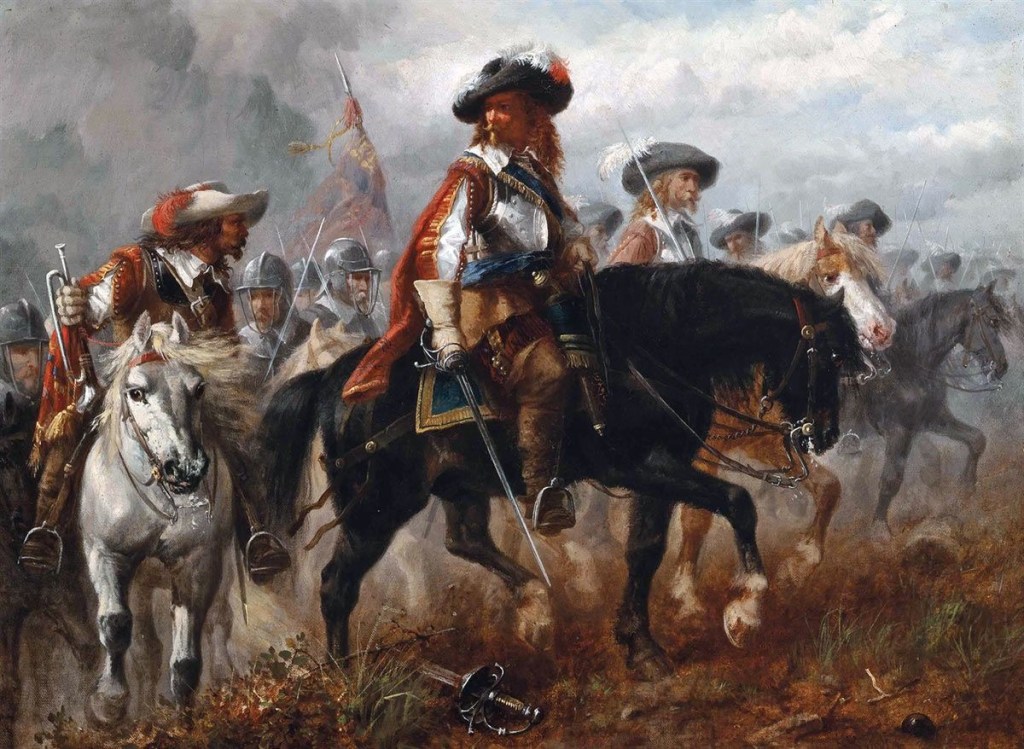
King Charles I and Prince Rupert before the Battle of Naseby 14 June 1645 during the English Civil War – Wikimedia Commons
During the Civil War John Lanyon had a tough time; he was plundered, sequestered and imprisoned. In 1661 he petitioned the Lord Treasurer to pay his fee due at Midsummer last. He had been promised £240 a year as chief engineer. Sir William Compton certified that John Lanyon had £240 a year granted him by the late King as chief engineer and that “he is well skilled in his art and deserving of the said salary.” (Source- Charles II State Papers Vol 36 – 1661).
His wife, Anne Goldsmith, must have died because John remarried Mary Latham (née Clarke) the widow of Ralph Latham Esq of Upminster, Essex, late barrister Middle Temple, London. Ralph died in 1642 so sometime after that date the marriage took place. There were no children of this marriage.
John died in Sep 1661 and was buried at Surrey. His widow Mary died in 1666 and her will mentions her children from her first marriage and step daughters Mary, Anne and Hester Lanyon.
Will of Mary Lanyon 1666 – Source NA PROB/11/320
As far as we can ascertain none of John’s sons survived and none of his daughters had children of their own so this little branch of the tree died out.
In 1573 John Lanion was elected Warden of St Ives. (Source – A History of the Parishes of St Ives, Lelant, Towednack and Zennor by John Hobson Matthews P 146 and P 147). He was also listed in 1575 “Payd to Mr Laynyane for iiij trees”.
Around 1596 John Lanion gent bought the Penwinnick Estate in St Agnes (later sold to Edward Noy, cousin, in 1622). So who is this John Lanion?
On the 1569 Muster Roll for St Agnes there is a John Lanyne listed. He is the only John Lanyon (all name variants checked) listed on any muster roll at this time. Which begs the question ‘where is John Lanyon (esq) listed?’ Both Johns are probably of a similar age so why is only one listed on the muster roll? Could the John Lanion gent who was elected Warden of St Ives and the John Lanion gent who bought the Penwinnick Estate actually be John Lanyon Esq or his younger brother who was also called John?
I think it more likely that the John Lanyon of Penwinnick Estate was the second son of Richard Lanyon esq and the younger brother of John Lanyon esq.
There are few surviving records from this time. One of the earliest entries at St Agnes is the marriage of John, son of John Lanyon gent who married Tamsin Tapprell on 22nd Jun 1596.
John Lanyon & Tamsin Tapprell
John and Tamsin married at St Agnes but soon went to Breage where most of their children were born.
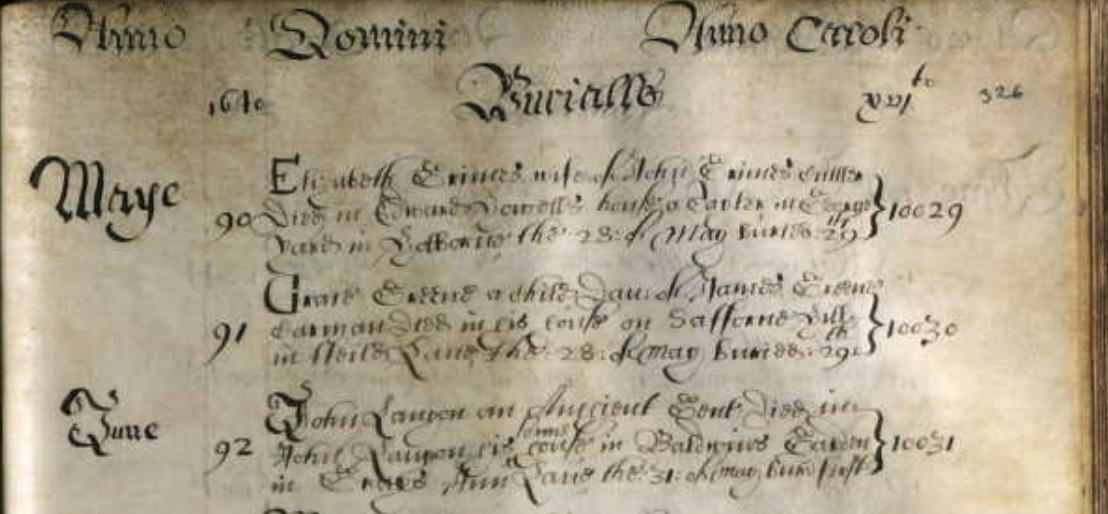
We know very little about John and Tamsin. John’s last child was baptised in 1620 but it’s not clear if Tamsin was the mother to all of them. John was buried in London at St Andrew, Holborn on 1st Jun 1640. He’s listed in the burial register as ‘an ancient gent’. He was living at Grey’s Inn Lane with his eldest son.
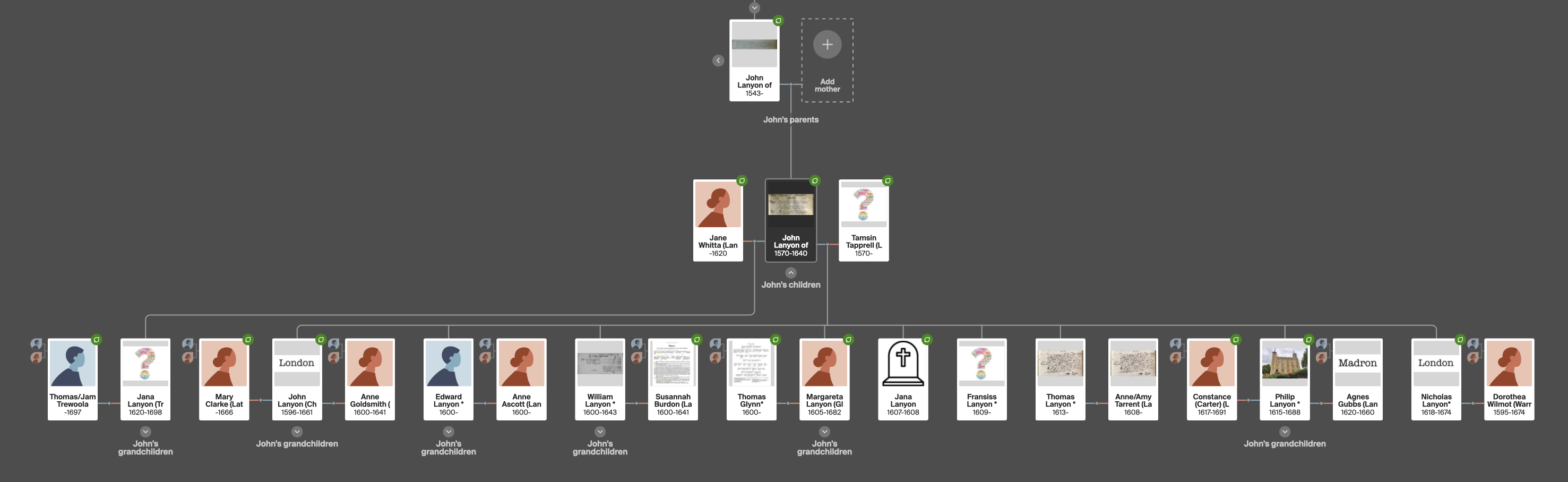
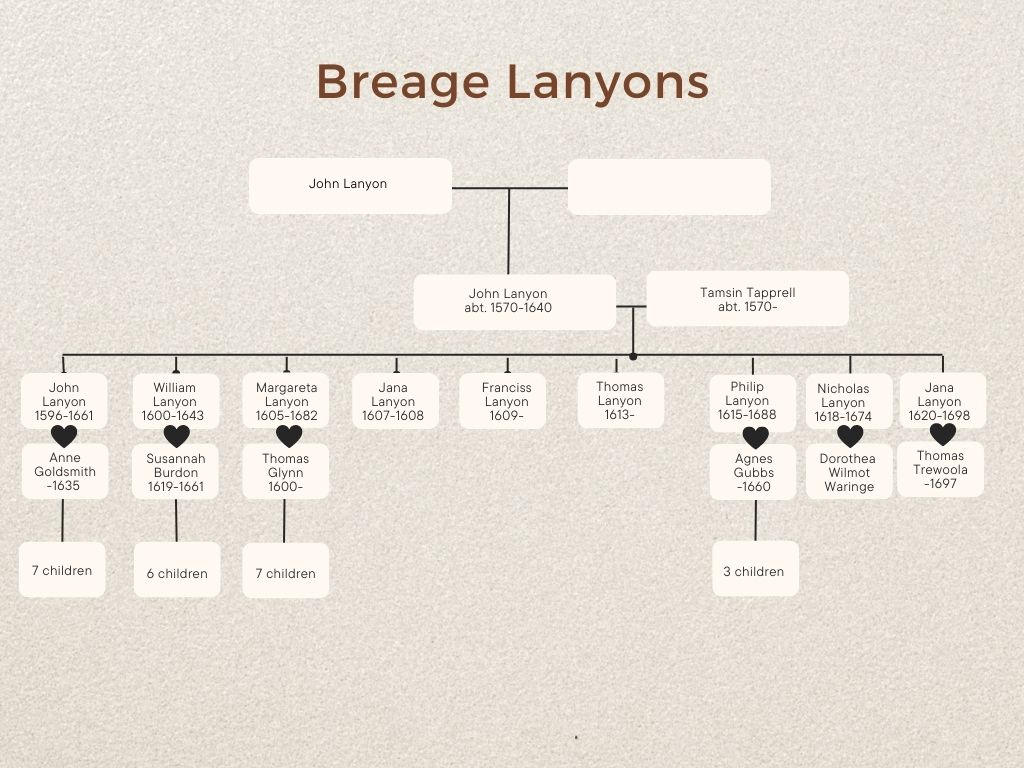
John had nine children, we don’t know if Tamsin was mother to all of them:
John aft. 1596-1661 married Anne Goldsmith
William 1600-1643 married Susannah Burdon
Margareta 1605-1682 married Thomas Glynn, gent and Mayor of Helston, Oct 1635. Seven children. John Lanyon of Plymouth’s will of 1674 states ‘…to every grandchild of Aunt Glynn and my cousin Thomas Glynn and his wife £10 for a ring…’ Margareta was buried at Gwinear on 9th Dec 1682 ‘wife of Thomas, gent’.
Jana 1607-1608 died in infancy
Franciss 1609- no further trace
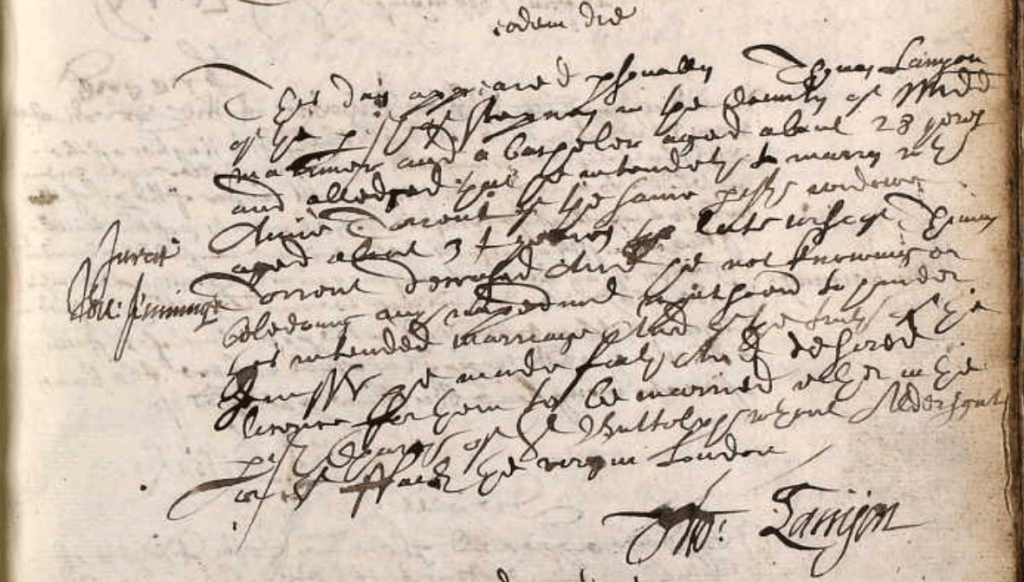
Thomas 1613- married Anne/Amy Tarrant 1639 London. Thomas is aged 28 therefore born about 1611.
London and Surrey marriage licences – Thomas Lanyon & Anne Tarrant 1639
Philip 1615-1688 married Agnes Gubbs
Nicholas 1618-1674 married Dorothea Wilmot Waringe, the illegitimate child of Lord Charles, Viscount Wilmot in 1647 at Saint Bartholomew The Less in London. He had properties in Essex and Nottinghamshire. They had no children although she had four children from her first marriage to a man called Waringe/Warren. In his will of 1674 he left ‘all to wife Dorothea Warren’
Jana 1620-1698 she is described in the parish register as daughter of Johis and Janae, could her father have had a second wife after Tamsin? She married Thomas Trewoola, gent of Towednack in 1647 at Helston. No children traced. Her cousin John Lanyon of Plymouth mentions her in his will of 1674 ‘…to cousin Jane Trewollah £50 more in consideration and satisfaction of the £5 I received from Uncle Glynn to improve her advantage.’ There is a burial of a Joan Trewhela widow at Towednack in 1698, possibly her.
Did John of Penwinnick remarry?
There is a document at Kresen Kernow dated 16th May 1623 – St Agnes – Penwennick – John Lanyon the elder gentleman and wife Jane and their sons John and Edward assign lease to Edward Noye. (Source GP/17). There is another document dated 30th Dec 1608 – St Agnes. John Lanyon of St Agnes, gent and Edward Lanyon (John Lanyon’s second son) 1 quarter of Penwennacke. The first document seems to confirm that John of Penwinnick did indeed have a wife named Jane and he also had a second son called Edward who was not found in the baptism register but must have been born before William who was baptised in Aug 1600. There is no record of Tamsin Tapprell being buried or of a marriage to Jane. Thomas Tonkin suggests that she is Jane the daughter of William Whitta, the previous owner of Penwennick Castle.
We’ll follow John, William and Philip Lanyon’s interesting lives in the post ‘Chief Engineer to Charles I’.
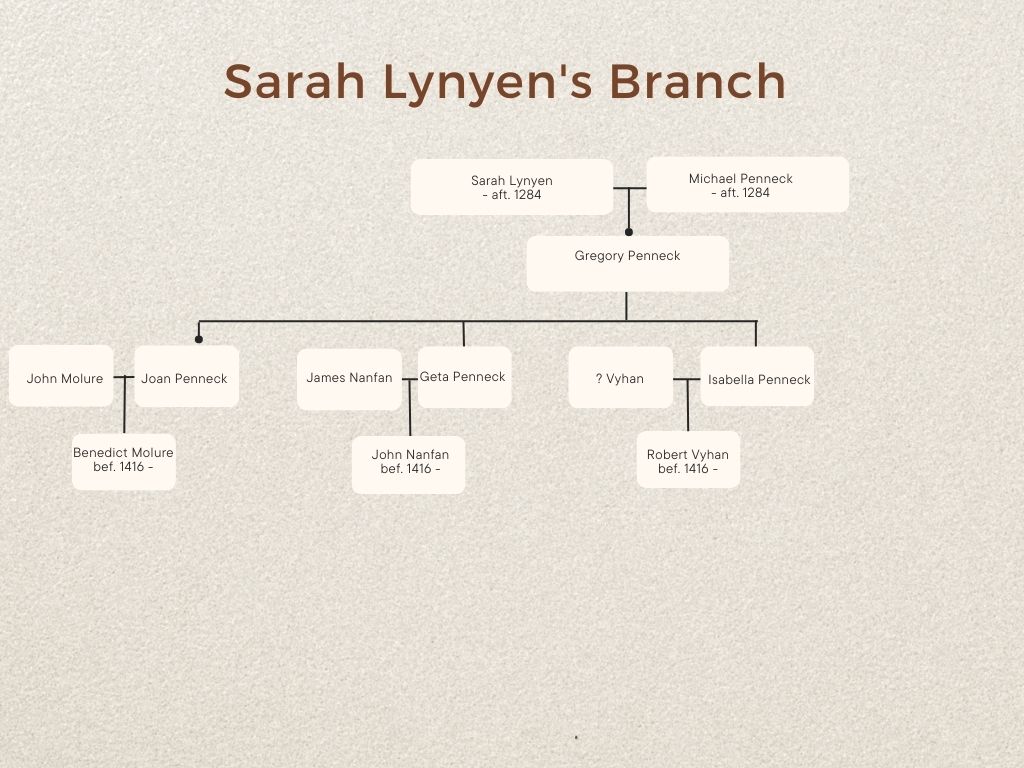
It’s difficult to know where to place Sarah on the Lanyon tree. We have very little information about her. This is my attempt to fit her in.
The De Banco Roll – Trinity 4 Henry V (1416)
Tredyn Lands – The plaintiffs – John Nanfan and Robert Vyhan sued their cousin Benedict Molure all three being sons and heirs of Geta, Isabella and Joan Penneck, granddaughters of David Lanyein.
So from this document we know that Geta, Isabella and Joan Penneck were graddaughters of Sarah Lynyen and great grand daughters to her father David.
Charter of 1284
“John de Leynen to David his son and William de Trenyer chaplain and to the heirs of the body of the said David by Marina his wife. Charter with warranty of all his lands and messuages in the towns of Lennyen, Resik, Bossewolonwyan, Polgon, Hendrenythyn, Boswolnel and Trengwenton, with two mills corn and fulling in Lenyen, and the rent, service and homage of Ralph de Pendyn and his heirs for land there, and of Michael Penneck, Sarah his wife and their heirs for land in Trethyn by Treudreuen.”
Dated Lanyen Friday before St Peter’s Chains 12 Edward I
From this document we know that Michael Penneck was the husband of Sarah and held lands at Trethyn. David was the son of John de Leynen and was married to Marina and held lands at Lanyon and Rissick that were still held in the 17th century. From the De Banco Roll we know that David had a son-in-law called Penneck so it seems logical to place Sarah as his daughter.
There is also a David De Linien who was a witness to a Charter of Glasney College dated 10th October 1267. Advowson of St Sithney Church by Roger de Skyburriow.
But there is also a mention of a David de Lynyen on the Lay Subsidy Roll of Madron 1 Edward III (1327) he was assessed at 4 shillings? Is he David de Lennyen or his son David de Kylminawis or another David altogether?
Therein lies the problem with researching families at this time you don’t know for sure who the documents refer to.
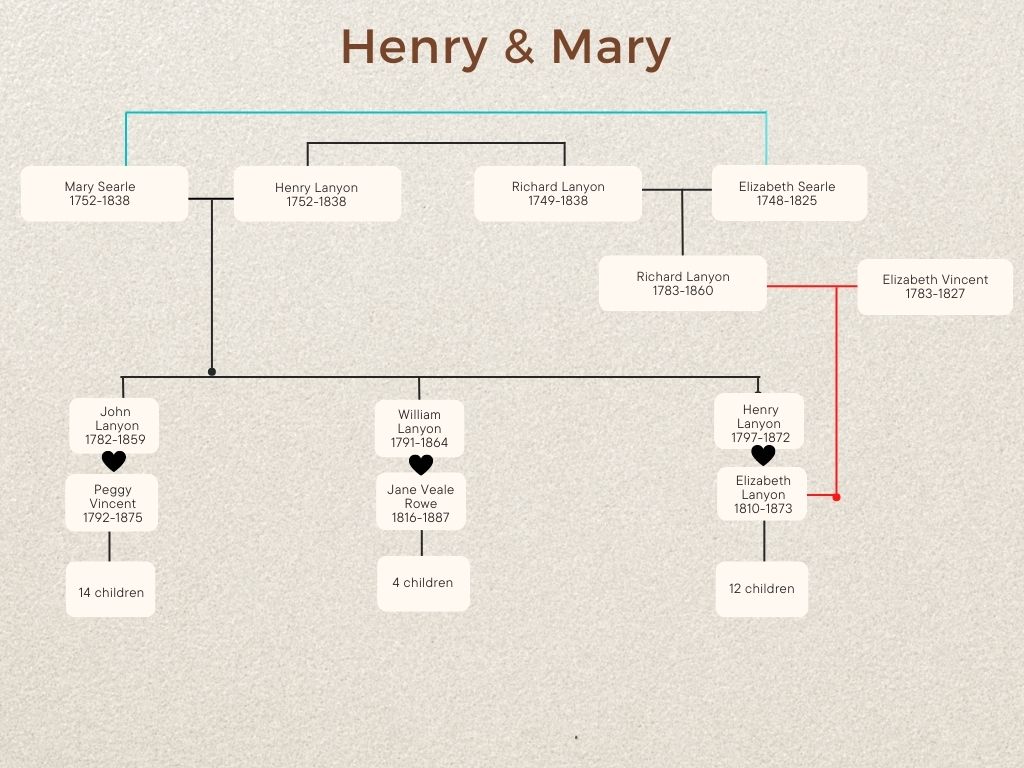
We’ve followed John & Peggy’s large family in part 1 of this post now we’ll follow William & Henry.
William & Jane’s Son
William Lanyon and Jane Veale Rowe had just one son Charles Scott.
Charles Scott Lanyon 1844-1890
Charles was born at Newlyn East in 1844, he was a farmer at Higher Treluddra and married Elizabeth Jane Rowe in 1872. Charles was accidentally killed in 1890 by being thrown from his horse at Shepherd’s Gate, Newlyn East. (Source – Royal Cornwall Gazette).
They had four children:
William 1874-1956 he was a farmer who married Amy Elizabeth Bice at Colan, Cornwall in 1899 – no children
Frances 1875-1875 died in infancy
Jane Rowe 1877-1953 married Francis Rowe, a farmer in 1899 and her name became Jane Rowe Rowe! No children
Thomas Rowe 1879-1958 he was a farmer too, he emigrated to Canada. Then he returned home in 1914 and fought in the first World War, he was a sergeant in the Royal Army Medical Corp. After the war he returned to Canada. He never married.
This little branch of the tree has died out.
Internet Archive Book Images, No restrictions, via Wikimedia Commons
Henry & Elizabeth’s Sons(and daughter!)
Henry and Elizabeth were first cousins once removed. They had twelve children and of them, three sons to carry on the Lanyon name.
Albert Cornelius 1834-1887
Albert was born at St Allen in 1834 and was a farmer at Trevalsa. He married Mary Ellen Varcoe in 1883 at St Erme, he died in 1887. Albert and Mary had three sons:
Albert Cornelius 1884-1960 he was a farmer at St Allen. In 1914 he married Margaret Louise May – two children
John Henry 1886-1963 he too was a farmer at Trevalsa, in 1933 he married Charlotte Adeline Carveth – no children
Obed Howard 1887-1970 also a farmer at Trevalsa, bachelor, no children
Emily Lanyon 1838-1888
Emily was Albert Cornelius’ younger sister. She and her brother Simon Searle Lanyon emigrated to Australia in 1857. She went to help her aunt Bella Lanyon and Uncle Thomas Johns with their children and working in their shop on Eureka Street, Ballarat. Her brother Simon set up a mining business with Thomas William Bull. Simon was killed in an accident at their Ophir mine in 1859. Thomas went to break the news to his sister Emily and months later they were married. They had eleven children:
Emily & Thomas
Sarah Ann Bull 1860-1889 Sarah developed appendicitis and died at Whitton railway station whilst waiting for a train to take her to hospital.
Sarah Ann Bull
Eliza Jane Bull 1862-1882 died age 20, spinster
Eliza Jane Bull
Elizabeth Emily Bull 1863-1934 married William Davies
Henry James Bull 1865-1947 married Charlotte Tresilian
William Thomas Bull 1866-1956 married Agnes Kock
William Thomas Bull
Albert Edwin Bull 1869-1952 married Lucy Taylor Johnstone
Albert Edwin Bull
Mary Ellen Bull 1871-1954 married Alfred George driver
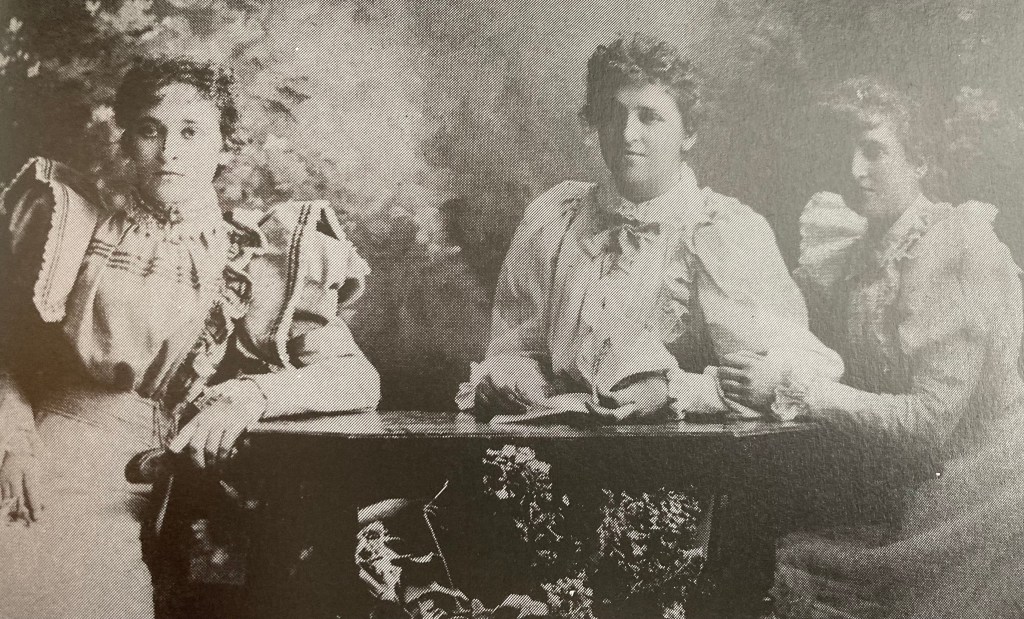
Mary Ellen, Adelaide Sibella and Caroline Louisa Bull
John Louis (Jack) Bull 1873-1951 married Matilda May Kock
Adelaide Sibella Bull 1875-1969 married George Cormack
Charles Wager Lanyon Bull 1877-1954 married Hanna Pearce
Caroline Louisa Bull 1879-1957 married Archibald Gates
Henry Scott Lanyon 1839-1903
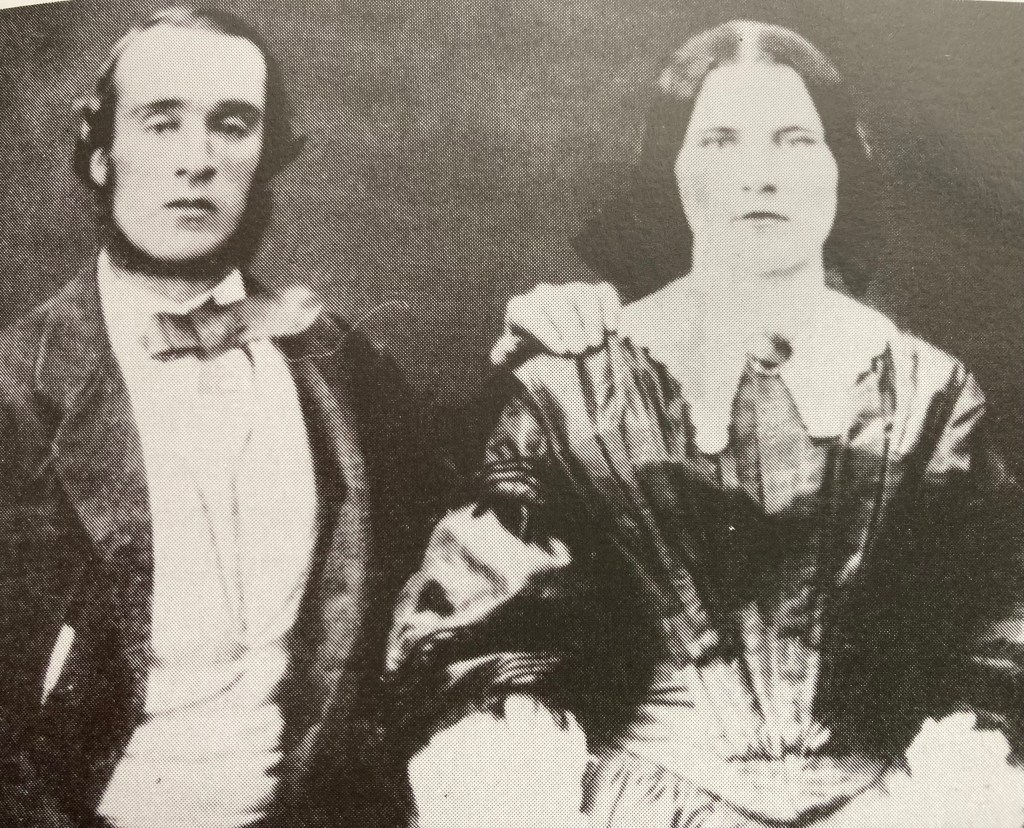
Henry was born at St Allen and emigrated to Ballarat in Australia in the 1860s. He was a shepherd and leased a paddock so he could run his own sheep. He married Maria Wescott in 1874. They met when Henry went to visit his cousin Richard Lanyon who was working for Isaac Westcott, Maria’s father. Henry died in 1903 after suffering with cancer for 18 months.
Henry Scott Lanyon & Maria Westcott
Maria WestcottHenry Scott Lanyon
They had six children:
Henry Maynard 1876-1967 he was a teacher, he married Mabel Wilkinson in 1903 – six children. Henry was quite delicate and instead of farm work he became a teacher.
Henry & MabelHenry Maynard
Albert Vincent 1878-1953 he married Emily Margaret McRorie in 1905 – five children
Albert and Emily
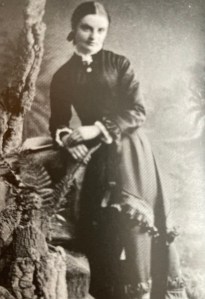
Elizabeth Jane 1881-1933 spinster
Elizabeth Jane
Annie Violet 1882-1973 married Percy Garnet Weaver in 1908 – five children
Annie Violet & percy
Thomas Wescott 1885-1965 married Margaret Ethel Smith in 1909 – three children
Thomas Westcott and Margaret Ethel
Lewis Isaac 1887-1925 married Elsie Elizabeth Lewis in 1913 at Victoria. One son. He returned to Cornwall in 1925 and made lots of notes about Lanyon family history. He died of Cholera after drinking contaminated water in Cornwall and was buried at St Allen Church
Lewis and Elsie
Lewis Edwin Lanyon 1841-1886
He was born at St Allen in 1841 and worked as a farmer and engineer. In 1877 he married Sarah Osman – six children:
Elizabeth Maud 1977-1934 she married John Henry Trenerry and they had one son, they emigrated to Omaha Nebraska.
Eliza Helen 1880-1956 she married William Thomas Argall Searle, a farmer, seven children
Isabella 1881-1944 married Samuel Arthur Chenoweth in 1903 – four children
Louisa 1882-1958 married Henry Woolcock in 1904. Two sons
Mabel 1885-1968 married Thomas Roberts in 1910, one son
Louis Edwin 1886-1955 he was a bookkeeper who emigrated to Omaha Nebraska, married Lillian Mae Ashley – two daughters
Here we must leave Henry & Mary’s branch of the family.



















 The Lanyons